EP2357724B1 - Système de commande de moteur pour commande de treuil - Google Patents
Système de commande de moteur pour commande de treuil Download PDFInfo
- Publication number
- EP2357724B1 EP2357724B1 EP09177587A EP09177587A EP2357724B1 EP 2357724 B1 EP2357724 B1 EP 2357724B1 EP 09177587 A EP09177587 A EP 09177587A EP 09177587 A EP09177587 A EP 09177587A EP 2357724 B1 EP2357724 B1 EP 2357724B1
- Authority
- EP
- European Patent Office
- Prior art keywords
- angular frequency
- frequency reference
- electric motor
- control system
- power
- Prior art date
- Legal status (The legal status is an assumption and is not a legal conclusion. Google has not performed a legal analysis and makes no representation as to the accuracy of the status listed.)
- Active
Links
- 229920006395 saturated elastomer Polymers 0.000 claims description 8
- 238000000034 method Methods 0.000 claims description 6
- 238000004364 calculation method Methods 0.000 claims description 5
- 230000000670 limiting effect Effects 0.000 claims description 5
- 230000008929 regeneration Effects 0.000 claims description 4
- 238000011069 regeneration method Methods 0.000 claims description 4
- 238000004590 computer program Methods 0.000 claims 1
- 238000005303 weighing Methods 0.000 description 6
- 238000005259 measurement Methods 0.000 description 4
- 239000013598 vector Substances 0.000 description 4
- 230000000630 rising effect Effects 0.000 description 2
- 230000001133 acceleration Effects 0.000 description 1
- 239000000654 additive Substances 0.000 description 1
- 230000000996 additive effect Effects 0.000 description 1
- 230000007423 decrease Effects 0.000 description 1
- 230000003247 decreasing effect Effects 0.000 description 1
- 230000001419 dependent effect Effects 0.000 description 1
- 239000000284 extract Substances 0.000 description 1
- 238000003384 imaging method Methods 0.000 description 1
- 230000006698 induction Effects 0.000 description 1
- 238000005070 sampling Methods 0.000 description 1
- 230000001360 synchronised effect Effects 0.000 description 1
Images


Classifications
-
- H—ELECTRICITY
- H02—GENERATION; CONVERSION OR DISTRIBUTION OF ELECTRIC POWER
- H02P—CONTROL OR REGULATION OF ELECTRIC MOTORS, ELECTRIC GENERATORS OR DYNAMO-ELECTRIC CONVERTERS; CONTROLLING TRANSFORMERS, REACTORS OR CHOKE COILS
- H02P23/00—Arrangements or methods for the control of AC motors characterised by a control method other than vector control
- H02P23/0004—Control strategies in general, e.g. linear type, e.g. P, PI, PID, using robust control
-
- B—PERFORMING OPERATIONS; TRANSPORTING
- B66—HOISTING; LIFTING; HAULING
- B66D—CAPSTANS; WINCHES; TACKLES, e.g. PULLEY BLOCKS; HOISTS
- B66D1/00—Rope, cable, or chain winding mechanisms; Capstans
- B66D1/28—Other constructional details
- B66D1/40—Control devices
- B66D1/42—Control devices non-automatic
- B66D1/46—Control devices non-automatic electric
-
- H—ELECTRICITY
- H02—GENERATION; CONVERSION OR DISTRIBUTION OF ELECTRIC POWER
- H02P—CONTROL OR REGULATION OF ELECTRIC MOTORS, ELECTRIC GENERATORS OR DYNAMO-ELECTRIC CONVERTERS; CONTROLLING TRANSFORMERS, REACTORS OR CHOKE COILS
- H02P23/00—Arrangements or methods for the control of AC motors characterised by a control method other than vector control
- H02P23/0077—Characterised by the use of a particular software algorithm
Definitions
- the present invention relates to a motor control system for a hoist drive according to the preamble of independent claim 1.
- a rotation speed of the electric motor of the hoist drive must be limited such that the slip frequency does not exceed the pull-out slip frequency.
- the pull-out torque must not be reached.
- the pull-out torque decreases as the inverse square of the speed, so the pull-out torque is reached more easily at high speeds than at low speeds.
- a prior art motor control system for a hoist drive is adapted to use load weighing data obtained from a load weighing sensor for limiting the rotation speed of the,electric motor of the hoist drive.
- Load weighing sensors adapted to output load weighing data are relatively expensive components.
- An object of the present invention is to provide a motor control system for a hoist drive that is capable of limiting the rotation speed of the electric motor of the hoist drive below the pull-out slip frequency without load weighing data.
- the object of the invention is achieved by a motor control system for a hoist drive which is characterized by what is stated in the independent claim 1.
- the preferred embodiments of the invention are disclosed in the dependent claims.
- the invention is based on the idea of generating a correction term for angular frequency reference with power limiter means comprising integrating controller means which uses as its initial data information relating to actual value of the power of the electric motor.
- An advantage of the motor control system of the invention is that the motor control system does not need any measurement data relating to the weight of the load. Another advantage is that the motor control system can reliably keep the slip frequency below the pull-out slip frequency.
- FIG. 1 shows an open-loop hoist drive comprising an electric motor 2 operationally connected to a hoisting member 4 for hoisting a load 6.
- the electric motor 2 is controlled by a motor control system according to an embodiment of present invention.
- the motor control system comprises power limiter means 8, saturation means 12, rate limiter means 14, control means 16, power estimator means 18, and pulse width modulation means 20.
- the motor control system is adapted to generate a final angular frequency reference ⁇ * s for control of the electric motor 2 based on initial data comprising a limited set point value ⁇ * s,lim for angular frequency reference and a correction term ⁇ s,cor for angular frequency reference.
- the final angular frequency reference ⁇ * s is a synchronous angular frequency reference and the control means 16 is a scalar control means.
- the open-loop hoist drive has been divided into three segments, namely an application software 50, a system software 60 and a hoist drive equipment 70.
- the application software and the system software are adapted to be carried out by an appropriate data-processing equipment.
- the hoist drive equipment comprises a frequency converter 22.
- the entire hoist drive equipment may be composed of known components.
- the saturation means 12 is adapted to receive an initial angular frequency reference ⁇ * s0 generated by user interface means.
- the saturation means 12 is adapted to generate an saturated angular frequency reference ⁇ * s,sat by imposing an upper limit ⁇ s0,max and a lower limit ⁇ s0,min on the initial angular frequency reference ⁇ * s0 .
- the saturated initial angular frequency reference ⁇ * s,sat is equal to the initial angular frequency reference ⁇ * s0 .
- the saturated initial angular frequency reference ⁇ * s,sat is equal to the upper limit ⁇ s0,max .
- the saturated initial angular frequency reference ⁇ * s,sat is equal to the lower limit ⁇ s0,min .
- the lower limit ⁇ s0,min may be the additive inverse of the upper limit ⁇ s0,max , wherein the absolute values of the upper and lower limits are equal.
- the saturation means may be adapted to impose only a lower limit or only an upper limit on the initial angular frequency reference.
- the saturation means 12 is adapted to feed the saturated initial angular frequency reference ⁇ * s,sat into rate limiter means 14 as the input signal of the rate limiter means 14.
- the rate limiter means 14 is adapted to generate the limited set point value ⁇ * s,lim for angular frequency reference by limiting the first derivative of the saturated initial angular frequency reference ⁇ * s,sat .
- ⁇ * s,in is the input of the rate limiter means 14
- T s is the sampling interval
- ⁇ ⁇ s is the unlimited rate of change of the angular frequency reference
- ⁇ max is the maximum rate of change of the angular frequency.
- the notation ⁇ * s,lim (n) denotes the current value and ⁇ * s,lim (n-1) denotes the previous value.
- the implementation of the rate limiter means 14 results in the same absolute value of the rate of change for the rising and falling edges.
- the absolute value of the rate of change for the rising edge may be different from the absolute value of the rate of change for the falling edge.
- the power limiter means 8 comprises integrating controller means 10 adapted to generate an output signal I P .
- the absolute value of the correction term ⁇ s,cor equals the output signal of the integrating controller means 10, and the sign of the correction term ⁇ s,cor depends on sign of the limited set point value ⁇ * s,lim for angular frequency reference.
- a previous value of the limited set point value ⁇ * s,lim for angular frequency reference should be used when calculating the correction term ⁇ s,cor for angular frequency reference with above equation.
- the final angular frequency reference ⁇ * s is inputted into the control means 16 for calculation of a stator voltage reference u* s and into the power limiter means 8 for calculation of a dynamic power P ⁇ dyn of the electric motor.
- the control means 16 is adapted to generate, using some known method, the stator voltage reference u* s based on the final angular frequency reference ⁇ * s and a measured stator current i s . Both the measured stator current i, and the stator voltage reference u* s are space vectors representing three phase quantities.
- the control means 16 is adapted to input the stator voltage reference u* s into the power estimator 18 for calculation of estimated real power P of the electric motor 2, and into the pulse width modulation means 20 for pulse width modulation of input voltage of the electric motor 2.
- the power limiter means 8 is also adapted to generate the upper limit ⁇ s0,max for the initial angular frequency reference based on the limited set point value ⁇ * s,lim for angular frequency reference and the output signal I P of the integrating controller means 10.
- ⁇ s,max is a predetermined maximum angular frequency of the electric motor 2.
- Initial data of the integrating controller means 10 include an absolute value of an estimated real power P of the electric motor, a power limit P lim of the electric motor, and dynamic power P ⁇ dyn of the electric motor.
- the output I P of the integrating controller means 10 is always greater than or equal ,to zero. This means that if above integral function returns a value less than a zero, the integrating controller means 10 delimits the output I P to zero.
- the estimated real power P ⁇ of the electric motor is obtained as an output of the power estimator 18.
- J is the inertia of the electric motor 2
- p is the number of pole pairs of the electric motor 2.
- the dynamic power P ⁇ dyn is nonzero only in the regeneration mode of the hoist drive. Compensating the dynamic power helps reducing the risk of the real power of the electric motor exceeding its limit when the acceleration ends in the regeneration mode.
- the power estimator means 18 is adapted to calculate the estimated real power P ⁇ of the electric motor 2 based on the measured stator current i s and the stator voltage reference u ⁇ s * generated by the control means 16. Methods for calculating estimated real power are well known in the art. The difference between the absolute value of the estimated real power P ⁇ and the power limit P lim of the electric motor is inputted into the power limiter means 10.
- the power limiter means 8 is adapted to generate the correction term ⁇ s,cor for angular frequency reference based on real power values relating to the electric motor 2.
- One skilled in the art knows that it is also possible to limit the current of the electric motor or, when using an induction motor, to limit the slip of the motor.
- expression "information relating to actual value of the power of the electric motor” encompasses information relating to real power, current and slip.
- the power limit P lim is replaced with a current limit.
- the power limit P lim is replaced with a slip limit.
- the power limit, the current limit and the slip limit is a power related limit value of the electric motor in the corresponding embodiment.
- Initial data of the pulse width modulation means 20 comprise the stator voltage reference u * s and a measured input direct voltage u dc of a frequency converter 22 adapted to supply the electric motor 2. Both pulse width modulators and frequency converters are well known in the art, and are therefore not discussed herein.
- the power limiter means 8, the integrating controller means 10, the saturation means 12, the rate limiter means 14, the control means 16, the power estimator means 18 and the pulse width modulation means 20 are software components adapted to perform certain method steps when executed on a data processing apparatus.
- the power limiter means 8, the integrating controller means 10, the saturation means 12, the rate limiter means 14, the control means 16, the power estimator means 18 and the pulse width modulation means 20 may comprise firmware components and/or hardware components.
- FIG. 2 shows a closed-loop hoist drive comprising an electric motor 2' operationally connected to a hoisting member 4' for hoisting a load 6'.
- the electric motor 2' is controlled by a motor control system according to a closed-loop embodiment of present invention.
- the motor control system comprises power limiter means 8', saturation means 12', rate limiter means 14', control means 16', power estimator means 18', a pulse width modulation means 20' and a speed sensor 24'.
- the motor control system is adapted to generate a final angular frequency reference ⁇ *' s for control of the electric motor 2' based on initial data comprising a limited set point value ⁇ *' s,lim for angular frequency reference and a correction term ⁇ ' s,cor for angular frequency reference.
- the final angular frequency reference ⁇ *' s is a rotation speed reference and the control means 16' is a vector control means.
- the closed-loop hoist drive of Figure 2 generates the final angular frequency reference ⁇ *' s with the same equations as the open-loop hoist drive of Figure 1 generates its final angular frequency reference ⁇ * s . Therefore all that has been said above about the algorithm for generating the final angular frequency reference ⁇ ' s of an open-loop hoist drive applies also to closed-loop hoist drives.
- Figure 3 shows a torque limit T lim and a power limit P lim of the hoist drive of Figure 1 as a function of a stator frequency ⁇ s of the electric motor 2.
- the stator frequency ⁇ s is depicted as a per unit value, i.e. as a quotient of an actual stator frequency and the nominal stator frequency.
- Figure 3 illustrates the influence of the power limit P lim on the torque limit T lim . In practice said influence is significant only at high angular frequencies. At low frequencies, the torque is usually limited by the maximum current.
- the forms of the plots depicted in Figure 3 are merely examples.
- the lower subplot of Figure 3 shows that when the stator frequency ⁇ s of the electric motor 2 is below a hoisting threshold frequency point ⁇ cp , the power limit P lim is equal to the nominal power P n of the electric motor 2.
- the power limit P lim drops approximately inversely proportional to the stator frequency ⁇ s .
- the upper subplot of Figure 3 shows that when the stator frequency ⁇ s of the electric motor 2 is less than nominal, the torque limit T lim is equal to the nominal torque T n of the electric motor 2.
- the hoisting threshold frequency point ⁇ cp is twice the nominal stator frequency of the electric motor 2.
- the hoisting threshold frequency point may have a different value.
- the torque limit has a different value than the nominal torque of the electric motor when the stator frequency of the electric motor is less than nominal.
- the border between the constant torque limit and the inversely dropping torque limit may also be located differently than in Figure 3 . Further, the torque limit does not have to be constant at any stator frequency range.
- the power limit has a different value than the nominal power of the electric motor when the stator frequency of the electric motor is less than the hoisting threshold frequency point. Further, the power limit does not have to be constant at frequency range below the hoisting threshold frequency point.
- plots of Figure 3 relate to a hoisting event.
- plots relating to a lowering event are mirror images of plots relating to a hoisting event.
- the lowering plots of a hoist drive are not mirror images of hoisting plots of the hoist drive.
- the power limit P lim is always greater than zero, both during a hoisting event and during a lowering event.
- plots relating to lowering event are not mirror imagines of plots relating to hoisting event.
- the lowering threshold frequency point may have a different absolute value than the hoisting threshold frequency point.
- At frequency range between zero and the lowering threshold frequency point he absolute value of the power limit may be different than absolute value of the power limit between zero and the hoisting threshold frequency point.
- stator frequency ⁇ s as the axis of abscisses, or x-axis.
- stator frequency ⁇ s is approximately equal to the final angular frequency reference ⁇ * s since a typical frequency converter is able to follow its frequency reference quite closely.
- Figure 4 shows measurement results obtained using the hoist drive according to Figu,re 1.
- the upper subplot shows the stator frequency f s and the actual value of the rotation speed n rot of the electric motor 2 as a function of time.
- the unit of the stator frequency f s and the actual value of the rotation speed n rot of the electric motor 2 is hertz, or cycle per second.
- the lower subplot shows the estimated real power P ⁇ of the electric motor 2 as a function of time.
- the lower subplot also shows a hoisting power limit P hst and a lowering power limit P lwr .
- the lower subplot of Figure 4 shows that the absolute value of the hoisting power limit P hst is higher than the absolute value of the lowering power limit P lwr .
- the hoisting power limit P hst is 80 % of the nominal power of the electric motor 2.
- the absolute value of the lowering power limit P lwr is 40 % of the nominal power of the electric motor 2.
- a hoisting speed has been given a positive sign and a lowering speed has been given a negative sign.
- the hoisting power limit P hst is the value of the power limit P lim during the hoisting events of Figure 4 .
- the power limit P lim is equal to the absolute value of the lowering power limit P lwr .
- the power limit P lim was constant, i.e. equal to the hoisting power limit P hst during the hoisting events because the stator frequency ⁇ s was all the time below the hoisting threshold frequency point ⁇ cp .
- the power limit P lim was equal to the absolute value of the lowering power limit P lwr during the lowering events because the stator frequency ⁇ s was all the time above the lowering threshold frequency point.
- the stator frequency ⁇ s being above the lowering threshold frequency point means that the absolute value of the stator frequency ⁇ s is less than the absolute value of the lowering threshold frequency point.
- the measurement relating to Figure 4 was made hoisting and lowering a load weighing 6000 kg.
- the initial angular frequency reference ⁇ * s0 was 150 Hz during the hoisting events, and -150 Hz during the lowering events.
- the upper subplot of Figure 4 shows that thanks to the power limiting action of the power limiter means 8 the actual value of the rotation speed n rot of the electric motor 2 did not rise higher than approximately 100 revolutions per second, or hertz.
Landscapes
- Engineering & Computer Science (AREA)
- Power Engineering (AREA)
- Mechanical Engineering (AREA)
- Control Of Ac Motors In General (AREA)
- Forklifts And Lifting Vehicles (AREA)
- Control Of Multiple Motors (AREA)
Claims (15)
- Système de commande de moteur destiné à un dispositif d'entraînement d'appareil de levage qui présente un moteur électrique (2) connecté de manière opérationnelle à un élément de levage (4) destiné à lever une charge (6), le système de commande de moteur étant adapté de façon à générer une référence de fréquence angulaire finale (ω*s) pour la commande du moteur électrique (2) sur la base de données initiales qui comprennent une valeur de point de consigne limitée (ω*s,lim) de la référence de fréquence angulaire qui est limitée en fréquence (14) et d'un terme de correction (ωs, cor) de la référence de fréquence angulaire, le système de commande de moteur comprenant des moyens de limitation de puissance (8) adaptés de façon à générer le terme de correction (ωs, cor) de la référence de fréquence angulaire, caractérisé en ce les moyens de limitation de puissance (8) comprennent des moyens de contrôleur d'intégration (10), les moyens de limitation de puissance (8) étant adaptés de façon à générer le terme de correction (ωs, cor) de la référence de fréquence angulaire en utilisant un signal de sortie IP des moyens de contrôleur d'intégration (10), le terme de correction (ωs, cor) de la référence de fréquence angulaire étant proportionnel au signal de sortie IP, les données initiales des moyens de contrôleur d'intégration (10) comprenant une première variable proportionnelle à la valeur réelle de puissance du moteur électrique (2) et un premier paramètre proportionnel à une valeur limite de puissance du moteur électrique (2), un calcul du signal de sortie IP des moyens de contrôleur d'intégration (10) comprend la soustraction dudit premier paramètre de ladite première variable, le signal de sortie IP des moyens de contrôleur d'intégration (10) étant délimités de telle sorte qu'il soit toujours supérieur ou égal à zéro, la référence de fréquence angulaire finale (ω*s) est obtenue en soustrayant le terme de correction (ωs, cor) de la référence de fréquence angulaire de la valeur de point de consigne limitée (ω*s,lim) de la référence de fréquence angulaire.
- Système de commande de moteur selon la revendication 1, caractérisé en ce que le système de commande de moteur est adapté de façon à recevoir une référence de fréquence angulaire initiale (ω*s0) générée par des moyens d'interface utilisateur, et à générer la valeur de point de consigne limitée (ω* s, lim) de la référence de fréquence angulaire sur la base des données initiales qui comprennent la référence de fréquence angulaire initiale (ω*s0).
- Système de commande de moteur selon la revendication 1 ou la revendication 2, caractérisé en ce que les moyens de limitation de puissance (8) sont adaptés de façon à générer le terme de correction (ωs, cor) de la référence de fréquence angulaire grâce à l'équation :

- Système de commande de moteur selon l'une quelconque des revendications précédentes, caractérisé en ce que la première variable proportionnelle à la valeur réelle de la puissance du moteur électrique (2) est une valeur absolue d'une puissance active estimée (P ) du moteur électrique (2), et le premier paramètre proportionnel à la valeur limite de puissance du moteur électrique (2) est la limite de puissance (Plim) du moteur électrique (2).
- Système de commande de moteur selon la revendication 4, caractérisé en ce que dans un mode de régénération, les données initiales des moyens de contrôleur d'intégration comprennent en outre des informations qui se rapportent à une puissance dynamique (P̂dym ) du moteur électrique (2).
- Système de commande de moteur selon la revendication 5, caractérisé en ce que la puissance dynamique (P̂dyn ) du moteur électrique (2) est calculée grâce à l'équation:
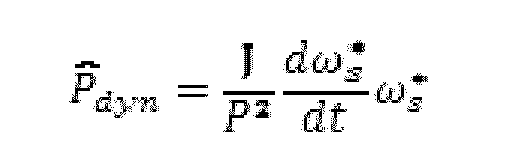
dans laquelle J est l'inertie du moteur électrique (2), et p est le nombre de paires de pôles du moteur électrique (2). - Système de commande de moteur selon la revendication 5 ou la revendication 6, caractérisé en ce que, dans le mode de régénération, la sortie IP des moyens de contrôleur d'intégration (10) est calculée grâce à l'équation :

dans laquelle kip est le gain des moyens de contrôleur d'intégration (10). - Système de commande de moteur selon l'une quelconque des revendications 4 à 7, caractérisé en ce que la limite de puissance (Plim) du moteur électrique (2) est une fonction d'une variable de fréquence angulaire de telle sorte que la limite de puissance (Plim) soit réduite de manière inversement proportionnelle à la variable de fréquence angulaire lorsque la variable de fréquence angulaire dépasse un point de fréquence de seuil de levage (ωcp), la variable de fréquence angulaire étant une variable qui se rapporte à la fréquence angulaire du moteur électrique (2).
- Système de commande de moteur selon la revendication 8, caractérisé en ce que la variable de fréquence angulaire est la référence de fréquence angulaire finale (ω*s) ou une valeur réelle d'une fréquence de stator (ωs) du moteur électrique (2).
- Système de commande de moteur selon l'une quelconque des revendications 2 à 9, caractérisé en ce que le système de commande de moteur comprend en outre des moyens de limitation de fréquence (14) adaptés de façon à générer la valeur de point de consigne limitée (ω*s, lim) de la référence de fréquence angulaire en limitant la dérivée première du signal d'entrée des moyens de limitation de fréquence (14).
- Système de commande de moteur selon la revendication 10, caractérisé en ce que le système de commande de moteur comprend en outre des moyens de saturation (12) adaptés de façon à générer une référence de fréquence angulaire saturée (ω*s, sat) en imposant une limite supérieure (ωs0,max) et une limite inférieure (ωs0,min) à la référence de fréquence angulaire initiale (ω*s0), les moyens de saturation (12) étant adaptés en outre de façon à fournir la référence de fréquence angulaire initiale saturée (ω*s, sat) aux moyens de limitation de fréquence (14) en tant que signal d'entrée des moyens de limitation de fréquence (14).
- Système de commande de moteur selon la revendication 11, caractérisé en ce que les moyens de limitation de puissance (8) sont adaptés, lorsque le signal de sortie IP des moyens de contrôleur d'intégration (10) est supérieur à zéro, de façon à attribuer à la limite supérieure (ωs0,max) de la référence de fréquence angulaire initiale une valeur égale à la valeur absolue de la valeur de point de consigne limitée (ω*s, lim) de la référence de fréquence angulaire, et lorsque le signal de sortie IP des moyens de contrôleur d'intégration (10) est égal à zéro, de façon à attribuer à la limite supérieure (ωs0,max) de la référence de fréquence angulaire initiale une fréquence angulaire maximum prédéterminée (ωs,max) du moteur électrique (2).
- Dispositif d'entraînement d'appareil de levage comprenant un moteur électrique (2), un système de commande de moteur et un élément de levage (4), le moteur électrique (2) étant connecté de manière opérationnelle à l'élément de levage (4) de façon à lever une charge (6), caractérisé en ce que le système de commande de moteur comprend un système de commande de moteur selon l'une quelconque des revendications 1 à 12.
- Procédé de commande d'un moteur électrique d'un dispositif d'entraînement d'appareil de levage, le procédé comprenant les étapes consistant à :recevoir une référence de fréquence angulaire initiale (ω*s0) ;générer une valeur de point de consigne limitée (ω*s, lim) de la référence de fréquence angulaire qui est une fréquence limitée sur la base de données initiales qui comprennent la référence de fréquence angulaire initiale (ω*s0) ;générer un terme de correction (ωs, cor) de la référence de fréquence angulaire en utilisant une commande d'intégration (10), le terme de correction (ωs, cor) de la référence de fréquence angulaire étant proportionnel au signal de sortie IP de la commande d'intégration, des données initiales de la commande d'intégration (10) comprenant une première variable proportionnelle à la valeur réelle de la puissance du moteur électrique (2) et un premier paramètre proportionnel à la valeur limite de puissance du moteur électrique (2) ;dans lequel un calcul du signal de sortie IP de la commande d'intégration (10) comprend la soustraction dudit premier paramètre de ladite première variable, le signal de sortie IP de la commande d'intégration (10) étant délimité de telle sorte qu'il soit toujours supérieur ou égal à zéro ; etgénérer une référence de fréquence angulaire finale (ω*s) de la commande du moteur électrique (2) en soustrayant le terme de correction (ωs, cor) de la référence de fréquence angulaire de la valeur de point de consigne limitée (ω*s, lim) de la référence de fréquence angulaire.
- Programme informatique adapté de façon à exécuter le procédé de la revendication 14.
Priority Applications (8)
| Application Number | Priority Date | Filing Date | Title |
|---|---|---|---|
| AT09177587T ATE546878T1 (de) | 2009-12-01 | 2009-12-01 | Motorsteuerungssystem für ein hubwerkantrieb |
| ES09177587T ES2381541T3 (es) | 2009-12-01 | 2009-12-01 | Sistema de control de un motor para un mecanismo de accionamiento de un montacargas |
| EP09177587A EP2357724B1 (fr) | 2009-12-01 | 2009-12-01 | Système de commande de moteur pour commande de treuil |
| PCT/FI2010/050982 WO2011067467A1 (fr) | 2009-12-01 | 2010-11-30 | Systeme de commande de moteur pour entrainement de systeme de levage |
| KR1020127016952A KR101343394B1 (ko) | 2009-12-01 | 2010-11-30 | 호이스트 구동기용 모터 제어 시스템 |
| US13/508,829 US8816619B2 (en) | 2009-12-01 | 2010-11-30 | Motor control system for a hoist drive |
| JP2012541547A JP5727504B2 (ja) | 2009-12-01 | 2010-11-30 | 巻上げ駆動装置のモータ制御システム |
| CN201080054520.0A CN102656795B (zh) | 2009-12-01 | 2010-11-30 | 用于起重机驱动器的电动机控制系统 |
Applications Claiming Priority (1)
| Application Number | Priority Date | Filing Date | Title |
|---|---|---|---|
| EP09177587A EP2357724B1 (fr) | 2009-12-01 | 2009-12-01 | Système de commande de moteur pour commande de treuil |
Publications (2)
| Publication Number | Publication Date |
|---|---|
| EP2357724A1 EP2357724A1 (fr) | 2011-08-17 |
| EP2357724B1 true EP2357724B1 (fr) | 2012-02-22 |
Family
ID=41718361
Family Applications (1)
| Application Number | Title | Priority Date | Filing Date |
|---|---|---|---|
| EP09177587A Active EP2357724B1 (fr) | 2009-12-01 | 2009-12-01 | Système de commande de moteur pour commande de treuil |
Country Status (8)
| Country | Link |
|---|---|
| US (1) | US8816619B2 (fr) |
| EP (1) | EP2357724B1 (fr) |
| JP (1) | JP5727504B2 (fr) |
| KR (1) | KR101343394B1 (fr) |
| CN (1) | CN102656795B (fr) |
| AT (1) | ATE546878T1 (fr) |
| ES (1) | ES2381541T3 (fr) |
| WO (1) | WO2011067467A1 (fr) |
Families Citing this family (5)
| Publication number | Priority date | Publication date | Assignee | Title |
|---|---|---|---|---|
| CN103288000B (zh) * | 2013-06-28 | 2015-10-28 | 苏州工业园区职业技术学院 | 料斗提升机的控制系统及控制方法 |
| CN104270055B (zh) * | 2014-09-24 | 2017-01-18 | 武汉科技大学 | 一种交流伺服系统位置环ip控制器的参数自校正方法 |
| CN114237189B (zh) * | 2021-12-21 | 2024-06-11 | 段采标 | 实现机械触觉的方法及电子设备 |
| CN114337464B (zh) * | 2021-12-31 | 2023-11-21 | 深圳市汇川技术股份有限公司 | 变频器的控制方法、变频系统、运载装置及存储介质 |
| CN115353005B (zh) * | 2022-08-16 | 2023-09-29 | 江苏苏港智能装备产业创新中心有限公司 | 基于起升重量的起重机恒功率起升速度控制方法和系统 |
Family Cites Families (19)
| Publication number | Priority date | Publication date | Assignee | Title |
|---|---|---|---|---|
| CH374411A (fr) * | 1961-06-16 | 1964-01-15 | Schneider Karl | Procédé pour la protection automatique d'une machine à courant continu contre une surcharge et installation pour sa mise en oeuvre |
| US3911339A (en) * | 1973-03-02 | 1975-10-07 | Litton Industrial Products | Method for controlling the output condition of a synchronous reluctance motor |
| US3962614A (en) * | 1973-03-02 | 1976-06-08 | Litton Industrial Products, Inc. | Method for controlling the output condition of a self excited alternating current induction motor |
| EP0159000B1 (fr) * | 1984-04-16 | 1990-07-11 | Hitachi, Ltd. | Méthode et appareil pour commander des inverseurs à l'impulsion modulée en largeur |
| JPS60234489A (ja) * | 1984-05-02 | 1985-11-21 | Mitsubishi Electric Corp | エレベ−タの速度制御装置 |
| US4683412A (en) * | 1985-11-21 | 1987-07-28 | Westinghouse Electric Corp. | Current source inverter motor drive adapted for full current regenerative mode operation |
| JP2559706B2 (ja) * | 1986-05-08 | 1996-12-04 | 三菱電機株式会社 | 交流エレベ−タの制御装置 |
| DE3765896D1 (de) * | 1986-08-28 | 1990-12-06 | Siemens Ag | Verfahren zur energieversorgung eines drehstrommotors eines hubwerks und einrichtung zur durchfuehrung des verfahrens. |
| SE454625B (sv) * | 1986-09-26 | 1988-05-16 | Ssab Svenskt Stal Ab | Sett jemte en anordning for att indikera overlast redan vid lyftets start vid lyft i wireupphengd lyftanordning |
| JP3140022B2 (ja) * | 1989-06-15 | 2001-03-05 | 東芝エンジニアリング株式会社 | 電動機の定出力制御装置 |
| JPH0556689A (ja) * | 1991-08-05 | 1993-03-05 | Fuji Electric Co Ltd | クレーン用インバータの制御装置 |
| JP2757712B2 (ja) * | 1992-09-29 | 1998-05-25 | 三菱電機株式会社 | インバータ装置 |
| FI99108C (fi) * | 1994-11-29 | 1997-10-10 | Kone Oy | Menetelmä hissin ohjaamiseksi |
| JP3241252B2 (ja) * | 1995-12-21 | 2001-12-25 | 株式会社日立製作所 | 交流モータ制御装置 |
| JP3322118B2 (ja) * | 1996-03-01 | 2002-09-09 | 富士電機株式会社 | 誘導電動機の制御装置 |
| JPH10191689A (ja) * | 1996-12-26 | 1998-07-21 | Toshiba Fa Syst Eng Kk | インバータ装置 |
| JP3684793B2 (ja) * | 1997-11-17 | 2005-08-17 | 株式会社明電舎 | インバータ装置 |
| US6527130B2 (en) * | 2001-02-16 | 2003-03-04 | General Electric Co. | Method and system for load measurement in a crane hoist |
| JP2002325492A (ja) * | 2001-04-25 | 2002-11-08 | Fuji Electric Co Ltd | 電圧形インバータの回生制限装置 |
-
2009
- 2009-12-01 EP EP09177587A patent/EP2357724B1/fr active Active
- 2009-12-01 AT AT09177587T patent/ATE546878T1/de active
- 2009-12-01 ES ES09177587T patent/ES2381541T3/es active Active
-
2010
- 2010-11-30 JP JP2012541547A patent/JP5727504B2/ja not_active Expired - Fee Related
- 2010-11-30 US US13/508,829 patent/US8816619B2/en active Active
- 2010-11-30 KR KR1020127016952A patent/KR101343394B1/ko not_active Expired - Fee Related
- 2010-11-30 CN CN201080054520.0A patent/CN102656795B/zh active Active
- 2010-11-30 WO PCT/FI2010/050982 patent/WO2011067467A1/fr not_active Ceased
Also Published As
| Publication number | Publication date |
|---|---|
| JP5727504B2 (ja) | 2015-06-03 |
| US8816619B2 (en) | 2014-08-26 |
| ATE546878T1 (de) | 2012-03-15 |
| KR20120107481A (ko) | 2012-10-02 |
| EP2357724A1 (fr) | 2011-08-17 |
| ES2381541T3 (es) | 2012-05-29 |
| WO2011067467A1 (fr) | 2011-06-09 |
| JP2013512655A (ja) | 2013-04-11 |
| CN102656795A (zh) | 2012-09-05 |
| CN102656795B (zh) | 2015-09-30 |
| KR101343394B1 (ko) | 2013-12-24 |
| US20120229062A1 (en) | 2012-09-13 |
Similar Documents
| Publication | Publication Date | Title |
|---|---|---|
| US9219439B2 (en) | Electric motor control device | |
| JP5547866B2 (ja) | 誘導電動機駆動装置、電動機駆動システム、及び昇降システム | |
| US8963461B2 (en) | Motor control device | |
| JP5948613B2 (ja) | モータの制御装置 | |
| EP3450382A1 (fr) | Détecteur de charge et appareil d'enroulement pour grue comprenant ledit détecteur | |
| EP3883123B1 (fr) | Dispositif de commande de moteur | |
| EP3509210A1 (fr) | Dispositif de contrôle d'onduleur et système d'entraînement de moteur électrique | |
| EP2357724B1 (fr) | Système de commande de moteur pour commande de treuil | |
| EP3139490A1 (fr) | Procédé de commande et dispositif de commande de machine rotative à courant alternatif, et dispositif de commande de direction à assistance électrique | |
| RU2539557C2 (ru) | Ограничение тока перегрузки при регулировании питаемых от инверторов трехфазных двигателей | |
| US7781996B2 (en) | Speed control device for electric motor | |
| EP2945280B1 (fr) | Appareil pour contrôler une machine à induction | |
| US11711039B2 (en) | Motor drive apparatus | |
| JP2013243876A (ja) | 交流電動機の制御装置 | |
| EP2879290B1 (fr) | Appareil pour contrôler un moteur à induction | |
| JP2016100961A (ja) | モータ制御装置、モータ制御方法及びプログラム | |
| EP3373442B1 (fr) | Appareil de commande d'onduleur | |
| EP1659684B1 (fr) | Unite de commande d'une machine tournante | |
| JP3351244B2 (ja) | 誘導電動機の速度制御方法 | |
| JP2008029189A (ja) | 電動機の速度制御装置 | |
| JP2006121770A (ja) | 誘導電動機のベクトル制御装置およびその制御方法 | |
| JP6580983B2 (ja) | 誘導電動機の制御装置 | |
| JPS62141986A (ja) | 電動機制御方式 |
Legal Events
| Date | Code | Title | Description |
|---|---|---|---|
| GRAP | Despatch of communication of intention to grant a patent |
Free format text: ORIGINAL CODE: EPIDOSNIGR1 |
|
| PUAI | Public reference made under article 153(3) epc to a published international application that has entered the european phase |
Free format text: ORIGINAL CODE: 0009012 |
|
| 17P | Request for examination filed |
Effective date: 20101007 |
|
| AK | Designated contracting states |
Kind code of ref document: A1 Designated state(s): AT BE BG CH CY CZ DE DK EE ES FI FR GB GR HR HU IE IS IT LI LT LU LV MC MK MT NL NO PL PT RO SE SI SK SM TR |
|
| AX | Request for extension of the european patent |
Extension state: AL BA RS |
|
| GRAS | Grant fee paid |
Free format text: ORIGINAL CODE: EPIDOSNIGR3 |
|
| GRAA | (expected) grant |
Free format text: ORIGINAL CODE: 0009210 |
|
| AK | Designated contracting states |
Kind code of ref document: B1 Designated state(s): AT BE BG CH CY CZ DE DK EE ES FI FR GB GR HR HU IE IS IT LI LT LU LV MC MK MT NL NO PL PT RO SE SI SK SM TR |
|
| REG | Reference to a national code |
Ref country code: GB Ref legal event code: FG4D |
|
| REG | Reference to a national code |
Ref country code: CH Ref legal event code: EP |
|
| REG | Reference to a national code |
Ref country code: AT Ref legal event code: REF Ref document number: 546878 Country of ref document: AT Kind code of ref document: T Effective date: 20120315 |
|
| REG | Reference to a national code |
Ref country code: IE Ref legal event code: FG4D |
|
| REG | Reference to a national code |
Ref country code: DE Ref legal event code: R096 Ref document number: 602009005448 Country of ref document: DE Effective date: 20120412 |
|
| REG | Reference to a national code |
Ref country code: ES Ref legal event code: FG2A Ref document number: 2381541 Country of ref document: ES Kind code of ref document: T3 Effective date: 20120529 |
|
| REG | Reference to a national code |
Ref country code: NL Ref legal event code: VDEP Effective date: 20120222 |
|
| LTIE | Lt: invalidation of european patent or patent extension |
Effective date: 20120222 |
|
| PG25 | Lapsed in a contracting state [announced via postgrant information from national office to epo] |
Ref country code: NO Free format text: LAPSE BECAUSE OF FAILURE TO SUBMIT A TRANSLATION OF THE DESCRIPTION OR TO PAY THE FEE WITHIN THE PRESCRIBED TIME-LIMIT Effective date: 20120522 Ref country code: LT Free format text: LAPSE BECAUSE OF FAILURE TO SUBMIT A TRANSLATION OF THE DESCRIPTION OR TO PAY THE FEE WITHIN THE PRESCRIBED TIME-LIMIT Effective date: 20120222 Ref country code: NL Free format text: LAPSE BECAUSE OF FAILURE TO SUBMIT A TRANSLATION OF THE DESCRIPTION OR TO PAY THE FEE WITHIN THE PRESCRIBED TIME-LIMIT Effective date: 20120222 Ref country code: IS Free format text: LAPSE BECAUSE OF FAILURE TO SUBMIT A TRANSLATION OF THE DESCRIPTION OR TO PAY THE FEE WITHIN THE PRESCRIBED TIME-LIMIT Effective date: 20120622 Ref country code: HR Free format text: LAPSE BECAUSE OF FAILURE TO SUBMIT A TRANSLATION OF THE DESCRIPTION OR TO PAY THE FEE WITHIN THE PRESCRIBED TIME-LIMIT Effective date: 20120222 |
|
| PG25 | Lapsed in a contracting state [announced via postgrant information from national office to epo] |
Ref country code: PT Free format text: LAPSE BECAUSE OF FAILURE TO SUBMIT A TRANSLATION OF THE DESCRIPTION OR TO PAY THE FEE WITHIN THE PRESCRIBED TIME-LIMIT Effective date: 20120622 Ref country code: BE Free format text: LAPSE BECAUSE OF FAILURE TO SUBMIT A TRANSLATION OF THE DESCRIPTION OR TO PAY THE FEE WITHIN THE PRESCRIBED TIME-LIMIT Effective date: 20120222 Ref country code: GR Free format text: LAPSE BECAUSE OF FAILURE TO SUBMIT A TRANSLATION OF THE DESCRIPTION OR TO PAY THE FEE WITHIN THE PRESCRIBED TIME-LIMIT Effective date: 20120523 Ref country code: LV Free format text: LAPSE BECAUSE OF FAILURE TO SUBMIT A TRANSLATION OF THE DESCRIPTION OR TO PAY THE FEE WITHIN THE PRESCRIBED TIME-LIMIT Effective date: 20120222 |
|
| REG | Reference to a national code |
Ref country code: AT Ref legal event code: MK05 Ref document number: 546878 Country of ref document: AT Kind code of ref document: T Effective date: 20120222 |
|
| PG25 | Lapsed in a contracting state [announced via postgrant information from national office to epo] |
Ref country code: CY Free format text: LAPSE BECAUSE OF FAILURE TO SUBMIT A TRANSLATION OF THE DESCRIPTION OR TO PAY THE FEE WITHIN THE PRESCRIBED TIME-LIMIT Effective date: 20120222 |
|
| PG25 | Lapsed in a contracting state [announced via postgrant information from national office to epo] |
Ref country code: SI Free format text: LAPSE BECAUSE OF FAILURE TO SUBMIT A TRANSLATION OF THE DESCRIPTION OR TO PAY THE FEE WITHIN THE PRESCRIBED TIME-LIMIT Effective date: 20120222 Ref country code: CZ Free format text: LAPSE BECAUSE OF FAILURE TO SUBMIT A TRANSLATION OF THE DESCRIPTION OR TO PAY THE FEE WITHIN THE PRESCRIBED TIME-LIMIT Effective date: 20120222 Ref country code: DK Free format text: LAPSE BECAUSE OF FAILURE TO SUBMIT A TRANSLATION OF THE DESCRIPTION OR TO PAY THE FEE WITHIN THE PRESCRIBED TIME-LIMIT Effective date: 20120222 Ref country code: RO Free format text: LAPSE BECAUSE OF FAILURE TO SUBMIT A TRANSLATION OF THE DESCRIPTION OR TO PAY THE FEE WITHIN THE PRESCRIBED TIME-LIMIT Effective date: 20120222 Ref country code: PL Free format text: LAPSE BECAUSE OF FAILURE TO SUBMIT A TRANSLATION OF THE DESCRIPTION OR TO PAY THE FEE WITHIN THE PRESCRIBED TIME-LIMIT Effective date: 20120222 Ref country code: EE Free format text: LAPSE BECAUSE OF FAILURE TO SUBMIT A TRANSLATION OF THE DESCRIPTION OR TO PAY THE FEE WITHIN THE PRESCRIBED TIME-LIMIT Effective date: 20120222 Ref country code: SE Free format text: LAPSE BECAUSE OF FAILURE TO SUBMIT A TRANSLATION OF THE DESCRIPTION OR TO PAY THE FEE WITHIN THE PRESCRIBED TIME-LIMIT Effective date: 20120222 |
|
| PG25 | Lapsed in a contracting state [announced via postgrant information from national office to epo] |
Ref country code: SK Free format text: LAPSE BECAUSE OF FAILURE TO SUBMIT A TRANSLATION OF THE DESCRIPTION OR TO PAY THE FEE WITHIN THE PRESCRIBED TIME-LIMIT Effective date: 20120222 |
|
| PLBE | No opposition filed within time limit |
Free format text: ORIGINAL CODE: 0009261 |
|
| STAA | Information on the status of an ep patent application or granted ep patent |
Free format text: STATUS: NO OPPOSITION FILED WITHIN TIME LIMIT |
|
| 26N | No opposition filed |
Effective date: 20121123 |
|
| PG25 | Lapsed in a contracting state [announced via postgrant information from national office to epo] |
Ref country code: AT Free format text: LAPSE BECAUSE OF FAILURE TO SUBMIT A TRANSLATION OF THE DESCRIPTION OR TO PAY THE FEE WITHIN THE PRESCRIBED TIME-LIMIT Effective date: 20120222 |
|
| REG | Reference to a national code |
Ref country code: DE Ref legal event code: R097 Ref document number: 602009005448 Country of ref document: DE Effective date: 20121123 |
|
| PG25 | Lapsed in a contracting state [announced via postgrant information from national office to epo] |
Ref country code: BG Free format text: LAPSE BECAUSE OF FAILURE TO SUBMIT A TRANSLATION OF THE DESCRIPTION OR TO PAY THE FEE WITHIN THE PRESCRIBED TIME-LIMIT Effective date: 20120522 Ref country code: MC Free format text: LAPSE BECAUSE OF NON-PAYMENT OF DUE FEES Effective date: 20121231 |
|
| REG | Reference to a national code |
Ref country code: IE Ref legal event code: MM4A |
|
| PG25 | Lapsed in a contracting state [announced via postgrant information from national office to epo] |
Ref country code: IE Free format text: LAPSE BECAUSE OF NON-PAYMENT OF DUE FEES Effective date: 20121201 |
|
| PG25 | Lapsed in a contracting state [announced via postgrant information from national office to epo] |
Ref country code: MT Free format text: LAPSE BECAUSE OF FAILURE TO SUBMIT A TRANSLATION OF THE DESCRIPTION OR TO PAY THE FEE WITHIN THE PRESCRIBED TIME-LIMIT Effective date: 20120222 |
|
| PG25 | Lapsed in a contracting state [announced via postgrant information from national office to epo] |
Ref country code: SM Free format text: LAPSE BECAUSE OF FAILURE TO SUBMIT A TRANSLATION OF THE DESCRIPTION OR TO PAY THE FEE WITHIN THE PRESCRIBED TIME-LIMIT Effective date: 20120222 Ref country code: LU Free format text: LAPSE BECAUSE OF NON-PAYMENT OF DUE FEES Effective date: 20121201 |
|
| PG25 | Lapsed in a contracting state [announced via postgrant information from national office to epo] |
Ref country code: HU Free format text: LAPSE BECAUSE OF FAILURE TO SUBMIT A TRANSLATION OF THE DESCRIPTION OR TO PAY THE FEE WITHIN THE PRESCRIBED TIME-LIMIT Effective date: 20091201 |
|
| REG | Reference to a national code |
Ref country code: CH Ref legal event code: PL |
|
| PG25 | Lapsed in a contracting state [announced via postgrant information from national office to epo] |
Ref country code: CH Free format text: LAPSE BECAUSE OF NON-PAYMENT OF DUE FEES Effective date: 20131231 Ref country code: LI Free format text: LAPSE BECAUSE OF NON-PAYMENT OF DUE FEES Effective date: 20131231 |
|
| PG25 | Lapsed in a contracting state [announced via postgrant information from national office to epo] |
Ref country code: MK Free format text: LAPSE BECAUSE OF FAILURE TO SUBMIT A TRANSLATION OF THE DESCRIPTION OR TO PAY THE FEE WITHIN THE PRESCRIBED TIME-LIMIT Effective date: 20120222 |
|
| REG | Reference to a national code |
Ref country code: FR Ref legal event code: PLFP Year of fee payment: 7 |
|
| REG | Reference to a national code |
Ref country code: DE Ref legal event code: R081 Ref document number: 602009005448 Country of ref document: DE Owner name: KONECRANES GLOBAL CORP., FI Free format text: FORMER OWNER: KONECRANES PLC, HYVINKAEAE, FI Ref country code: DE Ref legal event code: R081 Ref document number: 602009005448 Country of ref document: DE Owner name: KONECRANES GLOBAL CORPORATION, FI Free format text: FORMER OWNER: KONECRANES PLC, HYVINKAEAE, FI |
|
| REG | Reference to a national code |
Ref country code: GB Ref legal event code: 732E Free format text: REGISTERED BETWEEN 20160204 AND 20160210 |
|
| REG | Reference to a national code |
Ref country code: ES Ref legal event code: PC2A Owner name: KONECRANES GLOBAL CORPORATION Effective date: 20160301 |
|
| REG | Reference to a national code |
Ref country code: FR Ref legal event code: TP Owner name: KONECRANES GLOBAL CORPORATION, FI Effective date: 20160224 |
|
| REG | Reference to a national code |
Ref country code: FR Ref legal event code: PLFP Year of fee payment: 8 |
|
| REG | Reference to a national code |
Ref country code: FR Ref legal event code: PLFP Year of fee payment: 9 |
|
| PGFP | Annual fee paid to national office [announced via postgrant information from national office to epo] |
Ref country code: FI Payment date: 20191220 Year of fee payment: 11 |
|
| REG | Reference to a national code |
Ref country code: FI Ref legal event code: MAE |
|
| PG25 | Lapsed in a contracting state [announced via postgrant information from national office to epo] |
Ref country code: FI Free format text: LAPSE BECAUSE OF NON-PAYMENT OF DUE FEES Effective date: 20201201 |
|
| P01 | Opt-out of the competence of the unified patent court (upc) registered |
Effective date: 20230502 |
|
| PGFP | Annual fee paid to national office [announced via postgrant information from national office to epo] |
Ref country code: DE Payment date: 20241216 Year of fee payment: 16 |
|
| PGFP | Annual fee paid to national office [announced via postgrant information from national office to epo] |
Ref country code: GB Payment date: 20241218 Year of fee payment: 16 |
|
| PGFP | Annual fee paid to national office [announced via postgrant information from national office to epo] |
Ref country code: FR Payment date: 20241219 Year of fee payment: 16 |
|
| PGFP | Annual fee paid to national office [announced via postgrant information from national office to epo] |
Ref country code: IT Payment date: 20241216 Year of fee payment: 16 |
|
| PGFP | Annual fee paid to national office [announced via postgrant information from national office to epo] |
Ref country code: TR Payment date: 20241120 Year of fee payment: 16 |
|
| PGFP | Annual fee paid to national office [announced via postgrant information from national office to epo] |
Ref country code: ES Payment date: 20250117 Year of fee payment: 16 |