EP2359880A2 - Arzneimittelverabreichungssystem mit drahtlosem Monitor - Google Patents
Arzneimittelverabreichungssystem mit drahtlosem Monitor Download PDFInfo
- Publication number
- EP2359880A2 EP2359880A2 EP10190856A EP10190856A EP2359880A2 EP 2359880 A2 EP2359880 A2 EP 2359880A2 EP 10190856 A EP10190856 A EP 10190856A EP 10190856 A EP10190856 A EP 10190856A EP 2359880 A2 EP2359880 A2 EP 2359880A2
- Authority
- EP
- European Patent Office
- Prior art keywords
- drug delivery
- delivery device
- user
- drug
- infusion set
- Prior art date
- Legal status (The legal status is an assumption and is not a legal conclusion. Google has not performed a legal analysis and makes no representation as to the accuracy of the status listed.)
- Withdrawn
Links
Images



Classifications
-
- A—HUMAN NECESSITIES
- A61—MEDICAL OR VETERINARY SCIENCE; HYGIENE
- A61M—DEVICES FOR INTRODUCING MEDIA INTO, OR ONTO, THE BODY; DEVICES FOR TRANSDUCING BODY MEDIA OR FOR TAKING MEDIA FROM THE BODY; DEVICES FOR PRODUCING OR ENDING SLEEP OR STUPOR
- A61M5/00—Devices for bringing media into the body in a subcutaneous, intra-vascular or intramuscular way; Accessories therefor, e.g. filling or cleaning devices, arm-rests
- A61M5/14—Infusion devices, e.g. infusing by gravity; Blood infusion; Accessories therefor
- A61M5/142—Pressure infusion, e.g. using pumps
- A61M5/14244—Pressure infusion, e.g. using pumps adapted to be carried by the patient, e.g. portable on the body
-
- A—HUMAN NECESSITIES
- A61—MEDICAL OR VETERINARY SCIENCE; HYGIENE
- A61M—DEVICES FOR INTRODUCING MEDIA INTO, OR ONTO, THE BODY; DEVICES FOR TRANSDUCING BODY MEDIA OR FOR TAKING MEDIA FROM THE BODY; DEVICES FOR PRODUCING OR ENDING SLEEP OR STUPOR
- A61M5/00—Devices for bringing media into the body in a subcutaneous, intra-vascular or intramuscular way; Accessories therefor, e.g. filling or cleaning devices, arm-rests
- A61M5/14—Infusion devices, e.g. infusing by gravity; Blood infusion; Accessories therefor
- A61M5/168—Means for controlling media flow to the body or for metering media to the body, e.g. drip meters, counters ; Monitoring media flow to the body
- A61M5/172—Means for controlling media flow to the body or for metering media to the body, e.g. drip meters, counters ; Monitoring media flow to the body electrical or electronic
-
- G—PHYSICS
- G16—INFORMATION AND COMMUNICATION TECHNOLOGY [ICT] SPECIALLY ADAPTED FOR SPECIFIC APPLICATION FIELDS
- G16H—HEALTHCARE INFORMATICS, i.e. INFORMATION AND COMMUNICATION TECHNOLOGY [ICT] SPECIALLY ADAPTED FOR THE HANDLING OR PROCESSING OF MEDICAL OR HEALTHCARE DATA
- G16H20/00—ICT specially adapted for therapies or health-improving plans, e.g. for handling prescriptions, for steering therapy or for monitoring patient compliance
- G16H20/10—ICT specially adapted for therapies or health-improving plans, e.g. for handling prescriptions, for steering therapy or for monitoring patient compliance relating to drugs or medications, e.g. for ensuring correct administration to patients
- G16H20/17—ICT specially adapted for therapies or health-improving plans, e.g. for handling prescriptions, for steering therapy or for monitoring patient compliance relating to drugs or medications, e.g. for ensuring correct administration to patients delivered via infusion or injection
-
- G—PHYSICS
- G16—INFORMATION AND COMMUNICATION TECHNOLOGY [ICT] SPECIALLY ADAPTED FOR SPECIFIC APPLICATION FIELDS
- G16H—HEALTHCARE INFORMATICS, i.e. INFORMATION AND COMMUNICATION TECHNOLOGY [ICT] SPECIALLY ADAPTED FOR THE HANDLING OR PROCESSING OF MEDICAL OR HEALTHCARE DATA
- G16H40/00—ICT specially adapted for the management or administration of healthcare resources or facilities; ICT specially adapted for the management or operation of medical equipment or devices
- G16H40/60—ICT specially adapted for the management or administration of healthcare resources or facilities; ICT specially adapted for the management or operation of medical equipment or devices for the operation of medical equipment or devices
- G16H40/67—ICT specially adapted for the management or administration of healthcare resources or facilities; ICT specially adapted for the management or operation of medical equipment or devices for the operation of medical equipment or devices for remote operation
-
- A—HUMAN NECESSITIES
- A61—MEDICAL OR VETERINARY SCIENCE; HYGIENE
- A61M—DEVICES FOR INTRODUCING MEDIA INTO, OR ONTO, THE BODY; DEVICES FOR TRANSDUCING BODY MEDIA OR FOR TAKING MEDIA FROM THE BODY; DEVICES FOR PRODUCING OR ENDING SLEEP OR STUPOR
- A61M2205/00—General characteristics of the apparatus
- A61M2205/27—General characteristics of the apparatus preventing use
- A61M2205/276—General characteristics of the apparatus preventing use preventing unwanted use
-
- A—HUMAN NECESSITIES
- A61—MEDICAL OR VETERINARY SCIENCE; HYGIENE
- A61M—DEVICES FOR INTRODUCING MEDIA INTO, OR ONTO, THE BODY; DEVICES FOR TRANSDUCING BODY MEDIA OR FOR TAKING MEDIA FROM THE BODY; DEVICES FOR PRODUCING OR ENDING SLEEP OR STUPOR
- A61M2205/00—General characteristics of the apparatus
- A61M2205/35—Communication
- A61M2205/3546—Range
- A61M2205/3569—Range sublocal, e.g. between console and disposable
-
- A—HUMAN NECESSITIES
- A61—MEDICAL OR VETERINARY SCIENCE; HYGIENE
- A61M—DEVICES FOR INTRODUCING MEDIA INTO, OR ONTO, THE BODY; DEVICES FOR TRANSDUCING BODY MEDIA OR FOR TAKING MEDIA FROM THE BODY; DEVICES FOR PRODUCING OR ENDING SLEEP OR STUPOR
- A61M2205/00—General characteristics of the apparatus
- A61M2205/35—Communication
- A61M2205/3576—Communication with non implanted data transmission devices, e.g. using external transmitter or receiver
Definitions
- the present invention is a drug delivery system with a wireless monitor, and/or which provides user selectable infusion set configurations and/or which facilitates use of pre-filled or user fillable drug containers of varying dimensions.
- portable drug delivery devices which are either attached directly to the body of the user or are carried in a pocket and delivery a drug via an infusion set.
- a particularly significant subset of such devices are insulin pumps used by individuals suffering from diabetes to control blood sugar levels.
- the drug delivery device which will be referred to herein colloquially as a "pump"
- the drug delivery device is located under clothing and/or may be in a location on the body which is either physically awkward or socially awkward to access.
- various products have been developed which employ a wireless remote control unit with a suitable display and controls through which the user can control operation of the pump, for example, setting different basal profiles for the underlying rate of drug delivery and actuating short term "bolus" delivery for supplementing the underlying basal rate.
- a remote control has various advantages as stated, but also presents certain potential dangers. Specifically, since the operation of the pump is controlled via the remote controller, there exists a risk of inadvertent operation of the device by the user himself, or that an unauthorized person may play with the controller and modify the operation of the pump in an undesirable or even dangerous manner. This possibility is particularly of concern for children who often play with any gadget which falls into their hands in order to try to figure out how it works.
- a first type has a built-in needle mounted on the body of the device. In this case the device is affixed directly to the skin of the user, and drug delivery occurs within the footprint of the device itself, or immediately adjacent thereto.
- a second type of drug delivery device delivers the drug to an external infusion set via a flexible tube.
- the choice between these options may be a primary consideration in a choice of pump, since the user is subsequently limited to the corresponding mode of use, either needing to deal with sometimes inconvenient or unsightly lengths of flexible tubing, or alternatively needing to keep the entire pump directly attached to the skin at all times during use.
- This approach provides flexibility as to the quantity of drug which is loaded into the cartridge, but is accompanied by several drawbacks: a risk of introducing air bubbles into the system which may interfere with reliable dosing of the drug, a risk of contamination of the drug and/or cartridge during filling, and a dislike many users have for needing to handle needles during the filling process.
- certain manufacturers provide a prefilled cartridge which already contains a quantity of drug suitable for most users over the operative lifetime of the cartridge.
- a standard quantity of 3 cc. of insulin is typically provided per cartridge. Any amount unused at the end of the three day period is discarded.
- This approach has advantages of convenience, sterility and avoids introducing air bubbles.
- the provision of a standard quantity is wasteful and expensive for users whose dosage requirements are significantly less than the standard 3 cc. in three days.
- a portable drug delivery device which would provide the convenience of controlling the device and verifying that it is operating properly for a range of normal operations (e.g., execution of a pre-set basal profile and delivery of additional bolus doses on demand) without requiring the body-mounted pump to be physically uncovered and viewed, but which would at the same time prevent inadvertent or unauthorized changes to the drug delivery program via a remote controller. It would also be advantageous to provide a portable drug delivery system which would allow the user to select either a built-in or external infusion set configuration. Finally, it would also be advantageous to provide a portable drug delivery device which can employ interchangeably prefilled containers of varying dimensions and/or user fillable containers.
- the present invention is a drug delivery system with a wireless monitor, and/or which provides user selectable infusion set configurations and/or which facilitates use of pre-filled or user fillable drug containers of varying dimensions.
- a drug delivery system for delivering a drug to the body of a user, the system comprising: (a) a drug delivery device including: (i) a housing; (ii) a reservoir containing a quantity of the drug, the reservoir being located at least partially within the housing; (iii) an infusion arrangement for delivering the drug into the body of the user; (iv) a flow controller for controlling a flow of the drug from the reservoir to the infusion arrangement; and (v) a first communication device associated with the flow controller and including at least a transmitter, the first communication device transmitting wirelessly information indicative of a current state of operation of the flow controller; and (b) a remote unit including: (i) a display; (ii) a plurality of user input controls; (iii) a remote unit controller associated with the display and the user input controls; and (iv) a second communication device associated with the remote unit controller and including at least a receiver, the second communication device receiving the wirelessly transmitted information
- the first communication device includes a receiver and the second communication device includes a transmitter, and wherein data indicative of the required change in operation is transmitted wirelessly from the remote unit to the drug delivery device, the drug delivery device further comprising a manually operable user input, the tactile intervention requiring actuation of the manually operable user input to confirm the required change in operation.
- the manually operable user input is implemented as a readily accessible button configured to be operable by pressure of a finger applied through a garment.
- a tethered connection selectively deployable to provide a tethered link between the remote unit and the drug delivery device, wherein the tactile intervention requiring deployment of the tethered connection.
- the tethered connection is a wired communication link along which is transmitted data indicative of the required change in operation.
- each of the drug delivery device and the remote unit comprises a connector for removable attachment of the data storage device, and wherein the tactile intervention requires transfer of the data storage device from the remote unit to the drug delivery device.
- a method for operating a drug delivery system for delivering a drug to the body of a user comprising the steps of: (a) providing a drug delivery device including a reservoir containing a quantity of the drug and a flow controller for controlling a flow of the drug from the reservoir to the body of the user; (b) providing a remote unit including a display and a plurality of user input controls; (c) deploying the drug delivery device to deliver the drug to the body of the user in a first defined manner; (d) during operation of the drug delivery device, transmitting wirelessly from the drug delivery device to the remote unit information indicative of a current state of operation of the drug delivery device for display on the display; (e) inputting to the remote unit via the user input controls a required change in operation of the drug delivery device; (f) transferring to the drug delivery device data indicative of the required change in operation; and (g) changing the operation of the drug delivery device in accordance with the data, wherein at least one of the transferring
- the tactile intervention comprises manual operation of an input device located on the drug delivery device.
- the user input on the drug delivery device is implemented as a readily accessible button configured to be operable by pressure of a finger applied through a garment.
- the tactile intervention comprises deployment of a tethered connection between the remote unit and the drug delivery device.
- the tethered connection is a wired communication link along which is transmitted data indicative of the required change in operation.
- the tactile intervention comprises transfer of a data storage device from the remote unit to the drug delivery device.
- a drug delivery device for delivering a drug to the body of a user, the device comprising a disposable unit for receiving a cartridge containing a drug to be delivered, the disposable unit comprising: (a) a channel for receiving the cartridge containing the drug to be delivered, the channel having an opening and a direction of extension; (b) a loading spring deployed within the channel for applying a loading force on the cartridge when inserted within the channel, the loading force acting along the direction of extension towards the opening; and (c) a retention configuration deployed near the opening, the retention configuration including a plurality of rearwardly directed resilient teeth configured: (i) to retain the loading spring in a pre-compressed state within the channel prior to insertion of the cartridge, (ii) to flex outwards to allow insertion of the cartridge between the teeth, and (iii) to assume a retaining position engaging a recessed portion of the cartridge when the cartridge is fully inserted.
- the plurality of rearward directed resilient teeth are formed as part of a collar deployed within the opening.
- a user-fillable cartridge sized and shaped for insertion into the channel.
- the cartridge has an open base and a displaceable piston, and wherein the loading spring is configured to apply a load on the displaceable piston so as to pressurize the contents of the cartridge.
- a modular drug delivery system kit for delivering a drug to the body of a user, the kit comprising: (a) a drug delivery device comprising a disposable unit having an outlet arrangement with at least one outlet for release of a drug for infusion into the body of the user; (b) a first infusion set including a canula in fluid connection with a length of flexible tube for delivery of the drug into the body of the user at a location spaced from the drug delivery device, the first infusion set being configured for fluid connection to the outlet arrangement; and (c) a second infusion set including a canula deployable in fixed relation to a body contact element, the body contact element being configured to cooperate with the drug delivery device to define a fixed spatial alignment between the body contact element and the drug delivery device, and to define a fluid flow path from the outlet arrangement to the canula, wherein one of the first infusion set and the second infusion set is attached to the drug delivery device to provide a user selected form factor for the drug delivery system.
- the outlet arrangement includes a first outlet for attachment of the first infusion set and a second outlet for attachment of the second infusion set.
- the at least one outlet is formed with a septum needle recessed within a socket, and with an elastomer seal deployed within the socket so as to seal the end of the septum needle prior to attachment of the first or second infusion set.
- the present invention is a drug delivery system with a wireless monitor, and/or which provides user selectable infusion set configurations and/or which facilitates use of pre-filled or user fillable drug containers of varying dimensions.
- a first aspect of the present invention relates to provision of remote unit which serves as a wireless monitor for a drug delivery device wherein programming of the drug delivery device can be achieved by use of the remote unit but requires tactile intervention by the user with the drug delivery device, thereby avoiding inadvertent or unauthorized changes to the drug delivery settings via the wireless unit.
- This aspect of the invention will be described below primarily with reference to FIGS. 1-3B .
- a second aspect of the present invention relates to a configuration for receiving and retaining a drug container within a disposable unit of the drug delivery device. This aspect of the invention will be described below primarily with reference to FIGS. 4-6D .
- a third aspect of the present invention relates to a user-selectable form factor for the infusion set used with the drug delivery device, allowing the user to select either an integrated infusion set or an external infusion set for each session of use. This aspect of the present invention will be described below primarily with reference to FIGS. 7-10B .
- the various aspects of the present invention are applicable to a wide range of existing drug delivery devices including, but not limited to, devices with active pumping of a drug from a reservoir to the body and devices with pressurized reservoirs and arrangements of flow-restricting valves.
- the structure and operation of the flow controller of the pump are therefore not discussed here in detail.
- the present invention may be implemented using technology described in one or more of the following publications to the assignee of this application: US Patents Nos. 6,736,796 ; 7,291,126 ; 7,377,907 ; 7,311,693 ; and US Patent Application Publication No. 2007/0250007 A1 .
- one aspect of the present invention provides a system and corresponding mode of operation (and method) in which a remote unit separate from the drug delivery device itself acts as a wireless monitor, but requires some tactile intervention by the user with the drug delivery device before a change will occur in the drug delivery programming.
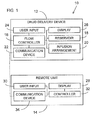
- FIGS. 1 , 3A and 3B show a drug delivery system, generally designated 10, constructed and operative according to the teachings of the present invention, for delivering a drug into the body of a user.
- drug delivery system 10 includes a drug delivery device 12 and a remote unit 14.
- drug delivery device 12 has a housing, represented here schematically as the outline of device 12.
- a reservoir 16 containing a quantity of the drug to be dispensed is located at least partially within the housing.
- a flow controller 18 for configured for controlling a flow of the drug from reservoir 16 to an infusion arrangement 20, which delivers the drug into the body of the user.
- a first communication device 22, associated with flow controller 18, includes at least a transmitter.
- drug delivery device 12 also includes one or more user input 24, such as buttons, switches and/or knobs, and a display 26.
- Remote unit 14 generally includes a display 28 and a plurality of user input controls 30, interconnected with a remote unit controller 32.
- a second communication device 34, associated with controller 32 includes at least a receiver.
- first communication device 22 transmits wirelessly information indicative of a current state of operation of flow controller 18. This information is received by second communication device 34 and supplied to remote unit controller 32 for display on display 28, thereby providing convenient monitoring of the functioning of the drug delivery device.
- remote unit 14 is configured to receive user input via user input controls 30 to define a required change in operation of flow controller 18.
- drug delivery device 12 is configured to require tactile intervention by the user prior to implementation of the required change.
- tactile intervention is used herein in the description and claims to refer to any and all actions which include either direct physical contact with the drug delivery device or application of a contact force to some part of the device even through a garment.
- the force or contact may be implemented directly by the hand of a user or indirectly via some intermediate object.
- the requirement for tactile intervention with the drug delivery device ensures that no change to the operation of the drug delivery occurs based solely on operations performed at the remote unit, but rather as a result of some action which is intuitively perceived by the user as a direct interaction with the drug delivery device itself. This substantially eliminates the risk of unauthorized or inadvertent tampering with the drug delivery regime via the remote unit.
- the requirement for tactile intervention may be implemented in many ways to achieve the required result.
- the tactile intervention is required to enable the transfer to the drug delivery device of data indicative of the required change in operation.
- the system may perform data transfer prior to the tactile intervention, instead requiring intervention as a condition for implementing the changes. A few non-limiting examples will now be illustrated with reference to FIGS. 2A-2C .
- both communication devices 22 and 34 include a transmitter and receiver (also referred to as a "transceiver"), allowing bidirectional wireless communication between drug delivery device 12 and remote unit 14.
- data indicative of the required change in operation is preferably transmitted wirelessly from remote unit 14 to drug delivery device 12.
- Drug delivery device is preferably configured to require tactile intervention by user actuation of manually operable user input 24 to confirm the required change in operation.
- user input 24 is preferably implemented as a readily accessible button configured to be discernable and operable by pressure of a finger applied through a garment.
- FIG. 2B A second non-limiting example is illustrated in FIG. 2B .
- a tethered connection 36 between remote unit 14 and drug delivery device 12 is selectively deployed to provide a tethered link between them.
- the tethered connection may be a simple string carrying a mechanical or electronic key or other engagement device (not shown) which engages drug delivery device 12 to provide authorization for implementing the required change to the drug delivery program.
- the functionality is essentially equivalent to that of FIG. 2A .
- tethered connection 36 is a wired communication link, such as a USB cable or the like.
- the data indicative of the required change in operation of the drug delivery device may be transmitted via connection 36.
- This implementation may optionally employ a unidirectional wireless link from drug delivery device 12 to remote unit 14.
- a data storage device 38 is provided for transferring data from remote unit 14 to drug delivery device 12.
- Data storage device 38 may be any standard or dedicated form of memory card, memory stick or the like, and drug delivery device 12 and remote unit 14 are implemented with corresponding connectors for removable attachment of data storage device 38.
- the data storage device is first connected to remote unit 14 to receive the new drug delivery program or changes to the existing program.
- the tactile intervention then requires transfer of data storage device 38 from remote unit 14 to drug delivery device 12 in order to transfer the data indicative of the required change in operation of the drug delivery device.
- Drug delivery device 12 is preferably configured to execute the updated drug delivery schedule from the connected memory device. Most preferably, the drug delivery device automatically downloads the updated program or changes into an internal memory, thus allowing removal of the plug-in memory device. Confirmation of the updated schedule is transmitted to the remote monitor as before.
- the changes in operation may be any changes typically required by users of portable drug delivery devices including, but not limited to, changes to a basal drug delivery rate, changes to a basal drug delivery profile, switching between a number of stored basal drug delivery schedules, immediate delivery or scheduling of a bolus dose of drug delivery, and setting parameters for a bolus dose of drug delivery.
- drug delivery system 10 allows remote unit 14 to be used to input required changes to the operation of drug delivery device 12, this is not necessarily, or even typically, to the exclusion of direct control of drug delivery device 12 via user inputs 24.
- certain modifications to operation of the drug delivery device, and in particular, selection and actuation of bolus doses of various sizes can advantageously be performed using manual input to drug delivery device 12, but with visual feedback and confirmation supplied via remote unit 14.
- the user selects a desired bolus dose by pressing a button of user inputs 24 on the drug delivery device. This can be done by inserting the user's hand under clothing, or by applying pressure through clothing, without uncovering the drug delivery device.
- each single press of a finger on the "bolus" button of the device may increment the selected bolus dose by half a unit, while a single long depression of the button, for example of 1.5 second duration, confirms the command to begin delivering the selected bolus.
- the drug delivery device transmits a signal indicative of the effect of the button press, e.g., the bolus quantity currently selected, or confirmation that the command has been confirmed and is being delivered. This information is received and then displayed or otherwise reported to the user by remote unit 14.
- the monitoring unit effectively acts as a removable display, indicating in real time what it happening at the drug delivery device in a manner similar to a built in display, but without requiring the user to uncover the drug delivery device itself.
- modification of the dosage is achieved through tactile intervention with the drug delivery device, there is no risk to the user of unauthorized or unintended modification of the delivery regime via the remote unit.
- drug delivery device 12 is deployed and actuated to deliver the drug to the body of the user in a first defined manner.
- drug delivery device 12 transmits wirelessly to remote unit 14 information indicative of a current state of operation of drug delivery device 12 for display on display 28.
- remote unit 14 information indicative of a current state of operation of drug delivery device 12 for display on display 28.
- details of the required change are input to remote unit 14 via user input controls 30 .
- data indicative of the required change in operation is transferred to the drug delivery device and operation of the drug delivery device is changed in accordance with the data. Either the transfer of the data or the implementation of the change, or both, are contingent on tactile intervention by the user with the drug delivery device.
- a number of commercially available drug delivery devices employ bottle-like cartridges with a cylindrical storage volume within which a piston slides.
- the dispensing end of the container typically has a recessed portion, corresponding to a restriction which limits the motion of the piston, followed by a top portion with a piercable elastomeric seal.
- These cartridges may be variously referred to as bottles, cartridges, or vials.
- most of the devices are based upon precise positive displacement mechanisms which act on the piston directly, and which are highly sensitive to variations in dimensions of the cartridge. For this reason, conventional drug delivery devices typically only operate with the exact model of cartridge for which they were designed, and are not interchangeable.
- a further aspect of the present invention relates to a retention configuration for drug containers which provides increased flexibility regarding the dimensions of the container used.
- This aspect of the invention relates specifically to devices in which the piston of the container is to be springloaded to provide a pressurized reservoir. For simplicity of the structure, it is preferable to allow insertion of the drug container into the device lengthways, i.e., along the direction of the loading spring. However, this presents various practical complications.
- the diameter of the loading spring must be smaller than that of the drug container in order for the spring to move freely within the inner bore of the container to act on the piston.
- a retention configuration is required.
- the retention configuration must not obstruct insertion of the larger diameter drug container into the channel.
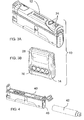
- disposable unit 40 from drug delivery device 12 for receiving a cartridge 42 containing a drug to be delivered.
- disposable unit 40 has a channel 44 for receiving cartridge 42.
- Channel 44 is open at one end (opening 46 ) and closed at the other.
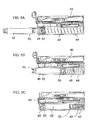
- Deployed within channel 44 is a loading spring 48 for applying a loading force on a piston 50 of cartridge 42 when inserted within channel 44 .
- Loading spring 48 is deployed to generate the loading force acting along a direction of extension of channel 44 towards opening 46. It is a particular feature of this aspect of the present invention that there is provided a retention configuration deployed near opening 46 which includes a plurality of rearwardly directed resilient teeth 52.
- Resilient teeth 52 are configured: (a) to retain loading spring 48 in a pre-compressed state within channel 44 prior to insertion of the cartridge ( FIG. 5A ); (b) to flex outwards to allow insertion of cartridge 42 between teeth 52 ( FIG. 5B ); and (c) to assume a retaining position engaging a recessed portion of the cartridge when the cartridge is fully inserted ( FIG. 5C ).
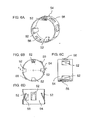
- the plurality of rearward directed resilient teeth 52 are formed as part of a collar 54.
- at least three, and most preferably at least four, teeth 52 are spaced around the collar, providing symmetrical retention and a centering effect for the head of the cartridge.
- Teeth 52 are described as “rearwardly directed” in that they project towards the back of channel 44 as viewed from opening 46. They are also clearly “inwardly projecting", i.e., sloped rearwardly inwards towards the axis of insertion of cartridge 42.
- the flexible teeth thus deployed act as unidirectional locking elements, momentarily deforming during insertion of the cartridge and then straightening towards their released position as they reach the narrower recessed portion.
- An additional advantage of this structure is that the flexible teeth tend to grip cartridge 42 during insertion, even prior to reaching its fully locked position, typically by biting into the layer of paper present in the labeling of the cartridge. This facilitates safe insertion of the cartridge, ensuring that it is not accidentally launched across the room in the event that the user loosens his or her grasp on the cartridge before it is fully inserted.
- collar 54 additionally features one or more forward-directed outward projections 56 which serve to lock collar 54 within opening 46.
- the entire structure of collar 54 with teeth 52 and projections 56 may be formed from a suitable spring metal, such as stainless steel, by conventional production techniques, such as by stamping, or may be formed from resilient polymer materials, again by conventional production techniques, such as by injection molding.
- the alignment of cartridge 42 once inserted is defined by forward biasing of the entire cartridge by loading spring 48 into abutment with the ends of teeth 52, thereby accurately defining the position of the head of the cartridge independent of slight variations in cartridge diameter or length.
- the drug delivery device may be provided as a kit including an optional user-fillable cartridge sized and shaped for insertion into channel 44, thereby leaving the user to choose whether to purchase prefilled containers or to fill his or her own container.
- the retention arrangement as described is particularly suitable for use in a disposable unit 40 as mentioned, since cartridge 42 is typically not easily removed from the retention arrangement. After use, the cartridge is typically discarded together with disposable unit 40.
- drug delivery device is a semi-disposable device in which disposable unit 40 is used together with a reusable control system.
- this and other aspects of the present invention may also be implemented in various other types of device such as, for example, a fully disposable single-use pump.
- this relates to a user selectable form factor for the infusion set to be used with drug delivery device 12, allowing the user to choose each time the disposable components of the system are switched whether to use an integrated infusion set in a body-mounted device configuration or a separate flexible-tube-fed infusion system for the upcoming round of drug delivery.
- all components coming in contact with the drug are preferably single-use disposable components which are switched each time the drug reservoir is replaced, thereby allowing frequent switching or alternating between the two configurations.
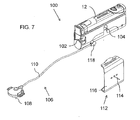
- kit 100 for delivering a drug to the body of a user.
- kit 100 includes a drug delivery device, such as device 12, including a disposable unit 40 having an outlet arrangement with at least one, and more preferably two, outlets 102, 104 for release of the drug for infusion into the body of the user.
- a first infusion set 106 includes a canula 108 in fluid connection with a length of flexible tube 110 for delivery of the drug into the body of the user at a location spaced from drug delivery device 12.
- a second infusion set 112 includes a canula 114 deployable in fixed relation to a body contact element 116 which is itself configured to cooperate with drug delivery device 12 to define a fixed spatial alignment between body contact element 116 and drug delivery device 12.
- Each infusion set 106 and 112 is configured to be connected to an outlet 102 or 104 of the outlet arrangement to define a flow path from the outlet arrangement to the respective canula 108 or 114 to provide a user selected form factor for the drug delivery system.
- the outlet arrangement includes at least two separate outlets 102 and 104, both in fluid connection with the downstream side of the flow control arrangement of the drug delivery device. This allows appropriate choice of positioning and/or orientation for the flow connection for each infusion set. For example, it is typically advantageous to connect external infusion set 106 at an outlet 102 located near a periphery of drug delivery device 12, while the integrated infusion set 112 is typically advantageously connected at an outlet 104 spaced away from said periphery of drug delivery device 12. Each outlet is preferably sealed prior to use by a suitable seal arrangement, and the unused outlet remains sealed during the entire operation of the drug delivery.
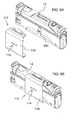
- outlets 102 and 104 show cross-sectional views through outlet 102 together with a connector 118 of infusion set 106.
- outlet 102 is formed with a septum needle 120 recessed within a socket 122, and with an elastomer seal 124 deployed within socket 122 so as to seal the end of septum needle 120 prior to attachment of connector 118 ( FIG. 8A ).
- connector 118 When connector 118 is inserted into socket 122, elastomer seal 124 and a seal 126 of connector 118 are successively pierced by septum needle 120 until the needle comes into fluid flow connection with flexible tube 110. Infusion set 106 is then ready for use, with outlet 104 remaining sealed throughout.
- body contact element 116 is preferably integrated with canula 114 and a connector 128.
- Body contact element 116 is configured for attachment to the skin of the user, such as by adhesive or any other conventional form of attachment.
- Canula 114 is then inserted, typically by use of an insertion mechanism of conventional type, so as to penetrate into the tissue beneath the base.
- the remaining components of drug delivery device 12 then directly engage body contact element 116 as shown in FIG. 10B , thereby forming a unitary skin-mounted assembly according to the integrated infusion set functionality described above.
- the mating of connector 128 with outlet 104 occurs in a manner analogous to the mating of connector 118 with outlet 102, as described above. In this case, outlet 102 remains sealed throughout use of the device in this form factor.
Landscapes
- Health & Medical Sciences (AREA)
- Engineering & Computer Science (AREA)
- General Health & Medical Sciences (AREA)
- Biomedical Technology (AREA)
- Public Health (AREA)
- Vascular Medicine (AREA)
- Life Sciences & Earth Sciences (AREA)
- Medical Informatics (AREA)
- Primary Health Care (AREA)
- Epidemiology (AREA)
- Veterinary Medicine (AREA)
- Anesthesiology (AREA)
- Animal Behavior & Ethology (AREA)
- Heart & Thoracic Surgery (AREA)
- Hematology (AREA)
- Medicinal Chemistry (AREA)
- Chemical & Material Sciences (AREA)
- Bioinformatics & Cheminformatics (AREA)
- Business, Economics & Management (AREA)
- General Business, Economics & Management (AREA)
- Infusion, Injection, And Reservoir Apparatuses (AREA)
Applications Claiming Priority (2)
| Application Number | Priority Date | Filing Date | Title |
|---|---|---|---|
| US2585908P | 2008-02-04 | 2008-02-04 | |
| EP09707503A EP2254621A2 (de) | 2008-02-04 | 2009-02-04 | Arzneiabgabesystem mit drahtlosem monitor |
Related Parent Applications (1)
| Application Number | Title | Priority Date | Filing Date |
|---|---|---|---|
| EP09707503.0 Division | 2009-02-04 |
Publications (2)
| Publication Number | Publication Date |
|---|---|
| EP2359880A2 true EP2359880A2 (de) | 2011-08-24 |
| EP2359880A3 EP2359880A3 (de) | 2011-09-21 |
Family
ID=40933753
Family Applications (2)
| Application Number | Title | Priority Date | Filing Date |
|---|---|---|---|
| EP10190856A Withdrawn EP2359880A3 (de) | 2008-02-04 | 2009-02-04 | Arzneimittelverabreichungssystem mit drahtlosem Monitor |
| EP09707503A Withdrawn EP2254621A2 (de) | 2008-02-04 | 2009-02-04 | Arzneiabgabesystem mit drahtlosem monitor |
Family Applications After (1)
| Application Number | Title | Priority Date | Filing Date |
|---|---|---|---|
| EP09707503A Withdrawn EP2254621A2 (de) | 2008-02-04 | 2009-02-04 | Arzneiabgabesystem mit drahtlosem monitor |
Country Status (4)
| Country | Link |
|---|---|
| US (1) | US20110004188A1 (de) |
| EP (2) | EP2359880A3 (de) |
| IL (1) | IL207366A0 (de) |
| WO (1) | WO2009098648A2 (de) |
Cited By (1)
| Publication number | Priority date | Publication date | Assignee | Title |
|---|---|---|---|---|
| US11865205B2 (en) | 2015-11-16 | 2024-01-09 | Medincell S.A. | Method for morselizing and/or targeting pharmaceutically active principles to synovial tissue |
Families Citing this family (117)
| Publication number | Priority date | Publication date | Assignee | Title |
|---|---|---|---|---|
| WO2008008281A2 (en) | 2006-07-07 | 2008-01-17 | Proteus Biomedical, Inc. | Smart parenteral administration system |
| US20080228056A1 (en) | 2007-03-13 | 2008-09-18 | Michael Blomquist | Basal rate testing using frequent blood glucose input |
| US8417311B2 (en) | 2008-09-12 | 2013-04-09 | Optiscan Biomedical Corporation | Fluid component analysis system and method for glucose monitoring and control |
| US7751907B2 (en) | 2007-05-24 | 2010-07-06 | Smiths Medical Asd, Inc. | Expert system for insulin pump therapy |
| US8221345B2 (en) | 2007-05-30 | 2012-07-17 | Smiths Medical Asd, Inc. | Insulin pump based expert system |
| CA2702116C (en) | 2007-10-10 | 2021-01-05 | Optiscan Biomedical Corporation | Fluid component analysis system and method for glucose monitoring and control |
| WO2009055733A1 (en) | 2007-10-25 | 2009-04-30 | Proteus Biomedical, Inc. | Fluid transfer port information system |
| US20090177147A1 (en) | 2008-01-07 | 2009-07-09 | Michael Blomquist | Insulin pump with insulin therapy coaching |
| US8986253B2 (en) | 2008-01-25 | 2015-03-24 | Tandem Diabetes Care, Inc. | Two chamber pumps and related methods |
| US7959598B2 (en) | 2008-08-20 | 2011-06-14 | Asante Solutions, Inc. | Infusion pump systems and methods |
| US8926561B2 (en) | 2009-07-30 | 2015-01-06 | Tandem Diabetes Care, Inc. | Infusion pump system with disposable cartridge having pressure venting and pressure feedback |
| US8882701B2 (en) | 2009-12-04 | 2014-11-11 | Smiths Medical Asd, Inc. | Advanced step therapy delivery for an ambulatory infusion pump and system |
| EP2531099B1 (de) | 2010-02-01 | 2018-12-12 | Proteus Digital Health, Inc. | Datensammelsystem |
| SG189763A1 (en) | 2010-02-01 | 2013-05-31 | Proteus Digital Health Inc | Two-wrist data gathering system |
| GB2481066A (en) * | 2010-06-11 | 2011-12-14 | Britannia Pharmaceuticals Ltd | Portable case for infusion |
| JP2014500538A (ja) | 2010-10-12 | 2014-01-09 | タニス,ケヴィン ジェイ. | 医療機器 |
| PL3045187T3 (pl) | 2011-10-14 | 2019-09-30 | Amgen Inc. | Wstrzykiwacz i sposób montażu |
| USD693456S1 (en) * | 2012-02-17 | 2013-11-12 | Picolife Technologies, Llc | Multi-drug delivery system |
| USD697198S1 (en) * | 2012-02-17 | 2014-01-07 | Picolife Technologies, Llc | Multi-drug delivery system having cartridge |
| RS65875B1 (sr) | 2012-03-30 | 2024-09-30 | Insulet Corp | Sredstvo za isporučivanje tečnosti sa alatom za transkutani pristup, mehanizmom za inserciju i praćenje nivoa glukoze u krvi za istovremenu upotrebu |
| US9180242B2 (en) | 2012-05-17 | 2015-11-10 | Tandem Diabetes Care, Inc. | Methods and devices for multiple fluid transfer |
| CN104661601B (zh) | 2012-05-22 | 2018-06-22 | 史密夫及内修公开有限公司 | 用于伤口治疗的设备和方法 |
| US9555186B2 (en) | 2012-06-05 | 2017-01-31 | Tandem Diabetes Care, Inc. | Infusion pump system with disposable cartridge having pressure venting and pressure feedback |
| US9238100B2 (en) | 2012-06-07 | 2016-01-19 | Tandem Diabetes Care, Inc. | Device and method for training users of ambulatory medical devices |
| RU2015143724A (ru) | 2013-03-14 | 2017-04-17 | Смит Энд Нефью Инк. | Системы и способы применения терапии с использованием пониженного давления |
| US9737649B2 (en) | 2013-03-14 | 2017-08-22 | Smith & Nephew, Inc. | Systems and methods for applying reduced pressure therapy |
| US9173998B2 (en) | 2013-03-14 | 2015-11-03 | Tandem Diabetes Care, Inc. | System and method for detecting occlusions in an infusion pump |
| US9242043B2 (en) | 2013-03-15 | 2016-01-26 | Tandem Diabetes Care, Inc. | Field update of an ambulatory infusion pump system |
| WO2014149357A1 (en) | 2013-03-22 | 2014-09-25 | Amgen Inc. | Injector and method of assembly |
| US9561324B2 (en) | 2013-07-19 | 2017-02-07 | Bigfoot Biomedical, Inc. | Infusion pump system and method |
| JP6679483B2 (ja) | 2013-08-13 | 2020-04-15 | スミス アンド ネフュー インコーポレイテッド | 減圧治療を実施するためのシステムおよび方法 |
| SG11201602876WA (en) | 2013-10-24 | 2016-05-30 | Amgen Inc | Injector and method of assembly |
| WO2015100439A1 (en) | 2013-12-26 | 2015-07-02 | Tandem Diabetes Care, Inc. | Integration of infusion pump with remote electronic device |
| US10279105B2 (en) | 2013-12-26 | 2019-05-07 | Tandem Diabetes Care, Inc. | System and method for modifying medicament delivery parameters after a site change |
| GB2593235A (en) * | 2014-01-30 | 2021-09-22 | Insulet Netherlands B V | Therapeutic product delivery system and method of pairing |
| GB2523989B (en) * | 2014-01-30 | 2020-07-29 | Insulet Netherlands B V | Therapeutic product delivery system and method of pairing |
| WO2015158184A1 (zh) * | 2014-04-18 | 2015-10-22 | 俞卫中 | 可智能镇痛的输注泵监控系统及方法 |
| CN111840696B (zh) | 2014-06-03 | 2022-12-20 | 安姆根有限公司 | 可控制药物递送系统和使用方法 |
| WO2016019133A1 (en) | 2014-07-30 | 2016-02-04 | Tandem Diabetes Care, Inc. | Temporary suspension for closed-loop medicament therapy |
| US12133789B2 (en) | 2014-07-31 | 2024-11-05 | Smith & Nephew, Inc. | Reduced pressure therapy apparatus construction and control |
| US20160114104A1 (en) * | 2014-10-23 | 2016-04-28 | Elwha Llc | Medicament infusion system and methods of use thereof |
| CN111905188B (zh) | 2015-02-18 | 2022-07-22 | 英赛罗公司 | 流体输送和输注装置及其使用方法 |
| WO2016187286A1 (en) | 2015-05-18 | 2016-11-24 | Tandem Diabetes Care, Inc. | Patch pump cartridge attachment |
| CN107847673B (zh) * | 2015-07-31 | 2022-04-15 | 赛诺菲-安万特德国有限公司 | 用于药物输送装置的传感器 |
| JP6862418B2 (ja) | 2015-07-31 | 2021-04-21 | サノフィ−アベンティス・ドイチュラント・ゲゼルシャフト・ミット・ベシュレンクテル・ハフツング | センサ、カートリッジ、および薬物送達デバイス |
| EP3328467B1 (de) | 2015-07-31 | 2022-03-23 | Sanofi-Aventis Deutschland GmbH | Sensor, kartusche und arzneimittelabgabevorrichtung |
| WO2017021227A1 (en) * | 2015-07-31 | 2017-02-09 | Sanofi-Aventis Deutschland Gmbh | Sensor, cartridge and drug delivery device |
| WO2017062042A1 (en) | 2015-10-07 | 2017-04-13 | Smith & Nephew, Inc. | Systems and methods for applying reduced pressure therapy |
| WO2017091584A1 (en) | 2015-11-25 | 2017-06-01 | Insulet Corporation | Wearable medication delivery device |
| US10569016B2 (en) | 2015-12-29 | 2020-02-25 | Tandem Diabetes Care, Inc. | System and method for switching between closed loop and open loop control of an ambulatory infusion pump |
| CN108601891B (zh) | 2016-01-12 | 2022-05-13 | 输液创新有限公司 | 输注设备 |
| WO2017123525A1 (en) | 2016-01-13 | 2017-07-20 | Bigfoot Biomedical, Inc. | User interface for diabetes management system |
| US10806859B2 (en) | 2016-01-14 | 2020-10-20 | Bigfoot Biomedical, Inc. | Adjusting insulin delivery rates |
| HK1256995A1 (zh) | 2016-01-14 | 2019-10-11 | Bigfoot Biomedical, Inc. | 药物输送设备、系统和方法中的阻塞解决方案 |
| JP2019508124A (ja) | 2016-02-12 | 2019-03-28 | スミス アンド ネフュー インコーポレイテッド | 減圧療法の動作条件を検出するシステムおよび方法 |
| JP1586116S (de) | 2016-02-29 | 2017-09-19 | ||
| AU2017261814B2 (en) | 2016-05-13 | 2022-05-19 | Smith & Nephew, Inc. | Automatic wound coupling detection in negative pressure wound therapy systems |
| US12383166B2 (en) | 2016-05-23 | 2025-08-12 | Insulet Corporation | Insulin delivery system and methods with risk-based set points |
| US10926025B2 (en) | 2016-09-15 | 2021-02-23 | Tandem Diabetes Care, Inc. | Vial supporter for medicament pump |
| US10765807B2 (en) | 2016-09-23 | 2020-09-08 | Insulet Corporation | Fluid delivery device with sensor |
| US12263294B2 (en) | 2016-09-28 | 2025-04-01 | T.J.Smith And Nephew, Limited | Systems and methods for operating negative pressure wound therapy devices |
| AU2017335635B2 (en) | 2016-09-29 | 2023-01-05 | Smith & Nephew, Inc. | Construction and protection of components in negative pressure wound therapy systems |
| US11096624B2 (en) | 2016-12-12 | 2021-08-24 | Bigfoot Biomedical, Inc. | Alarms and alerts for medication delivery devices and systems |
| US10583250B2 (en) | 2017-01-13 | 2020-03-10 | Bigfoot Biomedical, Inc. | System and method for adjusting insulin delivery |
| US10758675B2 (en) | 2017-01-13 | 2020-09-01 | Bigfoot Biomedical, Inc. | System and method for adjusting insulin delivery |
| US10500334B2 (en) | 2017-01-13 | 2019-12-10 | Bigfoot Biomedical, Inc. | System and method for adjusting insulin delivery |
| US10881792B2 (en) | 2017-01-13 | 2021-01-05 | Bigfoot Biomedical, Inc. | System and method for adjusting insulin delivery |
| US11033682B2 (en) | 2017-01-13 | 2021-06-15 | Bigfoot Biomedical, Inc. | Insulin delivery methods, systems and devices |
| EP3568860B1 (de) | 2017-01-13 | 2025-12-10 | Insulet Corporation | Insulinverabreichungsverfahren, -systeme und -vorrichtungen |
| WO2018156548A1 (en) | 2017-02-22 | 2018-08-30 | Insulet Corporation | Needle insertion mechanisms for drug containers |
| CN110545766A (zh) | 2017-03-07 | 2019-12-06 | 史密夫和内修有限公司 | 包括天线的减压治疗系统和方法 |
| CN106730212A (zh) * | 2017-03-13 | 2017-05-31 | 青海民族大学 | 富氧控制终端、富氧控制方法及富氧装置 |
| WO2019014141A1 (en) | 2017-07-10 | 2019-01-17 | Smith & Nephew, Inc. | SYSTEMS AND METHODS FOR INTERACTING DIRECTLY WITH A COMMUNICATION MODULE OF A WOUND PROCESSING APPARATUS |
| RU179373U1 (ru) * | 2017-07-11 | 2018-05-11 | Общество с ограниченной ответственностью "Центр внедрения медицинских инноваций" | Компактный переносной модуль оповещения для устройства регулирования и контроля температуры, скорости введения жидкостей и лекарственных растворов, используемых при инфузионной терапии |
| US10898656B2 (en) | 2017-09-26 | 2021-01-26 | Insulet Corporation | Needle mechanism module for drug delivery device |
| US11147931B2 (en) | 2017-11-17 | 2021-10-19 | Insulet Corporation | Drug delivery device with air and backflow elimination |
| USD928199S1 (en) | 2018-04-02 | 2021-08-17 | Bigfoot Biomedical, Inc. | Medication delivery device with icons |
| US11565043B2 (en) | 2018-05-04 | 2023-01-31 | Insulet Corporation | Safety constraints for a control algorithm based drug delivery system |
| US12562251B1 (en) | 2018-05-09 | 2026-02-24 | Bigfoot Biomedical, Inc. | Computing architecture for assuring the provenance of medication therapy related parameters, and related systems, methods and devices |
| AU2019347755B2 (en) | 2018-09-28 | 2023-02-02 | Insulet Corporation | Activity mode for artificial pancreas system |
| EP3864668A1 (de) | 2018-10-11 | 2021-08-18 | Insulet Corporation | Ereignisdetektion für ein arzneimittelabgabesystem |
| GB201820668D0 (en) | 2018-12-19 | 2019-01-30 | Smith & Nephew Inc | Systems and methods for delivering prescribed wound therapy |
| USD920343S1 (en) | 2019-01-09 | 2021-05-25 | Bigfoot Biomedical, Inc. | Display screen or portion thereof with graphical user interface associated with insulin delivery |
| EP3931840A1 (de) | 2019-02-27 | 2022-01-05 | T.J.Smith And Nephew, Limited | Systeme und verfahren zur synchronisierung einer geräteuhr in systemen zur wundüberwachung und/oder behandlung |
| GB201911693D0 (en) | 2019-08-15 | 2019-10-02 | Smith & Nephew | Systems and methods for monitoring essential performance of wound therapy |
| US11801344B2 (en) | 2019-09-13 | 2023-10-31 | Insulet Corporation | Blood glucose rate of change modulation of meal and correction insulin bolus quantity |
| US11935637B2 (en) | 2019-09-27 | 2024-03-19 | Insulet Corporation | Onboarding and total daily insulin adaptivity |
| EP4069082B1 (de) | 2019-12-06 | 2024-06-05 | Insulet Corporation | Techniken und vorrichtungen zum bereitstellen von adaptivität und personalisierung bei der behandlung von diabetes |
| US11833329B2 (en) | 2019-12-20 | 2023-12-05 | Insulet Corporation | Techniques for improved automatic drug delivery performance using delivery tendencies from past delivery history and use patterns |
| JP7512395B2 (ja) | 2020-01-06 | 2024-07-08 | インスレット コーポレイション | 持続する残差に基づく食事および/または運動行為の予測 |
| EP4100958A1 (de) | 2020-02-03 | 2022-12-14 | Insulet Corporation | Einsatz von fuzzy-logik beim vorhersagen von benutzerverhalten, das die blutzuckerkonzentration beeinflusst |
| US11551802B2 (en) | 2020-02-11 | 2023-01-10 | Insulet Corporation | Early meal detection and calorie intake detection |
| US11547800B2 (en) | 2020-02-12 | 2023-01-10 | Insulet Corporation | User parameter dependent cost function for personalized reduction of hypoglycemia and/or hyperglycemia in a closed loop artificial pancreas system |
| US11986630B2 (en) | 2020-02-12 | 2024-05-21 | Insulet Corporation | Dual hormone delivery system for reducing impending hypoglycemia and/or hyperglycemia risk |
| US11324889B2 (en) | 2020-02-14 | 2022-05-10 | Insulet Corporation | Compensation for missing readings from a glucose monitor in an automated insulin delivery system |
| US12495994B2 (en) | 2020-02-20 | 2025-12-16 | Insulet Corporation | Meal bolus subcategories in model based insulin therapy |
| US11607493B2 (en) | 2020-04-06 | 2023-03-21 | Insulet Corporation | Initial total daily insulin setting for user onboarding |
| US12102445B2 (en) | 2020-05-06 | 2024-10-01 | Janssen Pharmaceuticals, Inc. | Monitoring and communicating information using drug administration devices |
| US12121700B2 (en) | 2020-07-22 | 2024-10-22 | Insulet Corporation | Open-loop insulin delivery basal parameters based on insulin delivery records |
| US11684716B2 (en) | 2020-07-31 | 2023-06-27 | Insulet Corporation | Techniques to reduce risk of occlusions in drug delivery systems |
| US12569619B2 (en) | 2020-09-21 | 2026-03-10 | Insulet Corporation | Techniques for determining automated insulin delivery dosages |
| US12115351B2 (en) | 2020-09-30 | 2024-10-15 | Insulet Corporation | Secure wireless communications between a glucose monitor and other devices |
| EP4696344A3 (de) | 2020-09-30 | 2026-04-15 | Insulet Corporation | Arzneimittelabgabevorrichtung mit integriertem optischen glucosemonitor |
| US11160925B1 (en) | 2021-01-29 | 2021-11-02 | Insulet Corporation | Automatic drug delivery system for delivery of a GLP-1 therapeutic |
| EP4305636A1 (de) | 2021-03-10 | 2024-01-17 | Insulet Corporation | Medikamentenabgabevorrichtung mit einstellbarer und stückweiser analytniveau-kostenkomponente zur adressierung persistenter positiver analytniveauabweichungen |
| US11904140B2 (en) | 2021-03-10 | 2024-02-20 | Insulet Corporation | Adaptable asymmetric medicament cost component in a control system for medicament delivery |
| EP4327579A1 (de) | 2021-04-21 | 2024-02-28 | T.J. Smith and Nephew, Limited | Kommunikationssysteme und verfahren für unterdruckwundtherapievorrichtungen |
| US12592306B2 (en) | 2021-04-28 | 2026-03-31 | Insulet Corporation | Devices and methods for initialization of drug delivery devices using measured analyte sensor information |
| US12496398B2 (en) | 2021-05-28 | 2025-12-16 | Insulet Corporation | Threshold based automatic glucose control response |
| EP4101482A1 (de) | 2021-06-07 | 2022-12-14 | Insulet Corporation | Übungssicherheitsvorhersage basierend auf physiologischen bedingungen |
| US12514980B2 (en) | 2021-06-30 | 2026-01-06 | Insulet Corporation | Adjustment of medicament delivery by a medicament delivery device based on menstrual cycle phase |
| US12521486B2 (en) | 2021-07-16 | 2026-01-13 | Insulet Corporation | Method for modification of insulin delivery during pregnancy in automatic insulin delivery systems |
| WO2023049900A1 (en) | 2021-09-27 | 2023-03-30 | Insulet Corporation | Techniques enabling adaptation of parameters in aid systems by user input |
| US11439754B1 (en) | 2021-12-01 | 2022-09-13 | Insulet Corporation | Optimizing embedded formulations for drug delivery |
| EP4243030A1 (de) | 2022-03-09 | 2023-09-13 | Insulet Corporation | Anpassung von medikamentenverabreichungsparametern in einem offenen regelkreis der medikamentenverabreichung |
| KR20250044385A (ko) | 2022-08-04 | 2025-03-31 | 인슐렛 코포레이션 | 이중 저장조 및 고정 유체 포트를 갖는 펌프 기구 |
| EP4646726A1 (de) | 2023-01-06 | 2025-11-12 | Insulet Corporation | Automatisch oder manuell initiierte mahlzeitbolusabgabe mit anschliessender automatischer sicherheitseinschränkungsrelaxation |
Citations (4)
| Publication number | Priority date | Publication date | Assignee | Title |
|---|---|---|---|---|
| US6736796B2 (en) | 2001-11-26 | 2004-05-18 | Nili-Med Ltd. | Fluid drug delivery device |
| US20070250007A1 (en) | 2006-04-23 | 2007-10-25 | Nilimedix Ltd. | Drug Delivery Device With Air Pressure Spring And Safety Valve |
| US7291126B2 (en) | 2001-11-26 | 2007-11-06 | Nilimedix Ltd. | Drug delivery device and method |
| US7311693B2 (en) | 2001-11-26 | 2007-12-25 | Nilimedix Ltd. | Drug delivery device and method |
Family Cites Families (10)
| Publication number | Priority date | Publication date | Assignee | Title |
|---|---|---|---|---|
| US4671794A (en) * | 1985-10-18 | 1987-06-09 | Collagen Corporation | Laryngeal injector |
| US4978338A (en) * | 1988-04-21 | 1990-12-18 | Therex Corp. | Implantable infusion apparatus |
| US6749586B2 (en) * | 1994-11-25 | 2004-06-15 | I-Flow Corporation | Remotely programmable infusion system |
| US6554798B1 (en) * | 1998-08-18 | 2003-04-29 | Medtronic Minimed, Inc. | External infusion device with remote programming, bolus estimator and/or vibration alarm capabilities |
| US20030060765A1 (en) * | 2000-02-16 | 2003-03-27 | Arthur Campbell | Infusion device menu structure and method of using the same |
| GB2389791B (en) * | 2002-04-30 | 2006-12-13 | Steven Gill | Implantable drug delivery pump |
| WO2004093648A2 (en) * | 2003-04-18 | 2004-11-04 | Insulet Corporation | User interface for infusion pump remote controller and method of using the same |
| WO2007038059A2 (en) * | 2005-09-26 | 2007-04-05 | M2 Medical A/S | Infusion pump with a drive having a ratchet and pawl combination |
| DE602006008494D1 (de) * | 2005-11-08 | 2009-09-24 | M2 Medical As | Infusionspumpensystem |
| US8444595B2 (en) * | 2007-06-15 | 2013-05-21 | Animas Corporation | Methods to pair a medical device and at least a remote controller for such medical device |
-
2009
- 2009-02-04 EP EP10190856A patent/EP2359880A3/de not_active Withdrawn
- 2009-02-04 US US12/865,863 patent/US20110004188A1/en not_active Abandoned
- 2009-02-04 EP EP09707503A patent/EP2254621A2/de not_active Withdrawn
- 2009-02-04 WO PCT/IB2009/050453 patent/WO2009098648A2/en not_active Ceased
-
2010
- 2010-08-02 IL IL207366A patent/IL207366A0/en unknown
Patent Citations (5)
| Publication number | Priority date | Publication date | Assignee | Title |
|---|---|---|---|---|
| US6736796B2 (en) | 2001-11-26 | 2004-05-18 | Nili-Med Ltd. | Fluid drug delivery device |
| US7291126B2 (en) | 2001-11-26 | 2007-11-06 | Nilimedix Ltd. | Drug delivery device and method |
| US7311693B2 (en) | 2001-11-26 | 2007-12-25 | Nilimedix Ltd. | Drug delivery device and method |
| US7377907B2 (en) | 2001-11-26 | 2008-05-27 | Nilimedix Ltd. | Insulin pump |
| US20070250007A1 (en) | 2006-04-23 | 2007-10-25 | Nilimedix Ltd. | Drug Delivery Device With Air Pressure Spring And Safety Valve |
Cited By (1)
| Publication number | Priority date | Publication date | Assignee | Title |
|---|---|---|---|---|
| US11865205B2 (en) | 2015-11-16 | 2024-01-09 | Medincell S.A. | Method for morselizing and/or targeting pharmaceutically active principles to synovial tissue |
Also Published As
| Publication number | Publication date |
|---|---|
| IL207366A0 (en) | 2010-12-30 |
| US20110004188A1 (en) | 2011-01-06 |
| EP2359880A3 (de) | 2011-09-21 |
| WO2009098648A3 (en) | 2010-02-04 |
| WO2009098648A2 (en) | 2009-08-13 |
| EP2254621A2 (de) | 2010-12-01 |
Similar Documents
| Publication | Publication Date | Title |
|---|---|---|
| EP2359880A2 (de) | Arzneimittelverabreichungssystem mit drahtlosem Monitor | |
| US11406754B2 (en) | Patch pump | |
| US8469920B2 (en) | Wearable insulin dispensing device, and a combination of such a device and a programming controller | |
| EP2162168B1 (de) | Modulare infusionspumpe mit zwei verschiedenen energiequellen | |
| US8747368B2 (en) | Dispensing fluid from an infusion pump system | |
| EP1560616B1 (de) | Eine wegwerfbare, tragbare insulinspendervorrichtung, die kombination einer solchen vorrichtung und ein programmiergerät | |
| EP1503820B1 (de) | Spender für eine patienten-infusionsvorrichtung | |
| CA2943709C (en) | Catheter insertion device | |
| US20090088682A1 (en) | Wearable infusion device | |
| CN219354892U (zh) | 用于输送药物的药物输送装置 |
Legal Events
| Date | Code | Title | Description |
|---|---|---|---|
| PUAI | Public reference made under article 153(3) epc to a published international application that has entered the european phase |
Free format text: ORIGINAL CODE: 0009012 |
|
| PUAL | Search report despatched |
Free format text: ORIGINAL CODE: 0009013 |
|
| AC | Divisional application: reference to earlier application |
Ref document number: 2254621 Country of ref document: EP Kind code of ref document: P |
|
| AK | Designated contracting states |
Kind code of ref document: A2 Designated state(s): AT BE BG CH CY CZ DE DK EE ES FI FR GB GR HR HU IE IS IT LI LT LU LV MC MK MT NL NO PL PT RO SE SI SK TR |
|
| AX | Request for extension of the european patent |
Extension state: AL BA RS |
|
| AK | Designated contracting states |
Kind code of ref document: A3 Designated state(s): AT BE BG CH CY CZ DE DK EE ES FI FR GB GR HR HU IE IS IT LI LT LU LV MC MK MT NL NO PL PT RO SE SI SK TR |
|
| AX | Request for extension of the european patent |
Extension state: AL BA RS |
|
| RIC1 | Information provided on ipc code assigned before grant |
Ipc: A61M 5/172 20060101ALI20110816BHEP Ipc: G06F 19/00 20110101ALI20110816BHEP Ipc: A61M 5/142 20060101AFI20110816BHEP |
|
| 17P | Request for examination filed |
Effective date: 20120321 |
|
| STAA | Information on the status of an ep patent application or granted ep patent |
Free format text: STATUS: THE APPLICATION IS DEEMED TO BE WITHDRAWN |
|
| 18D | Application deemed to be withdrawn |
Effective date: 20140902 |