EP2363346B1 - Support de réservoir modulaire - Google Patents
Support de réservoir modulaire Download PDFInfo
- Publication number
- EP2363346B1 EP2363346B1 EP20110001607 EP11001607A EP2363346B1 EP 2363346 B1 EP2363346 B1 EP 2363346B1 EP 20110001607 EP20110001607 EP 20110001607 EP 11001607 A EP11001607 A EP 11001607A EP 2363346 B1 EP2363346 B1 EP 2363346B1
- Authority
- EP
- European Patent Office
- Prior art keywords
- tank stand
- sections
- wall
- support surface
- lobe
- Prior art date
- Legal status (The legal status is an assumption and is not a legal conclusion. Google has not performed a legal analysis and makes no representation as to the accuracy of the status listed.)
- Active
Links
Images






Classifications
-
- B—PERFORMING OPERATIONS; TRANSPORTING
- B65—CONVEYING; PACKING; STORING; HANDLING THIN OR FILAMENTARY MATERIAL
- B65D—CONTAINERS FOR STORAGE OR TRANSPORT OF ARTICLES OR MATERIALS, e.g. BAGS, BARRELS, BOTTLES, BOXES, CANS, CARTONS, CRATES, DRUMS, JARS, TANKS, HOPPERS, FORWARDING CONTAINERS; ACCESSORIES, CLOSURES, OR FITTINGS THEREFOR; PACKAGING ELEMENTS; PACKAGES
- B65D19/00—Pallets or like platforms, with or without side walls, for supporting loads to be lifted or lowered
- B65D19/0002—Platforms, i.e. load supporting devices without provision for handling by a forklift
-
- Y—GENERAL TAGGING OF NEW TECHNOLOGICAL DEVELOPMENTS; GENERAL TAGGING OF CROSS-SECTIONAL TECHNOLOGIES SPANNING OVER SEVERAL SECTIONS OF THE IPC; TECHNICAL SUBJECTS COVERED BY FORMER USPC CROSS-REFERENCE ART COLLECTIONS [XRACs] AND DIGESTS
- Y10—TECHNICAL SUBJECTS COVERED BY FORMER USPC
- Y10T—TECHNICAL SUBJECTS COVERED BY FORMER US CLASSIFICATION
- Y10T29/00—Metal working
- Y10T29/49—Method of mechanical manufacture
- Y10T29/49826—Assembling or joining
Definitions
- the present disclosure relates to material storage containers and, specifically, to supports for material storage containers.
- Bulk storage containers are commonly utilized for storage and dispensing of flowable materials.
- a valve may be located near the bottom of the container in order to facilitate controlled, gravity-driven dispensing of the flowable material though the valve, so that the container can be drained without a pump, and with no tilting or moving of the container.
- One method of ensuring that substantially all of the flowable material contained within a bulk storage container is dispensable via gravitational forces is to position the tank valve at the bottom-most portion of the storage tank wall.
- a bulk storage container with a valve so positioned is generally required to rest on an elevated platform or pedestal, so as to elevate the valve above the ground or other tank support surface.
- a bulk storage container with a valve positioned at the bottom-most portion of the container must typically be placed upon a pallet or platform, in order to prevent valve damage.
- a bulk storage container is elevated by a platform or pedestal, the platform or pedestal must be capable of supporting the weight of the bulk storage container and its contents.
- containment capacities may be up to 37.9 m 3 (10,000 gallons) or more, with liquids or other flowable materials having weights of up to 1.2 kg/l (10 lbs./gallon) or more.
- tank support surfaces and platforms may be called upon to support in excess of 45.400 kg (100,000 lbs).
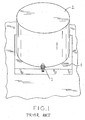
- Fig. 1 One known method of supporting such bulk storage containers, illustrated in Fig. 1 , is to create a poured and/or steel-reinforced concrete pedestal 1 in an area where the container 2 will be located, and position container 2 so that a bottom-mounted full-drain outlet 3 hangs over the edge of concrete pedestal 1.
- a disadvantage with concrete tank stands is that the concrete must be poured at a selected location and is thereafter not movable. This provides limited flexibility for storage areas including a large number of tanks, in that the tank stands must typically be planned as part of the building architecture and are permanently fixed.
- a single-piece steel frame can be used in place of concrete pedestal 1 to elevate and support container 2.
- Steel frame tank stands may be moved to allow reconfiguration of a number of storage tanks, but are often formed as single components that are heavy and difficult to ship from their manufacturing site to a use location. Further, steel reacts adversely with certain chemicals stored in the tanks supported by the steel frame tank stand, potentially shortening the service life or reliability of a steel stand.
- Known tank stands are generally permanent structures and/or require forklifts, cranes, or other heavy lifting equipment to move.
- Known modular weight- bearing designs are not designed for the heavy loads typically encountered in a tank stand application.
- a tank stand that is lightweight and transportable, yet strong enough to handle large loads without becoming structurally compromised. Ideally, such a tank stand will also be resistant to chemicals.
- EP 2 103 537 A1 discloses a tank stand section according to the preamble of claim 1.
- GB 2 395 188 further discloses another example of modular tank stand section.
- the present disclosure provides a modular tank stand that is lightweight and easily transportable, but also capable of supporting the weight of a large bulk storage container filled with a flowable material.
- the modular tank stand includes a plurality of individual tank stand sections which are interconnectable with one another to form a larger support surface sized to receive the bulk storage container.
- the individual sections include integral, vertically disposed support walls that provide both vertical support for the weight of the bulk storage container and resistance to collapse under shear forces arising from movement of the container.
- the interconnecting individual sections may be disconnected from one another and reconfigured to fit in a smaller space, such as onto a pallet or within a shipping container, thereby facilitating storage and transport of the disassembled modular tank stand.
- the present disclosure provides a modular tank stand assembled from a plurality of connectable tank stand sections, the modular tank stand comprising: a first tank stand section comprising: a first ground contacting surface; a first container support surface spaced vertically from the first ground contacting surface; a first wall extending between the first ground contacting surface and the first container support surface; and at least one lobe associated with the first peripheral wall, the lobe defining a lateral lobe width, the lobe width increasing as the lobe extends outwardly away from the first peripheral wall.
- the modular tank stand further includes a second tank stand section comprising: a second ground contacting surface; a second container support surface spaced vertically from the second ground contacting surface; and a second wall extending between the second ground contacting surface and the second container support surface; and at least one cavity associated with the second peripheral wall, the cavity defining a lateral cavity width, the cavity width increasing as the cavity extends inwardly away from the second peripheral wall, wherein the lobe interconnects with the cavity to restrain lateral movement of the first tank stand section with respect to the second tank stand section, while allowing vertical movement of the first tank stand section with respect to the second tank stand section.
- the lobe is one of unitarily formed with the first tank stand section and separately formed from the first tank stand section.
- the present disclosure provides a modular tank stand comprising: a plurality of modular tank stand sections each comprising: a container support surface defining a lateral support surface expanse; and a peripheral wall defining a vertical tank stand section height; and means for connecting the plurality of modular tank stand sections to one another, the means for connecting restricting lateral movement of the plurality of modular tank stand sections with respect to one another while permitting vertical movement.
- the present disclosure provides a method of constructing a modular tank stand for supporting a bulk storage container, the method comprising: providing a plurality of tank stand sections, each tank stand section including a container support surface at least partially bounded by a peripheral wall extending away from the container support surface, each of the plurality of tank stand sections including at least one of: a lobe extending from the peripheral wall, the lobe defining a lateral lobe width that increases as the lobe extends outwardly away from the peripheral wall, and a cavity extending into the peripheral wall, the cavity defining a lateral cavity width that increases as the cavity extends inwardly away from the peripheral wall; placing a first tank stand section on an underlying support surface suitable to support the weight of the modular tank stand and a filled bulk storage container; and interconnecting the cavity with the lobe by vertically lowering a second tank stand section into engagement with the first tank stand section, the step of interconnecting preventing lateral movement between the first and second tank stand sections.
- the present disclosure provides a tank stand comprising: a plurality of interconnecting tank stand sections, each tank stand section monolithically formed of a polymer material; the tank stand sections capable of being assembled and interconnected to form a substantially circular, aggregated container support surface having a surface diameter of at least 3.05 m (120 inches); the plurality of tank stand sections having a total weight of up to 572 kg (1260 lbs); and the plurality of tank stand sections capable of supporting a force of at least 68.000 kg (150,000 lbs) with material deflection remaining under 0.0016 m (0.063 inches) when the tank stand sections are assembled and interconnected.
- the plurality of tank stand sections are capable of supporting a force of at least 136.000 kg (300,000 lbs) with material deflection remaining under 0.0016 m (0.063 inches) when the tank stand sections are assembled and interconnected.
- Fig. 1 is a perspective view of a known tank stand with a bulk storage container resting thereon;
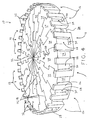
- Fig. 2 is a top plan view of a modular tank stand comprised of a plurality of tank stand sections;
- Fig. 3A is a top plan view of a single tank stand section shown in Fig. 2 ;
- Fig. 3B is a side elevation view of the tank stand section shown in Fig. 3A ;
- Fig. 3C is a top plan, cross-sectional view of the tank stand section shown in Figs. 3A and 3B ;
- Fig. 4 is a perspective view of the modular tank stand shown in Fig. 2 ;
- Fig. 5 is a schematic, perspective view showing initial steps in the assembly of the modular tank stand shown in Figs. 2 and 4 ;
- Fig. 6 is a schematic, perspective view showing additional assembly steps for mounting a storage container on the modular tank stand shown in Figs. 2 and 4 ;
- Fig. 7 is a perspective view of an assembled modular tank stand with a bulk storage container disposed thereon;
- Fig. 8 is a partial perspective, partial section view of a modular tank stand section with anchor points for seismic and wind load restraint systems
- Fig. 9 is a perspective view of a modular tank stand and bulk storage container, illustrating a wind load restraint system
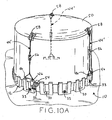
- Fig. 10A is another perspective view of a modular tank stand and bulk storage container, illustrating a wind load restraint system
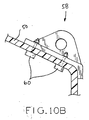
- Fig. 10B is a partial elevation, section view of the bulk storage container shown in Fig. 10A , illustrating a cable anchor;
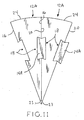
- Fig. 11 is a top plan view of another embodiment of interconnected modular tank stand sections in accordance with the present disclosure.
- Fig. 12A is a top plan view of yet another embodiment of interconnected modular tank stand sections in accordance with the present disclosure.
- Fig. 12B is an partial elevation, section view of the modular tank stand sections shown in Fig. 12A , illustrating a lateral connection assembly;
- Fig. 13A is a top plan view of still another embodiment of interconnected modular tank stand sections in accordance with the present disclosure.
- Fig. 13B is an partial elevation, section view of the modular tank stand sections shown in Fig. 13A , illustrating a lateral connection assembly.
- the present disclosure provides a modular tank stand comprised of a plurality of individual tank stand sections which may be disassembled for transport and storage. When assembled, the tank stand sections are interconnected with one another, thereby creating a lightweight and relocatable modular tank stand capable of supporting the weight of a fully filled bulk storage container.
- modular tank stand 10 includes a plurality of tank stand sections 12 which interconnect or interleave with one another to create a generally circular support surface sized and shaped to support a cylindrical bulk storage container or tank 50, as shown in Figs. 6 , 7 , 9 and 10 and described in detail below.
- bulk storage container 50 may be made of a rigid or semi-rigid rotationally molded plastic material, such as polyethylene, nylon, polyvinyl chloride (PVC), or the like.
- Container 50 is adapted to contain liquids such as industrial chemicals, petroleum products, water, food products, and the like. However, container 50 may contain and dispense any flowable material, such as granular materials, seeds and grain.
- Tank stand section 12 has a wedge or triangular shape, with acute angle ⁇ formed between radial lobe wall 16 and radial cavity wall 20.
- Radial lobe wall 16 and radial cavity wall 20 converge toward a "tip" or “point” of the wedge-shaped section 12, which is blunted to form center wall section 23.
- center wall sections 23 each define a portion of center wall 22, as illustrated in Figs. 2 and 4 .
- Radial lobe wall 16 and radial cavity wall 20 diverge toward a generally arcuate perimeter wall 24, which is disposed opposite center wall 22.
- Perimeter wall 24 forms the "triangle base" for wedge-shaped tank stand section 12.
- tank stand sections 12 include interconnecting lobes 14 protruding from radial lobe wall 16, and interconnecting cavities 18 protruding into radial cavity wall 20. Together, lobes 14 and cavities 18 form a dovetail-type connection between respective tank stand sections 12. As shown in Fig. 3C , lobe 14 defines a relatively narrow lobe width W LN at the point where lobe 14 meets radial lobe wall 16, but the lobe width steadily expands as lobe 14 extends outwardly away from lobe wall 16 to relatively wider lobe width W LW .
- cavity 18 defines a relatively narrow cavity width W CN at the point where cavity 18 meets cavity wall 20, and the cavity width steadily expands as cavity 18 extends inwardly away from cavity wall 20 to relatively wider cavity width W CW .
- widths W LN , W LW of lobe 14 is slightly less than width W CN , W CW of cavity 18, thereby providing for a clearance fit therebetween.
- the distances D1, D2 between each interconnecting lobe 14 and center wall section 23 are substantially equal to the corresponding distances D1, D2 between respective interconnecting cavities 18 and center wall section 23, allowing any tank stand section 12 to interconnect with any other tank stand section 12.
- the common shape, size and orientation between interconnecting lobes and cavities 14, 18 allows a plurality of substantially identical tank stand sections 12 to be interconnected with one another in any order to assemble modular tank stand 10.
- each tank stand section 12 has two cavities 18 on one side of each tank stand section 12 and two corresponding lobes 14 on the other side of each tank stand section 12, it is within the scope of the present disclosure that the number, location and configuration of lobes 14 and cavities 18 may be varied as required or desired for a particular application. For example, fewer or more cavities and lobes may be formed on each side of tank stand section 12, or each side may include both a cavity and a lobe.
- perimeter wall 24 includes a pair of perimeter wall columns 26. Gap 28 is formed between columns 26, with securement aperture 30 extending through a web 31 which connects end portions of perimeter wall columns 26. Lip 32 extends upwardly from a portion of columns 26. Columns 26 provide a solid structural support at perimeter wall 24, and lip 32 provides lateral support to prevent or restrain shifting or sliding of a bulk storage container disposed upon modular tank stand 10, as discussed in detail below. Securement apertures 30 facilitate anchoring of tank stand section 12 to a tank stand support surface, such as a reinforced concrete floor or pad. For example, fasteners 33 ( Fig. 5 ) may be driven through apertures 30 and into fixed engagement with the tank stand support surface. With at least two fasteners 33 driven fully into respective apertures 30 of any two of sections 12 so that the heads of fasteners 33 contact respective webs 31, modular tank stand 10 is fixedly secured to the tank stand support surface.
- the periphery of tank stand section 12 includes walls 16, 20, 23, 24, which in turn bound an upper container support surface 34.
- Lower ground contacting surface 36 ( Fig. 3B ) is disposed opposite, and spaced vertically from, container support surface 34.
- ground contacting surface 36 is parallel to container support surface 34 and surfaces 34, 36 have substantially identical outer profiles.
- Container support surface 34 forms a continuous planar surface connecting each of walls 16, 20, 23, 24.
- Container support surface 34 and ground contacting surface 36 are generally horizontal in use (as described below), and can therefore be said to occupy a lateral expanse.
- walls 16, 20, 23, 24 can be said to vertically extend between surfaces 34, 36, as walls 16, 20, 23, 24 are normal to surfaces 34, 36 along the entire respective vertical extents.
- container support surfaces may have non-planar and/or non-level lateral surfaces, such that the aggregated container support surface of modular tank stand 10 is other than flat and level.
- the aggregated container support surface may be conical, planar and sloped, spherical or any other desired shape, such as for accommodation of correspondingly shaped bottoms of bulk storage container 50.
- walls 16, 20, 23, 24 and container support surface 34 may have equal or unequal thicknesses T, and, in one embodiment, may be as thin as 0.00478 m (0.188 inches) or as thick as 38.1 mm (1.50 inches), or any thickness between the foregoing values.
- tank stand sections 12 are made of a rotationally-molded polymer material, such as polyethylene, and each of walls 16, 20, 23, 24 have a uniform thickness T of approximately 19.1 mm (0.75 inches).
- Upper container support surface 34 may also be approximately 0.75 inches thick. Walls 16, 20, 23, 24 encircle interior 25 of tank stand section 12.
- wall thicknesses T for other embodiments of modular tank stands may be less than or greater than the values described above.
- wall thickness may vary depending upon the size and weight of the container to be supported, the material(s) from which the modular tank stand is formed, the service environment of the modular tank stand, and the like.
- lower ground contact surface 36 is a substantially continuous planar surface interconnecting each of walls 16, 20, 23, 24, similar to container support surface 34.
- this closed lower surface cooperates with container support surface and walls 16, 20, 23, 24 to bound and enclose interior 25.
- Interior 25 may be formed as a sealed enclosure during the manufacturing process (as described below), thereby preventing ingress of potentially bacteria-forming fluids into interior 25.
- ground contacting surface 36 may have drain holes (not shown) formed therein, or may be a completely open profile, i.e., may be comprised only of the edges of walls 16, 20, 23, 24.
- walls 16, 20, 23, 24 and surfaces 34 and/or 36 at least partially bound interior 25, which is hollow or substantially hollow.
- interior 25 being "substantially hollow” contemplates all or part of interior 25 including a material having a lower density than the material of walls 16, 20, 23, 24 and/or surfaces 34, 36.
- Such lower density material may include sponge material, honeycomb or other matrix-based structures, expanded foams, insulations, and the like.
- the hollowness or substantial hollowness of interior 25 reduces the weight of tank support sections 12, while the design of walls 16, 20, 23, 24 and surfaces 34, 36 provides ample support for the weight of bulk storage container 50 on support surfaces 34, as shown in Fig. 7 and described in detail below.
- modular tank stand 10 is assembled by interconnecting a plurality of tank stand sections 12.
- a first tank stand section 12 is positioned to receive a bulk storage container on a flat and level tank stand support surface of suitable size and strength for supporting tank stand 10, container 50 ( Fig. 7 ) and any flowable material to be stored in container 50.
- Exemplary support surfaces include concrete container pads and reinforced concrete warehouse floors adapted to support the weight of a fully loaded container.
- Lower ground contacting surface 36 of a first tank stand section 12 is positioned to rest upon the tank stand support surface, such that lip 32 extends upwardly away from the support surface.
- a second tank stand section 12 is lowered into engagement with the first tank stand section 12 by vertically sliding interconnecting lobes 14 of the second tank stand section 12 into interconnecting cavity 18 of the first tank stand section 12.
- the radial lobe wall 16 of one of the tank stand sections 12 is disposed adjacent or abutting the radial cavity wall 20 of the other tank stand section 12.
- Additional tank stand sections 12 are similarly vertically lowered into interconnected engagement with adjacent tank stand sections 12.
- a generally circular, substantially continuous, aggregated support surface comprised of the various support surfaces 34 of tank stand sections 12 is formed.
- twelve (12) to eighteen (18) tank stand sections are used to create a complete modular tank stand.
- eighteen (18) of tank stand sections 12 are used to create modular tank stand 10.
- angle ⁇ ( Fig. 3C ) of each tank stand section 12 is approximately 20 degrees, so that eighteen (18) of tank stand sections 12 create the 360 degree circular profile shown in Fig. 2 .
- angle ⁇ can be calculated for any given number of tank stand sections 12 by dividing 360 degrees by the number of sections 12 to be used.
- the number of tank stand sections used to complete modular tank stand 10 may be reduced or increased, i.e., angle ⁇ of tank stand sections 12 may be made larger or smaller, so that as few as two or as many as several dozen tank stand sections may be used as constituent pieces of the complete modular tank stand.
- the modular tank stand may also be a single circular piece, i.e., tank stand sections 12 may be fused to one another or integrally formed as a single unit.
- lobes 14 are monolithically, integrally, and unitarily formed as a part of tank stand section 12.
- some clearance is provided between interconnecting lobes 14 and interconnecting cavities 18 (i.e., lobe width is slightly less than cavity width, as noted above). This clearance allows the respective sections 12 to be easily slid into place.
- the aggregated tolerances between the various tank stand sections 12 allow the assembler to slightly shift adjacent sections 12, as necessary, when the final tank stand section 12 is added to modular tank stand assembly 10.
- lobes 14 may also be formed as structures separate and distinct from tank stand section 12.
- tank stand sections 12A still include walls 16, 20, 23, 24, but walls 16, 20 both include cavities 18 and both exclude lobes 14.
- the function provided by lobe 14 in tank stand section 12 is instead accomplished by a "figure-8" type key 14A can be vertically lowered into a pair of adj acent cavities 18 when tank stand sections 12A are aligned as shown.
- a "lobe" corresponding to lobe 14 is provided by the portion of key 14A that extends away from walls 16 and/or 20.
- key 14A provides a non-integral, removable lobe for interconnection with cavity 18.
- tank stand sections 12B include recesses 100 formed adjacent walls 16 and 20, with stanchions 102 occupying part of recesses 100.
- Stanchions 102 are joined to one another by connecting band 104, which thereby joins tank stand sections 12B to one another.
- stanchions 102 may have an annular recess 106 to aid in retention of band 104.
- Connecting bank 104 may be an adjustable hose clamp-type device, or elastomeric device, or nylon webbing, or the like.
- tank stand sections 12C may include lobe 14C which maintains a constant width as it extends away from wall 16.
- cavity 18C also maintains a constant width as it extends into wall 20.
- Lobe 14C includes aperture 108, extending vertically therethrough, while cavity 18C has aperture 110 extending vertically through the upper and lower walls bounding cavity 18C.
- Lobe 14C is matingly received in cavity 18C, and pin 112 (see Fig. 13B ) is driven through apertures 108, 110 to interconnect a pair of tank stand sections 12C.
- connection methods and devices may be used to join respective tank stand sections to one another to form a complete modular tank stand.
- Some such devices include traditional (i.e., threaded) fasteners, adhesives, hook-and-loop type fasteners, rivets, and the like.
- Connection methods may include welding, fusing or melting tank stand sections to one another.
- these alternative methods of connection preserve the lateral securement of tank stand sections 12 with respect to one another (i.e., preventing or restricting any lateral movement of sections 12 with respect to adjacent sections 12), while still allowing for vertical-movement methods of assembly and disassembly as described herein.
- tank stand sections may not be fastened to one another, but simply arranged adjacent one another to form a container support surface.
- the aggregated tolerances between interconnecting lobes 14 and cavities 18 of tank stand sections 12 can render the container support surface of modular stand 10 slightly oval or oblong.
- strap 38 may optionally be provided to ensure that modular tank stand 10 defines a circular support surface prior to installation of bulk storage container 50. Strap 38 is loosely wrapped around the perimeter of modular tank stand 10, such that strap 38 comes into contact with perimeter columns 26 of respective tank stand sections 12.
- a generally cylindrical pipe or shaft 40 ( Fig. 6 ) having an axial length equal to height H of tank stand sections 12 is optionally assembled into the central aperture of modular tank stand 10, such that shaft 40 sits adjacent center wall 22.
- Strap 38 is then tightened around the perimeter of modular tank stand 10, which induces a radial inward force that draws tank stand sections 12 toward shaft 40 and creates a true circular profile of the aggregated container support surface (which, as noted above, consists of all container support surfaces 34 in modular tank stand 10).
- center support plate 42 may then be placed over shaft 40. Center support plate 42 extends past center wall 22, providing surface continuity between the respective container support surfaces 34 around the perimeter of center wall 22.
- container 50 may include spout 52 disposed at a bottom portion thereof to facilitate complete drainage of the contents of container 50 through spout 52.
- Spout 52 includes spout flange 54 which extends below the bottom surface of container 50.
- modular tank stand 10 elevates container 50 so that spout flange 54 is spaced from the underlying support surface.
- modular tank stand 10 facilitates complete drainage of bulk storage container 50 via spout 52 using only gravity by facilitating the placement of spout 52 at the bottom of container 50.
- modular tank stand 10 may be called upon to support and contain bulk storage container 50 during seismic activity.
- modular tank stand 10 provides a seismic restraint system including of a plurality of fasteners 33 ( Figs. 6 and 8 ), which prevent movement of modular tank stand 10 with respect to the underlying support surface.
- the seismic restraint system further includes upwardly extending lips 32, which prevent movement of bulk storage container 50 with respect to modular tank stand 10.
- a plurality of fasteners 33 are driven through respective, opposed securement apertures 30 to secure webs 31 of tank stand sections 12 to substrate G of the underlying tank stand support surface, as discussed above.
- fasteners 33 may be used to attach some or all of tank stand sections 12 to the container support surface, with Fig. 9 illustrating the use of a fastener 33 for every third securement aperture 30, and Fig. 10A illustrating a fastener 33 in every other securement aperture 30.
- any number of fasteners 33 may be employed in establishing seismic restraint for modular tank stand 10, as required or desired for a particular application.
- modular tank stand 10 is effectively prevented from any movements commonly associated with seismic activity, such as sliding or "skittering" across the support surface. Lips 32, in turn, prevent any sliding or skittering of bulk storage container 50 with respect to modular tank stand 10.
- modular tank stand 10 may also be used in environments with potentially heavy winds.
- modular tank stand 10 can be provided with a wind-load restraint system.
- the wind-load restraint system includes fasteners 33, as discussed above with respect to the seismic restraint system, which prevent lateral movement of bulk storage container 50.
- the wind-load restraint system further includes tie-down cables 44, 44' ( Figs. 9 and 10 ), which prevent vertical movement or "tipping" of bulk storage container 50.
- a first tie-down cable 44 passes through a pair of eye bolts 46 in one of tank stand sections 12, passes over the top of bulk storage container 50, and passes through another pair of eye bolts 46 in an opposing tank stand section 12.
- a second tie-down cable 44 is similarly routed, but positioned to intersect the first tie down cable 44 at the top of bulk storage container 50.
- ring 49 is secured to cables 44 at the junction thereof.
- Eye bolts 46 are firmly affixed to respective tank stand sections 12 via a molded-in anchoring assembly 48 ( Fig. 8 ).
- Anchoring assembly 48 includes baseplate 48A with an internally threaded hex nut 48B fixed (i.e.,welded) thereto.
- Anchoring assembly is embedded into the material of column 26 (and, more particularly, of lip 32), such that only the threaded opening to nut 48B is exposed at the top of lip 32. Eye bolt 46 threads into nut 48B via this exposed opening to affix eye bolt 46 to anchoring assembly 48.
- turnbuckles 56 can be used to effectively shorten each of cables 44, placing cables 44 under tension and thereby vertically securing bulk storage container 50 to modular tank stand 10.
- baseplates 48A are oriented to offer maximum resistance to the pull forces generated when cable 44 is placed under tension, both from tightening cables 44 and from wind loads on container 50.
- both modular tank stand 10 and bulk storage container 50 are fully constrained against motion, in that fasteners 33 and lip 32 cooperate to prevent any sliding motions (as discussed above) and cables 44 prevent any vertical motion of container 50.
- Fig. 10A another embodiment of a wind-load restrain system is shown.
- cables 44' extend only up the sides of container 50 and connect to upper anchors 58.
- Upper anchors may be integrally, monolithically molded as part of bulk storage container 50 (such as by rotational molding), or may be attached separately.
- anchors 58 are bolted to bulk storage container 50 with fasteners 60. Cables 44' are otherwise operated similarly, with cables 44 attached at the bottom end to eye bolts 46 and turnbuckles 56 used to cinch cables 44' to secure container 50 to modular tank stand 10.
- any number of cables 44, 44' may be used to secure container 50 to modular tank stand 10. Although two cables 44 are shown in Fig. 9 and three cables 44' are shown in Fig. 10A for simplicity, every radial section 12 includes anchoring assembly 48 and can therefore potentially provide an anchor point for cables 44, 44'.
- Modular tank stands in accordance with the present disclosure have weight bearing thresholds high enough to support the weight of a fully filled bulk storage container, including during application of dynamic loads (such as seismic activity, for example).
- the tank stand sections are lightweight and small enough to facilitate transport and storage of the sections of a disassembled modular tank stand.
- modular tank stand 10 is capable of supporting bulk storage container 50 having a base diameter of about 3.05 m (10 feet) and weighing in excess of 68.000 kg (150,000 lbs).
- Tank stand sections 12 have a weight of about 31.8 kg (70 lbs), for a total weight of modular tank stand 10, which has eighteen (18) tank stand sections 12, of 572 kg (1260 lbs).
- Each tank stand section 12 also has an overall length of just over 1.5 m (5 feet).
- the small size and light weight of tank stand sections 12 make assembly, disassembly and relocation of modular tank stand 10 possible for two unassisted workers or one worker assisted by light-duty handling equipment.
- tank stand sections 12 define vertical height H between container support surface 34 and ground contact surface 36, which amply elevates container 50 to facilitate the use of bottom-mounted drain structures.
- height H is 0.305 m (12 inches), which elevates container 50 sufficiently to allow a pump (not shown) to be positioned below the bottom of container 50, thereby ensuring adequate head for the pump inlet even when container 50 is nearly empty.
- elevation of the bottom of container 50 protects a full-drain outlet from contacting the ground, even where the full-drain outlet includes structures that extend past the bottom surface of container 50.
- One exemplary full-drain outlet assembly which can be beneficially paired with modular tank stand 10 is described in U.S. Provisional Patent Application Serial No. 61/323,146 , entitled METAL INSERT FITTING FOR POLYETHYLENE TANKS and filed April 12, 2010.
- the vertical orientation of walls 16, 20; 23, 24 provides a high level of vertical structural support for bulk storage container 50.
- the assembly of tank stand sections 12 in modular tank stand 10 positions lobe walls 16 adjacent or abutting cavity walls 20, effectively doubling the thickness of the support column provided by individual walls 16, 20.
- This "double wall” configuration further enhances the vertical support capabilities of modular tank stand 10.
- the "interconnecting" functionality of lobes 14 and cavities 18 prevents tank stand sections from splaying or separating under the pressure of a loaded storage container 50, so that the aggregated support surface comprised of surfaces 34 retains its original shape and form.
- the arcuate bends and angles create a corrugated profile in walls 16, 20, 23, 24, which provides superior lateral support and prevents shear forces from folding, buckling or otherwise toppling any of the walls.
- a straight wall which resists shear force resistance in two directions, namely along the longitudinal extent of the wall, but offers little shear force resistance in other directions; hence, an otherwise unsupported straight wall is easily toppled.
- the bends formed in walls 16, 20, 23, 24 provide stability and shear force resistance in all directions, so that tank stand sections 12 are capable of absorbing the dynamic forces associated with forces exerted on bulk storage container 50 while it is supported by modular tank stand 10.
- lobes 14 and cavities 18 provide resistance to any lateral movement that may be urged by the weight of container 50, such as radial outward shifting of tank stand sections 12 or the opening of gaps between adjacent tank stand sections 12. Because tank stand sections 12 are laterally interconnected with one another, none of tank stand sections 12 can be “pulled out” from modular tank stand 10 or otherwise laterally moved with respect to one another. Rather, removal of any of tank stand sections 12 requires that it be vertically lifted away, as discussed above, but such vertical movement is obstructed and/or resisted by the presence and weight of container 50 and its contents.
- the weight of container 50 which might otherwise tend to urge separation of tank stand sections 12 from modular tank stand 10, instead contributes to the stability of the assembly, such that modular tank stand 10 remains reliably unitary whole while in service.
- tank stand sections 12 ensure that the amount of wall support per unit area of the container support surfaces 34, or "wall density,” continuously increases from the perimeter walls 24 to the center wall 22.
- this steady increase in wall density toward the center of modular tank stand 10 corresponds with a potential increase in pressure arising from the weight of bulk storage container 50 and its contents.
- container 50 are made of a semi-rigid material, such as polyethylene. In certain conditions, such as a high vapor pressure within container 50, the semi-rigid material may develop a slight "bulge" in the bottom surface of container 50. Such a bulge typically occurs toward the center of container 50, and may result in increased pressure near the center of modular tank stand 10, where a high wall density is available to support the additional pressure.
- lips 32 formed in perimeter wall columns 26 prevent bulk storage container 50 from sliding relative to modular tank stand 10.
- the resistance of tank stand 10 to shear forces provided by walls 16, 20, 23, 24 cooperates with the resistance to shift of bulk storage container 50 provided by lip 32 to make modular tank stand 10 a suitable support structure for bulk storage container 50 when dynamic or vibration forces are applied, such as forces due to seismic activity. That is to say, in addition to the ability of modular tank stand 10 to withstand large amounts of weight placed upon container support surfaces 34, modular tank stand 10 is also capable of withstanding the dynamic forces associated with acceleration of bulk storage container 50 arising from shifting or movement of bulk container 50. Such acceleration forces may arise from seismic activity or wind loads, for example, as described in detail above.
- Tank stand sections 12 may be made from a variety of materials, such as polymeric materials.
- tank stand sections 12 are made of rotationally-molded polyethylene.
- polyethylene resists degradation from chemical and/or petroleum exposure, such as from chemicals or petroleum products which may be contained by container 50. Thus, the dripping or spillage of flowable materials from container 50 will not compromise the structural integrity or longevity of modular tank stand 10.
- Polyethylene is also suitable for corrosive environments, such as near saltwater or exposed to ultraviolet light from the sun.
- Yet a further advantage of polymers generally is that they can be made in a variety of different colors, which may be used to distinguish between materials contained in respective bulk storage containers 50 mounted to tank stand 10.
- the durometer range of polyethylene materials represents a good compromise between impact resistance (a quality typically associated with low-durometer, softer materials) and strength (a quality typically associated with higher-durometer, harder materials).
- polymeric materials suitable for use with the present disclosure include polyvinyl chloride (PVC), polypropylene, and polyvinylidene fluoride (PVDF) such as Kynar (Kynar is a registered trademark of Pennsalt Chemicals Corporation of Philadelphia, PA).
- PVDF polyvinylidene fluoride
- Kynar Kynar is a registered trademark of Pennsalt Chemicals Corporation of Philadelphia, PA.
- the above-mentioned polymeric materials are particularly suitable for rotational molding processes. It is contemplated that other materials may be used in conjunction with other manufacturing techniques.
- the overall size of modular tank stand 10 may be made larger or smaller to accommodate different sizes of bulk storage container 50.
- a modular tank stand made in accordance with the present disclosure may have an overall support surface diameter of between about 2.44 m (8 feet) and about 3.66 m (12 feet) for many industrial applications, or may have any other size as required or desired for a particular application.
- a modular tank stand in accordance with the present disclosure may have a container support surface with any profile, such as square, rectangular, polygonal, or the like, to accommodate bulk storage containers having a variety of footprints.
- the tank stand sections may take other forms, such as squares, rectangles, or the like.
- the tank stand sections may have a variety of modular "puzzle piece" configurations which can be assembled into a variety of differently-shaped container support surfaces.
- Modular tank stand 10 was constructed and assembled as discussed above.
- modular tank stand 10 has a container support surface diameter of about 3.07 m (121-7/8 inches) and an overall diameter of about 3.2 m (126 inches).
- the container support surface is elevated about 12 inches above the underlying tank stand support surface (in this case, the ground).
- Eighteen tank stand sections were used, each having a tank stand section angle ⁇ of approximately 20 degrees, as shown in the figures and described in detail above.
- Tank stand sections 12 are made of polyethylene material, and the thickness of walls 16, 20, 23, 24 are all approximately 19.1 m (0.75 inches).
- the overall length of each tank stand section 12 is about 1.52 m (60-7/8 inches).
- the load distribution fixture comprised a 1.37 x 2.29 m (54-inch-by-90-inch) steel plate set on top of a 3.05 m (10-foot) diameter circular wooden plate covering the entire container support surface.
- the servo hydraulic actuators were 1.83 m (72 inches) apart, with modular tank stand 10 centered beneath the actuators.
- Linear variable differential transformers were used to measure downward deflections of two of container support surfaces 34 and outward or radial deflections of three of perimeter walls 24 within gaps 28. Each of the tested perimeter walls 24 was separated approximately 120 degrees from the others, i.e., the testing points of radial walls 24 were evenly distributed about the periphery of modular tank stand 10.
- Modular tank stand 10 was loaded in compression (i.e., downward force was applied) at a rate of 3180 kg/min (7 kip/min) to a maximum load of 139.000 kg (307 kip). Visual inspections of modular tank stand 10 and sensor displacement measurements were performed when loads of 31800 kg (70 kip), 68.000 kg (150 kip), 106.000 kg (233 kip) and 139.000 kg (307 kip) were achieved. The maximum load of 139.000 kg (307 kip) was maintained for 8 hours and 45 minutes before releasing the load to 2370 kg (5.231 kip).
- modular tank stand 10 In service, modular tank stand 10 is sized to support container 50 having a capacity of 31.8 m 3 (8,400 gallons) of material for a total supported weight of up to 69.400 kg (153,000 lbs). Thus, modular tank stand 10 was subjected to a sustained load of approximately double its maximum anticipated service load of 1.89 kg/cm 2 (27 lb. per square inch) of container support surface area.
- Radial deflection of a first perimeter wall 24 was 1.22 mm (0.048 inches) at the maximum load of 139.000 kg (307 kip), and increased to 1.32 mm (0.052 inches) after the 139.000 kg (307 kip) load was sustained for 8 hours, 45 minutes.
- Radial deflection of a second perimeter wall 24 was 0.102 mm (0.004 inches) at the maximum load of 139.000 kg (307 kip), and increased to 0.152 mm (0.006 inches) after the 139.000 kg (307 kip) load was sustained for 8 hours, 45 minutes.
- Radial deflection of a third perimeter wall 24 was 0.711 mm (0.028 inches) at the maximum load of 139.000 kg (307 kip), and increased to 0.737 mm (0.029 inches) after the 139.000 kg (307 kip) load was sustained for 8 hours, 45 minutes.
Landscapes
- Engineering & Computer Science (AREA)
- Mechanical Engineering (AREA)
- Filling Or Discharging Of Gas Storage Vessels (AREA)
Claims (15)
- Section de support de réservoir (12) permettant d'assembler un support de réservoir modulaire (10) en imbriquant une pluralité de sections de support de réservoir (12), la section de support de réservoir (12) comprenant :- une surface touchant le sol (36) ;- une surface de support du récipient (34), distante verticalement de la surface touchant le sol (36) ;- une première paroi (16) s'étirant entre la surface touchant le sol (36) et la surface de support du récipient (34) ; et au moins un lobe (14) dépassant de la première paroi (16) ;- une seconde paroi (20) s'étirant entre la surface touchant le sol (36) et la surface de support du récipient (34) ; et- au moins une cavité (18) associée à la seconde paroi (20) et dimensionnée pour recevoir un lobe (14) suivant la direction verticale d'insertion, lorsqu'on la relie à une section voisine de support de réservoir (12) ;le lobe (14) et la cavité (18) coopérant pour restreindre le déplacement latéral, les unes par rapport aux autres, des sections de support de réservoir (12) imbriquées, tout en autorisant le déplacement vertical, les unes par rapport aux autres, des sections de support de réservoir (12) imbriquées,
caractérisée en ce que- la première et la seconde parois latérales (16, 20) s'étirent entre une paroi centrale (22) et une paroi périphérique (24) et définissent un angle aigu, de sorte que ladite première paroi latérale (16) et ladite seconde paroi latérale (20) convergent vers la paroi centrale (22) et divergent vers ladite paroi périphérique (24),- chacune des sections de support de réservoir (12) étant généralement cunéiforme. - Section de support de réservoir (12) selon la revendication 1, caractérisée en ce que le lobe (14) est formé d'un seul tenant avec la section de support de réservoir (12).
- Section de support de réservoir (12) selon la revendication 1, caractérisée en ce que le lobe (14) est formé séparément de la section de support de réservoir (12).
- Section de support de réservoir (12) selon l'une quelconque des revendications précédentes, caractérisée en ce que :- le lobe (14) définit une largeur de lobe latérale qui augmente à mesure que ledit lobe s'étire depuis la première paroi (16) vers l'extérieur, et- la cavité (18) définit une largeur de cavité latérale qui augmente à mesure que ladite cavité s'étire depuis ladite seconde paroi (16) vers l'intérieur,de sorte que les élargissements du lobe coopèrent avec les élargissements de la cavité pour que s'imbriquent latéralement une première et une seconde sections de support de réservoir, tout en autorisant ledit déplacement vertical d'une première section de réservoir par rapport à une seconde section de support de réservoir.
- Support de réservoir modulaire (10) assemblé à partir d'une pluralité de sections de support de réservoir (12) selon l'une quelconque des revendications 1 à 4.
- Support de réservoir modulaire (10) selon la revendication 5, caractérisé en ce que :- la pluralité de sections de support de réservoir (12) consiste en une quantité prédéfinie de sections de support de réservoir pouvant être fixées les unes aux autres de façon modulaire,- ledit angle aigu formé entre ladite première paroi latérale (16) et ladite seconde paroi latérale (16) est égal à 360° divisés par la quantité prédéfinie de sections de support de réservoir, de manière à pouvoir fixer les unes aux autres les sections de support de réservoir, pour créer une surface agrégée de support de récipient comprenant une première surface de support de récipient (34) et une seconde surface de support de récipient (34), de taille et de forme étudiées pour supporter un récipient de stockage de vrac (50).
- Support de réservoir modulaire (10) selon la revendication 5 ou 6, caractérisé par :- un rebord (32) s'étirant vers le haut depuis l'une au moins des surfaces de support de récipient (34), ledit rebord étant placé en périphérie de l'une desdites première (16) et seconde (16) parois, respectivement ; et- une structure d'ancrage (48) fixée audit rebord et pouvant être reliée à un câble (44).
- Support de réservoir modulaire (10) selon la revendication 5, 6 ou 7, caractérisé en ce que lesdites première et seconde parois (16) sont respectivement perpendiculaires auxdites surfaces de support de récipient (34) et sont par conséquent orientées à la verticale.
- Support de réservoir modulaire (10) selon l'une quelconque des revendications 5 à 8, caractérisé en ce que l'une au moins desdites première et seconde parois (16) encercle une cavité intérieure (25) desdites sections de support de réservoir (12), respectivement.
- Support de réservoir modulaire (10) selon l'une quelconque des revendications 5 à 9, caractérisé en ce que l'une au moins desdites sections de support de réservoir (12) est constituée d'un polymère.
- Procédé de construction d'un support de réservoir modulaire (10) destiné à supporter un récipient de stockage de vrac (50), le procédé se caractérisant en ce qu'il consiste à :- fournir une pluralité de sections de support de réservoir (12) selon les revendications 1 à 4, chaque section de support de réservoir comprenant dont chacune comprend une surface de support de récipient (34) et une paroi (16) s'étirant depuis la surface de support de récipient, chacune des sections de support de réservoir comprenant au moins l'un de :• un lobe (14) associé à la paroi et définissant une largeur de lobe latérale qui augmente à mesure que le lobe s'étire depuis la paroi vers l'extérieur, et• une cavité (18) associée à la paroi, la cavité définissant une largeur de cavité latérale qui augmente à mesure que la cavité s'étire depuis la paroi vers l'intérieur ;- placer une première section de support de réservoir (12) sur une surface de support sous-jacente, propre à supporter le poids du support de réservoir modulaire et un récipient de stockage de vrac plein ; et imbriquer la cavité et le lobe en abaissant verticalement une seconde section de support de réservoir (12) pour l'engager dans la première section de support de réservoir, ladite étape d'imbrication empêchant tout déplacement latéral entre la première et la seconde sections de support de réservoir.
- Procédé selon la revendication 11, caractérisée en ce que :- ladite étape de fourniture d'une pluralité de sections de support de réservoir (12) comprend la fourniture d'une pluralité de sections de support de réservoir cunéiformes, dotées chacune d'une première et d'une seconde parois latérales (16) définissant un angle aigu qui converge vers une paroi centrale (22),
et- ladite étape d'imbrication de la cavité (18) et du lobe (14) comprend le placement de la première paroi latérale de la première section de support de réservoir à côté de la seconde paroi latérale de la seconde section de support de réservoir, de sorte que les parois centrales de la première et de la seconde sections de support de réservoir soient également adjacentes. - Procédé selon la revendication 12, caractérisé par l'imbrication en série de sections supplémentaires de support de réservoir (12) entre elles pour former une surface agrégée de support de récipient, de taille et de forme étudiées pour s'adapter au récipient de stockage de vrac (50).
- Procédé selon la revendication 13, associé à un procédé d'ancrage du récipient de stockage de vrac (50) au support de réservoir modulaire (10), le procédé se caractérisant en ce qu'il consiste à :- poser le récipient de stockage de vrac sur la surface agrégée de support de récipient ;- fixer un câble (44) à une première section de la pluralité de sections de support de réservoir (12) ;- passer le câble par-dessus le sommet du récipient de stockage de vrac ; et- fixer le câble à une autre section de la pluralité de sections de support de réservoir, généralement opposée à la première section de support de réservoir.
- Procédé selon l'une quelconque des revendications 12 à 14, associé à un procédé d'ancrage du support de réservoir modulaire (10) à la surface de support sous-jacente, le procédé consistant à :- prévoir un orifice de fixation (30) dans au moins la première section de support de réservoir (12), l'orifice de fixation étant adjacent à la surface de support sous-jacente après ladite étape de placement sur celle-ci d'une première section de support de réservoir ;- passer une attache (33) à travers l'orifice de fixation et dans la surface de support sous-jacente pour y fixer la première section de support de réservoir.
Applications Claiming Priority (1)
| Application Number | Priority Date | Filing Date | Title |
|---|---|---|---|
| US30924310P | 2010-03-01 | 2010-03-01 |
Publications (2)
| Publication Number | Publication Date |
|---|---|
| EP2363346A1 EP2363346A1 (fr) | 2011-09-07 |
| EP2363346B1 true EP2363346B1 (fr) | 2012-08-22 |
Family
ID=43827778
Family Applications (1)
| Application Number | Title | Priority Date | Filing Date |
|---|---|---|---|
| EP20110001607 Active EP2363346B1 (fr) | 2010-03-01 | 2011-02-28 | Support de réservoir modulaire |
Country Status (3)
| Country | Link |
|---|---|
| US (1) | US8814110B2 (fr) |
| EP (1) | EP2363346B1 (fr) |
| CA (1) | CA2732982C (fr) |
Families Citing this family (16)
| Publication number | Priority date | Publication date | Assignee | Title |
|---|---|---|---|---|
| US9737654B2 (en) | 2011-12-29 | 2017-08-22 | Medline Industries, Inc. | Intravenous pole base having tessellating elements |
| US11813425B2 (en) * | 2011-12-29 | 2023-11-14 | Medline Industries, Lp | Apparatus pertaining to a base for a vertical support pole |
| US20140230348A1 (en) * | 2013-02-20 | 2014-08-21 | Hot Wheels Services, Inc. | Tank Stand |
| US20150114957A1 (en) * | 2013-10-28 | 2015-04-30 | Jerry W. Noles, Jr. | Modular Fluid Storage Tank |
| US20150114958A1 (en) * | 2013-10-28 | 2015-04-30 | Jerry W. Noles, Jr. | Modular Fluid Storage Tank |
| US9346584B1 (en) * | 2014-06-16 | 2016-05-24 | Murray Services Inc. | Tank battery pedestal system |
| US9254034B2 (en) * | 2014-07-03 | 2016-02-09 | Welter's Co., Ltd. | Combination dining turntable that is extended infinitely |
| USD837415S1 (en) * | 2015-11-16 | 2019-01-01 | Decora S.A. | Floor surface underlayment |
| USD837416S1 (en) * | 2015-11-16 | 2019-01-01 | Decora S.A. | Floor surface underlayment |
| US11427379B2 (en) * | 2020-02-14 | 2022-08-30 | Thomas M Fitzgerald | Modular pallet system |
| USD939042S1 (en) * | 2020-11-11 | 2021-12-21 | Shenzhen Otter Pump Industry Co., Ltd | Fountain |
| US12145794B2 (en) * | 2021-03-04 | 2024-11-19 | The Dragon Group, LLC | Hinge system and method of manufacture |
| US12522400B2 (en) * | 2022-05-05 | 2026-01-13 | Bozel North America Llc | Load carrying structure |
| US12533610B2 (en) | 2023-03-14 | 2026-01-27 | Sam Tyler | Device and method for emptying water treatment vessels |
| USD1086358S1 (en) | 2023-12-05 | 2025-07-29 | Sam Tyler | Water treatment vessel emptying device |
| CN119929357B (zh) * | 2025-04-08 | 2025-06-24 | 中太能源科技(上海)有限公司 | 绝热罐底部支撑结构及其安装方法 |
Family Cites Families (54)
| Publication number | Priority date | Publication date | Assignee | Title |
|---|---|---|---|---|
| US3131829A (en) | 1961-11-14 | 1964-05-05 | Spencer Chem Co | Article-carrying container |
| US3470656A (en) | 1967-09-13 | 1969-10-07 | Rohr Corp | On-site fabricated glass reinforced resin storage tank |
| US3541977A (en) * | 1968-11-25 | 1970-11-24 | David H Waldman | Pallet for transportation and storage of toroidal shaped articles |
| US3650224A (en) | 1969-08-25 | 1972-03-21 | William C Holden | Warehousing pallet |
| US3683825A (en) | 1970-11-23 | 1972-08-15 | Marvin Sheldon | Folding table |
| US3753407A (en) * | 1972-04-05 | 1973-08-21 | Kaiser Aluminium Chem Corp | Convertible shipping pallet |
| US3819138A (en) | 1972-07-17 | 1974-06-25 | Rehkopf Ind Inc | Chock cradle |
| GB1512450A (en) | 1975-05-06 | 1978-06-01 | Mitsubishi Chem Ind | Plastics pallet |
| US4008669A (en) * | 1975-11-28 | 1977-02-22 | Robert Earl Sumrell | Resiliently biased tie-down anchor |
| US4660733A (en) | 1981-06-08 | 1987-04-28 | Snyder Industries, Inc. | Cone bottom tank and liftable tank support |
| US4847028A (en) | 1981-06-08 | 1989-07-11 | Snyder Industries, Inc. | Molding method for a container with internal projections |
| CA1225941A (fr) | 1985-01-22 | 1987-08-25 | Larry R. Hughes | Contenant d'expedition pliant |
| FR2631928A2 (fr) * | 1987-10-27 | 1989-12-01 | Cosmetic Production | Boites pour le conditionnement ou le rangement d'objets divers |
| US4829909A (en) * | 1987-11-19 | 1989-05-16 | Mandel Ronald L | Material transporting arrangement |
| CA1261769A (fr) | 1987-12-08 | 1989-09-26 | Bruce Pett | Conteneur de transport |
| US5117596A (en) | 1990-01-05 | 1992-06-02 | Wenger Corporation | Portable dance floor |
| US5173346A (en) * | 1990-06-18 | 1992-12-22 | Breck Middleton | Foldable sponge mat for surgical applications |
| US5105746A (en) * | 1990-07-19 | 1992-04-21 | E. I. Du Pont De Nemours And Company | Interlocking pallet |
| FR2682021B3 (fr) | 1991-10-02 | 1993-09-24 | Lacroix Michel | Dispositif pour augmenter la capacite de recevoir d'une table. |
| US5199570A (en) | 1991-12-02 | 1993-04-06 | Bonar Inc. | Liquid transportation container |
| GB2263684A (en) | 1992-02-03 | 1993-08-04 | Lin Pac Mouldings | Interlockable pallets. |
| US5226558A (en) * | 1992-05-01 | 1993-07-13 | Rotonics Manufacturing, Inc. | Transportable multi-use storage container and pallet system |
| CH685276A5 (de) | 1992-11-25 | 1995-05-31 | Werner Schmidt | Bausatz zur Herstellung von Regalen, Schränken und Wohnwänden und Regale, Schränke und Wohnwände hergestellt mit diesem Bausatz. |
| US5490603A (en) | 1994-09-06 | 1996-02-13 | Snyder Industries, Inc. | Fluid tank apparatus |
| US5809905A (en) | 1995-09-05 | 1998-09-22 | Plastic Pallet Production, Inc. | Vertical interlocking modular pallet apparatus and method of construction |
| CA2176330A1 (fr) * | 1996-05-10 | 1997-11-11 | Peter L. Castle | Paillasson a encart publicitaire illumine |
| US20050217188A1 (en) * | 1996-09-04 | 2005-10-06 | Burns Peter R | Ground anchors with compression plates |
| US5860369A (en) * | 1996-11-26 | 1999-01-19 | Plastic Pallet Production, Inc. | Interlocking modular pallet apparatus and method of construction |
| USD404236S (en) * | 1997-02-24 | 1999-01-19 | Nolato Sunnex Equipment Ab | Work-floormat made of rubber |
| US5904021A (en) * | 1997-07-29 | 1999-05-18 | Fisher; Kirk R. | Modular flooring recreational use |
| DE29800696U1 (de) | 1998-01-16 | 1998-03-12 | Chen, Pi-Chi, Taichung | Transportfahrzeug |
| US6079580A (en) | 1998-04-15 | 2000-06-27 | Snyder Industries, Inc. | Molded tank |
| US6116552A (en) | 1998-08-12 | 2000-09-12 | Deere Company | Reinforced plastic tank support |
| DE29903247U1 (de) | 1999-02-23 | 1999-07-29 | Chen, Pi Chi, Taichung | Transporteinheit |
| US6193099B1 (en) | 1999-03-29 | 2001-02-27 | Snyder Industries, Inc. | Rotationally molded part having integrally formed reinforcement |
| US6276285B1 (en) * | 1999-12-03 | 2001-08-21 | Wayne P. Ruch | Barrel carrying device |
| US6474496B1 (en) | 2000-03-06 | 2002-11-05 | Snyder Industries, Inc. | Containment tank assembly |
| US6247594B1 (en) | 2000-08-31 | 2001-06-19 | Snyder Industries, Inc. | Fluid tank assembly |
| US6484899B1 (en) | 2000-10-31 | 2002-11-26 | Snyder Industries, Inc. | Fluid tank assembly |
| US6561739B1 (en) * | 2001-10-25 | 2003-05-13 | The United States Of America As Represented By The Secretary Of The Navy | Load transporting modular platform system |
| US6588167B2 (en) * | 2001-11-21 | 2003-07-08 | Kuo Chi Chang | Reversible dual-color floor pad module |
| US7426890B2 (en) * | 2002-09-18 | 2008-09-23 | Susan Olvey | Force-resisting support assembly |
| GB2395188A (en) | 2002-11-14 | 2004-05-19 | Best Caddy Co Ltd | Compact cart assembly |
| US7004082B2 (en) * | 2003-05-14 | 2006-02-28 | Jim Chi Hsiang Yang | Outdoor table, outdoor table and chair set |
| US7059575B2 (en) | 2003-08-07 | 2006-06-13 | Snyder Industries, Inc. | Industrial tank support |
| US10390647B2 (en) * | 2004-04-08 | 2019-08-27 | Parallax Group International, Llc | Floor matting |
| US7107914B2 (en) | 2004-05-04 | 2006-09-19 | Sherman Brad J | Modular table system |
| WO2008022380A1 (fr) | 2006-08-21 | 2008-02-28 | Bluescope Steel Limited | Modules de plate-forme sous forme de palette, plancher, coffrage et socle |
| US7334529B1 (en) | 2006-09-29 | 2008-02-26 | Lih Yann Industrial Co. Ltd. | Metal support base |
| US20090232632A1 (en) | 2008-03-14 | 2009-09-17 | Baltz Kyle L | Support platform |
| US8025468B2 (en) * | 2008-04-01 | 2011-09-27 | Paul Sever | Metal coil securing apparatus and method |
| USD587948S1 (en) * | 2008-07-15 | 2009-03-10 | Ying-Kuang Lai | Interconnectable module for plastic floor base |
| US8176857B2 (en) * | 2010-03-24 | 2012-05-15 | Ochs Kyle A | Versatile furniture units suitable for children |
| CN201822558U (zh) * | 2010-10-29 | 2011-05-11 | 常熟市豪毅纺织厂 | 透气防滑地垫 |
-
2011
- 2011-02-25 US US13/034,908 patent/US8814110B2/en active Active
- 2011-02-28 CA CA2732982A patent/CA2732982C/fr active Active
- 2011-02-28 EP EP20110001607 patent/EP2363346B1/fr active Active
Also Published As
| Publication number | Publication date |
|---|---|
| CA2732982C (fr) | 2016-05-03 |
| CA2732982A1 (fr) | 2011-09-01 |
| US8814110B2 (en) | 2014-08-26 |
| EP2363346A1 (fr) | 2011-09-07 |
| US20110240806A1 (en) | 2011-10-06 |
Similar Documents
| Publication | Publication Date | Title |
|---|---|---|
| EP2363346B1 (fr) | Support de réservoir modulaire | |
| US4218859A (en) | Working bin | |
| AU2008287621B2 (en) | A structure | |
| US11028586B2 (en) | Structural member connection system | |
| EP0104027B1 (fr) | Réservoirs de stockage sectionnels | |
| US20160024811A1 (en) | Grain storage structure | |
| US20140000189A1 (en) | Granular material storage container and associated method | |
| EP1165404B1 (fr) | Recipient de stockage | |
| CA2712029C (fr) | Support de passerelle integre | |
| US5615608A (en) | Reinforced containment pallet | |
| CA2958109A1 (fr) | Structure en beton modulaire | |
| US5408790A (en) | Modular dock system | |
| US20100307072A1 (en) | Roof structure for a grain bin | |
| US10532854B2 (en) | Drum stacking assembly | |
| US3842775A (en) | Tank for storing fluids on a ship or the like and tie down means therefor | |
| US20190264461A1 (en) | Earthquake dampening platform for a ground level storage vessel | |
| US4561222A (en) | Large container especially a silo | |
| NL1031468C2 (nl) | Systeem en werkwijze voor het vervaardigen van betonnen houders. | |
| CA1193560A (fr) | Conteneur compartimente pour reservoirs de dimensions diverses | |
| KR101957441B1 (ko) | 물탱크용 건식 패드 및 이를 이용한 물탱크용 건식지지 조립체 | |
| EA039456B1 (ru) | Транспортировочный контейнер с дополнительными подъемными петлями | |
| US4610376A (en) | Bulk storage containers | |
| EP2853512B1 (fr) | Dispositif pour relier un moyen de levage, tel qu'une grue, à un objet qui doit être soulevé | |
| AU687987B2 (en) | Storage tanks | |
| AU733349B2 (en) | Bearer plate |
Legal Events
| Date | Code | Title | Description |
|---|---|---|---|
| PUAI | Public reference made under article 153(3) epc to a published international application that has entered the european phase |
Free format text: ORIGINAL CODE: 0009012 |
|
| AK | Designated contracting states |
Kind code of ref document: A1 Designated state(s): AL AT BE BG CH CY CZ DE DK EE ES FI FR GB GR HR HU IE IS IT LI LT LU LV MC MK MT NL NO PL PT RO RS SE SI SK SM TR |
|
| AX | Request for extension of the european patent |
Extension state: BA ME |
|
| 17P | Request for examination filed |
Effective date: 20111206 |
|
| GRAP | Despatch of communication of intention to grant a patent |
Free format text: ORIGINAL CODE: EPIDOSNIGR1 |
|
| RIC1 | Information provided on ipc code assigned before grant |
Ipc: B65D 19/00 20060101AFI20120206BHEP |
|
| GRAS | Grant fee paid |
Free format text: ORIGINAL CODE: EPIDOSNIGR3 |
|
| GRAA | (expected) grant |
Free format text: ORIGINAL CODE: 0009210 |
|
| AK | Designated contracting states |
Kind code of ref document: B1 Designated state(s): AL AT BE BG CH CY CZ DE DK EE ES FI FR GB GR HR HU IE IS IT LI LT LU LV MC MK MT NL NO PL PT RO RS SE SI SK SM TR |
|
| REG | Reference to a national code |
Ref country code: GB Ref legal event code: FG4D |
|
| REG | Reference to a national code |
Ref country code: CH Ref legal event code: EP |
|
| REG | Reference to a national code |
Ref country code: IE Ref legal event code: FG4D |
|
| REG | Reference to a national code |
Ref country code: AT Ref legal event code: REF Ref document number: 571834 Country of ref document: AT Kind code of ref document: T Effective date: 20120915 |
|
| REG | Reference to a national code |
Ref country code: DE Ref legal event code: R096 Ref document number: 602011000131 Country of ref document: DE Effective date: 20121018 |
|
| REG | Reference to a national code |
Ref country code: NL Ref legal event code: VDEP Effective date: 20120822 |
|
| REG | Reference to a national code |
Ref country code: AT Ref legal event code: MK05 Ref document number: 571834 Country of ref document: AT Kind code of ref document: T Effective date: 20120822 |
|
| REG | Reference to a national code |
Ref country code: LT Ref legal event code: MG4D Effective date: 20120822 |
|
| PG25 | Lapsed in a contracting state [announced via postgrant information from national office to epo] |
Ref country code: IS Free format text: LAPSE BECAUSE OF FAILURE TO SUBMIT A TRANSLATION OF THE DESCRIPTION OR TO PAY THE FEE WITHIN THE PRESCRIBED TIME-LIMIT Effective date: 20121222 Ref country code: FI Free format text: LAPSE BECAUSE OF FAILURE TO SUBMIT A TRANSLATION OF THE DESCRIPTION OR TO PAY THE FEE WITHIN THE PRESCRIBED TIME-LIMIT Effective date: 20120822 Ref country code: AT Free format text: LAPSE BECAUSE OF FAILURE TO SUBMIT A TRANSLATION OF THE DESCRIPTION OR TO PAY THE FEE WITHIN THE PRESCRIBED TIME-LIMIT Effective date: 20120822 Ref country code: HR Free format text: LAPSE BECAUSE OF FAILURE TO SUBMIT A TRANSLATION OF THE DESCRIPTION OR TO PAY THE FEE WITHIN THE PRESCRIBED TIME-LIMIT Effective date: 20120822 Ref country code: LT Free format text: LAPSE BECAUSE OF FAILURE TO SUBMIT A TRANSLATION OF THE DESCRIPTION OR TO PAY THE FEE WITHIN THE PRESCRIBED TIME-LIMIT Effective date: 20120822 Ref country code: NO Free format text: LAPSE BECAUSE OF FAILURE TO SUBMIT A TRANSLATION OF THE DESCRIPTION OR TO PAY THE FEE WITHIN THE PRESCRIBED TIME-LIMIT Effective date: 20121122 |
|
| PG25 | Lapsed in a contracting state [announced via postgrant information from national office to epo] |
Ref country code: GR Free format text: LAPSE BECAUSE OF FAILURE TO SUBMIT A TRANSLATION OF THE DESCRIPTION OR TO PAY THE FEE WITHIN THE PRESCRIBED TIME-LIMIT Effective date: 20121123 Ref country code: PT Free format text: LAPSE BECAUSE OF FAILURE TO SUBMIT A TRANSLATION OF THE DESCRIPTION OR TO PAY THE FEE WITHIN THE PRESCRIBED TIME-LIMIT Effective date: 20121224 Ref country code: SI Free format text: LAPSE BECAUSE OF FAILURE TO SUBMIT A TRANSLATION OF THE DESCRIPTION OR TO PAY THE FEE WITHIN THE PRESCRIBED TIME-LIMIT Effective date: 20120822 Ref country code: LV Free format text: LAPSE BECAUSE OF FAILURE TO SUBMIT A TRANSLATION OF THE DESCRIPTION OR TO PAY THE FEE WITHIN THE PRESCRIBED TIME-LIMIT Effective date: 20120822 Ref country code: BE Free format text: LAPSE BECAUSE OF FAILURE TO SUBMIT A TRANSLATION OF THE DESCRIPTION OR TO PAY THE FEE WITHIN THE PRESCRIBED TIME-LIMIT Effective date: 20120822 Ref country code: SE Free format text: LAPSE BECAUSE OF FAILURE TO SUBMIT A TRANSLATION OF THE DESCRIPTION OR TO PAY THE FEE WITHIN THE PRESCRIBED TIME-LIMIT Effective date: 20120822 |
|
| PG25 | Lapsed in a contracting state [announced via postgrant information from national office to epo] |
Ref country code: NL Free format text: LAPSE BECAUSE OF FAILURE TO SUBMIT A TRANSLATION OF THE DESCRIPTION OR TO PAY THE FEE WITHIN THE PRESCRIBED TIME-LIMIT Effective date: 20120822 |
|
| PG25 | Lapsed in a contracting state [announced via postgrant information from national office to epo] |
Ref country code: EE Free format text: LAPSE BECAUSE OF FAILURE TO SUBMIT A TRANSLATION OF THE DESCRIPTION OR TO PAY THE FEE WITHIN THE PRESCRIBED TIME-LIMIT Effective date: 20120822 Ref country code: RO Free format text: LAPSE BECAUSE OF FAILURE TO SUBMIT A TRANSLATION OF THE DESCRIPTION OR TO PAY THE FEE WITHIN THE PRESCRIBED TIME-LIMIT Effective date: 20120822 Ref country code: DK Free format text: LAPSE BECAUSE OF FAILURE TO SUBMIT A TRANSLATION OF THE DESCRIPTION OR TO PAY THE FEE WITHIN THE PRESCRIBED TIME-LIMIT Effective date: 20120822 Ref country code: CZ Free format text: LAPSE BECAUSE OF FAILURE TO SUBMIT A TRANSLATION OF THE DESCRIPTION OR TO PAY THE FEE WITHIN THE PRESCRIBED TIME-LIMIT Effective date: 20120822 |
|
| PG25 | Lapsed in a contracting state [announced via postgrant information from national office to epo] |
Ref country code: SK Free format text: LAPSE BECAUSE OF FAILURE TO SUBMIT A TRANSLATION OF THE DESCRIPTION OR TO PAY THE FEE WITHIN THE PRESCRIBED TIME-LIMIT Effective date: 20120822 Ref country code: PL Free format text: LAPSE BECAUSE OF FAILURE TO SUBMIT A TRANSLATION OF THE DESCRIPTION OR TO PAY THE FEE WITHIN THE PRESCRIBED TIME-LIMIT Effective date: 20120822 Ref country code: IT Free format text: LAPSE BECAUSE OF FAILURE TO SUBMIT A TRANSLATION OF THE DESCRIPTION OR TO PAY THE FEE WITHIN THE PRESCRIBED TIME-LIMIT Effective date: 20120822 |
|
| PLBE | No opposition filed within time limit |
Free format text: ORIGINAL CODE: 0009261 |
|
| STAA | Information on the status of an ep patent application or granted ep patent |
Free format text: STATUS: NO OPPOSITION FILED WITHIN TIME LIMIT |
|
| 26N | No opposition filed |
Effective date: 20130523 |
|
| PG25 | Lapsed in a contracting state [announced via postgrant information from national office to epo] |
Ref country code: BG Free format text: LAPSE BECAUSE OF FAILURE TO SUBMIT A TRANSLATION OF THE DESCRIPTION OR TO PAY THE FEE WITHIN THE PRESCRIBED TIME-LIMIT Effective date: 20121122 Ref country code: RS Free format text: LAPSE BECAUSE OF FAILURE TO SUBMIT A TRANSLATION OF THE DESCRIPTION OR TO PAY THE FEE WITHIN THE PRESCRIBED TIME-LIMIT Effective date: 20120822 |
|
| REG | Reference to a national code |
Ref country code: DE Ref legal event code: R097 Ref document number: 602011000131 Country of ref document: DE Effective date: 20130523 |
|
| PG25 | Lapsed in a contracting state [announced via postgrant information from national office to epo] |
Ref country code: MC Free format text: LAPSE BECAUSE OF NON-PAYMENT OF DUE FEES Effective date: 20130228 |
|
| PG25 | Lapsed in a contracting state [announced via postgrant information from national office to epo] |
Ref country code: ES Free format text: LAPSE BECAUSE OF FAILURE TO SUBMIT A TRANSLATION OF THE DESCRIPTION OR TO PAY THE FEE WITHIN THE PRESCRIBED TIME-LIMIT Effective date: 20121203 |
|
| REG | Reference to a national code |
Ref country code: FR Ref legal event code: ST Effective date: 20131031 |
|
| PG25 | Lapsed in a contracting state [announced via postgrant information from national office to epo] |
Ref country code: CY Free format text: LAPSE BECAUSE OF FAILURE TO SUBMIT A TRANSLATION OF THE DESCRIPTION OR TO PAY THE FEE WITHIN THE PRESCRIBED TIME-LIMIT Effective date: 20120822 |
|
| REG | Reference to a national code |
Ref country code: IE Ref legal event code: MM4A |
|
| PG25 | Lapsed in a contracting state [announced via postgrant information from national office to epo] |
Ref country code: FR Free format text: LAPSE BECAUSE OF NON-PAYMENT OF DUE FEES Effective date: 20130228 Ref country code: AL Free format text: LAPSE BECAUSE OF FAILURE TO SUBMIT A TRANSLATION OF THE DESCRIPTION OR TO PAY THE FEE WITHIN THE PRESCRIBED TIME-LIMIT Effective date: 20120822 Ref country code: IE Free format text: LAPSE BECAUSE OF NON-PAYMENT OF DUE FEES Effective date: 20130228 |
|
| PG25 | Lapsed in a contracting state [announced via postgrant information from national office to epo] |
Ref country code: MT Free format text: LAPSE BECAUSE OF FAILURE TO SUBMIT A TRANSLATION OF THE DESCRIPTION OR TO PAY THE FEE WITHIN THE PRESCRIBED TIME-LIMIT Effective date: 20120822 |
|
| REG | Reference to a national code |
Ref country code: CH Ref legal event code: PL |
|
| PG25 | Lapsed in a contracting state [announced via postgrant information from national office to epo] |
Ref country code: CH Free format text: LAPSE BECAUSE OF NON-PAYMENT OF DUE FEES Effective date: 20140228 Ref country code: LI Free format text: LAPSE BECAUSE OF NON-PAYMENT OF DUE FEES Effective date: 20140228 |
|
| PG25 | Lapsed in a contracting state [announced via postgrant information from national office to epo] |
Ref country code: SM Free format text: LAPSE BECAUSE OF FAILURE TO SUBMIT A TRANSLATION OF THE DESCRIPTION OR TO PAY THE FEE WITHIN THE PRESCRIBED TIME-LIMIT Effective date: 20120822 |
|
| PG25 | Lapsed in a contracting state [announced via postgrant information from national office to epo] |
Ref country code: TR Free format text: LAPSE BECAUSE OF FAILURE TO SUBMIT A TRANSLATION OF THE DESCRIPTION OR TO PAY THE FEE WITHIN THE PRESCRIBED TIME-LIMIT Effective date: 20120822 |
|
| PG25 | Lapsed in a contracting state [announced via postgrant information from national office to epo] |
Ref country code: LU Free format text: LAPSE BECAUSE OF NON-PAYMENT OF DUE FEES Effective date: 20130228 Ref country code: MK Free format text: LAPSE BECAUSE OF FAILURE TO SUBMIT A TRANSLATION OF THE DESCRIPTION OR TO PAY THE FEE WITHIN THE PRESCRIBED TIME-LIMIT Effective date: 20120822 Ref country code: HU Free format text: LAPSE BECAUSE OF FAILURE TO SUBMIT A TRANSLATION OF THE DESCRIPTION OR TO PAY THE FEE WITHIN THE PRESCRIBED TIME-LIMIT; INVALID AB INITIO Effective date: 20110228 |
|
| GBPC | Gb: european patent ceased through non-payment of renewal fee |
Effective date: 20150228 |
|
| PG25 | Lapsed in a contracting state [announced via postgrant information from national office to epo] |
Ref country code: GB Free format text: LAPSE BECAUSE OF NON-PAYMENT OF DUE FEES Effective date: 20150228 |
|
| REG | Reference to a national code |
Ref country code: DE Ref legal event code: R081 Ref document number: 602011000131 Country of ref document: DE Owner name: ASSMANN CORPORATION OF AMERICA, GARRETT, US Free format text: FORMER OWNER: ROTO ENGINEERING GMBH, 60596 FRANKFURT, DE |
|
| P01 | Opt-out of the competence of the unified patent court (upc) registered |
Effective date: 20230428 |
|
| REG | Reference to a national code |
Ref country code: DE Ref legal event code: R082 Ref document number: 602011000131 Country of ref document: DE Representative=s name: MAUCHER JENKINS PATENTANWAELTE & RECHTSANWAELT, DE |
|
| PGFP | Annual fee paid to national office [announced via postgrant information from national office to epo] |
Ref country code: DE Payment date: 20260102 Year of fee payment: 16 |