EP2365459A2 - Datenspeichervorrichtung - Google Patents
Datenspeichervorrichtung Download PDFInfo
- Publication number
- EP2365459A2 EP2365459A2 EP11157476A EP11157476A EP2365459A2 EP 2365459 A2 EP2365459 A2 EP 2365459A2 EP 11157476 A EP11157476 A EP 11157476A EP 11157476 A EP11157476 A EP 11157476A EP 2365459 A2 EP2365459 A2 EP 2365459A2
- Authority
- EP
- European Patent Office
- Prior art keywords
- data storage
- storage device
- data
- transmission control
- control device
- Prior art date
- Legal status (The legal status is an assumption and is not a legal conclusion. Google has not performed a legal analysis and makes no representation as to the accuracy of the status listed.)
- Ceased
Links
Images

Classifications
-
- G—PHYSICS
- G06—COMPUTING OR CALCULATING; COUNTING
- G06F—ELECTRIC DIGITAL DATA PROCESSING
- G06F21/00—Security arrangements for protecting computers, components thereof, programs or data against unauthorised activity
- G06F21/70—Protecting specific internal or peripheral components, in which the protection of a component leads to protection of the entire computer
- G06F21/88—Detecting or preventing theft or loss
-
- G—PHYSICS
- G06—COMPUTING OR CALCULATING; COUNTING
- G06F—ELECTRIC DIGITAL DATA PROCESSING
- G06F21/00—Security arrangements for protecting computers, components thereof, programs or data against unauthorised activity
- G06F21/30—Authentication, i.e. establishing the identity or authorisation of security principals
- G06F21/31—User authentication
- G06F21/34—User authentication involving the use of external additional devices, e.g. dongles or smart cards
- G06F21/35—User authentication involving the use of external additional devices, e.g. dongles or smart cards communicating wirelessly
-
- G—PHYSICS
- G06—COMPUTING OR CALCULATING; COUNTING
- G06F—ELECTRIC DIGITAL DATA PROCESSING
- G06F21/00—Security arrangements for protecting computers, components thereof, programs or data against unauthorised activity
- G06F21/30—Authentication, i.e. establishing the identity or authorisation of security principals
- G06F21/31—User authentication
- G06F21/34—User authentication involving the use of external additional devices, e.g. dongles or smart cards
-
- G—PHYSICS
- G06—COMPUTING OR CALCULATING; COUNTING
- G06F—ELECTRIC DIGITAL DATA PROCESSING
- G06F21/00—Security arrangements for protecting computers, components thereof, programs or data against unauthorised activity
- G06F21/70—Protecting specific internal or peripheral components, in which the protection of a component leads to protection of the entire computer
- G06F21/71—Protecting specific internal or peripheral components, in which the protection of a component leads to protection of the entire computer to assure secure computing or processing of information
- G06F21/72—Protecting specific internal or peripheral components, in which the protection of a component leads to protection of the entire computer to assure secure computing or processing of information in cryptographic circuits
-
- G—PHYSICS
- G06—COMPUTING OR CALCULATING; COUNTING
- G06F—ELECTRIC DIGITAL DATA PROCESSING
- G06F21/00—Security arrangements for protecting computers, components thereof, programs or data against unauthorised activity
- G06F21/70—Protecting specific internal or peripheral components, in which the protection of a component leads to protection of the entire computer
- G06F21/78—Protecting specific internal or peripheral components, in which the protection of a component leads to protection of the entire computer to assure secure storage of data
-
- G—PHYSICS
- G06—COMPUTING OR CALCULATING; COUNTING
- G06F—ELECTRIC DIGITAL DATA PROCESSING
- G06F21/00—Security arrangements for protecting computers, components thereof, programs or data against unauthorised activity
- G06F21/70—Protecting specific internal or peripheral components, in which the protection of a component leads to protection of the entire computer
- G06F21/78—Protecting specific internal or peripheral components, in which the protection of a component leads to protection of the entire computer to assure secure storage of data
- G06F21/79—Protecting specific internal or peripheral components, in which the protection of a component leads to protection of the entire computer to assure secure storage of data in semiconductor storage media, e.g. directly-addressable memories
-
- G—PHYSICS
- G06—COMPUTING OR CALCULATING; COUNTING
- G06F—ELECTRIC DIGITAL DATA PROCESSING
- G06F21/00—Security arrangements for protecting computers, components thereof, programs or data against unauthorised activity
- G06F21/70—Protecting specific internal or peripheral components, in which the protection of a component leads to protection of the entire computer
- G06F21/78—Protecting specific internal or peripheral components, in which the protection of a component leads to protection of the entire computer to assure secure storage of data
- G06F21/80—Protecting specific internal or peripheral components, in which the protection of a component leads to protection of the entire computer to assure secure storage of data in storage media based on magnetic or optical technology, e.g. disks with sectors
-
- G—PHYSICS
- G06—COMPUTING OR CALCULATING; COUNTING
- G06F—ELECTRIC DIGITAL DATA PROCESSING
- G06F21/00—Security arrangements for protecting computers, components thereof, programs or data against unauthorised activity
- G06F21/70—Protecting specific internal or peripheral components, in which the protection of a component leads to protection of the entire computer
- G06F21/82—Protecting input, output or interconnection devices
- G06F21/85—Protecting input, output or interconnection devices interconnection devices, e.g. bus-connected or in-line devices
-
- H—ELECTRICITY
- H04—ELECTRIC COMMUNICATION TECHNIQUE
- H04W—WIRELESS COMMUNICATION NETWORKS
- H04W12/00—Security arrangements; Authentication; Protecting privacy or anonymity
- H04W12/02—Protecting privacy or anonymity, e.g. protecting personally identifiable information [PII]
-
- H—ELECTRICITY
- H04—ELECTRIC COMMUNICATION TECHNIQUE
- H04W—WIRELESS COMMUNICATION NETWORKS
- H04W12/00—Security arrangements; Authentication; Protecting privacy or anonymity
- H04W12/50—Secure pairing of devices
-
- G—PHYSICS
- G06—COMPUTING OR CALCULATING; COUNTING
- G06F—ELECTRIC DIGITAL DATA PROCESSING
- G06F2221/00—Indexing scheme relating to security arrangements for protecting computers, components thereof, programs or data against unauthorised activity
- G06F2221/21—Indexing scheme relating to G06F21/00 and subgroups addressing additional information or applications relating to security arrangements for protecting computers, components thereof, programs or data against unauthorised activity
- G06F2221/2111—Location-sensitive, e.g. geographical location, GPS
-
- G—PHYSICS
- G06—COMPUTING OR CALCULATING; COUNTING
- G06F—ELECTRIC DIGITAL DATA PROCESSING
- G06F2221/00—Indexing scheme relating to security arrangements for protecting computers, components thereof, programs or data against unauthorised activity
- G06F2221/21—Indexing scheme relating to G06F21/00 and subgroups addressing additional information or applications relating to security arrangements for protecting computers, components thereof, programs or data against unauthorised activity
- G06F2221/2129—Authenticate client device independently of the user
-
- H—ELECTRICITY
- H04—ELECTRIC COMMUNICATION TECHNIQUE
- H04W—WIRELESS COMMUNICATION NETWORKS
- H04W4/00—Services specially adapted for wireless communication networks; Facilities therefor
- H04W4/02—Services making use of location information
Definitions
- USB flash drives consist of a flash memory data storage device integrated with a USB interface. Such USB flash drives are typically removable and rewritable. These devices are extremely common where data can be transferred via the drive from one location to another.
- the USB flash drive typically may be of the order of 7-10 cm long and 1-2 cm wide having a storage capacity typically up to around 256GB and as such a large amount of data can be stored and carried from one location to another.
- USB flash drives are typically powered by the USB connection and therefore do not require a battery. They include a printed circuit board which carries the circuit element and the USB connector.
- USB flash drives With wide deployment of flash drives, the issue of data and information security is particularly important.
- Current security measures generally include the use of encryption.
- USB flash drive due to the nature of the USB flash drive with their small size, they can be easily misplaced, left behind or otherwise lost. This is a particular problem if the data they contain is sensitive and for this reason software encryption systems are utilised.
- a third party can connect the USB device and potentially break the encryption code.
- the present invention provides a secure memory storage system.
- a data storage apparatus comprising:
- the transmission control device which may in one embodiment be a key, and preferably a USB connecting key, may be (preferably physically) connected to a further device (e.g. a host device such as a personal computer) for example and is configured to enable transfer of information between the host device to the data storage device.
- a further device e.g. a host device such as a personal computer
- a further device e.g. a host device such as a personal computer
- password protection is analogous to the transmission control device of the present invention, in the absence of such password data may transfer freely, however without the transmission control device of the present invention data cannot be transferred.
- password protection present in networks does not include connection between the password protection and the server, rather the laptop for example is allowed to connect directly to the server.
- the data storage device beneficially has no exterior ports for enabling connection to the further device for data transfer therebetween.
- the data storage device may be free of physical external ports, and may be sealed to prevent liquid ingress. Access to the internals of the data storage device may therefore be prevented.
- the transmission control device enables or allows a direct data transfer path between the further device and the data storage device.
- data does not pass via or through the transmission control device.
- the transmission control device beneficially provides an intermediate data transfer path between the data storage device and the further device.
- a significant benefit associated with the data stored on the host device being transmitted via the transmission control device is that if a virus is present on the host device, the transmission control device will act as a barrier to prevent the virus being sent to the data storage device and the transmission control device will be affected only.
- the further device is beneficially a data source or a data destination.
- the data source may comprise a host device such as a host computer stored on which is data which may be transferred to the data storage device.
- a data destination may be a data reader or data player which may be a means, for example, to play music.
- the data storage device is beneficially matched to the transmission control device, meaning that the data storage device cannot be accessed without the matched transmission control device. Furthermore, the data storage device is predisposed to be matched to one or more specific transmission control devices.
- the transmission control device beneficially has an interface for connecting to the further device.
- the interface for connecting the transmission control device to the further device is beneficially a universal serial bus (USB) connection. Such a connection has in recent years become fairly standard for portable data storage transfer.
- the transmission control device beneficially comprises a transmitter for transmitting data to the data storage device.
- the transmission control device beneficially includes an identifier for matching with the data storage device.
- an identifier enables the transmission control device to allow communication with and user access to the data storage device through the transmission control device or the data source directly assuming that a user input which allows matching of the data storage device and the transmission control device is correct.
- the identifier may allow direct communication between the data storage device and the host device. The identifier thus acts effectively as a key to allow access to the data storage device.
- the data storage device beneficially further comprises a transmitter for transmitting data to the transmission control device, and the transmission control device beneficially comprises a receiver for receiving data from the data storage device wherein the data is preferably encrypted. Accordingly, the data can be transferred both from the host device such as the computer to the data storage device and vice versa.
- the transmission control device beneficially comprises means to enable power to be drawn from the data source.
- the transmission control device and the data storage device beneficially communicate via a wireless communication network.
- Such means of transfer is particularly advantageous as it enables there to be no external data transfer ports on the data storage device. Instead, the only means for uploading or downloading the stored electronic data is via the transmission control device (which may be termed a "key").
- a suitable wireless communication may be via Bluetooth, Zigbee or radio frequency modules.
- the data is beneficially transferred between the data storage and the transmission control device via short length radio waves.
- the benefits of data transfer through the use of Bluetooth are:
- Bluetooth is particularly suitable due to its security features.
- the transmission control device includes software configured such that the transmission control device is password protected. This means that when the transmission control device is in communication with a data source such as a personal computer, a password is beneficially required in order that the transmission control device can communicate with the personal computer. Alternatively or beneficially in addition, once a successful password is entered, a further identifier must be entered in order that the transmission control device may communicate with the data storage device. Beneficially, an additional level of security is provided wherein data transmitted is encrypted by the transmission control device before transmitting to the data storage device.
- the transmission control device beneficially comprises an encryption processor for performing encryption operations on data prior to transferring to the data storage device.
- the data storage device preferably comprises an encryption processor for performing encryption operations on data prior to transferring the data to the transmission control device.
- the data storage device beneficially comprises a rechargeable power source.
- the power source is beneficially rechargeable via an access port in the data storage device.
- the power source is beneficially a rechargeable battery.
- the power source is rechargeable through a wireless charging system.
- the wireless charging system may beneficially utilise magnetic induction.
- the system even more beneficially comprises a component including an induction coil.
- the data storage device comprises a battery configured to be charged via an induction coil.
- the data storage device may include means to identify the device to a global positioning system. Such means is beneficial as the location of the device may be monitored, for example, in the event that it is stolen or lost it is possible that the device may be located and retrieved.
- the data storage device may further include a radio frequency tag or label (which may comprise an identifier, which alternatively may comprise that found in SIM card technology).
- the data storage device beneficially further comprises a tag for providing information for identifying the location of the data storage device. This is beneficial should the data storage device be lost.
- the tag beneficially further comprises a receiver for receiving an interrogation signal from a remote location and a transmitter for transmitting a signal therefrom.
- the data storage device may further be configured in order that in the event that the data storage device is lost, the data storage device may be formatted to remove data therefrom, or alternatively the data could be removed and transmitted to a remote location.
- the tag beneficially comprises a radio frequency tag.
- the present invention also extends to an embodiment wherein the data storage device may be able to transmit or beneficially stream data to enable a reader to read the data, which may be, for example, video feed or music feed. Also according to the present invention there is a data storage system comprising:
- a data source (subsequently referred to in the exemplary embodiments on a host device) is shown connected via a USB connection, to the transmission control device (now referred to as a "key").
- a physical connection may therefore be provided between the host device and the key.
- USB flash memory devices include the memory capability incorporated into the device which physically connects to the host device.
- the key can communicate wirelessly with the memory device.
- the key and the data storage device are matched (non-physically) together such that matching keys and data storage devices can communicate whereas unmatched keys and data storage devices cannot communicate.
- a significant benefit of such an arrangement is the security afforded to the data stored on the data storage device.
- a user In order to access such data a user must have the key and the associated linked data storage device and must also have one or more identifiers for enabling access to the data storage device.
- a first identifier is beneficially required when the transmission control device is in communication with a host device such that the host device may communicate with the key.
- the host device side application requires the entering of an identifier such as access code or PIN which enables the user to use the key. This may be set by the user in the set up stage for each key. Each key beneficially has a unique identifier to allow the data storage device to pair with a maximum number of keys. Accordingly, it is not possible to access the data storage device without a matched key.
- an identifier such as access code or PIN which enables the user to use the key. This may be set by the user in the set up stage for each key.
- Each key beneficially has a unique identifier to allow the data storage device to pair with a maximum number of keys. Accordingly, it is not possible to access the data storage device without a matched key.
- the data storage device may be accessed via two keys such that two separate users may access the data storage device independently.
- a third party can be given a key such that the third party can obtain access to the data storage device.
- This is analogous to providing a spare car key, which allows the primary user to continue to use the car if the first key is lost or misplaced and also allows a chosen third party to access and use the car.
- the identifier for each of the transmission control devices to enable each transmission control device to be accessed via the work station may be different, however preferably all utilise the same identifier. This identifier may be set by the user and altered as often as desired.
- each key may have a unique identifier to allow the data storage device to pair to a maximum of, for example, two keys.
- at least one existing key will have to be removed.
- the data storage device will be formatted to remove data therefrom in the event of removing an existing pair of keys. The user may be prompted to enter an identifier to confirm that the user is entitled to access the storage device. On using for a first time, the user is beneficially requested to enter a unique identifier such as a new PIN number.
- Data transmitted between the key and the data storage device is beneficially encrypted using an encryption code thereby ensuring the wireless communication security is maximised.
- Bluetooth connection is beneficially utilised as it requires a higher level of security compared to radio frequency or zigbee and the communication range can be limited to approximately 1 metre.
- the encryption code is a sequence used to encrypt and decrypt the wireless data in the communications.
- the software is configured such that entering of either the identifiers that are required for the host device to communicate with the key and the key to communicate with the data storage device incorrectly three times may result in the formatting of the memory and/or the cause the key and/or storage device to be permanently locked. Once the identifiers have been entered, the user may, via the work station, transfer data between the work station and the data storage device via the key.
- more than one user may have access to the data storage device. Accordingly, more than one key may be provided.
- a host device such as a computer in a public place for example
- a third party cannot access the data storage device in the first event wherein the authorised user has the data storage device. Without the necessary identifiers (or access codes), an unauthorised user would not be able to enable the key to communicate with the host device.
- the key beneficially comprises a processor which may be for example an 8-bit processor, and an encryption code-processor beneficially using the Advanced Encryption Standard (AES).
- a dedicated radio and USB transceiver is provided utilising a wide range of frequencies.
- a local memory which may be unsecured and unencrypted of, for example, 32MB is provided which is used to provide the user with the installation programme for the key to allow the use of the device by the workstation.
- Such a key may be of small size and low weight.
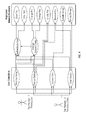
- the data storage device includes a user interface enabling the user to access the data storage device from the host device and includes mass storage memory, the size of which may be altered depending on specific requirements. In the example as shown in Figure 2 , there is a mass storage memory of 1 GB.
- a battery is also beneficially provided in order to power the data storage device. In the examples shown a rechargeable lithium iron battery may be provided. A port for mains charging of the battery may also be provided, however it is preferable that no exterior ports in the data storage device housing are provided thereby improving security.
- the data storage device may be completely sealed and may be charged via, for example, magnetic induction charging.
- Wireless charging may be achieved through the provision of a pad having an array of coils therein which spread a low power magnetic field over the pad's surface so that the data storage device located on the surface can intercept the charging flux. Accordingly, the battery may be charged wirelessly.
- the data storage device includes one or more contacts, similar or the same as provided in a typical rechargeable home telephone that communicate with corresponding contacts in a receiving cradle. Such a receiving cradle comprises connection means to a power supply.
- the radio transmitter/receiver and the processor may be formed on the same support. Accordingly, the key and the data storage device may be extremely small.
- FIG. 3 there is an alternative configuration for the key and data storage device.
- a stand alone radio transceiver is provided and a 32-bit processor is incorporated into both a key and data storage device.
- Such a processor has improved scalability with low cost.
- the arrangement as represented in Figure 3 increases the IC count due to the radio transceiver and processor being separate however this results in the casing for the key and data storage device respectfully to be of larger size.
- power and scalability is improved due to the larger processor.
- FIG. 4 there is a schematic representation of the operations that a first primary user and a second secondary user may carry out with respect to the key and the data storage device.
- the primary user can set up the apparatus for first use, change settings, access data and also clear the data storage device. Once the device is active and working, providing the secondary user has the key and the appropriate identifiers they too will be able to not only access the data but also change settings and clear/format the data storage device.
- the key is plugged into a host device such as a PC or lap top and the user must enter an identifier such as a pass code.
- the pass code may comprise of 4 characters using both numerals and letters.
- the user will initially be provided with a pass code and then may enter an alternative code during first use set up. Once the correct pass code is entered, the PC or lap top is allowed to communicate with the key. Following this, a further identifier such as a pass code to enable communication between the data storage device and key must be entered. This may be for example a 13 digit encrypted coded key and can be either numerical or letters.
- the software is configured to automatically freeze the device and make the information stored on the data storage device inaccessible.
- the key, the data storage device, and the at least two identifiers are all required. Accordingly, if, for example, either the key or the data storage device were left unattended, an unauthorised user could not access the stored data.
- a further feature of the present invention may include a portion or separate portion of memory provided on the data storage device that saves information relating to the use of the data storage device. For example, this information may be accessed by a primary user only and provide information relating to files that have been viewed and/or added at a certain time and date. Furthermore, information could be provided and stored confirming when data from the data storage device has been downloaded. If there is more than one key in use, then this information may also show and identify which key was used. Such information should beneficially be controlled by the primary user.
- the data may be stored in a text file.
- the data storage device and the key is provided to a third party, which includes a draft, for example, of a document then monitoring of the use of this document may be made and logged. Furthermore, files stored on the data storage device may be changed to be read only thereby preventing access and/or modification by certain people even if they have a key.
- An additional feature of the present arrangement may include a GPS tracking system which enables remote location of the data storage device.
- the data storage device may be configured to enable the information stored on the data storage device to be remotely formatted using radio frequency connections.
- Each data storage device may therefore contain an individual identifier such as serial number for the GPS system to locate the device and differentiate it from other similar devices.
- wireless radio links similar to SIM cards in mobile phones may be utilised.
- an anti-virus type software application may be stored on a separate memory component on the circuit board in the data storage device which debilitates or at least modifies the capabilities or behaviour of the equipment should an unauthorised user attempt to gain access to the data stored on the data storage device.
- a radio frequency tag may be utilised which may comprise an integrated circuit for storing and processing information, modulating, and demodulating a radio frequency signal.
- An antenna is also beneficially provided for receiving and transmitting a signal. Accordingly, the location of the data storage device may be monitored.
- a further additional feature and capability of the invention would be to stream files from the data storage device direct to, for example, portable players but never send the files themselves.
- This feature would allow the likes of a music track to be streamed through a remote player but the track itself would never be sent to the external source.
- music files could be loaded onto the data storage device and the music streamed onto a portable music player, meaning that the music data is retained onto the data storage device but is played through a remote player.
- the remote player may be configured to receive the data storage device.
- An exemplary embodiment of the present invention configured to stream data may be to provide a host device such as a PC or it is envisaged a data storage device which may be provided in a shop having data comprising music or film thereon may have incorporated therein a key which is matched to a data storage device.
- the data storage device may be purchased which is matched to the data source in, for example, the shop.
- a key is beneficially inbuilt to an apparatus in a shop in order that a user may purchase read only files relating to music or film for example from the shop and download directly to the data storage device. The user then locates their data storage device near, in, or on, a data read device such that data is streamed from the data storage device to the data read device and played.
- the data read device may, for example, comprise a music docking station, a television, DVD player, games console etc.
- the read device further comprises a second matched key meaning that the data storage device must be matched to this key to enable the read device to communicate with the key.
- the user beneficially must enter an identifier such as a password which would enable data to be transferred between the data storage device and the data read device.
- Significant benefits are associated with such an arrangement as data may be provided in a read only format meaning that copying of the data is extremely difficult.
- music or films may be obtained from a recognised outlet such as a high street shop without requiring the use of packaging and may be provided directly between the data source in the shop and the data storage device and used or viewed or listened to in a location as a required.
- a significant advantage is therefore that the data is streamed from the data storage device in a read only format.
Landscapes
- Engineering & Computer Science (AREA)
- Theoretical Computer Science (AREA)
- Computer Security & Cryptography (AREA)
- Computer Hardware Design (AREA)
- Physics & Mathematics (AREA)
- Software Systems (AREA)
- General Engineering & Computer Science (AREA)
- General Physics & Mathematics (AREA)
- Computer Networks & Wireless Communication (AREA)
- Signal Processing (AREA)
- Mathematical Physics (AREA)
- Storage Device Security (AREA)
- Communication Control (AREA)
Applications Claiming Priority (1)
| Application Number | Priority Date | Filing Date | Title |
|---|---|---|---|
| GB1003885.9A GB2478553B (en) | 2010-03-09 | 2010-03-09 | Data storage apparatus |
Publications (2)
| Publication Number | Publication Date |
|---|---|
| EP2365459A2 true EP2365459A2 (de) | 2011-09-14 |
| EP2365459A3 EP2365459A3 (de) | 2011-12-14 |
Family
ID=42136694
Family Applications (1)
| Application Number | Title | Priority Date | Filing Date |
|---|---|---|---|
| EP11157476A Ceased EP2365459A3 (de) | 2010-03-09 | 2011-03-09 | Datenspeichervorrichtung |
Country Status (2)
| Country | Link |
|---|---|
| EP (1) | EP2365459A3 (de) |
| GB (1) | GB2478553B (de) |
Cited By (3)
| Publication number | Priority date | Publication date | Assignee | Title |
|---|---|---|---|---|
| WO2014173884A1 (en) * | 2013-04-22 | 2014-10-30 | Knightsbridge Portable Communications Sp | Encrypted data storage apparatus |
| EP2806370A1 (de) | 2013-05-21 | 2014-11-26 | Knightsbridge Portable Communications SP | Tragbares Authentifizierungswerkzeug und Verfahren |
| US10995001B2 (en) | 2014-05-27 | 2021-05-04 | Nokia Technolgies Oy | Graphene oxide percolation network |
Citations (3)
| Publication number | Priority date | Publication date | Assignee | Title |
|---|---|---|---|---|
| EP1033675A2 (de) * | 1999-03-03 | 2000-09-06 | Kabushiki Kaisha Toshiba | Kontaktlose Informationsspeicherungsvorrichtung |
| US20050270756A1 (en) * | 2004-06-07 | 2005-12-08 | Kochis Craig A | Small form factor USB bluetooth dongle |
| US20060294230A1 (en) * | 2005-06-23 | 2006-12-28 | Kabushiki Kaisha Toshiba | Information processing apparatus and connection control method for the apparatus |
Family Cites Families (10)
| Publication number | Priority date | Publication date | Assignee | Title |
|---|---|---|---|---|
| JP3879376B2 (ja) * | 2000-08-07 | 2007-02-14 | 富士通株式会社 | 情報機器システム |
| US20030087601A1 (en) * | 2001-11-05 | 2003-05-08 | Aladdin Knowledge Systems Ltd. | Method and system for functionally connecting a personal device to a host computer |
| US6983888B2 (en) * | 2003-09-02 | 2006-01-10 | Cheng-Fu Weng | Portable wireless anti-theft USB disc |
| US7280843B2 (en) * | 2003-09-30 | 2007-10-09 | International Business Machines Corporation | Plug-and-play mass storage reflector |
| DE102004036374A1 (de) * | 2004-07-27 | 2006-03-23 | Siemens Ag | Verfahren zum Zugang zur Firmware eines Computers |
| US20060176146A1 (en) * | 2005-02-09 | 2006-08-10 | Baldev Krishan | Wireless universal serial bus memory key with fingerprint authentication |
| KR101238431B1 (ko) * | 2005-04-29 | 2013-02-28 | 스펜션 엘엘씨 | 휴대용 무선 데이터 저장 디바이스 |
| US20060294270A1 (en) * | 2005-06-03 | 2006-12-28 | Verona Steven N | Personal data storage and retrieval device |
| US20080303631A1 (en) * | 2007-06-05 | 2008-12-11 | Beekley John S | Mass Storage Device With Locking Mechanism |
| US8588418B2 (en) * | 2008-09-22 | 2013-11-19 | Sprint Communications Company L.P. | User level security for an emulated removable mass storage device |
-
2010
- 2010-03-09 GB GB1003885.9A patent/GB2478553B/en not_active Expired - Fee Related
-
2011
- 2011-03-09 EP EP11157476A patent/EP2365459A3/de not_active Ceased
Patent Citations (3)
| Publication number | Priority date | Publication date | Assignee | Title |
|---|---|---|---|---|
| EP1033675A2 (de) * | 1999-03-03 | 2000-09-06 | Kabushiki Kaisha Toshiba | Kontaktlose Informationsspeicherungsvorrichtung |
| US20050270756A1 (en) * | 2004-06-07 | 2005-12-08 | Kochis Craig A | Small form factor USB bluetooth dongle |
| US20060294230A1 (en) * | 2005-06-23 | 2006-12-28 | Kabushiki Kaisha Toshiba | Information processing apparatus and connection control method for the apparatus |
Cited By (4)
| Publication number | Priority date | Publication date | Assignee | Title |
|---|---|---|---|---|
| WO2014173884A1 (en) * | 2013-04-22 | 2014-10-30 | Knightsbridge Portable Communications Sp | Encrypted data storage apparatus |
| EP2806370A1 (de) | 2013-05-21 | 2014-11-26 | Knightsbridge Portable Communications SP | Tragbares Authentifizierungswerkzeug und Verfahren |
| WO2014187848A1 (en) | 2013-05-21 | 2014-11-27 | Knightsbridge Portable Communications Sp | Portable authentication tool and method |
| US10995001B2 (en) | 2014-05-27 | 2021-05-04 | Nokia Technolgies Oy | Graphene oxide percolation network |
Also Published As
| Publication number | Publication date |
|---|---|
| GB2478553B (en) | 2014-08-06 |
| GB201003885D0 (en) | 2010-04-21 |
| EP2365459A3 (de) | 2011-12-14 |
| GB2478553A (en) | 2011-09-14 |
Similar Documents
| Publication | Publication Date | Title |
|---|---|---|
| US12437040B2 (en) | Secure access device with multiple authentication mechanisms | |
| KR102201093B1 (ko) | 암호화를 이용한 데이터 보안 시스템 | |
| US9198037B2 (en) | Identification processing apparatus and mobile device using the same | |
| US20080098134A1 (en) | Portable Storage Device and Method For Exchanging Data | |
| CN102983886A (zh) | 在安全元件的设计中使用主存储器的安全架构 | |
| CN103339975A (zh) | 用于在安全服务器上输出包括在包括在终端中的uicc上的数据的方法 | |
| KR20120103929A (ko) | 휴대 단말기의 근거리 통신 장치 및 방법 | |
| KR102009863B1 (ko) | 보안카드와 모바일 단말을 이용한 출입 보안 시스템 및 그 보안 방법 | |
| CN104125342B (zh) | 一种移动通信终端与用户身份智能卡分离的通信使用办法 | |
| CN104937606A (zh) | 近场通信(nfc)交易中的数据保护 | |
| US20150373757A1 (en) | Wireless connection system and wireless connection method | |
| WO2008038379A1 (en) | Portable telephone and access control method | |
| CN112434271A (zh) | 存储设备身份的加密验证方法、装置及设备 | |
| US20140317420A1 (en) | Encrypted data storage apparatus | |
| CN103793816A (zh) | Nfc设备支付方法和nfc设备 | |
| GB2478553A (en) | Secure data storage system comprising an intermediate transmission control device | |
| US20130326591A1 (en) | Wireless communication device and wireless communication method | |
| CN101980309B (zh) | Nfc移动终端及其nfc安全支付的实现方法 | |
| JP2005301454A (ja) | ユーザ認証システムおよび充電器兼無線icチップリーダ | |
| JP2011205528A (ja) | 通信装置、通信方法、及び、通信システム | |
| JP2012044395A (ja) | 通信装置、情報処理システムおよび暗号切替方法 | |
| KR101662947B1 (ko) | 보안운영체제를 이용한 세션보안 제공 방법 | |
| CN105516102A (zh) | 文件传输系统及其方法 | |
| CN106230822A (zh) | 一种智能卡的识别方法和设备 | |
| US20150303734A1 (en) | Induction Charger |
Legal Events
| Date | Code | Title | Description |
|---|---|---|---|
| PUAI | Public reference made under article 153(3) epc to a published international application that has entered the european phase |
Free format text: ORIGINAL CODE: 0009012 |
|
| AK | Designated contracting states |
Kind code of ref document: A2 Designated state(s): AL AT BE BG CH CY CZ DE DK EE ES FI FR GB GR HR HU IE IS IT LI LT LU LV MC MK MT NL NO PL PT RO RS SE SI SK SM TR |
|
| AX | Request for extension of the european patent |
Extension state: BA ME |
|
| PUAL | Search report despatched |
Free format text: ORIGINAL CODE: 0009013 |
|
| AK | Designated contracting states |
Kind code of ref document: A3 Designated state(s): AL AT BE BG CH CY CZ DE DK EE ES FI FR GB GR HR HU IE IS IT LI LT LU LV MC MK MT NL NO PL PT RO RS SE SI SK SM TR |
|
| AX | Request for extension of the european patent |
Extension state: BA ME |
|
| RIC1 | Information provided on ipc code assigned before grant |
Ipc: G06F 21/00 20060101AFI20111107BHEP |
|
| 17P | Request for examination filed |
Effective date: 20120926 |
|
| 17Q | First examination report despatched |
Effective date: 20130102 |
|
| RAP1 | Party data changed (applicant data changed or rights of an application transferred) |
Owner name: KNIGHTSBRIDGE PORTABLE COMMUNICATIONS SP |
|
| RIN1 | Information on inventor provided before grant (corrected) |
Inventor name: DANIELS, LEWIS |
|
| STAA | Information on the status of an ep patent application or granted ep patent |
Free format text: STATUS: THE APPLICATION HAS BEEN REFUSED |
|
| 18R | Application refused |
Effective date: 20150713 |