EP2367598B1 - inhibitoren von diazylglycerinacyltransferase - Google Patents
inhibitoren von diazylglycerinacyltransferase Download PDFInfo
- Publication number
- EP2367598B1 EP2367598B1 EP09752998.6A EP09752998A EP2367598B1 EP 2367598 B1 EP2367598 B1 EP 2367598B1 EP 09752998 A EP09752998 A EP 09752998A EP 2367598 B1 EP2367598 B1 EP 2367598B1
- Authority
- EP
- European Patent Office
- Prior art keywords
- compound
- another embodiment
- prepared
- trifluoromethyl
- general procedure
- Prior art date
- Legal status (The legal status is an assumption and is not a legal conclusion. Google has not performed a legal analysis and makes no representation as to the accuracy of the status listed.)
- Not-in-force
Links
- 0 C*C1(*)OCCO1 Chemical compound C*C1(*)OCCO1 0.000 description 14
- CRNWXZBBYDUGHN-UHFFFAOYSA-N Cc1c(C(F)(F)F)[o]c(C)n1 Chemical compound Cc1c(C(F)(F)F)[o]c(C)n1 CRNWXZBBYDUGHN-UHFFFAOYSA-N 0.000 description 2
- OSRHSABNIIZWCE-UHFFFAOYSA-N O=C(c1c(C(F)(F)F)nc(N2CCCC2)[o]1)Nc1ccc(N(CC2)CCC2c2ccccc2)nc1 Chemical compound O=C(c1c(C(F)(F)F)nc(N2CCCC2)[o]1)Nc1ccc(N(CC2)CCC2c2ccccc2)nc1 OSRHSABNIIZWCE-UHFFFAOYSA-N 0.000 description 2
- UBQKCCHYAOITMY-UHFFFAOYSA-N O=C1NC=CC=C1 Chemical compound O=C1NC=CC=C1 UBQKCCHYAOITMY-UHFFFAOYSA-N 0.000 description 2
- JVCCTSHYFNUTGC-AIFAIQHRSA-N C/C(/N(CC1)CCC1c1ccccc1)=N\C(\C(F)(F)F)=C(\C(Nc1ccc(N(CC2)CCN2C(C2Nc3ccccc3CC2)=O)nc1)=O)/O Chemical compound C/C(/N(CC1)CCC1c1ccccc1)=N\C(\C(F)(F)F)=C(\C(Nc1ccc(N(CC2)CCN2C(C2Nc3ccccc3CC2)=O)nc1)=O)/O JVCCTSHYFNUTGC-AIFAIQHRSA-N 0.000 description 1
- UVQACSPMHYOBIK-LUOYHGDPSA-N CC(/C=C\C(\NC(c1c(C(C=C)(F)F)nc(N(CC2)CCC2c2ccccc2)[o]1)=O)=C/N)N(CC1)CCN1c1nc(cccc2)c2[nH]1 Chemical compound CC(/C=C\C(\NC(c1c(C(C=C)(F)F)nc(N(CC2)CCC2c2ccccc2)[o]1)=O)=C/N)N(CC1)CCN1c1nc(cccc2)c2[nH]1 UVQACSPMHYOBIK-LUOYHGDPSA-N 0.000 description 1
- ATHVQEAAGIPXOC-UHFFFAOYSA-N CC(C(N(CC1)CCN1c(nc1)ccc1NC(c1c(C(F)(F)F)nc(N(CC2)CCC2c2ccccc2)[o]1)=O)=O)Nc1c(C)cccc1 Chemical compound CC(C(N(CC1)CCN1c(nc1)ccc1NC(c1c(C(F)(F)F)nc(N(CC2)CCC2c2ccccc2)[o]1)=O)=O)Nc1c(C)cccc1 ATHVQEAAGIPXOC-UHFFFAOYSA-N 0.000 description 1
- BYSQXLZTGXZTSC-UHFFFAOYSA-N CC(C)(CCC1)CN1c1nc(C(F)(F)F)c(C(O)=O)[o]1 Chemical compound CC(C)(CCC1)CN1c1nc(C(F)(F)F)c(C(O)=O)[o]1 BYSQXLZTGXZTSC-UHFFFAOYSA-N 0.000 description 1
- CQNLJKPDKSYJLE-UHFFFAOYSA-N CC(CC(C)C1)CN1c1nc(C(F)(F)F)c(C(Nc(cc2)cnc2N(CC2)CCC2c2ccccc2)=O)[o]1 Chemical compound CC(CC(C)C1)CN1c1nc(C(F)(F)F)c(C(Nc(cc2)cnc2N(CC2)CCC2c2ccccc2)=O)[o]1 CQNLJKPDKSYJLE-UHFFFAOYSA-N 0.000 description 1
- XSUCWXKQXWYSNM-UHFFFAOYSA-N CC(CCC1)CN1c1nc(C(F)(F)F)c(C(Nc(cc2)cnc2N(CC2)CCC2(c2ccccc2)O)=O)[o]1 Chemical compound CC(CCC1)CN1c1nc(C(F)(F)F)c(C(Nc(cc2)cnc2N(CC2)CCC2(c2ccccc2)O)=O)[o]1 XSUCWXKQXWYSNM-UHFFFAOYSA-N 0.000 description 1
- XNVNXCSZVHGPMW-UHFFFAOYSA-N CC(CCC1)CN1c1nc(C(F)(F)F)c(C(Nc(cc2)cnc2N(CC2)CCC2C(c2ccccc2)O)=O)[o]1 Chemical compound CC(CCC1)CN1c1nc(C(F)(F)F)c(C(Nc(cc2)cnc2N(CC2)CCC2C(c2ccccc2)O)=O)[o]1 XNVNXCSZVHGPMW-UHFFFAOYSA-N 0.000 description 1
- HIOVQZHPLYPAMD-UHFFFAOYSA-N CC(CCC1)CN1c1nc(C(F)(F)F)c(C(Nc(cc2)cnc2N(CC2)CCC2OCc2ccccc2)=O)[o]1 Chemical compound CC(CCC1)CN1c1nc(C(F)(F)F)c(C(Nc(cc2)cnc2N(CC2)CCC2OCc2ccccc2)=O)[o]1 HIOVQZHPLYPAMD-UHFFFAOYSA-N 0.000 description 1
- PDMHVOKGQUATPY-UHFFFAOYSA-N CC(CCC1)CN1c1nc(C(F)(F)F)c(C(Nc(cc2)cnc2N(CC2)CCC2c2ccccc2)=O)[o]1 Chemical compound CC(CCC1)CN1c1nc(C(F)(F)F)c(C(Nc(cc2)cnc2N(CC2)CCC2c2ccccc2)=O)[o]1 PDMHVOKGQUATPY-UHFFFAOYSA-N 0.000 description 1
- ULZIKRNSKIXHDB-UHFFFAOYSA-N CC(CCC1)CN1c1nc(C(F)(F)F)c(C(Nc(cc2)cnc2N(CC2)CCN2C(C(c2c(C)ccc(C)c2)O)=O)=O)[o]1 Chemical compound CC(CCC1)CN1c1nc(C(F)(F)F)c(C(Nc(cc2)cnc2N(CC2)CCN2C(C(c2c(C)ccc(C)c2)O)=O)=O)[o]1 ULZIKRNSKIXHDB-UHFFFAOYSA-N 0.000 description 1
- CYYUXDZPJCQLLU-UHFFFAOYSA-N CC(CCC1)CN1c1nc(C(F)(F)F)c(C(Nc(cc2cc3)ccc2[n]3C(Nc(c(Cl)ccc2)c2Cl)=O)=O)[o]1 Chemical compound CC(CCC1)CN1c1nc(C(F)(F)F)c(C(Nc(cc2cc3)ccc2[n]3C(Nc(c(Cl)ccc2)c2Cl)=O)=O)[o]1 CYYUXDZPJCQLLU-UHFFFAOYSA-N 0.000 description 1
- HLILISLCXOGCBX-UHFFFAOYSA-N CC(CCC1)CN1c1nc(C(F)(F)F)c(C(Nc2ccc(N(CC3)CCC3S(NCc3ccccc3)(=O)=O)nc2)=O)[o]1 Chemical compound CC(CCC1)CN1c1nc(C(F)(F)F)c(C(Nc2ccc(N(CC3)CCC3S(NCc3ccccc3)(=O)=O)nc2)=O)[o]1 HLILISLCXOGCBX-UHFFFAOYSA-N 0.000 description 1
- JMXCACQNFNQAGE-UHFFFAOYSA-N CC(CCC1)CN1c1nc(C(F)(F)F)c(C(Nc2ccc(N(CC3)CCN(Cc4ccccc4)C3O)nc2)=O)[o]1 Chemical compound CC(CCC1)CN1c1nc(C(F)(F)F)c(C(Nc2ccc(N(CC3)CCN(Cc4ccccc4)C3O)nc2)=O)[o]1 JMXCACQNFNQAGE-UHFFFAOYSA-N 0.000 description 1
- WMLSHNSPYAIYLE-UHFFFAOYSA-N CC(CCC1)CN1c1nc(C(F)(F)F)c(C(Nc2ccc(N(CC3)Cc4c3c(C(O)=O)ccc4)nc2)=O)[o]1 Chemical compound CC(CCC1)CN1c1nc(C(F)(F)F)c(C(Nc2ccc(N(CC3)Cc4c3c(C(O)=O)ccc4)nc2)=O)[o]1 WMLSHNSPYAIYLE-UHFFFAOYSA-N 0.000 description 1
- PTTCFPUJCUWIPQ-UHFFFAOYSA-N CC(CCC1)CN1c1nc(C(F)(F)F)c(C(Nc2ccc(N(CC3)Cc4c3c(F)ccc4)nc2)=O)[o]1 Chemical compound CC(CCC1)CN1c1nc(C(F)(F)F)c(C(Nc2ccc(N(CC3)Cc4c3c(F)ccc4)nc2)=O)[o]1 PTTCFPUJCUWIPQ-UHFFFAOYSA-N 0.000 description 1
- JCJQUHJOUBOMIS-UHFFFAOYSA-N CC(CCC1)CN1c1nc(C(F)(F)F)c(C(Nc2ccc(N(CCC3)CCN3C(Nc(cccc3)c3Cl)=O)nc2)=O)[o]1 Chemical compound CC(CCC1)CN1c1nc(C(F)(F)F)c(C(Nc2ccc(N(CCC3)CCN3C(Nc(cccc3)c3Cl)=O)nc2)=O)[o]1 JCJQUHJOUBOMIS-UHFFFAOYSA-N 0.000 description 1
- TUAQBUSSZIXPLZ-UHFFFAOYSA-N CC(CCC1)CN1c1nc(C(F)(F)F)c(C(Nc2ccc(N(CCN3Cc4cccc(C(O)=O)c4)CC3=O)nc2)=O)[o]1 Chemical compound CC(CCC1)CN1c1nc(C(F)(F)F)c(C(Nc2ccc(N(CCN3Cc4cccc(C(O)=O)c4)CC3=O)nc2)=O)[o]1 TUAQBUSSZIXPLZ-UHFFFAOYSA-N 0.000 description 1
- RETYJCBAUUOSCW-UHFFFAOYSA-N CC(CCC1)CN1c1nc(C(F)(F)F)c(C(Nc2ccc(N(CCN3Cc4cccc(C(OC)=O)c4)CC3=O)nc2)=O)[o]1 Chemical compound CC(CCC1)CN1c1nc(C(F)(F)F)c(C(Nc2ccc(N(CCN3Cc4cccc(C(OC)=O)c4)CC3=O)nc2)=O)[o]1 RETYJCBAUUOSCW-UHFFFAOYSA-N 0.000 description 1
- VFLAQDGBHBNLHQ-UHFFFAOYSA-N CC(CCC1)CN1c1nc(C(F)(F)F)c(C(Nc2ccc(N3CCC(CC4)(CN4C(OC4CCCC4)=O)CC3)nc2)=O)[o]1 Chemical compound CC(CCC1)CN1c1nc(C(F)(F)F)c(C(Nc2ccc(N3CCC(CC4)(CN4C(OC4CCCC4)=O)CC3)nc2)=O)[o]1 VFLAQDGBHBNLHQ-UHFFFAOYSA-N 0.000 description 1
- XKZQIJBOGZFJNV-UHFFFAOYSA-N CC(CCC1)CN1c1nc(C(F)(F)F)c(C(Nc2ccc(N3CCC(CCc4ccccc4)CC3)nc2)=O)[o]1 Chemical compound CC(CCC1)CN1c1nc(C(F)(F)F)c(C(Nc2ccc(N3CCC(CCc4ccccc4)CC3)nc2)=O)[o]1 XKZQIJBOGZFJNV-UHFFFAOYSA-N 0.000 description 1
- WXYGFDUOSGZRBD-VNQANMTISA-N CC(CCC1)CN1c1nc(Cl)c(C(Nc(cc2)cc(CC3)c2N3C([C@@H](C2)[C@H]2C(Nc2c(C)cccc2)=O)=O)=O)[o]1 Chemical compound CC(CCC1)CN1c1nc(Cl)c(C(Nc(cc2)cc(CC3)c2N3C([C@@H](C2)[C@H]2C(Nc2c(C)cccc2)=O)=O)=O)[o]1 WXYGFDUOSGZRBD-VNQANMTISA-N 0.000 description 1
- HJWPWIGDHWVEPC-UHFFFAOYSA-N CCN(CC)c1nc(C(F)(F)F)c(C(Nc2ccc(N(CC3)CCC3c3ccccc3)nc2)=O)[o]1 Chemical compound CCN(CC)c1nc(C(F)(F)F)c(C(Nc2ccc(N(CC3)CCC3c3ccccc3)nc2)=O)[o]1 HJWPWIGDHWVEPC-UHFFFAOYSA-N 0.000 description 1
- WCGCOZXVVVIAEF-UHFFFAOYSA-N CCOC(c1cc2cc(N)ccc2[nH]1)=O Chemical compound CCOC(c1cc2cc(N)ccc2[nH]1)=O WCGCOZXVVVIAEF-UHFFFAOYSA-N 0.000 description 1
- NVLXVSSPHGZYHR-WUSNNIOESA-N CN(C1CCCC1)c1nc(C(F)(F)F)c(C(N/C(/C=C\C(N(CC2)CCC2c2ccccc2)=C)=C/N)=O)[o]1 Chemical compound CN(C1CCCC1)c1nc(C(F)(F)F)c(C(N/C(/C=C\C(N(CC2)CCC2c2ccccc2)=C)=C/N)=O)[o]1 NVLXVSSPHGZYHR-WUSNNIOESA-N 0.000 description 1
- ARCQSBYSVMBYCN-UHFFFAOYSA-N CNc(cccc1)c1NC(CC1)CCN1c(cc1)ncc1N Chemical compound CNc(cccc1)c1NC(CC1)CCN1c(cc1)ncc1N ARCQSBYSVMBYCN-UHFFFAOYSA-N 0.000 description 1
- IZGWJHAFONUXLG-UHFFFAOYSA-N C[n]1c(C(N(CCC2)CCN2c(nc2)ccc2NC(c2c(C(F)(F)F)nc(N3CCCCC3)[o]2)=O)=O)ccc1 Chemical compound C[n]1c(C(N(CCC2)CCN2c(nc2)ccc2NC(c2c(C(F)(F)F)nc(N3CCCCC3)[o]2)=O)=O)ccc1 IZGWJHAFONUXLG-UHFFFAOYSA-N 0.000 description 1
- UXIOAWVFDPINRU-UHFFFAOYSA-N Cc(cccc1)c1NC(NCCCN(C1CC1)c(nc1)ccc1NC(c1c(C(F)(F)F)nc(N2CCCCC2)[o]1)=O)=O Chemical compound Cc(cccc1)c1NC(NCCCN(C1CC1)c(nc1)ccc1NC(c1c(C(F)(F)F)nc(N2CCCCC2)[o]1)=O)=O UXIOAWVFDPINRU-UHFFFAOYSA-N 0.000 description 1
- LCZUOKDVTBMCMX-UHFFFAOYSA-N Cc1ncc(C)nc1 Chemical compound Cc1ncc(C)nc1 LCZUOKDVTBMCMX-UHFFFAOYSA-N 0.000 description 1
- MBOSBXDFNIDRLR-GPFIVKHLSA-N N#C/N=C(/N1CCCC1)\N(CC1)CCN1c(cc1)ncc1NC(c1c(C(F)(F)F)nc(N(CC2)CCC2c2ccccc2)[o]1)=O Chemical compound N#C/N=C(/N1CCCC1)\N(CC1)CCN1c(cc1)ncc1NC(c1c(C(F)(F)F)nc(N(CC2)CCC2c2ccccc2)[o]1)=O MBOSBXDFNIDRLR-GPFIVKHLSA-N 0.000 description 1
- WGOAHOSCIAWWJY-UHFFFAOYSA-N O=C(C(CC1)Nc2c1cccc2)N(CC1)CCN1c(nc1)ccc1NC(c1c(C(F)(F)F)nc(N(CC2)CCC2c2ccccc2)[o]1)=O Chemical compound O=C(C(CC1)Nc2c1cccc2)N(CC1)CCN1c(nc1)ccc1NC(c1c(C(F)(F)F)nc(N(CC2)CCC2c2ccccc2)[o]1)=O WGOAHOSCIAWWJY-UHFFFAOYSA-N 0.000 description 1
- DYDOTAOQABIECK-UHFFFAOYSA-N O=C(c([o]1)c(C(F)(F)F)nc1SC1CCCCC1)Nc1ccc(N(CC2)CCN2C(OC2CCCC2)=O)nc1 Chemical compound O=C(c([o]1)c(C(F)(F)F)nc1SC1CCCCC1)Nc1ccc(N(CC2)CCN2C(OC2CCCC2)=O)nc1 DYDOTAOQABIECK-UHFFFAOYSA-N 0.000 description 1
- ZGZZHTKNQSLCME-UHFFFAOYSA-N O=C(c1c(C(F)(F)F)nc(N(CC2)CCC2c2ccccc2)[o]1)Nc1ccc(N(CC2)CCN2C(OC2CCCC2)=O)nc1 Chemical compound O=C(c1c(C(F)(F)F)nc(N(CC2)CCC2c2ccccc2)[o]1)Nc1ccc(N(CC2)CCN2C(OC2CCCC2)=O)nc1 ZGZZHTKNQSLCME-UHFFFAOYSA-N 0.000 description 1
- PNQZGVZCXCFCBX-UHFFFAOYSA-N O=C(c1c(C(F)(F)F)nc(N(CC2)c3c2cccc3)[o]1)Nc(cc1)cnc1N(CC1)CCC1c1ccccc1 Chemical compound O=C(c1c(C(F)(F)F)nc(N(CC2)c3c2cccc3)[o]1)Nc(cc1)cnc1N(CC1)CCC1c1ccccc1 PNQZGVZCXCFCBX-UHFFFAOYSA-N 0.000 description 1
- IUGDCDUAWNJYNC-UHFFFAOYSA-N O=C(c1c(C(F)(F)F)nc(N(CCC2)CC2c2ccccc2)[o]1)Nc(cc1)cnc1N(CC1)CCC1c1ccccc1 Chemical compound O=C(c1c(C(F)(F)F)nc(N(CCC2)CC2c2ccccc2)[o]1)Nc(cc1)cnc1N(CC1)CCC1c1ccccc1 IUGDCDUAWNJYNC-UHFFFAOYSA-N 0.000 description 1
- CNJWHJMACLBVJX-UHFFFAOYSA-N O=C(c1c(C(F)(F)F)nc(N(CCC2)c3c2cccc3)[o]1)Nc1ccc(N(CC2)CCC2c2ccccc2)nc1 Chemical compound O=C(c1c(C(F)(F)F)nc(N(CCC2)c3c2cccc3)[o]1)Nc1ccc(N(CC2)CCC2c2ccccc2)nc1 CNJWHJMACLBVJX-UHFFFAOYSA-N 0.000 description 1
- QJUZFYXIICWRHF-UHFFFAOYSA-N O=C(c1c(C(F)(F)F)nc(N2CCCCC2)[o]1)Nc(cc1)cnc1N(CC1)CCN1c1ccccc1 Chemical compound O=C(c1c(C(F)(F)F)nc(N2CCCCC2)[o]1)Nc(cc1)cnc1N(CC1)CCN1c1ccccc1 QJUZFYXIICWRHF-UHFFFAOYSA-N 0.000 description 1
- ZKSAUIJGJVVGTG-UHFFFAOYSA-N O=C(c1c(C(F)(F)F)nc(N2CCCCC2)[o]1)Nc1ccc(N(CCC2)CCN2C(Nc(cc2)c(C(F)(F)F)cc2Cl)=O)nc1 Chemical compound O=C(c1c(C(F)(F)F)nc(N2CCCCC2)[o]1)Nc1ccc(N(CCC2)CCN2C(Nc(cc2)c(C(F)(F)F)cc2Cl)=O)nc1 ZKSAUIJGJVVGTG-UHFFFAOYSA-N 0.000 description 1
- CWENICUXHLRLLY-UHFFFAOYSA-N O=C(c1c(C(F)(F)F)nc(N2CCCCC2)[o]1)Nc1ccc(N(CCC2)CCN2C(Oc(cccc2)c2Cl)=O)nc1 Chemical compound O=C(c1c(C(F)(F)F)nc(N2CCCCC2)[o]1)Nc1ccc(N(CCC2)CCN2C(Oc(cccc2)c2Cl)=O)nc1 CWENICUXHLRLLY-UHFFFAOYSA-N 0.000 description 1
- DRXULKIQILHEEI-UHFFFAOYSA-N O=C(c1c(C(F)(F)F)nc(N2CCCCC2)[o]1)Nc1ccc(N(CCC2)CCN2S(c2ccccc2Cl)(=O)=O)nc1 Chemical compound O=C(c1c(C(F)(F)F)nc(N2CCCCC2)[o]1)Nc1ccc(N(CCC2)CCN2S(c2ccccc2Cl)(=O)=O)nc1 DRXULKIQILHEEI-UHFFFAOYSA-N 0.000 description 1
- QCLFSCQRKXBZDY-UHFFFAOYSA-N O=C(c1c(C(F)(F)F)nc(N2CCCCC2)[s]1)Nc1ccc(N(CC2)CCC2c2ccccc2)nc1 Chemical compound O=C(c1c(C(F)(F)F)nc(N2CCCCC2)[s]1)Nc1ccc(N(CC2)CCC2c2ccccc2)nc1 QCLFSCQRKXBZDY-UHFFFAOYSA-N 0.000 description 1
- FPAMTERFIJVEDV-UHFFFAOYSA-N OC(C(F)(F)F)C(N(CC1)CCN1c(nc1)ccc1NC(c1c(C(F)(F)F)nc(N(CC2)CC2c2cc(F)ccc2)[o]1)=O)=O Chemical compound OC(C(F)(F)F)C(N(CC1)CCN1c(nc1)ccc1NC(c1c(C(F)(F)F)nc(N(CC2)CC2c2cc(F)ccc2)[o]1)=O)=O FPAMTERFIJVEDV-UHFFFAOYSA-N 0.000 description 1
- KWFFPLHULSQZNS-UHFFFAOYSA-N OC(C(N(CCC1)CCN1c(nc1)ccc1NC(c1c(C(F)(F)F)nc(N(CC2)CCC2c(cc2)ccc2-c(cc2)cc(CC(N(CC3)CCN3c(cc3)ncc3NC(c3c(C(F)(F)F)nc(N(CC4)CCC4c4ccccc4)[o]3)=O)=O)c2F)[o]1)=O)=O)c1cc(F)cc(F)c1 Chemical compound OC(C(N(CCC1)CCN1c(nc1)ccc1NC(c1c(C(F)(F)F)nc(N(CC2)CCC2c(cc2)ccc2-c(cc2)cc(CC(N(CC3)CCN3c(cc3)ncc3NC(c3c(C(F)(F)F)nc(N(CC4)CCC4c4ccccc4)[o]3)=O)=O)c2F)[o]1)=O)=O)c1cc(F)cc(F)c1 KWFFPLHULSQZNS-UHFFFAOYSA-N 0.000 description 1
- XLPJQSVODOJALR-UHFFFAOYSA-N OC(CC1)(CCN1c(nc1)ccc1NC(c1c(C(F)(F)F)nc(N2CCCCC2)[o]1)=O)c1ccccc1 Chemical compound OC(CC1)(CCN1c(nc1)ccc1NC(c1c(C(F)(F)F)nc(N2CCCCC2)[o]1)=O)c1ccccc1 XLPJQSVODOJALR-UHFFFAOYSA-N 0.000 description 1
- FOIZLLNLJCVDMK-UHFFFAOYSA-N OC(c1c(C(F)(F)F)nc(N(CC2)CCC2(F)F)[o]1)=O Chemical compound OC(c1c(C(F)(F)F)nc(N(CC2)CCC2(F)F)[o]1)=O FOIZLLNLJCVDMK-UHFFFAOYSA-N 0.000 description 1
- HBXHRYOICRRLGL-UHFFFAOYSA-N Oc1ccccc1CC(N(CC1)CCN1c(cc1)ncc1NC(c1c(C(F)(F)F)nc(N(CC2)CCC2c2ccccc2)[o]1)=O)=O Chemical compound Oc1ccccc1CC(N(CC1)CCN1c(cc1)ncc1NC(c1c(C(F)(F)F)nc(N(CC2)CCC2c2ccccc2)[o]1)=O)=O HBXHRYOICRRLGL-UHFFFAOYSA-N 0.000 description 1
Classifications
-
- C—CHEMISTRY; METALLURGY
- C07—ORGANIC CHEMISTRY
- C07D—HETEROCYCLIC COMPOUNDS
- C07D413/00—Heterocyclic compounds containing two or more hetero rings, at least one ring having nitrogen and oxygen atoms as the only ring hetero atoms
- C07D413/14—Heterocyclic compounds containing two or more hetero rings, at least one ring having nitrogen and oxygen atoms as the only ring hetero atoms containing three or more hetero rings
-
- A—HUMAN NECESSITIES
- A61—MEDICAL OR VETERINARY SCIENCE; HYGIENE
- A61P—SPECIFIC THERAPEUTIC ACTIVITY OF CHEMICAL COMPOUNDS OR MEDICINAL PREPARATIONS
- A61P3/00—Drugs for disorders of the metabolism
-
- A—HUMAN NECESSITIES
- A61—MEDICAL OR VETERINARY SCIENCE; HYGIENE
- A61P—SPECIFIC THERAPEUTIC ACTIVITY OF CHEMICAL COMPOUNDS OR MEDICINAL PREPARATIONS
- A61P3/00—Drugs for disorders of the metabolism
- A61P3/04—Anorexiants; Antiobesity agents
-
- A—HUMAN NECESSITIES
- A61—MEDICAL OR VETERINARY SCIENCE; HYGIENE
- A61P—SPECIFIC THERAPEUTIC ACTIVITY OF CHEMICAL COMPOUNDS OR MEDICINAL PREPARATIONS
- A61P3/00—Drugs for disorders of the metabolism
- A61P3/06—Antihyperlipidemics
-
- A—HUMAN NECESSITIES
- A61—MEDICAL OR VETERINARY SCIENCE; HYGIENE
- A61P—SPECIFIC THERAPEUTIC ACTIVITY OF CHEMICAL COMPOUNDS OR MEDICINAL PREPARATIONS
- A61P3/00—Drugs for disorders of the metabolism
- A61P3/08—Drugs for disorders of the metabolism for glucose homeostasis
- A61P3/10—Drugs for disorders of the metabolism for glucose homeostasis for hyperglycaemia, e.g. antidiabetics
-
- A—HUMAN NECESSITIES
- A61—MEDICAL OR VETERINARY SCIENCE; HYGIENE
- A61P—SPECIFIC THERAPEUTIC ACTIVITY OF CHEMICAL COMPOUNDS OR MEDICINAL PREPARATIONS
- A61P43/00—Drugs for specific purposes, not provided for in groups A61P1/00-A61P41/00
-
- A—HUMAN NECESSITIES
- A61—MEDICAL OR VETERINARY SCIENCE; HYGIENE
- A61P—SPECIFIC THERAPEUTIC ACTIVITY OF CHEMICAL COMPOUNDS OR MEDICINAL PREPARATIONS
- A61P9/00—Drugs for disorders of the cardiovascular system
-
- C—CHEMISTRY; METALLURGY
- C07—ORGANIC CHEMISTRY
- C07D—HETEROCYCLIC COMPOUNDS
- C07D413/00—Heterocyclic compounds containing two or more hetero rings, at least one ring having nitrogen and oxygen atoms as the only ring hetero atoms
- C07D413/02—Heterocyclic compounds containing two or more hetero rings, at least one ring having nitrogen and oxygen atoms as the only ring hetero atoms containing two hetero rings
- C07D413/12—Heterocyclic compounds containing two or more hetero rings, at least one ring having nitrogen and oxygen atoms as the only ring hetero atoms containing two hetero rings linked by a chain containing hetero atoms as chain links
-
- C—CHEMISTRY; METALLURGY
- C07—ORGANIC CHEMISTRY
- C07D—HETEROCYCLIC COMPOUNDS
- C07D417/00—Heterocyclic compounds containing two or more hetero rings, at least one ring having nitrogen and sulfur atoms as the only ring hetero atoms, not provided for by group C07D415/00
- C07D417/02—Heterocyclic compounds containing two or more hetero rings, at least one ring having nitrogen and sulfur atoms as the only ring hetero atoms, not provided for by group C07D415/00 containing two hetero rings
- C07D417/12—Heterocyclic compounds containing two or more hetero rings, at least one ring having nitrogen and sulfur atoms as the only ring hetero atoms, not provided for by group C07D415/00 containing two hetero rings linked by a chain containing hetero atoms as chain links
-
- C—CHEMISTRY; METALLURGY
- C07—ORGANIC CHEMISTRY
- C07D—HETEROCYCLIC COMPOUNDS
- C07D417/00—Heterocyclic compounds containing two or more hetero rings, at least one ring having nitrogen and sulfur atoms as the only ring hetero atoms, not provided for by group C07D415/00
- C07D417/14—Heterocyclic compounds containing two or more hetero rings, at least one ring having nitrogen and sulfur atoms as the only ring hetero atoms, not provided for by group C07D415/00 containing three or more hetero rings
-
- C—CHEMISTRY; METALLURGY
- C07—ORGANIC CHEMISTRY
- C07D—HETEROCYCLIC COMPOUNDS
- C07D471/00—Heterocyclic compounds containing nitrogen atoms as the only ring hetero atoms in the condensed system, at least one ring being a six-membered ring with one nitrogen atom, not provided for by groups C07D451/00 - C07D463/00
- C07D471/02—Heterocyclic compounds containing nitrogen atoms as the only ring hetero atoms in the condensed system, at least one ring being a six-membered ring with one nitrogen atom, not provided for by groups C07D451/00 - C07D463/00 in which the condensed system contains two hetero rings
- C07D471/04—Ortho-condensed systems
-
- C—CHEMISTRY; METALLURGY
- C07—ORGANIC CHEMISTRY
- C07D—HETEROCYCLIC COMPOUNDS
- C07D471/00—Heterocyclic compounds containing nitrogen atoms as the only ring hetero atoms in the condensed system, at least one ring being a six-membered ring with one nitrogen atom, not provided for by groups C07D451/00 - C07D463/00
- C07D471/02—Heterocyclic compounds containing nitrogen atoms as the only ring hetero atoms in the condensed system, at least one ring being a six-membered ring with one nitrogen atom, not provided for by groups C07D451/00 - C07D463/00 in which the condensed system contains two hetero rings
- C07D471/10—Spiro-condensed systems
-
- C—CHEMISTRY; METALLURGY
- C07—ORGANIC CHEMISTRY
- C07D—HETEROCYCLIC COMPOUNDS
- C07D487/00—Heterocyclic compounds containing nitrogen atoms as the only ring hetero atoms in the condensed system, not provided for by groups C07D451/00 - C07D477/00
- C07D487/02—Heterocyclic compounds containing nitrogen atoms as the only ring hetero atoms in the condensed system, not provided for by groups C07D451/00 - C07D477/00 in which the condensed system contains two hetero rings
- C07D487/04—Ortho-condensed systems
Definitions
- the present invention relates to certain heterocyclic compounds useful as diacylglycerol acyltransferase (“DGAT”) inhibitors, especially diacylglycerol acyltransferase 1 (“DGAT1”) inhibitors, pharmaceutical compositions containing the compounds, and methods of treatment using the compounds and compositions to treat or prevent various diseases including cardiovascular disease, dyslipidemia, obesity and diabetes (e.g., Type 2 diabetes).
- DGAT diacylglycerol acyltransferase
- DGAT1 diacylglycerol acyltransferase 1
- Triglycerides or triacylglycerols are the major form of energy storage in eukaryotic organisms. In mammals, these compounds are primarily synthesized in three tissues: the small intestine, liver, and adipocytes. Triglycerides or triacylglycerols support the major functions of dietary fat absorption, packaging of newly synthesized fatty acids and storage in fat tissue (see Subauste and Burant, Current Drug Targets- Immune, Endocrine & Metabolic Disorders (2003) 3, pp. 263-270 ).
- Diacylglycerol O-acyltransferase also known as diglyceride acyltransferase or DGAT
- DGAT is a key enzyme in triglyceride synthesis.
- DGAT catalyzes the final and rate-limiting step in the triacylglycerol synthesis from 1,2-diacylglycerol (DAG) and long chain fatty acyl CoA as substrates.
- DAG 1,2-diacylglycerol
- DGAT plays an essential role in the metabolism of cellular diacylglycerol and is critically important for triglyceride production and energy storage homeostasis (see Mayorek et al, European Journal of Biochemistry (1989) 182, pp. 395-400 ).
- DGAT1 and DGAT2 Two forms of DGAT have been cloned and are designated DGAT1 and DGAT2 [see Cases et al, Proceedings of the National Academy of Science, USA (1998) 95, pp. 13018-13023 , Lardizabal et al, Journal of Biological Chemistry (2001) 276, pp. 38862-38869 and Cases et al, Journal of Biological Chemistry (2001) 276, pp. 38870-38876 ]. Although both enzymes utilize the same substrates, there is no homology between DGAT1 and DGAT2. Both enzymes are widely expressed however some differences do exist in the relative abundance of expression in various tissues.
- Known inhibitors of DGAT include: dibenzoxazepinones (see Ramharack et al, EP1219716 and Burrows et al, 26th National Medicinal Chemistry Symposium (1998) poster C-22 ), substituted amino-pyrimidino-oxazines (see Fox et al, WO2004047755 ), chalcones such as xanthohumol (see Tabata et al, Phytochemistry (1997) 46, pp. 683-687 and Casaschi et al, Journal of Nutrition (2004) 134, pp. 1340-1346 ), substituted benzyl-phosphonates (see Kurogi et al, Journal of Medicinal Chemistry (1996) 39, pp.
- Also known to be inhibitors of DGAT are: 2-bromo-palmitic acid (see Colman et al, Biochimica et Biophysica Acta (1992) pp. 1125, 203-9 ), 2-bromo-octanoic acid (see Mayorek and Bar-Tana, Journal of Biological Chemistry (1985) 260, pp. 6528-6532 ), roselipins (see Noriko et al, (Journal of Antibiotics (1999) 52, pp. 815-826 ), amidepsin (see Tomoda et al, Journal of Antibiotics (1995) 48, pp.
- DGAT inhibitors that have efficacy for the treatment of metabolic disorders such as, for example, obesity, Type II diabetes mellitus and metabolic syndrome.
- this invention discloses compound, or pharmaceutically acceptable salts or solvates, of said compound, the compound being represented by the general formula I: wheren:
- spirocyclyl refers to a cyclic group substituted off the same carbon atom. Some non-limiting examples would be:
- bicyclic heterocyclyl refers to bicyclic compounds containing heteroatom as part of the ring atoms.
- a non-limiting example would be: with no limitation as to the position of the heteroatom.
- the term "bicyclic heterocyclyl” also includes moieties where a heterocyclyl ring has an aryl or heteroaryl or heterocyclyl ring fused to itself. Some non-limiting examples would be:
- the term "COOH bioisostere” is as defined in The Practice of Medicinal Chemistry, C. G. Wermuth Ed.; Academic Press: New York, 1996, p. 203 .
- Non-limiting examples of COOH bioisosteres include -SO 3 H, -S(O) 2 NHR 7 , -S(O) 2 NHC(O)R 7 , -CH 2 S(O) 2 R 7 , -C(O)NHS(O) 2 R 7 , -C(O)NHOH, -C(O)NHCN, -CH(CF 3 )OH, -C(CF 3 ) 2 OH, -P(O)(OH) 2 and the groups listed below: where R 7 is selected from alkyl, aryl or heteroaryl. Furthermore, any COOH substituent can optionally be replaced by COOH bioisostere.
- the attachment points are from left to right when looking at the parent formula, e.g. Formula I.
- the moiety: is in Formula I, it means that the pyrazine ring is attached to NH on the left hand side and R 10 on the right hand side in Formula I.
- compositions comprising at least one compound of Formula I.
- this invention provides pharmaceutical compositions comprising at least one compound of Formula I and at least one pharmaceutically acceptable carrier.
- this invention provides a method of treating diabetes in a patient in need of such treatment using therapeutically effective amounts of at least one compound of Formula I, or of a composition comprising at least one compound of Formula I.
- this invention provides a method of treating diabetes in a patient in need of such treatment, e.g., Type 2 diabetes, using therapeutically effective amounts of at least one compound of Formula I, or of a composition comprising at least one compound of Formula I.
- this invention provides a method of treating metabolic syndrome in a patient in need of such treatment, using therapeutically effective amounts of at least one compound of Formula I, or of a composition comprising at least one compound of Formula I.
- this invention provides a method of inhibiting DGAT using therapeutically effective amounts of at least one compound of Formula I, or of a composition comprising at least one compound of Formula I.
- this invention provides a method of inhibiting DGAT1 using therapeutically effective amounts of at least one compound of Formula I, or of a composition comprising at least one compound of Formula 1.
- the present invention discloses compounds of Formula I, or pharmaceutically acceptable salts or, solvates, thereof.
- A is C(R 3 ).
- A is N.
- one is N and the other A moieties are C(R 3 ). In another embodiment, one A is C(R 3 ) and the other A moieties are N.
- two A moieties are N and the other two A moieties are C(R 3 ).
- X is C(R 3 ).
- X is N.
- X is N(R 4 ).
- X is O.
- X is S.
- At least one X is O.
- At least one Y is N.
- one X is O and one other X is N.
- one X is O, one X is N and the other X is C(R 3 ).
- Y is C.
- Y is N.
- R 1 is heterocyclyl
- R 1 is unsubstituted heterocyclyl.
- R 1 is 4-8 membered heterocyclyl, containing 1-3 heteroatoms which can be the same or different and is independently selected from the group consisting of N, O and S, wherein said heterocyclyl can be unsubstituted or optionally substituted, and/or fused as defined earlier.
- R 1 is 3-7 membered heterocyclyl, containing 1-3 heteroatoms which can be the same or different and is independently selected from the group consisting of N, O and S, wherein said heterocyclyl can be unsubstituted or optionally substituted, and/or fused as defined earlier.
- R 1 is pyrrolidinyl, wherein said heterocyclyl can be unsubstituted or optionally substituted, and/or fused as defined earlier.
- R 1 is piperidinyl, wherein said heterocyclyl can be unsubstituted or optionally substituted, and/or fused as defined earlier.
- R 1 is piperazinyl, wherein said heterocyclyl can be unsubstituted or optionally substituted, and/or fused as defined earlier.
- R 1 is morpholinyl, wherein said heterocyclyl can be unsubstituted or optionally substituted, and/or fused as defined earlier.
- R 1 is thiamorpholinyl, wherein said heterocyclyl can be unsubstituted or optionally substituted, and/or fused as defined earlier.
- R 1 is azetidinyl, wherein said heterocyclyl can be unsubstituted or optionally substituted, and/or fused as defined earlier.
- R 1 is azepinyl, wherein said heterocyclyl can be unsubstituted or optionally substituted, and/or fused as defined earlier.
- R 1 is oxazepinyl, wherein said heterocyclyl can be unsubstituted or optionally substituted, and/or fused as defined earlier.
- R 1 is the moiety:
- R 1 is 4-8 membered heterocyclyl, containing 1-3 heteroatoms which can be the same or different and is independently selected from the group consisting of N, O and S, wherein said heterocyclyl can be unsubstituted or optionally substituted as defined earlier, and is fused with an aryl wherein said aryl can be unsubstituted or optionally substituted as defined earlier.
- R 1 is 4-8 membered heterocyclyl, containing 1-3 heteroatoms which can be the same or different and is independently selected from the group consisting of N, O and S, wherein said heterocyclyl can be unsubstituted or optionally substituted as defined earlier, and is fused with a phenyl wherein said phenyl can be unsubstituted or optionally substituted as defined earlier.
- R 1 is pyrrolidinyl, wherein said pyrrolidinyl can be unsubstituted or optionally substituted as defined earlier, and is fused with a phenyl wherein said phenyl can be unsubstituted or optionally substituted as defined earlier.
- R 1 is piperidinyl, wherein said piperidnyl can be unsubstituted or optionally substituted as defined earlier, and is fused with a phenyl wherein said phenyl can be unsubstituted or optionally substituted as defined earlier.
- R 1 is piperazinyl, wherein said piperazinyl can be unsubstituted or optionally substituted as defined earlier, and is fused with a phenyl wherein said phenyl can be unsubstituted or optionally substituted as defined earlier.
- R 1 is morpholinyl, wherein said morpholinyl can be unsubstituted or optionally substituted as defined earlier, and is fused with a phenyl wherein said phenyl can be unsubstituted or optionally substituted as defined earlier.
- R 1 is 4-8 membered heterocyclyl, containing 1-3 heteroatoms which can be the same or different and is independently selected from the group consisting of N, O and S, wherein said heterocyclyl is substituted with an aryl wherein said aryl can be unsubstituted or optionally substituted as defined earlier.
- R 1 is 4-8 membered heterocyclyl, containing 1-3 heteroatoms which can be the same or different and is independently selected from the group consisting of N, O and S, wherein said heterocyclyl is substituted with a phenyl wherein said phenyl can be unsubstituted or optionally substituted as defined earlier.
- R 1 is pyrrolidinyl, wherein said pyrroldinyl is substituted with a phenyl wherein said phenyl can be unsubstituted or optionally substituted as defined earlier.
- R 1 is piperidinyl, wherein said pyrroldinyl is substituted with a phenyl wherein said phenyl can be unsubstituted or optionally substituted as defined earlier.
- R 1 is piperazinyl, wherein said pyrroldinyl is substituted with a phenyl wherein said phenyl can be unsubstituted or optionally substituted as defined earlier.
- R 1 is morpholinyl, wherein said pyrroldinyl is substituted with a phenyl wherein said phenyl can be unsubstituted or optionally substituted as defined earlier.
- R 3 is H.
- R 3 is lower alkyl
- R 3 is hydroxyl
- R 3 is -O-alkyl
- R 3 is -CN.
- R 3 is -CF 3 .
- R 3 is -O- haloalkyl.
- R 3 is -OSF 5 .
- R 3 is -SF 5 .
- R 4 is H.
- R 4 is lower alkyl.
- R 10 is a 4-8-membered heterocyclyl ring having from 1 to 3 ring N atoms, wherein said heterocyclyl ring is substituted off of a ring N atom.
- R 10 is a 4-8-membered heterocyclyl ring having from 1 to 3 ring N atoms, wherein said heterocyclyl ring is substituted off of a ring carbon atom.
- R 10 is a bicyclic heterocyclyl ring having from 1 to 3 ring N atoms, wherein said bicyclic heterocyclyl ring is substituted off of a ring N atom.
- R 10 is a bicyclic heterocyclyl ring having from 1 to 3 ring N atoms, wherein said bicyclic heterocyclyl ring is substituted off of a ring carbon atom.
- R 10 is a 4-8-membered heterocyclyl ring having from 1 to 3 ring N atoms, wherein said heterocyclyl ring is substituted with G, wherein G is as previously described.
- R 10 is the moiety:
- R 10 is the moiety:
- R 10 is the moiety:
- R 10 is the moiety:
- R 10 is a piperidinyl ring, wherein said piperidiriyl ring is substituted with G, wherein G is as previously described.
- R 10 is a piperazinyl ring, wherein said piperazinyl ring is with with G, wherein G is as previously described.
- R 10 is a diazepinyl ring, wherein said diazepinyl ring is substituted with G, wherein G is as previously described.
- R 10 is a diazepinyl ring, wherein said diazepinyl ring is substituted with two G moieties, wherein G is as previously described.
- G is -(CH 2 ) n -C(O)-O-R a .
- G is -(CH 2 ) n -C(O)-R a .
- G is -(CH 2 ) n -S(O 2 )-R a .
- G is -(CH 2 ) n -S(O 2 )-(CH 2 )n-R a .
- G is -(CH 2 ) n -S(O 2 )-NR a R b .
- G is -(CH 2 ) n -R a .
- G is -(CH 2 ) n -O-R a .
- G is -NH-C(O)-O-R a .
- G is -NH-C(O)-R a .
- G is -(CH 2 ) n -C(O)-NR a R b .
- G is -(CH 2 ) n -C(O)-NH-NH-C(O)-R a .
- G is -O-P(O)-(R a ) 2 .
- G is -O-CH(R a ) 2 .
- G is an oxo group.
- G is -(CHOH) m -R a .
- G is a spirocyclyl group.
- G is the moiety: coming off of a carbon atom of R 10 .
- R a is unsubstituted alkyl.
- R a is alkyl substituted as previously described under formula I.
- R a is unsubstituted aryl.
- R a is aryl substituted as previously described under formula I.
- R a is unsubstituted heteroaryl.
- R a is heteroaryl substituted as previously described under formula I.
- R a is unsubstituted cycloalkyl.
- R a is cycloalkyl substituted as previously described under formula I.
- R a is unsubstituted heterocyclyl.
- R a is heterocyclyl substituted as previously described under formula I.
- R a is hydroxy
- R a is cyano
- R a is halo
- R a is alkeny
- R a is alkynyl
- R a is alkoxyalkyl
- R a is aralkyl
- R a is haloalkyl
- R a is CF 3 .
- R a is phenyl substituted with one or more halo groups.
- R a is heteroaryl
- R a is pyridyl
- R a is oxazolyl
- R a is oxadiazolyl
- the moiety is selected from the group consisting of the following moieties: as well as their possible positional isomers, these moieties being unsubstituted or optionally substituted with R 3 .
- the moiety is selected from the group consisting of the following moieties: as well as any of their positional isomers.
- Z is O.
- Z is NR 4
- p is 0.
- p is 1.
- the moiety: is the moiety: is R 1 is morpholinyl (unsubstituted, substituted and/or fused as described earlier), R 10 is piperidinyl ring with -C(O)-O-R a , and R a is as previously described.
- the moiety: is the moiety: is R 1 is pyrrolidinyl (unsubstituted, substituted and/or fused as described earlier), R 10 is piperazinyl ring with -C(O)-O-R a , and R a is as previously described.
- the moiety: is the moiety: is R 1 is morpholinyl (unsubstituted, substituted and/or fused as described earlier), R 10 is piperidinyl ring with -C(O)-O-R a , and R a is as previously described.
- the moiety: is the moiety: is R 1 is azetidinyl (unsubstituted, substituted and/or fused as described earlier), R 10 is piperazinyl ring with -C(O)-O-R a , and R a is as previously described.
- Non-limiting examples of the compounds of Formula I are shown below: Several of the above-noted compounds exhibited IC 50 values less than 500 nM in the assay described on page 193. Many compounds exhibited IC50 values less than 100 nM.
- heteroatom containing ring systems of this invention there are no hydroxyl groups on carbon atoms adjacent to a N, O or S, as well as there are no N or S groups on carbon adjacent to another heteroatom.
- N, O or S there are no N or S groups on carbon adjacent to another heteroatom.
- Alkynylalkyl means an alkynyl-alkyl- group in which the alkynyl and alkyl are as previously described. Preferred alkynylalkyls contain a lower alkynyl and a lower alkyl group. The bond to the parent moiety is through the alkyl. Non-limiting examples of suitable alkynylalkyl groups include propargylmethyl.
- Heteroaralkyl means a heteroaryl-alkyl- group in which the heteroaryl and alkyl are as previously described. Preferred heteroaralkyls contain a lower alkyl group. Non-limiting examples of suitable aralkyl groups include pyridylmethyl, and quinolin-3-ylmethyl. The bond to the parent moiety is through the alkyl.
- Hydroxyalkyl means a HO-alkyl- group in which alkyl is as previously defined. Preferred hydroxyalkyls contain lower alkyl. Non-limiting examples of suitable hydroxyalkyl groups include hydroxymethyl and 2-hydroxyethyl.
- acyl means an H-C(O)-, alkyl-C(O)- or cycloalkyl-C(O)-, group in which the various groups are as previously described.
- the bond to the parent moiety is through the carbonyl.
- Preferred acyls contain a lower alkyl.
- suitable acyl groups include formyl, acetyl and propanoyl.
- Aroyl means an aryl-C(O)- group in which the aryl group is as previously described. The bond to the parent moiety is through the carbonyl.
- suitable groups include benzoyl and 1- naphthoyl.
- Alkoxy means an alkyl-O- group in which the alkyl group is as previously described.
- suitable alkoxy groups include methoxy, ethoxy, n-propoxy, isopropoxy and n-butoxy.
- the bond to the parent moiety is through the ether oxygen.
- Alkoxyalkyl- means an alkyl-O-alkyl- group in which the alkyl group is as previously described.
- suitable alkoxyalkyl groups include methoxymethyl, ethoxymethyl, n-propoxyethyl, isopropoxyethyl and n-butoxymethyl.
- the bond to the parent moiety is through the alkyl-.
- Aryloxy means an aryl-O- group in which the aryl group is as previously described.
- suitable aryloxy groups include phenoxy and naphthoxy.
- the bond to the parent moiety is through the ether oxygen.
- Aryloxyalkyl- means an aryl-O-alkyl- group in which the aryl and aryl groups are as previously described.
- suitable aryloxyalkyl groups include phenoxymethyl and naphthoxyethyl. The bond to the parent moiety is through the alkyl.
- Alkyloxy means an aralkyl-O- group in which the aralkyl group is as previously described.
- suitable aralkyloxy groups include benzyloxy and 1- or 2-naphthalenemethoxy.
- the bond to the parent moiety is through the ether oxygen.
- Alkylthio means an alkyl-S- group in which the alkyl group is as previously described.
- suitable alkylthio groups include methylthio and ethylthio.
- the bond to the parent moiety is through the sulfur.
- Alkylthioalkyl- means an alkyl-S-alkyl- group in which the alkyl group is as previously described.
- suitable alkylthioalkyl groups include methylthioethyl and ethylthiomethyl. The bond to the parent moiety is through the alkyl.
- Arylthio means an aryl-S- group in which the aryl group is as previously described.
- suitable arylthio groups include phenylthio and naphthylthio.
- the bond to the parent moiety is through the sulfur.
- Arylthioalkyl- means an aryl-S-alkyl- group in which the aryl group is as previously described.
- suitable arylthioalkyl groups include phenylthioethyl and phenylthiomethyl. The bond to the parent moiety is through the alkyl.
- Alkylthio means an aralkyl-S- group in which the aralkyl group is as previously described.
- Non-limiting example of a suitable aralkylthio group is benzylthio.
- the bond to the parent moiety is through the sulfur.
- Alkoxycarbonyl means an alkyl-O-CO- group.
- suitable alkoxycarbonyl groups include methoxycarbonyl and ethoxycarbonyl.
- the bond to the parent moiety is through the carbonyl.
- Aryloxycarbonyl means an aryl-O-C(O)- group.
- suitable aryloxycarbonyl groups include phenoxycarbonyl and naphthoxycarbonyl.
- the bond to the parent moiety is through the carbonyl.
- Alkoxycarbonyl means an aralkyl-O-C(O)- group.
- a suitable aralkoxycarbonyl group is benzyloxycarbonyl.
- the bond to the parent moiety is through the carbonyl.
- Alkylsulfonyl means an alkyl-S(O 2 )- group. Preferred groups are those in which the alkyl group is lower alkyl. The bond to the parent moiety is through the sulfonyl.
- Arylsulfonyl means an aryl-S(O 2 )- group. The bond to the parent moiety is through the sulfonyl.
- substituted means that one or more hydrogens on the designated atom is replaced with a selection from the indicated group, provided that the designated atom's normal valency under the existing circumstances is not exceeded, and that the substitution results in a stable compound. Combinations of substituents and/or variables are permissible only if such combinations result in stable compounds.
- stable compound or “stable structure” is meant a compound that is sufficiently robust to survive isolation to a useful degree of purity from a reaction mixture, and formulation into an efficacious therapeutic agent.
- the present invention further includes the inventive compounds in their isolated form(s).
- purified refers to the physical state of said compound after being isolated from a synthetic process (e.g. from a reaction mixture), or natural source or combination thereof.
- purified refers to the physical state of said compound after being obtained from a purification process or processes described herein or well known to the skilled artisan (e.g., chromatography, recrystallization and the like), in sufficient purity to be characterizable by standard analytical techniques described herein or well known to the skilled artisan.
- protecting groups When a functional group in a compound is termed "protected", this means that the group is in modified form to preclude undesired side reactions at the protected site when the compound is subjected to a reaction. Suitable protecting groups will be recognized by those with ordinary skill in the art as well as by reference to standard textbooks such as, for example, T. W. Greene et al, Protective Groups in organic Synthesis (1991), Wiley, New York .
- variable e.g., aryl, heterocycle, R 2 , etc.
- its definition on each occurrence is independent of its definition at every other occurrence.
- composition is intended to encompass a product comprising the specified ingredients in the specified amounts, as well as any product which results, directly or indirectly, from combination of the specified ingredients in the specified amounts.
- One or more compounds of the invention may exist in unsolvated as well as solvated forms with pharmaceutically acceptable solvents such as water, ethanol, and the like, and it is intended that the invention embrace both solvated and unsolvated forms.
- “Solvate” means a physical association of a compound of this invention with one or more solvent molecules. This physical association involves varying degrees of ionic and covalent bonding, including hydrogen bonding. In certain instances the solvate will be capable of isolation, for example when one or more solvent molecules are incorporated in the crystal lattice of the crystalline solid. "Solvate” encompasses both solution-phase and isolatable solvates. Non-limking examples of suitable solvates include ethanolates, methanolates, and the like.
- “Hydrate” is a solvate, wherein the solvent molecule is H 2 O.
- One or more compounds of the invention may optionally be converted to a solvate.
- Preparation of solvates is generally known.
- M. Caira et al, J. Pharmaceutical Sci., (2004) 93(3), pp. 601-611 describe the preparation of the solvates of the antifungal fluconazole in ethyl acetate as well as from water.
- Similar preparations of solvates, hemisolvate, hydrates and the like are described by E. C. van Tonder et al, AAPS PharmSciTech., (2004) 5(1), article 12 ; and A. L. Bingham et al, Chem. Commun., (2001) pp. 603-604 .
- a typical, non-limiting, process involves dissolving the inventive compound in desired amounts of the desired solvent (organic or water or mixtures thereof) at a higher than ambient temperature, and cooling the solution at a rate sufficient to form crystals which are then isolated by standard methods.
- Analytical techniques such as, for example I. R. spectroscopy, show the presence of the solvent (or water) in the crystals as a solvate (or hydrate).
- the compounds of Formula I can form salts which are also within the scope of this invention.
- Reference to a compound of Formula I herein is understood to include reference to salts thereof, unless otherwise indicated.
- the term "salt(s)", as employed herein, denotes acidic salts formed with inorganic and/or organic acids, as well as basic salts formed with inorganic and/or organic bases.
- zwitterions inner salts may be formed and are included within the term "salt(s)" as used herein.
- Salts of the compounds of the Formula I may be formed, for example, by reacting a compound of Formula I with an amount of acid or base, such as an equivalent amount, in a medium such as one in which the salt precipitates or in an aqueous medium followed by lyophilization.
- Exemplary acid addition salts include acetates, ascorbates, benzoates, benzenesulfonates, bisulfates, borates, butyrates, citrates, camphorates, camphorsulfonates, fumarates, hydrochlorides, hydrobromides, hydroiodides, lactates, maleates, methanesulfonates, naphthalenesulfonates, nitrates, oxalates, phosphates, propionates, salicylates, succinates, sulfates, tartarates, thiocyanates, toluenesulfonates (also known as tosylates,) and the like.
- Exemplary basic salts include ammonium salts, alkali metal salts such as sodium, lithium, and potassium salts, alkaline earth metal salts such as calcium and magnesium salts, salts with organic bases (for example, organic amines) such as dicyclohexylamines, t-butyl amines, and salts with amino acids such as arginine; lysine and the like.
- Basic nitrogen-containing groups may be quarternized with agents such as lower alkyl halides (e.g. methyl, ethyl, and butyl chlorides, bromides and iodides), dialkyl sulfates (e.g.
- dimethyl, diethyl, and dibutyl sulfates dimethyl, diethyl, and dibutyl sulfates
- long chain halides e.g. decyl, lauryl, and stearyl chlorides, bromides and iodides
- aralkyl halides e.g. benzyl and phenethyl bromides
- esters of the present compounds include the following groups: (1) carboxylic acid esters obtained by esterification of the groups, in which the non-carbonyl moiety of the carboxylic acid portion of the ester grouping is selected from straight or branched chain alkyl (for example, acetyl, n-propyl, t-butyl, or n-butyl), alkoxyalkyl (for example, methoxymethyl), aralkyl (for example, benzyl), aryloxyalkyl (for example, phenoxymethyl), aryl (for example, phenyl optionally substituted with, for example, halogen, C 1-4 alkyl, or C 1-4 alkoxy or amino); (2) sulfonate esters, such as alkyl- or aralkylsulfonyl (for example, methanesulfonyl); (3) amino acid esters (for example, L-valyl or L-isoleucyl); (4) phosphonate
- the compounds of Formula I may contain asymmetric or chiral centers, and, therefore, exist in different stereoisomeric forms. It is intended that all stereoisomeric forms of the compounds of Formula I as well as mixtures thereof, including racemic mixtures, form part of the present invention.
- the present invention embraces all geometric and positional isomers. For example, if a compound of Formula I incorporates a double bond or a fused ring, both the cis- and trans-forms, as well as mixtures, are embraced within the scope of the invention.
- Diastereomeric mixtures can be separated into their individual diastereomers on the basis of their physical chemical differences by methods well known to those skilled in the art, such as, for example, by chromatography and/or fractional crystallization.
- Enantiomers can be separated by converting the enantiomeric mixture into a diastereomeric mixture by reaction with an appropriate optically active compound (e.g., chiral auxiliary such as a chiral alcohol or Mosher's acid chloride), separating the diastereomers and converting (e.g., hydrolyzing) the individual diastereomers to the corresponding pure enantiomers.
- an appropriate optically active compound e.g., chiral auxiliary such as a chiral alcohol or Mosher's acid chloride
- some of the compounds of Formula I may be atropisomers (e.g., substituted biaryls) and are considered as part of this invention.
- Enantiomers can also be separated by use of chiral HPLC column.
- All stereoisomers for example, geometric isomers, optical isomers and the like
- of the present compounds including those of the salts, solvates, esters and prodrugs of the compounds as well as the salts, solvates and esters of the prodrugs
- those which may exist due to asymmetric carbons on various substituents including enantiomeric forms (which may exist even in the absence of asymmetric carbons), rotameric forms, atropisomers, and diastereomeric forms, are contemplated within the scope of this invention, as are positional isomers (such as, for example, 4-pyridyl and 3-pyridyl).
- salt is intended to equally apply to the salt, solvate, ester and prodrug of enantiomers, stereoisomers, rotamers, tautomers, positional isomers, racemates or prodrugs of the inventive compounds.
- the present invention also embraces isotopically-labelled compounds of the present invention which are identical to those recited herein, but for the fact that one or more atoms are replaced by an atom having an atomic mass or mass number different from the atomic mass or mass number usually found in nature.
- isotopes that can be incorporated into compounds of the invention include isotopes of hydrogen, carbon, nitrogen, oxygen, phosphorus, fluorine and chlorine, such as 2 H, 3 H, 13 c, 14 c, 15 N, 18 O. 17 O 31 P, 32 P, 35 S, 18 F,and 36 Cl, respectively.
- Certain isotopically-labelled compounds of Formula I are useful in compound and/or substrate tissue distribution assays. Tritiated (i.e., 3 H) and carbon-14 (i.e., 14 C) isotopes are particularly preferred for their ease of preparation and detectability. Further, substitution with heavier isotopes such as deuterium (i.e., 2 H) may afford certain therapeutic advantages resulting from greater metabolic stability (e.g., increased in vivo half-life or reduced dosage requirements) and hence may be preferred in some circumstances.
- Isotopically labelled compounds of Formula I can generally be prepared by following procedures analogous to those disclosed in the Schemes and/or in the Examples hereinbelow, by substituting an appropriate isotopically labelled reagent for a non-isotopically labelled reagent.
- the compounds according to the invention have pharmacological properties.
- the compounds of Formula I are inhibitors of DGAT, particularly DGAT1, and can be useful for the therapeutic and/or prophylactic treatment of diseases that are modulated by DGAT, particularly by DGAT1, such as, for example, metabolic syndrome, diabetes (e.g., Type 2 diabetes mellitus), obesity and the like.
- the invention also includes methods of treating diseases that are modulated by DGAT, particularly by DGAT1.
- the invention also includes methods of treating metabolic syndrome, diabetes (e.g., Type 2 diabetes mellitus), and obesity in a patient by administering at least one compound of Formula I to said patient.
- Diabetes refers to a disease process derived from multiple causative factors and is characterized by elevated levels of plasma glucose, or hyperglycemia in the fasting state or after administration of glucose during an oral glucose tolerance test. Persistent or uncontrolled hyperglycemia is associated with increased and premature morbidity and mortality. Abnormal glucose homeostasis is associated with alterations of the lipid, lipoprotein and apolipoprotein metabolism and other metabolic and hemodynamic disease. As such, the diabetic patient is at especially increased risk of macrovascular and microvascular complications, including coronary heart disease, stroke, peripheral vascular disease, hypertension, nephropathy, neuropathy, and retinopathy. Accordingly, therapeutic control of glucose homeostasis, lipid metabolism and hypertension are critically important in the clinical management and treatment of diabetes mellitus.
- Type 1 diabetes or insulin-dependent diabetes mellitus (IDDM)
- IDDM insulin-dependent diabetes mellitus
- NIDDM noninsulin dependent diabetes mellitus
- Insulin resistance is not associated with a diminished number of insulin receptors but rather to a post-insulin receptor binding defect that is not well understood. This resistance to insulin responsiveness results in insufficient insulin activation of glucose uptake, oxidation and storage in muscle, and inadequate insulin repression of lipolysis in adipose tissue and of glucose production and secretion in the liver.
- Type 2 diabetes which have not changed substantially in many years, have recognized limitations. While physical exercise and reductions in dietary intake of calories will dramatically improve the diabetic condition, compliance with this treatment is very poor because of well-entrenched sedentary lifestyles and excess food consumption, especially of foods containing high amounts of saturated fat.
- sulfonylureas e.g. tolbutarnide and glipizide
- meglitinide which stimulate the pancreatic [beta]-cells to secrete more insulin, and/or by injection of insulin when sulfonylureas or meglitinide become ineffective, can result in insulin concentrations high enough to stimulate the very insulin-resistant tissues.
- the biguanides are a class of agents that can increase insulin sensitivity and bring about some degree of correction of hyperglycemia. However, the biguanides can induce lactic acidosis and nausea/diarrhea.
- the glitazones are a separate class of compounds with potential for the treatment of Type 2 diabetes. These agents increase insulin sensitivity in muscle, liver and adipose tissue in several animal models of Type 2 diabetes, resulting in partial or complete correction of the elevated plasma levels of glucose without occurrence of hypoglycemia.
- the glitazones that are currently marketed are agonists of the peroxisome proliferator activated receptor (PPAR), primarily the PPAR-gamma subtype.
- PPAR-gamma agonism is generally believed to be responsible for the improved insulin sensititization that is observed with the glitazones.
- Newer PPAR agonists that are being tested for treatment of Type 2 diabetes are agonists of the alpha, gamma or delta subtype, or a combination of these, and in many cases are chemically different from the glitazones (i.e., they are not thiazolidinediones). Serious side effects (e.g. liver toxicity) have been noted in some patients treated with glitazone drugs, such as troglitazone.
- New biochemical approaches include treatment with alpha-glucosidase inhibitors (e.g. acarbose) and protein tyrosine phosphatase-1B (PTP-1B) inhibitors.
- alpha-glucosidase inhibitors e.g. acarbose
- PTP-1B protein tyrosine phosphatase-1B
- DPP-IV dipeptidyl peptidase-IV
- compositions e.g., pharmaceutical compositions, comprising at least one compound of Formula I.
- inert, pharmaceutically acceptable carriers can be either solid or liquid.
- Solid form preparations include powders, tablets, dispersible granules, capsules, cachets and suppositories.
- the powders and tablets may be comprised of from about 5 to about 95 percent active ingredient.
- Suitable solid carriers are known in the art, e.g., magnesium carbonate, magnesium stearate, talc, sugar or lactose. Tablets, powders, cachets and capsules can be used as solid dosage forms suitable for oral administration.
- Other carriers include Poloxamer, Povidone K17, Povidone K12, Tween 80, ethanol, Cremophor/ethanol, polyethylene glycol (PEG) 400, propylene glycol, Trappsol, alpha-cyclodextrin or analogs thereof, beta-cyclodextrin or analogs thereof, or gamma-cyclodextrin or analogs thereof.
- PEG polyethylene glycol
- Cremophor/ethanol polyethylene glycol
- Trappsol alpha-cyclodextrin or analogs thereof, beta-cyclodextrin or analogs thereof, or gamma-cyclodextrin or analogs thereof.
- Examples of pharmaceutically acceptable carriers and methods of manufacture for various compositions may be found in A. Gennaro (ed.), Remington's Pharmaceutical Sciences, 18th Edition, (1990), Mack Publishing Co., Easton, Pennsylvania .
- the therapeutic agents of the present invention are preferably formulated in pharmaceutical compositions and then, in accordance with the methods of the invention, administered to a subject, such as a human subject, in a variety of forms adapted to the chosen route of administration.
- the therapeutic agents may be formulated for intravenous administration.
- the formulations may, however, include those suitable for oral, rectal, vaginal, topical, nasal, ophthalmic, or other parenteral administration (including subcutaneous, intramuscular, intrathecal, intraperitoneal and intratumoral, in addition to intravenous) administration.
- Formulations suitable for parenteral administration conveniently include a sterile aqueous preparation of the active agent, or dispersions of sterile powders of the active agent, which are preferably isotonic with the blood of the recipient.
- Parenteral administration of the therapeutic agents e.g., through an I.V. drip
- Isotonic agents that can be included in the liquid preparation include sugars, buffers, and sodium chloride. Solutions of the active agents can be prepared in water, optionally mixed with a nontoxic surfactant.
- Dispersions of the active agent can be prepared in water, ethanol, a polyol (such as glycerol, propylene glycol, liquid polyethylene glycols, and the like), vegetable oils, glycerol esters, and mixtures thereof.
- the ultimate dosage form is sterile, fluid, and stable under the conditions of manufacture and storage.
- the necessary fluidity can be achieved, for example, by using liposomes, by employing the appropriate particle size in the case of dispersions, or by using surfactants.
- Sterilization of a liquid preparation can be achieved by any convenient method that preserves the bioactivity of the active agent, preferably by filter sterilization. Preferred methods for preparing powders include vacuum drying and freeze drying of the sterile injectible solutions.
- antimicrobial agents for example, antibacterial, antiviral and antifungal agents including parabens, chlorobutanol, phenol, sorbic acid, thimerosal, and the like.
- Absorption of the active agents over a prolonged period can be achieved by including agents for delaying, for example, aluminum monostearate and gelatin.
- Formulations of the present invention suitable for oral administration may be presented as discrete units such as tablets, troches, capsules, lozenges, wafers, or cachets, each containing a predetermined amount of the active agent as a powder or granules, as liposomes containing the first and/or second therapeutic agents, or as a solution or suspension in an aqueous liquor or non-aqueous liquid such as a syrup, an elixir, an emulsion, or a draught.
- Such compositions and preparations may contain at least about 0.1 wt-% of the active agent.
- the amounts of the therapeutic agents should be such that the dosage level will be effective to produce the desired result in the subject.
- Nasal spray formulations include purified aqueous solutions of the active agent with preservative agents and isotonic agents. Such formulations are preferably adjusted to a pH and isotonic state compatible with the nasal mucous membranes. Formulations for rectal or vaginal administration may be presented as a suppository with a suitable carrier such as cocoa butter, or hydrogenated fats or hydrogenated fatty carboxylic acids. Ophthalmic formulations are prepared by a similar method to the nasal spray, except that the pH and isotonic factors are preferably adjusted to match that of the eye. Topical formulations include the active agent dissolved or suspended in one or more media such as mineral oil, petroleum, polyhydroxy alcohols, or other bases used for topical pharmaceutical formulations.
- the tablets, troches, pills, capsules, and the like may also contain one or more of the following: a binder such as gum tragacanth, acacia, corn starch or gelatin; an excipient such as dicalcium phosphate; a disintegrating agent such as corn starch, potato starch, alginic acid, and the like; a lubricant such as magnesium stearate; a sweetening agent such as sucrose, fructose, lactose, or aspartame; and a natural or artificial flavoring agent.
- a binder such as gum tragacanth, acacia, corn starch or gelatin
- an excipient such as dicalcium phosphate
- a disintegrating agent such as corn starch, potato starch, alginic acid, and the like
- a lubricant such as magnesium stearate
- a sweetening agent such as sucrose, fructose, lactose, or aspartame
- Various other materials may be present as coatings or to otherwise modify the physical form of the solid unit dosage form.
- tablets, pills, or capsules may be coated with gelatin, wax, shellac, sugar, and the like.
- a syrup or elixir may contain one or more of a sweetening agent, a preservative such as methyl- or propylparaben, an agent to retard crystallization of the sugar, an agent to increase the solubility of any other ingredient, such as a polyhydric alcohol, for example glycerol or sorbitol, a dye, and flavoring agent.
- the material used in preparing any unit dosage form is substantially nontoxic in the amounts employed.
- the active agent may be incorporated into sustained-release preparations and devices.
- the compound is administered orally, intraperitoneally, or intravenously or intrathecally or some suitable combination(s) thereof.
- the therapeutic agents described in the present disclosure can be administered to a subject alone or together (coadministered, optionally but not necessarily, in a single formulation) with other active agents as described herein, and are preferably administered with a pharmaceutically acceptable buffer.
- the therapeutic agents can be combined with a variety of physiological acceptable carriers, additives for delivery to a subject, including a variety of diluents or excipients known to those of ordinary skill in the art.
- isotonic saline is preferred.
- a cream including a carrier such as dimethylsulfoxide (DMSO), or other agents typically found in topical creams that do not block or inhibit activity of the peptide, can be used.
- DMSO dimethylsulfoxide
- Other suitable carriers include, but are not limited to, alcohol, phosphate buffered saline, and other balanced salt solutions.
- the formulations may be conveniently presented in unit dosage form and may be prepared by any of the methods well known in the art of pharmacy.
- such methods include the step of bringing the therapeutic agent (i.e., the active agent) into association with a carrier that constitutes one or more accessory ingredients.
- the formulations are prepared by uniformly and intimately bringing the active agent into association with a liquid carrier, a finely divided solid carrier, or both, and then, if necessary, shaping the product into the desired formulations.
- the methods of the invention include administering the therapeutic agents to a subject in an amount effective to produce the desired effect.
- the therapeutic agents can be administered as a single dose or in multiple doses.
- Useful dosages of the active agents can be determined by comparing their in vitro activity and the in vivo activity in animal models.
- the actual dosage employed may be varied depending upon the requirements of the patient and the severity of the condition being treated. Determination of the proper dosage regimen for a particular situation is within the skill of the art. For convenience, the total daily dosage may be divided and administered in portions during the day as required.
- a typical recommended daily dosage regimen for oral administration can range from about 1 mg/day to about 500 mg/day, preferably 1 mg/day to 200 mg/day, in two to four divided doses.
- kits comprising a therapeutically effective amount of at least one compound of Formula I, or a pharmaceutically acceptable salt, solvate, ester or prodrug of said compound and a pharmaceutically acceptable carrier, vehicle or diluent.
- compositions comprising at least one compound of Formula I and at least one other therapeutic agent in combination.
- combination agents are described below.
- the agents in the combination can be administered together as a joint administration (e.g., joint single pill), separately, one after the other in any order and the like as is well known in the art.
- an effective amount can refer to each individual agent or to the combination as a whole, wherein the amounts of all agents administered are together effective, but wherein the component agent of the combination may not be present individually in an effective amount.
- the present invention provides methods for treating a Condition in a patient, the method comprising administering to the patient one or more Compounds of Formula I, or a pharmaceutically acceptable salt or solvate thereof and at least one additional therapeutic agent that is not a Compound of Formula I, wherein the amounts administered are together effective to treat or prevent a Condition.
- the therapeutic agents in the combination may be administered in any order such as, for example, sequentially, concurrently, together, simultaneously and the like.
- the amounts of the various actives in such combination therapy may be different amounts (different dosage amounts) or same amounts (same dosage amounts).
- the one or more Compounds of Formula (I) is administered during a time when the additional therapeutic agent(s) exert their prophylactic or therapeutic effect, or vice versa.
- the one or more Compounds of Formula (I) and the additional therapeutic agent(s) are administered in doses commonly employed when such agents are used as monotherapy for treating a Condition.
- the one or more Compounds of Formula (I) and the additional therapeutic agent(s) are administered in doses lower than the doses commonly employed when such agents are used as monotherapy for treating a Condition.
- the one or more Compounds of Formula (I) and the additional therapeutic agent(s) act synergistically and are administered in doses lower than the doses commonly employed when such agents are used as monotherapy for treating a Condition.
- the one or more Compounds of Formula (I) and the additional therapeutic agent(s) are present in the same composition.
- this composition is suitable for oral administration. In another embodiment, this composition is suitable for intravenous administration.
- the one or more Compounds of Formula (I) and the additional therapeutic agent(s) can act additively or synergistically.
- a synergistic combination may allow the use of lower dosages of one or more agents and/or less frequent administration of one or more agents of a combination therapy.
- a lower dosage or less frequent administration of one or more agents may lower toxicity of the therapy without reducing the efficacy of the therapy.
- the administration of one or more Compounds of Formula (I) and the additional therapeutic agent(s) may inhibit the resistance of a Condition to these agents.
- the other therapeutic is an antidiabetic agent which is not a Compound of Formula (I).
- the other therapeutic agent is an agent useful for reducing any potential side effect of a Compound of Formula (I).
- potential side effects include, but are not limited to, nausea, vomiting, headache, fever, lethargy, muscle aches, diarrhea, general pain, and pain at an injection site.
- the other therapeutic agent is used at its known therapeutically effective dose. In another embodiment, the other therapeutic agent is used at its normally prescribed dosage. In another embodiment, the other therapeutic agent is used at less than its normally prescribed dosage or its known therapeutically effective dose.
- Examples of antidiabetic agents useful in the present methods for treating diabetes or a diabetic complication include a sulfonylurea; an insulin sensitizer (such as a PPAR agonist, a DPP-IV inhibitor, a PTP-1 B inhibitor and a glucokinase activator); a glucosidase inhibitor; an insulin secretagogue; a hepatic glucose output lowering agent; an anti-obesity agent; a meglitinide; an agent that slows or blocks the breakdown of starches and sugars in vivo; an histamine H 3 receptor antagonist; a sodium glucose uptake transporter 2 (SGLT-2) inhibitor; a peptide that increases insulin production; and insulin or any insulin-containing composition.
- an insulin sensitizer such as a PPAR agonist, a DPP-IV inhibitor, a PTP-1 B inhibitor and a glucokinase activator
- a glucosidase inhibitor such as a PP
- the antidiabetic agent is an insulin sensitizer or a sulfonylurea.
- Non-limiting examples of sulfonylureas include glipizide, tolbutamide, glyburide, glimepiride, chlorpropamide, acetohexamide, gliamilide, gliclazide, glibenclamide and tolazamide.
- Non-limiting examples of insulin sensitizers include PPAR activators, such as rosiglitazone, pioglitazone and englitazone; biguanidines such as metformin and phenformin; DPP-IV inhibitors; PTP-1 B inhibitors; and ⁇ -glucokinase activators, such as miglitol, acarbose, and voglibose.
- PPAR activators such as rosiglitazone, pioglitazone and englitazone
- biguanidines such as metformin and phenformin
- DPP-IV inhibitors such as metformin and phenformin
- PTP-1 B inhibitors PTP-1 B inhibitors
- ⁇ -glucokinase activators such as miglitol, acarbose, and voglibose.
- Non-limiting examples of DPP-IV inhibitors useful in the present methods include sitagliptin (JanuviaTM, Merck), saxagliptin, denagliptin, vildagliptin (GalvusTM, Novartis), alogliptin, alogliptin benzoate, ABT-279 and ABT-341 (Abbott), ALS-2-0426 (Alantos), ARI-2243 (Arisaph), BI-A and BI-B (Boehringer Ingelheim), SYR-322 (Takeda), MP-513 (Mitsubishi), DP-893 (Pfizer), RO-0730699 (Roche) or a combination of sitagliptin/metformin HCl (JanumetTM, Merck).
- Non-limiting examples of SGLT-2 inhibitors useful in the present methods include dapagliflozin and sergliflozin, AVE2268 (Sanofi-Aventis) and T-1095 (Tanabe Seiyaku).
- Non-limiting examples of hepatic glucose output lowering agents include Glucophage and Glucophage XR.
- histamine H 3 receptor antagonist agents include the following compound:
- Non-limiting examples of insulin secretagogues include sulfonylurea and non-sulfonylurea drugs such as GLP-1, a GLP-1 mimetic, exendin, GIP, secretin, glipizide, chlorpropamide, nateglinide, meglitinide, glibenclamide, repaglinide and glimepiride.
- GLP-1 mimetics useful in the present methods include Byetta-Exenatide, Liraglutide, CJC-1131 (ConjuChem, Exenatide-LAR (Amylin), BIM-51077 (Ipsen/LaRoche), ZP-10 (Zealand Pharmaceuticals), and compounds disclosed in International Publication No. WO 00/07617 .
- insulin as used herein, includes all pyridinones of insulin, including long acting and short acting forms of insulin.
- Non-limiting examples of orally administrable insulin and insulin containing compositions include AL-401 from AutoImmune, and the compositions disclosed in U.S. Patent Nos. 4,579,730 ; 4,849,405 ; 4,963,526 ; 5,642,868 ; 5,763,396 ; 5,824,638 ; 5,843,866 ; 6,153,632 ; 6,191,105 ; and International Publication No. WO 85/05029 .
- the antidiabetic agent is an anti-obesity agent.
- Non-limiting examples of anti-obesity agents useful in the present methods for treating diabetes include a 5-HT2C agonist, such as lorcaserin; a neuropeptide Y antagonist; an MCR4 agonist; an MCH receptor antagonist; a protein hormone, such as leptin or adiponectin; an AMP kinase activator; and a lipase inhibitor, such as orlistat.
- a 5-HT2C agonist such as lorcaserin
- a neuropeptide Y antagonist such as lorcaserin
- an MCR4 agonist such as an MCH receptor antagonist
- a protein hormone such as leptin or adiponectin
- an AMP kinase activator such as orlistat
- lipase inhibitor such as orlistat.
- Appetite suppressants are not considered to be within the scope of the anti-obesity agents useful in the present methods.
- Non-limiting examples of meglitinides useful in the present methods for treating diabetes include repaglinide and nateglinide.
- Non-limiting examples of insulin sensitizing agents include biguanides, such as metformin, metformin hydrochloride (such as GLUCOPHAGE® from Bristol-Myers Squibb), metformin hydrochloride with glyburide (such as GLUCOVANCETM from Bristol-Myers Squibb) and buformin; glitazones; and thiazolidinediones, such as rosiglitazone, rosiglitazone maleate (AVANDIATM from GlaxoSmithKline), pioglitazone, pioglitazone hydrochloride (ACTOSTM, from Takeda) ciglitazone and MCC-555 (Mitsubishi Chemical Co.)
- biguanides such as metformin, metformin hydrochloride (such as GLUCOPHAGE® from Bristol-Myers Squibb), metformin hydrochloride with glyburide (such as GLUCOVANCETM from Bristol-Myers Squibb) and
- the insulin sensitizer is a thiazolidinedione.
- the insulin sensitizer is a biguanide.
- the insulin sensitizer is a DPP-IV inhibitor.
- the antidiabetic agent is a SGLT-2 inhibitor.
- Non-limiting examples of antidiabetic agents that slow or block the breakdown of starches and sugars and are suitable for use in the compositions and methods of the present invention include alpha-glucosidase inhibitors and certain peptides for increasing insulin production.
- Alpha-glucosidase inhibitors help the body to lower blood sugar by delaying the digestion of ingested carbohydrates, thereby resulting in a smaller rise in blood glucose concentration following meals.
- suitable alpha-glucosidase inhibitors include acarbose; miglitol; camiglibose; certain polyamines as disclosed in WO 01/47528 ; voglibose.
- suitable peptides for increasing insulin production including amlintide (CAS Reg. No. 122384-88-7 from Amylin; pramlintide, exendin, certain compounds having Glucagon-like peptide-1 (GLP-1) agonistic activity as disclosed in WO 00/07617 .
- Non-limiting examples of orally administrable insulin and insulin containing compositions include AL-401 from Autoimmune, and the compositions disclosed in U.S. Patent Nos. 4,579,730 ; 4,849,405 ; 4,963,526 ; 5,642,868 ; 5,763,396 ; 5,824,638 ; 5,843,866 ; 6,153,632 ; 6,191,105 ; and International Publication No. WO 85/05029 .
- the doses and dosage regimen of the other agents used in the combination therapies of the present invention for the treatment or prevention of a Condition can be determined by the attending clinician, taking into consideration the approved doses and dosage regimen in the package insert; the age, sex and general health of the patient; and the type and severity of the viral infection or related disease or disorder.
- the Compound(s) of Formula (I) and the other agent(s) for treating diseases or conditions listed above can be administered simultaneously or sequentially. This is particularly useful when the components of the combination are given on different dosing schedules, e.g., one component is administered once daily and another every six hours, or when the preferred pharmaceutical compositions are different, e.g. one is a tablet and one is a capsule.
- a kit comprising the separate dosage forms is therefore advantageous.
- a total daily dosage of the one or more Compounds of Formula (I) and the additional therapeutic agent(s) can, when administered as combination therapy, range from about 0.1 to about 2000 mg per day, although variations will necessarily occur depending on the target of the therapy, the patient and the route of administration.
- the dosage is from about 0.2 to about 1000 mg/day, administered in a single dose or in 2-4 divided doses.
- the dosage is from about 1 to about 500 mg/day, administered in a single dose or in 2-4 divided doses.
- the dosage is from about 1 to about 200 mg/day, administered in a single dose or in 2-4 divided doses.
- the dosage is from about 1 to about 100 mg/day, administered in a single dose or in 2-4 divided doses. In yet another embodiment, the dosage is from about 1 to about 50 mg/day, administered in a single dose or in 2-4 divided doses. In a further embodiment, the dosage is from about 1 to about 20 mg/day, administered in a single dose or in 2-4 divided doses.
- the compounds of the invention can be made according to the processes described below.
- LCMS analysis was performed using a PE SCIEX API-150EX, single quadrupole mass spectrometer equipped with a Phenomenex column: Gemini C-18, 50 x 4.6 mm, 5 micron; mobile phase A: 0.05 % trifluoroacetic acid in water, B: 0.05% trifluoroacetic acid in CH 3 CN; gradient: 90 % A and 10 % B to 5 % A and 95 % B in 5 minutes. Flash column chromatography was performed using Teledyne Isco RediSep Normal Phase Columns. Preparative TLC was performed using Analtech Silica gel GF plates.
- Step 1 ethyl 2-amino-4-trifluoromethyloxazole-5-carboxylate (A-1)
- Step 2 ethyl 2-bromo-4-trifluoromethyloxazole-5-carboxylate (A-2)
- Step 3 ethyl 2-(1-piperidinyl)-4-trifluoromethyloxazole-5-carboxylate (A-3)
- Step 4 2-(1-piperidinyl)-4-trifluoromethyloxazole-5-carboxylic acid (A-4)
- Intermediate A-6 was prepared by the general procedure for intermediate A-4 , by using A-2 and 4,4-difluoropiperidine as starting materials.
- LCMS (ESI) calcd for [M+1] + 301.1, found 301.2.
- Intermediate A-13 was prepared by the general procedure for intermediate A-4 , by using A-2 and 4-hydroxy-4-phenylpiperidine as starting materials.
- LCMS (ESI) calcd for [M+1] + 357.1, found 357.2.
- Intermediate A-15 was prepared by the general procedure for intermediate A-4 , by using A-2 and homomorpholine hydrochloride as starting materials.
- LCMS (ESI) calcd for [M+1] + 281.1, found 281.2.
- Intermediate A-16 was prepared by the general procedure for intermediate A-4 , by using A-2 and N,N-diethylamine as starting materials. MS (M+1): 253.
- Intermediate A-25 was prepared by the general procedure for intermediate A-4 , by using A-2 and 3-fluoropiperidine hydrochloride as starting materials with N,N-diisopropylethylamine. MS (M+1): 283.
- Intermediate A-28 was prepared by the general procedure for intermediate A-4 , by using A-2 and 3-methylpyrrolidine hydrochloride as starting materials with N,N-diisopropylethylamine. MS (M+1): 265.
- Intermediate A-29 was prepared by the general procedure for intermediate A-4 , by using A-2 and 3-methoxypyrrolidine hydrochloride as starting materials with N,N-diisopropylethylamine. MS (M+1): 281.
- Step 1 ethyl 2-(2-oxopyrrolidin-1-yl)-4-(trifluoromethyl)oxazole-5-carboxylate (A-30)
- Step 2 2-(2-oxopyrrolidin-1-yl)-4-(trifluoromethyl)oxazole-5-carboxylic acid (A-31)
- Step 1 ethyl 2-amino-4-trifluoromethylthiazole-5-carboxylate (A-32)
- Step 1 ethyl 2-(cyclohexylthio)-4-trifluoromethyloxazole-5-carboxylate
- Step 3 1-(5-(2-bromo-4-(trifluoromethyl)oxazole-5-carboxamido)pyridin-2-yl)-4-phenylpiperidine (A-40)
- Intermediate A-41 was prepared by the general procedure for intermediate A-40 , by using compound A-39 and cyclopentyl 4-(5-aminopyridin-2-yl)piperazine-1-carboxylate ( B-10 ) as starting materials.
- LCMS (ESI) calcd for [M+1] + for bromide (chloride) 533.1 (488.1), found 533.9 (488.0).
- Intermediate B-6 was prepared by the general procedure for intermediate B-2, by using 2-chloro-5-nitropyridine and 4-phenylpiperidine as starting materials.
- LCMS (ESI) calcd for [M+1] + 254.2, found 254.1.
- Compound B-7 was prepared by the general procedure of the intermediate B-1 .
- the crude product was dissolved in CH 2 Cl 2 (250 mL) and made basic with the addition of 1 N aqueous NaOH (200 mL) and 3 N aqueous NaOH (100 mL). The layers were separated, and the aqueous solution extracted with CH 2 Cl 2 .
- Step 2 cyclopentyl 4-(5-nitropyridin-2-yl)-piperazine-1-carboxylate (B-9)
- Step 3 cyclopentyl 4-(5-aminopyridin-2-yl)-piperazine-1-carboxylate (B-10 )
- Intermediate B-25 was prepared by the general procedure for intermediate B-2 , by using 2-chloro-5-nitropyridine and 4-((phenylmethylamino)sulfonyl)piperidine as starting materials. MS (M+1): 347.
- Intermediate B-33 was prepared by the general procedure for intermediate B-2 , by using 2-chloro-5-nitropyridine and tert-butyl piperidin-4-ylcarbamate as the starting material. LCMS [M+1] + 293.2.
- Intermediate B-34 was prepared by the general procedure for intermediate B-2 , by using ethyl 5-nitro-1 H-indole-2-carboxylate as the starting material. LCMS [M+1] + 205.1.
- Compound 40 was prepared by the general procedure for compound 8, by using compound 39 and 2-fluorophenylisocyanate as starting materials.
- Compound 54 was prepared by the general procedure for compound 1, by using compound A-10 and 5-amino-7-azaindole as starting materials.
- Compound 55 was prepared by the general procedure for compound 1, by using compound A-10 and 5-aminobenzimidazolone as starting materials (5-aminobenzimidazolone was prepared by reduction of 5-nitrobenzimidazolone according to Regan, J. and coll. J. Med. Chem. 2002, 45, 2994-3008 ).
- Step 2 N-[1-(3-(2-fluorophenylamino)-3-oxopropyl)-1H-indol-5-yl]-2-(3-methylpiperidin-1-yl)-4-(trifluoromethyl)oxazole-5-carboxamide (71)
- N-(2-fluorophenyl)acrylamide ( C-4 ) (0.101 g, 0.612 mmol) in one portion.
- reaction mixture was stirred at room temperature for 30 h, then additional N-(2-fluorophenyl)acrylamide ( C-4 ) (0.168 g, 1.02 mmol) was added, and the reaction mixture was heated at 50 °C for 24 h.
- the reaction mixture was filtered over a celite pad, washed with methylene chloride (50 mL) and concentrated.
- Step 3 Ethyl 2-((5-(2-(3-methylpiperidin-1-yl)-4-(trifluoromethyl)oxazole-5-carboxamido)-1H-indazol-1-yl)methyl)cyclopropanecarboxylate (72)
- Step 3 Phenyl 2-(5-(2-(3-methylpiperidin-1-yl)-4-(trifluoromethyl)oxazole-5-carboxamido)-1H-pyrrolo[2,3-b]pyridin-1-yl)acetate (73)
- Compound 73 was prepared by the general procedure for compound 1, by using intermediates A-10 and C-8 as starting materials.
- Step 1 3-Ethoxy-4-(4-(5-nitropyridin-2-yl)piperazin-1-yl)cyclobut-3-ene-1,2-dione (C-9)
- Step 2 3-(2-Fluorophenylamino)-4-(4-(5-nitropyridin-2-yl)piperazin-1-yl)cyclobut-3-ene-1,2-dione (C-10)
- Step 3 3-(4-(5-Aminopyridin-2-yl)piperazin-1-yl)-4-(2-fluorophenylamino)cyclobut-3-ene-1,2-dione (C-11)
- Step 4 N-[6-(4-(2-(2-fluorophenylamino)-3,4-dioxocyclobut-1-enyl)piperazin-1-yl)pyridin-3-yl]-2-(3-methylpiperidin-1-yl)-4-(trifluoromethyl)oxazole-5-carboxamide (74)
- Compound 74 was prepared by the general procedure for compound 1 , by using intermediates A-10 and C-11 as starting materials.
- Compound 153 was prepared by the general procedure for compound 1, by using compound A-4 and tert-butyl 6-arnino-3,4-dihydroisoquinoline-2(1H)-carboxylate as the starting materials.
- Compound 154 was prepared by the general procedure for compound C-3, by using compound 153 as the starting material.
- Compound 156 was prepared by the general procedure for compound 1, by using compounds A-4 and B-34 as the starting materials.
Landscapes
- Chemical & Material Sciences (AREA)
- Organic Chemistry (AREA)
- Health & Medical Sciences (AREA)
- Pharmacology & Pharmacy (AREA)
- Animal Behavior & Ethology (AREA)
- Veterinary Medicine (AREA)
- Diabetes (AREA)
- Chemical Kinetics & Catalysis (AREA)
- General Chemical & Material Sciences (AREA)
- Medicinal Chemistry (AREA)
- Nuclear Medicine, Radiotherapy & Molecular Imaging (AREA)
- Bioinformatics & Cheminformatics (AREA)
- Engineering & Computer Science (AREA)
- Life Sciences & Earth Sciences (AREA)
- Public Health (AREA)
- General Health & Medical Sciences (AREA)
- Hematology (AREA)
- Obesity (AREA)
- Cardiology (AREA)
- Heart & Thoracic Surgery (AREA)
- Emergency Medicine (AREA)
- Endocrinology (AREA)
- Child & Adolescent Psychology (AREA)
- Pharmaceuticals Containing Other Organic And Inorganic Compounds (AREA)
- Nitrogen Condensed Heterocyclic Rings (AREA)
- Plural Heterocyclic Compounds (AREA)
Claims (5)
- Eine Verbindung oder ein pharmazeutisch annehmbares Salz davon, wobei die Verbindung ausgewählt ist aus der Gruppe, bestehend aus den folgenden:


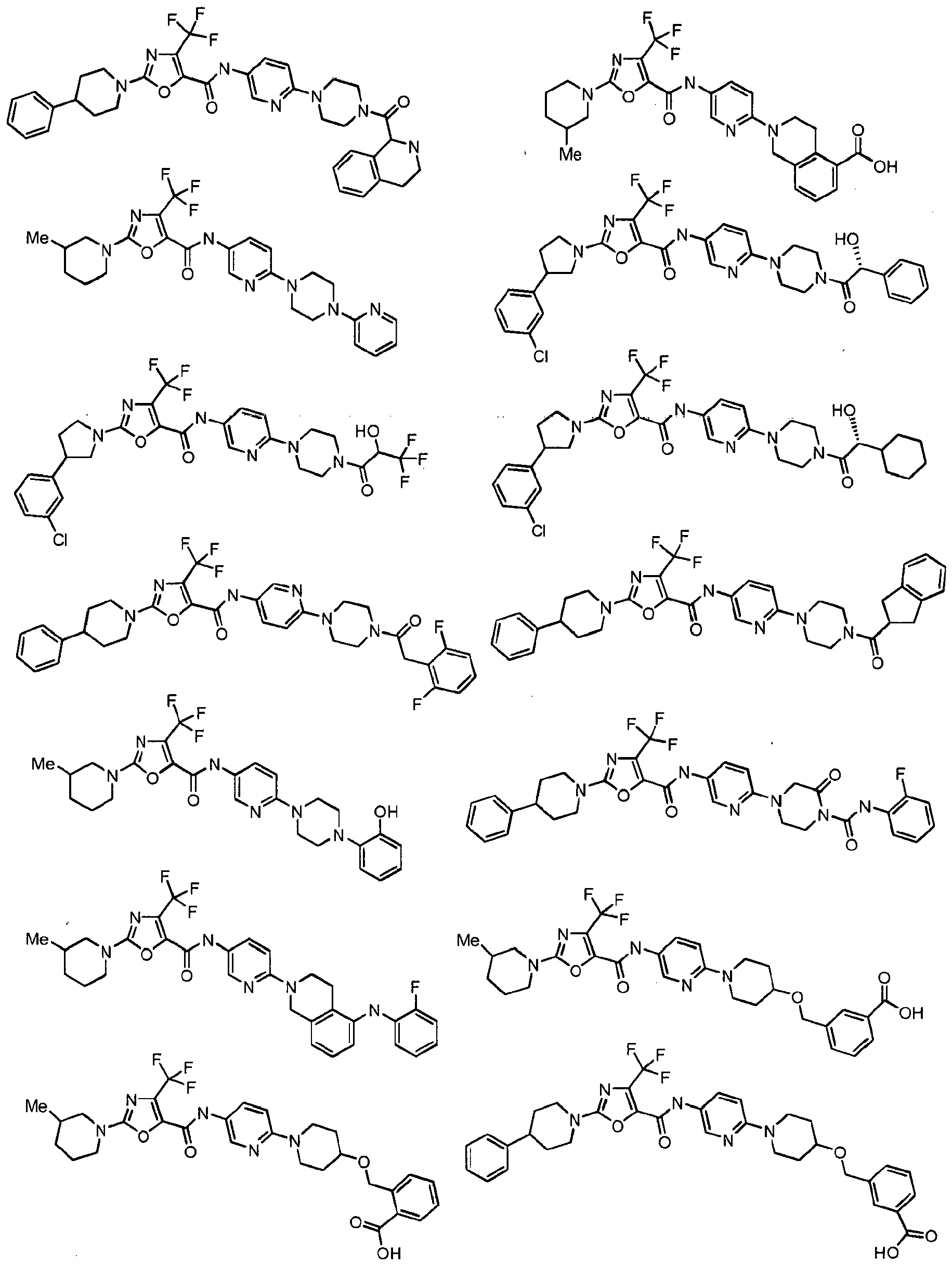

- Eine pharmazeutische Zusammensetzung, die eine wirksame Menge wenigstens einer Verbindung nach Anspruch 1 oder eines pharmazeutisch annehmbaren Salzes davon und einen pharmazeutisch annehmbaren Träger umfasst.
- Die Verbindung nach Anspruch 1 zur Verwendung in der Therapie.
- Die Verbindung nach Anspruch 1 zur Verwendung bei der Behandlung von Diabetes, Adipositas oder einer Stoffwechselstörung.
- Verwendung einer Verbindung nach Anspruch 1 zur Herstellung eines Medikaments zur Behandlung von Diabetes, Adipositas oder einer Stoffwechselstörung.
Applications Claiming Priority (3)
| Application Number | Priority Date | Filing Date | Title |
|---|---|---|---|
| US11598708P | 2008-11-19 | 2008-11-19 | |
| US11600008P | 2008-11-19 | 2008-11-19 | |
| PCT/US2009/064738 WO2010059602A2 (en) | 2008-11-19 | 2009-11-17 | Inhibitors of diacylglycerol acyltransferase |
Publications (2)
| Publication Number | Publication Date |
|---|---|
| EP2367598A2 EP2367598A2 (de) | 2011-09-28 |
| EP2367598B1 true EP2367598B1 (de) | 2014-04-09 |
Family
ID=42110031
Family Applications (1)
| Application Number | Title | Priority Date | Filing Date |
|---|---|---|---|
| EP09752998.6A Not-in-force EP2367598B1 (de) | 2008-11-19 | 2009-11-17 | inhibitoren von diazylglycerinacyltransferase |
Country Status (10)
| Country | Link |
|---|---|
| US (1) | US8716312B2 (de) |
| EP (1) | EP2367598B1 (de) |
| JP (1) | JP2012509274A (de) |
| CN (1) | CN102281919A (de) |
| AR (1) | AR074130A1 (de) |
| AU (1) | AU2009316786A1 (de) |
| CA (1) | CA2743609A1 (de) |
| MX (1) | MX2011005234A (de) |
| TW (1) | TW201031657A (de) |
| WO (1) | WO2010059602A2 (de) |
Families Citing this family (28)
| Publication number | Priority date | Publication date | Assignee | Title |
|---|---|---|---|---|
| JP6063870B2 (ja) * | 2010-11-08 | 2017-01-18 | ライセラ・コーポレイション | RORγ活性の阻害用のN−スルホニル化テトラヒドロキノリンおよび関連二環化合物および病気の治療 |
| EP2687507B1 (de) * | 2011-03-14 | 2016-03-09 | Taisho Pharmaceutical Co., Ltd. | Stickstoffhaltige kondensierte heterocyclische verbindung |
| WO2013169864A2 (en) | 2012-05-08 | 2013-11-14 | Lycera Corporation | TETRAHYDRO[1,8]NAPHTHYRIDINE SULFONAMIDE AND RELATED COMPOUNDS FOR USE AS AGONISTS OF RORƴ AND THE TREATMENT OF DISEASE |
| MX367341B (es) | 2012-05-08 | 2019-08-14 | Merck Sharp & Dohme | Tetrahidronaftiridina y compuestos biciclicos relacionados para la inhibicion de la actividad de rorgamma y el tratamiento de enfermedades. |
| US9563663B2 (en) | 2012-09-28 | 2017-02-07 | Oracle International Corporation | Fast path evaluation of Boolean predicates |
| JP6099753B2 (ja) | 2012-10-03 | 2017-03-22 | アドビナス セラピューティクス リミテッド | スピロ環化合物、その組成物及びその医薬応用 |
| KR20160068956A (ko) | 2013-10-15 | 2016-06-15 | 얀센 파마슈티카 엔.브이. | RORyT의 퀴놀리닐 조절제 |
| US10555941B2 (en) | 2013-10-15 | 2020-02-11 | Janssen Pharmaceutica Nv | Alkyl linked quinolinyl modulators of RORγt |
| US9403816B2 (en) | 2013-10-15 | 2016-08-02 | Janssen Pharmaceutica Nv | Phenyl linked quinolinyl modulators of RORγt |
| US9809561B2 (en) | 2013-12-20 | 2017-11-07 | Merck Sharp & Dohme Corp. | Tetrahydronaphthyridine, benzoxazine, aza-benzoxazine and related bicyclic compounds for inhibition of RORgamma activity and the treatment of disease |
| US9663502B2 (en) | 2013-12-20 | 2017-05-30 | Lycera Corporation | 2-Acylamidomethyl and sulfonylamidomethyl benzoxazine carbamates for inhibition of RORgamma activity and the treatment of disease |
| WO2015095792A1 (en) | 2013-12-20 | 2015-06-25 | Merck Sharp & Dohme Corp. | Carbamate benzoxaxine propionic acids and acid derivatives for modulation of rorgamma activity and the treatment of disease |
| BR112016015983A2 (pt) * | 2014-01-10 | 2017-08-08 | Aurigene Discovery Tech Ltd | Compostos de indazol como inibidores de irak4, seus usos, e composição farmacêutica |
| SMT202400142T1 (it) | 2014-01-13 | 2024-05-14 | Aurigene Oncology Ltd | Enantiomeri (r) e (s) di n-(5-(3-idrossipirrolidin-1-il)-2-morfolinoossazolo[4,5-b]piridin-6-il)-2-(2-metilpiridin-4-il)ossazolo-carbossammide in qualità di inibitori di irak4 per il trattamento di un cancro |
| AU2015222917A1 (en) | 2014-02-27 | 2016-09-15 | Lycera Corporation | Adoptive cellular therapy using an agonist of retinoic acid receptor-related orphan receptor gamma and related therapeutic methods |
| JP6728061B2 (ja) | 2014-05-05 | 2020-07-22 | リセラ・コーポレイションLycera Corporation | RORγアゴニストとして用いるテトラヒドロキノリンスルホンアミド及び関連化合物ならびに疾患の治療 |
| JP6523337B2 (ja) | 2014-05-05 | 2019-05-29 | リセラ・コーポレイションLycera Corporation | RORγのアゴニストとしての使用及び疾患治療のためのベンゼンスルホンアミド及び関連化合物 |
| WO2016130818A1 (en) | 2015-02-11 | 2016-08-18 | Merck Sharp & Dohme Corp. | SUBSTITUTED PYRAZOLE COMPOUNDS AS RORgammaT INHIBITORS AND USES THEREOF |
| AU2016257997A1 (en) | 2015-05-05 | 2017-11-09 | Lycera Corporation | Dihydro-2H-benzo[b][1,4]oxazine sulfonamide and related compounds for use as agonists of RORy and the treatment of disease |
| US10611740B2 (en) | 2015-06-11 | 2020-04-07 | Lycera Corporation | Aryl dihydro-2H-benzo[b][1,4]oxazine sulfonamide and related compounds for use as agonists of RORγ and the treatment of disease |
| WO2017075185A1 (en) | 2015-10-27 | 2017-05-04 | Merck Sharp & Dohme Corp. | Heteroaryl substituted benzoic acids as rorgammat inhibitors and uses thereof |
| WO2017075182A1 (en) | 2015-10-27 | 2017-05-04 | Merck Sharp & Dohme Corp. | Substituted indazole compounds as rorgammat inhibitors and uses thereof |
| US10344000B2 (en) | 2015-10-27 | 2019-07-09 | Merck Sharp & Dohme Corp. | Substituted bicyclic pyrazole compounds as RORgammaT inhibitors and uses thereof |
| CN106176776A (zh) * | 2016-07-04 | 2016-12-07 | 华北制药集团新药研究开发有限责任公司 | 葡萄糖激酶激动活性化合物的医药用途 |
| CN120267671A (zh) | 2017-03-31 | 2025-07-08 | 奥锐金肿瘤有限公司 | 用于治疗血液病的化合物和组合物 |
| MX2020003666A (es) | 2017-10-31 | 2020-08-03 | Curis Inc | Compuestos y composiciones para el tratamiento de trastornos hematologicos. |
| EP3950688B1 (de) * | 2019-04-03 | 2025-01-15 | Guangzhou Baiyunshan Pharmaceutical Holdings Co., Ltd. Baiyunshan Pharmaceutical General Factory | Stickstoffhaltige spiroderivate als ret-inhibitor |
| US12178821B2 (en) | 2021-04-08 | 2024-12-31 | Curis, Inc. | Combination therapies for the treatment of cancer |
Family Cites Families (19)
| Publication number | Priority date | Publication date | Assignee | Title |
|---|---|---|---|---|
| HRP980334A2 (en) * | 1997-06-19 | 1999-04-30 | Mimi Lifen Quan | INHIBITORS OF FACTOR Xa WITH A NEUTRAL P1 SPECIFICITY GROUP |
| CA2332957A1 (en) * | 1998-06-05 | 1999-12-09 | Boehringer Ingelheim Pharmaceuticals, Inc. | Substituted 1-(4-aminophenyl)pyrazoles and their use as anti-inflammatory agents |
| AU5027299A (en) | 1998-07-31 | 2000-02-28 | Novo Nordisk A/S | Use of glp-1 and analogues for preventing type ii diabetes |
| US20040185559A1 (en) | 2003-03-21 | 2004-09-23 | Isis Pharmaceuticals Inc. | Modulation of diacylglycerol acyltransferase 1 expression |
| JP2007501801A (ja) | 2003-08-07 | 2007-02-01 | 日本たばこ産業株式会社 | ピロロ[1,2−b]ピリダジン誘導体 |
| GB0325192D0 (en) | 2003-10-29 | 2003-12-03 | Astrazeneca Ab | Method of use |
| WO2005061477A1 (en) * | 2003-12-04 | 2005-07-07 | Wyeth | Biaryl sulfonamides as mmp inhibitors |
| JP5076091B2 (ja) * | 2005-11-28 | 2012-11-21 | マドリガル・ファーマシューティカルズ・インコーポレーテッド | ジアシルグリセロールアシルトランスフェラーゼ(dgat)のインヒビター |
| WO2007104557A2 (en) * | 2006-03-15 | 2007-09-20 | 4Sc Ag | Novel heterocyclic nf-kb inhibitors |
| EA200801838A1 (ru) * | 2006-03-15 | 2009-02-27 | 4ЭсЦэ АГ | НОВЫЕ ГЕТЕРОЦИКЛИЧЕСКИЕ ИНГИБИТОРЫ NF-kB |
| WO2007123269A1 (ja) * | 2006-04-19 | 2007-11-01 | Astellas Pharma Inc. | アゾールカルボキサミド誘導体 |
| WO2008011130A2 (en) | 2006-07-21 | 2008-01-24 | Takeda Pharmaceutical Company Limited | Amide compounds |
| EP2049103A2 (de) * | 2006-07-26 | 2009-04-22 | Novartis AG | Hemmer der undecaprenyl-pyrophosphat-synthase |
| US8058299B2 (en) * | 2007-05-22 | 2011-11-15 | Via Pharmaceuticals, Inc. | Diacylglycerol acyltransferase inhibitors |
| US8153644B2 (en) | 2007-05-22 | 2012-04-10 | Madrigal Pharmaceuticals, Inc. | Diacylglycerol acyltransferase inhibitors |
| MX2009012285A (es) | 2007-05-22 | 2009-12-15 | Via Pharmaceuticals Inc | Inhibidores de diacilglicerol aciltransferasa. |
| US20090076275A1 (en) * | 2007-09-19 | 2009-03-19 | David Robert Bolin | Diacylglycerol acyltransferase inhibitors |
| TW201002705A (en) * | 2008-03-31 | 2010-01-16 | Metabolex Inc | Oxymethylene aryl compounds and uses thereof |
| AU2009316790A1 (en) * | 2008-11-19 | 2010-05-27 | Schering Corporation | Inhibitors of diacylglycerol acyltransferase |
-
2009
- 2009-11-17 CA CA2743609A patent/CA2743609A1/en not_active Abandoned
- 2009-11-17 US US13/129,843 patent/US8716312B2/en not_active Expired - Fee Related
- 2009-11-17 MX MX2011005234A patent/MX2011005234A/es not_active Application Discontinuation
- 2009-11-17 JP JP2011536587A patent/JP2012509274A/ja active Pending
- 2009-11-17 EP EP09752998.6A patent/EP2367598B1/de not_active Not-in-force
- 2009-11-17 AU AU2009316786A patent/AU2009316786A1/en not_active Abandoned
- 2009-11-17 CN CN2009801549757A patent/CN102281919A/zh active Pending
- 2009-11-17 WO PCT/US2009/064738 patent/WO2010059602A2/en not_active Ceased
- 2009-11-18 AR ARP090104454A patent/AR074130A1/es not_active Application Discontinuation
- 2009-11-18 TW TW098139170A patent/TW201031657A/zh unknown
Also Published As
| Publication number | Publication date |
|---|---|
| CA2743609A1 (en) | 2010-05-27 |
| AR074130A1 (es) | 2010-12-22 |
| JP2012509274A (ja) | 2012-04-19 |
| TW201031657A (en) | 2010-09-01 |
| AU2009316786A1 (en) | 2010-05-27 |
| WO2010059602A3 (en) | 2010-07-15 |
| EP2367598A2 (de) | 2011-09-28 |
| MX2011005234A (es) | 2011-06-01 |
| US8716312B2 (en) | 2014-05-06 |
| US20110224137A1 (en) | 2011-09-15 |
| CN102281919A (zh) | 2011-12-14 |
| WO2010059602A2 (en) | 2010-05-27 |
Similar Documents
| Publication | Publication Date | Title |
|---|---|---|
| US8716312B2 (en) | Inhibitors of diacylglycerol acyltransferase | |
| US20120172369A1 (en) | Inhibitors of diacylglycerol acyltransferase | |
| AU2010226829A1 (en) | Bicyclic compounds as inhibitors of diacylglycerol acyltransferase | |
| US20110224136A1 (en) | Inhibitors of diacylglycerol acyltransferase | |
| RS64551B9 (sr) | Substituisani 2-azabickli i njihova upotreba kao modulatora receptora oreksina | |
| MX2011008308A (es) | Derivados de azaspiranil-alquilcarbamatos de heterociclos de 5 eslabones, su preparacion y su aplicacion en terapeutica. | |
| WO2008100620A2 (en) | Bicyclic aminopropyl tetrahydro-pyrazolo-pyridine modulators of cathepsin s | |
| US20110224193A1 (en) | Inhibitors of diacylglycerol acyltransferase | |
| US20240279215A1 (en) | Nampt modulators |
Legal Events
| Date | Code | Title | Description |
|---|---|---|---|
| PUAI | Public reference made under article 153(3) epc to a published international application that has entered the european phase |
Free format text: ORIGINAL CODE: 0009012 |
|
| 17P | Request for examination filed |
Effective date: 20110620 |
|
| AK | Designated contracting states |
Kind code of ref document: A2 Designated state(s): AT BE BG CH CY CZ DE DK EE ES FI FR GB GR HR HU IE IS IT LI LT LU LV MC MK MT NL NO PL PT RO SE SI SK SM TR |
|
| DAX | Request for extension of the european patent (deleted) | ||
| RAP1 | Party data changed (applicant data changed or rights of an application transferred) |
Owner name: MERCK SHARP & DOHME CORP. |
|
| 17Q | First examination report despatched |
Effective date: 20121023 |
|
| GRAP | Despatch of communication of intention to grant a patent |
Free format text: ORIGINAL CODE: EPIDOSNIGR1 |
|
| INTG | Intention to grant announced |
Effective date: 20131031 |
|
| GRAS | Grant fee paid |
Free format text: ORIGINAL CODE: EPIDOSNIGR3 |
|
| GRAA | (expected) grant |
Free format text: ORIGINAL CODE: 0009210 |
|
| AK | Designated contracting states |
Kind code of ref document: B1 Designated state(s): AT BE BG CH CY CZ DE DK EE ES FI FR GB GR HR HU IE IS IT LI LT LU LV MC MK MT NL NO PL PT RO SE SI SK SM TR |
|
| REG | Reference to a national code |
Ref country code: GB Ref legal event code: FG4D |
|
| REG | Reference to a national code |
Ref country code: AT Ref legal event code: REF Ref document number: 661005 Country of ref document: AT Kind code of ref document: T Effective date: 20140415 Ref country code: CH Ref legal event code: EP |
|
| REG | Reference to a national code |
Ref country code: IE Ref legal event code: FG4D |
|
| REG | Reference to a national code |
Ref country code: DE Ref legal event code: R096 Ref document number: 602009023132 Country of ref document: DE Effective date: 20140522 |
|
| REG | Reference to a national code |
Ref country code: AT Ref legal event code: MK05 Ref document number: 661005 Country of ref document: AT Kind code of ref document: T Effective date: 20140409 |
|
| REG | Reference to a national code |
Ref country code: NL Ref legal event code: VDEP Effective date: 20140409 |
|
| REG | Reference to a national code |
Ref country code: LT Ref legal event code: MG4D |
|
| PG25 | Lapsed in a contracting state [announced via postgrant information from national office to epo] |
Ref country code: LT Free format text: LAPSE BECAUSE OF FAILURE TO SUBMIT A TRANSLATION OF THE DESCRIPTION OR TO PAY THE FEE WITHIN THE PRESCRIBED TIME-LIMIT Effective date: 20140409 Ref country code: IS Free format text: LAPSE BECAUSE OF FAILURE TO SUBMIT A TRANSLATION OF THE DESCRIPTION OR TO PAY THE FEE WITHIN THE PRESCRIBED TIME-LIMIT Effective date: 20140809 Ref country code: GR Free format text: LAPSE BECAUSE OF FAILURE TO SUBMIT A TRANSLATION OF THE DESCRIPTION OR TO PAY THE FEE WITHIN THE PRESCRIBED TIME-LIMIT Effective date: 20140710 Ref country code: NL Free format text: LAPSE BECAUSE OF FAILURE TO SUBMIT A TRANSLATION OF THE DESCRIPTION OR TO PAY THE FEE WITHIN THE PRESCRIBED TIME-LIMIT Effective date: 20140409 Ref country code: NO Free format text: LAPSE BECAUSE OF FAILURE TO SUBMIT A TRANSLATION OF THE DESCRIPTION OR TO PAY THE FEE WITHIN THE PRESCRIBED TIME-LIMIT Effective date: 20140709 Ref country code: BG Free format text: LAPSE BECAUSE OF FAILURE TO SUBMIT A TRANSLATION OF THE DESCRIPTION OR TO PAY THE FEE WITHIN THE PRESCRIBED TIME-LIMIT Effective date: 20140709 Ref country code: FI Free format text: LAPSE BECAUSE OF FAILURE TO SUBMIT A TRANSLATION OF THE DESCRIPTION OR TO PAY THE FEE WITHIN THE PRESCRIBED TIME-LIMIT Effective date: 20140409 |
|
| PG25 | Lapsed in a contracting state [announced via postgrant information from national office to epo] |
Ref country code: HR Free format text: LAPSE BECAUSE OF FAILURE TO SUBMIT A TRANSLATION OF THE DESCRIPTION OR TO PAY THE FEE WITHIN THE PRESCRIBED TIME-LIMIT Effective date: 20140409 Ref country code: LV Free format text: LAPSE BECAUSE OF FAILURE TO SUBMIT A TRANSLATION OF THE DESCRIPTION OR TO PAY THE FEE WITHIN THE PRESCRIBED TIME-LIMIT Effective date: 20140409 Ref country code: AT Free format text: LAPSE BECAUSE OF FAILURE TO SUBMIT A TRANSLATION OF THE DESCRIPTION OR TO PAY THE FEE WITHIN THE PRESCRIBED TIME-LIMIT Effective date: 20140409 Ref country code: PL Free format text: LAPSE BECAUSE OF FAILURE TO SUBMIT A TRANSLATION OF THE DESCRIPTION OR TO PAY THE FEE WITHIN THE PRESCRIBED TIME-LIMIT Effective date: 20140409 Ref country code: ES Free format text: LAPSE BECAUSE OF FAILURE TO SUBMIT A TRANSLATION OF THE DESCRIPTION OR TO PAY THE FEE WITHIN THE PRESCRIBED TIME-LIMIT Effective date: 20140409 Ref country code: SE Free format text: LAPSE BECAUSE OF FAILURE TO SUBMIT A TRANSLATION OF THE DESCRIPTION OR TO PAY THE FEE WITHIN THE PRESCRIBED TIME-LIMIT Effective date: 20140409 |
|
| PG25 | Lapsed in a contracting state [announced via postgrant information from national office to epo] |
Ref country code: PT Free format text: LAPSE BECAUSE OF FAILURE TO SUBMIT A TRANSLATION OF THE DESCRIPTION OR TO PAY THE FEE WITHIN THE PRESCRIBED TIME-LIMIT Effective date: 20140811 |
|
| REG | Reference to a national code |
Ref country code: DE Ref legal event code: R097 Ref document number: 602009023132 Country of ref document: DE |
|
| PG25 | Lapsed in a contracting state [announced via postgrant information from national office to epo] |
Ref country code: SK Free format text: LAPSE BECAUSE OF FAILURE TO SUBMIT A TRANSLATION OF THE DESCRIPTION OR TO PAY THE FEE WITHIN THE PRESCRIBED TIME-LIMIT Effective date: 20140409 Ref country code: RO Free format text: LAPSE BECAUSE OF FAILURE TO SUBMIT A TRANSLATION OF THE DESCRIPTION OR TO PAY THE FEE WITHIN THE PRESCRIBED TIME-LIMIT Effective date: 20140409 Ref country code: BE Free format text: LAPSE BECAUSE OF FAILURE TO SUBMIT A TRANSLATION OF THE DESCRIPTION OR TO PAY THE FEE WITHIN THE PRESCRIBED TIME-LIMIT Effective date: 20140409 Ref country code: DK Free format text: LAPSE BECAUSE OF FAILURE TO SUBMIT A TRANSLATION OF THE DESCRIPTION OR TO PAY THE FEE WITHIN THE PRESCRIBED TIME-LIMIT Effective date: 20140409 Ref country code: CZ Free format text: LAPSE BECAUSE OF FAILURE TO SUBMIT A TRANSLATION OF THE DESCRIPTION OR TO PAY THE FEE WITHIN THE PRESCRIBED TIME-LIMIT Effective date: 20140409 Ref country code: EE Free format text: LAPSE BECAUSE OF FAILURE TO SUBMIT A TRANSLATION OF THE DESCRIPTION OR TO PAY THE FEE WITHIN THE PRESCRIBED TIME-LIMIT Effective date: 20140409 |
|
| PLBE | No opposition filed within time limit |
Free format text: ORIGINAL CODE: 0009261 |
|
| STAA | Information on the status of an ep patent application or granted ep patent |
Free format text: STATUS: NO OPPOSITION FILED WITHIN TIME LIMIT |
|
| 26N | No opposition filed |
Effective date: 20150112 |
|
| PG25 | Lapsed in a contracting state [announced via postgrant information from national office to epo] |
Ref country code: IT Free format text: LAPSE BECAUSE OF FAILURE TO SUBMIT A TRANSLATION OF THE DESCRIPTION OR TO PAY THE FEE WITHIN THE PRESCRIBED TIME-LIMIT Effective date: 20140409 |
|
| REG | Reference to a national code |
Ref country code: DE Ref legal event code: R097 Ref document number: 602009023132 Country of ref document: DE Effective date: 20150112 |
|
| REG | Reference to a national code |
Ref country code: DE Ref legal event code: R119 Ref document number: 602009023132 Country of ref document: DE |
|
| PG25 | Lapsed in a contracting state [announced via postgrant information from national office to epo] |
Ref country code: MC Free format text: LAPSE BECAUSE OF FAILURE TO SUBMIT A TRANSLATION OF THE DESCRIPTION OR TO PAY THE FEE WITHIN THE PRESCRIBED TIME-LIMIT Effective date: 20140409 Ref country code: LU Free format text: LAPSE BECAUSE OF FAILURE TO SUBMIT A TRANSLATION OF THE DESCRIPTION OR TO PAY THE FEE WITHIN THE PRESCRIBED TIME-LIMIT Effective date: 20141117 |
|
| REG | Reference to a national code |
Ref country code: CH Ref legal event code: PL |
|
| GBPC | Gb: european patent ceased through non-payment of renewal fee |
Effective date: 20141117 |
|
| PG25 | Lapsed in a contracting state [announced via postgrant information from national office to epo] |
Ref country code: CH Free format text: LAPSE BECAUSE OF NON-PAYMENT OF DUE FEES Effective date: 20141130 Ref country code: LI Free format text: LAPSE BECAUSE OF NON-PAYMENT OF DUE FEES Effective date: 20141130 Ref country code: SI Free format text: LAPSE BECAUSE OF FAILURE TO SUBMIT A TRANSLATION OF THE DESCRIPTION OR TO PAY THE FEE WITHIN THE PRESCRIBED TIME-LIMIT Effective date: 20140409 |
|
| REG | Reference to a national code |
Ref country code: IE Ref legal event code: MM4A |
|
| REG | Reference to a national code |
Ref country code: FR Ref legal event code: ST Effective date: 20150731 |
|
| PG25 | Lapsed in a contracting state [announced via postgrant information from national office to epo] |
Ref country code: GB Free format text: LAPSE BECAUSE OF NON-PAYMENT OF DUE FEES Effective date: 20141117 Ref country code: IE Free format text: LAPSE BECAUSE OF NON-PAYMENT OF DUE FEES Effective date: 20141117 Ref country code: DE Free format text: LAPSE BECAUSE OF NON-PAYMENT OF DUE FEES Effective date: 20150602 |
|
| PG25 | Lapsed in a contracting state [announced via postgrant information from national office to epo] |
Ref country code: FR Free format text: LAPSE BECAUSE OF NON-PAYMENT OF DUE FEES Effective date: 20141201 |
|
| PG25 | Lapsed in a contracting state [announced via postgrant information from national office to epo] |
Ref country code: SM Free format text: LAPSE BECAUSE OF FAILURE TO SUBMIT A TRANSLATION OF THE DESCRIPTION OR TO PAY THE FEE WITHIN THE PRESCRIBED TIME-LIMIT Effective date: 20140409 |
|
| PG25 | Lapsed in a contracting state [announced via postgrant information from national office to epo] |
Ref country code: CY Free format text: LAPSE BECAUSE OF FAILURE TO SUBMIT A TRANSLATION OF THE DESCRIPTION OR TO PAY THE FEE WITHIN THE PRESCRIBED TIME-LIMIT Effective date: 20140409 |
|
| PG25 | Lapsed in a contracting state [announced via postgrant information from national office to epo] |
Ref country code: TR Free format text: LAPSE BECAUSE OF FAILURE TO SUBMIT A TRANSLATION OF THE DESCRIPTION OR TO PAY THE FEE WITHIN THE PRESCRIBED TIME-LIMIT Effective date: 20140409 Ref country code: HU Free format text: LAPSE BECAUSE OF FAILURE TO SUBMIT A TRANSLATION OF THE DESCRIPTION OR TO PAY THE FEE WITHIN THE PRESCRIBED TIME-LIMIT; INVALID AB INITIO Effective date: 20091117 Ref country code: MT Free format text: LAPSE BECAUSE OF FAILURE TO SUBMIT A TRANSLATION OF THE DESCRIPTION OR TO PAY THE FEE WITHIN THE PRESCRIBED TIME-LIMIT Effective date: 20140409 |
|
| PG25 | Lapsed in a contracting state [announced via postgrant information from national office to epo] |
Ref country code: MK Free format text: LAPSE BECAUSE OF FAILURE TO SUBMIT A TRANSLATION OF THE DESCRIPTION OR TO PAY THE FEE WITHIN THE PRESCRIBED TIME-LIMIT Effective date: 20140409 |