EP2368493B1 - Aktive medizinische Vorrichtung mit Erfassungs- und Filtermitteln für Artefakte durch Analyse eines Vektor-Kardiogramms - Google Patents
Aktive medizinische Vorrichtung mit Erfassungs- und Filtermitteln für Artefakte durch Analyse eines Vektor-Kardiogramms Download PDFInfo
- Publication number
- EP2368493B1 EP2368493B1 EP11151353A EP11151353A EP2368493B1 EP 2368493 B1 EP2368493 B1 EP 2368493B1 EP 11151353 A EP11151353 A EP 11151353A EP 11151353 A EP11151353 A EP 11151353A EP 2368493 B1 EP2368493 B1 EP 2368493B1
- Authority
- EP
- European Patent Office
- Prior art keywords
- cycle
- analyzed
- noise
- characteristic
- threshold
- Prior art date
- Legal status (The legal status is an assumption and is not a legal conclusion. Google has not performed a legal analysis and makes no representation as to the accuracy of the status listed.)
- Active
Links
Images


Classifications
-
- A—HUMAN NECESSITIES
- A61—MEDICAL OR VETERINARY SCIENCE; HYGIENE
- A61B—DIAGNOSIS; SURGERY; IDENTIFICATION
- A61B5/00—Measuring for diagnostic purposes; Identification of persons
- A61B5/24—Detecting, measuring or recording bioelectric or biomagnetic signals of the body or parts thereof
- A61B5/316—Modalities, i.e. specific diagnostic methods
- A61B5/318—Heart-related electrical modalities, e.g. electrocardiography [ECG]
- A61B5/339—Displays specially adapted therefor
- A61B5/341—Vectorcardiography [VCG]
-
- A—HUMAN NECESSITIES
- A61—MEDICAL OR VETERINARY SCIENCE; HYGIENE
- A61B—DIAGNOSIS; SURGERY; IDENTIFICATION
- A61B5/00—Measuring for diagnostic purposes; Identification of persons
- A61B5/72—Signal processing specially adapted for physiological signals or for diagnostic purposes
- A61B5/7235—Details of waveform analysis
- A61B5/7264—Classification of physiological signals or data, e.g. using neural networks, statistical classifiers, expert systems or fuzzy systems
-
- A—HUMAN NECESSITIES
- A61—MEDICAL OR VETERINARY SCIENCE; HYGIENE
- A61N—ELECTROTHERAPY; MAGNETOTHERAPY; RADIATION THERAPY; ULTRASOUND THERAPY
- A61N1/00—Electrotherapy; Circuits therefor
- A61N1/18—Applying electric currents by contact electrodes
- A61N1/32—Applying electric currents by contact electrodes alternating or intermittent currents
- A61N1/36—Applying electric currents by contact electrodes alternating or intermittent currents for stimulation
- A61N1/362—Heart stimulators
- A61N1/37—Monitoring; Protecting
- A61N1/3702—Physiological parameters
-
- G—PHYSICS
- G16—INFORMATION AND COMMUNICATION TECHNOLOGY [ICT] SPECIALLY ADAPTED FOR SPECIFIC APPLICATION FIELDS
- G16H—HEALTHCARE INFORMATICS, i.e. INFORMATION AND COMMUNICATION TECHNOLOGY [ICT] SPECIALLY ADAPTED FOR THE HANDLING OR PROCESSING OF MEDICAL OR HEALTHCARE DATA
- G16H50/00—ICT specially adapted for medical diagnosis, medical simulation or medical data mining; ICT specially adapted for detecting, monitoring or modelling epidemics or pandemics
- G16H50/20—ICT specially adapted for medical diagnosis, medical simulation or medical data mining; ICT specially adapted for detecting, monitoring or modelling epidemics or pandemics for computer-aided diagnosis, e.g. based on medical expert systems
-
- Y—GENERAL TAGGING OF NEW TECHNOLOGICAL DEVELOPMENTS; GENERAL TAGGING OF CROSS-SECTIONAL TECHNOLOGIES SPANNING OVER SEVERAL SECTIONS OF THE IPC; TECHNICAL SUBJECTS COVERED BY FORMER USPC CROSS-REFERENCE ART COLLECTIONS [XRACs] AND DIGESTS
- Y02—TECHNOLOGIES OR APPLICATIONS FOR MITIGATION OR ADAPTATION AGAINST CLIMATE CHANGE
- Y02A—TECHNOLOGIES FOR ADAPTATION TO CLIMATE CHANGE
- Y02A90/00—Technologies having an indirect contribution to adaptation to climate change
- Y02A90/10—Information and communication technologies [ICT] supporting adaptation to climate change, e.g. for weather forecasting or climate simulation
Definitions
- the invention relates to "active implantable medical devices" as defined by the Council of European Communities Directive 90/385 / EEC of 20 June 1990, more specifically implants for continuously monitoring the heart rate and delivering if necessary to the heart. electrical pulses of stimulation, resynchronization, cardioversion and / or defibrillation in the event of disturbance of the rhythm detected by the device.
- the invention can be implemented not only within an implant, but also outside the patient's body, for example in an external programmer used by a practitioner to download and analyze the cardiac signals collected. and stored by the implant.
- the invention can also be implemented in a home monitoring monitor, which is a particular type of programmer whose operation is fully automated; such a monitor does not require the use of a practitioner, and allows in particular to remotely transmit to a remote site data collected by an implant, for analysis and monitoring of the patient.
- the invention can also be implemented at the data server of this site, from the data transmitted as is by the patient monitor.
- the invention is particularly applicable, although in a non-limiting manner, to devices for delivering at the heart of antitachycardia therapies involving the controlled application of defibrillation shocks (high energy electrical impulses intended to terminate a tachyarrhythmia), and or high frequency stimulation therapies of the so-called ATP ( AntiTachycardia Pacing ) type.
- defibrillation shocks high energy electrical impulses intended to terminate a tachyarrhythmia
- ATP AntiTachycardia Pacing
- the application of a shock of defibrillation in a conscious patient is extremely painful and distressing, the applied energies being indeed far beyond the threshold of pain.
- the application of a defibrillation shock is not devoid of side effects on the heart rhythm (risk of occurrence of secondary disorders), on the functional integrity of the myocardium, and generally on the physiological balance of the patient.
- the most used methods to overcome noise phenomena in the detection of ventricular signals include steps of filtering the collected signals and automatic controls of different detection parameters such as blanking period, sensitivity value, etc. to identify over-detections and prohibit in this case any inappropriate action.
- the US 6,584,351 B1 proposes a different way of proceeding, by trying to eliminate the noise a priori, before the ventricular detection.
- an additional electrode implanted out of the heart, makes it possible to detect the signals of non-cardiac origin, which will be considered as constituting noise. These signals will be subtracted from the detected signals by the intracardiac electrodes.
- This method if it is effective, however requires the implementation of an additional electrode, out of the heart, for example on the defibrillator housing - which involves a complete review of the mechanical and electrical design of the latter.
- Other methods have been proposed for effecting a posteriori filtering of extracardiac noise signals contained in the ventricular signal after collection thereof.
- the US 2006/0235476 A1 proposes to compare the chain of ventricular markers produced by the defibrillator from a bipolar or nearfield signal , with a chain of R markers obtained by analysis of a unipolar or farfield signal collected simultaneously.
- the markers detected by the defibrillator from the nearfield signal but not detected on the farfield signal will be considered as noise, and the origin of this noise will then be determined by analysis of the number and pattern of the chain of markers.
- this technique has the disadvantage that if the extra-cardiac origin signal is present on both the nearfield and the farfield , it will not be considered as noise, even if this phenomenon is clearly identifiable with the naked eye when examining the traces.
- the basic idea of the invention lies in the observation that it is possible to obtain relevant parameters relating to the origin of the collected signal - cardiac depolarization wave, or other artifact generating potential - by the analysis of endocavity electrogram signals (EGM signals) collected concurrently on two distinct pathways and coming from the same cavity, in particular the ventricle.
- EMM signals endocavity electrogram signals
- the two different EGM channels may in particular be that of a unipolar signal (distant signal collected between the housing and a distal or proximal electrode), and that of a bipolar signal (near signal collected between a distal electrode and a proximal electrode ).
- VGM cardiac loop
- VGM vectogram
- VGM vectogram
- ECG electrocardiogram
- EP 2 105 843 A1 ELA Medical
- VGM ventricular tachycardia
- VTS supraventricular tachycardia
- the invention relates to an active medical device of a type known from the US 2006/0235476 A1 , comprising: means for collecting the electrical activity of the heart over a series of cardiac cycles, comprising means for producing at least two distinct temporal components from at least two EGM endocavity electrogram signals from the same cavity of the heart and collected concurrently on respective separate pathways; and means for analyzing and filtering the collected electrical activity, able to discriminate, for each analyzed cardiac cycle, between invalid noisy cycle and valid non-noisy cycle.
- the means of analysis and filtering of this device comprise: means for determining a characteristic non-temporal 2D characteristic of the cardiac cycle analyzed, based on the variations of one of said temporal components as a function of one another; means for morphological analysis of this 2D characteristic, capable of delivering at least one intrinsic descriptor parameter of this characteristic; and classifying means capable of classifying the analyzed cardiac cycle as an invalid noisy cycle or as a valid non-noisy cycle, as a function of said at least one descriptor parameter.
- EGM signals collected concurrently on respective separate pathways may include a unipolar component signal collected between the device housing and a proximal or distal electrode, and a bipolar component signal collected between a proximal electrode and a distal electrode.
- the means for determining the 2D characteristic are means able to determine this characteristic from the variations of the temporal components on a fraction of the cardiac cycle analyzed, considered in a time window including the QRS complex of this cardiac cycle.
- the descriptor parameter can in particular be a parameter that is a function of the velocity vector of the characteristic 2D, considered in a plurality of points.
- this descriptor parameter is a function of the variations in the direction of the velocity vector between given consecutive points of the characteristic 2D, in particular as a function of the average angle formed by two consecutive velocity vectors of the characteristic 2D.
- the classifying means then comprise means for comparing the average angle with a given first threshold, and classifying the cardiac cycle to be analyzed as an invalid noisy cycle if the average angle is greater than this first threshold.
- the classifying means compare the average angle to a given second threshold lower than the first threshold, compare the amplitude of the depolarization peak of the cardiac cycle analyzed to a third threshold, and classify the cardiac cycle to be analyzed as an invalid noisy cycle if the average angle is greater than the second threshold and the amplitude of the depolarization peak is lower than the third threshold, and as the non-noisy cycle in the opposite case.
- the descriptor parameter is a function of the variance of the velocity vector norm between given consecutive points of the 2D characteristic.
- the device furthermore comprises means operating in response to the classifying means for, when the analyzed cycle is classified as an invalid noisy cycle by the classifying means: erasing a marker linked to the analyzed cardiac cycle, and / or assigning a specific marker to the cardiac cycle analyzed, and / or inhibit the memorization of the cardiac cycle analyzed, and / or change the sensitivity of the collection means, and / or inhibit the delivery of therapy by the device.
- the invention can be implemented by appropriate programming of the control software of a known pacemaker, for example of pacemaker, resynchronizer and / or defibrillator type, comprising means of acquisition of a signal provided by endocardial probes and / or one or more implanted sensors.
- the invention can notably be applied to implantable devices such as those of the Reply, Paradym, Ovatio, Esprit or Rhapsody families produced and marketed by Sorin CRM SAS, Clamart, France.
- programmable microprocessor devices having circuitry for receiving, shaping, and processing electrical signals collected by implanted electrodes, and providing pacing pulses to these electrodes. It is possible to transmit there by telemetry software which will be stored in memory and executed to implement the functions of the invention which will be described below. The adaptation of these devices to the implementation of the functions of the invention is within the abilities of those skilled in the art, and it will not be described in detail.
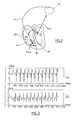
- the Figure 1 illustrates a "single chamber" stimulation configuration in which a pulse generator 10 is associated with a probe 12 implanted in the right ventricle 14.
- the probe head has two electrodes, namely a distal electrode 16 and a proximal electrode 18, which makes it possible to collect, in this simplest configuration, a first Vbip electrogram corresponding to the potential difference measured between the distal electrode 16 and the proximal electrode 18, and on the other hand a second Vuni electrogram , measured by the potential difference between one of the electrodes, for example the proximal electrode 18, and the metal housing of the generator 10.
- the bipolar Vbip signal can also be collected between the distal electrode 16 and the ventricular coil or ventricular coil forming the defibrillation electrode 20, and the Vuni unipolar signal can be collected between the metal case of the generator 10 and this ventricular winding 20, or between the proximal electrode 18 and the housing 10 when the bipolar signal Vbip is collected between the distal electrode 16 and the ventricular coil 20.
- the invention can also be applied to the filtering of the signals collected in the atrium by an appropriate electrode, or generally to any collection of signals by cardiac depolarization signal detection electrodes, in particular in the case of devices multisite.
- the analysis technique of the invention consists, for each heartbeat, in operating a classification between valid non-noise cycle (depolarization wave of cardiac origin) and invalid noisy cycle (artifact of extracardiac origin), from EGM electrogram signals from the same cavity, typically the right ventricle, and collected over two separate pathways and analyzed in two dimensions.
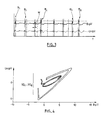
- the Figure 2 illustrates an example of Vbip and Vuni electrogram plots observed respectively on the ventricular bipolar pathway ( Fig. 2a ) and on the unipolar ventricular pathway ( Fig. 2b ) of the configuration shown in Figure 1.
- VGM cardiac bipolar pathway
- Vuni unipolar ventricular path
- This VGM loop is therefore a representation of a complete heartbeat in a non-temporal space.
- VGM V 1 ... V 8 are illustrated Figure 4 .
- the VGM are not closed loops, since they only correspond to a part of the complete cardiac loop, namely the QRS complex isolated inside the window W.
- EGMs of the Figure 3 and the VGM of the Figure 4 correspond to sampling at a frequency of 1000 Hz, representing approximately 80 sampling points for each VGM, therefore for each cycle analyzed.
- the invention is nevertheless effective even with much lower frequency sampling, for example at 128 Hz, giving only about 10 points per VGM, as in the case of the various cycles represented on the Figures 5 and 6 .
- the invention consists, essentially, for each cycle so for each VGM thus formed, to discriminate between invalid noisy cycle and valid non-noisy cycle by a corresponding VGM analysis. This analysis is carried out in the manner illustrated by the organization chart of the Figure 5 .
- the first steps are to operate the windowing explained above with reference to the Figure 3 by detecting the R-wave on the bipolar path (step 20), finding the depolarization peak R of this wave (step 22) and selecting the part of the signal included in a window of 80 ms centered on this peak R (step 24).
- the next step is to describe the vectogram by a parameter related to the intrinsic morphology of the current VGM.
- the analysis of this morphological descriptor parameter will then determine whether the current beat is of cardiac origin, or if it is noise.
- This descriptor parameter is for example the average angle formed by the consecutive velocity vectors along the course of the VGM loop.
- this descriptor is based on the assumption that for a non-noisy cardiac complex (signal whose origin is a cardiac depolarization wave), two consecutive velocity vectors should not change direction too much. Indeed, in the case of a non-noisy heartbeat, there is a correlation between the signals detected on the two channels that makes the VGM progress steadily. Conversely, in the case of a noisy cycle (artifact of non-cardiac origin), the VGM progresses erratically, so that two consecutive velocity vectors can be directed in very different or even opposite directions.
- the choice of the speed vector is however not limiting, and other descriptors may be used - alternatively or in addition - to operate the discrimination between heartbeat and noise, for example the variance of the average angle between the consecutive velocity vectors, or more generally still, any descriptor representing a regular progression of the consecutive points of the VGM.
- the speed vector ⁇ (t) is calculated (step 26) at each point t from a discrete filter which approximates the first derivatives V beep ' t and V United ' t (on 4 points for a sampling frequency of 1000 Hz and on 2 points for 128 Hz):
- V beep ' t V beep ⁇ t + 2 + 2 ⁇ V beep ⁇ t + 1 - 2 ⁇ V beep ⁇ t - 1 - V beep ⁇ t - 2 6
- V United ' t V United ⁇ t + 2 + 2 ⁇ V United ⁇ t + 1 - 2 ⁇ V United ⁇ t - 1 - V United ⁇ t - 2 6
- v ⁇ t V beep ' t , V United ' t
- the organization chart of the Figure 6 illustrates an improved variant of the organization chart of the Figure 5 , to avoid under-detection especially in the case of ventricular fibrillation.
- ⁇ V is compared with two different thresholds, one of which will depend on the amplitude A of the depolarization peak, stored (step 40) at the time of finding this peak on the signal of the bipolar path (step 22) .
- the descriptor ⁇ V will be compared to a first independent Threshold1 threshold of the amplitude of the depolarization peak, but this threshold will be higher, eg greater than 1. If ⁇ V exceeds Threshold 1 (step 42 ), as in the previous case the cycle is considered an invalid noisy cycle (steps 32 and 34).
- Threshold2 0.8
- FIGS. 7 and 8 illustrate various examples of vectograms analyzed by the technique of the invention and classified respectively as noise and as valid signals of ventricular fibrillation.
- the defibrillator already implements an algorithm for discriminating TV / TSV arrhythmias by the technique described in FIG. EP 2 105 843 A1 above, the VGM will have already been constituted and analyzed, and the speed vectors calculated, so that the noise elimination technique according to the present invention can be implemented with a very low cost in terms of software resources.
Landscapes
- Health & Medical Sciences (AREA)
- Life Sciences & Earth Sciences (AREA)
- Engineering & Computer Science (AREA)
- Physics & Mathematics (AREA)
- Public Health (AREA)
- Heart & Thoracic Surgery (AREA)
- Cardiology (AREA)
- Biomedical Technology (AREA)
- Biophysics (AREA)
- Veterinary Medicine (AREA)
- Animal Behavior & Ethology (AREA)
- General Health & Medical Sciences (AREA)
- Pathology (AREA)
- Physiology (AREA)
- Surgery (AREA)
- Artificial Intelligence (AREA)
- Molecular Biology (AREA)
- Medical Informatics (AREA)
- Evolutionary Computation (AREA)
- Computer Vision & Pattern Recognition (AREA)
- Psychiatry (AREA)
- Signal Processing (AREA)
- Mathematical Physics (AREA)
- Fuzzy Systems (AREA)
- Radiology & Medical Imaging (AREA)
- Nuclear Medicine, Radiotherapy & Molecular Imaging (AREA)
- Electrotherapy Devices (AREA)
- Measurement And Recording Of Electrical Phenomena And Electrical Characteristics Of The Living Body (AREA)
Claims (10)
- Aktive medizinische Vorrichtung (10, 12), die Folgendes umfasst:- Mittel zum Erfassen der elektrischen Aktivität des Herzens in einer Reihe von Herzzyklen, mit Mitteln, um anhand von wenigstens zwei EGM-Signalen eines endokavitären Elektrogramms, die vom selben Hohlraum des Herzens stammen und konkurrent auf jeweils verschiedenen Wegen erfasst werden, wenigstens zwei verschiedene zeitliche Komponenten (Vbip, Vuni) zu erzeugen; und- Mittel zum Analysieren und Filtern der erfassten elektrischen Aktivität, die für jeden analysierten Herzzyklus zwischen einem ungültigen verrauschten Zyklus und einem gültigen nicht verrauschten Zyklus unterscheiden können,wobei die Vorrichtung dadurch gekennzeichnet ist, dass die Analyse- und Filterungsmittel Folgendes umfassen:- Mittel zum Bestimmen einer nicht zeitlichen 2D-Charakteristik (VGM), die den analysierten Herzzyklus repräsentiert, anhand von Veränderungen einer der zeitlichen Komponenten (Vuni) als Funktion der jeweils anderen (Vbip);- Mittel zur morphologischen Analyse dieser 2D-Charakteristik, die wenigstens einen intrinsischen deskriptiven Parameter dieser Charakteristik liefern können; und- Klassifizierungsmittel, die den analysierten Herzzyklus als Funktion des wenigstens einen beschreibenden Parameters als ungültigen verrauschten Zyklus oder aber als gültigen nicht verrauschten Zyklus klassifizieren können.
- Vorrichtung nach Anspruch 1, wobei die EGM-Signale, die auf den jeweils verschiedenen Wegen konkurrent erfasst werden, Folgendes umfassen:- ein Signal (Vuni) einer unipolaren Komponente, das zwischen dem Gehäuse der Vorrichtung und einer proximalen oder distalen Elektrode erfasst wird, und- ein Signal (Vbip) einer bipolaren Komponente, das zwischen einer proximalen Elektrode und einer distalen Elektrode erfasst wird.
- Vorrichtung nach Anspruch 1, wobei die Mittel zum Bestimmen der 2D-Charakteristik Mittel sind, die diese Charakteristik anhand von Veränderungen der zeitlichen Komponenten in einem Bruchteil des analysierten Herzzyklus, der in einem Zeitfenster betrachtet wird, das den QRS-Komplex dieses Herzzyklus enthält, bestimmen können.
- Vorrichtung nach Anspruch 1, wobei der beschreibende Parameter ein Parameter ist, der von dem Geschwindigkeitsvektor der 2D-Charakteristik, der an mehreren Punkten (P) betrachtet wird, abhängt.
- Vorrichtung nach Anspruch 4, wobei der beschreibende Parameter eine Funktion von Veränderungen der Richtung des Geschwindigkeitsvektors zwischen gegebenen aufeinanderfolgenden Punkten der 2D-Charakteristik ist.
- Vorrichtung nach Anspruch 5, wobei der beschreibende Parameter eine Funktion des mittleren Winkels ist, den zwei aufeinanderfolgende Geschwindigkeitsvektoren der 2D-Charakteristik bilden.
- Vorrichtung nach Anspruch 6, wobei die Klassifikationsmittel Mittel umfassen, um:- den mittleren Winkel mit einem ersten gegebenen Schwellenwert zu vergleichen und- den zu analysierenden Herzzyklus als ungültigen verrauschten Zyklus zu klassifizieren, wenn der mittlere Winkel größer als dieser erste Schwellenwert ist.
- Vorrichtung nach Anspruch 7, wobei die Klassifikationsmittel Mittel umfassen, um dann, wenn der mittlere Winkel kleiner als der erste Schwellenwert ist:- den mittleren Winkel mit einem zweiten gegebenen Schwellenwert, der kleiner als der erste Schwellenwert ist, zu vergleichen,- die Amplitude der Depolarisationsspitze des analysierten Herzzyklus mit einem dritten Schwellenwert zu vergleichen und- den zu analysierenden Herzzyklus als ungültigen verrauschten Zyklus zu klassifizieren, wenn der mittlere Winkel größer als der zweite Schwellenwert ist und die Amplitude der Depolarisationsspitze kleiner als der dritte Schwellenwert ist, und andernfalls als nicht verrauschten Zyklus zu klassifizieren.
- Vorrichtung nach Anspruch 4, wobei der beschreibende Parameter eine Funktion der Varianz des Betrags des Geschwindigkeitsvektors zwischen gegebenen aufeinanderfolgenden Punkten der 2D-Charakteristik ist.
- Vorrichtung nach Anspruch 1, die außerdem Mittel umfasst, die in Reaktion auf die Klassifikationsmittel arbeiten und dazu ausgelegt sind,- einen mit dem analysierten Herzzyklus in Beziehung stehenden Markierer zu löschen und/oder- einen für den analysierten Herzzyklus spezifischen Markierer hinzuzufügen und/oder- das Speichern des analysierten Herzzyklus zu verhindern und/oder- die Empfindlichkeit der Erfassungsmittel zu modifizieren und/oder- die Verabreichung einer Therapie durch die Vorrichtung zu verhindern,wenn der analysierte Zyklus durch die Klassifikationsmittel als ungültiger verrauschter Zyklus klassifiziert wird.
Applications Claiming Priority (1)
| Application Number | Priority Date | Filing Date | Title |
|---|---|---|---|
| FR1052041A FR2957512A1 (fr) | 2010-03-22 | 2010-03-22 | Dispositif medical actif comprenant des moyens de detection et de filtrage d'artefacts par analyse du vectogramme cardiaque |
Publications (2)
| Publication Number | Publication Date |
|---|---|
| EP2368493A1 EP2368493A1 (de) | 2011-09-28 |
| EP2368493B1 true EP2368493B1 (de) | 2012-05-23 |
Family
ID=43063346
Family Applications (1)
| Application Number | Title | Priority Date | Filing Date |
|---|---|---|---|
| EP11151353A Active EP2368493B1 (de) | 2010-03-22 | 2011-01-19 | Aktive medizinische Vorrichtung mit Erfassungs- und Filtermitteln für Artefakte durch Analyse eines Vektor-Kardiogramms |
Country Status (3)
| Country | Link |
|---|---|
| US (1) | US8359091B2 (de) |
| EP (1) | EP2368493B1 (de) |
| FR (1) | FR2957512A1 (de) |
Families Citing this family (10)
| Publication number | Priority date | Publication date | Assignee | Title |
|---|---|---|---|---|
| EP2324885B1 (de) * | 2009-11-18 | 2018-10-24 | Sorin CRM SAS | Aktives medizinisches gerät mit mitteln zum einfangtesten durch auswertung eines kardialen vektogramms |
| US9480432B2 (en) * | 2010-10-08 | 2016-11-01 | Koninklijke Philips N.V. | Processing of periodic physiological signals |
| FR2982773A1 (fr) | 2011-11-22 | 2013-05-24 | Sorin Crm Sas | Dispositif medical de type defibrillateur/cardioverteur implantable avec seuil de detection ventriculaire ajustable dynamiquement |
| FR2999440A1 (fr) * | 2012-12-14 | 2014-06-20 | Sorin Crm Sas | Dispositif medical implantable actif de type stimulateur cardiaque a detection de stimulation anodique par analyse de vectogramme |
| FR3034319A1 (fr) | 2015-04-02 | 2016-10-07 | Sorin Crm Sas | Dispositif medical implantable actif a stimulation biventriculaire, comprenant des moyens de mesure du temps de conduction interventriculaire pour le diagnostic de la decompensation cardiaque. |
| EP3081257B1 (de) | 2015-04-17 | 2017-10-25 | Sorin CRM SAS | Aktive implantierbare medizinische vorrichtung zur herzstimulation, die detektionsmittel für remodellierungserscheinungen oder inversen remodellierungserscheinungen des patienten umfasst |
| EP3517029B1 (de) * | 2015-11-05 | 2021-01-06 | Sorin CRM SAS | Aktive implantierbare medizinische vorrichtung, die mittel für die erfassung und quantifizierung von fusionssituationen umfasst |
| EP3402397B1 (de) | 2016-01-11 | 2022-01-26 | Sorin CRM SAS | Aktive implantierbare medizinische defibrillationsvorrichtung mit verbesserten mitteln zur unterscheidung zwischen externem schall und sondenbruch und zur charakterisierung von tachyarrhythmien |
| EP3760277B1 (de) | 2019-07-05 | 2022-09-21 | Sorin CRM SAS | Subkutan implantierbares kardiales defibrillationssystem |
| EP3760114B1 (de) | 2019-07-05 | 2024-01-24 | Sorin CRM SAS | Subkutan implantierbare medizinische vorrichtung zur verarbeitung der signale einer subkutan implantierbaren medizinischen vorrichtung |
Family Cites Families (4)
| Publication number | Priority date | Publication date | Assignee | Title |
|---|---|---|---|---|
| SE9800126D0 (sv) | 1998-01-20 | 1998-01-20 | Pacesetter Ab | Implantable medical device |
| US7215993B2 (en) | 2002-08-06 | 2007-05-08 | Cardiac Pacemakers, Inc. | Cardiac rhythm management systems and methods for detecting or validating cardiac beats in the presence of noise |
| US7567835B2 (en) * | 2005-04-18 | 2009-07-28 | Medtronic, Inc. | Method and apparatus for identifying oversensing using far-field intracardiac electrograms and marker channels |
| ATE502339T1 (de) * | 2008-03-28 | 2011-04-15 | Ela Medical Sa | Aktives medizingerät, das verbesserte mittel zur unterscheidung zwischen tachykardien ventrikulären ursprungs und tachykardien supraventrikulären ursprungs enthält |
-
2010
- 2010-03-22 FR FR1052041A patent/FR2957512A1/fr active Pending
-
2011
- 2011-01-19 EP EP11151353A patent/EP2368493B1/de active Active
- 2011-03-22 US US13/053,843 patent/US8359091B2/en active Active
Also Published As
| Publication number | Publication date |
|---|---|
| US20110230776A1 (en) | 2011-09-22 |
| EP2368493A1 (de) | 2011-09-28 |
| FR2957512A1 (fr) | 2011-09-23 |
| US8359091B2 (en) | 2013-01-22 |
Similar Documents
| Publication | Publication Date | Title |
|---|---|---|
| EP2368493B1 (de) | Aktive medizinische Vorrichtung mit Erfassungs- und Filtermitteln für Artefakte durch Analyse eines Vektor-Kardiogramms | |
| EP2105843B1 (de) | Aktives Medizingerät, das verbesserte Mittel zur Unterscheidung zwischen Tachykardien ventrikulären Ursprungs und Tachykardien supraventrikulären Ursprungs enthält | |
| EP1857142B1 (de) | Aktives medizinisches Implantat zur Herzstimulation, Resynchronisation, Kardioversion und/oder Defibrillation, das Mittel zum Erfassen von Ventrikelgeräuschartefakten umfasst | |
| EP2324885B1 (de) | Aktives medizinisches gerät mit mitteln zum einfangtesten durch auswertung eines kardialen vektogramms | |
| EP2238896B1 (de) | Aktive medizinische Vorrichtung, die Mittel zur Rekonstruktion eines Oberflächenelektrokardiogramms auf der Grundlage von Fernfeldsignalen aus einer endokavitären Aktionsstromkurve umfasst | |
| EP2742971B1 (de) | Aktive implantierbare medizinische Vorrichtung vom Typ Herzschrittmacher mit Nachweistest durch vereinfachte Analyse eines Vektogramms | |
| EP2742973B1 (de) | Aktive implantierbare medizinische Vorrichtung vom Typ Herzschrittmacher mit Nachweis der anodischen Stimulation durch Vektogrammanalyse | |
| US9119545B2 (en) | Arrhythmia classification | |
| EP3402397B1 (de) | Aktive implantierbare medizinische defibrillationsvorrichtung mit verbesserten mitteln zur unterscheidung zwischen externem schall und sondenbruch und zur charakterisierung von tachyarrhythmien | |
| EP2371280A1 (de) | Arrhythmieklassifizierung | |
| EP1857143A1 (de) | Aktives medizinisches Implantat zur Herzstimulation, Resynchronisation, Kardioversion und/oder Defibrillation, das Mittel zum Erfassen eines Sondenbruchs umfasst | |
| EP2803385B1 (de) | Implantierbares CRT-Gerät zur Stimulation beider Ventrikel und zur Erkennung von Erfassungsverlusten und anodischen Stimulationen | |
| EP3081257B1 (de) | Aktive implantierbare medizinische vorrichtung zur herzstimulation, die detektionsmittel für remodellierungserscheinungen oder inversen remodellierungserscheinungen des patienten umfasst | |
| EP2596832B1 (de) | Medizinische Vorrichtung vom Typ implantierbarer Kardioverter/Defibrillator mit dynamisch anpassbarer ventrikulärer Erkennungsschwelle | |
| EP2332462B1 (de) | Einfacher implantierbarer Einkammer-Defibrillator/Kardioverter mit Erfassung der aurikularen Aktivität über Monokörper-Sonde | |
| EP3075413B1 (de) | Implantierbares medizinisches gerät für die biventrikuläre stimulation, umfassend mittel zur messung intraventrikulärer leitungszeit für die diagnose von herzdekompensation | |
| EP3760114B1 (de) | Subkutan implantierbare medizinische vorrichtung zur verarbeitung der signale einer subkutan implantierbaren medizinischen vorrichtung | |
| EP3165160B1 (de) | Aktive implantierbare medizinische vorrichtung, die mittel für die erfassung und quantifizierung von fusionssituationen umfasst | |
| EP4058133B1 (de) | Subkutaner herzschrittmacher und herzschrittmacher | |
| EP3389770B1 (de) | Aktive implantierbare medizinische vorrichtung wie etwa ein herzresynchronisator mit dynamischer anpassung der atrioventrikulären verzögerung in abhängigkeit eines erfassten und quantifizierten fusionsgrades |
Legal Events
| Date | Code | Title | Description |
|---|---|---|---|
| PUAI | Public reference made under article 153(3) epc to a published international application that has entered the european phase |
Free format text: ORIGINAL CODE: 0009012 |
|
| 17P | Request for examination filed |
Effective date: 20110119 |
|
| AK | Designated contracting states |
Kind code of ref document: A1 Designated state(s): AL AT BE BG CH CY CZ DE DK EE ES FI FR GB GR HR HU IE IS IT LI LT LU LV MC MK MT NL NO PL PT RO RS SE SI SK SM TR |
|
| AX | Request for extension of the european patent |
Extension state: BA ME |
|
| RIC1 | Information provided on ipc code assigned before grant |
Ipc: A61B 5/04 20060101AFI20111005BHEP Ipc: G06K 9/00 20060101ALI20111005BHEP |
|
| GRAP | Despatch of communication of intention to grant a patent |
Free format text: ORIGINAL CODE: EPIDOSNIGR1 |
|
| GRAS | Grant fee paid |
Free format text: ORIGINAL CODE: EPIDOSNIGR3 |
|
| GRAA | (expected) grant |
Free format text: ORIGINAL CODE: 0009210 |
|
| AK | Designated contracting states |
Kind code of ref document: B1 Designated state(s): AL AT BE BG CH CY CZ DE DK EE ES FI FR GB GR HR HU IE IS IT LI LT LU LV MC MK MT NL NO PL PT RO RS SE SI SK SM TR |
|
| REG | Reference to a national code |
Ref country code: GB Ref legal event code: FG4D Free format text: NOT ENGLISH |
|
| REG | Reference to a national code |
Ref country code: CH Ref legal event code: EP |
|
| REG | Reference to a national code |
Ref country code: AT Ref legal event code: REF Ref document number: 558657 Country of ref document: AT Kind code of ref document: T Effective date: 20120615 |
|
| REG | Reference to a national code |
Ref country code: IE Ref legal event code: FG4D Free format text: LANGUAGE OF EP DOCUMENT: FRENCH |
|
| REG | Reference to a national code |
Ref country code: DE Ref legal event code: R096 Ref document number: 602011000044 Country of ref document: DE Effective date: 20120719 |
|
| REG | Reference to a national code |
Ref country code: SE Ref legal event code: TRGR |
|
| REG | Reference to a national code |
Ref country code: NL Ref legal event code: VDEP Effective date: 20120523 |
|
| REG | Reference to a national code |
Ref country code: LT Ref legal event code: MG4D Effective date: 20120523 |
|
| PG25 | Lapsed in a contracting state [announced via postgrant information from national office to epo] |
Ref country code: RS Free format text: LAPSE BECAUSE OF FAILURE TO SUBMIT A TRANSLATION OF THE DESCRIPTION OR TO PAY THE FEE WITHIN THE PRESCRIBED TIME-LIMIT Effective date: 20120523 Ref country code: IS Free format text: LAPSE BECAUSE OF FAILURE TO SUBMIT A TRANSLATION OF THE DESCRIPTION OR TO PAY THE FEE WITHIN THE PRESCRIBED TIME-LIMIT Effective date: 20120923 Ref country code: CY Free format text: LAPSE BECAUSE OF FAILURE TO SUBMIT A TRANSLATION OF THE DESCRIPTION OR TO PAY THE FEE WITHIN THE PRESCRIBED TIME-LIMIT Effective date: 20120523 Ref country code: NO Free format text: LAPSE BECAUSE OF FAILURE TO SUBMIT A TRANSLATION OF THE DESCRIPTION OR TO PAY THE FEE WITHIN THE PRESCRIBED TIME-LIMIT Effective date: 20120823 Ref country code: FI Free format text: LAPSE BECAUSE OF FAILURE TO SUBMIT A TRANSLATION OF THE DESCRIPTION OR TO PAY THE FEE WITHIN THE PRESCRIBED TIME-LIMIT Effective date: 20120523 Ref country code: LT Free format text: LAPSE BECAUSE OF FAILURE TO SUBMIT A TRANSLATION OF THE DESCRIPTION OR TO PAY THE FEE WITHIN THE PRESCRIBED TIME-LIMIT Effective date: 20120523 |
|
| REG | Reference to a national code |
Ref country code: AT Ref legal event code: MK05 Ref document number: 558657 Country of ref document: AT Kind code of ref document: T Effective date: 20120523 |
|
| PG25 | Lapsed in a contracting state [announced via postgrant information from national office to epo] |
Ref country code: GR Free format text: LAPSE BECAUSE OF FAILURE TO SUBMIT A TRANSLATION OF THE DESCRIPTION OR TO PAY THE FEE WITHIN THE PRESCRIBED TIME-LIMIT Effective date: 20120824 Ref country code: LV Free format text: LAPSE BECAUSE OF FAILURE TO SUBMIT A TRANSLATION OF THE DESCRIPTION OR TO PAY THE FEE WITHIN THE PRESCRIBED TIME-LIMIT Effective date: 20120523 Ref country code: SI Free format text: LAPSE BECAUSE OF FAILURE TO SUBMIT A TRANSLATION OF THE DESCRIPTION OR TO PAY THE FEE WITHIN THE PRESCRIBED TIME-LIMIT Effective date: 20120523 Ref country code: PT Free format text: LAPSE BECAUSE OF FAILURE TO SUBMIT A TRANSLATION OF THE DESCRIPTION OR TO PAY THE FEE WITHIN THE PRESCRIBED TIME-LIMIT Effective date: 20120924 Ref country code: HR Free format text: LAPSE BECAUSE OF FAILURE TO SUBMIT A TRANSLATION OF THE DESCRIPTION OR TO PAY THE FEE WITHIN THE PRESCRIBED TIME-LIMIT Effective date: 20120523 |
|
| PG25 | Lapsed in a contracting state [announced via postgrant information from national office to epo] |
Ref country code: CZ Free format text: LAPSE BECAUSE OF FAILURE TO SUBMIT A TRANSLATION OF THE DESCRIPTION OR TO PAY THE FEE WITHIN THE PRESCRIBED TIME-LIMIT Effective date: 20120523 Ref country code: RO Free format text: LAPSE BECAUSE OF FAILURE TO SUBMIT A TRANSLATION OF THE DESCRIPTION OR TO PAY THE FEE WITHIN THE PRESCRIBED TIME-LIMIT Effective date: 20120523 Ref country code: AT Free format text: LAPSE BECAUSE OF FAILURE TO SUBMIT A TRANSLATION OF THE DESCRIPTION OR TO PAY THE FEE WITHIN THE PRESCRIBED TIME-LIMIT Effective date: 20120523 Ref country code: EE Free format text: LAPSE BECAUSE OF FAILURE TO SUBMIT A TRANSLATION OF THE DESCRIPTION OR TO PAY THE FEE WITHIN THE PRESCRIBED TIME-LIMIT Effective date: 20120523 Ref country code: DK Free format text: LAPSE BECAUSE OF FAILURE TO SUBMIT A TRANSLATION OF THE DESCRIPTION OR TO PAY THE FEE WITHIN THE PRESCRIBED TIME-LIMIT Effective date: 20120523 Ref country code: SK Free format text: LAPSE BECAUSE OF FAILURE TO SUBMIT A TRANSLATION OF THE DESCRIPTION OR TO PAY THE FEE WITHIN THE PRESCRIBED TIME-LIMIT Effective date: 20120523 Ref country code: NL Free format text: LAPSE BECAUSE OF FAILURE TO SUBMIT A TRANSLATION OF THE DESCRIPTION OR TO PAY THE FEE WITHIN THE PRESCRIBED TIME-LIMIT Effective date: 20120523 |
|
| PG25 | Lapsed in a contracting state [announced via postgrant information from national office to epo] |
Ref country code: PL Free format text: LAPSE BECAUSE OF FAILURE TO SUBMIT A TRANSLATION OF THE DESCRIPTION OR TO PAY THE FEE WITHIN THE PRESCRIBED TIME-LIMIT Effective date: 20120523 |
|
| PLBE | No opposition filed within time limit |
Free format text: ORIGINAL CODE: 0009261 |
|
| STAA | Information on the status of an ep patent application or granted ep patent |
Free format text: STATUS: NO OPPOSITION FILED WITHIN TIME LIMIT |
|
| PGFP | Annual fee paid to national office [announced via postgrant information from national office to epo] |
Ref country code: IE Payment date: 20130110 Year of fee payment: 3 |
|
| 26N | No opposition filed |
Effective date: 20130226 |
|
| REG | Reference to a national code |
Ref country code: DE Ref legal event code: R097 Ref document number: 602011000044 Country of ref document: DE Effective date: 20130226 |
|
| BERE | Be: lapsed |
Owner name: SORIN CRM SAS Effective date: 20130131 |
|
| PG25 | Lapsed in a contracting state [announced via postgrant information from national office to epo] |
Ref country code: BG Free format text: LAPSE BECAUSE OF FAILURE TO SUBMIT A TRANSLATION OF THE DESCRIPTION OR TO PAY THE FEE WITHIN THE PRESCRIBED TIME-LIMIT Effective date: 20120823 |
|
| PG25 | Lapsed in a contracting state [announced via postgrant information from national office to epo] |
Ref country code: MC Free format text: LAPSE BECAUSE OF NON-PAYMENT OF DUE FEES Effective date: 20130131 |
|
| REG | Reference to a national code |
Ref country code: SE Ref legal event code: EUG |
|
| PG25 | Lapsed in a contracting state [announced via postgrant information from national office to epo] |
Ref country code: BE Free format text: LAPSE BECAUSE OF NON-PAYMENT OF DUE FEES Effective date: 20130131 Ref country code: ES Free format text: LAPSE BECAUSE OF FAILURE TO SUBMIT A TRANSLATION OF THE DESCRIPTION OR TO PAY THE FEE WITHIN THE PRESCRIBED TIME-LIMIT Effective date: 20120903 Ref country code: SE Free format text: LAPSE BECAUSE OF NON-PAYMENT OF DUE FEES Effective date: 20130120 |
|
| PG25 | Lapsed in a contracting state [announced via postgrant information from national office to epo] |
Ref country code: AL Free format text: LAPSE BECAUSE OF FAILURE TO SUBMIT A TRANSLATION OF THE DESCRIPTION OR TO PAY THE FEE WITHIN THE PRESCRIBED TIME-LIMIT Effective date: 20120523 |
|
| PG25 | Lapsed in a contracting state [announced via postgrant information from national office to epo] |
Ref country code: MT Free format text: LAPSE BECAUSE OF FAILURE TO SUBMIT A TRANSLATION OF THE DESCRIPTION OR TO PAY THE FEE WITHIN THE PRESCRIBED TIME-LIMIT Effective date: 20120523 |
|
| REG | Reference to a national code |
Ref country code: CH Ref legal event code: PL |
|
| PG25 | Lapsed in a contracting state [announced via postgrant information from national office to epo] |
Ref country code: LI Free format text: LAPSE BECAUSE OF NON-PAYMENT OF DUE FEES Effective date: 20140131 Ref country code: CH Free format text: LAPSE BECAUSE OF NON-PAYMENT OF DUE FEES Effective date: 20140131 |
|
| REG | Reference to a national code |
Ref country code: IE Ref legal event code: MM4A |
|
| PG25 | Lapsed in a contracting state [announced via postgrant information from national office to epo] |
Ref country code: IE Free format text: LAPSE BECAUSE OF NON-PAYMENT OF DUE FEES Effective date: 20140119 |
|
| PG25 | Lapsed in a contracting state [announced via postgrant information from national office to epo] |
Ref country code: SM Free format text: LAPSE BECAUSE OF FAILURE TO SUBMIT A TRANSLATION OF THE DESCRIPTION OR TO PAY THE FEE WITHIN THE PRESCRIBED TIME-LIMIT Effective date: 20120523 |
|
| PG25 | Lapsed in a contracting state [announced via postgrant information from national office to epo] |
Ref country code: TR Free format text: LAPSE BECAUSE OF FAILURE TO SUBMIT A TRANSLATION OF THE DESCRIPTION OR TO PAY THE FEE WITHIN THE PRESCRIBED TIME-LIMIT Effective date: 20120523 |
|
| PG25 | Lapsed in a contracting state [announced via postgrant information from national office to epo] |
Ref country code: MK Free format text: LAPSE BECAUSE OF FAILURE TO SUBMIT A TRANSLATION OF THE DESCRIPTION OR TO PAY THE FEE WITHIN THE PRESCRIBED TIME-LIMIT Effective date: 20120523 Ref country code: LU Free format text: LAPSE BECAUSE OF NON-PAYMENT OF DUE FEES Effective date: 20130119 Ref country code: HU Free format text: LAPSE BECAUSE OF FAILURE TO SUBMIT A TRANSLATION OF THE DESCRIPTION OR TO PAY THE FEE WITHIN THE PRESCRIBED TIME-LIMIT; INVALID AB INITIO Effective date: 20110119 |
|
| REG | Reference to a national code |
Ref country code: FR Ref legal event code: PLFP Year of fee payment: 6 |
|
| REG | Reference to a national code |
Ref country code: FR Ref legal event code: PLFP Year of fee payment: 7 |
|
| REG | Reference to a national code |
Ref country code: FR Ref legal event code: PLFP Year of fee payment: 8 |
|
| REG | Reference to a national code |
Ref country code: DE Ref legal event code: R079 Ref document number: 602011000044 Country of ref document: DE Free format text: PREVIOUS MAIN CLASS: A61B0005040000 Ipc: A61B0005240000 |
|
| P01 | Opt-out of the competence of the unified patent court (upc) registered |
Effective date: 20230714 |
|
| REG | Reference to a national code |
Ref country code: DE Ref legal event code: R082 Ref document number: 602011000044 Country of ref document: DE Representative=s name: GULDE & PARTNER PATENT- UND RECHTSANWALTSKANZL, DE |
|
| PGFP | Annual fee paid to national office [announced via postgrant information from national office to epo] |
Ref country code: GB Payment date: 20260219 Year of fee payment: 16 |
|
| PGFP | Annual fee paid to national office [announced via postgrant information from national office to epo] |
Ref country code: DE Payment date: 20260206 Year of fee payment: 16 |
|
| PGFP | Annual fee paid to national office [announced via postgrant information from national office to epo] |
Ref country code: IT Payment date: 20260115 Year of fee payment: 16 |
|
| PGFP | Annual fee paid to national office [announced via postgrant information from national office to epo] |
Ref country code: FR Payment date: 20260130 Year of fee payment: 16 |