EP2368721B1 - Reibungskörper, Schreibinstrument und Schreibinstrumentset - Google Patents
Reibungskörper, Schreibinstrument und Schreibinstrumentset Download PDFInfo
- Publication number
- EP2368721B1 EP2368721B1 EP11169482.4A EP11169482A EP2368721B1 EP 2368721 B1 EP2368721 B1 EP 2368721B1 EP 11169482 A EP11169482 A EP 11169482A EP 2368721 B1 EP2368721 B1 EP 2368721B1
- Authority
- EP
- European Patent Office
- Prior art keywords
- writing instrument
- pen tip
- main body
- ink
- friction
- Prior art date
- Legal status (The legal status is an assumption and is not a legal conclusion. Google has not performed a legal analysis and makes no representation as to the accuracy of the status listed.)
- Active
Links
Images

Classifications
-
- B—PERFORMING OPERATIONS; TRANSPORTING
- B43—WRITING OR DRAWING IMPLEMENTS; BUREAU ACCESSORIES
- B43K—IMPLEMENTS FOR WRITING OR DRAWING
- B43K5/00—Pens with ink reservoirs in holders, e.g. fountain-pens
- B43K5/18—Arrangements for feeding the ink to the nibs
-
- B—PERFORMING OPERATIONS; TRANSPORTING
- B43—WRITING OR DRAWING IMPLEMENTS; BUREAU ACCESSORIES
- B43K—IMPLEMENTS FOR WRITING OR DRAWING
- B43K1/00—Nibs; Writing-points
- B43K1/08—Nibs; Writing-points with ball points; Balls or ball beds
- B43K1/086—Nibs; Writing-points with ball points; Balls or ball beds with resilient supporting means for the ball, e.g. springs
-
- B—PERFORMING OPERATIONS; TRANSPORTING
- B43—WRITING OR DRAWING IMPLEMENTS; BUREAU ACCESSORIES
- B43K—IMPLEMENTS FOR WRITING OR DRAWING
- B43K23/00—Holders or connectors for writing implements; Means for protecting the writing-points
- B43K23/08—Protecting means, e.g. caps
- B43K23/12—Protecting means, e.g. caps for pens
- B43K23/126—Protecting means, e.g. caps for pens with clips
-
- B—PERFORMING OPERATIONS; TRANSPORTING
- B43—WRITING OR DRAWING IMPLEMENTS; BUREAU ACCESSORIES
- B43K—IMPLEMENTS FOR WRITING OR DRAWING
- B43K29/00—Combinations of writing implements with other articles
- B43K29/02—Combinations of writing implements with other articles with rubbers
-
- B—PERFORMING OPERATIONS; TRANSPORTING
- B43—WRITING OR DRAWING IMPLEMENTS; BUREAU ACCESSORIES
- B43K—IMPLEMENTS FOR WRITING OR DRAWING
- B43K5/00—Pens with ink reservoirs in holders, e.g. fountain-pens
-
- B—PERFORMING OPERATIONS; TRANSPORTING
- B43—WRITING OR DRAWING IMPLEMENTS; BUREAU ACCESSORIES
- B43K—IMPLEMENTS FOR WRITING OR DRAWING
- B43K7/00—Ball-point pens
- B43K7/02—Ink reservoirs; Ink cartridges
-
- B—PERFORMING OPERATIONS; TRANSPORTING
- B43—WRITING OR DRAWING IMPLEMENTS; BUREAU ACCESSORIES
- B43K—IMPLEMENTS FOR WRITING OR DRAWING
- B43K7/00—Ball-point pens
- B43K7/10—Arrangements for feeding ink to the ball points
-
- B—PERFORMING OPERATIONS; TRANSPORTING
- B43—WRITING OR DRAWING IMPLEMENTS; BUREAU ACCESSORIES
- B43K—IMPLEMENTS FOR WRITING OR DRAWING
- B43K8/00—Pens with writing-points other than nibs or balls
- B43K8/02—Pens with writing-points other than nibs or balls with writing-points comprising fibres, felt, or similar porous or capillary material
- B43K8/04—Arrangements for feeding ink to writing-points
- B43K8/06—Wick feed from within reservoir to writing-points
-
- B—PERFORMING OPERATIONS; TRANSPORTING
- B43—WRITING OR DRAWING IMPLEMENTS; BUREAU ACCESSORIES
- B43L—ARTICLES FOR WRITING OR DRAWING UPON; WRITING OR DRAWING AIDS; ACCESSORIES FOR WRITING OR DRAWING
- B43L19/00—Erasers, rubbers, or erasing devices; Holders therefor
- B43L19/0025—Eraser or rubber material, e.g. comprising hard particles
-
- B—PERFORMING OPERATIONS; TRANSPORTING
- B43—WRITING OR DRAWING IMPLEMENTS; BUREAU ACCESSORIES
- B43L—ARTICLES FOR WRITING OR DRAWING UPON; WRITING OR DRAWING AIDS; ACCESSORIES FOR WRITING OR DRAWING
- B43L19/00—Erasers, rubbers, or erasing devices; Holders therefor
- B43L19/0056—Holders for erasers
- B43L19/0068—Hand-held holders
-
- C—CHEMISTRY; METALLURGY
- C09—DYES; PAINTS; POLISHES; NATURAL RESINS; ADHESIVES; COMPOSITIONS NOT OTHERWISE PROVIDED FOR; APPLICATIONS OF MATERIALS NOT OTHERWISE PROVIDED FOR
- C09D—COATING COMPOSITIONS, e.g. PAINTS, VARNISHES OR LACQUERS; FILLING PASTES; CHEMICAL PAINT OR INK REMOVERS; INKS; CORRECTING FLUIDS; WOODSTAINS; PASTES OR SOLIDS FOR COLOURING OR PRINTING; USE OF MATERIALS THEREFOR
- C09D11/00—Inks
- C09D11/16—Writing inks
- C09D11/18—Writing inks specially adapted for ball-point writing instruments
Definitions
- the present invention relates to a friction body, capable of thermally discoloring a thermochromic image or handwriting by frictional heat, incorporated in a writing instrument having the friction body.
- thermochromic ink There is an elastic friction body that discolors an image or handwriting formed by use of reversible thermochromic ink from a first state into a second state by frictional heat, (see Japanese Patent Unexamined Publications JP-A-2004-148744 , JP-A-2006-123324 , and JP2006-123324A ).
- thermochromic image or handwriting by frictional heat caused by manual friction for people regardless of age and sex.
- thermochromic image or handwriting When a thermochromic image or handwriting is rubbed by the related-art friction body, if force applied to the friction body and speed for moving the friction body are comparatively small (e.g., an aged person, a female, a child and the like, uses the friction body), there is a fear that the friction body cannot thermally discolor the thermochromic image or handwriting reliably.
- thermochromic image or handwriting when a contact area between the friction body and the paper surface formed in rubbing is set to a comparatively-large area, there is also a fear that a related-art friction body fail to thermally discolor a thermochromic image or handwriting reliably.
- Embodiments of the present invention address the drawbacks of the related art and attempt to provide a friction body that enables people of all ages and both sexes to reliably, readily perform thermal discoloring of a thermochromic image or handwriting by frictional heat. Moreover, embodiments of the present invention attempt to provide a writing instrument having a friction body that enables people of all ages and both sexes to reliably, readily perform thermal discoloring of a thermochromic image or handwriting by frictional heat.
- the inventor of the present invention paid attention to thermal conductivity of a frictional portion of a friction body and has found, through assiduous study, that the thermochromic image or handwriting can be reliably thermally discolored by frictional heat of the friction body when setting the thermal conductivity of the frictional portion of the friction body to a specific range.
- the inventor of the present invention pays attention to a friction coefficient between a friction body and the paper surface, load exerted on the friction body during friction, the traveling speed of the friction body during rubbing and a contact area of the friction body during rubbing.
- a thermochromic image or handwriting can be thermally discolored reliably and easily when frictional heat of the friction body satisfies a relation described below.
- thermo conductivity is set to a range from 0.05 W/(m•K) to 10 W/(m•K)
- people of all ages and both sexes can readily thermally discolor the thermochromic image or handwriting without fail by frictional heat resultant from manual friction.
- the thermal conductivity is measured at pressure loading of 250 Kg/m 2 , a high temperature plate of 35°C and a low temperature plate of 5°C by use of AUTO ⁇ . (HC-072) manufactured by EKO INSTRUMENTS CO. LTD.
- the unit of thermal conductivity is watt per meter and Kelvin [W/(m•K)].
- the friction portion of the friction body means a portion that causes frictional heat upon contacting the thermochromic image or handwriting on the paper surface.
- a friction coefficient between the friction portion of the friction body and the paper surface is set to a range from 0.2 to 1.0.
- the friction body When the friction coefficient between the friction portion of the friction body and the paper surface is set to a range from 0.2 to 1.0, the friction body enables thermal discoloration of the thermochromic image or handwriting in a more reliable and easy manner.
- a friction coefficient between the friction body and the paper surface is defined as ⁇ ; a vertical load imparted to the paper surface by the friction body when the thermochromic image or handwriting on the paper surface is rubbed with the friction body is defined as W (N); a velocity at which the friction body travels over the paper surface when the thermochromic image or handwriting on the paper surface is rubbed with the friction body is defined as V (m/s); and a contact area where the friction body contacts the paper surface when the thermochromic image or handwriting on the paper surface is rubbed with the friction body is defined as A (cm 2 ), the friction body of an unclaimed embodiment satisfies a relation of ( ⁇ W ⁇ V)/A ⁇ 4.
- thermochromic image or handwriting can be readily performed without fail by frictional heat.
- the friction body satisfies a relation of ( ⁇ W ⁇ V)/A ⁇ 15.
- the fric3tion body satisfies a relation of ( ⁇ W ⁇ V)/A ⁇ 2000.
- the load W is selected from a range from 0.9 N to 10 N and the contact area A is selected from a range from 0.005 cm 2 to 0.3 cm 2 .
- the velocity V is selected from a range from 0.1 m/s to 1.0 m/s.
- the velocity V is selected from a range from 0.1 m/s to 0.5 m/s.
- a vertical load W imparted to the paper surface by the friction body when the thermochromic image or handwriting on the paper surface is rubbed with the friction body is set to be 4.9N; and a velocity V at which the friction body travels over the paper surface when the thermochromic image or handwriting on the paper surface is rubbed with the friction body is set to be 0.5 m/s, and a friction coefficient between the friction body and the paper surface is defined as ⁇ ; and a contact area where the friction body contacts the paper surface when the thermochromic image or handwriting on the paper surface is rubbed with the friction body is defined as A (cm 2 ), the friction body satisfies a relation of ⁇ /A ⁇ 1.5.
- thermochromic image or handwriting can be readily performed without fail by frictional heat.
- the friction body satisfies a relation of ⁇ /A ⁇ 6.
- thermochromic image or handwriting can be readily performed without fail by frictional heat.
- the friction body satisfies a relation of ⁇ /A ⁇ 200.
- the contact area A is selected from a range from 0.005 cm 2 to 0.3 cm 2 .
- Embodiments of the invention also enable reliable, easy, thermal discoloration of the thermochromic image or handwriting formed by the writing instrument by friction of the friction body provided in a part of the writing instrument.
- a material of a friction body may be any of glass, metal, stone, resin and the like, provided that it satisfies the claimed parameters.
- synthetic resins for example, a silicone resin, a styrene-based resin (a copolymer of styrene and butadiene, a butadiene copolymer of styrene and ethylene), a fluorine-based resin, a chloroprene resin, a nitrile resin, a polyester-based resin, ethylene propylene dien monomer rubber (EPDM), polypropylene, polyethylene and the like, are preferable.
- a silicone resin for example, a silicone resin, a styrene-based resin (a copolymer of styrene and butadiene, a butadiene copolymer of styrene and ethylene), a fluorine-based resin, a chloroprene resin, a nitrile resin, a
- the friction body is configured so as to be provided in a part of a writing instrument that stores thermochromic ink and that can supply the thermochromic ink onto the paper surface from a pen tip.
- the friction body is provided in the part of the writing instrument
- a configuration in which the friction body is provided on a side of a writing instrument main body opposite to the pen tip a configuration in which the friction body is provided on a top of a removable cap located on the pen-tip side of the writing instrument main body and the like.
- a pen tip of the writing instrument there are exemplified a ball-point-pen tip, a pen element made of a processed fibrous element or a porous element, a synthetic resin pen element formed from an extruded article that has an axial capillary passageway, a pen element that is formed from a metal plate and that has a slit at a tip end thereof, a penicillate pen element and the like.
- a writing instrument of a direct fluid type that directly stores thermochromic ink, a writing instrument of an inner cotton type having an ink absorbing element impregnated with thermochromic ink and the like, are mentioned as the writing instrument.
- the unit of load W is Newton (N); and the unit of velocity V is a meter per second (m/s); and the unit of the contact area A is a square centimeter (cm 2 ).
- a vertical load W imparted by the friction body to a paper surface is selected from a range from 0.9 N to 10 N.
- a velocity V at which the friction body moves over the paper surface should be arbitrarily selected from a range from 0.1 m/s to 1.0 m/s (preferably a range from 0.1 m/s to 0.5 m/s).
- the contact area A between the friction body and the paper surface should be arbitrarily selected from a range from 0.005 cm 2 to 0.3 cm 2 (preferably a range from 0.01 cm 2 to 0.3 cm 2 ).
- thermochromic ink is preferably reversible thermochromic ink.
- the reversible thermochromic ink can be formed solely from or by combination of various types of ink, such as:
- thermochromic microcapsule pigment formed by enclosing, in a microcapsule, a reversible thermochromic composition containing at least three known indispensable components; namely, (a) an electron-releasing color-reactive organic compound; (b) an electron-accepting compound; and (c) a reactive medium that determines a generation temperature of color reaction of both compounds.
- thermochromic ink of color storage and retention type has a characteristic that when plotting a change in coloring density caused by the temperature change, as shown in Fig.8 , a path plotted when temperature is increased from a temperature lower than a discoloration temperature range differs from a path plotted when temperature is decreased from a temperature higher than a discoloration temperature range.
- the ink of color storage and retention type also has a characteristic that a colored state achieved at low temperature range which is a complete coloring temperature (t 1 ) or lower; and a faded color state achieved at high temperature range which is a complete color-fading temperature (t 4 ) or higher, are stored and retained at a specific temperature range [range from t 2 to t 3 (an essentially-two-phase retaining temperature range)].
- reference symbol ⁇ H designates a temperature range (i.e. the range of hysteresis) showing the degree of hysteresis.
- a value of ⁇ H is small, only one state achieved before and after discoloration is present.
- the value of ⁇ H is large, retention of states achieved before and after discoloration becomes easy.
- a discoloration temperature induced by frictional heat of the friction body of the thermochromic ink is set to 25 °C to 95 °C (preferably 36 °C to 95 °C).
- setting the high-temperature point of discoloration [a complete coloring temperature (t 4 )] to a range from 25 °C to 95 °C (preferably 36 °C to 90 °C) and setting the low-temperature point of discoloration [a complete discoloration temperature (t 1 )] to a range from -30 °C to +20 °C (preferably -30 °C to 10 °C) are effective.
- retention of color developed in a normal state (a temperature range for a daily activity) can be effectively performed and an image or handwriting created in reversible thermochromic ink can be readily discolored by frictional heat of the friction body.
- an average particle size of the pigment falls within a range from 0.5 to 5.0 ⁇ m, preferably a range from 1 to 4 ⁇ m. In a system where the average particle size of pigment exceeds 5.0 ⁇ m, excurrent of pigment from the ball-point-pen tip and capillary gaps of a porous pen element is deteriorated. In a system where an average particle size of pigment is less than 0.5 ⁇ m, the ease of high-density coloration becomes difficult.
- the reversible thermochromic microcapsule pigment can be formulated at 2 to 50 wt% (preferably 3 to 40 wt% and more preferably 4 to 30 wt%) with respect to the total amount of ink composition. If the concentration is less than 2 wt%, coloring density becomes insufficient. In contrast, when the concentration exceeds 50 wt%, the excurrent of ink is deteriorated, which in turn hinders ease of writing.
- thermochromic ink ink that changes from a colored state to a color less state by frictional heat is effective.
- colored handwriting created in thermochromic ink can be made colorless by frictional heat resultant from friction of the friction body, and handwriting is again formed on the colorless written surface, whereby colored handwriting formed by thermochromic ink can be created. Due to this operation, the user feels as if erasing handwriting made in pencil lead by an eraser and subsequently again creating handwriting on the writing surface.
- reversible thermochromic ink that changes from a colored state to a color less state when heated and that also changes from the colorless state to the colored state when cooled is effective for the thermochromic ink.
- thermochromic ink that changes from a colored state to another colored state differing from the colored state by frictional heat as a result of inclusion of a nonthermochromic coloring agent (a dye, a pigment, or the like) in a microcapsule or ink can also be adopted as the thermochromic ink of the present invention.
- a nonthermochromic coloring agent a dye, a pigment, or the like
- the friction body enables people of all ages and both sexes to readily, reliably perform thermal discoloration of a thermochromic image or handwriting.
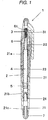
- FIG. 1 A first embodiment of the present invention will be described (see Fig. 1 ).
- the present embodiment is directed toward a writing instrument 1 including: a writing instrument main body 2; a cap 6 removably attached to a pen tip of the writing instrument main body 2; and a friction body 7 attached to a rear end of the writing instrument main body 2.
- Thermochromic ink 4 is stored in the writing instrument main body 2 and the thermochromic ink 4 is supplied onto a paper surface from a pen tip 3.
- thermochromic image or handwriting is formed on the paper surface as a result of the pen tip 3 of the writing instrument main body 2 contacting the paper surface.
- the thermochromic image or handwriting can be thermally discolored by rubbing the image or handwriting formed on the paper surface with the friction body 7.
- the writing instrument main body 2 includes: the pen tip 3 made up of a ball-point-pen tip; a pen tip holder 22 to which the pen tip 3 is fixed at a front end thereof; an ink storage cylinder 23 to which the pen tip holder 22 is fixed at a front end thereof; a tail plug 24 which is attached to an opening formed in a rear end of the ink storage cylinder 23 and has a ventilation opening; and a barrel 21 accommodating the ink storage cylinder 23.
- the thermochromic ink 4 and a following element 5 are housed in the ink storage cylinder 23.
- the following element 5 is disposed at a rear end of the thermochromic ink 4 and forwardly advances in association with consumption of the thermochromic ink 4
- a ball is held at the front end of the pen tip 3 in a rotatable manner.
- An elastic element (a coil spring) 31 is housed in the pen tip 3. The ball is urged forwardly by the elastic element 31, whereby the ball is brought into compressed contact with an inwardly-facing interior surface of the front end of the pen tip 3.
- a pen tip seal member 61 made from a soft material is housed in the cap 6.
- the pen tip 3 comes into close contact with the pen tip seal member 61, whereupon the pen tip 3 is sealed.
- the barrel 21 is made up of a front barrel 21a and a rear barrel 21b that are screw-engaged with each other.
- the pen tip 3 projects outwardly from a front-end hole of the barrel 21 (the front barrel 21a).
- the friction body 7 formed from soft synthetic resin is attached to a rear-end hole of the barrel 21 (the rear barrel 21b).
- An outward protrusion 71 is formed on an exterior surface of the friction body 7.
- An inward protrusion 21c is formed on an interior surface of the rear-end hole of the barrel 21. The outward protrusion 71 and the inward protrusion 21c are engaged with each other in a climbing manner, so that removal of the friction body 7 from the rear end hole can be avoided.
- the thermal conductivity of a friction portion of the friction body 7 is ranging from 0.05 W/(m•K) to 1.0 W/(m•K) and a friction coefficient of the friction portion of the friction body 7 to the paper surface is ranging from 0.2 to 1.0.
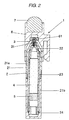
- the present embodiment is directed toward the writing instrument 1 including a writing instrument main body 2, a cap 6 removably attached to a pen tip of the writing instrument and the friction body 7 attached to the top of the cap 6.
- a thermochromic ink 4 is stored in the writing instrument main body 2 and supplied from the pen tip 3.
- the thermochromic image or handwriting is formed on the paper surface as a result of the pen tip 3 of the writing instrument main body 2 contacting the paper surface.
- the thermochromic image or handwriting can be thermally discolored by rubbing the image or handwriting formed on the paper surface with the friction body 7.
- the writing instrument main body 2 includes: a pen tip 3 made up of a ball-point-pen tip; a pen tip holder 22 to which the pen tip 3 is fixed at a front end thereof; an ink stoage cylinder 23 to which the pen tip holder 22 is fixed at to a front end of the ink storage cylinder; a tail plug 24 that is attached to an opening formed in a rear end of the ink storage cylinder 23 and that has a ventilation opening; and a barrel 21 accommodating the ink storage cylinder 23.
- the thermochromic ink 4 and the following element 5, which is disposed at the rear end of the thermochromic ink 4 and forwardly advances in association with consumption of the thermochromic ink 4, are housed in the ink storage cylinder 23.
- the barrel 21 is made up of the front barrel 21a and the rear barrel 21b that are screw-engaged with each other.
- the pen tip 3 protrudes outside from the front-end hole of the barrel 21 (the front barrel 21a).
- a ball is held at the front end of the pen tip 3 in a rotatable manner.
- the elastic element (a coil spring) 31 is housed in the pen tip 3.
- the ball is urged forwardly by the elastic element 31, whereby the ball is brought into compressed contact with an inwardly-facing interior surface of the front end of the pen tip 3.
- the pen tip seal member 61 made from a soft material is housed in the cap 6.
- the pen tip 3 comes into close contact with the pen tip seal member 61, whereupon the pen tip 3 is sealed.
- the friction body 7 formed from soft synthetic resin is attached to a mount hole opened in the top of the cap 6.
- the thermal conductivity of a friction portion of the friction body 7 is ranging from 0.05 W/(m•K) to 1.0 W/(m•K) and a friction coefficient of the friction portion of the friction body 7 to the paper surface is ranging from 0.2 to 1.0.
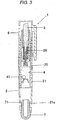
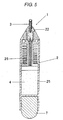
- the present embodiment is directed toward the writing instrument 1 including a writing instrument main body 2, a cap 6 removably attached to a pen tip of the writing instrument main body 2 and a friction body 7 attached to a rear end of the writing instrument main body 2.
- a thermochromic ink 4 is stored in the writing instrument main body 2 and is supplied from the pen tip 3.
- a thermochromic image or handwriting is formed on the paper surface as a result of the pen tip 3 of the writing instrument main body 2 contacting the paper surface.
- the thermochromic image or handwriting can be thermally discolored by rubbing the image or handwriting formed on the paper surface with the friction body 7.
- the writing instrument main body 2 includes: a pen tip 3 made up of a processed fibrous element or a porous element; an ink tank 25 attached to the front end of the pen tip 3 so as to be movable front and back; a valve 26 that opens as a result of the pen tip 3 being pressed backwardly; a barrel 21 holding a rear portion of the ink tank 25; and a friction body 7 made up of soft synthetic resin attached to the rear end of the barrel 21.
- An agitation member 41 is housed in the ink tank 25.
- the thermal conductivity of a friction portion of the friction body 7 is ranging from 0.05 W/(m•K) to 1.0 W/(m•K) and a friction coefficient of the friction portion of the friction body 7 to the paper surface is ranging from 0.2 to 1.0.
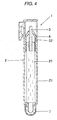
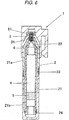
- the present embodiment is directed toward the writing instrument 1 including a writing instrument main body 2, a cap 6 removably attached to a pen tip of the writing instrument main body 2 and a friction body 7 attached to the rear end of the writing instrument main body 2.
- the thermochromic ink is stored in the writing instrument main body 2 and the thermochromic ink is emitted from the pen tip 3.
- a thermochromic image or handwriting is formed on the paper surface as a result of the pen tip 3 of the writing instrument main body 2 contacting the paper surface.
- the thermochromic image or handwriting can be thermally discolored by rubbing the image or handwriting formed on the paper surface with the friction body 7.
- the writing instrument main body 2 includes: the pen tip 3 formed from a processed fibrous element or a porous element; a pen tip holder 22 that holds the pen tip 3; a barrel 21 which has the pen tip holder 22 at a front end thereof and accommodates an ink absorbing element 27 therein; and a friction body 7 that is attached to the rear end of the barrel 21 and that is formed from soft synthetic resin.
- the ink absorbing element 27 is formed from a member having continuous pores (e.g., a processed fibrous element and a porous material such as a porous foam) and the ink absorbing element 27 is impregnated with thermochromic ink.
- a rear end of the pen tip 3 is connected to a front end of the ink absorbing element 27.
- the friction body 7 is attached to an exterior surface of a rear end of the barrel 21 by fitting or the friction body and the rear end of the barrel are formed integrally by coinjection molding.
- the thermal conductivity of a friction portion of the friction body 7 is ranging from 0.05 W/(m•K) to 1.0 W/(m•K) and a friction coefficient of the friction portion of the friction body 7 to the paper surface is ranging from 0.2 to 1.0.
- the present embodiment is directed toward the writing instrument 1 including a pen tip 3 attached to the front end of the writing instrument main body 2 and a friction body 7 attached to the rear end of the writing instrument main body 2.
- the thermochromic ink 4 is stored in the writing instrument main body 2 and supplied from the pen tip 3.
- a thermochromic image or handwriting is formed on the paper surface as a result of the pen tip 3 of the writing instrument main body 2 contacting the paper surface.
- the thermochromic image or handwriting can be thermally discolored by rubbing the image or handwriting formed on the paper surface with the friction body 7.
- the writing instrument main body 2 includes: a pen tip 3 formed from a ball-point-pen tip; a pen tip holder 22 holding the pen tip 3; an ink reservoir 28 having the pen tip holder 22 at a front end thereof; and an ink tank 25 that has the ink reservoir 28 at a front end thereof and that directly stores the thermochromic ink 4.
- the ink reservoir 28 is a member that is interposed between the pen tip 3 and the ink tank 25 and that temporarily retains overflowing ink resultant from an increase in the internal pressure of the ink tank 25.
- a comb-shaped member is adopted for the ink reservoir.
- the friction body 7 is formed from a soft synthetic resin and attached to the rear-end hole of the ink tank 25.
- the thermal conductivity of a friction portion of the friction body 7 is ranging from 0.05 W/(m•K) to 1.0 W/(m•K) and a friction coefficient of the friction portion of the friction body 7 to the paper surface is ranging from 0.2 to 1.0.
- the related example is directed toward a writing instrument set having the writing instrument 1 and the friction body 7.
- the thermochromic ink 4 is stored in the writing instrument 1 and supplied from the pen tip 3.
- a thermochromic image or handwriting is formed on the paper surface as a result of the pen tip 3 of the writing instrument 1 contacting the paper surface.
- the thermochromic image or handwriting can be thermally discolored by rubbing the image or handwriting formed on the paper surface with the friction body 7.
- the writing instrument 1 is made up of the writing instrument main body 2 which has the pen tip 3 at the front end thereof and stores the thermochromic ink 4 and the cap 6 removably attached to the pen tip side of the writing instrument main body 2.
- the writing instrument main body 2 includes: a pen tip 3 made up of a ball-point-pen tip, a pen tip holder 22 to which the pen tip 3 is fixed at the front end thereof, an ink storage cylinder 23 to which the pen tip holder 22 is fixed at the front end thereof, the tail plug 24 that is attached to an opening formed in a rear end of the ink storage cylinder 23 and has a ventilation opening; and a barrel 21 accommodating the ink storage cylinder 23.
- the thermochromic ink 4 and the following element 5, which is disposed at the rear end of the thermochromic ink 4 and forwardly advances in association with consumption of the thermochromic ink 4, are housed in the ink storage cylinder 23.
- the barrel 21 is made up of the front barrel 21a and the rear barrel 21b that are screw-engaged with each other.
- the pen tip 3 protrudes outside from the front-end hole of the barrel 21 (the front barrel 21a).
- a ball is held at the front end of the pen tip 3 in a rotatable manner.
- the elastic element (a coil spring) 31 is housed in the pen tip 3.
- the ball is urged forwardly by the elastic element 31, whereby the ball is brought into compressed contact with an inwardly-facing interior surface of the front end of the pen tip 3.
- the pen tip seal member 61 made from a soft material is housed in the cap 6.
- the pen tip 3 comes into close contact with the pen tip seal member 61, whereupon the pen tip 3 is sealed.
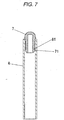
- the outward protrusion 71 is provided on the exterior surface of the friction body 7 formed from a soft synthetic resin.
- the friction body 7 is attached to the front end of the friction body holder 8.
- the friction body holder 8 is cylindrical and the inward protrusion 81 is formed on the interior surface of the front end of the friction body holder.
- the inward outward protrusions 81, 71 are engaged with each other in a climbing manner, thereby preventing removal of the friction body 7.
- the thermal conductivity of a friction portion of the friction body 7 is ranging from 0.05 W/(m•k) to 1.0 W/(m•K) and a friction coefficient of the friction portion of the friction body 7 to the paper surface is ranging from 0.2 to 1.0.
- Table 1 shows results of tests for thermochromism property when thermochromic handwriting formed in thermochromic ink was rubbed under the certain values of ( ⁇ W ⁇ V)/A, which is given by arbitrary selecting values of a friction coefficient ⁇ between the friction body and the paper surface; vertical load W (N) imparted to the paper surface by the friction body during frictional motion; velocity V(m/s) at which the friction body travels over the paper surface during frictional motion; and a contact area A (cm 2 ) at which the friction body contacts the paper surface during frictional motion.
- thermochromic handwriting formed in thermochromic ink having a discoloration temperature (a high-temperature point of discoloration) of 45°C was rubbed at an ambient temperature of 25°C with a plurality of types of friction bodies.
- thermochromism Evaluations of thermochromism in the table are as follows:
- Table 2 shows results of tests for thermochromism property when thermochromic handwriting formed in thermochromic ink was rubbed under the certain values of ⁇ /A, which is given by arbitrary selecting values of a friction coefficient ⁇ between the friction body and the paper surface; and a contact area A (cm 2 ) at which the friction body contacts the paper surface during frictional motion, and also setting the vertical load W (N) imparted to the paper surface by the friction body during frictional motion as 4.9N; and the velocity V(m/s) at which the friction body travels over the paper surface during frictional motion as 0.5 m/s.
- thermochromic handwriting formed in thermochromic ink having a discoloration temperature (a high-temperature point of discoloration) of 45 °C was rubbed at an ambient temperature of 25 °C with a plurality of types of friction bodies.
- thermochromism Evaluations of thermochromism in the table are as follows:
- Table 3 shows results of tests for thermochromism property when thermo chromic handwriting formed in thermochromic ink was rubbed under the certain values of ( ⁇ W ⁇ V)/A, which is given by arbitrary selecting values of a friction coefficient ⁇ between the friction body and the paper surface; vertical load W (N) imparted to the paper surface by the friction body during frictional motion; velocity V(m/s) at which the friction body travels over the paper surface during frictional motion; and a contact area A (cm 2 ) at which the friction body contacts the paper surface during frictional motion.
- thermochromic handwriting formed in thermochromic ink having a discoloration temperature (a high-temperature point of discoloration) of 60 °C was rubbed at an ambient temperature of 25 °C with a plurality of types of friction bodies.
- thermochromism Evaluations of thermochromism in the table are as follows:
- Table 4 shows results of tests for thermochromism property when thermochromic handwriting formed in thermochromic ink was rubbed under the certain values of ⁇ /A, which is given by arbitrary selecting values of a friction coefficient ⁇ between the friction body and the paper surface; and a contact area A (cm 2 ) at which the friction body contacts the paper surface during frictional motion, and also setting the vertical load W (N) imparted to the paper surface by the friction body during frictional motion as 4.9N; and the velocity V(m/s) at which the friction body travels over the paper surface during frictional motion as 0.5 m/s.
- thermochromic handwriting formed in thermochromic ink having a discoloration temperature of (a high-temperature point of discoloration) 60 °C was rubbed at an ambient temperature of 25 °C with a plurality of types of friction bodies.
- thermochromism Evaluations of thermochromism in the table are as follows:
Landscapes
- Chemical & Material Sciences (AREA)
- Engineering & Computer Science (AREA)
- Life Sciences & Earth Sciences (AREA)
- Materials Engineering (AREA)
- Wood Science & Technology (AREA)
- Organic Chemistry (AREA)
- Mechanical Engineering (AREA)
- Pens And Brushes (AREA)
Claims (6)
- Schreibinstrument, umfassend:einen Reibungskörper (7), der dazu angepasst ist, ein thermochromes Bild oder eine Handschrift, die auf einer Papieroberfläche unter Verwendung von thermochromer Tinte gebildet ist, zu reiben, um das thermochrome Bild oder die Handschrift durch Reibungswärme, die aus dem Reiben resultiert, thermisch zu verfärben; undeine thermochrome Tinte (4), die dazu angepasst ist, herauszufließen,dadurch gekennzeichnet, dass:eine Wärmeleitfähigkeit eines Reibungsabschnitts des Reibungskörpers im Bereich von 0,05 W / (m.K) bis 10 W / (m.K) liegt,das Schreibinstrument mit einer Bohrung bereitgestellt ist, die an einem hinteren Ende eines Schaftes (21) des Schreibinstruments oder an einer Oberseite einer Kappe (6) des Schreibinstruments ausgebildet ist; undein nach außen gerichteter Vorsprung (71), der auf einer Außenoberfläche des Reibungskörpers ausgebildet ist, undein nach innen gerichteter Vorsprung (21c), der auf der Innenoberfläche der Bohrung ausgebildet ist und einen Innendurchmesser aufweist, der kleiner ist als ein Außendurchmesser des nach außen gerichteten Vorsprungs,derart miteinander in Eingriff sind, dass sie ein Entfernen des Reibungskörpers aus der Bohrung verhindern.
- Schreibinstrument nach Anspruch 1, umfassend:einen Schreibinstrumenthauptkörper (2);die thermochrome Tinte, die in den Schreibinstrumenthauptkörper eingearbeitet ist; undeine Stiftspitze (3), die aus einer Kugelschreiberspitze besteht und in der Lage ist, die thermochrome Tinte zuzuführen, wobei die Stiftspitze an einem vorderen Ende des Schreibinstrumenthauptkörpers bereitgestellt ist,wobei der Reibungskörper an einem hinteren Ende des Schreibinstrumenthauptkörpers bereitgestellt ist.
- Schreibinstrument nach Anspruch 1 oder 2, umfassend:einen Schreibinstrumenthauptkörper (2);die thermochrome Tinte, die in den Schreibinstrumenthauptkörper eingearbeitet ist;eine Stiftspitze (3), die aus einer Kugelschreiberspitze besteht und in der Lage ist, die thermochrome Tinte zuzuführen, wobei die Stiftspitze an einem vorderen Ende des Schreibinstrumenthauptkörpers bereitgestellt ist; undeine abnehmbare Kappe (6), die an einer Stiftspitzenseite des Schreibinstrumenthauptkörpers bereitgestellt ist,wobei der Reibungskörper an einer Oberseite der Kappe bereitgestellt ist.
- Schreibinstrument nach Anspruch 1, umfassend:eine Stiftspitze (3), die aus einem verarbeiteten Faserelement oder einem porösen Element besteht, das in der Lage ist, die thermochrome Tinte zuzuführen;einen Schreibinstrumenthauptkörper (2), umfassend:einen Tintenbehälter (25), der die thermochrome Tinte speichert und an dem die Stiftspitze zurück und vorwärts bewegbar angebracht ist; undeinen Ventilmechanismus (26), der sich öffnet, wenn die Stiftspitze nach hinten gedrückt wird; undeine abnehmbare Kappe (6), die an der Stiftspitzenseite des Schreibinstrumenthauptkörpers bereitgestellt ist,wobei der Reibungskörper an einem hinteren Ende des Schreibinstrumenthauptkörpers oder einer Oberseite der Kappe bereitgestellt ist.
- Schreibinstrument nach Anspruch 1, umfassend:
einen Schreibinstrumenthauptkörper (2), umfassend:ein tintenabsorbierendes Element (27), das aus einem Element besteht, das durchgehende Poren aufweist und mit der thermochromen Tinte imprägniert ist, undeine Stiftspitze (3), die aus einem verarbeiteten Faserelement oder einem porösen Element hergestellt ist, die mit dem tintenabsorbierenden Element verbunden ist und die thermochrome Tinte zuführt; undeine abnehmbare Kappe (6), die an einer Stiftspitzenseite des Schreibinstrumenthauptkörpers bereitgestellt ist,wobei der Reibungskörper an einem hinteren Ende des Schreibinstrumenthauptkörpers oder der Oberseite der Kappe bereitgestellt ist. - Schreibinstrument nach Anspruch 1, umfassend:
einen Schreibinstrumenthauptkörper, umfassend:eine Stiftspitze (3), die aus einer Kugelschreiberspitze besteht, die die thermochrome Tinte zuführt;einen Tintenbehälter (25), der die thermochrome Tinte speichert; undein Tintenreservoir (28), das zwischen der Stiftspitze und dem Tintenbehälter angeordnet ist und das vorübergehend überlaufende Tinte aufnimmt, wenn ein Innendruck des Tintenbehälters steigt; undeine abnehmbare Kappe (6), die an einer Stiftspitzenseite des Schreibinstrumenthauptkörpers bereitgestellt ist,wobei der Reibungskörper an einem hinteren Ende des Schreibinstrumenthauptkörpers oder der Oberseite der Kappe bereitgestellt ist.
Applications Claiming Priority (3)
| Application Number | Priority Date | Filing Date | Title |
|---|---|---|---|
| JP2007135405A JP2008290267A (ja) | 2007-05-22 | 2007-05-22 | 摩擦体、筆記具及び筆記具セット |
| JP2007139609A JP2008290392A (ja) | 2007-05-25 | 2007-05-25 | 摩擦体、筆記具及び筆記具セット |
| EP08009365A EP1995076A1 (de) | 2007-05-22 | 2008-05-21 | Reibungskörper, Schreibinstrument und Schreibinstrumentset |
Related Parent Applications (2)
| Application Number | Title | Priority Date | Filing Date |
|---|---|---|---|
| EP08009365A Division EP1995076A1 (de) | 2007-05-22 | 2008-05-21 | Reibungskörper, Schreibinstrument und Schreibinstrumentset |
| EP08009365.1 Division | 2008-05-21 |
Publications (2)
| Publication Number | Publication Date |
|---|---|
| EP2368721A1 EP2368721A1 (de) | 2011-09-28 |
| EP2368721B1 true EP2368721B1 (de) | 2021-08-11 |
Family
ID=39645355
Family Applications (2)
| Application Number | Title | Priority Date | Filing Date |
|---|---|---|---|
| EP11169482.4A Active EP2368721B1 (de) | 2007-05-22 | 2008-05-21 | Reibungskörper, Schreibinstrument und Schreibinstrumentset |
| EP08009365A Ceased EP1995076A1 (de) | 2007-05-22 | 2008-05-21 | Reibungskörper, Schreibinstrument und Schreibinstrumentset |
Family Applications After (1)
| Application Number | Title | Priority Date | Filing Date |
|---|---|---|---|
| EP08009365A Ceased EP1995076A1 (de) | 2007-05-22 | 2008-05-21 | Reibungskörper, Schreibinstrument und Schreibinstrumentset |
Country Status (7)
| Country | Link |
|---|---|
| US (1) | US9592702B2 (de) |
| EP (2) | EP2368721B1 (de) |
| KR (1) | KR101552715B1 (de) |
| CN (1) | CN102785511B (de) |
| ES (1) | ES2886755T3 (de) |
| SG (1) | SG148122A1 (de) |
| TW (1) | TW200902336A (de) |
Families Citing this family (20)
| Publication number | Priority date | Publication date | Assignee | Title |
|---|---|---|---|---|
| JP2008155624A (ja) | 2006-11-29 | 2008-07-10 | Pilot Ink Co Ltd | 摩擦体及びそれを用いた筆記具、筆記具セット |
| KR20190049911A (ko) * | 2007-02-26 | 2019-05-09 | 파일롯트 잉크 가부시키가이샤 | 열 변색성 필기 도구 |
| KR101552715B1 (ko) | 2007-05-22 | 2015-09-11 | 파일롯트 잉크 가부시키가이샤 | 마찰체, 필기구 및 필기구세트 |
| PL3184320T3 (pl) * | 2010-02-03 | 2021-02-08 | The Pilot Ink Co., Ltd | Narzędzie do pisania |
| US8652996B2 (en) | 2011-12-31 | 2014-02-18 | Sanford, L.P. | Irreversible thermochromic pigment capsules |
| US8664156B2 (en) | 2011-12-31 | 2014-03-04 | Sanford, L.P. | Irreversible thermochromic ink compositions |
| US8709973B2 (en) | 2011-12-31 | 2014-04-29 | Sanford, L.P. | Irreversible thermochromic ink compositions |
| US8865621B2 (en) | 2012-08-06 | 2014-10-21 | Sanford, L.P. | Irreversible color changing ink compositions |
| US10556459B2 (en) * | 2015-12-29 | 2020-02-11 | Kabushiki Kaisha Pilot Corporation (Also Trading As Pilot Corporation) | Writing instrument for forming thermochromic handwriting |
| PT3538379T (pt) * | 2016-11-13 | 2023-05-22 | Rocket Innovations Inc | Sistema de anotações apagáveis por humidade |
| DE102016123858B4 (de) | 2016-12-08 | 2020-10-01 | Pelikan Pbs-Produktionsgesellschaft Mbh & Co. Kg | Reibkörper für thermosensitive Tinte |
| WO2018116767A1 (ja) * | 2016-12-19 | 2018-06-28 | 株式会社パイロットコーポレーション | 摩擦体並びに筆記具及び筆記セット |
| JP6778611B2 (ja) * | 2016-12-27 | 2020-11-04 | 株式会社パイロットコーポレーション | 熱変色性筆記具 |
| JP7535056B2 (ja) | 2019-04-30 | 2024-08-15 | ソシエテ ビック | 筆記用具のための後退可能な要素 |
| DE202020003851U1 (de) * | 2020-09-10 | 2021-12-14 | Stabilo International Gmbh | Stift und Behältnis eines solchen Stiftes |
| WO2022129522A1 (en) | 2020-12-18 | 2022-06-23 | Societe Bic | Friction body |
| KR102560972B1 (ko) | 2021-01-21 | 2023-07-28 | 주식회사 엑티브온 | 열변색성 안료를 포함하는 마찰제 |
| US20240051331A1 (en) * | 2021-02-25 | 2024-02-15 | BIC Violex Single Member S.A. | Friction body with anisotropic thermal conductivity |
| DE102022002185A1 (de) | 2022-06-15 | 2023-12-21 | Stabilo International Gmbh | Stift |
| DE202022001380U1 (de) | 2022-06-15 | 2023-09-22 | STABILO International GmbH | Stift |
Citations (11)
| Publication number | Priority date | Publication date | Assignee | Title |
|---|---|---|---|---|
| JPH0671164U (ja) | 1993-03-23 | 1994-10-04 | パイロットインキ株式会社 | 筆記具の尾冠取付構造 |
| JPH07241388A (ja) | 1994-03-07 | 1995-09-19 | Pilot Ink Co Ltd | 熱変色筆記材セット |
| US20020159818A1 (en) * | 2001-04-27 | 2002-10-31 | Smith David S. | Crayon with eraser |
| JP2003206432A (ja) | 2001-11-12 | 2003-07-22 | Pilot Ink Co Ltd | 摩擦熱変色性筆記具及びそれを用いた摩擦熱変色セット |
| JP2004148744A (ja) | 2002-10-31 | 2004-05-27 | Pilot Ink Co Ltd | 摩擦体及び筆記具 |
| JP2006123324A (ja) | 2004-10-28 | 2006-05-18 | Pilot Ink Co Ltd | 摩擦体及びそれを備えた筆記具、筆記具セット |
| JP2007135405A (ja) | 2005-11-14 | 2007-06-07 | Ezaki Glico Co Ltd | チョコレート入り冷菓ミックス |
| JP2007139609A (ja) | 2005-11-18 | 2007-06-07 | Denso Corp | 車両用計器 |
| EP1820662A2 (de) | 2006-01-27 | 2007-08-22 | The Pilot Ink Co., Ltd. | Reibungskörper, Schreibinstrument und Schreibinstrumentset |
| EP1939259A2 (de) | 2006-11-29 | 2008-07-02 | The Pilot Ink Co., Ltd. | Reibungskörper, Schreibinstrument und Schreibinstrumentset |
| EP1995076A1 (de) | 2007-05-22 | 2008-11-26 | The Pilot Ink Co., Ltd. | Reibungskörper, Schreibinstrument und Schreibinstrumentset |
Family Cites Families (26)
| Publication number | Priority date | Publication date | Assignee | Title |
|---|---|---|---|---|
| JPH0546950Y2 (de) | 1986-11-17 | 1993-12-09 | ||
| GB2205255B (en) * | 1987-04-29 | 1991-07-24 | Pilot Ink Co Ltd | Color changing toy |
| JPH0736718Y2 (ja) * | 1989-02-09 | 1995-08-23 | パイロットインキ株式会社 | 色彩記憶玩具用品セット |
| JPH0356682U (de) | 1989-09-30 | 1991-05-30 | ||
| JP2737550B2 (ja) | 1992-06-16 | 1998-04-08 | 信越化学工業株式会社 | 高摩擦用材料及びその硬化物 |
| JP2963849B2 (ja) | 1994-07-27 | 1999-10-18 | セーラー万年筆株式会社 | 軸体の嵌合構造 |
| CN2209044Y (zh) | 1994-09-29 | 1995-10-04 | 广西大学 | 板写笔 |
| JPH08220913A (ja) | 1995-02-17 | 1996-08-30 | Ricoh Co Ltd | 定着装置 |
| JP3472950B2 (ja) * | 1996-02-19 | 2003-12-02 | パイロットインキ株式会社 | ボールペン用インキ逆流防止体組成物 |
| US5618581A (en) * | 1996-07-01 | 1997-04-08 | Calladium Corporation | Method for making thermochromic writing instruments having a reptilian texture |
| JPH10283107A (ja) | 1997-03-31 | 1998-10-23 | Pilot Precision Co Ltd | 入力ペン |
| JPH11110112A (ja) | 1997-10-03 | 1999-04-23 | Pilot Precision Co Ltd | 入力ペン |
| JP2001010277A (ja) | 1999-06-29 | 2001-01-16 | Pilot Corp | 筆記具の軸筒 |
| JP2001022510A (ja) | 1999-07-06 | 2001-01-26 | Pilot Precision Co Ltd | 入力ペン |
| JP3835732B2 (ja) * | 1999-08-30 | 2006-10-18 | ラビット株式会社 | 字消し及びその製造方法 |
| US7316841B1 (en) | 1999-08-30 | 2008-01-08 | Sakura Color Products Corporation | Eraser |
| US6346024B1 (en) * | 2000-02-11 | 2002-02-12 | Robert W. Engel | Bath toy with thermally erasable drawing surface |
| CN1257808C (zh) | 2000-05-18 | 2006-05-31 | 三菱铅笔株式会社 | 集流器型书写用具 |
| CN1349148A (zh) * | 2000-10-16 | 2002-05-15 | 百乐精密股份有限公司 | 输入笔 |
| JP2003296009A (ja) | 2002-03-29 | 2003-10-17 | Pilot Precision Co Ltd | 入力ペン |
| JP2004146106A (ja) | 2002-10-22 | 2004-05-20 | Shin Etsu Polymer Co Ltd | 熱可塑性の弾性放熱性組成物及びこれを用いたプラズマディスプレイパネル |
| JP4326817B2 (ja) | 2003-02-13 | 2009-09-09 | パイロットインキ株式会社 | 金属光沢調可逆熱変色性筆記具用インキ組成物 |
| JP2005131793A (ja) * | 2003-10-28 | 2005-05-26 | Koichi Ogura | 簡易鉛筆 |
| JP4563105B2 (ja) | 2004-08-06 | 2010-10-13 | 三菱鉛筆株式会社 | 消し具 |
| JP4961115B2 (ja) | 2005-06-01 | 2012-06-27 | パイロットインキ株式会社 | 可逆熱変色性筆記具用水性インキ組成物及びそれを収容した筆記具 |
| CN101007482A (zh) * | 2006-01-27 | 2007-08-01 | 百乐墨水株式会社 | 摩擦体以及具备该摩擦体的书写工具、书写工具组件 |
-
2008
- 2008-05-20 KR KR1020080046380A patent/KR101552715B1/ko active Active
- 2008-05-20 SG SG200803797-0A patent/SG148122A1/en unknown
- 2008-05-21 CN CN201210286913.5A patent/CN102785511B/zh active Active
- 2008-05-21 EP EP11169482.4A patent/EP2368721B1/de active Active
- 2008-05-21 US US12/124,211 patent/US9592702B2/en active Active
- 2008-05-21 EP EP08009365A patent/EP1995076A1/de not_active Ceased
- 2008-05-21 TW TW097118637A patent/TW200902336A/zh unknown
- 2008-05-21 ES ES11169482T patent/ES2886755T3/es active Active
Patent Citations (12)
| Publication number | Priority date | Publication date | Assignee | Title |
|---|---|---|---|---|
| JPH0671164U (ja) | 1993-03-23 | 1994-10-04 | パイロットインキ株式会社 | 筆記具の尾冠取付構造 |
| JPH07241388A (ja) | 1994-03-07 | 1995-09-19 | Pilot Ink Co Ltd | 熱変色筆記材セット |
| US20020159818A1 (en) * | 2001-04-27 | 2002-10-31 | Smith David S. | Crayon with eraser |
| JP2003206432A (ja) | 2001-11-12 | 2003-07-22 | Pilot Ink Co Ltd | 摩擦熱変色性筆記具及びそれを用いた摩擦熱変色セット |
| JP2004148744A (ja) | 2002-10-31 | 2004-05-27 | Pilot Ink Co Ltd | 摩擦体及び筆記具 |
| JP2006123324A (ja) | 2004-10-28 | 2006-05-18 | Pilot Ink Co Ltd | 摩擦体及びそれを備えた筆記具、筆記具セット |
| JP2007135405A (ja) | 2005-11-14 | 2007-06-07 | Ezaki Glico Co Ltd | チョコレート入り冷菓ミックス |
| JP2007139609A (ja) | 2005-11-18 | 2007-06-07 | Denso Corp | 車両用計器 |
| EP1820662A2 (de) | 2006-01-27 | 2007-08-22 | The Pilot Ink Co., Ltd. | Reibungskörper, Schreibinstrument und Schreibinstrumentset |
| EP1939259A2 (de) | 2006-11-29 | 2008-07-02 | The Pilot Ink Co., Ltd. | Reibungskörper, Schreibinstrument und Schreibinstrumentset |
| EP1995076A1 (de) | 2007-05-22 | 2008-11-26 | The Pilot Ink Co., Ltd. | Reibungskörper, Schreibinstrument und Schreibinstrumentset |
| EP2368721A1 (de) | 2007-05-22 | 2011-09-28 | The Pilot Ink Co., Ltd. | Reibungskörper, Schreibinstrument und Schreibinstrumentset |
Non-Patent Citations (3)
| Title |
|---|
| "International Plastics Handbook ", 1 January 2006, article ANONYMOUS: "Characteristic Thermal Properties of Selected Plastics ", pages: 733 - 734, XP055924915 |
| "PP Handbook", 1 November 1997, article PETER BLUM: "8. THERMAL CONDUCTIVITY", XP055924918 |
| ANONYMOUS: "Thermally Conductive Silicones ", ADHERE, 1 October 2018 (2018-10-01), XP055924919, [retrieved on 20220525] |
Also Published As
| Publication number | Publication date |
|---|---|
| EP1995076A1 (de) | 2008-11-26 |
| TW200902336A (en) | 2009-01-16 |
| CN102785511A (zh) | 2012-11-21 |
| CN102785511B (zh) | 2015-10-07 |
| KR101552715B1 (ko) | 2015-09-11 |
| US20080292385A1 (en) | 2008-11-27 |
| KR20080102976A (ko) | 2008-11-26 |
| US9592702B2 (en) | 2017-03-14 |
| ES2886755T3 (es) | 2021-12-20 |
| EP2368721A1 (de) | 2011-09-28 |
| SG148122A1 (en) | 2008-12-31 |
Similar Documents
| Publication | Publication Date | Title |
|---|---|---|
| US9592702B2 (en) | Friction body, writing instrument and writing instrument set | |
| JP2024023833A (ja) | 熱変色性筆記具 | |
| US11383547B2 (en) | Friction body, writing instrument, and writing set | |
| CN101311001B (zh) | 摩擦体、书写工具及书写工具组件 | |
| CA2148902A1 (en) | A writing implement using liquid ink, in particular a solvent-based ink | |
| JP3162814U (ja) | 熱変色性筆記具 | |
| JP2013111952A (ja) | 筆記具 | |
| HK1158581B (en) | Friction body, writing instrument and writing instrument set | |
| TW202138210A (zh) | 熱變色性書寫筆具 | |
| JP2008273075A (ja) | 熱変色性筆記具 | |
| HK1124815A (en) | Friction body, writing instrument and writing instrument set | |
| HK1158581A (en) | Friction body, writing instrument and writing instrument set | |
| JP2008290392A (ja) | 摩擦体、筆記具及び筆記具セット | |
| JP2008296413A (ja) | 熱変色性筆記具 | |
| JP2009107229A (ja) | 熱変色性筆記具 | |
| JP2008273076A (ja) | 熱変色性筆記具 | |
| JP3161409U (ja) | 熱変色性筆記具 | |
| JP2012179912A (ja) | 筆記具 | |
| JP2009023271A (ja) | 熱変色性筆記具 | |
| JP3195851U (ja) | 筆記具 | |
| JP2008296412A (ja) | 熱変色性筆記具 | |
| JP5705463B2 (ja) | 熱変色性筆記具 | |
| JP3157874U (ja) | 熱変色性筆記具 | |
| JP2010188737A (ja) | 熱変色性筆記具 | |
| JP2009066779A (ja) | 熱変色性筆記具 |
Legal Events
| Date | Code | Title | Description |
|---|---|---|---|
| PUAI | Public reference made under article 153(3) epc to a published international application that has entered the european phase |
Free format text: ORIGINAL CODE: 0009012 |
|
| 17P | Request for examination filed |
Effective date: 20110610 |
|
| AC | Divisional application: reference to earlier application |
Ref document number: 1995076 Country of ref document: EP Kind code of ref document: P |
|
| AK | Designated contracting states |
Kind code of ref document: A1 Designated state(s): DE ES FR GB IT |
|
| REG | Reference to a national code |
Ref country code: HK Ref legal event code: DE Ref document number: 1158581 Country of ref document: HK |
|
| 17Q | First examination report despatched |
Effective date: 20150511 |
|
| RAP1 | Party data changed (applicant data changed or rights of an application transferred) |
Owner name: KABUSHIKI KAISHA PILOT CORPORATION (ALSO TRADING A Owner name: THE PILOT INK CO., LTD. |
|
| STAA | Information on the status of an ep patent application or granted ep patent |
Free format text: STATUS: EXAMINATION IS IN PROGRESS |
|
| GRAP | Despatch of communication of intention to grant a patent |
Free format text: ORIGINAL CODE: EPIDOSNIGR1 |
|
| STAA | Information on the status of an ep patent application or granted ep patent |
Free format text: STATUS: GRANT OF PATENT IS INTENDED |
|
| INTG | Intention to grant announced |
Effective date: 20210407 |
|
| RAP3 | Party data changed (applicant data changed or rights of an application transferred) |
Owner name: THE PILOT INK CO., LTD. Owner name: KABUSHIKI KAISHA PILOT CORPORATION (ALSO TRADING AS PILOT CORPORATION) |
|
| GRAS | Grant fee paid |
Free format text: ORIGINAL CODE: EPIDOSNIGR3 |
|
| GRAA | (expected) grant |
Free format text: ORIGINAL CODE: 0009210 |
|
| STAA | Information on the status of an ep patent application or granted ep patent |
Free format text: STATUS: THE PATENT HAS BEEN GRANTED |
|
| AC | Divisional application: reference to earlier application |
Ref document number: 1995076 Country of ref document: EP Kind code of ref document: P |
|
| AK | Designated contracting states |
Kind code of ref document: B1 Designated state(s): DE ES FR GB IT |
|
| REG | Reference to a national code |
Ref country code: GB Ref legal event code: FG4D |
|
| REG | Reference to a national code |
Ref country code: DE Ref legal event code: R096 Ref document number: 602008064160 Country of ref document: DE |
|
| REG | Reference to a national code |
Ref country code: ES Ref legal event code: FG2A Ref document number: 2886755 Country of ref document: ES Kind code of ref document: T3 Effective date: 20211220 |
|
| REG | Reference to a national code |
Ref country code: DE Ref legal event code: R026 Ref document number: 602008064160 Country of ref document: DE |
|
| PLBI | Opposition filed |
Free format text: ORIGINAL CODE: 0009260 |
|
| 26 | Opposition filed |
Opponent name: SOCIETE BIC Effective date: 20220510 |
|
| PLAX | Notice of opposition and request to file observation + time limit sent |
Free format text: ORIGINAL CODE: EPIDOSNOBS2 |
|
| PLBB | Reply of patent proprietor to notice(s) of opposition received |
Free format text: ORIGINAL CODE: EPIDOSNOBS3 |
|
| REG | Reference to a national code |
Ref country code: FR Ref legal event code: PLFP Year of fee payment: 16 |
|
| P01 | Opt-out of the competence of the unified patent court (upc) registered |
Effective date: 20230510 |
|
| PLCK | Communication despatched that opposition was rejected |
Free format text: ORIGINAL CODE: EPIDOSNREJ1 |
|
| APAH | Appeal reference modified |
Free format text: ORIGINAL CODE: EPIDOSCREFNO |
|
| APBM | Appeal reference recorded |
Free format text: ORIGINAL CODE: EPIDOSNREFNO |
|
| APBP | Date of receipt of notice of appeal recorded |
Free format text: ORIGINAL CODE: EPIDOSNNOA2O |
|
| APBQ | Date of receipt of statement of grounds of appeal recorded |
Free format text: ORIGINAL CODE: EPIDOSNNOA3O |
|
| APBU | Appeal procedure closed |
Free format text: ORIGINAL CODE: EPIDOSNNOA9O |
|
| PGFP | Annual fee paid to national office [announced via postgrant information from national office to epo] |
Ref country code: ES Payment date: 20260604 Year of fee payment: 19 |
|
| PGFP | Annual fee paid to national office [announced via postgrant information from national office to epo] |
Ref country code: GB Payment date: 20260409 Year of fee payment: 19 |
|
| PGFP | Annual fee paid to national office [announced via postgrant information from national office to epo] |
Ref country code: IT Payment date: 20260422 Year of fee payment: 19 |
|
| PGFP | Annual fee paid to national office [announced via postgrant information from national office to epo] |
Ref country code: DE Payment date: 20260402 Year of fee payment: 19 |
|
| PGFP | Annual fee paid to national office [announced via postgrant information from national office to epo] |
Ref country code: FR Payment date: 20260401 Year of fee payment: 19 |