EP2369859A2 - Verfahren zur Tonanpassung in einer Hörhilfevorrichtung durch Frequenzmodifikation und dem entsprechende Vorrichtung - Google Patents
Verfahren zur Tonanpassung in einer Hörhilfevorrichtung durch Frequenzmodifikation und dem entsprechende Vorrichtung Download PDFInfo
- Publication number
- EP2369859A2 EP2369859A2 EP11167949A EP11167949A EP2369859A2 EP 2369859 A2 EP2369859 A2 EP 2369859A2 EP 11167949 A EP11167949 A EP 11167949A EP 11167949 A EP11167949 A EP 11167949A EP 2369859 A2 EP2369859 A2 EP 2369859A2
- Authority
- EP
- European Patent Office
- Prior art keywords
- frequency
- frequency modification
- lcf
- pcf
- max
- Prior art date
- Legal status (The legal status is an assumption and is not a legal conclusion. Google has not performed a legal analysis and makes no representation as to the accuracy of the status listed.)
- Granted
Links
Images


Classifications
-
- H—ELECTRICITY
- H04—ELECTRIC COMMUNICATION TECHNIQUE
- H04R—LOUDSPEAKERS, MICROPHONES, GRAMOPHONE PICK-UPS OR LIKE ACOUSTIC ELECTROMECHANICAL TRANSDUCERS; ELECTRIC HEARING AIDS; PUBLIC ADDRESS SYSTEMS
- H04R25/00—Electric hearing aids
- H04R25/35—Electric hearing aids using translation techniques
- H04R25/353—Frequency, e.g. frequency shift or compression
-
- H—ELECTRICITY
- H04—ELECTRIC COMMUNICATION TECHNIQUE
- H04R—LOUDSPEAKERS, MICROPHONES, GRAMOPHONE PICK-UPS OR LIKE ACOUSTIC ELECTROMECHANICAL TRANSDUCERS; ELECTRIC HEARING AIDS; PUBLIC ADDRESS SYSTEMS
- H04R2225/00—Details of deaf aids covered by H04R25/00, not provided for in any of its subgroups
- H04R2225/39—Aspects relating to automatic logging of sound environment parameters and the performance of the hearing aid during use, e.g. histogram logging, or of user selected programs or settings in the hearing aid, e.g. usage logging
-
- H—ELECTRICITY
- H04—ELECTRIC COMMUNICATION TECHNIQUE
- H04R—LOUDSPEAKERS, MICROPHONES, GRAMOPHONE PICK-UPS OR LIKE ACOUSTIC ELECTROMECHANICAL TRANSDUCERS; ELECTRIC HEARING AIDS; PUBLIC ADDRESS SYSTEMS
- H04R2225/00—Details of deaf aids covered by H04R25/00, not provided for in any of its subgroups
- H04R2225/41—Detection or adaptation of hearing aid parameters or programs to listening situation, e.g. pub, forest
-
- H—ELECTRICITY
- H04—ELECTRIC COMMUNICATION TECHNIQUE
- H04R—LOUDSPEAKERS, MICROPHONES, GRAMOPHONE PICK-UPS OR LIKE ACOUSTIC ELECTROMECHANICAL TRANSDUCERS; ELECTRIC HEARING AIDS; PUBLIC ADDRESS SYSTEMS
- H04R2225/00—Details of deaf aids covered by H04R25/00, not provided for in any of its subgroups
- H04R2225/43—Signal processing in hearing aids to enhance the speech intelligibility
-
- H—ELECTRICITY
- H04—ELECTRIC COMMUNICATION TECHNIQUE
- H04R—LOUDSPEAKERS, MICROPHONES, GRAMOPHONE PICK-UPS OR LIKE ACOUSTIC ELECTROMECHANICAL TRANSDUCERS; ELECTRIC HEARING AIDS; PUBLIC ADDRESS SYSTEMS
- H04R2460/00—Details of hearing devices, i.e. of ear- or headphones covered by H04R1/10 or H04R5/033 but not provided for in any of their subgroups, or of hearing aids covered by H04R25/00 but not provided for in any of its subgroups
- H04R2460/03—Aspects of the reduction of energy consumption in hearing devices
-
- H—ELECTRICITY
- H04—ELECTRIC COMMUNICATION TECHNIQUE
- H04R—LOUDSPEAKERS, MICROPHONES, GRAMOPHONE PICK-UPS OR LIKE ACOUSTIC ELECTROMECHANICAL TRANSDUCERS; ELECTRIC HEARING AIDS; PUBLIC ADDRESS SYSTEMS
- H04R2460/00—Details of hearing devices, i.e. of ear- or headphones covered by H04R1/10 or H04R5/033 but not provided for in any of their subgroups, or of hearing aids covered by H04R25/00 but not provided for in any of its subgroups
- H04R2460/05—Electronic compensation of the occlusion effect
Definitions
- the invention relates to the field of adapting sound in a hearing aid device to the needs of an end-user of such a device by frequency modification. More particularly, it relates to a method for adapting sound according to the preamble of claim 1 and to a hearing aid device for carrying out such a method.
- US 5,014,319 discloses a frequency transposing hearing aid.
- the hearing aid apparatus comprises a pair of analogue delay lines.
- a transposition factor is a ratio of information storage rate to information retrieval rate.
- US 5,394,475 discloses a device for transposing the frequency of an input signal. It may be provided that a momentary frequency signal is subjected to a controlling means. In this way it is possible to change the extent of frequency shift.
- the control can be made manually through a potentiometer by the carrier of the hearing aid or depending on the volume encountered.
- a non-linear transformer can be provided to shift individual frequency ranges to different extents.
- US 6,577,739 discloses an apparatus for proportional audio compression and frequency shifting.
- the fast Fourier transform of the input signal is generated, to allow processing in the frequency domain.
- By proportionally shifting the spectral components the lawful relationship between spectral peaks associated with speech signals is maintained so the listener can understand the information.
- AU 2002/300314 discloses a method for frequency transposition in hearing aids.
- a fast Fourier transform is used.
- input frequencies up to 1000 Hz are conveyed to the output of the hearing-aid without any shifting.
- Frequencies above 1000 Hz are shifted downwards progressively such that an input frequency of 4000 Hz is conveyed to the output after being transposed downwards by one octave, to produce an output frequency of 2000 Hz.
- US 7,248,711 discloses a method for frequency transposition in a hearing device. There is a nonlinear frequency transposition function. Thereby, it is possible to transpose lower frequencies almost linearly, while higher frequencies are transposed more strongly. As a result thereof, harmonic relationships are not distorted in the lower frequency range.
- the frequency transposition function has a perception based scale.
- frequency compression fitting it is mentioned that there are the parameters compression ratio above the cut-off frequency and cut-off frequency.
- WO 2007/000161 discloses a hearing aid for reproducing frequencies above the upper frequency limit of a hearing impaired user. There are means for transposing higher bands down in frequency. There are means for superimposing the transposed signal onto an other signal creating a sum signal.
- the transposition down in frequency can be by a fixed amount, e.g. an octave.
- DE 10 2006 019 728 discloses a time-adaptive hearing aid device. A part of the input spectrum is shifted automatically from a first frequency to a second frequency as a function of time. Thereby a time-adaptive parameterisation of the compression ratio is achieved. The spontaneous acceptance of a hearing system is improved and there is support for the acclimatization of the hearing impaired to new frequency patterns.
- frequency modification is used. It is meant to cover, unless otherwise indicated, any kind of signal processing which changes the frequency of spectral components of a signal, in particular according to a frequency mapping function as explained further down below.
- hearing aid device denominates a device, which is at least partially worn adjacent to or inserted into an individual's ear and which is designed to improve the environment sound perception of a hearing impaired individual towards the environment sound perception of a "standard” individual.
- the term is meant to cover any devices which provide this functionality, even if the main purpose of the device is something else, as for example in the case of a telephone head-set which provides as an additional feature the functionality of a hearing aid device.
- hearing aid device The actual user of a hearing aid device is termed "end-user" in this document, whereas during configuration of hearing aid devices - or systems comprising hearing aid devices - may be operated by further users, such as audiologists or so called “fitters” whose task is the fitting of hearing aid devices to the hearing loss of a particular end-user.
- Frequency modification can be adjusted by adjusting "frequency modification parameters".
- Frequency modification parameters are parameters which describe or define how a particular frequency modification is to be performed. In the present document the following parameters are regarded to be frequency modification parameters:
- a frequency modification scheme typically only a subset of these parameters is used for defining it.
- a frequency modification scheme may not apply shifting of several frequencies by the same frequency delta, such that there is no parameter "frequency delta" or f shift .
- a frequency modification scheme can for example be defined by the three parameter subset consisting of said lower spectral bound, said upper spectral bound and said logarithmic compression factor.
- a first aspect of the invention addresses the problem of providing a method for adjusting frequency modification parameters in dependence on a sound environment analysis and/or in dependence on an end-user control in an efficient, accurate and easily configurable way, wherein the adjustment optimally suites a particular hearing situation and does not cause switching artefacts.
- a second aspect of the invention addresses the problem of reducing disturbing noise, artefacts and in particular occlusion, at the end-user's ear while maintaining signals which carry useful information.
- a third aspect of the invention addresses the problem of reducing disturbing noise and saving processing and battery resources during input signal situations with limited high frequencies such as telephone conversations.
- limited high frequencies is to be understood relative to the basic frequency range of the hearing aid device. Hence, the highest frequency emitted by such a sound source with limited high frequencies is significantly below the highest frequency which can be processed by the hearing aid device.
- the term “significantly below” can be defined as having a frequency which is, in regard to its Hertz value, at least 25% smaller.
- a fourth aspect of the invention addresses the problem of reducing unwanted noise and artefacts, in particular harmonic distortions, at the end-user's ear in situations where frequency modification is unlikely to improve the intelligibility of speech.
- a fifth aspect of the invention addresses the problem that in certain conditions frequency modification might have no benefit for the end-user or even deteriorate the usefulness of the signal while consuming energy and processing resources.
- a sixth aspect of the invention addresses the problem to provide a method for adapting sound by frequency modification which is well suited for end-users with a hearing impairment in the high frequencies, and which provides a good compromise between the intelligibility of speech and the occurrence and intensity of artefacts and disturbing noises, as well as the use of processing and battery resources. It addresses in particular the problem of finding a frequency modification scheme which is well suited to be dynamically adjusted during everyday life in dependence on a result of a sound environment analysis and/or in dependence on an end-user input.
- the solution of claim 11 has the advantage that high frequency environment sounds are made better perceivable by the intended end-user without severely compromising the perception of low frequency environment sounds.
- the solutions have further the advantage that the possibility is opened up to reduce the overall presence of frequency modification. Such a reduction means that there are fewer distortions of harmonic relationships which improves the naturalness and quality of sound, in particular the quality of music, and makes noise less annoying. Further, processing and battery resources are saved.
- the terms "at least one of said one or more frequency modification parameters" may refer to different subsets of frequency modification parameters, but may refer also to the same subset of frequency modification parameters.
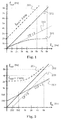
- Figs. 1 and 2 show the frequency mapping of different frequency modification schemes.
- Superposing signals has the disadvantage that information may be lost since only the stronger ones may be detectable or perceivable. In particular soft sounds cannot be detected any more because of louder ones at the same frequency. Due to the information loss, the term “destructive superposition” may also be used. Superposition typically occurs when frequencies of a first range are mapped to a second range, while the frequencies of the second range remain unchanged.
- mapping f out 0.7 * f in - 1 ⁇ kHz
- a mapping function appears in an input/output graph with linear scaling, such as Fig. 1 , as a straight line.
- log f out 1 LCF ⁇ log f in + 1 - 1 LCF ⁇ log f 0 LCF is a logarithmic compression factor.
- Such a mapping function appears in an input/output graph with logarithmic scaling, such as Fig. 2 , as a straight line. Since frequencies are perceived by humans rather in a logarithmic manner than in a linear manner, it is especially advantageous to modify frequencies based on such a logarithmic scheme.
- compression factors can also be defined reciprocally such that 1/CF is to be substituted by CF and 1/LCF is to be substituted by LCF.
- Figs. 1 and 2 illustrate the same frequency modification schemes with the only difference that Fig. 1 has a linear scale and Fig. 2 has a logarithmic scale.
- Curves 102 and 202 represent processing without frequency modification.
- Curves 101 and 201 represent a frequency independent shifting, more precisely, an up-shift by a frequency independent shifting distance or frequency delta f shift of 2 kHz.
- Curves 103 and 203 represent a downwards-transposition by one octave which is applied to the entire spectrum.
- Curves 104 and 204 show a logarithmic frequency modification.
- the information of six octaves is compressed to fit into three octaves.
- the compression factor has a different meaning than in the linear case. It also defines how much smaller a portion of the spectrum is after frequency modification in comparison to before, but now this comparison is made based on a logarithmic frequency scale.
- the logarithmic compression factor LCF is 2.
- Curves 103 and 203 represent a frequency modification scheme which preserves the harmonic relationships of the input signal components. If the logarithmic compression factor LCF is a whole number, there is also a harmonic relation between input and output signal.
- Curves 101, 201 and 104, 204 represent frequency modification schemes which distort the harmonic relationships of the input signals components.
- frequency independent shifting, linear frequency modification and logarithmic frequency modification are each applied to the entire spectrum.
- this frequency modification scheme can also be applied only to part of the spectrum.
- the remaining spectrum can either be left without frequency modification or it can be subject to a different kind of frequency modification.
- Further frequency modification parameters result from defining such partial modifications, in particular:
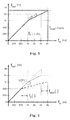
- Figs. 3 and 4 are diagrams of the input/output frequency relation in a hearing aid device with a logarithmic frequency modification according to one embodiment of the present invention.
- the diagrams have a logarithmic frequency scaling. Frequencies remain unchanged up to a lower spectral bound f o , i.e. there is no frequency modification.
- the lower spectral bound f 0 may also be termed "cut-off frequency". Above the lower spectral bound f 0 , frequencies are modified by progressively down-shifting them without superposition in accordance with a logarithmic compression factor LCF. The term "progressively" indicates that higher frequencies are shifted more than lower ones.
- the upper spectral bound is therefore in this embodiment equal to the maximum input frequency of the hearing aid device.
- the lower spectral bound is 1 kHz
- the logarithmic compression factor LCF is 2
- the maximum input frequency is 8 kHz.
- the frequency range from 1 to 8 kHz (three octaves bandwidth) is mapped by a frequency lowering into the frequency range from 1 to about 2.8 kHz (one and a half octaves).
- harmonic relationships of input sound components can get distorted due to the frequency modification. Such distortions are particularly unpleasant in loud sound environments. Noise with such distortions is perceived more disturbing due to psychoacoustic effects. In particular, music is not as enjoyable if the harmonic relationships are changed.
- only input signals with a spectral content not exceeding the lower spectral bound f 0 will sound natural.
- the present invention opens up the possibility to reduce these disadvantages.
- the frequency modification and in particular the "extent of frequency modification" is adjusted dynamically during use of the hearing aid device by applying different logarithmic compression factors LCF, by applying different lower spectral bounds f 0 and/or by applying different upper spectral bounds f max .
- LCF logarithmic compression factors
- these parameters are static, i.e. not adjusted during real life operation by the end-user.
- at least one of these parameters is adjusted dynamically based on a sound environment analysis and/or based on an end-user input. Examples on how an adjustment based on a sound environment analysis can be implemented are described further down below, in particular referring to Figs. 5 , 7 , 8 , 11 and 12 .
- Fig. 4 illustrates how the frequency modification according to the scheme of Fig. 3 can be adjusted.
- the upper spectral bound f max is static and the extent of frequency modification is increased by lowering the lower spectral bound f 0 and/or by raising the logarithmic compression factor LCF.
- the lower spectral bound f 0 will be in the range from 1 kHz to 2 kHz or in the range from 1.5 kHz to 4 kHz, the logarithmic compression factor LCF in the range from 1 to 5 and the upper spectral bound f max in the range from 8 to 10 kHz.
- the lower spectral bound f 0 may be varied in the range from 1 to 10 kHz, the logarithmic compression factor LCF from 1 to 5 or from 1 to 3, and the maximum input frequency in the range from 3.5 to 10 kHz.
- border values may be defined, in particular during a fitting session, for example restricting the logarithmic compression factor to a range from 1 to 2.
- Adjusting the frequency modification fully or partially by changing the lower spectral bound f 0 , and/or possibly also the upper spectral bound f max has the advantage that signal processing resources are saved, whenever frequency modification is reduced.
- the frequency modification above the lower spectral bound f 0 can have an other kind of "perception based frequency modification" instead of a logarithmic frequency modification.
- the compression factor may be called “perception based compression factor” (PCF).
- PCF perception based compression factor
- the term "logarithmic or perception based compression factor” (LCF, PCF) is used in order to include both kinds of embodiments, the ones with logarithmic frequency modification and the ones with an other type of perception based frequency modification.
- the logarithmic or perception based compression factor defines the ratio of an input bandwidth and an output bandwidth, or vice versa, wherein both bandwidths being measured on a logarithmic or perception based scale. Measuring bandwidths on a logarithmic scale is equivalent to expressing bandwidths as a number musical intervals, such as octaves, as already indicated referring to curves 104 and 204 and referring to Figs. 3 and 4 .
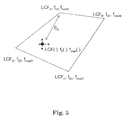
- Fig. 5 is a diagram illustrating a determination of frequency modification parameters by interpolation between "predefined frequency modification parameters". Such predefined parameters are provided for at least two typical sound environments; Typical sound environments can, for example, be
- predefined means in this context that the parameters are defined before the end-user actually uses the hearing aid device in real life. It is to be noted that for a particular frequency modification parameter, for example CF, there are generally only predefined frequency modification parameters for the at least two typical sound environments. Hence, for other sound environments the particular frequency modification parameter, for example CF, is not predefined and must be determined somehow during the dynamic frequency modification adjustment process as described further down below.
- the determination of such predefined frequency modification parameters can, for example, be performed when fitting the hearing aid device, for example, during a visit at an audiologist's office.
- the hearing aid device is adjusted consecutively for each typical sound environment A, B, C and D.
- the found frequency modification parameters LCF, f 0 and/or f max are recorded, such that, in the end, there is a set of parameters for each typical environment. For example for environment A there is a logarithmic compression factor LCF A , a lower spectral bound f 0A and an upper spectral bound f maxA .
- LCF, f 0 and/or f max are then adjusted automatically.
- a similarity of the current sound environment with at least one typical sound environment is determined.
- the result can, for example, be a similarity value S A or a similarity vector (S A , S B ).
- the determination of similarity values is described in more detail in EP 1 858 292 A1 .
- new values for the dynamic, i.e. not static, parameters LCF(.), f 0 (.) and/or f max (.) are calculated by interpolating between the predefined parameters in accordance with the similarity value.
- the term "in accordance with” means that in case of a high similarity with a particular typical environment (e.g. 90%) the predefined parameters for this environment are weighted more (e.g. with weight 0.9 in a weighted averaging). The calculations are performed often enough to assure a reasonable fast response to changed conditions and so as to keep the interpolation steps small, for example by allowing at least about 100 interpolation steps for a transition from one typical environment to an other.
- the solution has the advantage that individual preferences of the user, such as "frequency modification for speech, but not for speech in noise", can be accommodated in an efficient, user-friendly and precise way. Due to the interpolation disturbing switching artefacts are at least partially avoided.
- predefined parameters for different environments such as the parameters LCF A , f 0A and f maxA for environment A, can also be expressed as delta-values which indicate the difference to a standard or base environment.
- Fig. 6 shows how the frequency modification parameters logarithmic compression factor LCF, lower spectral bound f 0 and upper spectral bound f max can be adjusted in dependence on a single end-user controllable parameter X User .
- the end-user controllable parameter can, for example, be changed with a potentiometer or with an up/down switch on the hearing aid device or with similar buttons or menu options on a remote control device.
- the conversion scheme for converting the end-user controlled parameter X User into frequency modification parameters can be predefined at the factory or during a fitting session, by programming predefined frequency modification parameters, e.g.
- LCF X1 , LCF X2 , f 0X1 and f 0X2 etc. which are predefined for particular states, e.g. X1, X2 etc., of the end-user controllable parameter X User , in a similar manner as parameters may be predefined for particular sound environments as described referring to Fig. 5 .
- the frequency modification is automatically adjusted in response to this change by calculating and activating updated frequency modification parameters, wherein said calculating comprises
- X User has the states X1, X2, X3 and X4, or expressed as values 0%, 33%, 66% and 100%. In an other example X User may assume the values 0 to 10 or -10 to +10 with step size 1.
- the end-user controllable parameter X User can be subject to logging and learning.
- Logging means that states and/or events of the hearing aid device and/or statistical information about such states and/or events are recorded.
- Learning means that the behaviour of the hearing aid device is adapted automatically to the preference of the user based on such states, events and/or recorded data.
- changes of the parameter X User made by the end-user or statistical information about such changes can be stored in a non-volatile memory of the hearing aid device. During a fitting session this information can be used to manually or automatically readjust predefined parameters of the hearing aid device.
- Such a value is stored in the non-volatile memory of the hearing aid device and is programmed by the fitting device.
- this power-on value is subject to a "learning", i.e. that it is automatically readjusted by the hearing aid device based on current and previous settings of the end-user controllable parameter X User .
- an end-user based adjustment can be combined with an sound-environment based adjustment as described referring to Fig. 5 .
- the predefined frequency modification parameters for particular states, e.g. X1, X2 of the end-user controllable parameter and/or the ones for typical sound environments, e.g. A, B might preferably be defined, as already indicated above, as delta-values instead of absolute values.
- Fig. 6 shows the conversion of a single end-user controllable parameter X User into three frequency modification parameters
- the same principle can be applied in any case where a frequency modification is to be controlled optimally in dependence on a single parameter, wherein one or more frequency modification parameters are derived from the single parameter.
- this single parameter represents in the determination of frequency modification parameters an intermediate result it is also referred to in the present document as "intermediate frequency modification parameter".
- Such an intermediate frequency modification parameter can be adjusted like any other of the frequency modification parameters such as for example a compression factor.
- sound environment analysis results can be treated as intermediate parameters, i.e. that further frequency modification parameters can be derived from them by some sort of calculation:
- the lower spectral bound f 0 is adjusted. Such an adjustment changes the bandwidth of the part of the spectrum, to which frequency modification is applied, and therefore also the processor load necessary for the operation.
- the predefined frequency modification parameters are defined such that a signal processor load caused by frequency modification is limited.
- the processor load depends on the bandwidth to which frequency modification is to be applied.
- the processor load can be controlled.
- the upper spectral bound f max can be set adaptively dependent on the processor resources available in a specific situation, in particular such that f max is maximized. In practice, an end-user could, for example, actuate a control to chose "more frequency modification".
- the maximum input frequency f max would be lowered to avoid a processor overload. Even though such behaviour seems disadvantageous at first sight, it can e.g. be beneficial in telephone conversations as also indicated further down below referring to Fig. 8 .
- the frequency modification bandwidth could also be reduced by raising f 0 and/or by lowering f max whenever other processing resources requiring features, such as noise cancellers, are activated.
- Fig. 7 is a diagram illustrating, how frequency modification can be altered and in particular reduced or switched off in case of own-voice.
- Frequency modification can increase the so called occlusion effect by making sounds, in particular speech, emitted by the hearing aid device wearer him or herself especially audible. This kind of speech sound is referred to as "own-voice".
- One embodiment of the invention adjusts frequency modification in dependence on an own-voice detection.
- the environment sound analysis provides a probability value P OV for such an own-voice condition. Above a certain limit (here 75%), frequency modification is reduced and then (at 100%) fully switched off. The own-voice is thereby perceived less disturbing and the occlusion effect is reduced.
- a reduction of frequency modification can be achieved by adjusting the logarithmic compression factor LCF and/or the lower frequency bound f 0 .
- other frequency modification parameters might have to be adjusted for reducing or switching off the frequency modification.
- Fig. 8 and Fig. 9 are diagrams illustrating how frequency modification can be adjusted and in particular be reduced in case of listening situations, in which the predominant listening target is a sound source with limited high frequencies, like, for example, in telephone conversations.
- the example is based on the frequency modification scheme introduced referring to Figs. 3 and 4 , but might also be applied to other schemes.
- the predominant listening target is not necessarily the predominant signal in regard to the sound level or energy, but instead a signal from which it can be expected that the hearing aid device wearer wants to listen to, i.e. which is likely to be a "listening target".
- the sound environment analysis in this context might therefore well include evaluating non-acoustic indicators or factors such as sensing the presence of a magnet attached to a telephone handset held next to the hearing aid device, the manual selection of a specific hearing program by the end-user or the presence of an electric input signal provided by an other device such as a radio.
- a listening situation in this context will last at least one or more seconds and up to several minutes or even hours, such as for example given by the typical duration of telephone calls.
- the term "limited high frequencies” is to be understood relative to the basic frequency range of the hearing aid device. Hence, the highest frequency emitted by such a "sound source with limited high frequencies" is significantly below the highest frequency which can be processed by the hearing aid device.
- the term "significantly below” can be defined as having a frequency which is at least 25% lower, as for example a frequency of less than 6kHz in a 8kHz hearing device.
- This highest frequency or upper band limit of the hearing aid device is usually determined by the sampling rate of its A/D converter. The highest frequency is half the sampling rate. Typically it is about 10 kHz.
- Sound transmission by telephone has usually an upper band limit which is lower than such an upper band limit of a standard hearing aid device. In cellular networks it may be lower than in landline networks. The example shown in the figure assumes such a limit at 4 kHz. However, other limits such as 3.5 kHz or 5.5 kHz might be appropriate.
- Fig. 9 illustrates how processing resources are saved in such a case. It shows an in a diagram the input/output frequency relation. In the shaded range frequency modification is applied.
- f max is lowered to a value in the range from 3.5 to 6 kHz, in particular 5.5 kHz.
- Detection of telephone conversations can be performed in many ways as known in the state of the art and provides preferably a probability P TEL for the condition.
- Fig. 8 shows an example of how the upper spectral bound f max can be set in dependence on P TEL .
- a possible implementation detects if there is a useful signal in the high frequencies above a particular limit frequency.
- the limit frequency can be chosen fixed, for example in the range from 3.5 to 6 kHz. However, it can also be the result of the detection, such that 10 kHz in a 10kHz-device, i.e.
- a device which normally processes sounds up to 10 kHz would mean "no telephone conversation".
- the upper spectral bound f max is set to this result. It is to be noted that this feature might not only be useful in telephone conversations, but in any case when sound is reproduced by a technical device with limited band-width, such as AM-radio, CB-radio, intercom or public address systems.
- the sound source is a technical device, it might feed the sound non-acoustically, in particular electrically and/or electromagnetically, to the hearing aid device. This is for example the case when an mp3-player is electrically connected to an audio streaming device worn by the end-user which then wirelessly transmits the audio signal to a hearing aid device.
- Fig. 10 shows an audiogram of a typical individual which can benefit from a frequency modification and in particular from the kind of frequency modification described referring to Figs. 3 and 4 .
- the curve indicates the hearing loss in decibel relative to a normal hearing individual.
- "dB HL” stands for "decibel hearing level”.
- the figure also shows the characteristics of certain soft speech sounds or phonemes, namely the group of voiceless fricatives consisting of "f” which is a labiodental fricative, "th” which is a dental fricative, and "s" which is an alveolar fricative.
- frequency modification provides a significant benefit in situations where weak low level phonemes such as "f”, "th”, and “s” can be made audible. In other situations frequency modification is less likely to provide a benefit and can therefore be less active or be completely switched off. The particular situations “own-voice” and "telephone conversation" have already been discussed.
- the diagram illustrates how in one embodiment of the invention the extent of frequency modification is changed in dependence on the overall input level encountered by the device.
- the example is based on the kind of frequency modification described referring to Fig. 3 and 4 , but the principle can also be applied to other frequency modification schemes.
- the sound environment analysis provides as a result a value indicative of an overall input level encountered by the hearing aid device.
- frequency modification is reduced or switched off.
- a threshold in particular a threshold in a range from 30 to 60 dB or from 40 to 50 dB
- frequency modification is reduced or switched off.
- IL high the frequency modification is switched off completely, because it is assumed that under such noisy conditions there are either no voiceless fricatives and if there were, they could not be made audible by a frequency modification.
- IL loW of 40 dB HL the extent of frequency modification is set to a maximum, in the example defined by a maximum logarithmic compression factor LCF max of 3.
- LCF max IL low and/or IL high may be programmable by a fitting device.
- the compression factor LCF is gradually decreased in a linear manner.
- the frequency modification is reduced for loud sound environments and increased for soft sound environments, or accordingly, the extent of frequency modification and the sound level are inversely dependent on each other.
- the lower input level threshold IL low is between 30 and 50 dB, in particular 40 dB
- the upper input level threshold IL high is between 50 and 70 dB, in particular 60 dB.
- both thresholds are the same, which results in the frequency modification being either completely "on” or completely “off", thus having two discrete states. Analyzing the sound environment by simply detecting its overall input level has the advantage that it can be implemented with far less complexity and that it is much more reliable than detecting speech or certain phonemes themselves.
- the sound level in certain frequency bands can be used to adjust frequency modification.
- the same inverse dependency of input level and extent of frequency modification applies.
- the input level in the range of the voiceless fricatives or above a particular limit frequency which is preferably in the range from 3 kHz to 5 kHz and is in particular about 4 kHz, can be regarded.
- Fig. 12 illustrates a further condition in which frequency modification is preferably reduced or switched off, namely a "masking by excitation patterns".
- the diagram shows how the excitation pattern of a low frequency 52 sound may mask the result 54 of a down-shifting of a high frequency sound 51 in the end-user's perception.
- excitation pattern When a pure tone is presented to a human ear the basilar membrane not only of this tone, but also of neighbouring tones are excited according to a so called "excitation pattern".
- excitation pattern The term is also mentioned in EP 0 836 363 . In the case of hearing impaired individuals this pattern becomes even wider thereby masking more sound signals.
- the sound environment analysis is configured to provide an indication if such a masking by excitation patterns would be encountered if a particular frequency modification with particular frequency modification parameters is applied. If there is such an indication frequency modification is adjusted and is in particular switched off (or left switched off). On one hand this saves processing and battery resources, which would be otherwise employed without benefit. On the other hand it might still be possible to provide some audibility by a simple amplification instead of a frequency modification.
- the intensity of the masking sound in the shown example the low frequency sound 52, can be reduced such that the result 54 of the frequency modification is no longer masked.
- Such a attenuation or suppression of low frequency signals can further be dependent on an analysis which determines if the masking sound 52 is noise or rather a useful signal.
- such a masking by an excitation pattern may be encountered by any frequency modification which reduces the spectral distance between two sounds. Hence, it may, for example, result from down-shifting a low frequency sound less than a high frequency sound as well as from up-shifting a low-frequency sound more than a high frequency sound.
- the above described measures for avoiding the masking can be applied accordingly.
- low frequency sound and "high frequency sound” can be simply defined as the first sound being lower than the second sound.
- a limit between low and high frequency sounds can be defined in this context, for example 1 kHz, f 0 or the middle of the processed input spectrum on a logarithmic scale.
- the shape of an excitation pattern used in the calculation i.e. the detection of a potential masking, can be adapted to the hearing characteristic of the end-user.
- the adjustment in response to a changed sound environment is performed gradually over time even if the sound environment changes suddenly.
- changing a frequency modification parameter from a minimum to a maximum or vice versa takes a certain smoothing time, in particular in the range from 0.5 to 10 seconds. It is preferably long enough that there are no audible transition artefacts.
- the overall transition may still be audible, in particular when comparing the before and after situation.
- a "transition artefact" in this context is a sound characteristic on top of the basic transition itself, for example when the start and/or the end of the transition period can be noticed.
- frequency modification is in certain situations switched off completely.
- Feedback is an especially disturbing artefact typically perceived as a whistling noise and is more likely to occur in the case of open fittings.
- the minimum compression factor LCF can be set to 1.1 instead of 1.0 or it can be set to 0.9 instead of 1.0 which would be a slight expansion.
- a residual frequency modification component may be added automatically, in particular if an analysis of the overall system configuration indicates that feedback might be a problem.
- Fig. 13 is a block diagram showing the functional blocks of a digital frequency modifying hearing aid system according to an embodiment of the invention.
- the system comprises a hearing aid device 1, a fitting device 20 and a remote control 30.
- At least one microphone 2 is exposed to a sound environment.
- the analogue microphone signal is converted to a digital signal using an analogue to digital converter 4.
- the digital signal is transformed from the time to the frequency domain by a fast Fourier transform (FFT) using a fast Fourier transform means 6.
- FFT fast Fourier transform
- a detection means 10 performs a sound environment analysis and may provide as an analysis result one or more of the following values:
- Frequency modification is applied in the frequency domain by a signal processing means 9.
- the frequency modification is steered by a control means 11.
- Control means 11 adjusts one or more frequency modification parameters. The adjustment is performed while the hearing aid device is being used by the end-user in real life.
- the frequency modification parameters may comprise, as already indicated, depending on the applied frequency modification scheme one or more of the following:
- the control means 11 performs the adjustment in dependence
- the adjustment by control means 11 may further be based on static parameters stored in a non-volatile memory 12. These static parameters are programmed in the factory and/or during a fitting session using the fitting device 12 and remain usually unchanged during real life use of the hearing aid device. Said static parameters may comprise, as already indicated above, one or more of the following:
- the non-volatile memory 12 may further be used to store one or more of the following:
- the fitting device 12 can for example be a PC with fitting software and a hearing aid device interface such as NOHAlinkTM.
- the detection means 10 has as input a signal carrying information about the sound environment. This can in particular be the output of the analogue digital convert 4 and/or the output of the fast Fourier transform means 6.
- the output of the signal processing means 9 is converted back into the time domain by an inverse fast Fourier transform (IFFT) using an inverse fast Fourier transform means 7 and converted back into an analogue signal by digital to analogue converter 5.
- IFFT inverse fast Fourier transform
- the output signal is presented to the end-user of the hearing aid device by a receiver 3.
- the hearing aid device 1 can for example be a behind the ear device (BTE), an in the ear device (ITE) or a completely in the ear canal device (CIC).
- the receiver is generally coupled to the ear by a thin tube.
- ear-piece or ear-tip for example a so called “dome” tip or an ear-mould with a relatively large vent-opening.
- An open fitting has the advantage that there is less occlusion effect. This advantage is especially important in the case of mild or moderate hearing losses because such individuals are especially sensitive to it. Sounds from the user's body, in particular voice, are perceived softer since they can by-pass the ear-piece and exit the ear canal. Environment sounds can by-pass the ear-piece as well, as so-called "direct sound”.
- Switching frequency modification partially and/or temporarily off not only reduces distortions of harmonic relationships within the processed signal, but also artefacts caused by a disharmonious combination of direct sound and processed sound.
- the described solutions provide a good trade-off between sound naturalness and speech intelligibility.
- the method and device according to the invention can in particular be used for speech enhancement for sloping high frequency hearing losses. This kind of hearing loss is currently in the hearing aid industry the largest customer segment. The invention has therefore a high economic value.
- a second embodiment of the method according to the first embodiment wherein said predefined frequency modification parameters (f shiftA , CF A , LCF A , PCF A , f 0A , f maxA , f shiftB , CF B , LCF B , PCF B , f 0B , f maxB , f shiftX1 , CF X1 , LCF X1 , PCF X1 , f 0X1 , f maxX1 , f shiftX2 , CF X2 , LCF X2 , PCF X2 , f 0X2 , f maxX2 ) are determined during a fitting session based on an audiogram of said end-user (31) and/or based on interrogating said end-user (31) and that said predefined frequency modification parameters (f shiftA , CF A , LCF A , PCF A , f 0A , f maxA , f shiftB
- a third embodiment of the method according to the second embodiment wherein said predefined frequency modification parameters (f 0A , f maxA , f 0B , f maxB ) are defined such that a signal processor load caused by said frequency modification is limited, in particular by adjusting said lower spectral bound (f 0 ) and said upper spectral bound (f max ) in such a way that a bandwidth, to which said frequency modification is applied, is limited.
- a forth embodiment of the method according to one of the first embodiment to the third embodiment wherein said sound environment analysis provides at least a first similarity value (S A ) indicative of a similarity of a current sound environment with said first typical sound environment (A), wherein at least one of said one or more frequency modification parameters (f shift , CF, LCF, PCF, f 0 , f max ) is determined by a calculation comprising the step of interpolating between at least two of said predefined frequency modification parameters (f shiftA , CF A , LCF A , PCF A , f 0A , f maxA , f shiftB , CF B , LCF B , PCF B , f 0B , fmax B ) of said at least first and second typical sound environment (A, B) in accordance with said first similarity value (S A ).
- a sixth embodiment of the method according to the fifth embodiment wherein logging data for inspection during a fitting session incorporating a fitting device (20) is derived from said end-user controllable parameter (X USR ) and is stored in a non-volatile memory (12) of said hearing aid device (1), and/or an updated user preference based power-on value for said end-user controllable parameter (X USR ) is determined from current and previous settings of said end-user controllable parameter (X USR ) and is stored in said non-volatile memory (12).
- a ninth embodiment of the method according to the eighth embodiment wherein, whenever said listening situation is likely, said upper spectral bound (f max ) is reduced, in particular to a value in a range from 3.5 to 6 kHz, in particular to 5.5 kHz, or to an estimate of an upper frequency limit of said sound source provided by said sound environment analysis, and wherein in particular above said upper spectral bound (f max ) no processing takes place.
- a eighteenth embodiment of the method according to one of the preceding embodiments wherein said frequency modification is performed digitally, in a frequency domain, wherein a time domain input signal is transformed into said frequency domain using an FFT operation, and a processed frequency domain signal is transformed into a time domain using an IFFT operation.
- a nineteenth embodiment of the method according to one of the preceding embodiments wherein an adjustment of at least one of said one or more frequency modification parameters (f shift , CF, LCF, PCF, f 0 , f max ) is performed gradually over time, in particular such that changing from a minimum defined for a particular parameter to a maximum defined for said particular parameter takes 0.5 to 10 seconds and/or such that there are no audible transition artefacts.
- f shift , CF, LCF, PCF, f 0 , f max an adjustment of at least one of said one or more frequency modification parameters (f shift , CF, LCF, PCF, f 0 , f max ) is performed gradually over time, in particular such that changing from a minimum defined for a particular parameter to a maximum defined for said particular parameter takes 0.5 to 10 seconds and/or such that there are no audible transition artefacts.
- the invention further relates to a hearing aid device (1) for performing the method of one of the preceding embodiments, the method comprising
Landscapes
- Health & Medical Sciences (AREA)
- General Health & Medical Sciences (AREA)
- Neurosurgery (AREA)
- Otolaryngology (AREA)
- Physics & Mathematics (AREA)
- Engineering & Computer Science (AREA)
- Acoustics & Sound (AREA)
- Signal Processing (AREA)
- Circuit For Audible Band Transducer (AREA)
- Tone Control, Compression And Expansion, Limiting Amplitude (AREA)
- Compression, Expansion, Code Conversion, And Decoders (AREA)
- Telephone Function (AREA)
Priority Applications (2)
| Application Number | Priority Date | Filing Date | Title |
|---|---|---|---|
| EP11167949.4A EP2369859B1 (de) | 2008-05-30 | 2008-05-30 | Verfahren zur Tonanpassung in einer Hörhilfevorrichtung durch Frequenzmodifikation und dem entsprechende Vorrichtung |
| DK11167949.4T DK2369859T3 (en) | 2008-05-30 | 2008-05-30 | Method of adapting sound in a hearing aid by frequency change and such a device / Method of adapting sound in a hearing aid device by frequency modification and such a device |
Applications Claiming Priority (3)
| Application Number | Priority Date | Filing Date | Title |
|---|---|---|---|
| PCT/EP2008/056708 WO2009143898A1 (en) | 2008-05-30 | 2008-05-30 | Method for adapting sound in a hearing aid device by frequency modification and such a device |
| EP11167949.4A EP2369859B1 (de) | 2008-05-30 | 2008-05-30 | Verfahren zur Tonanpassung in einer Hörhilfevorrichtung durch Frequenzmodifikation und dem entsprechende Vorrichtung |
| EP08760295.9A EP2304972B1 (de) | 2008-05-30 | 2008-05-30 | Verfahren zur tonanpassung in einem hörgerät durch frequenzmodifikation |
Related Parent Applications (3)
| Application Number | Title | Priority Date | Filing Date |
|---|---|---|---|
| EP08760295.9A Division EP2304972B1 (de) | 2008-05-30 | 2008-05-30 | Verfahren zur tonanpassung in einem hörgerät durch frequenzmodifikation |
| EP08760295.9A Division-Into EP2304972B1 (de) | 2008-05-30 | 2008-05-30 | Verfahren zur tonanpassung in einem hörgerät durch frequenzmodifikation |
| EP08760295.9 Division | 2008-05-30 |
Publications (3)
| Publication Number | Publication Date |
|---|---|
| EP2369859A2 true EP2369859A2 (de) | 2011-09-28 |
| EP2369859A3 EP2369859A3 (de) | 2015-08-12 |
| EP2369859B1 EP2369859B1 (de) | 2016-12-21 |
Family
ID=40280839
Family Applications (2)
| Application Number | Title | Priority Date | Filing Date |
|---|---|---|---|
| EP08760295.9A Not-in-force EP2304972B1 (de) | 2008-05-30 | 2008-05-30 | Verfahren zur tonanpassung in einem hörgerät durch frequenzmodifikation |
| EP11167949.4A Not-in-force EP2369859B1 (de) | 2008-05-30 | 2008-05-30 | Verfahren zur Tonanpassung in einer Hörhilfevorrichtung durch Frequenzmodifikation und dem entsprechende Vorrichtung |
Family Applications Before (1)
| Application Number | Title | Priority Date | Filing Date |
|---|---|---|---|
| EP08760295.9A Not-in-force EP2304972B1 (de) | 2008-05-30 | 2008-05-30 | Verfahren zur tonanpassung in einem hörgerät durch frequenzmodifikation |
Country Status (4)
| Country | Link |
|---|---|
| US (1) | US8571242B2 (de) |
| EP (2) | EP2304972B1 (de) |
| DK (2) | DK2369859T3 (de) |
| WO (1) | WO2009143898A1 (de) |
Cited By (3)
| Publication number | Priority date | Publication date | Assignee | Title |
|---|---|---|---|---|
| EP3340656A1 (de) * | 2016-12-22 | 2018-06-27 | Sivantos Pte. Ltd. | Verfahren zum betrieb eines hörgerätes |
| US10325612B2 (en) | 2012-11-20 | 2019-06-18 | Unify Gmbh & Co. Kg | Method, device, and system for audio data processing |
| US11184715B1 (en) | 2020-10-05 | 2021-11-23 | Sonova Ag | Hearing devices and methods for implementing an adaptively adjusted cut-off frequency |
Families Citing this family (36)
| Publication number | Priority date | Publication date | Assignee | Title |
|---|---|---|---|---|
| DK2081405T3 (da) * | 2008-01-21 | 2012-08-20 | Bernafon Ag | Høreapparat tilpasset til en bestemt stemmetype i et akustisk miljø samt fremgangsmåde og anvendelse |
| EP2114090B1 (de) * | 2008-04-30 | 2012-06-20 | Siemens Medical Instruments Pte. Ltd. | Schaltung zum Betrieb eines Hörgeräts sowie Hörgerät |
| DE102009010892B4 (de) * | 2009-02-27 | 2012-06-21 | Siemens Medical Instruments Pte. Ltd. | Vorrichtung und Verfahren zur Reduzierung von Trittschallwirkungen bei Hörvorrichtungen mit aktiver Okklusionsreduktion |
| DE102009018812B4 (de) * | 2009-04-24 | 2015-05-28 | Siemens Medical Instruments Pte. Ltd. | Verfahren zum Betrieb einer Hörvorrichtung und Hörvorrichtung mit einer Frequenzweiche |
| ES2381512B1 (es) * | 2009-06-04 | 2013-05-07 | Coprecitec, S.L | Aparato domestico a gas con control de llama |
| US8553897B2 (en) | 2009-06-09 | 2013-10-08 | Dean Robert Gary Anderson | Method and apparatus for directional acoustic fitting of hearing aids |
| US9101299B2 (en) | 2009-07-23 | 2015-08-11 | Dean Robert Gary Anderson As Trustee Of The D/L Anderson Family Trust | Hearing aids configured for directional acoustic fitting |
| US8577049B2 (en) | 2009-09-11 | 2013-11-05 | Steelseries Aps | Apparatus and method for enhancing sound produced by a gaming application |
| DE102009058415B4 (de) * | 2009-12-16 | 2012-12-06 | Siemens Medical Instruments Pte. Ltd. | Verfahren zur Frequenztransposition bei einem Hörhilfegerät sowie Hörhilfegerät |
| DE102010006154B4 (de) | 2010-01-29 | 2012-01-19 | Siemens Medical Instruments Pte. Ltd. | Hörgerät mit Frequenzverschiebung und zugehöriges Verfahren |
| US8855342B2 (en) * | 2010-09-29 | 2014-10-07 | Siemens Medical Instruments Pte. Ltd. | Hearing aid device for frequency compression |
| DE102010041644B4 (de) * | 2010-09-29 | 2019-07-11 | Sivantos Pte. Ltd. | Verfahren zur Frequenzkompression mit harmonischer Korrektur und Vorrichtung |
| DE102010041643B4 (de) * | 2010-09-29 | 2014-01-30 | Siemens Medical Instruments Pte. Ltd. | Hörhilfegerät zur Frequenzkompression |
| DE102010041653B4 (de) * | 2010-09-29 | 2015-04-02 | Siemens Medical Instruments Pte. Ltd. | Verfahren und Vorrichtung zur Frequenzkompression mit selektiver Frequenzverschiebung |
| DE102011006472B4 (de) * | 2011-03-31 | 2013-08-14 | Siemens Medical Instruments Pte. Ltd. | Verfahren zur Verbesserung der Sprachverständlichkeit mit einem Hörhilfegerät sowie Hörhilfegerät |
| WO2013009672A1 (en) | 2011-07-08 | 2013-01-17 | R2 Wellness, Llc | Audio input device |
| US8942397B2 (en) * | 2011-11-16 | 2015-01-27 | Dean Robert Gary Anderson | Method and apparatus for adding audible noise with time varying volume to audio devices |
| DE102011087984A1 (de) * | 2011-12-08 | 2013-06-13 | Siemens Medical Instruments Pte. Ltd. | Hörvorrichtung mit Sprecheraktivitätserkennung und Verfahren zum Betreiben einer Hörvorrichtung |
| US9129602B1 (en) * | 2012-12-14 | 2015-09-08 | Amazon Technologies, Inc. | Mimicking user speech patterns |
| US9084050B2 (en) * | 2013-07-12 | 2015-07-14 | Elwha Llc | Systems and methods for remapping an audio range to a human perceivable range |
| TWI543634B (zh) * | 2013-12-10 | 2016-07-21 | 元鼎音訊股份有限公司 | 處理聲音段之方法及其電腦程式產品及助聽器 |
| US10043534B2 (en) * | 2013-12-23 | 2018-08-07 | Staton Techiya, Llc | Method and device for spectral expansion for an audio signal |
| US10390147B2 (en) * | 2015-02-24 | 2019-08-20 | Gn Hearing A/S | Frequency mapping for hearing devices |
| US9924277B2 (en) | 2015-05-27 | 2018-03-20 | Starkey Laboratories, Inc. | Hearing assistance device with dynamic computational resource allocation |
| US10085099B2 (en) * | 2015-11-03 | 2018-09-25 | Bernafon Ag | Hearing aid system, a hearing aid device and a method of operating a hearing aid system |
| US10142743B2 (en) | 2016-01-01 | 2018-11-27 | Dean Robert Gary Anderson | Parametrically formulated noise and audio systems, devices, and methods thereof |
| GB2547735B (en) | 2016-02-26 | 2018-10-31 | Cirrus Logic Int Semiconductor Ltd | Digital microphones |
| US10362415B2 (en) | 2016-04-29 | 2019-07-23 | Regents Of The University Of Minnesota | Ultrasonic hearing system and related methods |
| US10631103B2 (en) * | 2017-05-30 | 2020-04-21 | Regents Of The University Of Minnesota | System and method for multiplexed ultrasound hearing |
| AT520176B1 (de) | 2017-07-10 | 2019-02-15 | Isuniye Llc | Verfahren zum Modifizieren eines Audiosignals |
| TWI690214B (zh) * | 2018-11-02 | 2020-04-01 | 美商音美得股份有限公司 | 結合式頻譜增益適配模組及其方法、音訊處理系統及其施行方法 |
| FR3094859B1 (fr) * | 2019-04-05 | 2021-10-29 | Orange | Système d’aide auditive |
| DK3783919T3 (da) * | 2019-08-22 | 2023-05-15 | Sonova Ag | Justering af diskantforstærkning af høreapparat |
| EP3783920B1 (de) * | 2019-08-23 | 2024-10-02 | Sonova AG | Verfahren zur steuerung einer tonausgabe eines hörgeräts |
| US11750984B2 (en) * | 2020-09-25 | 2023-09-05 | Bose Corporation | Machine learning based self-speech removal |
| DE102022212035A1 (de) * | 2022-11-14 | 2024-05-16 | Sivantos Pte. Ltd. | Verfahren zum Betrieb eines Hörgeräts sowie Hörgerät |
Citations (9)
| Publication number | Priority date | Publication date | Assignee | Title |
|---|---|---|---|---|
| US5014319A (en) | 1988-02-15 | 1991-05-07 | Avr Communications Ltd. | Frequency transposing hearing aid |
| US5394475A (en) | 1991-11-13 | 1995-02-28 | Ribic; Zlatan | Method for shifting the frequency of signals |
| EP0836363A1 (de) | 1996-10-01 | 1998-04-15 | Phonak Ag | Lautstärkebegrenzung |
| US6577739B1 (en) | 1997-09-19 | 2003-06-10 | University Of Iowa Research Foundation | Apparatus and methods for proportional audio compression and frequency shifting |
| AU2002300314A1 (en) | 2002-07-29 | 2004-02-12 | Hearworks Pty. Ltd. | Apparatus And Method For Frequency Transposition In Hearing Aids |
| WO2007000161A1 (en) | 2005-06-27 | 2007-01-04 | Widex A/S | Hearing aid with enhanced high frequency reproduction and method for processing an audio signal |
| US7248711B2 (en) | 2003-03-06 | 2007-07-24 | Phonak Ag | Method for frequency transposition and use of the method in a hearing device and a communication device |
| DE102006019728A1 (de) | 2006-04-27 | 2007-11-15 | Siemens Audiologische Technik Gmbh | Zeit-adaptives Einstellen einer Hörhilfevorrichtung und entsprechendes Verfahren |
| EP1858292A1 (de) | 2006-05-16 | 2007-11-21 | Phonak AG | Hörgerät sowie Verfahren zum Betrieb eines Hörgerätes |
Family Cites Families (6)
| Publication number | Priority date | Publication date | Assignee | Title |
|---|---|---|---|---|
| AU4380393A (en) * | 1992-09-11 | 1994-04-12 | Goldberg, Hyman | Electroacoustic speech intelligibility enhancement method and apparatus |
| US6236731B1 (en) * | 1997-04-16 | 2001-05-22 | Dspfactory Ltd. | Filterbank structure and method for filtering and separating an information signal into different bands, particularly for audio signal in hearing aids |
| US6212496B1 (en) * | 1998-10-13 | 2001-04-03 | Denso Corporation, Ltd. | Customizing audio output to a user's hearing in a digital telephone |
| US7277554B2 (en) * | 2001-08-08 | 2007-10-02 | Gn Resound North America Corporation | Dynamic range compression using digital frequency warping |
| EP2005791A1 (de) * | 2006-03-24 | 2008-12-24 | GN Resound A/S | Lernende steuerung von hörgeräteparametereinstellungen |
| EP2095681B1 (de) * | 2006-10-23 | 2016-03-23 | Starkey Laboratories, Inc. | Filter-entrainment-vermeidung mit einem frequenzbereichs-transformationsalgorithmus |
-
2008
- 2008-05-30 DK DK11167949.4T patent/DK2369859T3/en active
- 2008-05-30 WO PCT/EP2008/056708 patent/WO2009143898A1/en not_active Ceased
- 2008-05-30 EP EP08760295.9A patent/EP2304972B1/de not_active Not-in-force
- 2008-05-30 EP EP11167949.4A patent/EP2369859B1/de not_active Not-in-force
- 2008-05-30 DK DK08760295.9T patent/DK2304972T3/en active
- 2008-05-30 US US12/994,505 patent/US8571242B2/en not_active Expired - Fee Related
Patent Citations (9)
| Publication number | Priority date | Publication date | Assignee | Title |
|---|---|---|---|---|
| US5014319A (en) | 1988-02-15 | 1991-05-07 | Avr Communications Ltd. | Frequency transposing hearing aid |
| US5394475A (en) | 1991-11-13 | 1995-02-28 | Ribic; Zlatan | Method for shifting the frequency of signals |
| EP0836363A1 (de) | 1996-10-01 | 1998-04-15 | Phonak Ag | Lautstärkebegrenzung |
| US6577739B1 (en) | 1997-09-19 | 2003-06-10 | University Of Iowa Research Foundation | Apparatus and methods for proportional audio compression and frequency shifting |
| AU2002300314A1 (en) | 2002-07-29 | 2004-02-12 | Hearworks Pty. Ltd. | Apparatus And Method For Frequency Transposition In Hearing Aids |
| US7248711B2 (en) | 2003-03-06 | 2007-07-24 | Phonak Ag | Method for frequency transposition and use of the method in a hearing device and a communication device |
| WO2007000161A1 (en) | 2005-06-27 | 2007-01-04 | Widex A/S | Hearing aid with enhanced high frequency reproduction and method for processing an audio signal |
| DE102006019728A1 (de) | 2006-04-27 | 2007-11-15 | Siemens Audiologische Technik Gmbh | Zeit-adaptives Einstellen einer Hörhilfevorrichtung und entsprechendes Verfahren |
| EP1858292A1 (de) | 2006-05-16 | 2007-11-21 | Phonak AG | Hörgerät sowie Verfahren zum Betrieb eines Hörgerätes |
Cited By (7)
| Publication number | Priority date | Publication date | Assignee | Title |
|---|---|---|---|---|
| US10325612B2 (en) | 2012-11-20 | 2019-06-18 | Unify Gmbh & Co. Kg | Method, device, and system for audio data processing |
| US10803880B2 (en) | 2012-11-20 | 2020-10-13 | Ringcentral, Inc. | Method, device, and system for audio data processing |
| EP3340656A1 (de) * | 2016-12-22 | 2018-06-27 | Sivantos Pte. Ltd. | Verfahren zum betrieb eines hörgerätes |
| CN108235210A (zh) * | 2016-12-22 | 2018-06-29 | 西万拓私人有限公司 | 用于运行听力设备的方法 |
| US10652670B2 (en) | 2016-12-22 | 2020-05-12 | Sivantos Pte. Ltd. | Method for operating a hearing aid and hearing aid |
| CN108235210B (zh) * | 2016-12-22 | 2020-11-17 | 西万拓私人有限公司 | 用于运行听力设备的方法 |
| US11184715B1 (en) | 2020-10-05 | 2021-11-23 | Sonova Ag | Hearing devices and methods for implementing an adaptively adjusted cut-off frequency |
Also Published As
| Publication number | Publication date |
|---|---|
| EP2369859A3 (de) | 2015-08-12 |
| WO2009143898A1 (en) | 2009-12-03 |
| EP2304972B1 (de) | 2015-07-08 |
| EP2304972A1 (de) | 2011-04-06 |
| DK2369859T3 (en) | 2017-03-13 |
| EP2369859B1 (de) | 2016-12-21 |
| US8571242B2 (en) | 2013-10-29 |
| DK2304972T3 (en) | 2015-08-17 |
| US20110150256A1 (en) | 2011-06-23 |
Similar Documents
| Publication | Publication Date | Title |
|---|---|---|
| EP2369859B1 (de) | Verfahren zur Tonanpassung in einer Hörhilfevorrichtung durch Frequenzmodifikation und dem entsprechende Vorrichtung | |
| AU2002368073B2 (en) | Hearing aid and a method for enhancing speech intelligibility | |
| EP1709734B1 (de) | System für die audiosignalverarbeitung | |
| EP3122072B1 (de) | Audioverarbeitungsvorrichtung, system, verwendung und verfahren | |
| EP1680781B1 (de) | System und verfahren zur signalverarbeitung | |
| US10805741B2 (en) | Audio systems, devices, and methods | |
| CN106911993A (zh) | 具有声音脉冲抑制的听力装置 | |
| JP2007511793A (ja) | オーディオ信号処理システム及び方法 | |
| EP1617705A2 (de) | Hörgerät mit in-situ Anpassung | |
| KR102403996B1 (ko) | 보청기의 채널영역 방식, 채널영역 방식을 이용한 보청기의 피팅방법, 그리고 이를 통해 피팅된 디지털 보청기 | |
| US20100040244A1 (en) | Method and system for auditory enhancement and hearing conservation | |
| Heide | Output Limitation/Compression | |
| KR20070022206A (ko) | 오디오 신호 처리를 위한 시스템 |
Legal Events
| Date | Code | Title | Description |
|---|---|---|---|
| PUAI | Public reference made under article 153(3) epc to a published international application that has entered the european phase |
Free format text: ORIGINAL CODE: 0009012 |
|
| AC | Divisional application: reference to earlier application |
Ref document number: 2304972 Country of ref document: EP Kind code of ref document: P |
|
| AK | Designated contracting states |
Kind code of ref document: A2 Designated state(s): AT BE BG CH CY CZ DE DK EE ES FI FR GB GR HR HU IE IS IT LI LT LU LV MC MT NL NO PL PT RO SE SI SK TR |
|
| AX | Request for extension of the european patent |
Extension state: AL BA MK RS |
|
| RIC1 | Information provided on ipc code assigned before grant |
Ipc: H04R 25/00 20060101AFI20110919BHEP |
|
| PUAL | Search report despatched |
Free format text: ORIGINAL CODE: 0009013 |
|
| PUAF | Information related to the publication of a search report (a3 document) modified or deleted |
Free format text: ORIGINAL CODE: 0009199SEPU |
|
| AK | Designated contracting states |
Kind code of ref document: A3 Designated state(s): AT BE BG CH CY CZ DE DK EE ES FI FR GB GR HR HU IE IS IT LI LT LU LV MC MT NL NO PL PT RO SE SI SK TR |
|
| AX | Request for extension of the european patent |
Extension state: AL BA MK RS |
|
| RIC1 | Information provided on ipc code assigned before grant |
Ipc: H04R 25/00 20060101AFI20120319BHEP |
|
| D17D | Deferred search report published (deleted) | ||
| RIC1 | Information provided on ipc code assigned before grant |
Ipc: H04R 25/00 20060101AFI20120411BHEP |
|
| PUAL | Search report despatched |
Free format text: ORIGINAL CODE: 0009013 |
|
| AK | Designated contracting states |
Kind code of ref document: A3 Designated state(s): AT BE BG CH CY CZ DE DK EE ES FI FR GB GR HR HU IE IS IT LI LT LU LV MC MT NL NO PL PT RO SE SI SK TR |
|
| AX | Request for extension of the european patent |
Extension state: AL BA MK RS |
|
| RAP1 | Party data changed (applicant data changed or rights of an application transferred) |
Owner name: SONOVA AG |
|
| 17P | Request for examination filed |
Effective date: 20160202 |
|
| RBV | Designated contracting states (corrected) |
Designated state(s): AT BE BG CH CY CZ DE DK EE ES FI FR GB GR HR HU IE IS IT LI LT LU LV MC MT NL NO PL PT RO SE SI SK TR |
|
| GRAP | Despatch of communication of intention to grant a patent |
Free format text: ORIGINAL CODE: EPIDOSNIGR1 |
|
| INTG | Intention to grant announced |
Effective date: 20160826 |
|
| GRAS | Grant fee paid |
Free format text: ORIGINAL CODE: EPIDOSNIGR3 |
|
| GRAA | (expected) grant |
Free format text: ORIGINAL CODE: 0009210 |
|
| AC | Divisional application: reference to earlier application |
Ref document number: 2304972 Country of ref document: EP Kind code of ref document: P |
|
| AK | Designated contracting states |
Kind code of ref document: B1 Designated state(s): AT BE BG CH CY CZ DE DK EE ES FI FR GB GR HR HU IE IS IT LI LT LU LV MC MT NL NO PL PT RO SE SI SK TR |
|
| REG | Reference to a national code |
Ref country code: GB Ref legal event code: FG4D |
|
| REG | Reference to a national code |
Ref country code: CH Ref legal event code: EP |
|
| REG | Reference to a national code |
Ref country code: IE Ref legal event code: FG4D |
|
| REG | Reference to a national code |
Ref country code: AT Ref legal event code: REF Ref document number: 856400 Country of ref document: AT Kind code of ref document: T Effective date: 20170115 |
|
| REG | Reference to a national code |
Ref country code: DE Ref legal event code: R096 Ref document number: 602008048068 Country of ref document: DE |
|
| PG25 | Lapsed in a contracting state [announced via postgrant information from national office to epo] |
Ref country code: LV Free format text: LAPSE BECAUSE OF FAILURE TO SUBMIT A TRANSLATION OF THE DESCRIPTION OR TO PAY THE FEE WITHIN THE PRESCRIBED TIME-LIMIT Effective date: 20161221 |
|
| REG | Reference to a national code |
Ref country code: DK Ref legal event code: T3 Effective date: 20170307 |
|
| REG | Reference to a national code |
Ref country code: LT Ref legal event code: MG4D |
|
| REG | Reference to a national code |
Ref country code: NL Ref legal event code: MP Effective date: 20161221 |
|
| PG25 | Lapsed in a contracting state [announced via postgrant information from national office to epo] |
Ref country code: NO Free format text: LAPSE BECAUSE OF FAILURE TO SUBMIT A TRANSLATION OF THE DESCRIPTION OR TO PAY THE FEE WITHIN THE PRESCRIBED TIME-LIMIT Effective date: 20170321 Ref country code: LT Free format text: LAPSE BECAUSE OF FAILURE TO SUBMIT A TRANSLATION OF THE DESCRIPTION OR TO PAY THE FEE WITHIN THE PRESCRIBED TIME-LIMIT Effective date: 20161221 Ref country code: GR Free format text: LAPSE BECAUSE OF FAILURE TO SUBMIT A TRANSLATION OF THE DESCRIPTION OR TO PAY THE FEE WITHIN THE PRESCRIBED TIME-LIMIT Effective date: 20170322 Ref country code: SE Free format text: LAPSE BECAUSE OF FAILURE TO SUBMIT A TRANSLATION OF THE DESCRIPTION OR TO PAY THE FEE WITHIN THE PRESCRIBED TIME-LIMIT Effective date: 20161221 |
|
| REG | Reference to a national code |
Ref country code: AT Ref legal event code: MK05 Ref document number: 856400 Country of ref document: AT Kind code of ref document: T Effective date: 20161221 |
|
| REG | Reference to a national code |
Ref country code: FR Ref legal event code: PLFP Year of fee payment: 10 |
|
| PG25 | Lapsed in a contracting state [announced via postgrant information from national office to epo] |
Ref country code: FI Free format text: LAPSE BECAUSE OF FAILURE TO SUBMIT A TRANSLATION OF THE DESCRIPTION OR TO PAY THE FEE WITHIN THE PRESCRIBED TIME-LIMIT Effective date: 20161221 Ref country code: HR Free format text: LAPSE BECAUSE OF FAILURE TO SUBMIT A TRANSLATION OF THE DESCRIPTION OR TO PAY THE FEE WITHIN THE PRESCRIBED TIME-LIMIT Effective date: 20161221 |
|
| PG25 | Lapsed in a contracting state [announced via postgrant information from national office to epo] |
Ref country code: NL Free format text: LAPSE BECAUSE OF FAILURE TO SUBMIT A TRANSLATION OF THE DESCRIPTION OR TO PAY THE FEE WITHIN THE PRESCRIBED TIME-LIMIT Effective date: 20161221 |
|
| PG25 | Lapsed in a contracting state [announced via postgrant information from national office to epo] |
Ref country code: SK Free format text: LAPSE BECAUSE OF FAILURE TO SUBMIT A TRANSLATION OF THE DESCRIPTION OR TO PAY THE FEE WITHIN THE PRESCRIBED TIME-LIMIT Effective date: 20161221 Ref country code: RO Free format text: LAPSE BECAUSE OF FAILURE TO SUBMIT A TRANSLATION OF THE DESCRIPTION OR TO PAY THE FEE WITHIN THE PRESCRIBED TIME-LIMIT Effective date: 20161221 Ref country code: CZ Free format text: LAPSE BECAUSE OF FAILURE TO SUBMIT A TRANSLATION OF THE DESCRIPTION OR TO PAY THE FEE WITHIN THE PRESCRIBED TIME-LIMIT Effective date: 20161221 Ref country code: IS Free format text: LAPSE BECAUSE OF FAILURE TO SUBMIT A TRANSLATION OF THE DESCRIPTION OR TO PAY THE FEE WITHIN THE PRESCRIBED TIME-LIMIT Effective date: 20170421 Ref country code: EE Free format text: LAPSE BECAUSE OF FAILURE TO SUBMIT A TRANSLATION OF THE DESCRIPTION OR TO PAY THE FEE WITHIN THE PRESCRIBED TIME-LIMIT Effective date: 20161221 |
|
| PG25 | Lapsed in a contracting state [announced via postgrant information from national office to epo] |
Ref country code: AT Free format text: LAPSE BECAUSE OF FAILURE TO SUBMIT A TRANSLATION OF THE DESCRIPTION OR TO PAY THE FEE WITHIN THE PRESCRIBED TIME-LIMIT Effective date: 20161221 Ref country code: PL Free format text: LAPSE BECAUSE OF FAILURE TO SUBMIT A TRANSLATION OF THE DESCRIPTION OR TO PAY THE FEE WITHIN THE PRESCRIBED TIME-LIMIT Effective date: 20161221 Ref country code: BG Free format text: LAPSE BECAUSE OF FAILURE TO SUBMIT A TRANSLATION OF THE DESCRIPTION OR TO PAY THE FEE WITHIN THE PRESCRIBED TIME-LIMIT Effective date: 20170321 Ref country code: IT Free format text: LAPSE BECAUSE OF FAILURE TO SUBMIT A TRANSLATION OF THE DESCRIPTION OR TO PAY THE FEE WITHIN THE PRESCRIBED TIME-LIMIT Effective date: 20161221 Ref country code: LU Free format text: LAPSE BECAUSE OF NON-PAYMENT OF DUE FEES Effective date: 20170531 Ref country code: PT Free format text: LAPSE BECAUSE OF FAILURE TO SUBMIT A TRANSLATION OF THE DESCRIPTION OR TO PAY THE FEE WITHIN THE PRESCRIBED TIME-LIMIT Effective date: 20170421 Ref country code: BE Free format text: LAPSE BECAUSE OF FAILURE TO SUBMIT A TRANSLATION OF THE DESCRIPTION OR TO PAY THE FEE WITHIN THE PRESCRIBED TIME-LIMIT Effective date: 20161221 Ref country code: ES Free format text: LAPSE BECAUSE OF FAILURE TO SUBMIT A TRANSLATION OF THE DESCRIPTION OR TO PAY THE FEE WITHIN THE PRESCRIBED TIME-LIMIT Effective date: 20161221 |
|
| REG | Reference to a national code |
Ref country code: DE Ref legal event code: R097 Ref document number: 602008048068 Country of ref document: DE |
|
| PLBE | No opposition filed within time limit |
Free format text: ORIGINAL CODE: 0009261 |
|
| STAA | Information on the status of an ep patent application or granted ep patent |
Free format text: STATUS: NO OPPOSITION FILED WITHIN TIME LIMIT |
|
| 26N | No opposition filed |
Effective date: 20170922 |
|
| REG | Reference to a national code |
Ref country code: CH Ref legal event code: PL |
|
| PG25 | Lapsed in a contracting state [announced via postgrant information from national office to epo] |
Ref country code: MC Free format text: LAPSE BECAUSE OF FAILURE TO SUBMIT A TRANSLATION OF THE DESCRIPTION OR TO PAY THE FEE WITHIN THE PRESCRIBED TIME-LIMIT Effective date: 20161221 |
|
| REG | Reference to a national code |
Ref country code: IE Ref legal event code: MM4A |
|
| PG25 | Lapsed in a contracting state [announced via postgrant information from national office to epo] |
Ref country code: LI Free format text: LAPSE BECAUSE OF NON-PAYMENT OF DUE FEES Effective date: 20170531 Ref country code: SI Free format text: LAPSE BECAUSE OF FAILURE TO SUBMIT A TRANSLATION OF THE DESCRIPTION OR TO PAY THE FEE WITHIN THE PRESCRIBED TIME-LIMIT Effective date: 20161221 Ref country code: CH Free format text: LAPSE BECAUSE OF NON-PAYMENT OF DUE FEES Effective date: 20170531 |
|
| PG25 | Lapsed in a contracting state [announced via postgrant information from national office to epo] |
Ref country code: LU Free format text: LAPSE BECAUSE OF NON-PAYMENT OF DUE FEES Effective date: 20170530 |
|
| PG25 | Lapsed in a contracting state [announced via postgrant information from national office to epo] |
Ref country code: IE Free format text: LAPSE BECAUSE OF NON-PAYMENT OF DUE FEES Effective date: 20170530 |
|
| REG | Reference to a national code |
Ref country code: FR Ref legal event code: PLFP Year of fee payment: 11 |
|
| PG25 | Lapsed in a contracting state [announced via postgrant information from national office to epo] |
Ref country code: MT Free format text: LAPSE BECAUSE OF NON-PAYMENT OF DUE FEES Effective date: 20170530 |
|
| PG25 | Lapsed in a contracting state [announced via postgrant information from national office to epo] |
Ref country code: HU Free format text: LAPSE BECAUSE OF FAILURE TO SUBMIT A TRANSLATION OF THE DESCRIPTION OR TO PAY THE FEE WITHIN THE PRESCRIBED TIME-LIMIT; INVALID AB INITIO Effective date: 20080530 |
|
| PG25 | Lapsed in a contracting state [announced via postgrant information from national office to epo] |
Ref country code: CY Free format text: LAPSE BECAUSE OF NON-PAYMENT OF DUE FEES Effective date: 20161221 |
|
| PG25 | Lapsed in a contracting state [announced via postgrant information from national office to epo] |
Ref country code: TR Free format text: LAPSE BECAUSE OF FAILURE TO SUBMIT A TRANSLATION OF THE DESCRIPTION OR TO PAY THE FEE WITHIN THE PRESCRIBED TIME-LIMIT Effective date: 20161221 |
|
| PGFP | Annual fee paid to national office [announced via postgrant information from national office to epo] |
Ref country code: DE Payment date: 20200528 Year of fee payment: 13 Ref country code: FR Payment date: 20200525 Year of fee payment: 13 Ref country code: DK Payment date: 20200528 Year of fee payment: 13 |
|
| PGFP | Annual fee paid to national office [announced via postgrant information from national office to epo] |
Ref country code: GB Payment date: 20200527 Year of fee payment: 13 |
|
| REG | Reference to a national code |
Ref country code: DE Ref legal event code: R119 Ref document number: 602008048068 Country of ref document: DE |
|
| REG | Reference to a national code |
Ref country code: DK Ref legal event code: EBP Effective date: 20210531 |
|
| GBPC | Gb: european patent ceased through non-payment of renewal fee |
Effective date: 20210530 |
|
| PG25 | Lapsed in a contracting state [announced via postgrant information from national office to epo] |
Ref country code: GB Free format text: LAPSE BECAUSE OF NON-PAYMENT OF DUE FEES Effective date: 20210530 Ref country code: DK Free format text: LAPSE BECAUSE OF NON-PAYMENT OF DUE FEES Effective date: 20210531 Ref country code: DE Free format text: LAPSE BECAUSE OF NON-PAYMENT OF DUE FEES Effective date: 20211201 |
|
| PG25 | Lapsed in a contracting state [announced via postgrant information from national office to epo] |
Ref country code: FR Free format text: LAPSE BECAUSE OF NON-PAYMENT OF DUE FEES Effective date: 20210531 |