EP2371322A2 - Mehrfach geripptes beschichtetes Zahnband - Google Patents
Mehrfach geripptes beschichtetes Zahnband Download PDFInfo
- Publication number
- EP2371322A2 EP2371322A2 EP11250401A EP11250401A EP2371322A2 EP 2371322 A2 EP2371322 A2 EP 2371322A2 EP 11250401 A EP11250401 A EP 11250401A EP 11250401 A EP11250401 A EP 11250401A EP 2371322 A2 EP2371322 A2 EP 2371322A2
- Authority
- EP
- European Patent Office
- Prior art keywords
- dental tape
- ribs
- tape
- dental
- cleaning surface
- Prior art date
- Legal status (The legal status is an assumption and is not a legal conclusion. Google has not performed a legal analysis and makes no representation as to the accuracy of the status listed.)
- Withdrawn
Links
- 238000004140 cleaning Methods 0.000 claims abstract description 101
- 238000000576 coating method Methods 0.000 claims abstract description 67
- 239000011248 coating agent Substances 0.000 claims abstract description 52
- UIIMBOGNXHQVGW-UHFFFAOYSA-M Sodium bicarbonate Chemical compound [Na+].OC([O-])=O UIIMBOGNXHQVGW-UHFFFAOYSA-M 0.000 claims abstract description 46
- 229910000030 sodium bicarbonate Inorganic materials 0.000 claims abstract description 23
- 235000017557 sodium bicarbonate Nutrition 0.000 claims abstract description 23
- VYPSYNLAJGMNEJ-UHFFFAOYSA-N Silicium dioxide Chemical compound O=[Si]=O VYPSYNLAJGMNEJ-UHFFFAOYSA-N 0.000 claims description 42
- 239000000377 silicon dioxide Substances 0.000 claims description 21
- MHAJPDPJQMAIIY-UHFFFAOYSA-N Hydrogen peroxide Chemical compound OO MHAJPDPJQMAIIY-UHFFFAOYSA-N 0.000 claims description 16
- 229920001400 block copolymer Polymers 0.000 claims description 12
- 239000000796 flavoring agent Substances 0.000 claims description 10
- 235000019634 flavors Nutrition 0.000 claims description 10
- 239000004721 Polyphenylene oxide Substances 0.000 claims description 8
- 239000004433 Thermoplastic polyurethane Substances 0.000 claims description 8
- 229920001971 elastomer Polymers 0.000 claims description 8
- 239000000806 elastomer Substances 0.000 claims description 8
- 239000004615 ingredient Substances 0.000 claims description 8
- 229920000570 polyether Polymers 0.000 claims description 8
- 229920002803 thermoplastic polyurethane Polymers 0.000 claims description 8
- 239000003795 chemical substances by application Substances 0.000 claims description 7
- PNEYBMLMFCGWSK-UHFFFAOYSA-N aluminium oxide Inorganic materials [O-2].[O-2].[O-2].[Al+3].[Al+3] PNEYBMLMFCGWSK-UHFFFAOYSA-N 0.000 claims description 6
- NEFBYIFKOOEVPA-UHFFFAOYSA-K dicalcium phosphate Chemical compound [Ca+2].[Ca+2].[O-]P([O-])([O-])=O NEFBYIFKOOEVPA-UHFFFAOYSA-K 0.000 claims description 6
- -1 peroxide compounds Chemical class 0.000 claims description 6
- 239000000341 volatile oil Substances 0.000 claims description 6
- 239000004200 microcrystalline wax Substances 0.000 claims description 5
- 235000019808 microcrystalline wax Nutrition 0.000 claims description 5
- 239000004343 Calcium peroxide Substances 0.000 claims description 4
- 125000001931 aliphatic group Chemical group 0.000 claims description 4
- 239000004599 antimicrobial Substances 0.000 claims description 4
- 239000003443 antiviral agent Substances 0.000 claims description 4
- 125000003118 aryl group Chemical group 0.000 claims description 4
- LHJQIRIGXXHNLA-UHFFFAOYSA-N calcium peroxide Chemical compound [Ca+2].[O-][O-] LHJQIRIGXXHNLA-UHFFFAOYSA-N 0.000 claims description 4
- 235000019402 calcium peroxide Nutrition 0.000 claims description 4
- 229940078916 carbamide peroxide Drugs 0.000 claims description 4
- 238000011065 in-situ storage Methods 0.000 claims description 4
- 229920000728 polyester Polymers 0.000 claims description 4
- 229920002397 thermoplastic olefin Polymers 0.000 claims description 4
- AQLJVWUFPCUVLO-UHFFFAOYSA-N urea hydrogen peroxide Chemical compound OO.NC(N)=O AQLJVWUFPCUVLO-UHFFFAOYSA-N 0.000 claims description 4
- 239000013543 active substance Substances 0.000 claims description 3
- 239000013536 elastomeric material Substances 0.000 claims description 3
- 239000000314 lubricant Substances 0.000 claims description 3
- 230000002087 whitening effect Effects 0.000 claims description 3
- 235000013305 food Nutrition 0.000 abstract description 12
- 241000124008 Mammalia Species 0.000 abstract description 4
- 239000008199 coating composition Substances 0.000 description 27
- 241000628997 Flos Species 0.000 description 26
- 238000001125 extrusion Methods 0.000 description 26
- 239000000463 material Substances 0.000 description 21
- 238000000034 method Methods 0.000 description 21
- 239000011347 resin Substances 0.000 description 17
- 229920005989 resin Polymers 0.000 description 17
- XLYOFNOQVPJJNP-UHFFFAOYSA-N water Substances O XLYOFNOQVPJJNP-UHFFFAOYSA-N 0.000 description 16
- 239000000203 mixture Substances 0.000 description 14
- 230000008569 process Effects 0.000 description 13
- 210000003298 dental enamel Anatomy 0.000 description 11
- 239000001993 wax Substances 0.000 description 11
- 229920002614 Polyether block amide Polymers 0.000 description 10
- 238000007906 compression Methods 0.000 description 10
- 230000006835 compression Effects 0.000 description 10
- 238000011084 recovery Methods 0.000 description 10
- 238000010186 staining Methods 0.000 description 10
- 239000002245 particle Substances 0.000 description 8
- 238000009472 formulation Methods 0.000 description 7
- 239000007787 solid Substances 0.000 description 7
- 230000008859 change Effects 0.000 description 6
- 239000003086 colorant Substances 0.000 description 6
- 230000006872 improvement Effects 0.000 description 6
- 229920001223 polyethylene glycol Polymers 0.000 description 6
- 229920001343 polytetrafluoroethylene Polymers 0.000 description 6
- 239000004810 polytetrafluoroethylene Substances 0.000 description 6
- 238000006073 displacement reaction Methods 0.000 description 5
- 210000000214 mouth Anatomy 0.000 description 5
- 239000000047 product Substances 0.000 description 5
- 238000007711 solidification Methods 0.000 description 5
- 230000008023 solidification Effects 0.000 description 5
- 238000004804 winding Methods 0.000 description 5
- 239000000654 additive Substances 0.000 description 4
- 238000001816 cooling Methods 0.000 description 4
- 238000004519 manufacturing process Methods 0.000 description 4
- 229910001220 stainless steel Inorganic materials 0.000 description 4
- 239000010935 stainless steel Substances 0.000 description 4
- 229920011453 Hytrel® 4056 Polymers 0.000 description 3
- 239000008367 deionised water Substances 0.000 description 3
- 229910021641 deionized water Inorganic materials 0.000 description 3
- 230000000694 effects Effects 0.000 description 3
- 239000000835 fiber Substances 0.000 description 3
- 235000003599 food sweetener Nutrition 0.000 description 3
- 238000003780 insertion Methods 0.000 description 3
- 230000037431 insertion Effects 0.000 description 3
- 229920000642 polymer Polymers 0.000 description 3
- CVHZOJJKTDOEJC-UHFFFAOYSA-N saccharin Chemical compound C1=CC=C2C(=O)NS(=O)(=O)C2=C1 CVHZOJJKTDOEJC-UHFFFAOYSA-N 0.000 description 3
- 239000007921 spray Substances 0.000 description 3
- 239000003765 sweetening agent Substances 0.000 description 3
- NCGICGYLBXGBGN-UHFFFAOYSA-N 3-morpholin-4-yl-1-oxa-3-azonia-2-azanidacyclopent-3-en-5-imine;hydrochloride Chemical compound Cl.[N-]1OC(=N)C=[N+]1N1CCOCC1 NCGICGYLBXGBGN-UHFFFAOYSA-N 0.000 description 2
- DSUFPYCILZXJFF-UHFFFAOYSA-N 4-[[4-[[4-(pentoxycarbonylamino)cyclohexyl]methyl]cyclohexyl]carbamoyloxy]butyl n-[4-[[4-(butoxycarbonylamino)cyclohexyl]methyl]cyclohexyl]carbamate Chemical compound C1CC(NC(=O)OCCCCC)CCC1CC1CCC(NC(=O)OCCCCOC(=O)NC2CCC(CC3CCC(CC3)NC(=O)OCCCC)CC2)CC1 DSUFPYCILZXJFF-UHFFFAOYSA-N 0.000 description 2
- LYCAIKOWRPUZTN-UHFFFAOYSA-N Ethylene glycol Chemical compound OCCO LYCAIKOWRPUZTN-UHFFFAOYSA-N 0.000 description 2
- RYECOJGRJDOGPP-UHFFFAOYSA-N Ethylurea Chemical compound CCNC(N)=O RYECOJGRJDOGPP-UHFFFAOYSA-N 0.000 description 2
- 239000004677 Nylon Substances 0.000 description 2
- CDBYLPFSWZWCQE-UHFFFAOYSA-L Sodium Carbonate Chemical compound [Na+].[Na+].[O-]C([O-])=O CDBYLPFSWZWCQE-UHFFFAOYSA-L 0.000 description 2
- 229910000831 Steel Inorganic materials 0.000 description 2
- NINIDFKCEFEMDL-UHFFFAOYSA-N Sulfur Chemical compound [S] NINIDFKCEFEMDL-UHFFFAOYSA-N 0.000 description 2
- GWEVSGVZZGPLCZ-UHFFFAOYSA-N Titan oxide Chemical compound O=[Ti]=O GWEVSGVZZGPLCZ-UHFFFAOYSA-N 0.000 description 2
- 239000003082 abrasive agent Substances 0.000 description 2
- 238000002835 absorbance Methods 0.000 description 2
- 230000008901 benefit Effects 0.000 description 2
- 230000007423 decrease Effects 0.000 description 2
- 238000005538 encapsulation Methods 0.000 description 2
- 238000005516 engineering process Methods 0.000 description 2
- 239000000499 gel Substances 0.000 description 2
- 238000007654 immersion Methods 0.000 description 2
- 230000001788 irregular Effects 0.000 description 2
- 239000007788 liquid Substances 0.000 description 2
- 239000000155 melt Substances 0.000 description 2
- 238000002844 melting Methods 0.000 description 2
- 230000008018 melting Effects 0.000 description 2
- 229920001778 nylon Polymers 0.000 description 2
- 229920002523 polyethylene Glycol 1000 Polymers 0.000 description 2
- 238000012545 processing Methods 0.000 description 2
- 239000010959 steel Substances 0.000 description 2
- 238000012360 testing method Methods 0.000 description 2
- 241000283690 Bos taurus Species 0.000 description 1
- SGHZXLIDFTYFHQ-UHFFFAOYSA-L Brilliant Blue Chemical compound [Na+].[Na+].C=1C=C(C(=C2C=CC(C=C2)=[N+](CC)CC=2C=C(C=CC=2)S([O-])(=O)=O)C=2C(=CC=CC=2)S([O-])(=O)=O)C=CC=1N(CC)CC1=CC=CC(S([O-])(=O)=O)=C1 SGHZXLIDFTYFHQ-UHFFFAOYSA-L 0.000 description 1
- OYPRJOBELJOOCE-UHFFFAOYSA-N Calcium Chemical compound [Ca] OYPRJOBELJOOCE-UHFFFAOYSA-N 0.000 description 1
- OKTJSMMVPCPJKN-UHFFFAOYSA-N Carbon Chemical compound [C] OKTJSMMVPCPJKN-UHFFFAOYSA-N 0.000 description 1
- VEXZGXHMUGYJMC-UHFFFAOYSA-M Chloride anion Chemical compound [Cl-] VEXZGXHMUGYJMC-UHFFFAOYSA-M 0.000 description 1
- 208000006558 Dental Calculus Diseases 0.000 description 1
- 239000004097 EU approved flavor enhancer Substances 0.000 description 1
- LFQSCWFLJHTTHZ-UHFFFAOYSA-N Ethanol Chemical compound CCO LFQSCWFLJHTTHZ-UHFFFAOYSA-N 0.000 description 1
- KRHYYFGTRYWZRS-UHFFFAOYSA-M Fluoride anion Chemical compound [F-] KRHYYFGTRYWZRS-UHFFFAOYSA-M 0.000 description 1
- 102000009338 Gastric Mucins Human genes 0.000 description 1
- 108010009066 Gastric Mucins Proteins 0.000 description 1
- VEXZGXHMUGYJMC-UHFFFAOYSA-N Hydrochloric acid Chemical compound Cl VEXZGXHMUGYJMC-UHFFFAOYSA-N 0.000 description 1
- 229920010930 Hytrel® 5556 Polymers 0.000 description 1
- 229920012530 Hytrel® 7246 Polymers 0.000 description 1
- IMQLKJBTEOYOSI-GPIVLXJGSA-N Inositol-hexakisphosphate Chemical compound OP(O)(=O)O[C@H]1[C@H](OP(O)(O)=O)[C@@H](OP(O)(O)=O)[C@H](OP(O)(O)=O)[C@H](OP(O)(O)=O)[C@@H]1OP(O)(O)=O IMQLKJBTEOYOSI-GPIVLXJGSA-N 0.000 description 1
- PQMWYJDJHJQZDE-UHFFFAOYSA-M Methantheline bromide Chemical compound [Br-].C1=CC=C2C(C(=O)OCC[N+](C)(CC)CC)C3=CC=CC=C3OC2=C1 PQMWYJDJHJQZDE-UHFFFAOYSA-M 0.000 description 1
- 241000191938 Micrococcus luteus Species 0.000 description 1
- IMQLKJBTEOYOSI-UHFFFAOYSA-N Phytic acid Natural products OP(O)(=O)OC1C(OP(O)(O)=O)C(OP(O)(O)=O)C(OP(O)(O)=O)C(OP(O)(O)=O)C1OP(O)(O)=O IMQLKJBTEOYOSI-UHFFFAOYSA-N 0.000 description 1
- 239000004698 Polyethylene Substances 0.000 description 1
- 229920002534 Polyethylene Glycol 1450 Polymers 0.000 description 1
- 229920002562 Polyethylene Glycol 3350 Polymers 0.000 description 1
- 239000004809 Teflon Substances 0.000 description 1
- 229920006362 Teflon® Polymers 0.000 description 1
- 238000011481 absorbance measurement Methods 0.000 description 1
- 230000004913 activation Effects 0.000 description 1
- 230000000996 additive effect Effects 0.000 description 1
- 238000007605 air drying Methods 0.000 description 1
- XAGFODPZIPBFFR-UHFFFAOYSA-N aluminium Chemical compound [Al] XAGFODPZIPBFFR-UHFFFAOYSA-N 0.000 description 1
- 229910052782 aluminium Inorganic materials 0.000 description 1
- WLDHEUZGFKACJH-UHFFFAOYSA-K amaranth Chemical compound [Na+].[Na+].[Na+].C12=CC=C(S([O-])(=O)=O)C=C2C=C(S([O-])(=O)=O)C(O)=C1N=NC1=CC=C(S([O-])(=O)=O)C2=CC=CC=C12 WLDHEUZGFKACJH-UHFFFAOYSA-K 0.000 description 1
- 230000000840 anti-viral effect Effects 0.000 description 1
- 229940121357 antivirals Drugs 0.000 description 1
- 235000013871 bee wax Nutrition 0.000 description 1
- 239000012166 beeswax Substances 0.000 description 1
- 230000015572 biosynthetic process Effects 0.000 description 1
- 239000007844 bleaching agent Substances 0.000 description 1
- 235000012745 brilliant blue FCF Nutrition 0.000 description 1
- 239000011575 calcium Substances 0.000 description 1
- 229910052791 calcium Inorganic materials 0.000 description 1
- 235000012730 carminic acid Nutrition 0.000 description 1
- 239000000919 ceramic Substances 0.000 description 1
- 230000000052 comparative effect Effects 0.000 description 1
- 238000010276 construction Methods 0.000 description 1
- 238000005520 cutting process Methods 0.000 description 1
- 230000007547 defect Effects 0.000 description 1
- 229910003460 diamond Inorganic materials 0.000 description 1
- 239000010432 diamond Substances 0.000 description 1
- 238000001035 drying Methods 0.000 description 1
- IINNWAYUJNWZRM-UHFFFAOYSA-L erythrosin B Chemical compound [Na+].[Na+].[O-]C(=O)C1=CC=CC=C1C1=C2C=C(I)C(=O)C(I)=C2OC2=C(I)C([O-])=C(I)C=C21 IINNWAYUJNWZRM-UHFFFAOYSA-L 0.000 description 1
- 238000011156 evaluation Methods 0.000 description 1
- 229940083282 fd&c blue #2 lake Drugs 0.000 description 1
- 239000012467 final product Substances 0.000 description 1
- 150000004673 fluoride salts Chemical class 0.000 description 1
- 235000019264 food flavour enhancer Nutrition 0.000 description 1
- 230000005484 gravity Effects 0.000 description 1
- 210000003128 head Anatomy 0.000 description 1
- 230000036541 health Effects 0.000 description 1
- 238000010438 heat treatment Methods 0.000 description 1
- 210000004283 incisor Anatomy 0.000 description 1
- 235000021539 instant coffee Nutrition 0.000 description 1
- 235000020344 instant tea Nutrition 0.000 description 1
- NQXWGWZJXJUMQB-UHFFFAOYSA-K iron trichloride hexahydrate Chemical compound O.O.O.O.O.O.[Cl-].Cl[Fe+]Cl NQXWGWZJXJUMQB-UHFFFAOYSA-K 0.000 description 1
- 238000003475 lamination Methods 0.000 description 1
- 238000002074 melt spinning Methods 0.000 description 1
- 239000002480 mineral oil Substances 0.000 description 1
- 235000010446 mineral oil Nutrition 0.000 description 1
- 238000012986 modification Methods 0.000 description 1
- 230000004048 modification Effects 0.000 description 1
- 239000012768 molten material Substances 0.000 description 1
- 238000012544 monitoring process Methods 0.000 description 1
- 235000016709 nutrition Nutrition 0.000 description 1
- 125000000913 palmityl group Chemical group [H]C([*])([H])C([H])([H])C([H])([H])C([H])([H])C([H])([H])C([H])([H])C([H])([H])C([H])([H])C([H])([H])C([H])([H])C([H])([H])C([H])([H])C([H])([H])C([H])([H])C([H])([H])C([H])([H])[H] 0.000 description 1
- 239000012188 paraffin wax Substances 0.000 description 1
- 235000019809 paraffin wax Nutrition 0.000 description 1
- 235000019271 petrolatum Nutrition 0.000 description 1
- 235000002949 phytic acid Nutrition 0.000 description 1
- 229940068041 phytic acid Drugs 0.000 description 1
- 239000000467 phytic acid Substances 0.000 description 1
- 229920000573 polyethylene Polymers 0.000 description 1
- 235000012731 ponceau 4R Nutrition 0.000 description 1
- 239000004175 ponceau 4R Substances 0.000 description 1
- 238000005086 pumping Methods 0.000 description 1
- 235000020095 red wine Nutrition 0.000 description 1
- 230000008439 repair process Effects 0.000 description 1
- 230000000284 resting effect Effects 0.000 description 1
- 238000005096 rolling process Methods 0.000 description 1
- 210000003296 saliva Anatomy 0.000 description 1
- 150000003839 salts Chemical class 0.000 description 1
- 239000012047 saturated solution Substances 0.000 description 1
- 229920002545 silicone oil Polymers 0.000 description 1
- 239000002002 slurry Substances 0.000 description 1
- 229910000029 sodium carbonate Inorganic materials 0.000 description 1
- FQENQNTWSFEDLI-UHFFFAOYSA-J sodium diphosphate Chemical compound [Na+].[Na+].[Na+].[Na+].[O-]P([O-])(=O)OP([O-])([O-])=O FQENQNTWSFEDLI-UHFFFAOYSA-J 0.000 description 1
- 238000001228 spectrum Methods 0.000 description 1
- 239000000021 stimulant Substances 0.000 description 1
- 239000000758 substrate Substances 0.000 description 1
- 239000011593 sulfur Substances 0.000 description 1
- 229910052717 sulfur Inorganic materials 0.000 description 1
- 239000004094 surface-active agent Substances 0.000 description 1
- 235000019818 tetrasodium diphosphate Nutrition 0.000 description 1
- 239000004408 titanium dioxide Substances 0.000 description 1
- SWGJCIMEBVHMTA-UHFFFAOYSA-K trisodium;6-oxido-4-sulfo-5-[(4-sulfonatonaphthalen-1-yl)diazenyl]naphthalene-2-sulfonate Chemical compound [Na+].[Na+].[Na+].C1=CC=C2C(N=NC3=C4C(=CC(=CC4=CC=C3O)S([O-])(=O)=O)S([O-])(=O)=O)=CC=C(S([O-])(=O)=O)C2=C1 SWGJCIMEBVHMTA-UHFFFAOYSA-K 0.000 description 1
- 239000001974 tryptic soy broth Substances 0.000 description 1
- 108010050327 trypticase-soy broth Proteins 0.000 description 1
Images
Classifications
-
- A—HUMAN NECESSITIES
- A61—MEDICAL OR VETERINARY SCIENCE; HYGIENE
- A61C—DENTISTRY; APPARATUS OR METHODS FOR ORAL OR DENTAL HYGIENE
- A61C15/00—Devices for cleaning between the teeth
- A61C15/04—Dental floss; Floss holders
- A61C15/041—Dental floss
- A61C15/042—Dental floss comprising protuberances along its length, e.g. balls or knots
Definitions
- the present invention is directed to coated multi-ribbed dental tapes for the removal of food particles or debris and plaque from interstices between the teeth.
- Dental floss has been in use for more than 100 years for removing plaque and entrapped food particles from between teeth, as well as providing a clean feeling in the mouth.
- the original floss consisted of twisted silk placed in ajar. Since then, many improvements have been made to dental floss to make flossing more convenient and less problematic. Most improvements have been aimed at solving the negative aspects of flossing. These include reducing fraying and breakage, providing easier insertion between teeth and providing a softer, more gum and hand friendly floss.
- With the invention of nylon a high tenacity fray-resistant yam was used to replace the silk, providing more fray resistance.
- the addition of wax to twisted multifilament yam helped anchor fibers together, while providing a lubricious coating for easier insertion.
- a very soft "gel” floss is taught in U.S. Pat. No. 6,029,678 , where the yarn is capable of being stretched to at least 200% of its original length, and as much as 2,000% of its original length.
- this floss is at least 0.010 to 0.100-inch thick and more usually from 0.020 to 0.200-inch thick. This means that, while soft, the user will have to apply significant stretch to the product to make it pass between teeth. Once placed in the interdental cavity, this floss will expand and fill the interdental cavity. However, this floss has a smooth surface and is unlikely to remove much plaque or stuck food particles. With this degree of elongation, the consumer may find it difficult to maintain the necessary tension to move the floss up and down during the cleaning process.
- the present invention provides a monofilament tape that not only cleans and whitens better than conventional monofilament flosses, but maintains the positive characteristics of monofilament flosses that make them desirable to consumers, such as mouth feel, easy slide between teeth and resistance to fraying or shredding.
- the present invention is directed to coated monofilament dental tapes for removing plaque and/or food debris from interdental spaces of a mammal, which tapes include a core body having an aspect ratio of about 5:1 or greater, a first cleaning surface and a second cleaning surface opposite the first cleaning surface, where each of the first and second cleaning surfaces includes a plurality of ribs disposed along the length thereof, and where the ratio of the width of the dental tape to the thickness of the dental tape is from about 3:1 to about 25:1.
- the dental tapes comprise a substantially uniform coating comprising about 0.8 milligram per yard dental tape or more of an abrasive selected from the group consisting of silica, di-calcium phosphate and alumina, and about 0.8 milligram per yard or more of sodium bicarbonate.
- the dental tapes of the present invention are in the form of a single monofilament.
- tape As used herein, the terms “tape”, “yarn” and “floss” are interchangeable.
- the monofilament dental tapes according to the present invention comprise a core body having first and second opposing cleaning surfaces, where at least one of the cleaning surfaces comprise a plurality of ribs disposed along the length thereof.
- along the length thereof means extending along the length, parallel or substantially parallel to the longitudinal axis of the surface.
- the term "rib” means a structural element integral with and protruding from the core body of the dental tape, which element has a configuration and dimension effective to provide for removal of plaque and/or food debris from interdental spaces of a mammal. Ribs may protrude substantially perpendicularly from the core body of the dental tape or at an angle.
- the term “cleaning surface” means that surface of the dental tape that contacts the surface of the tooth when placed within the interdental space of the mammal, thereby providing for removal of plaque and/or food debris from the interdental space.
- the monofilament dental tape provides the tensile strength and base structure required for good dental floss properties.
- the dental tape can be made using commercially available material and known monofilament melt extrusion technology and equipment, it does not fray or break, is easy to hold, and readily accepts coatings.
- the dental tape is made using a material that provides a high degree of compressibility when extruded in the cross-sectional configurations of this invention, allowing it to slip through the tight spaces between teeth.
- the dental tape substantially recovers from compression, providing cleaning surfaces containing ribs that act as scrapers to remove plaque and food particles from between the teeth.
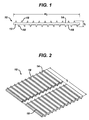
- FIG. 1 shows a cross-sectional view of an embodiment of dental tape 10 comprised of core body 12 with first cleaning surface 14 and second cleaning surface 16.
- ribs 18 protrude from both first cleaning surface 14 and second cleaning surface 16.
- ribs may protrude from only one cleaning surface of the monofilament dental tape.
- the width of dental tape 10 is represented by w t
- the thickness of dental tape 10 is represented by t t .
- FIG. 1 shows a total of twenty-two ribs 18 protruding from cleaning surfaces 14 and 16 of monofilament dental tape 10, eleven from cleaning surface 14, and eleven from cleaning surface 16.
- the total number of ribs protruding from the cleaning surfaces of the dental tape may be about eight or greater, or about twenty or greater.
- the plurality of ribs may comprise about 10 ribs disposed along each of the first and the cleaning surfaces.
- the plurality of ribs may comprise about 8 ribs disposed along each of the first and the cleaning surfaces.
- FIG. 1 shows eleven ribs 18 protruding from both first and second cleaning surfaces 14, 16 of monofilament dental tape 10.
- the number of ribs protruding from the first cleaning surface of the dental tape may be the same, about the same, or significantly different than the number of ribs protruding from the second cleaning surface. In some embodiments, all ribs may be disposed along one of the first or second ribs.
- the cross-sectional profile of the monofilament dental tape 10 shown in FIG. 1 is flat, it is to be understood that in other embodiments the dental tape can have other profiles, such as, but not limited to, arch, wave, or zig-zag.
- FIG. 2 shows a perspective view of the FIG. 1 embodiment of dental tape 10 with first cleaning surface 14 and ribs 18 as seen from the top front.
- the length of dental tape 10 is represented by l t .
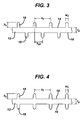
- FIG. 3 shows an enlarged cross-sectional view of the FIG. 1 embodiment of dental tape 10.
- the thickness of core 12 of dental tape 10 is represented by t c .
- the height and width of ribs 18 are represented by h r and w r , respectively.
- FIG. 3 shows an embodiment in which all ribs are uniform in height and width. It is to be understood that rib height and width can vary across the cleaning surfaces of the dental tape. For example, in one embodiment, ribs could be shorter and/or thinner at the edges of the cleaning surfaces than at the center of the cleaning surfaces.
- the spacing between neighboring ribs 18 on first or second cleaning surface 14, 16 of dental tape 10 is represented by s r .
- s r is depicted as the spacing between neighboring ribs 18 on first cleaning surface 14 of dental tape 10.
- s r could be used to measure the spacing between neighboring ribs 18 on either the first or second cleaning surfaces 14, 16 of dental tape 10.
- FIG. 3 shows an embodiment in which the spacing (s r ) between neighboring ribs 18 on cleaning surfaces 14, 16 of dental tape 10 are about equal for all ribs 18.
- the spacing between neighboring ribs on either cleaning surface of the dental tape do not have to be about equal.
- the spacing between the first two neighboring ribs could be represented as s r1-2 , while the spacing between the next two neighboring ribs could be represented as s r2-3 , etc. It is envisioned that in other alternative embodiments of the present invention, the spacing between some sets of neighboring ribs could be about equal, while the spacing between other sets of neighboring ribs are not about equal.
- s ar is used to show the spacing between alternating ribs, that is, the spacing between a rib 18 on first cleaning surface 14 and an adjacent rib 18 on second cleaning surface 16 of dental tape 10.
- FIG. 3 shows an embodiment in which spacing between alternating ribs s ar is about one-half the spacing between neighboring ribs s r . So, the ribs on second cleaning surface 16 of dental tape 10 are offset such that they are positioned about midway between those on first cleaning surface 14.
- FIG. 4 shows an embodiment in which spacing between alternating ribs s ar is equal to the spacing between neighboring ribs s r . So, the ribs on second cleaning surface 16 of dental tape 10 are aligned with those on first cleaning surface 14.
- the cross-sectional shape of ribs 18 is shown as rectangular with a single rounded tip on the distal end of the rib. It is to be understood that other cross-sectional rib shapes are also contemplated embodiments of monofilament ribbed dental tape of the present invention.
- the cross-sectional shape of rib 18 may be rectangular with a circular tip on the distal end of the rib. In other embodiments not shown, the tip on the distal end of the rib could be oval or semi-circular.
- the cross-sectional shapes may be rectangular and triangular, respectively.
- the ribs may have a cross-sectional configuration which is substantially rectangular and a ratio of the height of said ribs to the width of said ribs of from about 1.5:1 to about 8:1.
- all ribs on a given embodiment of the present invention may be, but are not required to be, of the same cross-sectional shape.
- a mixture of cross-sectional shapes may be employed as determined by the use of the ribbed monofilament dental tape.
- the ribs on the first cleaning surface may be offset from the ribs on the second cleaning surface.
- the spacing between the ribs may be substantially equal and the ribs on the first cleaning surface may be offset from the ribs on the second cleaning surface.
- Effective flossing of teeth involves placing dental floss into the interdental space between the teeth and then drawing the floss up against the side of each individual tooth to scrub as much of the tooth surface as possible.
- the monofilament ribbed dental tape of the present invention is inserted into the interdental space and moved thusly. Due to the configuration and dimensions of the ribs, the ribs act like squeegees to remove and trap/hold plaque and food debris in the spacing between the respective ribs with a higher degree of efficiency than, for example, a tape that does not include such ribs disposed along the length thereof, thus providing improved cleaning of the irregular surfaces of teeth.
- the floss must be able to pass between tight teeth, a gap of several thousandths of an inch. It must be sized to fit through the gap, or be made of a material and construction that can compress when passing into the interdental space.
- the monofilament ribbed dental tape of the present invention is thin in one dimension to allow it to slide between tight teeth. It is wide in the other direction to provide two substantial cleaning surfaces to contact teeth surfaces.
- the aspect ratio of the core body will be about 5:1 or greater, or about 10:1 or greater, or even about 35:1 or greater.
- the ratio of the width of the dental tape to the thickness of the dental tape may range from about 3:1 to about 25:1, or from about 10:1 to about 20:1.
- the monofilament ribbed dental tape of the present invention can be made using a number of materials known in the art. These materials can be elastomeric or non-elastomeric. Some non-elastomeric materials from which the dental tape can be made include nylon or polytetrafluoroethylene (PTFE).
- PTFE polytetrafluoroethylene
- the dental tape is made of a material that can compress when passing into the interdental space, and then recover a percentage of its original form upon passing into the interdental space. Accordingly, dental tapes of the present invention provide a percent compression of about 50 percent or greater and a percent recovery of about 40 percent or greater, or in certain embodiments, a percent compression of about 60 percent or greater and a percent recovery of about 60 percent or greater. Also, since teeth surfaces are not regular, the interdental space between the teeth will be irregular, having areas which are more or less open, depending on the structure of the particular adjacent teeth. As such, in certain embodiments, the ribs are flexible relative to the core body such that they easily deflect to allow passage into the interdental space.
- the ribs In order to achieve optimal cleaning, it is desirable to have the ribs substantially recover their original dimensions once the force is removed and regain the majority of their original height once the dental tape is in the larger area of the interdental spacing. In this way, the rib will conform to the tooth cross sectional profile, removing more plaque and food.
- the dental tape is made using an elastomeric material.
- Elastomeric materials provide a high degree of compressibility when extruded in the cross-sectional configurations of this invention, allowing it to slip through the tight spaces between teeth. Once in the cavity between teeth and into the interdental space, the dental tape substantially recovers from compression, providing cleaning surfaces that act as scrapers to remove plaque and food particles from between the teeth.
- Elastomeric materials that may be used to form the dental tape of the present invention include, but are not limited to, those selected from the group consisting of polyamide-polyether block copolymers, polyester-polyether block copolymers, polyester-polyester block copolymers, aliphatic thermoplastic polyurethane elastomers, aromatic thermoplastic polyurethane elastomers and thermoplastic polyolefin elastomers.
- polyamide-polyether block copolymers sold under the tradename PEBAX (Ato Chimie, Hauts-de-Seine France), such as PEBAX 7033, 5533 MX1205, 4033, 3533, and 2533; polyester-polyether block copolymers and polyester-polyester block copolymers sold under the tradename HYTREL (E. I.
- du Pont de Nemours & Co., Wilmington, Del. such as HYTREL 7246, 5556, and 4056; aliphatic thermoplastic polyurethane elastomers sold under the tradename TECOFLEX (Lubrizol Advanced Materials, Inc., Cleveland Ohio); aromatic thermoplastic polyurethane elastomers sold under the tradename PELLETHANE (Dow Chemical Co., Midland, Mich.); and thermoplastic polyolefin elastomer sold under the name MULTIFLEX (Dow Chemical Co., Midland, Mich.).
- the width of the dental tape, or w t is about 0.040 to about 0.100 inches, or about 0.070 to about 0.090 inches.
- the thickness of the dental tape, t t is about 0.0035 to about 0.012 inches, or about 0.007 to about 0.009 inches.
- the thickness of the core body of the dental tape, t c is about 0.001 to about 0.004 inches, or about 0.002 inches.
- the height of ribs 18, h r is about 0.0005 to about 0.004 inches, or about 0.002 inches.
- the width of the ribs, w r is about 0.0005 to about 0.003 inches, or about 0.0015 inches.
- the spacing between neighboring ribs on the cleaning surface of the dental tape, s r will depend on the width of the dental tape, and the number of ribs on the cleaning surface.
- spacing between neighboring ribs on a cleaning surface is about 0.003 to about 0.020 inches, or about 0.005 to about 0.010 inches.
- the ratio of s ar to s r defines the special relationship between alternating ribs. That ratio can vary from just greater than 0 when the ribs on the second cleaning surface are slightly out of alignment with those on the first cleaning surface, through 0.5 when the ribs on the second cleaning surface are positioned about midway between those on the first cleaning surface (see FIG. 3 ), to 1.0 when the ribs on the second cleaning surface are aligned with those on the first cleaning surface (see FIG. 4 ). In one embodiment of the monofilament ribbed dental tape of the present invention, the ratio of s ar to s r is about 0.5.
- the monofilament ribbed dental tape of the present invention may be produced by commercial melt spinning process.
- the resin is fed into an extruder screw where the material is heated, melted and passed on to a melt pump.
- the melt pump meters the molten material into a die with a desired profile machined into the surface such that the profile is imparted on the molten extrudate as it exits the die.
- the extrudate passes from the die and is allowed to flow downwards and start the process of solidification. Some necking down is typical at that point.
- the material passes into a water bath where the solidification of polymer melt to solid tape is complete.
- the tape then undergoes a drawing process where it is stretched in the heated state and final characteristics are achieved.
- the final dental tape is wound onto spools.
- the spools can be placed on winding machines where the dental tape is wound into bobbins and the bobbins are placed into dispensers or, optionally, the spools are placed on coating machines first, where coatings can be applied prior to the winding operation.
- the ribbed dental tape of the present invention may be comprised of multiple materials formed by co-extrusion, or lamination via rolling or adhesion processes.
- the dental tape of the invention could also be produced from sheets of material.
- the resin would be extruded through a shaped die of the correct dimensions imparting the shape on the film.
- the extrudate passes from the die and is allowed to flow downwards and start the process of solidification. Some necking down is typical at this point.
- the material passes into a water bath where the solidification of polymer melt to solid tape is complete.
- the film could be slit at this point and drawn to final dimensions or it could be drawn first and then slit.
- Coating compositions applied to coated monofilament dental tapes of the present invention must reliably adhere to the surface of the dental tape.
- the coating composition must have sufficient adherence to keep the coating on the surface of the dental tape during coating, winding, shipping and unwinding of the dental tape.
- Coated monofilament dental tapes of the present invention comprise a substantially uniform coating comprising about 0.8 milligrams per yard dental tape or more of an abrasive selected from the group consisting of silica, di-calcium phosphate and alumina, and about 0.8 milligrams per yard dental tape or more of sodium bicarbonate; or about 1.4 milligram per yard dental tape or more of an abrasive selected from the group consisting of silica, di-calcium phosphate and alumina, and about 1.4 milligram per yard or more of sodium bicarbonate; or about 2 milligram per yard dental tape or more of an abrasive selected from the group consisting of silica, di-calcium phosphate and alumina, in particular silica, and about 2 milligram per yard dental tape of sodium bicarbonate.
- the dental tape comprises about 2 milligram per yard dental tape of said sodium bicarbonate and about 2 milligram per yard dental tape of said silica. It will be recognized by those skilled in the art, once having the benefit of this disclosure, that other relative amounts of abrasive and sodium bicarbonate may be used within the above guidelines to provide a coated monofilament dental tape according to the present invention.
- Suitable insoluble coatings include, but are not limited to, microcrystalline wax, beeswax, paraffin waxes, low molecular weight polyethylenes, silicone oils, essential oils, and mineral oil.
- the insoluble wax coatings have melting temperatures ranging from about 25°C to about 100°C, optionally from about 35°C to about 80°C.
- the waxes may be combined with water insoluble colorants that are FD&C approved for use in the mouth.
- Suitable colorants include, but are not limited to, synthetically derived colorants such as FD&C Blue #1 Lake, FD&C Blue #2 Lake, FD&C Red #40 Lake, Erythrosin Lake, Amaranth Lake, Ponceau 4R Lake, Carmoisosine Lake, Carmine Lake and colorants generated by converting a naturally derived dye to an aluminum or calcium based salt. Natural colorants such as titanium dioxide and the like may also be used.
- the coating further comprises a microcrystalline wax, about 1.4 milligram per yard dental tape or more of sodium bicarbonate and about 1.4 milligram per yard dental tape or more of silica.
- the coating composition applied to the dental tape may be a soluble coating, i.e., the coating is such that it tends to dissolve or disperse in saliva present in the oral cavity.
- soluble coatings include soluble waxes or the like, which include, but are not limited to, low molecular weight polyethylene glycols ("PEGs"), such as PEG 1000 and PEG 1450. Combinations of higher molecular weight PEGs and lower molecular weight PEGs, such as a mixture of PEG 3350 and PEG 1000 may be used. Blends of liquid PEG's with high molecular weight PEG's may also be used.
- meltable surfactants such as Polyoxamer 407; sialagogues; olfactory stimulants; sensates; essential oils; actives, such as fluoride; cetyl pyridinim chloride (CPC); tetra sodium pyrophosphate; whitening agents other than sodium bicarbonate (baking soda), such as calcium peroxide, hydrogen peroxide, carbamide peroxide and other peroxide compounds capable of generating hydrogen peroxide in-situ; antimicrobials; anti-virals and mixtures thereof.
- meltable surfactants such as Polyoxamer 407; sialagogues; olfactory stimulants; sensates; essential oils; actives, such as fluoride; cetyl pyridinim chloride (CPC); tetra sodium pyrophosphate; whitening agents other than sodium bicarbonate (baking soda), such as calcium peroxide, hydrogen peroxide, carbamide peroxide and other peroxide compounds capable of generating hydrogen peroxide in-sit
- the coating may therefore comprise an ingredient selected from the group consisting of a lubricating agent, a release agent, a whitening agent selected from the group consisting of calcium peroxide, hydrogen peroxide, carbamide peroxide and other peroxide compounds capable of generating hydrogen peroxide in-situ, an active agent, an olfactory stimulant, a sialagogue, a sensate, an essential oil, a flavor, an antimicrobial agent and an anti-viral agent.
- a lubricating agent a release agent
- a whitening agent selected from the group consisting of calcium peroxide, hydrogen peroxide, carbamide peroxide and other peroxide compounds capable of generating hydrogen peroxide in-situ, an active agent, an olfactory stimulant, a sialagogue, a sensate, an essential oil, a flavor, an antimicrobial agent and an anti-viral agent.
- Such ingredients may be employed as solids, liquids, particles, gels, or the like, and may be encapsulated in conventional polymeric materials by conventional encapsulation techniques to form encapsulated materials having a polymeric shell and a core comprising the ingredient in one of the noted forms, as the case may be.
- Such ingredients also may be applied directly to the dental tapes of the present invention without the need for a coating carrier, where appropriate.
- a coating comprising an insoluble wax may be applied, wherein the coating contains encapsulated components such as spray dried flavors, essential oils, or other ingredients protected and released from soluble spheres within the insoluble wax, or a soluble coating may be applied directly to the yarn or over the insoluble coating.
- the soluble coating may contain ingredients that are placed directly in the wax or through the use of spray dried or other encapsulation technologies commonly practiced within the art.
- two insoluble coatings are applied to the dental tape.
- the second coating composition must have a lower melting point than the first coating composition.
- a soluble coating can be used by itself or as a second coating over an insoluble coating.
- One or both coatings can contain colorants, flavors, sweeteners, abrasives, anti-tartar agents, actives, such as fluoride salts, and like additives known in the art.
- Additional components can be added to coatings for various benefits. These include flavor systems, such as spray dried flavors, flavor enhancers, and sweeteners, such as sodium saccharin.
- flavor systems such as spray dried flavors, flavor enhancers, and sweeteners, such as sodium saccharin.
- sweeteners such as sodium saccharin.
- the amount of flavor added typically ranges from 10 percent to 25 percent, based on the total weight of the coating composition.
- sweetener typically ranges from 0.1 percent to 1 percent, based on the total weight is of the coating composition.
- the dental tape coating may be anhydrous or hydrous. When the coating is hydrous, the water is evaporated upon drying.
- the coating may be applied as an add-on typically ranging from about 10 percent to about 60 percent, optionally from about 20 percent to about 50 percent, based on the weight of the fiber substrate.
- the dental tape is manufactured using equipment and processes capable of doing the following:
- the coating should have an even (or relatively or, substantially even) thickness and be free from (or sufficiently [or substantially] free from) defects (such as pinholes or voids) in the coated area.
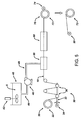
- FIG. 5 The above-mentioned process for manufacturing the elastomeric monofilament dental tape of the invention is illustrated in FIG. 5 .
- the coating composition 5 typically a wax, is liquefied if necessary, as by heating, in a mix tank 40.
- a high sheer mixer 42 such as a Rotostat High Sheer Mixer Model #XPBL, made by Admix, can be used to keep coating composition 5 homogeneous.
- a Rotosolver head blade is used in the high sheer mixer 42 and is operated at, e.g., 1700 rpm.
- the coating composition is then allowed to flow from mix tank 40, via a first pipe 44 into a positive displacement pump 46 which, when driven at a given speed, delivers a constant amount of coating, via a second pipe 48, to a coating die 50.
- the positive displacement pump can be a vane type positive displacement pumps, piston pumps, or similar type pumps.
- a Kerr piston pump supplied by Kerr Corp., Sulfur, OK, is used. Piston pumps, generally, facilitate the evenness and uniformity of coatings where the coating composition 5 contains solid particulates such as abrasives.
- positive displacement pumps are used since the passages bores, pipes, channels or outlets used in such embodiments to deliver coating composition 5 are generally positioned or oriented such that the directional path or track of the passage bores, pipes, channels or outlets points upwardly and toward or horizontally level with and toward the position of the dental tape 10 to be coated such that gravity has no effect or minimal effect on the flow of the coating composition from mix tank 40 onto the dental tape 10.
- the dental tape 10 is simultaneously fed and pulled through the process by a combination of a powered unwinding system 20 and a floss rewinding system 70.
- the dental tape 10 is fed or unwound at a low tension and, in certain embodiments, pulled perpendicularly from feed spool 22 across or through sensing arm assembly 30.
- Sensing arm assembly 30 is provided for monitoring the tension of the dental tape 10 as it enters coating die 50.
- the sensing arm assembly 30 has an arm 32, a pivot point 34, and rollers 36 over which the dental tape 10 passes.
- Sensing arm assembly 30 is used to maintain a substantially constant low feeding or unwinding tension on dental tape 10 by adjusting the speed of power unwinding system 20 as it is simultaneously fed and pulled into the coating process system.
- the constant low unwinding tension is generally maintained at from about 50 grams-force to about 100 grams-force, optionally at from about 60 grams-force to about 100 grams-force for dental tape 10 having denier of about 400 to about 1200.
- dental tape 10 is collected on a take-up spool 72.
- the speed at which take-up spool 72 operates is controlled by an electronic controller system.
- the controller may be a computer, a programmable logic controller or similar device.
- a speed sensing roll 74 rides on surface of the tape on take-up spool 72.
- Speed sensing roll 74 generates a signal which is fed to an electronic controller, such as a Fenner M-drive.
- the controller controls the voltage of the motor which drives the speed of take-up spool 72.
- the use of the signal generated by speed sensing roll 74 in controlling the speed of take-up spool 72 helps to maintain a constant speed or velocity of the dental tape 10 through the coating process, controlling and maintaining the tension on dental tape 10 to less than 250 or (about 250) grams-force.
- the electronic controller also controls the speed of positive displacement pump 46. Thus the velocity of dental tape 10 is maintained while a constant amount of coating composition 5 is pumped into the coating die 50.
- the coating die 50 contains at least two rollers around which elastomeric dental tape 10 has at least some wrap.
- the number of rollers can range from 2, optionally 3, optionally 4 or greater rollers, or optionally 2 to 7 rollers or, optionally, from 3 to 5 rollers.
- dental tape 10 wraps around the rollers at from about 90° to about 270°.
- the rollers assist in applying coating composition 5 to dental tape 10. Downstream of the rollers there is typically a slot die region where coating composition 5 is smoothed onto the surface of dental tape 10.
- the slot die is in the form of a groove having parallel sides or walls, the groove, optionally, having a radius at its bottom for guiding the dental tape into a slot.
- the slot is sized such that excess coating is removed from dental tape 10 as it passes through the die while, at the same time, minimizing any additional tension on dental tape 10 caused by the slot die as the tape 10 passes through the die.
- the dimensions of the groove and slot will depend upon such factors as the denier and type of elastomeric monofilament dental tape 10 and the amount of coating composition 5 being applied thereto.
- Dental tape that may be used in the present invention was produced using PEBAX MX 1205 resin.
- the resin was dried for over 3 hours at 75° C, fed into a Haake 20 mm extruder with a Slack and Parr gear melt pump attached and extruded through a shaped die formed of stainless steel, and having a cross-section similar to that of the dental tape shown in FIG. 1 .
- the extruded dental tape included eleven ribs protruding from both the first and second cleaning surfaces.
- the overall width of the slot (w t ) was 0.303 inches.
- the thickness of the core body of the die (t c ) was 0.0035 inches.
- the height and width of the rib portions of the die were 0.0075 inches and 0.0035 inches, respectively.
- the spacing between neighboring ribs on both cleaning surfaces (s r ) was 0.026 inches, and the ratio of s ar to s r was 0.5, i.e. the ribs on the second cleaning surface were positioned about midway between those on the first cleaning surface.
- the extruded tape passed through a room temperature water bath and was wound on a spool.
- the tensile properties and tenacity of the tapes were measured using an Instron universal testing machine with a specimen length of 10 inches, and a cross-head speed of 10 inches per minute.
- the resins were dried for over 3 hours at 75° C. They were processed in the extruder of Example 1, using the ribbed die described in Example 1.
- Dental tape that may be used in the present invention was produced using PEBAX MX 1205 resin where the drawing conditions were modified to change the dimensions of the final tape.
- the resins were dried for over 3 hours at 75°C, and processed in the extruder of Example 1, using the ribbed die described in Example 1.
- Dental tape that may be used in the present invention was produced using PEBAX MX 1205, 3533, and 2533 resins. The resins were dried for over 3 hours at 75°C, and processed in the extruder of Example 1, using the ribbed die described in Example 1.
- Dental tape that may be used in the present invention was produced using PEBAX MX 1205 resin where the number of ribs was modified to change the structure of the final tape.
- the die was formed of stainless steel, and had a cross-section similar to that in Example 1. The difference is that in Example 1, there were eleven ribs protruding from both the first and second cleaning surfaces. Here, there were five ribs protruding from both the first and second cleaning surfaces.
- the overall width of the slot, or w t was 0.305 inches.
- the thickness of the core body of the die t c was 0.0035 inches.
- the height and width of the rib portions of the die (h r and w r , respectively) were 0.0075 inches and 0.0035 inches.
- the spacing between neighboring ribs both cleaning surfaces was (s r ) is 0.050 inches, and the ratio of s ar to s r is 0.5, i.e. the ribs on second cleaning surface were positioned about midway between those on first cleaning surface.
- Dental tape that may be used in the present invention was produced using PEBAX MX 1205 resin where the width of ribs was modified to change the structure and dimensions of the final tape.
- the die was formed of stainless steel, and had a cross-section similar to that in Example 1. There were eleven ribs protruding from both the first and second cleaning surfaces.
- the overall width of the slot, or w t was 0.303 inches.
- the thickness of the core body of the die t c was 0.0035 inches.
- the height and width of rib portions of the die (h r and w r , respectively) were 0.0075 inches and 0.0025 inches.
- the width of rib portions of the die (w r ) was 0.0035 inches.
- the spacing between neighboring ribs both cleaning surfaces is (s r ) was 0.026 inches, and the ratio of s ar to s r was 0.5, i.e. the ribs on second cleaning surface were positioned about midway between those on first cleaning surface.
- Dental tape that may be used in the present invention was produced using PEBAX MX 1205 resin where the height of the ribs was modified to change the structure and dimensions of the final tape.
- the die was formed of stainless steel, and had a cross-section similar to that in Example 1. There were eleven ribs protruding from both the first and second cleaning surfaces.
- the overall width of the slot, or w t was 0.303 inches.
- the thickness of the core body of the die t c was 0.0035 inches.
- the height and width of the rib portions of the die (h r and w r , respectively) were 0.0038 inches and 0.0035 inches.
- the height of rib portions of the die (h r ) was 0.0075 inches.
- the spacing between neighboring ribs both cleaning surfaces is (s r ) was 0.026 inches, and the ratio of s ar to s r was 0.5, i.e. the ribs on second cleaning surface were positioned about midway between those on first cleaning surface.
- Ratio A P 1 / P 2 X P 3 / P 4 X P Z - 1 / P Z
- Dental tape spool rolls were formed in accordance with the coating and winding process of Example 8.
- the coatings comprised microcrystalline wax (Multiwax-W445, Crompton Corp. Petrolia, PA), flavor (Virginia Dare, Brooklyn, NY), sodium saccharin (PMC Specialties, Cincinnati, OH), baking soda (sodium bicarbonate; Church and Dwight, Old Fort, OH), and one of two silicas (Sident 10, Degussa GmbH, Wesseling, Germany or Zeodent, J.M. Huber Corporation, Atlanta, GA).
- the coating add-on % for all samples was approximately 33 w/w%.
- the yam used was a 865 denier mutli-ribbed floss made from PEBAX 1205 as previously described.
- Dental specimens were prepared and stained following the methods discussed in M. Moore, et al., BMC Oral Health 2008, 8:23, and summarized below.
- Squares of enamel were embedded in clear, self-curing, denture base repair acyric (Patterson Dental Supply, St. Paul, MN) to provide a 1.5 cm square block with the tooth enamel labial surface exposed.
- the enamel surface was then smoothed by hand-sanding and hand-polished to a mirror finish using a water/ceramic slurry.
- the finished specimens were examined under a dissecting microscope and discarded if surface imperfections were observed.
- the specimens were etched for 60 seconds in 0.2 M HCl, followed by a 30 second immersion in a saturated solution of sodium carbonate. A final etch was performed with 1% phytic acid for 60 seconds.
- the specimens were then rinsed with deionized water and attached to a staining apparatus, which was designed to provide alternate immersion into the staining broth and air-drying of the specimens.
- the staining apparatus had a Teflon rod connected to an electric motor. Specimens were attached to the rod so that when the rod was rotated, the specimens were dipped into a trough which held the staining broth.
- the staining broth was prepared using 1.02 gm instant coffee, 1.02 gm instant tea, 10 ml red wine, 0.75 gm gastric mucin (Nutritional Biochemicals Corp., Cleveland, OH) and 50 ml of a 24-hour Micrococcus luteus culture in 250 ml of sterilized trypticase soy broth.
- the apparatus containing the attached enamel specimens and staining broth, was then placed in an incubator at 37°C with the specimens rotating continuously through the staining broth and air.
- the staining broth was replaced with fresh broth once every 24 hours for ten consecutive days.
- the trough and specimens were rinsed and brushed with deionized water to remove any loose deposits at each broth change.
- FeCl 3 .6H 2 O was added to the staining broth. This was continued with daily broth changes until the stain on the specimens was sufficiently dark (L* ⁇ 35). The specimens were then removed from the staining broth, brushed thoroughly with deionized water, and refrigerated in a humidor until used.
- the flossing unit that was used was built internally. Each enamel specimen was vertically positioned in a holder. A strip of floss, placed under 3 ⁇ 4-pounds of tension, was wrapped around and through rods that held the floss in place and in contact with the specimen. The unit was activated, and a 5-stroke up/down motion was performed. The first strip of floss was replaced, and the unit activation was repeated. The process was repeated on the same enamel specimen until 150 strokes were performed with 30 strips of floss being tested. Specimens were removed from the flossing unit, and wiped off with alcohol.
- Evaluation of stain removal was done by measuring the extrinsic stain on the enamel specimens before and after flossing.
- the color of the extrinsic stain on the enamel sample was measured by taking diffuse reflectance absorbance readings with a Minolta CM-503i Spectrophotometer (Minolta Camera Co., Ramsey, NJ). Absorbance measurements over the entire visible color spectrum were obtained using the CIELAB color scale. This scale quantifies color according to 3 parameters, L* (lightness-darkness scale), a* (red-green chroma), and b* (yellow-blue chroma). An average of 3 absorbance readings using the L*a*b* scale were taken for each specimen.
- ⁇ E [( ⁇ L*) 2 + ( ⁇ a*) 2 + ( ⁇ b*) 2 ] 1/2 .
- Stain removal is related to the ⁇ E or ⁇ L score after treatment. Increasing ⁇ E or ⁇ L scores indicate higher stain removal.
- Table XXVII shows that the floss with no coating (Formulation 9-1), or 10 w/w % baking soda (Formulation 9-7) show slight stain removal ( ⁇ E of approximately 1). As the amount of Sident 10 silica is increased, stain removal increased. Surprisingly, formulation 9-4 showed the best stain removal of the flosses coated with Sident 10 silica. Formulation 9-5 showed the best stain removal of any tested formulation.
- the invention therefore provides, inter alia:
Landscapes
- Health & Medical Sciences (AREA)
- Public Health (AREA)
- Epidemiology (AREA)
- Life Sciences & Earth Sciences (AREA)
- Animal Behavior & Ethology (AREA)
- General Health & Medical Sciences (AREA)
- Dentistry (AREA)
- Veterinary Medicine (AREA)
- Artificial Filaments (AREA)
- Dental Tools And Instruments Or Auxiliary Dental Instruments (AREA)
- Cosmetics (AREA)
- Pharmaceuticals Containing Other Organic And Inorganic Compounds (AREA)
- Dental Preparations (AREA)
Applications Claiming Priority (1)
| Application Number | Priority Date | Filing Date | Title |
|---|---|---|---|
| US12/748,723 US8522796B2 (en) | 2007-11-08 | 2010-03-29 | Coated multi-ribbed dental tape |
Publications (2)
| Publication Number | Publication Date |
|---|---|
| EP2371322A2 true EP2371322A2 (de) | 2011-10-05 |
| EP2371322A3 EP2371322A3 (de) | 2012-10-24 |
Family
ID=44169229
Family Applications (1)
| Application Number | Title | Priority Date | Filing Date |
|---|---|---|---|
| EP11250401A Withdrawn EP2371322A3 (de) | 2010-03-29 | 2011-03-29 | Mehrfach geripptes beschichtetes Zahnband |
Country Status (7)
| Country | Link |
|---|---|
| US (1) | US8522796B2 (de) |
| EP (1) | EP2371322A3 (de) |
| JP (1) | JP2011206541A (de) |
| CN (1) | CN102247216A (de) |
| AU (1) | AU2011201249B2 (de) |
| CA (1) | CA2735075C (de) |
| RU (1) | RU2011111663A (de) |
Families Citing this family (15)
| Publication number | Priority date | Publication date | Assignee | Title |
|---|---|---|---|---|
| US20090230756A1 (en) * | 2008-03-12 | 2009-09-17 | Ranir, Llc | Interdental cleaning tool |
| FR2949687B1 (fr) | 2009-09-04 | 2011-09-23 | Sofradim Production | Tissu avec picots revetus d'un materiau hydrosoluble |
| US9277977B2 (en) | 2011-01-24 | 2016-03-08 | Leonard G. Lorch | Dental floss |
| US9277976B2 (en) | 2011-01-24 | 2016-03-08 | Leonard G. Lorch | Dental floss |
| US8381742B2 (en) | 2011-01-24 | 2013-02-26 | Leonard G. Lorch | Dental floss |
| US10206765B2 (en) | 2011-01-24 | 2019-02-19 | Leonard G. Lorch | Dental floss |
| WO2013147714A1 (en) * | 2012-03-30 | 2013-10-03 | The Foundation Of Promotion Of Supplementry Occupations And Related Technique Of Her Majesty Queen Sirikit Of Thailand | Silk dental floss machine |
| US20130319456A1 (en) * | 2012-06-05 | 2013-12-05 | Eric Safieh | Tooth flossing device |
| US8800574B2 (en) | 2012-12-03 | 2014-08-12 | Linda A. Hanrahan | Fluffy floss kit |
| US20160008113A1 (en) * | 2014-03-17 | 2016-01-14 | Daniela Spector | Dental floss and methods of maintaining oral hygiene |
| GB2525638A (en) * | 2014-04-30 | 2015-11-04 | Wisdom Toothbrushes Ltd | Oral hygiene device |
| US10058402B2 (en) * | 2016-04-18 | 2018-08-28 | Jeff Rickabaugh | Colored dental floss and a method for using colored dental floss |
| US20190117353A1 (en) * | 2017-10-24 | 2019-04-25 | John D. Bailey | Groovy Dental Floss |
| US20230181297A1 (en) * | 2021-12-15 | 2023-06-15 | Christopher Thomas-Jay Sizemore | Elastic dental floss loop |
| EP4605442A1 (de) | 2022-10-19 | 2025-08-27 | W. L. Gore & Associates, Inc. | Pha-basierte mikroporöse artikel und verfahren zur formung davon |
Citations (7)
| Publication number | Priority date | Publication date | Assignee | Title |
|---|---|---|---|---|
| US5518012A (en) | 1994-06-15 | 1996-05-21 | W. L. Gore & Associates, Inc. | Expanded PTFE floss material and method of making same |
| US5908039A (en) | 1998-07-24 | 1999-06-01 | Mcneil-Ppc, Inc. | Dental floss having improved fray and shred resistance |
| US6029678A (en) | 1996-08-15 | 2000-02-29 | Gillette Canada Inc. | "Gel" dental floss |
| US6039054A (en) | 1998-09-23 | 2000-03-21 | Gillette Canada Company | Dental floss |
| US6591844B2 (en) | 2001-01-22 | 2003-07-15 | Peri-Deat Limited | Elastomeric monofilament dental tapes |
| US6742528B2 (en) | 2000-12-01 | 2004-06-01 | Vipul Bhupendra Dave | Monofilament tape |
| US20090120454A1 (en) | 2007-11-08 | 2009-05-14 | Ochs Harold D | Multi-Ribbed Dental Tape |
Family Cites Families (56)
| Publication number | Priority date | Publication date | Assignee | Title |
|---|---|---|---|---|
| US2771084A (en) * | 1953-09-29 | 1956-11-20 | John S Fleming | Dental cleaner |
| US2821202A (en) * | 1955-06-20 | 1958-01-28 | Davis Jerome | Dental cord |
| US3999562A (en) * | 1976-02-24 | 1976-12-28 | Reukauf William B | Toothpick construction |
| US4312370A (en) * | 1980-05-13 | 1982-01-26 | George Hinge | Toothpick |
| US4450849A (en) * | 1982-09-27 | 1984-05-29 | Cerceo Chris A | Dental physio-tape |
| US4646766A (en) | 1982-10-01 | 1987-03-03 | Johnson & Johnson | Dental tape |
| US4776358A (en) * | 1986-09-23 | 1988-10-11 | Leonard Lorch | Floss employing microporous tapes sandwiching paste dentifrice |
| US4836226A (en) | 1987-11-20 | 1989-06-06 | Wolak Ronald G | Endless article for cleaning teeth |
| US5209251A (en) | 1988-03-29 | 1993-05-11 | Colgate-Palmolive Company | Dental floss |
| GB8819873D0 (en) | 1988-08-22 | 1988-09-21 | Westone Prod Ltd | Dental floss & tape |
| US5098711A (en) * | 1988-11-14 | 1992-03-24 | Ira Hill | Method of treating the oral cavity with dental floss containing chemotherapeutic agents |
| US4911927A (en) * | 1988-11-14 | 1990-03-27 | Hill Ira D | Method and apparatus for adding chemotherapeutic agents to dental floss |
| US4941487A (en) | 1989-07-11 | 1990-07-17 | Vanbeneden Floyd V | Fluoridated dental floss |
| US4998978A (en) | 1990-01-10 | 1991-03-12 | Varum Shirley B | Tooth cleaning strip |
| GB9003292D0 (en) | 1990-02-14 | 1990-04-11 | Lisney Kevin P | Dispensing mechanism |
| GB2250817A (en) | 1990-12-12 | 1992-06-17 | Naresh Gathani | Dental caries diagnostic floss. |
| US5226435A (en) | 1991-08-01 | 1993-07-13 | Gillette Canada Inc. | Flavored dental floss and method |
| US5320117A (en) * | 1992-01-09 | 1994-06-14 | Richard J. Lazzara | Dental flossing material with leader |
| US5293886A (en) | 1993-02-18 | 1994-03-15 | Henry Czapor | Dental strip |
| US7093316B2 (en) | 1994-04-19 | 2006-08-22 | Applied Elastomerics, Inc. | Gels for force gauging |
| AU694983B2 (en) | 1994-06-06 | 1998-08-06 | Johnson & Johnson Consumer Companies, Inc. | Novel compositions for dental floss |
| GB9419859D0 (en) | 1994-10-03 | 1994-11-16 | Westone Prod Ltd | Method and apparatus for forming elongate PTFE material and PTFE material particularly dental floss |
| US5588452A (en) | 1995-05-10 | 1996-12-31 | Peck; Granger | Tooth cleansing and flossing implement and method |
| US5875797A (en) | 1995-06-06 | 1999-03-02 | Gillette Canada Inc. | Dental floss |
| US6371133B1 (en) | 1996-05-01 | 2002-04-16 | Loops, L.L.C. | Variable-guage tooth-flossing loops |
| US5865197A (en) | 1996-05-20 | 1999-02-02 | Anchor Advanced Products, Inc. | Monofilament nylon dental floss |
| US5918609A (en) * | 1996-10-24 | 1999-07-06 | Gillette Canada Inc. | Particulate modified elastomeric flosses |
| JPH11244303A (ja) * | 1998-03-02 | 1999-09-14 | Morita Mfg Co Ltd | 歯面清掃研磨装置及び歯面清掃研磨装置用研磨剤 |
| US6003525A (en) | 1998-03-14 | 1999-12-21 | Katz; Harry S. | Elastomer floss and related flossing devices |
| US5967154A (en) | 1998-05-04 | 1999-10-19 | Vision International Production, Inc. | Dental hygiene filament |
| US6340027B1 (en) | 1998-08-17 | 2002-01-22 | Athena Nordic Ab | Extensible polishing mono-filament dental floss |
| NZ528417A (en) | 1999-04-29 | 2005-08-26 | Neks Technologies Inc | Interproximal tooth coating applicator |
| US6016816A (en) | 1999-07-16 | 2000-01-25 | Seaway Yarns Limited | Multi-colored dental floss and method of making |
| US6721987B2 (en) | 2000-04-06 | 2004-04-20 | Kimberly-Clark Worldwide, Inc. | Dental wipe |
| WO2002015814A1 (en) | 2000-08-23 | 2002-02-28 | Hill Ira D | Physical improvements in coated monofilament dental tapes |
| EP1311206A4 (de) | 2000-08-23 | 2008-01-02 | Ira D Hill | Dentale monofilamentbänder mit beschichtungen |
| US6453912B1 (en) | 2000-12-07 | 2002-09-24 | Steven M. Antler | Dental floss with abrasives |
| US6420024B1 (en) | 2000-12-21 | 2002-07-16 | 3M Innovative Properties Company | Charged microfibers, microfibrillated articles and use thereof |
| US6607000B2 (en) * | 2000-12-27 | 2003-08-19 | Padma Marwah | Frilly dental floss |
| US6536448B2 (en) | 2000-12-29 | 2003-03-25 | Kimberly-Clark Worldwide, Inc. | Hemostat coated dental floss and hemostat coated dental tape |
| AU2001286633B2 (en) | 2001-01-22 | 2005-06-09 | Dale G. Brown | Non-crystalline saliva-soluble coatings for elastomeric monofilament dental tapes |
| JP4098627B2 (ja) | 2001-01-22 | 2008-06-11 | インターナシヨナル・テープ・パートナーズ・エル・エル・シー | 被覆モノフィラメントからなるデンタルテープボビンおよび巻取方法 |
| US6575176B1 (en) | 2001-08-23 | 2003-06-10 | International Tape Partners, Llc | Monofilament dental tapes with soft abrasive coatings |
| US7017591B2 (en) * | 2001-08-23 | 2006-03-28 | International Tape Partners Llc | Particulate coated monofilament devices |
| US20030041873A1 (en) | 2001-08-28 | 2003-03-06 | Dana Contratto | Dental strip and method of use thereof |
| US20060243297A1 (en) | 2005-04-29 | 2006-11-02 | Brown Dale G | Coated monofilament oriented HDPE dental tapes |
| JP2003225250A (ja) * | 2002-02-04 | 2003-08-12 | Sunstar Inc | 歯間清掃用具 |
| US20030230319A1 (en) | 2002-06-14 | 2003-12-18 | Marcon Robert Victor | Flavor enhanced dental floss |
| US7055530B2 (en) | 2003-02-25 | 2006-06-06 | Mardelle M. LaMoure | Dental cleaning strip |
| US7210650B2 (en) | 2003-12-22 | 2007-05-01 | Brian David Metzger | Paper-back tape dispenser |
| US7281541B2 (en) | 2004-06-16 | 2007-10-16 | Lorch Leonard G | Dental floss |
| US20060016457A1 (en) | 2004-07-23 | 2006-01-26 | Hoffman William A Iii | Dental tape |
| US20060237028A1 (en) * | 2005-04-21 | 2006-10-26 | Hamidy Nasser W | Dental floss |
| US20090120455A1 (en) | 2007-11-08 | 2009-05-14 | Ochs Harold D | Multi-Ribbed Dental Tape |
| AU2009202949B2 (en) * | 2008-07-31 | 2015-12-03 | Lg Household & Health Care Ltd. | Apparatus for coating dental tape |
| US20100055052A1 (en) * | 2008-08-26 | 2010-03-04 | James Albert Berta | Processing System for Oral Care Compositions |
-
2010
- 2010-03-29 US US12/748,723 patent/US8522796B2/en active Active
-
2011
- 2011-03-21 AU AU2011201249A patent/AU2011201249B2/en active Active
- 2011-03-24 CA CA2735075A patent/CA2735075C/en active Active
- 2011-03-28 RU RU2011111663/14A patent/RU2011111663A/ru not_active Application Discontinuation
- 2011-03-28 JP JP2011069979A patent/JP2011206541A/ja active Pending
- 2011-03-28 CN CN2011100849838A patent/CN102247216A/zh active Pending
- 2011-03-29 EP EP11250401A patent/EP2371322A3/de not_active Withdrawn
Patent Citations (7)
| Publication number | Priority date | Publication date | Assignee | Title |
|---|---|---|---|---|
| US5518012A (en) | 1994-06-15 | 1996-05-21 | W. L. Gore & Associates, Inc. | Expanded PTFE floss material and method of making same |
| US6029678A (en) | 1996-08-15 | 2000-02-29 | Gillette Canada Inc. | "Gel" dental floss |
| US5908039A (en) | 1998-07-24 | 1999-06-01 | Mcneil-Ppc, Inc. | Dental floss having improved fray and shred resistance |
| US6039054A (en) | 1998-09-23 | 2000-03-21 | Gillette Canada Company | Dental floss |
| US6742528B2 (en) | 2000-12-01 | 2004-06-01 | Vipul Bhupendra Dave | Monofilament tape |
| US6591844B2 (en) | 2001-01-22 | 2003-07-15 | Peri-Deat Limited | Elastomeric monofilament dental tapes |
| US20090120454A1 (en) | 2007-11-08 | 2009-05-14 | Ochs Harold D | Multi-Ribbed Dental Tape |
Non-Patent Citations (1)
| Title |
|---|
| M. MOORE ET AL., BMC ORAL HEALTH, vol. 8, 2008, pages 23 |
Also Published As
| Publication number | Publication date |
|---|---|
| US20100180912A1 (en) | 2010-07-22 |
| JP2011206541A (ja) | 2011-10-20 |
| AU2011201249A1 (en) | 2011-10-13 |
| US8522796B2 (en) | 2013-09-03 |
| AU2011201249B2 (en) | 2014-05-01 |
| BRPI1101399A2 (pt) | 2012-12-04 |
| EP2371322A3 (de) | 2012-10-24 |
| CN102247216A (zh) | 2011-11-23 |
| CA2735075A1 (en) | 2011-09-29 |
| BRPI1101399A8 (pt) | 2022-08-16 |
| RU2011111663A (ru) | 2012-10-10 |
| CA2735075C (en) | 2019-04-30 |
Similar Documents
| Publication | Publication Date | Title |
|---|---|---|
| US8522796B2 (en) | Coated multi-ribbed dental tape | |
| AU2009202843B2 (en) | Multi-ribbed dental tape | |
| EP2149531B1 (de) | Verfahren zum Wickeln eines Zahnbandes | |
| CA2643208C (en) | Multi-ribbed dental tape | |
| EP2149632B1 (de) | Verfahren zum Beschichten eines Zahnbandes | |
| EP2149631B1 (de) | Vorrichtung und Verfahren zum Beschichten eines Zahnbandes | |
| AU2009202949B2 (en) | Apparatus for coating dental tape | |
| CA2673807A1 (en) | Apparatus for coating dental tape | |
| BRPI1101399B1 (pt) | Fita dental em monofilamento elastomérico | |
| ES2370144T3 (es) | Procedimiento de revestimiento de cinta dental. | |
| HK1139991B (en) | Apparatus and process for coating dental tape |
Legal Events
| Date | Code | Title | Description |
|---|---|---|---|
| PUAI | Public reference made under article 153(3) epc to a published international application that has entered the european phase |
Free format text: ORIGINAL CODE: 0009012 |
|
| AK | Designated contracting states |
Kind code of ref document: A2 Designated state(s): AL AT BE BG CH CY CZ DE DK EE ES FI FR GB GR HR HU IE IS IT LI LT LU LV MC MK MT NL NO PL PT RO RS SE SI SK SM TR |
|
| AX | Request for extension of the european patent |
Extension state: BA ME |
|
| RAP1 | Party data changed (applicant data changed or rights of an application transferred) |
Owner name: MCNEIL-PPC, INC. |
|
| PUAL | Search report despatched |
Free format text: ORIGINAL CODE: 0009013 |
|
| AK | Designated contracting states |
Kind code of ref document: A3 Designated state(s): AL AT BE BG CH CY CZ DE DK EE ES FI FR GB GR HR HU IE IS IT LI LT LU LV MC MK MT NL NO PL PT RO RS SE SI SK SM TR |
|
| AX | Request for extension of the european patent |
Extension state: BA ME |
|
| RIC1 | Information provided on ipc code assigned before grant |
Ipc: A61C 15/04 20060101AFI20120919BHEP |
|
| STAA | Information on the status of an ep patent application or granted ep patent |
Free format text: STATUS: THE APPLICATION IS DEEMED TO BE WITHDRAWN |
|
| 18D | Application deemed to be withdrawn |
Effective date: 20130425 |