EP2371916A1 - Ruban adhésif double face sensible à la pression pour module de cellule solaire - Google Patents
Ruban adhésif double face sensible à la pression pour module de cellule solaire Download PDFInfo
- Publication number
- EP2371916A1 EP2371916A1 EP09830129A EP09830129A EP2371916A1 EP 2371916 A1 EP2371916 A1 EP 2371916A1 EP 09830129 A EP09830129 A EP 09830129A EP 09830129 A EP09830129 A EP 09830129A EP 2371916 A1 EP2371916 A1 EP 2371916A1
- Authority
- EP
- European Patent Office
- Prior art keywords
- sensitive adhesive
- pressure
- adhesive layer
- double
- solar cell
- Prior art date
- Legal status (The legal status is an assumption and is not a legal conclusion. Google has not performed a legal analysis and makes no representation as to the accuracy of the status listed.)
- Withdrawn
Links
- 239000004820 Pressure-sensitive adhesive Substances 0.000 title claims abstract description 326
- 239000010410 layer Substances 0.000 claims abstract description 166
- 229910052782 aluminium Inorganic materials 0.000 claims abstract description 23
- XAGFODPZIPBFFR-UHFFFAOYSA-N aluminium Chemical compound [Al] XAGFODPZIPBFFR-UHFFFAOYSA-N 0.000 claims abstract description 23
- 239000000178 monomer Substances 0.000 claims description 66
- 239000000853 adhesive Substances 0.000 claims description 57
- 230000001070 adhesive effect Effects 0.000 claims description 53
- NIXOWILDQLNWCW-UHFFFAOYSA-N acrylic acid group Chemical group C(C=C)(=O)O NIXOWILDQLNWCW-UHFFFAOYSA-N 0.000 claims description 30
- 229920000058 polyacrylate Polymers 0.000 claims description 20
- 125000000217 alkyl group Chemical group 0.000 claims description 9
- 238000004519 manufacturing process Methods 0.000 claims description 8
- 229920005601 base polymer Polymers 0.000 claims description 7
- 125000004432 carbon atom Chemical group C* 0.000 claims description 7
- NIXOWILDQLNWCW-UHFFFAOYSA-M Acrylate Chemical compound [O-]C(=O)C=C NIXOWILDQLNWCW-UHFFFAOYSA-M 0.000 description 58
- 239000000203 mixture Substances 0.000 description 53
- -1 vinyl alkylether Chemical class 0.000 description 44
- 239000003999 initiator Substances 0.000 description 39
- 238000000034 method Methods 0.000 description 23
- 239000004005 microsphere Substances 0.000 description 22
- IJGRMHOSHXDMSA-UHFFFAOYSA-N Atomic nitrogen Chemical compound N#N IJGRMHOSHXDMSA-UHFFFAOYSA-N 0.000 description 20
- 239000011148 porous material Substances 0.000 description 19
- 101100476962 Drosophila melanogaster Sirup gene Proteins 0.000 description 18
- GZCGUPFRVQAUEE-SLPGGIOYSA-N aldehydo-D-glucose Chemical compound OC[C@@H](O)[C@@H](O)[C@H](O)[C@@H](O)C=O GZCGUPFRVQAUEE-SLPGGIOYSA-N 0.000 description 18
- 239000004745 nonwoven fabric Substances 0.000 description 18
- 235000020357 syrup Nutrition 0.000 description 18
- 229920005989 resin Polymers 0.000 description 17
- 239000011347 resin Substances 0.000 description 17
- 239000012711 adhesive precursor Substances 0.000 description 16
- 239000011248 coating agent Substances 0.000 description 16
- 238000002156 mixing Methods 0.000 description 16
- 238000000576 coating method Methods 0.000 description 15
- 239000011521 glass Substances 0.000 description 15
- 239000000463 material Substances 0.000 description 15
- 238000001723 curing Methods 0.000 description 12
- 229910052757 nitrogen Inorganic materials 0.000 description 12
- 229920000139 polyethylene terephthalate Polymers 0.000 description 12
- 239000005020 polyethylene terephthalate Substances 0.000 description 12
- 229920000642 polymer Polymers 0.000 description 12
- 238000002360 preparation method Methods 0.000 description 12
- 230000035882 stress Effects 0.000 description 11
- KWVGIHKZDCUPEU-UHFFFAOYSA-N 2,2-dimethoxy-2-phenylacetophenone Chemical compound C=1C=CC=CC=1C(OC)(OC)C(=O)C1=CC=CC=C1 KWVGIHKZDCUPEU-UHFFFAOYSA-N 0.000 description 10
- 239000007789 gas Substances 0.000 description 10
- 229910052751 metal Inorganic materials 0.000 description 10
- 239000002184 metal Substances 0.000 description 10
- 239000003505 polymerization initiator Substances 0.000 description 10
- 229920003023 plastic Polymers 0.000 description 9
- 239000004033 plastic Substances 0.000 description 9
- 239000002985 plastic film Substances 0.000 description 9
- 239000000123 paper Substances 0.000 description 8
- 239000002245 particle Substances 0.000 description 8
- 238000006116 polymerization reaction Methods 0.000 description 8
- 239000006260 foam Substances 0.000 description 7
- 238000005259 measurement Methods 0.000 description 7
- 239000004094 surface-active agent Substances 0.000 description 7
- 239000004698 Polyethylene Substances 0.000 description 6
- 239000004743 Polypropylene Substances 0.000 description 6
- 239000000654 additive Substances 0.000 description 6
- ISAOCJYIOMOJEB-UHFFFAOYSA-N benzoin Chemical compound C=1C=CC=CC=1C(O)C(=O)C1=CC=CC=C1 ISAOCJYIOMOJEB-UHFFFAOYSA-N 0.000 description 6
- 238000006243 chemical reaction Methods 0.000 description 6
- 239000000835 fiber Substances 0.000 description 6
- 238000003780 insertion Methods 0.000 description 6
- 230000037431 insertion Effects 0.000 description 6
- 229920000573 polyethylene Polymers 0.000 description 6
- 229920001155 polypropylene Polymers 0.000 description 6
- SMZOUWXMTYCWNB-UHFFFAOYSA-N 2-(2-methoxy-5-methylphenyl)ethanamine Chemical compound COC1=CC=C(C)C=C1CCN SMZOUWXMTYCWNB-UHFFFAOYSA-N 0.000 description 5
- HRPVXLWXLXDGHG-UHFFFAOYSA-N Acrylamide Chemical compound NC(=O)C=C HRPVXLWXLXDGHG-UHFFFAOYSA-N 0.000 description 5
- 239000006229 carbon black Substances 0.000 description 5
- 239000003431 cross linking reagent Substances 0.000 description 5
- 230000006866 deterioration Effects 0.000 description 5
- 230000000694 effects Effects 0.000 description 5
- 238000011156 evaluation Methods 0.000 description 5
- 239000007788 liquid Substances 0.000 description 5
- 230000036961 partial effect Effects 0.000 description 5
- 229920006255 plastic film Polymers 0.000 description 5
- 229920000728 polyester Polymers 0.000 description 5
- 229920001296 polysiloxane Polymers 0.000 description 5
- 239000002994 raw material Substances 0.000 description 5
- 239000003566 sealing material Substances 0.000 description 5
- QNODIIQQMGDSEF-UHFFFAOYSA-N (1-hydroxycyclohexyl)-phenylmethanone Chemical compound C=1C=CC=CC=1C(=O)C1(O)CCCCC1 QNODIIQQMGDSEF-UHFFFAOYSA-N 0.000 description 4
- GOXQRTZXKQZDDN-UHFFFAOYSA-N 2-Ethylhexyl acrylate Chemical compound CCCCC(CC)COC(=O)C=C GOXQRTZXKQZDDN-UHFFFAOYSA-N 0.000 description 4
- FIHBHSQYSYVZQE-UHFFFAOYSA-N 6-prop-2-enoyloxyhexyl prop-2-enoate Chemical compound C=CC(=O)OCCCCCCOC(=O)C=C FIHBHSQYSYVZQE-UHFFFAOYSA-N 0.000 description 4
- KWOLFJPFCHCOCG-UHFFFAOYSA-N Acetophenone Chemical compound CC(=O)C1=CC=CC=C1 KWOLFJPFCHCOCG-UHFFFAOYSA-N 0.000 description 4
- 230000000052 comparative effect Effects 0.000 description 4
- 238000001035 drying Methods 0.000 description 4
- 229920001971 elastomer Polymers 0.000 description 4
- 239000010408 film Substances 0.000 description 4
- 238000009434 installation Methods 0.000 description 4
- 239000005060 rubber Substances 0.000 description 4
- 238000012719 thermal polymerization Methods 0.000 description 4
- 229920002554 vinyl polymer Polymers 0.000 description 4
- 238000009816 wet lamination Methods 0.000 description 4
- YCKRFDGAMUMZLT-UHFFFAOYSA-N Fluorine atom Chemical compound [F] YCKRFDGAMUMZLT-UHFFFAOYSA-N 0.000 description 3
- 239000004677 Nylon Substances 0.000 description 3
- DNIAPMSPPWPWGF-UHFFFAOYSA-N Propylene glycol Chemical compound CC(O)CO DNIAPMSPPWPWGF-UHFFFAOYSA-N 0.000 description 3
- 244000028419 Styrax benzoin Species 0.000 description 3
- 235000000126 Styrax benzoin Nutrition 0.000 description 3
- 235000008411 Sumatra benzointree Nutrition 0.000 description 3
- 229960002130 benzoin Drugs 0.000 description 3
- RWCCWEUUXYIKHB-UHFFFAOYSA-N benzophenone Chemical compound C=1C=CC=CC=1C(=O)C1=CC=CC=C1 RWCCWEUUXYIKHB-UHFFFAOYSA-N 0.000 description 3
- 239000012965 benzophenone Substances 0.000 description 3
- 125000001797 benzyl group Chemical group [H]C1=C([H])C([H])=C(C([H])=C1[H])C([H])([H])* 0.000 description 3
- 239000000919 ceramic Substances 0.000 description 3
- 239000011247 coating layer Substances 0.000 description 3
- 229920001577 copolymer Polymers 0.000 description 3
- 230000002349 favourable effect Effects 0.000 description 3
- 239000011737 fluorine Substances 0.000 description 3
- 229910052731 fluorine Inorganic materials 0.000 description 3
- 235000019382 gum benzoic Nutrition 0.000 description 3
- 230000002401 inhibitory effect Effects 0.000 description 3
- 238000010030 laminating Methods 0.000 description 3
- 229920006113 non-polar polymer Polymers 0.000 description 3
- 229920001778 nylon Polymers 0.000 description 3
- 230000035515 penetration Effects 0.000 description 3
- 229940059574 pentaerithrityl Drugs 0.000 description 3
- WXZMFSXDPGVJKK-UHFFFAOYSA-N pentaerythritol Chemical compound OCC(CO)(CO)CO WXZMFSXDPGVJKK-UHFFFAOYSA-N 0.000 description 3
- 239000000843 powder Substances 0.000 description 3
- 238000007789 sealing Methods 0.000 description 3
- 239000007787 solid Substances 0.000 description 3
- YRHRIQCWCFGUEQ-UHFFFAOYSA-N thioxanthen-9-one Chemical compound C1=CC=C2C(=O)C3=CC=CC=C3SC2=C1 YRHRIQCWCFGUEQ-UHFFFAOYSA-N 0.000 description 3
- 125000000391 vinyl group Chemical group [H]C([*])=C([H])[H] 0.000 description 3
- XLYOFNOQVPJJNP-UHFFFAOYSA-N water Substances O XLYOFNOQVPJJNP-UHFFFAOYSA-N 0.000 description 3
- 239000002759 woven fabric Substances 0.000 description 3
- MYRTYDVEIRVNKP-UHFFFAOYSA-N 1,2-Divinylbenzene Chemical compound C=CC1=CC=CC=C1C=C MYRTYDVEIRVNKP-UHFFFAOYSA-N 0.000 description 2
- NLGDWWCZQDIASO-UHFFFAOYSA-N 2-hydroxy-1-(7-oxabicyclo[4.1.0]hepta-1,3,5-trien-2-yl)-2-phenylethanone Chemical compound OC(C(=O)c1cccc2Oc12)c1ccccc1 NLGDWWCZQDIASO-UHFFFAOYSA-N 0.000 description 2
- XKRFYHLGVUSROY-UHFFFAOYSA-N Argon Chemical compound [Ar] XKRFYHLGVUSROY-UHFFFAOYSA-N 0.000 description 2
- KAKZBPTYRLMSJV-UHFFFAOYSA-N Butadiene Chemical compound C=CC=C KAKZBPTYRLMSJV-UHFFFAOYSA-N 0.000 description 2
- VTYYLEPIZMXCLO-UHFFFAOYSA-L Calcium carbonate Chemical compound [Ca+2].[O-]C([O-])=O VTYYLEPIZMXCLO-UHFFFAOYSA-L 0.000 description 2
- CURLTUGMZLYLDI-UHFFFAOYSA-N Carbon dioxide Chemical compound O=C=O CURLTUGMZLYLDI-UHFFFAOYSA-N 0.000 description 2
- 101000651199 Dictyostelium discoideum Sphingosine kinase A Proteins 0.000 description 2
- 239000004593 Epoxy Substances 0.000 description 2
- VZCYOOQTPOCHFL-OWOJBTEDSA-N Fumaric acid Chemical compound OC(=O)\C=C\C(O)=O VZCYOOQTPOCHFL-OWOJBTEDSA-N 0.000 description 2
- RRHGJUQNOFWUDK-UHFFFAOYSA-N Isoprene Chemical compound CC(=C)C=C RRHGJUQNOFWUDK-UHFFFAOYSA-N 0.000 description 2
- 239000004696 Poly ether ether ketone Substances 0.000 description 2
- 239000004734 Polyphenylene sulfide Substances 0.000 description 2
- VYPSYNLAJGMNEJ-UHFFFAOYSA-N Silicium dioxide Chemical compound O=[Si]=O VYPSYNLAJGMNEJ-UHFFFAOYSA-N 0.000 description 2
- PPBRXRYQALVLMV-UHFFFAOYSA-N Styrene Chemical compound C=CC1=CC=CC=C1 PPBRXRYQALVLMV-UHFFFAOYSA-N 0.000 description 2
- GWEVSGVZZGPLCZ-UHFFFAOYSA-N Titan oxide Chemical compound O=[Ti]=O GWEVSGVZZGPLCZ-UHFFFAOYSA-N 0.000 description 2
- XTXRWKRVRITETP-UHFFFAOYSA-N Vinyl acetate Chemical compound CC(=O)OC=C XTXRWKRVRITETP-UHFFFAOYSA-N 0.000 description 2
- 239000002253 acid Substances 0.000 description 2
- 239000002390 adhesive tape Substances 0.000 description 2
- PNEYBMLMFCGWSK-UHFFFAOYSA-N aluminium oxide Inorganic materials [O-2].[O-2].[O-2].[Al+3].[Al+3] PNEYBMLMFCGWSK-UHFFFAOYSA-N 0.000 description 2
- 150000008064 anhydrides Chemical class 0.000 description 2
- RDOXTESZEPMUJZ-UHFFFAOYSA-N anisole Chemical compound COC1=CC=CC=C1 RDOXTESZEPMUJZ-UHFFFAOYSA-N 0.000 description 2
- 239000004760 aramid Substances 0.000 description 2
- 229920003235 aromatic polyamide Polymers 0.000 description 2
- 125000003118 aryl group Chemical group 0.000 description 2
- 125000003178 carboxy group Chemical group [H]OC(*)=O 0.000 description 2
- 239000003795 chemical substances by application Substances 0.000 description 2
- 238000004581 coalescence Methods 0.000 description 2
- 238000007334 copolymerization reaction Methods 0.000 description 2
- 238000000151 deposition Methods 0.000 description 2
- 239000005038 ethylene vinyl acetate Substances 0.000 description 2
- 125000003055 glycidyl group Chemical group C(C1CO1)* 0.000 description 2
- 230000005865 ionizing radiation Effects 0.000 description 2
- QYZFTMMPKCOTAN-UHFFFAOYSA-N n-[2-(2-hydroxyethylamino)ethyl]-2-[[1-[2-(2-hydroxyethylamino)ethylamino]-2-methyl-1-oxopropan-2-yl]diazenyl]-2-methylpropanamide Chemical compound OCCNCCNC(=O)C(C)(C)N=NC(C)(C)C(=O)NCCNCCO QYZFTMMPKCOTAN-UHFFFAOYSA-N 0.000 description 2
- 150000002923 oximes Chemical class 0.000 description 2
- 230000000149 penetrating effect Effects 0.000 description 2
- 239000005011 phenolic resin Substances 0.000 description 2
- 229920001200 poly(ethylene-vinyl acetate) Polymers 0.000 description 2
- 229920002647 polyamide Polymers 0.000 description 2
- 229920001707 polybutylene terephthalate Polymers 0.000 description 2
- 229920002530 polyetherether ketone Polymers 0.000 description 2
- 229920001721 polyimide Polymers 0.000 description 2
- 229920000069 polyphenylene sulfide Polymers 0.000 description 2
- 229920001343 polytetrafluoroethylene Polymers 0.000 description 2
- 239000004810 polytetrafluoroethylene Substances 0.000 description 2
- 230000002265 prevention Effects 0.000 description 2
- 238000000926 separation method Methods 0.000 description 2
- 229920002050 silicone resin Polymers 0.000 description 2
- 239000000126 substance Substances 0.000 description 2
- YBBRCQOCSYXUOC-UHFFFAOYSA-N sulfuryl dichloride Chemical compound ClS(Cl)(=O)=O YBBRCQOCSYXUOC-UHFFFAOYSA-N 0.000 description 2
- VZCYOOQTPOCHFL-UHFFFAOYSA-N trans-butenedioic acid Natural products OC(=O)C=CC(O)=O VZCYOOQTPOCHFL-UHFFFAOYSA-N 0.000 description 2
- LDHQCZJRKDOVOX-UHFFFAOYSA-N trans-crotonic acid Natural products CC=CC(O)=O LDHQCZJRKDOVOX-UHFFFAOYSA-N 0.000 description 2
- DTGKSKDOIYIVQL-WEDXCCLWSA-N (+)-borneol Chemical group C1C[C@@]2(C)[C@@H](O)C[C@@H]1C2(C)C DTGKSKDOIYIVQL-WEDXCCLWSA-N 0.000 description 1
- RQHGZNBWBKINOY-PLNGDYQASA-N (z)-4-tert-butylperoxy-4-oxobut-2-enoic acid Chemical compound CC(C)(C)OOC(=O)\C=C/C(O)=O RQHGZNBWBKINOY-PLNGDYQASA-N 0.000 description 1
- MSAHTMIQULFMRG-UHFFFAOYSA-N 1,2-diphenyl-2-propan-2-yloxyethanone Chemical compound C=1C=CC=CC=1C(OC(C)C)C(=O)C1=CC=CC=C1 MSAHTMIQULFMRG-UHFFFAOYSA-N 0.000 description 1
- QWQFVUQPHUKAMY-UHFFFAOYSA-N 1,2-diphenyl-2-propoxyethanone Chemical compound C=1C=CC=CC=1C(OCCC)C(=O)C1=CC=CC=C1 QWQFVUQPHUKAMY-UHFFFAOYSA-N 0.000 description 1
- DKEGCUDAFWNSSO-UHFFFAOYSA-N 1,8-dibromooctane Chemical compound BrCCCCCCCCBr DKEGCUDAFWNSSO-UHFFFAOYSA-N 0.000 description 1
- IQDDSZGPEUBKEM-UHFFFAOYSA-N 1-[4-(2-hydroxyethyl)phenyl]-2-methylpropan-1-one Chemical compound CC(C)C(=O)C1=CC=C(CCO)C=C1 IQDDSZGPEUBKEM-UHFFFAOYSA-N 0.000 description 1
- CTOHEPRICOKHIV-UHFFFAOYSA-N 1-dodecylthioxanthen-9-one Chemical compound S1C2=CC=CC=C2C(=O)C2=C1C=CC=C2CCCCCCCCCCCC CTOHEPRICOKHIV-UHFFFAOYSA-N 0.000 description 1
- OZFIGURLAJSLIR-UHFFFAOYSA-N 1-ethenyl-2h-pyridine Chemical compound C=CN1CC=CC=C1 OZFIGURLAJSLIR-UHFFFAOYSA-N 0.000 description 1
- LNKDTZRRFHHCCV-UHFFFAOYSA-N 1-ethenyl-2h-pyrimidine Chemical compound C=CN1CN=CC=C1 LNKDTZRRFHHCCV-UHFFFAOYSA-N 0.000 description 1
- OSSNTDFYBPYIEC-UHFFFAOYSA-N 1-ethenylimidazole Chemical compound C=CN1C=CN=C1 OSSNTDFYBPYIEC-UHFFFAOYSA-N 0.000 description 1
- DCRYNQTXGUTACA-UHFFFAOYSA-N 1-ethenylpiperazine Chemical compound C=CN1CCNCC1 DCRYNQTXGUTACA-UHFFFAOYSA-N 0.000 description 1
- PBGPBHYPCGDFEZ-UHFFFAOYSA-N 1-ethenylpiperidin-2-one Chemical compound C=CN1CCCCC1=O PBGPBHYPCGDFEZ-UHFFFAOYSA-N 0.000 description 1
- CTXUTPWZJZHRJC-UHFFFAOYSA-N 1-ethenylpyrrole Chemical compound C=CN1C=CC=C1 CTXUTPWZJZHRJC-UHFFFAOYSA-N 0.000 description 1
- 239000012956 1-hydroxycyclohexylphenyl-ketone Substances 0.000 description 1
- XLPJNCYCZORXHG-UHFFFAOYSA-N 1-morpholin-4-ylprop-2-en-1-one Chemical compound C=CC(=O)N1CCOCC1 XLPJNCYCZORXHG-UHFFFAOYSA-N 0.000 description 1
- YIKSHDNOAYSSPX-UHFFFAOYSA-N 1-propan-2-ylthioxanthen-9-one Chemical compound S1C2=CC=CC=C2C(=O)C2=C1C=CC=C2C(C)C YIKSHDNOAYSSPX-UHFFFAOYSA-N 0.000 description 1
- CERJZAHSUZVMCH-UHFFFAOYSA-N 2,2-dichloro-1-phenylethanone Chemical compound ClC(Cl)C(=O)C1=CC=CC=C1 CERJZAHSUZVMCH-UHFFFAOYSA-N 0.000 description 1
- PIZHFBODNLEQBL-UHFFFAOYSA-N 2,2-diethoxy-1-phenylethanone Chemical compound CCOC(OCC)C(=O)C1=CC=CC=C1 PIZHFBODNLEQBL-UHFFFAOYSA-N 0.000 description 1
- BRKORVYTKKLNKX-UHFFFAOYSA-N 2,4-di(propan-2-yl)thioxanthen-9-one Chemical compound C1=CC=C2C(=O)C3=CC(C(C)C)=CC(C(C)C)=C3SC2=C1 BRKORVYTKKLNKX-UHFFFAOYSA-N 0.000 description 1
- LCHAFMWSFCONOO-UHFFFAOYSA-N 2,4-dimethylthioxanthen-9-one Chemical compound C1=CC=C2C(=O)C3=CC(C)=CC(C)=C3SC2=C1 LCHAFMWSFCONOO-UHFFFAOYSA-N 0.000 description 1
- CCTFAOUOYLVUFG-UHFFFAOYSA-N 2-(1-amino-1-imino-2-methylpropan-2-yl)azo-2-methylpropanimidamide Chemical compound NC(=N)C(C)(C)N=NC(C)(C)C(N)=N CCTFAOUOYLVUFG-UHFFFAOYSA-N 0.000 description 1
- JAHNSTQSQJOJLO-UHFFFAOYSA-N 2-(3-fluorophenyl)-1h-imidazole Chemical compound FC1=CC=CC(C=2NC=CN=2)=C1 JAHNSTQSQJOJLO-UHFFFAOYSA-N 0.000 description 1
- OEPOKWHJYJXUGD-UHFFFAOYSA-N 2-(3-phenylmethoxyphenyl)-1,3-thiazole-4-carbaldehyde Chemical compound O=CC1=CSC(C=2C=C(OCC=3C=CC=CC=3)C=CC=2)=N1 OEPOKWHJYJXUGD-UHFFFAOYSA-N 0.000 description 1
- MTLWTRLYHAQCAM-UHFFFAOYSA-N 2-[(1-cyano-2-methylpropyl)diazenyl]-3-methylbutanenitrile Chemical compound CC(C)C(C#N)N=NC(C#N)C(C)C MTLWTRLYHAQCAM-UHFFFAOYSA-N 0.000 description 1
- TXBCBTDQIULDIA-UHFFFAOYSA-N 2-[[3-hydroxy-2,2-bis(hydroxymethyl)propoxy]methyl]-2-(hydroxymethyl)propane-1,3-diol Chemical compound OCC(CO)(CO)COCC(CO)(CO)CO TXBCBTDQIULDIA-UHFFFAOYSA-N 0.000 description 1
- 125000000022 2-aminoethyl group Chemical group [H]C([*])([H])C([H])([H])N([H])[H] 0.000 description 1
- FGTYTUFKXYPTML-UHFFFAOYSA-N 2-benzoylbenzoic acid Chemical compound OC(=O)C1=CC=CC=C1C(=O)C1=CC=CC=C1 FGTYTUFKXYPTML-UHFFFAOYSA-N 0.000 description 1
- ZCDADJXRUCOCJE-UHFFFAOYSA-N 2-chlorothioxanthen-9-one Chemical compound C1=CC=C2C(=O)C3=CC(Cl)=CC=C3SC2=C1 ZCDADJXRUCOCJE-UHFFFAOYSA-N 0.000 description 1
- KMNCBSZOIQAUFX-UHFFFAOYSA-N 2-ethoxy-1,2-diphenylethanone Chemical compound C=1C=CC=CC=1C(OCC)C(=O)C1=CC=CC=C1 KMNCBSZOIQAUFX-UHFFFAOYSA-N 0.000 description 1
- XMLYCEVDHLAQEL-UHFFFAOYSA-N 2-hydroxy-2-methyl-1-phenylpropan-1-one Chemical compound CC(C)(O)C(=O)C1=CC=CC=C1 XMLYCEVDHLAQEL-UHFFFAOYSA-N 0.000 description 1
- BQZJOQXSCSZQPS-UHFFFAOYSA-N 2-methoxy-1,2-diphenylethanone Chemical compound C=1C=CC=CC=1C(OC)C(=O)C1=CC=CC=C1 BQZJOQXSCSZQPS-UHFFFAOYSA-N 0.000 description 1
- MYISVPVWAQRUTL-UHFFFAOYSA-N 2-methylthioxanthen-9-one Chemical compound C1=CC=C2C(=O)C3=CC(C)=CC=C3SC2=C1 MYISVPVWAQRUTL-UHFFFAOYSA-N 0.000 description 1
- 125000003903 2-propenyl group Chemical group [H]C([*])([H])C([H])=C([H])[H] 0.000 description 1
- UJTRCPVECIHPBG-UHFFFAOYSA-N 3-cyclohexylpyrrole-2,5-dione Chemical compound O=C1NC(=O)C(C2CCCCC2)=C1 UJTRCPVECIHPBG-UHFFFAOYSA-N 0.000 description 1
- NIAXWFTYAJQENP-UHFFFAOYSA-N 3-ethenyl-2h-1,3-oxazole Chemical compound C=CN1COC=C1 NIAXWFTYAJQENP-UHFFFAOYSA-N 0.000 description 1
- SSMDYRHBKZVGNR-UHFFFAOYSA-N 3-propan-2-ylpyrrole-2,5-dione Chemical compound CC(C)C1=CC(=O)NC1=O SSMDYRHBKZVGNR-UHFFFAOYSA-N 0.000 description 1
- ZFSPZXXKYPTSTJ-UHFFFAOYSA-N 5-methyl-2-propan-2-yl-4,5-dihydro-1h-imidazole Chemical compound CC(C)C1=NCC(C)N1 ZFSPZXXKYPTSTJ-UHFFFAOYSA-N 0.000 description 1
- GZVHEAJQGPRDLQ-UHFFFAOYSA-N 6-phenyl-1,3,5-triazine-2,4-diamine Chemical compound NC1=NC(N)=NC(C=2C=CC=CC=2)=N1 GZVHEAJQGPRDLQ-UHFFFAOYSA-N 0.000 description 1
- RSWGJHLUYNHPMX-UHFFFAOYSA-N Abietic-Saeure Natural products C12CCC(C(C)C)=CC2=CCC2C1(C)CCCC2(C)C(O)=O RSWGJHLUYNHPMX-UHFFFAOYSA-N 0.000 description 1
- NLHHRLWOUZZQLW-UHFFFAOYSA-N Acrylonitrile Chemical compound C=CC#N NLHHRLWOUZZQLW-UHFFFAOYSA-N 0.000 description 1
- 241000531908 Aramides Species 0.000 description 1
- OMPJBNCRMGITSC-UHFFFAOYSA-N Benzoylperoxide Chemical compound C=1C=CC=CC=1C(=O)OOC(=O)C1=CC=CC=C1 OMPJBNCRMGITSC-UHFFFAOYSA-N 0.000 description 1
- GAWIXWVDTYZWAW-UHFFFAOYSA-N C[CH]O Chemical group C[CH]O GAWIXWVDTYZWAW-UHFFFAOYSA-N 0.000 description 1
- LCGLNKUTAGEVQW-UHFFFAOYSA-N Dimethyl ether Chemical compound COC LCGLNKUTAGEVQW-UHFFFAOYSA-N 0.000 description 1
- SNRUBQQJIBEYMU-UHFFFAOYSA-N Dodecane Natural products CCCCCCCCCCCC SNRUBQQJIBEYMU-UHFFFAOYSA-N 0.000 description 1
- VGGSQFUCUMXWEO-UHFFFAOYSA-N Ethene Chemical compound C=C VGGSQFUCUMXWEO-UHFFFAOYSA-N 0.000 description 1
- JOYRKODLDBILNP-UHFFFAOYSA-N Ethyl urethane Chemical compound CCOC(N)=O JOYRKODLDBILNP-UHFFFAOYSA-N 0.000 description 1
- 239000005977 Ethylene Substances 0.000 description 1
- VQTUBCCKSQIDNK-UHFFFAOYSA-N Isobutene Chemical group CC(C)=C VQTUBCCKSQIDNK-UHFFFAOYSA-N 0.000 description 1
- 229920000877 Melamine resin Polymers 0.000 description 1
- CERQOIWHTDAKMF-UHFFFAOYSA-N Methacrylic acid Chemical compound CC(=C)C(O)=O CERQOIWHTDAKMF-UHFFFAOYSA-N 0.000 description 1
- BWPYBAJTDILQPY-UHFFFAOYSA-N Methoxyphenone Chemical compound C1=C(C)C(OC)=CC=C1C(=O)C1=CC=CC(C)=C1 BWPYBAJTDILQPY-UHFFFAOYSA-N 0.000 description 1
- GYCMBHHDWRMZGG-UHFFFAOYSA-N Methylacrylonitrile Chemical compound CC(=C)C#N GYCMBHHDWRMZGG-UHFFFAOYSA-N 0.000 description 1
- 240000000907 Musa textilis Species 0.000 description 1
- WHNWPMSKXPGLAX-UHFFFAOYSA-N N-Vinyl-2-pyrrolidone Chemical compound C=CN1CCCC1=O WHNWPMSKXPGLAX-UHFFFAOYSA-N 0.000 description 1
- CBENFWSGALASAD-UHFFFAOYSA-N Ozone Chemical compound [O-][O+]=O CBENFWSGALASAD-UHFFFAOYSA-N 0.000 description 1
- 239000002033 PVDF binder Substances 0.000 description 1
- NBIIXXVUZAFLBC-UHFFFAOYSA-N Phosphoric acid Chemical group OP(O)(O)=O NBIIXXVUZAFLBC-UHFFFAOYSA-N 0.000 description 1
- 239000004952 Polyamide Substances 0.000 description 1
- 239000004962 Polyamide-imide Substances 0.000 description 1
- 239000004642 Polyimide Substances 0.000 description 1
- 239000004793 Polystyrene Substances 0.000 description 1
- OFOBLEOULBTSOW-UHFFFAOYSA-N Propanedioic acid Natural products OC(=O)CC(O)=O OFOBLEOULBTSOW-UHFFFAOYSA-N 0.000 description 1
- 229920000297 Rayon Polymers 0.000 description 1
- KHPCPRHQVVSZAH-HUOMCSJISA-N Rosin Natural products O(C/C=C/c1ccccc1)[C@H]1[C@H](O)[C@@H](O)[C@@H](O)[C@@H](CO)O1 KHPCPRHQVVSZAH-HUOMCSJISA-N 0.000 description 1
- XUIMIQQOPSSXEZ-UHFFFAOYSA-N Silicon Chemical compound [Si] XUIMIQQOPSSXEZ-UHFFFAOYSA-N 0.000 description 1
- ZJCCRDAZUWHFQH-UHFFFAOYSA-N Trimethylolpropane Chemical compound CCC(CO)(CO)CO ZJCCRDAZUWHFQH-UHFFFAOYSA-N 0.000 description 1
- 229920001807 Urea-formaldehyde Polymers 0.000 description 1
- BZHJMEDXRYGGRV-UHFFFAOYSA-N Vinyl chloride Chemical compound ClC=C BZHJMEDXRYGGRV-UHFFFAOYSA-N 0.000 description 1
- QYKIQEUNHZKYBP-UHFFFAOYSA-N Vinyl ether Chemical class C=COC=C QYKIQEUNHZKYBP-UHFFFAOYSA-N 0.000 description 1
- KJVBXWVJBJIKCU-UHFFFAOYSA-N [hydroxy(2-hydroxyethoxy)phosphoryl] prop-2-enoate Chemical compound OCCOP(O)(=O)OC(=O)C=C KJVBXWVJBJIKCU-UHFFFAOYSA-N 0.000 description 1
- 230000001133 acceleration Effects 0.000 description 1
- 238000010306 acid treatment Methods 0.000 description 1
- 239000003522 acrylic cement Substances 0.000 description 1
- 229920000800 acrylic rubber Polymers 0.000 description 1
- 230000004913 activation Effects 0.000 description 1
- 230000032683 aging Effects 0.000 description 1
- 125000002723 alicyclic group Chemical group 0.000 description 1
- 150000001336 alkenes Chemical class 0.000 description 1
- 125000004183 alkoxy alkyl group Chemical group 0.000 description 1
- 230000005260 alpha ray Effects 0.000 description 1
- 125000003368 amide group Chemical group 0.000 description 1
- 150000001408 amides Chemical class 0.000 description 1
- 125000003277 amino group Chemical group 0.000 description 1
- 125000001204 arachidyl group Chemical group [H]C([*])([H])C([H])([H])C([H])([H])C([H])([H])C([H])([H])C([H])([H])C([H])([H])C([H])([H])C([H])([H])C([H])([H])C([H])([H])C([H])([H])C([H])([H])C([H])([H])C([H])([H])C([H])([H])C([H])([H])C([H])([H])C([H])([H])C([H])([H])[H] 0.000 description 1
- 229910052786 argon Inorganic materials 0.000 description 1
- 125000002029 aromatic hydrocarbon group Chemical group 0.000 description 1
- 239000011324 bead Substances 0.000 description 1
- 238000005452 bending Methods 0.000 description 1
- 235000019400 benzoyl peroxide Nutrition 0.000 description 1
- 230000005250 beta ray Effects 0.000 description 1
- 230000005540 biological transmission Effects 0.000 description 1
- 230000015572 biosynthetic process Effects 0.000 description 1
- MQDJYUACMFCOFT-UHFFFAOYSA-N bis[2-(1-hydroxycyclohexyl)phenyl]methanone Chemical compound C=1C=CC=C(C(=O)C=2C(=CC=CC=2)C2(O)CCCCC2)C=1C1(O)CCCCC1 MQDJYUACMFCOFT-UHFFFAOYSA-N 0.000 description 1
- DQXBYHZEEUGOBF-UHFFFAOYSA-N but-3-enoic acid;ethene Chemical compound C=C.OC(=O)CC=C DQXBYHZEEUGOBF-UHFFFAOYSA-N 0.000 description 1
- CDQSJQSWAWPGKG-UHFFFAOYSA-N butane-1,1-diol Chemical compound CCCC(O)O CDQSJQSWAWPGKG-UHFFFAOYSA-N 0.000 description 1
- 125000000484 butyl group Chemical group [H]C([*])([H])C([H])([H])C([H])([H])C([H])([H])[H] 0.000 description 1
- 229910000019 calcium carbonate Inorganic materials 0.000 description 1
- 229910002092 carbon dioxide Inorganic materials 0.000 description 1
- 239000001569 carbon dioxide Substances 0.000 description 1
- KRVSOGSZCMJSLX-UHFFFAOYSA-L chromic acid Substances O[Cr](O)(=O)=O KRVSOGSZCMJSLX-UHFFFAOYSA-L 0.000 description 1
- 239000004927 clay Substances 0.000 description 1
- 229910052570 clay Inorganic materials 0.000 description 1
- 239000002734 clay mineral Substances 0.000 description 1
- 239000003086 colorant Substances 0.000 description 1
- 230000006835 compression Effects 0.000 description 1
- 238000007906 compression Methods 0.000 description 1
- 238000003851 corona treatment Methods 0.000 description 1
- LDHQCZJRKDOVOX-NSCUHMNNSA-N crotonic acid Chemical compound C\C=C\C(O)=O LDHQCZJRKDOVOX-NSCUHMNNSA-N 0.000 description 1
- 229910021419 crystalline silicon Inorganic materials 0.000 description 1
- 125000004093 cyano group Chemical group *C#N 0.000 description 1
- 125000000113 cyclohexyl group Chemical group [H]C1([H])C([H])([H])C([H])([H])C([H])(*)C([H])([H])C1([H])[H] 0.000 description 1
- 125000001511 cyclopentyl group Chemical group [H]C1([H])C([H])([H])C([H])([H])C([H])(*)C1([H])[H] 0.000 description 1
- 230000003247 decreasing effect Effects 0.000 description 1
- 125000002704 decyl group Chemical group [H]C([H])([H])C([H])([H])C([H])([H])C([H])([H])C([H])([H])C([H])([H])C([H])([H])C([H])([H])C([H])([H])C([H])([H])* 0.000 description 1
- 230000008021 deposition Effects 0.000 description 1
- 150000001993 dienes Chemical class 0.000 description 1
- 125000000118 dimethyl group Chemical group [H]C([H])([H])* 0.000 description 1
- 230000008034 disappearance Effects 0.000 description 1
- 239000006185 dispersion Substances 0.000 description 1
- 238000009826 distribution Methods 0.000 description 1
- WNAHIZMDSQCWRP-UHFFFAOYSA-N dodecane-1-thiol Chemical compound CCCCCCCCCCCCS WNAHIZMDSQCWRP-UHFFFAOYSA-N 0.000 description 1
- 125000003438 dodecyl group Chemical group [H]C([H])([H])C([H])([H])C([H])([H])C([H])([H])C([H])([H])C([H])([H])C([H])([H])C([H])([H])C([H])([H])C([H])([H])C([H])([H])C([H])([H])* 0.000 description 1
- 239000000975 dye Substances 0.000 description 1
- 238000010894 electron beam technology Methods 0.000 description 1
- UIWXSTHGICQLQT-UHFFFAOYSA-N ethenyl propanoate Chemical compound CCC(=O)OC=C UIWXSTHGICQLQT-UHFFFAOYSA-N 0.000 description 1
- 125000005448 ethoxyethyl group Chemical group [H]C([H])([H])C([H])([H])OC([H])([H])C([H])([H])* 0.000 description 1
- UHESRSKEBRADOO-UHFFFAOYSA-N ethyl carbamate;prop-2-enoic acid Chemical compound OC(=O)C=C.CCOC(N)=O UHESRSKEBRADOO-UHFFFAOYSA-N 0.000 description 1
- 125000001495 ethyl group Chemical group [H]C([H])([H])C([H])([H])* 0.000 description 1
- 239000000945 filler Substances 0.000 description 1
- 239000010419 fine particle Substances 0.000 description 1
- 238000007667 floating Methods 0.000 description 1
- 239000011888 foil Substances 0.000 description 1
- 239000001530 fumaric acid Substances 0.000 description 1
- AWJWCTOOIBYHON-UHFFFAOYSA-N furo[3,4-b]pyrazine-5,7-dione Chemical compound C1=CN=C2C(=O)OC(=O)C2=N1 AWJWCTOOIBYHON-UHFFFAOYSA-N 0.000 description 1
- 230000005251 gamma ray Effects 0.000 description 1
- 125000003187 heptyl group Chemical group [H]C([*])([H])C([H])([H])C([H])([H])C([H])([H])C([H])([H])C([H])([H])C([H])([H])[H] 0.000 description 1
- 125000000623 heterocyclic group Chemical group 0.000 description 1
- ACCCMOQWYVYDOT-UHFFFAOYSA-N hexane-1,1-diol Chemical compound CCCCCC(O)O ACCCMOQWYVYDOT-UHFFFAOYSA-N 0.000 description 1
- 125000004051 hexyl group Chemical group [H]C([H])([H])C([H])([H])C([H])([H])C([H])([H])C([H])([H])C([H])([H])* 0.000 description 1
- 125000002887 hydroxy group Chemical group [H]O* 0.000 description 1
- 125000002768 hydroxyalkyl group Chemical group 0.000 description 1
- 125000005462 imide group Chemical group 0.000 description 1
- 239000011261 inert gas Substances 0.000 description 1
- 239000003112 inhibitor Substances 0.000 description 1
- 230000005764 inhibitory process Effects 0.000 description 1
- 239000010954 inorganic particle Substances 0.000 description 1
- 229910000765 intermetallic Inorganic materials 0.000 description 1
- 230000001788 irregular Effects 0.000 description 1
- 125000000959 isobutyl group Chemical group [H]C([H])([H])C([H])(C([H])([H])[H])C([H])([H])* 0.000 description 1
- LDHQCZJRKDOVOX-IHWYPQMZSA-N isocrotonic acid Chemical compound C\C=C/C(O)=O LDHQCZJRKDOVOX-IHWYPQMZSA-N 0.000 description 1
- IQPQWNKOIGAROB-UHFFFAOYSA-N isocyanate group Chemical group [N-]=C=O IQPQWNKOIGAROB-UHFFFAOYSA-N 0.000 description 1
- 125000001972 isopentyl group Chemical group [H]C([H])([H])C([H])(C([H])([H])[H])C([H])([H])C([H])([H])* 0.000 description 1
- 125000001449 isopropyl group Chemical group [H]C([H])([H])C([H])(*)C([H])([H])[H] 0.000 description 1
- 239000005001 laminate film Substances 0.000 description 1
- 238000003475 lamination Methods 0.000 description 1
- VZCYOOQTPOCHFL-UPHRSURJSA-N maleic acid Chemical compound OC(=O)\C=C/C(O)=O VZCYOOQTPOCHFL-UPHRSURJSA-N 0.000 description 1
- 239000011976 maleic acid Substances 0.000 description 1
- FPYJFEHAWHCUMM-UHFFFAOYSA-N maleic anhydride Chemical compound O=C1OC(=O)C=C1 FPYJFEHAWHCUMM-UHFFFAOYSA-N 0.000 description 1
- 125000002960 margaryl group Chemical group [H]C([*])([H])C([H])([H])C([H])([H])C([H])([H])C([H])([H])C([H])([H])C([H])([H])C([H])([H])C([H])([H])C([H])([H])C([H])([H])C([H])([H])C([H])([H])C([H])([H])C([H])([H])C([H])([H])C([H])([H])[H] 0.000 description 1
- JDSHMPZPIAZGSV-UHFFFAOYSA-N melamine Chemical compound NC1=NC(N)=NC(N)=N1 JDSHMPZPIAZGSV-UHFFFAOYSA-N 0.000 description 1
- FQPSGWSUVKBHSU-UHFFFAOYSA-N methacrylamide Chemical compound CC(=C)C(N)=O FQPSGWSUVKBHSU-UHFFFAOYSA-N 0.000 description 1
- RBQRWNWVPQDTJJ-UHFFFAOYSA-N methacryloyloxyethyl isocyanate Chemical compound CC(=C)C(=O)OCCN=C=O RBQRWNWVPQDTJJ-UHFFFAOYSA-N 0.000 description 1
- UZKWTJUDCOPSNM-UHFFFAOYSA-N methoxybenzene Substances CCCCOC=C UZKWTJUDCOPSNM-UHFFFAOYSA-N 0.000 description 1
- ZQMHJBXHRFJKOT-UHFFFAOYSA-N methyl 2-[(1-methoxy-2-methyl-1-oxopropan-2-yl)diazenyl]-2-methylpropanoate Chemical compound COC(=O)C(C)(C)N=NC(C)(C)C(=O)OC ZQMHJBXHRFJKOT-UHFFFAOYSA-N 0.000 description 1
- 125000002496 methyl group Chemical group [H]C([H])([H])* 0.000 description 1
- LVHBHZANLOWSRM-UHFFFAOYSA-N methylenebutanedioic acid Natural products OC(=O)CC(=C)C(O)=O LVHBHZANLOWSRM-UHFFFAOYSA-N 0.000 description 1
- 239000003607 modifier Substances 0.000 description 1
- CWQXQMHSOZUFJS-UHFFFAOYSA-N molybdenum disulfide Chemical compound S=[Mo]=S CWQXQMHSOZUFJS-UHFFFAOYSA-N 0.000 description 1
- 125000001421 myristyl group Chemical group [H]C([*])([H])C([H])([H])C([H])([H])C([H])([H])C([H])([H])C([H])([H])C([H])([H])C([H])([H])C([H])([H])C([H])([H])C([H])([H])C([H])([H])C([H])([H])C([H])([H])[H] 0.000 description 1
- OPECTNGATDYLSS-UHFFFAOYSA-N naphthalene-2-sulfonyl chloride Chemical compound C1=CC=CC2=CC(S(=O)(=O)Cl)=CC=C21 OPECTNGATDYLSS-UHFFFAOYSA-N 0.000 description 1
- SLCVBVWXLSEKPL-UHFFFAOYSA-N neopentyl glycol Chemical compound OCC(C)(C)CO SLCVBVWXLSEKPL-UHFFFAOYSA-N 0.000 description 1
- 229940117969 neopentyl glycol Drugs 0.000 description 1
- 125000001196 nonadecyl group Chemical group [H]C([*])([H])C([H])([H])C([H])([H])C([H])([H])C([H])([H])C([H])([H])C([H])([H])C([H])([H])C([H])([H])C([H])([H])C([H])([H])C([H])([H])C([H])([H])C([H])([H])C([H])([H])C([H])([H])C([H])([H])C([H])([H])C([H])([H])[H] 0.000 description 1
- 125000001400 nonyl group Chemical group [H]C([*])([H])C([H])([H])C([H])([H])C([H])([H])C([H])([H])C([H])([H])C([H])([H])C([H])([H])C([H])([H])[H] 0.000 description 1
- 125000002347 octyl group Chemical group [H]C([*])([H])C([H])([H])C([H])([H])C([H])([H])C([H])([H])C([H])([H])C([H])([H])C([H])([H])[H] 0.000 description 1
- 125000000913 palmityl group Chemical group [H]C([*])([H])C([H])([H])C([H])([H])C([H])([H])C([H])([H])C([H])([H])C([H])([H])C([H])([H])C([H])([H])C([H])([H])C([H])([H])C([H])([H])C([H])([H])C([H])([H])C([H])([H])C([H])([H])[H] 0.000 description 1
- 125000002958 pentadecyl group Chemical group [H]C([*])([H])C([H])([H])C([H])([H])C([H])([H])C([H])([H])C([H])([H])C([H])([H])C([H])([H])C([H])([H])C([H])([H])C([H])([H])C([H])([H])C([H])([H])C([H])([H])C([H])([H])[H] 0.000 description 1
- 125000001147 pentyl group Chemical group C(CCCC)* 0.000 description 1
- 150000002978 peroxides Chemical class 0.000 description 1
- 239000003208 petroleum Substances 0.000 description 1
- 125000001997 phenyl group Chemical group [H]C1=C([H])C([H])=C(*)C([H])=C1[H] 0.000 description 1
- 238000000016 photochemical curing Methods 0.000 description 1
- 239000000049 pigment Substances 0.000 description 1
- 239000004014 plasticizer Substances 0.000 description 1
- 229920003229 poly(methyl methacrylate) Polymers 0.000 description 1
- 229920002312 polyamide-imide Polymers 0.000 description 1
- 239000005023 polychlorotrifluoroethylene (PCTFE) polymer Substances 0.000 description 1
- 229920001225 polyester resin Polymers 0.000 description 1
- 239000004645 polyester resin Substances 0.000 description 1
- 229920001223 polyethylene glycol Polymers 0.000 description 1
- 239000011112 polyethylene naphthalate Substances 0.000 description 1
- 239000009719 polyimide resin Substances 0.000 description 1
- 229920001228 polyisocyanate Polymers 0.000 description 1
- 239000005056 polyisocyanate Substances 0.000 description 1
- 230000000379 polymerizing effect Effects 0.000 description 1
- 239000004926 polymethyl methacrylate Substances 0.000 description 1
- 229920002223 polystyrene Polymers 0.000 description 1
- 150000003097 polyterpenes Chemical class 0.000 description 1
- 229920002635 polyurethane Polymers 0.000 description 1
- 239000004814 polyurethane Substances 0.000 description 1
- 239000004800 polyvinyl chloride Substances 0.000 description 1
- 229920002620 polyvinyl fluoride Polymers 0.000 description 1
- 229920002981 polyvinylidene fluoride Polymers 0.000 description 1
- KCTAWXVAICEBSD-UHFFFAOYSA-N prop-2-enoyloxy prop-2-eneperoxoate Chemical compound C=CC(=O)OOOC(=O)C=C KCTAWXVAICEBSD-UHFFFAOYSA-N 0.000 description 1
- HJWLCRVIBGQPNF-UHFFFAOYSA-N prop-2-enylbenzene Chemical compound C=CCC1=CC=CC=C1 HJWLCRVIBGQPNF-UHFFFAOYSA-N 0.000 description 1
- 125000001436 propyl group Chemical group [H]C([*])([H])C([H])([H])C([H])([H])[H] 0.000 description 1
- 230000001681 protective effect Effects 0.000 description 1
- 239000002964 rayon Substances 0.000 description 1
- 125000002914 sec-butyl group Chemical group [H]C([H])([H])C([H])([H])C([H])(*)C([H])([H])[H] 0.000 description 1
- 150000004760 silicates Chemical class 0.000 description 1
- 229910052710 silicon Inorganic materials 0.000 description 1
- 239000010703 silicon Substances 0.000 description 1
- 239000000377 silicon dioxide Substances 0.000 description 1
- 229920002379 silicone rubber Polymers 0.000 description 1
- BWYYYTVSBPRQCN-UHFFFAOYSA-M sodium;ethenesulfonate Chemical compound [Na+].[O-]S(=O)(=O)C=C BWYYYTVSBPRQCN-UHFFFAOYSA-M 0.000 description 1
- 238000005507 spraying Methods 0.000 description 1
- 125000004079 stearyl group Chemical group [H]C([*])([H])C([H])([H])C([H])([H])C([H])([H])C([H])([H])C([H])([H])C([H])([H])C([H])([H])C([H])([H])C([H])([H])C([H])([H])C([H])([H])C([H])([H])C([H])([H])C([H])([H])C([H])([H])C([H])([H])C([H])([H])[H] 0.000 description 1
- 239000000758 substrate Substances 0.000 description 1
- 125000000542 sulfonic acid group Chemical group 0.000 description 1
- 238000004381 surface treatment Methods 0.000 description 1
- 229920003002 synthetic resin Polymers 0.000 description 1
- 239000000057 synthetic resin Substances 0.000 description 1
- 239000000454 talc Substances 0.000 description 1
- 229910052623 talc Inorganic materials 0.000 description 1
- 125000000999 tert-butyl group Chemical group [H]C([H])([H])C(*)(C([H])([H])[H])C([H])([H])[H] 0.000 description 1
- 238000012360 testing method Methods 0.000 description 1
- 239000002562 thickening agent Substances 0.000 description 1
- 239000010409 thin film Substances 0.000 description 1
- 235000010215 titanium dioxide Nutrition 0.000 description 1
- OGIDPMRJRNCKJF-UHFFFAOYSA-N titanium oxide Inorganic materials [Ti]=O OGIDPMRJRNCKJF-UHFFFAOYSA-N 0.000 description 1
- KHPCPRHQVVSZAH-UHFFFAOYSA-N trans-cinnamyl beta-D-glucopyranoside Natural products OC1C(O)C(O)C(CO)OC1OCC=CC1=CC=CC=C1 KHPCPRHQVVSZAH-UHFFFAOYSA-N 0.000 description 1
- 125000002889 tridecyl group Chemical group [H]C([*])([H])C([H])([H])C([H])([H])C([H])([H])C([H])([H])C([H])([H])C([H])([H])C([H])([H])C([H])([H])C([H])([H])C([H])([H])C([H])([H])C([H])([H])[H] 0.000 description 1
- 125000002948 undecyl group Chemical group [H]C([*])([H])C([H])([H])C([H])([H])C([H])([H])C([H])([H])C([H])([H])C([H])([H])C([H])([H])C([H])([H])C([H])([H])C([H])([H])[H] 0.000 description 1
- 229920001567 vinyl ester resin Polymers 0.000 description 1
- 239000004711 α-olefin Substances 0.000 description 1
Images

Classifications
-
- C—CHEMISTRY; METALLURGY
- C09—DYES; PAINTS; POLISHES; NATURAL RESINS; ADHESIVES; COMPOSITIONS NOT OTHERWISE PROVIDED FOR; APPLICATIONS OF MATERIALS NOT OTHERWISE PROVIDED FOR
- C09J—ADHESIVES; NON-MECHANICAL ASPECTS OF ADHESIVE PROCESSES IN GENERAL; ADHESIVE PROCESSES NOT PROVIDED FOR ELSEWHERE; USE OF MATERIALS AS ADHESIVES
- C09J133/00—Adhesives based on homopolymers or copolymers of compounds having one or more unsaturated aliphatic radicals, each having only one carbon-to-carbon double bond, and at least one being terminated by only one carboxyl radical, or of salts, anhydrides, esters, amides, imides, or nitriles thereof; Adhesives based on derivatives of such polymers
- C09J133/04—Homopolymers or copolymers of esters
- C09J133/06—Homopolymers or copolymers of esters of esters containing only carbon, hydrogen and oxygen, the oxygen atom being present only as part of the carboxyl radical
- C09J133/08—Homopolymers or copolymers of acrylic acid esters
-
- C—CHEMISTRY; METALLURGY
- C09—DYES; PAINTS; POLISHES; NATURAL RESINS; ADHESIVES; COMPOSITIONS NOT OTHERWISE PROVIDED FOR; APPLICATIONS OF MATERIALS NOT OTHERWISE PROVIDED FOR
- C09J—ADHESIVES; NON-MECHANICAL ASPECTS OF ADHESIVE PROCESSES IN GENERAL; ADHESIVE PROCESSES NOT PROVIDED FOR ELSEWHERE; USE OF MATERIALS AS ADHESIVES
- C09J7/00—Adhesives in the form of films or foils
- C09J7/30—Adhesives in the form of films or foils characterised by the adhesive composition
- C09J7/38—Pressure-sensitive adhesives [PSA]
- C09J7/381—Pressure-sensitive adhesives [PSA] based on macromolecular compounds obtained by reactions involving only carbon-to-carbon unsaturated bonds
- C09J7/385—Acrylic polymers
-
- C—CHEMISTRY; METALLURGY
- C08—ORGANIC MACROMOLECULAR COMPOUNDS; THEIR PREPARATION OR CHEMICAL WORKING-UP; COMPOSITIONS BASED THEREON
- C08L—COMPOSITIONS OF MACROMOLECULAR COMPOUNDS
- C08L2205/00—Polymer mixtures characterised by other features
- C08L2205/14—Polymer mixtures characterised by other features containing polymeric additives characterised by shape
- C08L2205/18—Spheres
-
- C—CHEMISTRY; METALLURGY
- C08—ORGANIC MACROMOLECULAR COMPOUNDS; THEIR PREPARATION OR CHEMICAL WORKING-UP; COMPOSITIONS BASED THEREON
- C08L—COMPOSITIONS OF MACROMOLECULAR COMPOUNDS
- C08L2205/00—Polymer mixtures characterised by other features
- C08L2205/14—Polymer mixtures characterised by other features containing polymeric additives characterised by shape
- C08L2205/18—Spheres
- C08L2205/20—Hollow spheres
-
- C—CHEMISTRY; METALLURGY
- C09—DYES; PAINTS; POLISHES; NATURAL RESINS; ADHESIVES; COMPOSITIONS NOT OTHERWISE PROVIDED FOR; APPLICATIONS OF MATERIALS NOT OTHERWISE PROVIDED FOR
- C09J—ADHESIVES; NON-MECHANICAL ASPECTS OF ADHESIVE PROCESSES IN GENERAL; ADHESIVE PROCESSES NOT PROVIDED FOR ELSEWHERE; USE OF MATERIALS AS ADHESIVES
- C09J2301/00—Additional features of adhesives in the form of films or foils
- C09J2301/10—Additional features of adhesives in the form of films or foils characterized by the structural features of the adhesive tape or sheet
- C09J2301/12—Additional features of adhesives in the form of films or foils characterized by the structural features of the adhesive tape or sheet by the arrangement of layers
- C09J2301/124—Additional features of adhesives in the form of films or foils characterized by the structural features of the adhesive tape or sheet by the arrangement of layers the adhesive layer being present on both sides of the carrier, e.g. double-sided adhesive tape
-
- C—CHEMISTRY; METALLURGY
- C09—DYES; PAINTS; POLISHES; NATURAL RESINS; ADHESIVES; COMPOSITIONS NOT OTHERWISE PROVIDED FOR; APPLICATIONS OF MATERIALS NOT OTHERWISE PROVIDED FOR
- C09J—ADHESIVES; NON-MECHANICAL ASPECTS OF ADHESIVE PROCESSES IN GENERAL; ADHESIVE PROCESSES NOT PROVIDED FOR ELSEWHERE; USE OF MATERIALS AS ADHESIVES
- C09J2301/00—Additional features of adhesives in the form of films or foils
- C09J2301/30—Additional features of adhesives in the form of films or foils characterized by the chemical, physicochemical or physical properties of the adhesive or the carrier
- C09J2301/302—Additional features of adhesives in the form of films or foils characterized by the chemical, physicochemical or physical properties of the adhesive or the carrier the adhesive being pressure-sensitive, i.e. tacky at temperatures inferior to 30°C
-
- C—CHEMISTRY; METALLURGY
- C09—DYES; PAINTS; POLISHES; NATURAL RESINS; ADHESIVES; COMPOSITIONS NOT OTHERWISE PROVIDED FOR; APPLICATIONS OF MATERIALS NOT OTHERWISE PROVIDED FOR
- C09J—ADHESIVES; NON-MECHANICAL ASPECTS OF ADHESIVE PROCESSES IN GENERAL; ADHESIVE PROCESSES NOT PROVIDED FOR ELSEWHERE; USE OF MATERIALS AS ADHESIVES
- C09J2301/00—Additional features of adhesives in the form of films or foils
- C09J2301/40—Additional features of adhesives in the form of films or foils characterized by the presence of essential components
- C09J2301/412—Additional features of adhesives in the form of films or foils characterized by the presence of essential components presence of microspheres
-
- Y—GENERAL TAGGING OF NEW TECHNOLOGICAL DEVELOPMENTS; GENERAL TAGGING OF CROSS-SECTIONAL TECHNOLOGIES SPANNING OVER SEVERAL SECTIONS OF THE IPC; TECHNICAL SUBJECTS COVERED BY FORMER USPC CROSS-REFERENCE ART COLLECTIONS [XRACs] AND DIGESTS
- Y10—TECHNICAL SUBJECTS COVERED BY FORMER USPC
- Y10T—TECHNICAL SUBJECTS COVERED BY FORMER US CLASSIFICATION
- Y10T428/00—Stock material or miscellaneous articles
- Y10T428/24—Structurally defined web or sheet [e.g., overall dimension, etc.]
- Y10T428/24802—Discontinuous or differential coating, impregnation or bond [e.g., artwork, printing, retouched photograph, etc.]
-
- Y—GENERAL TAGGING OF NEW TECHNOLOGICAL DEVELOPMENTS; GENERAL TAGGING OF CROSS-SECTIONAL TECHNOLOGIES SPANNING OVER SEVERAL SECTIONS OF THE IPC; TECHNICAL SUBJECTS COVERED BY FORMER USPC CROSS-REFERENCE ART COLLECTIONS [XRACs] AND DIGESTS
- Y10—TECHNICAL SUBJECTS COVERED BY FORMER USPC
- Y10T—TECHNICAL SUBJECTS COVERED BY FORMER US CLASSIFICATION
- Y10T428/00—Stock material or miscellaneous articles
- Y10T428/28—Web or sheet containing structurally defined element or component and having an adhesive outermost layer
-
- Y—GENERAL TAGGING OF NEW TECHNOLOGICAL DEVELOPMENTS; GENERAL TAGGING OF CROSS-SECTIONAL TECHNOLOGIES SPANNING OVER SEVERAL SECTIONS OF THE IPC; TECHNICAL SUBJECTS COVERED BY FORMER USPC CROSS-REFERENCE ART COLLECTIONS [XRACs] AND DIGESTS
- Y10—TECHNICAL SUBJECTS COVERED BY FORMER USPC
- Y10T—TECHNICAL SUBJECTS COVERED BY FORMER US CLASSIFICATION
- Y10T428/00—Stock material or miscellaneous articles
- Y10T428/28—Web or sheet containing structurally defined element or component and having an adhesive outermost layer
- Y10T428/2848—Three or more layers
Definitions
- the present invention relates to a double-faced pressure-sensitive adhesive tape for solar cell modules. More specifically, it relates to a double-faced pressure-sensitive adhesive tape for solar cell modules superior in processability and workability during operations.
- Solar cell modules are produced by incorporating a solar panel (crystalline-silicon solar panel), which is prepared by sealing silicon cells formed on a glass plate for example with an ethylene-vinyl acetate (EVA) resin and installing a back sheet, into a frame (see Patent Document 1). Since solar cell modules are used outdoor, penetration of water into the panels should be avoided.
- a solar panel crystalline-silicon solar panel
- EVA ethylene-vinyl acetate
- an foam sealing material is placed as it is compressed between the panel and the frame.
- a method of bonding an foam sealing material to the panel end and covering the top, bottom, and end faces of the region close to the panel end before installing the panel in frame (insertion into frame) is known as a method advantageous for automated bonding without protrusion of the sealing material (see Patent Document 2).
- Patent Document 2 a method of bonding an foam sealing material to the panel end and covering the top, bottom, and end faces of the region close to the panel end before installing the panel in frame (insertion into frame) is known as a method advantageous for automated bonding without protrusion of the sealing material.
- such a method causes problems in processability because the foam sealing material is tacky.
- an object of the present invention is to provide a double-faced pressure-sensitive adhesive tape superior in processability and workability during operations such as covering of the top, bottom and end faces of the region close to the end of the panel for solar cell module and installation of the panel into a frame.
- the inventors After intensive studies to solve the problems above, the inventors have found that it is possible to improve the lubricity in the horizontal direction of a double-faced pressure-sensitive tape and the tackiness thereof in the thickness direction, by adjusting the frictional force on the surface of the pressure-sensitive adhesive layer (the pressure-sensitive adhesive face) in the horizontal direction in a particular range, and made the present invention.
- the present invention provides a double-faced pressure-sensitive adhesive tape for solar cell modules having a pressure-sensitive adhesive layer, characterized in that the frictional force, which is defined as the stress applied when a sample of 2 cmx2 cm in size having a 30 g load fixed is pulled on an aluminum plate in the horizontal direction at a speed of 300 mm/min, is 0.01 to 1.0 N/cm 2 , on at least one face of the pressure-sensitive adhesive layer.
- the present invention also provides the double-faced pressure-sensitive adhesive tape for solar cell modules, wherein the pressure-sensitive adhesive layer is an acrylic pressure-sensitive adhesive layer.
- the present invention also provides the double-faced pressure-sensitive adhesive tape for solar cell modules, wherein the acrylic polymer contained in the acrylic pressure-sensitive adhesive layer as base polymer has a (meth)acrylic alkyl ester with an alkyl group having 1 to 14 carbon atoms as its main monomer component.
- the present invention also provides the double-faced pressure-sensitive adhesive tape for solar cell modules, wherein the content of the (meth)acrylic alkyl ester with an alkyl group having 1 to 14 carbon atoms of the acrylic polymer is 60 wt % or more with respect to the total amount of the monomer components for production of the acrylic polymer.
- the present invention also provides the double-faced pressure-sensitive adhesive tape for solar cell modules, wherein the double-faced pressure-sensitive adhesive tape has a nonadhesive region at least on one face of the pressure-sensitive adhesive layer and the frictional force, which is defined as the stress applied when a sample of 2 cm ⁇ 2 cm in size having a 30 g load fixed is pulled on an aluminum plate in the horizontal direction at a speed of 300 mm/min, is 0.01 to 1.0 N/cm 2 , on at least one face of the pressure-sensitive adhesive layer.
- the present invention also provides the double-faced pressure-sensitive adhesive tape for solar cell modules, wherein the area ratio of the pressure-sensitive adhesive region to the nonadhesive region on the face of the pressure-sensitive adhesive layer having the nonadhesive region, adhesive region/nonadhesive region, is 5/95 to 95/5.
- the present invention also provides the double-faced pressure-sensitive adhesive tape for solar cell modules, wherein the nonadhesive region on the pressure-sensitive adhesive layer is a porous screen.
- the present invention also provides the double-faced pressure-sensitive adhesive tape for solar cell modules, wherein the thickness of the porous screen is 10 to 500 ⁇ m.
- the present invention also provides the double-faced pressure-sensitive adhesive tape for solar cell modules, wherein the basis weight of the porous screen is 1.0 to 80 g/m 2 .
- the present invention also provides the double-faced pressure-sensitive adhesive tape for solar cell modules, wherein the adhesive strength of the face of the pressure-sensitive adhesive layer having the nonadhesive region (180° peeling, against aluminum plate, tensile speed: 300 mm/minute) is 0.1 to 50 N/20 mm.
- the double-faced pressure-sensitive adhesive tape for solar cell modules according to the present invention which has the above-mentioned configuration, is superior in processability and workability during operations such as covering of the top, bottom and end faces of the panel close to the end and installation of the panel into the frame, in the solar cell module.
- the double-faced pressure-sensitive adhesive tape for solar cell modules (double-sided pressure-sensitive adhesive tape for solar cell modules, double-faced adhesive tape for solar cell modules) according to the present invention is a double-faced pressure-sensitive adhesive tape having a pressure-sensitive adhesive layer, wherein the frictional force, which is defined as the stress applied when a sample of 2 cmx2 cm in size having a 30 g load fixed is pulled on an aluminum plate at a speed of 300 mm/min in the horizontal direction, is 0.01 to 1.0 N/cm 2 , on at least one face of the acrylic pressure-sensitive adhesive layer.
- a pressure-sensitive adhesive face having such a frictional force shows both lubricity and tackiness.
- the double-faced pressure-sensitive adhesive tape for solar cell modules according to the present invention normally has a nonadhesive region on the surface of the pressure-sensitive adhesive layer formed to make the pressure-sensitive adhesive layer have the frictional force and the properties described above.
- the double-faced pressure-sensitive adhesive tape has a nonadhesive region at least on one face of the pressure-sensitive adhesive layer and the frictional force, which is defined as the stress applied when a sample of 2 cmx2 cm in size having a 30 g load fixed is pulled on an aluminum plate in the horizontal direction at a speed of 300 mm/min, is 0.01 to 1.0 N/cm 2 .
- the "nonadhesive region” means the region of the pressure-sensitive adhesive face other than the pressure-sensitive adhesive region, as will be described below.
- the double-faced pressure-sensitive adhesive tape for solar cell modules may be a base-less type having no base (base layer) or a base-containing type having a base (base layer).
- the "double-faced pressure-sensitive adhesive tapes,” when used include sheet-shaped products, i.e., “double-faced pressure-sensitive adhesive sheets”.
- Examples of the double-faced pressure-sensitive adhesive tape for solar cell modules according to the present invention when it is a base-less type, include a base-less double-faced pressure-sensitive adhesive tape having a pressure-sensitive adhesive layer having a frictional force in the horizontal direction in a particular range at least on one face.
- Examples of the double-faced pressure-sensitive adhesive tape for solar cell modules according to the present invention when it is a base-having type, is a base-containing double-faced pressure-sensitive adhesive tape at least having a base and a pressure-sensitive adhesive layer having a frictional force in the horizontal direction in a particular range, wherein the face having a frictional force in the horizontal direction in a particular range of the pressure-sensitive adhesive layer having a frictional force in the horizontal direction in a particular range is configured to provide at least one pressure-sensitive adhesive face, and the like.
- any known adhesive may be used for the pressure-sensitive adhesive layer, and examples thereof include acrylic adhesives, rubber-based adhesives, vinyl alkylether-based adhesives, silicone-based adhesives, polyester-based adhesives, polyamide-based adhesives, urethane-based adhesives, fluorine-based adhesives, epoxy-based adhesives, and the like.
- rubber-based adhesives and acrylic adhesives are preferably, and acrylic adhesives are particularly preferable, from the point of adhesiveness.
- the acrylic pressure-sensitive adhesive layer contains an acrylic polymer [in particular, an acrylic polymer employing a (meth)acrylic ester as the monomer component] as the base polymer (principal component).
- an acrylic polymer in particular, an acrylic polymer employing a (meth)acrylic ester as the monomer component
- a (meth)acrylic alkyl ester (straight- or branched-chain alkyl group-containing (meth)acrylic alkyl ester) may be used preferably as the monomer component mainly constituting the acrylic polymer.
- Examples of the (meth)acrylic alkyl esters include (meth)acrylic alkyl esters with an alkyl group having 1 to 20 carbon atoms such as methyl (meth)acrylate, ethyl (meth)acrylate, propyl (meth)acrylate, isopropyl (meth)acrylate, butyl (meth)acrylate, isobutyl (meth)acrylate, s-butyl (meth)acrylate, t-butyl (meth)acrylate, pentyl (meth)acrylate, isopentyl (meth)acrylate, hexyl (meth)acrylate, heptyl (meth)acrylate, octyl (meth)acrylate, 2-ethylhexyl (meth)acrylate, isooctyl (meth)acrylate, nonyl (meth)acrylate, isononyl (meth)acrylate, decyl (meth)acryl
- (meth)acrylic alkyl esters with an alkyl group having 1 to 14 carbon atoms
- (meth)acrylic alkyl esters with an alkyl group having 2 to 10 carbon atoms.
- the "(meth)acrylic esters” means “acrylic esters” and/or “methacrylic esters", and relative terms also have similar meanings.
- Examples of the (meth)acrylic esters other than the (meth)acrylic alkyl esters above include alicyclic hydrocarbon group-containing (meth)acrylic esters such as cyclopentyl (meth)acrylate, cyclohexyl (meth)acrylate and isobornyl (meth)acrylate; aromatic hydrocarbon group-containing (meth)acrylic esters such as phenyl (meth)acrylate; and the like.
- the ratio of the (meth)acrylic ester is preferably, for example 60 wt % or more, more preferably 80 wt % or more, with respect to the total amount of the monomer components for preparation of the acrylic polymer.
- various copolymerizable monomers such as polar group-containing monomers and polyfunctional monomers may also be used as the monomer components.
- Use of copolymerizable monomers as the monomer components enables, for example, improvement in adhesive strength to the adherend and cohesive force of the adhesive.
- the copolymerizable monomers may be used alone or in combination of two or more.
- Examples of the polar group-containing monomers include carboxyl group-containing monomers such as (meth)acrylic acid, itaconic acid, maleic acid, fumaric acid, crotonic acid, and isocrotonic acid or the anhydrides thereof (such as maleic anhydride); hydroxyl group-containing monomers such as hydroxyalkyl (meth)acrylate (in particular, hydroxyethyl (meth)acrylate, hydroxypropyl (meth)acrylate, and hydroxybutyl (meth)acrylate) amide group-containing monomers such as acrylamide, methacrylamide, N,N'dimethyl(meth)acrylamide, N-methylol(meth)acrylamide, N-methoxymethyl(meth)acrylamide, and N-butoxymethyl(meth)acrylamide; amino-group-containing monomers such as aminoethyl (meth)acrylate, dimethylaminoethyl (meth)acrylate, and t-butylaminoethy
- the amount of the polar group-containing monomer used is 30 wt % or less (e.g., 1 to 30 wt %), and preferably 3 to 20 wt %, with respect to the total amount of the monomer components for preparation of the acrylic polymer.
- a polar group-containing monomer content of more than 30 wt % may lead, for example, to excessively high cohesive force of the acrylic adhesive and deterioration in tackiness of the pressure-sensitive adhesive layer.
- an excessively low polar group-containing monomer content e.g., less than 1 wt %) may prohibit the advantageous effects obtained by copolymerization of these monomers.
- polyfunctional monomers examples include hexanediol di(meth)acrylate, butanediol di(meth)acrylate, (poly)ethylene glycol di(meth)acrylate, (poly)propylene glycol di(meth)acrylate, neopentylglycol di(meth)acrylate, pentaerythritol di(meth)acrylate, pentaerythritol tri(meth)acrylate, dipentaerythritol hexa(meth)acrylate, trimethylolpropane tri(meth)acrylate, tetramethylolmethane tri(meth)acrylate, allyl (meth)acrylate, vinyl (meth)acrylate, divinylbenzene, epoxyacrylate, polyester acrylate, urethane acrylate, and the like.
- the amount of the polyfunctional monomer used is 2 wt % or less (for example, 0.01 to 2 wt %), and preferably 0.02 to 1 wt %, with respect to the total amount of the monomer components for preparation of the acrylic polymer.
- a polyfunctional monomer content of more than 2 wt % with respect to the total amount of the monomer components for preparation of the acrylic polymer may lead, for example, to excessively high cohesive force of the adhesive and deterioration in tackiness.
- excessively low polyfunctional monomer content e.g., less than 0.01 wt %) may prohibit the advantageous effects obtained by copolymerization of these monomers.
- Examples of the copolymerizable monomers other than the polar group-containing monomers and the polyfunctional monomers include vinyl esters such as vinyl acetate, and vinyl propionate; aromatic vinyl compounds such as styrene, and vinyltoluene; olefins or dienes such as ethylene, butadiene, isoprene, and isobutylene; vinylethers such as vinyl alkylether; vinyl chloride, and the like.
- the adhesive may contain suitable additives as needed.
- suitable additives such as crosslinking agents (such as polyisocyanate-based crosslinking agents, silicone-based crosslinking agents, epoxy-based crosslinking agents and alkyl-etherified melamine-based crosslinking agents), tackifiers (resins solid, semi-solid or liquid at room temperature such as rosin-derived resins, polyterpene resins, petroleum resins, and oil-soluble phenol resins), polymerization modifiers (such as lauryl mercaptan and thioglycol acids), plasticizers, fillers, aging inhibitors, and colorants (such as pigments and dyes).
- crosslinking agents such as polyisocyanate-based crosslinking agents, silicone-based crosslinking agents, epoxy-based crosslinking agents and alkyl-etherified melamine-based crosslinking agents
- tackifiers resins solid, semi-solid or liquid at room temperature such as rosin-derived resins, polyterpene
- fluorochemical surfactants are preferably added as additives.
- the amount of these additives added is not particularly limited, but preferably, for example 50 wt parts or less, and more preferably 10 wt parts or less, with respect to 100 wt parts of the total monomer components for preparation of the acrylic polymer.
- a curing reaction by heat or active-energy ray by using a polymerization initiator such as thermal polymerization initiator or photopolymerization initiator (photoinitiator) may be used.
- a photopolymerization initiator such as thermal polymerization initiator or photopolymerization initiator (photoinitiator)
- photopolymerization initiator a active-energy ray curing reaction (photopolymerization) by using a photopolymerization initiator can be used preferably.
- the polymerization initiators may be used alone or in combination of two or more.
- thermal polymerization initiators examples include azo-based polymerization initiators [such as 2,2'-azobisisobutylonitrile, 2,2'-azobis-2-methylbutylonitrile, dimethyl 2,2'-azobis(2-methylpropionate), 4,4'-azobis-4-cyanovalerianic acid, azobisisovaleronitrile, 2,2'-azobis(2-amidinopropane) dihydrochloride, 2,2'-azobis[2-(5-methyl-2-imidazolin-2-yl)propane] dihydrochloride, 2,2'-azobis(2-methylpropionamidine) bisulfate salt, and 2,2'-azobis(N,N'-dimethyleneisobutylamidine) dihydrochloride], peroxide-based polymerization initiators (such as dibenzoyl peroxide and tert-butyl permaleate), redox-based polymerization initiators, and the like.
- the amount of the thermal polymerization initiators used is
- photopolymerization initiators for use include, but are not limited to, benzoin ether-based photopolymerization initiators, acetophenone-based photopolymerization initiators, ⁇ -ketol-based photopolymerization initiators, aromatic sulfonylchloride-based photopolymerization initiators, photoactive oxime-based photopolymerization initiators, benzoin-based photopolymerization initiators, benzyl-based photopolymerization initiators, benzophenone-based photopolymerization initiators, ketal-based photopolymerization initiators, thioxanthone-based photopolymerization initiators, and the like.
- benzoin ether-based photopolymerization initiators include benzoin methylether, benzoin ethylether, benzoin propylether, benzoin isopropylether, benzoin isobutylether, 2,2-dimethoxy-1,2-diphenylethan-1-one, anisole methylether, and the like.
- acetophenone-based photopolymerization initiators include 2,2-diethoxyacetophenone, 2,2-dimethoxy-2-phenylacetophenone, 1-hydroxycyclohexylphenylketone, 4-phenoxydichloroacetophenone, 4-(t-butyl)dichloroacetophenone, and the like.
- Examples of the ⁇ -ketol-based photopolymerization initiators include 2-methyl-2-hydroxypropiophenone, 1-[4-(2-hydroxyethyl)phenyl]-2-methylpropan-1-one, and the like.
- Examples of the aromatic sulfonylchloride-based photopolymerization initiators include 2-naphthalenesulfonylchloride, and the like.
- Examples of the photoactive oxime-based photopolymerization initiators include 1-phenyl-1,1-propandione-2-(o-ethoxycarbonyl)-oxime, and the like.
- the benzoin-based photopolymerization initiators include, for example, benzoin and the like.
- Examples of the benzyl-based photopolymerization initiators include benzyl and the like.
- Examples of the benzophenone-based photopolymerization initiators include benzophenone, benzoylbenzoic acid, 3,3'-dimethyl-4-methoxybenzophenone, polyvinylbenzopbenone, ⁇ -hydroxycyclohoxylphenylketone, and the like.
- Examples of the ketal-based photopolymerization initiators include benzyldimethyl ketal and the like.
- thioxanthone-based photopolymerization initiators examples include thioxanthone, 2-chlorothioxanthone, 2-methylthioxanthone, 2,4-dimethylthioxanthone, isopropylthioxanthone, 2,4-diisopropylthioxanthone, dodecylthioxanthone, and the like.
- the amount of the photopolymerization initiators used is not particularly limited, but may preferably be selected, for example, in the range of 0.01 to 5 wt parts (preferably 0.05 to 3 wt parts) with respect to 100 wt parts of the total monomer components for preparation of the acrylic polymer.
- An active-energy ray is irradiated for activation of the photopolymerization initiator.
- the active-energy rays include ionizing radiation rays such as ⁇ ray, ⁇ ray, ⁇ ray, neutron beam, and electron beam, ultraviolet ray and the like, and ultraviolet ray is particularly preferable.
- the irradiation energy and the exposure period of the active -energy ray for example are not particularly limited, if the photopolymerization initiator can be activated for reaction of the monomer components.
- the pressure-sensitive adhesive layer preferably contains bubbles and/or hollow microspheres.
- the pressure-sensitive adhesive layer is preferably a bubble and/or hollow microsphere-containing pressure-sensitive adhesive layer (hereinafter, referred to as "bubble-containing pressure-sensitive adhesive layer"). If it contains at least bubbles and/or hollow microspheres, it shows sealing and water-blocking properties improved by repulsion stress, when it is fixed as compressed in a solar cell module.
- the pressure-sensitive adhesive layer is preferably an acrylic pressure-sensitive adhesive layer and thus, a bubble-containing acrylic pressure-sensitive adhesive layer is used favorably.
- the amount of the bubbles possibly contained in the pressure-sensitive adhesive layer may be selected properly in the range that does not damage adhesiveness, lubricity and others, but normally is 5 to 50 vol % (preferably 10 to 40 vol %, more preferably 12 to 30 vol %) with respect to the total volume of the bubble-containing acrylic pressure-sensitive adhesive layer.
- a bubble content of less than 5 vol % may lead to unfavorable stress relaxation efficiency, making it difficult to show the sealing and water-blocking properties by repulsion stress when it is fixed as compressed.
- a content of more than 50 vol % may lead to generation of bubbles penetrating the pressure-sensitive adhesive layer, which in turn leads to deterioration in adhesiveness and excessive softening of the bubble-containing acrylic pressure-sensitive adhesive layer.
- the bubbles mixed in the pressure-sensitive adhesive layer are desirably, fundamentally independent bubbles, but may be a mixture of independent bubbles and semi-closed bubbles.
- Such a bubble usually has a spherical shape, but may have an irregular spherical shape.
- the average air bubble diameter of the bubbles is not particularly limited, and can be selected properly, for example, in the range of 1 to 1000 ⁇ m (preferably 10 to 500 ⁇ m, more preferably 30 to 300 ⁇ m).
- the gas component contained in the bubbles (gas component forming the bubbles, which will be referred to as "bubble-forming gas") is not particularly limited, and various gas components including inert gases (such as nitrogen, carbon dioxide, and argon) and air can be used. If a reaction, such as polymerization reaction, is carried out after mixing with the bubble-forming gas, it is important to use a bubble-forming gas that is inert to the reaction.
- the bubble-forming gas is preferably nitrogen, from the viewpoints of reaction inhibition and production cost.
- hollow microspheres as a component for the pressure-sensitive adhesive layer.
- the hollow microspheres may be used alone or in combination of two or more.
- the hollow microsphere may be a hollow inorganic microsphere or a hollow organic microsphere.
- the hollow inorganic microspheres among the hollow microspheres include hollow balloons of glass such as hollow glass balloons; hollow balloons of metallic compound such as hollow alumina balloons; hollow balloons of ceramic such as hollow ceramic balloons; and the like.
- the hollow organic microspheres include hollow balloons of a resin such as hollow acrylic balloons, hollow vinylidene chloride balloons, and the like.
- the particle diameter of the hollow microspheres is not particularly limited, but can be selected, for example, in the range of 1 to 500 ⁇ m (preferably 5 to 200 ⁇ m, more preferably 10 to 100 ⁇ m).
- the specific density of the hollow microspheres is not particularly limited, but can be selected, for example, in the range of 0.1 to 0.8 g/cm 3 (preferably 0.12 to 0.5 g/cm 3 ). Hollow-microspheres having a specific density of less than 0.1 g/cm 3 make it difficult to mix and disperse the hollow microspheres uniformly, because of increased floating, while those having a density larger than 0.8 g/cm 3 are more expensive and raise the production cost.
- the amount of the hollow microspheres used is not particularly limited, but can be selected, for example, in the range of 5 to 50 capacity % (vol %), preferably 10 to 50 capacity %, and more preferably 15 to 40 capacity %, with respect to the total volume of the pressure-sensitive adhesive layer (in particular, bubble containing acrylic pressure-sensitive adhesive layer).
- the advantageous effects obtained by adding the hollow microspheres may become decreased, while when the microspheres are used in an amount of more than 50 capacity %, the adhesive strength may be deteriorated.
- the pressure-sensitive adhesive composition for preparation of the pressure-sensitive adhesive layer for use in the present invention for example, acrylic pressure-sensitive adhesive layer
- acrylic pressure-sensitive adhesive layer can be prepared by mixing monomer components for preparation of the acrylic polymer (such as (meth)acrylic esters), polymerization initiators, various additives and others by a known method.
- the monomer components may be partially polymerized, for example, for viscosity adjustment, as needed.
- the pressure-sensitive adhesive composition is prepared, for example, according to the following procedure of: (i) preparing a monomer mixture by mixing the monomer components for forming the base polymer (such as (meth)acrylic esters and other copolymerizable monomers) with photopolymerization initiators, (ii) preparing a composition (sirup or sirup-like composition) wherein only part of the monomer components are polymerized by photopolymerization (for example, ultraviolet polymerization) of the monomer mixture, and then, (iii) blending the obtained sirup with hollow microspheres, fluorochemical surfactants and other additives, as needed, and further, if the adhesive contains bubbles (iv), supplying and mixing bubbles with the blend obtained in (iii), to give a bubble-containing adhesive composition.
- the method of producing the bubble-containing pressure-sensitive adhesive composition is not limited thereto, and, for example, a method of blending the monomer mixture with fluorochemical surfactants, and hollow microsphere
- bubbles are to be contained, it is preferable for stabilized dispersion of bubbles in the pressure-sensitive adhesive layer during mixing, for example, to add bubbles to and mix them in the pressure-sensitive adhesive composition as the final component, as in the production method described above. It is also preferable for stabilized mixing of bubbles to raise the viscosity of the blend (for example, the blend obtained in (iii)) before bubble mixing.
- the viscosity of the blend before bubble mixing is not particularly limited, but preferably, for example, 5 to 50 Pa ⁇ s, and more preferably 10 to 40 Pa ⁇ s (as determined by using a BH viscometer, rotor: No.5 rotor, rotational frequency: 10 rpm, measurement temperature: 30°C).
- a viscosity of less than 5 Pa ⁇ s may result in coalescence and disappearance of the mixed bubbles in the system because of excessively low viscosity, while a viscosity of more than 50 Pa ⁇ s may result in difficulty in forming the pressure-sensitive layer by coating because of excessively high viscosity.
- the viscosity can be adjusted, for example, by a method of blending various polymer components such as acrylic rubbers and thickeners or by a method of polymerizing part of the monomer components for the base polymer.
- the method of mixing bubbles in preparation of the bubble-containing pressure-sensitive adhesive composition is not particularly limited, and any known bubble mixing method may be used.
- An example of the apparatus is an apparatus including a stator having many fine gears on a circular plate having a through hole in the center, and a rotor facing the gears-equipped stator and having small gears on a circular plate similarly to the stator.
- the blend for bubble mixing is fed into the space between the gears of stator and those of the rotor in the apparatus; and a bubble-forming gas component (bubble-forming gas) is supplied through the through-hole, while the rotor is rotated at high speed, to give a bubble-containing pressure-sensitive adhesive composition in which the bubble-forming gas is finely dispersed and mixed.
- the operations from bubble mixing to formation of the pressure-sensitive adhesive layer are preferably carried out continuously in a series of steps. Specifically, it is preferable, after the bubble-containing pressure-sensitive adhesive composition is prepared by bubble mixing as described above, to form a pressure-sensitive adhesive layer by using the pressure-sensitive adhesive composition.
- the pressure-sensitive adhesive layer is formed by forming a coated film by applying the pressure-sensitive adhesive composition on a suitable substrate and curing the layer (for example, photocuring by irradiation of active-energy ray).
- the thickness of the pressure-sensitive adhesive layer is not particularly limited, but preferably, for example, 100 to 3000 ⁇ m, more preferably 400 to 2000 ⁇ m, and still more preferably 400 to 1200 ⁇ m, A thickness of less than 100 ⁇ m may lead to deterioration in adhesiveness, while a thickness of more than 3000 ⁇ m to difficulty in installation in module.
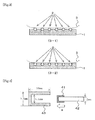
- the nonadhesive region is a region formed at least on one face of the pressure-sensitive adhesive layer where it dose not have tackiness (pressure-sensitive adhesiveness), i.e., a region on the pressure-sensitive adhesive face other than the pressure-sensitive adhesive region.
- the pressure-sensitive adhesiveness is suppressed on the pressure-sensitive adhesive face having the nonadhesive region and the pressure-sensitive adhesive layer shows both favorable tackiness in the thickness direction (thickness direction of the pressure-sensitive adhesive layer) and favorable lubricity in the horizontal direction (direction vertical to the thickness direction of pressure-sensitive adhesive layer).
- the reason for the fact of the pressure-sensitive adhesive layer having a nonadhesive region showing such properties in the present invention is that the nonadhesive region is protruding out of the pressure-sensitive adhesive layer surface, as part of the nonadhesive region is embedded in the pressure-sensitive adhesive layer, inhibiting contact of the pressure-sensitive adhesive layer surface with the contactant (object of contact, adherend) in the unpressurized state, while the nonadhesive region is embedded in the pressure-sensitive adhesive layer completely, leading to deformation of the pressure-sensitive adhesive layer and thus contact of the pressure-sensitive adhesive layer with the contactant in the pressurized state (when in contact with the contactant at sufficiently high contact pressure).
- the nonadhesive region itself may also be subjected to compressive deformation, but the compressive deformation of the nonadhesive region may also make it easier for the pressure-sensitive adhesive layer to contact therewith.
- the degree of embedment of the nonadhesive region in the unpressurized and pressurized states is not particularly limited, if the pressure-sensitive adhesive layer shows the properties above.
- Examples of the methods of forming a nonadhesive region at least on one face of the pressure-sensitive adhesive layer include lamination of a porous screen to the pressure-sensitive adhesive layer surface (adhesive face), deposition of a powdery material (powder) on the pressure-sensitive adhesive layer surface, partial non-adhesive coating on the pressure-sensitive adhesive layer surface and the like.
- a porous screen to the pressure-sensitive adhesive layer surface (adhesive face) for accurate control of the balance between the tackiness in the thickness direction and the lubricity in the horizontal direction and also from the points of productivity, equipment, and cost.
- the porous screen as the nonadhesive region is a screen to be laminated to the pressure-sensitive adhesive layer surface (adhesive face), and the pressure-sensitive adhesiveness is controlled on the pressure-sensitive adhesive face having the laminated porous screen and thus, the pressure-sensitive adhesive face shows both the tackiness in the thickness direction (thickness direction of the pressure-sensitive adhesive layer) and the lubricity in the horizontal direction (direction vertical to the thickness direction of the pressure-sensitive adhesive layer).
- the porous screen is a screen that is porous, i.e., a porous (or pore-containing) sheet-shaped product.
- the porous screens also include mesh product in the present invention.
- porous screens include, but are not limited to, nets (mesh products such as plastic nets, fiber nets, and metal fiber nets), woven fabrics, nonwoven fabrics, paper, and the like.
- nets mesh products such as plastic nets, fiber nets, and metal fiber nets
- woven fabrics nonwoven fabrics, paper, and the like.
- plastic sheets with pores, thin metal sheets with pores, woven fabrics with pores, nonwoven fabrics with pores, and paper with pores referred to as "pore-containing sheets”
- nets and pore-containing sheets are preferable, and particularly, nets are preferable.
- the shape of the pore or the mesh of the porous screen is not particularly limited, if the property above is exhibited, but, for example, triangular, quadrangular (e.g., square, rectangle, rhombus, or trapezoid), circular (e.g., perfect circle, nearly perfect circle, or ellipse), or the like. Alternatively, it may be an undefined shape similar to the shape above. All of the shapes of the pores or the networks may be the same as or different from each other.
- the thickness of the porous screen is not particularly limited, if the properties above are shown, but preferably, for example 10 to 500 ⁇ m, and more preferably 50 to 150 ⁇ m. A thickness of less than 10 ⁇ m may lead to decrease in lubricity, while a thickness of more than 500 ⁇ m may lead to fail to secure adhesiveness and lubricity at the same time.
- the raw material for the porous screen when it is a net is not particularly limited, but may be a synthetic resin (plastic) such as nylon, polyethylene, polypropylene, or polyester, a natural fiber, a metal fiber, or the like.
- a synthetic resin such as nylon, polyethylene, polypropylene, or polyester, a natural fiber, a metal fiber, or the like.
- the basis weight of the porous screen is not particularly limited, but, preferably 1.0 to 80 g/m 2 , more preferably 1.0 to 50 g/m 2 , still more preferably 2.0 to 20 g/m 2 , for improvement both in adhesiveness and lubricity on the pressure-sensitive adhesive face to which the porous screen is laminated.
- the size of the mesh is not particularly limited, but preferably 5 pieces/inch to 50 pieces/inch, and more preferably 20 pieces/inch to 40 pieces/inch, for improvement both in adhesiveness and lubricity on the pressure-sensitive adhesive face to which the porous screen is laminated.
- Examples of commercially available nets include “Net ND20” (trade name, produced by Daisen Co., Ltd.) and the like.
- the raw material for the porous screen when it is a pore-containing sheet is not particularly limited, but preferably a plastic or a nonwoven fabric, for improvement both in adhesiveness and lubricity on the pressure-sensitive adhesive face to which the porous screen is laminated.
- the size of the pores in the porous screen is not particularly limited if the properties above are exhibited, and the sizes of the pores may be the same or different from each other.
- the pore size in the largest pore region is, for example, approximately 500 ⁇ m to 10 mm.
- Distribution of the pores in the porous screen is not particularly limited if the properties above are exhibited, and the pores may be formed in clumps in a particular region or as dispersed in the entire porous screen.
- the distance between the pores of the porous screen is not particularly limited, and may or may not be constant.
- the porous screen-laminated pressure-sensitive adhesive face of the pressure-sensitive adhesive layer is superior both in tackiness and lubricity. More specifically, the pressure-sensitive adhesive layer having a porous screen shows tackiness in the thickness direction, while the pressure-sensitive adhesive layer having a porous screen shows lubricity in the horizontal direction (direction vertical to the thickness direction).
- the properties will be described with reference to Figures 1, 2 , and 3 .
- a porous screen having square network is shown as the porous screen in Figures 1, 2 and 3 , but the shape of the network is not limited to the square shape.
- Figure 1 is a schematic top view illustrating a pressure-sensitive adhesive layer having a porous screen on one pressure-sensitive adhesive face
- Figure 2 is schematic crosssectional view illustrating the pressure-sensitive adhesive layer having a porous screen on one pressure-sensitive adhesive face shown in Figure 1 , as seen along a line A-A cross section.
- a reference numeral 1 represents a pressure-sensitive adhesive layer
- 2 represents a porous screen.
- the tape shown in Figures 1 and 2 is also a base-less-type double-faced pressure-sensitive adhesive tape made only of a pressure-sensitive adhesive layer having a porous screen only on one pressure-sensitive adhesive face.
- Figure 3 includes a schematic sectional view illustrating a state of a pressure-sensitive adhesive layer having a porous screen on one pressure-sensitive adhesive face in contact with a contactant in the non-pressurized state on the face where the porous screen is formed (3-1), and a schematic sectional view illustrating a state of a pressure-sensitive adhesive layer having a porous screen on one pressure-sensitive adhesive face in contact with a contactant in the pressurized state on the face where the porous screen is formed (3-2).
- a reference numeral 1 represents a pressure-sensitive adhesive layer
- 2 represents a porous screen
- 3 represents a contactant.
- the pressure-sensitive adhesive face laminated with the porous screen shows above-mentioned properties, because part of the porous screen 2 is embedded into the pressure-sensitive adhesive layer 1 in the unpressurized state (see Figure 2 . about half of the porous screen is embedded in Figure 2 ) and thus, the porous screen 2 remains protruded on the surface of the pressure-sensitive adhesive layer 1, inhibiting contact of the contactant 3 onto the surface of pressure-sensitive adhesive layer 2 (see Figure 3 (3-1)).
- the porous screen 2 is deeply embedded into the pressure-sensitive adhesive layer 1 in the pressurized state (in which the contactant 3 is in contact under sufficiently high contact pressure), and thus, the pressure-sensitive adhesive layer 1 is deformed and the porous screen 2 is also deformed under compression. This makes part of the pressure-sensitive adhesive layer 1 protrude through the porous screen 2, and the part of the pressure-sensitive adhesive layer 1 penetrating through the porous screen 2 come in contact with the contactant 3 (see Figure 3 (3-2)).
- the degree of the embedment of the porous screen in the unpressurized state and the pressurized state is not particularly limited, if the properties are exhibited.
- the powdery material used in the nonadhesive region is a non-tacky substance to be fixed on the pressure-sensitive adhesive layer.
- the pressure-sensitive adhesive face having the powdery material has controlled pressure-sensitive adhesiveness and well-balanced tackiness in the thickness direction and lubricity in the horizontal direction.
- the powdery materials may be used alone or in combination of two or more.
- the reason for the fact of the pressure-sensitive adhesive layer having the powdery material showing such properties is that the powdery material is protruding out of the pressure-sensitive adhesive layer surface, as part of the powdery material is embedded in the pressure-sensitive adhesive layer, inhibiting contact of the pressure-sensitive adhesive layer surface with the contactant in the unpressurized state, while the powdery material is embedded in the pressure-sensitive adhesive layer completely, leading to deformation and protuberance of the pressure-sensitive adhesive layer and thus contact of the pressure-sensitive adhesive layer with the material to be adhered in the pressurized state.
- the degree of the embedment of the powdery material in the unpressurized and pressurized states is not particularly limited, if the properties are exhibited.
- the powdery materials include inorganic particles such as of silica, silicones (silicone powders), calcium carbonate, clay, titanium oxide, talc, layered silicate salt, clay mineral, metal powders, glass, glass beads, glass balloons, alumina balloons, ceramic balloons, titanium white, and carbon black; polymer particles such as of polystyrene, polymethyl methacrylate, phenol resins, benzoguanamine resins, urea resins, silicone resins, nylon, polyester, polyurethane, polyethylene, polypropylene, polyamide, and polyimide; and the like. These particles may be solid particles or hollow particles (balloons).
- inorganic particles such as of silica, silicones (silicone powders), calcium carbonate, clay, titanium oxide, talc, layered silicate salt, clay mineral, metal powders, glass, glass beads, glass balloons, alumina balloons, ceramic balloons, titanium white, and carbon black
- polymer particles such as of polystyrene, polymethyl
- the shape of the powdery material is not particularly limited, if the properties are exhibited, and may be, for example, spherical, prismatic, irregularly shaped or the like.
- the particle diameter (average particle diameter) of the fine particles is not particularly limited, if the properties are exhibited, but, for example, 1 ⁇ m to 2000 ⁇ m, preferably 5 ⁇ m to 1000 ⁇ m.
- the method of depositing the powdery material on the pressure-sensitive adhesive layer is not particularly limited, but, for example, spraying of the powdery material on the pressure-sensitive adhesive layer surface and the like.
- the non-adhesive coating used in the nonadhesive region means a coat layer (non-adhesive coating layer) partially formed on the pressure-sensitive adhesive layer.
- the pressure-sensitive adhesive face having a non-adhesive coating partially formed has controlled pressure-sensitive adhesiveness and both well-balanced tackiness in the thickness direction and lubricity in the horizontal direction.
- the non-adhesive coating on the pressure-sensitive adhesive layer can be carried out by using a known coating method.
- the shape of the non-adhesive coating is not particularly limited, if the properties are exhibited, and may be a shape in which most of the pressure-sensitive adhesive layer surface is non-adhesive coated or a shape in which only part of the pressure-sensitive adhesive layer surface is non-adhesive coated.
- the thickness of the non-adhesive coating is not particularly limited, if the properties are exhibited, and for example, preferably 10 to 500 ⁇ m, more preferably 50 to 150 ⁇ m. A thickness of less than 10 ⁇ m may lead to deterioration in lubricity, while a thickness of more than 500 ⁇ m may prohibit favorable balance of adhesiveness and lubricity.
- the resin used for the non-adhesive coating is not particularly limited, and any known resin may be used. Resins favorably used include fluorine resins such as polytetrafluoroethylene; silicone resins such as silicone rubbers; olefinic resins such as polyethylene and polypropylene; and the like.
- the resins for non-adhesive coating may be used alone or in combination of two or more.
- the area ratio of the pressure-sensitive adhesive region to nonadhesive region is preferably 5/95 to 95/5, and more preferably 10/90 to 90/10, for improvement both in adhesiveness and lubricity.
- the face having the nonadhesive region (20 mm ⁇ 20 mm) is copied as expanded (e.g., by about 16 times), and the pressure-sensitive adhesive region and the nonadhesive region are divided from the obtained copy with scissors.
- the area ratio was determined by measuring the weights of the sample fractions thus separated and by calculation with the resulting weight ratio.
- the frictional force which is defined as the stress applied when a sample of 2 cmx2 cm in size having a 30 g load is pulled on an aluminum plate ("SK-AAluminum Plate 1050P", trade name, manufactured by Sumitomo Light Metal Industires) in the horizontal direction at a speed of 300 mm/min, on at least one side of the pressure-sensitive adhesive layer, is 0.01 to 1.0 N/cm 2 , and preferably 0.01 to 0.5 N/cm 2 .
- a frictional force of more than 1.0 N/cm 2 may lead to generation of troubles caused by unfavorable in lubricity.
- the pressure-sensitive adhesiveness by forming a nonadhesive region (e.g., by laminating a porous screen) and the frictional force in a particular range, by improving the lubricity in the horizontal direction of the face having the nonadhesive region (e.g., porous screen-laminated pressure-sensitive adhesive face).
- the frictional force which is defined as the stress applied when a sample of 2 cm ⁇ 2 cm in size having a 30 g load fixed to the pressure-sensitive adhesive layer is pulled, as the nonadhesive region-having face [nonadhesive region-sided face (e.g., porous screen-sided face)] is placed on an aluminum plate, in the horizontal direction at a speed of 300 mm/min, is in the range above.
- the adhesive strength of the nonadhesive region-having face is not particularly limited, but, preferably 0.1 to 50 (N/20 mm), more preferably 0.1 to 20 (N/20 mm), and still more preferably 0.2 to 10 (N/20 mm), for improvement both in adhesiveness and lubricity.
- a double-faced pressure-sensitive adhesive tape having a pressure-sensitive adhesive layer wherein the frictional force, which is defined as the stress applied when a sample of 2 cmx2 cm in size having a 30 g load is pulled on an aluminum plate in the horizontal direction at a speed of 300 mm/min, is 0.01 to 1.0 N/cm 2 and the adhesive strength (180° peeling, against aluminum plate, tensile speed: 300 mm/minute) is 0.1 to 50 (N/20 mm), on at least one face of the pressure-sensitive adhesive layer, is superior both in lubricity and tackiness on the pressure-sensitive adhesive face.
- the frictional force which is defined as the stress applied when a sample of 2 cmx2 cm in size having a 30 g load is pulled on an aluminum plate in the horizontal direction at a speed of 300 mm/min, is 0.01 to 1.0 N/cm 2 and the adhesive strength (180° peeling, against aluminum plate, tensile speed: 300 mm/minute) is 0.1 to 50 (N/20
- the pressure-sensitive adhesive face (pressure-sensitive adhesive layer surface) of the double-faced pressure-sensitive adhesive tape for solar cell modules according to the present invention may be protected with a release liner (separator, separation film) before use.
- the pressure-sensitive adhesive faces of the double-faced pressure-sensitive adhesive tape may be protected respectively with two release liners or with a single release liner having separation faces on both faces as it is wound in the roll shape.
- the release liner that is used as a protective material for the pressure-sensitive adhesive layer is removed before the tape is bonded to the adherend.
- Such a release liner is not particularly limited, and any traditional release paper or the like may be used, and examples thereof for use include bases having a release-coating layer, low-adhesive bases of a fluorochemical polymer, low-adhesive bases of a non-polar polymer, and the like.
- Examples of the release-coating bases include plastic films, papers and others that are surface-treated with a release coating agent such as a silicone-based, long-chain alkyl-based, or fluorine-based agent or molybdenum sulfide.
- Examples of the low-adhesive bases of a fluorochemical polymer include polytetrafluoroethylene, polychloro-trifluoroethylene, polyvinyl fluoride, polyvinylidene fluoride, tetrafluoroethylene-hexafluoropropylene copolymers, chlorofluoroethylene-vinylidene fluoride copolymers and the like.
- Examples of the non-polar polymers for the low-adhesive bases of non-polar polymer include olefinic resins (such as polyethylene and polypropylene) and the like.
- the release liner can be prepared by a known and traditional method. In addition, the thickness and others of the release liner are also not particularly limited.
- the double-faced pressure-sensitive adhesive tape for solar cell modules according to the present invention may contain other layers (such as intermediate layer and undercoat layer) in the range that does not impair the advantageous effects of the invention.
- the base for the double-faced pressure-sensitive adhesive tape for solar cell modules according to the present invention when it is a base-containing type is not particularly limited, and examples thereof for use include thin-film products including paper bases such as paper; fiber bases such as woven fabric, nonwoven fabric and net (the raw material is not particularly limited and may be selected properly from manila hemp, rayon, polyester, pulp fiber and others); metal bases such as metal foil and metal plate; plastic bases such as plastic film and sheet; rubber bases such as rubber sheet; foam bases such as foam sheet; the laminated films thereof (such as laminate films of a plastic base and another base, and those of plastic films (or sheets)) and the like.
- a plastic base such as plastic film or sheet can be used preferably as the base.
- the raw materials for the plastic film and sheet include olefinic resins prepared from an ⁇ -olefin as the monomer component such as polyethylene (PE), polypropylene (PP), ethylene-propylene copolymers and ethylene-vinyl acetate copolymers (EVA); polyester resins such as polyethylene terephthalate (PET), polyethylene naphthalate (PEN), and polybutylene terephthalate (PBT); polyvinyl chloride (PVC); vinyl acetate resins; polyphenylene sulfide (PPS); amide resins such as polyamides (nylon) and wholly aromatic polyamides (aramides); polyimide resins; polyether ether ketone (PEEK) and the like.
- olefinic resins prepared from an ⁇ -olefin as the monomer component such as polyethylene (PE), polypropylene (PP), ethylene-propylene copolymers and ethylene-vinyl acetate copolymers (
- a plastic base When a plastic base is used as the base, deformation, such as elongation, thereof may be controlled for example by stretching treatment.
- the pressure-sensitive adhesive layer is formed by curing by active-energy ray irradiation, a base that does not inhibit transmission of the active-energy ray is used preferably as the base.
- the surface of the base may be oxidized by a common chemical or processed by a physical surface treatment method such as corona treatment, chromic acid treatment, ozone exposure, flame exposure, active-pressure electric shock exposure, or ionizing radiation treatment, and may also be coated, for example, with an undercoat agent and a release coating agent.
- a physical surface treatment method such as corona treatment, chromic acid treatment, ozone exposure, flame exposure, active-pressure electric shock exposure, or ionizing radiation treatment, and may also be coated, for example, with an undercoat agent and a release coating agent.
- the thickness of the base varies according to the desired strength, flexibility, and intend purpose thereof, but is generally about 1000 ⁇ m or less (e.g., 1 to 1000 ⁇ m), preferably 1 to 500 ⁇ m, and more preferably 3 to 300 ⁇ m, although it is not limited thereto.
- the base may be in any shape, single-layered or multi-layered.
- the method of producing the double-faced pressure-sensitive adhesive tape for solar cell modules according to the present invention is not particularly limited, but for example, the double-feced pressure-sensitive adhesive tape having a pressure-sensitive adhesive layer having a nonadhesive region (e.g., porous screen-laminated pressure-sensitive adhesive layer) can be prepared by obtaining a pressure-sensitive adhesive layer according to a known and traditional method and forming the nonadhesive region (for example, laminating a porous screen) on the surface of the pressure-sensitive adhesive layer.
- a nonadhesive region for example, laminating a porous screen
- the base-less type of double-faced pressure-sensitive adhesive tape made only of a pressure-sensitive adhesive layer having a nonadhesive region can be prepared, for example, by preparing a pressure-sensitive adhesive layer according to a known and traditional method, and forming the nonadhesive region (e.g., porous screen) on the surface of the pressure-sensitive adhesive layer.
- a base-containing double-faced pressure-sensitive adhesive tape having of a pressure-sensitive adhesive layer having a nonadhesive region (e.g., porous screen), a pressure-sensitive adhesive layer not having a nonadhesive region (e.g., porous screen), and a base can be prepared by forming a pressure-sensitive adhesive layer on one side of a base according to a known and traditional method, forming the nonadhesive region on the surface of the pressure-sensitive adhesive layer (e.g., laminating a porous screen to the surface of the pressure-sensitive adhesive layer), thus forming a pressure-sensitive adhesive layer having a nonadhesive region (e.g., porous screen), and additionally forming a pressure-sensitive adhesive layer not having a nonadhesive region (e.g., porous screen) on the other side of the base according to a known and traditional method.
- a pressure-sensitive adhesive layer having a nonadhesive region e.g., porous
- the double-faced pressure-sensitive adhesive tape for solar cell modules according to the present invention exhibits both preferable lubricity and tackiness on the pressure-sensitive adhesive face controlled in frictional force (e.g., surface of the pressure-sensitive adhesive layer having a nonadhesive region, for example, as laminated with a porous screen).
- the double-faced pressure-sensitive adhesive tape for solar cell modules according to the present invention can be used in certain bonding applications wherein the tape is desirably not bonded to a particular adherend in the undesired region because of lubricity but bonded to it only in the desired region because of tackiness.
- a double-faced pressure-sensitive adhesive tape made only of a pressure-sensitive adhesive layer with one pressure-sensitive adhesive face laminated with a porous screen and the other pressure-sensitive adhesive face not laminated with a porous screen, to bond the double-faced pressure-sensitive adhesive tape onto one member such that the pressure-sensitive adhesive face of the double-faced pressure-sensitive adhesive tape that is not laminated with a porous screen is in contact with the member, and then to bond the member having the bonded double-faced pressure-sensitive adhesive tape mainly onto the bottom of the dent in the other dent-containing member.
- the one member can be bonded to the dent of the other dent-containing member at high-processability.
- the double-faced pressure-sensitive adhesive tape for solar cell modules according to the present invention for example, to cover the top, bottom, and end faces close to the panel end before installation of the panel into the frame at high processability and workability during production of solar cell modules.
- the pressure-sensitive adhesive tape can be present in the compressed state after production of the solar cell module, and thus, shows better water-blocking property, if it has the bubble structure, and can prevent penetration of water into the panel. For that reason, the present invention can be used preferably in production of solar cell modules.
- the porous screen used was a plastic net ("Net ND20,” trade name, manufactured by Daisen Co., Ltd., thickness: 110 ⁇ m, knitted, basis weight: 6.6 g/m 2 , pore number: 23 pieces/inch vertically and 39 pieces/inch horizontally).
- the porous screen used was a porous nonwoven fabric ("Porous Nonwoven Fabric of Special Mesh Paper A” (manufactured by NIPPON PAPER PAPYLIA Co., Ltd.), thickness: 70 ⁇ m, hole shape: circular, hole diameter: 4 mm ⁇ , basis weight: 16 g/m 2 ).
- the porous screen used was a porous nonwoven fabric ("Porous Nonwoven Fabric of Special Mesh Paper B” (manufactured by NIPPON PAPER PAPYLIA Co., Ltd.), thickness: 60 ⁇ m, hole shape: circular, hole diameter: 3 mm ⁇ , basis weight: 16 g/m 2 ).
- a photopolymerization initiator ["Irgacure 651", trade name (manufactured by Ciba Japan)]: 0.05 wt part and a photopolymerization initiator ["Irgacure 184", trade name (manufactured by Ciba Japan)]: 0.05 wt part were blended with a monomer mixture containing 2-ethylhexyl acrylate: 90 wt parts and acrylic acid: 10 wt parts as the monomer components, and ultraviolet ray was irradiated until the viscosity of the mixture (as determined by a BH viscometer, No.5 rotor, 10 rpm, measurement temperature: 30°C) reached approximately 15 Pa ⁇ s, to give a partially polymerized composition (partial polymer, sirup).
- a photopolymerization initiator ["Irgacure 651”, trade name (manufactured by Ciba Japan)]: 0.04 wt part, 1,6-hexanediol diacrylate: 0.1 wt part, and a surfactant ["MEGAFACE F-477", trade name, manufactured by DIC Corporation]: 0.7 wt part, and carbon black: 0.02 wt part were added to the sirup: 100 wt parts.
- hollow glass balloons (“CEL-STAR Z-27", trade name, manufactured by Tokai Kogyo Co., Ltd.) were added to the sirup at a ratio of 30 capacity % with respect to the entire volume, to give an adhesive precursor.
- the entire volume of the hollow glass balloons in the adhesive precursor was approximately 23 capacity % with respect to the entire volume of the adhesive precursor.
- Nitrogen was introduced into the adhesive precursor for generation of bubbles, by using an apparatus equipped with a stator having many fine gears on a circular plate having a through hole in the center, and a rotor facing the gears-equipped stator and having fine gears on a circular plate similarly to the stator. Nitrogen was supplied until the amount of the bubbles mixed became approximately 15 capacity % with respect to the entire volume of the liquid extruded, to give a bubble-containing pressure-sensitive adhesive composition.
- the bubble-containing pressure-sensitive adhesive composition was fed into a wet-lamination roll coater through a tube (diameter: 19 mm, length: approximately 1.5 m), and the bubble-containing pressure-sensitive adhesive composition was coated between the release-coating faces of two polyethylene terephthalate bases release-coated on one face, to a thickness after drying and curing of 1.2 mm. In other words, the bubble-containing pressure-sensitive adhesive composition was held between the polyethylene terephthalate bases.
- Ultraviolet ray at an illuminance of 5 mW/cm 2 was then irradiated from both sides for 4 minutes, curing the bubble-containing pressure-sensitive adhesive composition, to give a pressure-sensitive adhesive tape having a pressure-sensitive adhesive layer (bubble-containing pressure-sensitive adhesive layer) of the bubble-containing adhesive.
- the polymer polymerization rate of the tape obtained was 98.9 wt %.
- the plastic net (of the Usage example of nonadhesive region 1) was laminated onto one pressure-sensitive adhesive face of the pressure-sensitive adhesive tape by using a four-axis laminator, while the network shape of the net was kept uniform, to give a pressure-sensitive adhesive tape having a bubble-containing pressure-sensitive adhesive layer laminated by the net on one pressure-sensitive adhesive face.
- the area ratios (occupying ratio) of the pressure-sensitive adhesive region and the net region (region other than the pressure-sensitive adhesive region) on the face having the net of the bubble-containing pressure-sensitive adhesive layer were respectively 78% for the pressure-sensitive adhesive region and 22% for the net region.
- a photopolymerization initiator ["Irgacure 651", trade name (manufactured by Ciba Japan)]: 0.05 wt part, a photopolymerization initiator ["Irgacure 184", trade name (manufactured by Ciba Japan)]: 0.05 wt part were blended with a monomer mixture containing 2-ethylhexyl acrylate: 90 wt parts and acrylic acid: 10 wt parts as the monomer components, and ultraviolet ray was irradiated until the viscosity (as determined with a BH viscometer, No.5 rotor, 10 rpm, measurement temperature: 30°C) reached approximately 15 Pa ⁇ s, to give a partially polymerized composition (partial polymer, sirup).
- a photopolymerization initiator ["Irgacure 651", trade name (manufactured by Ciba Japan)]: 0.04 wt part, 1,6-hexanediol diacrylate: 0.1 wt part, and a surfactant ["MEGAFACE F-477", trade name, manufactured by DIC Corporation]: 0.7 wt part, and carbon black: 0.02 wt part were added to the sirup: 100 wt parts.
- hollow glass balloons (“CEL-STAR Z-27", trade name, manufactured by Tokai Kogyo Co., Ltd.) were added to the sirup at a ratio of 30 capacity % with respect to the entire volume of the sirup, to give an adhesive precursor.
- the entire volume of the hollow glass balloons in the adhesive precursor was approximately 23 capacity % with respect to the entire volume of the adhesive precursor.
- Nitrogen was introduced into the adhesive precursor for generation of bubbles, by using an apparatus equipped with a stator having many fine gears on a circular plate having a through hole in the center and a rotor facing the gears-equipped stator and having fine gears on a circular plate similarly to the stator. Nitrogen was supplied until the amount of the bubbles mixed became approximately 15 capacity % with respect to the entire volume of the liquid extruded, to give a bubble-containing pressure-sensitive adhesive composition.
- the bubble-containing pressure-sensitive adhesive composition was fed into a wet-lamination roll coater through a tube (diameter: 19 mm, length: approximately 1.5 m), and the bubble-containing pressure-sensitive adhesive composition was coated between the release-coating faces of two polyethylene terephthalate bases release-coated on one face, to a thickness after drying and curing of 1.2 mm. In other words, the bubble-containing pressure-sensitive adhesive composition was held between the polyethylene terephthalate bases.
- Ultraviolet ray at an illuminance of 5 mW/cm 2 was then irradiated from both sides for 4 minutes, curing the bubble-containing pressure-sensitive adhesive composition, to give a pressure-sensitive adhesive tape having a pressure-sensitive adhesive layer (bubble-containing pressure-sensitive adhesive layer) of the bubble-containing adhesive.
- the polymer polymerization rate of the obtained tape was 98.9 wt %.
- the porous nonwoven fabric (of the Usage example of nonadhesive region 2) was laminated onto one pressure-sensitive adhesive face of the pressure-sensitive adhesive tape by using a four-axis laminator to give a pressure-sensitive adhesive tape having a bubble-containing pressure-sensitive adhesive layer laminated by the porous nonwoven fabric on one pressure-sensitive adhesive face.
- the area ratios (occupying ratio) of the pressure-sensitive adhesive region and the nonwoven fabric region (region other than the pressure-sensitive adhesive region) on the face having the porous nonwoven fabric of the bubble-containing pressure-sensitive adhesive layer were respectively 62% for the pressure-sensitive adhesive region and 38% for the nonwoven fabric region.
- a photopolymerization initiator ["Irgacure 651", trade name (manufactured by Ciba Japan)]: 0.05 wt part and a photopolymerization initiator ["Irgacure 184", trade name (manufactured by Ciba Japan)]: 0.05 wt part were blended with a monomer mixture containing 2-ethylhexyl acrylate: 90 wt parts, and acrylic acid: 10 wt parts as the monomer components, and ultraviolet ray was irradiated until the viscosity of the mixture (as determined by a BH viscometer, No.
- hollow glass balloons (“CEL-STAR Z-27", trade name, manufactured by Tokai Kogyo Co., Ltd.) were added to the sirup at a ratio of 30 capacity % with respect to the entire volume of the sirup, to give an adhesive precursor.
- the entire volume of the hollow glass balloons in the adhesive precursor was approximately 23 capacity % with respect to the entire volume of the adhesive precursor.
- Nitrogen was then introduced into the adhesive precursor for generation of bubbles, by using an apparatus equipped with a stator having many fine gears on a circular plate having a through hole in the center and a rotor facing the stator having gears and having fine gears on a circular plate similarly to the stator.
- Bubble-containing pressure-sensitive adhesive composition was fed into a wet-lamination roll coater through a tube (diameter: 19 mm, length: approximately 1.5 m), and the bubble-containing pressure-sensitive adhesive composition was coated between the release-coating faces of two polyethylene terephthalate bases release-coated on one face, to a thickness after drying and curing of 1.2 mm. In other words, the bubble-containing pressure-sensitive adhesive composition was held between the polyethylene terephthalate bases.
- Ultraviolet ray at an illuminance of 5 mW/cm 2 was then irradiated from both sides for 4 minutes, curing the bubble-containing pressure-sensitive adhesive composition, to give a pressure-sensitive adhesive tape having a pressure-sensitive adhesive layer (bubble-containing pressure-sensitive adhesive layer) of the bubble-containing adhesive.
- the polymer polymerization rate of the obtained tape was 98.9 wt %.
- the porous nonwoven fabric (of the Use example of nonadhesive region 3) was laminated onto one pressure-sensitive adhesive face of the pressure-sensitive adhesive tape by using a four-axis laminator, to give a pressure-sensitive adhesive tape having a bubble-containing pressure-sensitive adhesive layer covered by the porous nonwoven fabric on one pressure-sensitive adhesive face.
- the area ratios (occupying ratio) of the pressure-sensitive adhesive region and the nonwoven fabric region (region other than the pressure-sensitive adhesive region) on the face having a porous nonwoven fabric of the bubble-containing pressure-sensitive adhesive layer were respectively 8% for the pressure-sensitive adhesive region and 92% for the nonwoven fabric region.
- a photopolymerization initiator ["Irgacure 651", trade name (manufactured by Ciba Japan)]: 0.05 wt part and a photopolymerization initiator ["Irgacure 184", trade name (manufactured by Ciba Japan)]: 0.05 wt part were blended with a monomer mixture containing 2-ethylhexyl acrylate: 90 wt parts and acrylic acid: 10 wt parts mixed as the monomer components, and ultraviolet ray was irradiated until the viscosity of the mixture (as determined by a BH viscometer, No.5 rotor, 10 rpm, measurement temperature: 30°C) reached approximately 15 Pa ⁇ s, to give a partially polymerized composition (partial polymer, sirup).
- a photopolymerization initiator ["Irgacure 651", trade name (manufactured by Ciba Japan)]: 0.04 wt part, 1,6-hexanediol diacrylate: 0.1 wt part, and a surfactant ["MEGAFACE F-477", trade name, manufactured by DIC Corporation]: 0.7 wt part, and carbon black: 0.02 wt part were added to the sirup: 100 wt parts.
- hollow glass balloons (“CEL-STAR Z-27", trade name, manufactured by Tokai Kogyo Co., Ltd.) were added to the sirup at a ratio of 30 capacity % with respect to the entire volume of the sirup, to give an adhesive precursor.
- the entire volume of the hollow glass balloons in the adhesive precursor was approximately 23 capacity % with respect to the entire volume of the adhesive precursor.
- Nitrogen was introduced into the adhesive precursor for generation of bubbles, by using an apparatus equipped with a stator having many fine gears on a circular plate having a through hole in the center and a rotor facing the gears-equipped stator and having fine gears on a circular plate similarly to the stator. Nitrogen was supplied until the amount of the bubbles mixed reached approximately 15 capacity % with respect to the entire volume of the liquid extruded, to give a bubble-containing pressure-sensitive adhesive composition.
- the bubble-containing pressure-sensitive adhesive composition was fed into a wet-lamination roll coater through a tube (diameter: 19 mm, length: approximately 1.5 m), and the bubble-containing pressure-sensitive adhesive composition was coated between the release-coating faces of two polyethylene terephthalate bases release-coated on one face, to a thickness after drying and curing of 1.2 mm. In other words, the bubble-containing pressure-sensitive adhesive composition was held between the polyethylene terephthalate bases.
- Ultraviolet ray at an illuminance of 5 mW/cm 2 was then irradiated from both sides for 4 minutes, curing the bubble-containing pressure-sensitive adhesive composition, to give a pressure-sensitive adhesive tape having a pressure-sensitive adhesive layer (bubble-containing pressure-sensitive adhesive layer) of the bubble-containing adhesive.
- the polymer polymerization rate of the obtained tape was 98.9 wt %.
- a pressure-sensitive adhesive sheet of 20 mm in width was pressure-bonded onto an adherend by one reciprocation of a 2-kg roller under the condition of 23°C and 50% RH, and then left still for 30 minutes after bonding.
- the 1800peeving adhesive strength (N/20 mm) of the sheet from the adherend was then determined by using a tensile tester (instrument name "TG-1kN,” manufactured by Minebea) (tensile speed: 300 mm/minute).
- the adherends used were an aluminum plate ("SK-A Aluminum Plate 1050P", trade name, manufactured by SUMITOMO LIGHT METAL INDUSTRIES, LTD.), a polyethylene terephthalate (PET) film ("S10 #100", trade name, manufactured by Toray Industries Inc.), and a glass plate ("Micro-Slide Glass, No. 5", trade name, manufactured by Matsunami Glass Ind., Ltd. thickness: 3 mm).
- a pressure-sensitive adhesive tape sample cut to a size of 2 cm ⁇ 2 cm was placed on an adherend with its porous screen face (mesh face) in contact with the adherend.
- the adherend used was an aluminum plate ("SK-A Aluminum Plate 1050P", trade name, manufactured by SUMITOMO LIGHT METAL INDUSTRIES, LTD.). Then, a 30 g weight was placed on the still-standing adhesive tape sample for application of a load of 30 g to the tape sample.
- the pressure-sensitive adhesive tape sample was pulled in the horizontal direction at a speed of 300 mm/min, and the stress applied then was determined (N/cm 2 ).
- a pressure-sensitive adhesive tape sample (100 ⁇ 30 mm) was pressure-bonded onto an acrylic plate (100 mm ⁇ 100 mm, thickness: 2 mm), while the end of the plate was covered with the tape sample.
- the porous screen face (mesh face) was made externally oriented (exposed) then.
- a sample for evaluation was prepared in this way. The test sample was then inserted into a C-shaped aluminum frame (aluminum frame 43 in Figure 4 ) in the direction a as shown in Figure 4 , and the lubricity then was evaluated according to the following evaluation criteria,
- Figure 4 is a schematic sectional view showing the method of evaluating the processability.
- a reference numeral 41 represents a double-faced pressure-sensitive adhesive tape sample
- 42 represents an acrylic plate
- 43 represents an aluminum frame
- a represents the direction of insertion.
- the processability of the samples in Examples and Comparative Example were evaluated by the method shown in Figure 4 .
- the present invention can be used as a double-faced pressure-sensitive adhesive tape for solar cell modules.
Landscapes
- Chemical & Material Sciences (AREA)
- Organic Chemistry (AREA)
- Chemical Kinetics & Catalysis (AREA)
- Adhesive Tapes (AREA)
- Adhesives Or Adhesive Processes (AREA)
- Laminated Bodies (AREA)
Applications Claiming Priority (3)
| Application Number | Priority Date | Filing Date | Title |
|---|---|---|---|
| JP2008310162 | 2008-12-04 | ||
| JP2008310158A JP5324199B2 (ja) | 2008-12-04 | 2008-12-04 | 両面粘着テープ |
| PCT/JP2009/005867 WO2010064358A1 (fr) | 2008-12-04 | 2009-11-05 | Ruban adhésif double face sensible à la pression pour module de cellule solaire |
Publications (1)
| Publication Number | Publication Date |
|---|---|
| EP2371916A1 true EP2371916A1 (fr) | 2011-10-05 |
Family
ID=41594210
Family Applications (2)
| Application Number | Title | Priority Date | Filing Date |
|---|---|---|---|
| EP09830129A Withdrawn EP2371916A1 (fr) | 2008-12-04 | 2009-11-05 | Ruban adhésif double face sensible à la pression pour module de cellule solaire |
| EP09177560A Withdrawn EP2194106A1 (fr) | 2008-12-04 | 2009-12-01 | Bande adhésive sensible à la pression recto verso |
Family Applications After (1)
| Application Number | Title | Priority Date | Filing Date |
|---|---|---|---|
| EP09177560A Withdrawn EP2194106A1 (fr) | 2008-12-04 | 2009-12-01 | Bande adhésive sensible à la pression recto verso |
Country Status (4)
| Country | Link |
|---|---|
| US (2) | US20110223394A1 (fr) |
| EP (2) | EP2371916A1 (fr) |
| CN (2) | CN102224211A (fr) |
| WO (1) | WO2010064358A1 (fr) |
Families Citing this family (31)
| Publication number | Priority date | Publication date | Assignee | Title |
|---|---|---|---|---|
| JP5568290B2 (ja) * | 2009-11-30 | 2014-08-06 | 日東電工株式会社 | 粘着テープ |
| US8722166B2 (en) * | 2010-04-19 | 2014-05-13 | Protecto Wrap Company | Emergency extrication tape |
| US9287419B2 (en) | 2011-01-05 | 2016-03-15 | Nitto Denko Corporation | Wavelength conversion perylene diester chromophores and luminescent films |
| CN103403118B (zh) * | 2011-06-16 | 2015-02-11 | 精练股份有限公司 | 导电带及其制造方法 |
| WO2013049062A2 (fr) | 2011-09-26 | 2013-04-04 | Nitto Denko Corporation | Chromophores hautement fluorescents et photo-stables permettant une plus grande efficacité de récupération de l'énergie solaire |
| WO2013052381A2 (fr) | 2011-10-05 | 2013-04-11 | Nitto Denko Corporation | Film de conversion de longueur d'onde ayant une couche adhésive sensible à la pression pour améliorer le rendement de collecte solaire |
| JP6022761B2 (ja) * | 2011-12-02 | 2016-11-09 | スリーエム イノベイティブ プロパティズ カンパニー | 両面接着材の製造方法 |
| WO2013085607A1 (fr) | 2011-12-06 | 2013-06-13 | Nitto Denko Corporation | Matériau de conversion de longueur d'onde destiné à encapsuler des systèmes de module solaire pour améliorer l'efficacité de récupération de l'énergie solaire |
| JP5856463B2 (ja) * | 2011-12-09 | 2016-02-09 | 日東電工株式会社 | 携帯電子機器部材固定用両面粘着シート |
| US20150041042A1 (en) * | 2012-02-01 | 2015-02-12 | Nitto Denko Corporation | Pressure sensitive adhesive type of wavelength conversion tape for enhancing solar harvesting efficiency |
| JP2013227379A (ja) * | 2012-04-24 | 2013-11-07 | Nitto Denko Corp | 熱伝導性粘着シート、その製造方法、熱伝導性粘着シートの貼り付け方法、および、貼着構造物 |
| TWI451582B (zh) * | 2012-04-25 | 2014-09-01 | Au Optronics Corp | 膠帶結構及其太陽能模組 |
| CN102703001B (zh) * | 2012-06-12 | 2014-03-12 | 安徽省郎溪县阿拉法胶粘制品有限公司 | 一种丙烯酸异辛酯胶黏剂及其制备方法 |
| CN102702991B (zh) * | 2012-06-12 | 2014-04-16 | 安徽省郎溪县阿拉法胶粘制品有限公司 | 一种亚克力双面胶带及其制备方法 |
| JP6140491B2 (ja) * | 2012-08-07 | 2017-05-31 | 日東電工株式会社 | 両面粘着シート及び携帯電子機器 |
| JP2014051566A (ja) * | 2012-09-06 | 2014-03-20 | Nitto Denko Corp | 両面粘着シート |
| JP6013092B2 (ja) * | 2012-09-06 | 2016-10-25 | 日東電工株式会社 | 両面粘着シート |
| JP5972844B2 (ja) * | 2012-09-18 | 2016-08-17 | デクセリアルズ株式会社 | 異方性導電フィルム、異方性導電フィルムの製造方法、接続体の製造方法、及び接続方法 |
| JP6151412B2 (ja) * | 2012-09-18 | 2017-06-21 | デクセリアルズ株式会社 | 異方性導電フィルム、異方性導電フィルムの製造方法、接続体の製造方法、及び接続方法 |
| CN105339451B (zh) * | 2013-03-22 | 2018-07-03 | 3M创新有限公司 | 包括导电带的太阳能电池和模块以及制造和使用该太阳能电池和模块的方法 |
| JP6124166B2 (ja) * | 2013-03-28 | 2017-05-10 | パナソニックIpマネジメント株式会社 | 太陽電池モジュールおよび太陽電池モジュールの製造方法 |
| KR20140132885A (ko) * | 2013-05-08 | 2014-11-19 | 엘지전자 주식회사 | 태양 전지 모듈 및 이에 사용되는 에지 테이프 |
| US9539797B2 (en) * | 2013-11-14 | 2017-01-10 | Rayven, Inc. | Traverse wound double-sided pressure sensitive adhesive tape |
| US9494342B2 (en) | 2014-09-09 | 2016-11-15 | Johns Manville | Methods and devices for coupling solar panel support structures and/or securing solar panel support structures to a roof |
| EP3581630B1 (fr) | 2015-04-02 | 2021-07-14 | tesa SE | Bande adhésive pouvant être fixée de manière démontable |
| DE102015009004A1 (de) | 2015-06-05 | 2016-12-08 | Solaero Technologies Corp. | Automatisierte Anordnung und Befestigung von Solarzellen auf Paneelen für Weltraumanwendungen |
| US10276742B2 (en) | 2015-07-09 | 2019-04-30 | Solaero Technologies Corp. | Assembly and mounting of solar cells on space vehicles or satellites |
| KR102430049B1 (ko) * | 2016-12-12 | 2022-08-05 | 디아이씨 가부시끼가이샤 | 도전성 점착 테이프 |
| FI3584091T3 (fi) * | 2017-02-16 | 2024-03-21 | Dainippon Printing Co Ltd | Informaatiosivu |
| JP7378967B2 (ja) * | 2019-06-07 | 2023-11-14 | 日東電工株式会社 | 通気部品 |
| JP7493347B2 (ja) * | 2020-02-12 | 2024-05-31 | スリーエム イノベイティブ プロパティズ カンパニー | 熱膨張性、且つ熱硬化性の接着シート |
Family Cites Families (26)
| Publication number | Priority date | Publication date | Assignee | Title |
|---|---|---|---|---|
| USRE29389E (en) * | 1973-03-28 | 1977-09-06 | Method of preparing aluminum organoiodides | |
| US4223067A (en) * | 1978-03-27 | 1980-09-16 | Minnesota Mining And Manufacturing Company | Foam-like pressure-sensitive adhesive tape |
| US4376151A (en) * | 1981-06-29 | 1983-03-08 | Moore Business Forms, Inc. | Pressure threshold adhesive |
| CA2099432C (fr) * | 1993-02-03 | 2004-09-21 | George Rusincovitch | Revetement mural autocollant a adhesif antiblocage |
| JPH07310057A (ja) * | 1994-05-18 | 1995-11-28 | Nitto Denko Corp | 接着シート |
| JPH1017827A (ja) * | 1996-07-04 | 1998-01-20 | Sekisui Chem Co Ltd | 加圧接着型両面粘着シート |
| JPH1097710A (ja) * | 1996-08-02 | 1998-04-14 | Nitto Denko Corp | 粘着式クリーニングシート、クリーニング部を有する画像形成材料、及び画像形成装置のクリーニング方法 |
| US6194064B1 (en) * | 1997-12-03 | 2001-02-27 | Dyna-Tech Adhesive, Inc. | Pressure sensitive adhesive for decorative films with removable and repositionable properties |
| US5964252A (en) * | 1997-12-18 | 1999-10-12 | Morgan Adhesives Company | Adhesive closure system with an abridged release liner |
| EP0950421B1 (fr) * | 1998-04-14 | 2006-10-18 | Tranquil Prospects Ltd. | Matériau implantable et son procédé de préparation |
| JP2000226909A (ja) * | 1999-02-08 | 2000-08-15 | Sekisui Chem Co Ltd | 太陽電池付き屋根瓦 |
| JP2001081915A (ja) * | 1999-09-10 | 2001-03-27 | Kanegafuchi Chem Ind Co Ltd | 建材一体型太陽電池モジュール |
| JP2001279200A (ja) * | 2000-03-29 | 2001-10-10 | Sekisui Chem Co Ltd | 両面粘着テープ及びその製造方法 |
| DE10127325A1 (de) * | 2001-06-06 | 2003-02-06 | Tesa Ag | Selbstklebender Schutzartikel für mechanisch stark beanspruchte lackierte Autobilteile |
| JP2003110128A (ja) | 2001-09-28 | 2003-04-11 | Sharp Corp | 薄膜太陽電池モジュール及びその製造方法 |
| JP2003137611A (ja) | 2001-11-01 | 2003-05-14 | Nitto Denko Corp | ガラスフレームのシール構造およびシール方法 |
| US7063887B2 (en) * | 2002-02-04 | 2006-06-20 | 3M Innovative Properties Company | Stretch releasable foams, articles including same and methods for the manufacture thereof |
| JP4726421B2 (ja) * | 2003-04-30 | 2011-07-20 | 日東電工株式会社 | 繊維凸状構造転写形成用シート |
| US20050081993A1 (en) * | 2003-10-16 | 2005-04-21 | Ilkka Steven J. | Method of bonding glass |
| US8535473B2 (en) * | 2005-03-03 | 2013-09-17 | 3M Innovative Properties Company | Thermosettable adhesive tape, articles and methods |
| JP4699075B2 (ja) * | 2005-04-20 | 2011-06-08 | 日東電工株式会社 | 防水気密用両面粘着テープ |
| WO2006138719A2 (fr) * | 2005-06-17 | 2006-12-28 | Georgia Tech Research Corporation | Microstructures revetues et procede de fabrication de celles-ci |
| JP5063008B2 (ja) * | 2006-02-16 | 2012-10-31 | 日東電工株式会社 | 両面粘着テープ又はシート |
| JP5089894B2 (ja) * | 2006-03-10 | 2012-12-05 | 日東電工株式会社 | 微粒子含有粘弾性層、及び感圧性接着テープ又はシート |
| JP4845614B2 (ja) * | 2006-07-06 | 2011-12-28 | 日東電工株式会社 | 剥離ライナー、粘着テープ及び粘着テープ巻回体 |
| JP5558660B2 (ja) * | 2007-05-11 | 2014-07-23 | 日東電工株式会社 | 両面接着性感圧接着シート |
-
2009
- 2009-11-05 CN CN2009801473264A patent/CN102224211A/zh active Pending
- 2009-11-05 WO PCT/JP2009/005867 patent/WO2010064358A1/fr not_active Ceased
- 2009-11-05 US US12/998,736 patent/US20110223394A1/en not_active Abandoned
- 2009-11-05 EP EP09830129A patent/EP2371916A1/fr not_active Withdrawn
- 2009-12-01 US US12/591,760 patent/US20100143711A1/en not_active Abandoned
- 2009-12-01 EP EP09177560A patent/EP2194106A1/fr not_active Withdrawn
- 2009-12-04 CN CN200910253132A patent/CN101747848A/zh active Pending
Non-Patent Citations (1)
| Title |
|---|
| See references of WO2010064358A1 * |
Also Published As
| Publication number | Publication date |
|---|---|
| US20110223394A1 (en) | 2011-09-15 |
| US20100143711A1 (en) | 2010-06-10 |
| CN101747848A (zh) | 2010-06-23 |
| EP2194106A1 (fr) | 2010-06-09 |
| WO2010064358A1 (fr) | 2010-06-10 |
| CN102224211A (zh) | 2011-10-19 |
Similar Documents
| Publication | Publication Date | Title |
|---|---|---|
| US20110223394A1 (en) | Double-faced pressure-sensitive adhesive tape for solar cell modules | |
| EP2862901B1 (fr) | Couche viscoélastique renfermant des microparticules et ruban ou feuille d'adhésif sensible à la pression | |
| EP2345708B1 (fr) | Bande adhésive sensible à la pression | |
| EP2298844A1 (fr) | Ruban ou film revêtu d'un adhésif acrylique sensible à la pression | |
| EP2039506A1 (fr) | Doulblures antiadhesives, ruban adhesif sensible a la pression et rouleau de ruban adhesif sensible a la pression | |
| EP1964900B1 (fr) | Couche antiadhésive et feuille adhésive sensible à la pression l'utilisant | |
| US8501306B2 (en) | Viscoelastic articles with polymer layer containing elastomer unevenly distributed | |
| US20110076481A1 (en) | Acrylic pressure-sensitive adhesive tape or sheet | |
| EP2284909A1 (fr) | Feuille adhésive pour panneau de cellule solaire, panneau de cellule solaire utilisant la feuille adhésive, et procédé de fabrication d'un panneau de cellule solaire utilisant la feuille adhésive | |
| EP2123728B1 (fr) | Ruban ou feuille d'adhésif acrylique sensible à la pression et son procédé de fabrication | |
| EP2479229A1 (fr) | Bande adhésive acrylique | |
| WO2009116504A1 (fr) | Adhésif acrylique, couche d'adhésif acrylique et ruban ou feuille d'adhésif acrylique | |
| EP2653516A1 (fr) | Feuille adhésive sensible à la pression et composition adhésive sensible à la pression | |
| US20110045234A1 (en) | Method and configuration for reinforcing plate material | |
| EP2374854B1 (fr) | Bande adhésive sensible à la pression | |
| EP2743319B1 (fr) | Composition adhésive sensible à la pression et feuille adhésive sensible à la pression | |
| JP2010155973A (ja) | 太陽電池モジュール用両面粘着テープ | |
| JP6317938B2 (ja) | 粘着シート | |
| JP5324199B2 (ja) | 両面粘着テープ | |
| EP2703463A1 (fr) | Composition adhésive sensible à la pression et feuille adhésive sensible à la pression | |
| EP3467067A1 (fr) | Feuille adhésive sensible à la pression |
Legal Events
| Date | Code | Title | Description |
|---|---|---|---|
| PUAI | Public reference made under article 153(3) epc to a published international application that has entered the european phase |
Free format text: ORIGINAL CODE: 0009012 |
|
| 17P | Request for examination filed |
Effective date: 20110630 |
|
| AK | Designated contracting states |
Kind code of ref document: A1 Designated state(s): AT BE BG CH CY CZ DE DK EE ES FI FR GB GR HR HU IE IS IT LI LT LU LV MC MK MT NL NO PL PT RO SE SI SK SM TR |
|
| DAX | Request for extension of the european patent (deleted) | ||
| STAA | Information on the status of an ep patent application or granted ep patent |
Free format text: STATUS: THE APPLICATION IS DEEMED TO BE WITHDRAWN |
|
| 18D | Application deemed to be withdrawn |
Effective date: 20140603 |