EP2372913A1 - Eltektronischer Systemschutz - Google Patents
Eltektronischer Systemschutz Download PDFInfo
- Publication number
- EP2372913A1 EP2372913A1 EP11160523A EP11160523A EP2372913A1 EP 2372913 A1 EP2372913 A1 EP 2372913A1 EP 11160523 A EP11160523 A EP 11160523A EP 11160523 A EP11160523 A EP 11160523A EP 2372913 A1 EP2372913 A1 EP 2372913A1
- Authority
- EP
- European Patent Office
- Prior art keywords
- equipment
- electronic switch
- voltage
- transistor
- ground
- Prior art date
- Legal status (The legal status is an assumption and is not a legal conclusion. Google has not performed a legal analysis and makes no representation as to the accuracy of the status listed.)
- Withdrawn
Links
- 238000012360 testing method Methods 0.000 claims description 12
- 230000005669 field effect Effects 0.000 claims description 9
- 238000001514 detection method Methods 0.000 claims description 2
- 239000003990 capacitor Substances 0.000 description 4
- 238000010586 diagram Methods 0.000 description 3
- 238000005259 measurement Methods 0.000 description 3
- 230000000903 blocking effect Effects 0.000 description 2
- 238000012423 maintenance Methods 0.000 description 2
- 230000006378 damage Effects 0.000 description 1
Images

Classifications
-
- H—ELECTRICITY
- H03—ELECTRONIC CIRCUITRY
- H03K—PULSE TECHNIQUE
- H03K17/00—Electronic switching or gating, i.e. not by contact-making and –breaking
- H03K17/08—Modifications for protecting switching circuit against overcurrent or overvoltage
- H03K17/081—Modifications for protecting switching circuit against overcurrent or overvoltage without feedback from the output circuit to the control circuit
- H03K17/0812—Modifications for protecting switching circuit against overcurrent or overvoltage without feedback from the output circuit to the control circuit by measures taken in the control circuit
- H03K17/08122—Modifications for protecting switching circuit against overcurrent or overvoltage without feedback from the output circuit to the control circuit by measures taken in the control circuit in field-effect transistor switches
Definitions
- the invention relates to the protection of an electronic equipment against any overvoltages applied to its terminals and more specifically to an output terminal of the equipment.
- Output terminal means a terminal on which information is delivered to the outside of the equipment.
- the invention finds particular utility in electronic equipment, such as equipment on board aircraft, likely to be subjected to lightning or supply voltages that can be applied untimely to the output terminal .
- current supply networks deliver 28V or 115V DC voltages at a frequency of 400 Hz.
- the application of such voltages directly to an output terminal tends to destroy the components of the equipment associated with this terminal. This application may be due to a failure of other equipment for dialogue with the equipment through the output terminal.
- the protection of the output terminal is provided by means of a diode, called lightning arrester diode, connected between the output terminal and an electrical ground of the equipment as well as a fuse connected in series between the output terminal and the equipment components associated with this terminal.
- This protection is effective and avoids the destruction of components. Nevertheless, in case of overvoltage, the fuse and the diode are generally destroyed and requires intervention on the equipment.
- the test of a lightning diode can not be done without applying a voltage wave calibrated on the diode. This application is delicate and can not be performed without removing the equipment during a maintenance operation. In the field of equipment onboard aircraft, maintenance operations are planned with an occurrence of several thousand hours.
- the invention aims to overcome all or part of the problems mentioned above by proposing a new way of protecting an output terminal of an electronic equipment by avoiding the use of a fuse and a lightning arrester diode associated with the terminal of exit.
- the subject of the invention is an electronic equipment comprising an output terminal, an electronic switch connected between the output terminal and a ground of the equipment and means of protection of the electronic switch against possible overvoltages. applied to the output terminal, characterized in that the protection means comprise means for detecting a current greater than a given threshold flowing in the electronic switch and means for prohibiting the closure of the electronic switch when the current circulating in the electronic switch is greater than the given threshold.
- the protection means comprise means for authorizing the closing of the electronic switch after a given duration following a prohibition. This duration is fixed and starts at the beginning of the ban.
- the invention allows frequent testing of the protection means of the electronic switch without the need to remove the equipment for example by simulating a current greater than the given threshold.
- This test operation can for example be performed each time the equipment is powered up or even on simple request of an operator, for example in case of doubt that overvoltage has occurred.
- Another advantage of the invention is to avoid the use of a fuse. Therefore, no intervention to change the fuse is necessary after the occurrence of an overvoltage.
- the figure 1 represents components associated with an output terminal 10 of an electronic equipment 11.
- the output terminal 10 may be connected to a ground 12 of the equipment 11 is isolated.
- the ground connection 12 is effected by means of an electronic switch M1 formed, for example, by a negative-channel field effect transistor.
- the drain, denoted D, of the transistor M1 is connected to the terminal 10 by means of a diode D1 making it possible to allow the flow of current only from the terminal 10 to the ground 12.
- the source, denoted S, of the transistor M1 is connected to ground 12 via a resistor R8 for measuring the current flowing in the electronic switch M1 between its drain D and its source S.
- the electronic switch M1 and controlled by its gate, denoted by G. More precisely, when the voltage between gate G and source S of transistor M1 has a low value, the electronic switch is open. In other words, transistor M1 is off. When the voltage between gate G and source S of transistor M1 has a high value, the electronic switch is closed. In other words, the transistor M1 is passing.
- the gate G of the transistor M1 is controlled by a second electronic switch, for example formed by a negative-channel field effect transistor M2, which makes it possible to connect or not to connect the gate G of transistor M1 to ground 12.
- a second electronic switch for example formed by a negative-channel field effect transistor M2
- the gate voltage G of transistor M1 is at a high voltage value which is for example fixed by a voltage divider formed by two resistors R1 and R2.
- the resistor R1 is connected between a positive supply voltage 13 of the equipment 11 and the gate G of the transistor M1.
- the resistor R2 is connected between the gate G of the transistor M1 and the ground 12. For this high value of the gate voltage G, the transistor M1 is conducting.
- the gate voltage G of the transistor M1 is low. This voltage is close to that of the ground 12. For this low gate voltage value G, the transistor M1 is off.
- the transistor M2 is for example driven by its gate via a resistor R3 by means of a programmable logic circuit not represented on the figure 1 .
- the resistor R8 makes it possible to measure the current flowing in the switch M1 between its drain D and its source S.
- the common point of the transistor M1 and the resistor R8, that is to say the source S of the transistor M1 makes it possible to drive protection means 14 of the switch M1.
- the protection means 14 comprise a third switch M3 making it possible to connect the gate G of the transistor M1 to the ground 12 in the event of an overvoltage occurring at the output terminal 10. More precisely, an overvoltage present on the output terminal 10 when the switch M1 is closed raises the voltage across the resistor R8. The comparison of this voltage with a predefined threshold makes it possible to control the switch M3.
- the switch M3 remains open and the transistor M1 is controlled by the transistor M2.
- the switch M3 closes and forces the blocking of the transistor M1.
- the measurement of current flowing in the resistor R8 only occurs when the transistor M1 leads.
- the transistor M2 blocks the transistor M1
- the current measurement flowing in the resistor R8 is not performed. This lack of measurement has no consequence because, once blocked, the transistor M1 is not sensitive to a possible overvoltage.
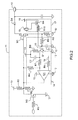
- the figure 2 represents a more complete diagram embodying the invention.
- the transistors M1 and M2 are found, the diode D1, the divider bridge formed by the resistors R1 and R2 and the resistors R3 and R8.
- An exemplary embodiment of the protection means 14 is shown in more detail on the figure 2 .
- the protection means 14 comprise a low-pass filter making it possible to filter the detection of the current flowing in the electronic switch M1 in order to prevent overvoltages of too short duration from preventing the closing of the electronic switch M1.
- the low-pass filter comprises for example a resistor R9 and a capacitor C1 connected in series between the source S of the transistor M1 and the ground 12.
- a common point 15 of the resistor R9 and the capacitor C1 forms the output of the low-pass filter.
- the voltage at point 15 is inverted and amplified by means of a bipolar transistor Q1 whose base is connected to point 15, the emitter to ground 12 and the collector to positive supply voltage 13 via a resistor R6 and a capacitor C2 connected in parallel.
- the collector of the transistor Q1 is connected to a positive input of a comparator U1 via a resistor R7.
- the positive input of comparator U1 is also connected to the gate of transistor M1 via a resistor R4.
- a negative input of the comparator U1 is connected to a reference voltage 16 via a resistor R5.
- the reference voltage 16 forms a threshold for defining the maximum current flowing in the resistor R8 beyond which it is necessary to force the blocking of the transistor M1 to ensure its protection.
- the output of the comparator U1 is connected to the gate G of the transistor M1.
- the output of the comparator M1 is either open or connected to ground according to the potential difference between its positive and negative inputs. This type of comparator is known in the Anglo-Saxon literature as "open / ground”.
- the comparator U1 forms the switch M3 represented on the figure 1 .
- the comparator U1 compares an image of the voltage across the resistor R8 to the reference voltage 16.
- the image of the voltage across the resistor R8 is the voltage present at the collector of the transistor Q1.
- the output of the comparator U1 is either open or connected to ground according to the result of the comparison between the image of the voltage across the resistor R8 and the reference voltage 16.
- the transistor M1 can be normally driven by the transistor M2.
- the protection means advantageously comprise means for authorizing the closing of the electronic switch M1, that is to say, to interrupt the forcing, after a given duration following a prohibition.
- This given duration begins at the moment when the prohibition begins.
- the duration given is fixed. It is defined by means of passive components and more precisely by means of the value of the capacitor C2 in connection with the values of the resistors R4, R6 and R7 which make it possible to delay the return to the normal state of the equipment. that is, without forcing gate G of transistor M1.
- the equipment 11 comprises test means 17 of the protection means 14.
- the test means 17 make it possible to force the image of the voltage across the resistor R8 to a value obtained in the event of an overvoltage applied to the terminal output 10.
- the test means 17 make it possible to bring the basic potential of the bipolar transistor Q1 to a voltage sufficient to turn it on independently of the current flowing in the resistor R8 and therefore without using an overvoltage on the terminal 10.
- the test means 17 include for example a positive channel field effect transistor M4 whose drain is connected to point 15 via a resistor R10, the source of which is connected to a voltage source 18 which can be used for applications logic of the electronic equipment 11, such as a voltage source of 3.3V.
- the gate of transistor M4 is connected to a terminal 19 of a logic circuit that can deliver either a voltage of 3.3V or a voltage of 0V. More generally, the transistor M4 forms an electronic switch for forcing the conduction of the bipolar transistor Q1.
- a logic voltage of 3.3V is applied to the gate of the transistor M4 and opens it.
- the voltage of the point 15 is then only formed through the resistor R9 and only an overvoltage applied to the terminal 10 can turn on the transistor Q1.
Landscapes
- Emergency Protection Circuit Devices (AREA)
Applications Claiming Priority (1)
| Application Number | Priority Date | Filing Date | Title |
|---|---|---|---|
| FR1001393A FR2958469B1 (fr) | 2010-04-02 | 2010-04-02 | Protection d'un equipement electronique. |
Publications (1)
| Publication Number | Publication Date |
|---|---|
| EP2372913A1 true EP2372913A1 (de) | 2011-10-05 |
Family
ID=43385559
Family Applications (1)
| Application Number | Title | Priority Date | Filing Date |
|---|---|---|---|
| EP11160523A Withdrawn EP2372913A1 (de) | 2010-04-02 | 2011-03-30 | Eltektronischer Systemschutz |
Country Status (3)
| Country | Link |
|---|---|
| US (1) | US20120075760A1 (de) |
| EP (1) | EP2372913A1 (de) |
| FR (1) | FR2958469B1 (de) |
Families Citing this family (2)
| Publication number | Priority date | Publication date | Assignee | Title |
|---|---|---|---|---|
| KR101813262B1 (ko) * | 2011-05-17 | 2018-01-02 | 삼성전자주식회사 | 히스테리시스를 사용하여 과전압, 과전류 및 과온도로부터 무선-커플된 전력 장치들을 보호하는 장치 및 방법 |
| CN114566950B (zh) * | 2022-04-28 | 2022-08-19 | 武汉中岩科技股份有限公司 | 一种锂电池输出短路保护电路及具有其的电池管理系统 |
Citations (5)
| Publication number | Priority date | Publication date | Assignee | Title |
|---|---|---|---|---|
| EP0561386A1 (de) * | 1992-03-18 | 1993-09-22 | Fuji Electric Co., Ltd. | Halbleiteranordnung |
| DE10035388A1 (de) * | 2000-07-20 | 2002-02-07 | Infineon Technologies Ag | Stromschaltanordnung |
| US20050078024A1 (en) * | 2003-10-09 | 2005-04-14 | Honeywell International Inc. | Digital current limiter |
| EP1804383A2 (de) * | 2005-12-28 | 2007-07-04 | Denso Corporation | Überstromschutzvorrichtung für Halbleiterbauelemente |
| EP2003777A1 (de) * | 2007-06-06 | 2008-12-17 | Nissan Motor Co., Ltd. | Antriebsschaltung eines spannungsbetriebenen Elements |
Family Cites Families (3)
| Publication number | Priority date | Publication date | Assignee | Title |
|---|---|---|---|---|
| US4771357A (en) * | 1986-07-23 | 1988-09-13 | Motorola, Inc. | Power driver having short circuit protection |
| US5500619A (en) * | 1992-03-18 | 1996-03-19 | Fuji Electric Co., Ltd. | Semiconductor device |
| DE19645783A1 (de) * | 1996-11-07 | 1998-05-20 | Braun Ag | Stromversorgungsschaltung |
-
2010
- 2010-04-02 FR FR1001393A patent/FR2958469B1/fr active Active
-
2011
- 2011-03-30 EP EP11160523A patent/EP2372913A1/de not_active Withdrawn
- 2011-04-01 US US13/078,045 patent/US20120075760A1/en not_active Abandoned
Patent Citations (5)
| Publication number | Priority date | Publication date | Assignee | Title |
|---|---|---|---|---|
| EP0561386A1 (de) * | 1992-03-18 | 1993-09-22 | Fuji Electric Co., Ltd. | Halbleiteranordnung |
| DE10035388A1 (de) * | 2000-07-20 | 2002-02-07 | Infineon Technologies Ag | Stromschaltanordnung |
| US20050078024A1 (en) * | 2003-10-09 | 2005-04-14 | Honeywell International Inc. | Digital current limiter |
| EP1804383A2 (de) * | 2005-12-28 | 2007-07-04 | Denso Corporation | Überstromschutzvorrichtung für Halbleiterbauelemente |
| EP2003777A1 (de) * | 2007-06-06 | 2008-12-17 | Nissan Motor Co., Ltd. | Antriebsschaltung eines spannungsbetriebenen Elements |
Also Published As
| Publication number | Publication date |
|---|---|
| US20120075760A1 (en) | 2012-03-29 |
| FR2958469B1 (fr) | 2015-01-02 |
| FR2958469A1 (fr) | 2011-10-07 |
Similar Documents
| Publication | Publication Date | Title |
|---|---|---|
| FR3019303B1 (fr) | Dispositif de mesure d'au moins une grandeur physique d'une installation electrique | |
| FR3021823A1 (fr) | Transistor a effet de champ et dispositif de detection de defaillance associe | |
| EP2187227B1 (de) | Eigensicheres System und Testmodul, insbesondere zur Verwendung in einem Eisenbahn-Signalsystem | |
| EP2694321A1 (de) | System zum aufladen eines elektro-oder hybridfahrzeugs | |
| CA2315896C (fr) | Circuit electronique de surveillance de tension electrique | |
| EP3614514A1 (de) | Elektrische oder elektronische vorrichtung mit zwei eingangsspannungen | |
| EP2849301A1 (de) | Sicherheitsvorrichtung und -verfahren für Elektrische Installationseinrichtung | |
| FR2958469A1 (fr) | Protection d'un equipement electronique. | |
| EP4184579B1 (de) | Schutz einer domäne einer integrierten schaltung gegen überspannungen | |
| FR3067514B1 (fr) | Liaison electrique comprenant un dispositif de protection electrique - test d'integrite | |
| EP1870976A2 (de) | Vorrichtung zum Schutz gegen Überspannungen mit verbesserter Fähigkeit zur Notabsperrung durch Abschalten und entsprechendes Verfahren | |
| EP4478070B1 (de) | Kurzschlussdetektionsvorrichtung | |
| FR2978879A1 (fr) | Procede de diagnostic d'un court-circuit dans un ensemble electrique d'un vehicule automobile comprenant une composante capacitive et dispositif de diagnostic | |
| FR3085153A1 (fr) | Procede de protection d'une charge associee a une voie de disjonction d'une carte electronique de disjoncteurs statiques | |
| EP3771055B1 (de) | Güberstrom-erkennungsvorrichtung in einem elektrischen leistungsschaltkreis umfassend einen filter zur steuerung der ladung eines kondensators | |
| EP3664294B1 (de) | Schutzvorrichtung eines versorgungssystems und messvorrichtung eines stroms in einem elektrischen schaltkreis, der eine solche schutzvorrichtung verwendet | |
| EP4184181B1 (de) | System zur bestimmung der anwesenheit von spannung für ein hochspannungsnetz | |
| EP1764892A1 (de) | Vorrichtung zur Überwachung eines Fehlerstromes am Ausgang einer Energiequelle eines Kraftfahrzeuges | |
| WO2014013206A1 (fr) | Calculateur de regulation de moteur et procede de detection de pannes d'un tel calculateur | |
| EP1936769B1 (de) | Hilfsvorrichtung und Verfahren zur Angabe von Informationen, Hilfseinheit und elektrischer Schalter mit dieser Vorrichtung | |
| EP3300540B1 (de) | Differentialschutzvorrichtung mit mitteln zum isolieren eines relais oder analoga | |
| FR3128594A1 (fr) | Dispositif de surveillance d’un convertisseur, aéronef et procédé associés | |
| FR2502411A1 (fr) | Dispositif de detection d'anomalies de conduction dans un circuit electrique | |
| WO2025021873A1 (fr) | Circuit de commande de disjonction pour système de gestion des accumulateurs de batterie et système de gestion des accumulateurs de batterie équipé d'un tel circuit | |
| FR2941101A1 (fr) | Dispositif de protection d'une borne de signaux, entree ou sortie, d'un calculateur, contre des courts circuits a une borne positive d'une batterie |
Legal Events
| Date | Code | Title | Description |
|---|---|---|---|
| PUAI | Public reference made under article 153(3) epc to a published international application that has entered the european phase |
Free format text: ORIGINAL CODE: 0009012 |
|
| AK | Designated contracting states |
Kind code of ref document: A1 Designated state(s): AL AT BE BG CH CY CZ DE DK EE ES FI FR GB GR HR HU IE IS IT LI LT LU LV MC MK MT NL NO PL PT RO RS SE SI SK SM TR |
|
| AX | Request for extension of the european patent |
Extension state: BA ME |
|
| 17P | Request for examination filed |
Effective date: 20120405 |
|
| 17Q | First examination report despatched |
Effective date: 20150611 |
|
| STAA | Information on the status of an ep patent application or granted ep patent |
Free format text: STATUS: THE APPLICATION IS DEEMED TO BE WITHDRAWN |
|
| 18D | Application deemed to be withdrawn |
Effective date: 20161001 |