EP2374474A1 - Zusammensetzungen mit Pathogen-assoziierten Molekularstrukturen und Antigene sowie ihre Verwendungen zur Stimulation einer Immunantwort - Google Patents
Zusammensetzungen mit Pathogen-assoziierten Molekularstrukturen und Antigene sowie ihre Verwendungen zur Stimulation einer Immunantwort Download PDFInfo
- Publication number
- EP2374474A1 EP2374474A1 EP20100180988 EP10180988A EP2374474A1 EP 2374474 A1 EP2374474 A1 EP 2374474A1 EP 20100180988 EP20100180988 EP 20100180988 EP 10180988 A EP10180988 A EP 10180988A EP 2374474 A1 EP2374474 A1 EP 2374474A1
- Authority
- EP
- European Patent Office
- Prior art keywords
- seq
- protein
- viral
- eiii
- flagellin
- Prior art date
- Legal status (The legal status is an assumption and is not a legal conclusion. Google has not performed a legal analysis and makes no representation as to the accuracy of the status listed.)
- Withdrawn
Links
- 239000000203 mixture Substances 0.000 title claims abstract description 161
- 230000028993 immune response Effects 0.000 title claims abstract description 53
- 239000000427 antigen Substances 0.000 title abstract description 76
- 108091007433 antigens Proteins 0.000 title abstract description 76
- 102000036639 antigens Human genes 0.000 title abstract description 76
- 244000052769 pathogen Species 0.000 title abstract description 62
- 230000001717 pathogenic effect Effects 0.000 title abstract description 62
- 108010067390 Viral Proteins Proteins 0.000 claims abstract description 214
- 102000037865 fusion proteins Human genes 0.000 claims abstract description 208
- 108020001507 fusion proteins Proteins 0.000 claims abstract description 208
- 108090000765 processed proteins & peptides Proteins 0.000 claims abstract description 181
- 102000004196 processed proteins & peptides Human genes 0.000 claims abstract description 150
- 229920001184 polypeptide Polymers 0.000 claims abstract description 143
- 108010040721 Flagellin Proteins 0.000 claims abstract description 120
- 108010003533 Viral Envelope Proteins Proteins 0.000 claims description 142
- 238000000034 method Methods 0.000 claims description 60
- 230000004936 stimulating effect Effects 0.000 claims description 35
- 208000015181 infectious disease Diseases 0.000 claims description 19
- 230000004927 fusion Effects 0.000 claims description 12
- 229960005486 vaccine Drugs 0.000 claims description 12
- 210000004899 c-terminal region Anatomy 0.000 claims description 10
- 241000725619 Dengue virus Species 0.000 claims description 4
- 239000002253 acid Substances 0.000 claims description 2
- 108090000623 proteins and genes Proteins 0.000 abstract description 111
- 102000004169 proteins and genes Human genes 0.000 abstract description 110
- 206010012310 Dengue fever Diseases 0.000 abstract description 63
- 208000001490 Dengue Diseases 0.000 abstract description 56
- 208000025729 dengue disease Diseases 0.000 abstract description 56
- 241000710842 Japanese encephalitis virus Species 0.000 abstract description 46
- 206010014596 Encephalitis Japanese B Diseases 0.000 abstract description 33
- 201000005807 Japanese encephalitis Diseases 0.000 abstract description 33
- 208000004006 Tick-borne encephalitis Diseases 0.000 abstract description 33
- 201000005805 Murray valley encephalitis Diseases 0.000 abstract description 22
- 208000003152 Yellow Fever Diseases 0.000 abstract description 21
- 208000005176 Hepatitis C Diseases 0.000 abstract description 11
- 101900195698 Salmonella typhimurium Flagellin Proteins 0.000 description 130
- 241000710831 Flavivirus Species 0.000 description 98
- 150000007523 nucleic acids Chemical group 0.000 description 97
- 235000018102 proteins Nutrition 0.000 description 96
- 241000710886 West Nile virus Species 0.000 description 86
- 102100038132 Endogenous retrovirus group K member 6 Pro protein Human genes 0.000 description 85
- 101710091045 Envelope protein Proteins 0.000 description 83
- 101710188315 Protein X Proteins 0.000 description 83
- 108091028043 Nucleic acid sequence Proteins 0.000 description 80
- 241000700605 Viruses Species 0.000 description 65
- 125000003275 alpha amino acid group Chemical group 0.000 description 63
- 235000001014 amino acid Nutrition 0.000 description 58
- XSQUKJJJFZCRTK-UHFFFAOYSA-N Urea Chemical compound NC(N)=O XSQUKJJJFZCRTK-UHFFFAOYSA-N 0.000 description 48
- 150000001413 amino acids Chemical class 0.000 description 48
- FAPWRFPIFSIZLT-UHFFFAOYSA-M Sodium chloride Chemical compound [Na+].[Cl-] FAPWRFPIFSIZLT-UHFFFAOYSA-M 0.000 description 47
- 210000004027 cell Anatomy 0.000 description 37
- 108010084333 N-palmitoyl-S-(2,3-bis(palmitoyloxy)propyl)cysteinyl-seryl-lysyl-lysyl-lysyl-lysine Proteins 0.000 description 34
- 101150104647 fljB gene Proteins 0.000 description 32
- 239000000556 agonist Substances 0.000 description 31
- PEDCQBHIVMGVHV-UHFFFAOYSA-N Glycerine Chemical compound OCC(O)CO PEDCQBHIVMGVHV-UHFFFAOYSA-N 0.000 description 30
- 241000699670 Mus sp. Species 0.000 description 30
- 241000588724 Escherichia coli Species 0.000 description 28
- 101710161955 Mannitol-specific phosphotransferase enzyme IIA component Proteins 0.000 description 26
- 101000669460 Homo sapiens Toll-like receptor 5 Proteins 0.000 description 24
- 102100039357 Toll-like receptor 5 Human genes 0.000 description 24
- 239000004202 carbamide Substances 0.000 description 24
- 239000011780 sodium chloride Substances 0.000 description 24
- UPAQRWMRKQCLSD-HTIIIDOHSA-N 2,3-dipalmitoyl-S-glycerylcysteine Chemical compound CCCCCCCCCCCCCCCC(=O)OCC(CSC[C@H](N)C(O)=O)OC(=O)CCCCCCCCCCCCCCC UPAQRWMRKQCLSD-HTIIIDOHSA-N 0.000 description 23
- 108010038122 S-(2,3-bis(palmitoyloxy)propyl)cysteine Proteins 0.000 description 22
- 238000002965 ELISA Methods 0.000 description 18
- 102000002689 Toll-like receptor Human genes 0.000 description 18
- 108020000411 Toll-like receptor Proteins 0.000 description 18
- 230000003472 neutralizing effect Effects 0.000 description 18
- 230000000694 effects Effects 0.000 description 17
- 239000000872 buffer Substances 0.000 description 16
- 108020004414 DNA Proteins 0.000 description 15
- 239000002158 endotoxin Substances 0.000 description 15
- 239000012634 fragment Substances 0.000 description 14
- 238000007912 intraperitoneal administration Methods 0.000 description 14
- 230000003612 virological effect Effects 0.000 description 14
- 101000831567 Homo sapiens Toll-like receptor 2 Proteins 0.000 description 13
- 241001465754 Metazoa Species 0.000 description 13
- 102100024333 Toll-like receptor 2 Human genes 0.000 description 13
- 235000018417 cysteine Nutrition 0.000 description 13
- 102000039446 nucleic acids Human genes 0.000 description 13
- 108020004707 nucleic acids Proteins 0.000 description 13
- 238000000746 purification Methods 0.000 description 13
- 239000013598 vector Substances 0.000 description 13
- 238000003556 assay Methods 0.000 description 12
- 238000006243 chemical reaction Methods 0.000 description 12
- XUJNEKJLAYXESH-UHFFFAOYSA-N cysteine Natural products SCC(N)C(O)=O XUJNEKJLAYXESH-UHFFFAOYSA-N 0.000 description 12
- 239000013615 primer Substances 0.000 description 12
- 230000009257 reactivity Effects 0.000 description 12
- 230000004083 survival effect Effects 0.000 description 12
- 241000607124 Salmonella enterica subsp. enterica serovar Muenchen Species 0.000 description 11
- 230000001580 bacterial effect Effects 0.000 description 11
- 201000010099 disease Diseases 0.000 description 11
- 208000037265 diseases, disorders, signs and symptoms Diseases 0.000 description 11
- 238000004519 manufacturing process Methods 0.000 description 11
- 230000001681 protective effect Effects 0.000 description 11
- 238000007920 subcutaneous administration Methods 0.000 description 11
- 239000013638 trimer Substances 0.000 description 11
- KCXVZYZYPLLWCC-UHFFFAOYSA-N EDTA Chemical compound OC(=O)CN(CC(O)=O)CCN(CC(O)=O)CC(O)=O KCXVZYZYPLLWCC-UHFFFAOYSA-N 0.000 description 10
- 206010054261 Flavivirus infection Diseases 0.000 description 10
- 108010058846 Ovalbumin Proteins 0.000 description 10
- 125000000151 cysteine group Chemical group N[C@@H](CS)C(=O)* 0.000 description 10
- 210000003000 inclusion body Anatomy 0.000 description 10
- 239000000178 monomer Substances 0.000 description 10
- 229940092253 ovalbumin Drugs 0.000 description 10
- 108090001030 Lipoproteins Proteins 0.000 description 9
- 102000004895 Lipoproteins Human genes 0.000 description 9
- 208000009714 Severe Dengue Diseases 0.000 description 9
- 238000005119 centrifugation Methods 0.000 description 9
- 239000000047 product Substances 0.000 description 9
- 230000002829 reductive effect Effects 0.000 description 9
- 210000002966 serum Anatomy 0.000 description 9
- 239000007983 Tris buffer Substances 0.000 description 8
- 230000005847 immunogenicity Effects 0.000 description 8
- 239000000463 material Substances 0.000 description 8
- 238000006386 neutralization reaction Methods 0.000 description 8
- 238000002360 preparation method Methods 0.000 description 8
- 125000003607 serino group Chemical group [H]N([H])[C@]([H])(C(=O)[*])C(O[H])([H])[H] 0.000 description 8
- 238000002415 sodium dodecyl sulfate polyacrylamide gel electrophoresis Methods 0.000 description 8
- 238000012360 testing method Methods 0.000 description 8
- QKNYBSVHEMOAJP-UHFFFAOYSA-N 2-amino-2-(hydroxymethyl)propane-1,3-diol;hydron;chloride Chemical compound Cl.OCC(N)(CO)CO QKNYBSVHEMOAJP-UHFFFAOYSA-N 0.000 description 7
- 241000255581 Drosophila <fruit fly, genus> Species 0.000 description 7
- 108090001007 Interleukin-8 Proteins 0.000 description 7
- 206010057293 West Nile viral infection Diseases 0.000 description 7
- 230000005875 antibody response Effects 0.000 description 7
- 201000002950 dengue hemorrhagic fever Diseases 0.000 description 7
- 238000010790 dilution Methods 0.000 description 7
- 239000012895 dilution Substances 0.000 description 7
- 206010014599 encephalitis Diseases 0.000 description 7
- 239000000499 gel Substances 0.000 description 7
- 238000013507 mapping Methods 0.000 description 7
- 239000011347 resin Substances 0.000 description 7
- 229920005989 resin Polymers 0.000 description 7
- 150000003839 salts Chemical class 0.000 description 7
- 208000024891 symptom Diseases 0.000 description 7
- LENZDBCJOHFCAS-UHFFFAOYSA-N tris Chemical compound OCC(N)(CO)CO LENZDBCJOHFCAS-UHFFFAOYSA-N 0.000 description 7
- 102100032814 ATP-dependent zinc metalloprotease YME1L1 Human genes 0.000 description 6
- WQZGKKKJIJFFOK-GASJEMHNSA-N Glucose Natural products OC[C@H]1OC(O)[C@H](O)[C@@H](O)[C@@H]1O WQZGKKKJIJFFOK-GASJEMHNSA-N 0.000 description 6
- CSNNHWWHGAXBCP-UHFFFAOYSA-L Magnesium sulfate Chemical compound [Mg+2].[O-][S+2]([O-])([O-])[O-] CSNNHWWHGAXBCP-UHFFFAOYSA-L 0.000 description 6
- 241000699666 Mus <mouse, genus> Species 0.000 description 6
- 238000012408 PCR amplification Methods 0.000 description 6
- 101800000795 Proadrenomedullin N-20 terminal peptide Proteins 0.000 description 6
- 238000003491 array Methods 0.000 description 6
- WQZGKKKJIJFFOK-VFUOTHLCSA-N beta-D-glucose Chemical compound OC[C@H]1O[C@@H](O)[C@H](O)[C@@H](O)[C@@H]1O WQZGKKKJIJFFOK-VFUOTHLCSA-N 0.000 description 6
- KRKNYBCHXYNGOX-UHFFFAOYSA-N citric acid Chemical compound OC(=O)CC(O)(C(O)=O)CC(O)=O KRKNYBCHXYNGOX-UHFFFAOYSA-N 0.000 description 6
- 239000003636 conditioned culture medium Substances 0.000 description 6
- 150000001945 cysteines Chemical class 0.000 description 6
- 230000001419 dependent effect Effects 0.000 description 6
- 238000000502 dialysis Methods 0.000 description 6
- 230000036541 health Effects 0.000 description 6
- 238000009396 hybridization Methods 0.000 description 6
- 230000002163 immunogen Effects 0.000 description 6
- 231100000636 lethal dose Toxicity 0.000 description 6
- 230000008569 process Effects 0.000 description 6
- 239000000243 solution Substances 0.000 description 6
- 241000894007 species Species 0.000 description 6
- 239000000725 suspension Substances 0.000 description 6
- FWMNVWWHGCHHJJ-SKKKGAJSSA-N 4-amino-1-[(2r)-6-amino-2-[[(2r)-2-[[(2r)-2-[[(2r)-2-amino-3-phenylpropanoyl]amino]-3-phenylpropanoyl]amino]-4-methylpentanoyl]amino]hexanoyl]piperidine-4-carboxylic acid Chemical compound C([C@H](C(=O)N[C@H](CC(C)C)C(=O)N[C@H](CCCCN)C(=O)N1CCC(N)(CC1)C(O)=O)NC(=O)[C@H](N)CC=1C=CC=CC=1)C1=CC=CC=C1 FWMNVWWHGCHHJJ-SKKKGAJSSA-N 0.000 description 5
- 238000012286 ELISA Assay Methods 0.000 description 5
- -1 NS2B Proteins 0.000 description 5
- 229920002684 Sepharose Polymers 0.000 description 5
- 241000710772 Yellow fever virus Species 0.000 description 5
- 238000004113 cell culture Methods 0.000 description 5
- 238000010367 cloning Methods 0.000 description 5
- 230000008878 coupling Effects 0.000 description 5
- 238000010168 coupling process Methods 0.000 description 5
- 238000005859 coupling reaction Methods 0.000 description 5
- 239000003599 detergent Substances 0.000 description 5
- 239000008103 glucose Substances 0.000 description 5
- 230000036039 immunity Effects 0.000 description 5
- 239000006166 lysate Substances 0.000 description 5
- 239000012528 membrane Substances 0.000 description 5
- 239000002245 particle Substances 0.000 description 5
- 230000003389 potentiating effect Effects 0.000 description 5
- 230000009467 reduction Effects 0.000 description 5
- 238000013207 serial dilution Methods 0.000 description 5
- 230000019491 signal transduction Effects 0.000 description 5
- 239000000126 substance Substances 0.000 description 5
- 229940051021 yellow-fever virus Drugs 0.000 description 5
- 229920000936 Agarose Polymers 0.000 description 4
- 108020004705 Codon Proteins 0.000 description 4
- 238000001712 DNA sequencing Methods 0.000 description 4
- 241000710829 Dengue virus group Species 0.000 description 4
- 108010010803 Gelatin Proteins 0.000 description 4
- 101100481579 Mus musculus Tlr11 gene Proteins 0.000 description 4
- 101100481580 Mus musculus Tlr12 gene Proteins 0.000 description 4
- 108091007491 NSP3 Papain-like protease domains Proteins 0.000 description 4
- MTCFGRXMJLQNBG-UHFFFAOYSA-N Serine Natural products OCC(N)C(O)=O MTCFGRXMJLQNBG-UHFFFAOYSA-N 0.000 description 4
- 235000004279 alanine Nutrition 0.000 description 4
- 238000004458 analytical method Methods 0.000 description 4
- 230000000890 antigenic effect Effects 0.000 description 4
- 210000004556 brain Anatomy 0.000 description 4
- 150000001720 carbohydrates Chemical class 0.000 description 4
- 235000014633 carbohydrates Nutrition 0.000 description 4
- 230000021615 conjugation Effects 0.000 description 4
- 230000034994 death Effects 0.000 description 4
- 231100000517 death Toxicity 0.000 description 4
- 229940009976 deoxycholate Drugs 0.000 description 4
- 239000012467 final product Substances 0.000 description 4
- 229920000159 gelatin Polymers 0.000 description 4
- 235000019322 gelatine Nutrition 0.000 description 4
- 235000011852 gelatine desserts Nutrition 0.000 description 4
- 210000000987 immune system Anatomy 0.000 description 4
- 238000000338 in vitro Methods 0.000 description 4
- 229930027917 kanamycin Natural products 0.000 description 4
- SBUJHOSQTJFQJX-NOAMYHISSA-N kanamycin Chemical compound O[C@@H]1[C@@H](O)[C@H](O)[C@@H](CN)O[C@@H]1O[C@H]1[C@H](O)[C@@H](O[C@@H]2[C@@H]([C@@H](N)[C@H](O)[C@@H](CO)O2)O)[C@H](N)C[C@@H]1N SBUJHOSQTJFQJX-NOAMYHISSA-N 0.000 description 4
- 229960000318 kanamycin Drugs 0.000 description 4
- 229930182823 kanamycin A Natural products 0.000 description 4
- 150000002632 lipids Chemical class 0.000 description 4
- 239000013612 plasmid Substances 0.000 description 4
- 239000013641 positive control Substances 0.000 description 4
- 102000005962 receptors Human genes 0.000 description 4
- 108020003175 receptors Proteins 0.000 description 4
- 238000006467 substitution reaction Methods 0.000 description 4
- 230000009385 viral infection Effects 0.000 description 4
- XLYOFNOQVPJJNP-UHFFFAOYSA-N water Substances O XLYOFNOQVPJJNP-UHFFFAOYSA-N 0.000 description 4
- 108091032973 (ribonucleotides)n+m Proteins 0.000 description 3
- 241000271566 Aves Species 0.000 description 3
- 241000894006 Bacteria Species 0.000 description 3
- UXVMQQNJUSDDNG-UHFFFAOYSA-L Calcium chloride Chemical compound [Cl-].[Cl-].[Ca+2] UXVMQQNJUSDDNG-UHFFFAOYSA-L 0.000 description 3
- QOSSAOTZNIDXMA-UHFFFAOYSA-N Dicylcohexylcarbodiimide Chemical compound C1CCCCC1N=C=NC1CCCCC1 QOSSAOTZNIDXMA-UHFFFAOYSA-N 0.000 description 3
- 102000004190 Enzymes Human genes 0.000 description 3
- 108090000790 Enzymes Proteins 0.000 description 3
- LFQSCWFLJHTTHZ-UHFFFAOYSA-N Ethanol Chemical compound CCO LFQSCWFLJHTTHZ-UHFFFAOYSA-N 0.000 description 3
- 241000282412 Homo Species 0.000 description 3
- 101000708009 Homo sapiens Sentrin-specific protease 8 Proteins 0.000 description 3
- 101000831496 Homo sapiens Toll-like receptor 3 Proteins 0.000 description 3
- 101000669447 Homo sapiens Toll-like receptor 4 Proteins 0.000 description 3
- 101800001030 Non-structural protein 2A Proteins 0.000 description 3
- 101710144111 Non-structural protein 3 Proteins 0.000 description 3
- 101800001020 Non-structural protein 4A Proteins 0.000 description 3
- DNIAPMSPPWPWGF-UHFFFAOYSA-N Propylene glycol Chemical compound CC(O)CO DNIAPMSPPWPWGF-UHFFFAOYSA-N 0.000 description 3
- 241000293869 Salmonella enterica subsp. enterica serovar Typhimurium Species 0.000 description 3
- 102100031407 Sentrin-specific protease 8 Human genes 0.000 description 3
- VYPSYNLAJGMNEJ-UHFFFAOYSA-N Silicium dioxide Chemical compound O=[Si]=O VYPSYNLAJGMNEJ-UHFFFAOYSA-N 0.000 description 3
- 102100024324 Toll-like receptor 3 Human genes 0.000 description 3
- 102100039360 Toll-like receptor 4 Human genes 0.000 description 3
- 208000036142 Viral infection Diseases 0.000 description 3
- 230000002411 adverse Effects 0.000 description 3
- 150000003862 amino acid derivatives Chemical class 0.000 description 3
- 238000005571 anion exchange chromatography Methods 0.000 description 3
- 238000013459 approach Methods 0.000 description 3
- 230000002238 attenuated effect Effects 0.000 description 3
- 230000015572 biosynthetic process Effects 0.000 description 3
- 239000001110 calcium chloride Substances 0.000 description 3
- 229910001628 calcium chloride Inorganic materials 0.000 description 3
- 210000000234 capsid Anatomy 0.000 description 3
- 239000003795 chemical substances by application Substances 0.000 description 3
- 238000004587 chromatography analysis Methods 0.000 description 3
- 238000003776 cleavage reaction Methods 0.000 description 3
- 210000004443 dendritic cell Anatomy 0.000 description 3
- 238000011161 development Methods 0.000 description 3
- 229940088598 enzyme Drugs 0.000 description 3
- 230000006870 function Effects 0.000 description 3
- 239000008273 gelatin Substances 0.000 description 3
- 238000002523 gelfiltration Methods 0.000 description 3
- 230000003053 immunization Effects 0.000 description 3
- 238000002649 immunization Methods 0.000 description 3
- 238000001727 in vivo Methods 0.000 description 3
- 230000006698 induction Effects 0.000 description 3
- BPHPUYQFMNQIOC-NXRLNHOXSA-N isopropyl beta-D-thiogalactopyranoside Chemical compound CC(C)S[C@@H]1O[C@H](CO)[C@H](O)[C@H](O)[C@H]1O BPHPUYQFMNQIOC-NXRLNHOXSA-N 0.000 description 3
- 231100000518 lethal Toxicity 0.000 description 3
- 230000001665 lethal effect Effects 0.000 description 3
- 229910052943 magnesium sulfate Inorganic materials 0.000 description 3
- 239000011159 matrix material Substances 0.000 description 3
- 239000002609 medium Substances 0.000 description 3
- 201000011475 meningoencephalitis Diseases 0.000 description 3
- 229910052751 metal Inorganic materials 0.000 description 3
- 239000002184 metal Substances 0.000 description 3
- 150000002739 metals Chemical class 0.000 description 3
- SECPZKHBENQXJG-FPLPWBNLSA-N palmitoleic acid Chemical compound CCCCCC\C=C/CCCCCCCC(O)=O SECPZKHBENQXJG-FPLPWBNLSA-N 0.000 description 3
- 102000007863 pattern recognition receptors Human genes 0.000 description 3
- 108010089193 pattern recognition receptors Proteins 0.000 description 3
- 239000008188 pellet Substances 0.000 description 3
- 238000010647 peptide synthesis reaction Methods 0.000 description 3
- 238000012545 processing Methods 0.000 description 3
- 230000010076 replication Effects 0.000 description 3
- 230000011664 signaling Effects 0.000 description 3
- 238000001542 size-exclusion chromatography Methods 0.000 description 3
- 239000000758 substrate Substances 0.000 description 3
- 229910052717 sulfur Inorganic materials 0.000 description 3
- 229960003495 thiamine Drugs 0.000 description 3
- DPJRMOMPQZCRJU-UHFFFAOYSA-M thiamine hydrochloride Chemical compound Cl.[Cl-].CC1=C(CCO)SC=[N+]1CC1=CN=C(C)N=C1N DPJRMOMPQZCRJU-UHFFFAOYSA-M 0.000 description 3
- 210000003501 vero cell Anatomy 0.000 description 3
- PZFZLRNAOHUQPH-GOOVXGPGSA-N (2r)-3-[2,3-di(hexadecanoyloxy)propylsulfanyl]-2-(hexadecanoylamino)propanoic acid Chemical compound CCCCCCCCCCCCCCCC(=O)N[C@H](C(O)=O)CSCC(OC(=O)CCCCCCCCCCCCCCC)COC(=O)CCCCCCCCCCCCCCC PZFZLRNAOHUQPH-GOOVXGPGSA-N 0.000 description 2
- 108010002375 2,3-bis(palmitoyloxy)-2-propyl-1-palmitoylcysteine Proteins 0.000 description 2
- IDOQDZANRZQBTP-UHFFFAOYSA-N 2-[2-(2,4,4-trimethylpentan-2-yl)phenoxy]ethanol Chemical compound CC(C)(C)CC(C)(C)C1=CC=CC=C1OCCO IDOQDZANRZQBTP-UHFFFAOYSA-N 0.000 description 2
- 241000238876 Acari Species 0.000 description 2
- 239000012619 Butyl Sepharose® Substances 0.000 description 2
- 241000283707 Capra Species 0.000 description 2
- 241000282693 Cercopithecidae Species 0.000 description 2
- 208000003322 Coinfection Diseases 0.000 description 2
- 241000699800 Cricetinae Species 0.000 description 2
- 108020001019 DNA Primers Proteins 0.000 description 2
- 239000003155 DNA primer Substances 0.000 description 2
- 102000016928 DNA-directed DNA polymerase Human genes 0.000 description 2
- 108010014303 DNA-directed DNA polymerase Proteins 0.000 description 2
- 241000710872 Dengue virus 3 Species 0.000 description 2
- 241000255925 Diptera Species 0.000 description 2
- 206010014612 Encephalitis viral Diseases 0.000 description 2
- 101710121417 Envelope glycoprotein Proteins 0.000 description 2
- 241000710781 Flaviviridae Species 0.000 description 2
- ZHNUHDYFZUAESO-UHFFFAOYSA-N Formamide Chemical compound NC=O ZHNUHDYFZUAESO-UHFFFAOYSA-N 0.000 description 2
- 102000003886 Glycoproteins Human genes 0.000 description 2
- 108090000288 Glycoproteins Proteins 0.000 description 2
- 206010019233 Headaches Diseases 0.000 description 2
- 108091006054 His-tagged proteins Proteins 0.000 description 2
- 101000763579 Homo sapiens Toll-like receptor 1 Proteins 0.000 description 2
- 101000763537 Homo sapiens Toll-like receptor 10 Proteins 0.000 description 2
- 101000669406 Homo sapiens Toll-like receptor 6 Proteins 0.000 description 2
- 208000004044 Hypesthesia Diseases 0.000 description 2
- 206010061218 Inflammation Diseases 0.000 description 2
- 239000007836 KH2PO4 Substances 0.000 description 2
- QNAYBMKLOCPYGJ-REOHCLBHSA-N L-alanine Chemical compound C[C@H](N)C(O)=O QNAYBMKLOCPYGJ-REOHCLBHSA-N 0.000 description 2
- 108010028921 Lipopeptides Proteins 0.000 description 2
- 108060004795 Methyltransferase Proteins 0.000 description 2
- 101800001019 Non-structural protein 4B Proteins 0.000 description 2
- 101710144121 Non-structural protein 5 Proteins 0.000 description 2
- 241000283973 Oryctolagus cuniculus Species 0.000 description 2
- 206010037660 Pyrexia Diseases 0.000 description 2
- 101710146873 Receptor-binding protein Proteins 0.000 description 2
- 102000012479 Serine Proteases Human genes 0.000 description 2
- 108010022999 Serine Proteases Proteins 0.000 description 2
- 229940124614 TLR 8 agonist Drugs 0.000 description 2
- 102100027010 Toll-like receptor 1 Human genes 0.000 description 2
- 102100027009 Toll-like receptor 10 Human genes 0.000 description 2
- 102100039387 Toll-like receptor 6 Human genes 0.000 description 2
- DTQVDTLACAAQTR-UHFFFAOYSA-N Trifluoroacetic acid Chemical compound OC(=O)C(F)(F)F DTQVDTLACAAQTR-UHFFFAOYSA-N 0.000 description 2
- 239000013504 Triton X-100 Substances 0.000 description 2
- 229920004890 Triton X-100 Polymers 0.000 description 2
- 229920004929 Triton X-114 Polymers 0.000 description 2
- 108010006886 Vitrogen Proteins 0.000 description 2
- 208000002552 acute disseminated encephalomyelitis Diseases 0.000 description 2
- 239000002671 adjuvant Substances 0.000 description 2
- 238000013019 agitation Methods 0.000 description 2
- BFNBIHQBYMNNAN-UHFFFAOYSA-N ammonium sulfate Chemical compound N.N.OS(O)(=O)=O BFNBIHQBYMNNAN-UHFFFAOYSA-N 0.000 description 2
- 229910052921 ammonium sulfate Inorganic materials 0.000 description 2
- 239000007864 aqueous solution Substances 0.000 description 2
- QVGXLLKOCUKJST-UHFFFAOYSA-N atomic oxygen Chemical compound [O] QVGXLLKOCUKJST-UHFFFAOYSA-N 0.000 description 2
- 108010030694 avidin-horseradish peroxidase complex Proteins 0.000 description 2
- 238000010923 batch production Methods 0.000 description 2
- 230000008901 benefit Effects 0.000 description 2
- 238000004166 bioassay Methods 0.000 description 2
- 210000000170 cell membrane Anatomy 0.000 description 2
- 230000001413 cellular effect Effects 0.000 description 2
- 230000008859 change Effects 0.000 description 2
- 239000003638 chemical reducing agent Substances 0.000 description 2
- 238000001816 cooling Methods 0.000 description 2
- 230000003247 decreasing effect Effects 0.000 description 2
- 201000009892 dengue shock syndrome Diseases 0.000 description 2
- 238000010511 deprotection reaction Methods 0.000 description 2
- 239000003085 diluting agent Substances 0.000 description 2
- 239000003814 drug Substances 0.000 description 2
- 238000005516 engineering process Methods 0.000 description 2
- 235000019441 ethanol Nutrition 0.000 description 2
- 239000013613 expression plasmid Substances 0.000 description 2
- 238000000605 extraction Methods 0.000 description 2
- 238000001914 filtration Methods 0.000 description 2
- 108010003342 flaB flagellin Proteins 0.000 description 2
- 238000001641 gel filtration chromatography Methods 0.000 description 2
- 231100000869 headache Toxicity 0.000 description 2
- 238000010438 heat treatment Methods 0.000 description 2
- 208000021760 high fever Diseases 0.000 description 2
- 208000034783 hypoesthesia Diseases 0.000 description 2
- 210000004201 immune sera Anatomy 0.000 description 2
- 229940042743 immune sera Drugs 0.000 description 2
- 230000000984 immunochemical effect Effects 0.000 description 2
- 230000001965 increasing effect Effects 0.000 description 2
- 238000011534 incubation Methods 0.000 description 2
- 230000001939 inductive effect Effects 0.000 description 2
- 230000004054 inflammatory process Effects 0.000 description 2
- 230000015788 innate immune response Effects 0.000 description 2
- 230000003993 interaction Effects 0.000 description 2
- 230000003834 intracellular effect Effects 0.000 description 2
- 238000007918 intramuscular administration Methods 0.000 description 2
- 239000007927 intramuscular injection Substances 0.000 description 2
- 238000001990 intravenous administration Methods 0.000 description 2
- BAUYGSIQEAFULO-UHFFFAOYSA-L iron(2+) sulfate (anhydrous) Chemical compound [Fe+2].[O-]S([O-])(=O)=O BAUYGSIQEAFULO-UHFFFAOYSA-L 0.000 description 2
- 229910000359 iron(II) sulfate Inorganic materials 0.000 description 2
- 239000003446 ligand Substances 0.000 description 2
- 229920006008 lipopolysaccharide Polymers 0.000 description 2
- 239000002502 liposome Substances 0.000 description 2
- 125000003588 lysine group Chemical group [H]N([H])C([H])([H])C([H])([H])C([H])([H])C([H])([H])C([H])(N([H])[H])C(*)=O 0.000 description 2
- 230000000813 microbial effect Effects 0.000 description 2
- 238000002156 mixing Methods 0.000 description 2
- 238000012544 monitoring process Methods 0.000 description 2
- 229910000402 monopotassium phosphate Inorganic materials 0.000 description 2
- 230000002969 morbid Effects 0.000 description 2
- 230000001459 mortal effect Effects 0.000 description 2
- DAZSWUUAFHBCGE-KRWDZBQOSA-N n-[(2s)-3-methyl-1-oxo-1-pyrrolidin-1-ylbutan-2-yl]-3-phenylpropanamide Chemical compound N([C@@H](C(C)C)C(=O)N1CCCC1)C(=O)CCC1=CC=CC=C1 DAZSWUUAFHBCGE-KRWDZBQOSA-N 0.000 description 2
- 210000004897 n-terminal region Anatomy 0.000 description 2
- PGSADBUBUOPOJS-UHFFFAOYSA-N neutral red Chemical compound Cl.C1=C(C)C(N)=CC2=NC3=CC(N(C)C)=CC=C3N=C21 PGSADBUBUOPOJS-UHFFFAOYSA-N 0.000 description 2
- 231100000862 numbness Toxicity 0.000 description 2
- 229910052760 oxygen Inorganic materials 0.000 description 2
- 239000001301 oxygen Substances 0.000 description 2
- 229940023041 peptide vaccine Drugs 0.000 description 2
- YBYRMVIVWMBXKQ-UHFFFAOYSA-N phenylmethanesulfonyl fluoride Chemical compound FS(=O)(=O)CC1=CC=CC=C1 YBYRMVIVWMBXKQ-UHFFFAOYSA-N 0.000 description 2
- 229920000642 polymer Polymers 0.000 description 2
- GNSKLFRGEWLPPA-UHFFFAOYSA-M potassium dihydrogen phosphate Chemical compound [K+].OP(O)([O-])=O GNSKLFRGEWLPPA-UHFFFAOYSA-M 0.000 description 2
- 230000002265 prevention Effects 0.000 description 2
- 238000002731 protein assay Methods 0.000 description 2
- 230000005180 public health Effects 0.000 description 2
- 230000004044 response Effects 0.000 description 2
- 239000012146 running buffer Substances 0.000 description 2
- 230000007017 scission Effects 0.000 description 2
- 238000002741 site-directed mutagenesis Methods 0.000 description 2
- 239000007787 solid Substances 0.000 description 2
- 239000007790 solid phase Substances 0.000 description 2
- 239000006228 supernatant Substances 0.000 description 2
- 239000000829 suppository Substances 0.000 description 2
- 125000003396 thiol group Chemical group [H]S* 0.000 description 2
- 210000001519 tissue Anatomy 0.000 description 2
- 229940044616 toll-like receptor 7 agonist Drugs 0.000 description 2
- 229940044655 toll-like receptor 9 agonist Drugs 0.000 description 2
- 238000005406 washing Methods 0.000 description 2
- 238000001262 western blot Methods 0.000 description 2
- INNTZVXVIZIYBF-PXSLIBMESA-N (2S)-6-amino-2-[[(2S)-6-amino-2-[[(2S)-6-amino-2-[[(2S)-6-amino-2-[[(2S)-2-[[(2R)-3-[2,3-di(hexadecanoyloxy)propylsulfanyl]-2-(hexadecanoylamino)propanoyl]amino]-3-hydroxypropanoyl]amino]hexanoyl]amino]hexanoyl]amino]hexanoyl]amino]hexanoic acid trihydrochloride Chemical compound Cl.Cl.Cl.CCCCCCCCCCCCCCCC(=O)N[C@@H](CSCC(COC(=O)CCCCCCCCCCCCCCC)OC(=O)CCCCCCCCCCCCCCC)C(=O)N[C@@H](CO)C(=O)N[C@@H](CCCCN)C(=O)N[C@@H](CCCCN)C(=O)N[C@@H](CCCCN)C(=O)N[C@@H](CCCCN)C(O)=O INNTZVXVIZIYBF-PXSLIBMESA-N 0.000 description 1
- DQJCDTNMLBYVAY-ZXXIYAEKSA-N (2S,5R,10R,13R)-16-{[(2R,3S,4R,5R)-3-{[(2S,3R,4R,5S,6R)-3-acetamido-4,5-dihydroxy-6-(hydroxymethyl)oxan-2-yl]oxy}-5-(ethylamino)-6-hydroxy-2-(hydroxymethyl)oxan-4-yl]oxy}-5-(4-aminobutyl)-10-carbamoyl-2,13-dimethyl-4,7,12,15-tetraoxo-3,6,11,14-tetraazaheptadecan-1-oic acid Chemical compound NCCCC[C@H](C(=O)N[C@@H](C)C(O)=O)NC(=O)CC[C@H](C(N)=O)NC(=O)[C@@H](C)NC(=O)C(C)O[C@@H]1[C@@H](NCC)C(O)O[C@H](CO)[C@H]1O[C@H]1[C@H](NC(C)=O)[C@@H](O)[C@H](O)[C@@H](CO)O1 DQJCDTNMLBYVAY-ZXXIYAEKSA-N 0.000 description 1
- 125000003088 (fluoren-9-ylmethoxy)carbonyl group Chemical group 0.000 description 1
- 102000040650 (ribonucleotides)n+m Human genes 0.000 description 1
- ASOKPJOREAFHNY-UHFFFAOYSA-N 1-Hydroxybenzotriazole Chemical compound C1=CC=C2N(O)N=NC2=C1 ASOKPJOREAFHNY-UHFFFAOYSA-N 0.000 description 1
- UAIUNKRWKOVEES-UHFFFAOYSA-N 3,3',5,5'-tetramethylbenzidine Chemical compound CC1=C(N)C(C)=CC(C=2C=C(C)C(N)=C(C)C=2)=C1 UAIUNKRWKOVEES-UHFFFAOYSA-N 0.000 description 1
- QFVHZQCOUORWEI-UHFFFAOYSA-N 4-[(4-anilino-5-sulfonaphthalen-1-yl)diazenyl]-5-hydroxynaphthalene-2,7-disulfonic acid Chemical compound C=12C(O)=CC(S(O)(=O)=O)=CC2=CC(S(O)(=O)=O)=CC=1N=NC(C1=CC=CC(=C11)S(O)(=O)=O)=CC=C1NC1=CC=CC=C1 QFVHZQCOUORWEI-UHFFFAOYSA-N 0.000 description 1
- 101710118202 43 kDa protein Proteins 0.000 description 1
- QTBSBXVTEAMEQO-UHFFFAOYSA-M Acetate Chemical compound CC([O-])=O QTBSBXVTEAMEQO-UHFFFAOYSA-M 0.000 description 1
- ORILYTVJVMAKLC-UHFFFAOYSA-N Adamantane Natural products C1C(C2)CC3CC1CC2C3 ORILYTVJVMAKLC-UHFFFAOYSA-N 0.000 description 1
- 241000256111 Aedes <genus> Species 0.000 description 1
- 102000002260 Alkaline Phosphatase Human genes 0.000 description 1
- 108020004774 Alkaline Phosphatase Proteins 0.000 description 1
- 241000710929 Alphavirus Species 0.000 description 1
- VHUUQVKOLVNVRT-UHFFFAOYSA-N Ammonium hydroxide Chemical compound [NH4+].[OH-] VHUUQVKOLVNVRT-UHFFFAOYSA-N 0.000 description 1
- 229920000856 Amylose Polymers 0.000 description 1
- 108020000946 Bacterial DNA Proteins 0.000 description 1
- 108010077805 Bacterial Proteins Proteins 0.000 description 1
- 201000004569 Blindness Diseases 0.000 description 1
- 101710117545 C protein Proteins 0.000 description 1
- 102100029226 Cancer-related nucleoside-triphosphatase Human genes 0.000 description 1
- 108010012236 Chemokines Proteins 0.000 description 1
- 102000019034 Chemokines Human genes 0.000 description 1
- 206010053567 Coagulopathies Diseases 0.000 description 1
- 229910021580 Cobalt(II) chloride Inorganic materials 0.000 description 1
- 206010010071 Coma Diseases 0.000 description 1
- 206010010904 Convulsion Diseases 0.000 description 1
- 241000256054 Culex <genus> Species 0.000 description 1
- 241000256113 Culicidae Species 0.000 description 1
- 108090000695 Cytokines Proteins 0.000 description 1
- 102000004127 Cytokines Human genes 0.000 description 1
- 241000710815 Dengue virus 2 Species 0.000 description 1
- 241000712471 Dhori virus Species 0.000 description 1
- QXNVGIXVLWOKEQ-UHFFFAOYSA-N Disodium Chemical compound [Na][Na] QXNVGIXVLWOKEQ-UHFFFAOYSA-N 0.000 description 1
- 101710102044 Envelope protein F13 homolog Proteins 0.000 description 1
- 101710204837 Envelope small membrane protein Proteins 0.000 description 1
- 208000010201 Exanthema Diseases 0.000 description 1
- 102000009109 Fc receptors Human genes 0.000 description 1
- 108010087819 Fc receptors Proteins 0.000 description 1
- 241000287828 Gallus gallus Species 0.000 description 1
- 108010015899 Glycopeptides Proteins 0.000 description 1
- 102000002068 Glycopeptides Human genes 0.000 description 1
- 241000238631 Hexapoda Species 0.000 description 1
- 101000669402 Homo sapiens Toll-like receptor 7 Proteins 0.000 description 1
- 108060003951 Immunoglobulin Proteins 0.000 description 1
- 102000019223 Interleukin-1 receptor Human genes 0.000 description 1
- 108050006617 Interleukin-1 receptor Proteins 0.000 description 1
- 108010055717 JNK Mitogen-Activated Protein Kinases Proteins 0.000 description 1
- 241000710912 Kunjin virus Species 0.000 description 1
- FFEARJCKVFRZRR-BYPYZUCNSA-N L-methionine Chemical compound CSCC[C@H](N)C(O)=O FFEARJCKVFRZRR-BYPYZUCNSA-N 0.000 description 1
- GUBGYTABKSRVRQ-QKKXKWKRSA-N Lactose Natural products OC[C@H]1O[C@@H](O[C@H]2[C@H](O)[C@@H](O)C(O)O[C@@H]2CO)[C@H](O)[C@@H](O)[C@H]1O GUBGYTABKSRVRQ-QKKXKWKRSA-N 0.000 description 1
- 241000710770 Langat virus Species 0.000 description 1
- 108010006444 Leucine-Rich Repeat Proteins Proteins 0.000 description 1
- 239000000232 Lipid Bilayer Substances 0.000 description 1
- 101710145006 Lysis protein Proteins 0.000 description 1
- 102000043136 MAP kinase family Human genes 0.000 description 1
- 108091054455 MAP kinase family Proteins 0.000 description 1
- 241000124008 Mammalia Species 0.000 description 1
- 102000016397 Methyltransferase Human genes 0.000 description 1
- 102100037808 Mitogen-activated protein kinase 8 Human genes 0.000 description 1
- 102000006833 Multifunctional Enzymes Human genes 0.000 description 1
- 108010047290 Multifunctional Enzymes Proteins 0.000 description 1
- 102000016943 Muramidase Human genes 0.000 description 1
- 108010014251 Muramidase Proteins 0.000 description 1
- 241000710908 Murray Valley encephalitis virus Species 0.000 description 1
- 208000010428 Muscle Weakness Diseases 0.000 description 1
- 206010028372 Muscular weakness Diseases 0.000 description 1
- 206010052904 Musculoskeletal stiffness Diseases 0.000 description 1
- 108010062010 N-Acetylmuramoyl-L-alanine Amidase Proteins 0.000 description 1
- 230000004988 N-glycosylation Effects 0.000 description 1
- 108010057466 NF-kappa B Proteins 0.000 description 1
- 102000003945 NF-kappa B Human genes 0.000 description 1
- 229910004619 Na2MoO4 Inorganic materials 0.000 description 1
- 206010028813 Nausea Diseases 0.000 description 1
- 108010075285 Nucleoside-Triphosphatase Proteins 0.000 description 1
- 108091034117 Oligonucleotide Proteins 0.000 description 1
- 208000002193 Pain Diseases 0.000 description 1
- 235000021319 Palmitoleic acid Nutrition 0.000 description 1
- 206010033799 Paralysis Diseases 0.000 description 1
- 235000019483 Peanut oil Nutrition 0.000 description 1
- 241000235648 Pichia Species 0.000 description 1
- 241000288906 Primates Species 0.000 description 1
- 229940124158 Protease/peptidase inhibitor Drugs 0.000 description 1
- 229940096437 Protein S Drugs 0.000 description 1
- 108010076504 Protein Sorting Signals Proteins 0.000 description 1
- VRDIULHPQTYCLN-UHFFFAOYSA-N Prothionamide Chemical compound CCCC1=CC(C(N)=S)=CC=N1 VRDIULHPQTYCLN-UHFFFAOYSA-N 0.000 description 1
- 241000589517 Pseudomonas aeruginosa Species 0.000 description 1
- RWRDLPDLKQPQOW-UHFFFAOYSA-N Pyrrolidine Chemical compound C1CCNC1 RWRDLPDLKQPQOW-UHFFFAOYSA-N 0.000 description 1
- 108090000944 RNA Helicases Proteins 0.000 description 1
- 102000004409 RNA Helicases Human genes 0.000 description 1
- 230000006819 RNA synthesis Effects 0.000 description 1
- 108010008281 Recombinant Fusion Proteins Proteins 0.000 description 1
- 102000007056 Recombinant Fusion Proteins Human genes 0.000 description 1
- 241000283984 Rodentia Species 0.000 description 1
- 208000032108 Russian spring-summer encephalitis Diseases 0.000 description 1
- 241000607142 Salmonella Species 0.000 description 1
- 101000847622 Salmonella muenchen Flagellin Proteins 0.000 description 1
- 238000012300 Sequence Analysis Methods 0.000 description 1
- 229920002472 Starch Polymers 0.000 description 1
- 101710172711 Structural protein Proteins 0.000 description 1
- 208000010513 Stupor Diseases 0.000 description 1
- 108700005078 Synthetic Genes Proteins 0.000 description 1
- 230000024932 T cell mediated immunity Effects 0.000 description 1
- 210000001744 T-lymphocyte Anatomy 0.000 description 1
- 239000004098 Tetracycline Substances 0.000 description 1
- 241000710771 Tick-borne encephalitis virus Species 0.000 description 1
- 241001529801 Tick-borne flavivirus Species 0.000 description 1
- 108010060818 Toll-Like Receptor 9 Proteins 0.000 description 1
- 102100039390 Toll-like receptor 7 Human genes 0.000 description 1
- 102100033117 Toll-like receptor 9 Human genes 0.000 description 1
- 206010044565 Tremor Diseases 0.000 description 1
- 108030003004 Triphosphatases Proteins 0.000 description 1
- 230000010530 Virus Neutralization Effects 0.000 description 1
- 206010047700 Vomiting Diseases 0.000 description 1
- BKXQBXXALHYQKZ-NPGUAINNSA-N [3-[(2r)-2-(hexadecanoylamino)-3-methoxy-3-oxopropyl]sulfanyl-2-hexadecanoyloxypropyl] hexadecanoate Chemical compound CCCCCCCCCCCCCCCC(=O)N[C@H](C(=O)OC)CSCC(OC(=O)CCCCCCCCCCCCCCC)COC(=O)CCCCCCCCCCCCCCC BKXQBXXALHYQKZ-NPGUAINNSA-N 0.000 description 1
- 159000000021 acetate salts Chemical class 0.000 description 1
- 230000004913 activation Effects 0.000 description 1
- 239000011149 active material Substances 0.000 description 1
- 239000013543 active substance Substances 0.000 description 1
- 125000002252 acyl group Chemical group 0.000 description 1
- 230000033289 adaptive immune response Effects 0.000 description 1
- 210000005006 adaptive immune system Anatomy 0.000 description 1
- 125000003295 alanine group Chemical group N[C@@H](C)C(=O)* 0.000 description 1
- 150000001295 alanines Chemical class 0.000 description 1
- 150000001298 alcohols Chemical class 0.000 description 1
- 229940037003 alum Drugs 0.000 description 1
- 125000000539 amino acid group Chemical group 0.000 description 1
- 239000003708 ampul Substances 0.000 description 1
- 238000010171 animal model Methods 0.000 description 1
- 239000002518 antifoaming agent Substances 0.000 description 1
- 210000000612 antigen-presenting cell Anatomy 0.000 description 1
- 125000000637 arginyl group Chemical group N[C@@H](CCCNC(N)=N)C(=O)* 0.000 description 1
- 125000003118 aryl group Chemical group 0.000 description 1
- 238000011948 assay development Methods 0.000 description 1
- 239000011324 bead Substances 0.000 description 1
- 230000005540 biological transmission Effects 0.000 description 1
- 210000004369 blood Anatomy 0.000 description 1
- 239000008280 blood Substances 0.000 description 1
- 208000027499 body ache Diseases 0.000 description 1
- 230000037396 body weight Effects 0.000 description 1
- 238000006664 bond formation reaction Methods 0.000 description 1
- KGBXLFKZBHKPEV-UHFFFAOYSA-N boric acid Chemical compound OB(O)O KGBXLFKZBHKPEV-UHFFFAOYSA-N 0.000 description 1
- 108010006025 bovine growth hormone Proteins 0.000 description 1
- 244000309464 bull Species 0.000 description 1
- 239000002775 capsule Substances 0.000 description 1
- 239000000969 carrier Substances 0.000 description 1
- 230000015556 catabolic process Effects 0.000 description 1
- 238000005341 cation exchange Methods 0.000 description 1
- 239000013592 cell lysate Substances 0.000 description 1
- 239000013553 cell monolayer Substances 0.000 description 1
- 230000005101 cell tropism Effects 0.000 description 1
- 210000002421 cell wall Anatomy 0.000 description 1
- 238000012412 chemical coupling Methods 0.000 description 1
- 239000003153 chemical reaction reagent Substances 0.000 description 1
- 210000004978 chinese hamster ovary cell Anatomy 0.000 description 1
- WIIZWVCIJKGZOK-RKDXNWHRSA-N chloramphenicol Chemical compound ClC(Cl)C(=O)N[C@H](CO)[C@H](O)C1=CC=C([N+]([O-])=O)C=C1 WIIZWVCIJKGZOK-RKDXNWHRSA-N 0.000 description 1
- 229960005091 chloramphenicol Drugs 0.000 description 1
- 238000011210 chromatographic step Methods 0.000 description 1
- SECPZKHBENQXJG-UHFFFAOYSA-N cis-palmitoleic acid Natural products CCCCCCC=CCCCCCCCC(O)=O SECPZKHBENQXJG-UHFFFAOYSA-N 0.000 description 1
- 239000013599 cloning vector Substances 0.000 description 1
- 230000035602 clotting Effects 0.000 description 1
- 238000004040 coloring Methods 0.000 description 1
- 208000004209 confusion Diseases 0.000 description 1
- 239000000356 contaminant Substances 0.000 description 1
- 238000011109 contamination Methods 0.000 description 1
- 230000036461 convulsion Effects 0.000 description 1
- 230000000139 costimulatory effect Effects 0.000 description 1
- 239000012043 crude product Substances 0.000 description 1
- 239000013078 crystal Substances 0.000 description 1
- 238000006731 degradation reaction Methods 0.000 description 1
- 238000012217 deletion Methods 0.000 description 1
- 230000037430 deletion Effects 0.000 description 1
- 238000001212 derivatisation Methods 0.000 description 1
- 238000013461 design Methods 0.000 description 1
- 239000008121 dextrose Substances 0.000 description 1
- 125000003374 diacylglycerol group Chemical group 0.000 description 1
- 235000005911 diet Nutrition 0.000 description 1
- 230000037213 diet Effects 0.000 description 1
- 235000014113 dietary fatty acids Nutrition 0.000 description 1
- 238000003113 dilution method Methods 0.000 description 1
- 238000006471 dimerization reaction Methods 0.000 description 1
- 206010013395 disorientation Diseases 0.000 description 1
- 239000003937 drug carrier Substances 0.000 description 1
- 238000001962 electrophoresis Methods 0.000 description 1
- 238000010828 elution Methods 0.000 description 1
- 239000003995 emulsifying agent Substances 0.000 description 1
- 239000000839 emulsion Substances 0.000 description 1
- 210000001163 endosome Anatomy 0.000 description 1
- 238000011013 endotoxin removal Methods 0.000 description 1
- 201000005884 exanthem Diseases 0.000 description 1
- 238000002474 experimental method Methods 0.000 description 1
- 239000000194 fatty acid Substances 0.000 description 1
- 229930195729 fatty acid Natural products 0.000 description 1
- 239000012526 feed medium Substances 0.000 description 1
- 239000012530 fluid Substances 0.000 description 1
- 230000037406 food intake Effects 0.000 description 1
- 238000009472 formulation Methods 0.000 description 1
- 230000002068 genetic effect Effects 0.000 description 1
- 210000004907 gland Anatomy 0.000 description 1
- 125000000291 glutamic acid group Chemical group N[C@@H](CCC(O)=O)C(=O)* 0.000 description 1
- 150000004676 glycans Chemical class 0.000 description 1
- 235000011187 glycerol Nutrition 0.000 description 1
- 230000012010 growth Effects 0.000 description 1
- 238000003306 harvesting Methods 0.000 description 1
- XLYOFNOQVPJJNP-ZSJDYOACSA-N heavy water Substances [2H]O[2H] XLYOFNOQVPJJNP-ZSJDYOACSA-N 0.000 description 1
- 238000000265 homogenisation Methods 0.000 description 1
- 238000007849 hot-start PCR Methods 0.000 description 1
- 244000052637 human pathogen Species 0.000 description 1
- 230000028996 humoral immune response Effects 0.000 description 1
- NPZTUJOABDZTLV-UHFFFAOYSA-N hydroxybenzotriazole Substances O=C1C=CC=C2NNN=C12 NPZTUJOABDZTLV-UHFFFAOYSA-N 0.000 description 1
- 230000008088 immune pathway Effects 0.000 description 1
- 102000018358 immunoglobulin Human genes 0.000 description 1
- 239000007943 implant Substances 0.000 description 1
- 230000005764 inhibitory process Effects 0.000 description 1
- 239000003999 initiator Substances 0.000 description 1
- 239000007924 injection Substances 0.000 description 1
- 238000002347 injection Methods 0.000 description 1
- 210000005007 innate immune system Anatomy 0.000 description 1
- 229910052500 inorganic mineral Inorganic materials 0.000 description 1
- 230000021995 interleukin-8 production Effects 0.000 description 1
- 238000001361 intraarterial administration Methods 0.000 description 1
- 230000006662 intracellular pathway Effects 0.000 description 1
- 230000031146 intracellular signal transduction Effects 0.000 description 1
- 238000010255 intramuscular injection Methods 0.000 description 1
- 239000007928 intraperitoneal injection Substances 0.000 description 1
- 238000004255 ion exchange chromatography Methods 0.000 description 1
- 210000003292 kidney cell Anatomy 0.000 description 1
- 239000008101 lactose Substances 0.000 description 1
- 210000004901 leucine-rich repeat Anatomy 0.000 description 1
- 238000012454 limulus amebocyte lysate test Methods 0.000 description 1
- 238000000464 low-speed centrifugation Methods 0.000 description 1
- 239000000314 lubricant Substances 0.000 description 1
- 210000002751 lymph Anatomy 0.000 description 1
- 229960000274 lysozyme Drugs 0.000 description 1
- 239000004325 lysozyme Substances 0.000 description 1
- 235000010335 lysozyme Nutrition 0.000 description 1
- 210000002540 macrophage Anatomy 0.000 description 1
- SQQMAOCOWKFBNP-UHFFFAOYSA-L manganese(II) sulfate Chemical compound [Mn+2].[O-]S([O-])(=O)=O SQQMAOCOWKFBNP-UHFFFAOYSA-L 0.000 description 1
- 229910000357 manganese(II) sulfate Inorganic materials 0.000 description 1
- 230000001404 mediated effect Effects 0.000 description 1
- 210000004779 membrane envelope Anatomy 0.000 description 1
- 230000002503 metabolic effect Effects 0.000 description 1
- 229930182817 methionine Natural products 0.000 description 1
- 244000005700 microbiome Species 0.000 description 1
- 230000005012 migration Effects 0.000 description 1
- 238000013508 migration Methods 0.000 description 1
- 239000011707 mineral Substances 0.000 description 1
- 230000004048 modification Effects 0.000 description 1
- 238000012986 modification Methods 0.000 description 1
- 102000035118 modified proteins Human genes 0.000 description 1
- 108091005573 modified proteins Proteins 0.000 description 1
- 125000000896 monocarboxylic acid group Chemical group 0.000 description 1
- 229940126619 mouse monoclonal antibody Drugs 0.000 description 1
- 230000008693 nausea Effects 0.000 description 1
- 239000013642 negative control Substances 0.000 description 1
- 230000000926 neurological effect Effects 0.000 description 1
- 229920002113 octoxynol Polymers 0.000 description 1
- 239000003921 oil Substances 0.000 description 1
- 235000019198 oils Nutrition 0.000 description 1
- 230000003287 optical effect Effects 0.000 description 1
- 239000003960 organic solvent Substances 0.000 description 1
- 230000008520 organization Effects 0.000 description 1
- 230000003204 osmotic effect Effects 0.000 description 1
- 230000036284 oxygen consumption Effects 0.000 description 1
- 125000001312 palmitoyl group Chemical group O=C([*])C([H])([H])C([H])([H])C([H])([H])C([H])([H])C([H])([H])C([H])([H])C([H])([H])C([H])([H])C([H])([H])C([H])([H])C([H])([H])C([H])([H])C([H])([H])C([H])([H])C([H])([H])[H] 0.000 description 1
- 238000007911 parenteral administration Methods 0.000 description 1
- 230000036961 partial effect Effects 0.000 description 1
- 239000000312 peanut oil Substances 0.000 description 1
- 239000000137 peptide hydrolase inhibitor Substances 0.000 description 1
- 230000000737 periodic effect Effects 0.000 description 1
- 230000035699 permeability Effects 0.000 description 1
- 239000000546 pharmaceutical excipient Substances 0.000 description 1
- 239000012071 phase Substances 0.000 description 1
- 230000007505 plaque formation Effects 0.000 description 1
- 238000005498 polishing Methods 0.000 description 1
- 229920002401 polyacrylamide Polymers 0.000 description 1
- 239000000244 polyoxyethylene sorbitan monooleate Substances 0.000 description 1
- 235000010482 polyoxyethylene sorbitan monooleate Nutrition 0.000 description 1
- 229920001282 polysaccharide Polymers 0.000 description 1
- 239000005017 polysaccharide Substances 0.000 description 1
- 229920000136 polysorbate Polymers 0.000 description 1
- 229920000053 polysorbate 80 Polymers 0.000 description 1
- 229940068968 polysorbate 80 Drugs 0.000 description 1
- 230000001323 posttranslational effect Effects 0.000 description 1
- 239000000843 powder Substances 0.000 description 1
- 239000003755 preservative agent Substances 0.000 description 1
- 125000002924 primary amino group Chemical group [H]N([H])* 0.000 description 1
- 235000013772 propylene glycol Nutrition 0.000 description 1
- 230000004845 protein aggregation Effects 0.000 description 1
- 230000006920 protein precipitation Effects 0.000 description 1
- 230000030788 protein refolding Effects 0.000 description 1
- 239000013014 purified material Substances 0.000 description 1
- 206010037844 rash Diseases 0.000 description 1
- 239000011541 reaction mixture Substances 0.000 description 1
- 230000035484 reaction time Effects 0.000 description 1
- 230000008707 rearrangement Effects 0.000 description 1
- 238000011084 recovery Methods 0.000 description 1
- 238000000611 regression analysis Methods 0.000 description 1
- 230000029058 respiratory gaseous exchange Effects 0.000 description 1
- 108091008146 restriction endonucleases Proteins 0.000 description 1
- 230000000717 retained effect Effects 0.000 description 1
- 239000012266 salt solution Substances 0.000 description 1
- 239000000523 sample Substances 0.000 description 1
- 239000012723 sample buffer Substances 0.000 description 1
- 238000003118 sandwich ELISA Methods 0.000 description 1
- 238000013341 scale-up Methods 0.000 description 1
- 238000012216 screening Methods 0.000 description 1
- 230000028327 secretion Effects 0.000 description 1
- 238000012163 sequencing technique Methods 0.000 description 1
- 239000008159 sesame oil Substances 0.000 description 1
- 235000011803 sesame oil Nutrition 0.000 description 1
- 230000007781 signaling event Effects 0.000 description 1
- 239000000377 silicon dioxide Substances 0.000 description 1
- 231100000046 skin rash Toxicity 0.000 description 1
- 239000011684 sodium molybdate Substances 0.000 description 1
- TVXXNOYZHKPKGW-UHFFFAOYSA-N sodium molybdate (anhydrous) Chemical compound [Na+].[Na+].[O-][Mo]([O-])(=O)=O TVXXNOYZHKPKGW-UHFFFAOYSA-N 0.000 description 1
- 238000010532 solid phase synthesis reaction Methods 0.000 description 1
- 239000003381 stabilizer Substances 0.000 description 1
- 238000010186 staining Methods 0.000 description 1
- 239000008107 starch Substances 0.000 description 1
- 235000019698 starch Nutrition 0.000 description 1
- 239000008174 sterile solution Substances 0.000 description 1
- 230000000638 stimulation Effects 0.000 description 1
- 210000002784 stomach Anatomy 0.000 description 1
- 238000003786 synthesis reaction Methods 0.000 description 1
- 239000003826 tablet Substances 0.000 description 1
- 229960002180 tetracycline Drugs 0.000 description 1
- 229930101283 tetracycline Natural products 0.000 description 1
- 235000019364 tetracycline Nutrition 0.000 description 1
- 150000003522 tetracyclines Chemical class 0.000 description 1
- 229940031351 tetravalent vaccine Drugs 0.000 description 1
- 238000010257 thawing Methods 0.000 description 1
- 230000001225 therapeutic effect Effects 0.000 description 1
- 238000011285 therapeutic regimen Methods 0.000 description 1
- 238000000954 titration curve Methods 0.000 description 1
- 238000001890 transfection Methods 0.000 description 1
- 102000057702 transmembrane signaling receptor Human genes 0.000 description 1
- 108700011013 transmembrane signaling receptor Proteins 0.000 description 1
- GPRLSGONYQIRFK-MNYXATJNSA-N triton Chemical compound [3H+] GPRLSGONYQIRFK-MNYXATJNSA-N 0.000 description 1
- 241000701161 unidentified adenovirus Species 0.000 description 1
- 241000701447 unidentified baculovirus Species 0.000 description 1
- 229920002554 vinyl polymer Polymers 0.000 description 1
- 210000002845 virion Anatomy 0.000 description 1
- 230000001018 virulence Effects 0.000 description 1
- 230000029302 virus maturation Effects 0.000 description 1
- 230000006394 virus-host interaction Effects 0.000 description 1
- 230000004393 visual impairment Effects 0.000 description 1
- 230000008673 vomiting Effects 0.000 description 1
- 239000000080 wetting agent Substances 0.000 description 1
- 210000005253 yeast cell Anatomy 0.000 description 1
- NWONKYPBYAMBJT-UHFFFAOYSA-L zinc sulfate Chemical compound [Zn+2].[O-]S([O-])(=O)=O NWONKYPBYAMBJT-UHFFFAOYSA-L 0.000 description 1
- 229910000368 zinc sulfate Inorganic materials 0.000 description 1
- 239000011686 zinc sulphate Substances 0.000 description 1
- DGVVWUTYPXICAM-UHFFFAOYSA-N β‐Mercaptoethanol Chemical compound OCCS DGVVWUTYPXICAM-UHFFFAOYSA-N 0.000 description 1
Images




























Classifications
-
- A—HUMAN NECESSITIES
- A61—MEDICAL OR VETERINARY SCIENCE; HYGIENE
- A61K—PREPARATIONS FOR MEDICAL, DENTAL OR TOILETRY PURPOSES
- A61K39/00—Medicinal preparations containing antigens or antibodies
- A61K39/12—Viral antigens
-
- A—HUMAN NECESSITIES
- A61—MEDICAL OR VETERINARY SCIENCE; HYGIENE
- A61K—PREPARATIONS FOR MEDICAL, DENTAL OR TOILETRY PURPOSES
- A61K38/00—Medicinal preparations containing peptides
- A61K38/16—Peptides having more than 20 amino acids; Gastrins; Somatostatins; Melanotropins; Derivatives thereof
- A61K38/162—Peptides having more than 20 amino acids; Gastrins; Somatostatins; Melanotropins; Derivatives thereof from virus
-
- A—HUMAN NECESSITIES
- A61—MEDICAL OR VETERINARY SCIENCE; HYGIENE
- A61K—PREPARATIONS FOR MEDICAL, DENTAL OR TOILETRY PURPOSES
- A61K38/00—Medicinal preparations containing peptides
- A61K38/16—Peptides having more than 20 amino acids; Gastrins; Somatostatins; Melanotropins; Derivatives thereof
- A61K38/164—Peptides having more than 20 amino acids; Gastrins; Somatostatins; Melanotropins; Derivatives thereof from bacteria
-
- A—HUMAN NECESSITIES
- A61—MEDICAL OR VETERINARY SCIENCE; HYGIENE
- A61K—PREPARATIONS FOR MEDICAL, DENTAL OR TOILETRY PURPOSES
- A61K39/00—Medicinal preparations containing antigens or antibodies
- A61K39/02—Bacterial antigens
- A61K39/025—Enterobacteriales, e.g. Enterobacter
- A61K39/0258—Escherichia
-
- A—HUMAN NECESSITIES
- A61—MEDICAL OR VETERINARY SCIENCE; HYGIENE
- A61K—PREPARATIONS FOR MEDICAL, DENTAL OR TOILETRY PURPOSES
- A61K39/00—Medicinal preparations containing antigens or antibodies
- A61K39/02—Bacterial antigens
- A61K39/025—Enterobacteriales, e.g. Enterobacter
- A61K39/0275—Salmonella
-
- A—HUMAN NECESSITIES
- A61—MEDICAL OR VETERINARY SCIENCE; HYGIENE
- A61P—SPECIFIC THERAPEUTIC ACTIVITY OF CHEMICAL COMPOUNDS OR MEDICINAL PREPARATIONS
- A61P1/00—Drugs for disorders of the alimentary tract or the digestive system
- A61P1/16—Drugs for disorders of the alimentary tract or the digestive system for liver or gallbladder disorders, e.g. hepatoprotective agents, cholagogues, litholytics
-
- A—HUMAN NECESSITIES
- A61—MEDICAL OR VETERINARY SCIENCE; HYGIENE
- A61P—SPECIFIC THERAPEUTIC ACTIVITY OF CHEMICAL COMPOUNDS OR MEDICINAL PREPARATIONS
- A61P31/00—Antiinfectives, i.e. antibiotics, antiseptics, chemotherapeutics
- A61P31/12—Antivirals
-
- A—HUMAN NECESSITIES
- A61—MEDICAL OR VETERINARY SCIENCE; HYGIENE
- A61P—SPECIFIC THERAPEUTIC ACTIVITY OF CHEMICAL COMPOUNDS OR MEDICINAL PREPARATIONS
- A61P37/00—Drugs for immunological or allergic disorders
- A61P37/02—Immunomodulators
- A61P37/04—Immunostimulants
-
- C—CHEMISTRY; METALLURGY
- C07—ORGANIC CHEMISTRY
- C07K—PEPTIDES
- C07K14/00—Peptides having more than 20 amino acids; Gastrins; Somatostatins; Melanotropins; Derivatives thereof
- C07K14/005—Peptides having more than 20 amino acids; Gastrins; Somatostatins; Melanotropins; Derivatives thereof from viruses
-
- C—CHEMISTRY; METALLURGY
- C07—ORGANIC CHEMISTRY
- C07K—PEPTIDES
- C07K14/00—Peptides having more than 20 amino acids; Gastrins; Somatostatins; Melanotropins; Derivatives thereof
- C07K14/195—Peptides having more than 20 amino acids; Gastrins; Somatostatins; Melanotropins; Derivatives thereof from bacteria
- C07K14/24—Peptides having more than 20 amino acids; Gastrins; Somatostatins; Melanotropins; Derivatives thereof from bacteria from Enterobacteriaceae (F), e.g. Citrobacter, Serratia, Proteus, Providencia, Morganella, Yersinia
- C07K14/245—Escherichia (G)
-
- C—CHEMISTRY; METALLURGY
- C07—ORGANIC CHEMISTRY
- C07K—PEPTIDES
- C07K14/00—Peptides having more than 20 amino acids; Gastrins; Somatostatins; Melanotropins; Derivatives thereof
- C07K14/195—Peptides having more than 20 amino acids; Gastrins; Somatostatins; Melanotropins; Derivatives thereof from bacteria
- C07K14/24—Peptides having more than 20 amino acids; Gastrins; Somatostatins; Melanotropins; Derivatives thereof from bacteria from Enterobacteriaceae (F), e.g. Citrobacter, Serratia, Proteus, Providencia, Morganella, Yersinia
- C07K14/255—Salmonella (G)
-
- C—CHEMISTRY; METALLURGY
- C12—BIOCHEMISTRY; BEER; SPIRITS; WINE; VINEGAR; MICROBIOLOGY; ENZYMOLOGY; MUTATION OR GENETIC ENGINEERING
- C12N—MICROORGANISMS OR ENZYMES; COMPOSITIONS THEREOF; PROPAGATING, PRESERVING, OR MAINTAINING MICROORGANISMS; MUTATION OR GENETIC ENGINEERING; CULTURE MEDIA
- C12N7/00—Viruses; Bacteriophages; Compositions thereof; Preparation or purification thereof
-
- A—HUMAN NECESSITIES
- A61—MEDICAL OR VETERINARY SCIENCE; HYGIENE
- A61K—PREPARATIONS FOR MEDICAL, DENTAL OR TOILETRY PURPOSES
- A61K39/00—Medicinal preparations containing antigens or antibodies
- A61K2039/60—Medicinal preparations containing antigens or antibodies characteristics by the carrier linked to the antigen
- A61K2039/6031—Proteins
- A61K2039/6068—Other bacterial proteins, e.g. OMP
-
- C—CHEMISTRY; METALLURGY
- C07—ORGANIC CHEMISTRY
- C07K—PEPTIDES
- C07K2319/00—Fusion polypeptide
-
- C—CHEMISTRY; METALLURGY
- C12—BIOCHEMISTRY; BEER; SPIRITS; WINE; VINEGAR; MICROBIOLOGY; ENZYMOLOGY; MUTATION OR GENETIC ENGINEERING
- C12N—MICROORGANISMS OR ENZYMES; COMPOSITIONS THEREOF; PROPAGATING, PRESERVING, OR MAINTAINING MICROORGANISMS; MUTATION OR GENETIC ENGINEERING; CULTURE MEDIA
- C12N2770/00—MICROORGANISMS OR ENZYMES; COMPOSITIONS THEREOF; PROPAGATING, PRESERVING, OR MAINTAINING MICROORGANISMS; MUTATION OR GENETIC ENGINEERING; CULTURE MEDIA ssRNA viruses positive-sense
- C12N2770/00011—Details
- C12N2770/24011—Flaviviridae
- C12N2770/24022—New viral proteins or individual genes, new structural or functional aspects of known viral proteins or genes
-
- C—CHEMISTRY; METALLURGY
- C12—BIOCHEMISTRY; BEER; SPIRITS; WINE; VINEGAR; MICROBIOLOGY; ENZYMOLOGY; MUTATION OR GENETIC ENGINEERING
- C12N—MICROORGANISMS OR ENZYMES; COMPOSITIONS THEREOF; PROPAGATING, PRESERVING, OR MAINTAINING MICROORGANISMS; MUTATION OR GENETIC ENGINEERING; CULTURE MEDIA
- C12N2770/00—MICROORGANISMS OR ENZYMES; COMPOSITIONS THEREOF; PROPAGATING, PRESERVING, OR MAINTAINING MICROORGANISMS; MUTATION OR GENETIC ENGINEERING; CULTURE MEDIA ssRNA viruses positive-sense
- C12N2770/00011—Details
- C12N2770/24011—Flaviviridae
- C12N2770/24111—Flavivirus, e.g. yellow fever virus, dengue, JEV
- C12N2770/24122—New viral proteins or individual genes, new structural or functional aspects of known viral proteins or genes
-
- C—CHEMISTRY; METALLURGY
- C12—BIOCHEMISTRY; BEER; SPIRITS; WINE; VINEGAR; MICROBIOLOGY; ENZYMOLOGY; MUTATION OR GENETIC ENGINEERING
- C12N—MICROORGANISMS OR ENZYMES; COMPOSITIONS THEREOF; PROPAGATING, PRESERVING, OR MAINTAINING MICROORGANISMS; MUTATION OR GENETIC ENGINEERING; CULTURE MEDIA
- C12N2770/00—MICROORGANISMS OR ENZYMES; COMPOSITIONS THEREOF; PROPAGATING, PRESERVING, OR MAINTAINING MICROORGANISMS; MUTATION OR GENETIC ENGINEERING; CULTURE MEDIA ssRNA viruses positive-sense
- C12N2770/00011—Details
- C12N2770/24011—Flaviviridae
- C12N2770/24111—Flavivirus, e.g. yellow fever virus, dengue, JEV
- C12N2770/24134—Use of virus or viral component as vaccine, e.g. live-attenuated or inactivated virus, VLP, viral protein
-
- Y—GENERAL TAGGING OF NEW TECHNOLOGICAL DEVELOPMENTS; GENERAL TAGGING OF CROSS-SECTIONAL TECHNOLOGIES SPANNING OVER SEVERAL SECTIONS OF THE IPC; TECHNICAL SUBJECTS COVERED BY FORMER USPC CROSS-REFERENCE ART COLLECTIONS [XRACs] AND DIGESTS
- Y02—TECHNOLOGIES OR APPLICATIONS FOR MITIGATION OR ADAPTATION AGAINST CLIMATE CHANGE
- Y02A—TECHNOLOGIES FOR ADAPTATION TO CLIMATE CHANGE
- Y02A50/00—TECHNOLOGIES FOR ADAPTATION TO CLIMATE CHANGE in human health protection, e.g. against extreme weather
- Y02A50/30—Against vector-borne diseases, e.g. mosquito-borne, fly-borne, tick-borne or waterborne diseases whose impact is exacerbated by climate change
Definitions
- flaviviruses such as West Nile flavivirus, Dengue flavivirus, Japanese encephalitis flavivirus, Langat flavivirus, Kunjin flavivirus, Murray Valley encephalitis flavivirus, Tick-borne flavivirus and Yellow fever flavivirus
- viruses can result in serious disease and, possibly death.
- Mosquitos and ticks transmit many of the flaviviruses.
- severe symptoms of West Nile virus infection include high fever, headache, neck stiffness, stupor, disorientation, coma, tremors, convulsions, muscle weakness, vision loss, numbness, meningoencephalitis and paralysis. These symptoms may last several weeks, and neurological effects may be permanent.
- compositions of live attenuated and inactivated virus may be less than optimally immunogenic, may result in unknown hazards if improperly prepared and may have adverse side effects. There is a need to develop new compositions and methods to prevent flavivirus infection.
- the present invention relates to compositions, fusion proteins and polypeptides of at least a portion of an antigen and a flagellin that lacks a hinge region; and at least a portion of at least one pathogen-associated molecular pattern (PAMP) and at least a portion of at least one flavivirus.
- the compositions, fusion protein and polypeptides of the invention can be employed in methods to stimulate an immune response in a subject.
- the invention is a composition comprising at least a portion of at least one antigen and at least a portion of at least one flagellin, wherein at least one of the flagellin lacks at least a portion of a hinge region.
- the invention is a fusion protein comprising at least a portion of at least one antigen and at least a portion of at least one flagellin, wherein at least one of the flagellin lacks at least a portion of a hinge region.
- the invention is a composition comprising at least a portion of at least one pathogen-associated molecular pattern and at least a portion of at least one viral protein selected from the group consisting of a West Nile viral protein, a Langat viral protein, a Kunjin viral protein, a Murray Valley encephalitis viral protein, a Japanese encephalitis viral protein, a tickbome encephalitis viral protein, and a Yellow fever viral protein.
- the invention is a composition comprising at least a portion of at least one pathogen-associated molecular pattern and at least a portion of at least one Den2 viral envelope protein, wherein the Den2 viral envelope protein is at least one member selected from the group consisting of SEQ ID NO: 22 and SEQ ID NO: 40.
- the invention is a composition comprising at least a portion of at least one pathogen-associated molecular pattern and at least a portion of at least one member selected from the group consisting of a Den1 viral envelope protein, a Den2 viral envelope protein, a Den3 viral envelope protein and a Den4 viral envelope protein.
- the invention is a fusion protein comprising at least a portion of at least one pathogen-associated molecular pattern and at least a portion of at least one viral protein selected from the group consisting of a West Nile viral protein, a Langat viral protein, a Kunjin viral protein, a Murray Valley encephalitis viral protein, a Japanese encephalitis viral protein, a tickbome encephalitis viral protein, and a Yellow fever viral protein.
- An additional embodiment of the invention is a fusion protein comprising at least a portion of at least one member selected from the group consisting of a Salmonella typhimurium flagellin type 2 (fljB/STF2), an E. coli fliC, and a S . muenchen fliC and at least a portion of at least one member selected from the group consisting of a Den1 viral envelope protein, a Den2 viral envelope protein, a Den3 viral envelope protein and a Den4 viral envelope protein.
- fljB/STF2 Salmonella typhimurium flagellin type 2
- E. coli fliC E. coli fliC
- S . muenchen fliC S . muenchen fliC
- the invention is a fusion protein comprising at least a portion of at least one pathogen-associated molecular pattern and at least a portion of at least one member selected from the group consisting of a Den1 viral envelope protein, a Den2 viral envelope protein, a Den3 viral envelope protein and a Den4 viral envelope protein.
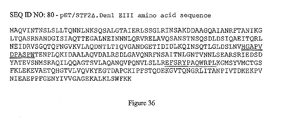
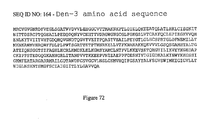
- Another embodiment of the invention is a polypeptide encoded by SEQ ID NO: 29.
- the invention is a polypeptide that includes SEQ ID NO: 30.
- the invention is a polypeptide having at least about 85% identity to SEQ ID NO: 30.
- the invention is a polypeptide encoded by SEQ ID NO: 31.
- the invention is a polypeptide that includes SEQ ID NO: 32.
- the invention is a polypeptide having at least about 70% identity to SEQ ID NO: 32.
- the invention is a polypeptide encoded by SEQ ID NO: 33.
- the invention is a polypeptide that includes SEQ ID NO: 34.
- the invention is a polypeptide having at least about 70% identity to SEQ ID NO: 34.
- the invention is a polypeptide encoded by SEQ ID NO: 35.
- the invention is a polypeptide that includes SEQ ID NO: 36.
- the invention is a polypeptide having at least 80% identity to SEQ ID NO: 36.
- the invention is a polypeptide encoded by SEQ ID NO: 37.
- the invention is a polypeptide that includes SEQ ID NO: 38.
- the invention is a polypeptide having at least 70% identity to SEQ ID NO: 38.
- the invention is a polypeptide encoded by SEQ ID NO: 54.
- the invention is a polypeptide that includes SEQ ID NO: 55.
- Another embodiment of the invention is a polypeptide having at least about 70% identity to SEQ ID NO: 55.
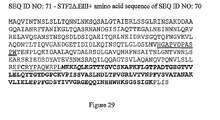
- the invention is a polypeptide that includes at least one member selected from the group consisting of SEQ ID NO: 71 and SEQ ID NO: 72.
- the invention is a polypeptide encoded by at least one member selected from the group consisting of SEQ ID NO: 70 and SEQ ID NO: 73.
- the invention is a polypeptide having at least about 70% identity to at least one member selected from the group consisting of SEQ ID NO: 71 and SEQ ID NO: 72.
- the invention is a polypeptide that includes at least one member selected from the group consisting of SEQ ID NO: 76 and SEQ ID NO: 6.
- the invention is a polypeptide encoded by at least one member selected from the group consisting of SEQ ID NO: 77 and SEQ ID NO: 5.
- the invention is a polypeptide having at least about 70% identity to at least one member selected from the group consisting of SEQ ID NO: 76 and SEQ ID NO: 6.
- the invention is a polypeptide that includes at least one member selected from the group consisting of SEQ ID NO: 80, SEQ ID NO: 82, SEQ ID NO: 84 and SEQ ID NO: 86.
- the invention is a polypeptide encoded by at least one member selected from the group consisting of SEQ ID NO: 81, SEQ ID NO: 83, SEQ ID NO: 85 and SEQ ID NO: 87.
- the invention is a polypeptide having at least about 70% identity to at least one member selected from the group consisting of SEQ ID NO: 80, SEQ ID NO: 82, SEQ ID NO: 84 and SEQ ID NO: 86.
- the invention is a polypeptide that includes SEQ ID NO: 159.
- the invention is a polypeptide encoded by SEQ ID NO: 158.
- the invention is a polypeptide having at least about 70% identity to SEQ ID NO: 159.
- the invention is a composition comprising at least one Pam3Cys and at least a portion of at least one flavivirus protein.
- the invention is a composition comprising at least one Pam2Cys and at least a portion of at least one flavivirus protein.
- the invention is a method of stimulating an immune response in a subject, comprising the step of administering to the subject a composition that includes at least a portion of at least one pathogen-associated molecular pattern and at least a portion of at least one viral protein selected from the group consisting of a West Nile viral protein, a Langat viral protein, a Kunj in viral protein, a Murray Valley encephalitis viral protein, a Japanese encephalitis viral protein, a tickborne encephalitis viral protein, and a Yellow fever virus protein.
- a composition that includes at least a portion of at least one pathogen-associated molecular pattern and at least a portion of at least one viral protein selected from the group consisting of a West Nile viral protein, a Langat viral protein, a Kunj in viral protein, a Murray Valley encephalitis viral protein, a Japanese encephalitis viral protein, a tickborne encephalitis viral protein, and a Yellow fever virus protein.
- the invention is a method of stimulating an immune response in a subject, comprising the step of administering to the subject the composition that includes at least a portion of at least one pathogen-associated molecular pattern and at least a portion of at least one Den2 envelope protein, wherein the Den2 envelope protein is selected from the group consisting of SEQ ID NO: 20 and SEQ ID NO: 40.
- the invention is a method of stimulating an immune response in a subject, comprising the step of administering to the subject a fusion protein that includes at least a portion of at least one pathogen-associated molecular pattern and at least a portion of at least one viral protein selected from the group consisting of a West Nile viral protein, a Langat viral protein, a Kunjin viral protein, a Murray Valley encephalitis viral protein, a Japanese encephalitis viral protein, a tickborne encephalitis viral protein and a Yellow fever viral protein.
- the invention is a method stimulating an immune response in a subject, comprising the step of administering to the subject a composition that includes at least a portion of at least one pathogen-associated molecular pattern and at least a portion of at least one member selected from the group consisting of a Den1 viral envelope protein, a Den2 viral envelope protein, a Den3 viral envelope protein and a Den4 viral envelope protein.
- the invention is a method stimulating an immune response in a subject, comprising the step of administering to the subject a fusion protein that includes at least a portion of at least one member selected from the group consisting of a Salmonella typhimurium flagellin type 2 (fljB/STF2), an E. coli fliC, and a S. muenchen fliC and at least a portion of at least one member selected from the group consisting of a Den1 viral envelope protein, a Den2 viral envelope protein, a Den3 viral envelope protein and a Den4 viral envelope protein.
- a fusion protein that includes at least a portion of at least one member selected from the group consisting of a Salmonella typhimurium flagellin type 2 (fljB/STF2), an E. coli fliC, and a S. muenchen fliC and at least a portion of at least one member selected from the group consisting of a Den1 viral envelope protein, a Den2 viral envelope protein
- the invention is a method stimulating an immune response in a subject, comprising the step of administering to the subject a fusion protein that includes at least a portion of at least one pathogen-associated molecular pattern and at least a portion of at least one member selected from the group consisting of a Den1 viral envelope protein, a Den2 viral envelope protein, a Den3 viral envelope protein and a Den4 viral envelope protein.
- the invention is a method of stimulating an immune response in a subject, comprising the step of administering to the subject a composition comprising at least a portion of at least one antigen and at least a portion of at least one flagellin, wherein at least one of the flagellins lack at least a portion of a hinge region.
- the invention is a method of stimulating an immune response in a subject, comprising the step of administering to the subject a fusion protein comprising at least a portion of at least one antigen and at least a portion of at least one flagellin, wherein at least one of the flaggelins lack at least a protion of a hinge region.
- compositions, fusions proteins and polypeptides of the invention can be employed to stimulate an immune response in a subject.
- Advantages of the claimed invention can include, for example, prevention of flavivirus infection in a subject in a manner specific for a particular antigen or virus, such as a flavivirus protein, that has effective immunogencity and reduced side effects.
- the claimed compositions, fusion proteins, polypeptides and methods can be employed to prevent or treat infection and, therefore, avoid serious diseases consequent to antigen or viral infection.
- the present invention relates to compositions, fusion proteins and polypeptides of at least a portion of at least one antigen and at least a portion of a flagellin that lacks a hinge region; and at least a portion of at least one pathogen-associated molecular pattern (PAMP) and at least a portion of at least one flavivirus.
- the compositions, fusion proteins and polypeptides of the invention can be employed in methods to stimulate an immune response in a subject.
- the invention is a composition comprising at least a portion of at least one antigen and at least a portion of at least one flagellin, wherein at least one of the flagellins lacks at least a portion of a hinge region.
- Pathogen-associated molecular pattern such as a flagellin or a bacterial lipoprotein
- PAMP a flagellin or a bacterial lipoprotein
- the PRR can be a Toll-like receptor (TLR).
- TLR Toll-like receptor
- Toll-like receptors refer to a family of receptor proteins that are homologous to the Drosophila melangogaster Toll protein. Toll-like receptors are type I transmembrane signaling receptor proteins characterized by an extracellular leucine-rich repeat domain and an intracellular domain homologous to an interleukin 1 receptor. Toll-like receptors include TLR1, TLR2, TLR3, TLR4, TLR5, TLR6, TLR7, TLR 8, TLR9, TLR10, TLR11 and TLR12.
- the pathogen-associated molecular pattern can be an agonist of a toll-like receptor, for example, a TLR2 agonist (i.e., Pam2Cys, Pam3Cys, a bacterial lipoprotein) or a TLR5 agonist, such as a flagellin.
- a TLR2 agonist i.e., Pam2Cys, Pam3Cys, a bacterial lipoprotein
- TLR5 agonist such as a flagellin.
- Agonist as used herein in referring to a TLR, means a molecule that activates a TLR signaling pathway.
- a TLR signaling pathway is an intracellular signal transduction pathway employed by a particular TLR that can be activated by a TLR ligand or a TLR agonist.
- TLRs include, for example, NF- ⁇ B, Jun N-terminal kinase and mitogen-activated protein kinase.
- the pathogen-associated molecular pattern can include at least one member selected from the group
- TLR1 agonist consisting of a TLR1 agonist, a TLR2 agonist (e.g., Pam3Cys, Pam2Cys, bacterial lipoprotein), a TLR3 agonist (e.g., dsRNA), a TLR4 agonist (e.g., bacterial lipopolysaccharide), a TLR5 agonist (e.g., a flagellin), a TLR6 agonist, a TLR7 agonist, a TLR8 agonist, a TLR9 agonist (e.g., unmethylated DNA motifs), TLR10 agonist, a TLR11 agonist and a TLR12 agonist.
- TLR1 agonist consisting of a TLR1 agonist, a TLR2 agonist (e.g., Pam3Cys, Pam2Cys, bacterial lipoprotein), a TLR3 agonist (e.g., dsRNA), a TLR4 agonist (e.g.,
- the TLR2 agonist is a bacterial lipoprotein, such as Pam2Cys, Pam3Cys or Pseudomonas aeruginosa OprI lipoprotein (OprI).
- exemplary OprI lipoproteins include MNNVLKFSALALAAVLATGCSSH (SEQ ID NO: 179), encoded by ATGAAAGCTACTAAACTGGTACTGGGCGCGGTAATCCTGGGTTCTACTCT GCTGGCAGGTTGCTCCAGCAAC (SEQ ID NO: 180).
- An exemplary E.coli bacterial lipoprotein for use in the invention described herein is MKATKLVLGAVILGSTLLAGCSSN (SEQ ID NO: 181) encoded by ATGAAAGCTACTAAACTGGTACTGGGCGCGGTAATCCTGGGTTCTACTCT GCTGGCAGGTTGCTCCAGCAAC (SEQ ID NO: 182).
- a bacterial lipoprotein that activates a TLR2 signaling pathway is a bacterial protein that includes a palmitoleic acid ( Omueti, K.O., et al., J. Biol. Chem. 280: 36616-36625 (2005 )).
- SEQ ID NOS: 180 and 182 expression of SEQ ID NOS: 180 and 182 in bacterial expression systems (e.g., E.coli) results in the addition of a palmitoleic acid moiety to a cysteine residue of the resulting protein (e.g., SEQ ID NOS: 179, 181) thereby generating a TLR2 agonist for use in the compositions, fusion proteins and polypeptides of the invention.
- bacterial expression systems e.g., E.coli
- tripalmitoylated-lipoproteins also referred to as triacyl-lipoproteins
- a diacylglycerol group to the sulfhydryl group of a cysteine (Cysteine 21 of SEQ ID NO: 181) followed by cleavage of the signal sequence and addition of a third acyl chain to the free N-terminal group of the same cysteine (Cysteine 21 of SEQ ID NO: 181) ( Sankaran, K., et al., J. Biol. Chem. 269:19706 (1994 )), to generate a tripalmitylated peptide (a TLR2 agonist) as shown, for example, in Figure 80 .
- a TLR2 agonist tripalmitylated peptide
- An antigen is any molecule (e.g., protein, peptide, glycoprotein, glycopeptide, carbohydrate, lipid, lipopeptide, polysaccharide) that generates an immune response in a subject either when employed in combination with a PAMP (e.g., a flagellin, Pam2Cys, Pam3Cys) or in the absence of a PAMP.
- the antigen can be a fragment or portion of a naturally occurring antigen or a synthetic molecule that mimics the naturally occurring antigen or a portion of the naturally occurring antigen.
- the antigen can be a viral antigen.
- a "viral antigen,” as used herein, refers to any portion of a virus (e.g., flavivirus) that generates an immune response in a subject either when employed in combination with a PAMP (e.g., a flagellin, Pam2Cys, Pam3Cys) or in the absence of a PAMP.
- the viral antigen can be a portion or a fragment of a naturally occurring virus or a synthetic molecule that mimics a naturally occurring virus, such as a recombinant or synthetic protein (e.g., a flavivirus), peptide, lipid, carbohydrate, that generates an immune response in the subject.
- At least a portion as used herein in reference to at least a portion of an antigen (e.g., a viral antigen), means any part of the antigen or the entirety of the antigen.
- at least a portion of a flaviviral antigen can be an envelope protein, or a domain (e.g., domain I, II, III) of an envelope protein of a flavivirus antigen.
- the flagellin employed in the compositions, fusion proteins and polypeptides of the invention can lack at least a portion of a hinge region.
- Hinge regions are the hypervariable regions of a flagellin that link the amino-terminus and carboxy-terminus of the flagellin. Hinge regions of a flagellin are also referred to herein as “hypervariable regions” or “hypervariable hinge regions.”
- “Lack,” as used herein in reference to a hinge region of a flagellin means that at least one amino acid or at least one nucleic acid codon encoding at least one amino acid that comprises the hinge region of a flagellin is absent in the flagellin.
- Example of hinge regions include amino acids 176-415 of SEQ ID NO: 1, which are encoded by nucleic acids 528-1245 of SEQ ID NO: 2; amino acids 174-422 of SEQ ID NO: 68, which are encoded by nucleic acids 522-1266 of SEQ ID NO: 69; or amino acids 173-464 of SEQ ID NO: 58, which are encoded by nucleic acids 519-1392 of SEQ ID NO: 59.
- amino acids 176-415 were absent from the flagellin of SEQ ID NO: 1, the flagellin would lack a hinge region.
- a flagellin lacking at least a portion of a hinge region is also referred to herein as a "truncated version" of a flagellin.
- At least a portion of a hinge region refers to any part of the hinge region of the PAMP (e.g., flagellin), or the entirety of the hinge region. "At least a portion of a hinge region” is also referred to herein as a "fragment of a hinge region.”
- the hinge region of S. typhimurium flagellin B (fljB, also referred to herein as “fljB/STF2" or "STF2”) is amino acids 176-416 of SEQ ID NO: 1, which is encoded by nucleic acids at position 528-1245 of SEQ ID NO: 2.
- At least a portion of the hinge region of fljB/STF2 can be, for example, amino acids 200-300 of SEQ ID NO: 1.
- amino acids 200-300 were absent from SEQ ID NO: 1, the resulting amino acid sequence of STF2 would lack at least a portion of a hinge region.
- At least a portion of a naturally occurring a flagellin can be replaced with at least a portion of an artificial hinge region.
- "Naturally occurring,” as used herein in reference to a hinge region of a flagellin means the hinge region that is present in the native flagellin.
- amino acids 176-415 of SEQ ID NO: 1, amino acids 174-422 of SEQ ID NO: 68 and amino acids 173-464 of SEQ ID NO: 58 are the amino acids corresponding to the natural hinge region of STF2, E. coli fliC and S. muenchen flagellins, fliC, respectively.
- “Artificial,” as used herein in reference to a hinge region of a flagellin, means a hinge region that is inserted in the native flagellin in any region of the flagellin that contains or contained the native hinge region.
- SEQ ID NO: 32 lacks the naturally occurring hinge region, which has been replaced by amino acids 176-186, the artificial hinge region.
- An artificial hinge region may be employed in a flagellin that lacks at least a portion of a hinge region to facilitate interaction of the carboxy-and amino-terminus of the flagellin for binding to TLR5 and, thus, activation of the TLR5 innate signal transduction pathway.
- a flagellin lacking at least a portion of a hinge region is designated by the name of the flagellin followed by a " ⁇ .”
- STF2 e.g., SEQ ID NO: 1
- STF2 ⁇ that lacks at least a portion of a hinge region
- fljB/ STF2 ⁇ e.g., SEQ ID NO: 3
- the flagellin employed in the compositions, fusion proteins and polypeptides of the invention can be at least one member selected from the group consisting of fljB/STF2 (S. typhimurium flagellin B, Genbank Accession Number AF045151), a fragment of fljB/STF2, E. coli flagellin fliC (also referred to herein as E. coli fliC) (Genbank Accession Number AB028476), a fragment of E. coli flagellin fliC, S. muenchen flagellin fliC (also referred to herein as S. muenchen fliC), and a fragment of S . muenchen flagellin fliC.
- fljB/STF2 S. typhimurium flagellin B, Genbank Accession Number AF045151
- E. coli flagellin fliC also referred to herein as E. coli fliC
- the flagellin employed in the compositions, fusion proteins and polypeptides of the invention include the polypeptides of SEQ ID NO: 1, SEQ ID NO: 3, SEQ ID NO: 58 and SEQ ID NO: 68; at least a portion of SEQ ID NO: 1, at least a portion of SEQ ID NO: 3, at least a portion of SEQ ID NO: 58 and at least a portion of SEQ ID NO: 68; and a polypeptide encoded by SEQ ID NO: 2, SEQ ID NO: 4, SEQ ID NO: 59 and SEQ ID NO: 69; or at least a portion of a polypeptide encoded by SEQ ID NO: 2, SEQ ID NO: 4, SEQ ID NO: 59 and SEQ ID NO: 69.
- the invention is a fusion protein comprising at least a portion of at least one antigen and at least a portion of at least one flagellin, wherein at least one of the flagellins lack at least a portion of a hinge region.
- Fusion protein refers to a protein generated from at least two similar or distinct components (e.g., Pam2Cys, Pam3Cys, PAMP, at least a portion of an antigen, at least a portion of a viral protein) that are linked covalently or noncovalently.
- the components of the fusion protein can be made, for example, synthetically (e.g., Pam3Cys, Pam2Cys) or by recombinant nucleic acid techniques (e.g., transfection of a host cell with a nucleic acid sequence encoding a component of the fusion protein, such as at least a portion of a PAMP, or at least a portion of an antigen or a viral protein).
- One component of the fusion protein e.g., Pam2Cys, Pam3Cys, PAMP, at least a portion of an antigen or at least a portion of a viral protein
- a component of the fusion protein e.g., Pam2Cys, Pam3Cys, PAMP, at least a portion of an antigen or at least a portion of a viral protein
- another component of the fusion protein e.g., Pam2Cys, Pam3Cys, PAMP, at least a portion of an antigen or at least a portion of a viral protein
- chemical conjugation techniques including peptide conjugation
- molecular biological techniques including recombinant technology
- Chemical conjugation can include conjugation by a reactive group, such as a thiol group (e.g., a cysteine residue) or by derivatization of a primary (e.g., a amino-terminal) or secondary (e.g., lysine) group.
- a reactive group such as a thiol group (e.g., a cysteine residue) or by derivatization of a primary (e.g., a amino-terminal) or secondary (e.g., lysine) group.
- Exemplary fusion proteins of the invention include SEQ ID NOS: 6, 71, 72, 76, 80, 82, 84, 86 and 159 ( Figures 6 , 29 , 30 , 32 , 36 , 38 , 40 and 42 ), encoded by SEQ ID NOS: 5, 70, 73, 77, 81, 83, 85, 87 and 158 ( Figures 5 , 28 , 31 , 33 , 37 , 39 , 41 and 43 )
- Fusion proteins of the invention can be designated by components of the fusion proteins separated by a ".” or "-.”
- STF2.EIII refers to a fusion protein comprising one fljB/STF2 protein and at least a portion of domain III (see, infra ) of at least one West Nile virus envelope protein
- STF2 ⁇ .EIII refers to a fusion protein comprising one fljB/STF2 protein lacking at least a portion of its hinge region and having at least a portion of domain III of at least one West Nile virus envelope protein.
- the invention is a composition comprising at least a portion of at least one pathogen-associated molecular pattern and at least a portion of at least one viral protein selected from the group consisting of a West Nile viral protein, a Langat viral protein, a Kunjin viral protein, a Murray Valley encephalitis viral protein, a Japanese encephalitis viral protein, a Tick-borne encephalitis viral protein, and a Yellow fever viral protein, which are flaviviral proteins.
- the pathogen-associated molecular pattern and viral protein can be components of a fusion protein.
- the genus flavivirus is in the virus family Flaviviridae and consists of about 70 viruses. Mosquito or ticks transmit most of these viruses.
- flaviviruses are significant human pathogens, including the four dengue viruses (Den1, Den2, Den3 and Den4), yellow fever (YF), Japanese encephalitis (JE), West Nile (WN, also referred to herein as "WNV”) and Tick-borne encephalitis (TBE) ( Weaver S.C., et al., Nat Rev Microbiol 10: 789-801 (2004 )).
- the flavivirus genus is divided into a number of serogroups based on cross-neutralization tests, including the dengue serogroup that contains four serologically and genetically distinct viruses termed DEN-1, DEN-2, DEN-3 and DEN-4.
- Flaviviruses are small, enveloped viruses with icosahedral capsids.
- the flavivirus genome is a single-stranded positive-sense RNA (about 11 kb) that is directly translated by the host cell machinery following infection.
- the viral genome is translated as a single polypeptide that undergoes co- and post-translational cleavage by viral and cellular enzymes to generate three structural proteins of the flavivirus (the capsid (C), the membrane (M) and the envelope (E) proteins); and seven nonstructural proteins (NS1, NS2A, NS2B, NS3, NS4A, NS4B, and NS5) ( Weaver, et al., Annu Rev Microbiol 1990:44-649 (2004 )).
- the flavivirus genome organization is depicted in Figure 44 .
- the viral capsid is composed of the C-protein, while both the M- and envelope proteins are located on the envelope surface of the virion ( Weaver, S.C., et al., Nat. Rev. Microbial 10:789-801 (2004 ); , Chambers et al., Annu Rev. Microbiol. 44: 649-688 (1990 )).
- a major immunogen for flaviviruses is the membrane envelope protein.
- the flavivirus envelope protein plays a role in virus assembly. These proteins form a protective shell around the virus, which serves as a cage for the genetic material inside, sheltering the virus until it is released inside a host cell. While simple viruses consist of only a protein shell and genetic information, more complex viruses, such as flaviviruses, also contain a lipid bilayer between the protein shell and viral genome. A flavivirus can enter a host cell when the viral envelope protein binds to a receptor and responds by conformational rearrangement to the reduced pH of an endosome. The conformational change induces fusion of viral and host-cell membranes.
- the envelope of a flavivirus may function as a receptor binding protein and to facilitate fusion of the virus and host cell membrane.
- the envelope protein is a determinant of host range, cell tropism, virulence and elicits neutralizing antibodies during the immune response ( Roehrig, Adv Virus Res 59:141-175 (2003 )).
- the envelope protein is responsible for fusing the virus and host membranes ( Chu, et al., J. Virol 78:10543-10555 (2004 ); Heinz, et al., Adv Virus Res 59:63-97 (2003 ); Chu, et al., J. Gen Virol 86:405-412 (2005 )).
- Crystallographic structures of the Tick-borne encephalitis virus envelope protein and the Dengue-2 (Den 2) virus envelope protein have been determined ( Rey, et al., Nature 375:291-298(1995 ); Modis, et al., Proc Natl Acad Sci USA 100:6986-6991(2003 )).
- Envelope proteins of flaviviruses have common structural (domains I, II and III) and functional features (receptor binding of virus and host cell and fusion functions) and are class II fusion glycoproteins ( Lescar et al., Cell 105:137-148 (2001 )).
- envelope proteins form homodimers on the outer surface of the virus particles ( Rey, et al., Nature 375:291-298 ); Kuhn, et al., Cell 108:717-725 (2002 ); Mukhopadhyay, et al., Science 302:248 (2003 )).
- Each envelope protein monomer folds into three structural domains (domains I, II and III) predominantly composed of ⁇ -strands.
- Domain I also referred to herein as "I” or "DI”
- I is centrally located in the structure and has an N-glycosylation site in glycosylated envelope proteins.
- Domain II (also referred to herein as “II” or “DII”) of the envelope protein promotes dimerization and has a fusion loop that inserts into the target host membrane during the pH-dependent fusion of the virus ( Modis, et al., Nature 427:313-319 (2004 ); Bressanelli, et al., EMBO J 23:728-738 (2004 )).
- Domain III (also referred to herein as “III” or “DIII”) is at the carboxy-terminus of the envelope protein. Domain III is also referred to as "domain B" in earlier antigenic mapping studies.
- Domain III has several epitopes that can elicit virus-neutralizing antibodies ( Roehrig, Adv Virus Res 59:141-175 (2003 )).
- studies with several flaviviruses, including Tick-borne encephalitis indicate that domain III, which has a fold typical of an immunoglobulin constant domain, may mediate flavivirus attachment to host cells ( Anderson, Adv Virus Res 59:229-274 (2003 )) and, thus, be a receptor-binding domain.
- domains I, II and III of the envelope protein from the Tick-borne encephalitis flavivirus and the Dengue 2 flavivirus has been determined ( Rey, F.A., et al., Nature 375:291-298 (1995 ); Modis, Y., et al., Nature 427:313-319 (2004 ), respectively).
- Domain I of the Tick-borne encephalitis envelope protein corresponds to amino acids 1-51, 137-189 and 285-302 of SEQ ID NO: 174;
- domain II of the Tick-borne encephalitis envelope protein of SEQ ID NO: 174 corresponds to amino acids 52-136 and 190-284; and domain III corresponds to amino acids 303-395 of SEQ ID NO: 174.
- SEQ ID NO: 174 ( Figure 44 ) is encoded by SEQ ID NO: 175 ( Figure 78 ).
- Domain I of the Dengue 2 flavivirus envelope protein corresponds to amino acids 1-52, 132-193 and 280-296 of SEQ ID NO: 160 ( Figure 70 ); domain II corresponds to amino acids 53-131 and 194-279 of SEQ ID NO: 160; and domain III corresponds to amino acids 297-495 of SEQ ID NO: 160 ( Modis, Y., et al., Nature 427:313-319 (2004 )).
- domains I, II and III of other flavivirus e.g., West Nile virus, Japanese encephalitis, Dengue 1 virus, Dengue 3 virus and Dengue 4 virus
- flaviviruses other than Tick-borne encephalitis flavivirus envelope proteins and Dengue 2 flavivirus envelope proteins are based on homology to domains in the Tick-borne encephalitis flavivirus envelope protein and the Dengue 2 flavivirus envelope protein.
- the domain III of the envelope protein of the DEN flavivirus encodes the majority of the flavivirus type-specific contiguous critical/dominant neutralizing epitopes ( Roehring, J.T., Adv. Virus Res. 59:141 (2003 )), including the four DEN (DEN1, DEN2, DEN3, DEN4) viruses.
- Flavivirus envelope proteins are highly homologous. Exemplary envelope protein sequences are shown in Figures 45 , 68 , 70 , 72 , 74 and 77 (SEQ ID NOs: 39, 160, 162, 164, 166 and 171, respectively).
- NS3 is a multifunctional enzyme that encodes a serine protease at the aminus-terminal region; and helicase, RNA triphosphatase and NTPase activities in the carboxy-terminal region.
- NS5 encodes a methyltransferase and the RNA-dependent-RNA polymerase.
- NS2A, NS2B, NS4A and NS4B are four poorly characterized proteins.
- the central domain of NS2B is a co-factor for the NS3 serine protease while NS2A and NS4A are known to be components of the replication complex.
- NS1 is located at both the plasma membrane and in the lumen of intracellular vesicles of virus-infected cells.
- NS1 is a multifunctional protein that is associated with an early step in the replication cycle either prior to or early in negative-strand RNA synthesis and is also thought to be involved in virus maturation and/or release ( Brinton, M.A., Annu Rev Microbial 56:371 (2002 )).
- West Nile virus is a single-stranded positive sense RNA envelope virus. It was first isolated and identified in the West Nile region of Kenya in 1937 from a febrile female adult ( Smithburn, et al., Am J Trop Med Hyg 3:9-18 (1954 )). West Nile Virus has been classified as a member of the family Flaviviridae using cross-neutralization tests with polyclonal antisera ( Boctor, et al., J. Virol Methods 26:305-311 (1989 )).
- West Nile virus is neuroinvasive ( George, et al., Bull WHO 62:879-882 (1984 )); and severe human meningoencephalitis might occur consequent to infection with West Nile virus, as seen in the outbreaks in North America ( CDC, Update: West Nile Virus Encephalitis - New York 1999, MMWR Morbid Mortal Wkly Rep 48:994-946 ; CDC, Update: West Nile Virus Encephalitis-New York 1999. MMWR Morbid Mortal Wkly Rep 51:1135-1136 ).
- WNV extended its range throughout much of the eastern part of the United States, and its range within the western hemisphere is expected to continue to expand. Birds are the natural reservoir hosts, and WNV is maintained in nature in a mosquito-bird-mosquito transmission cycle primarily involving Culex species mosquitoes.
- WNV infection has emerged in temperate regions of Europe and North America, presenting a threat to public and animal health.
- the most serious manifestation of WNV infection is fatal encephalitis (inflammation of the brain) in humans and horses, as well as mortality in certain domestic and wild birds.
- West Nile virus infection has also been a significant cause of human illness in the United States.
- the envelope glycoprotein of the West Nile virus (WNV-E) and other flaviviruses may be important in formulating compositions to stimulate an immune response to generate neutralizing and protective antibodies.
- WNV-E West Nile virus
- there are no compositions that prevent West Nile virus infection for example, by stimulating an immune response in a subject.
- J encephalitis (JE) virus is localized in Asia and northern Australia (about 50,000 cases with about10,000 deaths annually).
- a composition comprising an inactivated virus was recently associated with a case of acute disseminated encephalomyelitis, prompting the Japanese Ministry of Health, Labor and Welfare to recommend the nationwide suspension of compositions comprising inactivated virus.
- the Dengue (DEN) disease is caused by four mosquito-borne, serologically related flaviviruses known as DEN-1 (also referred to herein as “Den1” or Den 1"), DEN-2 (also referred to herein as “Den2” or “Den 2”), DEN-3 (also referred to herein as “Den3” or “Den 3”), and DEN-4 (also referred to herein as "Den4" or Den 4"), and is an important arboviral disease of humans.
- DEN is a major public health problem in all tropical areas of the world.
- DHF Dengue hemorrhagic fever
- DSS dengue shock syndrome
- DHF may be the result of an antibody dependent enhancement (ADE) where non-neutralizing antibodies induced by the primary DEN infection form virus-antibody complexes in secondary infections that are taken up into macrophages by Fc receptors and, thus, enhance virus infection.
- ADE antibody dependent enhancement
- military personnel are often sent overseas to tropical areas of the world where DEN viruses are found. Significant numbers of soldiers succumb to DEN while performing overseas, such as in Somalia, Grenada, Viet Nam and the Gulf conflicts. Attempts to develop a DEN vaccine have proved difficult due to the need to develop a tetravalent vaccine that protects against all four DEN serotypes/viruses.
- compositions comprising live flavivirus -have been developed for YF and JE based on strains 17D and SA14-14-2, respectively, and were derived by empirical passage in chicken and hamster tissue, respectively.
- SAI4-14-2 is produced in the People's Republic of China, grown in primary hamster kidney cell culture and very recently has been approved for use outside China. Both compositions are efficacious and require one or two doses, respectively, to develop protective immunity.
- inactivated virus compositions for JE and TBE.
- the inactivated JE compositions are based on strains Nakayama, Beijing-1 or P3, while inactivated TBE compositions are based on Central European TBE strains Neudorfl and K23, and Russian Spring Summer encephalitis strains Sofjin and 205. These killed flavivirus compositions require about two doses (given about 1 week to about 2 months apart), a booster dose at about one year and periodic boosters about every 3 to about 4 years.
- the antibody-mediated immunity in particular neutralizing antibodies, may be important in preventing flavivirus disease. Long-lived neutralizing antibody responses following administration of compositions to treat flavivirus disease or to prevent flavivirus disease may also be important.
- compositions to prevent flavivirus infection have not been successful.
- DEN which is the result of four related viruses (DEN1, DEN2, DEN3, DEN4)
- a composition may need to be developed to one or more the DEN flaviviruses.
- a tetravalent (DEN1, DEN2, DEN3 and DEN4) composition may stimulate an immune response simultaneously against all four DEN viruses and thereby eliminate the potential of antibody dependent enhancement.
- compositions to prevent infection by many flaviviruses including West Nile virus. Dengue virus, Tick-borne virus, Kunjun virus, Murray Valley encephalitis virus and Yellow fever virus ( Chang, G.J., et al., Expert Rev. Vaccine 3:199 (2004 )). Attenuation and immunogenicity may occur in compositions with live attenuated flavivirus. Furthermore, compositions with tetravalent live Dengue flaviviruses may have problems with interference and imbalanced immune response resulting in many compositions being tested with variation in the quantity of each of the four DEN viruses. Compositions comprising inactivated flavivirus may have problems with immunogenicity and the need for multiple doses.
- compositions, fusion proteins and polypeptides of the invention employ pathogen-associated molecular patterns that trigger cellular events resulting in the expression of costimulatory molecules, secretion of critical cytokines and chemokines; and efficient processing and presentation of antigens to T-cells.
- TLRs recognize PAMPs including bacterial cell wall components (e.g., bacterial lipoproteins and lipopolysaccharides), bacterial DNA sequences that contain unmethylated CpG residues and bacterial flagellin.
- TLRs act as initiators of the innate immune response and gatekeepers of the adaptive immune response ( Medzhitov, R., et al., Cold Springs Harb. Symp. Quant. Biol.
- the binding of PAMPs to TLRs activates immune pathways for use in the compositions, fusion proteins and polypeptides of the invention, which can be employed in stimulating the immune system in a subject.
- the compositions, fusion proteins and polypeptides of the invention can trigger an immune response to an antigen (e.g., a viral protein, such as a flaviviral protein) and trigger signal transduction pathways of the innate and adaptive immune system of the subject to thereby stimulate the immune system of a subject.
- Stimulation of the immune system of the subject may prevent infection by an antigen or a virus (e.g., a flavivirus) and thereby treat the subject or prevent the subject from disease, illness and, possibly, death.
- compositions, fusion proteins and polypeptides of the invention can include, for example, one, two, three, four, five, six or more pathogen-associated molecular patterns (e.g., Pam2Cys, Pam3Cys, flagellin) and one, two, three, four, five, six or more antigens.
- pathogen-associated molecular patterns e.g., Pam2Cys, Pam3Cys, flagellin
- two or more PAMPs and/or two or more antigens and/or viral proteins comprise the compositions, fusion proteins and polypeptides of the invention, they are also referred to as "multimers.”
- the pathogen-associated molecular pattern can be a TLR5 agonist (e.g., at least a portion of at least one flagellin).
- the flagellin can be at least one member selected from the group consisting of a fljB/STF2, an E . coli fliC, and a S. muenchen fliC.
- the flagellin can include fljB/STF2 (e.g., SEQ ID NO: 1) or a flagellin lacking a hinge region (e.g., SEQ ID NO: 3).
- the pathogen-associated molecular pattern can be a TLR2 agonist.
- the TLR2 agonist includes at least one member selected from the group consisting of a Pam2Cys and a Pam3Cys.
- Pam3Cys is ([Palmitoyl]-Cys((RS)-2,3-di(palmitoyloxy)-propyl cysteine).
- Pam3Cys is also referred to herein as "P2.”
- Pam2Cys is (S-[2,3-bis(palmitoyloxy) propyl] cysteine).
- the viral protein for use in the compositions, fusion proteins and polypeptides of the invention can be an envelope protein of at least one member selected from the group consisting of a West Nile viral envelope protein, a Langat viral envelope protein, a Kunjin viral envelope protein, a Murray Valley encephalitis viral envelope protein, a Japanese encephalitis viral envelope protein, a Tick-borne encephalitis viral envelope protein, a Yellow fever viral envelope protein and a Dengue viral envelope protein.
- compositions, fusion proteins and polypeptides of the invention can employ any portion of the envelope protein of a flavivirus
- the compositions, fusion proteins and polypeptides of the invention can include at least a portion of at least one member selected from the group consisting of domain I, domain II and domain III of an envelope protein of a flavivirus.
- "At least a portion,” as used herein, in reference to a domain of an envelope protein means any part of the envelope protein domain or the entirety of the envelope protein.
- SEQ ID NOS: 88 and 100-151 include at least a portion of domain III of the West Nile virus envelope protein.
- ''EI,'' "EII,” and “EIII,” as used herein, refer to domains I, II and III, respectively, of the West Nile flavivirus envelope protein.
- JEI JEII
- JEIII refer to domains I, II and III, respectively, of the Japanese encephalitis flavivirus envelope protein.
- Den1 I “Den1 II,” and “Den1 III,” as used herein refer to domains I, II and III, respectively, of the Dengue 1 flavivirus envelope protein.
- domains of envelope proteins of other flaviviruses are referenced by the flavivirus name followed by the domain number (e.g., (Tick-borne) TBI (Tick-borne), TBII, TBIII, Den2 I, Den2 II, Den2 III).
- the portion of an envelope protein of a flavivirus employed in the compositions, fusion proteins and polypeptides of the invention can include at least one member selected from the group consisting of at least a portion of domain I, at least a portion of domain II and at least a portion of domain III.
- a domain is designated with a "+,” for example "EIII+” or "JEIII+”
- the portion of the envelope protein referenced as "III” is one component of the total of that domain plus at least one of at least a portion of either or both of domains I and II.
- EIII+ as used herein, means the compositions, fusion proteins and polypeptides of the invention include domain III and at least a portion of domain I.
- EIII+ is also referred to as "EI/III.”
- JEIII+ is also referred to as "JEI/III.”
- the domains can be any combination of domains I, II, and III and can be designated based on the domain.
- EI/II includes domain I and II of the West Nile flavivirus.
- the absence of a "+” in reference to a domain (e.g., EIII, JEIII, Den1 III) of an envelope protein employed in the compositions, fusion proteins and polypeptides of the invention means that the composition, fusion protein and polypeptide includes the referenced domain.
- "Den1 III” means the compositions, fusion proteins and compositions include domain III, not domains I and II, of the Dengue 1 virus.
- the West Nile viral envelope protein for use in the compositions, fusion proteins and polypeptides of the invention can include at least a portion of at least one member selected from the group consisting of MEKLQ LKGTTYGVCSKAFKFLGTPADTGHGTVVLELQYTGTDGPCKVPISS VASLNDLTPVGRLVTVNPFVSVATANAKVLIELEPPFGDSYIVVGRGEQQIN HHWHKSGSSIGK (SEQ ID NO: 7, which is an EIII+ amino acid sequence, the italicized amino acids are domain I of the envelope protein and the remaining sequence is domain III of the envelope protein); GTTYGVCSKAFKFARTPADTGHGTVVLELQYTGKDGPCKVPISSVASLNDL TPVGRLVTVNPFVSVATANSKVLIELEPPFGDSYIVVGRGEQQINHHWHKSG (SEQ ID NO: 8, West Nile virus, Stanford, CT, also referred to as "West Nile S"); GTTYGVCSKAFKFLGTPADTGHG
- SEQ ID NO: 7 is encoded by ATGGAAAAATTGCAGTTGAAGGGAACAACCTATGGCGTCTGTTCAAAGG CTTTCAAGTTTCTTGGGACTCCCGCAGACACAGGTCACGGCACTGTGGTG TTGGAATTGCAGTACACTGGCACGGATGGACCTTGCAAAGTTCCTATCTC GTCAGTGGCTTCATTGAACGACCTAACGCCAGTGGGCAGATTGGTCACT GTCAACCCTTTTGTTTCAGTGGCCACGGCCAACGCTAAGGTCCTGATTGA ATTGGAACCACCCTTTGGAGACTCATACATAGTGGTGGGCAGAGGAGAA CAACAGATCAATCACCATTGGCACAAGTCTGGAAGCAGCATTGGCAAA (SEQ ID NO: 11).
- the West Nile viral envelope protein can include a protein that has at least about 70% identity, at least about 75% identity, at least about 80% identity, at least about 85% identity, at least about 90% identity, at least about 95% identity and at least about 99% identity to a polypeptide that includes SEQ ID NO: 7, which include portions of domains I and III (referred to herein as "EIII+") of the West Nile virus.
- the Langat virus envelope protein for use in the compositions, fusion proteins and polypeptides of the invention can include at least a portion of GLTYTVCDKTKFTWKRAPTDSGHDTVVMEVGFSGTRPCRIPVRAVAHGVP EVNVAMLITPNPTMENNGGGFIEMQLPPGDNIIYVGDLNHQWFQKG (SEQ ID NO: 12).
- the Kunjin virus envelope protein can include at least a portion of GTTYGVCSKAFRFLGTPADTGHGTVVLELQYTGTDGPCKIPISSVASLNDLT PVGRLVTVNPFVSVSTANAKVLIELEPPFGDSYIVVGRGEQQINHHWHKSG (SEQ ID NO: 13).
- the Murray Valley encephalitis envelope protein can include at least a portion of GTTYGMCTEKFTFSKNPADTGHGTVVLELQYTGSDGPCKIPISSVASLNDMT PVGRMVTANPYVASSTANAKVLVEIEPPFGDSYIVVGRGDKQINHHWHKEG (SEQ ID NO: 14).
- the Japanese encephalitis envelope protein can include at least one member selected from the group consisting of at least a portion of GTTYGMCTEKFSFAKNPADTGHGTWIELSYSGSDGPCKIPIVSVASLNDMT PVGRLVTVNPFVATSSANSKVLVEMEPPFGSDYIVVGMGDKQINHHWHKA G (SEQ ID NO: 15) and EMEPPFGDSYIVVMGDKQINHHWHKA (SEQ ID NO: 16).
- the Tick-borne encephalitis envelope protein can include at least a portion of GLTYTMCDKTKFTWKRAPTDSGHDTVVMEVTFSGTKPCRIPVRAVAHGSP DVNVAMLITPNPTIENNGGGFIEMQLPPGDNIIYVGELSHQWFQK (SEQ ID NO: 17).
- the Yellow fever virus envelope protein can include at least a portion of GLTYTMCDKTFTWKRAPTDSGHDTVVMEVTFSGTKPCRIPVRAVAHGSPD VNVAMLITPNPTIENNGGGFIEMQLPPGDNIIYVGELSHQWFQK (SEQ ID NO: 18).
- the envelope protein of a flavivirus can include at least a portion of at least one member selected from the group consisting of GTTYGMCSKKFTFRPADTGHGTVVLELQYSGDGPCKIPISVASKNDLTPVGR LVTVNPFVSSTANAKVLIEMEPPFGDSYIVVGGEQINHHWHKG (SEQ ID NO: 19) and GMSYSMCTGKFKVVKEIAETQHGTIVIRVQYEGDGSPCKIPFEIMDLEKRHV LGRLITVNPIVTEKDSPVNIEAEPPFGDSYIIIGVEPGQLKLNWFKK (SEQ ID NO: 40).
- SEQ ID NOS: 12, 13, 14, 15, 16, 17, 18, 19 and 40 are portions of domain III of the viral envelope protein.
- the invention is a composition comprising at least a portion of at least one pathogen-associated molecular pattern and at least a portion of at least one Den2 viral envelope protein, wherein the Den2 viral envelope protein is at least one member selected from the group consisting of EAEPPFGDSYIIIGVEPQQLKLNWFKK (SEQ ID NO: 22), SEQ ID NO: 40 and SEQ ID NO: 97.
- compositions, fusion proteins and polypeptides of the invention can include Den 1 (EAEPPFGESYIVVGAGEKALKLSWFKK (SEQ ID NO.: 20); Den 1 PR 94 (Puerto Rico, 1994) (ETEPPFGESYIVVGAGEKALKLSWFKK (SEQ ID NO: 21)); Den 3 (EAEPPFGESNIVIGIGDKALKINWYKK (SEQ ID NO: 23)); and Den 4 (ELEPPFGESYIVIGVGNSALTLHWFRK (SEQ ID NO: 24)).
- SEQ ID NOS: 20, 21, 22, 23 and 24 are portions of domain III of Den1, Den2, Den3 and Den4 flaviviruses.
- domain III of the four Dengue viruses can be employed together or separately in the compositions, fusion proteins or polypeptides of the ivnetion.
- domain III of Den1 (strain 16007), Den2 (strain 515803), Den3 (strain H53489) and Den4 (strain 703) can be employed separately or in combination.
- the pathogen-associated molecular pattern and Den2 envelope viral protein can be components of a fusion protein.
- the invention is a composition comprising at least a portion of at least one pathogen-associated molecular pattern and at least a portion of at least one member selected from the group consisting of a Den viral envelope protein, a Den2 viral envelope protein, a Den3 viral envelope protein and a Den4 viral envelope protein.
- the invention is a fusion protein comprising at least a portion of at least one pathogen-associated molecular pattern and at least a portion of at least one viral protein selected from the group consisting of a West Nile viral protein, a Langat viral protein, a Kunjin viral protein, a Murray Valley encephalitis viral protein, a Japanese encephalitis viral protein, a Tick-borne encephalitis viral protein, a Yellow fever viral protein and a hepatitis C viral protein.
- the hepatitis C viral protein for use in the compositions, fusion proteins and polypeptides of the invention can include a polypeptide of at least one member selected from the group consisting of SEQ ID NO: 64 ( Figure 22 ) and SEQ ID NO: 65 ( Figure 23 ), which are encoded by SEQ ID NOS: 66 ( Figure 24 ) and 67 ( Figure 25 ), respectively.
- the invention is a fusion protein comprising at least a portion of at least one pathogen-associated molecular pattern and at least a portion of at least one member selected from the group consisting of a Den1 viral envelope protein, a Den2 viral envelope protein, a Den3 viral envelope protein and a Den4 viral envelope protein.
- Fusion proteins of the invention can further include a linker between the pathogen-associated molecular pattern and the viral protein.
- the linker can be an amino acid linker.
- the amino acid linker can include synthetic or naturally occurring amino acid residues.
- the amino acid linker employed in the fusion proteins of the invention can include at least one member selected from.the group consisting of a lysine residue, a glutamic acid residue, a serine residue, a cysteine residue and an arginine residue.
- amino acid linker is also referred to as a "peptide linker.”
- the amino acid linker can include at least one member selected from the group consisting of a peptide of KGNSKLEGQLEFPRTS (SEQ ID NO: 26); EFCRYPAQWRPL (SEQ ID NO: 28); EFSRYPAQWRPL (SEQ ID NO: 60); KGNSKLEGQLEFPRTSPVWWNSADIQHSGGRQCDGYLQNSPLRPL (SEQ ID NO: 62); EFSRYPAQWRPL (SEQ ID NO: 75); which are encoded by AAGGGCAATTCGAAGCTTGAAGGTCAATTGGAATTCCCTAGGACTAGT (SEQ ID NO: 25); GAATTCTGCAGATATCCAGCACAGTGGCGGCCGCTC (SEQ ID NO: 27); GAATTCTCTAGATATCCAGCACAGTGGCGGCCGCTC (SEQ ID NO: 61); AAGGGCAATTCGAAGCTTGAAGGTCAATTGGA
- the fusion proteins of the invention can further include a linker between at least one component of the fusion protein (e.g., Pam3Cys, Pam2Cys, flagellin, PAMP) and at least one other component of the fusion protein (e.g., at least a portion of an antigen, at least a portion of a viral protein) of the composition, a linker between at least two of similar components of the fusion protein (e.g., Pam3Cys, Pam2Cys, flagellin, PAMP, at least a portion of an antigen, at least a portion of a viral protein) or any combination thereof.
- a linker between at least one component of the fusion protein e.g., Pam3Cys, Pam2Cys, flagellin, PAMP
- at least one component of the fusion protein e.g., Pam3Cys, Pam2Cys, flagellin, PAMP
- at least two of similar components of the fusion protein e.g., Pam3
- Linker refers to a connector between components of the fusion protein in a manner that the components of the fusion protein are not directly joined.
- one component of the fusion protein e.g., Pam3Cys, Pam2Cys, PAMP
- a distinct component e.g., at least a portion of an antigen, at least a portion of a viral protein
- two PAMPs can further include a linker between each PAMP
- two antigens can further include a linker between each antigen
- two viral proteins can further include a linker between each viral protein
- the fusion proteins of the invention can include a combination of a linker between distinct components of the fusion protein and similar or like components of the fusion protein.
- a fusion protein can comprise at least two PAMPs, Pam3Cys and/or Pam2Cys components that further includes a linker between, for example, two or more PAMPs; at least two antigens or at least two viral proteins that further include a linker between them; a linker between one component of the fusion protein (e.g., PAMP) and another distinct component of the fusion protein (e.g., at least a portion of an antigen, at least a portion of a viral protein), or any combination thereof.
- the fusion proteins of the invention can further include a linker between at least two pathogen-associated molecular patterns, a linker between at least two antigens, a linker between at least two viral proteins, or any combination thereof.
- the pathogen-associated molecular pattern of the fusion proteins of the invention can be fused to a carboxy-terminus, an amino-terminus or both a carboxy-and an amino-terminus of an antigen or at least a portion of a viral protein (e.g., a flavivirus viral-protein, such as at least a portion of domain III of the West Nile envelope protein, referred to as "EIII," at least a portion of domain III of Dengue 1 envelope protein) referred to as "Den1 III.”
- a viral protein e.g., a flavivirus viral-protein, such as at least a portion of domain III of the West Nile envelope protein, referred to as "EIII," at least a portion of domain III of Dengue 1 envelope protein
- the fusion proteins of the invention can include at least one pathogen-associated molecular pattern between at least two antigens or at least two viral proteins, which can, optionally, include a linker between the pathogen-associate molecular pattern and the antigen or the viral protein.
- the fusion proteins of the invention can include a pathogen-associated molecular pattern fused between at least two viral proteins (e.g., designated as "viral protein.PAMP.viral protein”).
- the fusion proteins of the invention can include an antigen or a viral protein fused between at least two pathogen-associated molecular patterns (e.g., designated as "PAMP.viral protein.PAMP").
- the pathogen-associated molecular pattern of the fusion proteins of the invention can be a TLR5 agonist, such as a flagellin.
- the antigen or viral protein of the fusion proteins of the invention can be fused to the flagellin in a region of the flagellin that lacks at least a portion of a hinge region of the flagellin.
- at least a portion of the hinge region of the fljB/STF2 flagellin of SEQ ID NO: 1 ( Figure 1 ) can be deleted and an antigen or a viral protein can be fused to the flagellin in the region of the deletion.
- the antigen or viral protein of the fusion proteins of the invention can be fused to the flagellin in a region of the flagellin that contains a hinge region of the flagellin.
- an antigen or viral protein can be fused to the fljB/STF2 flagellin of SEQ ID NO: 1 ( Figure 1 ) at any place in the hinge region, for example, at any place with amino acids 176-415 of SEQ ID NO: 1.
- the antigen or viral protein of the fusion proteins of the invention can be fused to the flagellin in a region of the flagellin that lacks a hinge region of the flagellin, wherein the hinge region has been replaced with an artificial hinge region, such as an amino acid linker.
- an antigen or viral protein can be fused to the fljB/STF2 ⁇ flagellin of SEQ ID NO: 3 ( Figure 3 ) by placing an amino acid linker (also referred to herein as an "artificial hinge” or “an artifical hinge region” or “an artificial hypervariable region”), as depicted, for example, with the placement of an amino acid linker (HGAPVDPASPW, SEQ D NO: 183) between amino acids 175 to 186 of SEQ ID NO: 3.
- an amino acid linker also referred to herein as an "artificial hinge” or "an artifical hinge region” or “an artificial hypervariable region
- the invention is a fusion protein comprising at least a portion of at least one member selected from the group consisting of fljB/STF2, an E. coli fliC, and a S. muenchen flic and at least a portion of at least one member selected from the group consisting of a Den1 viral envelope protein, a Den2 viral envelope protein, a Den3 viral envelope protein and a Den4 viral envelope protein.
- the portion of the envelope protein can be at least a portion of at least one member selected from the group consisting of domain I, domain II and domain III of the envelope protein.
- the invention includes a polypeptide that includes SEQ ID NOS: 71, 72, 30, 32, 34, 36, 38, 55, 76, 6, 80, 82, 84, 86 and 159 and a polypeptide encoded by SEQ ID NOS: 70,73,29, 31, 33, 35, 37,54,77, 5, 81, 83, 85, 87 and 158.
- the invention includes a polypeptide having at least about 70%, at least about 75%, at least about 80%, at least about 85%, at least about 90%, at least about 95%, at least about 98% and at least about 99% sequence identity to the polypeptides of SEQ ID NOS: 71, 72, 30, 32, 34, 36, 38, 55, 75, 6, 80, 82, 84, 86 and 159 and the nucleic acids of SEQ ID NOS: 70, 73, 29, 31, 33, 35, 37, 54, 77, 5, 81, 83, 85, 87 and 158.
- the invention includes compositions, fusion proteins and polypeptides that include a polypeptide having a flagellin that includes polypeptides having at least about 70%, at least about 75%, at least about 80%, at least about 85%, at least about 90%, at least about 95%, at least about 98% and at least about 99% sequence identity to the polypeptides of SEQ ID NOS: 1, 3, 58 and 68 and the nucleic acids of 2, 4, 59 and 69.
- the length of the protein or nucleic acid encoding a PAMP, at least a portion of a fusion protein, a viral protein, or a polypeptide of the invention aligned for comparison purposes is at least 30%, preferably, at least 40%, more preferably, at least 60%, and even more preferably, at least 70%, 75%, 80%, 85%, 90%, 95%, 98%, 99% or 100%, of the length of the reference sequence, for example, the nucleic acid sequence of a PAMP, at least a portion of a viral protein, or a polypeptide or fusion protein, for example, as depicted in SEQ ID NOS: 71, 72, 30, 32, 34, 36, 38, 55, 75, 6, 80, 82, 84, 86 and 159.
- the default parameters of the respective programs e.g., BLASTN; available at the Internet site for the National Center for Biotechnology Information
- the database searched is a non-redundant (NR) database, and parameters for sequence comparison can be set at: no filters; Expect value of 10; Word Size of 3; the Matrix is BLOSUM62; and Gap Costs have an Existence of 11 and an Extension of 1.
- the invention is host cells and vectors that include the nucleic acid sequences of the invention.
- the host cells can be prokaryotic (e.g., E. coli ) or eukaryotic (e.g., insect cells, such as Drosophila Dme12 cells; Baculovirus; CHO cells; yeast cells, such as Pichia ) host cells.
- prokaryotic e.g., E. coli
- eukaryotic e.g., insect cells, such as Drosophila Dme12 cells; Baculovirus; CHO cells; yeast cells, such as Pichia
- the percent identity between two amino acid sequences can also be accomplished using the GAP program in the GCG software package (Accelrys, San Diego, California) using either a Blossom 63 matrix or a PAM250 matrix, and a gap weight of 12, 10, 8, 6, or 4 and a length weight of 2, 3, or 4.
- the percent identity between two nucleic acid sequences can be accomplished using the GAP program in the GCG software package (Accelrys, San Diego, California), using a gap weight of 50 and a length weight of 3.
- the nucleic acid sequence encoding a PAMP, at least a portion of a viral protein, fusion proteins of the invention and polypeptides of the invention can include nucleic acid sequences that hybridize to, for example, a fljB/STF2 (e.g., SEQ ID NOS: 2, 4), a fliC (e.g., SEQ ID NOs: 59, 69), at least a portion of a viral protein (e.g., SEQ ID NOS: 39, 160, 162, 164, 166 and 177 and fusion proteins of the invention (e.g., SEQ ID NOS: 71, 72, 30, 32, 34, 36, 38, 55, 75, 6, 80, 82, 84 and 86) under selective hybridization conditions (e.g., highly stringent hybridization conditions).
- a fljB/STF2 e.g., SEQ ID NOS: 2, 4
- a fliC e.g., SEQ ID
- hybridizes under low stringency As used herein, the terms “hybridizes under low stringency,” “hybridizes under medium stringency,” “hybridizes under high stringency,” or “hybridizes under very high stringency conditions,” describe conditions for hybridization and washing of the nucleic acid sequences.
- Guidance for performing hybridization reactions which can include aqueous and nonaqueous methods, can be found in Aubusel, F.M., et al., Current Protocols in Molecular Biology, John Wiley & Sons, N.Y. (2001 ), the teachings of which are hereby incorporated herein in its entirety.
- High stringency conditions are, for example, relatively low salt and/or high temperature conditions. High stringency are provided by about 0.02 M to about 0.10 M NaCl at temperatures of about 50°C to about 70°C. High stringency conditions allow for limited numbers of mismatches between the two sequences. In order to achieve less stringent conditions, the salt concentration may be increased and/or the temperature may be decreased.
- Medium stringency conditions are achieved at a salt concentration of about 0.1 to 0.25 M NaCl and a temperature of about 37°C to about 55°C, while low stringency conditions are achieved at a salt concentration of about 0.15 M to about 0.9 M NaCl, and a temperature ranging from about 20°C to about 55°C.
- Selection of components and conditions for hybridization are well known to those skilled in the art and are reviewed in Ausubel et al. (1997, Short Protocols in Molecular Biology, John Wiley & Sons, New York N.Y., Units 2.8-2.11, 3.18-3.19 and 4-64.9 ).
- the invention is a composition comprising at least one Pam3Cys and at least a portion of at least one flavivirus protein (e.g., at least one member selected from the group consisting of a West Nile viral protein, a Dengue viral protein, a Langat viral protein, a Kunjin viral protein, a Murray Valley encephalitis viral protein, a Japanese encephalitis viral protein, a Tick-borne encephalitis viral protein, a Yellow fever viral protein and a hepatitis C viral protein).
- the Dengue viral protein can be at least one member selected from the group consisting of a Den1 viral protein, a Den2 viral protein, a Den3 viral protein and a Den4 viral protein.
- the Pam3Cys and the flavivirus protein can be components of a fusion protein.
- An additional embodiment of the invention is a composition comprising at least one Pam2Cys and at least a portion of at least one flavivirus protein (e.g., at least one member selected from the group consisting of a West Nile viral protein, a Dengue viral protein, a Langat viral protein, a Kunjin viral protein, a Murray Valley encephalitis viral protein, a Japanese encephalitis viral protein, a Tick-borne encephalitis viral protein, a Yellow fever viral protein and a hepatitis C viral protein).
- the Dengue viral protein can be at least one member selected from the group consisting of a Den1 viral protein, a Den2 viral protein, a Den3 viral protein and a Den4 viral protein.
- the Pam2Cys and the flavivirus protein can be components of a fusion protein.
- the invention is a method of stimulating an immune response in a subject, comprising the step of administering to the subject a composition that includes the compositions, fusion proteins and polypeptides of the invention.
- Stimulating an immune response refers to the generation of antibodies to at least a portion of an antigen or a viral protein (e.g., a West Nile viral protein, a Dengue viral protein, a Langat viral protein, a Kunjin viral protein, a Murray Valley encephalitis viral protein, a Japanese encephalitis viral protein, a Tick-borne encephalitis viral protein, a Yellow fever viral protein and a hepatitis C viral protein).
- Stimulating an immune response in a subject can include the production of humoral and/or cellular immune responses that are reactive against the antigen or viral protein.
- the subject may be protected from infection by the antigen or virus or conditions associated with infection by the antigen or virus that may diminish or be halted as a consequence of stimulating an immune response in the subject.
- compositions, fusion proteins and polypeptides of the invention for use in methods to stimulate immune responses in subjects can be evaluated for the ability to stimulate an immune response in a subject using well-established methods.
- Exemplary methods to determine whether the compositions, fusion proteins and polypeptides of the invention stimulate an immune response in a subject include measuring the production of antibodies specific to the antigen or viral protein (e.g., IgG antibodies) by a suitable technique such as, ELISA assays; the potential to induce antibody-dependent enhancement (ADE) of a secondary infection; macrophage-like assays; neutralization assessed by using the Plaque Reduction Neutralization Test (PRNT 80 ); the ability to generate serum antibodies in non-human models (e.g., mice, rabbits, monkeys) ( Putnak, et al., Vaccine 23:4442-4452 (2005 )); the ability to survive a challenge of exposure to an antigen, in particular, a viral antigen employing non-human animals, such as mice and monkeys.
- a "subject,” as used herein, can be a mammal, such as a primate or rodent (e.g., rat, mouse). In a particular embodiment, the subject is a human.
- the invention is a method of stimulating an immune response in a subject, comprising the step of administering to the subject a composition that includes at least a portion of at least one pathogen-associated molecular pattern and at least a portion of at least one viral protein selected from the group consisting of a West Nile viral protein, a Langat viral protein, a Kunjin viral protein, a Murray Valley encephalitis viral protein, a Japanese encephalitis viral protein, a Tick-borne encephalitis viral protein, and a Yellow fever virus protein.
- a composition that includes at least a portion of at least one pathogen-associated molecular pattern and at least a portion of at least one viral protein selected from the group consisting of a West Nile viral protein, a Langat viral protein, a Kunjin viral protein, a Murray Valley encephalitis viral protein, a Japanese encephalitis viral protein, a Tick-borne encephalitis viral protein, and a Yellow fever virus protein.
- the invention is a method of stimulating an immune response in a subject, comprising the step of administering to the subject the composition that includes at least a portion of at least one pathogen-associated molecular pattern and at least a portion of at least one Den2 envelope protein, wherein the Den2 envelope protein is selected from the group consisting of SEQ ID NO: 22, SEQ ID NO: 40 and SEQ ID NO: 97.
- the invention is a method of stimulating an immune response in a subject, comprising the step of administering to the subject a fusion protein that includes at least a portion of at least one pathogen-associated molecular pattern and at least a portion of at least one viral protein selected from the group consisting of a West Nile viral protein, a Langat viral protein, a Kunjin viral protein, a Murray Valley encephalitis viral protein, a Japanese encephalitis viral protein, a Tick-borne encephalitis viral protein and a Yellow fever viral protein.
- the invention is a method stimulating an immune response in a subject, comprising the step of administering to the subject a composition that includes at least a portion of at least one pathogen-associated molecular pattern and at least a portion of at least one member selected from the group consisting of a Den1 viral envelope protein, a Den2 viral envelope protein, a Den3 viral envelope protein and a Den4 viral envelope protein.
- An additional embodiment of the invention is a method stimulating an immune response in a subject, comprising the step of administering to the subject a fusion protein that includes at least a portion of at least one member selected from the group consisting of a fljB/STF2, an E. coli fliC, and a S.
- a Den1 viral envelope protein e.g., KGMSYVMCTGSFKLEKEVAETQHGTVLVQVKYEGTDAPCKIPFSTQDEKG VTQNGRLITANPIVTDKEKPVNIEAEPPFGENYIVVGAGEKALKLSWFKK (SEQ ID NOS: 21 and 96)
- a Den2 viral envelope protein e.g., SEQ ID NOS: 22, 40 and KGMSYSMCTGKFKVVKEIAETQHGTIVIRVQYEGDGSPCKTPFEIMDLEKRH VLGRLTTVNPIVTEKDSPVNIEAEPPFGDSYIIIGVEPGQLKLDWFKK (SEQ ID NO: 97)
- a Den3 viral envelope protein e.g., SEQ ID NO: 23 and KGMSYAMCLNTFVLKKEVSETQHGTILIKVEYKGEDAPCKIPFSTEDG
- the invention is a method stimulating an immune response in a subject, comprising the step of administering to the subject a fusion protein that includes at least a portion of at least one pathogen-associated molecular pattern and at least a portion of at least one member selected from the group consisting of a Den1 viral envelope protein, a Den2 viral envelope protein, a Den3 viral envelope protein and a Den4 viral envelope protein.
- the invention is a method of stimulating an immune response in a subject, comprising the step of administering to the subject a composition comprising at least a portion of at least one antigen and at least a portion of at least one flagellin, wherein at least one of the flagellins lack at least a portion of a hinge region.
- the invention is a method of stimulating an immune response in a subject, comprising the step of administering to the subject a fusion protein comprising at least a portion of at least one antigen and at least a portion of at least one flagellin, wherein at least one of the flagellins lack at least a portion of the hinge region.
- the compositions, fusion proteins, or polypeptides of the invention can be administered in a single dose or in multiple doses.
- the methods of the present invention can be accomplished by the administration of the compositions, fusion proteins or polypeptides of the invention by enteral or parenteral means.
- the route of administration is by oral ingestion (e.g., drink, tablet, capsule form) or intramuscular injection of the composition, fusion protein or polypeptide.
- Other routes of administration as also encompassed by the present invention including intravenous, intradermal, intraarterial, intraperitoneal, or subcutaneous routes, and nasal administration. Suppositories or transdermal patches can also be employed.
- compositions, fusion proteins or polypeptides of the invention can be administered ex vivo to a subject's autologous dendritic cells. Following exposure of the dendritic cells to the composition, fusion protein or polypeptide of the invention, the dendritic cells can be administered to the subject.
- compositions, fusion proteins or polypeptides of the invention can be administered alone or can be coadministered to the patient. Coadminstration is meant to include simultaneous or sequential administration of the composition, fusion protein or polypeptide of the invention individually or in combination. Where the composition, fusion protein or polypeptide are administered individually, the mode of administration can be conducted sufficiently close in time to each other (for example, administration of the composition close in time to administration of the fusion protein) so that the effects on stimulating an immune response in a subject are maximal. It is also envisioned that multiple routes of administration (e.g., intramuscular, oral, transdermal) can be used to administer the compositions and fusion proteins of the invention.
- routes of administration e.g., intramuscular, oral, transdermal
- compositions, fusion proteins or polypeptide of the invention can be administered alone or as admixtures with conventional excipients, for example, pharmaceutically, or physiologically, acceptable organic, or inorganic carrier substances suitable for enteral or parenteral application which do not deleteriously react with the extract.
- suitable pharmaceutically acceptable carriers include water, salt solutions (such as Ringer's solution), alcohols, oils, gelatins and carbohydrates such as lactose, amylose or starch, fatty acid esters, hydroxymethycellulose, and polyvinyl pyrolidine.
- compositions, fusion proteins or polypeptides of the invention can be sterilized and, if desired, mixed with auxillary agents such as lubricants, preservatives, stabilizers, wetting agents, emulsifiers, salts for influencing osmotic pressure, buffers, coloring, and/or aromatic substances and the like which do not deleteriously react with the compositions, fusion proteins or polypeptides of the invention.
- auxillary agents such as lubricants, preservatives, stabilizers, wetting agents, emulsifiers, salts for influencing osmotic pressure, buffers, coloring, and/or aromatic substances and the like which do not deleteriously react with the compositions, fusion proteins or polypeptides of the invention.
- auxillary agents such as lubricants, preservatives, stabilizers, wetting agents, emulsifiers, salts for influencing osmotic pressure, buffers, coloring, and/or aromatic substances and the like which do not deleter
- compositions, fusion proteins , or polypeptides alone, or when combined with an admixture can be administered in a single or in more than one dose over a period of time to confer the desired effect (e.g., alleviate prevent flavivirus infection, to alleviate symptoms of flavivirus infection).
- compositions, fusion proteins or polypeptides are injectable, sterile solutions, preferably oily or aqueous solutions, as well as suspensions, emulsions, or implants, including suppositories.
- carriers for parenteral administration include aqueous solutions of dextrose, saline, pure water, ethanol, glycerol, propylene glycol, peanut oil, sesame oil, polyoxyethylene-block polymers, and the like.
- Ampules are convenient unit dosages.
- the compositions, fusion proteins or polypeptides can also be incorporated into liposomes or administered via transdermal pumps or patches.
- compositions, fusion proteins and polypeptides of the invention can be administered to a subject on a carrier.
- Carrier means any composition that presents the compositions, fusion proteins and polypeptides of the invention to the immune system of the subject to generate an immune response in the subject.
- the presentation of the compositions, fusion proteins and polypeptides of the invention would preferably include exposure of antigenic portions of the viral protein to generate antibodies.
- the components (e.g., PAMP and a viral protein) of the compositions, fusion proteins and polypeptides of the invention are in close physical proximity to one another on the carrier.
- the compositions, fusion proteins and polypeptides of the invention can be attached to the carrier by covalent or noncovalent attachment.
- the carrier is biocompatible.
- Biocompatible means that the carrier does not generate an immune response in the subject (e.g., the production of antibodies).
- the carrier can be a biodegradable substrate carrier, such as a polymer bead or a liposome.
- the carrier can further include alum or other suitable adjuvants.
- the carrier can be a virus (e.g., adenovirus, poxvirus, alphavirus), bacteria (e.g., Salmonella ) or a nucleic acid (e.g., plasmid DNA).
- the dosage and frequency (single or multiple doses) administered to a subject can vary depending upon a variety of factors, including prior exposure to an antigen, a viral protein, the duration of viral infection, prior treatment of the viral infection, the route of administration of the composition, fusion protein or polypeptide; size, age, sex, health, body weight, body mass index, and diet of the subject; nature and extent of symptoms of flavivirus exposure, flavivirus infection and the particular flavivirus responsible for the infection (e.g., a West Nile flavivirus, a Dengue flavivirus, a Langat flavivirus, a Kunjin flavivirus, a Murray Valley encephalitis flavivirus, a Japanese encephalitis flavivirus, a Tick-borne encephalitis flavivirus, a Yellow fever flavivirus and a hepatitis C flavivirus), kind of concurrent treatment, complications from the flavivirus exposure, flavivirus infection or other health-related problems.
- a West Nile flavivirus a Dengue fla
- compositions, fusion proteins or polypeptides of the present invention can be used in conjunction with the methods and compositions, fusion proteins or polypeptides of the present invention.
- administration of the compositions, fusion proteins or polypeptides can be accompanied by other viral therapeutics or use of agents to treat the symptoms of the flavivirus infection (e.g., high fever, numbness, DHF, meningoencephalitis).
- Adjustment and manipulation of established dosages e.g., frequency and duration
- STF28BGF-1 CTCGGGAGATCTGCACAAGTAATCAACACTAACAGTCT (SEQ ID NO: 41)
- STF28MCR-1 CCATGGGCTAGCAGGATCCACCGGCGCTCCCTGCACGTTCA (SEQ ID NO: 42)
- STF28MCF-2 GGAGCGCCGGTGGATCCTGCTAGCCCATGGACCGAAAACCCG (SEQ ID NO: 43)
- pET24AF GCTTAATGCGCCGCTACAGG (SEQ ID NO: 48) 5'WNE28: GCGGCCGCTCATGGAAAAATTGCAGTTGAAGGGAACAACC (SEQ ID NO: 49) 3'WNE28: CCGCGGTTTGCCAATGCTGCTTCCAGACTTGT (SEQ ID NO: 50)
- NdeI-STF2 CCGGCATGCCATATGGCACAAGTAATCAACACTAACAGTCTGTCGCTGC (SEQ ID NO: 51)
- STF2 Full length flagellin of S almonella t yphimurium fljb ( f lagellin phase 2 ) (also referred to herein as "STF2") is encoded by a 1.5 kb gene.
- a truncated version of the STF2 (STF2 ⁇ , SEQ ID NO: 3, encoded by SEQ ID NO: 4) was generated by deleting the hyper-variable region that spans amino acids 170 to 415 of SEQ ID NO: 1. The deleted region was replaced with a short flexible linker (GAPVDPASPW, SEQ ID NO: 56) designed to facilitate interactions of the NH2 and COOH termini sequences necessary for TLR5 signaling. To generate this construct, a two-step PCR was used.
- GAPVDPASPW short flexible linker
- STF2.OVA (( Figure 61 ) SEQ ID NO: 152 encoding amino acid sequence SEQ ID NO: 153 of Figure 62 ) served as the DNA template and STF28BGF-1 and STF28MCR-1 were used as primer pairs.
- STF28MCF-2 and STF28ECR-2 were used as primer pairs.
- the PCR amplification reactions generated about 500 bp and about 270 bp fragments, respectively. These PCR products were combined in a final PCR reaction using STF28BGF-1 and STF28ECR-2 as primers.
- the amplified DNA product from this reaction (about 0.77 kb) was digested with Bgl II and EcoR I restriction enzymes and ligated into pMTBiP/V5-His B (Invitrogen, Carlsbad, CA) that had previously been digested with Bgl II and EcoR I and treated with alkaline phosphatase. An aliquot of the ligation mix was used to transform TOP10 cells (InVitrogen, Carlsbad, CA).
- PCR screening was performed using vector specific primers, pMTFOR (methionine promoter) (CATCTCAGTGCAACTAAA, SEQ ID NO: 156) and BGHREV (bovine growth hormone poly A) (TAGAAGGCACAGTCGAGG, SEQ ID NO: 157), to identify several positive clones. All positive clones were further analyzed by restriction mapping analysis and confirmed by DNA sequencing. The resultant construct pMT/STF2 ⁇ was used to generate pMT/STF2 ⁇ .EIII+.
- pMTFOR methionine promoter
- BGHREV bovine growth hormone poly A
- the domain III of the West Nile virus envelope protein ( Figures 45 and 46 ) of pET/STF2 ⁇ .EIII+ (SEQ ID NOS: 70, 71) was derived from the Drosophila expression plasmid pMT/STF2.E.
- This plasmid contains full-length STF2 (amino acids 1-506, SEQ ID NO: 1) fused to the West Nile Virus envelope protein (amino acids 1-406 , SEQ ID NO:39, Figure 45 ).
- the pMT/STF2.E (SEQ ID NO: 158) clone AX-1 was used as a DNA template and 5'WNE28 (SEQ ID NO: 49) and 3'WNE28 (SEQ ID NO: 50) served as primers for PCR amplification.
- 5' primer encoded a novel Not I site (New England Biolabls, Beverly, MA) and the 3' primer contained a unique Sac II site.
- the amplified EIII+ DNA fragment (345bp; SEQ ID NO: 178 that encodes amino acids 292-406 of SEQ ID NO: 39) was subcloned into pCR-Blunt II-TOPO cloning vector (InVitrogen, Carlsbad, CA) to generate plasmid TOPOEIII.
- a stop codon was subsequently introduced downstream of the EIII+ sequence by blunting the Sac II and Spe I restriction sites using T4 DNA polymerase.
- the EIII+ fragment was isolated from TOPOEIII+ using Not I and BamH I restriction sites and ligated into the Not I and Sac II restriction sites in pMT/STF2 ⁇ .
- the BamH I site of the EIII+ DNA fragment and the Sac II site of pMTSTF2 ⁇ were blunted with T4 DNA polymerase prior to ligation.
- the STF2 ⁇ .EIII+ sequence (SEQ ID NOS: 70, 71) from pMT/STF2 ⁇ .EIII+ was isolated by PCR amplification using the primers NdeI-STF2 and BIpI-EdIII.
- pET/STF2 ⁇ .EIII+ SEQ ID NO: 71
- the PCR product was digested with Nde I and Blp I and ligated into pET24a plasmid that had been predigested with Nde I and Blp I.
- the ligation mix was transformed into Mach-1 cells (In Vitrogen, Carlsbad, CA) and the cells were grown on LB supplemented with 50 ⁇ g/ml kanamycin. Several colonies were screened by restriction mapping and were verified by DNA sequencing.
- the West Nile virus EIII+ sequence of pET/STF2.EIII+ was derived from pETSTF2.E (SEQ ID NOS: 158, 159).
- This E . coli expression plasmid contains full-length STF2 (amino acids 1-506) fused to the West Nile Virus envelope protein (amino acids 292-406 of SEQ ID NO: 39, which is SEQ ID NO: 7).
- STF2 amino acids 1-506
- SEQ ID NO: 39 which is SEQ ID NO: 7
- JEV Japanese encephalitis virus
- strain SA-14-14-2 Jai, L., et al., Chin Med J (Eng) 116:941-943 (2003 )
- JEV vaccine encoded by domain III was custom synthesized by DNA 2. Inc (Menlo Park, CA).
- the portion of domain III was excised from the pJ2:G01510 using NotI and Blp I site that flank the insert.
- the DNA insert was gel isolated and cloned by compatible ends to pET24A/STF2 ⁇ .EIII+ (SEQ ID NOS: 70, 71) that had previously been digested with the appropriate enzymes to release the West Nile virus EIII+ insert.
- the deleted vector was then gel purified and ligated to an aliquot of JE EIII+.
- the ligation mix was used to transform TOP-10 cells (InVitrogen, Carlsbad, CA) and the cells were grown on LB supplemented with 50 ⁇ g/ml kanamycin. Several colonies were screened by restriction mapping and were verified by DNA sequencing.
- pET24A/STF2 ⁇ .JEIII (SEQ ID NOS: 5, 5) was BLR (DE3) strain (Novagen) and expression was monitored in several clones using Commassie Blue staining which was confirmed by Western blot using anti-flagellin antibodies.
- pET24A/STF2 ⁇ .JEIII+ as the DNA template and the JE EIII+ oligonucleotide as primer (SEQ ID NO: 53)
- the cysteine residue in the linker region between STF2 ⁇ and JEIII+ was changed to a serine residue using QuikChange Site Directed Mutagenesis Kit (Stratagene, LaJolla, CA) according to the manaufacturer's instructions.
- the clone was verified by sequencing and assayed for expression as described for pET24A/STF2 ⁇ .JEIII+ above.
- fusion protein in also referred to herein by includsion of an "s" in the designation of the fusion protein.
- "STF2 ⁇ .EIII+” includes a cysteine residue in the linker ( Figure 29 , SEQ ID NO: 71)
- “STF2 ⁇ .EIIIs+” include a serine residue substituted for the cysteine residue in the linker ( Figure 30 , SEQ ID NO: 72).
- Domain III of the dengue viruses (Den1, Den2, Den3 and Den4) has been expressed in bacteria and shown to be immunogenic, capable of inducing neutralizing antibodies in experimental animals ( Simmons, M., et al., Am. J. Trop. Med Hyg 65:159 (2001 )). Domain III corresponding to residues about 295 to about 399 (exact numbering depends on the particular DEN virus, for example, of SEQ ID NOS: 160, 162, 164, 166) of the four different DEN viruses have been codon-optimized for expression in E . coli.
- the synthetic gene was amplified by using PCR and sub-cloned into the Not I site of the vector pET/STF2 ⁇ generating pET/STF2 ⁇ .DEN1EIII, pET/STF2 ⁇ .DEN2EIII, pET/STF2 ⁇ .DEN3EIII and pET/STF2 ⁇ .DEN4EIII (SEQ ID NOS: 80, 82, 84 AND 86).
- cells were harvested by centrifugation (7000 rpm x 7 minutes in a Sorvall RC5C centrifuge) and resuspended in 2x PBS, 1% glycerol, DNAse, 1 mM PMSF, protease inhibitor cocktail and 1 mg/ml lysozyme.
- the suspension was passed through a microfluidizer to lyse the cells and the lysate was centrifuged (45,000 g for one hour in a Beckman Optima L ultracentrifuge) to separate the soluble fraction from inclusion bodies.
- STF2.EIII+ was expressed as a soluble protein and STF2 ⁇ .EIII+ (SEQ ID NOS: 70, 71), STF2 ⁇ .EIIIs+ (SEQ ID NOS: 72, 73) and STF2 ⁇ .JEIII+ (SEQ ID NOS: 5, 6) formed inclusion bodies.
- Cell lysate containing soluble STF2.EIII+ (SEQ ID NOS: 54, 55) was applied to Sepharose Q resin (Amersham Biosciences, Piscataway, NJ) in the presence of 0.5 M NaCl to reduce DNA, endotoxin, and other contaminants.
- the flow-through fraction was collected and the conductivity adjusted by a 10-fold dilution with buffer A (Buffer A: 100 mM Tris-Cl, pH 8.0).
- Buffer B 100 mM Tris-Cl, 1 M NaCl, pH 8.0.
- STF2 ⁇ .EIII+ inclusion bodies were collected by low-speed centrifugation (7000 rpm x 7 minutes in a Sorvall RC5C centrifuge) and solubilized with buffer containing 8 M urea, 100mM Tris-HCl, 5 mM EDTA, pH 8.0.
- the urea concentration of the solubilized protein was adjusted to 1 M and the sample was loaded onto Q Sepharose.
- the bound protein was eluted using a linear gradient from 0% to 100% Buffer B. (Buffer A: 100 mM Tris-HCl, 5mM EDTA, 1 M urea, pH 8.0.
- Buffer B 100 mM Tris-Cl, 5 mM EDTA, 1 M NaCl, 1 M urea, pH 8.0). Due to the formation of protein aggregates following elution, the urea concentration of the Q Sepharose material was adjusted to 8 M. The protein was further purified by gel filtration chromatography using SD200. The column was pre-equilibrated with 100 mM Tris-HCl, pH 8.0, 100 mM NaCl, 1% glycerol, 8 M urea plus 1% Na-deoxycholate. The eluted protein was subjected to a second IEX chromatography step using Source Q to remove 1% Na-deoxycholate.
- Bound protein was eluted with a linear gradient from 20% to 60% Buffer B.
- Buffer A 100 mM Tris-Cl, pH 8.0, 8 M urea, 5mM EDTA.
- Buffer B 100 mM Tris-HCl, pH 8.0, 5 mM EDTA, 8 M urea, 1 M NaCl.
- Final polishing of the protein was completed by gel filtration chromatography using SD200 (Running Buffer: 100 mM Tris-HCl, pH 8.0, 8 M urea, 100 mM NaCl and 1% glycerol).
- Reducing agent was added to the SD200 fraction (2.5 mM DTT) and the protein was refolded by step-wise dialysis against decreasing concentrations of urea.
- the urea concentration was reduced sequentially against buffers that contained 100 mM Tris-HCl, pH 8.0, 100 mM NaCl, 1% glycerol and 6 M, 4 M, 2 M or no urea.
- STF2 ⁇ .EIII+ (SEQ ID NOS: 70, 71) from urea-solubilized inclusion bodies was efficiently refolded to form trimer product by simple dialysis as described above the trimer (3 of thes STF ⁇ .EIII fusion proteins) was deduced based on molecular weight in SDS-PAGE. Following dialysis, endotoxin was removed by multiple extractions with Triton X-114. The trimer was purified and separated from monomer and aggregates by S200 size exclusion chromatography. The final product migrated as a single band with an apparent molecular weight of about 130 kDa on SDS-PAGE.
- STF2 ⁇ .EIII+ SEQ ID NOS: 70, 71
- STF2 ⁇ .EIII+ solubilized from inclusion bodies in 4M urea was raised to 8M urea without reductant.
- the protein was then rapidly diluted in Tris/NaCl/glycerol buffer, pH 8.0, to about 0.1mg/ml and a final urea concentration of 0.1M at room temperature.
- the monomer was further purified and separated from aggregates by S200 size exclusion chromatography. The final product migrated as a single band with an apparent molecular weight of about 43 kDa on SDS-PAGE.
- STF2 ⁇ .EIIIs+ (SEQ ID NOS: 72, 73) from solubilized inclusion bodies was refolded using a rapid dilution method similar to that used to refold the STF2 ⁇ .EIII+ monomer.
- the refolded protein was captured on a butyl sepharose column and eluted while removing most of the endotoxin contamination.
- Eluate from the butyl sepharose purification was concentrated and put through 4 cycles of Triton X-114 extractions to reduce endotoxin levels down to about ⁇ 0.1 EU/ ⁇ g before a final purification step over SD200 gel filtration.
- the final pooled product migrated as a single band with an apparent molecular weight of about 43 kDa on SDS-PAGE and contained a trace amount of Triton X- 114 (about 0.000015%).
- Protein was isolated from inclusion bodies under denaturing conditions. Inclusion bodies were washed with detergent (0.5% Triton X 100) and solubilized in 8 M urea, resulting in partial purification of the target protein.
- detergent 0.5% Triton X 100
- protein was applied on a Source S cation exchange column at low pH (about 3.5) and eluted with a salt gradient (0 to about 1M NaCl). The protein was refolded using rapid dilution as described for STF2 ⁇ .EIII+ monomer. The protein was then concentrated and further purified using SD200 to separate the monomeric form of the protein from aggregates. The purified material migrated with an apparent molecular weight of about 43 kDa on SDS PAGE and contained acceptable levels of endotoxin (about 0.03 EU/ug).
- STF2 ⁇ .EIIIs+ was produced in an aerobic bioreactor using a fed batch process.
- Three control loops were placed to control pH by acid (2 N HCl) or base (3 N NH 4 OH) addition, temperature by heating (heating blanket) or cooling (time cycled cooling loop), and dissolved oxygen by compressed air flow (manually controlled), agitation (mixing speed) and O 2 flow (timed cycled) in cascade.
- Cells [BLR(DE3) pLysS that harbor the STF2 ⁇ .EIIIs+ were adapted to and banked in MRSF media (see infra), and frozen in 25% glycerol.
- Cells were scaled up for the bioreactor by adding 1 mL of banked cells to 1 L of MRSF media and agitating at about 37°C for about 15.5 to about 16.5 hours. Cells from the scale up process were added in a about 1:10 ratio to MRSF or MRBR synthetic media at about 37°C and about 0.5 vvm air flow.
- the process was run in batch mode at about 37°C until the cells oxygen consumption was such that the compressed air flow is about 1.5 vvm and the agitation is at the maximum, about 6 hours, when the temperature is dropped to between about 25°C and about 33°C.
- the feed can be started before the culture is induced, or up to about 1 and about 1/2 hours after.
- the feed rate can be kept constant, or adjusted based on process variables (dissolved oxygen, glucose concentration).
- the culture was induced with IPTG upon batch glucose exhaustion. The culture was maintained for a minimum of about 2 hours and a maximum of about 20 hours.
- MRBR Media Trace Metal-Solution 1000x Composition g/L Component g/L Glucose 20 EDTA, disodium 5 KH 2 PO 4 2.2 FeSO 4 (7H 2 O) 10 (NH 4 ) 2 SO 4 4.5 ZnSO 4 (7H 2 O) 2 Citric Acid 1.0 MnSO 4 (H 2 O) 2 MgSO 4 (7H 2 0) 1.0 CoCl 2 (6H 2 O) 0.2 CaCl 2 0.04 CuSo 4 (5H 2 O) 0.1 Trace Metals 1ml Na 2 MoO 4 (2H 2 O) 0.2 Thiamine HCl 0.01 H 3 BO 3 0.1 Antifoam 0.05 MRSF Media Feed Media Composition g/L Composition g/L Glucose 10 (20 in bioreactor) NaCl 0.5 KH 2 PO 4 7.8 FeSO 4 (7H 2 O 2 (NH 4 ) 2 SO4 2.33 CaCl 2 3.5 Citric Acid 1.0 MgSO 4 (7H 2 O) 12 MgSO 4 (7
- STF2 ⁇ .EIIIs+ was produced as inclusion bodies.
- the cells were separated from the conditioned media by centrifugation (Beckman Avanti J-20 XP, JLA 8.1000 rotor, 10 kxg for about 20 minutes at about 4°C) and resuspended in equal volume of 50 mM Tris, 100 mM NaCl, 1 mM EDTA, pH 8.0. The centrifugation was repeated under the same conditions, with the cells resuspended in a minimum volume of the same buffer. The suspension was passed through a homogenizer (APV-1000) at > 10,000 psi for at least two passes.
- AAV-1000 homogenizer
- the solids can be separated and the STF2 ⁇ .EIIIs solubilized by one of three methods; centrifugation, filtration, or fluidized bed chromatography.
- Solids are separated by centrifugation (Beckman Avanti J-20 XP, JA 20 rotor, 20 kxg for 20 minutes at 4°C) and resuspended in 50 mM tris, 1 m NaCl, 1mM EDTA, 1% glycerol, 0.5% Triton X-100, pH 8.0. This process was repeated up to 6 times (total) at increasing speeds and times (to a maximum of about 40 kxg for about 20 minutes).
- the pellet was resuspended in 50 mM Tris, 0.1M NaCl, 1 mM EDTA, pH 8.0 and clarified by centrifugation (Beckman Avanti J-20 XP, JA 20 rotor, 40 kxg for about 20 minutes at about 4°C)
- the pellet was resuspended and dissolved in 50 mM Tris, 0.1M NaCl, 1 mM EDTA, 4 M urea, pH 8.0.
- Insolubles were removed by centrifugation (Beckman Avanti J-20 XP, JA 20 rotor, 40 kxg for about 50 minutes at about 4°C), the supernatant retained for further processing.
- STF2 ⁇ .EIIIs can also be dissolved in 50 mM acetate, 10 mM NaCl, 8M urea, pH about 4.1 to about 5.3 and clarified by centrifugation (Beckman Avanti J-20 XP, JA 20 rotor, 20 kxg for about 20 minutes).
- Body feed is a filter aid designed to trap particles in a cake above a depth filter.
- the body feed Advanced Minerals Corporation CelPure 65
- the filter aid was pre-mixed with the lysate and pumped over a depth filter (Ertel 703), building up a cake containing both body feed and lysate particles. The suspension creates a depth filter as the particles settle on the filter pad.
- a 50mM Tris, 100mM NaCl pH 8.0 wash was performed to remove soluble proteins and nucleic acids.
- a subsequent wash with 50 mM Tris, 100 mM NaCl, 4 M urea, pH 8 solubilizes and removes the STF2 ⁇ .EIIIs from the body feed for further processing.
- the cells were initially resuspended in buffer, they were resuspended in sodium chloride and urea containing buffer at pH about 6 to about 8 and homogenized.
- the lysate was applied on a Streamline CST fluidized bed column (GE Healthcare) where the STF2 ⁇ .EIIIs+ binds to the resin and the particulates flow through.
- STF2 ⁇ .EIIIs+ may be eluted in low salt conditions at a pH greater than the load pH, in the presence or absence of detergents such as Triton X-100 or polysorbate 80.
- Proteins typically about 5 ⁇ g were diluted in SDS-PAGE sample buffer with and without ⁇ -mercaptoethanol. The samples were boiled for 5 minutes and loaded onto a 4-20% SDS polyacrylamide gel. Following electrophoresis, gels were stained with coomassie blue to visualize protein bands.
- Endotoxin levels were measured using the QCL-1000 Quantitative Chromogenic LAL test kit (BioWhittaker #50-648U, Walkersville, MD), following the manufacturer's instructions for the microplate method.
- Protein concentrations were determined by the MicroBCA Protein Assay Reagent Kit in a 96-well format using BSA as a standard (Pierce Biotechnology, Rockford, IL).
- HEK293 cells constitutively express TLR5, and secrete several soluble factors, including IL-8, in response to TLR5 signaling.
- Cells were seeded in 96-well microplates (about 50,000 cells/well), fusion proteins added and incubated overnight. The next day, the conditioned medium was harvested, transferred to a clean 96-well microplate, and frozen at -20°C. After thawing, the conditioned medium was assayed for the presence of IL-8 in a sandwich ELISA using an anti-human.
- IL-8 matched antibody pair (Pierce, #M801E and #M802B, Rockford, IL) following the manufacturer's instructions.
- Optical density was measured using a microplate spectrophotometer (FARCyte, Amersham Biosciences, Piscataway, NJ).
- PRNT was performed according to Wang, et al., J. Immunol. 167:5273-5277 (2001 ). Briefly, serum samples were heat inactivated by incubation in a 56°C water bath for about 30 min and were serially diluted in PBS with 5% gelatin from 1/10 to 1/2560. West Nile virus was diluted in PBS with 5% gelatin so that the final concentration was about 100 PFU/well. Virus was mixed with about 75 ⁇ l serum in a 96-well plate at about 37°C for about 1 h. Aliquots of serum-virus mixture were inoculated onto confluent monolayers of Vero cells in a six-well tissue-culture plate.
- the cells were incubated at about 37°C for 1 h, and the plates were shaken every 15 min.
- the agarose overlay was then added.
- the overlay was prepared by mixing equal volumes of a solution consisting of 100 ml 2x MEM (Life Technologies) with sterile 2% agarose. Both solutions were placed in a 40°C water bath for 1 h before adding the overlay.
- the cells were incubated for 4 days at 37°C in a humidified 5% CO 2 -air mixture. A second overlay with an additional 4% neutral red was added on day 5. Virus plaques were counted about 12 h later.
- ELISA plates (96-well) were coated overnight at 4°C with serial dilutions (100 ⁇ l/well) of purified STF2 ⁇ -fusion proteins (SEQ ID NOS: 158, 159, 54, 55, 70, 71) in PBS (about 2 ⁇ g/ml). Plates were blocked with 200 ⁇ l/well of Assay Diluent Buffer (ADB; BD Pharmingen) for one hour at room temperature. The plates were washed 3x in PBS-Tween, and then incubated with antibodies reactive with flagellin or the E domain of the construct.
- ADB Assay Diluent Buffer
- flagellin was detected using the mAb 6H11 (Intotek), while the antigenicity of WNV-E was monitored using a panel of mAb (5C5, 7H2, 5H10, 3A3, and 3D9) ( Beasley, D.W., et al., J. Virol. 76:13097-13100 (2002 )) were purchased from Bioreliance (Road Rockville, MD). Antibodies diluted in ADB (about 100 ⁇ l/well) were incubated overnight at 4°C. The plates were washed 3x with PBS-T.
- mice (10 per group) were immunized intraperitoneally or subcutaneously with the indicated concentrations of fusion proteins or synthetic peptides on days 0, 14 and 28.
- immunized animals were bled by retro-orbital puncture.
- Sera were harvested by clotting and centrifugation of the heparin-free blood samples.
- mice were challenged with a lethal dose of WNV strain 2741 ( Wang, T., et al., J. Immunol 167:5273-5277 (2001 )). Survival was monitored for 21 days post-challenge.
- West Nile envelope protein specific IgG levels were determined by ELISA.
- ELISA plates (96-wells) were coated overnight at about 4°C with 100 ⁇ l/well of West Nile E protein mAb 5C5, 7H2, 5H10, 3A3, and 3D9 ( Beasley, D.W., et al., J. Viro. 76:13097-13100 (2002 )) (Bioreliance, Road Rockville, MD) in PBS at a concentration of 2 ⁇ g/ml. Plates were blocked with 200 ⁇ l/well of Assay Diluent Buffer (ADB; BD Pharmingen, San Diego CA) for one hour at room temperature. The plates were washed 3x in PBS-T.
- ADB Assay Diluent Buffer
- a 450 was measured on a Tecan Farcyte microspectrophotometer.
- Pam3Cys.WNV001 was synthesized by Bachem Bioscience, Inc. (King of Prussia, PA). WNV001 is a 20 amino acid peptide (SEQ ID NO: 168) of the West Nile virus envelope protein chemically coupled to a tri-palmitoylcysteine (Pam3Cys) moiety through the amino terminal serine residue of the peptide.
- the chemical name for Pam3Cys.WNV001 is [Palmitoyl-Cys((RS)-2,3-di(palmitoyloxy)-propyl)-LTSGHLKCRVKMEKLQLKGT (SEQ ID NO: 168) acetate salt].
- the molecular mass of Pam3Cys.WNV001 is 3163.3 daltons.
- the peptide was synthesized by Bachem using solid phase synthesis methodologies and FMOC chemistry.
- the amino acid sequence of Pam3Cys.WNV001 was assembled on an H-Pro-2-chlorotrityl chloride resin by solid phase peptide synthesis.
- the peptide chain was elongated by successive coupling of the amino acid derivatives. Each coupling step was preceded by an Fmoc-deprotection step and were accompanied by repeated washing of the resin. After coupling of the last amino acid derivative, the final Fmoc-deprotection step was performed. Finally, the peptide resin was washed and dried under reduced pressure.
- the completed peptide was cleaved from the resin by incubating with trifluroacetic acid (TFA).
- TFA trifluroacetic acid
- the liberated product was precipitated from the reaction mixture and lyophilized.
- the crude product was used for initial immunogenicity studies.
- WNV West Nile virus
- WNV-E West Nile virus envelope
- One approach is to engineer a smaller WNV-E antigen by fusing domain III (EIII) and, optionally, with amino acids of domain II of the WNV-E protein to full-length STF2 (e.g., STF2.E, STF2.EIII+).
- Domain III is responsible for virus-host interactions and retains many West Nile virus neutralizing antibody epitopes. It also contains only 2 of the 12 cysteine residues present within the full length envelope protein, making expression in E . coli more feasible.
- a second approach has been to delete the hyper-variable hinge region of flagellin (e.g., STF2 ⁇ ) thereby creating a smaller fusion protein (STF2 ⁇ .EIII+)
- the hyper-variable region of flagellin is not required for TLR5 signaling and its removal may also reduce the immunogenic potential of flagellin.
- STF2.EIII+ and STF2 ⁇ .EIII+ have been expressed in E . coli and purified.
- the purified proteins have been characterized for TLR5 signaling activity in bioassays and for E epitope display in ELISA assays using a panel of WNV-E polyclonal and neutralizing monoclonal antibodies. Results from these studies indicate that STF2 ⁇ .EIII+ has higher PAMP activity and more conformation-sensitive neutralizing WNV-E epitopes than STF2.EIII+.
- STF2.EIII+ and STF2 ⁇ .EIII+ have been produced in E . coli and purified (Table 1).
- STF2.EIII+ was expressed as a soluble protein and purified under non-denaturing conditions using a 4-step process, as described above, that included anion exchange chromatography and gel filtration.
- Final yields from 6 L cultures ranged from about 0.9 mg to about 3.8 mg and all preparations contained low levels of endotoxin as measured by standard LAL procedures (about ⁇ 0.1 EU/ ⁇ g protein, see supra).
- STF2 ⁇ .EIII+ formed inclusion bodies in E. coli, and was purified under denaturing conditions.
- STF2 ⁇ .EIII+ migrated slightly faster under non-reducing conditions. This altered migration may be due to disulfide bond formation involving the two cysteines residues in domain III of the envelope protein.
- a larger species of STF2 ⁇ .EIII+ was detected by Western blot analysis whose molecular weight is consistent with a trimer form of the protein ("(STF2 ⁇ .EIII+)x3 or 3 units of STF2 ⁇ .EIII+").
- Table 1 Endotoxin levels and TLR-5 activity for STF2.EIII+ (SEQ ID NO: 55) and STF2 ⁇ .EIII+ (SEQ ID NO: 71) fusion proteins.
- a TLR5 bioassay was performed.
- HEK293 IL-8 cells were treated with serial dilutions of two independent protein batches ( Figures 47A and 47B ). Cultures were incubated for a 24 hour period and conditioned media were harvested and assayed for IL-8 production by ELISA. As shown in Figure 47A , STF2 ⁇ .EIII+ showed potent TLR-5 activity. Regression analysis of the titration curve determined the EC 50 of batches 2004-044 and 2004-045 to be 1.13 ng/ml and 4.34 ng/ml, respectively (Table 1, supra). In both cases, the TLR5 specific-activity was at least about 10-fold higher than the control protein STF2.OVA.
- STF2.EIII+ batches 054 and 057 were about 1195.00 ng/ml and about 197.92 ng/ml.
- STF2.EIII+ and STF2 ⁇ .EIII+ were examined by direct ELISA using a flagellin monoclonal antibody specific for the N-terminal region of STF2 (6H11, Inotek Pharmaceuticals, Beverly, MA) and a panel of WNV-E-specific antibodies (5C5, 5H10, 3A3, 7H2 and 3D9, Bioreliance, Road Rockville, MD) previously shown to neutralize West Nile virus in vitro.
- a comparison of the reactivity of full length West Nile virus envelope protein with STF2 ⁇ .EIII+ revealed that West Nile virus monoclonal antibodies 5C5, 5H10, 3A3 and 7H2, but not 3D9 recognize the fusion protein.
- mice were immunized intraperitoneally (i.p.) or subcutaneously (s.c.) on days 0, 14 and 28.
- s.c. subcutaneously
- ELISA West Nile virus envelope protein - IgG antibody
- PRNT assay the ability to neutralize West Nile virus in vitro
- mice were challenged with a lethal dose of West Nile virus strain 2741. Survival was monitored for 21 days post-challenge.
- mice were immunized with PBS, Drosophila conditioned medium containing STF2.E (CM, positive control), 25 ⁇ g of STF2 ⁇ .EIII+ i.p., 25 ⁇ g STF2 ⁇ .EIII+ s.c., 25 ⁇ g STF2.EIII+ i.p. and 25 ⁇ g STF2.EIII+ s.c.
- the West Nile virus envelope protein antibody responses and survival data are shown Figures 50 and 51 .
- STF2 ⁇ .EIII+ had significant levels of West Nile virus envelope protein IgG.
- mice that received STF2.EIII+ had no measurable West Nile virus envelope protein antibody response.
- the plaque reduction neutralization test was performed. Day 35 serum samples from efficacy studies described above were tested for their ability to block West Nile virus infection in cultured Vero cells. Briefly, pooled mouse serum samples were heat-inactivated and serially diluted twofold in PBS with 0.5% gelatin. Dilutions starting with 1:10 were incubated with about 100 pfu of the West Nile virus strain 2741.
- the virus/serum mixture was incubated at about 37°C for 1 h and then inoculated onto confluent monolayers of Vero cells (ATCC, Catalog Number CCL-81, Manassas, Virginia) in duplicate wells of 6-well tissue culture plates. The virus was allowed to adsorb to the cell monolayer prior to adding a 1% agarose overlay. Infected cell cultures were incubated for 4 days at 37°C followed by a second agarose overlay containing 4% neutral red. Virus plaques were counted 12 h later. Serum titers that led to 80% reduction in viral plaque numbers (PRNT 80 ) were recorded.
- PRNT 80 Serum titers that led to 80% reduction in viral plaque numbers
- Protein preparations of STF2 ⁇ .EIII+ tested in the mouse efficacy studies described above were purified by anion-exchange and size-exclusion chromatography steps carried out under denaturing conditions followed by refolding using step-wise dialysis. With this process, two predominant species that correspond to the monomeric and trimeric forms of STF2 ⁇ .EIII+ were generated and present as a mixture in the final product. To minimize the heterogeneity of the final product, new refolding and purification methods have been developed that favor the production of either monomer or trimer. Because it is unclear which form of STF2 ⁇ .EIII+ is the active component or if both are equally potent, both species have been produced in milligram quantities and tested for efficacy in mice.
- STF2 ⁇ .EIII+ monomer
- STF2 ⁇ .EIIIs+ trimer
- Five groups of mice (10 per group) were immunized with about 25 ug of protein s.c. on days 0, 14 and 28.
- sera were harvested and tested for WNV-E IgG antibody (ELISA).
- mice were challenged with a lethal dose of WNV strain 2741 and survival was monitored for 21 days.
- ELISA results from boost 2 (day 35, Figure 52 ) and survival data ( Figure 53 ) indicate that all constructs elicited significant levels of WNV-E reactive IgG prior to viral challenge and provided about 90% to about 100% protection against the lethal infection.
- monomeric or multimeric (e.g., trimers) forms of STF ⁇ .EIII+ are efficacious and removal of the additional cysteine from the construct does not appreciably impact potency. Removal of the cysteine within the linker sequence may simplify purification of the protein by reducing heterogeneity following protein refolding.
- STF2 Salmonella typhimurium flagellin fused to EIII+ domain of West Nile virus envelope protein
- STF2 Salmonella typhimurium flagellin
- STF2 ⁇ .EIII+ a modified version of STF2 that lacks the internal hypervariable region of STF2
- Both proteins have been expressed in E. coli and purified by conventional means using anion exchange chromatography and gel filtration.
- STF2.EIII+ was produced as a soluble protein and was purified under non-denaturing conditions.
- STF2 ⁇ .EIII+ was expressed as an insoluble protein and was purified under denaturing conditions and refolded by step-wise dialysis to remove urea.
- preparations of STF2 ⁇ .EIII+ showed greater TLR-5 activity than STF2.EIII+.
- STF2 ⁇ .EIII+ displayed more of the critical conformation dependent neutralizing epitopes. Consistent with the potent TLR-5 activity and envelope protein epitope antigenicity observed with STF2 ⁇ .EIII+, STF2 ⁇ .EIII+ was highly immunogenic and efficacious in mice challenged with a lethal dose of West Nile virus. Because monomeric and trimeric species of STF2 ⁇ .EIII+ were generated during the purification process of this protein, a cysteine within the linker sequence of the expression construct was changed to a serine. Removal of this cysteine eliminated the production of trimeric forms of the protein during refolding and resulted in the generation of monomeric product that displayed potent efficacy in vivo.
- JE virus is localized in Asia and northern Australia (about 50,000 cases with about 10,000 deaths annually).
- An approved inactivated virus vaccine was recently associated with a case of acute disseminated encephalomyelitis, prompting the Japanese Ministry of Health, Labor and Welfare to recommend the nationwide suspension of the vaccine.
- a STF2 ⁇ .JEIII+ fusion construct was constructed.
- the JE EIII+ DNA fragment was generated synthetically and codon optimized for expression in E . coli.
- the sequence was ligated into pET24STF2 ⁇ to generate pETSTF2 ⁇ .JEIII+.
- Expression constructs have been screened by restriction analysis and for expression in E . coli BLR(DE3) by IPTG induction. The DNA sequence of each construct has been confirmed, and production of the protein has been scaled up.
- a batch of material has been generated. A total of about 24 mg of material was purified. This material has potent TLR5 activity, acceptable levels of endotoxin (about 0.03 EU/ ⁇ g) and a A280/A260 ratio of about 1.3.
- a lipidated West Nile virus envelope protein fused to Pam3Cys on the N-terminal end was synthesized using the 20 amino acid sequence LTSGHLKCRVKMEKLQLKGT (SEQ ID NO:169) ( Putnak, R., et al, Vaccine 23:4442-4452 (2005 )).
- the immunogenicity of this peptide was tested in C3H/HeN mice and compared to peptide without Pam3Cys ( Figure 58 ).
- the reactivity of antisera from immunized animals was tested by direct ELISA as described in the legend and the results indicate that the Pam3Cys.WNV001 peptide is significantly more immunogenic than the peptide without the TLR2 modification.
- the antisera from these studies will be tested in virus neutralization assays (PRNT) to determine if the antibodies elicited will neutralize West Nile virus in vitro.
- PRNT virus neutralization assays
- the lipidated peptide will also be tested in the West Nile virus challenge model to assess protective efficacy against a lethal virus challenge.
- a competition ELISA assay was developed using well-characterized monoclonal antibody (7H2) that neutralizes West Nile virus in culture and reacts with a conformation-sensitive epitope within the EIII domain of the West Nile virus envelope protein antigen.
- the assay was designed as a capture ELISA that measures the ability of sera from immunized animals to prevent 7H2 from binding West Nile virus envelope protein.
Landscapes
- Health & Medical Sciences (AREA)
- Life Sciences & Earth Sciences (AREA)
- Chemical & Material Sciences (AREA)
- General Health & Medical Sciences (AREA)
- Medicinal Chemistry (AREA)
- Organic Chemistry (AREA)
- Immunology (AREA)
- Pharmacology & Pharmacy (AREA)
- Animal Behavior & Ethology (AREA)
- Public Health (AREA)
- Veterinary Medicine (AREA)
- Gastroenterology & Hepatology (AREA)
- Proteomics, Peptides & Aminoacids (AREA)
- Genetics & Genomics (AREA)
- Virology (AREA)
- Epidemiology (AREA)
- Bioinformatics & Cheminformatics (AREA)
- Engineering & Computer Science (AREA)
- Biochemistry (AREA)
- Molecular Biology (AREA)
- Biophysics (AREA)
- Microbiology (AREA)
- Mycology (AREA)
- Nuclear Medicine, Radiotherapy & Molecular Imaging (AREA)
- General Chemical & Material Sciences (AREA)
- Chemical Kinetics & Catalysis (AREA)
- Wood Science & Technology (AREA)
- Zoology (AREA)
- Biomedical Technology (AREA)
- Biotechnology (AREA)
- General Engineering & Computer Science (AREA)
- Oncology (AREA)
- Communicable Diseases (AREA)
- Peptides Or Proteins (AREA)
- Medicines That Contain Protein Lipid Enzymes And Other Medicines (AREA)
- Medicines Containing Antibodies Or Antigens For Use As Internal Diagnostic Agents (AREA)
Applications Claiming Priority (6)
| Application Number | Priority Date | Filing Date | Title |
|---|---|---|---|
| US64517005P | 2005-01-19 | 2005-01-19 | |
| US65340505P | 2005-02-15 | 2005-02-15 | |
| US70416005P | 2005-07-29 | 2005-07-29 | |
| US72340905P | 2005-10-04 | 2005-10-04 | |
| US72591905P | 2005-10-11 | 2005-10-11 | |
| EP20060718667 EP1841785A2 (de) | 2005-01-19 | 2006-01-19 | Zusammensetzungen, die pathogen-assoziierte molekulare muster und antigene enthalten und deren verwendung zur stimulation des immunsystems |
Related Parent Applications (1)
| Application Number | Title | Priority Date | Filing Date |
|---|---|---|---|
| EP06718667.6 Division | 2006-01-19 |
Publications (1)
| Publication Number | Publication Date |
|---|---|
| EP2374474A1 true EP2374474A1 (de) | 2011-10-12 |
Family
ID=36692789
Family Applications (2)
| Application Number | Title | Priority Date | Filing Date |
|---|---|---|---|
| EP20100180988 Withdrawn EP2374474A1 (de) | 2005-01-19 | 2006-01-19 | Zusammensetzungen mit Pathogen-assoziierten Molekularstrukturen und Antigene sowie ihre Verwendungen zur Stimulation einer Immunantwort |
| EP20060718667 Withdrawn EP1841785A2 (de) | 2005-01-19 | 2006-01-19 | Zusammensetzungen, die pathogen-assoziierte molekulare muster und antigene enthalten und deren verwendung zur stimulation des immunsystems |
Family Applications After (1)
| Application Number | Title | Priority Date | Filing Date |
|---|---|---|---|
| EP20060718667 Withdrawn EP1841785A2 (de) | 2005-01-19 | 2006-01-19 | Zusammensetzungen, die pathogen-assoziierte molekulare muster und antigene enthalten und deren verwendung zur stimulation des immunsystems |
Country Status (11)
| Country | Link |
|---|---|
| US (4) | US8574588B2 (de) |
| EP (2) | EP2374474A1 (de) |
| JP (1) | JP2008527009A (de) |
| AR (1) | AR052195A1 (de) |
| AU (2) | AU2006206647C1 (de) |
| BR (1) | BRPI0606479A (de) |
| CA (1) | CA2594612A1 (de) |
| MY (1) | MY157941A (de) |
| SG (1) | SG158894A1 (de) |
| TW (1) | TW200640485A (de) |
| WO (1) | WO2006078657A2 (de) |
Families Citing this family (31)
| Publication number | Priority date | Publication date | Assignee | Title |
|---|---|---|---|---|
| CU23245A1 (es) | 2001-07-16 | 2007-10-17 | Inst De Medicina Tropical Pedr | CADENAS QUIMéRICAS CODIFICANTES PARA PROTEINAS INDUCTORAS DE EFECTOS CONTRA VIRUS. PREPARADOS UTILIZANDO PROTEINAS QUIMéRICAS |
| CA2594612A1 (en) | 2005-01-19 | 2006-07-27 | Vaxinnate Corporation | Compositions comprising pathogen-associated molecular patterns and antigens and their use to stimulate an immune response |
| CU23578A1 (es) | 2005-09-16 | 2010-09-30 | Ct Ingenieria Genetica Biotech | Proteína de la cápsida del virus dengue inductora de respuesta protectora y composición vacunal |
| WO2007078879A2 (en) * | 2005-12-21 | 2007-07-12 | Vaxinnate Corporation | Lipopeptide compositions and methods of use thereof |
| ES2555544T3 (es) | 2006-03-07 | 2016-01-04 | Vaxinnate Corporation | Composiciones que incluyen hemaglutinina, métodos de preparación y métodos de uso de las mismas |
| CU23630A1 (es) * | 2006-10-30 | 2011-02-24 | Ct Ingenieria Genetica Biotech | Moléculas peptídicas quiméricas con propiedades antivirales contra los virus de la familia flaviviridae |
| KR100823866B1 (ko) * | 2007-02-09 | 2008-04-21 | 전남대학교산학협력단 | 톨-유사 수용체-5 자극 활성이 증가된 플라젤린 변형체 |
| WO2008097016A1 (en) | 2007-02-09 | 2008-08-14 | Chonnam National University | Modified flagellin improved toll-like receptor 5 stimulating activity |
| PL2173376T3 (pl) | 2007-08-02 | 2015-08-31 | Biondvax Pharmaceuticals Ltd | Multimeryczne wieloepitopowe szczepionki przeciwko grypie |
| WO2009073133A1 (en) * | 2007-11-29 | 2009-06-11 | Vaxinnate Corporation | Compositions of toll-like receptor agonists and papillomavirus antigens and uses thereof |
| AU2009236585B2 (en) * | 2008-04-18 | 2013-03-07 | Vaxinnate Corporation | Deletion mutants of flagellin and methods of use |
| JP2011519834A (ja) * | 2008-04-25 | 2011-07-14 | インスティチュート フォー システムズ バイオロジー | フラジェリンポリペプチドワクチン |
| CA2728038A1 (en) * | 2008-06-25 | 2009-12-30 | Inserm (Institut National De La Sante Et De La Recherche Medicale) | Novel immunoadjuvant flagellin-based compounds and use thereof |
| SI22889A (sl) * | 2008-10-28 | 2010-04-30 | Kemijski inštitut | Himerni flagelini za cepiva |
| EP2430112B1 (de) | 2009-04-23 | 2018-09-12 | The University of Chicago | Materialien und verfahren zur herstellung von nanoverbundstoffen |
| EP2272860A1 (de) * | 2009-07-10 | 2011-01-12 | Institut Pasteur | Multivalentes Epitop in einem Komplex mit Erkennungsmarker zur Frühserodiagnose von Infektionen |
| CA2777198C (en) * | 2009-10-06 | 2018-07-24 | Panacela Labs, Inc. | Use of toll-like receptor and agonist for treating cancer |
| WO2011100508A2 (en) * | 2010-02-12 | 2011-08-18 | Arizona Board Of Regents For And On Behalf Of Arizona State University | Methods and compositions related to glycoprotein-immunoglobulin fusions |
| US8993744B2 (en) | 2010-05-21 | 2015-03-31 | University of Pittsburgh—of the Commonwealth System of Higher Education | Universal dengue virus sequences and methods of use |
| EP2621525A4 (de) * | 2010-10-01 | 2015-01-14 | Univ Rochester | Flavivirus-domänen-iii-impfstoff |
| CA2828068C (en) | 2011-02-22 | 2019-03-19 | Biondvax Pharmaceuticals Ltd. | Multimeric multiepitope polypeptides in improved seasonal and pandemic influenza vaccines |
| US20140205624A1 (en) * | 2011-02-28 | 2014-07-24 | Langzhou Song | Tetravalent and mixed head bivalent dengue vaccine |
| US9259453B2 (en) | 2011-07-05 | 2016-02-16 | Suzhou Sciscape Biomedicine Science & Technology Co. Ltd. | Use of salmonella flagellin derivative in preparation of drug for preventing and treating inflammatory bowel diseases |
| HK1205138A1 (en) | 2012-07-27 | 2015-12-11 | Institut National De La Santé Et De La Recherche Médicale (Inserm) | Cd147 as receptor for pilus-mediated adhesion of meningococci to vascular endothelia |
| US8932598B2 (en) | 2012-08-28 | 2015-01-13 | Vaxinnate Corporation | Fusion proteins and methods of use |
| JP6086378B2 (ja) * | 2012-11-30 | 2017-03-01 | 国立大学法人お茶の水女子大学 | 組み換えヒト膵臓リパーゼの調製方法 |
| WO2015166010A1 (en) * | 2014-04-30 | 2015-11-05 | Centro Di Riferimento Oncologico | Peptide agonists of toll-like receptor 5 ligand and methods of use |
| US10864253B2 (en) | 2016-04-29 | 2020-12-15 | Araim Pharmaceuticals, Inc. | Tissue protective peptides for preventing and treating diseases and disorders associated with tissue damage |
| TWI625393B (zh) * | 2016-11-15 | 2018-06-01 | 國立清華大學 | 對抗複數種登革熱病毒血清型之疫苗套組及其製備方法與用途 |
| CN111892648B (zh) * | 2020-06-08 | 2022-08-26 | 中国科学院上海药物研究所 | 偶联tlr7激动剂的新型冠状病毒多肽疫苗及其应用 |
| CN114231496B (zh) * | 2021-11-30 | 2023-05-26 | 中国农业科学院哈尔滨兽医研究所(中国动物卫生与流行病学中心哈尔滨分中心) | 马流产沙门氏菌竞争elisa抗体检测试剂盒及其应用 |
Citations (4)
| Publication number | Priority date | Publication date | Assignee | Title |
|---|---|---|---|---|
| US5895651A (en) * | 1996-06-27 | 1999-04-20 | The United States Of America As Represented By The Secretary Of The Navy | Recombinant dengue virus envelope protein/maltose-binding protein antigens and subunit vaccine compositions containing said antigens |
| WO2005042564A1 (en) * | 2003-10-20 | 2005-05-12 | Sidney Kimmel Cancer Center | Flagellin fusion proteins as adjuvants or vaccines and methods of use |
| WO2005077408A2 (en) * | 2004-02-06 | 2005-08-25 | Vaxinnate Corporation | Compositions of pamps and listeria monocytogenes and methods of use |
| WO2006069262A2 (en) * | 2004-12-21 | 2006-06-29 | Vaxinnate Corporation | Compositions of influenza viral proteins and methods of use thereof |
Family Cites Families (47)
| Publication number | Priority date | Publication date | Assignee | Title |
|---|---|---|---|---|
| US4666839A (en) | 1982-12-01 | 1987-05-19 | Amgen | Methods and materials for obtaining microbial expression of polypeptides including bovine prolactin |
| US5817753A (en) | 1985-12-04 | 1998-10-06 | The Ohio State University Research Foundation | Antigenic modification of polypeptides |
| NZ219516A (en) | 1987-02-10 | 1991-02-26 | Wellcome Found | Fusion proteins of hbcag (hepatitis b virus core antigen) |
| US6130082A (en) * | 1988-05-05 | 2000-10-10 | American Cyanamid Company | Recombinant flagellin vaccines |
| JP2793673B2 (ja) * | 1988-05-05 | 1998-09-03 | アメリカン・サイアナミド・カンパニー | 組み換えフラジエリンのワクチン |
| US5777095A (en) | 1988-10-24 | 1998-07-07 | Symbicom Aktiebolag | Osp A and B Sequence of Borrelia burgdonferi strains ACA1 and IP90 |
| GB9200117D0 (en) | 1992-01-06 | 1992-02-26 | Connaught Lab | Production of recombinant chimeric proteins for vaccine use |
| FR2695563B1 (fr) | 1992-09-11 | 1994-12-02 | Pasteur Institut | Microparticules portant des antigènes et leur utilisation pour l'induction de réponses humorales ou cellulaires. |
| US5976552A (en) | 1995-04-28 | 1999-11-02 | Protein Sciences Corporation | Virus vaccines |
| US5762939A (en) | 1993-09-13 | 1998-06-09 | Mg-Pmc, Llc | Method for producing influenza hemagglutinin multivalent vaccines using baculovirus |
| JP4484969B2 (ja) | 1996-11-26 | 2010-06-16 | ヌベンタ バイオファーマスティカル コーポレイション | ストレスタンパク質を含む組成物を使用する免疫応答 |
| GB9625283D0 (en) * | 1996-12-04 | 1997-01-22 | Janssen Pharmaceutica Nv | Vertebrate homologues of unc-53 protein of c.elegans or functional eqivalents thereof and cdna sequences coding for said homologue |
| US6589940B1 (en) | 1997-06-06 | 2003-07-08 | Dynavax Technologies Corporation | Immunostimulatory oligonucleotides, compositions thereof and methods of use thereof |
| US5965714A (en) | 1997-10-02 | 1999-10-12 | Connaught Laboratories, Inc. | Method for the covalent attachment of polysaccharides to protein molecules |
| US6730778B2 (en) * | 1997-12-19 | 2004-05-04 | Pharmacia And Upjohn Company | Human sel-10 polypeptides and polynucleotides that encode them |
| US6562798B1 (en) | 1998-06-05 | 2003-05-13 | Dynavax Technologies Corp. | Immunostimulatory oligonucleotides with modified bases and methods of use thereof |
| IL127331A0 (en) | 1998-11-30 | 1999-09-22 | Yeda Res & Dev | Peptide-based vaccine for influenza |
| WO2001040280A2 (en) * | 1999-11-29 | 2001-06-07 | Inotek Corporation | Composition and method for treating a microbial infection |
| US7129222B2 (en) | 2000-03-10 | 2006-10-31 | Dynavax Technologies Corporation | Immunomodulatory formulations and methods for use thereof |
| CA2418036A1 (en) | 2000-07-31 | 2002-02-07 | Yale University | Innate immune system-directed vaccines |
| US20030232055A1 (en) | 2000-07-31 | 2003-12-18 | Ruslan Medzhitov | Innate immune system-directed vaccines |
| AU2002212521B2 (en) * | 2000-11-07 | 2007-04-26 | Paradigm Therapeutics Limited | A "Bach" G protein coupled receptor polypeptide and polynucleotide encoding this receptor |
| US20030175287A1 (en) | 2001-01-03 | 2003-09-18 | Yale University | Innate immune system-directed vaccines |
| ATE463505T1 (de) * | 2001-04-20 | 2010-04-15 | Inst Systems Biology | Toll-ähnlichen-rezeptor-5-liganden und verwendungsverfahren |
| WO2004035784A2 (en) * | 2002-10-21 | 2004-04-29 | Rna-Line Oy | Soluble rna polymerase protein and methods for the use thereof |
| DE102004049223A1 (de) | 2004-10-08 | 2006-04-20 | Johannes-Gutenberg-Universität Mainz | Zubereitung zum Impfen, Impfverfahren und Verwendung einer Impf-Zubereitung |
| JP5094407B2 (ja) | 2004-12-16 | 2012-12-12 | ウェイク・フォレスト・ユニヴァーシティ・ヘルス・サイエンシズ | Yersiniapestisの免疫療法におけるフラジェリンの使用 |
| US20090162400A1 (en) | 2004-12-21 | 2009-06-25 | Powell Thomas J | Compositions of influenza viral proteins and methods of use thereof |
| HU227285B1 (en) | 2004-12-29 | 2011-01-28 | Mta Enzimologiai Intezet | Modified flagellins and flagellar filaments useful as receptors and processes for producing same |
| CA2594612A1 (en) | 2005-01-19 | 2006-07-27 | Vaxinnate Corporation | Compositions comprising pathogen-associated molecular patterns and antigens and their use to stimulate an immune response |
| CU23578A1 (es) | 2005-09-16 | 2010-09-30 | Ct Ingenieria Genetica Biotech | Proteína de la cápsida del virus dengue inductora de respuesta protectora y composición vacunal |
| WO2007103048A2 (en) | 2006-03-01 | 2007-09-13 | Regents Of The University Of Colorado | Tlr agonist (flagellin)/cd40 agonist/antigen protein and dna conjugates and use thereof for inducing synergistic enhancement in immunity |
| ES2555544T3 (es) | 2006-03-07 | 2016-01-04 | Vaxinnate Corporation | Composiciones que incluyen hemaglutinina, métodos de preparación y métodos de uso de las mismas |
| US8137674B2 (en) | 2006-04-19 | 2012-03-20 | Postech Foundation | Compositions comprising HPV polypeptides and immunoenhancement peptides for the treatment and prevention of cervical cancer |
| WO2008010478A1 (fr) | 2006-07-21 | 2008-01-24 | Yokohama City University | Vaccin contre un mutant de la flagelline |
| PL2173376T3 (pl) | 2007-08-02 | 2015-08-31 | Biondvax Pharmaceuticals Ltd | Multimeryczne wieloepitopowe szczepionki przeciwko grypie |
| WO2009073133A1 (en) | 2007-11-29 | 2009-06-11 | Vaxinnate Corporation | Compositions of toll-like receptor agonists and papillomavirus antigens and uses thereof |
| AU2009236585B2 (en) | 2008-04-18 | 2013-03-07 | Vaxinnate Corporation | Deletion mutants of flagellin and methods of use |
| JP2011519834A (ja) | 2008-04-25 | 2011-07-14 | インスティチュート フォー システムズ バイオロジー | フラジェリンポリペプチドワクチン |
| EP2521563B1 (de) | 2010-01-06 | 2016-12-07 | VaxInnate Corporation | Zusammensetzungen zur bereitstellung von schutzimmunität im alter |
| EP2678361A4 (de) | 2011-02-21 | 2015-06-03 | Vaxinnate Corp | Zusammensetzungen mit verbesserter immunogenität und/oder reduzierter reaktogenität und verwendungsverfahren dafür |
| US20140205624A1 (en) | 2011-02-28 | 2014-07-24 | Langzhou Song | Tetravalent and mixed head bivalent dengue vaccine |
| WO2013065365A1 (ja) | 2011-11-01 | 2013-05-10 | オリンパスメディカルシステムズ株式会社 | 超音波振動子エレメントおよび超音波内視鏡 |
| EP2773674A4 (de) | 2011-11-04 | 2015-04-29 | Vaxinnate Corp | Immunologische konstrukte und verfahren |
| US8932598B2 (en) | 2012-08-28 | 2015-01-13 | Vaxinnate Corporation | Fusion proteins and methods of use |
| WO2014130938A1 (en) | 2013-02-25 | 2014-08-28 | Vaxinnate Corporation | Particle formulations for delivery of tlr agonists and antigens |
| WO2014168948A2 (en) | 2013-04-09 | 2014-10-16 | Vaxinnate Corporation | Clostridium difficile compositions and methods of use |
-
2006
- 2006-01-19 CA CA 2594612 patent/CA2594612A1/en not_active Abandoned
- 2006-01-19 AU AU2006206647A patent/AU2006206647C1/en not_active Ceased
- 2006-01-19 WO PCT/US2006/001623 patent/WO2006078657A2/en not_active Ceased
- 2006-01-19 TW TW095102048A patent/TW200640485A/zh unknown
- 2006-01-19 BR BRPI0606479-5A patent/BRPI0606479A/pt not_active IP Right Cessation
- 2006-01-19 EP EP20100180988 patent/EP2374474A1/de not_active Withdrawn
- 2006-01-19 AR ARP060100194 patent/AR052195A1/es unknown
- 2006-01-19 MY MYPI20060243A patent/MY157941A/en unknown
- 2006-01-19 EP EP20060718667 patent/EP1841785A2/de not_active Withdrawn
- 2006-01-19 SG SG201000312-7A patent/SG158894A1/en unknown
- 2006-01-19 JP JP2007551469A patent/JP2008527009A/ja active Pending
-
2007
- 2007-07-18 US US11/879,695 patent/US8574588B2/en not_active Expired - Fee Related
-
2010
- 2010-10-14 AU AU2010233052A patent/AU2010233052A1/en not_active Abandoned
-
2013
- 2013-10-10 US US14/050,938 patent/US8871221B2/en not_active Expired - Fee Related
-
2014
- 2014-09-23 US US14/494,046 patent/US9234009B2/en not_active Expired - Fee Related
-
2015
- 2015-12-01 US US14/955,691 patent/US9446115B2/en not_active Expired - Fee Related
Patent Citations (4)
| Publication number | Priority date | Publication date | Assignee | Title |
|---|---|---|---|---|
| US5895651A (en) * | 1996-06-27 | 1999-04-20 | The United States Of America As Represented By The Secretary Of The Navy | Recombinant dengue virus envelope protein/maltose-binding protein antigens and subunit vaccine compositions containing said antigens |
| WO2005042564A1 (en) * | 2003-10-20 | 2005-05-12 | Sidney Kimmel Cancer Center | Flagellin fusion proteins as adjuvants or vaccines and methods of use |
| WO2005077408A2 (en) * | 2004-02-06 | 2005-08-25 | Vaxinnate Corporation | Compositions of pamps and listeria monocytogenes and methods of use |
| WO2006069262A2 (en) * | 2004-12-21 | 2006-06-29 | Vaxinnate Corporation | Compositions of influenza viral proteins and methods of use thereof |
Non-Patent Citations (58)
| Title |
|---|
| "CDC, Update: West Nile Virus Encephalitis - New York", MMWR MORBID MORTAL WKLY REP, vol. 48, 1999, pages 994 - 946 |
| "CDC, Update: West Nile Virus Encephalitis-New York", MMWR MORBID MORTAL WKLY REP, vol. 51, 1999, pages 1135 - 1136 |
| "Pharmaceutical Sciences", MACK PUB. CO. |
| ANDERSON, ADV VIRUS RES, vol. 59, 2003, pages 229 - 274 |
| AUBUSEL, F.M. ET AL.: "Current Protocols in Molecular Biology", 2001, JOHN WILEY & SONS |
| AUSUBEL ET AL.: "Short Protocols in Molecular Biology", 1997, JOHN WILEY & SONS |
| BARRETT, A.D., ANN. N. Y. ACAD. SCI, vol. 951, 2001, pages 262 |
| BARTON, G.M. ET AL., CURR. OPIN. IMMUNOL, vol. 14, 2002, pages 380 |
| BEASLEY, D.W. ET AL., J. VIRO., vol. 76, 2002, pages 13097 - 13100 |
| BEASLEY, D.W. ET AL., J. VIROL., vol. 76, 2002, pages 13097 - 13100 |
| BENDELAC, A. ET AL., J EXP. MED., vol. 195, 2002, pages F19 |
| BOCTOR ET AL., J. VIRAL METHODS, vol. 26, 1989, pages 305 - 311 |
| BRESSANELLI ET AL., EMBO J, vol. 23, 2004, pages 728 - 738 |
| BRINTON, M.A., ANNU REV MICROBIAL, vol. 56, 2002, pages 371 |
| CHAMBERS ET AL., ANNU REV. MICROBIOL., vol. 44, 1990, pages 649 - 688 |
| CHANG, G.J. ET AL., EXPERT REV. VACCINE, vol. 3, 2004, pages 199 |
| CHU ET AL., J VIROL, vol. 78, 2004, pages 10543 - 10555 |
| CHU ET AL., J. GEN VIROL, vol. 86, 2005, pages 405 - 412 |
| CRILL W D ET AL: "Monoclonal antibodies that bind to domain III of dengue virus E glycoprotein arethe most efficient blockers of virus adsorption to Vero cells", JOURNAL OF VIROLOGY, THE AMERICAN SOCIETY FOR MICROBIOLOGY, US, vol. 75, no. 16, 1 August 2001 (2001-08-01), pages 7769 - 7773, XP002982315, ISSN: 0022-538X, DOI: 10.1128/JVI.75.16.7769-7773.2001 * |
| CUADROS C ET AL: "Flagellin fusion proteins as adjuvants or vaccines induce specific immune responses", INFECTION AND IMMUNITY, AMERICAN SOCIETY FOR MICROBIOLOGY, WASHINGTON, US, vol. 72, no. 5, 1 May 2004 (2004-05-01), pages 2810 - 2816, XP002392967, ISSN: 0019-9567, DOI: 10.1128/IAI.72.5.2810-2816.2004 * |
| GEORGE ET AL., BULL WHO, vol. 62, 1984, pages 879 - 882 |
| GRACAS LUNA DAS M ET AL: "Salmonella flagellin fused with a linear epitope of colonization factor antigen I (CFA/I) can prime antibody responses against homologous and heterologous fimbriae of enterotoxigenic Escherichia coli", RESEARCH IN MICROBIOLOGY, ELSEVIER, AMSTERDAM, NL, vol. 151, no. 7, 1 September 2000 (2000-09-01), pages 575 - 582, XP002392966, ISSN: 0923-2508, DOI: 10.1016/S0923-2508(00)00227-8 * |
| GUBLER, D.J., ANN ACAD MED SINGAPORE, vol. 27, 1998, pages 227 - 34 |
| HEINZ ET AL., ADV VIRUS RES, vol. 59, 2003, pages 63 - 97 |
| JAI, L. ET AL., CHIN MED J (ENG), vol. 116, 2003, pages 941 - 943 |
| JEON S H ET AL: "Intranasal immunization with synthetic recombinant vaccine containing multiple epitopes of influenza virus", VACCINE, ELSEVIER LTD, GB, vol. 20, no. 21-22, 21 June 2002 (2002-06-21), pages 2772 - 2780, XP004357801, ISSN: 0264-410X, DOI: 10.1016/S0264-410X(02)00187-1 * |
| KARLIN ET AL., PROC. NATL. ACAD. SCI. USA, vol. 90, 1993, pages 5873 - 5877 |
| KUHN ET AL., CELL, vol. 108, 2002, pages 717 - 725 |
| LESCAR ET AL., CELL, vol. 105, 2001, pages 137 - 148 |
| MANDLE ET AL., J. VIROL, vol. 75, 2001, pages 5627 - 5637 |
| MEDZHITOV, R. ET AL., COLD SPRINGS HARB. SYMP. QUANT. BIOL., vol. 64, 1999, pages 429 |
| MEDZHITOV, R. ET AL., NATURE, vol. 388, 1997, pages 394 |
| MODIS ET AL., NATURE, vol. 427, 2004, pages 313 - 319 |
| MODIS ET AL., PROC NATL ACAD SCI USA, vol. 100, 2003, pages 6986 - 6991 |
| MODIS, Y. ET AL., NATURE, vol. 427, 2004, pages 313 - 319 |
| MUKHOPADHYAY ET AL., SCIENCE, vol. 302, 2003, pages 248 |
| MYERS; MILLER, CABIOS, 1989 |
| OMUETI, K.O. ET AL., J. BIOL. CHEM., vol. 280, 2005, pages 36616 - 36625 |
| PASARE, C. ET AL., SEMIN, IMMUNOL, vol. 16, 2004, pages 23 |
| PEARSON; LIPMAN, PROC. NATL. ACAD. SCI USA, vol. 85, 1988, pages 2444 - 2448 |
| PUTNAK ET AL., VACCINE, vol. 23, 2005, pages 4442 - 4452 |
| PUTNAK, R. ET AL., VACCINE, vol. 23, 2005, pages 4442 - 4452 |
| REY ET AL., NATURE, vol. 375, 1995, pages 291 - 298 |
| REY ET AL., NATURE, vol. 375, pages 291 - 298 |
| REY, F.A. ET AL., NATURE, vol. 375, 1995, pages 291 - 298 |
| ROEHRIG, ADV VIRUS RES, vol. 59, 2003, pages 141 - 175 |
| ROEHRING, J.T., ADV. VIRUS RES., vol. 59, 2003, pages 141 |
| SANKARAN, K. ET AL., J. BIOL. CHEM., vol. 269, 1994, pages 19706 |
| SCHAFFER ET AL., NUCLEIC ACIDS RES., vol. 29, 2001, pages 2994 - 3005 |
| SIMMONS M ET AL: "SHORT REPORT: ANTIBODY RESPONSES OF MICE IMMUNIZED WITH A TETRAVALENT DENGUE RECOMBINANT PROTEIN SUBUNIT VACCINE", AMERICAN JOURNAL OF TROPICAL MEDICINE & HYGIENE, AMERICAN SOCIETY OF TROPICAL MEDICINE AND HYGIENE, US, vol. 65, no. 2, 1 August 2001 (2001-08-01), pages 159 - 161, XP009015135, ISSN: 0002-9637 * |
| SIMMONS, M. ET AL., AM. J. TROP. MED HYG, vol. 65, 2001, pages 159 |
| SMITHBURN ET AL., AM J TROP MED HYG, vol. 3, 1954, pages 9 - 18 |
| TORELLIS; ROBOTTI, COMPUT. APPL. BIOSCI., vol. 10, 1994, pages 3 - 5 |
| WANG, J. IMMUNOL., vol. 167, 2001, pages 5273 - 5277 |
| WANG, T. ET AL., J. IMMUNOL, vol. 167, 2001, pages 5273 - 5277 |
| WEAVER ET AL., ANNU REV MICROBIOL, vol. 1990, 2004, pages 44 - 649 |
| WEAVER S.C. ET AL., NAT REV MICROBIOL, vol. 10, 2004, pages 789 - 801 |
| WEAVER, S.C. ET AL., NAT. REV. MICROBIOL., vol. 10, 2004, pages 789 - 801 |
Also Published As
| Publication number | Publication date |
|---|---|
| US9446115B2 (en) | 2016-09-20 |
| US8871221B2 (en) | 2014-10-28 |
| AU2010233052A1 (en) | 2010-11-04 |
| AU2006206647B9 (en) | 2010-11-04 |
| TW200640485A (en) | 2006-12-01 |
| CA2594612A1 (en) | 2006-07-27 |
| JP2008527009A (ja) | 2008-07-24 |
| WO2006078657A3 (en) | 2007-06-21 |
| AU2006206647C1 (en) | 2011-01-20 |
| SG158894A1 (en) | 2010-02-26 |
| US20140037683A1 (en) | 2014-02-06 |
| AU2006206647B2 (en) | 2010-08-12 |
| MY157941A (en) | 2016-08-15 |
| EP1841785A2 (de) | 2007-10-10 |
| US8574588B2 (en) | 2013-11-05 |
| BRPI0606479A (pt) | 2008-03-11 |
| US20080063657A1 (en) | 2008-03-13 |
| US9234009B2 (en) | 2016-01-12 |
| AU2006206647A1 (en) | 2006-07-27 |
| US20150031858A1 (en) | 2015-01-29 |
| WO2006078657A2 (en) | 2006-07-27 |
| US20160158338A1 (en) | 2016-06-09 |
| AR052195A1 (es) | 2007-03-07 |
Similar Documents
| Publication | Publication Date | Title |
|---|---|---|
| AU2006206647B9 (en) | Compositions comprising pathogen-associated molecular patterns and antigens and their use to stimulate an immune response | |
| EP2476432B1 (de) | Zusammensetzungen mit Hämagglutinin, Verfahren zu ihrer Herstellung und Verfahren zu ihrer Verwendung | |
| Fahimi et al. | Dengue viruses and promising envelope protein domain III-based vaccines | |
| US9211320B2 (en) | Deletion mutants of flagellin and methods of use | |
| Valdés et al. | Immunological evaluation in nonhuman primates of formulations based on the chimeric protein P64k-domain III of dengue 2 and two components of Neisseria meningitidis | |
| Rahman et al. | Next-Generation dengue vaccines: leveraging Peptide-Based immunogens and advanced nanoparticles as delivery platforms | |
| CN101394864A (zh) | 包含血细胞凝集素的组合物、制造其的方法与使用其的方法 | |
| JP2000500969A (ja) | 抗デング熱多価ワクチン | |
| KR20040030056A (ko) | 바이러스에 대한 효과를 유도하는 단백질을 코딩하는키메라 사슬 | |
| Rauthan et al. | Oral immunization of mice with Japanese encephalitis virus envelope protein synthesized in Escherichia coli induces anti-viral antibodies | |
| CN101111514A (zh) | 包含病原体关联性分子模式与抗原的组合物及其刺激免疫反应的用途 | |
| MX2007008259A (en) | Compositions comprising pathogen-associated molecular patterns and antigens and their use to stimulate an immune response | |
| Tripathi et al. | Enhanced production and immunological characterization of recombinant West Nile virus envelope domain III protein | |
| HK1173381A (en) | Compositions that include hemagglutinin, methods of making and methods of use thereof |
Legal Events
| Date | Code | Title | Description |
|---|---|---|---|
| PUAI | Public reference made under article 153(3) epc to a published international application that has entered the european phase |
Free format text: ORIGINAL CODE: 0009012 |
|
| AC | Divisional application: reference to earlier application |
Ref document number: 1841785 Country of ref document: EP Kind code of ref document: P |
|
| AK | Designated contracting states |
Kind code of ref document: A1 Designated state(s): AT BE BG CH CY CZ DE DK EE ES FI FR GB GR HU IE IS IT LI LT LU LV MC NL PL PT RO SE SI SK TR |
|
| 17P | Request for examination filed |
Effective date: 20120412 |
|
| 17Q | First examination report despatched |
Effective date: 20140901 |
|
| RAP1 | Party data changed (applicant data changed or rights of an application transferred) |
Owner name: VAXINNATE CORPORATION |
|
| STAA | Information on the status of an ep patent application or granted ep patent |
Free format text: STATUS: THE APPLICATION IS DEEMED TO BE WITHDRAWN |
|
| 18D | Application deemed to be withdrawn |
Effective date: 20170321 |