EP2377954A1 - Procédé de production d'une feuille d'acier pour joint d'étanchéité et joint d'étanchéité - Google Patents
Procédé de production d'une feuille d'acier pour joint d'étanchéité et joint d'étanchéité Download PDFInfo
- Publication number
- EP2377954A1 EP2377954A1 EP09833139A EP09833139A EP2377954A1 EP 2377954 A1 EP2377954 A1 EP 2377954A1 EP 09833139 A EP09833139 A EP 09833139A EP 09833139 A EP09833139 A EP 09833139A EP 2377954 A1 EP2377954 A1 EP 2377954A1
- Authority
- EP
- European Patent Office
- Prior art keywords
- gasket
- steel plate
- less
- manufacturing
- oriented
- Prior art date
- Legal status (The legal status is an assumption and is not a legal conclusion. Google has not performed a legal analysis and makes no representation as to the accuracy of the status listed.)
- Withdrawn
Links
Images
Classifications
-
- F—MECHANICAL ENGINEERING; LIGHTING; HEATING; WEAPONS; BLASTING
- F16—ENGINEERING ELEMENTS AND UNITS; GENERAL MEASURES FOR PRODUCING AND MAINTAINING EFFECTIVE FUNCTIONING OF MACHINES OR INSTALLATIONS; THERMAL INSULATION IN GENERAL
- F16J—PISTONS; CYLINDERS; SEALINGS
- F16J15/00—Sealings
- F16J15/02—Sealings between relatively-stationary surfaces
- F16J15/06—Sealings between relatively-stationary surfaces with solid packing compressed between sealing surfaces
- F16J15/08—Sealings between relatively-stationary surfaces with solid packing compressed between sealing surfaces with exclusively metal packing
- F16J15/0806—Sealings between relatively-stationary surfaces with solid packing compressed between sealing surfaces with exclusively metal packing characterised by material or surface treatment
-
- C—CHEMISTRY; METALLURGY
- C21—METALLURGY OF IRON
- C21D—MODIFYING THE PHYSICAL STRUCTURE OF FERROUS METALS; GENERAL DEVICES FOR HEAT TREATMENT OF FERROUS OR NON-FERROUS METALS OR ALLOYS; MAKING METAL MALLEABLE, e.g. BY DECARBURISATION OR TEMPERING
- C21D8/00—Modifying the physical properties of ferrous metals or ferrous alloys by deformation combined with, or followed by, heat treatment
- C21D8/02—Modifying the physical properties of ferrous metals or ferrous alloys by deformation combined with, or followed by, heat treatment during manufacturing of plates or strips
- C21D8/0221—Modifying the physical properties of ferrous metals or ferrous alloys by deformation combined with, or followed by, heat treatment during manufacturing of plates or strips characterised by the working steps
- C21D8/0226—Hot rolling
-
- C—CHEMISTRY; METALLURGY
- C21—METALLURGY OF IRON
- C21D—MODIFYING THE PHYSICAL STRUCTURE OF FERROUS METALS; GENERAL DEVICES FOR HEAT TREATMENT OF FERROUS OR NON-FERROUS METALS OR ALLOYS; MAKING METAL MALLEABLE, e.g. BY DECARBURISATION OR TEMPERING
- C21D8/00—Modifying the physical properties of ferrous metals or ferrous alloys by deformation combined with, or followed by, heat treatment
- C21D8/02—Modifying the physical properties of ferrous metals or ferrous alloys by deformation combined with, or followed by, heat treatment during manufacturing of plates or strips
- C21D8/0221—Modifying the physical properties of ferrous metals or ferrous alloys by deformation combined with, or followed by, heat treatment during manufacturing of plates or strips characterised by the working steps
- C21D8/0236—Cold rolling
-
- C—CHEMISTRY; METALLURGY
- C21—METALLURGY OF IRON
- C21D—MODIFYING THE PHYSICAL STRUCTURE OF FERROUS METALS; GENERAL DEVICES FOR HEAT TREATMENT OF FERROUS OR NON-FERROUS METALS OR ALLOYS; MAKING METAL MALLEABLE, e.g. BY DECARBURISATION OR TEMPERING
- C21D8/00—Modifying the physical properties of ferrous metals or ferrous alloys by deformation combined with, or followed by, heat treatment
- C21D8/02—Modifying the physical properties of ferrous metals or ferrous alloys by deformation combined with, or followed by, heat treatment during manufacturing of plates or strips
- C21D8/0247—Modifying the physical properties of ferrous metals or ferrous alloys by deformation combined with, or followed by, heat treatment during manufacturing of plates or strips characterised by the heat treatment
- C21D8/0273—Final recrystallisation annealing
-
- C—CHEMISTRY; METALLURGY
- C21—METALLURGY OF IRON
- C21D—MODIFYING THE PHYSICAL STRUCTURE OF FERROUS METALS; GENERAL DEVICES FOR HEAT TREATMENT OF FERROUS OR NON-FERROUS METALS OR ALLOYS; MAKING METAL MALLEABLE, e.g. BY DECARBURISATION OR TEMPERING
- C21D9/00—Heat treatment, e.g. annealing, hardening, quenching or tempering, adapted for particular articles; Furnaces therefor
- C21D9/0068—Heat treatment, e.g. annealing, hardening, quenching or tempering, adapted for particular articles; Furnaces therefor for particular articles not mentioned below
-
- C—CHEMISTRY; METALLURGY
- C22—METALLURGY; FERROUS OR NON-FERROUS ALLOYS; TREATMENT OF ALLOYS OR NON-FERROUS METALS
- C22C—ALLOYS
- C22C38/00—Ferrous alloys, e.g. steel alloys
- C22C38/04—Ferrous alloys, e.g. steel alloys containing manganese
-
- C—CHEMISTRY; METALLURGY
- C22—METALLURGY; FERROUS OR NON-FERROUS ALLOYS; TREATMENT OF ALLOYS OR NON-FERROUS METALS
- C22C—ALLOYS
- C22C38/00—Ferrous alloys, e.g. steel alloys
- C22C38/18—Ferrous alloys, e.g. steel alloys containing chromium
- C22C38/40—Ferrous alloys, e.g. steel alloys containing chromium with nickel
Definitions
- the present invention relates to a manufacturing method of a gasket-oriented steel plate and a gasket formed by adopting the gasket-oriented steel plate obtained by the manufacturing method of a gasket-oriented steel plate, which may be used in a compressor of an automobile air conditioner or the like, and particularly to a manufacturing method capable of manufacturing a gasket-oriented steel plate excellent in elasticity and formability, and a gasket withstandable to a repeated stress from a discharge valve.
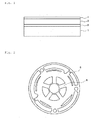
- FIG. 1 designates a steel plate, 2 an adhesive layer, 3 a rubber layer, and 4 a surface coating material layer.
- the rubber coated metal shown in FIG. 1 is formed into a gasket as shown in FIG. 2 , which is to be widely used in a compressor of an automobile air conditioner.
- reference numeral 5 designates a bead, and 6 a retainer.
- Examples of functions of a gasket include a shape keeping function as a basic one, and a fluid sealing function by an embossed bead of the gasket.
- the functions of the gasket include a particularly important one to be achieved by a "retainer" drawn at a central part of the gasket.
- Automobile air conditioners are each configured to use flon as a cooling medium, and to conduct an exchange of thermal energy by a cycle of compression, liquefaction, and evaporation of flon.
- the compressed flon is transferred to a next stage by opening and closing of a discharge valve.
- the discharge valve is controlled in an opening/closing amount thereof by the retainer fabricated on the gasket. Since the discharge valve is contacted with the gasket at a frequency on the order of 4,000 to 9,000 times/minute, the retainer is required to possess a higher strength and a higher elasticity.
- Patent Document 1 Disclosed in Patent Document 1 is a manufacturing method of a stainless steel plate for a flapper valve, and particularly a method for manufacturing a stainless steel plate for a flapper valve, which steel plate has an improved fatigue property, is high in hardness and is thus less in occurrence of burrs after punching, and is subjected to a cold rolling at a rolling reduction ratio of 5% or more. Apparently, it is classified into a stainless steel plate, because it contains 2.0 to 6.0 mass% of Ni, and 12.0 to 20.0 mass% of Cr.
- Patent Document 1 a cold rolled steel plate (SPCC)
- SPCC cold rolled steel plate
- Patent Document 2 is a manufacturing method of a cold rolled steel plate for a gasket material, comprising the steps of: hot rolling a continuously cast article produced by a continuous casting method comprising Mn: 0.5 to 3.0%, Ni: ⁇ 1.2%, and balacne Fe and inevitable impurities; hot rolling it; acid pickling it; and cold rolling it at a rolling reduction ratio of 30 to 90%.
- Mn is a component required to be included at 0.5% or more so as to prevent red shortness of a primitive plate due to S as an impurity, and to provide the plate with a higher refining degree.
- the invention recited in claim 1 resides in a manufacturing method of a gasket-oriented steel plate, comprising the steps of:
- the invention recited in claim 2 resides in the manufacturing method of a gasket-oriented steel plate according to claim 1, further comprising the steps in the order of:
- the invention recited in claim 3 resides in the manufacturing method of a gasket-oriented steel plate according to claim 1 or 2, wherein the starting steel material contains Mn in an amount of 0.3% or less.
- the invention recited in claim 4 resides in a gasket formed by adopting a gasket-oriented steel plate obtained by the manufacturing method of a gasket-oriented steel plate according to any one of claims 1 to 3.
- the present invention it becomes possible: to manufacture such a kind of gasket-oriented steel plate excellent in elasticity and formability, in a manner to allow for reduction of a breaking elongation of the steel plate to thereby improve a formability (punchability) thereof while improving a proof stress of the steel plate against a repeated stress from a discharge valve to thereby maintain a higher elasticity of the steel plate; and to provide a gasket withstandable to the repeated stress from the discharge valve.
- the starting steel material upon manufacturing a gasket-oriented steel plate is provided by preparing a general-purpose product such as SPCC, SPCD, SPCE, SPCF, and SPCG prescribed by JIS G3141 (cold rolled steel plate and steel band) in a manner to contain Mn as a chemical component in an amount less than 0.5%. Further, the starting steel material is configured to contain carbon as an additional component in an amount of 0.15% or less. Other additional components contained in the starting steel material are P, S, and the like, and Fe as a remaining component.
- a general-purpose product such as SPCC, SPCD, SPCE, SPCF, and SPCG prescribed by JIS G3141 (cold rolled steel plate and steel band) in a manner to contain Mn as a chemical component in an amount less than 0.5%.
- the starting steel material is configured to contain carbon as an additional component in an amount of 0.15% or less.
- Other additional components contained in the starting steel material are P, S, and the like, and Fe as a remaining component.
- the starting steel material in the present invention contains, in its chemical composition, Ni in an amount less than 2.0%, preferably less than 1.5%, and Cr in an amount less than 12.0%, and preferably less than 10%.
- Ni and Cr, if any, are contained in such smaller amounts as noted just above, respectively, so that the starting steel material of the present invention is never matured into such a stainless steel plate as described in JP2005-36266A (Patent Document 2).
- Mn is contained in the starting steel material in an amount less than 0.5%, thereby exhibiting the following effects. Namely, addition of manganese exhibiting a reinforcing property in an amount of 0.5% or more has considerably increased a strength of a steel, thereby bringing about such a problem of punchability that a specific die made of high speed steel, cemented carbide, or the like as a press material is required upon punching a product. However, addition of manganese in an amount less than 0.5% brings about such an advantage that a die made of SKD11, which is a general-purpose material, can form the steel plate.
- the method of the present invention for manufacturing a gasket-oriented steel plate is characterized in that the method comprises the steps of: annealing the above described starting steel material; and subsequently conducting a temper rolling treatment at a rolling reduction ratio of 10% or more.
- the present invention is not limited in terms of a step(s) before the annealing, it is possible for the starting steel material to be successively passed through the steps in the order of a hot rolling step, an acid pickling step, and a cold rolling step, for example.
- the molten steel having been prepared to have the above chemical components is smelted by a typically known smelting method using a converter or the like, and then prepared by a typically used casting method such as a continuous casting method into a material to be rolled then.
- the material to be rolled is heated to about 1,200°C, and then successively stretched by rolls while the material is still in a hot state, in a manner to hot roll the material into a thickness on the order of 2 to 4mm at about 600°C.
- the hot rolling may be adjusted in terms of a temperature for processing, a rate for cooling, and the like, thereby allowing for obtainment of various steel materials.
- the thermally stretched plate having been hot rolled into a thickness of 2 to 4 mm is to be preferably acid pickled.
- the method for acid pickling is not particularly limited, and examples of usable acids include various organic acids or inorganic acids.
- the plate After acid pickling, the plate is cold rolled at an ordinary temperature into a thickness on the order of 0.1 mm to several mm. "Cold” means that a heat is not particularly applied. It is possible here to conduct annealing after cold rolling.
- temper rolling is conducted after annealing. It is important in the present invention to set the rolling reduction ratio at 10% or more.
- the rolling reduction ratio is also called a "temper rolling reduction ratio" hereinafter.
- temper rolling reduction ratio is less than 10%, it will lead to insufficient strain hardening, thereby failing to obtain an appropriate proof stress (of 290MPa or more, preferably 315MPa or more) and failing to withstand a stress from a discharge valve, and thereby causing a damage of a steel plate.
- the temper rolled steel plate is subjected to occurrence of a strain hardening phenomenon where the steel plate is enabled to withstand a repeated stress from a discharge valve, thereby enabling to manufacture such a kind of gasket-oriented steel plate excellent in elasticity and formability, in a manner that the strain hardening phenomenon allows to decrease a breaking elongation of the plate down to less than 33% (preferably down to 30% or less) to thereby improve the formability (punchability) thereof while improving a proof stress thereof to maintain a higher elasticity.
- the gasket of the present invention is obtainable by exemplarily forming and fabricating the above manufactured gasket-oriented steel plate into a rubber coated metal. Examples of its shape include one shown in FIG. 2 .
- the obtained gasket exhibits an effect to withstand a repeated stress from a discharge valve, by virtue of the properties of the steel plate as a starting material of the gasket.
- Example 1 to Example 3 Comparative Example 1 to Comparative Example 4:
- Component analysis values of reinforcing components were obtained as analysis values of molten steels, respectively.
- test pieces specified in JIS Z 2201 were used, and were each subjected to measurement of a proof stress (MPa), a tensile strength (MPa), and a breaking elongation (%) all in conformity to JIS Z 2241 by the following measurement, while adopting a rolling direction of each steel plate as a test direction.
- MPa proof stress
- MPa tensile strength
- % breaking elongation
- SKD11 was used. In case of failure of punching by means of SKD11, a high speed steel was used. Amount of burr: An amount of burr was measured by a shape measuring instrument after punching, setting the clearance of 0.06mm between the punch and the die. Cross-section state: A sheared section or broken section after punching was visually observed, to evaluate whether it was homogeneous or inhomogeneous.
- Each rubber coated metal was formed into a gasket, and evaluated for presence/absence of retainer-crack due to a repeated load from a discharge valve.
- Example 1 The steel plates of Examples 1 to 3 were each punchable by means of SKD11, less in amount of burr, and homogeneous in cross-section state. Further, retainer-cracks were not caused in gaskets manufactured from Examples 1 to 3. Example 2 is more suitable for mass-production.
- Comparative Example 1 (rolling reduction ratio of 2%) exhibited a proof stress and a breaking elongation, out of appropriate ranges, respectively.
- Comparative Example 2 (rolling reduction ratio of 2%, and manganese amount of 0.7%) exhibited a proof stress by virtue of the increased manganese amount, but exhibited a breaking elongation exceeding an appropriate range.
- Comparative Examples 1 and 2 exhibited more amounts of burr than Examples 1 to 3, and cross-section states of Comparative Examples 1 and 2 were inhomogeneous, respectively. Retainer-cracks were found in gaskets formed from Comparative Examples 1 and 2.
- Comparative Example 3 (rolling reduction ratio of 2%, and manganese amount of 1.2%) exhibited an excessively increased strength, and was not punchable by means of SKD11.
- Comparative Example 4 (rolling reduction ratio of 5%) exhibited a breaking elongation exceeding an appropriate range, and its cross-section state was inhomogeneous. Further, retainer-cracks were found in a gasket formed from Comparative Example 4.
Landscapes
- Chemical & Material Sciences (AREA)
- Engineering & Computer Science (AREA)
- Mechanical Engineering (AREA)
- Materials Engineering (AREA)
- Metallurgy (AREA)
- Organic Chemistry (AREA)
- Physics & Mathematics (AREA)
- Thermal Sciences (AREA)
- Crystallography & Structural Chemistry (AREA)
- General Engineering & Computer Science (AREA)
- Heat Treatment Of Sheet Steel (AREA)
Applications Claiming Priority (2)
| Application Number | Priority Date | Filing Date | Title |
|---|---|---|---|
| JP2008324346 | 2008-12-19 | ||
| PCT/JP2009/006541 WO2010070829A1 (fr) | 2008-12-19 | 2009-12-02 | Procédé de production d'une feuille d'acier pour joint d'étanchéité et joint d'étanchéité |
Publications (1)
| Publication Number | Publication Date |
|---|---|
| EP2377954A1 true EP2377954A1 (fr) | 2011-10-19 |
Family
ID=42268512
Family Applications (1)
| Application Number | Title | Priority Date | Filing Date |
|---|---|---|---|
| EP09833139A Withdrawn EP2377954A1 (fr) | 2008-12-19 | 2009-12-02 | Procédé de production d'une feuille d'acier pour joint d'étanchéité et joint d'étanchéité |
Country Status (6)
| Country | Link |
|---|---|
| US (2) | US20110114232A1 (fr) |
| EP (1) | EP2377954A1 (fr) |
| JP (1) | JP5321599B2 (fr) |
| KR (1) | KR20110126519A (fr) |
| CN (1) | CN102105606A (fr) |
| WO (1) | WO2010070829A1 (fr) |
Families Citing this family (3)
| Publication number | Priority date | Publication date | Assignee | Title |
|---|---|---|---|---|
| WO2015130187A1 (fr) * | 2014-02-27 | 2015-09-03 | Иван Тимофеевич ТОЦКИЙ | Précédé de préparation de produit semi-fini en acier laminé à chaud en vue du laminage à froid |
| DE112020002503T5 (de) * | 2019-05-21 | 2022-05-19 | Nok Corporation | Dichtung |
| CN116426729A (zh) * | 2023-02-24 | 2023-07-14 | 首钢集团有限公司 | 一种钢及其制备方法 |
Family Cites Families (8)
| Publication number | Priority date | Publication date | Assignee | Title |
|---|---|---|---|---|
| JPS59129733A (ja) * | 1983-01-17 | 1984-07-26 | Kawasaki Steel Corp | ストレツチヤ−ストレインの発生しない硬質ぶりき用めつき原板の製造方法 |
| JPS60262918A (ja) * | 1984-06-08 | 1985-12-26 | Kawasaki Steel Corp | ストレツチヤ−ストレインの発生しない表面処理原板の製造方法 |
| JPH0737659B2 (ja) * | 1990-09-11 | 1995-04-26 | 新日本製鐵株式会社 | プレス成形時の耐バリ性、絞り性に優れた冷延鋼板およびその製造方法 |
| JP2000256802A (ja) * | 1999-03-03 | 2000-09-19 | Nisshin Steel Co Ltd | 耐へたり性に優れたメタルガスケット用ステンレス鋼材およびその製造法 |
| JP2003041350A (ja) | 2001-08-01 | 2003-02-13 | Nisshin Steel Co Ltd | フラッパーバルブ用マルテンサイト系ステンレス鋼板およびその製造方法 |
| JP2003105502A (ja) * | 2001-09-25 | 2003-04-09 | Nisshin Steel Co Ltd | 高温耐へたり性に優れたメタルガスケット用ステンレス鋼およびメタルガスケット |
| JP2005036266A (ja) | 2003-07-18 | 2005-02-10 | Toyo Kohan Co Ltd | ガスケット材用冷延鋼板、その製造法およびガスケット材 |
| JP2007270329A (ja) * | 2006-03-31 | 2007-10-18 | Jfe Steel Kk | ファインブランキング加工性に優れた鋼板の製造方法 |
-
2009
- 2009-12-02 US US13/054,666 patent/US20110114232A1/en not_active Abandoned
- 2009-12-02 KR KR1020107027541A patent/KR20110126519A/ko not_active Withdrawn
- 2009-12-02 EP EP09833139A patent/EP2377954A1/fr not_active Withdrawn
- 2009-12-02 CN CN2009801292305A patent/CN102105606A/zh active Pending
- 2009-12-02 WO PCT/JP2009/006541 patent/WO2010070829A1/fr not_active Ceased
- 2009-12-02 JP JP2010542830A patent/JP5321599B2/ja active Active
-
2012
- 2012-08-02 US US13/565,208 patent/US20130025337A1/en not_active Abandoned
Non-Patent Citations (1)
| Title |
|---|
| See references of WO2010070829A1 * |
Also Published As
| Publication number | Publication date |
|---|---|
| CN102105606A (zh) | 2011-06-22 |
| KR20110126519A (ko) | 2011-11-23 |
| US20130025337A1 (en) | 2013-01-31 |
| WO2010070829A1 (fr) | 2010-06-24 |
| US20110114232A1 (en) | 2011-05-19 |
| JP5321599B2 (ja) | 2013-10-23 |
| JPWO2010070829A1 (ja) | 2012-05-24 |
Similar Documents
| Publication | Publication Date | Title |
|---|---|---|
| JP4321066B2 (ja) | 金属ガスケットとその素材およびそれらの製造方法 | |
| CN105401073B (zh) | 一种汽车离合器膜片合金弹簧冷轧钢带51CrV4 热处理工艺 | |
| JP2011506886A (ja) | 金属製平板ガスケットおよび製造方法 | |
| KR100385342B1 (ko) | 가스킷용 스테인레스 강, 그의 제조방법 및 그에 따른 가스킷 | |
| EP2377954A1 (fr) | Procédé de production d'une feuille d'acier pour joint d'étanchéité et joint d'étanchéité | |
| CN110100022B (zh) | 加工性优异的冷轧钢板及其制造方法 | |
| CN103361563B (zh) | 一种易切削高硬度奥氏体无磁模具钢及其制造方法 | |
| CN1974813A (zh) | 空调器用铝箔 | |
| EP4276212A1 (fr) | Acier à engrenage forgé à froid et son procédé de fabrication | |
| EP2671962A1 (fr) | Feuille d'acier pour un fond de boîte métallique d'aérosol ayant une résistance élevée à la pression et une excellente aptitude au façonnage et son procédé de fabrication | |
| JP3093091B2 (ja) | メタルガスケットの製造方法 | |
| CN109722604B (zh) | 一种两片喷雾罐用镀锡板及其制造方法 | |
| EP1566460A1 (fr) | Tole d'acier laminee a froid pour joints, son procede de fabrication, et joints en etant fait | |
| US8066830B2 (en) | Method for producing a shaft for compressors | |
| EP1990556A1 (fr) | Element de fixation et son procede de fabrication | |
| CN117778888A (zh) | 具有优良冲裁性能的400MPa级垫片钢及其制备方法 | |
| KR20150028502A (ko) | 성형성이 향상된 고장력강의 제조방법 | |
| CN113088669B (zh) | 一种半奥氏体沉淀硬化不锈钢精密带钢提高表面硬度的方法 | |
| CN113718172A (zh) | 一种1200MPa级低碳马氏体钢带及其生产方法 | |
| EP4681837A1 (fr) | Article façonné d'estampage à chaud et son procédé de fabrication | |
| CN117778887A (zh) | 具有优良冲裁性能的300MPa级垫片钢及其制备方法 | |
| EP4450672A1 (fr) | Tôle d'acier laminée à froid et son procédé de fabrication | |
| WO2005083140A1 (fr) | Feuillard d'acier enroule extrement mince ayant une force elevee; procede pour la production; materiau pour joint utilisant la feuille et l'organe de joint utilisant le materiau | |
| CN116900135A (zh) | 一种免抛丸热冲压零件及其制备方法 | |
| KR20240052320A (ko) | 전지 케이스용 냉연강판 및 이의 제조방법 |
Legal Events
| Date | Code | Title | Description |
|---|---|---|---|
| PUAI | Public reference made under article 153(3) epc to a published international application that has entered the european phase |
Free format text: ORIGINAL CODE: 0009012 |
|
| 17P | Request for examination filed |
Effective date: 20110524 |
|
| AK | Designated contracting states |
Kind code of ref document: A1 Designated state(s): AT BE BG CH CY CZ DE DK EE ES FI FR GB GR HR HU IE IS IT LI LT LU LV MC MK MT NL NO PL PT RO SE SI SK SM TR |
|
| DAX | Request for extension of the european patent (deleted) | ||
| STAA | Information on the status of an ep patent application or granted ep patent |
Free format text: STATUS: THE APPLICATION HAS BEEN WITHDRAWN |
|
| 18W | Application withdrawn |
Effective date: 20140430 |