EP2380933B1 - Cross-linked elastomer with thermoplastic transformation and method for preparing same - Google Patents
Cross-linked elastomer with thermoplastic transformation and method for preparing same Download PDFInfo
- Publication number
- EP2380933B1 EP2380933B1 EP11161880.7A EP11161880A EP2380933B1 EP 2380933 B1 EP2380933 B1 EP 2380933B1 EP 11161880 A EP11161880 A EP 11161880A EP 2380933 B1 EP2380933 B1 EP 2380933B1
- Authority
- EP
- European Patent Office
- Prior art keywords
- phase
- thermoplastic
- thermoplastic elastomer
- extruder
- phases
- Prior art date
- Legal status (The legal status is an assumption and is not a legal conclusion. Google has not performed a legal analysis and makes no representation as to the accuracy of the status listed.)
- Active
Links
Images
Classifications
-
- C—CHEMISTRY; METALLURGY
- C08—ORGANIC MACROMOLECULAR COMPOUNDS; THEIR PREPARATION OR CHEMICAL WORKING-UP; COMPOSITIONS BASED THEREON
- C08L—COMPOSITIONS OF MACROMOLECULAR COMPOUNDS
- C08L77/00—Compositions of polyamides obtained by reactions forming a carboxylic amide link in the main chain; Compositions of derivatives of such polymers
-
- B—PERFORMING OPERATIONS; TRANSPORTING
- B29—WORKING OF PLASTICS; WORKING OF SUBSTANCES IN A PLASTIC STATE IN GENERAL
- B29C—SHAPING OR JOINING OF PLASTICS; SHAPING OF MATERIAL IN A PLASTIC STATE, NOT OTHERWISE PROVIDED FOR; AFTER-TREATMENT OF THE SHAPED PRODUCTS, e.g. REPAIRING
- B29C48/00—Extrusion moulding, i.e. expressing the moulding material through a die or nozzle which imparts the desired form; Apparatus therefor
- B29C48/25—Component parts, details or accessories; Auxiliary operations
- B29C48/36—Means for plasticising or homogenising the moulding material or forcing it through the nozzle or die
- B29C48/395—Means for plasticising or homogenising the moulding material or forcing it through the nozzle or die using screws surrounded by a cooperating barrel, e.g. single screw extruders
- B29C48/40—Means for plasticising or homogenising the moulding material or forcing it through the nozzle or die using screws surrounded by a cooperating barrel, e.g. single screw extruders using two or more parallel screws or at least two parallel non-intermeshing screws, e.g. twin screw extruders
-
- C—CHEMISTRY; METALLURGY
- C08—ORGANIC MACROMOLECULAR COMPOUNDS; THEIR PREPARATION OR CHEMICAL WORKING-UP; COMPOSITIONS BASED THEREON
- C08K—Use of inorganic or non-macromolecular organic substances as compounding ingredients
- C08K3/00—Use of inorganic substances as compounding ingredients
- C08K3/18—Oxygen-containing compounds, e.g. metal carbonyls
- C08K3/20—Oxides; Hydroxides
- C08K3/22—Oxides; Hydroxides of metals
-
- C—CHEMISTRY; METALLURGY
- C08—ORGANIC MACROMOLECULAR COMPOUNDS; THEIR PREPARATION OR CHEMICAL WORKING-UP; COMPOSITIONS BASED THEREON
- C08L—COMPOSITIONS OF MACROMOLECULAR COMPOUNDS
- C08L23/00—Compositions of homopolymers or copolymers of unsaturated aliphatic hydrocarbons having only one carbon-to-carbon double bond; Compositions of derivatives of such polymers
- C08L23/02—Compositions of homopolymers or copolymers of unsaturated aliphatic hydrocarbons having only one carbon-to-carbon double bond; Compositions of derivatives of such polymers not modified by chemical after-treatment
-
- C—CHEMISTRY; METALLURGY
- C08—ORGANIC MACROMOLECULAR COMPOUNDS; THEIR PREPARATION OR CHEMICAL WORKING-UP; COMPOSITIONS BASED THEREON
- C08L—COMPOSITIONS OF MACROMOLECULAR COMPOUNDS
- C08L23/00—Compositions of homopolymers or copolymers of unsaturated aliphatic hydrocarbons having only one carbon-to-carbon double bond; Compositions of derivatives of such polymers
- C08L23/02—Compositions of homopolymers or copolymers of unsaturated aliphatic hydrocarbons having only one carbon-to-carbon double bond; Compositions of derivatives of such polymers not modified by chemical after-treatment
- C08L23/04—Homopolymers or copolymers of ethene
- C08L23/06—Polyethylene
-
- C—CHEMISTRY; METALLURGY
- C08—ORGANIC MACROMOLECULAR COMPOUNDS; THEIR PREPARATION OR CHEMICAL WORKING-UP; COMPOSITIONS BASED THEREON
- C08L—COMPOSITIONS OF MACROMOLECULAR COMPOUNDS
- C08L23/00—Compositions of homopolymers or copolymers of unsaturated aliphatic hydrocarbons having only one carbon-to-carbon double bond; Compositions of derivatives of such polymers
- C08L23/02—Compositions of homopolymers or copolymers of unsaturated aliphatic hydrocarbons having only one carbon-to-carbon double bond; Compositions of derivatives of such polymers not modified by chemical after-treatment
- C08L23/04—Homopolymers or copolymers of ethene
- C08L23/08—Copolymers of ethene
-
- C—CHEMISTRY; METALLURGY
- C08—ORGANIC MACROMOLECULAR COMPOUNDS; THEIR PREPARATION OR CHEMICAL WORKING-UP; COMPOSITIONS BASED THEREON
- C08L—COMPOSITIONS OF MACROMOLECULAR COMPOUNDS
- C08L23/00—Compositions of homopolymers or copolymers of unsaturated aliphatic hydrocarbons having only one carbon-to-carbon double bond; Compositions of derivatives of such polymers
- C08L23/02—Compositions of homopolymers or copolymers of unsaturated aliphatic hydrocarbons having only one carbon-to-carbon double bond; Compositions of derivatives of such polymers not modified by chemical after-treatment
- C08L23/04—Homopolymers or copolymers of ethene
- C08L23/08—Copolymers of ethene
- C08L23/0807—Copolymers of ethene with unsaturated hydrocarbons only containing four or more carbon atoms
- C08L23/0815—Copolymers of ethene with unsaturated hydrocarbons only containing four or more carbon atoms with aliphatic 1-olefins containing one carbon-to-carbon double bond
-
- C—CHEMISTRY; METALLURGY
- C08—ORGANIC MACROMOLECULAR COMPOUNDS; THEIR PREPARATION OR CHEMICAL WORKING-UP; COMPOSITIONS BASED THEREON
- C08L—COMPOSITIONS OF MACROMOLECULAR COMPOUNDS
- C08L23/00—Compositions of homopolymers or copolymers of unsaturated aliphatic hydrocarbons having only one carbon-to-carbon double bond; Compositions of derivatives of such polymers
- C08L23/02—Compositions of homopolymers or copolymers of unsaturated aliphatic hydrocarbons having only one carbon-to-carbon double bond; Compositions of derivatives of such polymers not modified by chemical after-treatment
- C08L23/10—Homopolymers or copolymers of propene
- C08L23/14—Copolymers of propene
-
- C—CHEMISTRY; METALLURGY
- C08—ORGANIC MACROMOLECULAR COMPOUNDS; THEIR PREPARATION OR CHEMICAL WORKING-UP; COMPOSITIONS BASED THEREON
- C08L—COMPOSITIONS OF MACROMOLECULAR COMPOUNDS
- C08L67/00—Compositions of polyesters obtained by reactions forming a carboxylic ester link in the main chain; Compositions of derivatives of such polymers
-
- C—CHEMISTRY; METALLURGY
- C08—ORGANIC MACROMOLECULAR COMPOUNDS; THEIR PREPARATION OR CHEMICAL WORKING-UP; COMPOSITIONS BASED THEREON
- C08L—COMPOSITIONS OF MACROMOLECULAR COMPOUNDS
- C08L75/00—Compositions of polyureas or polyurethanes; Compositions of derivatives of such polymers
-
- C—CHEMISTRY; METALLURGY
- C08—ORGANIC MACROMOLECULAR COMPOUNDS; THEIR PREPARATION OR CHEMICAL WORKING-UP; COMPOSITIONS BASED THEREON
- C08L—COMPOSITIONS OF MACROMOLECULAR COMPOUNDS
- C08L79/00—Compositions of macromolecular compounds obtained by reactions forming in the main chain of the macromolecule a linkage containing nitrogen with or without oxygen or carbon only, not provided for in groups C08L61/00 - C08L77/00
- C08L79/04—Polycondensates having nitrogen-containing heterocyclic rings in the main chain; Polyhydrazides; Polyamide acids or similar polyimide precursors
- C08L79/08—Polyimides; Polyester-imides; Polyamide-imides; Polyamide acids or similar polyimide precursors
-
- C—CHEMISTRY; METALLURGY
- C08—ORGANIC MACROMOLECULAR COMPOUNDS; THEIR PREPARATION OR CHEMICAL WORKING-UP; COMPOSITIONS BASED THEREON
- C08L—COMPOSITIONS OF MACROMOLECULAR COMPOUNDS
- C08L83/00—Compositions of macromolecular compounds obtained by reactions forming in the main chain of the macromolecule a linkage containing silicon with or without sulfur, nitrogen, oxygen or carbon only; Compositions of derivatives of such polymers
- C08L83/04—Polysiloxanes
-
- C—CHEMISTRY; METALLURGY
- C08—ORGANIC MACROMOLECULAR COMPOUNDS; THEIR PREPARATION OR CHEMICAL WORKING-UP; COMPOSITIONS BASED THEREON
- C08L—COMPOSITIONS OF MACROMOLECULAR COMPOUNDS
- C08L91/00—Compositions of oils, fats or waxes; Compositions of derivatives thereof
-
- C—CHEMISTRY; METALLURGY
- C08—ORGANIC MACROMOLECULAR COMPOUNDS; THEIR PREPARATION OR CHEMICAL WORKING-UP; COMPOSITIONS BASED THEREON
- C08K—Use of inorganic or non-macromolecular organic substances as compounding ingredients
- C08K3/00—Use of inorganic substances as compounding ingredients
- C08K3/34—Silicon-containing compounds
- C08K3/36—Silica
-
- C—CHEMISTRY; METALLURGY
- C08—ORGANIC MACROMOLECULAR COMPOUNDS; THEIR PREPARATION OR CHEMICAL WORKING-UP; COMPOSITIONS BASED THEREON
- C08L—COMPOSITIONS OF MACROMOLECULAR COMPOUNDS
- C08L23/00—Compositions of homopolymers or copolymers of unsaturated aliphatic hydrocarbons having only one carbon-to-carbon double bond; Compositions of derivatives of such polymers
- C08L23/02—Compositions of homopolymers or copolymers of unsaturated aliphatic hydrocarbons having only one carbon-to-carbon double bond; Compositions of derivatives of such polymers not modified by chemical after-treatment
- C08L23/10—Homopolymers or copolymers of propene
-
- C—CHEMISTRY; METALLURGY
- C08—ORGANIC MACROMOLECULAR COMPOUNDS; THEIR PREPARATION OR CHEMICAL WORKING-UP; COMPOSITIONS BASED THEREON
- C08L—COMPOSITIONS OF MACROMOLECULAR COMPOUNDS
- C08L51/00—Compositions of graft polymers in which the grafted component is obtained by reactions only involving carbon-to-carbon unsaturated bonds; Compositions of derivatives of such polymers
- C08L51/06—Compositions of graft polymers in which the grafted component is obtained by reactions only involving carbon-to-carbon unsaturated bonds; Compositions of derivatives of such polymers grafted on to homopolymers or copolymers of aliphatic hydrocarbons containing only one carbon-to-carbon double bond
-
- C—CHEMISTRY; METALLURGY
- C08—ORGANIC MACROMOLECULAR COMPOUNDS; THEIR PREPARATION OR CHEMICAL WORKING-UP; COMPOSITIONS BASED THEREON
- C08L—COMPOSITIONS OF MACROMOLECULAR COMPOUNDS
- C08L53/00—Compositions of block copolymers containing at least one sequence of a polymer obtained by reactions only involving carbon-to-carbon unsaturated bonds; Compositions of derivatives of such polymers
-
- C—CHEMISTRY; METALLURGY
- C08—ORGANIC MACROMOLECULAR COMPOUNDS; THEIR PREPARATION OR CHEMICAL WORKING-UP; COMPOSITIONS BASED THEREON
- C08L—COMPOSITIONS OF MACROMOLECULAR COMPOUNDS
- C08L75/00—Compositions of polyureas or polyurethanes; Compositions of derivatives of such polymers
- C08L75/04—Polyurethanes
Definitions
- the present invention relates to a crosslinked elastomer with thermoplastic transformation (“TPV”) of the type comprising two phases, respectively thermoplastic and liquid silicone elastomer (“LSR”), and its preparation process.
- TPV thermoplastic transformation
- LSR liquid silicone elastomer
- thermoplastic silicone vulcanisates are formed in known manner by dynamic crosslinking of a silicone phase, for example of the liquid bi- components (“LSR” for “Liquid Silicone Rubber” in English) in the presence of a thermoplastic phase.
- LSR liquid Silicone Rubber
- TPSiV thermoplastic phase
- An object of the present invention is to remedy this drawback, and this object is achieved in that the Applicant has just discovered in a surprising manner that if one injects into a twin-screw extruder, according to a sequence and conditions particular shear and temperature, a thermoplastic phase, a liquid silicone phase, a specific compatibilizing system and a reinforcing filler, then a “TPV” is obtained by reactive extrusion in which at least the silicone phase is continuous and in which the thermoplastic phase can be dispersed there with a much improved homogeneity and fineness compared to known “TPSiV” based on the same thermoplastic polymer (s), which makes it possible to significantly improve their resistance to rupture, tearing and their remanent deformation in compression and in addition to make these "TPV” according to the invention completely capable of being again m is implemented and transformed without penalizing their properties.
- this “TPV” advantageously forms a homogeneous mixture of these first and second phases, with at least the second phase which is continuous there.
- the first phase can be a discontinuous phase formed of nodules dispersed in the second continuous phase, or else these first and second phases can be co-continuous in the mixture in the form of nodules of one contained in the other and vice versa, these nodules having in these two cases an average size less than 10 ⁇ m and preferably between 50 nm and 5 ⁇ m.
- this “TPV” comprises the product of the reaction, by this reactive extrusion, of said at least one thermoplastic polymer and of said polyorganosiloxane which is present in excess relative to the stoichiometric proportions of the two components of the liquid silicone and which exhibits said functional groups SiH, monovalent, at its chain ends or along its chain, this polyorganosiloxane grafting by this reaction on said at least one thermoplastic polymer.
- said polymer included in the compatibilizing system comprises said grafted polyolefin, which can be chosen from the group consisting of homopolymers and copolymers of olefins and copolymers of at least one olefin and at least one non-comonomer olefinic and, even more preferably, in the group consisting of homopolymers of an alpha-olefin, such as polypropylenes, and copolymers of ethylene and an amide, and preferably this polyolefin is grafted with l maleic anhydride.
- said grafted polyolefin which can be chosen from the group consisting of homopolymers and copolymers of olefins and copolymers of at least one olefin and at least one non-comonomer olefinic and, even more preferably, in the group consisting of homopolymers of an alpha-olefin, such as polypropylenes, and copolymers of ethylene
- said polymer included in the compatibilizing system can be for example a terpolymer with polystyrene / polybutadiene-1,4 / polymethyl methacrylate blocks such as that of designation "SBM”, a terpolymer with polymethyl methacrylate blocks / polybutylacrylate / methyl methacrylate such as that of designation “MAM”, an ethylene-methyl acrylate-acrylic acid terpolymer such as those of designation “ATX”, or alternatively an ethylene / methylacrylate / glycidyl methacrylate terpolymer .
- thermoplastic polymer in a “TPV” according to the invention, can be chosen from the group consisting of isotactic polypropylenes, propylene copolymers, high density polyethylenes, low density polyethylenes, copolyesters (COPE), polyether block amides (PEBA), polyamides 6, polyamides 4.6, polyamides 6.6, polyamides 11, polyamides 12, thermoplastic polyurethanes (TPU) and their mixtures.
- a “TPV” according to the invention can also comprise, according to a mass fraction ranging from 1% to 30%, a reinforcing filler of said first and / or said second phase which can be any compatible filler known and which is preferably chosen from the group consisting of inorganic fillers such as hydrophobic fumed silicas, titanium dioxide and talc, organic fillers such as carbon black and graphite, and their mixtures.
- a reinforcing filler of said first and / or said second phase which can be any compatible filler known and which is preferably chosen from the group consisting of inorganic fillers such as hydrophobic fumed silicas, titanium dioxide and talc, organic fillers such as carbon black and graphite, and their mixtures.
- a process for the preparation according to the invention of a “TPV” as defined above comprises a reactive extrusion, implemented in at least one pass in a twin-screw extruder, of a mixture comprising said first and second phases and said compatibilizing system.
- said first phase before said second phase is introduced into said extruder, said first phase, said compatibilizing system preferably by means of a peristaltic pump, and a reinforcing filler of the first and / or second phase.
- the first and second phases are mixed in a dispersion zone of the extruder, at a temperature at least 20 ° C. above the melting point of said thermoplastic polymer or that of said thermoplastic polymers which is highest, and with a shear rate of the mixture in this dispersion zone which is greater than 10 2 s -1 and preferably equal to or greater than 10 3 s -1 .
- the mixture formed of granules which is obtained at the outlet of the extruder is subjected to a heat treatment, for example for several hours at a temperature between 100 ° C. and 150 °. C, for the improvement of the mechanical properties of this mixture, such as the resistance to rupture, the resistance to tearing and the residual deformation to compression.
- this post-extrusion heat treatment is optional, but avoids a final annealing step on the finished parts.
- these granules obtained by the compatibilizing system and by the reactive extrusion method of the invention are characterized by a significant improvement in these properties, compared with those of a "TPSiV" based on or of the same (s) thermoplastic polymer (s) in which the silicone elastomer forms a discontinuous phase dispersed in this (s) thermoplastic polymer (s).
- thermoplastic materials and with the advantages of silicone elastomers, and they are completely capable of being recycled without significant loss of their properties.
- a co-rotating twin-screw extruder with the name "CLEXTRAL EVOLUM 32" was used for reactive mixing in a single pass of the two phases, of the compatibilizing system and of the reinforcing filler.
- H-Siloxane The polyorganosiloxane containing SiH groups (of designation “H-Siloxane”) was introduced into the extruder by means of a peristaltic pump, and the two components B1 and B2 of the silicone elastomer ("LSR") by a "DOPAG” pump. This H-siloxane was introduced in excess relative to the stoichiometric amounts of the components B1 and B2.
- the residence time of all the compounds in the extruder was between 1 min. and 2 min. for all the tests carried out.
- mixing has been carried out at temperatures above 20 to 30 ° C. at least at the melting point of the one or that of the thermoplastic polymers of phase A having the highest melting point.
- this mixing temperature in the dispersion zone of the extruder being for example between 150 and 220 ° C and preferably between 160 and 200 ° C (these temperatures are given here by way of example only in the case where either polypropylene or TPU is used as the thermoplastic polymer for phase A).
- thermoplastic vulcanizates obtained it is optionally possible to carry out a second pass for each mixture in the extruder by adding thereto a system of antioxidants, for example of the phenol / aromatic amine type.
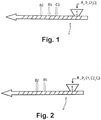
- thermoplastic vulcanizate "TPV 1" was prepared according to the method of the invention using a polyolefinic phase A with two polymers and, as compatibilizing system C between this phase A and phase B, the three compounds C1, C2 and C3 mentioned above introduced according to the first mode of the figure 1 .
- TPV 1 Ingredients of TPV 1 according to the invention Parts by weight per 100 parts of thermoplastic polymers and silicone elastomer PPH3060 8.25 (Polypropylene) Vistamaxx 6202 19.25 (ethylene-propylene copolymer) SL 7240 70 (“LSR” two-component B1 and B2) EXXELOR PO 1020 2.5 (maleic anhydride grafted polypropylene) Primol 352 10 (plasticizing white oil) H-siloxane 1 Silica Aerosil R972 1 TiO 2 5
- TPV 1 The above properties of this TPV 1 were measured and compared in Table 2 below to those of a TPSiV “5300” from the company Polyolefin-based Multibase (ie comprising a thermoplastic phase similar to that of this TPV 1 ).
- Table 2 ⁇ /u>: TPV 1 invention TPSiV witness "5300" Shore A hardness (15 s) 58 59 R / R (MPa) 6.5 4.4 A / R (%) 235 275 DELFT (N / m) 20.7 10.8 25% DRC 36 100 22 h at 100 ° C (%)
- the breaking strength, the tear strength DELFT and the residual compressive deformation at 100 ° C. of the TPV 1 according to the invention are very clearly superior to the same properties measured on a TPSiV available in trade based on a similar polyolefinic phase.
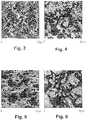
- this TPV 1 has a morphology such that the two thermoplastic phases A (clear) and silicone elastomer B (dark) are co-continuous (ie with a dispersion in each of the phases A and B of nodules of B and A, respectively), and we see at the figure 3 that this dispersion according to the invention is much finer (with average nodule sizes of between 1 ⁇ m and 2 ⁇ m approximately) than that which characterizes the two thermoplastic and silicone phases of the control TPSiV “5300” at the figure 4 .
- thermoplastic vulcanizate "TPV 2" was prepared according to the method of the invention using a polyamide phase A with a single polymer and, as compatibilizing system C between this phase A and phase B (unchanged), the three compounds C1, C2 and C3 mentioned above introduced according to the first mode of the figure 1 .
- the granules obtained at the outlet of the extruder were subjected to a heat treatment for several hours and at a temperature between 100 ° C. and 150 ° C.
- Table 3 ⁇ /u>: Ingredients of TPV 2 according to the invention Parts by weight per 100 parts of thermoplastic polymers and silicone elastomer Akulon F136DH 60 (polyamide PA 6) SL 7240 40 (“LSR” two-component B1 and B2) Lotader X-LP21H 5 (maleic anhydride grafted amide-ethylene copolymer) Sibercizer PA100 15 (sulfonamide plasticizer) H-siloxane 1 Silica Aerosil R972 1 TiO 2 5
- TPV 2 the mechanical properties of TPV 2 according to the invention are similar to those measured on this known TPSiV based on an analogous polyamide phase, with the exception however of the glass transition temperatures. Indeed, this TPV 2 has only one Tg, characteristic of a homogeneous mixture well compatibilized, while this TPSiV has two very different Tg, which testifies to a biphasic mixture and therefore of a less effective compatibilization than for POS 2.
- this TPV 2 has a morphology such that the two thermoplastic phases A (clear) and silicone elastomer B (dark) are co-continuous (with phase A which contains nodules of phase B with an average size of less than 1 ⁇ m), and we can see at the figure 5 that this dispersion is much better than that visible at figure 6 for the witness TPSiV "1180", which has its phases A and B which are visibly very distinct and very little compatible.
Landscapes
- Chemical & Material Sciences (AREA)
- Health & Medical Sciences (AREA)
- Chemical Kinetics & Catalysis (AREA)
- Medicinal Chemistry (AREA)
- Polymers & Plastics (AREA)
- Organic Chemistry (AREA)
- Oil, Petroleum & Natural Gas (AREA)
- Engineering & Computer Science (AREA)
- Mechanical Engineering (AREA)
- Compositions Of Macromolecular Compounds (AREA)
- Processes Of Treating Macromolecular Substances (AREA)
- Silicon Polymers (AREA)
Claims (13)
- Vernetztes Elastomer mit thermoplastischer Umwandlung, umfassend:- eine erste Phase (A) auf der Grundlage wenigstens eines thermoplastischen Polymers, gewählt aus der Gruppe, umfassend Olefinhomopolymere und - copolymere, Polyamide, Polyimide (PI), Polyphtalamide (PPA), Polyetherimide (PEI), Polyamidimide (PAI), thermoplastische Elastomere (TPE) und deren Mischungen, wobei das wenigstens eine thermoplastische Polymer in dem vernetzten Elastomer mit thermoplastischer Umwandlung mit einem Massenanteil von 20 % bis 80 % enthalten ist,- eine zweite Phase (B) auf der Grundlage wenigstens eines flüssigen Zweikomponenten-Silikonelastomers (B1 und B2), das durch Hydrosilylierung vernetzt ist, umfassend eine erste Komponente (B1), umfassend eine Mischung aus Diorganopolysiloxanen, eine verstärkende Kieselsäure und einen platinbasierten Hydrosilylierungskatalysator, und eine zweite Komponente (B2), umfassend ein Diorganopolysiloxan, eine Organohydridosilikonverbindung, eine verstärkende Kieselsäure und einen Inhibitor, wobei das wenigstens eine flüssige Silikonelastomer in dem vernetzten Elastomer mit thermoplastischer Umwandlung mit einem Massenanteil von 20 % bis 80 % enthalten ist, und- ein untereinander kompatibilisierendes System (C) für diese Phasen,dadurch gekennzeichnet, dass das System umfasst:- wenigstens ein Polymer (C1), gewählt aus der Gruppe, umfassend gepfropfte Polyolefine, Terpolymere mit Poly(vinylaromat/konjugiertes Dien/Methylmethacrylat)-Blöcken, Terpolymere mit Poly(methyl-alkylmethacrylatmethylacrylat)-Blöcken, Alkylacrylsäure-Ethylen(meth)acrylat-Terpolymere und Polymere, die sich von wenigstens einem Glycidylester wie beispielsweise Ethylen-(meth)acrylat-glycidyl(meth)acrylat-Terpolymeren ableiten, und- ein Polyorganosiloxan (C2) mit einer funktionellen SiH-Gruppe/funktionellen SiH-Gruppen,
und dadurch, dass das vernetzte Elastomer mit thermoplastischer Umwandlung eine homogene Dispersion der ersten und zweiten Phase bildet, die durch reaktive Extrusion mit wenigstens der kontinuierlichen zweiten Phase darin erhalten wurde, wobei die erste Phase (A) eine diskontinuierliche Phase ist, die aus Knötchen gebildet wird, die in der zweiten kontinuierlichen Phase (B) dispergiert sind, oder wobei die erste und zweite Phase in dem vernetzten Elastomer mit thermoplastischer Umwandlung als Knötchen der einen Phase in der anderen und umgekehrt gemeinsam kontinuierlich sind, wobei diese Knötchen in beiden Fällen eine durchschnittliche Größe von weniger als 10 µm aufweisen. - Vernetztes Elastomer mit thermoplastischer Umwandlung nach Anspruch 1, dadurch gekennzeichnet, dass die Knötchen in beiden Fällen eine durchschnittliche Größe zwischen 50 nm und 5 µm aufweisen.
- Vernetztes Elastomer mit thermoplastischer Umwandlung nach einem der vorhergehenden Ansprüche, dadurch gekennzeichnet, dass es das Reaktionsprodukt des wenigstens einen thermoplastischen Polymers und des Polyorganosiloxans (C2) durch reaktive Extrusion umfasst, welches über die stöchiometrischen Anteile der Komponenten (B1 und B2) hinaus vorhanden ist und die einwertigen SiH-Funktionsgruppen an seinen Kettenenden oder entlang seiner Kette aufweist, wobei sich das Polyorganosiloxan durch diese Reaktion auf das wenigstens eine thermoplastische Polymer aufpfropft.
- Vernetztes Elastomer mit thermoplastischer Umwandlung nach einem der vorhergehenden Ansprüche, dadurch gekennzeichnet, dass das in dem System enthaltene Polymer (C1) das gepfropfte Polyolefin umfasst, gewählt aus der Gruppe, umfassend Olefinhomopolymere und -copolymere und Copolymere wenigstens eines Olefins und wenigstens eines nicht-olefinischen Comonomers und bevorzugt aus der Gruppe, umfassend Homopolymere eines Alpha-Olefins, wie beispielsweise Polypropylene, und Copolymere des Ethylen und des Amids, und dass bevorzugt das Polyolefin mit Maleinsäureanhydrid gepfropft ist.
- Vernetztes Elastomer mit thermoplastischer Umwandlung nach einem der vorhergehenden Ansprüche, dadurch gekennzeichnet, dass es das kompatibilisierende System (C) mit einem Massenanteil von 1% bis 30 % umfasst, wobei das System (in Gewichtsteilen pro 100 Teile thermoplastische(s) Polymer(e) und Flüssigsilikonelastomer(e)) umfasst:- das Polymer (C1) in einer Menge von 0,1 bis 10 Gewichtsteilen,- das Polyorganosiloxan (C2) mit der/den funktionellen SiH-Gruppe(n) in einer Menge von 0,1 bis 2 Gewichtsteilen, und gegebenenfalls- einen Weichmacher (C3), wie beispielsweise ein paraffinhaltiges Öl, einen Weichmacher vom Ester-, Phosphat- oder Sulfonamid-Typ, in einer Menge von 0 bis 20 Gewichtsteilen.
- Vernetztes Elastomer mit thermoplastischer Umwandlung nach einem der vorhergehenden Ansprüche, dadurch gekennzeichnet, dass das wenigstens eine thermoplastische Polymer gewählt ist aus der Gruppe, umfassend isotaktische Polypropylene, Propylencopolymere, hochdichte Polyethylene, niederdichte Polyethylene, Copolyester (COPE), Polyetherblockamide (PEBA), Polyamide 6, Polyamide 4.6, Polyamide 6.6, Polyamide 11, Polyamide 12, thermoplastische Polyurethane (TPUs) und deren Mischungen.
- Vernetztes Elastomer mit thermoplastischer Umwandlung nach einem der vorhergehenden Ansprüche, dadurch gekennzeichnet, dass es ferner mit einem Massenanteil von 1% bis 30 % einen verstärkenden Füllstoff (D) der ersten (A) und/oder der zweiten Phase (B) umfasst, welcher gewählt ist aus der Gruppe, umfassend anorganische Füllstoffe, wie beispielsweise hydrophobe pyrogene Kieselsäuren, Titandioxid und Talkum, organische Füllstoffen, wie beispielsweise Rußschwarz und Graphit und deren Mischungen.
- Verfahren zur Herstellung eines vernetzten Elastomers mit thermoplastischer Umwandlung nach einem der vorhergehenden Ansprüche, dadurch gekennzeichnet, dass es eine in wenigstens einem Durchgang in einem Doppelschneckenextruder (2) durchgeführte reaktive Extrusion einer Mischung umfasst, welche die erste und zweite Phase (A und B) und das kompatibilisierende System (C) umfasst.
- Verfahren nach Anspruch 8, dadurch gekennzeichnet, dass vor der zweiten Phase (B) in den Extruder eingeführt wird:- die erste Phase (A),- das kompatibilisierende System (C), bevorzugt mittels einer peristaltischen Pumpe, und- eine verstärkende Füllung (D) der ersten und/oder zweiten Phase.
- Verfahren nach Anspruch 9, dadurch gekennzeichnet, dass gleichzeitig in eine Zuführzone (1) des Extruders (2) eingebracht werden:- die erste Phase (A),- das gesamte oder ein Teil des kompatibilisierenden Systems (C), und- eine verstärkende Füllung (D) der ersten und/oder zweiten Phase,
zum Erhalt einer Vormischung, die man dann optional mit dem verbleibenden Teil (C3) des Systems, und anschließend mit der zweiten Phase (8) reagieren lässt. - Verfahren nach einem der Ansprüche 8 bis 10, dadurch gekennzeichnet, dass die zweite Phase (B) mit der ersten Phase (A) durch Einspritzen in einer Dispersionszone des Extruders (2) vermischt wird:- eine erste Komponente (B1) dieser zweiten Phase, welche eine Mischung aus Diorganopolysiloxanen, einer verstärkenden Kieselsäure und einem Hydrosilylierungskatalysator auf Platinbasis umfasst, und dann- eine zweite Komponente (B2) dieser zweiten Phase, die ein Diorganopolysiloxan, eine Organohydridosilikonverbindung, eine verstärkende Kieselsäure und einen Inhibitor umfasst.
- Verfahren nach einem der Ansprüche 8 bis 11, dadurch gekennzeichnet, dass die erste und zweite Phase (A und B) in einer Dispersionszone des Extruders (2) bei einer Temperatur gemischt werden, die wenigstens 20 °C über dem Schmelzpunkt des thermoplastischen Polymers oder dem höchsten Schmelzpunkt der thermoplastischen Polymere liegt, und mit einer Scherrate der Mischung in der Dispersionszone, die größer als 102 s-1 und bevorzugt größer gleich 103 s-1 ist.
- Verfahren nach einem der Ansprüche 8 bis 12, dadurch gekennzeichnet, dass die aus Granulat gebildete Mischung, die am Ausgang des Extruders (2) erhalten wird, einer Wärmebehandlung unterzogen wird, beispielsweise für mehrere Stunden bei einer Temperatur zwischen 100 °C und 150 °C, um die mechanischen Eigenschaften dieser Mischung, wie Bruchfestigkeit, Reißfestigkeit und verbleibende Druckverformung zu verbessern.
Priority Applications (1)
| Application Number | Priority Date | Filing Date | Title |
|---|---|---|---|
| PL11161880T PL2380933T3 (pl) | 2010-04-21 | 2011-04-11 | Elastomer usieciowany w transformacji termoplastycznej i sposób jego przygotowania |
Applications Claiming Priority (1)
| Application Number | Priority Date | Filing Date | Title |
|---|---|---|---|
| FR1001697A FR2959235B1 (fr) | 2010-04-21 | 2010-04-21 | Elastomere reticule a transformation thermoplastique et son procede de preparation |
Publications (2)
| Publication Number | Publication Date |
|---|---|
| EP2380933A1 EP2380933A1 (de) | 2011-10-26 |
| EP2380933B1 true EP2380933B1 (de) | 2020-02-19 |
Family
ID=42307873
Family Applications (1)
| Application Number | Title | Priority Date | Filing Date |
|---|---|---|---|
| EP11161880.7A Active EP2380933B1 (de) | 2010-04-21 | 2011-04-11 | Cross-linked elastomer with thermoplastic transformation and method for preparing same |
Country Status (8)
| Country | Link |
|---|---|
| US (1) | US8648145B2 (de) |
| EP (1) | EP2380933B1 (de) |
| JP (1) | JP5927575B2 (de) |
| AR (1) | AR080961A1 (de) |
| BR (1) | BRPI1101750B1 (de) |
| ES (1) | ES2788695T3 (de) |
| FR (1) | FR2959235B1 (de) |
| PL (1) | PL2380933T3 (de) |
Families Citing this family (20)
| Publication number | Priority date | Publication date | Assignee | Title |
|---|---|---|---|---|
| FR2963624B1 (fr) | 2010-08-04 | 2014-02-21 | Hutchinson | Procede de preparation d'une composition thermoplastique renforcee et reactive, cette composition et son utilisation |
| US9365453B2 (en) | 2012-04-19 | 2016-06-14 | Construction Research & Technology Gmbh | Admixture and method for freeze-thaw damage resistance and scaling damage resistance of cementitious compositions |
| US9312047B2 (en) | 2012-06-22 | 2016-04-12 | Honeywell International Inc. | Method and compositions for producing polymer blends |
| FR2996617B1 (fr) * | 2012-10-08 | 2014-12-26 | Hutchinson | Courroie de transmission de puissance avec film thermoplastique comprenant un elastomere silicone. |
| US9102825B2 (en) | 2013-09-17 | 2015-08-11 | Nike, Inc. | Dynamically crosslinked thermoplastic material process |
| CN103756287B (zh) * | 2014-01-24 | 2015-12-02 | 福州大学 | 一种改性tpu压延薄膜及其制备方法 |
| EP3116952B1 (de) * | 2014-03-12 | 2019-11-06 | 3M Innovative Properties Company | Leitfähiges polymermaterial |
| KR20170039249A (ko) | 2014-08-12 | 2017-04-10 | 뮐티바스 에스아 | 열가소성 폴리우레탄 실리콘 탄성중합체 |
| TWI685533B (zh) * | 2014-11-21 | 2020-02-21 | 法商馬堤貝斯股份有限公司 | 熱塑性聚矽氧彈性體 |
| JP6437873B2 (ja) * | 2015-04-15 | 2018-12-12 | 信越ポリマー株式会社 | 押出成形品及びその製造方法並びに押出成形用成形原料及びその製造方法 |
| CN107636062B (zh) * | 2015-06-18 | 2021-05-04 | 陶氏环球技术有限责任公司 | 导热弹性复合材料 |
| FR3042246B1 (fr) | 2015-10-09 | 2018-03-23 | Hutchinson | Courroie de transmission de puissance avec film thermoplastique comprenant un elastomere silicone et des nanotubes de carbone |
| KR102506408B1 (ko) | 2015-12-04 | 2023-03-07 | 삼성전자주식회사 | 고분자 조성물, 전자기기 및 전자기기의 제조 방법 |
| WO2018108228A1 (de) * | 2016-12-13 | 2018-06-21 | Actega Ds Gmbh | Thermoplastische vulkanisate |
| US10808144B2 (en) * | 2017-05-22 | 2020-10-20 | Ppg Industries Ohio, Inc. | Polyolefin silicon coating composition |
| FR3072267A1 (fr) | 2017-10-13 | 2019-04-19 | Seb S.A. | Accessoire de cuisine et son procede de fabrication |
| EP3740532B1 (de) * | 2018-01-18 | 2024-02-21 | ExxonMobil Chemical Patents Inc. | Thermoplastische vulkanisate |
| CN113698764A (zh) * | 2020-05-21 | 2021-11-26 | 北京化工大学 | 一种有机硅热塑性硫化胶共混物及其制备方法 |
| CN114702901B (zh) * | 2020-12-17 | 2023-03-14 | 中国石油化工股份有限公司 | 覆膜胶塞用喷涂液组合物与接枝型胶塞喷涂液和覆膜胶塞及其制备方法 |
| KR102625307B1 (ko) * | 2021-02-22 | 2024-01-16 | (주)한성피.엔.씨 | 동적 가교에 의한 열가소성 탄소계 수지와 실리콘 고무의 폴리머 알로이의 연속 제조 방법 |
Family Cites Families (6)
| Publication number | Priority date | Publication date | Assignee | Title |
|---|---|---|---|---|
| US6013715A (en) | 1997-04-22 | 2000-01-11 | Dow Corning Corporation | Thermoplastic silicone elastomers |
| US6569958B1 (en) * | 2001-10-19 | 2003-05-27 | Dow Corning Corporation | Thermoplastic silicone elastomers from compatibilized polyester resins |
| US6569955B1 (en) * | 2001-10-19 | 2003-05-27 | Dow Corning Corporation | Thermoplastic silicone elastomers from compatibilized polyamide resins |
| KR100968355B1 (ko) | 2001-10-23 | 2010-07-06 | 다우 코닝 코포레이션 | 열가소성 엘라스토머 조성물, 열가소성 엘라스토머의 제조방법 및 당해 방법으로 제조한 생성물 |
| WO2004023026A1 (en) * | 2002-09-09 | 2004-03-18 | Titeflex Corporation | A flexible, kink resistant, fluid transfer hose construction |
| JP2007204644A (ja) * | 2006-02-02 | 2007-08-16 | Two-One:Kk | 架橋可能なゴム組成物および成形品およびその製造方法。 |
-
2010
- 2010-04-21 FR FR1001697A patent/FR2959235B1/fr active Active
-
2011
- 2011-04-11 EP EP11161880.7A patent/EP2380933B1/de active Active
- 2011-04-11 PL PL11161880T patent/PL2380933T3/pl unknown
- 2011-04-11 ES ES11161880T patent/ES2788695T3/es active Active
- 2011-04-15 US US13/087,802 patent/US8648145B2/en active Active
- 2011-04-18 AR ARP110101322A patent/AR080961A1/es active IP Right Grant
- 2011-04-18 JP JP2011091842A patent/JP5927575B2/ja active Active
- 2011-04-19 BR BRPI1101750A patent/BRPI1101750B1/pt active IP Right Grant
Non-Patent Citations (1)
| Title |
|---|
| None * |
Also Published As
| Publication number | Publication date |
|---|---|
| BRPI1101750A2 (pt) | 2012-08-21 |
| EP2380933A1 (de) | 2011-10-26 |
| US20110281984A1 (en) | 2011-11-17 |
| PL2380933T3 (pl) | 2020-07-27 |
| JP2011225875A (ja) | 2011-11-10 |
| JP5927575B2 (ja) | 2016-06-01 |
| ES2788695T3 (es) | 2020-10-22 |
| FR2959235A1 (fr) | 2011-10-28 |
| US8648145B2 (en) | 2014-02-11 |
| AR080961A1 (es) | 2012-05-23 |
| BRPI1101750B1 (pt) | 2020-04-14 |
| FR2959235B1 (fr) | 2013-09-20 |
Similar Documents
| Publication | Publication Date | Title |
|---|---|---|
| EP2380933B1 (de) | Cross-linked elastomer with thermoplastic transformation and method for preparing same | |
| EP2167581B1 (de) | Thermoplastische elastomere zusammensetzungen mit verbesserten eigenschaften, verfahren zur herstellung dieser zusammensetzungen und anwendungen | |
| CA2396203C (fr) | Polypropylene isotactique greffe obtenu par catalyse metallocene | |
| EP2384352B1 (de) | Klebstoffzusammensetzung, enthaltend gepfropftes polyethylen | |
| FR2913023A1 (fr) | Composition polymere thermoplastique a base de polyamide | |
| EP2079801B1 (de) | Schlagfeste zusammensetzung auf der basis eines polyamidharzes und einer mischung aus mindestens einem pfropfcopolymer mit polyamidblöcken und weichem ethylenpolymer | |
| FR2931160A1 (fr) | Nouvel elastomere thermoplastique, adapte a la fabrication de conduits flexibles pour le transport de liquides | |
| EP0802207A1 (de) | Koextrusionsbindemittel aus einer Mischung von gepfropften Polyolefinen | |
| FR2894252A1 (fr) | Composition reticulee comprenant un copolymere coeur ecorce, son procede d'obtention et ses utilisations | |
| EP3818099A1 (de) | Kunststoffmaterial mit hohem pla-gehalt mit einem citratester | |
| BE1012638A3 (fr) | Compositions de polyolefines, procede pour leur preparation et utilisation de celles-ci. | |
| FR2801892A1 (fr) | Composition de polymeres | |
| EP1718698A1 (de) | Vernetzte zusammensetzung mit einem triblock-blockcopolymer, herstellungsverfahren dafür und verwendung davon | |
| EP2167556B1 (de) | Mischung aus mit polyamidblöcken gepfropften copolymeren und mit einem vernetzungs- oder vulkanisierungssystem formulierten elastomeren | |
| EP0605381B2 (de) | Polymerzusammensetzung zur medizinischen Anwendungen | |
| FR2730242A1 (fr) | Composition thermoplastique et procede de preparation | |
| EP0394113B1 (de) | Thermoplastisches Elastomer auf der Basis eines Ethylen/Acrylatcopolymers und von Polynorbornen | |
| EP1749851B1 (de) | Zusammensetzung enthaltend mindestens zwei unverträgliche thermoplastische Polymere und ein Kompatibilisierungsmittel, Verfahren zu ihrer Herstellung und deren Verwendung | |
| EP3083863B1 (de) | Bindemittel für eine mehrschichtige struktur | |
| FR2755442A1 (fr) | Dispersions solides de polymere et procede pour leur preparation | |
| WO2025120535A1 (fr) | Composition thermoplastique elastomere comprenant un copolymere a blocs, un polymere thermoplastique particulier, une charge et un agent plastifiant | |
| WO2005030864A1 (fr) | Composition comprenant une polyolefine non fonctionnalisee et une polyolefine greffee, et article fabrique en mettant en oeuvre une telle composition | |
| FR3078338A1 (fr) | Composition thermoplastique elastomerique de pre-expansion en deux parties et comprenant un agent d'expansion chimique |
Legal Events
| Date | Code | Title | Description |
|---|---|---|---|
| AK | Designated contracting states |
Kind code of ref document: A1 Designated state(s): AL AT BE BG CH CY CZ DE DK EE ES FI FR GB GR HR HU IE IS IT LI LT LU LV MC MK MT NL NO PL PT RO RS SE SI SK SM TR |
|
| AX | Request for extension of the european patent |
Extension state: BA ME |
|
| PUAI | Public reference made under article 153(3) epc to a published international application that has entered the european phase |
Free format text: ORIGINAL CODE: 0009012 |
|
| 17P | Request for examination filed |
Effective date: 20120410 |
|
| STAA | Information on the status of an ep patent application or granted ep patent |
Free format text: STATUS: EXAMINATION IS IN PROGRESS |
|
| 17Q | First examination report despatched |
Effective date: 20170814 |
|
| GRAP | Despatch of communication of intention to grant a patent |
Free format text: ORIGINAL CODE: EPIDOSNIGR1 |
|
| STAA | Information on the status of an ep patent application or granted ep patent |
Free format text: STATUS: GRANT OF PATENT IS INTENDED |
|
| INTG | Intention to grant announced |
Effective date: 20190912 |
|
| RIN1 | Information on inventor provided before grant (corrected) |
Inventor name: GAROIS, NICOLAS Inventor name: SONNTAG, PHILIPPE Inventor name: MARTIN, GREGORY Inventor name: GALPIN, DAVID Inventor name: HONG, SATHA |
|
| GRAS | Grant fee paid |
Free format text: ORIGINAL CODE: EPIDOSNIGR3 |
|
| GRAA | (expected) grant |
Free format text: ORIGINAL CODE: 0009210 |
|
| STAA | Information on the status of an ep patent application or granted ep patent |
Free format text: STATUS: THE PATENT HAS BEEN GRANTED |
|
| AK | Designated contracting states |
Kind code of ref document: B1 Designated state(s): AL AT BE BG CH CY CZ DE DK EE ES FI FR GB GR HR HU IE IS IT LI LT LU LV MC MK MT NL NO PL PT RO RS SE SI SK SM TR |
|
| REG | Reference to a national code |
Ref country code: GB Ref legal event code: FG4D Free format text: NOT ENGLISH |
|
| REG | Reference to a national code |
Ref country code: CH Ref legal event code: EP |
|
| REG | Reference to a national code |
Ref country code: DE Ref legal event code: R096 Ref document number: 602011065052 Country of ref document: DE |
|
| REG | Reference to a national code |
Ref country code: AT Ref legal event code: REF Ref document number: 1234933 Country of ref document: AT Kind code of ref document: T Effective date: 20200315 |
|
| REG | Reference to a national code |
Ref country code: IE Ref legal event code: FG4D Free format text: LANGUAGE OF EP DOCUMENT: FRENCH |
|
| REG | Reference to a national code |
Ref country code: NL Ref legal event code: MP Effective date: 20200219 |
|
| PG25 | Lapsed in a contracting state [announced via postgrant information from national office to epo] |
Ref country code: NO Free format text: LAPSE BECAUSE OF FAILURE TO SUBMIT A TRANSLATION OF THE DESCRIPTION OR TO PAY THE FEE WITHIN THE PRESCRIBED TIME-LIMIT Effective date: 20200519 Ref country code: FI Free format text: LAPSE BECAUSE OF FAILURE TO SUBMIT A TRANSLATION OF THE DESCRIPTION OR TO PAY THE FEE WITHIN THE PRESCRIBED TIME-LIMIT Effective date: 20200219 Ref country code: RS Free format text: LAPSE BECAUSE OF FAILURE TO SUBMIT A TRANSLATION OF THE DESCRIPTION OR TO PAY THE FEE WITHIN THE PRESCRIBED TIME-LIMIT Effective date: 20200219 |
|
| REG | Reference to a national code |
Ref country code: LT Ref legal event code: MG4D |
|
| PG25 | Lapsed in a contracting state [announced via postgrant information from national office to epo] |
Ref country code: LV Free format text: LAPSE BECAUSE OF FAILURE TO SUBMIT A TRANSLATION OF THE DESCRIPTION OR TO PAY THE FEE WITHIN THE PRESCRIBED TIME-LIMIT Effective date: 20200219 Ref country code: SE Free format text: LAPSE BECAUSE OF FAILURE TO SUBMIT A TRANSLATION OF THE DESCRIPTION OR TO PAY THE FEE WITHIN THE PRESCRIBED TIME-LIMIT Effective date: 20200219 Ref country code: HR Free format text: LAPSE BECAUSE OF FAILURE TO SUBMIT A TRANSLATION OF THE DESCRIPTION OR TO PAY THE FEE WITHIN THE PRESCRIBED TIME-LIMIT Effective date: 20200219 Ref country code: IS Free format text: LAPSE BECAUSE OF FAILURE TO SUBMIT A TRANSLATION OF THE DESCRIPTION OR TO PAY THE FEE WITHIN THE PRESCRIBED TIME-LIMIT Effective date: 20200619 Ref country code: GR Free format text: LAPSE BECAUSE OF FAILURE TO SUBMIT A TRANSLATION OF THE DESCRIPTION OR TO PAY THE FEE WITHIN THE PRESCRIBED TIME-LIMIT Effective date: 20200520 Ref country code: BG Free format text: LAPSE BECAUSE OF FAILURE TO SUBMIT A TRANSLATION OF THE DESCRIPTION OR TO PAY THE FEE WITHIN THE PRESCRIBED TIME-LIMIT Effective date: 20200519 |
|
| PG25 | Lapsed in a contracting state [announced via postgrant information from national office to epo] |
Ref country code: NL Free format text: LAPSE BECAUSE OF FAILURE TO SUBMIT A TRANSLATION OF THE DESCRIPTION OR TO PAY THE FEE WITHIN THE PRESCRIBED TIME-LIMIT Effective date: 20200219 |
|
| REG | Reference to a national code |
Ref country code: ES Ref legal event code: FG2A Ref document number: 2788695 Country of ref document: ES Kind code of ref document: T3 Effective date: 20201022 |
|
| PG25 | Lapsed in a contracting state [announced via postgrant information from national office to epo] |
Ref country code: PT Free format text: LAPSE BECAUSE OF FAILURE TO SUBMIT A TRANSLATION OF THE DESCRIPTION OR TO PAY THE FEE WITHIN THE PRESCRIBED TIME-LIMIT Effective date: 20200712 Ref country code: SM Free format text: LAPSE BECAUSE OF FAILURE TO SUBMIT A TRANSLATION OF THE DESCRIPTION OR TO PAY THE FEE WITHIN THE PRESCRIBED TIME-LIMIT Effective date: 20200219 Ref country code: LT Free format text: LAPSE BECAUSE OF FAILURE TO SUBMIT A TRANSLATION OF THE DESCRIPTION OR TO PAY THE FEE WITHIN THE PRESCRIBED TIME-LIMIT Effective date: 20200219 Ref country code: CZ Free format text: LAPSE BECAUSE OF FAILURE TO SUBMIT A TRANSLATION OF THE DESCRIPTION OR TO PAY THE FEE WITHIN THE PRESCRIBED TIME-LIMIT Effective date: 20200219 Ref country code: EE Free format text: LAPSE BECAUSE OF FAILURE TO SUBMIT A TRANSLATION OF THE DESCRIPTION OR TO PAY THE FEE WITHIN THE PRESCRIBED TIME-LIMIT Effective date: 20200219 Ref country code: RO Free format text: LAPSE BECAUSE OF FAILURE TO SUBMIT A TRANSLATION OF THE DESCRIPTION OR TO PAY THE FEE WITHIN THE PRESCRIBED TIME-LIMIT Effective date: 20200219 Ref country code: DK Free format text: LAPSE BECAUSE OF FAILURE TO SUBMIT A TRANSLATION OF THE DESCRIPTION OR TO PAY THE FEE WITHIN THE PRESCRIBED TIME-LIMIT Effective date: 20200219 Ref country code: SK Free format text: LAPSE BECAUSE OF FAILURE TO SUBMIT A TRANSLATION OF THE DESCRIPTION OR TO PAY THE FEE WITHIN THE PRESCRIBED TIME-LIMIT Effective date: 20200219 |
|
| REG | Reference to a national code |
Ref country code: AT Ref legal event code: MK05 Ref document number: 1234933 Country of ref document: AT Kind code of ref document: T Effective date: 20200219 |
|
| REG | Reference to a national code |
Ref country code: DE Ref legal event code: R097 Ref document number: 602011065052 Country of ref document: DE |
|
| PG25 | Lapsed in a contracting state [announced via postgrant information from national office to epo] |
Ref country code: MC Free format text: LAPSE BECAUSE OF FAILURE TO SUBMIT A TRANSLATION OF THE DESCRIPTION OR TO PAY THE FEE WITHIN THE PRESCRIBED TIME-LIMIT Effective date: 20200219 |
|
| REG | Reference to a national code |
Ref country code: CH Ref legal event code: PL |
|
| PLBE | No opposition filed within time limit |
Free format text: ORIGINAL CODE: 0009261 |
|
| STAA | Information on the status of an ep patent application or granted ep patent |
Free format text: STATUS: NO OPPOSITION FILED WITHIN TIME LIMIT |
|
| 26N | No opposition filed |
Effective date: 20201120 |
|
| PG25 | Lapsed in a contracting state [announced via postgrant information from national office to epo] |
Ref country code: LI Free format text: LAPSE BECAUSE OF NON-PAYMENT OF DUE FEES Effective date: 20200430 Ref country code: AT Free format text: LAPSE BECAUSE OF FAILURE TO SUBMIT A TRANSLATION OF THE DESCRIPTION OR TO PAY THE FEE WITHIN THE PRESCRIBED TIME-LIMIT Effective date: 20200219 Ref country code: CH Free format text: LAPSE BECAUSE OF NON-PAYMENT OF DUE FEES Effective date: 20200430 Ref country code: LU Free format text: LAPSE BECAUSE OF NON-PAYMENT OF DUE FEES Effective date: 20200411 |
|
| REG | Reference to a national code |
Ref country code: BE Ref legal event code: MM Effective date: 20200430 |
|
| PG25 | Lapsed in a contracting state [announced via postgrant information from national office to epo] |
Ref country code: BE Free format text: LAPSE BECAUSE OF NON-PAYMENT OF DUE FEES Effective date: 20200430 Ref country code: SI Free format text: LAPSE BECAUSE OF FAILURE TO SUBMIT A TRANSLATION OF THE DESCRIPTION OR TO PAY THE FEE WITHIN THE PRESCRIBED TIME-LIMIT Effective date: 20200219 |
|
| PG25 | Lapsed in a contracting state [announced via postgrant information from national office to epo] |
Ref country code: IE Free format text: LAPSE BECAUSE OF NON-PAYMENT OF DUE FEES Effective date: 20200411 |
|
| PG25 | Lapsed in a contracting state [announced via postgrant information from national office to epo] |
Ref country code: TR Free format text: LAPSE BECAUSE OF FAILURE TO SUBMIT A TRANSLATION OF THE DESCRIPTION OR TO PAY THE FEE WITHIN THE PRESCRIBED TIME-LIMIT Effective date: 20200219 Ref country code: MT Free format text: LAPSE BECAUSE OF FAILURE TO SUBMIT A TRANSLATION OF THE DESCRIPTION OR TO PAY THE FEE WITHIN THE PRESCRIBED TIME-LIMIT Effective date: 20200219 Ref country code: CY Free format text: LAPSE BECAUSE OF FAILURE TO SUBMIT A TRANSLATION OF THE DESCRIPTION OR TO PAY THE FEE WITHIN THE PRESCRIBED TIME-LIMIT Effective date: 20200219 |
|
| PG25 | Lapsed in a contracting state [announced via postgrant information from national office to epo] |
Ref country code: MK Free format text: LAPSE BECAUSE OF FAILURE TO SUBMIT A TRANSLATION OF THE DESCRIPTION OR TO PAY THE FEE WITHIN THE PRESCRIBED TIME-LIMIT Effective date: 20200219 Ref country code: AL Free format text: LAPSE BECAUSE OF FAILURE TO SUBMIT A TRANSLATION OF THE DESCRIPTION OR TO PAY THE FEE WITHIN THE PRESCRIBED TIME-LIMIT Effective date: 20200219 |
|
| PG25 | Lapsed in a contracting state [announced via postgrant information from national office to epo] |
Ref country code: IT Free format text: LAPSE BECAUSE OF NON-PAYMENT OF DUE FEES Effective date: 20220411 |
|
| P01 | Opt-out of the competence of the unified patent court (upc) registered |
Effective date: 20230526 |
|
| PGFP | Annual fee paid to national office [announced via postgrant information from national office to epo] |
Ref country code: PL Payment date: 20250321 Year of fee payment: 15 |
|
| PGFP | Annual fee paid to national office [announced via postgrant information from national office to epo] |
Ref country code: DE Payment date: 20250422 Year of fee payment: 15 |
|
| PGFP | Annual fee paid to national office [announced via postgrant information from national office to epo] |
Ref country code: GB Payment date: 20250423 Year of fee payment: 15 Ref country code: ES Payment date: 20250529 Year of fee payment: 15 |
|
| PGFP | Annual fee paid to national office [announced via postgrant information from national office to epo] |
Ref country code: IT Payment date: 20250424 Year of fee payment: 15 |
|
| PGFP | Annual fee paid to national office [announced via postgrant information from national office to epo] |
Ref country code: FR Payment date: 20250424 Year of fee payment: 15 |
|
| PG25 | Lapsed in a contracting state [announced via postgrant information from national office to epo] |
Ref country code: IT Free format text: LAPSE BECAUSE OF NON-PAYMENT OF DUE FEES Effective date: 20220411 |
|
| PGRI | Patent reinstated in contracting state [announced from national office to epo] |
Ref country code: IT Effective date: 20230707 |