EP2383943A2 - Réseau sémantique orienté informations - Google Patents
Réseau sémantique orienté informations Download PDFInfo
- Publication number
- EP2383943A2 EP2383943A2 EP11167933A EP11167933A EP2383943A2 EP 2383943 A2 EP2383943 A2 EP 2383943A2 EP 11167933 A EP11167933 A EP 11167933A EP 11167933 A EP11167933 A EP 11167933A EP 2383943 A2 EP2383943 A2 EP 2383943A2
- Authority
- EP
- European Patent Office
- Prior art keywords
- event
- semantic information
- information
- filter
- place
- Prior art date
- Legal status (The legal status is an assumption and is not a legal conclusion. Google has not performed a legal analysis and makes no representation as to the accuracy of the status listed.)
- Granted
Links
Images








Classifications
-
- H—ELECTRICITY
- H04—ELECTRIC COMMUNICATION TECHNIQUE
- H04L—TRANSMISSION OF DIGITAL INFORMATION, e.g. TELEGRAPHIC COMMUNICATION
- H04L63/00—Network architectures or network communication protocols for network security
- H04L63/14—Network architectures or network communication protocols for network security for detecting or protecting against malicious traffic
- H04L63/1408—Network architectures or network communication protocols for network security for detecting or protecting against malicious traffic by monitoring network traffic
- H04L63/1416—Event detection, e.g. attack signature detection
-
- G—PHYSICS
- G06—COMPUTING OR CALCULATING; COUNTING
- G06F—ELECTRIC DIGITAL DATA PROCESSING
- G06F16/00—Information retrieval; Database structures therefor; File system structures therefor
- G06F16/30—Information retrieval; Database structures therefor; File system structures therefor of unstructured textual data
-
- H—ELECTRICITY
- H04—ELECTRIC COMMUNICATION TECHNIQUE
- H04L—TRANSMISSION OF DIGITAL INFORMATION, e.g. TELEGRAPHIC COMMUNICATION
- H04L12/00—Data switching networks
- H04L12/54—Store-and-forward switching systems
- H04L12/56—Packet switching systems
-
- H—ELECTRICITY
- H04—ELECTRIC COMMUNICATION TECHNIQUE
- H04L—TRANSMISSION OF DIGITAL INFORMATION, e.g. TELEGRAPHIC COMMUNICATION
- H04L67/00—Network arrangements or protocols for supporting network services or applications
- H04L67/2866—Architectures; Arrangements
- H04L67/30—Profiles
- H04L67/306—User profiles
-
- H—ELECTRICITY
- H04—ELECTRIC COMMUNICATION TECHNIQUE
- H04L—TRANSMISSION OF DIGITAL INFORMATION, e.g. TELEGRAPHIC COMMUNICATION
- H04L67/00—Network arrangements or protocols for supporting network services or applications
- H04L67/50—Network services
- H04L67/56—Provisioning of proxy services
-
- H—ELECTRICITY
- H04—ELECTRIC COMMUNICATION TECHNIQUE
- H04L—TRANSMISSION OF DIGITAL INFORMATION, e.g. TELEGRAPHIC COMMUNICATION
- H04L67/00—Network arrangements or protocols for supporting network services or applications
- H04L67/50—Network services
- H04L67/56—Provisioning of proxy services
- H04L67/565—Conversion or adaptation of application format or content
Definitions
- the present invention relates to a semantic information-oriented network, a semantic information switch, a semantic information router, a semantic information gateway, an event place, an event routing method, a federation method, a session, a filter management method, a statistical data collection method, an ontology conversion method, an ontology conversion information management method, and additional functions, that can directly specify the most appropriate information to an end user from among an enormous amount of information distributed around a network, and alternatively, in which an information provider can specify the most appropriate user to deliver information to.
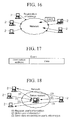
- a conventional network is expressed conceptually by the network model shown in FIG. 16 .
- each terminal registers a terminal address (for example, a network address or a host address) as its identifier.
- a send terminal sends an event (packet) comprising destination address (destination terminal address) and data onto the network. That is, the basic concept of a conventional information network is to deliver an event to its destination accurately based on a destination address.
- a case is considered wherein recommendation services (personalized information recommendation services for recommending personalized information to each user, and yellow pages services such as search services and the like) are achieved with this network.
- intervention with a centralized server system (broker) is always necessary as shown in FIG. 18 in order to realize a personalized information recommendation service.
- a yellow pages service it is also necessary to assume a broker called a search service.
- a broker model Such a centralized business model involving a broker is called the broker model.
- a broker takes the role of connecting an information provider and a user. That is, it is only possible for a user and an information provider to meet through a broker.
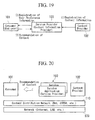
- FIG. 19 A detailed description of the broker model described above will be given using FIG. 19 .
- the service provider 103 achieves a recommendation service for recommending content appropriate to an end user (consumer 101) by managing registered content information from an information provider (content provider 102) and registered end user preference information from an end user (consumer 101), and also comparing the registered content information and the end user preference information.
- a service provider corresponds to a broker.
- Specific services include search services such as Yahoo and the like, trading services, and personalized information recommendation services for recommending content matching the interests of an end user without direct intervention by the end user.
- Each such service is achieved as an integrated type service system (service application) in an individual service provider 103 on a network 109 or a content distribution network 110 as shown in FIG. 20 .
- service application an integrated type service system
- an information provider (content provider) can provide appropriate content directly to an appropriate end user without assuming the existence of a broker.
- Gnutella is a network for searching and discoverying a specific entity from among an unspecified number of entities (information) distributed around the Internet based on a P2P (Peer-to-Peer) interaction model.
- an entity is also called a servent. That is, each information provider performs massively distributed management of metadata (meta files), and establishes arbitrary connections between meta files (between hosts in which meta files are stored), and thus an massively distributed database of metadata is built by only the information provider. Then, collaboration of information providers with each other enables the construction of a distributed search network of metadata that does not require a broker. However, search request packets from consumers are broadcast to all information providers based on the connection.
- Reference 1 describes a method that enables the request and use of information in a situation where an information provider (Publisher) and a user (Subscriber) have no knowledge of each other, without a broker.
- an information provider Subscriber
- Subscriber user
- it does not have a routing mechanism that suppresses unnecessary event forwarding there is a problem of scalability.
- an ontology mechanism for converting event dictionaries
- the method of realizing a territory and the method of sharing information among different territories are not made clear. Therefore regarding territory, the description of specific implementations is poor.
- Reference 2 proposes information routing capable of routing not only packets having specific destination addresses but also packets containing only an assignment of region of interest. Searching that does not require a broker can be achieved by information routing. However, it does not have the concepts of an event place, which gurantees a unique ontology system and limits the event delivery range, gateway and session. As a result, there are problems in aspects of scalability, security, privacy, interoperability, information sharing, extendibility, and the like.
- the endpoint of information is a terminal of an end user, and this is accessible from the outside. Therefore, even if information that is not wanted to be opend outside is placed on the terminal, there is a possibility of releasing the information if it is connected to a network.
- the present invention takes such situations into consideration, with an object of providing a semantic information-oriented network, a semantic information switch, a semantic information router, a semantic information gateway, an event routing method, a federation method, a session, a filter management method, a statistical data collection method, an ontology conversion method, an ontology conversion information management method, and additional functions, wherein an end user can directly specify the most appropriate information from among an enormous amount of information distributed around a network, or an information provider can specify the most appropriate user to deliver information to, and furthermore an entity to communicate can be directly searched, discovered, and specified, without the intervention of a broker.
- the present invention provides an event delivery apparatus for delivering, on a network, an event comprising data and semantic information, being metadata of the data, based on the semantic information, wherein there is provided an apparatus that provides an event place that is a place for comparing an event from an event sender with a filter in which semantic information of an event that an event receiver wishes to receive is set as an event acquisition condition, and that is the smallest unit required to guarantee a common ontology system, and is also an event delivery range.
- an apparatus for providing an event place is, for example, one or a plurality of computers.
- “Computer” here is an apparatus provided with a central processing unit (CPU) and memory connected such that it can be controlled by this CPU, being an apparatus that provides an event place by storing a program for achieving an event place in this memory and executing this program in the CPU.
- an apparatus (computer) for providing an event place may be a personal computer, a PDA, a mobile telephone, a workstation, a mainframe, or the like.
- an event delivery apparatus of the present invention guarantees a common ontology system in event places, the accuracy of comparison of an event in an event place is guaranteed.
- an event place is constructed for each subnet (physical network unit) for each service category, for each service operator, or according to stakeholders such as security, management units and the like, and thus it is possible to avoid increases in event types (semantic information categories) that regulate an ontology system.
- an event place in an event delivery apparatus of the present invention is an event delivery range, it is easily possible to achieve localization of information (events) being delivered.
- an event delivery apparatus it is possible to avoid unnecessary connections from an event sender-receiver and other event places to the event place, and as a result, it is possible to easily achieve high security and protection of private information of event sender-receivers.
- the present invention provides a community providing apparatus achieved in an environment wherein in the event delivery apparatus, the event place is provided with:
- the community is achieved using event places provided by the event delivery apparatus, and the management functions set values of information delivered from adjacent communities on the semantic information gateway provided by the event delivery apparatus.
- a community providing apparatus of the present invention it is also possible to delivered only information that is statistically delivered frequently (popular information) between adjacent communities as deliverable information from adjacent communities, for example from an adjacent community to its own community. Furthermore, in the community providing apparatus of the present invention, in a large scale system, it is also possible to obtain popular information without depending on a centralized server in one location.
- the present invention provides a semantic information gateway that is used when delivering events comprising data and semantic information, being metadata of the data, on a network, based on semantic information, which is provided with a forwarding section for forwarding an event between event places that are; places for comparing an event from an event sender with a filter in which semantic information of an event that an event receiver desires to receive is set as an acquisition condition of the event, the smallest units to guarantee a common ontology system, and also an event delivery range.
- a semantic information gateway of the present invention it is possible to share events among different event places. Furthermore, it is possible to achieve a global, autonomous decentralized comparison network using a bottom up approach.
- the present invention provides a semantic information switch for notifying an event receiver, being the destination of an event delivered on a network, of an event comprising data and semantic information, being metadata of the data, based on semantic information, which is provided with:
- a semantic information switch of the present invention categorizes filters for each event type, being templates of the events, and manages them. In the case where a plurality of filters is registered in the same session, the relationships between the filters are managed as a logical OR operation, so that it is possible to compare the filters and events efficiently. Furthermore, in the present invention, a plurality of semantic information switches is prepared in one event place, and the semantic information switches are connected by semantic information routers, and thus it is possible to distribute filter processing to a plurality of semantic information switches.
- the present invention provides a semantic information router that determines an event delivery route comprising data and semantic information, being metadata of the data, on a network, which has:
- a semantic information router of the present invention selects event routes between semantic information switches, it is possible to achieve a reduction of unnecessary comparisons and traffic in the semantic information switches.
- the present invention provides methods provided by functions of each of the above-described event forwarding apparatus, community providing apparatus, semantic information gateway, semantic information switches, and semantic information router, also programs to execute some of the methods by computer, and a computer-readable recording medium on which the programs are recorded.
- Functions that can be added include a statistical information collection function, and the like, being additional functions other than a standard semantic information gateway and a semantic information router.
- deleting a filter from a semantic information switch it is possible to delete the function, and the functions that can be deleted include additional functions other than a standard semantic information gateway and semantic information router.
- an event receiver that connects to a semantic information-oriented network of the present invention, and receives an event, can receive the event it requires by registering a filter on a semantic information switch.
- an event sender that sends the event can also send the event by describing semantic information, being metadata of the event, that indicates an event receiver targeted to receive it.
- the present invention provides a semantic information-oriented network for delivering an event comprising semantic information and data, wherein the semantic information-oriented network is provided with:
- the present invention provides a semantic information switch that is connected to a plurality of entities to receive events delivered on the network, and activates an entity to receive an event based on semantic information contained in the event, incorporating:
- the present invention provides a semantic information router that routes an event on the network, and the semantic information router incorporates:
- the present invention provides a semantic information gateway that interconnects between the smallest number of semantic information-oriented networks having different semantic information systems, and forwards an event containing semantic information, and the semantic information gateway incorporates:
- the present invention provides a semantic information-oriented network incorporating the above-mentioned semantic information switch, the above-mentioned semantic information router and the above-mentioned semantic information gateway.
- the present invention provides an event routing method for determining an event route based on semantic information contained in the event, in the case of an event route comprising semantic information and data, and the event routing method has:
- the present invention provides an event routing method for determining an event route on a network based on semantic information contained in the event, in the case of delivering an event comprising semantic information and data, and the event routing method has:
- the present invention provides an event routing method for determining an event route on a network based on semantic information contained in the event, in the case of delivering an event comprising semantic information and data, and the event routing method has:
- the present invention provides an event routing apparatus for determining an event route based on semantic information contained in the event, in the case of delivering an event comprising semantic information and data, and the event routing apparatus has:
- the present invention provides an event routing apparatus for determining an event route on a network based on semantic information contained in the event, in the case of delivering an event comprising semantic information and data, and the event routing apparatus has:
- the present invention provides an event routing apparatus for determining an event route on a network based on semantic information contained in the event, in the case of delivering an event comprising semantic information and data, and the event routing apparatus has:
- the present invention provides a highly reliable event delivery method wherein an event sender delivers an event to an unspecified number of event receivers via an event notification service under a network environment, and a plurality of paths for delivery are prepared, wherein the event notification service assigns each event an identifier that can identify it uniquely under the network environment, and can detect that the same event was delivered from a different path by comparison with the identifiers of events delivered and stored in the past.
- event whose identifier has been removed is delivered to at least one event notification service directly connected to the event sender among the unspecified number of event receivers, and an event that is assigned identifier is delivered to at least one event notification service located downstream of the directly connected notification service.
- the present invention provides a highly reliable event delivery method wherein an event sender delivers an event to an unspecified number of event receivers via an event notification service in a network environment, and a plurality of routes are prepared for delivering the event, characterized in that there is provided:
- the present invention provides a highly reliable event delivery method wherein an event sender delivers an event to an unspecified number of event receivers via an event notification service in a network environment, the event notification services are located at a plurality of network nodes and connected to each other, and a plurality of paths are prepared for delivering the event, which is provided with:
- the present invention provides a content information delivery network in which, when a content provider, which provides content, recommends content that it holds to a consumer, who consumes the content, it directly recommends the offered content to a consumer appropriate to the content to be provided, which is provided with:
- the content information is information that the content provider sends
- the construction is such that there is provided a comparison device for matching the content information with user preference information, being acquisition conditions of content information that a consumer wishes to obtain, and the content recommendation device recommends offered content by autonomously notifying only content information that matches the user preference information from among the content information.
- the content information and the user preference information are registered, and there is provided an event place for providing a place for the comparison device to compare this registered information, and a federation device for enabling information sharing among the event places.
- the content information and the user preference information are registered, and there is provided an event place for providing a place for the comparison device to compare this registered information, and a load delivery device for delivering event place objects in the event place to a plurality of computer systems, and sharing information among delivered event place obj ects.
- the above-described content information delivery network is provided with a user agent device for registering the user preference information as a filter in the event place, and the construction is such that the comparison device compares an event sent from the content provider with a filter registered by the user agent device, a filter that matches the event is activated as a result of the comparison, and a user agent device corresponding to this filter is activated autonomously.
- the above-described content information delivery network is provided with a content-agent apparatus for registering the content information as a filter in the event place, and the construction is such that the comparison apparatus compares the user preference information sent from the consumer side as an event with the filter registered by the content-agent apparatus, and the consumer side extracts a filter that matches the event as a result of the comparison autonomously.
- the above-described content information delivery network is provided with: an event place creation apparatus for creating the event place based on an event place creation request; a send session establishment apparatus for establishing a session to send an event to the event place; a receive session establishment apparatus for establishing a session to receive an event from the event place; a filter creation apparatus for creating the filter; and a filter registration apparatus for registering a filter in the event place with a filter identifier created by the filter creation apparatus as a parameter.
- the present invention provides a processing method of a content information delivery network in which, when a content provider, which provides content, recommends content that it holds to a consumer, who consumes the content, it directly recommends the offered content to a consumer appropriate to the content to be provided, which is provided with:
- the content information is information that the content provider sends
- the content recommendation process recommends offered content by comparing the content information and user preference information, being an acquisition condition of content information that a consumer wants to obtain, and by autonomously notifying only content information that matches the user preference information from among the content information.
- the content information and the user preference information are registered, and federation processing that enables information sharing among the event places is performed for an event place that provides a place to compare this registered information.
- the content information and the user preference information are registered, and load distribution processing is performed in which event place objects in an event place, which provides a place for the comparison apparatus to compare this registered information, are distributed on a plurality of computer systems, and information is shared among the distributed event place objects.
- the user preference information sent from the consumer side as an event is compared by the comparison process, and as a result of the comparison a filter that matches the event is extracted by the consumer side autonomously.
- the above-described content information delivery network processing method performs; event place creation processing for creating the event place based on an event place creation request, send session establishment processing for establishing a session to send an event in the event place, receive session establishment processing for establishing a session to receive an event in the event place, filter creation processing for creating the filter, and filter registration processing for registering a filter in the event place with an identifier of the filter created by the filter creation processing as a parameter.
- the present invention provides a computer-readable recording medium on which a program for a computer to perform any of the above-described processing methods of the content information delivery network is recorded.
- SION Semantic Information-Oriented Network
- FIG. 1 shows a conceptual model of SION.
- each terminal 2 registers semantic information (Semantic Information: SI) on SION 1.
- SI Semantic Information
- a terminal 2 sends an event, it sends an event comprising semantic information and data as shown in FIG. 2 to the SION 1.
- the semantic information here is a description of the characteristics of the data contained in the event, and evaluated as meta information of the data. For example, semantic information uses expressions such as:
- SION is an autonomous decentralized meta network that can determine a target to deliver data (terminal, person, software or the like) dynamically, and deliver and notify the data to a specified target.
- FIG. 21 shows the position of SION (a content information delivery network (autonomous decentralized comparison environment) 123 in the drawing).
- SION a content information delivery network
- information providers content providers 110 in the drawing
- users consumer (end users) 111) to whom it is appropriate to provide it without using a broker (often achieved as a third party service provider).
- a multicast type comparison in contrast to the conventional broadcast type comparison.
- Such a business model that enables peer-to-peer information recommendation without broker intervention is here called an order taking model (or order taking information recommendation model).
- order taking model or order taking information recommendation model
- real time information search is also possible in which information that a user wants can be searched directly without using a search service (broker).
- This business model is called an inquiry model in contrast to an order taking model. The difference between the two is the difference in event direction.
- SION is an-imaginary network with a purpose of performing a comparison of content information in order to build an order taking society on a network 121, and is located on the upper layer of a content delivery network 122.
- an order taking information recommendation service it can be used for the following services.
- the kind of information in an event data part depends on the service.
- a range of forms is possible, for example such as substance of information, references for information (URL, distributed object identifier and the like), proxies (Jini proxy and the like), and mobile agents.
- FIG. 3 shows a network model of SION.
- terminals 2 are divided into event senders designated as send terminals 21 and event receivers as receive terminals 22.
- an event sender gives a stimulus to SION by sending an event to SION 1 using a send terminal 21.
- This event comprises semantic information, in which the characteristics of the event are described, and data, as shown in FIG. 2 .
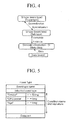
- FIG. 4 shows a definition of semantic information. Semantic information is metadata of an event, and also an instance of a semantic information type (event type).
- SION is an autonomous decentralized comparison network for comparing (filtering) an event sent from an event sender with filters registered by event receivers.
- a filter through which an event has passed (event reacted) is ignited, and the receive terminal 22 of a corresponding event receiver is activated autonomously.
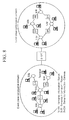
- FIG. 5 shows a definition example of an event type, being a template of an event.
- an event type can also be mentioned a template of semantic information from the relationship between an event and semantic information.
- An event type name is a name that uniquely identifies the event type.
- an event is ignited according to the data structure of an event type.
- An event comprises a combination of an event type name, condition names and condition values, and a data part. If the condition name, the conditional equation, or the condition value does not match the event type, it creates an error. However, a condition name used in an event may be a subset of the event type.
- FIG. 7 shows an example of a filter definition.
- a filter comprises permissible event type names, and pairs of attribute names (corresponding to "CPU power" and "Age” in FIG. 7 ) and attribute values (corresponding to 200 and 25 in FIG. 7 ).
- Only events belonging to the event types defined by the permissible event type names may be targets of filtering.
- a wildcard * if an attribute name defined by a filter does not exist in the condition names of event type defined by the permissible event type name, it creates an error.
- a subset of event types is also permissible.
- FIG. 8 shows the structure of SION 1.
- SION comprises semantic information switches (Semantic Information-Switch, shown as SI-SW in the figure), semantic information routers (Semantic Information-Router, shown as SI-R in the figure), and semantic information gateways (Semantic Information-Gateway, shown as SI-GW in the figure).
- Semantic information switches provide a switching mechanism for comparing semantic information registered as filters and semantic information assigned to an event, and activating the terminal 2 of an ignited event receiver as a result.
- Semantic information switches (SI-SW) and terminals 2 are combined in a star configuration.
- a semantic information router (SI-R) routing an event between semantic information switches, and also plays a role of forwarding an event sent from the terminal 2 to a semantic information switch to another semantic information switch. This is achieved by dynamic event routing based on semantic information.
- a semantic information gateway forwards an event between event places (EP: Event Place).
- An event place provides a place for comparing events, is the smallest unit (ontology domain) required to guarantee a common semantic information space, and limits event delivery range.
- An event place being an ontology domain means that in the event place, the uniqueness of an ontology system such as the name, concept, vocabulary, semantics, relationship and the like of an event type is guaranteed, and semantic information is described based on a common ontology, so that there is an effect of preventing an increase in event categories.
- By limiting the delivery range of an event it is possible to prevent an increase to a scale such as sending the event to all host terminals connected to a network 121 and a content delivery network 122 in FIG. 21 . It is possible to create an event place for each an administrator, security, service, physical subnet and the like.
- an event sent from the terminal 2 of an event sender is delivered only inside the event place.
- a semantic information gateway (SI-GW)
- SI-GW semantic information gateway
- a user agent UA is an agent of an end user, which is regarded as one entity using SION.
- a UA becomes an event sender or an event receiver depending on the type of operation (order taking, inquiry).
- end user preference information based on the preferences of an end user is registered in the event place as a filter.
- a content agent CA is an agent of an information provider (content provider), which is one entity using SION.
- a CA also can be either an event sender or an event receiver.
- an event sender it sends an event with content keywords (content information) as the semantic information of the event, and with a content identifier as the data of the event.
- CAs are divided into two main types of usage. One is a CA used from the situation of a service provider (content information provider), and the other is one as an information provider. The latter is used as a method for an information provider itself to easily become a content information provider.
- an event sender and a UA, an event receiver described in this example, an EP provides a place for comparing an event sent from a CA with a filter registered by a UA.
- an EP provides a place for comparing an event sent from a CA with a filter registered by a UA.
- a CA initiative order taking comparison can be achieved.
- Each of the UAs activated can access its desired content independently using a content identifier obtained as an event.
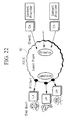
- FIG. 23 shows a business model of SION.
- SION is basically operated by service providers (content information providers) or content providers.
- a case is considered where content information is delivered by SION. That is, it is a case where information to be used is content information, and also a case where an end user receives content, and an information provider sends an event.
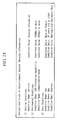
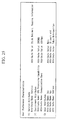
- Content information is described by content conditions, and user preference information by user preference attributes.
- Content conditions means a definition of the conditions of an end user (UA) appropriate to the content to be provided, and can be described as in FIG. 24 , for example.
- end user preference attributes means a definition of the characteristics of a user (UA), and can be described as in FIG. 25 , for example.
- content information is used as content attributes
- end user preference conditions search conditions
- the expression mentioned above is newly defined since, for an order taking model where a content provider provides content only to a really appropriate end user, the method of describing the conditions of an appropriate end user in content information, and for describing the attributes of a UA in end user preference information, is more compatible with an order taking comparison compared with the conventional type.
- a content agent CA sends content conditions as an event. This event creation procedure is described as follows.
- an event type a template
- an event type name is a name for identifying the event type uniquely.
- condition names and data types and conditional equations for the condition names.
- the event type is registered in an event place.
- An event is ignited according to the data structure of the event type (refer to FIG. 6 ).
- An event comprises a combination of an event type name, condition names and condition values.
- a content identifier is defined in the data part.
- the event is sent to the event place.
- the condition names and conditional equations defined in the event do not match the event type, it creates a send error.
- the condition names used in the event may be a subset of the event type.
- a user agent UA registers user preference attributes in the event place as a filter. This filter creation procedure is described as follows.
- a filter is defined as shown in FIG. 7 .
- a filter comprises permissible event type names, and pairs of attribute names and attribute values. Only events belonging to the event types defined by the permissible event type names may be targets of filtering.
- a plurality of event names can also be defined, and furthermore by assigning a wildcard, (*.*), it is possible to enable all events as objects.
- the filter is registered in the event place.
- an attribute name defined in the filter does not exist in the condition names in the event type defined by the permissible event type name, it creates a register error. However, it may be a subset of the event type.
- SI-SW, SI-R, and SI-GW are achieved as distributed objects called event place objects (EPO), shared link objects (SLO) and federation agents (FA) respectively.
- EPO event place objects
- SLO shared link objects
- FA federation agents
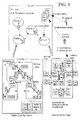
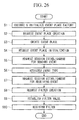
- the operating mechanism and control interface of SIGN 1 are described in detail using FIG. 9 , FIGs. 26 and 27 .
- SION-MT Management Tool
- SION interface it is possible to easily remove, increase or decrease EPOs, dynamic change physical link information, migrate a PO (dynamic change of EPO which is bound by a PO), collect ignition rate, collect statistical information of favorite information or popularity information, and the like.
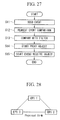
- a SION administrator activates an event place factory (EPF) on an arbitrary host, and subsequently, initializes the EPF. At this time, it provides the EPF with the name of a host that can create an event place (EP), and a storage area of executable files for the EP. These are called event place creation information.
- EPF event place factory
- a SION administrator corresponds mainly to an information provider or a service provider (content information provider such as Yahoo).
- a person who creates an EP requests the EPF to create an EP.
- it gives the EP name, and EP attributes as parameters of the request to create the EP.
- the EP attributes indicate for which one of the purposes, order taking model or inquiry model, the created EP is to be used, and indicates the direction of event flow.
- the EPF creates an EP.
- an event place management object (EPMO) is created for managing the EP. That is, a request for EP processing has the same meaning as a request for EPMO processing.
- the EPF returns an identifier of the EP (that is, EPMO) created to the source of the creation request.
- the EPMO is created on a host dynamically determined from among the hosts capable of creating an EP, specified in FIG. 9 (1) (step S1 of FIG. 26 ). For a method of determining a host on which an EPMO is invoked, it is possible to select a method such as determining it cyclically, determining it according to traffic, assigning it explicitly, or the like.
- the EP administrator requests the EPMO to initialize the EP. At this time, it assigns a single event place object or multiple event place objects. Furthermore, it provides a host capable of creating event place objects and the like, and a storage area of an executable file such as an event place object or the like. This is called event place object creation information. Here, in the case where this is omitted, event place creation information is used.
- EPO event place objects
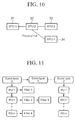
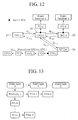
- FIG. 10 shows that an EPO 2, 32, is aware of the existence of EPO 1, 31, EPO 3, 33, and EPO 4, 34, but the EPO 3, 33, is only aware of the existence of EPO 2, 32.
- Having multiple EPOs aims towards improving scalability by delivering the load of event comparison processing in an EP.
- An EPO dynamically determines a host on which to create an EPO from among a list of hosts capable of creating an EP, assigned in FIG. 9 (1) (step 1 of FIG. 26 ), and creates an EPO there.
- one filter factory (FF) and one statistical information collection object (SO) are always created simultaneously in each EPO, and these correspond to SI-SW.
- a shared link object (SLO) is created simultaneously with each EPO.
- three SLOs are created for an EPO 2 (corresponding to SLO2,1, SL02,3, SLO2,4 in FIG. 9 ), and these correspond to an SI-R.
- the method for determining the host on which the EPO is invoked is the same as that of an EPMO. However, it is possible to fix the EPO used for each event type.
- the EPMO creates an event type factory (ETF) in the EP.
- ETF event type factory
- the EPMO creates a proxy object (PO) for each session request.
- a session identifier being an identifier of the PO, is returned to the source of the request.
- the EPMO instructs the PO which EPO is used (which EPO to bind with). This instruction is necessary for multiple EPOs.
- a method for determining the EPO to bind with is the same as that of an EPMO.
- the PO is requested to register an event type.
- the PO requests the ETF to create an event type object (ETO). Furthermore, it stores the event type in the ETO.
- the EP requests the ETF to create an ETO, and stores the event type in the created ETO.
- an event sender registers an event type
- it is performed via a PO.
- an EP administrator registers an event type in the EP.
- an event type with the same name is registered, it creates an error.
- a session establishment requester (event receive object) provides an identifier of an event receive object, being the destination of event notification, and a method for notifying an event (ignition type, look in type) as parameters. Furthermore, that it is event receive may be included as a parameter.
- the EPMO creates a PO for each session request. It returns a session identifier (identifier of PO) to the source of the request.
- session identifier identifier of PO
- the EPMO specifies the EPO to be used for the PO. This specification is necessary for multiple EPOs. However, the method for determining an EPO to bind with is the same as that of an EPMO.
- the PO is requested to create a filter object (FO).
- the PO requests an FF to create the FO.
- an FF accompanying the EPO bound with the PO is used.
- the identifier of the created FO is returned to the source of the request to create the FO via the PO.
- the PO is requested to define a filter value for the FO using the FO identifier as a parameter.
- the ETO it is possible to selectively request the ETO to check whether the data structure (filter value) of the FO is correct by using the event type name (that is, event type name as an target of filtering) stored in the filter object as a key. If it is not correct, it creates an error. However, in the case where a wildcard is assigned, this check is not performed at all.
- the PO is requested to register the filter using the identifier of the FO as a parameter.
- the filter identifier is returned to the source of the registration request. After this, it is possible to receive an event.
- it is possible to register a plurality of filters via one PO for this, a case can be considered where a plurality of different FOs are registered as a filter via one PO, or the same FO is registered as a filter a plurality of times).
- all filters registered for one PO have an "OR relationship".
- the event sender sends an event to the PO.
- the PO it is possible for the PO to selectively request the ETO to check whether the data structure of the event is correct, using the event type name stored in the event as a key. If it is correct when this checking is selected, it proceeds to the next process ( FIG. 9(B) ), and if it is not correct, it creates an error.
- the PO forwards the event to the EPO.
- the EPO creates a thread.
- a thread is created for each event, and each thread performs multiple event processing.
- the thread performs a filtering process by comparing the event and the filter. This includes complete matching, partial matching, weighted matching and the like, which may be selected when setting the filter value.
- the corresponding PO is activated, and receives this event.
- the PO it is selectively possible for the PO to register the type, the value, the ID and the like of received event in the SO. This information enables the SO to measure the ignition rate (for each event type, for each event) of the event, and popular events in the EP.
- the PO starts an event receive object, and also passes this event to the event receive object. This corresponds to ignition type (interrupt type) event notification.
- ignition type interrupt type
- the PO does not start the event receive object, but the event receive object itself extracts the event spooled in the PO corresponding to the event receive object. This corresponds to look in type event notification.
- a session is established for receiving events.
- one PO is created for each session request, and this PO is bound to an arbitrary EPO,
- One FF accompanies each EPO.
- the EPO that a PO uses is uniquely determined, and the following processes are all performed via a PO (session for receiving events).
- an FO is created, and a filter value (type of receive event, and its acquisition conditions) is set for the FO. Subsequently, a filter is registered using an FO identifier as a parameter. At this time, an FO identifier is stored in each filter.
- Each EPO manages filters registered via a PO based on the following rules.
- an event type X is set as a type of receive event in the FO assigned when registering a filter.
- a filter registered in the EPO corresponds to a filter 1 in FIG. 11
- a filter registered via a PO 2 corresponds to a filter 2.
- registered filters have an "OR relationship".
- EPO Simple Multimedia Sub-SI-SW
- SI-SW Simple Multimedia Sub-SIG-SW
- SIW Simple Multimedia Sub-Teller
- SION provides multiple EPOs as a device for realizing high scalability of EP. Having multiple EPOs aims to improve the total processing capability of EP in a way that is scalable. To be specific, high scalability of EP is achieved from the following two points.
- a first point is load distribution and autonomous decentralized. This avoids the bottleneck factor associated with centralized processing, by delivering the load of filtering process of events by delivering event sender receivers around a plurality of EPOs. Furthermore, it achieves decentralized collaboration by mechanisms capable of operating autonomously, with each EPO having no influence from other EPOs.
- a second point is optimization by reduction of network traffic and optimization of filtering process. This minimizes the amount of communication by not forwarding unnecessary events between EPOs, with an accompanying reduction of filtering process.
- FIG. 10 a case is considered where a filter of an event type X is registered as a type of receive event in EPO 3, 33.
- EPO 4 when an event of the event type X is sent to EPO 4, it is necessary to forward this event to EPO 3 via EPO 2. At this time, the event must not be forwarded to EPO 1 where the filter of the event type X is not registered.
- a shared link object (SLO) performs such routing control of events between EPOs, which corresponds to the aforementioned SI-R.
- SLOs are creates accompanying each EPO based on physical link information (topology af EPO). For example, in FIG. 9 , three SLOs are created for the EPO 2. These correspond to an SLO2,1, an SL02,3 and an SL02,4 in the figure.
- This SLOi,j establishes a shared link (SLi,j) for forwarding events from EPO j to EPO i. That is, as shown in FIG. 9 and FIG.
- the SLOi,j establishes an event receive session for the EPO j, and likewise establishes an event send session for the EPO i, thus establishing a shared link SLi,j, being a logical link for forwarding events (shared link means session establishment by SLO when initializing an EP, and does not include a filter registration process).
- an event receiver After initializing an EP, an event receiver establishes a session for an EP, which enables a filter to be registered via the session. At this time, an event path is created according to the shared link established. For example, in FIG. 12 , in the case where an event receiver 3 registers a filter for receiving an event of "event type X" in the EPO 3 via PO 3, the PO 3 registers the filter of the event type X in the EPO 3, and also notifies it to SLO3,j (here SL03,2). The SLO3,2 registers a filter of event type X in the EPO 2 using the SL3,2. This is performed via a PO for a receive session allocated to the SL03,2 as mentioned above.
- this PO notifies it to the SL02,j other than SL02,3.
- SLO2,j (j 3) registers the filter in the EPO using SL2,j. Subsequently, the same is repeated until paths for the event X are established in all EPOs.
- a series of paths established for an event type X in this manner is called an event path.
- a request for establishing an event path for each event type is sequentially and autonomously distributed to all EPOs, triggered by a filter registration via a PO 3. That is, each EPO may recognize only an adjacent EPO.
- FIG. 13 shows the filter registration conditions in the EPO 1 at this point of time.
- the filter 1 is registered in the EPO 1.
- Establishing an event path means registering filters for forwarding events to a series of EPOs based on shared link information. Furthermore, only receive event type names are set in the filters that an SLO registers, and acquisition conditions are not set, so filtering is only performed of event type name.
- an event of event type X is sent to the EPO 1
- the filter 1 is ignited, and the SLO2,1 is activated.
- the SLO2,1 sending this event to the EPO 2
- the SLO3,2 is activated.
- the event is also forwarded to the EPO 3 via the SLO3,2.
- an event holds a maximum of two latest identifiers of EPOs that it has passed through in as control information.
- the filter 1 and filter 2 have an OR relationship, in the case where the filter 1 is ignited, comparison with the filter 2 is not performed. As a result, it is possible to completely avoid the occurrence of redundant filtering process overhead accompanying a new registration of the filter 2, regardless of the existence of the filter 1. This means that when an event path is established, there is no need to reconstruct all established event paths, which enables simple and unified event paths to be established autonomously.
- FIG. 28 a case is considered where a filter of the event type X is registered as a type of receive event in EPO 3.
- EPO 1 when an event of the event type X is sent to EPO 1, it is necessary to forward this event from EPO 1 to EPO 3, or via EPO 2.
- a shared link object (SLO) performs such routing control of events between EPOs, which corresponds to the aforementioned SI-R.
- SLOs are created accompanying each EPO based on physical link information (topology of EPO). For example, in FIG. 9 , an SL02,3 is created for the EPO 2.
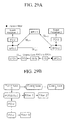
- This SLOi,j establishes a shared link (SLi,j) for forwarding events from EPO j to EPMO i. That is, as shown in FIG. 9 and FIG. 29A , the SLOi, j establishes an event receive session for the EPO j, and likewise establishes an event send session for the EPO i, thus establishing a shared link SLi,j, being a logical link for forwarding events (shared link means session establishment by SLO when initializing an EP, and does not include a filter registration process). In this manner, a ring shaped, unidirectional shared link is established.
- an event receiver After initializing an EP, an event receiver establishes a session for an EP, which enables a filter to be established via the session. At this time, an event path is created accompanying the shared link established.
- an event receiver 3 registers a filter for receiving an event of event type X in the EPO 3 via PO 3.
- the PO 3 registers the filter of the event type X in the EPO 3, and also notifies it to SLO3,j (here SL03,2).
- SLO3,j here SL03,2
- the fact that the source of the request to create a filter registration is EPO 3 is given to the SLO3,1 as a parameter.
- the SLO3,1 registers a filter of event type X in the EPO 1 using the SL3,1.
- a series of paths established for an event type X in this manner is called an event path.
- This is a system in which an event path establishment request for each event type is sequentially and autonomously distributed to all EPOs, triggered by a filter registration via a PO 3. That is, each EPO may recognize only an adjacent EPO.
- it is possible to establish event paths with a simple, unified, autonomous logic compared with a method for establishing and managing event paths by centralized management and broadcasting of event paths.
- FIG. 29B shows the filter registration conditions in the EPO 1 at this point of time.
- the filter 1 is registered in the EPO 2.
- Establishing an event path means registering filters for forwarding events to a series of EPOs based on shared link information.
- only receive event type names are set in the filters that an SLO registers, and acquisition conditions are not set, so filtering is only performed of event type name.
- an event of event type X is sent to the EPO 1, the filter 1 is ignited, and the SLO3,1 is activated.
- the SLO3,1 sending this event to the EPO 3
- the SLO2,3 is activated.
- the event is also forwarded to the EPO 2 via the SL02,3.
- an event holds the identifier of the EPO where the event was created as control information, and if the event is circulated and returned to the EPO (SLO) that was the source of the event creation, the event is cancelled.
- the filter 1 and filter 2 have an OR relationship, in the case where the filter 1 is ignited, comparison with the filter 2 is not performed. As a result, it is possible to completely avoid the occurrence of redundant filtering process overhead accompanying a fresh registration of the filter 2, regardless of the existence of the filter 2. This means that when an event path is established, there is no need to reconstruct all event paths where there are existing event paths, which enables simple and unified event paths to be established autonomously.
- an event circulates following a ring shaped shared link SLi,j, so that it is possible to deliver the event to all EPOs.
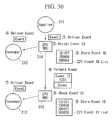
- FIG. 30 is a conceptual diagram showing a procedure of an event routing method.
- a numeral 211 denotes an event sender
- numerals 212 and 213 denote event receivers
- the numerals 214 and 215 are EPOs where the event routing method is achieved.
- SLOs which exist between EPOs, are not specifically mentioned in the following description of the event routing.
- supply in the figures corresponds to “event sender”
- “consumer” corresponds to “event receiver”.
- “NS” event notification service
- FIG. 30 shows a procedure of event notification for notifying event information between an event sender 211 and event receivers 212 and 213 via EPOs 214 and 215.
- the event sender 211 sends an event to the directly connected EPO 214 (1. deliver event).
- the EPO 214 performs processing to assign an event identifier (ID) to the event as additional information that can identify the event uniquely in a network wide environment (2. assign event ID), store the event ID in an event ID list 221 (3, store event ID), deliver the event whose ID, being additional information, is removed to a group of directly connected event receivers (here only the event receiver 212), and forward the event containing the additional information to a group of directly connected EPOs (here, only the EPO 215) downstream (4. deliver event).
- ID event identifier
- each EPO On receiving the forwarded event, each EPO (EPO 215 in the figure) checks whether the same event ID is stored in the event ID list (here, event ID list 221) or not (5. check event ID). An EPO in which the same event ID is found by this check discards the event, and an EPO in which none is found performs processing to store the event ID in the event ID list 221 (6. store event ID), and deliver the event whose event ID, being additional information, is removed, to only a group of directly connected event receivers (here, only the event receiver 213) (7. deliver event), and forwards the event containing the additional information to a group of directly connected EPOs downstream (here, none exist).
- the EPOs 214 and 215 are located in a plurality of network nodes, connecting them, and establishing a plurality of event forwarding routes, it is possible to distribute the event delivery processing load, and also it is possible to reduce the frequency of event loss by obstructions or the like when forwarding an event between network nodes. Furthermore, it is not necessary for the event receivers 212 and 213 to check the same event from the plurality of event forwarding routes, so that it is possible to achieve the group of EPOs 214 and 215 that deliver a non duplicated event to the event receivers 212 and 213. This group of EPOs 214 and 215 is seen as one EPO from the event sender 211 or the event receivers 212 and 213.
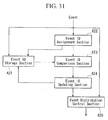
- FIG. 31 is a block diagram showing the internal structure of a highly reliable event delivery apparatus that performs an event routing method using sequential numbers.
- an event sender delivers an event to an unspecified number of event receivers via EPOs
- the EPOs are located at a plurality of network nodes and connected to each other, and a plurality of paths are set up for delivering the event in order to perform highly reliable event delivery.
- a highly reliable event delivery apparatus of the present invention comprises an event ID storage section 421, an event ID assignment section 422, an event ID comparison section 423, an event ID updating section 424, and an event delivery control section 425.
- an event ID list is stored as mentioned above.
- the event ID assignment section 422 which is in each of the EPOs 214 and 215, assigns each event an identifier that can identify it uniquely under a network environment.
- the event ID comparison section 423 compares it with event IDs that were delivered and stored in the past in order to detect whether a duplicate event was delivered from a different path, and supplies a result to the event ID updating section 424.
- the event is removed, and in the case where the same ID does not exist, the event ID is newly stored in the event ID storage section 421.
- the event delivery control section 425 delivers an event whose event ID is removed to a group of EPOs connected directly to the event sender (supplier) 211 of an unspecified number of event receivers (consumers) 212 and 213, and delivers an event with an ID assigned to a group of EPOs located downstream of the directly connected EPO.
- FIG. 32 is an embodiment showing a procedure for achieving this event routing method expanded onto a network tree.
- an EPO 231 when an EPO 231 receives an event from an event sender 221, it assigns an event ID that can identify the event uniquely under a network wide environment as additional information, stores the event ID in an event ID list managed by the EPO 231, delivers an event whose event ID, being additional information, is removed to a directly connected event receiver (here, an event receiver 222), and forwards an event with the additional information to a group of directly connected EPOs (here, EPOs 232 and EPO 233) downstream.
- a directly connected event receiver here, an event receiver 222
- the EPO 232 and the EPO 233 check whether a similar event ID to the event ID of this event is stored in the event ID lists that they manage. In this case, since the same event ID is not found by this check, the EPO 232 and the EPO 233 store the event ID in the event ID lists that they manage, deliver the event whose event ID, being additional information, is removed to a directly connected event receiver, and forward the event with additional information to directly connected EPOs downstream, (here, an EPO 234 is an EPO downstream, connected directly to the EPO 232 and the EPO 233).
- the EPO 234 receives the same forwarded event from both the EPO 232 and the EPO 233. If the EPO 232 receives the event first, the EPO 234 checks whether a similar event ID to the event ID of this event is stored in the event ID list that the EPO 234 manages.
- the event ID is stored in the event ID list, the event whose event ID, being additional information, is removed is delivered to a directly connected event receiver, and the event with the additional information is forwarded to a directly connected EPO 235 downstream.
- the same event as mentioned above is also forwarded from the EPO 233.
- the EPO 234 checks whether a similar event ID to the event ID of this event is stored in the event ID list that the EPO 234 manages.
- the EPO 234 discards the event. In this case, event forwarding to a directly connected event receiver and a directly connected EPO downstream is not performed, and hence a duplicate event is not delivered.
- the EPO 235 receives the forwarded event from EPO 234 only once, and at this time the EPO 235 checks whether a similar event ID to the event ID of this event is stored in the event ID list that the EPO 235 manages.
- the event ID list is stored in the event ID list, and the event whose event ID, being additional information, is removed is delivered to a directly connected event receiver.
- event delivery is completed.
- the forwarding route from the EPO 231 to the EPO 232 since there is only one route, it is possible to use a method of building forwarding routes from the EPO 233 to the EPO 232, building forwarding routes from the EPO 233 to the EPO 235, and the like.
- a federation agent means an agent for establishing a federation between event places, and corresponds to an SI-GW mentioned previously.
- a federation agent means an agent for establishing a federation between event places, and corresponds to an SI-GW mentioned previously.
- an event place A establishes a federation with an event place B.
- an FA belonging to the event place A registers a filter in the event place B.
- an event sender belonging to the event place B sends an event, and if this filter is ignited as a result, the FA starts autonomously.
- the FA can be regarded as an event receiver belonging to the event place B.
- the FA resends the event obtained to the event place A that it belongs to. This enables the FA to be regarded as an event sender belonging to the event place A.
- Ontology conversion is required in the case where forwarding an event extends to a different ontology system.
- Ontology conversion is required in the case where forwarding an event extends to a different ontology system.
- there are methods such as a method in which a standard ontology is defined and event forwarding is performed after conversion into a form based on the standard ontology for a time when forwarding an event to another event place, a method in which ontology conversion tables are prepared in advance for a number of combinations of event places, and the like.
- an FA holds only the difference (conversion information) from the ontology information of an adjacent event place in an ontology conversion table. That is, this is a method in which each FA distributes and holds conversion information, and the integrity of the ontology system is guaranteed. This makes it possible to deal with dynamic federations between event places easily.
- ontology conversion processing occurs each time an event passes an event place, there is a characteristic that the conversion processing overhead is increased compared with the conventional methods.
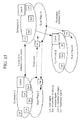
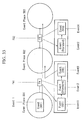
- FIG. 33 shows a system of the present method. Firstly, this figure shows that an event place 501 is connected to an event place 502, and the event place 502 to an event place 503 by an FA 1 and an FA 2 respectively, and an event 1 sent from the event place 501 is forwarded to the event place 502 by the FA 1, and further to the event place 503 by the FA 2. Furthermore, the numerals inside the brackets of events in the figure indicate on which event place ontologies the descriptions of those events are based.
- an event when forwarding events between event places, an event is converted to one based on the standard ontology for a time, then afterwards it is converted into one based on the ontology of the event place of the event receiver.
- Ontology Conversion Method 2 (ontology conversion is performed between a sender event place and a receiver event place)
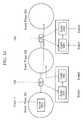
- FIG. 34 shows that an event place 501 is connected to an event place 502, and the event place 502 to an event place 503 by an FA 1 and an FA 2 respectively, and an event 1 sent from the event place 501 is forwarded to the event place 502 by the FA 1, and further to the event place 503 by the FA 2.
- the numerals inside the brackets of events in the figure indicate on which event place ontologies the descriptions of those events are based.
- FIG. 35 shows that an event place 501 is connected to an event place 502, and the event place 502 to an event place 503 by an FA 1 and an FA 2 respectively, and an event 1 sent from the event place 501 is forwarded to the event place 502 by the FA 1, and further to the event place 503 by the FA 2.
- the numerals inside the brackets of events in the figure indicate on which event place ontologies the descriptions of those events are based.
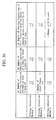
- FIG. 36 shows a comparison of the three ontology conversion methods described above by three comparative items.
- the three ontology conversion methods above are placed vertically down the left-hand column, and the three comparative items are described horizontally across the top row.
- the first comparative item "(A) number of pieces of ontology conversion information held by each FA" indicates the number of pieces of ontology conversion information that one FA must hold for ontology conversion.
- ontology conversion information (ontology conversion table) means the information used to convert an event described based on one ontology into an event described based on another ontology.
- the ontology conversion methods 1 and 3 require at most two and one pieces of ontology conversion information respectively.
- the ontology conversion method 2 requires the largest number (the number of event places - 1) of pieces of ontology conversion information.
- the next comparative item, "(B) number of ontology conversions performed for a specific event by each FA” is the number of ontology conversion processes performed for only one event received by each FA.
- the ontology conversion methods 1, 2 and 3 it is at most two, one and one respectively. That is, regarding the present comparative item, the relative superiority or inferiority between the ontology conversion methods is negligible.
- the last comparative item, "(C) number of ontology conversions performed for the event concerned when the event is forwarded across a plurality of event places" is the number of ontology conversion processes performed for the event concerned when the event is forwarded across a plurality of event places, in the case where a specific event is paied attention.
- the largest number (the number of FA passed - 1) of ontology conversion processes is performed in the ontology conversion method 3, while the ontology conversion methods 1 and 2 have at most two and one.
- the ontology conversion method 1 has no problem with comparative items (A), (B) and (C), and it has the best processing efficiency.
- the present method has a problem that it must establish a standard ontology.
- IP it has been possible to establish an address system as a unique standard all over the world.
- an address system in a semantic information-oriented network is, in other words, a semantic information system (ontology), so it is considered to be impossible to establish a unique standard system for such semantic information all over the world.
- a facilitator or the like for example, a method is used wherein a standard ontology is used as a communication language between agents.
- items (B) and (C) have no problem.
- item (A) there is a problem in item (A). That is, in the ontology conversion method 2, if the number of event places that perform federation increases, the number of pieces of ontology conversion information that each FA must hold increases proportionally. Therefore in the case where there is an enormous number of event places that perform federation (in the case where a global environment is targeted as an application region), it is, on balance, difficult to use the present method 2.
- the ontology conversion method 3 is the method designed in the present invention.
- the present method 3 has no problem with items (A) and (B).
- item (C) there is a problem in item (C). That is, when the number of event places (FA) through which an event passes increases, the number of ontology conversions performed to this event increases proportionally. Therefore, there is a problem that not only is the ontology conversion processing efficiency poor, but also errors occurring during ontology conversion accumulate. However, since it focuses only on an adjacent event place, there is an advantage that active federation (active start and cancellation of federation) can be achieved easily.
- ontology conversion information has been created manually.
- a characteristic of the present invention is that it is created automatically. By creating it automatically, it is possible to reduce the effort of performing the creation operation manually.
- the present automatic creation method can be applied to any of the above-described ontology conversion methods 1 through 3.
- An FA acquires a semantic information system (ontology) from both an ontology conversion source event place and a conversion destination event place.
- semantic information system specifically means the collection of event types registered in each event place.
- An FA can acquire a collection of event types registered in an event place by request to an EPMO.
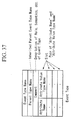
- FIG. 37 shows a form of an event type, being an object of the present automatic creation method.
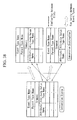
- the event type is described in a frame structure as shown in the present figure. That is, each event type comprises an event type name that specifies the event type uniquely, a parent type name that specifies an inherited parent type, an explanation (comment) where the role and the like of the event type concerned are described, and a plurality of slots comprising pairs of attribute names and attribute value type names.
- Ontology conversion information (ontology conversion table) is created based on the semantic information system acquired in (1) above.
- the present automatic creation method is intended for the case where an event type is described based on a frame table as shown in FIG. 37 in both an ontology conversion source event place and a conversion destination event place.
- event ontology conversion it is necessary to obtain the correspondences of event types and slots, that is which event type in the conversion source event place corresponds to which event type in the conversion destination event place, and further which slot corresponds to which slot in the corresponding event types (refer to FIG 38 ). That is, in the present automatic creation method, ontology conversion information is defined as a correspondence table (table) between event types and slots in a conversion source event place and a conversion destination event place.
- the similarity of words is calculated by summing weightings of similarities calculated by approximate string match(best-match retrieval) or Levenshtein distance depending on the type of thesaurus used.
- Slot mapping means a method for obtaining the most suitable correspondence between slots.
- mapping is achieved by the following simple algorithm.
- An entity in a community service is an autonomous decentralized type activity capable of determining its activity style by repetitive learning, evolution, degradation, extinction and the like based on its own policy.
- a community provides a place for effective communication to such an entity. That is, an entity in the community can dynamically search, discover, and specify another entity to communicate with, or influence its own behavior, and interact with the specified entity.
- This community can specifically deal with entities that have the following characteristics.
- An EP in SION 1 is ranked as an execution environment of a community having such characteristics. That is, a community is a meta execution environment, and provides a place of communication with a high degree of abstraction compared with the direct use of EPs.
- EPs As the execution environment of a community, every entity in the community can discover another entity to communicate with directly without using a broker. This is because communication among entities in the community is achieved as send and receive events in EPs.
- FIG. 15 shows a conceptual model of a community.
- UAs and information and service provider agents correspond to entities in the community.
- a UA is an agent that behaves autonomously as a user's agent, which decides its own behavior dynamically according to the user's preference, execution environment, location information, situation, trend and the like, searches for an ISA or another UA to interact with, and interacts with it.
- An ISA is an agent that behaves autonomously as an agent of an information provider or a service provider, which searches for a UA or another ISA to interact with. That is, it searches for and specifies an appropriate partner to which to provide its own information.
- a community agent is an agent that is in charge of administrating the community.
- An EP administrator performs control and administration of SION, with using SION-MT, based on an administration policy.
- the ComA can be regarded as an EP administrator serving as an agent.
- the administration policy of the community is defined by the ComA. It takes charge of, for example, the permission of UAs, ISAs and the like to participate in the community, leave, disappear, reproduce and the like; understanding and controlling information delivered through the community (removal of inappropriate events, etc.); management of statistical information (trend information, popular information, etc.) in the community; and the like based on its own administration policy.
- SION control such as increasing, decreasing and removing EPs and EPOs, migration, and the like, according to load status and obstruction status. That is, by combining SION 1 and ComA, the SION 1 develops from an autonomous decentralized network to an evolutionary type network that can learn, grow and evolve. In this manner, a ComA controls the behavior of entities in the community, and also takes a role of self-organizing the SION 1. Moreover, by collaboration between communities, it is possible to share information among communities. It is possible, for example, to distribute only the top ten most popular pieces of information distributed in a community A to a community B. The flow of processing is shown as follows.
- the ComB in the community B instructs the FA in an event place B "to distribute only the top ten most popular pieces of information distributed in the community A".
- the FA requests the top ten most popular event types from an event place A, Receiving this, the event place A requests a statistical information collection object (SO) in it, and returns the result to the FA.
- SO statistical information collection object
- the FA creates an ontology conversion table based on the obtained event type, and also establishes a filter for the event place A. Afterwards, the FA becomes capable of receiving the event concerned from the event place A.
- the FA converts the event obtained from the event place A based on the ontology conversion table, and sends it to the event place B.
- the addition, discard, or change of an entity does not influence other entities. That is, even if a new service is added, it does not influence existing services. Furthermore, even if a new function is added, it does not influence other functions. For example, even if a fault-tolerant function is added, it does not influence existing system elements. Accordingly, in the present invention, plug-in and plug-out of services/functions can be performed easily.
- the construction may be such that a software program to achieve the functions (event places, semantic information switches, semantic information routers, semantic information gateways and/or additional functions) of the above-described embodiment is recorded on a computer-readable recording medium, and the program recorded on this recording medium is read and executed by one or a plurality of computer systems.
- “computer system” includes an OS and hardware such as peripheral equipment and the like.
- “computer system” may be any device equipped with a central processing unit (CPU) and memory connected controllably by this CPU, and may be an information terminal such as a personal computer, a PDA, a mobile phone, a workstation, a mainframe, or the like.
- CPU central processing unit
- memory may be any device equipped with a central processing unit (CPU) and memory connected controllably by this CPU, and may be an information terminal such as a personal computer, a PDA, a mobile phone, a workstation, a mainframe, or the like.
- “computer-readable recording medium” is a portable medium such as a floppy disk, an optical disk, a ROM, a CD-ROM, a CD-R and the like, or a storage device such as a hard disk equipped in a computer system. Furthermore, “computer-readable recording medium” also includes anything holding a program for a certain time such as volatile memory (RAM) inside a computer system, which becomes a server or a client when the program is sent via a network such as the Internet, etc. and a communication line such as a telephone line, etc.
- RAM volatile memory
- transmission medium is a medium having a function of transmitting information like a network (communication network) such as the Internet and the like, or a communication circuit (communication line) such as a telephone line and the like.
- the above-mentioned program may be an entitiy for achieving a part of the aforementioned function. Moreover, it may be an entity that can achieve the function by combination with a program already stored in the computer system, a so-called difference file (difference program).
- an event place it is possible for an event place to fetch an event delivered only in another event place by a federation system between event places using an FA. That is, it is possible to use an information provider belonging to another event place.
- an information provider can specify an appropriate end user for information that it provides without being aware of the end user.
- a case of a content provider that wants to provide certain content is considered. That is, this content provider is an information provider as mentioned previously. It is possible to realize an order taking society easily wherein a content provider itself provides content to an end user appropriate to the content.
- a method wherein an end user specifies content appropriate to itself, by an end user initiative service provider inquiry type comparison has been the norm.
- a content provider it is possible for a content provider to be a sender of content information without depending on a specific content information provider.
- a content provider can send not only content but also content information according to its own policy.
- an end user can search for and discover an information provider (content provider in the case described above) appropriate to its own preference without being aware of the existence of the information provider (content provider).
- an end user and an information provider are transparent to each other.
- an information provider content provider
- a search technique based on a brokerless model is especially effective.
- the end point of semantic information is a network.
- the end point of semantic information is a terminal, and the content of the terminal is disclosed outside. Therefore SION can realize higher security and privacy protection than the latter method.
- the sending of events, reception of events, and the registration of event types are performed through sessions, being connections between terminals of event receivers, event senders or event type registers and semantic information switches. It is possible to locate semantic information switches on any host (terminals) by these sessions.
Landscapes
- Engineering & Computer Science (AREA)
- Computer Networks & Wireless Communication (AREA)
- Signal Processing (AREA)
- General Engineering & Computer Science (AREA)
- Computer Security & Cryptography (AREA)
- Theoretical Computer Science (AREA)
- Computer Hardware Design (AREA)
- Computing Systems (AREA)
- Data Mining & Analysis (AREA)
- Databases & Information Systems (AREA)
- Physics & Mathematics (AREA)
- General Physics & Mathematics (AREA)
- Computer And Data Communications (AREA)
- Data Exchanges In Wide-Area Networks (AREA)
Applications Claiming Priority (5)
| Application Number | Priority Date | Filing Date | Title |
|---|---|---|---|
| JP2000062447A JP3571604B2 (ja) | 2000-03-07 | 2000-03-07 | 自律分散照合装置、コンテンツ情報流通システム、コンピュータ、処理方法、及び記憶媒体 |
| JP2000204203A JP3540253B2 (ja) | 2000-07-05 | 2000-07-05 | 高信頼イベント配送方法及びその装置 |
| JP2000284075A JP3589965B2 (ja) | 2000-09-19 | 2000-09-19 | イベントルーティング方法、及びイベントルーティング装置 |
| JP2000284076A JP3571632B2 (ja) | 2000-09-19 | 2000-09-19 | 意味情報ネットワーク、意味情報スイッチ、意味情報ルータ、意味情報ゲートウェイ、イベントルーティング方法、及びイベントルーティング装置 |
| EP01912149.0A EP1267527B1 (fr) | 2000-03-07 | 2001-03-07 | Reseau d'information semantique |
Related Parent Applications (2)
| Application Number | Title | Priority Date | Filing Date |
|---|---|---|---|
| EP01912149.0A Division EP1267527B1 (fr) | 2000-03-07 | 2001-03-07 | Reseau d'information semantique |
| EP01912149.0 Division | 2001-03-07 |
Publications (3)
| Publication Number | Publication Date |
|---|---|
| EP2383943A2 true EP2383943A2 (fr) | 2011-11-02 |
| EP2383943A3 EP2383943A3 (fr) | 2012-10-17 |
| EP2383943B1 EP2383943B1 (fr) | 2014-09-17 |
Family
ID=27481105
Family Applications (2)
| Application Number | Title | Priority Date | Filing Date |
|---|---|---|---|
| EP11167933.8A Expired - Lifetime EP2383943B1 (fr) | 2000-03-07 | 2001-03-07 | Procédé et dispositif pour la transmission des événements |
| EP01912149.0A Expired - Lifetime EP1267527B1 (fr) | 2000-03-07 | 2001-03-07 | Reseau d'information semantique |
Family Applications After (1)
| Application Number | Title | Priority Date | Filing Date |
|---|---|---|---|
| EP01912149.0A Expired - Lifetime EP1267527B1 (fr) | 2000-03-07 | 2001-03-07 | Reseau d'information semantique |
Country Status (6)
| Country | Link |
|---|---|
| US (2) | US7702744B2 (fr) |
| EP (2) | EP2383943B1 (fr) |
| KR (1) | KR100505265B1 (fr) |
| CN (2) | CN100417130C (fr) |
| CA (1) | CA2401982C (fr) |
| WO (1) | WO2001067690A1 (fr) |
Families Citing this family (39)
| Publication number | Priority date | Publication date | Assignee | Title |
|---|---|---|---|---|
| EP2383943B1 (fr) * | 2000-03-07 | 2014-09-17 | Nippon Telegraph And Telephone Corporation | Procédé et dispositif pour la transmission des événements |
| JP4039158B2 (ja) * | 2002-07-22 | 2008-01-30 | ソニー株式会社 | 情報処理装置および方法、情報処理システム、記録媒体、並びにプログラム |
| CA2496830A1 (fr) * | 2002-09-12 | 2004-03-25 | Thomson Licensing S.A. | Association de notifications du statut d'un reseau de donnees a l'aide d'un editeur de topologie |
| DE10308011B4 (de) * | 2003-02-25 | 2005-04-28 | Siemens Ag | Verfahren zum prämienbasierten Empfehlen von auf ein Mobilfunkendgerät herunterladbaren Inhaltsobjekten |
| WO2004080064A1 (fr) * | 2003-03-06 | 2004-09-16 | Fujitsu Limited | Dispositif de traitement d'informations, procede de traitement d'informations et programme de traitement d'informations |
| WO2004097655A1 (fr) * | 2003-04-25 | 2004-11-11 | Matsushita Electric Industrial Co. Ltd. | Systeme de partage d'information multimedia |
| US9525566B2 (en) * | 2003-07-31 | 2016-12-20 | Cloudsoft Corporation Limited | Self-managed mediated information flow |
| CN100362514C (zh) * | 2004-03-23 | 2008-01-16 | 中国科学院计算技术研究所 | 一种构造和浏览语义链的方法 |
| US7565662B2 (en) * | 2004-09-24 | 2009-07-21 | International Business Machines Corporation | Program agent initiated processing of enqueued event actions |
| US7499903B2 (en) * | 2005-01-24 | 2009-03-03 | Nevin James B | Semantic to non-semantic routing for locating a live expert |
| JP2006236140A (ja) * | 2005-02-25 | 2006-09-07 | Toshiba Corp | 情報管理装置、情報管理方法、及び情報管理プログラム |
| US8028085B2 (en) * | 2005-06-03 | 2011-09-27 | Microsoft Corporation | Optimizing message transmission and delivery in a publisher-subscriber model |
| KR100644317B1 (ko) | 2005-08-25 | 2006-11-10 | 한국과학기술정보연구원 | 온톨로지 기반의 정보 유통 시스템 및 그 방법 |
| US7761881B2 (en) | 2005-10-28 | 2010-07-20 | Microsoft Corporation | Event bookmarks |
| US20070124458A1 (en) * | 2005-11-30 | 2007-05-31 | Cisco Technology, Inc. | Method and system for event notification on network nodes |
| KR100785778B1 (ko) * | 2005-12-08 | 2007-12-13 | 한국전자통신연구원 | 의미정보 기반 서비스 제공 시스템 및 방법 |
| US8122087B2 (en) * | 2006-03-21 | 2012-02-21 | Aol Inc. | Matching engine for comparing data feeds with user profile criteria |
| WO2008062962A1 (fr) * | 2006-11-24 | 2008-05-29 | University-Industry Cooperation Group Of Kyunghee University | Procédé et système de copier/coller de contexte spatial et copieur spatial |
| CN100432930C (zh) * | 2006-12-06 | 2008-11-12 | 武汉大学 | 一种软构件资源管理方法 |
| JP5137434B2 (ja) * | 2007-03-28 | 2013-02-06 | 株式会社ソニー・コンピュータエンタテインメント | データ処理装置、分散処理システム、データ処理方法、及びデータ処理プログラム |
| US20080295013A1 (en) * | 2007-05-21 | 2008-11-27 | Justsystems Evans Research, Inc. | Method and apparatus for performing semantically informed text operations |
| US20080294425A1 (en) * | 2007-05-21 | 2008-11-27 | Justsystems Evans Research, Inc. | Method and apparatus for performing semantic update and replace operations |
| US20080294427A1 (en) * | 2007-05-21 | 2008-11-27 | Justsystems Evans Research, Inc. | Method and apparatus for performing a semantically informed merge operation |
| US20080294426A1 (en) * | 2007-05-21 | 2008-11-27 | Justsystems Evans Research, Inc. | Method and apparatus for anchoring expressions based on an ontological model of semantic information |
| US8086597B2 (en) * | 2007-06-28 | 2011-12-27 | International Business Machines Corporation | Between matching |
| US7895189B2 (en) * | 2007-06-28 | 2011-02-22 | International Business Machines Corporation | Index exploitation |
| EP2105847A1 (fr) * | 2008-03-27 | 2009-09-30 | Alcatel Lucent | Dispositif et procédé pour générer automatiquement des ontologies à partir de définitions de mots contenues dans un dictionnaire |
| US20090282063A1 (en) * | 2008-05-12 | 2009-11-12 | Shockro John J | User interface mechanism for saving and sharing information in a context |
| US20120072604A1 (en) * | 2009-05-29 | 2012-03-22 | France Telecom | technique for delivering content to a user |
| JP5621778B2 (ja) | 2009-09-25 | 2014-11-12 | 日本電気株式会社 | コンテンツベーススイッチシステム、及びコンテンツベーススイッチ方法 |
| US20130066979A1 (en) * | 2011-09-12 | 2013-03-14 | Microsoft Corporation | Distributing events to large numbers of devices |
| US10346422B2 (en) | 2012-10-18 | 2019-07-09 | International Business Machines Corporation | Use of proxy objects for integration between a content management system and a case management system |
| US20140114864A1 (en) * | 2012-10-22 | 2014-04-24 | International Business Machines Corporation | Case management integration with external content repositories |
| US9904724B1 (en) * | 2013-09-30 | 2018-02-27 | Emc Corporation | Method and apparatus for message based security audit logging |
| CN103905534A (zh) * | 2014-03-14 | 2014-07-02 | 汉柏科技有限公司 | 基于运营商城市信息的全局负载均衡方法及装置 |
| CN110390020A (zh) * | 2018-04-19 | 2019-10-29 | 株式会社日立制作所 | 语义网关的建模方法和语义网关 |
| US11196669B2 (en) | 2018-05-17 | 2021-12-07 | At&T Intellectual Property I, L.P. | Network routing of media streams based upon semantic contents |
| WO2020142640A1 (fr) * | 2019-01-03 | 2020-07-09 | Lucomm Technologies, Inc. | Dispositifs robotiques |
| DE102019217463A1 (de) * | 2019-11-12 | 2021-05-12 | Siemens Aktiengesellschaft | Verfahren zur Übertragung von Abonnementdaten, sowie Datenbereitstellungskomponente, Datenkonsumkomponente, Netzwerk und Anlage |
Citations (2)
| Publication number | Priority date | Publication date | Assignee | Title |
|---|---|---|---|---|
| US5870605A (en) | 1996-01-18 | 1999-02-09 | Sun Microsystems, Inc. | Middleware for enterprise information distribution |
| JPH11328654A (ja) | 1998-05-13 | 1999-11-30 | Sony Corp | 磁気記録媒体 |
Family Cites Families (28)
| Publication number | Priority date | Publication date | Assignee | Title |
|---|---|---|---|---|
| JPH0683258B2 (ja) | 1988-03-11 | 1994-10-19 | 日本電気株式会社 | パケット伝送方式 |
| JPH0342940A (ja) | 1989-07-11 | 1991-02-25 | Mitsubishi Electric Corp | Atm交換装置 |
| US5257369A (en) * | 1990-10-22 | 1993-10-26 | Skeen Marion D | Apparatus and method for providing decoupling of data exchange details for providing high performance communication between software processes |
| JP3137744B2 (ja) | 1992-06-25 | 2001-02-26 | 三菱電機株式会社 | 複数経路型データ転送方式 |
| JPH0816619A (ja) * | 1994-06-30 | 1996-01-19 | Casio Comput Co Ltd | 情報処理システム |
| JPH0946689A (ja) | 1995-07-28 | 1997-02-14 | Hitachi Ltd | 映像ソフト紹介システムおよび映像ソフト紹介方法 |
| JPH09106421A (ja) | 1995-10-09 | 1997-04-22 | Fujitsu Ltd | 適切なサービス源を選択するサービス提供システム |
| US6076088A (en) * | 1996-02-09 | 2000-06-13 | Paik; Woojin | Information extraction system and method using concept relation concept (CRC) triples |
| US5970490A (en) * | 1996-11-05 | 1999-10-19 | Xerox Corporation | Integration platform for heterogeneous databases |
| JP3569114B2 (ja) | 1997-08-04 | 2004-09-22 | 日本電信電話株式会社 | 要求応答型無限長データ通信方法 |
| US6112304A (en) * | 1997-08-27 | 2000-08-29 | Zipsoft, Inc. | Distributed computing architecture |
| JPH11127427A (ja) | 1997-10-21 | 1999-05-11 | Matsushita Electric Ind Co Ltd | 携帯端末vodシステム |
| US6134532A (en) * | 1997-11-14 | 2000-10-17 | Aptex Software, Inc. | System and method for optimal adaptive matching of users to most relevant entity and information in real-time |
| US6178416B1 (en) * | 1998-06-15 | 2001-01-23 | James U. Parker | Method and apparatus for knowledgebase searching |
| AU5233099A (en) * | 1998-07-24 | 2000-02-14 | Jarg Corporation | Search system and method based on multiple ontologies |
| US6363378B1 (en) * | 1998-10-13 | 2002-03-26 | Oracle Corporation | Ranking of query feedback terms in an information retrieval system |
| US6498795B1 (en) * | 1998-11-18 | 2002-12-24 | Nec Usa Inc. | Method and apparatus for active information discovery and retrieval |
| US6665656B1 (en) * | 1999-10-05 | 2003-12-16 | Motorola, Inc. | Method and apparatus for evaluating documents with correlating information |
| US6772141B1 (en) * | 1999-12-14 | 2004-08-03 | Novell, Inc. | Method and apparatus for organizing and using indexes utilizing a search decision table |
| EP2383943B1 (fr) * | 2000-03-07 | 2014-09-17 | Nippon Telegraph And Telephone Corporation | Procédé et dispositif pour la transmission des événements |
| US7216179B2 (en) * | 2000-08-16 | 2007-05-08 | Semandex Networks Inc. | High-performance addressing and routing of data packets with semantically descriptive labels in a computer network |
| US6640231B1 (en) * | 2000-10-06 | 2003-10-28 | Ontology Works, Inc. | Ontology for database design and application development |
| US6850944B1 (en) * | 2000-11-20 | 2005-02-01 | The University Of Alabama | System, method, and computer program product for managing access to and navigation through large-scale information spaces |
| CA2441385A1 (fr) * | 2001-04-06 | 2002-10-17 | British Telecommunications Public Limited Company | Procede et dispositif de construction d'algorithmes |
| WO2003077079A2 (fr) * | 2002-03-08 | 2003-09-18 | Enleague Systems, Inc | Procedes et systemes destines a modeler et a utiliser des ressources informatiques sur un reseau distribue heterogene au moyen d'ontologies semantiques |
| JP4344922B2 (ja) * | 2003-01-27 | 2009-10-14 | 富士ゼロックス株式会社 | 評価装置およびその方法 |
| US7293271B2 (en) * | 2003-06-19 | 2007-11-06 | Nokia Corporation | Systems and methods for event semantic binding in networks |
| US20060080428A1 (en) * | 2004-06-07 | 2006-04-13 | Nokia Corporation | Method, system and computer program to enable semantic mediation for SIP events through support of dynamically binding to and changing of application semantics of SIP events |
-
2001
- 2001-03-07 EP EP11167933.8A patent/EP2383943B1/fr not_active Expired - Lifetime
- 2001-03-07 EP EP01912149.0A patent/EP1267527B1/fr not_active Expired - Lifetime
- 2001-03-07 CA CA002401982A patent/CA2401982C/fr not_active Expired - Fee Related
- 2001-03-07 WO PCT/JP2001/001771 patent/WO2001067690A1/fr not_active Ceased
- 2001-03-07 KR KR10-2002-7011648A patent/KR100505265B1/ko not_active Expired - Fee Related
- 2001-03-07 US US10/220,864 patent/US7702744B2/en not_active Expired - Fee Related
- 2001-03-07 CN CNB200410055945XA patent/CN100417130C/zh not_active Expired - Fee Related
- 2001-03-07 CN CNB018091547A patent/CN100474835C/zh not_active Expired - Fee Related
-
2007
- 2007-04-18 US US11/788,335 patent/US7747697B2/en not_active Expired - Fee Related
Patent Citations (2)
| Publication number | Priority date | Publication date | Assignee | Title |
|---|---|---|---|---|
| US5870605A (en) | 1996-01-18 | 1999-02-09 | Sun Microsystems, Inc. | Middleware for enterprise information distribution |
| JPH11328654A (ja) | 1998-05-13 | 1999-11-30 | Sony Corp | 磁気記録媒体 |
Non-Patent Citations (4)
| Title |
|---|
| "Goi-Taikei - A Japanese Lexicon", NTT COMMUNICATION SCIENCE LABORATORIES, IWANAMI PUBLISHING |
| "Japanese Thesaurus "Bunrui-Goihyo"", THE NATIONAL INSTITUTE FOR JAPANESE LANGUAGE |
| "Kadokawa New Thesaurus", KADOKAWA PUBLISHING |
| MAKOTO NAGAO, NATURAL LANGUAGE PROCESSING |
Also Published As
| Publication number | Publication date |
|---|---|
| US20070204035A1 (en) | 2007-08-30 |
| WO2001067690A1 (fr) | 2001-09-13 |
| EP1267527A1 (fr) | 2002-12-18 |
| EP1267527B1 (fr) | 2013-04-10 |
| CN100474835C (zh) | 2009-04-01 |
| US20030167352A1 (en) | 2003-09-04 |
| CN1578265A (zh) | 2005-02-09 |
| CN100417130C (zh) | 2008-09-03 |
| CA2401982A1 (fr) | 2001-09-13 |
| EP1267527A4 (fr) | 2009-04-08 |
| US7702744B2 (en) | 2010-04-20 |
| US7747697B2 (en) | 2010-06-29 |
| CN1428033A (zh) | 2003-07-02 |
| KR100505265B1 (ko) | 2005-07-29 |
| EP2383943A3 (fr) | 2012-10-17 |
| EP2383943B1 (fr) | 2014-09-17 |
| KR20020080468A (ko) | 2002-10-23 |
| CA2401982C (fr) | 2007-12-11 |
Similar Documents
| Publication | Publication Date | Title |
|---|---|---|
| EP2383943B1 (fr) | Procédé et dispositif pour la transmission des événements | |
| US20030088544A1 (en) | Distributed information discovery | |
| US20080040428A1 (en) | Method for establishing a social network system based on motif, social status and social attitude | |
| Kermarrec et al. | Xl peer-to-peer pub/sub systems | |
| JP2008252907A (ja) | ペイロード検査を介したパケット・ルーティング、及びパブリッシュ/サブスクライブ型ネットワークにおけるサブスクリプション処理 | |
| US20080172445A1 (en) | Method and System For Increasing Popularity of Content Items Shared Over Peer-to-Peer Networks | |
| Koubarakis et al. | Selective information dissemination in P2P networks: Problems and solutions | |
| WO2006111970A1 (fr) | Procede et systeme de detection et de gestion du trafic entre homologues sur un reseau de donnees | |
| US20090083414A1 (en) | Method and System for Monitoring and Analyzing Peer-to-Peer Users' Activities over a Data Network | |
| Marsh et al. | The ACORN multi-agent system | |
| KR100566778B1 (ko) | 네트워크 링 구조를 이용한 콘텐츠 공유 서비스 시스템 및방법 | |
| Ho Kwok et al. | Searching the peer‐to‐peer networks: The community and their queries | |
| JP2003044502A (ja) | オントロジー対応情報生成装置、方法、プログラム、記憶媒体 | |
| Zhang et al. | Computational web intelligence: Intelligent technology for web applications | |
| Lioudakis et al. | Routing in content-centric networks: From names to concepts | |
| Olson et al. | Learning improves service discovery | |
| Del Val et al. | An overview of search strategies in distributed environments | |
| JP2002183197A (ja) | 意味情報ネットワークを用いた情報検索方法とシステム、情報提供方法とシステムおよび送信端末と受信端末 | |
| Smithson et al. | Engineering an agent-based peer-to-peer resource discovery system | |
| Pham et al. | An adaptive approach to p2p resource discovery in distributed scientific research communities | |
| Yu et al. | A novel web service catalog system supporting distributed service publication and discovery | |
| Mohamed-Salem | Scalable server selection for Web applications using a broker node | |
| Tiendrebeogo | A Scalable Architecture for Secured Access to Distributed Services | |
| JP3589965B2 (ja) | イベントルーティング方法、及びイベントルーティング装置 | |
| Zhang et al. | Virtual semantic resource routing algorithm for multimedia information grid |
Legal Events
| Date | Code | Title | Description |
|---|---|---|---|
| 17P | Request for examination filed |
Effective date: 20110527 |
|
| AC | Divisional application: reference to earlier application |
Ref document number: 1267527 Country of ref document: EP Kind code of ref document: P |
|
| AK | Designated contracting states |
Kind code of ref document: A2 Designated state(s): DE FR GB IT |
|
| PUAI | Public reference made under article 153(3) epc to a published international application that has entered the european phase |
Free format text: ORIGINAL CODE: 0009012 |
|
| PUAL | Search report despatched |
Free format text: ORIGINAL CODE: 0009013 |
|
| AK | Designated contracting states |
Kind code of ref document: A3 Designated state(s): DE FR GB IT |
|
| RIC1 | Information provided on ipc code assigned before grant |
Ipc: G06F 13/00 20060101ALI20120907BHEP Ipc: H04L 29/08 20060101ALI20120907BHEP Ipc: H04L 29/06 20060101ALI20120907BHEP Ipc: G06F 17/30 20060101ALI20120907BHEP Ipc: H04L 12/56 20060101AFI20120907BHEP Ipc: H04L 12/18 20060101ALI20120907BHEP |
|
| REG | Reference to a national code |
Ref country code: DE Ref legal event code: R079 Ref document number: 60149020 Country of ref document: DE Free format text: PREVIOUS MAIN CLASS: H04L0012560000 Ipc: H04L0012540000 |
|
| RIC1 | Information provided on ipc code assigned before grant |
Ipc: H04L 29/06 20060101ALI20140220BHEP Ipc: H04L 29/08 20060101ALI20140220BHEP Ipc: G06F 17/30 20060101ALI20140220BHEP Ipc: H04L 12/54 20130101AFI20140220BHEP |
|
| GRAP | Despatch of communication of intention to grant a patent |
Free format text: ORIGINAL CODE: EPIDOSNIGR1 |
|
| INTG | Intention to grant announced |
Effective date: 20140410 |
|
| RIN1 | Information on inventor provided before grant (corrected) |
Inventor name: SHIBATA, HIROSHI Inventor name: KIKUYA, YUKIO Inventor name: TAKEMOTO, MICHIHARU Inventor name: HOSHIAI, TAKASHIGE Inventor name: SAKAI, TAKAMICHI |
|
| GRAS | Grant fee paid |
Free format text: ORIGINAL CODE: EPIDOSNIGR3 |
|
| GRAA | (expected) grant |
Free format text: ORIGINAL CODE: 0009210 |
|
| AC | Divisional application: reference to earlier application |
Ref document number: 1267527 Country of ref document: EP Kind code of ref document: P |
|
| AK | Designated contracting states |
Kind code of ref document: B1 Designated state(s): DE FR GB IT |
|
| REG | Reference to a national code |
Ref country code: GB Ref legal event code: FG4D |
|
| REG | Reference to a national code |
Ref country code: DE Ref legal event code: R096 Ref document number: 60149020 Country of ref document: DE Effective date: 20141023 |
|
| REG | Reference to a national code |
Ref country code: FR Ref legal event code: PLFP Year of fee payment: 15 |
|
| PGFP | Annual fee paid to national office [announced via postgrant information from national office to epo] |
Ref country code: DE Payment date: 20150305 Year of fee payment: 15 Ref country code: IT Payment date: 20150223 Year of fee payment: 15 |
|
| PGFP | Annual fee paid to national office [announced via postgrant information from national office to epo] |
Ref country code: FR Payment date: 20150309 Year of fee payment: 15 Ref country code: GB Payment date: 20150304 Year of fee payment: 15 |
|
| REG | Reference to a national code |
Ref country code: DE Ref legal event code: R097 Ref document number: 60149020 Country of ref document: DE |
|
| PLBE | No opposition filed within time limit |
Free format text: ORIGINAL CODE: 0009261 |
|
| STAA | Information on the status of an ep patent application or granted ep patent |
Free format text: STATUS: NO OPPOSITION FILED WITHIN TIME LIMIT |
|
| 26N | No opposition filed |
Effective date: 20150618 |
|
| REG | Reference to a national code |
Ref country code: DE Ref legal event code: R119 Ref document number: 60149020 Country of ref document: DE |
|
| GBPC | Gb: european patent ceased through non-payment of renewal fee |
Effective date: 20160307 |
|
| REG | Reference to a national code |
Ref country code: FR Ref legal event code: ST Effective date: 20161130 |
|
| PG25 | Lapsed in a contracting state [announced via postgrant information from national office to epo] |
Ref country code: FR Free format text: LAPSE BECAUSE OF NON-PAYMENT OF DUE FEES Effective date: 20160331 Ref country code: GB Free format text: LAPSE BECAUSE OF NON-PAYMENT OF DUE FEES Effective date: 20160307 Ref country code: DE Free format text: LAPSE BECAUSE OF NON-PAYMENT OF DUE FEES Effective date: 20161001 |
|
| PG25 | Lapsed in a contracting state [announced via postgrant information from national office to epo] |
Ref country code: IT Free format text: LAPSE BECAUSE OF NON-PAYMENT OF DUE FEES Effective date: 20160307 |