EP2384646A2 - Blutabfall-behandlungssystem für geschlachtete tiere und verfahren zur herstellung von qualitativ hochwertiger aminosäurelösung mit blutabfall - Google Patents
Blutabfall-behandlungssystem für geschlachtete tiere und verfahren zur herstellung von qualitativ hochwertiger aminosäurelösung mit blutabfall Download PDFInfo
- Publication number
- EP2384646A2 EP2384646A2 EP10736051A EP10736051A EP2384646A2 EP 2384646 A2 EP2384646 A2 EP 2384646A2 EP 10736051 A EP10736051 A EP 10736051A EP 10736051 A EP10736051 A EP 10736051A EP 2384646 A2 EP2384646 A2 EP 2384646A2
- Authority
- EP
- European Patent Office
- Prior art keywords
- blood
- treatment tank
- amino acid
- treating
- blood treatment
- Prior art date
- Legal status (The legal status is an assumption and is not a legal conclusion. Google has not performed a legal analysis and makes no representation as to the accuracy of the status listed.)
- Withdrawn
Links
- 210000004369 blood Anatomy 0.000 title claims abstract description 320
- 239000008280 blood Substances 0.000 title claims abstract description 320
- 241001465754 Metazoa Species 0.000 title claims abstract description 119
- 150000001413 amino acids Chemical class 0.000 title claims abstract description 79
- 239000002699 waste material Substances 0.000 title claims abstract description 45
- 238000004519 manufacturing process Methods 0.000 title claims description 9
- 244000005700 microbiome Species 0.000 claims abstract description 69
- 239000003795 chemical substances by application Substances 0.000 claims abstract description 57
- 239000007788 liquid Substances 0.000 claims abstract description 54
- 230000000813 microbial effect Effects 0.000 claims abstract description 41
- 238000003307 slaughter Methods 0.000 claims abstract description 40
- XLYOFNOQVPJJNP-UHFFFAOYSA-N water Substances O XLYOFNOQVPJJNP-UHFFFAOYSA-N 0.000 claims abstract description 30
- 238000003860 storage Methods 0.000 claims abstract description 21
- 239000010802 sludge Substances 0.000 claims abstract description 20
- 238000001914 filtration Methods 0.000 claims abstract description 14
- 239000012535 impurity Substances 0.000 claims abstract description 7
- 238000000034 method Methods 0.000 claims description 21
- 102000004169 proteins and genes Human genes 0.000 claims description 19
- 108090000623 proteins and genes Proteins 0.000 claims description 19
- 230000001954 sterilising effect Effects 0.000 claims description 13
- 230000001546 nitrifying effect Effects 0.000 claims description 8
- 239000003797 essential amino acid Substances 0.000 claims description 4
- 235000020776 essential amino acid Nutrition 0.000 claims description 4
- 238000006243 chemical reaction Methods 0.000 claims description 3
- 238000003756 stirring Methods 0.000 claims description 3
- 241000194110 Bacillus sp. (in: Bacteria) Species 0.000 claims description 2
- 241000120652 Cellulomonas sp. Species 0.000 claims description 2
- 241001148162 Nitrobacter sp. Species 0.000 claims description 2
- 241000143395 Nitrosomonas sp. Species 0.000 claims description 2
- 241000589774 Pseudomonas sp. Species 0.000 claims description 2
- 241000190946 Rhodopseudomonas sp. Species 0.000 claims description 2
- 230000000694 effects Effects 0.000 abstract description 15
- 238000011109 contamination Methods 0.000 abstract description 9
- 230000007613 environmental effect Effects 0.000 abstract description 8
- 238000004064 recycling Methods 0.000 abstract description 4
- 244000144972 livestock Species 0.000 description 21
- 235000018102 proteins Nutrition 0.000 description 17
- 239000003337 fertilizer Substances 0.000 description 16
- 239000000126 substance Substances 0.000 description 14
- 239000000306 component Substances 0.000 description 11
- 244000063299 Bacillus subtilis Species 0.000 description 10
- 235000014469 Bacillus subtilis Nutrition 0.000 description 10
- 102000004190 Enzymes Human genes 0.000 description 9
- 108090000790 Enzymes Proteins 0.000 description 9
- 239000003814 drug Substances 0.000 description 9
- 229940079593 drug Drugs 0.000 description 9
- 239000000203 mixture Substances 0.000 description 9
- IJGRMHOSHXDMSA-UHFFFAOYSA-N Atomic nitrogen Chemical compound N#N IJGRMHOSHXDMSA-UHFFFAOYSA-N 0.000 description 8
- 239000000047 product Substances 0.000 description 7
- 241000605121 Nitrosomonas europaea Species 0.000 description 6
- 241000589517 Pseudomonas aeruginosa Species 0.000 description 6
- 230000008569 process Effects 0.000 description 6
- 239000002994 raw material Substances 0.000 description 6
- 238000012546 transfer Methods 0.000 description 6
- 238000006911 enzymatic reaction Methods 0.000 description 5
- 239000002351 wastewater Substances 0.000 description 5
- 241000186221 Cellulosimicrobium cellulans Species 0.000 description 4
- VEXZGXHMUGYJMC-UHFFFAOYSA-N Hydrochloric acid Chemical compound Cl VEXZGXHMUGYJMC-UHFFFAOYSA-N 0.000 description 4
- 241000605159 Nitrobacter Species 0.000 description 4
- NBIIXXVUZAFLBC-UHFFFAOYSA-N Phosphoric acid Chemical compound OP(O)(O)=O NBIIXXVUZAFLBC-UHFFFAOYSA-N 0.000 description 4
- 241001134684 Rubrivivax gelatinosus Species 0.000 description 4
- 230000012010 growth Effects 0.000 description 4
- 229910052757 nitrogen Inorganic materials 0.000 description 4
- 235000015097 nutrients Nutrition 0.000 description 4
- 239000002689 soil Substances 0.000 description 4
- 239000006228 supernatant Substances 0.000 description 4
- 241000894006 Bacteria Species 0.000 description 3
- 210000000601 blood cell Anatomy 0.000 description 3
- 235000013305 food Nutrition 0.000 description 3
- 235000013372 meat Nutrition 0.000 description 3
- 235000004252 protein component Nutrition 0.000 description 3
- 230000002829 reductive effect Effects 0.000 description 3
- ZLMJMSJWJFRBEC-UHFFFAOYSA-N Potassium Chemical compound [K] ZLMJMSJWJFRBEC-UHFFFAOYSA-N 0.000 description 2
- 229910000147 aluminium phosphate Inorganic materials 0.000 description 2
- 210000001772 blood platelet Anatomy 0.000 description 2
- 230000036770 blood supply Effects 0.000 description 2
- 239000006227 byproduct Substances 0.000 description 2
- 239000001913 cellulose Substances 0.000 description 2
- 229920002678 cellulose Polymers 0.000 description 2
- 230000001112 coagulating effect Effects 0.000 description 2
- 238000010276 construction Methods 0.000 description 2
- 230000000593 degrading effect Effects 0.000 description 2
- 239000010781 infectious medical waste Substances 0.000 description 2
- 229910052500 inorganic mineral Inorganic materials 0.000 description 2
- 150000002632 lipids Chemical class 0.000 description 2
- 239000011707 mineral Substances 0.000 description 2
- 238000002156 mixing Methods 0.000 description 2
- 238000001139 pH measurement Methods 0.000 description 2
- 230000001766 physiological effect Effects 0.000 description 2
- 239000011591 potassium Substances 0.000 description 2
- 229910052700 potassium Inorganic materials 0.000 description 2
- 230000035755 proliferation Effects 0.000 description 2
- 230000001737 promoting effect Effects 0.000 description 2
- 102000009027 Albumins Human genes 0.000 description 1
- 108010088751 Albumins Proteins 0.000 description 1
- 208000019901 Anxiety disease Diseases 0.000 description 1
- 241000193830 Bacillus <bacterium> Species 0.000 description 1
- 102000004506 Blood Proteins Human genes 0.000 description 1
- 108010017384 Blood Proteins Proteins 0.000 description 1
- 241000283690 Bos taurus Species 0.000 description 1
- 239000004278 EU approved seasoning Substances 0.000 description 1
- 241000287828 Gallus gallus Species 0.000 description 1
- 102000006395 Globulins Human genes 0.000 description 1
- 108010044091 Globulins Proteins 0.000 description 1
- 102000001554 Hemoglobins Human genes 0.000 description 1
- 108010054147 Hemoglobins Proteins 0.000 description 1
- 241000238631 Hexapoda Species 0.000 description 1
- 102000005741 Metalloproteases Human genes 0.000 description 1
- 108010006035 Metalloproteases Proteins 0.000 description 1
- CBENFWSGALASAD-UHFFFAOYSA-N Ozone Chemical compound [O-][O+]=O CBENFWSGALASAD-UHFFFAOYSA-N 0.000 description 1
- 108091005804 Peptidases Proteins 0.000 description 1
- 239000004365 Protease Substances 0.000 description 1
- 102100037486 Reverse transcriptase/ribonuclease H Human genes 0.000 description 1
- 241000282887 Suidae Species 0.000 description 1
- 238000010521 absorption reaction Methods 0.000 description 1
- 230000002378 acidificating effect Effects 0.000 description 1
- 230000004913 activation Effects 0.000 description 1
- 238000007792 addition Methods 0.000 description 1
- 238000012271 agricultural production Methods 0.000 description 1
- 239000003905 agrochemical Substances 0.000 description 1
- 239000003674 animal food additive Substances 0.000 description 1
- 230000036506 anxiety Effects 0.000 description 1
- 230000015572 biosynthetic process Effects 0.000 description 1
- 230000017531 blood circulation Effects 0.000 description 1
- 239000012503 blood component Substances 0.000 description 1
- 150000001720 carbohydrates Chemical class 0.000 description 1
- 235000014633 carbohydrates Nutrition 0.000 description 1
- 230000015556 catabolic process Effects 0.000 description 1
- 238000006555 catalytic reaction Methods 0.000 description 1
- 238000002144 chemical decomposition reaction Methods 0.000 description 1
- 235000013330 chicken meat Nutrition 0.000 description 1
- 238000004891 communication Methods 0.000 description 1
- 238000007796 conventional method Methods 0.000 description 1
- 239000002537 cosmetic Substances 0.000 description 1
- 239000010779 crude oil Substances 0.000 description 1
- 238000012258 culturing Methods 0.000 description 1
- 230000003247 decreasing effect Effects 0.000 description 1
- 230000002950 deficient Effects 0.000 description 1
- 238000006731 degradation reaction Methods 0.000 description 1
- 230000003111 delayed effect Effects 0.000 description 1
- 235000005911 diet Nutrition 0.000 description 1
- 230000037213 diet Effects 0.000 description 1
- 238000007599 discharging Methods 0.000 description 1
- 208000037265 diseases, disorders, signs and symptoms Diseases 0.000 description 1
- 238000005516 engineering process Methods 0.000 description 1
- 210000003743 erythrocyte Anatomy 0.000 description 1
- 238000002474 experimental method Methods 0.000 description 1
- 235000021107 fermented food Nutrition 0.000 description 1
- 230000035558 fertility Effects 0.000 description 1
- 239000003527 fibrinolytic agent Substances 0.000 description 1
- 230000003480 fibrinolytic effect Effects 0.000 description 1
- 235000013373 food additive Nutrition 0.000 description 1
- 239000002778 food additive Substances 0.000 description 1
- 235000012631 food intake Nutrition 0.000 description 1
- 235000011194 food seasoning agent Nutrition 0.000 description 1
- 239000000446 fuel Substances 0.000 description 1
- 235000013402 health food Nutrition 0.000 description 1
- 230000002401 inhibitory effect Effects 0.000 description 1
- 230000002147 killing effect Effects 0.000 description 1
- 210000000265 leukocyte Anatomy 0.000 description 1
- 239000000463 material Substances 0.000 description 1
- 238000013508 migration Methods 0.000 description 1
- 230000005012 migration Effects 0.000 description 1
- 235000010755 mineral Nutrition 0.000 description 1
- 238000012986 modification Methods 0.000 description 1
- 230000004048 modification Effects 0.000 description 1
- 239000005416 organic matter Substances 0.000 description 1
- 244000052769 pathogen Species 0.000 description 1
- 239000003208 petroleum Substances 0.000 description 1
- 230000008635 plant growth Effects 0.000 description 1
- 239000000843 powder Substances 0.000 description 1
- 230000002786 root growth Effects 0.000 description 1
- 150000003839 salts Chemical class 0.000 description 1
- 238000004659 sterilization and disinfection Methods 0.000 description 1
- 238000006467 substitution reaction Methods 0.000 description 1
- 239000013589 supplement Substances 0.000 description 1
- 235000015961 tonic Nutrition 0.000 description 1
- 230000001256 tonic effect Effects 0.000 description 1
- 229960000716 tonics Drugs 0.000 description 1
Images




Classifications
-
- A—HUMAN NECESSITIES
- A22—BUTCHERING; MEAT TREATMENT; PROCESSING POULTRY OR FISH
- A22B—SLAUGHTERING
- A22B7/00—Slaughterhouse arrangements
- A22B7/008—Slaughterhouse arrangements for temporary storage, disposal, cooling or removal of cadavers, carrion, offal or similar slaughterhouse waste
-
- A—HUMAN NECESSITIES
- A22—BUTCHERING; MEAT TREATMENT; PROCESSING POULTRY OR FISH
- A22B—SLAUGHTERING
- A22B5/00—Accessories for use during or after slaughtering
- A22B5/04—Blood-collecting apparatus; Blood-stirring devices
-
- A—HUMAN NECESSITIES
- A23—FOODS OR FOODSTUFFS; TREATMENT THEREOF, NOT COVERED BY OTHER CLASSES
- A23J—PROTEIN COMPOSITIONS FOR FOODSTUFFS; WORKING-UP PROTEINS FOR FOODSTUFFS; PHOSPHATIDE COMPOSITIONS FOR FOODSTUFFS
- A23J1/00—Obtaining protein compositions for foodstuffs; Bulk opening of eggs and separation of yolks from whites
- A23J1/06—Obtaining protein compositions for foodstuffs; Bulk opening of eggs and separation of yolks from whites from blood
-
- A—HUMAN NECESSITIES
- A23—FOODS OR FOODSTUFFS; TREATMENT THEREOF, NOT COVERED BY OTHER CLASSES
- A23J—PROTEIN COMPOSITIONS FOR FOODSTUFFS; WORKING-UP PROTEINS FOR FOODSTUFFS; PHOSPHATIDE COMPOSITIONS FOR FOODSTUFFS
- A23J3/00—Working-up of proteins for foodstuffs
- A23J3/04—Animal proteins
- A23J3/12—Animal proteins from blood
-
- A—HUMAN NECESSITIES
- A23—FOODS OR FOODSTUFFS; TREATMENT THEREOF, NOT COVERED BY OTHER CLASSES
- A23J—PROTEIN COMPOSITIONS FOR FOODSTUFFS; WORKING-UP PROTEINS FOR FOODSTUFFS; PHOSPHATIDE COMPOSITIONS FOR FOODSTUFFS
- A23J3/00—Working-up of proteins for foodstuffs
- A23J3/30—Working-up of proteins for foodstuffs by hydrolysis
- A23J3/32—Working-up of proteins for foodstuffs by hydrolysis using chemical agents
- A23J3/34—Working-up of proteins for foodstuffs by hydrolysis using chemical agents using enzymes
- A23J3/341—Working-up of proteins for foodstuffs by hydrolysis using chemical agents using enzymes of animal proteins
- A23J3/345—Working-up of proteins for foodstuffs by hydrolysis using chemical agents using enzymes of animal proteins of blood proteins
Definitions
- the present invention relates to a system for treating the blood of slaughtered animals and a method for producing a high-quality amino acid solution using the blood of slaughtered animals, and more particularly to a system for treating the blood of slaughtered animals and a method for producing a high-quality amino acid solution using the blood of slaughtered animals, wherein a newly developed special microbial agent for treating blood is added to animal blood occurring during a process of slaughtering domestic animals so that the organic components (e.g., proteins) of the blood are completely dissolved within a short time, thereby producing a high-quality amino acid solution which can be advantageously used in various applications, including raw materials for producing fertilizers, drugs and the like, thereby providing the effects of recycling resources and preventing environmental contamination.
- a newly developed special microbial agent for treating blood is added to animal blood occurring during a process of slaughtering domestic animals so that the organic components (e.g., proteins) of the blood are completely dissolved within a short time, thereby producing a high-quality amino acid solution which can be advantageously
- the plasma of the blood of domestic animals contains protein components such as albumin and globulin, and the blood cells contain a large amount of the protein hemoglobin.
- protein components such as albumin and globulin
- the blood cells contain a large amount of the protein hemoglobin.
- useful substances such as amino acids can be recovered from the protein components.
- FIG. 1 shows a system for treating the blood of slaughtered animals according to the prior art.
- a process for treating the domestic animal blood generated in a slaughter plant according to the prior art will now be described with reference to FIG. 1 .
- an animal blood 1b flowing out during the slaughtering process is collected in a specific place through a blood collection pipe 2 disposed in the slaughter plant.
- the collected blood 1b is transferred into a blood storage tank 3 through a blood transfer pipe 2b by means of a transfer pump 2a, and the blood stored in the blood storage tank 3 is put in, for example, blood barrels 4, and is transferred to an incineration plant 6 or a wastewater disposal 7 by a car 5 and disposed of therein.
- reference numeral 3a indicates a valve provided in the outlet pipe of the blood storage tank 3.
- conventional methods for disposing of the blood of domestic animals include an incineration method of burning the blood using high-temperature flames in the incineration plant, and a water treatment method of sterilizing the blood using chemicals such as hydrochloric acid in the wastewater disposal plant 7.
- the two methods were not so satisfactory in terms of cost and results.
- the method of incinerating the blood of domestic animals in the incineration plant 6 had a shortcoming in that the incineration cost is increased, because the waste blood is not easily incinerated so that a fuel such as petroleum should be used in a large amount. For this reason, the method of incinerating the waste blood was not frequently used.
- the method of disposing of the waste blood in the wastewater disposal plant 7 had a problem in that much time and cost are required to improve the water quality so as to be able to be discharged, because a chemical substance such as highly acidic hydrochloric acid is added in order to dissolve the degradable components of the waste blood, after which the waste blood is sterilized, neutralized and discharged to the outside. If the waste blood-containing water is discharged to the outside in an insufficiently treated state, it will have the risk of causing serious environmental contamination.
- waste animal blood is classified as infectious waste, and thus should be disposed of under the supervision of the Korean Food and Drug Administration, and this waste disposal operation can be conducted only by companies approved as waste disposal companies by the Korean government.
- waste livestock blood has been newly recognized as a recyclable useful resource, departing from the prior viewpoint that the waste livestock blood was simply regarded as waste.
- useful substances such as proteins and amino acids
- studies have been attempted to extract useful substances such as proteins and amino acids from waste livestock blood or to recycle the waste livestock blood as a raw material for animal feeds, and as a result, enzyme products that degrade the protein of waste animal blood into amino acids were marketed in Japan.
- the enzyme products marketed by Japanese companies had shortcomings in that they are very inefficient in terms of time, because 70 hours or more is required to degrade the blood components, and also that the enzyme products have low business value, because the concentration of finally produced amino acids is only about 12%.
- slaughter plants having a sanitary slaughter environment have been newly installed so that it has become possible to collect livestock blood in a sanitary manner.
- a base that allows waste livestock blood to be recycled for industrial purposes has been provided. Accordingly, according to this recent industrial trend, there is an increasing need to develop a new technology that can produce useful functional substances from waste livestock blood in a more rapid and cost-effective manner and can safely treat waste livestock blood at the minimum cost.
- the present invention has been made in view of the problems occurring in the prior art, and it is an object of the present invention to provide a system for treating the blood of slaughtered animals, in which a newly developed special microbial agent for treating blood is added to the blood occurring during a process of slaughtering domestic animals so that the organic components (e.g., proteins) of the blood are completely degraded within a short time, thereby producing a high-quality amino acid solution which can be used for various applications, including a raw material for fertilizers, drugs and the like, thereby providing both the effect of recycling the animal blood as a resource and the effect of preventing environmental contamination caused by the animal blood.
- a newly developed special microbial agent for treating blood is added to the blood occurring during a process of slaughtering domestic animals so that the organic components (e.g., proteins) of the blood are completely degraded within a short time, thereby producing a high-quality amino acid solution which can be used for various applications, including a raw material for fertilizers, drugs and the like, thereby providing both the effect
- Another object of the present invention is to provide a method for producing an amino acid solution from the blood of slaughtered animals, in which a liquid microbial agent for treating blood is added to the blood of domestic animals so that the protein of the animal blood is rapidly degraded into amino acids, whereby 18 amino acids can be extracted from the animal blood in a high-quality state without damage.
- the present invention provides a system for treating the blood of slaughtered animals, the system comprising: a storage tank for collecting and storing the blood of animals slaughtered in a slaughter plant; a blood treatment tank in which the animal blood is received and stored from the blood storage tank and into which a liquid microbial agent for treating blood is introduced so that microorganisms of the liquid microbial agent are allowed to react at a temperature of 25 ⁇ 35 °C for 8-12 hours, thereby separating the animal blood into an amino acid solution and a waste blood sludge; a blood-treating agent supply unit for supplying the liquid microbial agent to the blood treatment tank; a water supply unit for supplying water to the blood treatment tank; a filtering means for filtering the amino acid solution discharged from the blood treatment tank to remove impurities; a heater for maintaining the blood treatment tank at a temperature of 25 ⁇ 35 °C; and a temperature sensor for sensing the internal temperature of the blood treatment tank.
- the present invention also provides a method for producing a high-quality amino acid solution using the blood of slaughtered animals, the method comprising the steps of collecting and storing the blood of animals slaughtered in a slaughter plant; supplying each of a liquid microbial agent for treating blood and of water to the animal blood at a ratio of 0.5-5 wt% and allowing microorganisms of the liquid microbial agent to react at a temperature of 25 ⁇ 35 °C for 8-12 hours, thereby separating the animal blood into an amino acid solution and a waste blood sludge; filtering the amino acid solution separated from the animal solution to remove impurities; and sterilizing the amino acid solution, thereby producing an amino acid solution containing 18.66 wt% of 18 essential amino acids.
- FIGS. 2 to 4 illustrating the present invention, the same reference numerals are used for the same elements as those in the prior art ( FIG. 1 ).
- FIG. 2 shows a system 10 for treating the blood of slaughtered animals according to the present invention.
- an animal blood flowing out from a slaughter plant 1 is collected through a blood collection pipe 2, and then temporarily stored in a blood storage tank 3. Because the animal blood should not be spoiled, it should be transferred from the slaughter plant in a cold state and stored in the blood storage tank in a cold state.
- the animal blood stored in the blood storage tank 3 is transferred to a blood treatment tank 11 through a blood supply pipe 3b.
- the blood treatment tank 11 may preferably have a volume of about 100-200 liters, and the volume of the blood treatment tank 11 may also be increased or decreased depending on the amount of animal blood occurring in the slaughter plant. Also, as shown in FIG. 4 , a plurality of blood treatment tanks 100a, 100b and 100c may be arranged in parallel, so that when any one blood treatment tank is completely filled, the animal blood can be supplied to another blood treatment tank, whereby the animal blood can be continuously treated without being delayed in the blood storage tank for a long time.
- a stirrer 114 is provided in the blood treatment tank 11, and the stirrer 114 is rotated at a speed of about 20-40 rpm to prevent the blood in the blood treatment tank 11 from coagulating.
- the stirrer is most preferably rotated at a speed of 25 rpm.
- the stirrer 114 comprises: a driving motor 114a disposed outside the blood treatment tank 11; a stirrer shaft 114b connected with the driving motor 114a to transfer rotational power; and a stirrer impeller 114c placed on the stirrer shaft 114b to stir the animal blood.
- the blood treatment tank 11 includes a temperature sensor 111, a pH measurement sensor 112, and a level sensor 115 for sensing the level of liquid such as blood. These sensors 111, 112 and 115 are either connected integrally with the blood treatment tank 11 or provided near the blood treatment tank 11 to transfer an input signal to a control unit 110. Meanwhile, the blood treatment tank 11 is provided with a heater 113, so that the internal temperature of the blood treatment tank 11 can be controlled by the operation of the heater 113.
- a blood treating agent consisting of microorganisms is introduced into the blood treatment tank 11, so that the organic substances of the blood are degraded by the proliferation and enzymatic reaction of the microorganisms.
- the internal temperature and pH concentration of the blood treatment tank 11 should be maintained at levels optimal for the proliferation and enzymatic reaction of microorganisms 20.
- the temperature of the blood treatment tank is preferably maintained at 25 ⁇ 35 °C suitable for the enzymatic reaction, and needs to be maintained at a pH environment that can cause an optimal enzymatic reaction, depending on the properties of microorganisms and enzymes used.
- signals by the temperature sensor 111 and the pH measurement sensor 112 are transmitted to the control unit 110 which operates the heater 113 to maintain the temperature of the blood 110a within the desired range, and separate chemicals (not shown) capable of adjusting pH are introduced into the blood treatment tank so that the pH of the blood 110a can be maintained at a suitable level.
- a signal sensed by the level sensor 115 is transmitted to the control unit 110, whereby the control unit 110 can determine the amount of blood in the blood treatment tank 11, can determine the supply of blood 1 10a according to preset program, and can determine the supply of the microbial agent for treating blood and the supply of water. Also, the control unit 110 may be designed so that it has a function of controlling the driving speed of a stirrer 114.
- the system 10 for treating animal blood comprises a blood-treating agent supply unit 12 for supplying the liquid microbial agent for treating blood and a water supply unit 13 for water required for the enzymatic reaction of microorganisms.
- the liquid microbial agent in the blood-treating agent supply unit 12 is introduced into the blood treatment tank 11 through a blood-treating agent supply pipe 12b, and water discharged from the water supply unit 13 is supplied to the blood treatment tank 11 through a water supply pipe 13b.
- reference numerals 12a and 13a indicate valves connected with the blood-treating agent supply unit 12 and the water supply agent, respectively.
- the liquid microbial agent for treating blood which is supplied from the blood-treating agent supply unit 12 to the blood treatment tank 11 is a new microbial mixture developed by the present inventors by mixing cultures containing microorganisms, including bacillus microorganisms extracted from substances such as Cheonggukjang.
- the liquid microbial agent for treating blood performs a function of completely degrading the animal blood within 10 hours to separate the animal blood into an upper layer of amino acid solution and a lower layer of waste blood sludge.
- the liquid microbial agent for treating blood which is used for the treatment of animal blood in the present invention contains protein-degrading microorganisms, cellulose-degrading microorganisms, carbohydrate-degrading microorganisms, and nitrifying microorganisms.
- Animal blood is composed of a liquid plasma component and blood cells, including white blood cells, red blood cells and platelets.
- the plasma consists of 90% water, 9% plasma protein and 1% inorganic salts
- the blood cells consist mainly of protein and contain trace amounts of sugar, fat and cellulose.
- the liquid microbial agent for treating blood which is used in the present invention contains: (1) Bacillus sp. microorganisms as protein/lipid-degrading microorganisms; (2) Cellulomonas sp. microorganisms as cellulose-degrading microorganisms; (3) Pseudomonas sp. or Rhodopseudomonas sp. microorganisms as carbohydrate-degrading microorganisms; and (4) Nitrosomonas sp. or Nitrobacter sp. microorganisms as nitrifying microorganisms.
- microorganisms which are used in the liquid microbial agent for treating blood are present in the form of cultures, and cultures of the microorganisms are mixed with each other at a suitable ratio to prepare the liquid microbial agent for treating blood.
- a preferred embodiment of the present invention will now be described with reference to FIG. 5 .
- protein/lipid-degrading microorganisms a 1:1 mixture of Bacillus subtilis and Bacillusnatto is used, and as cellulose-degrading microorganisms, Cellulomonas cellulans is used.
- carbohydrate-degrading microorganisms Pseudomonas aeruginosa or Rhodopseudomonas gelatinosa is used, and as nitrifying microorganisms, Nitrosomonas europaea or Nitrobacter winogradski is used.
- microorganisms 20 which are used in the liquid microbial agent for treating blood are introduced into blood, they grow using the components of the blood while producing specific enzymes which cause catalysis to degrade proteins into smaller components such as amino acids.
- Bacillus subtilis and Bacillusnatto which are used as protein/lipid-degrading microorganisms in the present invention are microorganisms isolated from Cheonggukjang, a Korean traditional fermented food, and produce protein-degrading enzymes such as protease or metalloprotease, which are fibrinolytic enzymes functioning to degrade the protein and lipid components into amino acids.
- protein-degrading enzymes such as protease or metalloprotease, which are fibrinolytic enzymes functioning to degrade the protein and lipid components into amino acids.
- cellulose-degrading microorganisms, carbohydrate-degrading microorganisms and nitrifying microorganisms produce the respective enzymes which function to degrade the organic components of blood into smaller substances.
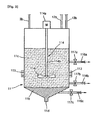
- FIG. 3 shows a state in which animal blood was separated into a high-quality amino acid solution and a waste blood sludge by the reaction of microorganisms in the blood treatment tank 11.
- the amino acid solution 11c has a clear and transparent appearance
- the waste blood sludge 11b has a dark red appearance, in which the amino acid solution 11c and the waste blood sludge 11b are present as clearly separated layers.
- the liquid microbial agent for treating blood is allowed to react with blood in the blood treatment tank 11 so as to separate the blood into an upper layer of amino acid solution 11c c and a lower layer of waste blood sludge 11b.
- the sludge 11b is discharged through a sludge outlet 11d provided at the lower end of the blood treatment tank 11, and the discharged sludge 11b is put in blood barrels 140 and transferred to an incineration plant 6 or a wastewater disposal plant 7 by a car 5.
- the amino acid solution 11c obtained by treating the blood in the blood treatment tank 11 according to the present invention is discharged through discharge pipes 116a, 116b and 116c provided at the side of the blood treatment tank 11, after which it is filtered in a filtering means 120 to remove impurities and sterilized in a sterilizing means 121.
- the amino acid solution 123a is temporarily stored in an amino acid storage means 123, after which it may be put in storage vessels 124 and transferred and used for various applications.
- a plurality of discharge pipes 116a, 116b and 116c are provided at the side of the blood treatment tank 11, and the discharge pipes should not be necessarily provided in plurality.
- the discharge pipes should not be necessarily provided in plurality.
- the blood in the blood treatment tank 11 is separated into a supernatant (amino acid liquid 11c) and a lower layer of sludge 11d, it is believed to be preferable that discharge pipes for discharging the supernatant 11c be separately provided at locations of different heights in order to effectively discharge the amino acid liquid and the sludge to the outside.
- reference numerals 117a, 117b and 117c indicate valves coupled to the discharge pipes 116a, 116b and 116c, respectively.
- the liquids of the discharge pipes 116a, 116b and 116c are combined into one solution by a multi-valve unit 118 and pressurized by a transfer pump 119, after which the liquid is transferred to the filtering means 120.
- the filtering means 120 includes at least one filter element 120a, so that the amino acid liquid 11c is passed through the filter element 120a while impurities are removed from the amino acid liquid 11c.
- the amino acid solution 121b After the amino acid solution 121b has been passed through the filtering means 120, it is sterilized in a sterilizing means 121. Because blood is infectious waste and rich in organic matter, harmful bacteria are likely to propagate in blood. For this reason, blood needs to be sterilized in the sterilizing means 121 to remove bacteria.
- the sterilizing means 121 performs a function of killing bacteria using a sterilizer such as an UV light sterilizer 121a or an ozone sterilizer (not shown).
- the amino acid solution passed through the sterilizing means 121, a highly purified, sanitarily sterilized amino acid solution containing 18 essential amino acids uniformly dissolved therein is obtained. According to the experimental results obtained by the present inventors, it was shown that the concentration of amino acids in the amino acid solution reached 18.66%.
- the amino acid solution, passed through the sterilizing means 121, is pressurized by the transfer pump 122 and cold-stored in the amino acid storage tank 123, and it may be used for various applications, including a raw material for liquid fertilizers, drugs or health foods.
- control units 110 in which the control units 110 separately placed at a site are connected with a server, placed at a central control center, by internet or communication cables, so that they can be remote controlled.
- control units 110 for the respective blood treatment tanks 100a, 100b and 100c can be combined into one network, so that they can be remote-controlled and monitored in the control center 130.
- a central control center 130 for remote controlling the blood treatment systems 10 installed in the slaughter plants can be established, so that the systems 10 can be integrally remote-connected in the central control center.
- a sever 131 remote-connected with each control unit 110 is present in the control center, and a manager can be connected with the server through a terminal 132 to control the operation of the server.
- FIG. 4 shows a system 100 for treating animal blood according to another embodiment of the present invention, in which a plurality of blood treatment tanks 100a, 100b and 100c are arranged in parallel, so that the system 100 can continuously receive and treat an animal blood 1b flowing out from the slaughter plant 1.
- the blood treatment system 100 shown in FIG. 4 differs from the blood treatment system 10 of FIG. 2 in that the blood treatment tanks 100a, 100b and 100c are arranged in plurality in parallel.
- the time taken for microorganisms to complete the degradation of blood in the blood treatment tanks 11, 100a, 100b, 100c of the present invention is about 10 hours.
- the blood treatment tank 11 In the case in which only one blood treatment tank 11 is present as shown in FIG. 2 , if the blood treatment tank 11 is completely filled, it can no longer receive animal blood, and thus animal blood flowing out from the slaughter plant should stay in the storage tank 3.
- the blood treatment tank 11 In the case in which only one blood treatment tank 11 is present as shown in FIG. 2 , if the blood treatment tank 11 is completely filled, it can no longer receive animal blood, and thus animal blood flowing out from the slaughter plant should stay in the storage tank 3.
- blood be treated as soon as possible after the occurrence thereof
- a plurality of blood treatment tanks 110a, 110b and 1 10c be placed as shown in FIG.
- the blood treatment system 100 of the present invention can exhibit the effect of continuously treating the blood 1b flowing out from the slaughter plant 1.
- a plurality of blood treatment tanks 100a, 100b and 100c are placed, and pipe facilities for supplying blood, the microbial agent and water to each of the blood treatment tanks are also provided.
- the blood storage tank 3 is connected with the plurality of blood treatment tanks 100a, 100b and 100c by blood supply pipes 3d, and the supply of blood to each channel is performed by a multi-valve unit 3c.
- the blood-treating agent supply unit 12 and the water supply unit 13 are connected with the plurality of blood treatment tanks 100a, 100b and 100c by the blood-treating agent supply pipes 12d and the water supply pipes 13d, and the supply of the blood-treating agent and water through each channel is determined by the multi-valves 12c and 13c.
- the amino acid liquid which is discharged as a supernatant from the blood treatment tanks 100a, 110b and 110c is supplied to the filtering means 120 through discharge pipes 116 and a multi-valve unit 118, and then passed through the sterilizing means 121 and the amino acid storage tank 123 and used for various applications, as described with respect to FIG. 2 .
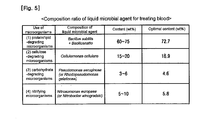
- FIG. 5 illustrates the composition ratio of a liquid microbial agent for treating blood which is used for the treatment of blood in the system for treating the blood of slaughtered animals according to the present invention.
- the liquid microbial agent for treating blood which is used in one embodiment of the present invention preferably contains: 60-75 wt% of a 1:1 mixture of a Bacillus subtilis culture and a Bacillusnatto culture as protein/lipid-degrading microorganisms; 15-20 wt% of a Cellulomonas cellulans culture as cellulose-degrading microorganisms; 3-6 wt% of a Pseudomonas aeruginosa culture as carbohydrate-degrading microorganisms; and 5-10 wt% of a Nitrosomonas europaea culture as nitrifying microorganisms.
- Rhodopseudomonas gelatinosa may be used instead of the Pseudomonas aeruginosa,
- the blood-treating agent is preferably determined in the range of 0.5-5 liter per 100 liters of blood
- the amount of the water is preferably determined in the range of 5-20 liters per 100 liters of blood. According to the experimental results obtained by the present inventors, it was shown that the most preferable result was obtained when the microbial agent for treating blood was introduced in an amount of 1 liter per 100 liters of blood to be treated and water was introduced in an amount of 10 liters per 100 liters of blood.
- the composition of the liquid microbial agent for treating blood preferably contains 60-75 wt% of a 1:1 mixture of a Bacillus subtilis culture and a Bacillusnatto culture as the protein/lipid-degrading microorganism culture, 15-20 wt% of a Cellulomonas cellulans culture as the cellulose-degrading microorganism culture, 3-6 wt% of a Pseudomonas aeruginosa culture as the carbohydrate-degrading microorganism culture, and 5-10 wt% of a Nitrosomonas europaea culture as the nitrifying microorganism culture.
- Rhodopseudomonas gelatinosa may be used instead of the Pseudomonas aeruginosa
- Nitrobacter winogradski may be used instead of the Nitrosomonas europaea.
- the blood-treating agent is preferably determined in the range of 0.5-5 liter per 100 liters of blood
- the amount of the water is preferably determined in the range of 5-20 liters per 100 liters of blood. According to the experimental results obtained by the present inventors, it was shown that the most preferable result was obtained when the microbial agent for treating blood was introduced in an amount of 1 liter per 100 liters of blood to be treated and water was introduced in an amount of 10 liters per 100 liters of blood to be treated.
- the composition of the liquid microbial agent for treating blood contains 72.7 wt% of a 1:1 mixture of a Bacillus subtilis culture and a Bacillusnatto culture, 16.9 wt% of a Cellulomonas cellulans culture, 4.6 wt% of a Pseudomonas aeruginosa or Rhodopseudomonas gelatinosa culture, and a Nitrosomonas europaea or Nitrobacter winogradski culture.
- the system for treating the blood of slaughtered animals according to the present invention can be placed as a compact form in slaughter plants throughout the nation, so that the system can immediately treat animal blood flowing out from the slaughter plants, thereby producing an amino acid liquid.
- animal blood can be mostly used to produce amino acids which can be used for agricultural fertilizers, so that the cost to purchase fertilizers required for agricultural production can be significantly reduced. Also, the amount of animal blood to be incinerated or disposed of in a wastewater disposed plant can be significantly reduced, thereby reducing the disposal cost of animal blood and greatly reducing the risk of environmental contamination caused by animal blood.
- a method of degrading animal blood using natural microorganisms is used to treat the animal blood without using a chemical degradation method that uses harmful chemicals, and thus an environmentally friendly amino acid liquid fertilizer containing high concentrations of natural microorganisms, 18 amino acids and minerals can be obtained. Accordingly, when the present invention is applied to the agricultural, food and drug fields, it has advantages in that it has excellent effects and is environmentally friendly.
- Amino acids which are obtained using the system for treating animal blood according to the present invention can be used in various applications, including foods, feed additives, drugs, animal drugs, cosmetics and agricultural chemicals.
- amino acids are synthesized in plants, stored in a protein form and used in various applications, including physiological activity, and thus amino acids provide a nutrient source for soil microorganisms, activate the growth of microorganisms and increase the root growth of plants.
- Fertilizers consist of 3 elements: nitrogen, phosphoric acid and potassium.
- the amino acid liquid that is produced by the present invention contains nitrogen, phosphoric acid and potassium, and thus greatly assists in the growth of plants.
- the amino acid liquid that is produced by the present invention is used as a nitrogen source, it has the effects of promoting the growth of agricultural crops and preventing damages by blight and harmful insects.
- the amino acids according to the present invention are absorbed into the root of plants, they advantageously show good growth compared to inorganic nitrogen and can exhibit the effects of overcoming physiological disorders, inhibiting the growth of pathogens and increasing sugar contents.
- the amino acid liquid fertilizer produced according to the present invention provide necessary components directly into plants without undergoing a biosynthesis process in the plants, and thus the effects thereof are fast, the various physiological activities are enhanced and the rates of absorption and migration into plants are very fast. Also, the amino acid liquid fertilizer according to the present invention has the effect of promoting the activation of useful microorganisms in soil to improve the physical, biological and chemical properties of the soil.
- amino acid solution which is produced according to the present invention can be widely used in industrial applications.
- it can be used in various applications, including seasonings, food additives, drugs, diet supplements and tonics.
- the system of the present invention is installed in slaughter plants throughout the nation, useful substances can be produced using livestock blood, which is a huge amount of a byproduct occurring in the livestock industry.
- livestock blood which is a huge amount of a byproduct occurring in the livestock industry.
- the disposal cost of the livestock blood can be reduced, thereby increasing the income.
- economic loss caused by the disposal of the animal blood can be fundamentally blocked.
- the blood treatment system according to the present invention can be exported to areas, such as Southeast Asia, which are highly based on agriculture and in which slaughter plants have not yet been modernized, whereby it can contribute to the obtaining of foreign money and can have a good effect on the economy of our country.
- areas such as Southeast Asia
- livestock industry and agriculture are in an advanced state, but animal blood occurring in slaughter plants are disposed of to cause contamination, and fertilizers for use in the agricultural field are deficient.
- the plant system according to the present invention is constructed in a compact form in the countries of Southeast Asia, it will have a good effect on both the livestock industry and the agricultural industry.
- the amino acid liquid fertilizer which is produced according to the present invention is a completely environmentally friendly product which can be used without anxiety.
- environmentally friendly agriculture has significantly advanced, and thus the amino acid liquid fertilizer of the present invention can attract a great deal of attention.
- the present invention can advantageously present a significantly profitable business model.
- the system for treating the blood of slaughtered animals according to the present invention can be installed near each slaughter plant in such a manner as to be connected to the slaughter plant, and thus it can completely degrade the blood of domestic animals within 10 hours, thereby maximizing the efficiency of the treatment system.
- a high-quality amino acid solution containing a high concentration (18.66% or more) of 18 essential amino acids can be obtained as a product.
- This high-quality amino acid solution can be used as an environmentally friendly fertilizer, and thus the present invention can provide the effects of recycling animal blood as a resource and preventing environmental contamination caused by animal blood.
- the inventive system for treating the blood of slaughtered animals and the inventive method of producing amino acids using the blood of slaughtered animals can solve both the problem of disposing of waste animal blood, which was a problem difficult to solve in the prior livestock industry, and the problem of obtaining a quality-quality inexpensive fertilizer, which was a problem difficult to solve in the prior agricultural field.
- the present invention can provide a high-value-added new business item which is highly profitable in economic terms in both in the livestock industry and the agricultural industry.
Landscapes
- Life Sciences & Earth Sciences (AREA)
- Chemical & Material Sciences (AREA)
- Engineering & Computer Science (AREA)
- Food Science & Technology (AREA)
- Zoology (AREA)
- Health & Medical Sciences (AREA)
- Biochemistry (AREA)
- Polymers & Plastics (AREA)
- Hematology (AREA)
- General Health & Medical Sciences (AREA)
- Nutrition Science (AREA)
- Chemical Kinetics & Catalysis (AREA)
- General Chemical & Material Sciences (AREA)
- Fertilizers (AREA)
- Treatment Of Sludge (AREA)
Applications Claiming Priority (2)
| Application Number | Priority Date | Filing Date | Title |
|---|---|---|---|
| KR1020090007520A KR100935020B1 (ko) | 2009-01-30 | 2009-01-30 | 도축 동물의 폐혈액 처리 시스템 및 도축 동물의 폐혈액을 이용하여 고품질의 아미노산 용액을 생산하는 방법 |
| PCT/KR2010/000586 WO2010087660A2 (ko) | 2009-01-30 | 2010-02-01 | 도축 동물의 폐혈액 처리 시스템 및 도축 동물의 폐혈액을 이용하여 고품질의 아미노산 용액을 생산하는 방법 |
Publications (1)
| Publication Number | Publication Date |
|---|---|
| EP2384646A2 true EP2384646A2 (de) | 2011-11-09 |
Family
ID=41809361
Family Applications (1)
| Application Number | Title | Priority Date | Filing Date |
|---|---|---|---|
| EP10736051A Withdrawn EP2384646A2 (de) | 2009-01-30 | 2010-02-01 | Blutabfall-behandlungssystem für geschlachtete tiere und verfahren zur herstellung von qualitativ hochwertiger aminosäurelösung mit blutabfall |
Country Status (8)
| Country | Link |
|---|---|
| US (1) | US20110300607A1 (de) |
| EP (1) | EP2384646A2 (de) |
| KR (1) | KR100935020B1 (de) |
| CN (1) | CN102300471A (de) |
| AU (1) | AU2010208795A1 (de) |
| BR (1) | BRPI1007482A2 (de) |
| CA (1) | CA2750955A1 (de) |
| WO (1) | WO2010087660A2 (de) |
Families Citing this family (24)
| Publication number | Priority date | Publication date | Assignee | Title |
|---|---|---|---|---|
| US8252170B2 (en) | 2008-06-27 | 2012-08-28 | Exxonmobil Upstream Research Company | Optimizing feed mixer performance in a paraffinic froth treatment process |
| KR101320077B1 (ko) * | 2012-02-01 | 2013-11-21 | 문경화 | 돼지혈 분말을 이용한 수용성 아미노산 추출물의 제조방법 |
| KR101370311B1 (ko) * | 2012-02-14 | 2014-03-06 | 주식회사 한국녹색기술산업 | 도축 혈액 단백질을 이용한 아미노산 비료 및 사료 제조의 고효율 일괄 생산 시스템과 그 제조방법 |
| US8464437B1 (en) | 2012-05-25 | 2013-06-18 | Wyssmont Company Inc. | Apparatus and method for the treatment of biosolids |
| CN103193524A (zh) * | 2013-04-09 | 2013-07-10 | 青岛曙俊肥料有限公司 | 一种液体氨基酸肥料及其制备方法 |
| CN103451248B (zh) * | 2013-08-30 | 2015-04-22 | 蔡晖 | 一种利用屠宰血液高效制备天然氨基酸的方法 |
| KR101790662B1 (ko) * | 2016-03-11 | 2017-10-27 | 주식회사 나눔 | 도축혈액을 이용하여 바이오 활성소재를 제조하는 방법 |
| CN109400668A (zh) * | 2018-09-29 | 2019-03-01 | 湖南璟荣生物科技有限公司 | 一种动物血的新型抗凝设备 |
| KR20200082270A (ko) | 2018-12-28 | 2020-07-08 | 주식회사 나눔 | 도축 폐혈액으로부터 수득된 고순도 아미노산을 포함하는 돼지 사료 첨가제 |
| KR102211107B1 (ko) | 2018-12-28 | 2021-02-03 | 주식회사 아미노랩 | 도축 폐혈액으로부터 수득된 고순도 아미노산을 포함하는 가금용 사료 첨가제 |
| KR102212453B1 (ko) | 2019-01-15 | 2021-02-04 | 주식회사 아미노랩 | 도축혈액을 이용하여 아미노산 액체비료를 제조하는 친환경 장치 및 이를 이용한 아미노산 액체비료의 제조방법 |
| CN110484429A (zh) * | 2019-09-19 | 2019-11-22 | 安徽小溪生态科技发展有限公司 | 微波水解废弃蛋白资源制备复合氨基酸糖浆工艺及装备 |
| KR102398960B1 (ko) * | 2020-03-16 | 2022-05-17 | 농업회사법인 다음산업주식회사 | 천연항생제를 함유하는 동애등에 유충용 사료 조성물, 이를 이용하여 사육한 곤충을 포함하는 가축, 어패류 또는 반려동물 사료용 조성물 |
| KR102187522B1 (ko) * | 2020-05-18 | 2020-12-08 | 주식회사 삼다 | 양돈 혈액 발효물의 제조 방법과 그 발효물을 이용한 양계 사료 조성물 |
| KR102264841B1 (ko) * | 2020-11-30 | 2021-06-15 | 주식회사 서현컴퍼니 | 천연 광물을 이용한 와구모 방제 및 악취 저감 제제의 제조 방법 |
| KR102680433B1 (ko) * | 2021-03-03 | 2024-07-02 | 배문수 | 감을 섭취한 토끼 중탕액 제조 장치 |
| KR102680434B1 (ko) * | 2021-03-03 | 2024-07-02 | 배문수 | 감을 섭취한 토끼 중탕액 제조 방법 |
| KR102481339B1 (ko) * | 2021-05-20 | 2022-12-27 | 정승진 | 전혈에서 혈장과 혈구를 분리하여 사용하는 아미노산의 제조방법 |
| KR102479382B1 (ko) * | 2021-05-20 | 2022-12-20 | 정승진 | 전혈에서 혈장과 혈구를 분리하여 사용하는 아미노산 제조 시스템 |
| CN114982805A (zh) * | 2021-10-08 | 2022-09-02 | 东莞市踔厉智能科技有限公司 | 一种用于生猪屠宰的真空抽血装置 |
| WO2023067869A1 (ja) * | 2021-10-20 | 2023-04-27 | Jfeスチール株式会社 | クッションタンク装置 |
| CN113913477A (zh) * | 2021-11-24 | 2022-01-11 | 云南中农俊发生物科技有限责任公司 | 一种动物蛋白酶解氨基酸的方法 |
| KR102737979B1 (ko) | 2021-12-31 | 2024-12-04 | 충남대학교산학협력단 | 돼지 도축혈액 가수분해물을 포함하는 근육 질환 치료 또는 운동수행능력 향상용 조성물 |
| CN116082081A (zh) * | 2023-02-27 | 2023-05-09 | 青海金地盘现代农业科技有限公司 | 一种利用动物屠宰血制备含氨基酸水溶肥的制备方法 |
Family Cites Families (9)
| Publication number | Priority date | Publication date | Assignee | Title |
|---|---|---|---|---|
| KR900001721B1 (ko) * | 1987-07-23 | 1990-03-19 | 이주권 | 두부의 제조방법과 장치 |
| JPH08168507A (ja) * | 1993-07-29 | 1996-07-02 | Tomoji Tanaka | 血液凝固剤処理 |
| CN1144273A (zh) * | 1995-09-01 | 1997-03-05 | 郑国亮 | 通过酶法水解动物屠宰血制取多肽及氨基酸的方法 |
| CN1252997A (zh) * | 1999-11-25 | 2000-05-17 | 天津市工业微生物研究所 | 血肽素的制备方法及血肽素类产品 |
| JP2002153843A (ja) * | 2000-11-16 | 2002-05-28 | Yuichi Ueda | 感染性有機廃棄物の処理方法及びそれに使用する発酵処理装置 |
| KR20020089760A (ko) * | 2001-05-24 | 2002-11-30 | 주식회사 맑은물 | 제올라이트를 이용한 아미노산 비료의 제조방법 |
| KR100509840B1 (ko) * | 2002-06-20 | 2005-08-24 | 유겐카이샤 후지.바이오 겐큐쇼 | 어란 외피의 효소 분해에 의한 아미노산 성분의 제법 |
| KR100726842B1 (ko) * | 2006-01-16 | 2007-06-12 | 주식회사 빅바이오젠 | 혈분 생산 공정 중 발생하는 폐수를 이용한 액체 비료, 그제조 방법 및 이를 이용하여 재배된 농작물 |
| KR100874338B1 (ko) * | 2008-08-22 | 2008-12-15 | 충청남도 | 도축 부산물을 이용한 아미노산 제조 장치 및 제조 방법 |
-
2009
- 2009-01-30 KR KR1020090007520A patent/KR100935020B1/ko active Active
-
2010
- 2010-02-01 AU AU2010208795A patent/AU2010208795A1/en not_active Abandoned
- 2010-02-01 CN CN2010800059077A patent/CN102300471A/zh active Pending
- 2010-02-01 CA CA2750955A patent/CA2750955A1/en not_active Abandoned
- 2010-02-01 WO PCT/KR2010/000586 patent/WO2010087660A2/ko not_active Ceased
- 2010-02-01 BR BRPI1007482-1A patent/BRPI1007482A2/pt not_active IP Right Cessation
- 2010-02-01 US US13/147,142 patent/US20110300607A1/en not_active Abandoned
- 2010-02-01 EP EP10736051A patent/EP2384646A2/de not_active Withdrawn
Non-Patent Citations (1)
| Title |
|---|
| See references of WO2010087660A2 * |
Also Published As
| Publication number | Publication date |
|---|---|
| CA2750955A1 (en) | 2010-08-05 |
| AU2010208795A1 (en) | 2011-08-18 |
| US20110300607A1 (en) | 2011-12-08 |
| CN102300471A (zh) | 2011-12-28 |
| WO2010087660A2 (ko) | 2010-08-05 |
| WO2010087660A3 (ko) | 2010-11-25 |
| KR100935020B1 (ko) | 2010-01-06 |
| BRPI1007482A2 (pt) | 2015-08-25 |
Similar Documents
| Publication | Publication Date | Title |
|---|---|---|
| EP2384646A2 (de) | Blutabfall-behandlungssystem für geschlachtete tiere und verfahren zur herstellung von qualitativ hochwertiger aminosäurelösung mit blutabfall | |
| CN104003766B (zh) | 利用畜禽无害化处理的废水与肉骨粉生产氨基酸肥的方法 | |
| CN105331565A (zh) | 一种用于净化生活污水的微生物菌剂及其制备方法 | |
| KR20190066774A (ko) | 도축혈액을 이용한 액상비료 제조 방법 | |
| CN112195213A (zh) | 利用餐饮垃圾固体物养殖黑水虻提取蛋白粉的方法 | |
| CN108203165A (zh) | 一种复合酶生化净水剂及其制备方法 | |
| CN112573961A (zh) | 一种城市生鲜垃圾复合酶解生产的液体微肽肥、生产工艺及其应用 | |
| CN102311929B (zh) | 大量快速繁殖生产乳酸菌方法 | |
| CN1389438A (zh) | 一种植物源有机生物液肥 | |
| KR100333091B1 (ko) | 혈분 분해액을 기초로 한 액체비료 제조방법 | |
| JP2007143542A (ja) | 新規微生物コンソーシア及び固形有機物の液化のためのその使用 | |
| KR970027028A (ko) | 음식물 쓰레기와 유효 미생물균군을 주재로 유기질사료, 유기질비료, 유기질 오·폐수정화제를 제조하는 방법 | |
| US5567325A (en) | Thermophilic digestion of chitin-containing waste | |
| KR100377112B1 (ko) | 건강음료의 제조방법 | |
| Jumini | Alternative fish feed production from waste chicken feathers | |
| Rocha-Meneses et al. | Bioresource recovery in the Australian red meat processing industry: a technical review of strategies for increased circularity | |
| CN114672413B (zh) | 使用从全血中分离的血浆和血细胞制造氨基酸的系统 | |
| Abdel-Fatah | Integrated Management of Industrial Wastewater in the Food Sector. Sustainability 2023, 15, 16193 | |
| CN104445640A (zh) | 一种利用泔水制备生物促生剂的工艺 | |
| KR102481339B1 (ko) | 전혈에서 혈장과 혈구를 분리하여 사용하는 아미노산의 제조방법 | |
| CN106244492B (zh) | 一种以硫酸软骨素生产工业废水为原料发酵生产枯草芽孢杆菌的方法 | |
| CN109879580B (zh) | 一种无害化鸡粪快速脱臭水解处理方法 | |
| Park et al. | Characterisation of key components of biofertiliser produced from mackerel wastewater and commercialisation feasibility analysis of the biofertiliser production process for wastewater valorisation | |
| CN120937988A (zh) | 一种基于竹粉发酵的养殖环境改良剂及其制备方法和应用 | |
| Novia | Pineapple peel: its million benefits |
Legal Events
| Date | Code | Title | Description |
|---|---|---|---|
| PUAI | Public reference made under article 153(3) epc to a published international application that has entered the european phase |
Free format text: ORIGINAL CODE: 0009012 |
|
| 17P | Request for examination filed |
Effective date: 20110719 |
|
| AK | Designated contracting states |
Kind code of ref document: A2 Designated state(s): AT BE BG CH CY CZ DE DK EE ES FI FR GB GR HR HU IE IS IT LI LT LU LV MC MK MT NL NO PL PT RO SE SI SK SM TR |
|
| DAX | Request for extension of the european patent (deleted) | ||
| RIN1 | Information on inventor provided before grant (corrected) |
Inventor name: PARK, DEOK GYU Inventor name: HAN, MYEONG GYU |
|
| STAA | Information on the status of an ep patent application or granted ep patent |
Free format text: STATUS: THE APPLICATION IS DEEMED TO BE WITHDRAWN |
|
| 18D | Application deemed to be withdrawn |
Effective date: 20140902 |