EP2384664A1 - Dispositif d'hygiène bucco-dentaire et tête pour un dispositif d'hygiène bucco-dentaire - Google Patents
Dispositif d'hygiène bucco-dentaire et tête pour un dispositif d'hygiène bucco-dentaire Download PDFInfo
- Publication number
- EP2384664A1 EP2384664A1 EP11003683A EP11003683A EP2384664A1 EP 2384664 A1 EP2384664 A1 EP 2384664A1 EP 11003683 A EP11003683 A EP 11003683A EP 11003683 A EP11003683 A EP 11003683A EP 2384664 A1 EP2384664 A1 EP 2384664A1
- Authority
- EP
- European Patent Office
- Prior art keywords
- electrode
- cleaning
- tongue
- head portion
- user
- Prior art date
- Legal status (The legal status is an assumption and is not a legal conclusion. Google has not performed a legal analysis and makes no representation as to the accuracy of the status listed.)
- Granted
Links
Images



Classifications
-
- A—HUMAN NECESSITIES
- A46—BRUSHWARE
- A46B—BRUSHES
- A46B15/00—Other brushes; Brushes with additional arrangements
-
- A—HUMAN NECESSITIES
- A46—BRUSHWARE
- A46B—BRUSHES
- A46B15/00—Other brushes; Brushes with additional arrangements
- A46B15/0055—Brushes combined with other articles normally separate from the brushing process, e.g. combs, razors, mirrors
-
- A—HUMAN NECESSITIES
- A46—BRUSHWARE
- A46B—BRUSHES
- A46B15/00—Other brushes; Brushes with additional arrangements
- A46B15/0002—Arrangements for enhancing monitoring or controlling the brushing process
-
- A—HUMAN NECESSITIES
- A46—BRUSHWARE
- A46B—BRUSHES
- A46B15/00—Other brushes; Brushes with additional arrangements
- A46B15/0002—Arrangements for enhancing monitoring or controlling the brushing process
- A46B15/0016—Arrangements for enhancing monitoring or controlling the brushing process with enhancing means
- A46B15/0022—Arrangements for enhancing monitoring or controlling the brushing process with enhancing means with an electrical means
-
- A—HUMAN NECESSITIES
- A46—BRUSHWARE
- A46B—BRUSHES
- A46B15/00—Other brushes; Brushes with additional arrangements
- A46B15/0055—Brushes combined with other articles normally separate from the brushing process, e.g. combs, razors, mirrors
- A46B15/0081—Brushes with a scraper, e.g. tongue scraper
-
- A—HUMAN NECESSITIES
- A61—MEDICAL OR VETERINARY SCIENCE; HYGIENE
- A61B—DIAGNOSIS; SURGERY; IDENTIFICATION
- A61B17/00—Surgical instruments, devices or methods
- A61B17/24—Surgical instruments, devices or methods for use in the oral cavity, larynx, bronchial passages or nose; Tongue scrapers
- A61B17/244—Surgical instruments, devices or methods for use in the oral cavity, larynx, bronchial passages or nose; Tongue scrapers for cleaning of the tongue
-
- A—HUMAN NECESSITIES
- A61—MEDICAL OR VETERINARY SCIENCE; HYGIENE
- A61N—ELECTROTHERAPY; MAGNETOTHERAPY; RADIATION THERAPY; ULTRASOUND THERAPY
- A61N1/00—Electrotherapy; Circuits therefor
- A61N1/02—Details
- A61N1/04—Electrodes
- A61N1/05—Electrodes for implantation or insertion into the body, e.g. heart electrode
- A61N1/0526—Head electrodes
- A61N1/0548—Oral electrodes
-
- A—HUMAN NECESSITIES
- A61—MEDICAL OR VETERINARY SCIENCE; HYGIENE
- A61N—ELECTROTHERAPY; MAGNETOTHERAPY; RADIATION THERAPY; ULTRASOUND THERAPY
- A61N1/00—Electrotherapy; Circuits therefor
- A61N1/18—Applying electric currents by contact electrodes
- A61N1/32—Applying electric currents by contact electrodes alternating or intermittent currents
-
- A—HUMAN NECESSITIES
- A61—MEDICAL OR VETERINARY SCIENCE; HYGIENE
- A61N—ELECTROTHERAPY; MAGNETOTHERAPY; RADIATION THERAPY; ULTRASOUND THERAPY
- A61N1/00—Electrotherapy; Circuits therefor
- A61N1/18—Applying electric currents by contact electrodes
- A61N1/32—Applying electric currents by contact electrodes alternating or intermittent currents
- A61N1/322—Electromedical brushes, combs, massage devices
-
- A—HUMAN NECESSITIES
- A46—BRUSHWARE
- A46B—BRUSHES
- A46B2200/00—Brushes characterized by their functions, uses or applications
- A46B2200/10—For human or animal care
- A46B2200/1066—Toothbrush for cleaning the teeth or dentures
-
- A—HUMAN NECESSITIES
- A61—MEDICAL OR VETERINARY SCIENCE; HYGIENE
- A61B—DIAGNOSIS; SURGERY; IDENTIFICATION
- A61B17/00—Surgical instruments, devices or methods
- A61B2017/00367—Details of actuation of instruments, e.g. relations between pushing buttons, or the like, and activation of the tool, working tip, or the like
- A61B2017/00398—Details of actuation of instruments, e.g. relations between pushing buttons, or the like, and activation of the tool, working tip, or the like using powered actuators, e.g. stepper motors, solenoids
-
- A—HUMAN NECESSITIES
- A61—MEDICAL OR VETERINARY SCIENCE; HYGIENE
- A61B—DIAGNOSIS; SURGERY; IDENTIFICATION
- A61B17/00—Surgical instruments, devices or methods
- A61B2017/00681—Aspects not otherwise provided for
- A61B2017/00734—Aspects not otherwise provided for battery operated
Definitions
- the present invention relates to a head portion for a mouth cleaning device comprising cleaning elements for cleaning teeth.
- the invention further relates to a mouth cleaning device comprising such a head portion and a handle.
- the invention is in particular concerned with such head portions and mouth cleaning devices that comprise an electrode for additional treatment of the oral cavity by electrophoresis.
- Halitosis or most commonly bad breath stems to more than 80% from a contamination of the tongue by mostly anaerobic bacteria. When left on the tongue the anaerobic respiration of those bacteria can yield a plurality of bad smells. In order to fight malodour from the tongue it is necessary to clean the bacteria from the tongue. Mints, mouth sprays, mouth wash or gum usually only provide temporary relief as the tongue surface is very rough and the bacteria can hide in the pits and fissures. In order to provide a better cleaning tongue cleaners often also denoted as tongue scrapers are known from the prior art for collecting and removing the bacterial coating of the tongue.
- Ergonomic tongue cleaners from the prior art are shaped in accordance with the anatomy of the tongue, and are optimized to lift and trap the plaque coating and effectively clean the surface of the tongue.
- tongue cleaners made from plastic, metal or other materials.
- Most tongue cleaners can generally be described as being spoon-shaped comprising a head portion and a handle portion while having plurality of ribs at their head portion facing towards the tongue for scrubbing the tongue when in operation.
- EP 1 908 435 A1 discloses a mouth cleaning device including a head portion provided with bristles and an electrode, and a handle portion provided with an electrode.
- the electrode in the head portion is located near the roots of the bristles facing into the same direction as the bristles.
- the bristles as well as the electrode when in use do face towards the teeth in order to provide a current flow in the direction of the user's teeth and gums when in use.
- the head portion as proposed comprises a plurality of cleaning elements, e.g. in the form of bristles arranged in bristle tufts or elastomeric fingers, and a tongue cleaning electrode enabling a current flow into a user's tongue when in use.
- the tongue cleaning electrode and the cleaning elements are essentially arranged on opposing sides of the head portion such that in use only one of the sides of the head portion will get into contact with the tongue (assuming that the tongue is kept in an essentially flat state). In other words, the tongue cleaning electrode and the cleaning elements face essentially in opposing directions.
- the head portion comprises an electrical connecting element being electrically coupled to the tongue cleaning electrode for providing an electrical connection with a corresponding electrical connecting element located at a handle portion in an attached state.
- a mouth cleaning device having a head portion comprising a plurality of cleaning elements (e.g. being realized as bristles or elastomeric fingers) and a tongue cleaning electrode enabling a current flow into a user's tongue when in use.
- the tongue cleaning electrode and the cleaning elements are essentially arranged on opposing sides of the head portion such that in use only one of the sides of the head portion will get into contact with the tongue (assuming that the tongue is kept in a flat state).
- the mouth cleaning device further comprises a handle portion having a contact electrode, wherein the contact electrode of the handle portion enables a current flow into a user's hand when in use, and an energy source, wherein the energy source is electrically connected to the contact electrode in the handle portion and to the tongue cleaning electrode in the head portion such that when in operation a current may flow between the contact electrode and the tongue cleaning electrode through a user's body.
- the head portion may be realized as an integral (not detachable) part of the mouth cleaning device or it may be realized as a detachable part, in particular to enable replacing the head portion.
- the head portion for a mouth cleaning device not only enables a mechanical cleaning of the teeth but also an electrically driven cleaning process for the user's tongue based on electrophoresis.
- the arrangement of the cleaning elements and the tongue cleaning electrode facing at least partly into different directions enables cleaning of the user's teeth as well as the user's tongue without turning the head portion around in the user's mouth, but more prominently, the tongue can be cleaned with a special tongue cleaning side of the toothbrush that may comprise protrusions for mechanically removing debris and bacteria from the tongue in addition to the cleaning action induced by electrophoresis.
- the arrangement of contact electrode in the handle portion and tongue cleaning electrode in the head portion of the mouth cleaning device allows for providing a current flow from one electrode to the other through the user's body.
- the bacteria on the tongue may be fought against by anti-bacterial ions.
- An anti-bacterial agent comprising the respective anti-bacterial ions can be provided for example as part of a cleaning substance like a dentifrice or mouth rinse, which is applied into the user's mouth.
- the anti-bacterial ions can be provided from (ionised) water without addition of an additional anti-bacterial substance or the tongue cleaning electrode may provide anti-bacterial ions, e.g. silver ions.
- the cleaning substance or anti-bacterial agent may be provided as an integral part of the mouth cleaning device, for example in a container (e.g. a gel cushion or a slowly dissolving strip) located next to the tongue cleaning electrode of the head portion.
- a container e.g. a gel cushion or a slowly dissolving strip located next to the tongue cleaning electrode of the head portion.
- the polarity of the applied voltage potentials will depend on the charge of the active ions of the anti-bacterial agent in order to provide an effective flow of the anti-bacterial agent into the pits and fissures of the tongue.
- the tongue cleaning electrode in the head portion of the mouth cleaning device When for example operating with positively charged ions, the tongue cleaning electrode in the head portion of the mouth cleaning device must be positively charged (against the contact electrode) to provide an effective driving of the ions towards the tongue.
- the current strengths and polarity may be manually adjustable by the user. The current strengths can be reduced to allow the user to become acquainted to the device and later to choose an optimal strength. If a user is very sensitive at the tongue it is possible to reduce the current strengths or if somebody suffers from strong malodour he or she can use a higher strengths of current.
- the mouth cleaning device may hence be equipped with a respective control element for controlling the polarity of the applied voltages and to control the current strength.
- the applied current is a constant direct current.
- an alternating current or a pulsed current may be used in order to optimize a tongue cleaning.
- a periodic change of the polarity of the applied voltage potentials is advantageous.
- the handle portion comprises a switch for activating or deactivating the device.
- the energy source is arranged such that it limits the current.
- the current provided by the energy source through the user's body is in a range from 20 ⁇ A to 700 ⁇ A and preferably between 50 ⁇ A and 400 ⁇ A.
- the voltage applied between the electrode ranges from 8 Volts to 20 Volts.
- the applied voltage may have a value of 8 Volts, 10 Volts, 12 Volts, 14 Volts, 16 Volts, 18 Volts or 20 Volts.
- the tongue cleaning electrode comprises an electrode area, wherein the electrode area has a surface normal at each point of it, wherein the surface normal of at least one section of the electrode surface and each of the cleaning elements includes an angle of at least 45°, preferably of at least 70°, and most preferred of at least 90°.
- the angle should be measured between the surface normal and the symmetry axis or longitudinal extension axis of the cleaning element
- the electrode area in the sense of the present application is the area covered by the tongue cleaning electrode, wherein the electrode area need not necessarily being entirely electrically conductive, but may be composed for example of a number of alternating conductive surfaces, like blades, ribs or nubs, and isolating sections.
- the electrode area is the area underlying this structure and determining the overall shape of the electrode.
- the surface normal to be considered is the surface normal of the overall electrode area which is not at each point identical to the surface normal of the electrically conductive surface of the tongue cleaning electrode.
- This geometric orientation guarantees that the tongue cleaning electrode and the cleaning elements are facing into two different directions enabling an independent cleaning of the user's teeth with the cleaning elements and of the user's tongue with the tongue cleaning electrode.
- the surface normal of at least one section of the electrode area of the tongue cleaning electrode and each of the bristles include an angle in a range from 135° to 180°.
- the tongue cleaning electrode and the cleaning elements are at least partly located opposite each other such that when inserted into the user's oral cavity, the cleaning elements are facing towards the masticatory surface of the user's tooth and the tongue cleaning electrode is facing towards the user's tongue.
- the cleaning elements are arranged to be driven by a mechanical actuator, wherein the mechanical actuator is arranged for establishing connection to an electrical drive providing an electrical toothbrush assembly.
- the head portion comprises a cleaning element carrier that is arranged to provide a rotational oscillatory motion when in use.
- the handle portion of the mouth cleaning device comprises an electrical drive for connecting to the mechanical actuator in the head portion in order to form an electrical toothbrush.
- the head portion comprises a second electrode facing into the first direction (i.e. the direction into which the cleaning elements extend) to enable a current flow into the user's gums or teeth when using the cleaning elements for mechanically cleaning the teeth.
- the ionic tongue cleaning capability of the proposed mouth cleaning device is combined with the known principle of ionic teeth cleaning.
- the cleaning elements are at least partly electrically conducting and are thus forming the second electrode.
- the second electrode and the tongue cleaning electrode are operated selectively, e.g. by providing a control element to selectively switch on only one of the second electrode and tongue cleaning electrode or to switch on both electrodes.
- the different electrodes may have the same or opposite polarity.
- the polarity of each of the electrodes may be independently controllable via respective control elements.
- the head portion further comprises a mechanical tongue cleaning section having a structured surface with at least one protrusion, wherein the mechanical tongue cleaning section is facing into the second direction (i.e. into the direction into which the tongue cleaning electrode is facing).
- a mechanical tongue cleaning section having a structured surface with at least one protrusion, wherein the mechanical tongue cleaning section is facing into the second direction (i.e. into the direction into which the tongue cleaning electrode is facing).
- a rough surface i.e. like a rasp, is structured and as such comprises a plurality of protrusions.
- the tongue cleaning electrode is a laminar electrode having an extended contact surface.
- the area over which the mechanical tongue cleaning section extends at least partly overlaps with the area over which the tongue cleaning electrode extends. This guarantees that when mechanically scrubbing the tongue with the mechanical tongue cleaning section of the head portion an electric current can be applied to the tongue simultaneously enabling the above described cleaning process by electrophoresis.
- the mechanical tongue cleaning section and the laminar electrode on the head portion overlap to full extend.
- the mechanical cleaning section comprises a plurality of protrusions extending above the electrode.
- Those protrusions which may have multiple forms of design shall enable an effective scrubbing of the tongue in order to mechanically remove bacteria from the tongue.
- Those protrusions in an embodiment may have the shape of ribs, blades or nubs.
- protrusion in the sense of the present application does exclude filaments, for example filaments used as bristles in a tooth brush.
- a filament if compared to a protrusion according to the definition used in this application has an additional degree of freedom for flexing.
- a protrusion on the other hand has the function of following the motion of the carrier and to transmit a significant force for efficient scrapping of the tongue. For this particular application of the present invention a significant bending would be disturbing the functionality.
- a protrusion in the sense of the present application follows the motion of the carrier and allows no or only little internal flexing.
- a protrusion typically does not allow any significant movement within itself and therefore does have significant higher natural frequencies than a filament.
- a protrusion in the sense of the present application in an embodiment has a natural frequency of more than 1200 Hz, preferably of more than 2000 Hz and most preferred of more than 3000 Hz.
- the natural frequency of a protrusion is equal or larger than 4000 Hz. Then its internal stiffness is so high that it would follow the motion of the carrier without noticeable internal flexing.
- natural frequency is used synonymously for Eigenfrequenz.
- a cylindrical protrusion formed of nylon with a length of 5 mm, a diameter of 0.15 mm and a Young modulus of 3000 N/mm 2 treated as a cylindrical beam with one end fixed and the other end freely oscillating does have a (lowest) natural frequency of 1400 Hz. At a length of 2.5 mm the lowest natural frequency would be 5690 Hz.
- the protrusions have a height (distance between free end and base) of maximally 5.0 mm, preferably less than 4.0 mm, more preferably of less than 3.0 mm and most preferably of less than 2.0 mm.
- the protrusion is formed of an elastomeric plastic material.
- the protrusion may be made of electrically isolating material and extends above the tongue cleaning electrode.
- the protrusion when in use forms a spacer between the tongue cleaning electrode and the user's tongue at least partly avoiding direct contact between the electrode and the tongue.
- the electrode is implemented as a laminar electrode partly covered by a plurality of electrically isolating protrusions, preferably ribs, forming the structured surface of the mechanical tongue cleaning section.
- a laminar electrode partly covered by a plurality of electrically isolating protrusions, preferably ribs, forming the structured surface of the mechanical tongue cleaning section.
- the ribs of the mechanical tongue cleaning section form a grid between which at a lower level the electrically conductive material of the electrode would be present.
- the tongue cleaning electrode comprises a material selected from a group consisting of metal, in particular noble metal, e.g. silver, stainless steel, an electrically conductive plastic or a combination thereof.
- the tongue cleaning electrode itself may form the mechanical tongue cleaning section. This may for example be implemented by providing a rough electrically conductive surface having protrusions.
- the electrode comprises a plurality of protrusions in the form of nubs.
- the nubs - when in use - point towards the user's tongue to provide places of high current density assisting to drive the ions as deep as possible into the pits and fissures between the papillae.
- the protrusions in particular the nubs have a height in a range from 0.1 mm to 2 mm measured from base to tip.
- a nub in the sense of the present application is a protrusion whose height above the surrounding material is larger than or on the order of its widths or lengths.
- the nubs may have all kinds of different shapes.
- the nubs may be cylindrical, conical, Gaussian or (hemi-)spheric.
- nubs having a circular cross-section it is of course possible that the nubs have a triangular, rectangular or any other cross-sectional shape.
- the nubs may be arranged in a particular pattern or alternatively they could be arranged randomly.
- the plurality of nubs may be formed of a single piece of electrically conductive material, e.g. by punching a sheet of metal foil, the nubs need not necessarily be manufactured of a single piece, but could for example be arranged as a set of individual balls, which are separated from each other.
- the protrusions in particular the nubs, have a widths in a range from 0.1 mm to 3 mm.
- the widths of the nub is identical to its diameter.
- the height of the protrusions in particular the height of the nubs, is less than five times their diameter or width.
- the area of the electrode covered by the nubs is in a range from between 1 % to 50 % of the overall area of the tongue cleaning electrode. In another embodiment, the area of the tongue cleaning electrode covered by the nubs is in a range from 1 mm 2 to 100 mm 2 . The area of the tongue cleaning area may be in the range of between 10 mm 2 and 500 mm 2 .
- the current density at the electrically conductive sections of the tongue cleaning electrode is higher than 0.5 ⁇ A/mm 2 and preferably less than 60 ⁇ A/mm 2 .
- the area of the electrically conductive sections of the electrode must have an area of less than 200 mm 2 .
- the high current density at the nubs is achieved when the nubs have a density of between 5 nubs/cm 2 and 50 nubs/cm 2 taking into account the overall area of the electrode.
- each nub is even further enhanced when the electrically conductive nubs of the electrode are separated from each other by electrically isolating material sections. In an embodiment, this may be achieved by first forming an electrically conductive electrode comprising the nubs while in a second step the spacing between the nubs is partly filled with an electrically isolating material. The nubs may protrude over the electrically isolating material for providing contact points with the tongue.
- the overall area of the electrically conductive sections of the electrode is smaller than 200 mm 2 and preferably equal to 150 mm 2 or less.
- the ratio between the area of the electrode covered by the nubs and the overall area of the electrode is equal or less than 0.7, preferably equal or less than 0.3 and most preferably in a range from 0.1 to 0.3.
- the tongue cleaning electrode in an embodiment has a width in a range from 0.2 cm to 6 cm, preferably in a range of between 0.5 cm and 3 cm.
- the size of the tongue cleaning electrode is somewhat smaller than the back area of a replacement brush head and may thus have a width of about 0.4 mm - 1.0 mm and a length (measured in longitudinal extension direction of the replacement brush head) of about 0.8 mm - 2.5 mm.
- the head portion and the handle portion are detachably mounted to each other such that the head portion may be realized as a disposable exchange part.
- the head portion and/or the handle portion comprise a mechanical connector for establishing a mechanical connection between the head portion and the handle portion and/or an electrical connector between the head portion and the handle portion for establishing an electrical connection.
- the electric current flowing through the user's body will be substantially reduced when a current flow is provided between the tongue cleaning electrode and the handle electrode, e.g. by a water film extending from the head section to the handle section.
- the head section and/or the handle section may comprise a (e.g. annular) protrusion acting as a tear-off edge for the film.
- the mouth cleaning device in particular the head portion and/or the handle portion, are arranged such that they provide a vibrational motion of the head portion, in particular of the mechanical tongue cleaning section, where such is present.
- a vibrational motion could for example be caused by an ultrasound device (e.g. a piezoelectric actuator) integrated into the head portion or into the handle portion, by driving the head portion with a linear drive or by including a motorized eccentric mass on a rotatable axis.
- the vibrational motion provided in a tongue cleaning mode for cleaning the user's tongue has a frequency which is smaller than the frequency used for cleaning the user's teeth.
- the head portion comprises an emitter for electromagnetic radiation, in particular a light emitting diode.
- This emitter may emit light in the visible range for illuminating the user's mouth.
- emission in other ranges of the electromagnetic spectrum may be considered.
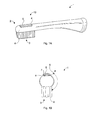
- Fig. 1 a) and b) show a first exemplary embodiment of a head portion 1 for a mouth cleaning device according to the present invention.
- the head portion 1 has a front end 2, which is intended to be inserted into the user's oral cavity during operation, carries cleaning elements realized as bristles 6 forming a brush 3, a tongue cleaning electrode 4 as well as six protrusions realised as plastic ribs 5 that extend over the tongue cleaning electrode 4 forming a mechanical tongue cleaning section for scrubbing the tongue.
- the brush 3 is here realized as a passive element which does not provide for any rotational or otherwise active motion of the bristles 6.
- the tongue cleaning electrode 4 While the bristles 6 of the brush 3 are facing into a first direction, i.e. when inserted into the user's oral cavity towards the user's teeth, the tongue cleaning electrode 4 as well as the mechanically tongue cleaning section 10 formed by the plastic ribs 5 do face into a second direction being distinct over the direction the bristles 6 are facing to.
- the tongue cleaning electrode 4 and the cleaning elements are arranged on opposite sides of the head portion 2 so that they face into different directions such that they would not simultaneously get in contact with the tongue during a tongue cleaning operation (assuming that the tongue is kept in an essentially flat state).
- the brush 3 and the tongue cleaning electrode 4 as well as the plastic ribs 5 are arranged such that they are facing into opposite directions, i.e. when in use the brush may clean the masticatory surfaces of the teeth while simultaneously the tongue cleaning electrode 4 and/or the mechanical cleaning section formed by the ribs 5 could clean the user's tongue.
- Fig. 1b shows a schematic cross-sectional view of the head portion 1 of Fig. 1a ).
- the tongue cleaning electrode 4 is a laminar electrode forming a section of the surface of the head portion 1 while the mechanical cleaning ribs 5 extend above the cleaning electrode in a more or less regular pattern.
- One advantage of the embodiment shown in Figs. 1a) and 1b ) is that when in use the electrode 4 will most probably not engage the tongue directly as the ribs 5 do serve as distance pieces establishing a distance between the top surface of the ribs 5 and the surface of the tongue cleaning electrode 4. The electric contact is nevertheless established by the liquid environment in the user's oral cavity.
- the tongue cleaning electrode 4 has an electrode area 7 which is almost identical to the area of the extension of the tongue cleaning electrode 4 itself. However, it is reduced by the area covered by the plastic ribs 5.
- the electrode area 7 has at each point a surface normal 8 being perpendicular to the electrode area 7 of the tongue cleaning electrode 4. By this surface normal 8 it can be more clearly defined what it means that the brush 3 and the tongue cleaning electrode 4 as well as the mechanical cleaning section, i.e. the ribs 5, are facing into different directions.
- each of the surface normals 8 on the surface area of the tongue cleaning electrode 4 do include an angle of at least 135° with the cleaning elements realized as bristles 6 of the brush 3. In fact the angle included between the bristles 6 and surface normals 8 lies between 135° and 180°.
- the mouth cleaning device When in use as a tongue cleaner the mouth cleaning device is inserted into the user's oral cavity and the side of the head portion 1 on which the tongue cleaning electrode 4 is located is brought into contact with the user's tongue. In operation the side of the head portion 1 carrying the electrode 4 and the mechanical tongue cleaning section 10 is facing towards the user's tongue. The device 2 is moved such that the ribs 5 scrub over the surface of the tongue in order to mechanically remove part of the malodour producing bacteria. In addition to the mechanical cleaning an electrophoretic cleaning is switched on by actuating the on/off-button of the handle portion 21. When switched on the energy source inside the handle portion 21 applies a voltage to the contact electrode 35 in the handle portion as well as to the tongue cleaning electrode 4 in the head portion 1 such that a potential difference exists between the both electrodes.
- the current starts to flow through the user's body from the tongue cleaning electrode 4 to the contact electrode 35 in the handle portion 21 or vice versa as soon as the tongue cleaning electrode 4 is brought into contact with the tongue.
- the user has inserted a cleaning agent into the mouth containing positively charged ions before inserting the device 1 into the oral cavity.
- the voltage is applied to the two electrodes 4, 35 such that the tongue cleaning electrode 4 is positively charged against the contact electrode 35.
- Figs. 2 and 3 show alternative arrangements of the tongue cleaning electrode and the mechanical tongue cleaning section.
- Fig. 2 an alternative concept for implementing an integrated tongue cleaning electrode 9 and mechanical tongue cleaning section 10 has been chosen. Again, the areas over which the tongue cleaning electrode 9 extends and the area over which the mechanical tongue cleaning section 10 extends are spatially overlapping.
- the tongue cleaning electrode 9 is formed by a metal sheet which has been bent (e.g. by stamping) in order to form a set of six protrusions realised as metallic ribs 11 protruding from the plane of the remaining laminar electrode structure.
- the orientation and arrangement of the electrode ribs 11 is comparable to the arrangement of the elastomeric ribs 5 of Figs. 1a) and 1b ).
- the space between the ribs 11 has been filled by an electrically isolating material 12, e.g.
- the isolating material 12 forms a layer over the electrode material.
- the isolating material 12 fills the spacing between the ribs 11 only partly such that the ribs 11 protrude over the surface level 13 of the isolating material 12 enabling an effective scrubbing when moving the head portion 1 of the device over the user's tongue.
- the electric connection 14 connecting the electrode 9 with the current source in the handle portion of the device (not shown in Fig. 2 ).
- electrode area denotes the overall area and shape of the electrode section, not only including the sections getting into electric contact with the user's tongue, like the ribs 11 in Fig. 2 , but e.g. also including those sections underneath the isolating material 12. In particular if it comes to the question of shape and location of the electrode the electrode area is distinct from the surface area of the electrode. While the surface area also includes surface sections like the ribs 11 having surface normals facing into a variety of directions the electrode area of the electrode describes the overall shape of the electrode. In Fig. 2 the electrode area of the electrode is planar.
- FIG. 3 shows a cross-sectional cut through an alternative embodiment of the tongue cleaning electrode 15.
- the tongue cleaning electrode 15 in this embodiment consists of a metal foil into which a plurality of protrusions in the form of nubs 16 have been stamped such that the nubs 16 protrude from the otherwise planar electrode 15.
- the spacing between the individual nubs 16 once again have been filled by an isolating material 17 (e.g. by an elastomer) being electrically isolating.
- the nubs 16 further protrude above the surface level 18 of the isolating material 17.
- the electrode area of the tongue cleaning electrode 15 is indicated by the doted line 19.
- the surface normals at each point of the electrode area are perpendicular to the doted line but not perpendicular to the electrode surface 20 at each point of the tongue cleaning electrode 15 which at some locations differs substantially from the orientation of line 19, in particular at the nubs 16.
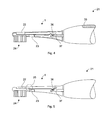
- FIGS 4 to 7 show embodiments of the present invention in which not only a tongue cleaning electrode 22 is provided but also a second electrode 23 facing into the same direction as the cleaning elements realized as bristles forming a brush 24.
- FIGS 4 to 7 are schematic sketches provided in order to describe the electric connectivity of the electrodes 22, 23, each of the electrodes 22, 23 and brushes 24 in the different figures have been denoted by the same reference numbers although they may be formed by different types of electrodes or bristles.
- the tongue cleaning electrode 22 is used for cleaning the user's tongue as described with reference to Figs. 1a) and 1b ) the second electrode 23 will enable a current flow towards the user's teeth and gums while the brush 24 is used to clean the teeth.
- the tongue cleaning electrode 22 is used in order to drive positively charged ions as an antibacterial agent towards the user's tongue and the second electrode 23 is used to drive negatively charged (e.g. fluoride) ions towards the user's teeth, in particular to the enamel.
- the polarity of the tongue cleaning electrode 22 is positive in order to drive negatively charged ions towards the user's tongue.
- Fig. 4 shows a simple embodiment in which both electrodes 22, 23 are simultaneously switched-on and provided with the same polarity. In order to switch between the two above described modes for cleaning the tongue or for cleaning the teeth the polarity of the two electrodes is switched with a corresponding switch element provided at the handle portion 21.
- the circuit for driving the two electrodes 22, 23 could contain a diode 25 as shown in Fig. 5 .
- This diode is arranged between the two electrodes 22, 23 such that the second electrode 23 is always switched on nevertheless which polarity is chosen.
- the tongue cleaning electrode 22 is only provided with a positive charge and is switched off by the diode 25 when a negative polarity is chosen.
- Fig. 6 is an amendment of the embodiment depicted in Fig. 5 , the amendment leading to a diode 26, 27 in front of each of the electrodes 22, 23.
- the tongue cleaning electrode 22 is only switched on when a positive polarity is chosen and the second electrode 23 for cleaning the user's teeth is only switched on when a negative polarity is chosen.
- a current flows only through the tongue cleaning electrode or the second electrode.
- diode different types of semiconductor elements such for example field effect transistors, thyristors, etc. could be used in order to provide a selective switching of the electrodes 22, 23.
- the two electrodes 22, 23 may be coupled to a frequency dependent circuit.
- frequency filters can be applied in order to selectively drive the two electrodes 22, 23.
- the second electrode 23 is not realized by a planar electrode but conductive bristles form the second electrode in order to provide the electrode as close to the teeth as possible.
- Fig. 7 shows an alternative embodiment in which the two electrodes 22, 23 have each been connected with a biasing line 28, 29, which can be selectively connected to the energy source.
- Figs. 4 to 7 the electrical connecting elements 36, 37 of the head portion 1 and the handle portion 21 are shown, respectively. While the connecting element 36 of the head portion 1 is electrically connected to the tongue cleaning electrode 22, the connecting element 37 of the handle portion 37 is connected to the energy source.
- the connecting element 36 may be formed by an resilient connecting element, e.g. a contact spring, that is arranged to engage with a complementary contact element at the handle portion 21.
- Fig. 8 is an example for a handle portion 21 of a mouth cleaning device containing not only the energy source for applying a current to the different electrodes, but also an electric motor driving a drive shaft 30 for providing a rotational motion of the brush, i.e. forming an electric tooth brush.
- the handle portion 21 in the depicted embodiment further comprises an on/off-button 31, a mode selection button 32, a display 33 for providing instructions on use of the device as well as information on the mode the device is currently operating in, and a light emitting diode 34 for indicating the charge condition of the energy source (e.g. a rechargeable battery).
Landscapes
- Health & Medical Sciences (AREA)
- Life Sciences & Earth Sciences (AREA)
- Public Health (AREA)
- Animal Behavior & Ethology (AREA)
- Nuclear Medicine, Radiotherapy & Molecular Imaging (AREA)
- Veterinary Medicine (AREA)
- Engineering & Computer Science (AREA)
- Biomedical Technology (AREA)
- General Health & Medical Sciences (AREA)
- Radiology & Medical Imaging (AREA)
- Surgery (AREA)
- Heart & Thoracic Surgery (AREA)
- Medical Informatics (AREA)
- Molecular Biology (AREA)
- Otolaryngology (AREA)
- Dentistry (AREA)
- Oral & Maxillofacial Surgery (AREA)
- Pulmonology (AREA)
- Cardiology (AREA)
- Brushes (AREA)
- Surgical Instruments (AREA)
Applications Claiming Priority (1)
| Application Number | Priority Date | Filing Date | Title |
|---|---|---|---|
| US33196710P | 2010-05-06 | 2010-05-06 |
Publications (2)
| Publication Number | Publication Date |
|---|---|
| EP2384664A1 true EP2384664A1 (fr) | 2011-11-09 |
| EP2384664B1 EP2384664B1 (fr) | 2014-02-26 |
Family
ID=44260321
Family Applications (1)
| Application Number | Title | Priority Date | Filing Date |
|---|---|---|---|
| EP11003683.7A Active EP2384664B1 (fr) | 2010-05-06 | 2011-05-05 | Dispositif d'hygiène bucco-dentaire |
Country Status (8)
| Country | Link |
|---|---|
| US (1) | US8479750B2 (fr) |
| EP (1) | EP2384664B1 (fr) |
| JP (1) | JP5437531B2 (fr) |
| KR (1) | KR20120140683A (fr) |
| CN (1) | CN102869286B (fr) |
| AU (1) | AU2011248338A1 (fr) |
| CA (1) | CA2798609A1 (fr) |
| WO (1) | WO2011140058A1 (fr) |
Cited By (6)
| Publication number | Priority date | Publication date | Assignee | Title |
|---|---|---|---|---|
| DE202012105098U1 (de) | 2012-12-29 | 2014-01-08 | Armin Rees | Vorrichtung zur Zungenreinigung |
| DE102012113227B3 (de) * | 2012-12-29 | 2014-05-22 | Armin Rees | Vorrichtung und Verfahren zur Zungenreinigung |
| EP3326578A1 (fr) * | 2016-11-23 | 2018-05-30 | Braun GmbH | Outil de soin buccal |
| WO2018099770A1 (fr) * | 2016-12-01 | 2018-06-07 | Koninklijke Philips N.V. | Dispositif de soins buccaux et accessoire |
| US10391302B2 (en) | 2015-05-05 | 2019-08-27 | Cosmo Haralambidis | Device for electrical stimulation of peridontal complex and surrounding tissue |
| EP3733117A1 (fr) * | 2019-05-02 | 2020-11-04 | Braun GmbH | Dispositif de soins personnels |
Families Citing this family (30)
| Publication number | Priority date | Publication date | Assignee | Title |
|---|---|---|---|---|
| US9314321B2 (en) | 2007-09-05 | 2016-04-19 | Biolectrics Llc | Concurrent treatment of oral and systemic maladies in animals using electrical current |
| US9168370B2 (en) | 2007-09-05 | 2015-10-27 | Biolectrics Llc | Concurrent treatment of oral and systemic maladies using direct current electricity |
| CN103703668B (zh) * | 2011-07-25 | 2016-12-07 | 博朗有限公司 | 线性电动聚合物马达和具有所述线性电动聚合物马达的装置 |
| TWD153974S (zh) * | 2011-12-28 | 2013-06-11 | 美國棕欖公司 | 電動牙刷之刷頭 |
| AU343514S (en) * | 2011-12-28 | 2012-07-26 | Omron Healthcare Co | Brush head for electric toothbrush |
| CN104582598A (zh) * | 2012-06-29 | 2015-04-29 | 金顶集团有限公司 | 超声刮舌器 |
| JP6065205B2 (ja) * | 2012-12-07 | 2017-01-25 | パナソニックIpマネジメント株式会社 | 舌清掃器具およびこの舌清掃器具を有する電動口腔衛生装置 |
| US9101204B2 (en) * | 2013-09-26 | 2015-08-11 | M+C Schiffer Gmbh | Oral care implement |
| USD776435S1 (en) * | 2013-12-19 | 2017-01-17 | Colgate-Palmolive Company | Head portion of a toothbrush |
| CA2936087C (fr) | 2014-01-07 | 2023-02-28 | Animal Oralectrics Llc | Traitement d'affections buccales au moyen d'un courant electrique |
| CN104305707B (zh) * | 2014-10-24 | 2017-02-22 | 傅敏 | 可电解牙刷 |
| US11103696B2 (en) | 2015-05-05 | 2021-08-31 | Cosmo Haralambidis | Device for electrical stimulation of peridontal complex and surrounding tissue |
| USD815280S1 (en) * | 2015-08-06 | 2018-04-10 | Spencer Cho | Standing tongue scraper |
| US9597496B1 (en) * | 2015-10-16 | 2017-03-21 | Colgate-Palmolive Company | Oral care implement with conductive protrusions |
| US11103058B2 (en) * | 2017-06-27 | 2021-08-31 | Colgate-Palmolive Company | Oral care implement |
| US10639467B2 (en) * | 2017-06-27 | 2020-05-05 | Colgate-Palmolive Company | Oral care implement |
| US11071854B2 (en) * | 2017-06-27 | 2021-07-27 | Colgate-Palmolive Company | Oral care implement |
| DE102017120902A1 (de) * | 2017-09-11 | 2019-03-14 | Cinogy Gmbh | Plasma-Behandlungsgerät |
| EP3733116B1 (fr) | 2019-05-02 | 2021-11-17 | Braun GmbH | Moteur avec partie de moteur mobile montée sur ressort et dispositif de soins personnels comprenant un tel moteur |
| ES2906953T3 (es) | 2019-05-02 | 2022-04-21 | Braun Gmbh | Dispositivo de higiene personal |
| DE102019211370A1 (de) * | 2019-07-30 | 2021-02-04 | GalvoSurge Dental AG | Kontaktierungssystem und Verwendung des Kontaktierungssystems |
| KR102259765B1 (ko) | 2019-11-11 | 2021-06-01 | 김영욱 | 플라그 제거 촉진용 칫솔 및 이의 제조 방법 |
| KR102195771B1 (ko) * | 2020-04-06 | 2020-12-28 | 주식회사 프록시헬스케어 | 전기 칫솔 |
| JP6989915B2 (ja) * | 2020-04-28 | 2022-01-12 | アイオニック株式会社 | イオン歯ブラシ |
| USD950957S1 (en) | 2020-04-30 | 2022-05-10 | Colgate-Palmolive Company | Oral care implement handle |
| AU2021315990A1 (en) | 2020-07-28 | 2023-02-23 | Biolectrics Llc | Systems and methods related to intraoral electrical stimulation |
| EP4199771A4 (fr) | 2020-12-10 | 2024-05-01 | Colgate-Palmolive Company | Instrument de soins buccaux et poignée de cet instrument |
| EP4019078A1 (fr) | 2020-12-22 | 2022-06-29 | Koninklijke Philips N.V. | Dispositif de soins personnels |
| USD1107431S1 (en) | 2022-08-29 | 2025-12-30 | Colgate-Palmolive Company | Oral care implement handle |
| CN222723465U (zh) * | 2023-12-27 | 2025-04-08 | 雅萌股份有限公司 | 美容仪 |
Citations (4)
| Publication number | Priority date | Publication date | Assignee | Title |
|---|---|---|---|---|
| WO1990009206A2 (fr) * | 1989-02-20 | 1990-08-23 | Solar Wide Industrial Ltd. | Appareil dentaire |
| JP2001190336A (ja) * | 1999-10-26 | 2001-07-17 | Richter Corporation:Kk | ブラシ |
| WO2007047568A1 (fr) * | 2005-10-14 | 2007-04-26 | Colgate-Palmolive Company | Dispositif de soin buccal a potentiel electrique |
| EP1908435A1 (fr) | 2006-10-06 | 2008-04-09 | Matsushita Electric Works, Ltd. | Dispositif de nettoyage de bouche |
Family Cites Families (11)
| Publication number | Priority date | Publication date | Assignee | Title |
|---|---|---|---|---|
| US4665921A (en) * | 1984-05-28 | 1987-05-19 | Teranishi Electric Works, Ltd. | High potential generating toothbrush |
| JP2717843B2 (ja) * | 1989-04-26 | 1998-02-25 | 株式会社サンギ | 電子歯ブラシ |
| JPH1042962A (ja) * | 1996-08-02 | 1998-02-17 | Hiroshi Fukuba | イオン歯ブラシ |
| JPH1080324A (ja) * | 1996-09-06 | 1998-03-31 | Sangi Co Ltd | 電子歯ブラシ |
| US6119296A (en) * | 1998-12-14 | 2000-09-19 | Noe; Dennis | All-sided mouthbrush |
| JP4076043B2 (ja) * | 1999-06-24 | 2008-04-16 | 株式会社広栄社 | 口内清掃具 |
| AU7956500A (en) * | 1999-10-26 | 2001-05-08 | Eroica Corporation | Toothbrush |
| US7607189B2 (en) * | 2004-07-14 | 2009-10-27 | Colgate-Palmolive | Oral care implement |
| JP4642422B2 (ja) * | 2004-10-05 | 2011-03-02 | ライオン株式会社 | 口腔清掃用具 |
| US7975341B2 (en) * | 2007-10-02 | 2011-07-12 | Colgate-Palmolive Company | Bio-activated oral care instrument |
| JP5482209B2 (ja) * | 2010-01-08 | 2014-05-07 | オムロンヘルスケア株式会社 | 電動歯ブラシ |
-
2011
- 2011-05-03 CN CN201180021847.2A patent/CN102869286B/zh active Active
- 2011-05-03 WO PCT/US2011/034952 patent/WO2011140058A1/fr not_active Ceased
- 2011-05-03 JP JP2013509173A patent/JP5437531B2/ja not_active Expired - Fee Related
- 2011-05-03 AU AU2011248338A patent/AU2011248338A1/en not_active Abandoned
- 2011-05-03 US US13/099,512 patent/US8479750B2/en active Active
- 2011-05-03 CA CA2798609A patent/CA2798609A1/fr not_active Abandoned
- 2011-05-03 KR KR1020127029042A patent/KR20120140683A/ko not_active Ceased
- 2011-05-05 EP EP11003683.7A patent/EP2384664B1/fr active Active
Patent Citations (4)
| Publication number | Priority date | Publication date | Assignee | Title |
|---|---|---|---|---|
| WO1990009206A2 (fr) * | 1989-02-20 | 1990-08-23 | Solar Wide Industrial Ltd. | Appareil dentaire |
| JP2001190336A (ja) * | 1999-10-26 | 2001-07-17 | Richter Corporation:Kk | ブラシ |
| WO2007047568A1 (fr) * | 2005-10-14 | 2007-04-26 | Colgate-Palmolive Company | Dispositif de soin buccal a potentiel electrique |
| EP1908435A1 (fr) | 2006-10-06 | 2008-04-09 | Matsushita Electric Works, Ltd. | Dispositif de nettoyage de bouche |
Cited By (9)
| Publication number | Priority date | Publication date | Assignee | Title |
|---|---|---|---|---|
| DE202012105098U1 (de) | 2012-12-29 | 2014-01-08 | Armin Rees | Vorrichtung zur Zungenreinigung |
| DE102012113227B3 (de) * | 2012-12-29 | 2014-05-22 | Armin Rees | Vorrichtung und Verfahren zur Zungenreinigung |
| WO2014102752A1 (fr) | 2012-12-29 | 2014-07-03 | Armin Rees | Dispositif et procédé de nettoyage de la langue |
| US10391302B2 (en) | 2015-05-05 | 2019-08-27 | Cosmo Haralambidis | Device for electrical stimulation of peridontal complex and surrounding tissue |
| EP3326578A1 (fr) * | 2016-11-23 | 2018-05-30 | Braun GmbH | Outil de soin buccal |
| WO2018096433A1 (fr) * | 2016-11-23 | 2018-05-31 | Braun Gmbh | Accessoire de soins buccaux |
| WO2018099770A1 (fr) * | 2016-12-01 | 2018-06-07 | Koninklijke Philips N.V. | Dispositif de soins buccaux et accessoire |
| EP3733117A1 (fr) * | 2019-05-02 | 2020-11-04 | Braun GmbH | Dispositif de soins personnels |
| WO2020222214A1 (fr) * | 2019-05-02 | 2020-11-05 | Braun Gmbh | Dispositif de soins personnels |
Also Published As
| Publication number | Publication date |
|---|---|
| US8479750B2 (en) | 2013-07-09 |
| WO2011140058A8 (fr) | 2015-03-12 |
| US20110289699A1 (en) | 2011-12-01 |
| CN102869286A (zh) | 2013-01-09 |
| KR20120140683A (ko) | 2012-12-31 |
| JP2013528426A (ja) | 2013-07-11 |
| WO2011140058A1 (fr) | 2011-11-10 |
| AU2011248338A1 (en) | 2012-11-29 |
| EP2384664B1 (fr) | 2014-02-26 |
| JP5437531B2 (ja) | 2014-03-12 |
| CA2798609A1 (fr) | 2011-11-10 |
| CN102869286B (zh) | 2015-03-25 |
Similar Documents
| Publication | Publication Date | Title |
|---|---|---|
| EP2384664B1 (fr) | Dispositif d'hygiène bucco-dentaire | |
| EP2384707B1 (fr) | Dispositif de nettoyage de langue | |
| RU2406422C2 (ru) | Устройство для ухода за полостью рта | |
| CN101098643B (zh) | 口腔护理器具 | |
| EP1585406A2 (fr) | Elements d'essuyage multidirectionnel et dispositif les utilisant | |
| JPWO2011078127A1 (ja) | ブラシ体及び歯ブラシ | |
| US20040010869A1 (en) | Toothbrush with movable head sections for enhanced oral care | |
| WO2017062833A1 (fr) | Brosses utiles pour le nettoyage des dents et des espaces interdentaires | |
| WO2014201019A1 (fr) | Dispositif de nettoyage | |
| EP2853230B1 (fr) | Instrument d'hygiène buccale et dispositif d'hygiène buccale le comprenant | |
| KR20220001996U (ko) | 길이가 다른 칫솔모들이 교대로 배열된 칫솔 | |
| WO2023044521A1 (fr) | Dispositif de brossage | |
| WO2002019866A1 (fr) | Brosse a dents a structure de support peripherique | |
| JP2003093158A (ja) | 口腔内衛生用具 | |
| KR200293919Y1 (ko) | 전동 칫솔용 나사산 칫솔모 헤드 | |
| KR200354565Y1 (ko) | 칫솔 | |
| JP2012213445A (ja) | 口内ケア装置 | |
| JPH09201229A (ja) | 菊池の歯ブラシ | |
| HK1106920A1 (en) | Oral care implement |
Legal Events
| Date | Code | Title | Description |
|---|---|---|---|
| AK | Designated contracting states |
Kind code of ref document: A1 Designated state(s): AL AT BE BG CH CY CZ DE DK EE ES FI FR GB GR HR HU IE IS IT LI LT LU LV MC MK MT NL NO PL PT RO RS SE SI SK SM TR |
|
| AX | Request for extension of the european patent |
Extension state: BA ME |
|
| PUAI | Public reference made under article 153(3) epc to a published international application that has entered the european phase |
Free format text: ORIGINAL CODE: 0009012 |
|
| 17P | Request for examination filed |
Effective date: 20120411 |
|
| 17Q | First examination report despatched |
Effective date: 20130221 |
|
| GRAP | Despatch of communication of intention to grant a patent |
Free format text: ORIGINAL CODE: EPIDOSNIGR1 |
|
| INTG | Intention to grant announced |
Effective date: 20130812 |
|
| GRAS | Grant fee paid |
Free format text: ORIGINAL CODE: EPIDOSNIGR3 |
|
| GRAA | (expected) grant |
Free format text: ORIGINAL CODE: 0009210 |
|
| AK | Designated contracting states |
Kind code of ref document: B1 Designated state(s): AL AT BE BG CH CY CZ DE DK EE ES FI FR GB GR HR HU IE IS IT LI LT LU LV MC MK MT NL NO PL PT RO RS SE SI SK SM TR |
|
| REG | Reference to a national code |
Ref country code: GB Ref legal event code: FG4D |
|
| REG | Reference to a national code |
Ref country code: CH Ref legal event code: EP |
|
| REG | Reference to a national code |
Ref country code: AT Ref legal event code: REF Ref document number: 653040 Country of ref document: AT Kind code of ref document: T Effective date: 20140315 |
|
| REG | Reference to a national code |
Ref country code: NL Ref legal event code: T3 |
|
| REG | Reference to a national code |
Ref country code: IE Ref legal event code: FG4D |
|
| REG | Reference to a national code |
Ref country code: DE Ref legal event code: R096 Ref document number: 602011005003 Country of ref document: DE Effective date: 20140410 |
|
| REG | Reference to a national code |
Ref country code: AT Ref legal event code: MK05 Ref document number: 653040 Country of ref document: AT Kind code of ref document: T Effective date: 20140226 |
|
| REG | Reference to a national code |
Ref country code: LT Ref legal event code: MG4D |
|
| PG25 | Lapsed in a contracting state [announced via postgrant information from national office to epo] |
Ref country code: IS Free format text: LAPSE BECAUSE OF FAILURE TO SUBMIT A TRANSLATION OF THE DESCRIPTION OR TO PAY THE FEE WITHIN THE PRESCRIBED TIME-LIMIT Effective date: 20140626 Ref country code: LT Free format text: LAPSE BECAUSE OF FAILURE TO SUBMIT A TRANSLATION OF THE DESCRIPTION OR TO PAY THE FEE WITHIN THE PRESCRIBED TIME-LIMIT Effective date: 20140226 Ref country code: NO Free format text: LAPSE BECAUSE OF FAILURE TO SUBMIT A TRANSLATION OF THE DESCRIPTION OR TO PAY THE FEE WITHIN THE PRESCRIBED TIME-LIMIT Effective date: 20140526 |
|
| PG25 | Lapsed in a contracting state [announced via postgrant information from national office to epo] |
Ref country code: SE Free format text: LAPSE BECAUSE OF FAILURE TO SUBMIT A TRANSLATION OF THE DESCRIPTION OR TO PAY THE FEE WITHIN THE PRESCRIBED TIME-LIMIT Effective date: 20140226 Ref country code: FI Free format text: LAPSE BECAUSE OF FAILURE TO SUBMIT A TRANSLATION OF THE DESCRIPTION OR TO PAY THE FEE WITHIN THE PRESCRIBED TIME-LIMIT Effective date: 20140226 Ref country code: PT Free format text: LAPSE BECAUSE OF FAILURE TO SUBMIT A TRANSLATION OF THE DESCRIPTION OR TO PAY THE FEE WITHIN THE PRESCRIBED TIME-LIMIT Effective date: 20140626 Ref country code: AT Free format text: LAPSE BECAUSE OF FAILURE TO SUBMIT A TRANSLATION OF THE DESCRIPTION OR TO PAY THE FEE WITHIN THE PRESCRIBED TIME-LIMIT Effective date: 20140226 Ref country code: CY Free format text: LAPSE BECAUSE OF FAILURE TO SUBMIT A TRANSLATION OF THE DESCRIPTION OR TO PAY THE FEE WITHIN THE PRESCRIBED TIME-LIMIT Effective date: 20140226 |
|
| PG25 | Lapsed in a contracting state [announced via postgrant information from national office to epo] |
Ref country code: BE Free format text: LAPSE BECAUSE OF FAILURE TO SUBMIT A TRANSLATION OF THE DESCRIPTION OR TO PAY THE FEE WITHIN THE PRESCRIBED TIME-LIMIT Effective date: 20140226 Ref country code: LV Free format text: LAPSE BECAUSE OF FAILURE TO SUBMIT A TRANSLATION OF THE DESCRIPTION OR TO PAY THE FEE WITHIN THE PRESCRIBED TIME-LIMIT Effective date: 20140226 Ref country code: HR Free format text: LAPSE BECAUSE OF FAILURE TO SUBMIT A TRANSLATION OF THE DESCRIPTION OR TO PAY THE FEE WITHIN THE PRESCRIBED TIME-LIMIT Effective date: 20140226 |
|
| PG25 | Lapsed in a contracting state [announced via postgrant information from national office to epo] |
Ref country code: DK Free format text: LAPSE BECAUSE OF FAILURE TO SUBMIT A TRANSLATION OF THE DESCRIPTION OR TO PAY THE FEE WITHIN THE PRESCRIBED TIME-LIMIT Effective date: 20140226 Ref country code: CZ Free format text: LAPSE BECAUSE OF FAILURE TO SUBMIT A TRANSLATION OF THE DESCRIPTION OR TO PAY THE FEE WITHIN THE PRESCRIBED TIME-LIMIT Effective date: 20140226 Ref country code: RO Free format text: LAPSE BECAUSE OF FAILURE TO SUBMIT A TRANSLATION OF THE DESCRIPTION OR TO PAY THE FEE WITHIN THE PRESCRIBED TIME-LIMIT Effective date: 20140226 Ref country code: EE Free format text: LAPSE BECAUSE OF FAILURE TO SUBMIT A TRANSLATION OF THE DESCRIPTION OR TO PAY THE FEE WITHIN THE PRESCRIBED TIME-LIMIT Effective date: 20140226 |
|
| REG | Reference to a national code |
Ref country code: DE Ref legal event code: R097 Ref document number: 602011005003 Country of ref document: DE |
|
| PG25 | Lapsed in a contracting state [announced via postgrant information from national office to epo] |
Ref country code: PL Free format text: LAPSE BECAUSE OF FAILURE TO SUBMIT A TRANSLATION OF THE DESCRIPTION OR TO PAY THE FEE WITHIN THE PRESCRIBED TIME-LIMIT Effective date: 20140226 Ref country code: SK Free format text: LAPSE BECAUSE OF FAILURE TO SUBMIT A TRANSLATION OF THE DESCRIPTION OR TO PAY THE FEE WITHIN THE PRESCRIBED TIME-LIMIT Effective date: 20140226 Ref country code: ES Free format text: LAPSE BECAUSE OF FAILURE TO SUBMIT A TRANSLATION OF THE DESCRIPTION OR TO PAY THE FEE WITHIN THE PRESCRIBED TIME-LIMIT Effective date: 20140226 |
|
| PG25 | Lapsed in a contracting state [announced via postgrant information from national office to epo] |
Ref country code: LU Free format text: LAPSE BECAUSE OF FAILURE TO SUBMIT A TRANSLATION OF THE DESCRIPTION OR TO PAY THE FEE WITHIN THE PRESCRIBED TIME-LIMIT Effective date: 20140505 |
|
| REG | Reference to a national code |
Ref country code: CH Ref legal event code: PL |
|
| PLBE | No opposition filed within time limit |
Free format text: ORIGINAL CODE: 0009261 |
|
| STAA | Information on the status of an ep patent application or granted ep patent |
Free format text: STATUS: NO OPPOSITION FILED WITHIN TIME LIMIT |
|
| PG25 | Lapsed in a contracting state [announced via postgrant information from national office to epo] |
Ref country code: CH Free format text: LAPSE BECAUSE OF NON-PAYMENT OF DUE FEES Effective date: 20140531 Ref country code: LI Free format text: LAPSE BECAUSE OF NON-PAYMENT OF DUE FEES Effective date: 20140531 Ref country code: MC Free format text: LAPSE BECAUSE OF FAILURE TO SUBMIT A TRANSLATION OF THE DESCRIPTION OR TO PAY THE FEE WITHIN THE PRESCRIBED TIME-LIMIT Effective date: 20140226 |
|
| 26N | No opposition filed |
Effective date: 20141127 |
|
| REG | Reference to a national code |
Ref country code: IE Ref legal event code: MM4A |
|
| REG | Reference to a national code |
Ref country code: DE Ref legal event code: R097 Ref document number: 602011005003 Country of ref document: DE Effective date: 20141127 |
|
| PG25 | Lapsed in a contracting state [announced via postgrant information from national office to epo] |
Ref country code: IT Free format text: LAPSE BECAUSE OF FAILURE TO SUBMIT A TRANSLATION OF THE DESCRIPTION OR TO PAY THE FEE WITHIN THE PRESCRIBED TIME-LIMIT Effective date: 20140226 |
|
| PG25 | Lapsed in a contracting state [announced via postgrant information from national office to epo] |
Ref country code: IE Free format text: LAPSE BECAUSE OF NON-PAYMENT OF DUE FEES Effective date: 20140505 |
|
| PG25 | Lapsed in a contracting state [announced via postgrant information from national office to epo] |
Ref country code: SI Free format text: LAPSE BECAUSE OF FAILURE TO SUBMIT A TRANSLATION OF THE DESCRIPTION OR TO PAY THE FEE WITHIN THE PRESCRIBED TIME-LIMIT Effective date: 20140226 |
|
| PG25 | Lapsed in a contracting state [announced via postgrant information from national office to epo] |
Ref country code: MT Free format text: LAPSE BECAUSE OF FAILURE TO SUBMIT A TRANSLATION OF THE DESCRIPTION OR TO PAY THE FEE WITHIN THE PRESCRIBED TIME-LIMIT Effective date: 20140226 |
|
| REG | Reference to a national code |
Ref country code: FR Ref legal event code: PLFP Year of fee payment: 6 |
|
| PG25 | Lapsed in a contracting state [announced via postgrant information from national office to epo] |
Ref country code: SM Free format text: LAPSE BECAUSE OF FAILURE TO SUBMIT A TRANSLATION OF THE DESCRIPTION OR TO PAY THE FEE WITHIN THE PRESCRIBED TIME-LIMIT Effective date: 20140226 |
|
| PG25 | Lapsed in a contracting state [announced via postgrant information from national office to epo] |
Ref country code: RS Free format text: LAPSE BECAUSE OF NON-PAYMENT OF DUE FEES Effective date: 20140226 Ref country code: GR Free format text: LAPSE BECAUSE OF FAILURE TO SUBMIT A TRANSLATION OF THE DESCRIPTION OR TO PAY THE FEE WITHIN THE PRESCRIBED TIME-LIMIT Effective date: 20140527 Ref country code: BG Free format text: LAPSE BECAUSE OF FAILURE TO SUBMIT A TRANSLATION OF THE DESCRIPTION OR TO PAY THE FEE WITHIN THE PRESCRIBED TIME-LIMIT Effective date: 20140226 |
|
| PG25 | Lapsed in a contracting state [announced via postgrant information from national office to epo] |
Ref country code: HU Free format text: LAPSE BECAUSE OF FAILURE TO SUBMIT A TRANSLATION OF THE DESCRIPTION OR TO PAY THE FEE WITHIN THE PRESCRIBED TIME-LIMIT; INVALID AB INITIO Effective date: 20110505 Ref country code: TR Free format text: LAPSE BECAUSE OF FAILURE TO SUBMIT A TRANSLATION OF THE DESCRIPTION OR TO PAY THE FEE WITHIN THE PRESCRIBED TIME-LIMIT Effective date: 20140226 |
|
| REG | Reference to a national code |
Ref country code: FR Ref legal event code: PLFP Year of fee payment: 7 |
|
| REG | Reference to a national code |
Ref country code: FR Ref legal event code: PLFP Year of fee payment: 8 |
|
| PG25 | Lapsed in a contracting state [announced via postgrant information from national office to epo] |
Ref country code: MK Free format text: LAPSE BECAUSE OF FAILURE TO SUBMIT A TRANSLATION OF THE DESCRIPTION OR TO PAY THE FEE WITHIN THE PRESCRIBED TIME-LIMIT Effective date: 20140226 |
|
| PG25 | Lapsed in a contracting state [announced via postgrant information from national office to epo] |
Ref country code: AL Free format text: LAPSE BECAUSE OF FAILURE TO SUBMIT A TRANSLATION OF THE DESCRIPTION OR TO PAY THE FEE WITHIN THE PRESCRIBED TIME-LIMIT Effective date: 20140226 |
|
| REG | Reference to a national code |
Ref country code: FR Ref legal event code: PLFP Year of fee payment: 13 |
|
| P01 | Opt-out of the competence of the unified patent court (upc) registered |
Effective date: 20230430 |
|
| PGFP | Annual fee paid to national office [announced via postgrant information from national office to epo] |
Ref country code: NL Payment date: 20250409 Year of fee payment: 15 |
|
| PGFP | Annual fee paid to national office [announced via postgrant information from national office to epo] |
Ref country code: DE Payment date: 20250402 Year of fee payment: 15 |
|
| PGFP | Annual fee paid to national office [announced via postgrant information from national office to epo] |
Ref country code: FR Payment date: 20250401 Year of fee payment: 15 |
|
| PGFP | Annual fee paid to national office [announced via postgrant information from national office to epo] |
Ref country code: GB Payment date: 20260313 Year of fee payment: 16 |