EP2388537A2 - Pied de montage pour modules solaires et système de montage doté de plusieurs pieds de montage de ce type - Google Patents
Pied de montage pour modules solaires et système de montage doté de plusieurs pieds de montage de ce type Download PDFInfo
- Publication number
- EP2388537A2 EP2388537A2 EP11163156A EP11163156A EP2388537A2 EP 2388537 A2 EP2388537 A2 EP 2388537A2 EP 11163156 A EP11163156 A EP 11163156A EP 11163156 A EP11163156 A EP 11163156A EP 2388537 A2 EP2388537 A2 EP 2388537A2
- Authority
- EP
- European Patent Office
- Prior art keywords
- mounting
- leg
- ballast
- mounting system
- cross
- Prior art date
- Legal status (The legal status is an assumption and is not a legal conclusion. Google has not performed a legal analysis and makes no representation as to the accuracy of the status listed.)
- Withdrawn
Links
Images

Classifications
-
- F—MECHANICAL ENGINEERING; LIGHTING; HEATING; WEAPONS; BLASTING
- F24—HEATING; RANGES; VENTILATING
- F24S—SOLAR HEAT COLLECTORS; SOLAR HEAT SYSTEMS
- F24S25/00—Arrangement of stationary mountings or supports for solar heat collector modules
- F24S25/60—Fixation means, e.g. fasteners, specially adapted for supporting solar heat collector modules
- F24S25/61—Fixation means, e.g. fasteners, specially adapted for supporting solar heat collector modules for fixing to the ground or to building structures
- F24S25/617—Elements driven into the ground, e.g. anchor-piles; Foundations for supporting elements; Connectors for connecting supporting structures to the ground or to flat horizontal surfaces
-
- F—MECHANICAL ENGINEERING; LIGHTING; HEATING; WEAPONS; BLASTING
- F24—HEATING; RANGES; VENTILATING
- F24S—SOLAR HEAT COLLECTORS; SOLAR HEAT SYSTEMS
- F24S25/00—Arrangement of stationary mountings or supports for solar heat collector modules
- F24S25/10—Arrangement of stationary mountings or supports for solar heat collector modules extending in directions away from a supporting surface
- F24S25/16—Arrangement of interconnected standing structures; Standing structures having separate supporting portions for adjacent modules
-
- F—MECHANICAL ENGINEERING; LIGHTING; HEATING; WEAPONS; BLASTING
- F24—HEATING; RANGES; VENTILATING
- F24S—SOLAR HEAT COLLECTORS; SOLAR HEAT SYSTEMS
- F24S25/00—Arrangement of stationary mountings or supports for solar heat collector modules
- F24S2025/01—Special support components; Methods of use
- F24S2025/016—Filling or spacing means; Elastic means
-
- F—MECHANICAL ENGINEERING; LIGHTING; HEATING; WEAPONS; BLASTING
- F24—HEATING; RANGES; VENTILATING
- F24S—SOLAR HEAT COLLECTORS; SOLAR HEAT SYSTEMS
- F24S25/00—Arrangement of stationary mountings or supports for solar heat collector modules
- F24S2025/01—Special support components; Methods of use
- F24S2025/02—Ballasting means
-
- F—MECHANICAL ENGINEERING; LIGHTING; HEATING; WEAPONS; BLASTING
- F24—HEATING; RANGES; VENTILATING
- F24S—SOLAR HEAT COLLECTORS; SOLAR HEAT SYSTEMS
- F24S25/00—Arrangement of stationary mountings or supports for solar heat collector modules
- F24S2025/80—Special profiles
-
- Y—GENERAL TAGGING OF NEW TECHNOLOGICAL DEVELOPMENTS; GENERAL TAGGING OF CROSS-SECTIONAL TECHNOLOGIES SPANNING OVER SEVERAL SECTIONS OF THE IPC; TECHNICAL SUBJECTS COVERED BY FORMER USPC CROSS-REFERENCE ART COLLECTIONS [XRACs] AND DIGESTS
- Y02—TECHNOLOGIES OR APPLICATIONS FOR MITIGATION OR ADAPTATION AGAINST CLIMATE CHANGE
- Y02B—CLIMATE CHANGE MITIGATION TECHNOLOGIES RELATED TO BUILDINGS, e.g. HOUSING, HOUSE APPLIANCES OR RELATED END-USER APPLICATIONS
- Y02B10/00—Integration of renewable energy sources in buildings
- Y02B10/10—Photovoltaic [PV]
-
- Y—GENERAL TAGGING OF NEW TECHNOLOGICAL DEVELOPMENTS; GENERAL TAGGING OF CROSS-SECTIONAL TECHNOLOGIES SPANNING OVER SEVERAL SECTIONS OF THE IPC; TECHNICAL SUBJECTS COVERED BY FORMER USPC CROSS-REFERENCE ART COLLECTIONS [XRACs] AND DIGESTS
- Y02—TECHNOLOGIES OR APPLICATIONS FOR MITIGATION OR ADAPTATION AGAINST CLIMATE CHANGE
- Y02B—CLIMATE CHANGE MITIGATION TECHNOLOGIES RELATED TO BUILDINGS, e.g. HOUSING, HOUSE APPLIANCES OR RELATED END-USER APPLICATIONS
- Y02B10/00—Integration of renewable energy sources in buildings
- Y02B10/20—Solar thermal
-
- Y—GENERAL TAGGING OF NEW TECHNOLOGICAL DEVELOPMENTS; GENERAL TAGGING OF CROSS-SECTIONAL TECHNOLOGIES SPANNING OVER SEVERAL SECTIONS OF THE IPC; TECHNICAL SUBJECTS COVERED BY FORMER USPC CROSS-REFERENCE ART COLLECTIONS [XRACs] AND DIGESTS
- Y02—TECHNOLOGIES OR APPLICATIONS FOR MITIGATION OR ADAPTATION AGAINST CLIMATE CHANGE
- Y02E—REDUCTION OF GREENHOUSE GAS [GHG] EMISSIONS, RELATED TO ENERGY GENERATION, TRANSMISSION OR DISTRIBUTION
- Y02E10/00—Energy generation through renewable energy sources
- Y02E10/40—Solar thermal energy, e.g. solar towers
- Y02E10/47—Mountings or tracking
Definitions
- the invention relates to a mounting foot for solar modules and a mounting system, in particular a flat roof mounting system for solar modules, with such mounting feet.
- this mounting system is usually installed without direct attachment or connection to the building.
- the securing of the mounting system against shifting or lifting takes place via ballast, whereby, however, the maximum load of the flat roof is to be observed.
- the mounting system serving as a substructure thus forms a roof attachment to which the solar modules are fastened at a desired angle of inclination.
- the mounting system for reliable securing of the solar modules in wind load must be complained, the sometimes considerable weight is usually applied in the form of ballast elements.
- the mounting feet are based over a large area on stand plates on the ground and form bearing surfaces for the ballast elements.
- the large contact surface of the mounting base stand plates on the ground brings with it the disadvantage that the mounting feet tilt slightly on uneven ground relative to each other and thus complicate installation of the solar modules.
- these can also form tripping places for fitters or maintenance technicians.
- the object of the invention is to provide a simple and inexpensive to produce mounting base and a mounting system for solar modules, which has improved ballast, can be installed with little effort on a substrate and also allows easy installation of the solar modules.
- a mounting foot for solar modules having a base body which has at least one base, with which the mounting foot can be supported on a base, a leg projecting upwards from the base body, and an upper support for a first inclined module plate, which is arranged on the leg, preferably at the free end thereof, wherein the leg forms a bearing for a ballast element, in particular an erected plate, and / or the mounting foot forms a support surface for a ballast element Cross-connection strut for connecting two in a transverse direction adjacent mounting feet.
- ballast element is extremely advantageous in terms of load transfer, as acting on the solar modules Abhebe modification can be introduced via the upper support in the leg and there compensated by the weight of the ballast elements mounted directly on the leg.
- the mounting foot has a lower support connected to the main body for an adjacent, second inclined module plate that is not coplanar with the first module plate.
- the bearing for the ballast element in particular the entire leg with the bearing, preferably extends obliquely upward from the lower support, whereby a desired distance between two adjacent rows of solar modules can be set.
- an inventive mounting system in particular a flat roof mounting system for solar modules, with several of the mounting feet described above and at least one ballast for weighting the mounting system, said at least one ballast element on the leg of the mounting feet and / or at least a transverse connecting strut is mounted for connecting two in a transverse direction adjacent mounting feet.
- the ballast element is mounted in an integrally formed on the leg receptacle.
- At least one cross connection strut is provided for connecting two transversely adjacent mounting feet, the cross connection strut forming a bearing for a lower edge of the ballast element.
- the cross-connecting strut thus assumes two functions in an advantageous manner, namely on the one hand, the connection of adjacent mounting feet in the transverse direction to form a large, modular system unit, as well as the storage of the ballast elements.
- ballast elements For optimized storage of the ballast elements could also provide two vertically offset cross-connecting struts, which together store the ballast or the elements.
- a lower strut could accommodate or enclose an edge of a ballast element and act as a simple contact surface against tilting an upper strut or enclose the upper edge of the ballast element.
- the one or more ballast elements on the one hand can only be mounted directly on the mounting feet or only on the or the cross connection struts or on the mounting feet and in addition the / the cross connection struts.
- the ballast element is plate-shaped, in particular designed as a concrete slab and is placed on an end face on the cross connection strut.
- the cross connection strut thus forms an advantageous line storage for erected ballast plates.
- the standing or tilted storage of ballast plates is very space-saving compared to a horizontal storage and thus less disturbing to the ground.
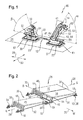
- the Figures 1 and 2 show a mounting base 10 for solar modules, with a base body 12, an integrally connected to the base 12 upper support 14 for a first inclined module plate 16 and integrally connected to the base 12 lower support 18 for a non-coplanar to the first module plate 16, adjacent , second inclined module plate 20.
- the base body 12 has at least one base 22, with which the mounting foot 10 on a substrate 24, such as a roof of a flat roof, can be supported.
- the upper support 14 in this case has a greater distance to a plane spanned by the base 22 level than the lower support 18th
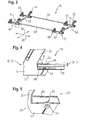
- FIG. 2 a section of a solar system 25 shown with a mounting system 26 for solar modules, wherein the present mounting system 26 is a flat roof mounting system with a corresponding horizontal surface 24 and a plurality of mounting feet 10 according to FIG. 1 having.
- the mounting system 26, together with the module modules 16, 20 formed solar modules, the solar system 25. Except on flat roofs is a use of the mounting system 26 also conceivable on pitch roofs with low roof pitch or other ground 24 with low inclination.
- the mounting foot 10 In its primary function as a solar module carrier, the mounting foot 10 provides height-offset supports 14, 18 for up to four module plates 16, 20. Furthermore, the mounting foot 10 also performs a connection function between two rows of solar modules, so that the mounting system 26, which has a plurality of such mounting feet 10 can be connected to a modular unit with minimal effort and consequently no unwanted displacement of individual solar modules or individual rows of solar modules is possible.
- module plates 16, 20 As a solar module row while several adjacent module plates 16, 20 are designated, which are aligned largely coplanar, that is, lie substantially in a plane. In contrast, the module plates 16, 20 of different solar module rows are arranged non-coplanar and lie in different, albeit mostly parallel planes.
- the mounting feet 10 can be used universally and are not limited to specific module plate dimensions.
- the mounting system 26 comprises a plurality of inclined or tilted relative to a plane defined by the base surface 22 solar modules, which according to FIG. 2 are divided into two rows of solar modules with first module plates 16 and second module plates 20, wherein in FIG. 2 By way of example, only a second module plate 20 is shown.
- the inclination or inclination of the solar modules is usually oriented so that an upper side of the solar modules is facing south.
- a direction of inclination of the solar modules is defined as the longitudinal direction 28 of the mounting system 26, so that the longitudinal direction 28 in a completed solar system 25 according to FIG. 2 usually corresponds to the north-south direction.
- a solar module row extends in a transverse direction 30, which usually corresponds to the west-east direction.
- the free end of the leg 34 is formed with the lower support 18 as a fork bearing for receiving a (seen from the south) front edge 36 of the module plate 16, 20 (see also FIG. 2 ).
- the fork bearing is designed so that it allows a limited pivoting of the module plate 16, 20 to the lower support 18, so that the mounting base 10 can be used in the same design for different angles of inclination of the solar modules.
- both legs 32, 34 for the supports 14, 18 each have an acute angle ⁇ , ⁇ with the base 22, wherein the legs 32, 34 in the longitudinal direction 28 are directed away from each other.
- the leg 32 of the upper support 14 is directed away from the lower support 18 and includes an acute (Anstell-) angle ⁇ , that is an angle of 0 ° ⁇ ⁇ 90 ° with the base 22 a. Due to the dynamic pressure occurring in a wind load, the angle of attack ⁇ of the leg 32 is preferably between 50 ° and 80 °. Angle of incidence ⁇ ⁇ 90 ° are conceivable in principle, but for the above-mentioned reason only makes sense in exceptional cases.
- the leg 34 of the lower support 18 is usually so short that its angle of attack ⁇ has no appreciable influence on the mounting system 26. Therefore, the in FIG. 1 drawn angle ⁇ of the leg 34 also assume values of ⁇ ⁇ 90 °.
- the main body 12 of the mounting foot 10 comprises a first main body portion 37 with the leg 32, a second main body portion 38 with the leg 34 and a connecting web 39 between the main body portions 37, 38, wherein the standing surface 22 is interrupted in the region of the connecting web 39.
- this embodiment provides locally very uneven ground 24 the advantage of greater stability due to less tendency to tilt.
- interrupted floor space 22 allows a laying of cables and cables in the transverse direction 30 directly on the ground 24, below the connecting web 39. By the risk of damage to the cables or cables is minimized.
- the laying of the cables and cables in the transverse direction 30 in a cable channel 72 which is secured by means of a cable channel holder 40 at the free end of the leg 32 (see. FIGS. 6 and 7 ).
- the cables and cables are in this case after completion of the solar system 25 protected under the solar modules.
- FIG. 1 are on the leg 32 of the upper support 14 bearing portions 41, 42, 43 for a wind deflector 44 and a ballast element 46 (see also FIG. 2 to see).
- the bearing portion 41 for the wind deflector 44 is a groove which extends in the longitudinal direction of the leg 32 and can receive lateral ends of the wind deflector 44.
- An angle of attack of the wind deflector 44 thus corresponds to the angle of attack ⁇ of the leg 32 with the upper support 14.
- the bearing portions 42, 43 for the ballast element 46 are as a support surface 64 in the transition region between the base body 12 and the leg 32 or laterally projecting bearing tongue on the leg 32 formed.
- the bearing portions 42, 43 are arranged so that an angle of attack of the plate-shaped ballast elements 46 substantially corresponds to the angle ⁇ of the leg 32 with the upper support 14.
- the mounting system 26 points in FIG. 2 as already explained, a plurality of longitudinally arranged in succession 28 mounting feet 10 to the front edge 36 of a module plate 16, 20 on the lower support 18 of a front mounting bracket 10 and a rear edge 48 of this module plate 16, 20 on the upper support 14 of a rear mounting base 10 to store.
- the mounting system 26 includes longitudinal connecting struts 50 to Connecting two in the longitudinal direction 28 adjacent mounting feet 10 and cross-connecting struts 52 for connecting two transverse in the transverse direction 30 adjacent mounting feet 10.
- This basic system structure can be particularly the FIG. 3 refer to, in which a section of the mounting system 26 is shown.
- the longitudinal connecting struts 50 are preferably made of plastic, but may alternatively be metal struts.
- the cross-connecting struts 52 are preferably metal struts, in particular when they serve as supports for the ballast elements 46. Alternatively, of course, but also cross connection struts 52 made of plastic are conceivable.
- the cross connection struts 52 are preferably channel-shaped and each extend between two adjacent mounting feet 10, wherein the ends of each cross connecting strut 52 are fixed to the mounting feet 10. According to FIG. 3 the ends of the cross connecting strut 52 are inserted into recesses of the legs 32 and lie on the likewise groove-shaped bearing portion 42 in the transition region between the base body 12 and leg 32 (see also FIG. 6 ).
- the individual mounting feet 10 according to FIG. 1 each have offset supports 14, 18 for up to four module plates 16, 20, wherein in the corner and edge regions of the mounting system 26 only one or two supports 14, 18 are used.
- adapted mounting feet 10 ' are used, which consist essentially only of the second body portion 38 with the lower supports 18 (see. FIG. 2 ).
- the bearing portion 42 for receiving a cross-connecting strut 52 exceptionally in the transition region between the base body 12 and the legs 34 of the lower support 18 is formed.
- adapted mounting feet 10 can be used, which consist essentially only of the first base portion 37 with the upper supports 14 (see. FIG. 6 ).
- FIG. 4 shows a detailed view A of the mounting system 26 in a connection region between mounting foot 10 and longitudinal connecting strut 50, wherein this connection region for orientation in FIG. 3 circled dashed.
- the base body 12 of the mounting foot 10 at its longitudinally opposite ends 28 each have a fastening portion 53 for a longitudinal connecting strut 50.
- a fastening means 54 is provided between the longitudinal connecting strut 50 and the base body 12, which allows locking of mounting foot 10 and longitudinal connecting strut 50 in the longitudinal direction 28 at different positions.
- the fastening means 54 in the present case comprises a screw which cooperates with a slot 56 in the longitudinal connecting strut 50 in order to allow a variable in the longitudinal direction 28 locking.
- FIG. 5 shows the detail view according to FIG. 4 However, without the longitudinal connecting strut 50.
- the attachment portion 53 of the main body 12 can be seen in detail and good to see that the fastening means 54 locking geometries 58 on the mounting base 10 has.
- These latching geometries 58 preferably interact with suitable latching geometries (not shown) on the longitudinal connecting strut 50, so that over the longitudinally displaceable connection between the mounting foot 10 and the longitudinal connecting strut 50 numerous different latching engagements are created.
- These locking engagements provide already without screwing for a lock in the longitudinal direction 28, so that the mounting system 26 can be aligned with little effort.
- a stop 60 is provided between the mounting foot 10 and the longitudinal connecting strut 50, the stop 60 delimiting an angular adjustment range around a central position in which the longitudinal connecting strut 50 runs parallel to the standing surface 22.
- This stop 60 is formed in the present embodiment on the mounting base 10 (see. FIG. 5 ) and has one Angle adjustment range in the order of about ⁇ 3 ° around the central position (see also FIG. 4 ).
- the mounting system 26 Since the mounting system 26 is subject to large temperature fluctuations and usually reaches dimensions of several meters both in the longitudinal direction 28 and in the transverse direction 30, the strains caused by temperature change are considerable. Thus, these thermal expansions do not lead to undesirably large voltages within the mounting system 26, for example, in the longitudinal direction 28 and / or in the transverse direction 30 rather centrally arranged mounting feet 10 in a plane spanned by its base surfaces 22 as a fixed bearing and the other mounting feet 10 in this plane as a plain bearing be educated.
- preferably sliding shoes 61 as in the FIGS. 1 and 6 indicated, provided so that the mounting feet 10 are supported on their base 22, optional sliding inserts and the shoes 61 on the ground 24.
- the mounting foot 10 is preferably made in one piece in die-cast aluminum.
- plastic in particular fiber-reinforced plastic or the use of alternative metals is possible. From plastics it is also possible to produce relatively complex geometric shapes such as the mounting foot 10 with relatively little effort.
- 10 suitable plastics with sufficient strength, durability and weather resistance are comparatively inexpensive available for the mounting base, so that the mounting foot 10 can be made very cost overall.
- a multi-part production of the mounting base 10 is conceivable.
- FIG. 6 shows the mounting foot 10 ", which has no lower support 18 and thus at the rear, that is usually northern end of the mounting system 26 is used.
- the mounting foot 10 “comprises the main body 12, which has a base 22 with which the mounting foot 10" can be supported on the ground 24, the leg 32 upwardly projecting from the main body 12 and the upper support 14 for a first inclined module plate 16 which at the free end of the Leg 32 is disposed, wherein the leg 32 forms a bearing 62 for the plate-shaped ballast element 46.
- the bearing 62 for the ballast element 46 comprises a molded support surface 64 in the transition region between the leg 32 and the base body 12 and a side bearing 66 integrally formed on the leg 32.
- the lateral bearing 66 can according to FIG. 6 merely a bearing tongue, which is arranged in the upper half of the leg 32 and extends from the leg 32 in the transverse direction 30.
- an underside of the leg 32 is widened overall laterally and the lateral bearing 66 extends continuously from the support surface 64 to near the free end of the leg 32.
- FIG. 7 shows a different view of the detail according to FIG. 6 , wherein additionally a ballast element 46, a cable channel 70 in the longitudinal direction 28 and a cable channel 72 in the transverse direction 30 is provided.
- the ballast element 46 for weighting the mounting system 26 is plate-shaped, in particular as a concrete slab, and is inclined over a front side with a lower edge 74 on the cross-connecting strut 52.
- the cross connection strut 52 for connecting two transversely adjoining assembly feet 10, 10 "in other words forms a linear bearing for the lower edge 74 of the slanted ballast plate.
- the cross-connecting strut 52 rests on the integrally formed support surface 64 of the mounting foot 10, 10 ".
- a desired ground clearance of the mounting system 26, for example for easy laying of the cable channel 70, can be achieved over a distance between the support surface 64 and that of the Simply adjust setting of the standing surface 22 and already take into account during production of the mounting foot 10.
- a connecting means 76 is preferably provided which fixes the transverse connection strut 52 to the mounting foot 10, 10 "in the transverse direction 30 , This connecting means 76 is for example a screw.
- the transverse connecting strut 52 has a longitudinal groove 78 into which the lower edge 74 of the plate-shaped ballast element 46 engages.
- the Ballast plate is thus held by the cross-connecting strut 52 in the longitudinal direction 28 and is also supported on the side bearing 66, so as not to tip out of the longitudinal groove 78.
- each ballast element 46 rests exclusively on the cross-connecting strut 52 and on the bearing 66 projecting laterally from the leg 32, so that depending on the design of the lateral bearing 66, there are different possibilities for installing the ballast elements 46.
- the lateral bearing 66 for example, an integrally formed guide rail, which extends substantially in leg longitudinal direction, so a simple insertion of the ballast elements 46 from obliquely above possible.
- the lateral bearing 66 allows the formation of the lateral bearing 66 as a bearing tongue according to FIG. 6 in addition, adjusting the ballast plates from behind, that is from the north side.
- the advantage of the guide rail lies in the particularly good positional securing of the ballast elements 46, while the embodiment variant with the bearing tongue permits particularly rapid installation of the ballast elements 46.
- a lower, e.g. upwardly open, U-shaped strut 52 receive or enclose a lower edge 74 of a ballast element 46.
- At least one leg of the "U” would preferably be longer in this embodiment than in the embodiment shown to securely grasp the rim 74 and the ballast elements 46.
- An alternative additionally provided upper, not shown strut would act as a simple abutment surface against tilting of the inclined ballast elements 46 or enclose the upper edge of the ballast element 46, e.g. by using a downwardly open U-profile as the upper strut.
- the one or more ballast elements 46 can thus be mounted on the one hand only directly to the mounting feet 10, 10 "or only on the or the cross connection struts 52 or on the mounting feet 10, 10" and in addition the / the cross connection struts 52nd
- the plate-shaped ballast element 46 extends substantially in a plane which is spanned by the leg 32 of the mounting foot 10, 10 "and the cross-connecting strut 52, this plane extending obliquely to the standing surface 22.
- This makes it possible to manufacture the mounting feet 10, 10 "on the choice of the angle of attack ⁇ of the leg 32 very easily set the angle of the plate-shaped ballast elements 46. This is particularly important if no separate wind deflector 44 is provided, but the plate-shaped ballast elements 46 take over the function of the wind deflector 44. In this case, the angle of attack of the ballast plates significantly influences the bearing forces of the mounting system 26 under wind load.
- the ballast elements 46 as wind deflector or the ballast elements 46 together with separate wind deflector 44 do not have to protrude at least to the rear edge of the module plates 16 in order to avoid wind penetration at this point. It may be particularly advantageous for achieving a lower lift-off force when using lower ballast elements 46 and bulkheads 44, which extend only over 50 to 90% of the distance between crossbar 52 and rear edge. This leaves a gap between the upper edge of the ballast elements 46 or the wind deflector 44 and the edge of the module free.
- the cross connection strut 52 may be set higher to increase the gap between the ground and lower edge of the ballast member 52 and / or the wind deflector 44.
- the ballast element 46 extends in the transverse direction 30 from one mounting foot 10, 10 ", to an adjacent mounting foot 10, 10".
- the cross connecting strut 52 would not necessarily be necessary as a support for the plate-shaped ballast element 46, since the ballast plate at the lower edge 74 in its corner areas on the support surfaces 64 of the mounting feet 10, 10 "rests and in addition by the lateral bearings 66 of the mounting feet 10, 10 "is held.
- ballast elements 46 are arranged between two adjacent mounting feet 10, 10 ", whereby a secure mounting of the ballast plates is achieved in that they are arranged in the longitudinal groove 78 of the transverse connecting strut 52 and can additionally be supported on the lateral bearing 66 of the adjacent mounting foot 10, 10 "In order to additionally stabilize the ballast elements 46 at their center in the transverse direction 30 between the mounting feet 10, 10" arranged shock, optional (not shown) coupling element be provided, which connects the adjacent corner areas at an upper edge 80 with each other.
- the advantage of a ballast element 46 divided in the transverse direction 30 between two mounting feet 10, 10 "lies in the dimensions of the individual ballast elements 46, which are more advantageous in terms of handling and weight.
Landscapes
- Engineering & Computer Science (AREA)
- Physics & Mathematics (AREA)
- Life Sciences & Earth Sciences (AREA)
- Sustainable Development (AREA)
- Sustainable Energy (AREA)
- Thermal Sciences (AREA)
- Chemical & Material Sciences (AREA)
- Combustion & Propulsion (AREA)
- Mechanical Engineering (AREA)
- General Engineering & Computer Science (AREA)
- Photovoltaic Devices (AREA)
Applications Claiming Priority (1)
| Application Number | Priority Date | Filing Date | Title |
|---|---|---|---|
| DE102010029006A DE102010029006A1 (de) | 2010-05-17 | 2010-05-17 | Montagefuss für Solarmodule sowie Montagesystem mit mehreren solcher Montagefüsse |
Publications (1)
| Publication Number | Publication Date |
|---|---|
| EP2388537A2 true EP2388537A2 (fr) | 2011-11-23 |
Family
ID=44117541
Family Applications (1)
| Application Number | Title | Priority Date | Filing Date |
|---|---|---|---|
| EP11163156A Withdrawn EP2388537A2 (fr) | 2010-05-17 | 2011-04-20 | Pied de montage pour modules solaires et système de montage doté de plusieurs pieds de montage de ce type |
Country Status (2)
| Country | Link |
|---|---|
| EP (1) | EP2388537A2 (fr) |
| DE (1) | DE102010029006A1 (fr) |
Families Citing this family (3)
| Publication number | Priority date | Publication date | Assignee | Title |
|---|---|---|---|---|
| US20130298968A1 (en) * | 2012-05-14 | 2013-11-14 | Mika Brian Laitila | Solar panel racking system having separate support structure and cover assembly |
| USD746768S1 (en) | 2013-05-15 | 2016-01-05 | Mika Brian Laitila | Solar panel rack |
| US10673373B2 (en) | 2016-02-12 | 2020-06-02 | Solarcity Corporation | Building integrated photovoltaic roofing assemblies and associated systems and methods |
-
2010
- 2010-05-17 DE DE102010029006A patent/DE102010029006A1/de not_active Withdrawn
-
2011
- 2011-04-20 EP EP11163156A patent/EP2388537A2/fr not_active Withdrawn
Non-Patent Citations (1)
| Title |
|---|
| None |
Also Published As
| Publication number | Publication date |
|---|---|
| DE102010029006A1 (de) | 2011-11-17 |
Similar Documents
| Publication | Publication Date | Title |
|---|---|---|
| EP2388539A2 (fr) | Socle de montage pour modules solaires et système de montage doté de plusieurs socles de montage de ce type | |
| EP3742602B1 (fr) | Installation photovoltaïque et utilisation associée | |
| DE102008037964A1 (de) | Montagevorrichtung für Solarmodule mit einem großen Aspektverhältnis | |
| WO2010054795A1 (fr) | Support pour monter un panneau solaire | |
| DE202010017294U1 (de) | Anordnung, Unterkonstruktion und Photovoltaikanlage | |
| DE202010018095U1 (de) | Vorrichtung zur Befestigung mindestens eines Solarmoduls | |
| EP2526350B1 (fr) | Système de fondation pour panneaux solaires avec pièces de montage préassemblées | |
| EP2475940B1 (fr) | Ensemble modulaire composé de modules solaires | |
| DE202009011880U1 (de) | Modulanordnung aus Solarmodulen | |
| EP2400238B1 (fr) | Elévation d'un module solaire | |
| EP2388537A2 (fr) | Pied de montage pour modules solaires et système de montage doté de plusieurs pieds de montage de ce type | |
| EP2213961A2 (fr) | Dispositif destiné à l'élévation de modules solaires | |
| DE102009037978B4 (de) | Traggerüst für eine Photovoltaik-Freiflächenanlage sowie Verfahren zur Montage eines Traggerüsts | |
| EP2554925B1 (fr) | Élément d'appui pour un module solaire | |
| WO2014029500A2 (fr) | Base de toit en zig-zag | |
| DE102012016671A1 (de) | PV-Generator mit Traufenablauf | |
| DE102010029003A1 (de) | Lagerungssystem für Solarmodule und Solaranlage | |
| DE202011052032U1 (de) | Stützelement für ein Solarmodul | |
| DE202011102826U1 (de) | Solarcarport | |
| EP2388536A2 (fr) | Pied de montage pour modules solaires et système de montage doté de plusieurs pieds de montage de ce type | |
| DE102011102236A1 (de) | Traganordnung für Solarmodule mit Ost-West-Ausrichtung | |
| DE202010003418U1 (de) | Formteil zur Aufnahme wenigstens eines Solarmoduls | |
| DE202009001071U1 (de) | Vorrichtung zur Aufständerung von Solarmodulen | |
| EP2388538A2 (fr) | Pied de montage pour modules solaires | |
| DE102024116949A1 (de) | Klemme, System und Verfahren zur Befestigung eines Solarmoduls an einer Unterkonstruktion |
Legal Events
| Date | Code | Title | Description |
|---|---|---|---|
| AK | Designated contracting states |
Kind code of ref document: A2 Designated state(s): AL AT BE BG CH CY CZ DE DK EE ES FI FR GB GR HR HU IE IS IT LI LT LU LV MC MK MT NL NO PL PT RO RS SE SI SK SM TR |
|
| AX | Request for extension of the european patent |
Extension state: BA ME |
|
| PUAI | Public reference made under article 153(3) epc to a published international application that has entered the european phase |
Free format text: ORIGINAL CODE: 0009012 |
|
| STAA | Information on the status of an ep patent application or granted ep patent |
Free format text: STATUS: THE APPLICATION IS DEEMED TO BE WITHDRAWN |
|
| 18D | Application deemed to be withdrawn |
Effective date: 20141101 |