EP2416251B1 - Procédé de gestion de la mémoire d'un ordinateur, produit de programme informatique correspondant et dispositif de stockage de données correspondant - Google Patents
Procédé de gestion de la mémoire d'un ordinateur, produit de programme informatique correspondant et dispositif de stockage de données correspondant Download PDFInfo
- Publication number
- EP2416251B1 EP2416251B1 EP10305868A EP10305868A EP2416251B1 EP 2416251 B1 EP2416251 B1 EP 2416251B1 EP 10305868 A EP10305868 A EP 10305868A EP 10305868 A EP10305868 A EP 10305868A EP 2416251 B1 EP2416251 B1 EP 2416251B1
- Authority
- EP
- European Patent Office
- Prior art keywords
- data
- cache
- data block
- page table
- memory
- Prior art date
- Legal status (The legal status is an assumption and is not a legal conclusion. Google has not performed a legal analysis and makes no representation as to the accuracy of the status listed.)
- Not-in-force
Links
Images

Classifications
-
- G—PHYSICS
- G06—COMPUTING OR CALCULATING; COUNTING
- G06F—ELECTRIC DIGITAL DATA PROCESSING
- G06F12/00—Accessing, addressing or allocating within memory systems or architectures
- G06F12/02—Addressing or allocation; Relocation
- G06F12/08—Addressing or allocation; Relocation in hierarchically structured memory systems, e.g. virtual memory systems
- G06F12/10—Address translation
- G06F12/1009—Address translation using page tables, e.g. page table structures
-
- G—PHYSICS
- G06—COMPUTING OR CALCULATING; COUNTING
- G06F—ELECTRIC DIGITAL DATA PROCESSING
- G06F12/00—Accessing, addressing or allocating within memory systems or architectures
- G06F12/02—Addressing or allocation; Relocation
- G06F12/08—Addressing or allocation; Relocation in hierarchically structured memory systems, e.g. virtual memory systems
-
- G—PHYSICS
- G06—COMPUTING OR CALCULATING; COUNTING
- G06F—ELECTRIC DIGITAL DATA PROCESSING
- G06F12/00—Accessing, addressing or allocating within memory systems or architectures
- G06F12/14—Protection against unauthorised use of memory or access to memory
-
- G—PHYSICS
- G06—COMPUTING OR CALCULATING; COUNTING
- G06F—ELECTRIC DIGITAL DATA PROCESSING
- G06F9/00—Arrangements for program control, e.g. control units
- G06F9/06—Arrangements for program control, e.g. control units using stored programs, i.e. using an internal store of processing equipment to receive or retain programs
- G06F9/46—Multiprogramming arrangements
-
- G—PHYSICS
- G06—COMPUTING OR CALCULATING; COUNTING
- G06F—ELECTRIC DIGITAL DATA PROCESSING
- G06F12/00—Accessing, addressing or allocating within memory systems or architectures
- G06F12/14—Protection against unauthorised use of memory or access to memory
- G06F12/1416—Protection against unauthorised use of memory or access to memory by checking the object accessibility, e.g. type of access defined by the memory independently of subject rights
- G06F12/145—Protection against unauthorised use of memory or access to memory by checking the object accessibility, e.g. type of access defined by the memory independently of subject rights the protection being virtual, e.g. for virtual blocks or segments before a translation mechanism
-
- G—PHYSICS
- G06—COMPUTING OR CALCULATING; COUNTING
- G06F—ELECTRIC DIGITAL DATA PROCESSING
- G06F2212/00—Indexing scheme relating to accessing, addressing or allocation within memory systems or architectures
- G06F2212/10—Providing a specific technical effect
- G06F2212/1016—Performance improvement
-
- G—PHYSICS
- G06—COMPUTING OR CALCULATING; COUNTING
- G06F—ELECTRIC DIGITAL DATA PROCESSING
- G06F2212/00—Indexing scheme relating to accessing, addressing or allocation within memory systems or architectures
- G06F2212/10—Providing a specific technical effect
- G06F2212/1052—Security improvement
Definitions
- the invention relates to a method of managing computer memory comprising the steps of maintaining a page table entry for mapping a virtual address to a physical address and a cache comprising a plurality of data blocks and, in response to a reference to the virtual address, translating the virtual address into the physical address by means of the page table entry and fetching data from the physical address into the cache.
- the invention further relates to a computer program product comprising computer-executable instructions for performing said method when the program is run on a computer, and to a device programmed or configured to perform said method.
- memory management is the act of managing computer memory. In its simpler forms, this involves providing ways to allocate portions of memory to programs at their request and freeing it for reuse when no longer needed. The management of memory is critical to any computer system.
- Virtual memory systems separate memory addresses used by a process from physical addresses, allowing separation of processes and increasing the effectively available amount of memory.
- the quality of the virtual memory manager has a significant impact on overall system performance.
- Ludmila Cherkasova and Rob Gardner outline a virtual memory system in " Measuring CPU Overhead for I/O Processing in the Xen Virtual Machine Monitor", Proceedings of the USENIX Annual Technical Conference 2005, Anaheim, California, United States of America .
- OS operating system
- secondary storage sometimes called external memory, is meant any storage not directly accessible by the central processing unit (CPU), such as a hard disk drive, optical storage, flash memory, floppy disk, magnetic tape, paper tape, punched card, or Zip drive.
- CPU central processing unit
- the state-of-the-art virtual memory system implements a mechanism known as page flipping.
- an application specifies one or more memory pages for receiving input data, allowing the OS to supply that data by means of its built-in paging scheme.
- the OS "swaps" the specified memory pages in the application's working memory, commonly called its address space, with the requested input.
- a major downside of this known system lies in the fact that the input data to be supplied rarely fits the target memory pages precisely. The remainder of each memory page swapped in thus needs to be zeroed to cater for applications that rely on memory initialization as well as to prevent the requesting application from obtaining unauthorized access to foreign, potentially sensitive data.
- zeroing is meant overwriting data with a fixed, meaningless value, e.g., zero, to prevent its accidental disclosure, such disclosure potentially allowing a security breach by the requesting application.
- the efficiency of writing files that are cached using mapped file I/O is improved by suppressing zeroing of uninitialized data in cached pages of a file until the file is mapped by a user mode thread.
- suppressing zeroing of mapped files on writes is implemented by a set of internal operating system interfaces for communications between the virtual memory manager and the cache manager.
- the cache manager tracks the extent to which a cache page of the file is written so that any uninitialized data in the cache page can later be zeroed when the file is mapped by a user mode thread.
- a method for preventing digital piracy in a computing environment comprises loading an application into the computing environment, wherein the application is encrypted using a cryptographic key; assigning a virtual address space to the application; loading the cryptographic key for the application into a register which is accessible only by a central processing unit; and storing an index value for the key in the register in a page table entry which corresponds to the virtual address space for the application, thereby linking the virtual address space to the key for the application.
- main memory also called primary storage or internal memory
- main memory any storage directly accessible by the CPU, such as random-access memory (RAM), read-only memory (ROM), processor registers, or processor caches.
- a method of managing computer memory comprising the steps of maintaining a page table entry for mapping a virtual address to a physical address and a cache comprising a plurality of data blocks and, in response to a reference to the virtual address, translating the virtual address into the physical address by means of the page table entry and fetching data from the physical address into the cache, wherein the page table entry comprises a plurality of indicators, each data block corresponding to one of the plurality of indicators, and, once fetching the data into the cache has started, the method comprises the further step of, in response to an indicator, selected from said plurality of indicators, being set, zeroing the corresponding data block.
- a computer program product comprising computer-executable instructions for performing said method when the program is run on a computer, or by a device programmed or configured to perform said method.
- a main idea of the invention is to augment the page table, a data structure used by the virtual memory system of the OS to store the mapping between a virtual address, that is, the index for a location in an application's working memory, and the corresponding physical address.
- a virtual address is unique only to the accessing process, whereas a physical address refers to the actual storage cell of main memory.
- a page table entry is maintained to map a virtual address to a physical address. Further, a cache comprising a plurality of data blocks is maintained. The page table entry comprises a plurality of indicators, each data block corresponding to an indicator. In response to a reference to the virtual address, the latter is translated into the physical address by means of the page table entry, and data is fetched from that physical address into the cache. Upon fetching the data, in response to an indicator being set, the corresponding data block is zeroed.
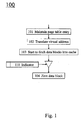
- the flowchart 100 of Fig. 1 comprises a first processing step 101, a second processing step 102, a third processing step 103, and a fourth processing step 104.
- a set of arrows represents the flow of control passing through the processing steps 101 to 103, merging with internal storage 110, and finally passing into the fourth processing step 104.
- an arrow starting at a first symbol and ending at a second symbol indicates that control passes from the first symbol to the second symbol.
- MMU dedicated memory management unit
- MMU any computer hardware component responsible for handling access to memory requested by the CPU.
- virtual memory management that is, the translation of virtual addresses to physical addresses
- the MMU may support techniques such as memory protection, bus arbitration, and, in simpler computer architectures such as 8-bit systems, bank switching.
- the MMU supports paging, thus taking the form of what is known in the art as a paged MMU (PMMU).
- PMMU paged MMU
- the PMMU further controls a CPU cache, that is, a smaller, faster memory configured to store copies of data from the most frequently used main memory locations.
- a CPU cache that is, a smaller, faster memory configured to store copies of data from the most frequently used main memory locations.
- the CPU needs to read from or write to a location in main memory, it first checks whether a copy of that data is in the cache. If so, the CPU immediately reads from or writes to the cache, which is inherently faster than reading from or writing to main memory.
- the main memory is sometimes referred to as the cache's backing store.
- the CPU cache controlled by the PMMU comprises a data cache to speed up data fetch and store as well as a translation look-aside buffer (TLB) to speed up virtual memory management for both executable instructions and data.
- the TLB comprises a fixed number of slots that contain page table entries (PTEs) mapping virtual addresses to physical addresses.
- PTEs page table entries
- each PTE comprises between 32 and 64 bits.
- the PMMU maintains a PTE for mapping a virtual address to a physical address. Further, the PMMU maintains a cache comprising a plurality of data blocks, commonly called cache lines or cache blocks in the context of CPU caching. Typically, each data block ranges in size from 8 to 512 bytes. For maximum hardware acceleration, the PMMU at hand employs data blocks larger than the amount of data that can be requested by a single CPU instruction, which typically ranges from 1 byte to 16 bytes in state-of-the-art 32-bit and 64-bit CPU architectures.
- the PTE maintained in the first processing step 101 comprises a plurality of indicators, each data block corresponding to an indicator, indicating whether the corresponding data block needs to be zeroed before providing it to a requesting application. Consequently, the indicator takes the form of a flag, that is, a Boolean variable having either of the values "true” or "false".
- each indicator takes the form of a bit, each of its binary values having an assigned meaning.
- the bits are grouped into a suitably sized vector known in computer arithmetic as a bitmask.
- each bit may be interpreted to correspond to a plurality of data blocks, effectively reducing the number of bits that constitute the bitmask.
- the OS on request by an application, receives a data block over a computer network by means of an associated network interface controller (NIC), also known as a network interface card, network adapter, or Local Area Network (LAN) adapter.
- NIC network interface controller
- the data block is transmitted by means of a Gigabit Ethernet (GbE, 1 GigE) connection, that is, at a rate of one gigabit per second, as defined by the IEEE 802.3-2008 standard.
- GbE, 1 GigE Gigabit Ethernet
- the OS employs page flipping to store it in a memory page specified by the application.
- the OS sets the bits in the PTE's bitmask that correspond to the data blocks to be zeroed while clearing those bits that correspond to the modified data blocks.
- Ethernet being a packet switching protocol
- the I/O data takes the form of a data transmission unit called a packet or, in this context, Ethernet frame.
- the frame may vary in size between a lower limit of 64 bytes, such as required for a simple acknowledgment, and an upper limit, commonly called maximum transmission unit (MTU) in the art of computer networking, of 9000 bytes or more.
- MTU maximum transmission unit
- a typical memory page size of up 4 to 64 kilobytes a conventional memory management system, in this scenario, would impose a significant zeroing overhead on the CPU and memory due to the significant portion of the memory page that needs to be purged upon receiving each packet.
- a further benefit of the invention thus lies in its particular aptitude for the receipt of small to medium-sized packet data.
- the amount of data received through the NIC may not coincide with a multiple of the fixed size of a data block as defined by the PTE. In such cases, at least part of the first and/or last data block affected by the I/O remain undefined. To avoid disclosure of the data contained therein to the requesting application, the OS needs to zero that remaining part of the data block instantly prior to page flipping.
- the OS may be requested to load a program into main memory for execution by the CPU.
- the program loader updates the page table and TLB, effectively declaring a mapping of the virtual address designated for the executable to the contents of the associated object file.
- the segment of virtual memory thus mapped is commonly called a memory-mapped file, bearing the advantage that unused program code may never need to be loaded into main memory at all.
- the program to be loaded comprises a section known as a block started by symbol (BSS), often referred to as a BSS segment, containing statically allocated variables that are expected to be filled with zero-valued data initially, that is, when execution of the program begins.
- BSS block started by symbol
- the OS employs the above mechanism analogously by setting the bits in the PTE's bitmask that correspond to the data blocks to be zeroed while clearing those bits that correspond to other data segments of the program.
- the PMMU in response to the virtual address being referenced by a CPU instruction, fulfills its primary function of virtual memory management by translating the virtual address into the physical address.
- the PMMU employs the PTEs contained in the TLB of the first processing step 101. More particularly, the PMMU first searches the TLB for a PTE that corresponds to the virtual address at hand. If a match is found, a situation known in the art of virtual memory management as a TLB hit, the physical address can be retrieved directly from the matching PTE. Otherwise, the situation is commonly called a TLB miss, requiring the PMMU to consult the page table maintained by the OS. If this page table contains a matching PTE, the PMMU caches it in the TLB and re-executes the faulting CPU instruction.
- the PMMU accesses the physical address derived in the second processing step 102 and starts to fetch data blocks contained therein into the CPU's data cache. If the data cache is already full at this point, an occupied cache line may need to be overwritten and its prior contents discarded to accommodate the newly fetched data block.
- Various algorithms are known in the art for selecting which cache line to evict.
- the latter takes the form of a write-back cache, sometimes called write-behind cache.
- writes are not immediately mirrored to the backing store. Instead, the PMMU tracks which cache lines have been overwritten by the CPU and accordingly marks these locations as "dirty". Prior to eviction of a dirty cache line, the respective data block is written back to the backing store to preserve its updated contents for future read access. This approach is known in computer science as a "lazy write”. Upon writing back a data block, the PMMU needs to clear the corresponding bit in the PTE's bitmask to prevent that data block from being zeroed in case it is ever retrieved.
- the PMMU consults the bitmask contained in the PTE found in its internal storage 110. If its corresponding bit is set, the PMMU, instead of retrieving the data block from main memory, zeros the respective cache line in the fourth processing step 104 prior to making it available to the requesting application.
- program storage devices e.g., digital data storage media, which are machine or computer readable and encode machine-executable or computer-executable programs of instructions where said instructions perform some or all of the steps of methods described herein.
- the program storage devices may be, e.g., digital memories, magnetic storage media such as a magnetic disks or tapes, hard drives, or optically readable digital data storage media.
- the embodiments are also intended to cover computers programmed to perform said steps of methods described herein.
Landscapes
- Engineering & Computer Science (AREA)
- Theoretical Computer Science (AREA)
- Physics & Mathematics (AREA)
- General Engineering & Computer Science (AREA)
- General Physics & Mathematics (AREA)
- Software Systems (AREA)
- Computer Security & Cryptography (AREA)
- Memory System Of A Hierarchy Structure (AREA)
Claims (10)
- Procédé de gestion de la mémoire d'un ordinateur, le procédé comprenant les étapes suivantes
conserver (101) une entrée de table de page pour mettre en correspondance une adresse virtuelle avec une adresse physique et une antémémoire comprenant une pluralité de blocs de données et,
en réponse à une référence à l'adresse virtuelle, traduire (102) l'adresse virtuelle en l'adresse physique au moyen de l'entrée de table de page et récupérer (103) des données à partir de l'adresse physique dans l'antémémoire,
caractérisé en ce que l'entrée de table de page comprend une pluralité d'indicateurs, chaque bloc de données correspondant à un indicateur parmi la pluralité d'indicateurs, et, une fois que la récupération des données dans l'antémémoire a commencé (103), le procédé comprend l'étape supplémentaire suivante,
en réponse à la définition d'un indicateur (110), choisi parmi ladite pluralité d'indicateurs, mettre à zéro (104) le bloc de données correspondant. - Procédé selon la revendication 1, caractérisé en ce que l'entrée de table de page comprend un masque de bits et les indicateurs sont des bits contenus dans le masque de bits.
- Procédé selon la revendication 1, caractérisé en ce que l'entrée de table de page est associée à une page de mémoire comprenant la pluralité de blocs de données et le procédé comprend les étapes intermédiaires suivantes
recevoir un bloc de données,
stocker le bloc de données dans la page de mémoire, et
effacer l'indicateur auquel le bloc de données correspond. - Procédé selon la revendication 1, caractérisé en ce que le procédé comprend l'étape supplémentaire suivante
définir les indicateurs restants parmi ladite pluralité d'indicateurs, auxquels le bloc de données ne correspond pas. - Procédé selon la revendication 3 ou 4, caractérisé en ce que le procédé comprend les étapes ultérieures suivantes
écraser un autre bloc de données et
effacer l'indicateur auquel l'autre bloc de données correspond. - Produit de programme Informatique comprenant des instructions exécutables par un ordinateur pour réaliser un procédé selon la revendication 1 lorsque le programme est exécuté sur un ordinateur.
- Produit de programme informatique selon la revendication 6, caractérisé en ce que le produit de programme informatique comprend un système d'exploitation.
- Dispositif comprenant
moyens pour conserver (101) une entrée de table de page pour mettre en correspondance une adresse virtuelle avec une adresse physique et une antémémoire comprenant une pluralité de blocs de données et des moyens,
en réponse à une référence à l'adresse virtuelle, pour traduire (102) l'adresse virtuelle en l'adresse physique au moyen de l'entrée de table de page et pour récupérer (103) des données à partir de l'adresse physique dans l'antémémoire, caractérisé en ce que l'entrée de table de page comprend une pluralité d'indicateurs, chaque bloc de données correspondant à un indicateur parmi la pluralité d'indicateurs, et le dispositif comprend d'autres moyens, une fois que la récupération des données dans l'antémémoire a commencé (103) et
en réponse à la définition d'un indicateur (110), choisi parmi ladite pluralité d'indicateurs, pour mettre à zéro (104) le bloc de données correspondant. - Dispositif selon la revendication 8, caractérisé en ce que le dispositif comprend au moins un des éléments suivantes :une unité centrale de traitement,une unité de gestion de la mémoire, etune antémémoire de données.
- Dispositif selon les revendications 8 ou 9, caractérisé en ce que le dispositif comprend en outre un répertoire de pages actives configuré pour stocker l'entrée de table de page, dans lequel l'adresse virtuelle est traduite (102) au moyen du répertoire de pages actives.
Priority Applications (6)
| Application Number | Priority Date | Filing Date | Title |
|---|---|---|---|
| EP10305868A EP2416251B1 (fr) | 2010-08-06 | 2010-08-06 | Procédé de gestion de la mémoire d'un ordinateur, produit de programme informatique correspondant et dispositif de stockage de données correspondant |
| JP2013523548A JP5583274B2 (ja) | 2010-08-06 | 2011-07-07 | コンピュータ・メモリを管理する方法、対応するコンピュータ・プログラム製品、およびそのためのデータ・ストレージ・デバイス |
| PCT/EP2011/061513 WO2012016783A1 (fr) | 2010-08-06 | 2011-07-07 | Procédé de gestion de mémoire informatique, produit-programme d'ordinateur correspondant ; et dispositif de stockage de données associé |
| KR1020137005686A KR101451045B1 (ko) | 2010-08-06 | 2011-07-07 | 컴퓨터 메모리 관리방법 및 컴퓨터 프로그램제품과 이를 위한 데이터 저장 장치 |
| CN201180036120.1A CN103052945B (zh) | 2010-08-06 | 2011-07-07 | 管理计算机存储器的方法及数据存储设备 |
| US13/810,282 US20130124821A1 (en) | 2010-08-06 | 2011-07-07 | Method of managing computer memory, corresponding computer program product, and data storage device therefor |
Applications Claiming Priority (1)
| Application Number | Priority Date | Filing Date | Title |
|---|---|---|---|
| EP10305868A EP2416251B1 (fr) | 2010-08-06 | 2010-08-06 | Procédé de gestion de la mémoire d'un ordinateur, produit de programme informatique correspondant et dispositif de stockage de données correspondant |
Publications (2)
| Publication Number | Publication Date |
|---|---|
| EP2416251A1 EP2416251A1 (fr) | 2012-02-08 |
| EP2416251B1 true EP2416251B1 (fr) | 2013-01-02 |
Family
ID=43569401
Family Applications (1)
| Application Number | Title | Priority Date | Filing Date |
|---|---|---|---|
| EP10305868A Not-in-force EP2416251B1 (fr) | 2010-08-06 | 2010-08-06 | Procédé de gestion de la mémoire d'un ordinateur, produit de programme informatique correspondant et dispositif de stockage de données correspondant |
Country Status (6)
| Country | Link |
|---|---|
| US (1) | US20130124821A1 (fr) |
| EP (1) | EP2416251B1 (fr) |
| JP (1) | JP5583274B2 (fr) |
| KR (1) | KR101451045B1 (fr) |
| CN (1) | CN103052945B (fr) |
| WO (1) | WO2012016783A1 (fr) |
Families Citing this family (11)
| Publication number | Priority date | Publication date | Assignee | Title |
|---|---|---|---|---|
| CN105359115A (zh) * | 2013-07-01 | 2016-02-24 | 惠普发展公司,有限责任合伙企业 | 包含虚拟地址空间和物理地址空间之间的映射的数据结构的查找 |
| CN104699633B (zh) * | 2013-12-04 | 2019-04-23 | 瑞昱半导体股份有限公司 | 虚拟物理地址转换系统及其管理方法 |
| WO2016106757A1 (fr) * | 2014-12-31 | 2016-07-07 | 华为技术有限公司 | Procédé destiné à la gestion de stockage de données, gestionnaire de stockage et système de stockage |
| KR101994952B1 (ko) | 2015-03-27 | 2019-07-01 | 후아웨이 테크놀러지 컴퍼니 리미티드 | 데이터 처리 방법, 메모리 관리 유닛, 및 메모리 제어 장치 |
| WO2016171866A1 (fr) * | 2015-04-24 | 2016-10-27 | Optimum Semiconductor Technologies, Inc. | Processeur d'ordinateur ayant des registres distincts pour adresser une mémoire |
| US10884945B2 (en) * | 2015-06-30 | 2021-01-05 | International Business Machines Corporation | Memory state indicator check operations |
| WO2017058218A1 (fr) * | 2015-09-30 | 2017-04-06 | Hewlett Packard Enterprise Development LP. | Utilisation d'un contrôleur de mémoire pour gérer l'accès à une mémoire d'après un indicateur d'état d'initialisation de mémoire |
| US10534724B2 (en) * | 2015-12-24 | 2020-01-14 | Intel Corporation | Instructions and logic to suspend/resume migration of enclaves in a secure enclave page cache |
| CN112486403B (zh) * | 2019-09-12 | 2024-12-24 | 伊姆西Ip控股有限责任公司 | 管理存储对象的元数据的方法、装置和计算机程序产品 |
| CN112799977B (zh) * | 2021-02-26 | 2022-07-19 | 中国人民解放军国防科技大学 | 计算机的缓存分区和缓存访问实时性保护方法及装置 |
| CN115712500A (zh) * | 2022-11-10 | 2023-02-24 | 阿里云计算有限公司 | 内存释放、内存恢复方法、装置、计算机设备及存储介质 |
Family Cites Families (8)
| Publication number | Priority date | Publication date | Assignee | Title |
|---|---|---|---|---|
| JPH02176951A (ja) * | 1988-12-28 | 1990-07-10 | Nec Corp | 仮想記憶装置 |
| US5388244A (en) * | 1992-09-17 | 1995-02-07 | International Business Machines Corporation | Controls for initial diversion of page-frame logical content as part of dynamic virtual-to-real translation of a virtual page address |
| US5920895A (en) * | 1995-04-24 | 1999-07-06 | Microsoft Corporation | Mapped file input/output with delayed zeroing |
| US7073042B2 (en) * | 2002-12-12 | 2006-07-04 | Intel Corporation | Reclaiming existing fields in address translation data structures to extend control over memory accesses |
| US8214622B2 (en) * | 2004-05-27 | 2012-07-03 | International Business Machines Corporation | Facilitating management of storage of a pageable mode virtual environment absent intervention of a host of the environment |
| US20080229117A1 (en) * | 2007-03-07 | 2008-09-18 | Shin Kang G | Apparatus for preventing digital piracy |
| GB2448907B (en) * | 2007-05-02 | 2011-07-27 | Advanced Risc Mach Ltd | Reducng information leakage between processes sharing a cache |
| US7757035B2 (en) * | 2007-06-26 | 2010-07-13 | Intel Corporation | Method for optimizing virtualization technology and memory protections using processor-extensions for page table and page directory striping |
-
2010
- 2010-08-06 EP EP10305868A patent/EP2416251B1/fr not_active Not-in-force
-
2011
- 2011-07-07 CN CN201180036120.1A patent/CN103052945B/zh not_active Expired - Fee Related
- 2011-07-07 JP JP2013523548A patent/JP5583274B2/ja not_active Expired - Fee Related
- 2011-07-07 US US13/810,282 patent/US20130124821A1/en not_active Abandoned
- 2011-07-07 WO PCT/EP2011/061513 patent/WO2012016783A1/fr not_active Ceased
- 2011-07-07 KR KR1020137005686A patent/KR101451045B1/ko not_active Expired - Fee Related
Also Published As
| Publication number | Publication date |
|---|---|
| JP2013544380A (ja) | 2013-12-12 |
| JP5583274B2 (ja) | 2014-09-03 |
| CN103052945B (zh) | 2015-09-16 |
| CN103052945A (zh) | 2013-04-17 |
| WO2012016783A1 (fr) | 2012-02-09 |
| US20130124821A1 (en) | 2013-05-16 |
| EP2416251A1 (fr) | 2012-02-08 |
| KR20130041303A (ko) | 2013-04-24 |
| KR101451045B1 (ko) | 2014-10-15 |
Similar Documents
| Publication | Publication Date | Title |
|---|---|---|
| EP2416251B1 (fr) | Procédé de gestion de la mémoire d'un ordinateur, produit de programme informatique correspondant et dispositif de stockage de données correspondant | |
| US8996814B2 (en) | System and method for providing stealth memory | |
| US10802987B2 (en) | Computer processor employing cache memory storing backless cache lines | |
| EP2115599B1 (fr) | Procédé et appareil pour établir des règles de mise en mémoire cache dans un processeur | |
| US8086821B2 (en) | Input-output memory management unit (IOMMU) and method for tracking memory pages during virtual-machine migration | |
| KR101575827B1 (ko) | 주변장치 상호연결에서 i/o 및 계산 오프로드 디바이스들을 위해 2-레벨 어드레스 변환을 사용하는 iommu | |
| US7882330B2 (en) | Virtualizing an IOMMU | |
| EP2994837B1 (fr) | Ensembles de tables de pages multicoeur de champs d'attribut | |
| EP3182291B1 (fr) | Système et procédé de mise en cache de lecture exclusive dans un environnement informatique virtualisé | |
| EP2017739A1 (fr) | Système de traitement mettant en ýuvre une organisation de mémoire de taille de page variable | |
| JP7622180B2 (ja) | 命令キャッシュにおけるプリフェッチの強制終了及び再開 | |
| JP2011008783A (ja) | リンクされているデータストアにおいて、アイテムの保存およびアイテムの上書きを決定するデータ保存プロトコル |
Legal Events
| Date | Code | Title | Description |
|---|---|---|---|
| 17P | Request for examination filed |
Effective date: 20110328 |
|
| AK | Designated contracting states |
Kind code of ref document: A1 Designated state(s): AL AT BE BG CH CY CZ DE DK EE ES FI FR GB GR HR HU IE IS IT LI LT LU LV MC MK MT NL NO PL PT RO SE SI SK SM TR |
|
| AX | Request for extension of the european patent |
Extension state: BA ME RS |
|
| PUAI | Public reference made under article 153(3) epc to a published international application that has entered the european phase |
Free format text: ORIGINAL CODE: 0009012 |
|
| RIC1 | Information provided on ipc code assigned before grant |
Ipc: G06F 12/08 20060101AFI20120417BHEP Ipc: G06F 12/14 20060101ALI20120417BHEP Ipc: G06F 9/46 20060101ALI20120417BHEP Ipc: G06F 9/54 20060101ALI20120417BHEP |
|
| GRAJ | Information related to disapproval of communication of intention to grant by the applicant or resumption of examination proceedings by the epo deleted |
Free format text: ORIGINAL CODE: EPIDOSDIGR1 |
|
| GRAP | Despatch of communication of intention to grant a patent |
Free format text: ORIGINAL CODE: EPIDOSNIGR1 |
|
| GRAP | Despatch of communication of intention to grant a patent |
Free format text: ORIGINAL CODE: EPIDOSNIGR1 |
|
| GRAS | Grant fee paid |
Free format text: ORIGINAL CODE: EPIDOSNIGR3 |
|
| GRAA | (expected) grant |
Free format text: ORIGINAL CODE: 0009210 |
|
| AK | Designated contracting states |
Kind code of ref document: B1 Designated state(s): AL AT BE BG CH CY CZ DE DK EE ES FI FR GB GR HR HU IE IS IT LI LT LU LV MC MK MT NL NO PL PT RO SE SI SK SM TR |
|
| REG | Reference to a national code |
Ref country code: GB Ref legal event code: FG4D |
|
| REG | Reference to a national code |
Ref country code: CH Ref legal event code: EP Ref country code: AT Ref legal event code: REF Ref document number: 591935 Country of ref document: AT Kind code of ref document: T Effective date: 20130115 |
|
| REG | Reference to a national code |
Ref country code: IE Ref legal event code: FG4D |
|
| REG | Reference to a national code |
Ref country code: DE Ref legal event code: R096 Ref document number: 602010004434 Country of ref document: DE Effective date: 20130307 |
|
| REG | Reference to a national code |
Ref country code: AT Ref legal event code: MK05 Ref document number: 591935 Country of ref document: AT Kind code of ref document: T Effective date: 20130102 |
|
| REG | Reference to a national code |
Ref country code: NL Ref legal event code: VDEP Effective date: 20130102 |
|
| PG25 | Lapsed in a contracting state [announced via postgrant information from national office to epo] |
Ref country code: SI Free format text: LAPSE BECAUSE OF FAILURE TO SUBMIT A TRANSLATION OF THE DESCRIPTION OR TO PAY THE FEE WITHIN THE PRESCRIBED TIME-LIMIT Effective date: 20130102 |
|
| REG | Reference to a national code |
Ref country code: LT Ref legal event code: MG4D |
|
| PG25 | Lapsed in a contracting state [announced via postgrant information from national office to epo] |
Ref country code: AT Free format text: LAPSE BECAUSE OF FAILURE TO SUBMIT A TRANSLATION OF THE DESCRIPTION OR TO PAY THE FEE WITHIN THE PRESCRIBED TIME-LIMIT Effective date: 20130102 Ref country code: BG Free format text: LAPSE BECAUSE OF FAILURE TO SUBMIT A TRANSLATION OF THE DESCRIPTION OR TO PAY THE FEE WITHIN THE PRESCRIBED TIME-LIMIT Effective date: 20130402 Ref country code: ES Free format text: LAPSE BECAUSE OF FAILURE TO SUBMIT A TRANSLATION OF THE DESCRIPTION OR TO PAY THE FEE WITHIN THE PRESCRIBED TIME-LIMIT Effective date: 20130413 Ref country code: BE Free format text: LAPSE BECAUSE OF FAILURE TO SUBMIT A TRANSLATION OF THE DESCRIPTION OR TO PAY THE FEE WITHIN THE PRESCRIBED TIME-LIMIT Effective date: 20130102 Ref country code: CZ Free format text: LAPSE BECAUSE OF FAILURE TO SUBMIT A TRANSLATION OF THE DESCRIPTION OR TO PAY THE FEE WITHIN THE PRESCRIBED TIME-LIMIT Effective date: 20130102 Ref country code: IS Free format text: LAPSE BECAUSE OF FAILURE TO SUBMIT A TRANSLATION OF THE DESCRIPTION OR TO PAY THE FEE WITHIN THE PRESCRIBED TIME-LIMIT Effective date: 20130502 Ref country code: SE Free format text: LAPSE BECAUSE OF FAILURE TO SUBMIT A TRANSLATION OF THE DESCRIPTION OR TO PAY THE FEE WITHIN THE PRESCRIBED TIME-LIMIT Effective date: 20130102 Ref country code: LT Free format text: LAPSE BECAUSE OF FAILURE TO SUBMIT A TRANSLATION OF THE DESCRIPTION OR TO PAY THE FEE WITHIN THE PRESCRIBED TIME-LIMIT Effective date: 20130102 Ref country code: NO Free format text: LAPSE BECAUSE OF FAILURE TO SUBMIT A TRANSLATION OF THE DESCRIPTION OR TO PAY THE FEE WITHIN THE PRESCRIBED TIME-LIMIT Effective date: 20130402 |
|
| PG25 | Lapsed in a contracting state [announced via postgrant information from national office to epo] |
Ref country code: LV Free format text: LAPSE BECAUSE OF FAILURE TO SUBMIT A TRANSLATION OF THE DESCRIPTION OR TO PAY THE FEE WITHIN THE PRESCRIBED TIME-LIMIT Effective date: 20130102 Ref country code: PT Free format text: LAPSE BECAUSE OF FAILURE TO SUBMIT A TRANSLATION OF THE DESCRIPTION OR TO PAY THE FEE WITHIN THE PRESCRIBED TIME-LIMIT Effective date: 20130502 Ref country code: NL Free format text: LAPSE BECAUSE OF FAILURE TO SUBMIT A TRANSLATION OF THE DESCRIPTION OR TO PAY THE FEE WITHIN THE PRESCRIBED TIME-LIMIT Effective date: 20130102 Ref country code: FI Free format text: LAPSE BECAUSE OF FAILURE TO SUBMIT A TRANSLATION OF THE DESCRIPTION OR TO PAY THE FEE WITHIN THE PRESCRIBED TIME-LIMIT Effective date: 20130102 Ref country code: GR Free format text: LAPSE BECAUSE OF FAILURE TO SUBMIT A TRANSLATION OF THE DESCRIPTION OR TO PAY THE FEE WITHIN THE PRESCRIBED TIME-LIMIT Effective date: 20130403 Ref country code: PL Free format text: LAPSE BECAUSE OF FAILURE TO SUBMIT A TRANSLATION OF THE DESCRIPTION OR TO PAY THE FEE WITHIN THE PRESCRIBED TIME-LIMIT Effective date: 20130102 |
|
| PG25 | Lapsed in a contracting state [announced via postgrant information from national office to epo] |
Ref country code: HR Free format text: LAPSE BECAUSE OF FAILURE TO SUBMIT A TRANSLATION OF THE DESCRIPTION OR TO PAY THE FEE WITHIN THE PRESCRIBED TIME-LIMIT Effective date: 20130102 |
|
| REG | Reference to a national code |
Ref country code: GB Ref legal event code: 732E Free format text: REGISTERED BETWEEN 20130926 AND 20131002 |
|
| PG25 | Lapsed in a contracting state [announced via postgrant information from national office to epo] |
Ref country code: RO Free format text: LAPSE BECAUSE OF FAILURE TO SUBMIT A TRANSLATION OF THE DESCRIPTION OR TO PAY THE FEE WITHIN THE PRESCRIBED TIME-LIMIT Effective date: 20130102 Ref country code: SK Free format text: LAPSE BECAUSE OF FAILURE TO SUBMIT A TRANSLATION OF THE DESCRIPTION OR TO PAY THE FEE WITHIN THE PRESCRIBED TIME-LIMIT Effective date: 20130102 Ref country code: DK Free format text: LAPSE BECAUSE OF FAILURE TO SUBMIT A TRANSLATION OF THE DESCRIPTION OR TO PAY THE FEE WITHIN THE PRESCRIBED TIME-LIMIT Effective date: 20130102 Ref country code: EE Free format text: LAPSE BECAUSE OF FAILURE TO SUBMIT A TRANSLATION OF THE DESCRIPTION OR TO PAY THE FEE WITHIN THE PRESCRIBED TIME-LIMIT Effective date: 20130102 |
|
| PLBE | No opposition filed within time limit |
Free format text: ORIGINAL CODE: 0009261 |
|
| STAA | Information on the status of an ep patent application or granted ep patent |
Free format text: STATUS: NO OPPOSITION FILED WITHIN TIME LIMIT |
|
| REG | Reference to a national code |
Ref country code: FR Ref legal event code: GC Effective date: 20131018 |
|
| PG25 | Lapsed in a contracting state [announced via postgrant information from national office to epo] |
Ref country code: CY Free format text: LAPSE BECAUSE OF FAILURE TO SUBMIT A TRANSLATION OF THE DESCRIPTION OR TO PAY THE FEE WITHIN THE PRESCRIBED TIME-LIMIT Effective date: 20130102 |
|
| 26N | No opposition filed |
Effective date: 20131003 |
|
| PG25 | Lapsed in a contracting state [announced via postgrant information from national office to epo] |
Ref country code: IT Free format text: LAPSE BECAUSE OF FAILURE TO SUBMIT A TRANSLATION OF THE DESCRIPTION OR TO PAY THE FEE WITHIN THE PRESCRIBED TIME-LIMIT Effective date: 20130102 |
|
| REG | Reference to a national code |
Ref country code: DE Ref legal event code: R097 Ref document number: 602010004434 Country of ref document: DE Effective date: 20131003 |
|
| PG25 | Lapsed in a contracting state [announced via postgrant information from national office to epo] |
Ref country code: MC Free format text: LAPSE BECAUSE OF FAILURE TO SUBMIT A TRANSLATION OF THE DESCRIPTION OR TO PAY THE FEE WITHIN THE PRESCRIBED TIME-LIMIT Effective date: 20130102 |
|
| REG | Reference to a national code |
Ref country code: IE Ref legal event code: MM4A |
|
| PG25 | Lapsed in a contracting state [announced via postgrant information from national office to epo] |
Ref country code: IE Free format text: LAPSE BECAUSE OF NON-PAYMENT OF DUE FEES Effective date: 20130806 |
|
| REG | Reference to a national code |
Ref country code: CH Ref legal event code: PCOW Free format text: NEW ADDRESS: 148/152 ROUTE DE LA REINE, 92100 BOULOGNE-BILLANCOURT (FR) |
|
| REG | Reference to a national code |
Ref country code: CH Ref legal event code: PL |
|
| PG25 | Lapsed in a contracting state [announced via postgrant information from national office to epo] |
Ref country code: CH Free format text: LAPSE BECAUSE OF NON-PAYMENT OF DUE FEES Effective date: 20140831 Ref country code: LI Free format text: LAPSE BECAUSE OF NON-PAYMENT OF DUE FEES Effective date: 20140831 |
|
| PG25 | Lapsed in a contracting state [announced via postgrant information from national office to epo] |
Ref country code: SM Free format text: LAPSE BECAUSE OF FAILURE TO SUBMIT A TRANSLATION OF THE DESCRIPTION OR TO PAY THE FEE WITHIN THE PRESCRIBED TIME-LIMIT Effective date: 20130102 |
|
| PG25 | Lapsed in a contracting state [announced via postgrant information from national office to epo] |
Ref country code: MT Free format text: LAPSE BECAUSE OF FAILURE TO SUBMIT A TRANSLATION OF THE DESCRIPTION OR TO PAY THE FEE WITHIN THE PRESCRIBED TIME-LIMIT Effective date: 20130102 Ref country code: TR Free format text: LAPSE BECAUSE OF FAILURE TO SUBMIT A TRANSLATION OF THE DESCRIPTION OR TO PAY THE FEE WITHIN THE PRESCRIBED TIME-LIMIT Effective date: 20130102 |
|
| PG25 | Lapsed in a contracting state [announced via postgrant information from national office to epo] |
Ref country code: LU Free format text: LAPSE BECAUSE OF NON-PAYMENT OF DUE FEES Effective date: 20130806 Ref country code: MK Free format text: LAPSE BECAUSE OF FAILURE TO SUBMIT A TRANSLATION OF THE DESCRIPTION OR TO PAY THE FEE WITHIN THE PRESCRIBED TIME-LIMIT Effective date: 20130102 Ref country code: HU Free format text: LAPSE BECAUSE OF FAILURE TO SUBMIT A TRANSLATION OF THE DESCRIPTION OR TO PAY THE FEE WITHIN THE PRESCRIBED TIME-LIMIT; INVALID AB INITIO Effective date: 20100806 |
|
| REG | Reference to a national code |
Ref country code: FR Ref legal event code: PLFP Year of fee payment: 6 |
|
| PGFP | Annual fee paid to national office [announced via postgrant information from national office to epo] |
Ref country code: GB Payment date: 20150819 Year of fee payment: 6 Ref country code: DE Payment date: 20150821 Year of fee payment: 6 |
|
| PGFP | Annual fee paid to national office [announced via postgrant information from national office to epo] |
Ref country code: FR Payment date: 20150820 Year of fee payment: 6 |
|
| REG | Reference to a national code |
Ref country code: DE Ref legal event code: R119 Ref document number: 602010004434 Country of ref document: DE |
|
| GBPC | Gb: european patent ceased through non-payment of renewal fee |
Effective date: 20160806 |
|
| REG | Reference to a national code |
Ref country code: FR Ref legal event code: ST Effective date: 20170428 |
|
| PG25 | Lapsed in a contracting state [announced via postgrant information from national office to epo] |
Ref country code: GB Free format text: LAPSE BECAUSE OF NON-PAYMENT OF DUE FEES Effective date: 20160806 Ref country code: FR Free format text: LAPSE BECAUSE OF NON-PAYMENT OF DUE FEES Effective date: 20160831 Ref country code: DE Free format text: LAPSE BECAUSE OF NON-PAYMENT OF DUE FEES Effective date: 20170301 |
|
| PG25 | Lapsed in a contracting state [announced via postgrant information from national office to epo] |
Ref country code: AL Free format text: LAPSE BECAUSE OF FAILURE TO SUBMIT A TRANSLATION OF THE DESCRIPTION OR TO PAY THE FEE WITHIN THE PRESCRIBED TIME-LIMIT Effective date: 20130102 |