EP2428115A1 - Ver à soie génétiquement modifié pour la production de soie d'araîgnée - Google Patents
Ver à soie génétiquement modifié pour la production de soie d'araîgnée Download PDFInfo
- Publication number
- EP2428115A1 EP2428115A1 EP11179742A EP11179742A EP2428115A1 EP 2428115 A1 EP2428115 A1 EP 2428115A1 EP 11179742 A EP11179742 A EP 11179742A EP 11179742 A EP11179742 A EP 11179742A EP 2428115 A1 EP2428115 A1 EP 2428115A1
- Authority
- EP
- European Patent Office
- Prior art keywords
- nucleic acid
- protein
- silkworm
- recombinant
- sequence
- Prior art date
- Legal status (The legal status is an assumption and is not a legal conclusion. Google has not performed a legal analysis and makes no representation as to the accuracy of the status listed.)
- Withdrawn
Links
Images



Classifications
-
- C—CHEMISTRY; METALLURGY
- C07—ORGANIC CHEMISTRY
- C07K—PEPTIDES
- C07K14/00—Peptides having more than 20 amino acids; Gastrins; Somatostatins; Melanotropins; Derivatives thereof
- C07K14/435—Peptides having more than 20 amino acids; Gastrins; Somatostatins; Melanotropins; Derivatives thereof from animals; from humans
- C07K14/43504—Peptides having more than 20 amino acids; Gastrins; Somatostatins; Melanotropins; Derivatives thereof from animals; from humans from invertebrates
- C07K14/43513—Peptides having more than 20 amino acids; Gastrins; Somatostatins; Melanotropins; Derivatives thereof from animals; from humans from invertebrates from arachnidae
- C07K14/43518—Peptides having more than 20 amino acids; Gastrins; Somatostatins; Melanotropins; Derivatives thereof from animals; from humans from invertebrates from arachnidae from spiders
-
- A—HUMAN NECESSITIES
- A01—AGRICULTURE; FORESTRY; ANIMAL HUSBANDRY; HUNTING; TRAPPING; FISHING
- A01K—ANIMAL HUSBANDRY; AVICULTURE; APICULTURE; PISCICULTURE; FISHING; REARING OR BREEDING ANIMALS, NOT OTHERWISE PROVIDED FOR; NEW BREEDS OF ANIMALS
- A01K67/00—Rearing or breeding animals, not otherwise provided for; New or modified breeds of animals
- A01K67/60—New or modified breeds of invertebrates
- A01K67/61—Genetically modified invertebrates, e.g. transgenic or polyploid
-
- A—HUMAN NECESSITIES
- A01—AGRICULTURE; FORESTRY; ANIMAL HUSBANDRY; HUNTING; TRAPPING; FISHING
- A01K—ANIMAL HUSBANDRY; AVICULTURE; APICULTURE; PISCICULTURE; FISHING; REARING OR BREEDING ANIMALS, NOT OTHERWISE PROVIDED FOR; NEW BREEDS OF ANIMALS
- A01K67/00—Rearing or breeding animals, not otherwise provided for; New or modified breeds of animals
- A01K67/60—New or modified breeds of invertebrates
- A01K67/61—Genetically modified invertebrates, e.g. transgenic or polyploid
- A01K67/65—Genetically modified arthropods
- A01K67/68—Genetically modified insects
-
- C—CHEMISTRY; METALLURGY
- C12—BIOCHEMISTRY; BEER; SPIRITS; WINE; VINEGAR; MICROBIOLOGY; ENZYMOLOGY; MUTATION OR GENETIC ENGINEERING
- C12N—MICROORGANISMS OR ENZYMES; COMPOSITIONS THEREOF; PROPAGATING, PRESERVING, OR MAINTAINING MICROORGANISMS; MUTATION OR GENETIC ENGINEERING; CULTURE MEDIA
- C12N15/00—Mutation or genetic engineering; DNA or RNA concerning genetic engineering, vectors, e.g. plasmids, or their isolation, preparation or purification; Use of hosts therefor
- C12N15/09—Recombinant DNA-technology
- C12N15/63—Introduction of foreign genetic material using vectors; Vectors; Use of hosts therefor; Regulation of expression
- C12N15/79—Vectors or expression systems specially adapted for eukaryotic hosts
- C12N15/85—Vectors or expression systems specially adapted for eukaryotic hosts for animal cells
- C12N15/8509—Vectors or expression systems specially adapted for eukaryotic hosts for animal cells for producing genetically modified animals, e.g. transgenic
-
- A—HUMAN NECESSITIES
- A01—AGRICULTURE; FORESTRY; ANIMAL HUSBANDRY; HUNTING; TRAPPING; FISHING
- A01K—ANIMAL HUSBANDRY; AVICULTURE; APICULTURE; PISCICULTURE; FISHING; REARING OR BREEDING ANIMALS, NOT OTHERWISE PROVIDED FOR; NEW BREEDS OF ANIMALS
- A01K2217/00—Genetically modified animals
- A01K2217/05—Animals comprising random inserted nucleic acids (transgenic)
- A01K2217/052—Animals comprising random inserted nucleic acids (transgenic) inducing gain of function
-
- A—HUMAN NECESSITIES
- A01—AGRICULTURE; FORESTRY; ANIMAL HUSBANDRY; HUNTING; TRAPPING; FISHING
- A01K—ANIMAL HUSBANDRY; AVICULTURE; APICULTURE; PISCICULTURE; FISHING; REARING OR BREEDING ANIMALS, NOT OTHERWISE PROVIDED FOR; NEW BREEDS OF ANIMALS
- A01K2227/00—Animals characterised by species
- A01K2227/70—Invertebrates
- A01K2227/706—Insects, e.g. Drosophila melanogaster, medfly
-
- A—HUMAN NECESSITIES
- A01—AGRICULTURE; FORESTRY; ANIMAL HUSBANDRY; HUNTING; TRAPPING; FISHING
- A01K—ANIMAL HUSBANDRY; AVICULTURE; APICULTURE; PISCICULTURE; FISHING; REARING OR BREEDING ANIMALS, NOT OTHERWISE PROVIDED FOR; NEW BREEDS OF ANIMALS
- A01K2267/00—Animals characterised by purpose
- A01K2267/01—Animal expressing industrially exogenous proteins
-
- A—HUMAN NECESSITIES
- A01—AGRICULTURE; FORESTRY; ANIMAL HUSBANDRY; HUNTING; TRAPPING; FISHING
- A01K—ANIMAL HUSBANDRY; AVICULTURE; APICULTURE; PISCICULTURE; FISHING; REARING OR BREEDING ANIMALS, NOT OTHERWISE PROVIDED FOR; NEW BREEDS OF ANIMALS
- A01K2267/00—Animals characterised by purpose
- A01K2267/02—Animal zootechnically ameliorated
Definitions
- the present invention relates to a recombinant organism and a protein produced by the recombinant organism.
- spider silk As a natural fiber with an excellent strength, attention is focused on spider silk.
- spiders eat each other and thus they are not suitable for rearing them together in a same place, and the amount of spider silk obtained from a single spider is low.
- a spider uses different types of silk threads according to the purpose. Therefore, mass production of spider silk is difficult.
- Patent Literature 2 WO2005/068495 .
- the spider silk protein is ejected as a silk thread, and therefore the aforementioned treatments such as extraction, purification and spinning become unnecessary.
- the present invention aims to provide a recombinant organism producing a protein with excellent physical properties and a protein with excellent physical properties produced by the recombinant organism. Furthermore, the present invention aims to provide a recombinant silkworm producing a silk thread with a sufficiently excellent strength and a silk thread with sufficiently excellent strength produced by the recombinant silkworm.
- the present inventors intensively studied with a view to achieving the aforementioned aims, as a result, found that when a gene of Argiope bruennichi is introduced into an organism to be genetically modified, the resultant protein has excellent physical properties, and thereby completed the present invention.
- the present invention relates to a recombinant organism having any one of the following nucleic acids (i) to (iv) introduced therein and a protein produced by the recombinant organism:
- a protein produced by the recombinant organism becomes rich in the spider protein and, as a result, becomes excellent in physical properties such as strength.
- the present invention relates to a recombinant silkworm having any one of the aforementioned nucleic acids (i) to (iv) introduced therein, a protein produced by the recombinant silkworm and a silk thread produced by the recombinant silkworm.
- a silk thread produced by the recombinant silkworm becomes rich in spider protein and, as a result, becomes to have sufficient strength.
- a recombinant organism which produces a protein with excellent physical properties, and a protein with excellent physical properties produced by the recombinant organism. Furthermore, it becomes possible to provide a recombinant silkworm which produces a silk thread with a sufficiently excellent strength and a silk thread with a sufficiently excellent strength produced by the recombinant silkworm.
- the present invention relates to a recombinant organism having any one of the following nucleic acids (i) to (iv) introduced therein and a protein produced by the recombinant organism:
- the present invention relates to a recombinant silkworm having any one of the aforementioned nucleic acids (i) to (iv) introduced therein, a protein produced by the recombinant silkworm and a silk thread produced by the recombinant silkworm.
- a nucleic acid having a base sequence of SEQ ID NO: 1 is a nucleic acid encoding MaSp1 (major ampullate spidroin 1) protein, which is a main component of a dragline (or warp) protein of Argiope bruennichi , and may be artificially synthesized or obtained from a genomic library or a cDNA library, or may be obtained by amplifying each of these nucleic acids by PCR and obtained by digestion with a restriction enzyme(s), as long as a nucleic acid has the base sequence of SEQ ID NO: 1.
- MaSp1 major ampullate spidroin 1
- Dragline or warp
- the amino acid sequence of SEQ ID NO: 2 is an amino acid sequence that MaSp1 protein of Argiope bruennichi has.
- nucleic acid (iii) having a sequence identity of 90% or more with the nucleic acid having a base sequence of SEQ ID NO: 1 may be used as long as it encodes a dragline protein.
- sequence identity may be 90% or more, but is preferably 95% or more and more preferably 98% or more.
- nucleic acid to be introduced into a silkworm may be a nucleic acid (iv) which hybridizes with a complementary chain of a nucleic acid having the base sequence of SEQ ID NO: 1 under stringent conditions as long as the nucleic acid encodes a dragline protein.
- complementary chain of a nucleic acid refers to a nucleotide sequence which pairs through hydrogen bonding between nucleic acid bases (for example, T to A, C to G).
- hybridize means to form complementary bonding between complementary chains or form interaction between bases of single-strand nucleic acid molecules.
- Stringent conditions refers to conditions under which a complementary chain of a nucleotide chain having a homology with a target sequence preferentially hybridizes with the target sequence and a complementary chain of a nucleotide chain having no homology does not substantially hybridize.
- the stringent conditions are dependent upon the sequence and vary depending upon various situations. As a sequence becomes longer, specific hybridization thereof occurs at a further higher temperature. Generally, for stringent conditions, a temperature is selected so that it is about 5°C lower than the thermal melting temperature (T m ) of a specific sequence at a predetermined ion strength and pH.
- T m is the temperature at which 50% of complementary nucleotides to a target sequence hybridize with the target sequence in an equilibrium state at a predetermined ion strength, pH and nucleic acid concentration.
- Stringent conditions are dependent upon the sequence and vary depending upon various environmental parameters. A general principle of nucleic acid hybridization can be found in Tijssen ( Tijssen (1993), Laboratory Techniques In Biochemistry And Molecular Biology-Hybridization With Nucleic Acid Probes Part I, Chapter 2 "Overview of principles of hybridization and the strategy of nucleic acid probe assay", Elsevier, New York ).
- the stringent conditions are those in which the salt concentration is less than about 1.0 M Na + , typically about 0.01 to 1.0 M of Na + concentration (or another salt) at pH 7.0 to 8.3; and the temperature is at least about 30°C for a short nucleotide (for example, 10 to 50 nucleotides) and at least about 60°C for a long nucleotide (for example, longer than 50 nucleotides).
- the stringent conditions can be also achieved by addition of an unstablizing agent such as formamide.
- the stringent conditions referred in this specification include hybridization in a buffer solution of 50% formamide, 1M NaCl, 1% SDS (37°C) and washing with 0.1 x SSC at 60°C.
- recombinant organism refers to an organism transformed by introducing a foreign gene into the chromosome by means of genetic recombination.
- the organism to be transformed is not particularly limited and, for example, an insect, an animal, a plant or a microorganism may be used; however, an insect is preferred.
- the preferable insect include Bombyx mori, Bombyx mandarina, Antheraea yamamai and Antheraea pernyi. Among them, Bombyx mori and Bombyx mandarin belonging to Bombycidae are preferably used, and Bombyx mori is particularly preferably used.
- silkworm refers to Bombyx mori.
- a silkworm may be either a breed for experimentation or a commercial breed commercialized for practical use.
- recombinant silkworm refers to a silkworm transformed by introducing a foreign gene into the silkworm chromosome by means of genetic recombination.
- genetic recombination is performed by a method using a transposon; however, the method is not limited and any method is used as long as it can introduce a foreign gene into a silkworm and recombination of a gene can be performed by other methods including electroporation.
- fibroin thread is a fiber, which is ejected by Bombyx mori, Bombyx mandarina, Antheraea yamamai, Antheraea pernyi, etc., constituting a cocoon and containing a fibroin protein as a main component.
- the fibroin protein is composed of two large and small subunits (H-chain and L chain).
- a spider gene was obtained in accordance with a PCR method by using a vector containing a nucleic acid having a base sequence of SEQ ID NO: 1 and primers designed so as to match respectively with two ends of the nucleic acid.
- primers appropriate restriction enzyme sites are previously provided for the following gene manipulation. More specifically, as a forward primer, MaSp1FW (5'-CGACTCACTATAGGGAATTCCTTAACTAGTGGAGCAGCC-3')(SEQ ID NO: 3) was used and as a reverse primer, MaSp1RV (5'-GACAATCCGTATACCAAGCTTTCTCTGCTAGCTAG-3')(SEQ ID NO: 4) was used.
- a silkworm fibroin H-chain gene promoter sequence was obtained in accordance with a PCR method by using primers designed based on the sequence of the silkworm fibroin H-chain gene (GeneBank Registration No. AF226688) and normal silkworm genomic DNA as a template. More specifically, as a forward primer, PfibH5' (5'-AAGCTTGTTGTACAAAACTGCC-3')(SEQ ID NO: 5) containing a HindIII restriction enzyme site was used and as a reverse primer, PfibH3' (5'-TGCAGCACTAGTGCTGAAATCGCT-3')(SEQ ID NO: 6) containing a SpeI site was used.
- a C-terminal partial sequence of the silkworm fibroin H-chain gene was obtained in accordance with a PCR method by using primers designed based on the sequence of the silkworm fibroin H-chain gene (GeneBank Registration No. AF226688) and normal silkworm genomic DNA as a template. More specifically, as a forward primer, LBS-FW (5'-CTAGCTAGCAGTTACGGAGCTGGCAGGG-3')(SEQ ID NO: 7) containing a NheI site was used and as a reverse primer, LBS-RV (5'-CGGGATCCTAGTACATTCAAATAAAATGCATAC-3')(SEQ ID NO: 8) containing a BamHI site was used.
- FIG. 1 is a schematic view showing the structure of the vector plasmid for genetic recombination.
- the reference symbols of FIG. 1 stand for the followings.
- the vector plasmid for genetic recombination was amplified in Escherichia coli, and purified by "QIAGEN plasmid Midi Kit” (manufactured by QIAGEN) in accordance with the manual attached the kit.
- a helper plasmid containing a transposase protein gene was also purified by the above method. DNA of the plasmids purified above were dissolved in TE buffer such that the DNA of the vector plasmid for genetic recombination and the DNA of the helper plasmid were mixed in a ratio of 1:1 and precipitated with ethanol.
- the concentration of the DNA mixture was prepared with a phosphate buffer (pH 7) containing 5 mM KCl to be 400 ng/ul. This was injected to a silkworm egg of 3-6 hour old after egg-laying under microscopic observation.
- the egg to which the sample was injected is designated as G0 generation; the G0 generation grows and changes to moth, which is designated as G0 moth; eggs laid by G0 moth as a parent are designated as G1 eggs.
- G0 moth was mated with a moth having no injection and G1 eggs were collected; and G1 eggs in the incubation state were observed under a fluorescent microscope and screened for fluorescence-emitting eggs (positive egg).
- a population of eggs laid by a single parent moth G0 moth was treated as a group and the number of groups in which one or more positive eggs were detected was counted and recorded as the "positive G1 number". The results are shown in Table 1.
- Silkworm genomic DNA was extracted by a known method (see Sambrook and Maniatis, Molecular Cloning-A Laboratory Manual). The genomic DNA was cleaved with restriction enzyme HaeIII and thereafter self-ligated. Using this as a template and two pairs of primers respectively matching with left and right hands of piggyBac, and a fragment containing a silkworm genome sequence of an insertion site was amplified to identify the sequence.
- FIG. 2 shows a silkworm genome sequence (SEQ ID NO: 13) downstream of a site at which a spider gene expression cassette is inserted.
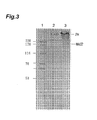
- FIG. 3 shows the SDS-PAGE separation results of the silk thread protein produced by a recombinant silkworm.
- FH stands for a silkworm fibroin H-chain
- MASP stands for a spider silk protein.
- FIG. 4 shows scanning electron micrographs of silk threads of a recombinant silkworm (A) and a non-recombinant silkworm (B).
- the cocoon produced by a recombinant silkworm was soaked in warm water of 40°C for one minute, fluff was removed, and thread was carefully collected and acclimated at conditions: 20°C, 65%RH, a day and night to prepare a sample.
- the obtained sample was tested for tensile strength by use of "AUTOGRAPH AGS-J" (manufactured by Shimadzu Corporation) under standard conditions: 20°C, 65%RH.
- AUTOGRAPH AGS-J manufactured by Shimadzu Corporation
- the strength of the silk thread of a control was 397.0 MPa (3.49 g/d), whereas the strength of the silk thread produced by the recombinant silkworm was 489.2 MPa (4.27 g/d), which was increased by 22.35%.
- a protein produced by the recombinant organism of the present invention is useful as a naturally occurring material with excellent physical properties.
- the silk thread produced by the recombinant silkworm of the present invention is a naturally occurring material with a sufficiently excellent strength, and thus, the silk thread is preferably used not only in medical supplies such as surgical suture but also various uses such as flight equipment, clothing and cosmetics.
Landscapes
- Life Sciences & Earth Sciences (AREA)
- Health & Medical Sciences (AREA)
- Chemical & Material Sciences (AREA)
- Zoology (AREA)
- Genetics & Genomics (AREA)
- Organic Chemistry (AREA)
- Environmental Sciences (AREA)
- Engineering & Computer Science (AREA)
- Insects & Arthropods (AREA)
- General Health & Medical Sciences (AREA)
- Biophysics (AREA)
- Molecular Biology (AREA)
- Biochemistry (AREA)
- General Engineering & Computer Science (AREA)
- Animal Behavior & Ethology (AREA)
- Biodiversity & Conservation Biology (AREA)
- Wood Science & Technology (AREA)
- Bioinformatics & Cheminformatics (AREA)
- Biotechnology (AREA)
- Animal Husbandry (AREA)
- Biomedical Technology (AREA)
- Proteomics, Peptides & Aminoacids (AREA)
- Tropical Medicine & Parasitology (AREA)
- Gastroenterology & Hepatology (AREA)
- Toxicology (AREA)
- Medicinal Chemistry (AREA)
- Physics & Mathematics (AREA)
- Veterinary Medicine (AREA)
- Plant Pathology (AREA)
- Microbiology (AREA)
- Peptides Or Proteins (AREA)
Applications Claiming Priority (1)
| Application Number | Priority Date | Filing Date | Title |
|---|---|---|---|
| JP2010203558A JP5691052B2 (ja) | 2010-09-10 | 2010-09-10 | 組換え生物及び組換え生物により作られるタンパク質 |
Publications (1)
| Publication Number | Publication Date |
|---|---|
| EP2428115A1 true EP2428115A1 (fr) | 2012-03-14 |
Family
ID=44653188
Family Applications (1)
| Application Number | Title | Priority Date | Filing Date |
|---|---|---|---|
| EP11179742A Withdrawn EP2428115A1 (fr) | 2010-09-10 | 2011-09-01 | Ver à soie génétiquement modifié pour la production de soie d'araîgnée |
Country Status (4)
| Country | Link |
|---|---|
| US (3) | US8222479B2 (fr) |
| EP (1) | EP2428115A1 (fr) |
| JP (1) | JP5691052B2 (fr) |
| CN (1) | CN102428897A (fr) |
Families Citing this family (9)
| Publication number | Priority date | Publication date | Assignee | Title |
|---|---|---|---|---|
| JP2014198715A (ja) * | 2013-03-15 | 2014-10-23 | 岡本株式会社 | タンパク質繊維 |
| CN105400817B (zh) * | 2015-10-23 | 2019-01-18 | 杭州超丝生物科技有限公司 | 利用家蚕同时合成分泌黑寡妇蜘蛛牵引丝蛋白1和蛋白2的方法 |
| CN105400815B (zh) * | 2015-10-23 | 2019-01-25 | 杭州超丝生物科技有限公司 | 利用家蚕丝腺生物反应器合成分泌黑寡妇蜘蛛牵引丝蛋白1的方法 |
| CN105463022B (zh) * | 2015-10-23 | 2019-01-25 | 杭州超丝生物科技有限公司 | 利用家蚕丝腺生物反应器合成分泌黑寡妇蜘蛛牵引丝蛋白2的方法 |
| WO2017138002A1 (fr) | 2016-02-11 | 2017-08-17 | Seevix Material Sciences Ltd. | Matériaux composites comprenant de la soie d'araignée synthétique de type fil de traîne |
| KR102563658B1 (ko) * | 2016-10-18 | 2023-08-03 | 코쿠리츠켄큐카이하츠호진 노교쇼쿠힌산교기주츠소고켄큐키코 | 유전자 재조합 도롱이벌레 견사 |
| US11089767B2 (en) | 2017-03-30 | 2021-08-17 | Utah State University | Transgenic silkworms expressing spider silk |
| CN115698049A (zh) | 2020-04-23 | 2023-02-03 | 赛威克斯材料科学公司 | 包括牵引蛛丝的化妆品组合物 |
| CN118058239B (zh) * | 2024-03-26 | 2025-08-22 | 西部(重庆)科学城种质创制大科学中心 | 家蚕BmPriL在提高家蚕经济性状中的应用 |
Citations (7)
| Publication number | Priority date | Publication date | Assignee | Title |
|---|---|---|---|---|
| WO1999047661A2 (fr) * | 1998-03-17 | 1999-09-23 | Nexia Biotechnologies, Inc. | Production de biofilaments chez des animaux transgeniques |
| WO2002099082A2 (fr) * | 2001-06-06 | 2002-12-12 | University Of Wyoming | Expression de proteines de soie d'araignee dans des vegetaux superieurs |
| WO2003020916A2 (fr) * | 2001-08-29 | 2003-03-13 | University Of Wyoming | Acides nucleiques codant des proteines de soie d'araignee, polypeptides de soie d'araignee, anticorps specifiques des polypeptides de soie d'araignee et leurs procedes d'utilisation |
| EP1413585A2 (fr) * | 1993-06-15 | 2004-04-28 | E.I. Du Pont De Nemours And Company | Nouveaux analogues de soie d'araignée produits par recombination |
| CN1563085A (zh) * | 2004-03-26 | 2005-01-12 | 南京师范大学 | 重组悦目金蛛大壶状腺丝蛋白及其制备方法 |
| WO2005068495A1 (fr) | 2004-01-13 | 2005-07-28 | Toray Industries, Inc. | Fil de soie contenant une proteine de fil d'araignee et vers a soie reproduisant ce fil de soie |
| WO2008154547A2 (fr) * | 2007-06-11 | 2008-12-18 | The Regents Of The University Of California | Polynucléotides, polypeptides de traîne de soie d'araignée et leurs procédés d'utilisation |
Family Cites Families (15)
| Publication number | Priority date | Publication date | Assignee | Title |
|---|---|---|---|---|
| US5989894A (en) * | 1990-04-20 | 1999-11-23 | University Of Wyoming | Isolated DNA coding for spider silk protein, a replicable vector and a transformed cell containing the DNA |
| IL123398A0 (en) * | 1995-08-22 | 1998-09-24 | Agricola Tech Inc | Cloning methods for high strength spider silk proteins |
| US5994099A (en) * | 1997-12-31 | 1999-11-30 | The University Of Wyoming | Extremely elastic spider silk protein and DNA coding therefor |
| US6608242B1 (en) * | 2000-05-25 | 2003-08-19 | E. I. Du Pont De Nemours And Company | Production of silk-like proteins in plants |
| CN1350778A (zh) * | 2000-10-26 | 2002-05-29 | 中国科学院上海生物化学研究所 | 利用家蚕生产非天然蚕丝的方法 |
| CN1362520A (zh) * | 2001-01-02 | 2002-08-07 | 成都天友发展有限公司 | 蜘蛛拖牵丝蛋白基因在转基因家蚕中时空表达系统的构建方法 |
| CN101712955B (zh) * | 2002-03-06 | 2013-06-05 | 东丽株式会社 | 利用基因重组蚕生产生理活性蛋白质的方法 |
| JP2004016144A (ja) * | 2002-06-18 | 2004-01-22 | Japan Science & Technology Corp | ヒト・コラーゲンを産生する形質転換カイコ |
| JP4431739B2 (ja) * | 2003-11-18 | 2010-03-17 | 独立行政法人農業生物資源研究所 | カイコのキヌレニン酸化酵素遺伝子をコードするdnaの利用 |
| JP2005168460A (ja) * | 2003-12-15 | 2005-06-30 | Kyoto Institute Of Technology | 形質転換カイコの作製方法、カイコ卵に組み換えウイルスを接種する方法 |
| CN101018806B (zh) * | 2004-07-22 | 2014-05-07 | Am丝绸有限责任公司 | 重组蜘蛛丝蛋白 |
| JPWO2007046439A1 (ja) * | 2005-10-18 | 2009-04-23 | 独立行政法人農業生物資源研究所 | 抗体を産生するトランスジェニックカイコとその製造方法 |
| JP5240699B2 (ja) * | 2006-03-29 | 2013-07-17 | 独立行政法人農業生物資源研究所 | 効率的なトランスジェニックカイコの作出方法 |
| JP5030610B2 (ja) * | 2007-02-02 | 2012-09-19 | 独立行政法人農業生物資源研究所 | 抗ウイルスタンパク質遺伝子ノックダウンによる有用タンパク質高発現カイコおよびその利用 |
| EP2244563B1 (fr) * | 2008-02-01 | 2019-08-28 | Bogin, Robert | Procédés, compositions et systèmes pour la production de polypeptides recombinants de soie d'araignée |
-
2010
- 2010-09-10 JP JP2010203558A patent/JP5691052B2/ja not_active Expired - Fee Related
-
2011
- 2011-09-01 EP EP11179742A patent/EP2428115A1/fr not_active Withdrawn
- 2011-09-07 US US13/226,964 patent/US8222479B2/en not_active Expired - Fee Related
- 2011-09-09 CN CN2011102681920A patent/CN102428897A/zh active Pending
-
2012
- 2012-06-15 US US13/524,120 patent/US8394942B2/en not_active Expired - Fee Related
-
2013
- 2013-02-11 US US13/764,124 patent/US8519101B2/en not_active Expired - Fee Related
Patent Citations (9)
| Publication number | Priority date | Publication date | Assignee | Title |
|---|---|---|---|---|
| EP1413585A2 (fr) * | 1993-06-15 | 2004-04-28 | E.I. Du Pont De Nemours And Company | Nouveaux analogues de soie d'araignée produits par recombination |
| WO1999047661A2 (fr) * | 1998-03-17 | 1999-09-23 | Nexia Biotechnologies, Inc. | Production de biofilaments chez des animaux transgeniques |
| JP2002506642A (ja) | 1998-03-17 | 2002-03-05 | ネクシア バイオテクノロジーズ, インコーポレイテッド | トランスジェニック動物における生体フィラメントの産生 |
| WO2002099082A2 (fr) * | 2001-06-06 | 2002-12-12 | University Of Wyoming | Expression de proteines de soie d'araignee dans des vegetaux superieurs |
| WO2003020916A2 (fr) * | 2001-08-29 | 2003-03-13 | University Of Wyoming | Acides nucleiques codant des proteines de soie d'araignee, polypeptides de soie d'araignee, anticorps specifiques des polypeptides de soie d'araignee et leurs procedes d'utilisation |
| WO2005068495A1 (fr) | 2004-01-13 | 2005-07-28 | Toray Industries, Inc. | Fil de soie contenant une proteine de fil d'araignee et vers a soie reproduisant ce fil de soie |
| EP1712561A1 (fr) * | 2004-01-13 | 2006-10-18 | Toray Industries, Inc. | Fil de soie contenant une proteine de fil d'araignee et vers a soie reproduisant ce fil de soie |
| CN1563085A (zh) * | 2004-03-26 | 2005-01-12 | 南京师范大学 | 重组悦目金蛛大壶状腺丝蛋白及其制备方法 |
| WO2008154547A2 (fr) * | 2007-06-11 | 2008-12-18 | The Regents Of The University Of California | Polynucléotides, polypeptides de traîne de soie d'araignée et leurs procédés d'utilisation |
Non-Patent Citations (4)
| Title |
|---|
| HU X ET AL: "Molecular mechanisms of spider silk", CMLS CELLULAR AND MOLECULAR LIFE SCIENCES, BIRKHÄUSER-VERLAG, BA, vol. 63, no. 17, 4 July 2006 (2006-07-04), pages 1986 - 1999, XP019419203, ISSN: 1420-9071, DOI: 10.1007/S00018-006-6090-Y * |
| LAWRENCE BARBARA A ET AL: "Molecular and mechanical properties of major ampullate silk of the black widow spider, Latrodectus hesperus", BIOMACROMOLECULES, ACS, US, vol. 5, no. 3, 1 May 2004 (2004-05-01), pages 689 - 695, XP002453722, ISSN: 1525-7797, DOI: 10.1021/BM0342640 * |
| TIJSSEN: "Laboratory Techniques In Biochemistry And Molecular Biology-Hybridization With Nucleic Acid Probes Part I", 1993, ELSEVIER, article "Overview of principles of hybridization and the strategy of nucleic acid probe assay" |
| ZHAO AC, ZHAO TF, NAKAGAKI K, ZHANG YS, SIMA YH, MIAO YG, SHIOMI K, KAJIURA Z, NAGATA Y, TAKADERA M, NAKAGAKI M.: "Novel molecular and mechanical properties of egg case silk from wasp spider, Argiope bruennichi.", BIOCHEMISTRY., vol. 45, no. 10, 14 March 2006 (2006-03-14), pages 3348 - 3356, XP002665973 * |
Also Published As
| Publication number | Publication date |
|---|---|
| US20120065375A1 (en) | 2012-03-15 |
| US8222479B2 (en) | 2012-07-17 |
| CN102428897A (zh) | 2012-05-02 |
| JP5691052B2 (ja) | 2015-04-01 |
| US8394942B2 (en) | 2013-03-12 |
| JP2012055270A (ja) | 2012-03-22 |
| US8519101B2 (en) | 2013-08-27 |
| US20120276590A1 (en) | 2012-11-01 |
| US20130178602A1 (en) | 2013-07-11 |
Similar Documents
| Publication | Publication Date | Title |
|---|---|---|
| US8519101B2 (en) | Nucleic acid encoding a silk protein and a method of producing a silk thread using same | |
| JP7544348B2 (ja) | 改良シルク繊維を合成するための方法および組成物 | |
| US12414552B2 (en) | Methods, compositions and systems for production of recombinant spider silk polypeptides | |
| EP1712561A1 (fr) | Fil de soie contenant une proteine de fil d'araignee et vers a soie reproduisant ce fil de soie | |
| CN110719732B (zh) | 表达蜘蛛丝的转基因蚕 | |
| CN110551190B (zh) | 一种利用家蚕生产蜘蛛丝的方法 | |
| Takasu et al. | Fibroin heavy chain gene replacement with a highly ordered synthetic repeat sequence in Bombyx mori | |
| JP2014198715A (ja) | タンパク質繊維 | |
| EP2428116A1 (fr) | Protéine de pelle à benne traînante | |
| CN112746085B (zh) | 提高蚕丝纤维力学性能的方法及其产品 | |
| WO2025227874A1 (fr) | Soie améliorée par un gène de protéine de soie d'araignée et procédé d'utilisation d'un gène de protéine de soie d'araignée pour améliorer la soie | |
| Yu et al. | A strategy for improving the mechanical properties of silk fibers through the combination of genetic manipulation and zinc ion crosslinking | |
| JP6300302B2 (ja) | カイコのセリシン1変異系統 | |
| WO2002000016A1 (fr) | Fibres modifiees de laine et de poil | |
| CN119876154B (zh) | 靶向家蚕丝胶1基因的gRNA、粗蚕丝制备方法与应用 | |
| CN114717261B (zh) | 一种通过特异调控家蚕内源丝蛋白提高蚕丝机械性能的方法及其家蚕品种 | |
| US12065660B2 (en) | Transgenic silkworms expressing hagfish thread keratin | |
| WO2025013948A1 (fr) | Insecte génétiquement modifié appartenant à l'ordre des lépidoptères | |
| WO2017067423A1 (fr) | Procédé de synthèse et de sécrétion de protéine de soie de ligne traînante d'araignée veuve noire utilisant un bioréacteur de glande à soie de vers à soie | |
| CN120230797A (zh) | 一种含有蜘蛛丝蛋白的复合丝纤维及其制备方法 | |
| AU2001267154A1 (en) | Altered wool and hair fibres |
Legal Events
| Date | Code | Title | Description |
|---|---|---|---|
| AK | Designated contracting states |
Kind code of ref document: A1 Designated state(s): AL AT BE BG CH CY CZ DE DK EE ES FI FR GB GR HR HU IE IS IT LI LT LU LV MC MK MT NL NO PL PT RO RS SE SI SK SM TR |
|
| AX | Request for extension of the european patent |
Extension state: BA ME |
|
| PUAI | Public reference made under article 153(3) epc to a published international application that has entered the european phase |
Free format text: ORIGINAL CODE: 0009012 |
|
| 17P | Request for examination filed |
Effective date: 20120628 |
|
| STAA | Information on the status of an ep patent application or granted ep patent |
Free format text: STATUS: THE APPLICATION IS DEEMED TO BE WITHDRAWN |
|
| 18D | Application deemed to be withdrawn |
Effective date: 20150401 |