EP2428351A2 - Procédé et dispositifs de fabrication de pièces moulées et de granulés - Google Patents
Procédé et dispositifs de fabrication de pièces moulées et de granulés Download PDFInfo
- Publication number
- EP2428351A2 EP2428351A2 EP11180506A EP11180506A EP2428351A2 EP 2428351 A2 EP2428351 A2 EP 2428351A2 EP 11180506 A EP11180506 A EP 11180506A EP 11180506 A EP11180506 A EP 11180506A EP 2428351 A2 EP2428351 A2 EP 2428351A2
- Authority
- EP
- European Patent Office
- Prior art keywords
- sand
- plastic
- heated
- molding
- mixing device
- Prior art date
- Legal status (The legal status is an assumption and is not a legal conclusion. Google has not performed a legal analysis and makes no representation as to the accuracy of the status listed.)
- Withdrawn
Links
- 239000008187 granular material Substances 0.000 title claims abstract description 31
- 238000004519 manufacturing process Methods 0.000 title claims abstract description 23
- 238000000034 method Methods 0.000 title claims abstract description 23
- 239000004576 sand Substances 0.000 claims abstract description 128
- 239000004033 plastic Substances 0.000 claims abstract description 82
- 229920003023 plastic Polymers 0.000 claims abstract description 82
- 238000010438 heat treatment Methods 0.000 claims abstract description 21
- 238000002156 mixing Methods 0.000 claims description 83
- 238000000465 moulding Methods 0.000 claims description 59
- 150000001875 compounds Chemical class 0.000 claims description 26
- 239000000203 mixture Substances 0.000 claims description 13
- 239000012778 molding material Substances 0.000 claims description 6
- 238000001816 cooling Methods 0.000 claims description 3
- 239000003365 glass fiber Substances 0.000 claims description 3
- 238000007493 shaping process Methods 0.000 claims description 3
- 238000007711 solidification Methods 0.000 claims description 3
- 230000008023 solidification Effects 0.000 claims description 3
- 230000001419 dependent effect Effects 0.000 claims 1
- 229920000426 Microplastic Polymers 0.000 description 5
- 239000000463 material Substances 0.000 description 5
- 239000007789 gas Substances 0.000 description 4
- 238000002844 melting Methods 0.000 description 4
- 230000008018 melting Effects 0.000 description 4
- 239000002245 particle Substances 0.000 description 4
- -1 syenites Substances 0.000 description 4
- 238000010924 continuous production Methods 0.000 description 3
- 239000000945 filler Substances 0.000 description 3
- 229910052500 inorganic mineral Inorganic materials 0.000 description 3
- 239000011707 mineral Substances 0.000 description 3
- 239000007787 solid Substances 0.000 description 3
- 229920001169 thermoplastic Polymers 0.000 description 3
- 239000012815 thermoplastic material Substances 0.000 description 3
- 239000004416 thermosoftening plastic Substances 0.000 description 3
- 239000011230 binding agent Substances 0.000 description 2
- 238000005469 granulation Methods 0.000 description 2
- 230000003179 granulation Effects 0.000 description 2
- 239000004579 marble Substances 0.000 description 2
- 239000002699 waste material Substances 0.000 description 2
- 235000019738 Limestone Nutrition 0.000 description 1
- 239000004698 Polyethylene Substances 0.000 description 1
- 239000004743 Polypropylene Substances 0.000 description 1
- 230000002411 adverse Effects 0.000 description 1
- 239000012615 aggregate Substances 0.000 description 1
- RHZUVFJBSILHOK-UHFFFAOYSA-N anthracen-1-ylmethanolate Chemical compound C1=CC=C2C=C3C(C[O-])=CC=CC3=CC2=C1 RHZUVFJBSILHOK-UHFFFAOYSA-N 0.000 description 1
- 239000003830 anthracite Substances 0.000 description 1
- 239000011449 brick Substances 0.000 description 1
- 239000004566 building material Substances 0.000 description 1
- 239000013590 bulk material Substances 0.000 description 1
- 238000006243 chemical reaction Methods 0.000 description 1
- 239000004927 clay Substances 0.000 description 1
- 238000011161 development Methods 0.000 description 1
- 230000018109 developmental process Effects 0.000 description 1
- 239000012467 final product Substances 0.000 description 1
- 239000010881 fly ash Substances 0.000 description 1
- 239000011521 glass Substances 0.000 description 1
- 239000010438 granite Substances 0.000 description 1
- 230000005283 ground state Effects 0.000 description 1
- 239000012943 hotmelt Substances 0.000 description 1
- 239000011261 inert gas Substances 0.000 description 1
- 239000007788 liquid Substances 0.000 description 1
- 239000012803 melt mixture Substances 0.000 description 1
- 239000010451 perlite Substances 0.000 description 1
- 235000019362 perlite Nutrition 0.000 description 1
- 229920000573 polyethylene Polymers 0.000 description 1
- 229920000642 polymer Polymers 0.000 description 1
- 229920000098 polyolefin Polymers 0.000 description 1
- 229920001155 polypropylene Polymers 0.000 description 1
- 229910052573 porcelain Inorganic materials 0.000 description 1
- 238000002360 preparation method Methods 0.000 description 1
- 239000008262 pumice Substances 0.000 description 1
- 239000011044 quartzite Substances 0.000 description 1
- 230000008929 regeneration Effects 0.000 description 1
- 238000011069 regeneration method Methods 0.000 description 1
- 239000011347 resin Substances 0.000 description 1
- 229920005989 resin Polymers 0.000 description 1
- 239000011435 rock Substances 0.000 description 1
- 239000013049 sediment Substances 0.000 description 1
- 239000002893 slag Substances 0.000 description 1
- 239000007858 starting material Substances 0.000 description 1
- 230000007704 transition Effects 0.000 description 1
- 235000019354 vermiculite Nutrition 0.000 description 1
Images
Classifications
-
- B—PERFORMING OPERATIONS; TRANSPORTING
- B29—WORKING OF PLASTICS; WORKING OF SUBSTANCES IN A PLASTIC STATE IN GENERAL
- B29C—SHAPING OR JOINING OF PLASTICS; SHAPING OF MATERIAL IN A PLASTIC STATE, NOT OTHERWISE PROVIDED FOR; AFTER-TREATMENT OF THE SHAPED PRODUCTS, e.g. REPAIRING
- B29C67/00—Shaping techniques not covered by groups B29C39/00 - B29C65/00, B29C70/00 or B29C73/00
- B29C67/24—Shaping techniques not covered by groups B29C39/00 - B29C65/00, B29C70/00 or B29C73/00 characterised by the choice of material
- B29C67/242—Moulding mineral aggregates bonded with resin, e.g. resin concrete
-
- C—CHEMISTRY; METALLURGY
- C04—CEMENTS; CONCRETE; ARTIFICIAL STONE; CERAMICS; REFRACTORIES
- C04B—LIME, MAGNESIA; SLAG; CEMENTS; COMPOSITIONS THEREOF, e.g. MORTARS, CONCRETE OR LIKE BUILDING MATERIALS; ARTIFICIAL STONE; CERAMICS; REFRACTORIES; TREATMENT OF NATURAL STONE
- C04B18/00—Use of agglomerated or waste materials or refuse as fillers for mortars, concrete or artificial stone; Treatment of agglomerated or waste materials or refuse, specially adapted to enhance their filling properties in mortars, concrete or artificial stone
- C04B18/02—Agglomerated materials, e.g. artificial aggregates
- C04B18/022—Agglomerated materials, e.g. artificial aggregates agglomerated by an organic binder
-
- C—CHEMISTRY; METALLURGY
- C04—CEMENTS; CONCRETE; ARTIFICIAL STONE; CERAMICS; REFRACTORIES
- C04B—LIME, MAGNESIA; SLAG; CEMENTS; COMPOSITIONS THEREOF, e.g. MORTARS, CONCRETE OR LIKE BUILDING MATERIALS; ARTIFICIAL STONE; CERAMICS; REFRACTORIES; TREATMENT OF NATURAL STONE
- C04B26/00—Compositions of mortars, concrete or artificial stone, containing only organic binders, e.g. polymer or resin concrete
- C04B26/02—Macromolecular compounds
Definitions
- the present invention relates to a method for producing a molded article in which sand and plastic are processed. Furthermore, the invention relates to a method for producing a granulate for further processing into a molded part, wherein in turn sand and plastic are processed in the same way. Another object of the invention is given by a device for producing a molded part or granules for further processing into a molded part.
- the EP 1 299 321 B1 shows a method for producing a material in which sand is heated to a temperature between 300 ° C and 800 ° C.
- the heated sand and a polymer are mixed in a mixing vessel to produce a hot melt mixture.
- the melt mixture is placed in a mold where it cools under pressure and solidifies to a workpiece.
- thermoplastic material in which the thermoplastic material is melted and mixed with a filler.
- the filler may be formed for example by sand or fly ash.
- the mixing takes place in a rotating mixing vessel.
- the mixed materials can be dispensed using a screw extruder.
- the WO 94/27800 A1 shows a method for producing a building material from a mixture of thermoplastic waste and minerals.
- the minerals are preferably finely ground and have an average diameter between 3 mm and 4 mm.
- the minerals are heated to a temperature between 160 ° and 220 ° C and mixed with the thermoplastic material.
- WO 02/090 288 A1 is a mixed material of plastic and various particles described.
- solid particles and plastic are heated separately as a binder, then mixed and output as a molding compound.
- the particles consist of aggregates, sand and fillers. Due to the non-homogeneous heating of the sand, however, it can lead to significant temperature differences in the mixture, which strongly adversely affect the properties of the final product.
- the DE 10 2007 008 149 A1 describes the thermal regeneration of foundry sand, which is achieved inter alia by heating, for example, in a rotary kiln.
- the preparation of a mixture of materials does not teach this document.
- the EP 2 087 979 A1 shows an apparatus for mixing granular inert material and resin binder in the manufacture of composite-made laminated articles.
- the object of the present invention starting from the prior art is to improve the production of moldings based on sand and plastic in such a way that a large amount of moldings can be produced with little effort.
- the above object is achieved by a method for producing a molded part according to the appended claim 1. Furthermore, the object is achieved by a method for producing a granulate according to the attached independent claim 2 and by a method for producing a molded part according to the appended claim 7. The solution of the stated object is also achieved by a device for producing a molded part or for producing a granulate according to the attached independent claim 8.
- first sand is provided, which is sediments or sedimentary rocks, for example in the form of grains, which are in diameter preferably between 0.005 mm and 5 mm in size.
- it may also be a specially made sand, such as coarse-crystalline marble, marble limestones, Dolomites, coarse-crystalline granite, syenites, bricks, roof tiles, tuffs, anthracite, clay pipes, porcelain, glass, basalt, quartzite, pumice, slags, perlite, vermiculites.
- a plastic is provided, which is preferably thermoplastic, such as polyolefin, polyethylene, polypropylene.
- the plastic can be provided in a variety of forms, eg. B. as granules or in any forms, such as waste.
- the sand is heated in a sand-circulating device.
- the sand is mixed by the circulation, so that a homogeneous heating of the sand is ensured.
- the sand is preferably circulated permanently during heating, so that a very uniform heating is ensured.
- part of the heated sand and part of the plastic are filled into a mixing device. This filling is preferably carried out in the context of conveying the heated sand and the plastic, so that the filling of the part of the heated sand and the part of the heated plastic can be done in a continuous process.
- the plastic is melted at the latest in the mixing device or at least in a thermoplastic state. This is done partially or completely by the heat that is released from the heated sand to the plastic.
- the heated sand and the melted plastic are mixed in the mixing device to form a molding compound having deformable properties in this step of the method of the invention.
- the mixing of the heated sand and the melted plastic in the mixing device is preferably carried out continuously, in particular when the mixing device is filled continuously.
- a part of the molding compound is dispensed from the mixing device into a molding device.
- a further portion of the heated heated sand and a further portion of the plastic provided are filled into the mixing device, which preferably takes place simultaneously with the output in the forming device.
- the filled in the mixing device further part of the sand provided and the further part of the plastic provided are mixed in the mixing device, preferably in the context of a continuous process.
- that part of the molding compound which is output from the mixing device is equal to the sum of the further part of the heated heated sand and the other part of the provided plastic, which is filled in the mixing device.
- the molding compound located in the molding device cools, whereby it solidifies to form a molding. Finally, the formed molding is taken from the mold.
- a particular advantage of the method according to the invention is that it can be carried out quasi-continuously or continuously, whereby a large amount of moldings, for. B. 4 tons of molded parts per hour, can be produced. It can be processed large amounts of sand and plastic, since the process allows uninterrupted processing of the bulk material o. ⁇ . Available starting materials.
- the inventive method for producing a granulate is another embodiment of the invention in which the granules are prepared to use it in a subsequent step for producing a molded part.
- the subsequent step for the production of the molded part can take place temporally and locally offset.
- the method for producing a granule in the same way as the method for producing a molded part, comprises steps of providing sand, providing plastic, heating the sand in a sand circulating device, and filling a part of the heated sand and a part of the sand Plastic in a mixing device. Likewise, the heated sand and the melted plastic are mixed in the mixing device into a molding compound.
- a part of Mold compound discharged from the mixing device in a molding device wherein a further part of the heated heated sand and a further part of the provided plastic are filled in the mixing device to mix them.
- this step is similar to the corresponding step of the method for producing a molded part, but the molding device is intended to form the molding material into a granular intermediate molding, for example, to an intermediate molding in the form of one or more thin strands.
- the molding compound cools at least partially, thereby at least partially solidifying it.
- the mold mass may cool to a temperature at which the mold mass is near a solid to liquid state transition.
- the molding compound may preferably be allowed to cool to a temperature at which it is still in a solid state but is of soft consistency.
- the soft consistency facilitates the subsequent granulation of the intermediate molding into granules.
- the granulation can be done, for example, by chopping the strands forming the intermediate moldings.
- the granules can then be completely cooled to be used at a later time for the production of a molded part.
- the sand is preferably heated in the sand-circulating device to such an extent that the heat of the heated sand results in the melting of the plastic in the mixing device. Consequently, there is no further heating of the plastic, For example, before filling in the mixing device required.
- the mixing of the heated sands and the plastic in the mixing device ensures that the heat of the sand is transmitted evenly to all areas of the plastic, so that the plastic is completely melted.
- the temperature of the heated sand is higher than the melting temperature of the plastic.
- the heated sand and the plastic preferably pass through the mixing device in a continuous operation from filling in the mixing device to the output from the mixing device.
- This continuous operation ensures a continuous process of mixing the heated sand and the melted plastic, so that the steps of heating the sand and filling a part of this sand and a part of the plastic into the mixing device can also proceed continuously.
- the plastic is preferably provided as a plastic granulate or in a ground state, which ensures that the plastic is brought in the mixing device by the heated sand in a short time to melt.
- the sand when heated, preferably passes through the sand-circulating device in a continuous operation from the provision of the sand to the filling of a portion of the heated sand into the mixing device.
- the continuous operation allows the heating of sand, which is provided continuously.
- This is particularly suitable for a rotary kiln, which circulates the sand on the one hand and heated to the other.
- the rotary kiln is preferably gas-fired, whereby The sand can be brought to high temperatures in a short time. The sand is exposed to the flame of the gas.
- the sand is preferably heated to a temperature between 150 ° and 350 ° C, more preferably between 200 ° C and 300 ° C.
- the comparatively low temperature is made possible by the fact that the heated sand emits its heat during mixing in the mixing device evenly to all the individual elements of the plastic.
- the sand in the mixing device and the plastic located in the mixing device are preferably heated in order to prevent solidification of the molten plastic in the mixing device. This heating is preferably carried out only to the extent that the temperature of the mixture of the sand and the plastic does not decrease.
- the molding compound When a part of the molding compound is discharged from the mixing device into the molding device, it is preferable to fill an equal part of the heated heated sand and the plastic provided in the mixing device in order to ensure a uniformly continuous operation of the process.
- the parts are the same when the mass of the dispensed portion of the molding compound is equal to the sum of the masses of the parts of the heated heated sand and the plastic provided in the mixing device.
- the sand is preferably continuously filled in the sand-circulating device to heat the sand there.
- the heated sand and the plastic are preferably continuously filled into the mixing device.
- the mixing of the heated sand and the melted plastic in the mixing device is preferably carried out in several stages of a continuous mixture, with each step of the flow mixture, the mixing is intensified.
- the multi-stage mixing ensures a high degree of mixing of the heated sand and the melted plastic, whereby a high strength of the resulting shaped body or granules can be ensured.
- glass fibers are additionally provided, which are filled together with the heated sand and the plastic in the mixing device to be mixed in the mixing device with the plastic and with the sand.
- the glass fibers lead to increased elasticity and resilience of the resulting molded part.
- a dye is further provided, which is filled together with the heated sand and the plastic in the mixing device, whereby the molded part or granules to be produced receives colored properties.
- the molding device is preferably formed by a hollow mold into which the molding compound is filled.
- the cooling and solidification of the molding compound in the molding compound is preferably carried out at an overpressure between 1 kPa and 40 kPa, whereby the molding material is compressed and the shaped body to be formed is given a high strength.
- the sand preferably has a particle size between 0.5 mm and 0.9 mm. However, other grain sizes may be chosen depending on the properties to be achieved.
- gases may form during the mixing of the heated sand and the melted plastic, which are preferably removed by suction.
- inert gases are preferably introduced into the mixing device, whereby burning of the plastic or other reactions are prevented.
- the sand is preferably filled with a proportion of at least 50% in the mixing device, while the plastic is filled with a proportion of at least 15% in the mixing device.
- a further embodiment of the invention is given by a method for producing a molded part, which adjoins the inventive method for producing a granulate.
- the granules are heated, whereupon it is filled into a mold.
- the granules can also be heated within the mold.
- the granules in the mold cool down to solidify and form a molded part. The formed molding is then removed from the mold.
- the granules are preferably heated so that the plastic contained is melted.
- the granules preferably heated to a temperature between 150 ° and 200 ° C.
- the heated granules are preferably pressed into the mold at an overpressure between 1 kPa and 40 kPa.
- the device according to the invention is used for producing a molded part and / or for producing a granulate for the subsequent production of a molded part.
- the apparatus comprises first a controllable means for providing sand and a controllable means for providing plastic.
- the apparatus further comprises means for heating the sand while circulating the sand.
- the device for heating the sand is preferably formed by a rotary kiln.
- the device according to the invention further comprises a mixing device for mixing the heated sand and the molten plastic into a molding compound.
- the mixing device is preferably formed by one or more continuous mixers, with which large quantities of sand and plastic can be mixed.
- the device according to the invention further comprises a molding device for molding a part of the molding compound taken from the mixing device.
- the shaping device can be formed, for example, by a hollow mold, which can preferably be acted upon by a pressure. However, the shaping device can also be formed, for example, by an extruder in order to form a thin strand.
- the device according to the invention comprises a control device for controlling the means for providing the sand and for controlling the means for providing the plastic.
- the controller is configured to provide a further portion of the heated heated sand and another portion of the provided plastic by the means for providing to let the sand and the plastic fill into the mixing device after the part of the molding material has been taken out into the molding device.
- the control device allows a quasi-continuous or continuous operation of the device according to the invention.
- the controllable means for providing sand is preferably formed by at least one silo with a conveyor connected thereto.
- the controllable means for providing plastic is preferably formed by at least one silo with a conveyor connected thereto.
- the silos with the conveyors connected thereto allow a continuous provision of the sand and the plastic, so that the control device, which controls in particular the conveyors, can ensure a continuous filling of the mixing device.
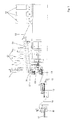
- the only Fig. 1 shows a preferred embodiment of a device according to the invention for producing a molded part, which is designed as a large-scale plant.
- the large-scale plant initially comprises several silos 01 in which sand (not shown) is stored.
- the large-scale plant further comprises several silos 02, in which plastic in the form of plastic granules (not shown) is stored.
- the stockpiled in the silos 01 sand is conveyed by means of a sand conveyor 03 to a rotary kiln 04.
- the sand conveyor 03 comprises a spiral with a capacity of 60 kg / min.
- the rotary kiln 04 is heated by means of a gas burner 06.
- the transported with the sand conveyor 03 from the silos 01 in the rotary kiln 04 sand passes through the rotary kiln 04 in a continuous operation, since the rotating rotary kiln 04 is in an inclined state, so that the circulated in the rotary kiln 04 sand during heating by the burner 06 moved to an opening 07.
- the sand is heated in the rotary kiln 04 up to a temperature of 250 ° C.
- the flow rate of the sand is 3.5 t / h in the large plant shown.
- the sand emerging from the opening 07 of the rotary kiln 04 passes into an intermediate bin 08, by means of which a definable amount of the sand can be dispensed into a first continuous mixer 09.
- a determinable amount of the stored in the silos 02 plastic granules in the first flow mixer 09 can be filled.
- the filled sand and the filled plastic granules are mixed, whereby the heat of the heated sand leads to the melting of the plastic.
- the mixture produced in the first continuous mixer 09 is conveyed via a first conveyor belt 12 to a second continuous mixer 13, in which the mixture of the sand and the molten plastic is further mixed.
- the mixture further mixed in the second continuous mixer 13 is conveyed via a second conveyor belt 14 to a third continuous mixer 16, in which the mixture is intensively mixed again.
- the mixture treated in the third continuous mixer 16 now constitutes a molding compound which is controllably conveyed by a screw conveyor 17 in quantity to a former (not shown) where it is molded, whereupon it cools and solidifies into a molded article.
Landscapes
- Engineering & Computer Science (AREA)
- Chemical & Material Sciences (AREA)
- Ceramic Engineering (AREA)
- Structural Engineering (AREA)
- Materials Engineering (AREA)
- Organic Chemistry (AREA)
- Civil Engineering (AREA)
- Mechanical Engineering (AREA)
- Processing And Handling Of Plastics And Other Materials For Molding In General (AREA)
Applications Claiming Priority (1)
| Application Number | Priority Date | Filing Date | Title |
|---|---|---|---|
| DE201010037441 DE102010037441A1 (de) | 2010-09-09 | 2010-09-09 | Verfahren und Vorrichtung zur Herstellung von Formteilen und Granulat |
Publications (2)
| Publication Number | Publication Date |
|---|---|
| EP2428351A2 true EP2428351A2 (fr) | 2012-03-14 |
| EP2428351A3 EP2428351A3 (fr) | 2013-08-28 |
Family
ID=44772768
Family Applications (1)
| Application Number | Title | Priority Date | Filing Date |
|---|---|---|---|
| EP11180506.5A Withdrawn EP2428351A3 (fr) | 2010-09-09 | 2011-09-08 | Procédé et dispositifs de fabrication de pièces moulées et de granulés |
Country Status (2)
| Country | Link |
|---|---|
| EP (1) | EP2428351A3 (fr) |
| DE (1) | DE102010037441A1 (fr) |
Families Citing this family (1)
| Publication number | Priority date | Publication date | Assignee | Title |
|---|---|---|---|---|
| DE102016010133A1 (de) | 2016-08-19 | 2018-02-22 | Matthias Liebetrau | Verfahren und Vorrichtung zum Herstellen von Formteilen |
Citations (7)
| Publication number | Priority date | Publication date | Assignee | Title |
|---|---|---|---|---|
| FR600703A (fr) * | 1924-07-17 | 1926-02-13 | Perfectionnements dans les fours rotatifs pour le chauffage et le séchage des matières granuleuses | |
| WO1993008974A1 (fr) | 1991-11-08 | 1993-05-13 | Alun Roy Williams | Articles faconnes et procedes de fabrication |
| WO1994027800A1 (fr) | 1993-05-31 | 1994-12-08 | Matti Toivola | Procede de production d'un materiau de construction a partir d'un melange de dechets thermoplastiques et d'origine minerale cribles |
| WO2002090288A1 (fr) | 2001-05-08 | 2002-11-14 | Shell Internationale Research Maatschappij B.V. | Compositions contenant des particules solides et un liant |
| EP1299321B1 (fr) | 2000-06-30 | 2006-02-01 | Michael Manes | Materiau, de meme que procede et dispositif appropries pour le produire |
| DE102007008149A1 (de) | 2007-02-19 | 2008-08-21 | Ashland-Südchemie-Kernfest GmbH | Thermische Regenerierung von Gießereisand |
| EP2087979A1 (fr) | 2008-02-08 | 2009-08-12 | Vem S.P.A. | Appareil pour le mélange d'un matériau inerte granulaire et un liant de résine lors de la fabrication d'articles stratifiés fabriqués à partir d'un matériau composite |
Family Cites Families (4)
| Publication number | Priority date | Publication date | Assignee | Title |
|---|---|---|---|---|
| FR2182771A1 (en) * | 1972-05-05 | 1973-12-14 | Philipon Paul | Forming agglomerates or blocks - from powder by preheating and mixing with a heat hardenable binder then pressing and curing |
| US4980390A (en) * | 1988-10-24 | 1990-12-25 | Ralph B. Andy | Method of mixing composite filled thermoplastic resins |
| DE4340188A1 (de) * | 1993-11-25 | 1995-06-01 | Helmut Hiendl | Verfahren zum Herstellen von Polymerbeton |
| DE102004057549A1 (de) * | 2004-11-30 | 2006-06-01 | Zehmen, Thomas von, Dipl.-Ing. | Verfahren und Vorrichtung zur Ummantelung von Sand mit Kunststoff und anschließender Formenpressung |
-
2010
- 2010-09-09 DE DE201010037441 patent/DE102010037441A1/de not_active Withdrawn
-
2011
- 2011-09-08 EP EP11180506.5A patent/EP2428351A3/fr not_active Withdrawn
Patent Citations (7)
| Publication number | Priority date | Publication date | Assignee | Title |
|---|---|---|---|---|
| FR600703A (fr) * | 1924-07-17 | 1926-02-13 | Perfectionnements dans les fours rotatifs pour le chauffage et le séchage des matières granuleuses | |
| WO1993008974A1 (fr) | 1991-11-08 | 1993-05-13 | Alun Roy Williams | Articles faconnes et procedes de fabrication |
| WO1994027800A1 (fr) | 1993-05-31 | 1994-12-08 | Matti Toivola | Procede de production d'un materiau de construction a partir d'un melange de dechets thermoplastiques et d'origine minerale cribles |
| EP1299321B1 (fr) | 2000-06-30 | 2006-02-01 | Michael Manes | Materiau, de meme que procede et dispositif appropries pour le produire |
| WO2002090288A1 (fr) | 2001-05-08 | 2002-11-14 | Shell Internationale Research Maatschappij B.V. | Compositions contenant des particules solides et un liant |
| DE102007008149A1 (de) | 2007-02-19 | 2008-08-21 | Ashland-Südchemie-Kernfest GmbH | Thermische Regenerierung von Gießereisand |
| EP2087979A1 (fr) | 2008-02-08 | 2009-08-12 | Vem S.P.A. | Appareil pour le mélange d'un matériau inerte granulaire et un liant de résine lors de la fabrication d'articles stratifiés fabriqués à partir d'un matériau composite |
Also Published As
| Publication number | Publication date |
|---|---|
| DE102010037441A1 (de) | 2012-03-15 |
| EP2428351A3 (fr) | 2013-08-28 |
Similar Documents
| Publication | Publication Date | Title |
|---|---|---|
| DE69227509T2 (de) | Verfahren und vorrichtung zum kontinuierlichen strangpressen von massiven gegenständen | |
| EP2665687B1 (fr) | Prétraitement de matériau brut pour la fabrication de fibres de basalte | |
| CN105209237A (zh) | 塑胶成型方法 | |
| EP1299321A2 (fr) | Materiau, de meme que procede et dispositif appropries pour le produire | |
| EP3704073B1 (fr) | Procédé pour la fabrication de granulat de matériaux de construction sur la base de grains de minéraux | |
| DE10134701B4 (de) | Verfahren und Vorrichtung zur kontinuierlichen Herstellung von Kautschukmischungen | |
| DE2226287C3 (de) | Verfahren zur Herstellung und Formung einer Mischung aus thermoplastischen Kunststoffen und festen Füllstoffen | |
| DE1286263B (de) | Modellmasse zum Praezisionsgiessen mit verlorenen Modellen | |
| DE3022787A1 (de) | Verfahren zur kontinuierlichen herstellung von schaumglas | |
| EP3480176A1 (fr) | Microsphères creuses de verre et leur procédé de fabrication | |
| WO2017194485A1 (fr) | Procédé et installation destinés à la fabrication de microsphères creuses en verre | |
| DE2539195A1 (de) | Konstruktionsmaterial sowie verfahren und vorrichtun zu seiner herstellung sowie verfahren und vorrichtung zu seiner weiterverarbeitung | |
| DE102005014704B4 (de) | Materialaufbereitungsanlage zur Herstellung von Leichtwerkstoffen | |
| EP2428351A2 (fr) | Procédé et dispositifs de fabrication de pièces moulées et de granulés | |
| AT516548B1 (de) | Thermoplastisches Gussmaterial | |
| DE29611969U1 (de) | Formkörper | |
| EP2586546A1 (fr) | Procédé de fabrication de noyaux de sel | |
| DE2021632A1 (de) | Verfahren zum Herstellen von kunststoff- bzw. kautschukgebundenen Schleifkoerpern | |
| DE102018007267A1 (de) | Herstellung hoch gefüllter Kunststoffe | |
| DE4111739A1 (de) | Verfahren und vorrichtung zur kontinuierlichen herstellung von schmelzklebstoffen | |
| KR101598358B1 (ko) | 인공어초 및 그 제조방법 | |
| EP0305679B1 (fr) | Matériau de marquage pour superficies reserrées à la circulation ainsi que procédé et dispositif pour sa préparation | |
| EP1114710A2 (fr) | Objet moulé et procédé pour la fabrication d'objets moulés | |
| EP2006062B1 (fr) | Procédé et dispositif d'enveloppement de matière solide | |
| DE102016211418A1 (de) | Verfahren und Produktionsanlage zur Herstellung von Hohlkugeln aus Perlit |
Legal Events
| Date | Code | Title | Description |
|---|---|---|---|
| AK | Designated contracting states |
Kind code of ref document: A2 Designated state(s): AL AT BE BG CH CY CZ DE DK EE ES FI FR GB GR HR HU IE IS IT LI LT LU LV MC MK MT NL NO PL PT RO RS SE SI SK SM TR |
|
| AX | Request for extension of the european patent |
Extension state: BA ME |
|
| PUAI | Public reference made under article 153(3) epc to a published international application that has entered the european phase |
Free format text: ORIGINAL CODE: 0009012 |
|
| RAP1 | Party data changed (applicant data changed or rights of an application transferred) |
Owner name: SIOPLAST INTERNATIONAL CORPORATION |
|
| RIN1 | Information on inventor provided before grant (corrected) |
Inventor name: KREFT, SIEGFRIED Inventor name: HORN, DIETMAR |
|
| PUAL | Search report despatched |
Free format text: ORIGINAL CODE: 0009013 |
|
| AK | Designated contracting states |
Kind code of ref document: A3 Designated state(s): AL AT BE BG CH CY CZ DE DK EE ES FI FR GB GR HR HU IE IS IT LI LT LU LV MC MK MT NL NO PL PT RO RS SE SI SK SM TR |
|
| AX | Request for extension of the european patent |
Extension state: BA ME |
|
| RIC1 | Information provided on ipc code assigned before grant |
Ipc: C04B 18/02 20060101ALI20130722BHEP Ipc: B29C 67/24 20060101AFI20130722BHEP Ipc: C04B 26/02 20060101ALI20130722BHEP |
|
| 17P | Request for examination filed |
Effective date: 20140228 |
|
| RBV | Designated contracting states (corrected) |
Designated state(s): AL AT BE BG CH CY CZ DE DK EE ES FI FR GB GR HR HU IE IS IT LI LT LU LV MC MK MT NL NO PL PT RO RS SE SI SK SM TR |
|
| RAP1 | Party data changed (applicant data changed or rights of an application transferred) |
Owner name: POLY STONE GREEN TECHNOLOGIE GMBH |
|
| 17Q | First examination report despatched |
Effective date: 20151209 |
|
| RAP1 | Party data changed (applicant data changed or rights of an application transferred) |
Owner name: POLY BLOCK GREEN TECHNOLOGIE GMBH |
|
| PUAJ | Public notification under rule 129 epc |
Free format text: ORIGINAL CODE: 0009425 |
|
| 32PN | Public notification |
Free format text: FESTSTELLUNG EINES RECHTSVERLUSTS NACH REGEL 112(1) EPUE (EPA FORM 2021A VOM 27/03/2017) |
|
| STAA | Information on the status of an ep patent application or granted ep patent |
Free format text: STATUS: THE APPLICATION IS DEEMED TO BE WITHDRAWN |
|
| 18D | Application deemed to be withdrawn |
Effective date: 20170922 |