EP2429568B1 - Makrozyklische verbindungen als hepatitis-c-virus-hemmer - Google Patents
Makrozyklische verbindungen als hepatitis-c-virus-hemmer Download PDFInfo
- Publication number
- EP2429568B1 EP2429568B1 EP10775229.7A EP10775229A EP2429568B1 EP 2429568 B1 EP2429568 B1 EP 2429568B1 EP 10775229 A EP10775229 A EP 10775229A EP 2429568 B1 EP2429568 B1 EP 2429568B1
- Authority
- EP
- European Patent Office
- Prior art keywords
- compound
- hcv
- hepatitis
- compounds
- inhibitor
- Prior art date
- Legal status (The legal status is an assumption and is not a legal conclusion. Google has not performed a legal analysis and makes no representation as to the accuracy of the status listed.)
- Not-in-force
Links
- RLHGNACRCYKIBQ-ZSQFBXSQSA-N CC(C)(C)[C@@H](C(N(C[C@@H](C1)Oc2nc(cccc3)c3cc2-c2cc(OCC(C)(C)CO3)ccc2)[C@@H]1C(O)=O)=O)NC3=O Chemical compound CC(C)(C)[C@@H](C(N(C[C@@H](C1)Oc2nc(cccc3)c3cc2-c2cc(OCC(C)(C)CO3)ccc2)[C@@H]1C(O)=O)=O)NC3=O RLHGNACRCYKIBQ-ZSQFBXSQSA-N 0.000 description 2
- XOPXBNOXYDMTIV-UHFFFAOYSA-N BC1=Cc(cccc2)c2NC1=O Chemical compound BC1=Cc(cccc2)c2NC1=O XOPXBNOXYDMTIV-UHFFFAOYSA-N 0.000 description 1
- VQKZJTBDEVXLTI-DURWQBQJSA-N CC(C)(C)[C@@H](C(N(C[C@@H](C1)Oc2nc(cccc3)c3cc2-c2cc(OCC(C)(C)CO3)ccc2)[C@@H]1C(OC)=O)=O)NC3=O Chemical compound CC(C)(C)[C@@H](C(N(C[C@@H](C1)Oc2nc(cccc3)c3cc2-c2cc(OCC(C)(C)CO3)ccc2)[C@@H]1C(OC)=O)=O)NC3=O VQKZJTBDEVXLTI-DURWQBQJSA-N 0.000 description 1
- FZZOXHDPCLAXPJ-ANRPOXJZSA-N CC(C)(C)[C@@H](C(N(C[C@@H](C1)Oc2nc(cccc3)c3cc2-c2cccc(OCC(C)(C)CO3)c2)[C@@H]1C(N[C@](CC1)(CC1=C)C(NS(C1CC1)(=O)=O)=O)=O)=O)NC3=O Chemical compound CC(C)(C)[C@@H](C(N(C[C@@H](C1)Oc2nc(cccc3)c3cc2-c2cccc(OCC(C)(C)CO3)c2)[C@@H]1C(N[C@](CC1)(CC1=C)C(NS(C1CC1)(=O)=O)=O)=O)=O)NC3=O FZZOXHDPCLAXPJ-ANRPOXJZSA-N 0.000 description 1
- FRDNXPJTOVACDX-UHFFFAOYSA-N CC1(CC1)S(NC)(=O)=O Chemical compound CC1(CC1)S(NC)(=O)=O FRDNXPJTOVACDX-UHFFFAOYSA-N 0.000 description 1
- MWGKOIRGTYNPFE-UHFFFAOYSA-N CCC(CC(C(N)=O)N)=C Chemical compound CCC(CC(C(N)=O)N)=C MWGKOIRGTYNPFE-UHFFFAOYSA-N 0.000 description 1
- MRCYJNBEXCNWCW-UHFFFAOYSA-N CCOC(C)(C)CNC Chemical compound CCOC(C)(C)CNC MRCYJNBEXCNWCW-UHFFFAOYSA-N 0.000 description 1
- FALGYAAKAHIFBF-UHFFFAOYSA-N Cc(cc(cccc1)c1n1)c1OC Chemical compound Cc(cc(cccc1)c1n1)c1OC FALGYAAKAHIFBF-UHFFFAOYSA-N 0.000 description 1
- IZINHCDQZXWOIW-UHFFFAOYSA-N O=C1Nc(cccc2)c2C=C1c1cccc(Br)c1 Chemical compound O=C1Nc(cccc2)c2C=C1c1cccc(Br)c1 IZINHCDQZXWOIW-UHFFFAOYSA-N 0.000 description 1
Classifications
-
- A—HUMAN NECESSITIES
- A61—MEDICAL OR VETERINARY SCIENCE; HYGIENE
- A61K—PREPARATIONS FOR MEDICAL, DENTAL OR TOILETRY PURPOSES
- A61K38/00—Medicinal preparations containing peptides
- A61K38/16—Peptides having more than 20 amino acids; Gastrins; Somatostatins; Melanotropins; Derivatives thereof
- A61K38/17—Peptides having more than 20 amino acids; Gastrins; Somatostatins; Melanotropins; Derivatives thereof from animals; from humans
- A61K38/19—Cytokines; Lymphokines; Interferons
- A61K38/21—Interferons [IFN]
-
- A—HUMAN NECESSITIES
- A61—MEDICAL OR VETERINARY SCIENCE; HYGIENE
- A61K—PREPARATIONS FOR MEDICAL, DENTAL OR TOILETRY PURPOSES
- A61K45/00—Medicinal preparations containing active ingredients not provided for in groups A61K31/00 - A61K41/00
- A61K45/06—Mixtures of active ingredients without chemical characterisation, e.g. antiphlogistics and cardiaca
-
- A—HUMAN NECESSITIES
- A61—MEDICAL OR VETERINARY SCIENCE; HYGIENE
- A61P—SPECIFIC THERAPEUTIC ACTIVITY OF CHEMICAL COMPOUNDS OR MEDICINAL PREPARATIONS
- A61P31/00—Antiinfectives, i.e. antibiotics, antiseptics, chemotherapeutics
- A61P31/04—Antibacterial agents
-
- A—HUMAN NECESSITIES
- A61—MEDICAL OR VETERINARY SCIENCE; HYGIENE
- A61P—SPECIFIC THERAPEUTIC ACTIVITY OF CHEMICAL COMPOUNDS OR MEDICINAL PREPARATIONS
- A61P31/00—Antiinfectives, i.e. antibiotics, antiseptics, chemotherapeutics
- A61P31/10—Antimycotics
-
- A—HUMAN NECESSITIES
- A61—MEDICAL OR VETERINARY SCIENCE; HYGIENE
- A61P—SPECIFIC THERAPEUTIC ACTIVITY OF CHEMICAL COMPOUNDS OR MEDICINAL PREPARATIONS
- A61P31/00—Antiinfectives, i.e. antibiotics, antiseptics, chemotherapeutics
- A61P31/12—Antivirals
-
- A—HUMAN NECESSITIES
- A61—MEDICAL OR VETERINARY SCIENCE; HYGIENE
- A61P—SPECIFIC THERAPEUTIC ACTIVITY OF CHEMICAL COMPOUNDS OR MEDICINAL PREPARATIONS
- A61P31/00—Antiinfectives, i.e. antibiotics, antiseptics, chemotherapeutics
- A61P31/12—Antivirals
- A61P31/14—Antivirals for RNA viruses
-
- A—HUMAN NECESSITIES
- A61—MEDICAL OR VETERINARY SCIENCE; HYGIENE
- A61P—SPECIFIC THERAPEUTIC ACTIVITY OF CHEMICAL COMPOUNDS OR MEDICINAL PREPARATIONS
- A61P35/00—Antineoplastic agents
-
- C—CHEMISTRY; METALLURGY
- C07—ORGANIC CHEMISTRY
- C07K—PEPTIDES
- C07K5/00—Peptides containing up to four amino acids in a fully defined sequence; Derivatives thereof
- C07K5/04—Peptides containing up to four amino acids in a fully defined sequence; Derivatives thereof containing only normal peptide links
- C07K5/06—Dipeptides
- C07K5/06008—Dipeptides with the first amino acid being neutral
- C07K5/06017—Dipeptides with the first amino acid being neutral and aliphatic
- C07K5/06034—Dipeptides with the first amino acid being neutral and aliphatic the side chain containing 2 to 4 carbon atoms
-
- C—CHEMISTRY; METALLURGY
- C07—ORGANIC CHEMISTRY
- C07K—PEPTIDES
- C07K5/00—Peptides containing up to four amino acids in a fully defined sequence; Derivatives thereof
- C07K5/04—Peptides containing up to four amino acids in a fully defined sequence; Derivatives thereof containing only normal peptide links
- C07K5/08—Tripeptides
- C07K5/0802—Tripeptides with the first amino acid being neutral
- C07K5/0804—Tripeptides with the first amino acid being neutral and aliphatic
- C07K5/0808—Tripeptides with the first amino acid being neutral and aliphatic the side chain containing 2 to 4 carbon atoms, e.g. Val, Ile, Leu
-
- C—CHEMISTRY; METALLURGY
- C07—ORGANIC CHEMISTRY
- C07K—PEPTIDES
- C07K5/00—Peptides containing up to four amino acids in a fully defined sequence; Derivatives thereof
- C07K5/04—Peptides containing up to four amino acids in a fully defined sequence; Derivatives thereof containing only normal peptide links
- C07K5/08—Tripeptides
- C07K5/0802—Tripeptides with the first amino acid being neutral
- C07K5/0812—Tripeptides with the first amino acid being neutral and aromatic or cycloaliphatic
Definitions
- the present invention relates to novel hepatitis C virus (HCV) protease inhibitor compounds having antiviral activity against HCV and useful in the treatment of HCV infections. More particularly, the invention relates to macrocyclic compounds, compositions containing such compounds and methods for using the same, as well as processes for making such compounds.
- HCV hepatitis C virus
- HCV is the principal cause of non-A, non-B hepatitis and is an increasingly severe public health problem both in the developed and developing world. It is estimated that the virus infects over 200 million people worldwide, surpassing the number of individuals infected with the human immunodeficiency virus (HIV) by nearly five fold. HCV infected patients, due to the high percentage of individuals inflicted with chronic infections, are at an elevated risk of developing cirrhosis of the liver, subsequent hepatocellular carcinoma and terminal liver disease. HCV is the most prevalent cause of hepatocellular cancer and cause of patients requiring liver transplantations in the western world.
- HIV human immunodeficiency virus
- anti-HCV therapeutics There are considerable barriers to the development of anti-HCV therapeutics, which include, but are not limited to, the persistence of the virus, the genetic diversity of the virus during replication in the host, the high incident rate of the virus developing drug-resistant mutants, and the lack of reproducible infectious culture systems and small-animal models for HCV replication and pathogenesis. In a majority of cases, given the mild course of the infection and the complex biology of the liver, careful consideration must be given to antiviral drugs, which are likely to have significant side effects.
- NS3 hepatitis C non-structural protein-3
- HCV is a flaviridae type RNA virus.
- the HCV genome is enveloped and contains a single strand RNA molecule composed of circa 9600 base pairs. It encodes a polypeptide comprised of approximately 3010 amino acids.
- the HCV polyprotein is processed by viral and host peptidase into 10 discreet peptides which serve a variety of functions.
- the P7 protein is of unknown function and is comprised of a highly variable sequence.
- NS2 is a zinc-dependent metalloproteinase that functions in conjunction with a portion of the NS3 protein.
- NS3 incorporates two catalytic functions (separate from its association with NS2): a serine protease at the N-terminal end, which requires NS4A as a cofactor, and an ATP-ase-dependent helicase function at the carboxyl terminus.
- NS4A is a tightly associated but non-covalent cofactor of the serine protease.
- the NS3-NS4A protease is responsible for cleaving four sites on the viral polyprotein.
- the NS3-NS4A cleavage is autocatalytic, occurring in cis.
- the remaining three hydrolyses, NS4A-NS4B, NS4B-NS5A and NS5A-NS5B all occur in trans.
- NS3 is a serine protease which is structurally classified as a chymotrypsin-like protease. While the NS serine protease possesses proteolytic activity by itself, the HCV protease enzyme is not an efficient enzyme in terms of catalyzing polyprotein cleavage. It has been shown that a central hydrophobic region of the NS4A protein is required for this enhancement. The complex formation of the NS3 protein with NS4A seems necessary to the processing events, enhancing the proteolytic efficacy at all of the sites.
- a general strategy for the development of antiviral agents is to inactivate virally encoded enzymes, including NS3, that are essential for the replication of the virus.
- Current efforts directed toward the discovery of NS3 protease inhibitors were reviewed by S. Tan, A. Pause, Y. Shi, N. Sonenberg, Hepatitis C Therapeutics: Current Status and Emerging Strategies, Nature Rev. Drug Discov. 1, 867-881 (2002 ).
- the present invention relates to macrocyclic compounds and pharmaceutically acceptable salts, esters or prodrugs thereof, and methods of using the same to treat hepatitis C infection in a subject in need of such therapy.
- Compounds of the present invention interfere with the life cycle of the hepatitis C virus and are also useful as antiviral agents.
- the present invention further relates to pharmaceutical compositions comprising the aforementioned compounds, salts, esters or prodrugs for administration to a subject suffering from HCV infection.
- the present invention further features pharmaceutical compositions comprising a compound of the present invention (or a pharmaceutically acceptable salt, ester or prodrug thereof) and another anti-HCV agent, such as interferon (e.g., alpha-interferon, beta-interferon, consensus interferon, pegylated interferon, or albumin or other conjugated interferon), ribavirin, amantadine, another HCV protease inhibitor, or an HCV polymerase, helicase or internal ribosome entry site inhibitor.
- the present invention further relates to pharmaceutical compositions comprising the compounds of the present invention, or pharmaceutically acceptable salts, esters, or prodrugs thereof, in combination with a pharmaceutically acceptable carrier or excipient.
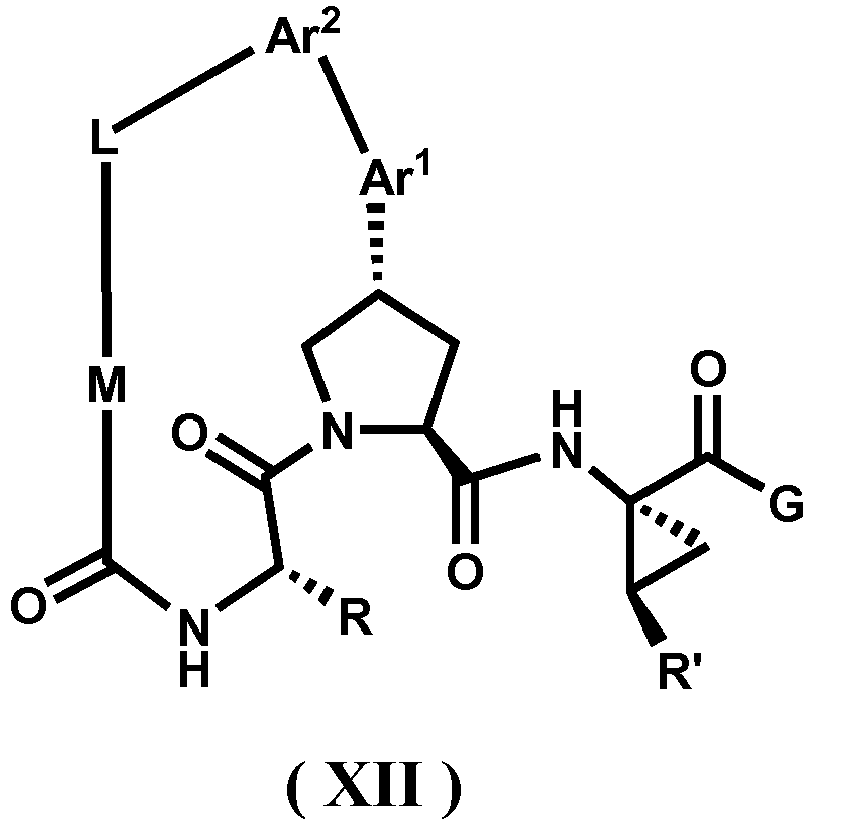
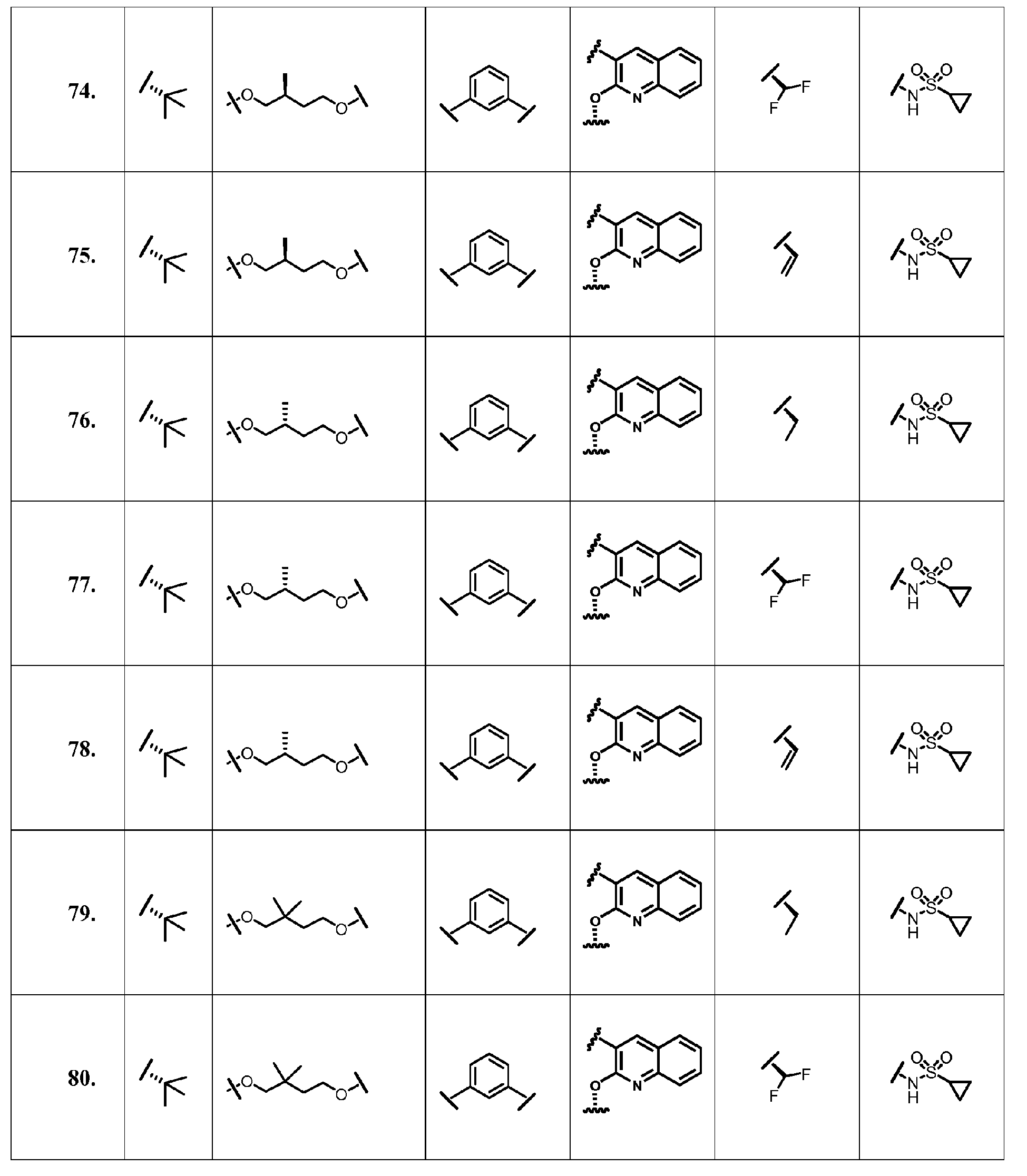
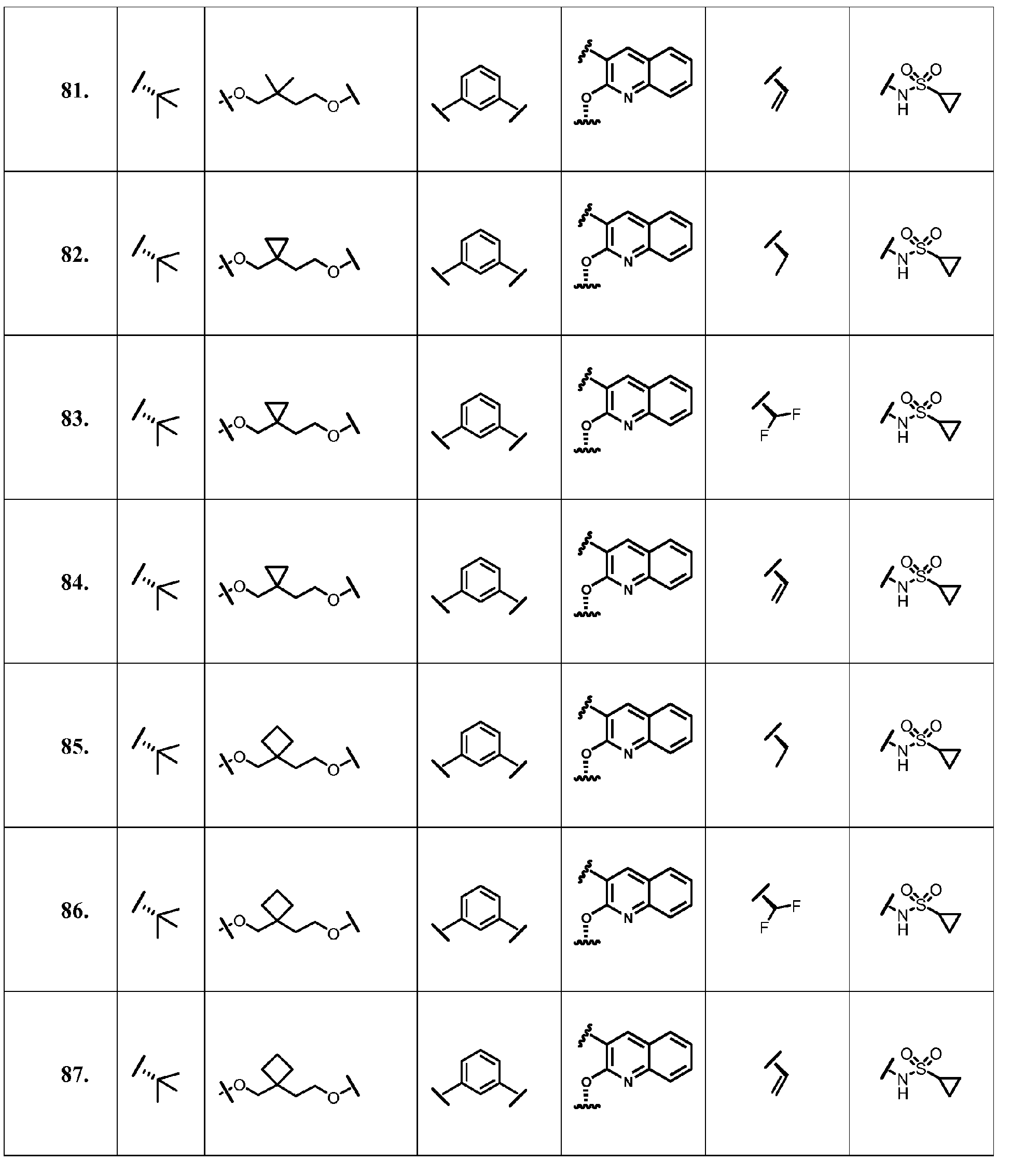
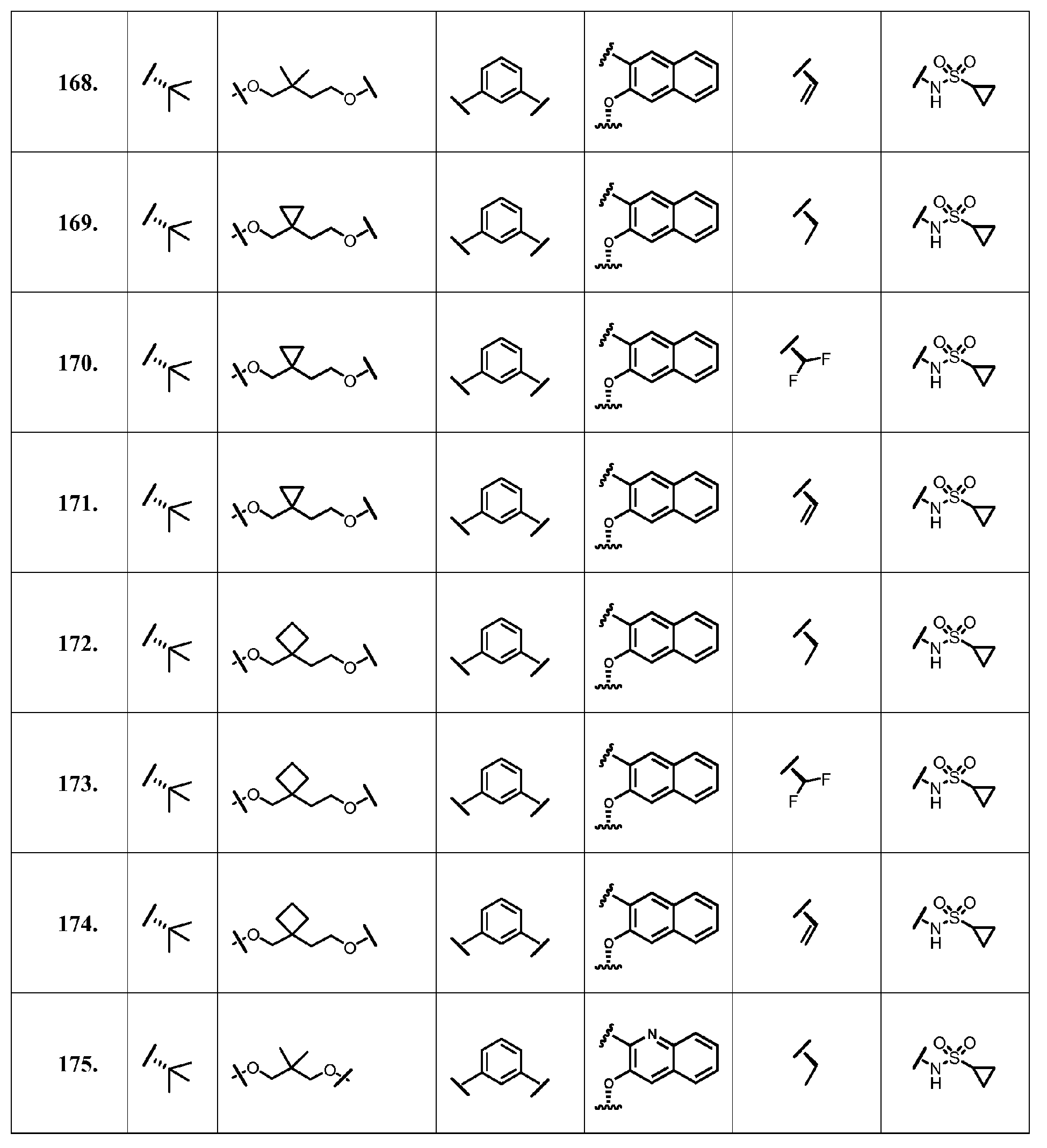
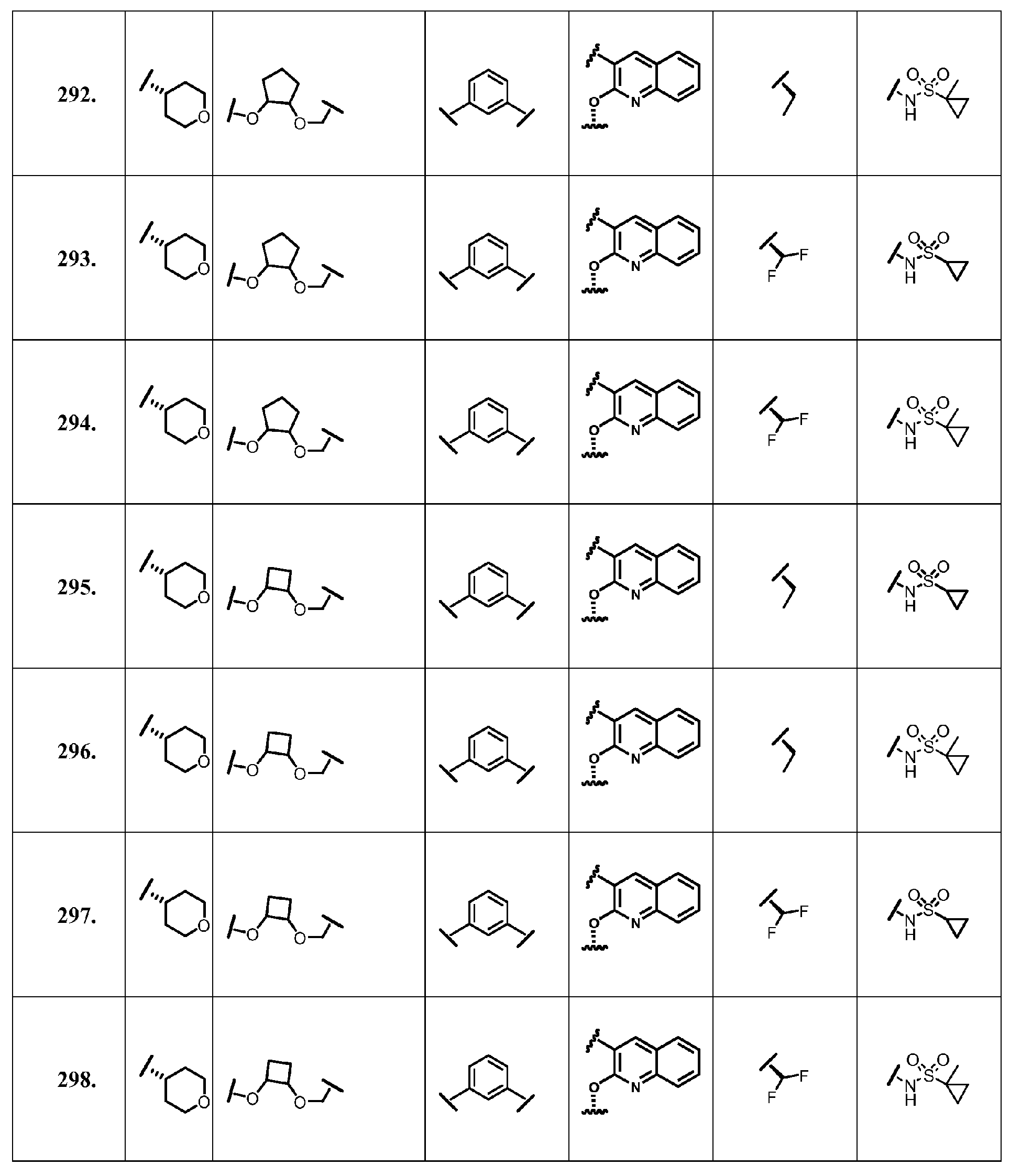
- the present invention provides a compound according to Formula XII wherein R, M-L, Ar 2 , Ar 1 and G are delineated for each example in Table 1.
- the present invention also features pharmaceutical compositions comprising a compound of the present invention, or a pharmaceutically acceptable salt, ester or prodrug thereof.
- the present invention provides a compound of the invention for use in a method of treating a viral infection, preferably a hepatitis C infection, in a subject.
- Compounds of the present invention can be administered as the sole active pharmaceutical agent, or used in combination with one or more agents to treat or prevent hepatitis C infections or the symptoms associated with HCV infection.
- Other agents to be administered in combination with a compound or combination of compounds of the invention include therapies for disease caused by HCV infection that suppresses HCV viral replication by direct or indirect mechanisms. These include agents such as host immune modulators (for example, interferon-alpha, pegylated interferon-alpha, interferon-beta, interferon-gamma, CpG oligonucleotides and the like), or antiviral compounds that inhibit host cellular functions such as inosine monophosphate dehydrogenase (for example, ribavirin and the like).
- host immune modulators for example, interferon-alpha, pegylated interferon-alpha, interferon-beta, interferon-gamma, CpG oligonucleotides and the like
- cytokines that modulate immune function.
- vaccines comprising HCV antigens or antigen adjuvant combinations directed against HCV.
- agents to be administered in combination with a compound of the present invention include any agent or combination of agents that inhibit the replication of HCV by targeting proteins of the viral genome involved in the viral replication.
- These agents include but are not limited to other inhibitors of HCV RNA dependent RNA polymerase such as, for example, nucleoside type polymerase inhibitors described in WO0190121(A2 ), or U.S. Pat. No. 6,348,587 B1 or WO0160315 or WO0132153 or non-nucleoside inhibitors such as, for example, benzimidazole polymerase inhibitors described in EP 1162196 A1 or WO0204425 or inhibitors of HCV protease such as, for example, peptidomimetic type inhibitors such as BILN2061 and the like or inhibitors of HCV helicase.
- inhibitors of HCV RNA dependent RNA polymerase such as, for example, nucleoside type polymerase inhibitors described in WO0190121(A2 ), or U.S. Pat. No. 6,348,587 B1 or WO0160315 or WO0132153 or non-nucleoside inhibitors such as, for example,
- agents to be administered in combination with a compound of the present invention include any agent or combination of agents that inhibit the replication of other viruses for co-infected individuals.
- agents include but are not limited to therapies for disease caused by hepatitis B (HBV) infection such as, for example, adefovir, lamivudine, and tenofovir or therapies for disease caused by human immunodeficiency virus (HIV) infection such as, for example, protease inhibitors: ritonavir, lopinavir, indinavir, nelfinavir, saquinavir, amprenavir, atazanavir, tipranavir, TMC-114, fosamprenavir; reverse transcriptase inhibitors: zidovudine, lamivudine, didanosine, stavudine, tenofovir, zalcitabine, abacavir, efavirenz, nevirapine, delavirdine, TMC-125;
- combination of compound or compounds of the invention, together with one or more agents as defined herein above can be employed in pure form or, where such forms exist, in pharmaceutically acceptable salt form, prodrug, salt of a prodrug, or combination thereof.
- combination of therapeutic agents can be administered as a pharmaceutical composition containing a therapeutically effective amount of the compound or combination of compounds of interest, or their pharmaceutically acceptable salt form, prodrugs, or salts of the prodrug, in combination with one or more agents as defined hereinabove, and a pharmaceutically acceptable carrier.
- Such pharmaceutical compositions can be used for inhibiting the replication of an RNA-containing virus, particularly Hepatitis C virus (HCV), by contacting said virus with said pharmaceutical composition.
- such compositions are useful for the treatment or prevention of an infection caused by an RNA-containing virus, particularly Hepatitis C virus (HCV).
- the therapeutic agents When administered as a combination, the therapeutic agents can be formulated as separate compositions which are given at the same time or within a predetermined period of time, or the therapeutic agents can be given as a single unit dosage form.
- Antiviral agents contemplated for use in such combination therapy include agents (compounds or biologicals) that are effective to inhibit the formation and/or replication of a virus in a mammal, including but not limited to agents that interfere with either host or viral mechanisms necessary for the formation and/or replication of a virus in a mammal.
- agents can be selected from another anti-HCV agent; an HIV inhibitor; an HAV inhibitor; and an HBV inhibitor.
- anti-HCV agents include those agents that are effective for diminishing or preventing the progression of hepatitis C related symptoms or disease. Such agents include but are not limited to immunomodulatory agents, inhibitors of HCV NS3 protease, other inhibitors of HCV polymerase, inhibitors of another target in the HCV life cycle and other anti-HCV agents, including but not limited to ribavirin, amantadine, levovirin and viramidine.
- Immunomodulatory agents include those agents (compounds or biologicals) that are effective to enhance or potentiate the immune system response in a mammal.
- Immunomodulatory agents include, but are not limited to, inosine monophosphate dehydrogenase inhibitors such as VX-497 (merimepodib, Vertex Pharmaceuticals), class I interferons, class II interferons, consensus interferons, asialo-interferons pegylated interferons and conjugated interferons, including but not limited to interferons conjugated with other proteins including but not limited to human albumin.
- Class I interferons are a group of interferons that all bind to receptor type I, including both naturally and synthetically produced class I interferons, while class II interferons all bind to receptor type II.
- Examples of class I interferons include, but are not limited to, [alpha]-, [beta]-, [delta]-, [omega]-, and [tau]-interferons, while examples of class II interferons include, but are not limited to, [gamma]-interferons.
- Inhibitors of HCV NS3 protease include agents (compounds or biologicals) that are effective to inhibit the function of HCV NS3 protease in a mammal.
- Inhibitors of HCV NS3 protease include, but are not limited to, those compounds described in WO 99/07733 , WO 99/07734 , WO 00/09558 , WO 00/09543 , WO 00/59929 , WO 03/064416 , WO 03/064455 , WO 03/064456 , WO 2004/030670 , WO 2004/037855 , WO 2004/039833 , WO 2004/101602 , WO 2004/101605 , WO 2004/103996 , WO 2005/028501 , WO 2005/070955 , WO 2006/000085 , WO 2006/007700 and WO 2006/007708 (all by Boehringer Ingelheim), WO 02/
- Inhibitors of HCV polymerase include agents (compounds or biologicals) that are effective to inhibit the function of an HCV polymerase.
- Such inhibitors include, but are not limited to, non-nucleoside and nucleoside inhibitors of HCV NS5B polymerase.
- inhibitors of HCV polymerase include but are not limited to those compounds described in: WO 02/04425 , WO 03/007945 , WO 03/010140 , WO 03/010141 , WO 2004/064925 , WO 2004/065367 , WO 2005/080388 and WO 2006/007693 (all by Boehringer Ingelheim), WO 2005/049622 (Japan Tobacco), WO 2005/014543 (Japan Tobacco), WO 2005/012288 (Genelabs), WO 2004/087714 (IRBM), WO 03/101993 (Neogenesis), WO 03/026587 (BMS), WO 03/000254 (Japan Tobacco), and WO 01/47883 (Japan Tobacco), and the clinical candidates XTL-2125, HCV 796, R-1626 and NM 283.
- Inhibitors of another target in the HCV life cycle include agents (compounds or biologicals) that are effective to inhibit the formation and/or replication of HCV other than by inhibiting the function of the HCV NS3 protease. Such agents may interfere with either host or HCV viral mechanisms necessary for the formation and/or replication of HCV.
- Inhibitors of another target in the HCV life cycle include, but are not limited to, entry inhibitors, agents that inhibit a target selected from a helicase, a NS2/3 protease and an internal ribosome entry site (IRES) and agents that interfere with the function of other viral targets including but not limited to an NS5A protein and an NS4B protein.
- a patient may be co-infected with hepatitis C virus and one or more other viruses, including but not limited to human immunodeficiency virus (HIV), hepatitis A virus (HAV) and hepatitis B virus (HBV).
- HAV human immunodeficiency virus
- HAV hepatitis A virus
- HBV hepatitis B virus
- combination therapy to treat such co-infections by co-administering a compound according to the present invention with at least one of an HIV inhibitor, an HAV inhibitor and an HBV inhibitor.
- compositions of the present invention may further comprise inhibitor(s) of other targets in the HCV life cycle, including, but not limited to, helicase, polymerase, metalloprotease, and internal ribosome entry site (IRES).
- inhibitor(s) of other targets in the HCV life cycle including, but not limited to, helicase, polymerase, metalloprotease, and internal ribosome entry site (IRES).
- compositions of the present invention may further comprise another anti-viral, anti-bacterial, anti-fungal or anti-cancer agent, or an immune modulator, or another thearapeutic agent.
- the cytochrome P450 monooxygenase inhibitor used in this invention is expected to inhibit metabolism of the compounds of the invention. Therefore, the cytochrome P450 monooxygenase inhibitor would be in an amount effective to inhibit metabolism of the protease inhibitor. Accordingly, the CYP inhibitor is administered in an amount such that the bioavailiablity of the protease inhibitor is increased in comparison to the bioavailability in the absence of the CYP inhibitor.
- the CYP inhibitor inhibits CYP3A4.
- Any CYP inhibitor that improves the pharmacokinetics of the relevant NS3/4A protease may be used in such methods.
- These CYP inhibitors include, but are not limited to, ritonavir ( WO 94/14436 ), ketoconazole, troleandomycin, 4-methyl pyrazole, cyclosporin, clomethiazole, cimetidine, itraconazole, fluconazole, miconazole, fluvoxamine, fluoxetine, nefazodone, sertraline, indinavir, nelfinavir, amprenavir, fosamprenavir, saquinavir, lopinavir, delavirdine, erythromycin, VX-944, and VX-497.
- Preferred CYP inhibitors include ritonavir, ketoconazole, troleandomycin, 4-methyl pyrazole, cyclosporin,
- viral infection refers to the introduction of a virus into cells or tissues, e.g., hepatitis C virus (HCV). In general, the introduction of a virus is also associated with replication. Viral infection may be determined by measuring virus antibody titer in samples of a biological fluid, such as blood, using, e.g., enzyme immunoassay. Other suitable diagnostic methods include molecular based techniques, such as RT-PCR, direct hybrid capture assay, nucleic acid sequence based amplification, and the like. A virus may infect an organ, e.g., liver, and cause disease, e.g., hepatitis, cirrhosis, chronic liver disease and hepatocellular carcinoma.
- HCV hepatitis C virus
- anti-cancer agent refers to a compound or drug capable of preventing or inhibiting the advancement of cancer.
- agents include cis-platin, actinomycin D, doxorubicin, vincristine, vinblastine, etoposide, amsacrine, mitoxantrone, tenipaside, taxol, colchicine, cyclosporin A, phenothiazines or thioxantheres.
- anti-fungal agent shall used to describe a compound which may be used to treat a fungus infection other than 3-AP, 3-AMP or prodrugs of 3-AP and 3-AMP according to the present invention.
- Anti-fungal agents according to the present invention include, for example, terbinafine, fluconazole, itraconazole, posaconazole, clotrimazole, griseofulvin, nystatin, tolnaftate, caspofungin, amphotericin B, liposomal amphotericin B, and amphotericin B lipid complex.
- antibacterial agent refers to both naturally occurring antibiotics produced by microorganisms to suppress the growth of other microorganisms, and agents synthesized or modified in the laboratory which have either bactericidal or bacteriostatic activity, e.g., ⁇ -lactam antibacterial agents, glycopeptides, macrolides, quinolones, tetracyclines, and aminoglycosides.
- bacteriostatic it means that the agent essentially stops bacterial cell growth (but does not kill the bacteria); if the agent is bacteriocidal, it means that the agent kills the bacterial cells (and may stop growth before killing the bacteria).
- immune modulator refers to any substance meant to alter the working of the humoral or cellular immune system of a subject.
- immune modulators include inhibitors of mast cell-mediated inflammation, interferons, interleukins, prostaglandins, steroids, cortico-steroids, colony-stimulating factors, chemotactic factors, etc.
- C 1 -C 6 alkyl or “C 1 -C 8 alkyl,” as used herein, refer to saturated, straight-or branched-chain hydrocarbon radicals containing between one and six, or one and eight carbon atoms, respectively.
- C 1 -C 6 alkyl radicals include, but are not limited to, methyl, ethyl, propyl, isopropyl, n-butyl, tert -butyl, neopentyl, n-hexyl radicals; and examples of C 1 -C 8 alkyl radicals include, but are not limited to, methyl, ethyl, propyl, isopropyl, n-butyl, tert -butyl, neopentyl, n-hexyl, heptyl, octyl radicals.
- C 2 -C 6 alkenyl or "C 2 -C 8 alkenyl,” as used herein, denote a group derived from a hydrocarbon moiety, wherein the hydrocarbon moiety has at least one carbon-carbon double bond and contains from two to six, or two to eight carbon atoms, respectively.
- Alkenyl groups include, but are not limited to, for example, ethenyl, propenyl, butenyl, 1-methyl-2-buten-1-yl, heptenyl, octenyl and the like.
- C 2 -C 6 alkynyl or “C 2 -C 8 alkynyl,” as used herein, denote a group derived from a hydrocarbon moiety, wherein the hydrocarbon moiety has at least one carbon-carbon triple bond and contains from two to six, or two to eight carbon atoms, respectively.
- Representative alkynyl groups include, but are not limited to, for example, ethynyl, 1-propynyl, 1-butynyl, heptynyl, octynyl and the like.
- C 3 -C 8 -cycloalkyl or "C 3 -C 12 -cycloalkyl,” as used herein, denotes a group derived from a monocyclic or polycyclic saturated carbocyclic ring, where the saturated carbocyclic ring compound has from 3 to 8, or from 3 to 12, ring atoms, respectively.
- C 3 -C 8 -cycloalkyl examples include, but not limited to, cyclopropyl, cyclobutyl, cyclopentyl, cyclohexyl, cyclopentyl and cyclooctyl; and examples of C 3 -C 12 -cycloalkyl include, but not limited to, cyclopropyl, cyclobutyl, cyclopentyl, cyclohexyl, bicyclo [2.2.1] heptyl, and bicyclo [2.2.2] octyl.
- C 3 -C 8 -cycloalkenyl or "C 3 -C 12 -cycloalkenyl” as used herein, denote a group derived from a monocyclic or polycyclic carbocyclic ring compound having at least one carbon-carbon double, where the carbocyclic ring compound has from 3 to 8, or from 3 to 12, ring atoms, respectively.
- C 3 -C 8 -cycloalkenyl examples include, but not limited to, cyclopropenyl, cyclobutenyl, cyclopentenyl, cyclohexenyl, cycloheptenyl, cyclooctenyl, and the like; and examples of C 3 -C 12 -cycloalkenyl include, but not limited to, cyclopropenyl, cyclobutenyl, cyclopentenyl, cyclohexenyl, cycloheptenyl, cyclooctenyl, and the like.
- aryl refers to a mono- or bicyclic carbocyclic ring system having one or two aromatic rings including, but not limited to, phenyl, naphthyl, tetrahydronaphthyl, indanyl, indenyl and the like.
- arylalkyl refers to a C 1 -C 3 alkyl or C 1 -C 6 alkyl residue attached to an aryl ring. Examples include, but are not limited to, benzyl, phenethyl and the like.
- heteroaryl refers to a mono-, bi-, or tri-cyclic aromatic radical or ring having from five to ten ring atoms of which at least one ring atom is selected from S, O and N; wherein any N or S contained within the ring may be optionally oxidized.
- Heteroaryl includes, but is not limited to, pyridinyl, pyrazinyl, pyrimidinyl, pyrrolyl, pyrazolyl, imidazolyl, thiazolyl, oxazolyl, isooxazolyl, thiadiazolyl, oxadiazolyl, thiophenyl, furanyl, quinolinyl, isoquinolinyl, benzimidazolyl, benzooxazolyl, quinoxalinyl, and the like.
- heteroarylalkyl refers to a C 1 -C 3 alkyl or C 1 -C 6 alkyl, residue attached to a heteroaryl ring. Examples include, but are not limited to, pyridinylmethyl, pyrimidinylethyl and the like.
- substituted refers to independent replacement of one, two, or three or more of the hydrogen atoms thereon with substituents including, but not limited to, -F, -Cl, -Br, -I, -OH, protected hydroxyl, -NO 2 , -CN, -NH 2 , N 3 , protected amino, alkoxy, thioalkoxy, oxo, -halo- C 1 -C 12 -alkyl, -halo- C 2 -C 12 -alkenyl, -halo- C 2 -C 12 -alkynyl, -halo-C 3 -C 12 -cycloalkyl, -NH -C 1 -C 12 -alkyl, -NH -C 2 -C 12 -alkenyl, -NH -C 2 -C 12 -alkynyl, -NH -C 3 -C 12 -cyclo
- each substituent in a substituted moiety is additionally optionally substituted with one or more groups, each group being independently selected from -F, -Cl, -Br, -I, -OH, -NO 2 , -CN, or-NH 2 .
- the two substitutents can be taken together to form a cycloalkyl, cycloalkenyl or heterocyclic ring.
- any of the aryls, substituted aryls, heteroaryls and substituted heteroaryls described herein, can be any aromatic group.
- Aromatic groups can be substituted or unsubstituted.
- any alkyl, alkenyl, alkynyl, cycloalkyl and cycloalkenyl moiety described herein can also be an aliphatic group, an alicyclic group or a heterocyclic group.
- An "aliphatic group” is non-aromatic moiety that may contain any combination of carbon atoms, hydrogen atoms, halogen atoms, oxygen, nitrogen or other atoms, and optionally contain one or more units of unsaturation, e.g., double and/or triple bonds.
- An aliphatic group may be straight chained, branched or cyclic and preferably contains between about 1 and about 24 carbon atoms, more typically between about 1 and about 12 carbon atoms.
- aliphatic groups include, for example, polyalkoxyalkyls, such as polyalkylene glycols, polyamines, and polyimines, for example. Such aliphatic groups may be further substituted. It is understood that aliphatic groups may be used in place of the alkyl, alkenyl, alkynyl, alkylene, alkenylene, and alkynylene groups described herein.
- alicyclic denotes a group derived from a monocyclic or polycyclic saturated carbocyclic ring compound. Examples include, but not limited to, cyclopropyl, cyclobutyl, cyclopentyl, cyclohexyl, bicyclo [2.2.1] heptyl, and bicyclo [2.2.2] octyl. Such alicyclic groups may be further substituted.
- heterocycloalkyl and “heterocyclic” can be used interchangeably and refer to a non-aromatic 3-, 4-, 5-, 6- or 7-membered ring or a bi- or tri-cyclic group fused system, where (i) each ring contains between one and three heteroatoms independently selected from oxygen, sulfur and nitrogen, (ii) each 5-membered ring has 0 to 1 double bonds and each 6-membered ring has 0 to 2 double bonds, (iii) the nitrogen and sulfur heteroatoms may optionally be oxidized, (iv) the nitrogen heteroatom may optionally be quaternized, (v) any of the above rings may be fused to a benzene ring, and (vi) the remaining ring atoms are carbon atoms which may be optionally oxo-substituted.
- heterocycloalkyl groups include, but are not limited to, [1,3]dioxolane, pyrrolidinyl, pyrazolinyl, pyrazolidinyl, imidazolinyl, imidazolidinyl, piperidinyl, piperazinyl, oxazolidinyl, isoxazolidinyl, morpholinyl, thiazolidinyl, isothiazolidinyl, quinoxalinyl, pyridazinonyl, and tetrahydrofuryl.
- Such heterocyclic groups may be further substituted to give substituted heterocyclic.
- alkyl, alkenyl, alkynyl, cycloalkyl, cycloalkenyl, cycloalkynyl, arylalkyl, heteroarylalkyl, and heterocycloalkyl are intended to be monovalent or divalent.
- alkylene, alkenylene, and alkynylene, cycloaklylene, cycloalkenylene, cycloalkynylene, arylalkylene, hetoerarylalkylene and heterocycloalkylene groups are to be included in the above definitions, and are applicable to provide the formulas herein with proper valency.
- hydroxyl activating group refers to a labile chemical moiety which is known in the art to activate a hydroxyl group so that it will depart during synthetic procedures such as in a substitution or elimination reactions.
- hydroxyl activating group include, but not limited to, mesylate, tosylate, triflate, p -nitrobenzoate, phosphonate and the like.
- activated hydroxyl refers to a hydroxyl group activated with a hydroxyl activating group, as defined above, including mesylate, tosylate, triflate, p-nitrobenzoate, phosphonate groups, for example.
- protected hydroxyl refers to a hydroxyl group protected with a hydroxyl protecting group, as defined above, including benzoyl, acetyl, trimethylsilyl, triethylsilyl, methoxymethyl groups.
- halo and halogen, as used herein, refer to an atom selected from fluorine, chlorine, bromine and iodine.
- the compounds described herein contain one or more asymmetric centers and thus give rise to enantiomers, diastereomers, and other stereoisomeric forms that may be defined, in terms of absolute stereochemistry, as (R)- or (S)- , or as (D)- or (L)- for amino acids.
- the present invention is meant to include all such possible isomers, as well as their racemic and optically pure forms.
- Optical isomers may be prepared from their respective optically active precursors by the procedures described above, or by resolving the racemic mixtures. The resolution can be carried out in the presence of a resolving agent, by chromatography or by repeated crystallization or by some combination of these techniques, which are known to those skilled in the art.
- subject refers to a mammal.
- a subject therefore refers to, for example, dogs, cats, horses, cows, pigs, guinea pigs, and the like.
- the subject is a human.
- the subject may be referred to herein as a patient.
- the term "pharmaceutically acceptable salt” refers to those salts of the compounds formed by the process of the present invention which are, within the scope of sound medical judgment, suitable for use in contact with the tissues of humans and lower animals without undue toxicity, irritation, allergic response and the like, and are commensurate with a reasonable benefit/risk ratio.
- Pharmaceutically acceptable salts are well known in the art.
- hydroxyl protecting group refers to a labile chemical moiety which is known in the art to protect a hydroxyl group against undesired reactions during synthetic procedures. After said synthetic procedure(s) the hydroxyl protecting group as described herein may be selectively removed. Hydroxyl protecting groups as known in the are described generally in T.H. Greene and P.G., S. M. Wuts, Protective Groups in Organic Synthesis, 3rd edition, John Wiley & Sons, New York (1999 ).
- hydroxyl protecting groups include benzyloxycarbonyl, 4-nitrobenzyloxycarbonyl, 4-bromobenzyloxycarbonyl, 4-methoxybenzyloxycarbonyl, methoxycarbonyl, tert-butoxycarbonyl, isopropoxycarbonyl, diphenylmethoxycarbonyl, 2,2,2-trichloroethoxycarbonyl, 2-(trimethylsilyl)ethoxycarbonyl, 2-furfuryloxycarbonyl, allyloxycarbonyl, acetyl, formyl, chloroacetyl, trifluoroacetyl, methoxyacetyl, phenoxyacetyl, benzoyl, methyl, t-butyl, 2,2,2-trichloroethyl, 2-trimethylsilyl ethyl, 1,1-dimethyl-2-propenyl, 3-methyl- 3 -butenyl, allyl, benzyl, paramethoxybenzyl
- Preferred hydroxyl protecting groups for the present invention are acetyl (Ac or -C(O)CH 3 ), benzoyl (Bz or -C(O)C 6 H 5 ), and trimethylsilyl (TMS or-Si(CH 3 ) 3 ).
- acetyl Ac or -C(O)CH 3
- benzoyl Bz or -C(O)C 6 H 5
- trimethylsilyl TMS or-Si(CH 3 ) 3
- the salts can be prepared in situ during the final isolation and purification of the compounds of the invention, or separately by reacting the free base function with a suitable organic acid.
- salts include, but are not limited to, nontoxic acid addition salts e.g., salts of an amino group formed with inorganic acids such as hydrochloric acid, hydrobronic acid, phosphoric acid, sulfuric acid and perchloric acid or with organic acids such as acetic acid, maleic acid, tartaric acid, citric acid, succinic acid or malonic acid or by using other methods used in the art such as ion exchange.
- nontoxic acid addition salts e.g., salts of an amino group formed with inorganic acids such as hydrochloric acid, hydrobronic acid, phosphoric acid, sulfuric acid and perchloric acid or with organic acids such as acetic acid, maleic acid, tartaric acid, citric acid, succinic acid or malonic acid or by using other methods used in the art such as ion exchange.
- salts include, but are not limited to, adipate, alginate, ascorbate, aspartate, benzenesulfonate, benzoate, bisulfate, borate, butyrate, camphorate, camphorsulfonate, citrate, cyclopentanepropionate, digluconate, dodecylsulfate, ethanesulfonate, formate, fumarate, glucoheptonate, glycerophosphate, gluconate, hemisulfate, heptanoate, hexanoate, hydroiodide, 2-hydroxy-ethanesulfonate, lactobionate, lactate, laurate, lauryl sulfate, malate, maleate, malonate, methanesulfonate, 2-naphthalenesulfonate, nicotinate, nitrate, oleate, oxalate, palmitate, pamo
- alkali or alkaline earth metal salts include sodium, lithium, potassium, calcium, magnesium, and the like.
- Further pharmaceutically acceptable salts include, when appropriate, nontoxic ammonium, quaternary ammonium, and amine cations formed using counterions such as halide, hydroxide, carboxylate, sulfate, phosphate, nitrate, alkyl having from I to 6 carbon atoms, sulfonate and aryl sulfonate.
- amino protecting group refers to a labile chemical moiety which is known in the art to protect an amino group against undesired reactions during synthetic procedures. After said synthetic procedure(s) the amino protecting group as described herein may be selectively removed.
- Amino protecting groups as known in the are described generally in T.H. Greene and P.G. M. Wuts, Protective Groups in Organic Synthesis, 3rd edition, John Wiley & Sons, New York (1999 ). Examples of amino protecting groups include, but are not limited to, t-butoxycarbonyl, 9-fluorenylmethoxycarbonyl, benzyloxycarbonyl, and the like.
- ester refers to esters of the compounds formed by the process of the present invention which hydrolyze in vivo and include those that break down readily in the human body to leave the parent compound or a salt thereof.
- Suitable ester groups include, for example, those derived from pharmaceutically acceptable aliphatic carboxylic acids, particularly alkanoic, alkenoic, cycloalkanoic and alkanedioic acids, in which each alkyl or alkenyl moiety advantageously has not more than 6 carbon atoms.
- esters include, but are not limited to, formates, acetates, propionates, butyrates, acrylates and ethylsuccinates.
- prodrugs refers to those prodrugs of the compounds formed by the process of the present invention which are, within the scope of sound medical judgment, suitable for use in contact with the tissues of humans and lower animals with undue toxicity, irritation, allergic response, and the like, commensurate with a reasonable benefit/risk ratio, and effective for their intended use, as well as the zwitterionic forms, where possible, of the compounds of the present invention.
- Prodrug as used herein means a compound, which is convertible in vivo by metabolic means (e.g. by hydrolysis) to afford any compound delineated by the formulae of the instant invention.
- prodrugs are known in the art, for example, as discussed in Bundgaard, (ed.), Design of Prodrugs, Elsevier (1985 ); Widder, et al., (ed.), Methods in Enzymology, vol. 4, Academic Press (1985 ); Krogsgaard-Larsen, et al., (ed). "Design and Application of Prodrugs, Textbook of Drug Design and Development, Chapter 5, 113-191 (1991 ); Bundgaard, et al., Journal of Drug Deliver Reviews, 8:1-38(1992 ); Bundgaard, J. of Pharmaceutical Sciences, 77:285 et seq.
- acyl includes residues derived from acids, including but not limited to carboxylic acids, carbamic acids, carbonic acids, sulfonic acids, and phosphorous acids. Examples include aliphatic carbonyls, aromatic carbonyls, aliphatic sulfonyls, aromatic sulfinyls, aliphatic sulfinyls, aromatic phosphates and aliphatic phosphates. Examples of aliphatic carbonyls include, but are not limited to, acetyl, propionyl, 2-fluoroacetyl, butyryl, 2-hydroxy acetyl, and the like.
- aprotic solvent refers to a solvent that is relatively inert to proton activity, i.e., not acting as a proton-donor.
- examples include, but are not limited to, hydrocarbons, such as hexane and toluene, for example, halogenated hydrocarbons, such as, for example, methylene chloride, ethylene chloride, chloroform, and the like, heterocyclic compounds, such as, for example, tetrahydrofuran and N-methylpyrrolidinone, and ethers such as diethyl ether, bis-methoxymethyl ether.
- solvents are well known to those skilled in the art, and individual solvents or mixtures thereof may be preferred for specific compounds and reaction conditions, depending upon such factors as the solubility of reagents, reactivity of reagents and preferred temperature ranges, for example. Further discussions of aprotic solvents may be found in organic chemistry textbooks or in specialized monographs, for example: Organic Solvents Physical Properties and Methods of Purification, 4th ed., edited by John A. Riddick et al., Vol. II, in the Techniques of Chemistry Series, John Wiley & Sons, NY, 1986 .
- protogenic organic solvent or “protic solvent” as used herein, refer to a solvent that tends to provide protons, such as an alcohol, for example, methanol, ethanol, propanol, isopropanol, butanol, t-butanol, and the like.
- solvents are well known to those skilled in the art, and individual solvents or mixtures thereof may be preferred for specific compounds and reaction conditions, depending upon such factors as the solubility of reagents, reactivity of reagents and preferred temperature ranges, for example. Further discussions of protogenic solvents may be found in organic chemistry textbooks or in specialized monographs, for example: Organic Solvents Physical Properties and Methods of Purification, 4th ed., edited by John A. Riddick et al., Vol. II, in the Techniques of Chemistry Series, John Wiley & Sons, NY, 1986 .
- stable refers to compounds which possess stability sufficient to allow manufacture and which maintains the integrity of the compound for a sufficient period of time to be useful for the purposes detailed herein (e.g., therapeutic or prophylactic administration to a subject).
- the synthesized compounds can be separated from a reaction mixture and further purified by a method such as column chromatography, high pressure liquid chromatography, or recrystallization. Additionally, the various synthetic steps may be performed in an alternate sequence or order to give the desired compounds.
- the solvents, temperatures, reaction durations, etc. delineated herein are for purposes of illustration only and variation of the reaction conditions can produce the desired bridged macrocyclic products of the present invention.
- Synthetic chemistry transformations and protecting group methodologies (protection and deprotection) useful in synthesizing the compounds described herein include, for example, those described in R. Larock, Comprehensive Organic Transformations, VCH Publishers (1989 ); T.W. Greene and P.G.M.
- the compounds of this invention may be modified by appending various functionalities via synthetic means delineated herein to enhance selective biological properties.
- modifications include those which increase biological penetration into a given biological system (e.g., blood, lymphatic system, central nervous system), increase oral availability, increase solubility to allow administration by injection, alter metabolism and alter rate of excretion.
- compositions of the present invention comprise a therapeutically effective amount of a compound of the present invention formulated together with one or more pharmaceutically acceptable carriers.
- pharmaceutically acceptable carrier means a non-toxic, inert solid, semi-solid or liquid filler, diluent, encapsulating material or formulation auxiliary of any type.
- materials which can serve as pharmaceutically acceptable carriers are sugars such as lactose, glucose and sucrose; starches such as corn starch and potato starch; cellulose and its derivatives such as sodium carboxymethyl cellulose, ethyl cellulose and cellulose acetate; powdered tragacanth; malt; gelatin; talc; excipients such as cocoa butter and suppository waxes; oils such as peanut oil, cottonseed oil; safflower oil; sesame oil; olive oil; corn oil and soybean oil; glycols; such a propylene glycol; esters such as ethyl oleate and ethyl laurate; agar; buffering agents such as magnesium hydroxide and aluminum hydroxide; alginic acid; pyrogen-free water; isotonic saline; Ringer's solution; ethyl alcohol, and phosphate buffer solutions, as well as other non-toxic compatible lubricants such as sodium lauryl sulf
- compositions of this invention can be administered to humans and other animals orally, rectally, parenterally, intracisternally, intravaginally, intraperitoneally, topically (as by powders, ointments, or drops), buccally, or as an oral or nasal spray.
- compositions of this invention may be administered orally, parenterally, by inhalation spray, topically, rectally, nasally, buccally, vaginally or via an implanted reservoir, preferably by oral administration or administration by injection.
- the pharmaceutical compositions of this invention may contain any conventional non-toxic pharmaceutically-acceptable carriers, adjuvants or vehicles.
- the pH of the formulation may be adjusted with pharmaceutically acceptable acids, bases or buffers to enhance the stability of the formulated compound or its delivery form.
- parenteral as used herein includes subcutaneous, intracutaneous, intravenous, intramuscular, intra-articular, intraarterial, intrasynovial, intrasternal, intrathecal, intralesional and intracranial injection or infusion techniques.
- Liquid dosage forms for oral administration include pharmaceutically acceptable emulsions, microemulsions, solutions, suspensions, syrups and elixirs.
- the liquid dosage forms may contain inert diluents commonly used in the art such as, for example, water or other solvents, solubilizing agents and emulsifiers such as ethyl alcohol, isopropyl alcohol, ethyl carbonate, ethyl acetate, benzyl alcohol, benzyl benzoate, propylene glycol, 1,3-butylene glycol, dimethylformamide, oils (in particular, cottonseed, groundnut, corn, germ, olive, castor, and sesame oils), glycerol, tetrahydrofurfuryl alcohol, polyethylene glycols and fatty acid esters of sorbitan, and mixtures thereof.
- the oral compositions can also include adjuvants such as wetting agents, e
- sterile injectable aqueous or oleaginous suspensions may be formulated according to the known art using suitable dispersing or wetting agents and suspending agents.
- the sterile injectable preparation may also be a sterile injectable solution, suspension or emulsion in a nontoxic parenterally acceptable diluent or solvent, for example, as a solution in 1,3-butanediol.
- acceptable vehicles and solvents that may be employed are water, Ringer's solution, U.S.P. and isotonic sodium chloride solution.
- sterile, fixed oils are conventionally employed as a solvent or suspending medium.
- any bland fixed oil can be employed including synthetic mono- or diglycerides.
- fatty acids such as oleic acid are used in the preparation of injectables.
- the injectable formulations can be sterilized, for example, by filtration through a bacterial-retaining filter, or by incorporating sterilizing agents in the form of sterile solid compositions which can be dissolved or dispersed in sterile water or other sterile injectable medium prior to use.
- the rate of drug release can be controlled.
- biodegradable polymers include poly(orthoesters) and poly(anhydrides).
- Depot injectable formulations are also prepared by entrapping the drug in liposomes or microemulsions which are compatible with body tissues.
- compositions for rectal or vaginal administration are preferably suppositories which can be prepared by mixing the compounds of this invention with suitable non-irritating excipients or carriers such as cocoa butter, polyethylene glycol or a suppository wax which are solid at ambient temperature but liquid at body temperature and therefore melt in the rectum or vaginal cavity and release the active compound.
- suitable non-irritating excipients or carriers such as cocoa butter, polyethylene glycol or a suppository wax which are solid at ambient temperature but liquid at body temperature and therefore melt in the rectum or vaginal cavity and release the active compound.
- Solid dosage forms for oral administration include capsules, tablets, pills, powders, and granules.
- the active compound is mixed with at least one inert, pharmaceutically acceptable excipient or carrier such as sodium citrate or dicalcium phosphate and/or: a) fillers or extenders such as starches, lactose, sucrose, glucose, mannitol, and silicic acid, b) binders such as, for example, carboxymethylcellulose, alginates, gelatin, polyvinylpyrrolidinone, sucrose, and acacia, c) humectants such as glycerol, d) disintegrating agents such as agar-agar, calcium carbonate, potato or tapioca starch, alginic acid, certain silicates, and sodium carbonate, e) solution retarding agents such as paraffin, f) absorption accelerators such as quaternary ammonium compounds, g) wetting agents such as, for example, cetyl alcohol and g
- compositions of a similar type may also be employed as fillers in soft and hard-filled gelatin capsules using such excipients as lactose or milk sugar as well as high molecular weight polyethylene glycols and the like.
- the active compounds can also be in micro-encapsulated form with one or more excipients as noted above.
- the solid dosage forms of tablets, dragees, capsules, pills, and granules can be prepared with coatings and shells such as enteric coatings, release controlling coatings and other coatings well known in the pharmaceutical formulating art.
- the active compound may be admixed with at least one inert diluent such as sucrose, lactose or starch.
- Such dosage forms may also comprise, as is normal practice, additional substances other than inert diluents, e.g., tableting lubricants and other tableting aids such a magnesium stearate and microcrystalline cellulose.
- the dosage forms may also comprise buffering agents. They may optionally contain opacifying agents and can also be of a composition that they release the active ingredient(s) only, or preferentially, in a certain part of the intestinal tract, optionally, in a delayed manner.
- buffering agents include polymeric substances and waxes.
- Dosage forms for topical or transdermal administration of a compound of this invention include ointments, pastes, creams, lotions, gels, powders, solutions, sprays, inhalants or patches.
- the active component is admixed under sterile conditions with a pharmaceutically acceptable carrier and any needed preservatives or buffers as may be required.
- Ophthalmic formulation, ear drops, eye ointments, powders and solutions are also contemplated as being within the scope of this invention.
- the ointments, pastes, creams and gels may contain, in addition to an active compound of this invention, excipients such as animal and vegetable fats, oils, waxes, paraffins, starch, tragacanth, cellulose derivatives, polyethylene glycols, silicones, bentonites, silicic acid, talc and zinc oxide, or mixtures thereof.
- excipients such as animal and vegetable fats, oils, waxes, paraffins, starch, tragacanth, cellulose derivatives, polyethylene glycols, silicones, bentonites, silicic acid, talc and zinc oxide, or mixtures thereof.
- Powders and sprays can contain, in addition to the compounds of this invention, excipients such as lactose, talc, silicic acid, aluminum hydroxide, calcium silicates and polyamide powder, or mixtures of these substances.
- Sprays can additionally contain customary propellants such as chlorofluorohydrocarbons.
- Transdermal patches have the added advantage of providing controlled delivery of a compound to the body.
- dosage forms can be made by dissolving or dispensing the compound in the proper medium.
- Absorption enhancers can also be used to increase the flux of the compound across the skin.
- the rate can be controlled by either providing a rate controlling membrane or by dispersing the compound in a polymer matrix or gel.
- An inhibitory amount or dose of the compounds of the present invention may range from about 0.01 mg/Kg to about 500 mg/Kg, alternatively from about 1 to about 50 mg/Kg. Inhibitory amounts or doses will also vary depending on route of administration, as well as the possibility of co-usage with other agents.
- viral infections are treated or prevented in a subject such as a human or lower mammal by administering to the subject an anti-hepatitis C virally effective amount or an inhibitory amount of a compound of the present invention, in such amounts and for such time as is necessary to achieve the desired result.
- An additional method of the present invention is the treatment of biological samples with an inhibitory amount of a compound of composition of the present invention in such amounts and for such time as is necessary to achieve the desired result.
- anti-hepatitis C virally effective amount of a compound of the invention, as used herein, mean a sufficient amount of the compound so as to decrease the viral load in a biological sample or in a subject (e.g., resulting in at least 10%, preferably at least 50%, more preferably at least 80%, and most preferably at least 90% or 95%, reduction in viral load).
- an anti-hepatitis C virally effective amount of a compound of this invention will be at a reasonable benefit/risk ratio applicable to any medical treatment.
- inhibitory amount of a compound of the present invention means a sufficient amount to decrease the hepatitis C viral load in a biological sample or a subject (e.g., resulting in at least 10%, preferably at least 50%, more preferably at least 80%, and most preferably at least 90% or 95%, reduction in viral load). It is understood that when said inhibitory amount of a compound of the present invention is administered to a subject it will be at a reasonable benefit/risk ratio applicable to any medical treatment as determined by a physician.
- biological sample(s), as used herein, means a substance of biological origin intended for administration to a subject.
- biological samples include, but are not limited to, blood and components thereof such as plasma, platelets, subpopulations of blood cells and the like; organs such as kidney, liver, heart, lung, and the like; sperm and ova; bone marrow and components thereof; or stem cells.
- another embodiment of the present invention is a method of treating a biological sample by contacting said biological sample with an inhibitory amount of a compound or pharmaceutical composition of the present invention.
- a maintenance dose of a compound, composition or combination of this invention may be administered, if necessary. Subsequently, the dosage or frequency of administration, or both, may be reduced, as a function of the symptoms, to a level at which the improved condition is retained when the symptoms have been alleviated to the desired level, treatment should cease.
- the subject may, however, require intermittent treatment on a long-term basis upon any recurrence of disease symptoms.
- the total daily usage of the compounds and compositions of the present invention will be decided by the attending physician within the scope of sound medical judgment.
- the specific inhibitory dose for any particular patient will depend upon a variety of factors including the disorder being treated and the severity of the disorder; the activity of the specific compound employed; the specific composition employed; the age, body weight, general health, sex and diet of the patient; the time of administration, route of administration, and rate of excretion of the specific compound employed; the duration of the treatment; drugs used in combination or coincidental with the specific compound employed; and like factors well known in the medical arts.
- the total daily inhibitory dose of the compounds of this invention administered to a subject in single or in divided doses can be in amounts, for example, from 0.01 to 50 mg/kg body weight or more usually from 0.1 to 25 mg/kg body weight.
- Single dose compositions may contain such amounts or submultiples thereof to make up the daily dose.
- treatment regimens according to the present invention comprise administration to a patient in need of such treatment from about 10 mg to about 1000 mg of the compound(s) of this invention per day in single or multiple doses.
- Three general synthetic strategies are used to construct the macrocyclic core structure of formula I. They are intramolecular cross-coupling ring closure reaction, intramolecular alkylation or Mitsunobu ring closure reaction and intramolecular amide formation ring closure reaction.
- the synthesis of macrocyclic ring 1-2 via intramolecular cross-coupling reaction is shown in Scheme 1.
- the precursor 1 -1 (where X is a leaving group, such as a halogen, mesylate, tosylate or triflate and Ar 1 and Ar 2 are aryl or heteroaryl rings) closes the macrocyclic ring in the presence of transition metal such as palladium derivates, a ligand and a base.
- transition metal such as palladium derivates, a ligand and a base.
- the macrocyclic core 1 -2 can also be prepared from intramolecular alkylation or Mituonobu reaction of the precursor 2 -1, as shown in Scheme 2.
- Y is a leaving group, such as a halogen, mesylate, tosylate or triflate when the intramolecular alkylation conditions are used.
- Y is hydroxyl group for the intramolecular Mitunobu reaction.
- the intramolecular amide formation strategy is shown in Scheme 3.
- the precursor amino acid 3 -1 is subjected to normal coupling reagents such as HATU/DIPEA, giving the desired macrocyclic ring 1 -2.
- Compound 4 -3 can also be prepared by converting 4 -1 to the corresponding mesylate derivative and the subsequent reaction with 4 -2.
- compound 4 -3 is prepared from commercially available trans-Boc-hydroxyproline 4 -1a by the alkylation with bromobiaryl chloride 4 -2a (which can be prepared from 4 -2) in the presence of a base, followed by the methylation (using a methylating agent such as TMSCHN 2 ). Deprotection of 4 -3 using acid such as HCl gave the corresponding amine 4 -4.
- the compounds of the present invention exhibit potent inhibitory properties against the HCV NS3 protease.
Landscapes
- Health & Medical Sciences (AREA)
- Chemical & Material Sciences (AREA)
- Life Sciences & Earth Sciences (AREA)
- Organic Chemistry (AREA)
- Medicinal Chemistry (AREA)
- General Health & Medical Sciences (AREA)
- Pharmacology & Pharmacy (AREA)
- Animal Behavior & Ethology (AREA)
- Public Health (AREA)
- Veterinary Medicine (AREA)
- Proteomics, Peptides & Aminoacids (AREA)
- Molecular Biology (AREA)
- Genetics & Genomics (AREA)
- Biophysics (AREA)
- Biochemistry (AREA)
- General Chemical & Material Sciences (AREA)
- Nuclear Medicine, Radiotherapy & Molecular Imaging (AREA)
- Chemical Kinetics & Catalysis (AREA)
- Epidemiology (AREA)
- Communicable Diseases (AREA)
- Oncology (AREA)
- Virology (AREA)
- Zoology (AREA)
- Gastroenterology & Hepatology (AREA)
- Engineering & Computer Science (AREA)
- Bioinformatics & Cheminformatics (AREA)
- Immunology (AREA)
- Pharmaceuticals Containing Other Organic And Inorganic Compounds (AREA)
- Medicines That Contain Protein Lipid Enzymes And Other Medicines (AREA)
- Nitrogen And Oxygen Or Sulfur-Condensed Heterocyclic Ring Systems (AREA)
- Acyclic And Carbocyclic Compounds In Medicinal Compositions (AREA)
- Peptides Or Proteins (AREA)
Claims (12)
- Verbindung, ausgewählt aus Verbindungen der Formel XII, oder ein pharmazeutisch akzeptables Salz davon, worin R, M-L, Ar2, Ar1 und G für jede Verbindung dargestellt sind in Tabelle 1:








- Pharmazeutische Zusammensetzung, umfassend eine inhibitorische Menge einer Verbindung gemäß Anspruch 1 oder ein pharmazeutisch akzezptables Salz, Ester oder Prodrug davon, in Kombination mit einem pharmazeutisch akzeptablen Träger oder Exzipienten.
- Verbindung, wie in Anspruch 1 beansprucht, zur Verwendung bei einer Methode zur Behandlung einer viralen Infektion bei einem Individuum.
- Verbindung zur Verwendung gemäß Anspruch 3, wobei die virale Infektion Hepatitis C-Virus ist.
- Verbindung, wie in Anspruch 1 beansprucht, zur Verwendung bei einer Methode zur Hemmung der Replikation von Hepatitis C-Virus, wobei die Verbindung in einer ausreichenden Menge verwendet wird, um NS3-Protease von Hepatitis C-Virus zu hemmen.
- Verbindung zur Verwendung gemäß Anspruch 3, wobei die Verbindung gleichzeitig mit einem zusätzlichen Mittel gegen Hepatitis-C-Virus verabreicht wird.
- Pharmazeutische Zusammensetzung gemäß Anspruch 2, außerdem umfassend ein weiteres Anti-HCV-Mittel.
- Verbindung zur Verwendung gemäß Anspruch 6 oder eine pharmazeutische Zusammensetzung gemäß Anspruch 7, worin das zusätzliche Anti-HCV-Mittel ausgewählt ist aus Interferon, Ribavirin, Amantadin, einem anderen HCV-Protease-Inhibitor, einem HCV-Polymerase-Inhibitor, einem HCV-Helikase-Inhibitor oder einem internen ribosomalen Eintrittsstellen-Inhibitor.
- Pharmazeutische Zusammensetzung gemäß Anspruch 2, außerdem umfassend pegyliertes Interferon, ein anderes antivirales, antibakterielles, antifungales oder Antikrebsmittel, oder einen Immunmodulator.
- Zusammensetzung gemäß Anspruch 2, außerdem umfassend einen Cytochrom-P450-Monooxygenase-Inhibitor oder ein pharmazeutisch akzeptables Salz davon.
- Zusammensetzung gemäß Anspruch 10, worin der Cytochrom-P450-Monooxygenase-Inhibitor Ritonavir ist.
- Verbindung, wie in Anspruch 1 beansprucht, zur Verwendung bei einer Methode zur Behandlung eines Patienten, der einer Behandlung gegen Hepatitis C-Virus bedarf, wobei die Verbindung gemeinsam mit einem Cytochrom-P450-Monooxygenase-Inhibitor oder einem pharmazeutisch akzeptablen Salz davon verabreicht wird.
Applications Claiming Priority (2)
| Application Number | Priority Date | Filing Date | Title |
|---|---|---|---|
| US17785309P | 2009-05-13 | 2009-05-13 | |
| PCT/US2010/030850 WO2010132163A1 (en) | 2009-05-13 | 2010-04-13 | Macrocyclic compounds as hepatitis c virus inhibitors |
Related Child Applications (1)
| Application Number | Title | Priority Date | Filing Date |
|---|---|---|---|
| EP15163370 Division-Into | 2015-04-13 |
Publications (3)
| Publication Number | Publication Date |
|---|---|
| EP2429568A1 EP2429568A1 (de) | 2012-03-21 |
| EP2429568A4 EP2429568A4 (de) | 2012-12-05 |
| EP2429568B1 true EP2429568B1 (de) | 2016-08-17 |
Family
ID=43085267
Family Applications (1)
| Application Number | Title | Priority Date | Filing Date |
|---|---|---|---|
| EP10775229.7A Not-in-force EP2429568B1 (de) | 2009-05-13 | 2010-04-13 | Makrozyklische verbindungen als hepatitis-c-virus-hemmer |
Country Status (7)
| Country | Link |
|---|---|
| US (1) | US8936781B2 (de) |
| EP (1) | EP2429568B1 (de) |
| JP (1) | JP5639155B2 (de) |
| CN (1) | CN102458444A (de) |
| CA (1) | CA2761650C (de) |
| MX (1) | MX2011012155A (de) |
| WO (1) | WO2010132163A1 (de) |
Families Citing this family (20)
| Publication number | Priority date | Publication date | Assignee | Title |
|---|---|---|---|---|
| WO2009079353A1 (en) * | 2007-12-14 | 2009-06-25 | Enanta Pharmaceuticals, Inc. | Triazole-containing macrocyclic hcv serine protease inhibitors |
| EP2224801A4 (de) * | 2007-12-14 | 2011-09-28 | Enanta Pharm Inc | Makrocyclische oximyl-hepatitis-c-serinproteasehemmer |
| CA2719008A1 (en) * | 2008-03-20 | 2009-09-24 | Enanta Pharmaceuticals, Inc. | Fluorinated macrocyclic compounds as hepatitis c virus inhibitors |
| WO2011049908A2 (en) * | 2009-10-19 | 2011-04-28 | Enanta Pharmaceuticals, Inc. | Bismacrokyclic compounds as hepatitis c virus inhibitors |
| HUE028384T2 (en) | 2010-09-21 | 2016-12-28 | Enanta Pharm Inc | Macrocyclic proline derived hcv serine protease inhibitors |
| US8957203B2 (en) | 2011-05-05 | 2015-02-17 | Bristol-Myers Squibb Company | Hepatitis C virus inhibitors |
| CN102617705B (zh) * | 2012-02-16 | 2014-12-31 | 上海纬诺医药科技有限公司 | 抑制丙肝病毒复制的大环类化合物 |
| WO2013139697A1 (en) * | 2012-03-17 | 2013-09-26 | Polyphor Ag | Conformationally constrained, fully synthetic macrocyclic compounds |
| UA119315C2 (uk) | 2012-07-03 | 2019-06-10 | Гіліад Фармассет Елелсі | Інгібітори вірусу гепатиту с |
| SI2909205T1 (sl) | 2012-10-19 | 2017-02-28 | Bristol-Myers Squibb Company | 9-metil substituiran heksadekahidrociklopropa(e)pirolo(1,2-A)(1,4)diazaciklopentadecinil karbamat derivati kot nestrukturalni 3 (NS3) proteazni inhibitorji za zdravljenje hepatitis C virusnih infekcij |
| EP2914598B1 (de) | 2012-11-02 | 2017-10-18 | Bristol-Myers Squibb Company | Inhibitoren des hepatitis-c-virus |
| US9643999B2 (en) | 2012-11-02 | 2017-05-09 | Bristol-Myers Squibb Company | Hepatitis C virus inhibitors |
| EP2914613B1 (de) | 2012-11-02 | 2017-11-22 | Bristol-Myers Squibb Company | Inhibitoren des hepatitis-c-virus |
| US9409943B2 (en) | 2012-11-05 | 2016-08-09 | Bristol-Myers Squibb Company | Hepatitis C virus inhibitors |
| US9580463B2 (en) | 2013-03-07 | 2017-02-28 | Bristol-Myers Squibb Company | Hepatitis C virus inhibitors |
| US11484534B2 (en) | 2013-03-14 | 2022-11-01 | Abbvie Inc. | Methods for treating HCV |
| SG11201507223TA (en) | 2013-03-15 | 2015-10-29 | Gilead Sciences Inc | Macrocyclic and bicyclic inhibitors of hepatitis c virus |
| EP2899207A1 (de) | 2014-01-28 | 2015-07-29 | Amikana.Biologics | Neues Verfahren zum Testen von HCV-Proteasehemmung |
| CN107266529A (zh) * | 2016-04-08 | 2017-10-20 | 上海长森药业有限公司 | 一类抑制丙肝病毒的大环状杂环化合物及其制备和用途 |
| CN107074876B (zh) * | 2016-04-08 | 2019-12-20 | 上海长森药业有限公司 | 一类抑制丙肝病毒的大环状杂环化合物及其制备和用途 |
Citations (2)
| Publication number | Priority date | Publication date | Assignee | Title |
|---|---|---|---|---|
| WO2008022006A2 (en) * | 2006-08-11 | 2008-02-21 | Enanta Pharmaceuticals, Inc. | Arylalkoxyl hepatitis c virus protease inhibitors |
| WO2008057209A1 (en) * | 2006-10-27 | 2008-05-15 | Merck & Co., Inc. | Hcv ns3 protease inhibitors |
Family Cites Families (104)
| Publication number | Priority date | Publication date | Assignee | Title |
|---|---|---|---|---|
| DE69305093T2 (de) | 1992-12-29 | 1997-04-17 | Abbott Lab | Inhibitoren der retroviralen protease |
| US6051704A (en) | 1996-07-22 | 2000-04-18 | Carnegie Mellon University | Synthesis of macrocyclic tetraamido-N ligands |
| EP1012180B1 (de) | 1997-08-11 | 2004-12-01 | Boehringer Ingelheim (Canada) Ltd. | Peptidanaloga mit inhibitorischer wirkung auf hepatitis c |
| DE69829381T2 (de) | 1997-08-11 | 2006-04-13 | Boehringer Ingelheim (Canada) Ltd., Laval | Hepatitis c inhibitor peptide |
| EP1058686B1 (de) | 1998-02-25 | 2006-11-02 | Emory University | 2'-fluoronukleoside |
| AR022061A1 (es) | 1998-08-10 | 2002-09-04 | Boehringer Ingelheim Ca Ltd | Peptidos inhibidores de la hepatitis c, una composicion farmaceutica que los contiene, el uso de los mismos para preparar una composicion farmaceutica, el uso de un producto intermedio para la preparacion de estos peptidos y un procedimiento para la preparacion de un peptido analogo de los mismos. |
| US6323180B1 (en) | 1998-08-10 | 2001-11-27 | Boehringer Ingelheim (Canada) Ltd | Hepatitis C inhibitor tri-peptides |
| US6121257A (en) * | 1999-03-31 | 2000-09-19 | Abbott Laboratories | Sulfamate containing macrocyclic immunomodulators |
| UA74546C2 (en) | 1999-04-06 | 2006-01-16 | Boehringer Ingelheim Ca Ltd | Macrocyclic peptides having activity relative to hepatitis c virus, a pharmaceutical composition and use of the pharmaceutical composition |
| US6608027B1 (en) | 1999-04-06 | 2003-08-19 | Boehringer Ingelheim (Canada) Ltd | Macrocyclic peptides active against the hepatitis C virus |
| AU1262001A (en) | 1999-11-04 | 2001-05-14 | Biochem Pharma Inc. | Method for the treatment or prevention of flaviviridae viral infection using nucleoside analogues |
| EP1162196A4 (de) | 1999-12-27 | 2003-04-16 | Japan Tobacco Inc | Verbindungen mit kondensierten ringen und ihre verwendung als medikamente |
| CN1427722A (zh) | 2000-02-18 | 2003-07-02 | 希拉生物化学股份有限公司 | 用核苷类似物治疗或预防黄病毒感染的方法 |
| IL141438A0 (en) | 2000-02-23 | 2002-03-10 | Pfizer Prod Inc | Method of increasing the bioavailability and tissue penetration of azithromycin |
| JP4748911B2 (ja) * | 2000-04-05 | 2011-08-17 | シェーリング コーポレイション | N−環状p2部分を含むc型肝炎ウイルスの大環状ns3‐セリンプロテアーゼ阻害剤 |
| PY0111577A (es) | 2000-05-23 | 2017-01-02 | Idenix Cayman Ltd | Métodos y composiciones para el tratamiento del virus de la hepatitis c |
| US6448281B1 (en) | 2000-07-06 | 2002-09-10 | Boehringer Ingelheim (Canada) Ltd. | Viral polymerase inhibitors |
| CA2429359A1 (en) | 2000-11-20 | 2002-08-08 | Bristol-Myers Squibb Company | Hepatitis c tripeptide inhibitors |
| AR035543A1 (es) | 2001-06-26 | 2004-06-16 | Japan Tobacco Inc | Agente terapeutico para la hepatitis c que comprende un compuesto de anillo condensado, compuesto de anillo condensado, composicion farmaceutica que lo comprende, compuestos de benzimidazol, tiazol y bifenilo utiles como intermediarios para producir dichos compuestos, uso del compuesto de anillo con |
| WO2003007945A1 (en) | 2001-07-20 | 2003-01-30 | Boehringer Ingelheim (Canada) Ltd. | Viral polymerase inhibitors |
| EP2335700A1 (de) | 2001-07-25 | 2011-06-22 | Boehringer Ingelheim (Canada) Ltd. | Hepatitis C Virus Polymerase Inhibitoren mit heterobicylischer Struktur |
| US20030134853A1 (en) | 2001-09-26 | 2003-07-17 | Priestley Eldon Scott | Compounds useful for treating hepatitis C virus |
| US6867185B2 (en) | 2001-12-20 | 2005-03-15 | Bristol-Myers Squibb Company | Inhibitors of hepatitis C virus |
| CA2369711A1 (en) | 2002-01-30 | 2003-07-30 | Boehringer Ingelheim (Canada) Ltd. | Macrocyclic peptides active against the hepatitis c virus |
| US7119072B2 (en) | 2002-01-30 | 2006-10-10 | Boehringer Ingelheim (Canada) Ltd. | Macrocyclic peptides active against the hepatitis C virus |
| US7091184B2 (en) | 2002-02-01 | 2006-08-15 | Boehringer Ingelheim International Gmbh | Hepatitis C inhibitor tri-peptides |
| CA2369970A1 (en) | 2002-02-01 | 2003-08-01 | Boehringer Ingelheim (Canada) Ltd. | Hepatitis c inhibitor tri-peptides |
| CA2370396A1 (en) | 2002-02-01 | 2003-08-01 | Boehringer Ingelheim (Canada) Ltd. | Hepatitis c inhibitor tri-peptides |
| US6642204B2 (en) | 2002-02-01 | 2003-11-04 | Boehringer Ingelheim International Gmbh | Hepatitis C inhibitor tri-peptides |
| MY140680A (en) | 2002-05-20 | 2010-01-15 | Bristol Myers Squibb Co | Hepatitis c virus inhibitors |
| WO2004032827A2 (en) | 2002-05-20 | 2004-04-22 | Bristol-Myers Squibb Company | Hepatitis c virus inhibitors |
| EP1506000B9 (de) | 2002-05-20 | 2011-08-31 | Bristol-Myers Squibb Company | Heterocyclische sulfonamid-hepatitis-c-virus-hemmer |
| US6878722B2 (en) | 2002-05-20 | 2005-04-12 | Bristol-Myers Squibb Company | Substituted cycloalkyl P1′ hepatitis C virus inhibitors |
| EP1511751B1 (de) | 2002-06-04 | 2008-03-19 | Neogenesis Pharmaceuticals, Inc. | Pyrazolo[1,5-a]pyrimidin-verbindungen als antivirale agentien |
| US20040138109A1 (en) | 2002-09-30 | 2004-07-15 | Boehringer Ingelheim Pharmaceuticals, Inc. | Potent inhibitor of HCV serine protease |
| US20050075279A1 (en) | 2002-10-25 | 2005-04-07 | Boehringer Ingelheim International Gmbh | Macrocyclic peptides active against the hepatitis C virus |
| US20050159345A1 (en) | 2002-10-29 | 2005-07-21 | Boehringer Ingelheim International Gmbh | Composition for the treatment of infection by Flaviviridae viruses |
| US20040152625A1 (en) | 2002-12-16 | 2004-08-05 | Boehringer Ingelheim International Gmbh | Method for improving the pharmacokinetics of an NNRTI |
| US7098231B2 (en) | 2003-01-22 | 2006-08-29 | Boehringer Ingelheim International Gmbh | Viral polymerase inhibitors |
| US7223785B2 (en) | 2003-01-22 | 2007-05-29 | Boehringer Ingelheim International Gmbh | Viral polymerase inhibitors |
| AU2004211637C1 (en) | 2003-02-07 | 2010-08-19 | Enanta Pharmaceuticals, Inc. | Macrocyclic hepatitis C serine protease inhibitors |
| JP4682140B2 (ja) | 2003-03-05 | 2011-05-11 | ベーリンガー インゲルハイム インターナショナル ゲゼルシャフト ミット ベシュレンクテル ハフツング | C型肝炎インヒビターペプチド類縁体 |
| EP1601685A1 (de) | 2003-03-05 | 2005-12-07 | Boehringer Ingelheim International GmbH | Hepatitis-c-inhibitierende verbindungen |
| GB0307891D0 (en) | 2003-04-04 | 2003-05-14 | Angeletti P Ist Richerche Bio | Chemical compounds,compositions and uses |
| EP1629000B1 (de) | 2003-04-16 | 2009-02-18 | Bristol-Myers Squibb Company | Makrocyclische isochinolinpeptidinhibitoren des hepatitis-c-virus |
| SI1615613T1 (sl) | 2003-04-18 | 2010-03-31 | Enanta Pharm Inc | Kinoksalinilni makrociklični inhibitorji serinske proteaze hepatitisa C |
| US7176208B2 (en) | 2003-04-18 | 2007-02-13 | Enanta Pharmaceuticals, Inc. | Quinoxalinyl macrocyclic hepatitis C serine protease inhibitors |
| HRP20080014T3 (en) | 2003-05-21 | 2008-02-29 | Boehringer Ingelheim International Gmbh | Hepatitis c inhibitor compounds |
| WO2004113365A2 (en) | 2003-06-05 | 2004-12-29 | Enanta Pharmaceuticals, Inc. | Hepatitis c serine protease tri-peptide inhibitors |
| US7125845B2 (en) | 2003-07-03 | 2006-10-24 | Enanta Pharmaceuticals, Inc. | Aza-peptide macrocyclic hepatitis C serine protease inhibitors |
| CA2534649A1 (en) | 2003-08-01 | 2005-02-10 | Genelabs Technologies, Inc. | Bicyclic imidazol derivatives against flaviviridae |
| WO2005014543A1 (ja) | 2003-08-06 | 2005-02-17 | Japan Tobacco Inc. | 縮合環化合物及びそのhcvポリメラーゼ阻害剤としての利用 |
| RS20060197A (sr) | 2003-09-22 | 2008-09-29 | Boehringer Ingelheim International Gmbh., | Makrociklični peptidi koji su aktivni protiv hepatitisa c virusa |
| TW201245229A (en) | 2003-10-14 | 2012-11-16 | Hoffmann La Roche | Macrocyclic carboxylic acids and acylsulfonamides as inhibitors of HCV replication |
| US7132504B2 (en) | 2003-11-12 | 2006-11-07 | Bristol-Myers Squibb Company | Hepatitis C virus inhibitors |
| EP1688420A4 (de) | 2003-11-19 | 2008-10-22 | Japan Tobacco Inc | 5-5-gliedrige kondensierte heterocyclische verbindung und deren verwendung als hcv-polymeraseinhibitor |
| JP2007532479A (ja) | 2003-11-20 | 2007-11-15 | シェーリング コーポレイション | C型肝炎ウイルスns3プロテアーゼの脱ペプチド化インヒビター |
| US7135462B2 (en) | 2003-11-20 | 2006-11-14 | Bristol-Myers Squibb Company | Hepatitis C virus inhibitors |
| US7309708B2 (en) | 2003-11-20 | 2007-12-18 | Birstol-Myers Squibb Company | Hepatitis C virus inhibitors |
| ATE495185T1 (de) | 2004-01-21 | 2011-01-15 | Boehringer Ingelheim Int | Makrocyclische peptide mit wirkung gegen das hepatitis-c-virus |
| UY28758A1 (es) | 2004-02-20 | 2005-09-30 | Boehringer Ingelheim Int | Inhibidores de polimerasa viral |
| WO2006000085A1 (en) | 2004-06-28 | 2006-01-05 | Boehringer Ingelheim International Gmbh | Hepatitis c inhibitor peptide analogs |
| UY29017A1 (es) | 2004-07-16 | 2006-02-24 | Boehringer Ingelheim Int | Inhibidores de polimerasa viral |
| JP4914355B2 (ja) | 2004-07-20 | 2012-04-11 | ベーリンガー インゲルハイム インターナショナル ゲゼルシャフト ミット ベシュレンクテル ハフツング | C型肝炎インヒビターペプチド類似体 |
| UY29016A1 (es) | 2004-07-20 | 2006-02-24 | Boehringer Ingelheim Int | Analogos de dipeptidos inhibidores de la hepatitis c |
| WO2006119061A2 (en) * | 2005-05-02 | 2006-11-09 | Merck & Co., Inc. | Hcv ns3 protease inhibitors |
| TWI387603B (zh) | 2005-07-20 | 2013-03-01 | Merck Sharp & Dohme | Hcv ns3蛋白酶抑制劑 |
| KR20080036598A (ko) | 2005-08-01 | 2008-04-28 | 머크 앤드 캄파니 인코포레이티드 | Hcv ns3 프로테아제 억제제로서의 마크로사이클릭펩티드 |
| US7741281B2 (en) | 2005-11-03 | 2010-06-22 | Bristol-Myers Squibb Company | Hepatitis C virus inhibitors |
| GB0609492D0 (en) * | 2006-05-15 | 2006-06-21 | Angeletti P Ist Richerche Bio | Therapeutic agents |
| GB0612423D0 (en) | 2006-06-23 | 2006-08-02 | Angeletti P Ist Richerche Bio | Therapeutic agents |
| UY30437A1 (es) | 2006-06-26 | 2008-01-31 | Enanta Pharm Inc | Quinoxalinil macroceclicos inhibidores de serina proteasa del virus de la hepatitis c |
| US7635683B2 (en) | 2006-08-04 | 2009-12-22 | Enanta Pharmaceuticals, Inc. | Quinoxalinyl tripeptide hepatitis C virus inhibitors |
| US20090098085A1 (en) * | 2006-08-11 | 2009-04-16 | Ying Sun | Tetrazolyl acyclic hepatitis c serine protease inhibitors |
| US20100204159A1 (en) * | 2006-09-13 | 2010-08-12 | Trixl Brandl | Organic compounds and their uses |
| AU2007309488B2 (en) * | 2006-10-24 | 2012-10-11 | Merck Sharp & Dohme Corp. | HCV NS3 protease inhibitors |
| EP2079479B1 (de) * | 2006-10-24 | 2014-11-26 | Merck Sharp & Dohme Corp. | Inhibitoren der hcv-ns3-protease |
| AU2007309546A1 (en) | 2006-10-24 | 2008-05-02 | Istituto Di Ricerche Di Biologia Molecolare P. Angeletti S.P.A. | HCV NS3 protease inhibitors |
| US20080107625A1 (en) | 2006-11-01 | 2008-05-08 | Bristol-Myers Squibb Company | Inhibitors of Hepatitis C Virus |
| US20080107623A1 (en) | 2006-11-01 | 2008-05-08 | Bristol-Myers Squibb Company | Inhibitors of Hepatitis C Virus |
| US8343477B2 (en) | 2006-11-01 | 2013-01-01 | Bristol-Myers Squibb Company | Inhibitors of hepatitis C virus |
| US7772180B2 (en) | 2006-11-09 | 2010-08-10 | Bristol-Myers Squibb Company | Hepatitis C virus inhibitors |
| CN102442941A (zh) | 2006-12-14 | 2012-05-09 | 安斯泰来制药有限公司 | 用作crth2拮抗剂和抗过敏剂的多环酸化合物 |
| US20090123423A1 (en) | 2007-04-26 | 2009-05-14 | Yonghua Gai | Hydroxyamic analogs as hepatitis c virus serine protease inhibitor |
| US20090005387A1 (en) * | 2007-06-26 | 2009-01-01 | Deqiang Niu | Quinoxalinyl macrocyclic hepatitis c virus serine protease inhibitors |
| AU2008277377B2 (en) | 2007-07-19 | 2013-08-01 | Msd Italia S.R.L. | Macrocyclic compounds as antiviral agents |
| MX2010005261A (es) | 2007-11-14 | 2010-10-15 | Enanta Pharm Inc | Inhibidores macrocíclicos de proteasa de serina de hepatitis c de tetrazolilo. |
| CL2008003384A1 (es) | 2007-11-14 | 2009-12-11 | Enanta Pharm Inc | Compuestos derivados de quinoxalina macrocíclica, inhibidores de serina proteasa; composicion farmaceutica que los comprende; y su uso en el tratamiento de la hepatitis c. |
| WO2009073719A1 (en) | 2007-12-05 | 2009-06-11 | Enanta Pharmaceuticals, Inc. | Quinoxalinyl derivatives |
| WO2009079353A1 (en) | 2007-12-14 | 2009-06-25 | Enanta Pharmaceuticals, Inc. | Triazole-containing macrocyclic hcv serine protease inhibitors |
| EP2224801A4 (de) | 2007-12-14 | 2011-09-28 | Enanta Pharm Inc | Makrocyclische oximyl-hepatitis-c-serinproteasehemmer |
| US8283309B2 (en) * | 2007-12-20 | 2012-10-09 | Enanta Pharmaceuticals, Inc. | Bridged carbocyclic oxime hepatitis C virus serine protease inhibitors |
| CA2714604A1 (en) * | 2008-02-25 | 2009-09-03 | Merck Sharp & Dohme Corp. | Macrocyclic hcv ns3 protease inhibitors |
| CA2719008A1 (en) | 2008-03-20 | 2009-09-24 | Enanta Pharmaceuticals, Inc. | Fluorinated macrocyclic compounds as hepatitis c virus inhibitors |
| EP2271345B1 (de) * | 2008-04-28 | 2015-05-20 | Merck Sharp & Dohme Corp. | Hcv-ns3 -proteasehemmer |
| WO2009134987A1 (en) * | 2008-04-30 | 2009-11-05 | Enanta Pharmaceuticals, Inc. | Difluoromethyl-containing macrocyclic compounds as hepatitis c virus inhibitors |
| US20090285773A1 (en) | 2008-05-15 | 2009-11-19 | Bristol-Myers Squibb Company | Hepatitis C Virus Inhibitors |
| US20090285774A1 (en) | 2008-05-15 | 2009-11-19 | Bristol-Myers Squibb Company | Hepatitis C Virus Inhibitors |
| ME02024B (me) * | 2008-07-22 | 2015-05-20 | Merck Sharp & Dohme | Makrociklična jedinjenja hinoksalina kao inhibitori hcv ns3 proteaze |
| US20100080770A1 (en) | 2008-09-29 | 2010-04-01 | Bristol-Myers Squibb Company | Hepatitis C Virus Inhibitors |
| US8563505B2 (en) | 2008-09-29 | 2013-10-22 | Bristol-Myers Squibb Company | Hepatitis C virus inhibitors |
| US20100272674A1 (en) | 2008-12-04 | 2010-10-28 | Bristol-Myers Squibb Company | Hepatitis C Virus Inhibitors |
| WO2011049908A2 (en) * | 2009-10-19 | 2011-04-28 | Enanta Pharmaceuticals, Inc. | Bismacrokyclic compounds as hepatitis c virus inhibitors |
| HUE028384T2 (en) * | 2010-09-21 | 2016-12-28 | Enanta Pharm Inc | Macrocyclic proline derived hcv serine protease inhibitors |
-
2010
- 2010-04-13 CN CN2010800265765A patent/CN102458444A/zh active Pending
- 2010-04-13 MX MX2011012155A patent/MX2011012155A/es active IP Right Grant
- 2010-04-13 JP JP2012510813A patent/JP5639155B2/ja not_active Expired - Fee Related
- 2010-04-13 CA CA2761650A patent/CA2761650C/en not_active Expired - Fee Related
- 2010-04-13 WO PCT/US2010/030850 patent/WO2010132163A1/en not_active Ceased
- 2010-04-13 US US12/759,132 patent/US8936781B2/en active Active
- 2010-04-13 EP EP10775229.7A patent/EP2429568B1/de not_active Not-in-force
Patent Citations (2)
| Publication number | Priority date | Publication date | Assignee | Title |
|---|---|---|---|---|
| WO2008022006A2 (en) * | 2006-08-11 | 2008-02-21 | Enanta Pharmaceuticals, Inc. | Arylalkoxyl hepatitis c virus protease inhibitors |
| WO2008057209A1 (en) * | 2006-10-27 | 2008-05-15 | Merck & Co., Inc. | Hcv ns3 protease inhibitors |
Non-Patent Citations (1)
| Title |
|---|
| VELÁZQUEZ F ET AL: "Application of ring-closing metathesis for the synthesis of macrocyclic peptidomimetics as inhibitors of HCV NS3 protease", ORGANIC LETTERS, AMERICAN CHEMICAL SOCIETY, US, vol. 9, no. 16, 1 January 2007 (2007-01-01), pages 3061 - 3064, XP002611588, ISSN: 1523-7060, [retrieved on 20070704], DOI: 10.1021/OL0711265 * |
Also Published As
| Publication number | Publication date |
|---|---|
| CA2761650C (en) | 2015-05-26 |
| US20110033420A1 (en) | 2011-02-10 |
| CN102458444A (zh) | 2012-05-16 |
| JP2012526812A (ja) | 2012-11-01 |
| MX2011012155A (es) | 2012-02-28 |
| WO2010132163A1 (en) | 2010-11-18 |
| EP2429568A1 (de) | 2012-03-21 |
| EP2429568A4 (de) | 2012-12-05 |
| CA2761650A1 (en) | 2010-11-18 |
| JP5639155B2 (ja) | 2014-12-10 |
| US8936781B2 (en) | 2015-01-20 |
Similar Documents
| Publication | Publication Date | Title |
|---|---|---|
| EP2219453B1 (de) | Chinoxalinhaltige verbindungen als hemmer des hepatitis-c-virus | |
| US8273709B2 (en) | Triazole-containing macrocyclic HCV serine protease inhibitors | |
| US8936781B2 (en) | Macrocyclic compounds as hepatitis C virus inhibitors | |
| US8785377B2 (en) | Tetrazolyl macrocyclic hepatitis C serine protease inhibitors | |
| US8372802B2 (en) | Fluorinated macrocyclic compounds as hepatitis C virus inhibitors | |
| US8211891B2 (en) | Difluoromethyl-containing macrocyclic compounds as hepatitis C virus inhibitors | |
| US8263549B2 (en) | C5-substituted, proline-derived, macrocyclic hepatitis C serine protease inhibitors | |
| US8383583B2 (en) | Macrocyclic, pyridazinone-containing hepatitis C serine protease inhibitors | |
| US9193740B2 (en) | Bismacrocyclic compounds as hepatitis C virus inhibitors | |
| US8501682B2 (en) | Difluorinated tripeptides as HCV serine protease inhibitors | |
| WO2009070689A1 (en) | Bicyclic, c5-substituted proline derivatives as inhibitors of the hepatitis c virus ns3 protease | |
| JP2011503201A (ja) | 大環状テトラゾリルc型肝炎セリンプロテアーゼ阻害剤 | |
| HK1223955A1 (en) | Macrocyclic proline derived hcv serine protease inhibitors | |
| CA2712940A1 (en) | Heteroaryl-containing tripeptide hcv serine protease inhibitors | |
| HK1146693B (en) | Quinoxaline-containing compounds as hepatitis c virus inhibitors |
Legal Events
| Date | Code | Title | Description |
|---|---|---|---|
| PUAI | Public reference made under article 153(3) epc to a published international application that has entered the european phase |
Free format text: ORIGINAL CODE: 0009012 |
|
| 17P | Request for examination filed |
Effective date: 20111209 |
|
| AK | Designated contracting states |
Kind code of ref document: A1 Designated state(s): AT BE BG CH CY CZ DE DK EE ES FI FR GB GR HR HU IE IS IT LI LT LU LV MC MK MT NL NO PL PT RO SE SI SK SM TR |
|
| DAX | Request for extension of the european patent (deleted) | ||
| A4 | Supplementary search report drawn up and despatched |
Effective date: 20121102 |
|
| RIC1 | Information provided on ipc code assigned before grant |
Ipc: C07K 5/08 20060101ALI20121026BHEP Ipc: A61K 38/21 20060101AFI20121026BHEP Ipc: A61K 45/06 20060101ALI20121026BHEP Ipc: C07K 5/06 20060101ALI20121026BHEP |
|
| REG | Reference to a national code |
Ref country code: HK Ref legal event code: DE Ref document number: 1168532 Country of ref document: HK |
|
| 17Q | First examination report despatched |
Effective date: 20130708 |
|
| GRAP | Despatch of communication of intention to grant a patent |
Free format text: ORIGINAL CODE: EPIDOSNIGR1 |
|
| RIC1 | Information provided on ipc code assigned before grant |
Ipc: C07K 5/087 20060101ALI20150827BHEP Ipc: C07K 5/083 20060101ALI20150827BHEP Ipc: C07K 5/062 20060101ALI20150827BHEP Ipc: A61K 38/21 20060101AFI20150827BHEP Ipc: A61K 45/06 20060101ALI20150827BHEP |
|
| INTG | Intention to grant announced |
Effective date: 20150922 |
|
| INTG | Intention to grant announced |
Effective date: 20160229 |
|
| GRAS | Grant fee paid |
Free format text: ORIGINAL CODE: EPIDOSNIGR3 |
|
| GRAA | (expected) grant |
Free format text: ORIGINAL CODE: 0009210 |
|
| AK | Designated contracting states |
Kind code of ref document: B1 Designated state(s): AT BE BG CH CY CZ DE DK EE ES FI FR GB GR HR HU IE IS IT LI LT LU LV MC MK MT NL NO PL PT RO SE SI SK SM TR |
|
| REG | Reference to a national code |
Ref country code: GB Ref legal event code: FG4D |
|
| REG | Reference to a national code |
Ref country code: CH Ref legal event code: EP |
|
| REG | Reference to a national code |
Ref country code: IE Ref legal event code: FG4D |
|
| REG | Reference to a national code |
Ref country code: AT Ref legal event code: REF Ref document number: 820407 Country of ref document: AT Kind code of ref document: T Effective date: 20160915 |
|
| REG | Reference to a national code |
Ref country code: DE Ref legal event code: R096 Ref document number: 602010035645 Country of ref document: DE |
|
| REG | Reference to a national code |
Ref country code: NL Ref legal event code: MP Effective date: 20160817 |
|
| REG | Reference to a national code |
Ref country code: LT Ref legal event code: MG4D |
|
| REG | Reference to a national code |
Ref country code: AT Ref legal event code: MK05 Ref document number: 820407 Country of ref document: AT Kind code of ref document: T Effective date: 20160817 |
|
| PG25 | Lapsed in a contracting state [announced via postgrant information from national office to epo] |
Ref country code: NO Free format text: LAPSE BECAUSE OF FAILURE TO SUBMIT A TRANSLATION OF THE DESCRIPTION OR TO PAY THE FEE WITHIN THE PRESCRIBED TIME-LIMIT Effective date: 20161117 Ref country code: LT Free format text: LAPSE BECAUSE OF FAILURE TO SUBMIT A TRANSLATION OF THE DESCRIPTION OR TO PAY THE FEE WITHIN THE PRESCRIBED TIME-LIMIT Effective date: 20160817 Ref country code: FI Free format text: LAPSE BECAUSE OF FAILURE TO SUBMIT A TRANSLATION OF THE DESCRIPTION OR TO PAY THE FEE WITHIN THE PRESCRIBED TIME-LIMIT Effective date: 20160817 Ref country code: HR Free format text: LAPSE BECAUSE OF FAILURE TO SUBMIT A TRANSLATION OF THE DESCRIPTION OR TO PAY THE FEE WITHIN THE PRESCRIBED TIME-LIMIT Effective date: 20160817 Ref country code: NL Free format text: LAPSE BECAUSE OF FAILURE TO SUBMIT A TRANSLATION OF THE DESCRIPTION OR TO PAY THE FEE WITHIN THE PRESCRIBED TIME-LIMIT Effective date: 20160817 Ref country code: IT Free format text: LAPSE BECAUSE OF FAILURE TO SUBMIT A TRANSLATION OF THE DESCRIPTION OR TO PAY THE FEE WITHIN THE PRESCRIBED TIME-LIMIT Effective date: 20160817 |
|
| PG25 | Lapsed in a contracting state [announced via postgrant information from national office to epo] |
Ref country code: GR Free format text: LAPSE BECAUSE OF FAILURE TO SUBMIT A TRANSLATION OF THE DESCRIPTION OR TO PAY THE FEE WITHIN THE PRESCRIBED TIME-LIMIT Effective date: 20161118 Ref country code: SE Free format text: LAPSE BECAUSE OF FAILURE TO SUBMIT A TRANSLATION OF THE DESCRIPTION OR TO PAY THE FEE WITHIN THE PRESCRIBED TIME-LIMIT Effective date: 20160817 Ref country code: PT Free format text: LAPSE BECAUSE OF FAILURE TO SUBMIT A TRANSLATION OF THE DESCRIPTION OR TO PAY THE FEE WITHIN THE PRESCRIBED TIME-LIMIT Effective date: 20161219 Ref country code: AT Free format text: LAPSE BECAUSE OF FAILURE TO SUBMIT A TRANSLATION OF THE DESCRIPTION OR TO PAY THE FEE WITHIN THE PRESCRIBED TIME-LIMIT Effective date: 20160817 Ref country code: ES Free format text: LAPSE BECAUSE OF FAILURE TO SUBMIT A TRANSLATION OF THE DESCRIPTION OR TO PAY THE FEE WITHIN THE PRESCRIBED TIME-LIMIT Effective date: 20160817 Ref country code: LV Free format text: LAPSE BECAUSE OF FAILURE TO SUBMIT A TRANSLATION OF THE DESCRIPTION OR TO PAY THE FEE WITHIN THE PRESCRIBED TIME-LIMIT Effective date: 20160817 Ref country code: PL Free format text: LAPSE BECAUSE OF FAILURE TO SUBMIT A TRANSLATION OF THE DESCRIPTION OR TO PAY THE FEE WITHIN THE PRESCRIBED TIME-LIMIT Effective date: 20160817 |
|
| PG25 | Lapsed in a contracting state [announced via postgrant information from national office to epo] |
Ref country code: EE Free format text: LAPSE BECAUSE OF FAILURE TO SUBMIT A TRANSLATION OF THE DESCRIPTION OR TO PAY THE FEE WITHIN THE PRESCRIBED TIME-LIMIT Effective date: 20160817 Ref country code: RO Free format text: LAPSE BECAUSE OF FAILURE TO SUBMIT A TRANSLATION OF THE DESCRIPTION OR TO PAY THE FEE WITHIN THE PRESCRIBED TIME-LIMIT Effective date: 20160817 |
|
| REG | Reference to a national code |
Ref country code: DE Ref legal event code: R097 Ref document number: 602010035645 Country of ref document: DE |
|
| PG25 | Lapsed in a contracting state [announced via postgrant information from national office to epo] |
Ref country code: DK Free format text: LAPSE BECAUSE OF FAILURE TO SUBMIT A TRANSLATION OF THE DESCRIPTION OR TO PAY THE FEE WITHIN THE PRESCRIBED TIME-LIMIT Effective date: 20160817 Ref country code: CZ Free format text: LAPSE BECAUSE OF FAILURE TO SUBMIT A TRANSLATION OF THE DESCRIPTION OR TO PAY THE FEE WITHIN THE PRESCRIBED TIME-LIMIT Effective date: 20160817 Ref country code: BG Free format text: LAPSE BECAUSE OF FAILURE TO SUBMIT A TRANSLATION OF THE DESCRIPTION OR TO PAY THE FEE WITHIN THE PRESCRIBED TIME-LIMIT Effective date: 20161117 Ref country code: SK Free format text: LAPSE BECAUSE OF FAILURE TO SUBMIT A TRANSLATION OF THE DESCRIPTION OR TO PAY THE FEE WITHIN THE PRESCRIBED TIME-LIMIT Effective date: 20160817 Ref country code: BE Free format text: LAPSE BECAUSE OF FAILURE TO SUBMIT A TRANSLATION OF THE DESCRIPTION OR TO PAY THE FEE WITHIN THE PRESCRIBED TIME-LIMIT Effective date: 20160817 Ref country code: SM Free format text: LAPSE BECAUSE OF FAILURE TO SUBMIT A TRANSLATION OF THE DESCRIPTION OR TO PAY THE FEE WITHIN THE PRESCRIBED TIME-LIMIT Effective date: 20160817 |
|
| PLBE | No opposition filed within time limit |
Free format text: ORIGINAL CODE: 0009261 |
|
| STAA | Information on the status of an ep patent application or granted ep patent |
Free format text: STATUS: NO OPPOSITION FILED WITHIN TIME LIMIT |
|
| 26N | No opposition filed |
Effective date: 20170518 |
|
| PG25 | Lapsed in a contracting state [announced via postgrant information from national office to epo] |
Ref country code: SI Free format text: LAPSE BECAUSE OF FAILURE TO SUBMIT A TRANSLATION OF THE DESCRIPTION OR TO PAY THE FEE WITHIN THE PRESCRIBED TIME-LIMIT Effective date: 20160817 |
|
| REG | Reference to a national code |
Ref country code: DE Ref legal event code: R119 Ref document number: 602010035645 Country of ref document: DE |
|
| REG | Reference to a national code |
Ref country code: CH Ref legal event code: PL |
|
| GBPC | Gb: european patent ceased through non-payment of renewal fee |
Effective date: 20170413 |
|
| REG | Reference to a national code |
Ref country code: IE Ref legal event code: MM4A |
|
| REG | Reference to a national code |
Ref country code: FR Ref legal event code: ST Effective date: 20171229 |
|
| PG25 | Lapsed in a contracting state [announced via postgrant information from national office to epo] |
Ref country code: DE Free format text: LAPSE BECAUSE OF NON-PAYMENT OF DUE FEES Effective date: 20171103 Ref country code: FR Free format text: LAPSE BECAUSE OF NON-PAYMENT OF DUE FEES Effective date: 20170502 Ref country code: MC Free format text: LAPSE BECAUSE OF FAILURE TO SUBMIT A TRANSLATION OF THE DESCRIPTION OR TO PAY THE FEE WITHIN THE PRESCRIBED TIME-LIMIT Effective date: 20160817 |
|
| PG25 | Lapsed in a contracting state [announced via postgrant information from national office to epo] |
Ref country code: CH Free format text: LAPSE BECAUSE OF NON-PAYMENT OF DUE FEES Effective date: 20170430 Ref country code: GB Free format text: LAPSE BECAUSE OF NON-PAYMENT OF DUE FEES Effective date: 20170413 Ref country code: LU Free format text: LAPSE BECAUSE OF NON-PAYMENT OF DUE FEES Effective date: 20170413 Ref country code: LI Free format text: LAPSE BECAUSE OF NON-PAYMENT OF DUE FEES Effective date: 20170430 |
|
| PG25 | Lapsed in a contracting state [announced via postgrant information from national office to epo] |
Ref country code: IE Free format text: LAPSE BECAUSE OF NON-PAYMENT OF DUE FEES Effective date: 20170413 |
|
| PG25 | Lapsed in a contracting state [announced via postgrant information from national office to epo] |
Ref country code: MT Free format text: LAPSE BECAUSE OF NON-PAYMENT OF DUE FEES Effective date: 20170413 |
|
| REG | Reference to a national code |
Ref country code: HK Ref legal event code: WD Ref document number: 1168532 Country of ref document: HK |
|
| PG25 | Lapsed in a contracting state [announced via postgrant information from national office to epo] |
Ref country code: HU Free format text: LAPSE BECAUSE OF FAILURE TO SUBMIT A TRANSLATION OF THE DESCRIPTION OR TO PAY THE FEE WITHIN THE PRESCRIBED TIME-LIMIT; INVALID AB INITIO Effective date: 20100413 |
|
| PG25 | Lapsed in a contracting state [announced via postgrant information from national office to epo] |
Ref country code: CY Free format text: LAPSE BECAUSE OF NON-PAYMENT OF DUE FEES Effective date: 20160817 |
|
| PG25 | Lapsed in a contracting state [announced via postgrant information from national office to epo] |
Ref country code: MK Free format text: LAPSE BECAUSE OF FAILURE TO SUBMIT A TRANSLATION OF THE DESCRIPTION OR TO PAY THE FEE WITHIN THE PRESCRIBED TIME-LIMIT Effective date: 20160817 |
|
| PG25 | Lapsed in a contracting state [announced via postgrant information from national office to epo] |
Ref country code: TR Free format text: LAPSE BECAUSE OF FAILURE TO SUBMIT A TRANSLATION OF THE DESCRIPTION OR TO PAY THE FEE WITHIN THE PRESCRIBED TIME-LIMIT Effective date: 20160817 |
|
| PG25 | Lapsed in a contracting state [announced via postgrant information from national office to epo] |
Ref country code: IS Free format text: LAPSE BECAUSE OF FAILURE TO SUBMIT A TRANSLATION OF THE DESCRIPTION OR TO PAY THE FEE WITHIN THE PRESCRIBED TIME-LIMIT Effective date: 20161217 |