EP2435247B1 - Methode pour produire un element decoratif en cuir et element decoratif de piece automobile en cuir - Google Patents
Methode pour produire un element decoratif en cuir et element decoratif de piece automobile en cuir Download PDFInfo
- Publication number
- EP2435247B1 EP2435247B1 EP10721771.3A EP10721771A EP2435247B1 EP 2435247 B1 EP2435247 B1 EP 2435247B1 EP 10721771 A EP10721771 A EP 10721771A EP 2435247 B1 EP2435247 B1 EP 2435247B1
- Authority
- EP
- European Patent Office
- Prior art keywords
- pieces
- block
- material pieces
- composite body
- leather
- Prior art date
- Legal status (The legal status is an assumption and is not a legal conclusion. Google has not performed a legal analysis and makes no representation as to the accuracy of the status listed.)
- Not-in-force
Links
- 239000010985 leather Substances 0.000 title claims description 42
- 238000004519 manufacturing process Methods 0.000 title claims description 15
- 239000000463 material Substances 0.000 claims description 297
- 239000002131 composite material Substances 0.000 claims description 128
- 239000010410 layer Substances 0.000 claims description 59
- 238000005520 cutting process Methods 0.000 claims description 28
- 238000000034 method Methods 0.000 claims description 24
- 239000000853 adhesive Substances 0.000 claims description 19
- 230000001070 adhesive effect Effects 0.000 claims description 19
- 229920000642 polymer Polymers 0.000 claims description 17
- 238000005304 joining Methods 0.000 claims description 9
- 239000002346 layers by function Substances 0.000 claims description 4
- 239000003981 vehicle Substances 0.000 description 21
- 238000012545 processing Methods 0.000 description 12
- 230000000694 effects Effects 0.000 description 10
- 239000000835 fiber Substances 0.000 description 9
- 239000004753 textile Substances 0.000 description 8
- 210000004207 dermis Anatomy 0.000 description 7
- 238000009423 ventilation Methods 0.000 description 6
- 239000002023 wood Substances 0.000 description 6
- 239000007799 cork Substances 0.000 description 5
- 239000000945 filler Substances 0.000 description 5
- 238000000227 grinding Methods 0.000 description 5
- 230000003287 optical effect Effects 0.000 description 5
- 238000000926 separation method Methods 0.000 description 5
- 238000005266 casting Methods 0.000 description 4
- 238000000576 coating method Methods 0.000 description 4
- 238000003801 milling Methods 0.000 description 4
- 239000000203 mixture Substances 0.000 description 4
- 239000000843 powder Substances 0.000 description 4
- 238000003856 thermoforming Methods 0.000 description 4
- 239000004433 Thermoplastic polyurethane Substances 0.000 description 3
- 239000001913 cellulose Substances 0.000 description 3
- 229920002678 cellulose Polymers 0.000 description 3
- 239000011248 coating agent Substances 0.000 description 3
- 239000003086 colorant Substances 0.000 description 3
- 239000006185 dispersion Substances 0.000 description 3
- 229920001971 elastomer Polymers 0.000 description 3
- 239000004744 fabric Substances 0.000 description 3
- 238000005187 foaming Methods 0.000 description 3
- 238000003754 machining Methods 0.000 description 3
- 238000000465 moulding Methods 0.000 description 3
- 239000000123 paper Substances 0.000 description 3
- 229920001296 polysiloxane Polymers 0.000 description 3
- 239000004814 polyurethane Substances 0.000 description 3
- 229920002725 thermoplastic elastomer Polymers 0.000 description 3
- 229920002803 thermoplastic polyurethane Polymers 0.000 description 3
- 239000004831 Hot glue Substances 0.000 description 2
- 239000004952 Polyamide Substances 0.000 description 2
- 239000011358 absorbing material Substances 0.000 description 2
- 239000002313 adhesive film Substances 0.000 description 2
- 238000004040 coloring Methods 0.000 description 2
- 238000004043 dyeing Methods 0.000 description 2
- 238000001125 extrusion Methods 0.000 description 2
- -1 fleece Substances 0.000 description 2
- 230000001788 irregular Effects 0.000 description 2
- 239000004922 lacquer Substances 0.000 description 2
- 239000002649 leather substitute Substances 0.000 description 2
- 229910052751 metal Inorganic materials 0.000 description 2
- 239000002184 metal Substances 0.000 description 2
- 229920002647 polyamide Polymers 0.000 description 2
- 229920000515 polycarbonate Polymers 0.000 description 2
- 239000004417 polycarbonate Substances 0.000 description 2
- 229920000728 polyester Polymers 0.000 description 2
- 229920000915 polyvinyl chloride Polymers 0.000 description 2
- 238000007639 printing Methods 0.000 description 2
- 238000004080 punching Methods 0.000 description 2
- 238000005096 rolling process Methods 0.000 description 2
- 239000005060 rubber Substances 0.000 description 2
- 238000007789 sealing Methods 0.000 description 2
- 239000002356 single layer Substances 0.000 description 2
- 238000007711 solidification Methods 0.000 description 2
- 230000008023 solidification Effects 0.000 description 2
- 125000006850 spacer group Chemical group 0.000 description 2
- 229920001187 thermosetting polymer Polymers 0.000 description 2
- 238000009966 trimming Methods 0.000 description 2
- 244000198134 Agave sisalana Species 0.000 description 1
- 229920002101 Chitin Polymers 0.000 description 1
- 240000003517 Elaeocarpus dentatus Species 0.000 description 1
- 240000006240 Linum usitatissimum Species 0.000 description 1
- 235000004431 Linum usitatissimum Nutrition 0.000 description 1
- 241000270666 Testudines Species 0.000 description 1
- 230000006978 adaptation Effects 0.000 description 1
- 239000002390 adhesive tape Substances 0.000 description 1
- AZDRQVAHHNSJOQ-UHFFFAOYSA-N alumane Chemical group [AlH3] AZDRQVAHHNSJOQ-UHFFFAOYSA-N 0.000 description 1
- 238000000149 argon plasma sintering Methods 0.000 description 1
- 239000011230 binding agent Substances 0.000 description 1
- 230000015572 biosynthetic process Effects 0.000 description 1
- 239000003795 chemical substances by application Substances 0.000 description 1
- 230000001427 coherent effect Effects 0.000 description 1
- 238000000748 compression moulding Methods 0.000 description 1
- 239000004020 conductor Substances 0.000 description 1
- 238000010276 construction Methods 0.000 description 1
- 238000005034 decoration Methods 0.000 description 1
- 230000001419 dependent effect Effects 0.000 description 1
- 239000000428 dust Substances 0.000 description 1
- 239000000806 elastomer Substances 0.000 description 1
- 239000003925 fat Substances 0.000 description 1
- 239000002657 fibrous material Substances 0.000 description 1
- 239000011888 foil Substances 0.000 description 1
- 239000011521 glass Substances 0.000 description 1
- 230000001771 impaired effect Effects 0.000 description 1
- 238000005470 impregnation Methods 0.000 description 1
- 238000010348 incorporation Methods 0.000 description 1
- 238000013532 laser treatment Methods 0.000 description 1
- 230000000873 masking effect Effects 0.000 description 1
- 239000002245 particle Substances 0.000 description 1
- 238000005554 pickling Methods 0.000 description 1
- 239000004033 plastic Substances 0.000 description 1
- 229920003023 plastic Polymers 0.000 description 1
- 238000005498 polishing Methods 0.000 description 1
- 229920005594 polymer fiber Polymers 0.000 description 1
- 229920002635 polyurethane Polymers 0.000 description 1
- 238000003825 pressing Methods 0.000 description 1
- 239000011347 resin Substances 0.000 description 1
- 229920005989 resin Polymers 0.000 description 1
- 239000004576 sand Substances 0.000 description 1
- 238000007493 shaping process Methods 0.000 description 1
- 239000007787 solid Substances 0.000 description 1
- 238000005507 spraying Methods 0.000 description 1
- 239000004575 stone Substances 0.000 description 1
- 229920001864 tannin Polymers 0.000 description 1
- 239000001648 tannin Substances 0.000 description 1
- 235000018553 tannin Nutrition 0.000 description 1
- 229920001169 thermoplastic Polymers 0.000 description 1
- 239000004416 thermosoftening plastic Substances 0.000 description 1
- 238000012876 topography Methods 0.000 description 1
- 239000012780 transparent material Substances 0.000 description 1
- 239000002966 varnish Substances 0.000 description 1
- 230000003313 weakening effect Effects 0.000 description 1
Images

Classifications
-
- B—PERFORMING OPERATIONS; TRANSPORTING
- B32—LAYERED PRODUCTS
- B32B—LAYERED PRODUCTS, i.e. PRODUCTS BUILT-UP OF STRATA OF FLAT OR NON-FLAT, e.g. CELLULAR OR HONEYCOMB, FORM
- B32B7/00—Layered products characterised by the relation between layers; Layered products characterised by the relative orientation of features between layers, or by the relative values of a measurable parameter between layers, i.e. products comprising layers having different physical, chemical or physicochemical properties; Layered products characterised by the interconnection of layers
- B32B7/04—Interconnection of layers
- B32B7/12—Interconnection of layers using interposed adhesives or interposed materials with bonding properties
-
- B—PERFORMING OPERATIONS; TRANSPORTING
- B32—LAYERED PRODUCTS
- B32B—LAYERED PRODUCTS, i.e. PRODUCTS BUILT-UP OF STRATA OF FLAT OR NON-FLAT, e.g. CELLULAR OR HONEYCOMB, FORM
- B32B3/00—Layered products comprising a layer with external or internal discontinuities or unevennesses, or a layer of non-planar shape; Layered products comprising a layer having particular features of form
- B32B3/02—Layered products comprising a layer with external or internal discontinuities or unevennesses, or a layer of non-planar shape; Layered products comprising a layer having particular features of form characterised by features of form at particular places, e.g. in edge regions
- B32B3/08—Layered products comprising a layer with external or internal discontinuities or unevennesses, or a layer of non-planar shape; Layered products comprising a layer having particular features of form characterised by features of form at particular places, e.g. in edge regions characterised by added members at particular parts
-
- B—PERFORMING OPERATIONS; TRANSPORTING
- B32—LAYERED PRODUCTS
- B32B—LAYERED PRODUCTS, i.e. PRODUCTS BUILT-UP OF STRATA OF FLAT OR NON-FLAT, e.g. CELLULAR OR HONEYCOMB, FORM
- B32B3/00—Layered products comprising a layer with external or internal discontinuities or unevennesses, or a layer of non-planar shape; Layered products comprising a layer having particular features of form
- B32B3/10—Layered products comprising a layer with external or internal discontinuities or unevennesses, or a layer of non-planar shape; Layered products comprising a layer having particular features of form characterised by a discontinuous layer, i.e. formed of separate pieces of material
- B32B3/14—Layered products comprising a layer with external or internal discontinuities or unevennesses, or a layer of non-planar shape; Layered products comprising a layer having particular features of form characterised by a discontinuous layer, i.e. formed of separate pieces of material characterised by a face layer formed of separate pieces of material which are juxtaposed side-by-side
-
- B—PERFORMING OPERATIONS; TRANSPORTING
- B32—LAYERED PRODUCTS
- B32B—LAYERED PRODUCTS, i.e. PRODUCTS BUILT-UP OF STRATA OF FLAT OR NON-FLAT, e.g. CELLULAR OR HONEYCOMB, FORM
- B32B3/00—Layered products comprising a layer with external or internal discontinuities or unevennesses, or a layer of non-planar shape; Layered products comprising a layer having particular features of form
- B32B3/26—Layered products comprising a layer with external or internal discontinuities or unevennesses, or a layer of non-planar shape; Layered products comprising a layer having particular features of form characterised by a particular shape of the outline of the cross-section of a continuous layer; characterised by a layer with cavities or internal voids ; characterised by an apertured layer
- B32B3/263—Layered products comprising a layer with external or internal discontinuities or unevennesses, or a layer of non-planar shape; Layered products comprising a layer having particular features of form characterised by a particular shape of the outline of the cross-section of a continuous layer; characterised by a layer with cavities or internal voids ; characterised by an apertured layer characterised by a layer having non-uniform thickness
-
- B—PERFORMING OPERATIONS; TRANSPORTING
- B32—LAYERED PRODUCTS
- B32B—LAYERED PRODUCTS, i.e. PRODUCTS BUILT-UP OF STRATA OF FLAT OR NON-FLAT, e.g. CELLULAR OR HONEYCOMB, FORM
- B32B3/00—Layered products comprising a layer with external or internal discontinuities or unevennesses, or a layer of non-planar shape; Layered products comprising a layer having particular features of form
- B32B3/26—Layered products comprising a layer with external or internal discontinuities or unevennesses, or a layer of non-planar shape; Layered products comprising a layer having particular features of form characterised by a particular shape of the outline of the cross-section of a continuous layer; characterised by a layer with cavities or internal voids ; characterised by an apertured layer
- B32B3/266—Layered products comprising a layer with external or internal discontinuities or unevennesses, or a layer of non-planar shape; Layered products comprising a layer having particular features of form characterised by a particular shape of the outline of the cross-section of a continuous layer; characterised by a layer with cavities or internal voids ; characterised by an apertured layer characterised by an apertured layer, the apertures going through the whole thickness of the layer, e.g. expanded metal, perforated layer, slit layer regular cells B32B3/12
-
- B—PERFORMING OPERATIONS; TRANSPORTING
- B32—LAYERED PRODUCTS
- B32B—LAYERED PRODUCTS, i.e. PRODUCTS BUILT-UP OF STRATA OF FLAT OR NON-FLAT, e.g. CELLULAR OR HONEYCOMB, FORM
- B32B38/00—Ancillary operations in connection with laminating processes
- B32B38/18—Handling of layers or the laminate
- B32B38/1825—Handling of layers or the laminate characterised by the control or constructional features of devices for tensioning, stretching or registration
- B32B38/1833—Positioning, e.g. registration or centering
- B32B38/1841—Positioning, e.g. registration or centering during laying up
- B32B38/185—Positioning, e.g. registration or centering during laying up combined with the cutting of one or more layers
-
- B—PERFORMING OPERATIONS; TRANSPORTING
- B32—LAYERED PRODUCTS
- B32B—LAYERED PRODUCTS, i.e. PRODUCTS BUILT-UP OF STRATA OF FLAT OR NON-FLAT, e.g. CELLULAR OR HONEYCOMB, FORM
- B32B7/00—Layered products characterised by the relation between layers; Layered products characterised by the relative orientation of features between layers, or by the relative values of a measurable parameter between layers, i.e. products comprising layers having different physical, chemical or physicochemical properties; Layered products characterised by the interconnection of layers
- B32B7/04—Interconnection of layers
- B32B7/05—Interconnection of layers the layers not being connected over the whole surface, e.g. discontinuous connection or patterned connection
-
- B—PERFORMING OPERATIONS; TRANSPORTING
- B32—LAYERED PRODUCTS
- B32B—LAYERED PRODUCTS, i.e. PRODUCTS BUILT-UP OF STRATA OF FLAT OR NON-FLAT, e.g. CELLULAR OR HONEYCOMB, FORM
- B32B9/00—Layered products comprising a layer of a particular substance not covered by groups B32B11/00 - B32B29/00
- B32B9/02—Layered products comprising a layer of a particular substance not covered by groups B32B11/00 - B32B29/00 comprising animal or vegetable substances, e.g. cork, bamboo, starch
-
- B—PERFORMING OPERATIONS; TRANSPORTING
- B32—LAYERED PRODUCTS
- B32B—LAYERED PRODUCTS, i.e. PRODUCTS BUILT-UP OF STRATA OF FLAT OR NON-FLAT, e.g. CELLULAR OR HONEYCOMB, FORM
- B32B9/00—Layered products comprising a layer of a particular substance not covered by groups B32B11/00 - B32B29/00
- B32B9/02—Layered products comprising a layer of a particular substance not covered by groups B32B11/00 - B32B29/00 comprising animal or vegetable substances, e.g. cork, bamboo, starch
- B32B9/025—Layered products comprising a layer of a particular substance not covered by groups B32B11/00 - B32B29/00 comprising animal or vegetable substances, e.g. cork, bamboo, starch comprising leather
-
- B—PERFORMING OPERATIONS; TRANSPORTING
- B32—LAYERED PRODUCTS
- B32B—LAYERED PRODUCTS, i.e. PRODUCTS BUILT-UP OF STRATA OF FLAT OR NON-FLAT, e.g. CELLULAR OR HONEYCOMB, FORM
- B32B9/00—Layered products comprising a layer of a particular substance not covered by groups B32B11/00 - B32B29/00
- B32B9/04—Layered products comprising a layer of a particular substance not covered by groups B32B11/00 - B32B29/00 comprising such particular substance as the main or only constituent of a layer, which is next to another layer of the same or of a different material
-
- B—PERFORMING OPERATIONS; TRANSPORTING
- B44—DECORATIVE ARTS
- B44C—PRODUCING DECORATIVE EFFECTS; MOSAICS; TARSIA WORK; PAPERHANGING
- B44C1/00—Processes, not specifically provided for elsewhere, for producing decorative surface effects
- B44C1/18—Applying ornamental structures, e.g. shaped bodies consisting of plastic material
-
- B—PERFORMING OPERATIONS; TRANSPORTING
- B44—DECORATIVE ARTS
- B44C—PRODUCING DECORATIVE EFFECTS; MOSAICS; TARSIA WORK; PAPERHANGING
- B44C3/00—Processes, not specifically provided for elsewhere, for producing ornamental structures
- B44C3/02—Superimposing layers
- B44C3/025—Superimposing layers to produce ornamental relief structures
-
- B—PERFORMING OPERATIONS; TRANSPORTING
- B60—VEHICLES IN GENERAL
- B60R—VEHICLES, VEHICLE FITTINGS, OR VEHICLE PARTS, NOT OTHERWISE PROVIDED FOR
- B60R13/00—Elements for body-finishing, identifying, or decorating; Arrangements or adaptations for advertising purposes
- B60R13/02—Internal Trim mouldings ; Internal Ledges; Wall liners for passenger compartments; Roof liners
-
- C—CHEMISTRY; METALLURGY
- C14—SKINS; HIDES; PELTS; LEATHER
- C14B—MECHANICAL TREATMENT OR PROCESSING OF SKINS, HIDES OR LEATHER IN GENERAL; PELT-SHEARING MACHINES; INTESTINE-SPLITTING MACHINES
- C14B7/00—Special leathers and their manufacture
- C14B7/02—Composite leathers
-
- B—PERFORMING OPERATIONS; TRANSPORTING
- B32—LAYERED PRODUCTS
- B32B—LAYERED PRODUCTS, i.e. PRODUCTS BUILT-UP OF STRATA OF FLAT OR NON-FLAT, e.g. CELLULAR OR HONEYCOMB, FORM
- B32B2307/00—Properties of the layers or laminate
- B32B2307/50—Properties of the layers or laminate having particular mechanical properties
- B32B2307/546—Flexural strength; Flexion stiffness
-
- B—PERFORMING OPERATIONS; TRANSPORTING
- B32—LAYERED PRODUCTS
- B32B—LAYERED PRODUCTS, i.e. PRODUCTS BUILT-UP OF STRATA OF FLAT OR NON-FLAT, e.g. CELLULAR OR HONEYCOMB, FORM
- B32B2307/00—Properties of the layers or laminate
- B32B2307/50—Properties of the layers or laminate having particular mechanical properties
- B32B2307/58—Cuttability
-
- B—PERFORMING OPERATIONS; TRANSPORTING
- B32—LAYERED PRODUCTS
- B32B—LAYERED PRODUCTS, i.e. PRODUCTS BUILT-UP OF STRATA OF FLAT OR NON-FLAT, e.g. CELLULAR OR HONEYCOMB, FORM
- B32B2317/00—Animal or vegetable based
- B32B2317/08—Natural leather
-
- B—PERFORMING OPERATIONS; TRANSPORTING
- B32—LAYERED PRODUCTS
- B32B—LAYERED PRODUCTS, i.e. PRODUCTS BUILT-UP OF STRATA OF FLAT OR NON-FLAT, e.g. CELLULAR OR HONEYCOMB, FORM
- B32B2605/00—Vehicles
- B32B2605/003—Interior finishings
-
- B—PERFORMING OPERATIONS; TRANSPORTING
- B32—LAYERED PRODUCTS
- B32B—LAYERED PRODUCTS, i.e. PRODUCTS BUILT-UP OF STRATA OF FLAT OR NON-FLAT, e.g. CELLULAR OR HONEYCOMB, FORM
- B32B37/00—Methods or apparatus for laminating, e.g. by curing or by ultrasonic bonding
- B32B37/12—Methods or apparatus for laminating, e.g. by curing or by ultrasonic bonding characterised by using adhesives
-
- Y—GENERAL TAGGING OF NEW TECHNOLOGICAL DEVELOPMENTS; GENERAL TAGGING OF CROSS-SECTIONAL TECHNOLOGIES SPANNING OVER SEVERAL SECTIONS OF THE IPC; TECHNICAL SUBJECTS COVERED BY FORMER USPC CROSS-REFERENCE ART COLLECTIONS [XRACs] AND DIGESTS
- Y10—TECHNICAL SUBJECTS COVERED BY FORMER USPC
- Y10T—TECHNICAL SUBJECTS COVERED BY FORMER US CLASSIFICATION
- Y10T29/00—Metal working
- Y10T29/49—Method of mechanical manufacture
- Y10T29/49826—Assembling or joining
-
- Y—GENERAL TAGGING OF NEW TECHNOLOGICAL DEVELOPMENTS; GENERAL TAGGING OF CROSS-SECTIONAL TECHNOLOGIES SPANNING OVER SEVERAL SECTIONS OF THE IPC; TECHNICAL SUBJECTS COVERED BY FORMER USPC CROSS-REFERENCE ART COLLECTIONS [XRACs] AND DIGESTS
- Y10—TECHNICAL SUBJECTS COVERED BY FORMER USPC
- Y10T—TECHNICAL SUBJECTS COVERED BY FORMER US CLASSIFICATION
- Y10T428/00—Stock material or miscellaneous articles
- Y10T428/24—Structurally defined web or sheet [e.g., overall dimension, etc.]
- Y10T428/24479—Structurally defined web or sheet [e.g., overall dimension, etc.] including variation in thickness
- Y10T428/24612—Composite web or sheet
Definitions
- the invention relates to a method for producing a composite body comprising a flexible decorative material, preferably for use as a trim piece with a visible surface, in particular in vehicles and preferably a motor vehicle. Furthermore, the invention relates to a decorative element of a vehicle part with a visible surface.
- a difficulty in the individualization of trim parts is a limited number of available materials and another in the limitation of labor, which may be operated to produce such a trim part to keep the cost of the trim part as low as possible.
- the FR 2 913 028 A1 describes a method of manufacturing a body wherein a plurality of pieces of material are assembled into a block of material and a composite is separated from the block of material. Each of the pieces of material has a constant thickness.
- the object of the present invention is to provide a method for producing a composite comprising a flexible decorative material, preferably leather, preferably for use as a trim piece with a visible surface, in particular in a vehicle, particularly preferably a motor vehicle and a decorative element of a vehicle part with a visible To allow surface.
- the process is intended to allow an individualization of the trim part in an efficient manner.
- “Leather” in this context includes leather fibers ("Lefa”), which are made of leather residues of the leather industry, Naturiatex (binders), natural fats and tannins, leather powder and braided leather.
- the materials may be fully or partially pre-treated, e.g. coated, dyed and / or pickled, wherein the pretreatment material can be applied both superficially and introduced into the depth of the material. It is also possible that one or more of the additional elements of the composite perceive functional properties, such as the conduction of light.
- a trim part may be integrated in an instrument panel, a headliner or an airbag cover.
- the composite body can be designed in such a way that one or more defined tear edges are provided in order to allow an error-free, unimpeded triggering of the airbag.
- the crack edges can be created by subsequent weakening of the composite.
- functional elements which are provided with the composite body at least in some areas or which themselves are designed as composite bodies can also be produced by the process according to the invention.
- the composite can be used in addition to cars in other vehicles, such as buses, and in other means of transport or vehicles such as ships, aircraft, trains and the like.
- the different pieces of material are particularly well suited for individualization of the trim part produced by the method
- the different pieces of material can preferably vary in a direction which lies in a sectional plane, and alternatively or particularly preferably additionally in a direction which is not in a sectional plane.
- variations of other parameters of the material pieces may also be provided in one or more of the above-mentioned directions in order to produce a particularly clear individualization.
- a separated composite body preferably forms a flat layer or can be converted, for example, by stretching or stretching in a flat layer, which is also bendable depending on the material.
- "Even” in this case does not mean that the layer must run along a plane plane, but the layer may also include bends, kinks and the like.
- the shape of the layer depends in particular on the surface of the trim part. Also, the thickness of the separated composite may vary depending on the requirement.
- the block of material, from which a composite body is separated can itself represent a composite body. That is, the composite body can be cut from the block of material, for example by the edges are processed (separated). This is usually the case when the block of material has more than one layer.
- the material block can be further processed. For example, functional elements such as light or air conductive elements are introduced into recesses and produced perforations and / or dyeings and / or coatings are made.
- the contour of the material block is therefore largely arbitrary and can be adjusted for the subsequent use of the composite and / or block of material.
- the block of material for example, use a half moon-shaped or wave-shaped auxiliary part. Then the individual pieces of material can be placed and connected to each other. The auxiliary part can then be removed and the block of material already has stable preformed composite layers.
- the appearance of the composite body is determined on the one hand by the number, on the other hand by the size, shape, color, the material, the order and the manner of assembling the individual pieces of material of the material block. In addition, the appearance of the composite also depends on how the composite is separated from the block of material.
- a plurality of flat leather pieces can be glued together with their surfaces and thereby a block-shaped block of material can be created. Cutting off a surface along a cutting plane, which for example is perpendicular to the extension of the individual pieces of material, then leads to a composite body having a plurality of strips of leather in accordance with the number and order of the pieces of material joined to the material block.
- parallel cuts can be used to create a multiplicity of further composite bodies which are each different from one another and thus individualized.
- this method can be used for any type of joining of individual pieces of material to a block of material.
- non-planar, but for example spherical or randomly shaped pieces of material are joined together by appropriate adhesives or the like to form a block of material from which subsequently composite body can be separated.
- the composite body is subsequently applied to a visible surface of a trim part, so that the surface of the trim part is given an individual appearance.
- the pieces of material are brought into a defined or random shape prior to assembly, preferably sharpened, split, sharpened, ground or bent.
- the defined or random shapes of the pieces of material can be achieved for example by different thicknesses, contours, openings, lateral expansions and the like. It is also possible to assemble individual parts, which have a substantially random shape, directly, that is, without prior processing, to the block of material.
- the material of the material pieces for the material block can also be processed, for example, by laser processing, grinding, milling and polishing.
- a sharp blade in the form of a band knife preferably allows an exact removal behavior that is more uniform than during grinding. In this way, no dust and no fiber breakage, which would be to fear during grinding and milling.
- individualized surfaces of a trim part can be produced in a motor vehicle, without high workload means that these trim parts are particularly costly.
- the pieces of material have flat layers of a thickness of between 0.15 mm and 10.0 mm, preferably between 0.4 mm and 1.4 mm.
- Such sheet-like layers can be joined together particularly efficiently to form a block of material, for example by bonding them together.
- a block of material produced by these layers is suitable for the simultaneous production of a plurality of composite bodies, so that it allows a particularly efficient way of producing an individual trim part in a motor vehicle.
- the pieces of material are joined together flat surface.
- the pieces of material may preferably be bonded together, for example, by adhesive (e.g., hot melt adhesive, dispersion adhesive, adhesive film, adhesive tape) along their surfaces.
- adhesive e.g., hot melt adhesive, dispersion adhesive, adhesive film, adhesive tape
- pieces of material are shapes other than layers of a particular thickness, such as more complex shaped pieces, inclusion of a corresponding piece of material in an environment of adhesive or jamming of a piece of material between two surrounding and adhesively bonded, for example Material pieces done.
- the pieces of material are randomly shaped in three dimensions. This may mean that the pieces of material, which may be, for example, laminar layers, vary in thickness through sharpening gaps or the like.
- the layers may also have been individualized in their lateral extent, that is perpendicular to their thickness, of different sizes or by appropriate shaping processes. It is particularly preferred that the pieces of material are uniformly dimensioned in their lateral direction, in order to obtain a uniform block of material, but are dimensioned differently perpendicular to the lateral extent.
- the layers may have different thicknesses with respect to each other but within one layer.
- the Matenal publishede have at least partially different from each other shapes, in particular different thicknesses.
- the pieces of material is a particularly easily customizable material block and thus a variety of the material block resulting composite body is possible.
- the pieces of material comprise functional pieces, in particular functional layers, which are joined between adjacent pieces of material.
- functional pieces are transparent layers, polymer, wood, cork, fleece, textile, polyester, polyamide, polycarbonate, TPE, TPU, silicone, PVC, PU or mixed pieces.
- a functional piece in the sense of the invention is a piece that is provided with a function, that can generate an effect. This effect can be active or passive generated or only in conjunction with another element.
- An at least partially light-transparent layer can be realized, for example, by suitable materials (latticed materials, spacer fabrics, transparent polymers, etc.).
- subsequent processing e.g. by laser treatment openings, perforations and / or the like bring.
- the light-transparent layer can be performed simultaneously as a gas, in particular air-permeable layer. This requires a suitable material selection and / or a subsequent processing.
- the pieces of material are joined together by an adhesive, in particular a polymer.
- an adhesive in particular a polymer.
- This is a particularly simple and secure way of joining the pieces of material.
- it is also possible to clamp the pieces of material, for example, to fuse together or otherwise connect with each other.
- a substantially block-shaped block of material is produced by the joining together.
- Such a substantially block-shaped block of material facilitates the creation of well-processed composites and thus contributes to the efficiency of the process.
- the severing of one or more composites is performed by cutting along a surface that intersects a plurality of the pieces of material.
- the surface need not be a flat surface, but may for example also be bent or provided with sharp creases.
- the surface can also be a three-dimensional structure, for example, a smaller block of material ("daughter block") or a relief that runs according to the decorative part to be covered, separated from the block of material.
- the one or more orientations or orientations or principal orientations of the area along which is separated be selected at random. Random selection of the orientation of the area along which it is separated results in additional individualization of the resulting composites.
- An inventive decorative element of a vehicle part has a visible surface and a plurality of joined, preferably glued together, along the surface next to each other, different pieces of material comprising leather wherein at least one of the pieces of material varies in thickness.
- a decorative element may in particular be the product of a method described above. The plurality of assembled and along the surface juxtaposed pieces of material that include leather, leading to the desired individualization of the decorative element and thus the vehicle in which the vehicle part is installed.
- the plurality of assembled pieces of material may differ from various decorative items in a variety of parameters. On the one hand, it is possible to use a variety of different materials or colors, on the other hand, these can be connected and aligned in a variety of different ways. A particularly efficient way of achieving this is demonstrated by the above method.
- strips of the above-mentioned thickness it is advantageous to use strips of the above-mentioned thickness.
- pieces of material can be used that are not strip-shaped, but for example, like a patchwork rug are arranged side by side.
- a volume of non-layered pieces of material such as small particles and the like can be inserted between individual layered pieces of material.
- the pieces of material comprise functional pieces, in particular functional strips, which are arranged between adjacent pieces of material.
- functional pieces in particular functional strips, which are arranged between adjacent pieces of material.
- transparent strips can produce surprising effects on the decorative element and therefore lend themselves to the design of a surface of the decorative element.
- the pieces of material are sealed by an adhesive, e.g. Hot melt adhesive, dispersion adhesive, adhesive film, Klebeweb or a polymer assembled.
- the adhesive may contain additional fillers to create particular optical effects (e.g., fluorescent adhesives, metallic or pearlescent adhesives).
- optical effects e.g., fluorescent adhesives, metallic or pearlescent adhesives.
- the decorative element is produced by the method described above.
- the composite body can be fully laminated on a molded part, sewn, screwed, glued, locked or clamped.
- the composite body and / or the material block can be further processed after their production.
- Possible processing steps for processing at least partial areas are e.g. Trimming, punching or milling of partial areas, possibly with subsequent filling of the resulting openings, sharpening, splitting, sharpening gaps, laser processing, forming, contouring for adaptation to a molded part, dyeing, pickling, coating, printing, backfilling, storing with haptic or optical acting intermediate layers and / or backlighting. Combinations thereof are also conceivable, for example, first a partial depth coloring of the composite body and subsequent sharpening to produce special effects.
- the use of the composite body for the production of further material blocks in conjunction with different other materials is possible.
- the individual pieces of material of the block of material may preferably differ from one another in their color, but this is not absolutely necessary.
- the selection and arrangement of the layers can be defined or random with regard to their colors, thicknesses, geometries, types of materials or functionalities.
- the composite body and in particular the material block, have defined recesses which, after attachment of the composite body on the ventilation outlet, coincide with the ventilation slots of the ventilation outlet.
- Such defined by recesses of the composite body or block material openings can cover other openings in addition to ventilation openings. Examples include speakers, lights or sensors.
- a piece of material of a composite body after its separation from the block of material or one or more of the composite surfaces between adjacent pieces of material are expanded, so that one or more openings arise.
- the openings can also be produced by bonding the individual pieces of material only partially during the production of the block of material. Such openings can also be filled in addition to their use described above. Polymers, stones, glass and textiles are particularly suitable for this purpose.
- leather of the pieces of material, the block of material and / or the composite can be backfilled by a suitable material.
- a suitable material is polymers.
- the polymer for backfilling a leather structure may have light transparent properties, so that a correspondingly designed composite body allows to produce special optical effects.
- an impregnation of individual or all pieces of material can be made before joining into a block of material.
- the block of material as a whole or an already separated composite body is sealed with an impregnating agent or the like and protected against external influences.
- a lacquer layer can additionally be applied to the composite body along a defined pattern.
- a masking template by means of which the visible side of the composite body can be painted over.
- trim parts in the strict sense can be covered by the composite body according to the invention also decorative parts in the broadest sense, ie, for example, parts of the seats or head pad.
- the composite body is thinned out at selected locations, for example by laser processing.
- An application example of this is the generation of a defined tear line in a cover of an airbag.
- organic structures is to be understood as meaning that different and irregular layer composites are provided. Different material consistency can lead to different material removal, which leads to the appearance called “organic structure”. "Organic structures" can also be produced by contoured and / or offset cutting or grinding or by the use of templates. The term “organic structure” also includes the effect that occurs when a composite body is brought into a predicament in which, for example, torsional forces act on the individual material pieces of the composite body. An example of this arises in the manufacture of a trim piece with a preferred composite body in which the composite is brought into a constrained position by the shape of the trim piece. After cutting the composite body after attachment to the trim part, the composite body is in a relaxed situation back, so that an edge profile between adjacent pieces of material can be irregular.
- the predicament can also be generated by a template.
- the composite body is formed into a "string".
- a string can have different geometries in cross section.
- the cord can then be inserted, for example, in a part of a vehicle part part or preferably by a transparent material, a coating, a film or a textile are wrapped.
- the textile can also have a network structure.
- the cord can also form a decorative seam. Several such cords can be sewn together.
- the composite can be deformed by thermoforming.
- a composite body can also be sealed on the back, in order to make a rear foaming, rear casting, back molding and the like possible.
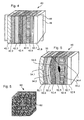
- Fig. 1 shows a block of material 10 of a plurality of pieces of material 12.1 to 12.8.
- the pieces of material 12.1 to 12.8 are in the in Fig. 1 shown embodiment layers of leather, which are interconnected along adjacent surfaces.
- the leather layers 12.1 to 12.8 are in the in Fig. 1 shown embodiment joined together by an adhesive.
- the shape of the block of material 10 in FIG Fig. 1 is cubic.
- a cube-shaped shape as a special form of a cuboid represents a particularly advantageous form of the material block, because a plurality of individual composite bodies with a defined, in particular rectangular or square and at least for the majority of the composite body of the same size can be separated.
- Fig. 1 Two preferred cutting planes 14, 16 are indicated, along which a composite body can be separated from the block of material.
- the cutting planes shown in this figure are merely exemplary nature and can be rotated arbitrarily and also transform, such as in the later described Fig. 4 will be shown.
- the type of assembly in terms of a sequence and material selection of the pieces of material on the other hand, the orientation and shape of the cutting plane along which one or more composite bodies are separated from the material block, can be varied.
- the orientation and shape of the cutting plane along which one or more composite bodies are separated from the material block can be varied.
- a plurality of composite bodies as products of the same material block can be identical to one another, but differently structured from products of other material blocks.
- Fig. 2 shows a composite body 20, which consists of the block of material 10 Fig. 1 by cutting along the cutting plane 14 in FIG Fig. 1 was generated.
- the composite body 20 comprises a plurality of pieces of material 22.1 to 22.8, the material pieces 12.1 to 12.8 from Fig. 1 correspond.
- By cutting along the cutting plane 14 in Fig. 1 was made of the pieces of material 12.1 to 12.8, which are each layers of leather, a corresponding compilation of individual strips 22.1 to 22.8 from the material of the leather layers 12.1 to 12.8 of the material block.
- FIG. 3 shows another embodiment of a material block 30.
- the material block 30 in Fig. 3 is similar to the block of material 10 Fig. 1 in that substantially layered pieces of material 32.1 to 32.8 are connected to each other to the block of material 30.
- the layers 32.1 to 32.8 of the material block 30 are glued together in the embodiment shown here.
- Fig. 1 In contrast to the embodiment of Fig. 1 are the material layers 32.1. to 32.8 but at least partially processed in particular by sharpening columns.
- the thicknesses of the layers 32.1 to 32.8 locally differ from each other such that the regular pattern of the composite body 20 is made Fig. 2 made from the block of material 10 Fig. 1 has been generated is changed.
- a correspondingly separated composite body of material block 30 would have no parallel, just adjacent strips, but according to the layer thickness of the pieces of material 32.1 to 32.8 contoured strip.
- an additional individualization of the composite body by the local thickness variation of the pieces of material 32.1 to 32.8 can be subjected to a change in thickness, in particular a continuous change in thickness or a thickness change with and without discontinuities for each piece of material.
- the pieces of material 32.1 to 32.8 are not only varied along one direction in the cutting plane 34, but also have contours that are perpendicular to it. Thus, it becomes possible for a variety of Cut along the cutting plane 34 and a parallel plane to produce each individual composite body.
- Fig. 4 shows a block of material 40, the material block 10 from Fig. 1 like.
- the material block 40 is composed of a plurality of different pieces of material 42.1 to 42.8, wherein the pieces of material 42.1. to 42.8 analogous to the embodiment Fig. 1 by flat elements, in particular by layer elements, which are preferably made of leather, are formed.
- FIG. 4 Figure 12 shows a pairing of cutting planes 46, 48 extending through the block of material 40 along an individual contour.
- the cutting planes 46, 48 do not run continuously planar, but contoured by the material block 40. This can on the one hand enable a particularly efficient formation of a surface decoration of a trim part in a motor vehicle, if the surface of the trim part, for example, the course of the cutting planes 46, 48 corresponds.
- an individual and in particular random guidance of the cutting lines 46, 48 which preferably run parallel to one another in order to produce a composite body of uniform thickness, allows a further individualization of the composite body.
- the cut-out composite does not have to conform to its shape according to the cutting plane along which it was cut, but can also be stretched to a plane.
- the pieces of material 42.1 to 42.8 correspond to the pieces of material 12.1 to 12.8 of the block of material 10 Fig. 1 , Fig. 5 shows a further embodiment of a material block 50.
- the material block 50 includes a plurality of interconnected pieces of material 52.1 to 52.8.
- the pieces of material 52.1 to 52.8 are similar to those in FIG Fig. 3 shown embodiment in its thickness, in particular by sharpening, columns or preferably processed by sharp gaps.
- the pieces of material 52.1 to 52.8 are not plan with each other opposing surfaces mounted on each other, z. B. glued.
- the block of material 50 in FIG Fig. 5 For example, recesses 54.1 to 54.5, in which a filler can be introduced.
- a filler in this embodiment preferably a transparent polymer such. As polyester, polyamide, polycarbonate, polyurethane, TPU, TPE, silicone, adhesive or mixtures may be introduced.
- a transparent polymer such as polyester, polyamide, polycarbonate, polyurethane, TPU, TPE, silicone, adhesive or mixtures may be introduced.
- Such transparent fillings of recesses between adjacent pieces of material 52.1 to 52.8 allow the composite that is separated from the block of material 50 to perform functional properties.
- the inputs can then act, for example, as a light guide, which contribute to a lighting of the surface of the trim part.
- a light guide which contribute to a lighting of the surface of the trim part.
- sensors for ambient light and the like it is also possible for example for sensors for ambient light and the like to be connected to the surface of the trim part via the light-conducting inserts.
- inserts 54.1 to 54.5 it is also possible, instead of the inserts 54.1 to 54.5, to keep openings between adjacent layers of the material block 50 and thus between adjacent strips of the composite body in order, for example, to make ventilation slots and the like integral with the surface of the ornamental part.
- hollow sections eg tubes made of rubber, silicone thermoplastics or thermosets
- a recess 56 is provided with another material and glued into the block of material.
- the introduction 56 may be, for example, wood, cork, fleece, textile, polymers or the like.
- Such elements can be used as an additional customization element or as a functional element.
- a pushbutton, a sensor or the like can be introduced in the recess.
- a recess between adjacent pieces of material 52.1 to 52.8 can also remain free, for example, to leave the view of an element provided below the composite element free. It may also be necessary in this connection to allow an element, for example a switch, to pass through the surface of the composite body on the part of the surface of the trim part to be covered with the composite body.
- Fig. 6 shows another embodiment of a material block 60.
- the material block 60 is in the in Fig. 6 shown embodiment composed of a plurality of undefined textured pieces of material 62.
- the pieces of material 62 may be, for example, small, undefined shaped pieces of material that can be joined together for example by adhesive to form a block of material.
- the pieces of material may also be residues, for example blends of leather or the like.
- the material block 60 can be machined in the same way as the material blocks described above to produce an individualized composite body.
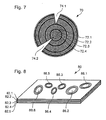
- Fig. 7 another embodiment of a composite body 70 is shown.
- the composite body 70 is separated from a block of material of cylindrical layer-shaped pieces of material lying concentrically around one another and now comprises a multiplicity of annular pieces of material 72.1 to 72.4.
- the pieces of material 72.1 to 72.4 are selected examples of pieces of material from the plurality of different pieces of material of the composite body 70.
- the composite body 70 Fig. 7 two recesses 74. 1, 74. 2 projecting radially from a circumferential side toward the center of the composite body 70.
- the composite body 70 can be machined like any other layer even after it has been separated from a block of material, in particular cutting, sharpening or splitting.
- the composite 70 can be used by cutting along defined contours as an individual design of a surface of a trim part in a motor vehicle and adapted for a variety of different shaped surfaces.
- FIG. 8 also represents a block of material 80, which has been subjected to a total of a machining process, in particular a sharpness splitting. From the block of material 80, a plurality of pieces of material 82.1 to 82.5, individual composites are separated. The remaining block of material 80, for example, at the locations where pieces of the material block 80 were separated, recesses 86.1 to 86.6. This structure is also called "deposited ornamentation / structures”.
- material block 80 also forms a composite body according to the invention, which is set up for use as a trim part with a visible surface in a motor vehicle.
- the recesses 86.1 to 86.6 represent an efficiently realized individual machining of the surface of the trim part, in that contours are varied individually during the sharpening split.
- finger guides or the like it is possible for finger guides or the like to be provided, for example by the recesses 86.1 to 86.6, in each case or in part for actuating elements present within the recesses 86.1 to 86.6, for example pushbuttons or the like.
- pressure-sensitive elements may be present which realize a functional effect of the recesses 86.1 to 86.6 in the composite body.
- Rubber, elastomers, polymers, TPU, TPE, PVC, leather, natural fiber materials, multilayer leather, wood, cork, metal, textiles, chitin-containing materials (for example shells, turtle cases), cellulose or paper can be used in particular.
- a light source or a switch is deposited.
- the light source or the switch can be flat, contoured or a knob, wherein the light source can be formed, for example, by LED, OLED, luminescent film EL lacquer, etc.
- the luminous means can also be of multilayer construction, wherein in particular an upper wear layer can be provided, which is transparent to light. The wear layer can be removed in this case, without the light bulb is impaired in its function or even damaged.
- a corresponding wear layer can also be provided on a switch which is formed, for example, by a piezo switch, an electromagnetic switch, etc.
- light-transparent layers can be colored.
- they can be flat, contoured or provided with nubs.
- a colored light-transparent layer may also be formed, for example, by a transparent layer having a coloring layer (e.g., foil, varnish, printing).
- the color layer can be light-transparent or light-scattering, full-surface or only partially present.
- Light-transparent or light-absorbing materials are suitable for generating electrical energy from incoming light energy.
- one of an omamental "mother block” preferably several different deposited omamental separation layers, including Composite body to be generated.
- a composite body can only consist of at least two layers. A subsequent separation of further layers is preferably not, although this is of course possible and in certain situations also preferable.
- surface deposits can be used as a translucent look. Such surface deposits can be incorporated into the material block or used in the sense of a template for processing the material block and then removed again.
- intarsia can be produced by a cutout is produced in a composite body and / or block of material, in which a matching insert is inserted from any material.
- intarsia-like effects so-called “undefined intarsia” can also be produced by targeted layering of materials and subsequent trimming.
- pillars having a defined or random cross-section can be made.
- the columns can be produced by molding, casting, foaming, extrusion, pressing or by mechanical machining such as milling and grinding.
- the columns can be replaced by "multi-layer leather” such as e.g. be constructed a composite body. This can be done by layering and rolling up several layers of leather or other flexible decorative material. When rolling up, it is also possible to use a core part with a selected cross-section which defines the roll-up outer cross-section.
- multi-layer leather such as e.g. be constructed a composite body. This can be done by layering and rolling up several layers of leather or other flexible decorative material. When rolling up, it is also possible to use a core part with a selected cross-section which defines the roll-up outer cross-section.
- a polymer (PUR, resin, etc.) or polymer fiber or powder mixture is preferably used in the molding processes of casting, foaming, extrusion, compression molding.
- the fiber or the powder may for example consist of a wood, cellulose, paper, natural fiber, leather powder fiber, cork, textile fiber or non-woven.
- the columns can be shaped bodies with varying cross section, solid profiles or hollow profiles.
- transparent or light-conducting material for example in the form of another column or in the form of "fillers" can also be embedded in the columns.
- the columns can then be inserted, for example, in a block of material and / or composite, inserted into a block of material, plugged or pressed, wherein the block of material can be produced according to the above invention on one hand or from wood, polymer, a filler and the like.
- a block of material can also be produced by joining together a plurality of columns. The block of material can then be joined together, for example, by a positive fit ("puzzling effect") or a fabric bond or a combination thereof.
- the material pieces of the material block are different in color from each other.
- individual pieces of material may alternatively and additionally be different from each other in their structure, their material, their shape, etc.
- the pieces of material may e.g. Glued together via Holtmelt or dispersion adhesives. Alternatively, however, it is also possible to use other adhesives.
- a composite body after application to the visible surface of the trim part, alternatively also before, sealed.
- a spraying or casting process on the other hand, also a film, for example by means of a thermoforming process, are applied to the composite body.
- the sealing can be done either on the visible side to protect the finished trim from external influences such as irradiation, dirt or moisture or to create additional optical effects (eg representation of a grain in the sealing layer).
- a backside seal may be applied which, for example, serves to reinforce the composite and ensures better processability. It is also conceivable, of course, to provide both a visible and a rear-side seal.
- pieces of material that are leather layers can also be backfilled or back-pressed for solidification, preferably provided with a polymer.
- a backfilling or backpressing for solidification is therefore more interesting for leather structures, the thicker they are.
- the composite may also be coated with a transparent polymer, the surface may also be embossed.
- the processing of the leather is meant the removal of material of a single layer or the processing of the multi-layer material block.
- a two-dimensionally structured part arises, for example, when a composite body is separated from the block of material Fig. 1 along the cutting plane 14.
- the resulting composite body 20 is in Fig. 2 shown.
- a three-dimensionally structured shape of a composite body is formed, for example, in a section through the material block 40 Fig. 4 along the cutting lines 46 and 48.
Landscapes
- Engineering & Computer Science (AREA)
- Mechanical Engineering (AREA)
- Chemical & Material Sciences (AREA)
- Composite Materials (AREA)
- Manufacturing & Machinery (AREA)
- Organic Chemistry (AREA)
- Ceramic Engineering (AREA)
- Laminated Bodies (AREA)
- Vehicle Interior And Exterior Ornaments, Soundproofing, And Insulation (AREA)
Claims (18)
- Procédé pour la fabrication d'un corps comprenant un matériau de décoration flexible pour l'utilisation en tant qu'élément décoratif avec une surface visible dans un véhicule automobile, comprenant les étapes suivantes :assembler, en particulier coller une pluralité de différentes pièces de matériau (12.1-12.8, 32.1-32.8, 42.1-42.8, 52.1-52.8, 62, 82.1-82.5), au moins l'une de ces pièces de matériau variant concernant son épaisseur, pour donner un bloc de matériau (10, 30, 40, 50, 60, 80) etséparer un ou plusieurs corps composites (20, 70) du bloc de matériau (10, 30, 40, 50, 60, 80), de sorte que le corps composite (20, 70) séparé contienne plusieurs des pièces de matériau (22.1-22.8, 72.1-72.4) etappliquer le corps composite séparé (20, 70) sur un support pour la formation d'une surface visible d'un élément décoratif, les pièces de matériau (22.1-22.8, 72.1-72.4) étant disposées les unes à côté des autres le long de la surface.
- Procédé selon la revendication 1, dans lequel le matériau de décoration flexible est du cuir.
- Procédé selon les revendications 1 ou 2, dans lequel les pièces de matériau (12.1-12.8, 32.1-32.8, 42.1-42.8, 52.1-52.8, 62, 82.1-82.5) sont réalisées avec une forme définie ou aléatoire avant l'assemblage, de préférence meulées, refendues, refendues par meulage, poncées ou cintrées.
- Procédé selon l'une des revendications précédentes, dans lequel les pièces de matériau (12.1-12.8, 32.1-32.8, 42.1-42.8, 52.1-52.8, 62, 82.1-82.5) présentent des couches plates d'une épaisseur comprise entre 0,15 mm et 10,0 mm, de préférence entre 0,4 mm et 1,4 mm.
- Procédé selon l'une des revendications précédentes, dans lequel les pièces de matériau (12.1-12.8, 32.1-32.8, 42.1-42.8, 52.1-52.8, 62, 82.1-82.5) sont assemblées à plat les unes sur les autres.
- Procédé selon l'une des revendications précédentes, dans lequel les pièces de matériau (12.1-12.8, 32.1-32.8, 42.1-42.8, 52.1-52.8, 62, 82.1-82.5) sont formées aléatoirement en trois dimensions.
- Procédé selon l'une des revendications précédentes, dans lequel les pièces de matériau (12.1-12.8, 32.1-32.8, 42.1-42.8, 52.1-52.8, 62, 82.1-82.5) présentent, au moins par endroits, des formes différentes les unes des autres, en particulier des épaisseurs différentes.
- Procédé selon l'une des revendications précédentes, dans lequel les pièces de matériau comprennent des pièces fonctionnelles (54.1-54.5), en particulier des couches fonctionnelles, lesquelles sont insérées entre des pièces de matériau (52.1-52.8) voisines.
- Procédé selon l'une des revendications précédentes, dans lequel les pièces de matériau (12.1-12.8, 32.1-32.8, 42.1-42.8, 52.1-52.8, 62, 82.1-82.5) sont assemblées grâce à un adhésif, en particulier un polymère.
- Procédé selon l'une des revendications précédentes, dans lequel, grâce à l'assemblage, on génère un bloc de matériau (10, 30, 40, 50, 60, 80) sensiblement en forme de parallélépipède ou en forme de cylindre.
- Procédé selon l'une des revendications précédentes, dans lequel le sectionnement d'un ou plusieurs corps composite (20, 70) est réalisé par découpage le long d'une surface (14, 16, 34, 36, 46, 48) qui coupe plusieurs des pièces de matériau (12.1-12.8, 32.1-32.8, 42.1-42.8, 52.1-52.8, 62, 82.1-82.5).
- Procédé selon la revendication 11, dans lequel l'orientation de la surface (14, 16, 34, 36, 46, 48) le long de laquelle on effectue la séparation est choisie de manière aléatoire.
- Elément de décoration d'une pièce de véhicule avec une surface visible et une pluralité de différentes pièces de matériau (12.1-12.8, 22.1-22.8, 32.1-32.8, 42.1-42.8, 52.1-52.8, 62, 82.1-82.5) assemblées, de préférences collées ensemble, disposées les unes à côté des autres le long de la surface, lesquelles comprennent un matériau de décoration flexible, au moins l'une des pièces de matériau variant concernant son épaisseur.
- Elément de décoration selon la revendication 13, dans lequel le matériau de décoration flexible est du cuir.
- Elément de décoration selon les revendications 13 ou 14, dans lequel les pièces de matériau (12.1-12.8, 222.1-22.8, 32.1-32.8, 42.1-42.8, 52.1-52.8, 62, 82.1-82.5) présentent des bandes d'une épaisseur comprise entre 0,15 mm et 10,0 mm, de préférence entre 0,4 mm et 1,4 mm.
- Elément de décoration selon l'une des revendications 13 à 15, dans lequel les pièces de matériau comprennent des pièces fonctionnelles (54.1-54.5), en particulier des bandes fonctionnelles, lesquelles sont disposées entre des pièces de matériau (52.1-52.8) voisines.
- Elément de décoration selon l'une des revendications 13 à 16, dans lequel les pièces de matériau (12.1-12.8, 22.1-22.8, 32.1-32.8, 42.1-42.8, 52.1-52.8, 62, 82.1-82.5) sont assemblées par un adhésif, en particulier un polymère.
- Elément de décoration selon l'une des revendications 13 à 17, lequel est fabriqué selon le procédé de l'une des revendications 1 à 12.
Applications Claiming Priority (2)
| Application Number | Priority Date | Filing Date | Title |
|---|---|---|---|
| DE102009026537A DE102009026537A1 (de) | 2009-05-28 | 2009-05-28 | Verfahren zum Herstellen von Mehrschichtenleder |
| PCT/EP2010/056710 WO2010136348A1 (fr) | 2009-05-28 | 2010-05-17 | Procédé de fabrication d'un élément de décoration en cuir |
Publications (2)
| Publication Number | Publication Date |
|---|---|
| EP2435247A1 EP2435247A1 (fr) | 2012-04-04 |
| EP2435247B1 true EP2435247B1 (fr) | 2013-10-23 |
Family
ID=42483422
Family Applications (1)
| Application Number | Title | Priority Date | Filing Date |
|---|---|---|---|
| EP10721771.3A Not-in-force EP2435247B1 (fr) | 2009-05-28 | 2010-05-17 | Methode pour produire un element decoratif en cuir et element decoratif de piece automobile en cuir |
Country Status (4)
| Country | Link |
|---|---|
| US (1) | US9272487B2 (fr) |
| EP (1) | EP2435247B1 (fr) |
| DE (1) | DE102009026537A1 (fr) |
| WO (1) | WO2010136348A1 (fr) |
Cited By (2)
| Publication number | Priority date | Publication date | Assignee | Title |
|---|---|---|---|---|
| US10821889B2 (en) | 2018-10-19 | 2020-11-03 | Shanghai Yanfeng Inqiao Automotive Trim Systems Co. Ltd. | Vehicle interior component |
| US12083953B2 (en) | 2018-10-19 | 2024-09-10 | Shanghai Yanfeng Jinqiao Automotive Trim Systems Co. Ltd. | Vehicle interior component |
Families Citing this family (16)
| Publication number | Priority date | Publication date | Assignee | Title |
|---|---|---|---|---|
| DE102013202095B4 (de) | 2013-02-08 | 2022-04-28 | Lisa Dräxlmaier GmbH | Herstellung strukturierter Dekorschichten für Ausstattungsteile |
| DE102013019334B4 (de) | 2013-11-20 | 2018-10-04 | Lisa Dräxlmaier GmbH | Dekorschicht für ein Verkleidungsteil und Verfahren zur Herstellung der Dekorschicht |
| DE102014004880A1 (de) * | 2014-04-04 | 2015-10-08 | Lisa Dräxlmaier GmbH | Verfahren zur Herstellung eines Dekorelements |
| FR3024863B1 (fr) * | 2014-08-12 | 2016-09-30 | Faurecia Interieur Ind | Procede de realisation d'un element de garnissage comprenant une couche d'aspect comprenant des bandes de materiau ligneux |
| DE102014223542A1 (de) | 2014-11-18 | 2016-05-19 | Faurecia Innenraum Systeme Gmbh | Verfahren, mit dem ein Fahrzeug-lnnenverkleidungsteil mit einer Papierschichten aufweisenden Dekorschicht erzeugt wird |
| DE102015101331A1 (de) * | 2015-01-29 | 2016-08-04 | Bayerische Motoren Werke Aktiengesellschaft | Lichtdurchlässiges Kunstleder und Verfahren zur Herstellung desselben |
| DE202015005521U1 (de) * | 2015-08-05 | 2016-11-10 | Quin Gmbh | Dekorteil |
| DE202015104715U1 (de) | 2015-09-04 | 2015-10-26 | Lisa Dräxlmaier GmbH | Dekorschicht für ein Verkleidungsteil |
| DE102015220681B4 (de) | 2015-10-22 | 2019-02-21 | Lisa Dräxlmaier GmbH | Verfahren zum Herstellen einer Dekorschicht |
| FR3043035B1 (fr) * | 2015-10-30 | 2018-08-31 | Faurecia Interieur Ind | Element de garnissage comprenant des bandes en materiau ligneux opaque et des bandes en materiau translucide |
| DE102015121494A1 (de) | 2015-12-10 | 2017-06-14 | Dr. Ing. H.C. F. Porsche Aktiengesellschaft | Thermostabiles Leder |
| DE102016102932A1 (de) | 2016-02-19 | 2017-08-24 | Dr. Ing. H.C. F. Porsche Aktiengesellschaft | Thermostabiles Leder |
| FR3087706B1 (fr) | 2018-10-26 | 2020-10-16 | Faurecia Interieur Ind | Procede de realisation d'un element de garnissage a surface decorative |
| DE102020115706A1 (de) | 2020-06-15 | 2021-12-16 | Fritz Kohl GmbH + Co KG | Dekorelement |
| DE102021112793A1 (de) | 2021-05-18 | 2022-11-24 | H-Flachs Gmbh | Vorrichtung und Verfahren zum Herstellen von Plattensandwichs |
| DE102021122689A1 (de) | 2021-09-02 | 2023-03-02 | Bayerische Motoren Werke Aktiengesellschaft | Herstellungsverfahren eines Interieurbauteils |
Family Cites Families (11)
| Publication number | Priority date | Publication date | Assignee | Title |
|---|---|---|---|---|
| FR2240980A1 (en) * | 1973-08-14 | 1975-03-14 | Bossan Louis | Web of matl. pref. leather produced from strips of matl. - which are glued together side by side |
| EP0977657B1 (fr) * | 1997-04-18 | 2003-03-19 | Atoma International Corp. | Articles decoratifs formant moulures pour interieur d'automobile avec revetement incorpore, leger et stable a la lumiere et procede de fabrication de ces articles |
| DE19752058A1 (de) | 1997-11-25 | 1999-05-27 | Bayerische Motoren Werke Ag | Verfahren zum Hinterschäumen von eine Kappnaht aufweisenden Lederformstücken |
| US6013323A (en) * | 1998-10-30 | 2000-01-11 | Klayder; Donna W. | Silicone gel waxes and silicone gel protectants |
| DE10143883A1 (de) | 2001-09-07 | 2003-03-27 | Magna Eybl Gmbh | Verfahren zur Herstellung eines mehrschichtigen Fahrzeuginnenteils |
| DE10211171A1 (de) * | 2002-03-14 | 2004-01-08 | Angell-Demmel Gmbh | Dekor-Zierteil |
| DE102004025570A1 (de) | 2004-05-25 | 2005-12-15 | Adam Opel Ag | Hochwertiges Kunststoffformteil und Verfahren zur seiner Herstellung unter Verwendung eingelegter Schaumteile |
| DE102006019675B3 (de) * | 2006-04-27 | 2007-11-15 | Lisa Dräxlmaier GmbH | Holzfurnier auf Lederuntergrund |
| FR2913028B1 (fr) * | 2007-02-23 | 2012-06-08 | Hermes Sellier | Procede de realisation de pieces de revetemenent en cuir, simili cuir ou similaire |
| DE202007007832U1 (de) | 2007-06-01 | 2007-08-23 | R+S Technik Gmbh | Werkstoffkombination |
| DE102007059233B4 (de) | 2007-12-07 | 2014-08-28 | Novem Car Interior Design Gmbh | Formteil mit Holzfurnier als Dekorlage, insbesondere Dekorteil und/oder Verkleidungsteil für einen Fahrzeuginnenraum, mit weicher Schicht und Verfahren zu seiner Herstellung |
-
2009
- 2009-05-28 DE DE102009026537A patent/DE102009026537A1/de not_active Withdrawn
-
2010
- 2010-05-17 WO PCT/EP2010/056710 patent/WO2010136348A1/fr not_active Ceased
- 2010-05-17 US US13/322,244 patent/US9272487B2/en not_active Expired - Fee Related
- 2010-05-17 EP EP10721771.3A patent/EP2435247B1/fr not_active Not-in-force
Cited By (2)
| Publication number | Priority date | Publication date | Assignee | Title |
|---|---|---|---|---|
| US10821889B2 (en) | 2018-10-19 | 2020-11-03 | Shanghai Yanfeng Inqiao Automotive Trim Systems Co. Ltd. | Vehicle interior component |
| US12083953B2 (en) | 2018-10-19 | 2024-09-10 | Shanghai Yanfeng Jinqiao Automotive Trim Systems Co. Ltd. | Vehicle interior component |
Also Published As
| Publication number | Publication date |
|---|---|
| US9272487B2 (en) | 2016-03-01 |
| DE102009026537A1 (de) | 2010-12-02 |
| US20120107571A1 (en) | 2012-05-03 |
| EP2435247A1 (fr) | 2012-04-04 |
| WO2010136348A1 (fr) | 2010-12-02 |
Similar Documents
| Publication | Publication Date | Title |
|---|---|---|
| EP2435247B1 (fr) | Methode pour produire un element decoratif en cuir et element decoratif de piece automobile en cuir | |
| DE102013202223B4 (de) | Verfahren zur Herstellung eines Dekorverbunds durch Umformen von Folie an Materialöffnungen mittels eines Laser- und/oder Warmluftstrahls | |
| EP2563570B1 (fr) | Élément intérieur à structure superficielle artificielle et procédé pour le produire | |
| EP3023308B1 (fr) | Partie de revetement interieur et son procede de fabrication | |
| DE102013013348A1 (de) | Fahrzeuginnenkomponenten mit dekorativer Naht | |
| DE102009000605A1 (de) | Hinterleuchtete genarbte Planware | |
| DE102011082344A1 (de) | Optimierte Ausstrahlgeometrien bei hinterleuchteten, perforierten Dekorschichten | |
| DE102013202095B4 (de) | Herstellung strukturierter Dekorschichten für Ausstattungsteile | |
| DE102005023945A1 (de) | Mehrfarbige Innenausstattungskomponenten | |
| DE102015003448A1 (de) | Zierteil, Dekorteil und Verfahren zur Herstellung eines Zierteils | |
| DE102018124893A1 (de) | Interieurbauteil und Verfahren zu dessen Herstellung | |
| DE102008043441A1 (de) | Verformbarer Dekorverbund und Verfahren zur Herstellung eines verformbaren Dekorverbunds | |
| AT506942B1 (de) | Verfahren zur herstellung eines innenverkleidungsteils | |
| EP1648741B1 (fr) | Decor de surface pour element de garniture et procede de production dudit decor | |
| DE102020130598A1 (de) | Verfahren zur Herstellung eines Verkleidungsteils und ein Verkleidungsteil | |
| DE102018212741A1 (de) | Verfahren zum Aufkaschieren einer Oberflächenstruktur | |
| DE102005006541A1 (de) | Verfahren zur Herstellung von Dekormaterialien, Dekormaterial und dessen Verwendung, insbesondere bei Innenausstattungsteilen für Kraftfahrzeuge | |
| DE4310803A1 (de) | Verfahren zur Herstellung von hinterschäumten Verkleidungsteilen, insbesondere für Kraftfahrzeuge | |
| EP2760660B1 (fr) | Procédé de fabrication d'une partie d'équipement intérieur d'un véhicule | |
| DE102009054488B4 (de) | Verfahren zur Herstellung einer mit einer künstlichen Maserung versehenen Schicht | |
| DE102009024307A1 (de) | Formteil mit eingebetteten Dekorobjekten und Verfahren zu seiner Herstellung | |
| DE102022103619A1 (de) | Verfahren zum herstellen eines eine funktionsöffnung aufweisenden dekorelements für ein kraftfahrzeug sowie dekorelement | |
| DE102022103620A1 (de) | Verfahren zum herstellen eines eine funktionsöffnung aufweisenden dekorelements für ein kraftfahrzeug sowie dekorelement | |
| DE202025107965U1 (de) | Flexibles Mehrschichtmaterial, Fahrzeuginnenraumkomponente und Rollabdeckung mit einem solchen | |
| DE102024111050A1 (de) | Dekorteil mit teilweise reflektierender Deckschicht |
Legal Events
| Date | Code | Title | Description |
|---|---|---|---|
| PUAI | Public reference made under article 153(3) epc to a published international application that has entered the european phase |
Free format text: ORIGINAL CODE: 0009012 |
|
| 17P | Request for examination filed |
Effective date: 20111116 |
|
| AK | Designated contracting states |
Kind code of ref document: A1 Designated state(s): AL AT BE BG CH CY CZ DE DK EE ES FI FR GB GR HR HU IE IS IT LI LT LU LV MC MK MT NL NO PL PT RO SE SI SK SM TR |
|
| DAX | Request for extension of the european patent (deleted) | ||
| GRAP | Despatch of communication of intention to grant a patent |
Free format text: ORIGINAL CODE: EPIDOSNIGR1 |
|
| INTG | Intention to grant announced |
Effective date: 20130529 |
|
| GRAS | Grant fee paid |
Free format text: ORIGINAL CODE: EPIDOSNIGR3 |
|
| GRAA | (expected) grant |
Free format text: ORIGINAL CODE: 0009210 |
|
| AK | Designated contracting states |
Kind code of ref document: B1 Designated state(s): AL AT BE BG CH CY CZ DE DK EE ES FI FR GB GR HR HU IE IS IT LI LT LU LV MC MK MT NL NO PL PT RO SE SI SK SM TR |
|
| REG | Reference to a national code |
Ref country code: GB Ref legal event code: FG4D Free format text: NOT ENGLISH |
|
| REG | Reference to a national code |
Ref country code: CH Ref legal event code: EP |
|
| REG | Reference to a national code |
Ref country code: AT Ref legal event code: REF Ref document number: 637308 Country of ref document: AT Kind code of ref document: T Effective date: 20131115 |
|
| REG | Reference to a national code |
Ref country code: IE Ref legal event code: FG4D Free format text: LANGUAGE OF EP DOCUMENT: GERMAN |
|
| REG | Reference to a national code |
Ref country code: DE Ref legal event code: R096 Ref document number: 502010005155 Country of ref document: DE Effective date: 20131219 |
|
| REG | Reference to a national code |
Ref country code: NL Ref legal event code: VDEP Effective date: 20131023 |
|
| REG | Reference to a national code |
Ref country code: LT Ref legal event code: MG4D |
|
| PG25 | Lapsed in a contracting state [announced via postgrant information from national office to epo] |
Ref country code: IS Free format text: LAPSE BECAUSE OF FAILURE TO SUBMIT A TRANSLATION OF THE DESCRIPTION OR TO PAY THE FEE WITHIN THE PRESCRIBED TIME-LIMIT Effective date: 20140223 Ref country code: FI Free format text: LAPSE BECAUSE OF FAILURE TO SUBMIT A TRANSLATION OF THE DESCRIPTION OR TO PAY THE FEE WITHIN THE PRESCRIBED TIME-LIMIT Effective date: 20131023 Ref country code: LT Free format text: LAPSE BECAUSE OF FAILURE TO SUBMIT A TRANSLATION OF THE DESCRIPTION OR TO PAY THE FEE WITHIN THE PRESCRIBED TIME-LIMIT Effective date: 20131023 Ref country code: HR Free format text: LAPSE BECAUSE OF FAILURE TO SUBMIT A TRANSLATION OF THE DESCRIPTION OR TO PAY THE FEE WITHIN THE PRESCRIBED TIME-LIMIT Effective date: 20131023 Ref country code: NL Free format text: LAPSE BECAUSE OF FAILURE TO SUBMIT A TRANSLATION OF THE DESCRIPTION OR TO PAY THE FEE WITHIN THE PRESCRIBED TIME-LIMIT Effective date: 20131023 Ref country code: NO Free format text: LAPSE BECAUSE OF FAILURE TO SUBMIT A TRANSLATION OF THE DESCRIPTION OR TO PAY THE FEE WITHIN THE PRESCRIBED TIME-LIMIT Effective date: 20140123 Ref country code: SE Free format text: LAPSE BECAUSE OF FAILURE TO SUBMIT A TRANSLATION OF THE DESCRIPTION OR TO PAY THE FEE WITHIN THE PRESCRIBED TIME-LIMIT Effective date: 20131023 |
|
| PG25 | Lapsed in a contracting state [announced via postgrant information from national office to epo] |
Ref country code: CY Free format text: LAPSE BECAUSE OF FAILURE TO SUBMIT A TRANSLATION OF THE DESCRIPTION OR TO PAY THE FEE WITHIN THE PRESCRIBED TIME-LIMIT Effective date: 20131023 Ref country code: ES Free format text: LAPSE BECAUSE OF FAILURE TO SUBMIT A TRANSLATION OF THE DESCRIPTION OR TO PAY THE FEE WITHIN THE PRESCRIBED TIME-LIMIT Effective date: 20131023 Ref country code: LV Free format text: LAPSE BECAUSE OF FAILURE TO SUBMIT A TRANSLATION OF THE DESCRIPTION OR TO PAY THE FEE WITHIN THE PRESCRIBED TIME-LIMIT Effective date: 20131023 |
|
| PG25 | Lapsed in a contracting state [announced via postgrant information from national office to epo] |
Ref country code: PT Free format text: LAPSE BECAUSE OF FAILURE TO SUBMIT A TRANSLATION OF THE DESCRIPTION OR TO PAY THE FEE WITHIN THE PRESCRIBED TIME-LIMIT Effective date: 20140224 |
|
| REG | Reference to a national code |
Ref country code: DE Ref legal event code: R097 Ref document number: 502010005155 Country of ref document: DE |
|
| PG25 | Lapsed in a contracting state [announced via postgrant information from national office to epo] |
Ref country code: EE Free format text: LAPSE BECAUSE OF FAILURE TO SUBMIT A TRANSLATION OF THE DESCRIPTION OR TO PAY THE FEE WITHIN THE PRESCRIBED TIME-LIMIT Effective date: 20131023 |
|
| PG25 | Lapsed in a contracting state [announced via postgrant information from national office to epo] |
Ref country code: SK Free format text: LAPSE BECAUSE OF FAILURE TO SUBMIT A TRANSLATION OF THE DESCRIPTION OR TO PAY THE FEE WITHIN THE PRESCRIBED TIME-LIMIT Effective date: 20131023 Ref country code: CZ Free format text: LAPSE BECAUSE OF FAILURE TO SUBMIT A TRANSLATION OF THE DESCRIPTION OR TO PAY THE FEE WITHIN THE PRESCRIBED TIME-LIMIT Effective date: 20131023 Ref country code: PL Free format text: LAPSE BECAUSE OF FAILURE TO SUBMIT A TRANSLATION OF THE DESCRIPTION OR TO PAY THE FEE WITHIN THE PRESCRIBED TIME-LIMIT Effective date: 20131023 Ref country code: RO Free format text: LAPSE BECAUSE OF FAILURE TO SUBMIT A TRANSLATION OF THE DESCRIPTION OR TO PAY THE FEE WITHIN THE PRESCRIBED TIME-LIMIT Effective date: 20131023 |
|
| PLBE | No opposition filed within time limit |
Free format text: ORIGINAL CODE: 0009261 |
|
| STAA | Information on the status of an ep patent application or granted ep patent |
Free format text: STATUS: NO OPPOSITION FILED WITHIN TIME LIMIT |
|
| PG25 | Lapsed in a contracting state [announced via postgrant information from national office to epo] |
Ref country code: DK Free format text: LAPSE BECAUSE OF FAILURE TO SUBMIT A TRANSLATION OF THE DESCRIPTION OR TO PAY THE FEE WITHIN THE PRESCRIBED TIME-LIMIT Effective date: 20131023 |
|
| 26N | No opposition filed |
Effective date: 20140724 |
|
| REG | Reference to a national code |
Ref country code: DE Ref legal event code: R097 Ref document number: 502010005155 Country of ref document: DE Effective date: 20140724 |
|
| PG25 | Lapsed in a contracting state [announced via postgrant information from national office to epo] |
Ref country code: LU Free format text: LAPSE BECAUSE OF FAILURE TO SUBMIT A TRANSLATION OF THE DESCRIPTION OR TO PAY THE FEE WITHIN THE PRESCRIBED TIME-LIMIT Effective date: 20140517 |
|
| REG | Reference to a national code |
Ref country code: CH Ref legal event code: PL |
|
| PG25 | Lapsed in a contracting state [announced via postgrant information from national office to epo] |
Ref country code: CH Free format text: LAPSE BECAUSE OF NON-PAYMENT OF DUE FEES Effective date: 20140531 Ref country code: MC Free format text: LAPSE BECAUSE OF FAILURE TO SUBMIT A TRANSLATION OF THE DESCRIPTION OR TO PAY THE FEE WITHIN THE PRESCRIBED TIME-LIMIT Effective date: 20131023 Ref country code: LI Free format text: LAPSE BECAUSE OF NON-PAYMENT OF DUE FEES Effective date: 20140531 |
|
| REG | Reference to a national code |
Ref country code: IE Ref legal event code: MM4A |
|
| PG25 | Lapsed in a contracting state [announced via postgrant information from national office to epo] |
Ref country code: SI Free format text: LAPSE BECAUSE OF FAILURE TO SUBMIT A TRANSLATION OF THE DESCRIPTION OR TO PAY THE FEE WITHIN THE PRESCRIBED TIME-LIMIT Effective date: 20131023 |
|
| REG | Reference to a national code |
Ref country code: FR Ref legal event code: ST Effective date: 20150130 |
|
| PG25 | Lapsed in a contracting state [announced via postgrant information from national office to epo] |
Ref country code: IE Free format text: LAPSE BECAUSE OF NON-PAYMENT OF DUE FEES Effective date: 20140517 |
|
| PG25 | Lapsed in a contracting state [announced via postgrant information from national office to epo] |
Ref country code: FR Free format text: LAPSE BECAUSE OF NON-PAYMENT OF DUE FEES Effective date: 20140602 |
|
| PG25 | Lapsed in a contracting state [announced via postgrant information from national office to epo] |
Ref country code: MT Free format text: LAPSE BECAUSE OF FAILURE TO SUBMIT A TRANSLATION OF THE DESCRIPTION OR TO PAY THE FEE WITHIN THE PRESCRIBED TIME-LIMIT Effective date: 20131023 |
|
| PG25 | Lapsed in a contracting state [announced via postgrant information from national office to epo] |
Ref country code: SM Free format text: LAPSE BECAUSE OF FAILURE TO SUBMIT A TRANSLATION OF THE DESCRIPTION OR TO PAY THE FEE WITHIN THE PRESCRIBED TIME-LIMIT Effective date: 20131023 |
|
| PG25 | Lapsed in a contracting state [announced via postgrant information from national office to epo] |
Ref country code: BG Free format text: LAPSE BECAUSE OF FAILURE TO SUBMIT A TRANSLATION OF THE DESCRIPTION OR TO PAY THE FEE WITHIN THE PRESCRIBED TIME-LIMIT Effective date: 20131023 Ref country code: GR Free format text: LAPSE BECAUSE OF FAILURE TO SUBMIT A TRANSLATION OF THE DESCRIPTION OR TO PAY THE FEE WITHIN THE PRESCRIBED TIME-LIMIT Effective date: 20140124 |
|
| REG | Reference to a national code |
Ref country code: AT Ref legal event code: MM01 Ref document number: 637308 Country of ref document: AT Kind code of ref document: T Effective date: 20150517 |
|
| PG25 | Lapsed in a contracting state [announced via postgrant information from national office to epo] |
Ref country code: HU Free format text: LAPSE BECAUSE OF FAILURE TO SUBMIT A TRANSLATION OF THE DESCRIPTION OR TO PAY THE FEE WITHIN THE PRESCRIBED TIME-LIMIT; INVALID AB INITIO Effective date: 20100517 Ref country code: BE Free format text: LAPSE BECAUSE OF FAILURE TO SUBMIT A TRANSLATION OF THE DESCRIPTION OR TO PAY THE FEE WITHIN THE PRESCRIBED TIME-LIMIT Effective date: 20140531 Ref country code: TR Free format text: LAPSE BECAUSE OF FAILURE TO SUBMIT A TRANSLATION OF THE DESCRIPTION OR TO PAY THE FEE WITHIN THE PRESCRIBED TIME-LIMIT Effective date: 20131023 |
|
| PG25 | Lapsed in a contracting state [announced via postgrant information from national office to epo] |
Ref country code: AT Free format text: LAPSE BECAUSE OF NON-PAYMENT OF DUE FEES Effective date: 20150517 |
|
| PG25 | Lapsed in a contracting state [announced via postgrant information from national office to epo] |
Ref country code: MK Free format text: LAPSE BECAUSE OF FAILURE TO SUBMIT A TRANSLATION OF THE DESCRIPTION OR TO PAY THE FEE WITHIN THE PRESCRIBED TIME-LIMIT Effective date: 20131023 |
|
| PG25 | Lapsed in a contracting state [announced via postgrant information from national office to epo] |
Ref country code: AL Free format text: LAPSE BECAUSE OF FAILURE TO SUBMIT A TRANSLATION OF THE DESCRIPTION OR TO PAY THE FEE WITHIN THE PRESCRIBED TIME-LIMIT Effective date: 20131023 |
|
| PGFP | Annual fee paid to national office [announced via postgrant information from national office to epo] |
Ref country code: NL Payment date: 20190623 Year of fee payment: 10 |
|
| PGFP | Annual fee paid to national office [announced via postgrant information from national office to epo] |
Ref country code: DE Payment date: 20210530 Year of fee payment: 12 |
|
| PG25 | Lapsed in a contracting state [announced via postgrant information from national office to epo] |
Ref country code: IT Free format text: LAPSE BECAUSE OF NON-PAYMENT OF DUE FEES Effective date: 20200517 |
|
| REG | Reference to a national code |
Ref country code: DE Ref legal event code: R119 Ref document number: 502010005155 Country of ref document: DE |
|
| PG25 | Lapsed in a contracting state [announced via postgrant information from national office to epo] |
Ref country code: DE Free format text: LAPSE BECAUSE OF NON-PAYMENT OF DUE FEES Effective date: 20221201 |
|
| PGFP | Annual fee paid to national office [announced via postgrant information from national office to epo] |
Ref country code: GB Payment date: 20230323 Year of fee payment: 14 |
|
| GBPC | Gb: european patent ceased through non-payment of renewal fee |
Effective date: 20240517 |
|
| PG25 | Lapsed in a contracting state [announced via postgrant information from national office to epo] |
Ref country code: GB Free format text: LAPSE BECAUSE OF NON-PAYMENT OF DUE FEES Effective date: 20240517 |