EP2437306A1 - Substrat für eine verbundhalbleitersolarzelle - Google Patents
Substrat für eine verbundhalbleitersolarzelle Download PDFInfo
- Publication number
- EP2437306A1 EP2437306A1 EP10780216A EP10780216A EP2437306A1 EP 2437306 A1 EP2437306 A1 EP 2437306A1 EP 10780216 A EP10780216 A EP 10780216A EP 10780216 A EP10780216 A EP 10780216A EP 2437306 A1 EP2437306 A1 EP 2437306A1
- Authority
- EP
- European Patent Office
- Prior art keywords
- substrate
- solar cell
- layer
- steel sheet
- compound semiconductor
- Prior art date
- Legal status (The legal status is an assumption and is not a legal conclusion. Google has not performed a legal analysis and makes no representation as to the accuracy of the status listed.)
- Withdrawn
Links
Images


Classifications
-
- H—ELECTRICITY
- H10—SEMICONDUCTOR DEVICES; ELECTRIC SOLID-STATE DEVICES NOT OTHERWISE PROVIDED FOR
- H10F—INORGANIC SEMICONDUCTOR DEVICES SENSITIVE TO INFRARED RADIATION, LIGHT, ELECTROMAGNETIC RADIATION OF SHORTER WAVELENGTH OR CORPUSCULAR RADIATION
- H10F10/00—Individual photovoltaic cells, e.g. solar cells
-
- H—ELECTRICITY
- H10—SEMICONDUCTOR DEVICES; ELECTRIC SOLID-STATE DEVICES NOT OTHERWISE PROVIDED FOR
- H10F—INORGANIC SEMICONDUCTOR DEVICES SENSITIVE TO INFRARED RADIATION, LIGHT, ELECTROMAGNETIC RADIATION OF SHORTER WAVELENGTH OR CORPUSCULAR RADIATION
- H10F77/00—Constructional details of devices covered by this subclass
- H10F77/10—Semiconductor bodies
- H10F77/16—Material structures, e.g. crystalline structures, film structures or crystal plane orientations
- H10F77/169—Thin semiconductor films on metallic or insulating substrates
-
- H—ELECTRICITY
- H10—SEMICONDUCTOR DEVICES; ELECTRIC SOLID-STATE DEVICES NOT OTHERWISE PROVIDED FOR
- H10F—INORGANIC SEMICONDUCTOR DEVICES SENSITIVE TO INFRARED RADIATION, LIGHT, ELECTROMAGNETIC RADIATION OF SHORTER WAVELENGTH OR CORPUSCULAR RADIATION
- H10F77/00—Constructional details of devices covered by this subclass
- H10F77/10—Semiconductor bodies
- H10F77/16—Material structures, e.g. crystalline structures, film structures or crystal plane orientations
- H10F77/169—Thin semiconductor films on metallic or insulating substrates
- H10F77/1698—Thin semiconductor films on metallic or insulating substrates the metallic or insulating substrates being flexible
- H10F77/1699—Thin semiconductor films on metallic or insulating substrates the metallic or insulating substrates being flexible the films including Group I-III-VI materials, e.g. CIS or CIGS on metal foils or polymer foils
-
- Y—GENERAL TAGGING OF NEW TECHNOLOGICAL DEVELOPMENTS; GENERAL TAGGING OF CROSS-SECTIONAL TECHNOLOGIES SPANNING OVER SEVERAL SECTIONS OF THE IPC; TECHNICAL SUBJECTS COVERED BY FORMER USPC CROSS-REFERENCE ART COLLECTIONS [XRACs] AND DIGESTS
- Y02—TECHNOLOGIES OR APPLICATIONS FOR MITIGATION OR ADAPTATION AGAINST CLIMATE CHANGE
- Y02E—REDUCTION OF GREENHOUSE GAS [GHG] EMISSIONS, RELATED TO ENERGY GENERATION, TRANSMISSION OR DISTRIBUTION
- Y02E10/00—Energy generation through renewable energy sources
- Y02E10/50—Photovoltaic [PV] energy
- Y02E10/541—CuInSe2 material PV cells
Definitions
- Thepresent invention relates to a substrate for a compound semiconductor solar cell having flexibility.
- a metal strip As a substrate for a compound semiconductor solar cell having a flexibility such as, for example, a solar cell of a CuInSe 2 (CIS) type or Cu (In, Ga) Se 2 (CIGS) type, a metal strip has been proposed (patent document 1). As a metal strip, stainless steel is usually used.
- a metal strip described in patent document 1 has a film including an insulation layer doped with one kind of alkali metal or a mixture of plural kinds of alkali metals, a material of the metal strip has a thermal expansion coefficient of 12 ⁇ 10 -6 K -1 within temperature range of 0 to 600°C, the insulation layer includes at least one kind of oxide layer, and the oxide layer is formed of any one kind of dielectric oxide selected from a group consisting of Al 2 O 3 , TiO 2 , HfO 2 , Ta 2 O 5 , Nb 2 O 5 and a mixture of these oxides, and is preferably formed of Al 2 O 3 and/or TiO 2 .
- Patent document 2 describes a solar cell where a barrier layer made of a thin conductor, an extremely thin insulation material or the like, a back contact layer made of molybdenum or the like, a p type semiconductor layer and the like are formed on a substrate made of glass, metal, ceramics, plastics or the like.
- the present invention has clearly designated a specific substrate which is effective for the manufacture of a compound semiconductor solar cell which includes high-temperature heat treatment as a step thereof. That is, it is an object of the present invention to provide a substrate for a compound semiconductor solar cell where, on a surface of a steel strip which maintains excellent elasticity even after a high temperature process at the time of forming a thin film of the compound semiconductor solar cell, a film layer capable of suppressing thermal diffusion and intrusion of an element contained in the steel strip which causes lowering of cell conversion efficiency into a thin film layer is formed by electrolytic plating.
- the present invention provides the substrate which can prevent the diffusion of an impurity element into the substrate which lowers power generation efficiency into a solar cell layer by clearly designating the film constitution of a diffusion barrier layer. Further, the present invention provides an inexpensive material with high productivity by adopting an electrolytic plating method as a method for forming the diffusion barrier layer.
- a substrate for a compound semiconductor solar cell according to the present invention is a flexible substrate for a compound semiconductor solar cell.
- the substrate is formed of a steel sheet (steel strip), and a Cr layer having a coating quantity of 300 to 8000mg/m 2 is formed on a surface of the steel sheet on a side where a solar cell layer is laminated to the steel sheet.
- the Cr layer constitutes a diffusionbarrier layer capable of suppressing the diffusion of elements such as Fe, Ni, Mn, Si and A1 which are harmful in conversion efficiency into the solar cell layer even in a high temperature process at the time of forming a thin film, and the Cr layer is formed by electrolytic treatment. It is desirable that a Cr layer is also formed on a back surface side of the substrate as a corrosion resistance layer.
- the steel strip may also be a surface treated steel sheet to which plating of Ni, Zn, Sn or the like is applied.
- the formation of a Cr layer can be named.
- a thickness of the Cr layer on a light collection surface side is set to 300 to 8000mg/m 2 . This is because a manufacturing process of the compound semiconductor solar cell includes a step of treating the substrate at a high temperature of 500°C or above and hence, it is necessary to set a thickness of the diffusion barrier layer to at least 300mg/m 2 .
- an upper limit of the thickness of the Cr layer is set to 8000mg/m 2 .
- the film thickness of the Cr layer is set to approximately 500 to 5000mg/m 2 .
- the reason is that, in the case where heat treatment is performed within a temperature range of approximately 550°C, when the Cr plating layer is thick, cracks occur in the plating layer due to thermal stress thus lowering an Fe diffusion preventing effect. Further, when the heat treatment includes high-temperature treatment at 800°C or above, it is preferable to set the film thickness of the Cr layer to approximately 2000 to 8000mg/m 2 . When the Cr layer has the thickness of approximately 2000 to 5000mg/m 2 , so long as heat treatment is performed within a range of 550 to 800°C, the Cr layer exhibits an effective diffusion preventing function.
- the treated layer having corrosion resistance has, when the treated layer is a Cr layer, a thickness of 80 to 500mg/m 2 , and preferably 100 to 200mg/m 2 .
- a linear expansion coefficient (TCE) of the steel strip is desirably set to 16 ⁇ 10 -6 /K or less at a temperature range of 0 to 800°C.
- TCE thermal expansion coefficient
- a steel strip material which satisfies the prevention of deterioration contains following components as inevitable components. That is, the steel strip contains, as components thereof, C ⁇ 0.2% (% being mass (wt)%, the same definition being applicable in this specification), Si ⁇ 0.5%, Mn ⁇ 2.0%, P ⁇ 0.06%, S ⁇ 0.04%, Ti ⁇ 0.15% or Nb ⁇ 0.1%, Fe ⁇ 98% and unavoidable impurities.
- C is an important element for the steel strip to acquire strength after forming a solar cell layer as a film.
- C is an important element for the steel strip to acquire strength after forming a solar cell layer as a film.
- a rolling load at the time of hot rolling and cold rolling is increased and hence, productivity is impeded due to the degradation of a shape or the like whereby an upper limit of C is set to 0.20%.
- Si although not particularly designated, when the content of Si is excessively large in the same manner as Mn, Si causes the increase of a load at the time of cold rolling, the degradation of a shape, the reduction of passing property in a continuous annealing step and the like thus lowering productivity.
- an upper limit value of the content of Si is set to 0.5%.
- Mn is, in the same manner as C, an element necessary for the steel strip to acquire high strength after the formation of the solar cell layer as a film.
- an upper limit of the content of Mn is set to 2.0%.
- P is a component which makes crystal grains fine and increases strength of a cold-rolled steel sheet. Accordingly, the addition of P at a fixed rate is desirable.
- P segregates in a crystal grain boundary thus making the steel strip brittle and hence, the content of P is set to 0.06% or less.
- S is an impurity component which causes red brittleness during hot rolling and hence, it is desirable that the content of S is as small as possible.
- the inclusion of S into the steel strip from a raw material or the like cannot be completely prevented, and desulphurization during the step is also limited and hence, the retention of S to some extent cannot be avoided.
- Red brittleness caused by a small amount of residual S can be reduced by Mn and hence, an upper limit value of the content of S is set to 0.04%.
- Both elements Ti and Nb form carbonitride and hence, Ti and Nb have an effect of making crystal grains fine thus enhancing strength of the steel strip.
- the contents of Ti and Nb are set to a range of Ti ⁇ 0.15% and a range of Nb ⁇ 0.1% respectively, and the steel strip contains either one or both of Ti and Nb.
- Fe lowers power generation efficiency of a compound semiconductor solar cell and hence, the content of Fe is set to 98% or less.
- a steel strip which constitutes the base of the substrate is manufactured in such a manner that raw materials are melted in a converter or an electric furnace, contents of molten steel are adjusted to the above-mentioned content ranges, the molten steel is formed into a slabmember, and the slabmember is subj ected to following steps thus forming the steel strip.
- the slab member with adjusted composition is formed into a sheet having a sheet thickness of 1.6 to 2.5mm by hot rolling.
- a load at the time of hot rolling is increased and hence, a lower limit of a sheet thickness is set to 1.6mm.
- a load at the time of cold rolling which is performed after hot rolling is increased and hence, an upper limit of a sheet thickness is set to 2.5mm.
- a heating temperature of the slab member having the above-mentioned composition ranges is set to 1100°C or above, and a winding temperature is set to 500°C or above.
- the heating temperature of the slab member is below 1100°C, the positive decomposition and solid solution of N becomes insufficient and a hot rolling load is increased and hence, such a heating temperature is not preferable.
- the winding temperature is set to 500°C to 700°C.
- the winding temperature is low, this induces the increase of strength of a hot-rolled steel sheet which is not favorable at the time of cold rolling and hence, a lower limit of the winding temperature is set to 500°C.
- the winding temperature exceeds 700°C, the formation of scales is accelerated at the time of hot rolling and hence, a load is increased at the time of descaling by pickling whereby an upper limit is set to 700°C.
- the above-mentioned hot-rolled steel sheet is subjected to usual pickling, cold rolling and annealing, and is finally finished to a predetermined sheet thickness by cold rolling.
- the substrate takes the configuration of a steel strip wherein a thickness of the substrate is 0.01 to 0.2mm, and desirably 0.025 to 0.05mm.
- Ra surface roughness at center line
- Rz ten point height of irregularities
- Rmax maximum height
- Yield stress (Yp) of the substrate after Cr plating is desirably set to 200MPa or more. Yield stress (Yp) is desirably 200 MPa or more even after heat hysteresis corresponding to a thin film forming heat treatment temperature of 550°C or above.
- the reason is as follows. That is, no particular restriction is imposed on the substrate before the forming of a solar cell layer as a film and hence, the substrate is subj ected to hot working at a temperature of approximately 500 to 800°C whereby heat treatment is applied to the substrate so that the substrate is softened.
- the substrate for a compound semiconductor solar cell of the present invention preferably has a sheet thickness of 0.2mm or less and, more preferably, 0.025 to 0.05mm.
- the substrate Since the substrate is extremely thin to be used as a substrate, the working and handling of the compound semiconductor solar cell become difficult when the substrate is softened. Accordingly, the substrate desirablyhas yield stress of 300MPa or more and tensile strength of 400MPa or more before the film forming of the solar cell layer, and desirably has yield stress of 200MPa or more and tensile strength of 300MPa or more after the film forming of the solar cell layer.
- cleaning treatment is applied to the steel strip before the laminating of the Cr layer. That is, firstly, to remove a residual oil component or the like which has a possibility of adversely influencing the efficiency of lamination treatment, the adhesion of the film and quality of the film, the steel strip is cleaned by a proper method. Next, electrolytic plating treatment is applied to the steel strip in line.
- the conditions of the electrolytic plating treatment are preferably as follows.
- a sulfuric acid bath can be used as a plating bath, and a bath formed by adding a sulfuric acid (0.3g/L) to 30 to 250g/L of chromium oxide (CrO 3 ) can be named.
- chromium oxide CrO 3
- auxiliaries for example, NaF, a sulfuric acid (in the case of a sulfuric acid bath), ammonium fluoride and the like can be named.
- Plating conditions are as follows. Current density: 10 to 70A/dm 2 , preferably 20 to 40A/dm 2 Bath temperature: 30 to 60°C, preferably 40 to 50°C pH: 1 or less (strong acid)
- a material having the adjusted composition containing 0. 06% C, 0.2% Si, 1.6% Mn, 0.012% P and 0.010% S is subjected to hot rolling and, thereafter, is subjected to cold rolling consisting of several steps with a recrystallization step interposed therebetween thus eventually manufacturing a cold-rolled steel strip having a thickness of approximately 0.1mm.
- Specimens are prepared by applying Cr plating having thicknesses of 500, 1000, 1500, 2000, 3000, 5000 and 8000mg/m 2 to one-side surfaces (on a light collecting surface side) of the steel strips respectively and by applying Cr plating having a thickness of 200mg/m 2 to the-other-side surfaces (onanon-light collecting surface side).
- an electrolysis time is changed.
- Cr plating treatment is performed with current density of 30A/dm 2 for 40 sec. Thereafter, the specimens are heated in vacuum. Heating temperature conditions are 550°C ⁇ 30min and 800°C ⁇ 15min respectively.
- the surface roughness (Ra) of the substrate on a light collecting surface side to which Cr plating is applied is 0.05 ⁇ m.
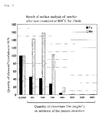
- Fig. 2 and Fig. 3 are graphs showing a result of measurement of elements (measured by an SIMS device) on a surface of the Cr plating after heat treatment is applied to the substrate according to the present invention.
- the results shown in Fig. 2 and Fig. 3 are obtained by evaluating an Fe element diffusionpreventing effect in the steel strip which becomes a base of the substrate. As can be understood from Fig. 2 and Fig.
- the substrate for a compound semiconductor solar cell of the present invention by clearly designating the film constitution of the diffusion barrier layer, the diffusion of an impurity element in a steel strip which causes lowering of power generation efficiency into the solar cell layer can be prevented. Further, by adopting an electrolytic plating method as a method for forming the diffusion barrier layer, productivity is increased and hence, an inexpensive material can be offered whereby industrial applicability of the present invention is extremely high.
Landscapes
- Photovoltaic Devices (AREA)
Applications Claiming Priority (2)
| Application Number | Priority Date | Filing Date | Title |
|---|---|---|---|
| JP2009129610 | 2009-05-28 | ||
| PCT/JP2010/003329 WO2010137255A1 (ja) | 2009-05-28 | 2010-05-18 | 化合物半導体型太陽電池用基板 |
Publications (2)
| Publication Number | Publication Date |
|---|---|
| EP2437306A1 true EP2437306A1 (de) | 2012-04-04 |
| EP2437306A4 EP2437306A4 (de) | 2013-10-02 |
Family
ID=43218843
Family Applications (1)
| Application Number | Title | Priority Date | Filing Date |
|---|---|---|---|
| EP10780216.7A Withdrawn EP2437306A4 (de) | 2009-05-28 | 2010-05-18 | Substrat für eine verbundhalbleitersolarzelle |
Country Status (6)
| Country | Link |
|---|---|
| US (1) | US20100300527A1 (de) |
| EP (1) | EP2437306A4 (de) |
| JP (1) | JP5506061B2 (de) |
| KR (1) | KR20120022905A (de) |
| CN (1) | CN102460720B (de) |
| WO (1) | WO2010137255A1 (de) |
Families Citing this family (1)
| Publication number | Priority date | Publication date | Assignee | Title |
|---|---|---|---|---|
| CN107851721A (zh) * | 2015-09-07 | 2018-03-27 | 杰富意钢铁株式会社 | 光电转换元件用基板 |
Family Cites Families (18)
| Publication number | Priority date | Publication date | Assignee | Title |
|---|---|---|---|---|
| US4055707A (en) * | 1975-12-22 | 1977-10-25 | The United States Of America As Represented By The Administrator Of The National Aeronautics And Space Administration | Selective coating for solar panels |
| GB2117971A (en) * | 1982-04-05 | 1983-10-19 | Hitachi Ltd | Amorphous silicon photovoltaic device |
| US4578319A (en) * | 1984-05-08 | 1986-03-25 | Toyo Kohan Co., Ltd. | Surface treated steel sheet having an excellent weldability and its production method |
| JPS613472A (ja) * | 1984-06-16 | 1986-01-09 | Kawasaki Steel Corp | 太陽電池基板 |
| AU632241B2 (en) * | 1990-09-06 | 1992-12-17 | Mitsui Toatsu Chemicals Inc. | Amorphous silicon solar cell and method for manufacturing the same |
| US5686194A (en) * | 1994-02-07 | 1997-11-11 | Toyo Kohan Co., Ltd. | Resin film laminated steel for can by dry forming |
| JP2952660B2 (ja) * | 1996-09-05 | 1999-09-27 | 日新製鋼株式会社 | 太陽電池基板用ステンレス鋼の製造方法、太陽電池用基板,太陽電池及び太陽電池の製造方法 |
| US6106689A (en) * | 1997-01-20 | 2000-08-22 | Canon Kabushiki Kaisha | Process for forming zinc oxide film and processes for producing semiconductor device substrate and photo-electricity generating device using the film |
| US6238778B1 (en) * | 1998-11-04 | 2001-05-29 | Ga-Tek Inc. | Component of printed circuit boards |
| JP2005126756A (ja) * | 2003-10-23 | 2005-05-19 | Matsushita Electric Ind Co Ltd | 化合物半導体薄膜の製造方法および製造装置 |
| JP4663300B2 (ja) * | 2004-11-18 | 2011-04-06 | 本田技研工業株式会社 | カルコパイライト型薄膜太陽電池の製造方法 |
| JP4664060B2 (ja) * | 2004-12-21 | 2011-04-06 | 本田技研工業株式会社 | カルコパイライト型太陽電池 |
| US7713773B2 (en) * | 2005-11-02 | 2010-05-11 | Solopower, Inc. | Contact layers for thin film solar cells employing group IBIIIAVIA compound absorbers |
| US8101858B2 (en) * | 2006-03-14 | 2012-01-24 | Corus Technology B.V. | Chalcopyrite semiconductor based photovoltaic solar cell comprising a metal substrate, coated metal substrate for a photovoltaic solar cell and manufacturing method thereof |
| JP2007305877A (ja) * | 2006-05-12 | 2007-11-22 | Matsushita Electric Ind Co Ltd | 太陽電池モジュール及びその製造方法 |
| US7867551B2 (en) * | 2006-09-21 | 2011-01-11 | Solopower, Inc. | Processing method for group IBIIIAVIA semiconductor layer growth |
| US7915522B2 (en) * | 2008-05-30 | 2011-03-29 | Twin Creeks Technologies, Inc. | Asymmetric surface texturing for use in a photovoltaic cell and method of making |
| US20100051105A1 (en) * | 2008-08-26 | 2010-03-04 | Mustafa Pinarbasi | Flexible substrate for ii-vi compound solar cells |
-
2010
- 2010-05-18 EP EP10780216.7A patent/EP2437306A4/de not_active Withdrawn
- 2010-05-18 JP JP2011515863A patent/JP5506061B2/ja not_active Expired - Fee Related
- 2010-05-18 KR KR1020117026783A patent/KR20120022905A/ko not_active Ceased
- 2010-05-18 WO PCT/JP2010/003329 patent/WO2010137255A1/ja not_active Ceased
- 2010-05-18 CN CN201080025477.5A patent/CN102460720B/zh not_active Expired - Fee Related
- 2010-05-28 US US12/790,213 patent/US20100300527A1/en not_active Abandoned
Also Published As
| Publication number | Publication date |
|---|---|
| JP5506061B2 (ja) | 2014-05-28 |
| WO2010137255A1 (ja) | 2010-12-02 |
| EP2437306A4 (de) | 2013-10-02 |
| KR20120022905A (ko) | 2012-03-12 |
| US20100300527A1 (en) | 2010-12-02 |
| JPWO2010137255A1 (ja) | 2012-11-12 |
| CN102460720B (zh) | 2014-10-29 |
| CN102460720A (zh) | 2012-05-16 |
Similar Documents
| Publication | Publication Date | Title |
|---|---|---|
| CN105209651B (zh) | 绝缘性优异且热膨胀系数小的不锈钢制太阳能电池用基板及其制造方法 | |
| KR102031465B1 (ko) | 가공 후 내식성 우수한 아연합금도금강재 및 그 제조방법 | |
| KR101507940B1 (ko) | 고분자 연료전지 분리판용 스테리인스강 제조방법 | |
| EP2987888A1 (de) | Ferritische rostfreie stahlfolie | |
| EP3461579B1 (de) | Verfahren zur herstellung von verkleidungsmaterial | |
| KR102598376B1 (ko) | 페라이트계 스테인리스 강판 및 그 제조 방법, 그리고, Al 계 도금 스테인리스 강판 | |
| EP2623631A1 (de) | Hochfestes stahlblech und herstellungsverfahren dafür | |
| KR20160120324A (ko) | 내열성이 우수한 표면 피복층 부착 구리 합금 판조 | |
| US20140038064A1 (en) | Steel for solid oxide fuel cells having excellent oxidation resistance, and member for solid oxide fuel cells using same | |
| JP2017172027A (ja) | Al含有フェライト系ステンレス鋼およびその製造方法 | |
| KR20200067279A (ko) | 수소취성에 대한 저항성이 우수한 열간 프레스 성형 부재 및 그 제조방법 | |
| KR101253818B1 (ko) | 표면특성이 우수한 열간 프레스용 용융아연도금강판, 이를 이용한 열간 프레스 부재 및 이들의 제조방법 | |
| EP2953170A1 (de) | Ferritische rostfreie stahlfolie für solarzellensubstrate | |
| KR20130055696A (ko) | 고강도 강판 및 그 제조 방법 | |
| KR101929138B1 (ko) | 고체 산화물형 연료 전지용 강 및 그 제조방법 | |
| EP3467131A1 (de) | Blech aus einem ferritischen edelstahl | |
| EP2437306A1 (de) | Substrat für eine verbundhalbleitersolarzelle | |
| US20160064574A1 (en) | Ferritic stainless steel foil for solar cell | |
| EP3342895B1 (de) | Al-haltiger ferritischer edelstahl und verfahren zur herstellung davon | |
| JP7133917B2 (ja) | 表面性状と耐硫化腐食性に優れたAl含有フェライト系ステンレス鋼板およびその製造方法 | |
| KR102793606B1 (ko) | 연료전지 양극판용 페라이트계 스테인리스강, 표면 거칠기의 제어방법, 패시베이션 막의 형성 방법 및 용도 | |
| JP2021147683A (ja) | フェライト系ステンレス鋼板およびその製造方法ならびに基板 | |
| JP2021147682A (ja) | フェライト系ステンレス鋼板およびその製造方法ならびに基板 | |
| JP5625442B2 (ja) | 耐遅れ破壊性に優れた引張強度1180MPa以上を有する高強度鋼板 | |
| US20250188583A1 (en) | Ferritic stainless steel and steel sheet |
Legal Events
| Date | Code | Title | Description |
|---|---|---|---|
| PUAI | Public reference made under article 153(3) epc to a published international application that has entered the european phase |
Free format text: ORIGINAL CODE: 0009012 |
|
| 17P | Request for examination filed |
Effective date: 20111201 |
|
| AK | Designated contracting states |
Kind code of ref document: A1 Designated state(s): AL AT BE BG CH CY CZ DE DK EE ES FI FR GB GR HR HU IE IS IT LI LT LU LV MC MK MT NL NO PL PT RO SE SI SK SM TR |
|
| DAX | Request for extension of the european patent (deleted) | ||
| A4 | Supplementary search report drawn up and despatched |
Effective date: 20130903 |
|
| RIC1 | Information provided on ipc code assigned before grant |
Ipc: H01L 31/0392 20060101AFI20130828BHEP |
|
| 17Q | First examination report despatched |
Effective date: 20140915 |
|
| STAA | Information on the status of an ep patent application or granted ep patent |
Free format text: STATUS: THE APPLICATION IS DEEMED TO BE WITHDRAWN |
|
| 18D | Application deemed to be withdrawn |
Effective date: 20160105 |