EP2437332A1 - Electrode positive et son procédé de production - Google Patents
Electrode positive et son procédé de production Download PDFInfo
- Publication number
- EP2437332A1 EP2437332A1 EP10780341A EP10780341A EP2437332A1 EP 2437332 A1 EP2437332 A1 EP 2437332A1 EP 10780341 A EP10780341 A EP 10780341A EP 10780341 A EP10780341 A EP 10780341A EP 2437332 A1 EP2437332 A1 EP 2437332A1
- Authority
- EP
- European Patent Office
- Prior art keywords
- positive
- electrode
- electrode active
- particles
- collector
- Prior art date
- Legal status (The legal status is an assumption and is not a legal conclusion. Google has not performed a legal analysis and makes no representation as to the accuracy of the status listed.)
- Withdrawn
Links
Images
Classifications
-
- H—ELECTRICITY
- H01—ELECTRIC ELEMENTS
- H01M—PROCESSES OR MEANS, e.g. BATTERIES, FOR THE DIRECT CONVERSION OF CHEMICAL ENERGY INTO ELECTRICAL ENERGY
- H01M4/00—Electrodes
- H01M4/02—Electrodes composed of, or comprising, active material
- H01M4/04—Processes of manufacture in general
- H01M4/0402—Methods of deposition of the material
- H01M4/0404—Methods of deposition of the material by coating on electrode collectors
-
- H—ELECTRICITY
- H01—ELECTRIC ELEMENTS
- H01M—PROCESSES OR MEANS, e.g. BATTERIES, FOR THE DIRECT CONVERSION OF CHEMICAL ENERGY INTO ELECTRICAL ENERGY
- H01M4/00—Electrodes
- H01M4/02—Electrodes composed of, or comprising, active material
- H01M4/04—Processes of manufacture in general
- H01M4/043—Processes of manufacture in general involving compressing or compaction
-
- H—ELECTRICITY
- H01—ELECTRIC ELEMENTS
- H01M—PROCESSES OR MEANS, e.g. BATTERIES, FOR THE DIRECT CONVERSION OF CHEMICAL ENERGY INTO ELECTRICAL ENERGY
- H01M4/00—Electrodes
- H01M4/02—Electrodes composed of, or comprising, active material
- H01M4/04—Processes of manufacture in general
- H01M4/0471—Processes of manufacture in general involving thermal treatment, e.g. firing, sintering, backing particulate active material, thermal decomposition, pyrolysis
-
- H—ELECTRICITY
- H01—ELECTRIC ELEMENTS
- H01M—PROCESSES OR MEANS, e.g. BATTERIES, FOR THE DIRECT CONVERSION OF CHEMICAL ENERGY INTO ELECTRICAL ENERGY
- H01M4/00—Electrodes
- H01M4/02—Electrodes composed of, or comprising, active material
- H01M4/13—Electrodes for accumulators with non-aqueous electrolyte, e.g. for lithium-accumulators; Processes of manufacture thereof
-
- H—ELECTRICITY
- H01—ELECTRIC ELEMENTS
- H01M—PROCESSES OR MEANS, e.g. BATTERIES, FOR THE DIRECT CONVERSION OF CHEMICAL ENERGY INTO ELECTRICAL ENERGY
- H01M4/00—Electrodes
- H01M4/02—Electrodes composed of, or comprising, active material
- H01M4/13—Electrodes for accumulators with non-aqueous electrolyte, e.g. for lithium-accumulators; Processes of manufacture thereof
- H01M4/139—Processes of manufacture
-
- H—ELECTRICITY
- H01—ELECTRIC ELEMENTS
- H01M—PROCESSES OR MEANS, e.g. BATTERIES, FOR THE DIRECT CONVERSION OF CHEMICAL ENERGY INTO ELECTRICAL ENERGY
- H01M4/00—Electrodes
- H01M4/02—Electrodes composed of, or comprising, active material
- H01M4/62—Selection of inactive substances as ingredients for active masses, e.g. binders, fillers
-
- H—ELECTRICITY
- H01—ELECTRIC ELEMENTS
- H01M—PROCESSES OR MEANS, e.g. BATTERIES, FOR THE DIRECT CONVERSION OF CHEMICAL ENERGY INTO ELECTRICAL ENERGY
- H01M4/00—Electrodes
- H01M4/02—Electrodes composed of, or comprising, active material
- H01M4/64—Carriers or collectors
- H01M4/70—Carriers or collectors characterised by shape or form
-
- Y—GENERAL TAGGING OF NEW TECHNOLOGICAL DEVELOPMENTS; GENERAL TAGGING OF CROSS-SECTIONAL TECHNOLOGIES SPANNING OVER SEVERAL SECTIONS OF THE IPC; TECHNICAL SUBJECTS COVERED BY FORMER USPC CROSS-REFERENCE ART COLLECTIONS [XRACs] AND DIGESTS
- Y02—TECHNOLOGIES OR APPLICATIONS FOR MITIGATION OR ADAPTATION AGAINST CLIMATE CHANGE
- Y02E—REDUCTION OF GREENHOUSE GAS [GHG] EMISSIONS, RELATED TO ENERGY GENERATION, TRANSMISSION OR DISTRIBUTION
- Y02E60/00—Enabling technologies; Technologies with a potential or indirect contribution to GHG emissions mitigation
- Y02E60/10—Energy storage using batteries
Definitions
- the present invention relates to a positive-electrode member used as the positive-electrode layer of a nonaqueous electrolyte battery and a method for producing the positive-electrode member.
- Relatively small electrical devices such as portable devices employ, as a power supply, a nonaqueous electrolyte battery that has a positive-electrode layer having a positive-electrode collector and a positive-electrode active-material layer, a negative-electrode layer having a negative-electrode collector and a negative-electrode active-material layer, and an electrolyte layer disposed between these electrode layers.
- nonaqueous electrolyte batteries in particular, lithium-ion batteries, which are charged and discharged through movements of lithium ions between the positive electrode and the negative electrode, have excellent charging-discharging characteristics.
- Patent Literature 1 discloses a lithium-ion battery employing a sinter of a lithium oxide as a positive-electrode active-material layer.
- a positive-electrode active-material layer composed of the sinter repeatedly expands and contracts due to charging and discharging and it may be damaged by cracking or the like, or the positive-electrode active-material layer and the positive-electrode collector that are joined may become separated from each other.
- the discharge capacity of the battery tends to decrease, that is, the cycle characteristic of the battery becomes poor.
- the battery is used at a high current density, such a problem tends to become serious.
- the present invention has been made under such circumstances and an object of the present invention is to provide a positive-electrode member for producing a nonaqueous electrolyte battery having a high discharge capacity and an excellent cycle characteristic, and a method for producing such a positive-electrode member.
- a positive-electrode member is a positive-electrode member used as a positive-electrode layer of a nonaqueous electrolyte battery, the positive-electrode member including a positive-electrode collector composed of a metal, and a positive-electrode active-material portion that allows for electron transfer between the positive-electrode active-material portion and the positive-electrode collector.
- the positive-electrode active-material portion in the positive-electrode member includes a group of particles of a positive-electrode active material and a solid electrolyte that fixes the group of the particles. The contours of the positive-electrode active-material particles that are next to each other in the positive-electrode active-material portion partially conform to each other.
- the solid electrolyte disposed in the gaps between positive-electrode active-material particles having been plastically deformed allows for conduction of lithium ions between the active-material particles that are close to each other.
- the lithium-ion conductivity at the interface between positive-electrode active-material particles that are in contact with each other is inherently very low, compared with lithium-ion conductivity within the particles. Accordingly, a configuration in which the particles are simply in contact with each other results in a positive-electrode member having a low lithium-ion conductivity.
- lithium ions can be smoothly conducted between the particles that are close to each other and hence the discharge capacity of the battery can be increased.
- the lithium-ion conductivity at grain boundaries is high, compared with a configuration in which the particles are simply in contact with each other; however, it is low, compared with a configuration according to the present invention in which a solid electrolyte is disposed between the particles.
- a positive-electrode member according to the present invention can be broadly divided into two configurations in terms of the form of a collector used.
- a first form and a production method relating thereto are described in (2) to (7) below.
- a second form and a production method relating thereto are described in (8) to (13) below.
- the positive-electrode collector is a solid plate
- the positive-electrode active-material portion is a layer disposed on a surface of the positive-electrode collector.
- the positive-electrode active-material portion is formed as a layer, by simply changing the thickness of the layer, the amount of the positive-electrode active material contained in the positive-electrode active-material portion can be readily adjusted.
- the surface of the positive-electrode collector preferably has an arithmetic mean roughness Ra (Japanese Industrial Standard (JIS) B0601 2001) of 100 nm or more.
- the surface of the positive-electrode collector on which the layer-shaped positive-electrode active-material portion is formed has a complex irregularly shaped structure, the surface area of the surface, that is, the current-collecting area becomes large and hence the current density of a battery can be increased.
- the adhesion between the positive-electrode active-material portion and the positive-electrode collector is enhanced due to the anchoring effect and hence the cycle characteristic of a battery can be enhanced.
- the area percentage of the solid electrolyte in an arbitrary section of the positive-electrode active-material layer is preferably 20% or less.
- the percentage of the solid electrolyte with respect to the positive-electrode active-material portion is in this range, a sufficiently large amount of active-material particles can be ensured in the positive-electrode active-material portion.
- the solid electrolyte that mediates conduction of lithium ions between the particles is also necessary and hence the area percentage of the solid electrolyte is preferably made 2% or more.
- a method for producing a positive-electrode member according to the present invention is a method for producing a positive-electrode member used as a positive-electrode layer of a nonaqueous electrolyte battery, the method including the following steps:
- a positive-electrode member according to the present invention can be produced in which a positive-electrode active-material layer is formed on a plate-shaped positive-electrode collector and positive-electrode active-material particles in the positive-electrode active-material layer have been plastically deformed.
- a positive-electrode active-material layer is formed from a raw-material sol, in the process of turning metal alkoxides or the hydrolysates of the metal alkoxides in the raw-material sol into a solid electrolyte, a solvent contained in the raw-material sol evaporates and cavities are formed in the positive-electrode active-material layer.
- the cavities are squashed in the pressing of the positive-electrode active-material layer, for example, a decrease in the lithium-ion conductivity of the positive-electrode member due to the cavities scarcely occurs.
- the surface of the positive-electrode collector provided preferably has an arithmetic mean roughness Ra (JIS B0601 2001) of 100 nm or more.
- a surface of a positive-electrode collector has been conventionally roughened, in this case, the surface is made to have an arithmetic mean roughness Ra of less than 100 nm.
- Ra arithmetic mean roughness
- the positive-electrode active-material layer is formed so as to conform to the surface profile of a positive-electrode collector.
- the surface profile of the positive-electrode collector is too rough, there may be cases where the positive-electrode active-material layer is not formed in some portions.
- a positive-electrode active-material layer is formed by applying a raw-material sol to a surface of a positive-electrode collector. Accordingly, even when the surface has an Ra of 100 nm or more, portions where the positive-electrode active-material layer is not formed scarcely occur.
- a pressure in a range of 100 to 1000 MPa is preferably applied.
- the positive-electrode collector is a porous member including a plurality of pores, and the positive-electrode active-material portion is disposed in the pores of the positive-electrode collector.
- the collector can be made to be in three-dimensional contact with the positive-electrode active-material portion.
- the current-collecting area can be made large and hence the current density of a battery can be increased.
- the porous collector serves as a framework to suppress cracking of the positive-electrode member due to expansion and contraction of the positive-electrode active-material portion. As a result, the cycle characteristic of a battery can be enhanced.
- the area percentage of the solid electrolyte in an arbitrary section of the positive-electrode active-material portion is preferably 20% or less.
- the solid electrolyte that mediates conduction of lithium ions between the particles is also necessary and hence the area percentage of the solid electrolyte is preferably made 5% or more.
- a porosity that represents a percentage of the pores with respect to the porous collector is preferably 90 to 98 vol%.
- the porosity is determined in consideration of the volume ratio of the plate-shaped positive-electrode collector to the positive-electrode active-material layer of a normal battery. For example, in batteries for high-power applications, the ratio of the volume of the plate-shaped positive-electrode collector to the volume of the positive-electrode active-material layer is 1:7 to 1:12. When a porous collector is prepared with reference to this volume ratio, the porosity of the porous collector becomes 90 to 98 vol%. When the porosity is in this range, the positive-electrode member is well-balanced between the active-material component and the current-collecting component; and use of this positive-electrode member allows for the production of a high-power battery. The porosity is more preferably 95 to 98 vol%.
- a method for producing a positive-electrode member according to the present invention is a method for producing a positive-electrode member used as a positive-electrode layer of a nonaqueous electrolyte battery, the method including the following steps:
- a positive-electrode member according to the present invention in which a positive-electrode active-material phase is formed in the pores of a porous collector and positive-electrode active-material particles in the positive-electrode active-material phase have been plastically deformed can be produced.
- a positive-electrode active-material phase is formed from a raw-material sol, in the process of turning metal alkoxides or the hydrolysates of the metal alkoxides in the raw-material sol into a solid electrolyte, a solvent contained in the raw-material sol evaporates and cavities are formed in the positive-electrode active-material phase.
- the cavities are squashed in the pressing of the positive-electrode member and hence, for example, a decrease in the lithium-ion conductivity of the positive-electrode member due to the cavities scarcely occurs.
- the porous collector composed of metal has a function of maintaining the shape of the positive-electrode member having been pressed and hence re-formation of cavities having been squashed in the positive-electrode active-material phase scarcely occurs.
- a porosity that represents a percentage of the pores with respect to the provided porous collector is preferably 90 to 98 vol%.
- a porous collector having a porosity in this range the pores of the collector can be readily filled with a raw-material sol.
- the porosity is in the range, the positive-electrode member is well-balanced between the active-material component and the current-collecting component.
- a pressure in a range of 100 to 1000 MPa is preferably applied.
- a positive-electrode member according to the present invention allows for production of a battery having a high discharge capacity and an excellent cycle characteristic.
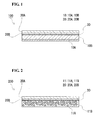
- FIG. 1 is a schematic longitudinal sectional view illustrating a normal lithium-ion battery (nonaqueous electrolyte battery).
- This lithium-ion battery 100 includes a positive-electrode layer 10, a negative-electrode layer 20, and an electrolyte layer 30 disposed between these electrode layers 10 and 20.
- the positive-electrode layer 10 includes a positive-electrode collector 10A and a positive-electrode active-material layer 10B.
- the negative-electrode layer 20 includes a negative-electrode collector 20A and a negative-electrode active-material layer 20B.
- the battery 100 has the most distinguishable feature of employing, as the positive-electrode layer 10, a positive-electrode member according to the present invention. Accordingly, the positive-electrode layer (positive-electrode member) 10 will be mainly described in the following description.
- the positive-electrode member 10 is produced by a production method including the following steps 1 to 5.
- lithium-ion-conductive solid electrolyte examples include LiNbO 3 , Li 4 Ti 5 O 12 , and LiTaO 3 .
- metal alkoxides that finally produce such a solid electrolyte through polycondensation for example, the combination of ethoxylithium (LiOC 2 H 5 ) and pentaethoxyniobium (Nb(OC 2 H 5 ) 5 ) is preferred, and ethoxylithium and pentaethoxyniobium produce LiNbO 3 through hydrolysis and polycondensation.
- metal alkoxides such as LiOC 2 H 5 and Ti(OC 4 H 9 ) 4 can be used; and to produce LiTaO 3 , metal alkoxides such as LiOC 2 H 5 and Ta(OC 2 H 5 ) 5 can be used.
- hydrolysates of metal alkoxides the hydrolysates of the above-described metal alkoxides can be used.
- the solute when the solute is metal alkoxides, for example, an alcohol solvent such as ethyl alcohol or methyl alcohol can be used.
- an aqueous solvent can be used or a solvent mixture of an alcohol solvent and an aqueous solvent can be used.
- the concentration of the solute in the alkoxide solution is not particularly limited, it is preferably 5 to 30 mol/ml. An advantage provided by achieving a concentration in this range will be described in the description of Step 2 below.
- a lithium-containing oxide can be used as the positive-electrode active-material particles that are mixed with the alkoxide solution in the preparation of the raw-material sol.
- This lithium-containing oxide is preferably a substance represented by a chemical formula of Li ⁇ O 2 or Li ⁇ 2O4 (note that ⁇ and ⁇ include at least one of Co, Mn, and Ni). Specific examples include LiCoO 2 , LiNiO 2 , LiMnO 2 , and LiMn 2 O 4 .
- a substance containing an element other than Co, Mn, and Ni such as LiCo 0.5 Fe 0.5 O 2 can be used.
- the raw-material sol may contain an electrically conductive auxiliary such as acetylene black.
- the concentration of positive-electrode active-material particles in the raw-material sol obtained by mixing the positive-electrode active-material particles with the alkoxide solution should be appropriately selected in accordance with the amount of the positive-electrode active material in the positive-electrode member 10 to be produced and the concentration of the solute (metal alkoxides or the hydrolysates thereof) in the alkoxide solution, it is preferably in the range of about 5 to 50 g/ml.
- the concentration of the solute in the alkoxide solution in Step 1 is made 5 to 30 mol/ml, the viscosity of the alkoxide solution becomes about 200 to 500 mPa ⁇ s.
- the active-material particles can be readily uniformly dispersed in the raw-material sol.
- the positive-electrode collector 10A provided is preferably a plate composed of a metal.
- This metal may be an elemental metal such as Al, Cu, or Ni or an alloy such as stainless steel.
- a surface to which the raw-material sol is applied preferably has an arithmetic mean roughness Ra of 100 nm or more, more preferably 400 nm or more.
- Ra arithmetic mean roughness
- the positive-electrode collector 10A has a surface having such a roughness and the raw-material sol is applied to the surface, positive-electrode active-material particles contained in the raw-material sol enter recesses in the surface and the movement of the particles is constrained. As a result, in Step 5 described below, the positive-electrode active-material particles can be plastically deformed effectively.
- a surface of a positive-electrode collector is polished or etched.
- the raw-material sol prepared in Step 2 may be applied to a surface of the positive-electrode collector in Step 3 by a publicly known application method such as a doctor blade method.
- the raw-material sol is naturally applied such that the positive-electrode collector serving as a base is not exposed from the applied layer.
- a heat treatment should be performed.
- the heat treatment is preferably performed at 200°C to 300°C for 0.5 to 6 h.
- Step 4 a positive-electrode member in which a positive-electrode active-material layer is formed on a surface of a positive-electrode collector is formed.
- active-material particles in the positive-electrode active-material layer are partially in point contact with each other and lithium-ion conductivity between the particles is low.
- the average distance of gaps between the particles is long.
- the lithium-ion-conductive solid electrolyte is disposed in the gaps between the particles and hence lithium ions can be conducted.
- the positive-electrode active-material layer has cavities formed by evaporation of the solvent of the raw-material sol.
- the positive-electrode member in which the positive-electrode active-material layer is formed on a surface of the positive-electrode collector is pressed, it should be compressed from both surfaces thereof. Specifically, a pressure is applied such that the surface of the positive-electrode collector and the surface of the positive-electrode active-material layer in the positive-electrode member approach each other. As a result of this pressing, the positive-electrode active-material particles in the positive-electrode active-material layer are plastically deformed such that the particles that are next to each other partially conform to each other. At the same time, the cavities formed in the positive-electrode active-material layer in Step 4 are squashed and thereby removed.
- the pressure applied in the pressing is preferably in the range of 100 to 1000 MPa. When a pressure in this range is applied, active-material particles can be plastically deformed regardless of the type of the particles and the cavities can be substantially eliminated.
- the positive-electrode member 10 obtained by Steps 1 to 5 above includes the positive-electrode collector 10A that is a metal plate and the positive-electrode active-material layer 10B disposed on a surface of the positive-electrode collector 10A.
- the positive-electrode active-material layer 10B includes a group of particles of the positive-electrode active material and a solid electrolyte fixing the particle group.
- the particle group in the positive-electrode active-material layer has been plastically deformed by the pressing in Step 5.
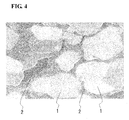
- Figure 3 is a schematic view schematically illustrating a SEM photograph of a section of the positive-electrode active-material layer 10B included in a positive-electrode member in EXAMPLE 1 described below.
- Fig. 3 in the positive-electrode active-material layer 10B of a positive-electrode member obtained by Steps 1 to 5 according to the present invention, among combinations of neighboring positive-electrode active-material particles 1 and 1, combinations in which contours partially conform to each other account for 30% or more of all the combinations.
- contours partially conform to each other refers to pairs of neighboring active-material particles 1 and 1 in which the length over which the particles 1 and 1 of each pair conform to each other accounts for 30% or more of the total contour length of at least one particle 1 out of the pair of particles 1 and 1.
- the contours of neighboring active-material particles 1 and 1 partially conform to each other because the positive-electrode member is compressed so as to be sandwiched from both sides thereof and, as a result, each particle 1 has been plastically deformed (refer to Step 5 in the above production method).
- the external shapes of the provided particles are different from each other.
- FIG. 4 is a schematic view schematically illustrating a SEM photograph of a section of the positive-electrode active-material layer 10A included in a positive-electrode member (positive-electrode member that is prepared under pressing by which positive-electrode active-material particles are not plastically deformed) in COMPARATIVE EXAMPLE 2 described below.
- a positive-electrode member positive-electrode member that is prepared under pressing by which positive-electrode active-material particles are not plastically deformed
- COMPARATIVE EXAMPLE 2 described below.
- plastic deformation of active-material particles can also be confirmed by measuring a specific physical quantity. For example, when it is found that, by X-ray diffractometry, the peak of active-material particles in a pressed positive-electrode member deviates from the peak of active-material particles serving as the raw material, as a result of this, it can be confirmed that strain has been introduced into the active-material particles, that is, the active-material particles have been plastically deformed.
- the negative-electrode layer 20 includes the negative-electrode collector 20A and the negative-electrode active-material layer 20B.
- the negative-electrode collector 20A is a layer composed of a metal such as Al, Ni, or Fe, or an alloy of the foregoing.
- the negative-electrode active-material layer 20B is a layer composed of a negative-electrode active material such as Li, Si, In, or an alloy of the foregoing.
- the electrolyte layer 30 may be a solid composed of a sulfide such as Li 2 S-P 2 S 5 or an oxide such as Li-P-O-N or a nonaqueous organic electrolytic solution obtained by dissolving a lithium-ion-conductive material such as LiPF 6 in an organic solvent.
- a separator composed of, for example, polypropylene or polyethylene that insulates the positive-electrode layer 10 and the negative-electrode layer 20 from each other is disposed between these layers.
- the electrolyte layer 30 is composed of a sulfide-based solid electrolyte
- the resistance of the interface between the electrolyte layer 30 and the positive-electrode layer 10 increases and the capacity of the battery decreases.
- an intermediate layer that suppresses such an increase in the resistance of the interface is preferably disposed between the solid electrolyte layer 30 and the positive-electrode layer 10.
- the intermediate layer may be composed of a lithium-containing oxide such as LiNbO 3 .
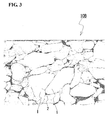
- FIG. 2 is a schematic longitudinal sectional view illustrating a lithium-ion battery (nonaqueous electrolyte battery) according to the second embodiment.
- This lithium-ion battery 200 has the same configuration as the battery according to the first embodiment except that it includes a positive-electrode layer (positive-electrode member) 11 including a porous positive-electrode collector (porous collector) 11A having pores and a positive-electrode active-material phase 11B formed in the pores. Accordingly, only the positive-electrode member 11, which is the difference from the first embodiment, will be described below.
- the positive-electrode member 11 according to the second embodiment is produced by a production method including the following steps 1 to 5.
- the porous collector 11A may be formed of, for example, a metal foam formed by foaming molten metal.
- the porous collector 11A may be a member obtained by covering nonwoven fabric or woven fabric formed of a resin such as urethane with metal and eliminating the resin by a heat treatment.
- the porosity of the porous collector 11A (the total percentage of all the pores with respect to the collector) is preferably 90 to 98 vol%, more preferably 95 to 98 vol%.
- the collector has such a porosity, a sufficiently large current-collecting area can be ensured and the collector can be filled with the raw-material sol in an amount required for a high-power battery.
- Step 3 the pores of the porous collector 11A are filled with the raw-material sol prepared in Step 2 by, for example, immersing the porous collector 11A in the raw-material sol in a vacuum vessel and evacuating the vacuum vessel. In this way, the pores of the porous collector 11A can be fully impregnated with the raw-material sol.
- a heat treatment should be performed.
- the heat treatment is preferably performed at 200°C to 300°C for 0.5 to 6 h.
- Step 4 the positive-electrode member 11 in which the positive-electrode active-material phase 11B is formed so as to fill the pores of the porous collector 11A is produced.
- active-material particles in the positive-electrode active-material phase 11B are partially in point contact with each other and lithium-ion conductivity between the particles is low.
- the average distance of gaps between the particles is long.
- the lithium-ion-conductive solid electrolyte is disposed in the gaps between the particles and hence lithium ions can be conducted.
- the positive-electrode active-material phase 11B has cavities formed by evaporation of the solvent of the raw-material sol.
- the positive-electrode member 11 in which the positive-electrode active-material phase 11B is formed in the pores of the porous collector 11A is pressed, a pressure is applied such that the front surface and the back surface of the positive-electrode member 11 approach each other.
- the positive-electrode active-material particles in the positive-electrode active-material phase 11B are plastically deformed such that the particles that are next to each other partially conform to each other.
- the cavities formed in the positive-electrode active-material phase 11B in Step 4 are squashed and thereby removed.
- the porous collector 11A composed of metal serves as a framework to maintain the shape of the positive-electrode member 11 having been deformed by the pressing.
- the positive-electrode member 11 obtained by Steps 1 to 5 described above includes the porous collector 11A that is composed of metal and the positive-electrode active-material phase 11B formed in the pores of the porous collector 11A.
- the positive-electrode active-material phase 11B includes the group of positive-electrode active-material particles and a solid electrolyte fixing the particle group.
- the state of the particle group in the positive-electrode active-material phase 11B is substantially the same as the state of the particle group in the positive-electrode active-material layer 10B described with reference to Fig. 3 , and the contours of the positive-electrode active-material particles that are next to each other partially conform to each other.
- the lithium-ion batteries 100 (EXAMPLES 1 and 2) according to the first embodiment described with reference to Fig. 1 and the lithium-ion battery 200 (EXAMPLE 3) according to the second embodiment described with reference to Fig. 2 were actually produced and characteristics (discharge capacity, internal resistance, and cycle characteristic) of these batteries were evaluated.
- lithium-ion batteries (COMPARATIVE EXAMPLES 1 to 3) compared with batteries according to the present invention were produced and the characteristics of the batteries were also evaluated.
- LiCoO 2 powder Equimolar amounts of a cobalt carbonate (CoCO 3 ) powder and a lithium carbonate (Li 2 CO 3 ) powder were mixed and baked at 900°C for 6 hours to provide a LiCoO 2 powder.
- the LiCoO 2 powder had an average particle size (50% particle size) of 10 ⁇ m.
- An alkoxide solution was provided that was obtained by dissolving an equimolar mixture of ethoxylithium (LiOC 2 H 5 ) and pentaethoxyniobium (Nb(OC 2 H 5 ) 5 ) in an ethanol solvent.
- the content of the equimolar mixture in the alkoxide solution was 15 mol/ml.
- the alkoxide solution had a viscosity of 200 mPa ⁇ s.
- the prepared alkoxide solution (6 ml) was mixed with 100 g of the LiCoO 2 powder to prepare a raw-material sol.
- the content of LiCoO 3 was 16.7 g/ml.
- a steel use stainless (SUS) 316L member having a thickness of 10 ⁇ m was subsequently provided as a positive-electrode collector.
- the raw-material sol was applied to a surface of the positive-electrode collector so as to have an average thickness of 100 ⁇ m.
- the surface of the positive-electrode collector had an arithmetic mean roughness Ra (JIS B0601 2001) of 44 nm.
- the raw-material sol was heat-treated at about 75°C for an hour and, as a result, the ethanol solvent contained in the raw-material sol was removed, and sodium ethoxide and pentaethoxyniobium were subjected to hydrolysis and polycondensation and turned into LiNbO 3 .
- a positive-electrode member was formed that included, on the positive-electrode collector, the positive-electrode active-material layer in which the group of the positive-electrode active-material particles was substantially uniformly dispersed and fixed in the solid electrolyte.
- the positive-electrode member was pressed at 500 MPa so as to be sandwiched from both sides thereof.
- a positive-electrode member according to the present invention was completed.
- Figure 3 schematically illustrates a SEM photograph of a section of the positive-electrode active-material layer in a positive-electrode member produced under the above-described conditions. Observation of the details of the state of the positive-electrode active-material particles 1 in the positive-electrode active-material layer 10B in Fig. 3 revealed that the active-material particles 1 were plastically deformed so that the contours of the particles 1 and 1 that were next to each other partially conformed to each other, and that the solid electrolyte 2 fixing the active-material particles 1 had a uniform phase substantially having no grain boundaries. In addition, in the field of view observed, no cavities were observed in the positive-electrode active-material layer 10B. The area percentage of the solid electrolyte 2 in a section of the positive-electrode active-material layer 10B was about 3%. The distance between the particles 1 that were next to each other was mostly 500 nm or less.
- a lithium-ion battery (nonaqueous electrolyte battery) was then actually produced with the produced positive-electrode member.
- the positive-electrode member 10 produced was used as a base member.
- An intermediate layer (not shown) that had an average thickness of 10 nm and was composed of LiNbO 3 was formed by excimer-laser ablation on a surface (the surface of the positive-electrode active-material layer 10B) of the base member.
- the intermediate layer suppresses an increase in the resistance of the interface between the positive-electrode active-material layer 10B and the solid electrolyte layer 30.
- the solid electrolyte layer 30 that had an average thickness of 10 ⁇ m and was composed of Li 2 S and P 2 S 5 was formed by excimer-laser ablation on the intermediate layer.
- the negative-electrode active-material layer 20B that had an average thickness of 4 ⁇ m and was composed of Li was formed by resistance heating on the electrolyte layer 30.
- the negative-electrode collector 20A composed of Cu was formed by resistance heating on the negative-electrode active-material layer 20B.
- the multilayer member in which the negative-electrode collector 20A had been formed was then sealed in an aluminum laminate pack and tab leads were extracted from the positive-electrode collector 10A and the negative-electrode collector 20A.
- the battery 100 was completed.
- a battery in EXAMPLE 2 was produced with a positive-electrode collector having a surface with an Ra of 100 nm or more (measured value was 431 nm).
- the battery in EXAMPLE 2 was produced with the same materials and conditions as in the battery in EXAMPLE 1 except that the Ra of the surface of the positive-electrode collector was different from that in EXAMPLE 1.
- a battery in EXAMPLE 3 was produced with a porous positive-electrode collector.
- the battery in EXAMPLE 3 had the same configuration as in the second embodiment described with reference to Fig. 2 and was produced with the same materials and conditions as in the battery in EXAMPLE 1 except for the following respects.
- the porous collector 11A used was formed of nickel Celmet (registered trademark of Sumitomo Electric Industries, Ltd.), which is a Ni metal foam.
- the porous collector 11A had an average thickness of 100 ⁇ m and a porosity of 95 vol%.
- the porous collector 11A was immersed in a raw-material sol prepared in the same manner as in EXAMPLE 1 and placed in a vacuum vessel, and the entirety of the vacuum vessel was evacuated so as to be at 50 kPa.
- the pores of the porous collector 11A were impregnated with the raw-material sol by the immersion and evacuation.
- the porous collector 11A was withdrawn from the raw-material sol and heated in the air at 75°C for 1 h and, as a result, the ethanol solvent contained in the raw-material sol was removed, and sodium ethoxide and pentaethoxyniobium were subjected to hydrolysis and polycondensation and turned into LiNbO 3 .
- a positive-electrode member 11 was formed that included, in the pores of the porous collector 11A, the positive-electrode active-material phase 11B in which the group of the positive-electrode active-material particles was substantially uniformly dispersed and fixed in the solid electrolyte.
- a battery of COMPARATIVE EXAMPLE 1 was produced with a positive-electrode member that was completed without pressing after the formation of a positive-electrode active-material layer on a surface of a positive-electrode collector.
- the battery of COMPARATIVE EXAMPLE 1 was produced with the same materials and conditions as in the battery in EXAMPLE 1 except that the positive-electrode member was not pressed.
- a battery of COMPARATIVE EXAMPLE 2 was produced with a positive-electrode member that was completed with the application of a pressure of 57 MPa after the formation of a positive-electrode active-material layer on a surface of a positive-electrode collector.
- the battery of COMPARATIVE EXAMPLE 2 was produced with the same materials and conditions as in the battery in EXAMPLE 1 except for the pressure applied.
- a battery of COMPARATIVE EXAMPLE 3 was produced with a positive-electrode member including a positive-electrode active-material layer formed of a sinter.
- the positive-electrode member in COMPARATIVE EXAMPLE 3 was obtained by providing the positive-electrode active-material layer formed of a sinter and subsequently depositing a positive-electrode collector onto a surface of the active-material layer by a vapor-phase method.
- the dimensions of the active-material layer and the collector in the positive-electrode member and the battery configuration other than the positive-electrode member were the same as in the batteries in EXAMPLES.
- the produced batteries in EXAMPLES 1 to 3 and COMPARATIVE EXAMPLES 1 to 3 were charged at a constant current of 0.05 mA until 4.2 V was reached and the discharge capacity (mAh/cm 2 ) thereof was measured in discharging at 3 V
- the internal resistance of the batteries was determined from voltage drop at the initiation of discharging.
- capacity retention (%) of the batteries was measured. The capacity retention is obtained by dividing a discharge capacity at the 100th cycle by the maximum discharge capacity in the 100 cycles. The measurement results are described in Table.
- the batteries in EXAMPLES 1 to 3 had a low internal resistance, a high discharge capacity, and an excellent cycle characteristic, compared with the batteries in COMPARATIVE EXAMPLES 1 to 3.
- comparison between the battery in EXAMPLE 1 and the batteries in COMPARATIVE EXAMPLES 1 and 2 shows that the only difference between the batteries was whether the active-material particles in the positive-electrode active-material layer were plastically deformed or not.
- a positive-electrode member according to the present invention produced by a method for producing a positive-electrode member according to the present invention can be suitably used as a positive-electrode layer of a nonaqueous electrolyte battery used as a power supply of a portable device or the like.
Landscapes
- Chemical & Material Sciences (AREA)
- Chemical Kinetics & Catalysis (AREA)
- Electrochemistry (AREA)
- General Chemical & Material Sciences (AREA)
- Engineering & Computer Science (AREA)
- Manufacturing & Machinery (AREA)
- Materials Engineering (AREA)
- Battery Electrode And Active Subsutance (AREA)
- Secondary Cells (AREA)
- Cell Electrode Carriers And Collectors (AREA)
Applications Claiming Priority (4)
| Application Number | Priority Date | Filing Date | Title |
|---|---|---|---|
| JP2009128221 | 2009-05-27 | ||
| JP2009128222 | 2009-05-27 | ||
| JP2009128223 | 2009-05-27 | ||
| PCT/JP2010/054212 WO2010137381A1 (fr) | 2009-05-27 | 2010-03-12 | Electrode positive et son procédé de production |
Publications (2)
| Publication Number | Publication Date |
|---|---|
| EP2437332A1 true EP2437332A1 (fr) | 2012-04-04 |
| EP2437332A4 EP2437332A4 (fr) | 2014-01-22 |
Family
ID=43222507
Family Applications (1)
| Application Number | Title | Priority Date | Filing Date |
|---|---|---|---|
| EP10780341.3A Withdrawn EP2437332A4 (fr) | 2009-05-27 | 2010-03-12 | Electrode positive et son procédé de production |
Country Status (6)
| Country | Link |
|---|---|
| US (1) | US20120052383A1 (fr) |
| EP (1) | EP2437332A4 (fr) |
| JP (1) | JPWO2010137381A1 (fr) |
| KR (1) | KR20140014361A (fr) |
| CN (1) | CN102449814A (fr) |
| WO (1) | WO2010137381A1 (fr) |
Cited By (1)
| Publication number | Priority date | Publication date | Assignee | Title |
|---|---|---|---|---|
| EP3113252A1 (fr) * | 2015-06-29 | 2017-01-04 | Toyota Jidosha Kabushiki Kaisha | Couche de matériau actif de cathode, batterie au lithium entièrement solide, et procédé de fabrication d'une couche de matériau actif de cathode |
Families Citing this family (16)
| Publication number | Priority date | Publication date | Assignee | Title |
|---|---|---|---|---|
| KR20140003548A (ko) * | 2011-02-18 | 2014-01-09 | 스미토모덴키고교가부시키가이샤 | 집전체용 3차원 그물 형상 알루미늄 다공체, 당해 알루미늄 다공체를 이용한 집전체 및 당해 집전체를 이용한 전극, 그리고 당해 전극을 이용한 비수 전해질 전지, 커패시터 및 리튬 이온 커패시터 |
| US9461303B2 (en) * | 2011-05-13 | 2016-10-04 | Toyota Jidosha Kabushiki Kaisha | Electrode body, all solid state battery, and method for producing coated active material |
| JP2013073707A (ja) * | 2011-09-27 | 2013-04-22 | Toyota Motor Corp | 電極合材の製造方法及び電極体の製造方法 |
| DE102012112186A1 (de) * | 2012-12-12 | 2014-06-26 | Fraunhofer-Gesellschaft zur Förderung der angewandten Forschung e.V. | Materialverbund, Verfahren zu dessen Herstellung, daraus hergestelltes System und Anwendung desselben |
| US20140272558A1 (en) * | 2013-03-14 | 2014-09-18 | GM Global Technology Operations LLC | Electrode for a lithium-based secondary electrochemical device and method of forming same |
| JP2014212029A (ja) * | 2013-04-18 | 2014-11-13 | Jsr株式会社 | 蓄電デバイス用電極および蓄電デバイス |
| JP2014212028A (ja) * | 2013-04-18 | 2014-11-13 | Jsr株式会社 | 蓄電デバイス用電極および蓄電デバイス |
| CN105164838B (zh) | 2013-07-10 | 2018-01-26 | 日立金属株式会社 | 锂离子二次电池用集电体以及锂离子二次电池用正极 |
| JP2015097150A (ja) * | 2013-11-15 | 2015-05-21 | セイコーエプソン株式会社 | 電池用電極体、電極複合体およびリチウム電池 |
| JP6494194B2 (ja) * | 2014-07-04 | 2019-04-03 | マクセルホールディングス株式会社 | リチウム二次電池用被覆正極活物質、その製造方法及びそれを用いたリチウム二次電池 |
| JP6958462B2 (ja) * | 2018-04-09 | 2021-11-02 | トヨタ自動車株式会社 | 硫化物全固体電池 |
| CN113892198A (zh) * | 2019-04-26 | 2022-01-04 | Ppg工业俄亥俄公司 | 具有沉积到多孔集电体上的共形涂层的电极 |
| CN115136343A (zh) * | 2020-03-10 | 2022-09-30 | 本田技研工业株式会社 | 锂离子二次电池用电极及锂离子二次电池 |
| KR20240054575A (ko) * | 2022-10-19 | 2024-04-26 | 주식회사 엘지에너지솔루션 | 양극 입자, 이를 포함하는 양극 및 전고체 전지 |
| KR20250100354A (ko) * | 2023-12-26 | 2025-07-03 | 주식회사 엘지에너지솔루션 | 양극의 제조방법, 양극 및 상기 양극을 포함하는 리튬 이차전지 |
| CN120497267B (zh) * | 2025-04-09 | 2026-05-01 | 国网黑龙江省电力有限公司电力科学研究院 | 一种高倍率锂离子电池极片及其制备方法和应用 |
Family Cites Families (11)
| Publication number | Priority date | Publication date | Assignee | Title |
|---|---|---|---|---|
| JPH08162117A (ja) * | 1994-12-07 | 1996-06-21 | Sumitomo Electric Ind Ltd | 非水電解液二次電池及びその製造方法 |
| JP4280339B2 (ja) * | 1998-10-16 | 2009-06-17 | パナソニック株式会社 | 固体電解質成型体、電極成型体および電気化学素子 |
| JP4210556B2 (ja) * | 2003-06-09 | 2009-01-21 | 東洋アルミニウム株式会社 | アルミニウム箔の製造方法 |
| CN100495801C (zh) * | 2004-12-13 | 2009-06-03 | 松下电器产业株式会社 | 包含活性材料层和固体电解质层的叠层体及使用这种叠层体的全固态锂二次电池 |
| JP5176262B2 (ja) * | 2005-03-18 | 2013-04-03 | 日産自動車株式会社 | 非水電解質電池用電極の製造方法 |
| US7993782B2 (en) * | 2005-07-01 | 2011-08-09 | National Institute For Materials Science | All-solid lithium battery |
| JP4770489B2 (ja) * | 2006-01-31 | 2011-09-14 | トヨタ自動車株式会社 | 電極積層体およびバイポーラ2次電池 |
| JP2008103280A (ja) * | 2006-10-20 | 2008-05-01 | Idemitsu Kosan Co Ltd | 正極合材及びそれを用いた全固体二次電池 |
| JP5082406B2 (ja) * | 2006-11-28 | 2012-11-28 | パナソニック株式会社 | 非水電解質二次電池負極の製造方法 |
| JP2008243736A (ja) * | 2007-03-28 | 2008-10-09 | Arisawa Mfg Co Ltd | リチウムイオン二次電池およびその製造方法 |
| US20100112452A1 (en) * | 2007-10-30 | 2010-05-06 | Nishimura Takuhiro | Battery current collector, method for producing the same, and non-aqueous secondary battery |
-
2010
- 2010-03-12 JP JP2011515934A patent/JPWO2010137381A1/ja active Pending
- 2010-03-12 WO PCT/JP2010/054212 patent/WO2010137381A1/fr not_active Ceased
- 2010-03-12 CN CN2010800229504A patent/CN102449814A/zh active Pending
- 2010-03-12 KR KR1020117025291A patent/KR20140014361A/ko not_active Withdrawn
- 2010-03-12 EP EP10780341.3A patent/EP2437332A4/fr not_active Withdrawn
- 2010-03-12 US US13/319,096 patent/US20120052383A1/en not_active Abandoned
Cited By (1)
| Publication number | Priority date | Publication date | Assignee | Title |
|---|---|---|---|---|
| EP3113252A1 (fr) * | 2015-06-29 | 2017-01-04 | Toyota Jidosha Kabushiki Kaisha | Couche de matériau actif de cathode, batterie au lithium entièrement solide, et procédé de fabrication d'une couche de matériau actif de cathode |
Also Published As
| Publication number | Publication date |
|---|---|
| WO2010137381A1 (fr) | 2010-12-02 |
| JPWO2010137381A1 (ja) | 2012-11-12 |
| EP2437332A4 (fr) | 2014-01-22 |
| CN102449814A (zh) | 2012-05-09 |
| KR20140014361A (ko) | 2014-02-06 |
| US20120052383A1 (en) | 2012-03-01 |
Similar Documents
| Publication | Publication Date | Title |
|---|---|---|
| US20120052383A1 (en) | Positive-electrode member and method for producing the same | |
| EP3699996B1 (fr) | Procédé de production de batterie tout électronique | |
| JP4030443B2 (ja) | 非水電解質二次電池 | |
| JP7439541B2 (ja) | リチウムイオン二次電池用正極活物質、正極、及びリチウムイオン二次電池 | |
| JP6934727B2 (ja) | 全固体電池およびその製造方法 | |
| CN100456533C (zh) | 非水电解质二次电池用负极及其制造方法、以及二次电池 | |
| JPH08170126A (ja) | 金属多孔体、その製造方法及びそれを用いた電池用極板 | |
| JP6988738B2 (ja) | 硫化物全固体電池用負極及び硫化物全固体電池 | |
| KR20130108244A (ko) | 비수 전해질 전지 및, 그 제조 방법 | |
| JP5560492B2 (ja) | 非水電解質二次電池用集電体およびこれを用いた電極 | |
| JP5974424B2 (ja) | 電気二重層キャパシタ用電極およびこれを用いた電気二重層キャパシタ | |
| EP4564509A1 (fr) | Électrolyte à l'état solide, son procédé de préparation, batterie secondaire, module de batterie, bloc-batterie et appareil électrique | |
| JP2011216193A (ja) | リチウム電池用負極及びこれを用いたリチウム二次電池 | |
| JP7421985B2 (ja) | 全固体二次電池およびその製造方法 | |
| CN113036084A (zh) | 全固体电池和全固体电池的制造方法 | |
| CN112670441A (zh) | 锂离子二次电池用电极及锂离子二次电池 | |
| JP2011249254A (ja) | 非水電解質電池用正極体及びその製造方法 | |
| JP6849863B2 (ja) | リチウムイオン二次電池、その製造方法、及びリチウムイオン二次電池用正極 | |
| US20160049651A1 (en) | Negative electrode for nonaqueous electrolyte secondary battery and nonaqueous electrolyte secondary battery | |
| KR100842930B1 (ko) | 리튬 이차 전지용 음극, 및 이를 포함하는 리튬 이차 전지 | |
| JP2004356047A (ja) | リチウム二次電池 | |
| EP3866221B1 (fr) | Électrode de batterie secondaire au lithium-ion et batterie secondaire au lithium-ion | |
| Park et al. | Anode design based on microscale porous scaffolds for advanced lithium ion batteries | |
| JP6284492B2 (ja) | 非水電解質二次電池用負極及び非水電解質二次電池 | |
| JP2007188864A (ja) | 非水電解質二次電池用負極とそれを用いた非水電解質二次電池 |
Legal Events
| Date | Code | Title | Description |
|---|---|---|---|
| PUAI | Public reference made under article 153(3) epc to a published international application that has entered the european phase |
Free format text: ORIGINAL CODE: 0009012 |
|
| 17P | Request for examination filed |
Effective date: 20111109 |
|
| AK | Designated contracting states |
Kind code of ref document: A1 Designated state(s): AT BE BG CH CY CZ DE DK EE ES FI FR GB GR HR HU IE IS IT LI LT LU LV MC MK MT NL NO PL PT RO SE SI SK SM TR |
|
| DAX | Request for extension of the european patent (deleted) | ||
| A4 | Supplementary search report drawn up and despatched |
Effective date: 20131220 |
|
| RIC1 | Information provided on ipc code assigned before grant |
Ipc: H01M 4/62 20060101ALI20131216BHEP Ipc: H01M 4/70 20060101ALI20131216BHEP Ipc: H01M 4/80 20060101ALI20131216BHEP Ipc: H01M 4/13 20100101AFI20131216BHEP Ipc: H01M 4/04 20060101ALI20131216BHEP Ipc: H01M 4/139 20100101ALI20131216BHEP |
|
| STAA | Information on the status of an ep patent application or granted ep patent |
Free format text: STATUS: THE APPLICATION IS DEEMED TO BE WITHDRAWN |
|
| 18D | Application deemed to be withdrawn |
Effective date: 20140722 |