EP2439178A1 - Procédé de traitement de boues - Google Patents
Procédé de traitement de boues Download PDFInfo
- Publication number
- EP2439178A1 EP2439178A1 EP11183095A EP11183095A EP2439178A1 EP 2439178 A1 EP2439178 A1 EP 2439178A1 EP 11183095 A EP11183095 A EP 11183095A EP 11183095 A EP11183095 A EP 11183095A EP 2439178 A1 EP2439178 A1 EP 2439178A1
- Authority
- EP
- European Patent Office
- Prior art keywords
- sludge
- electrodes
- electric field
- biosludge
- radicals
- Prior art date
- Legal status (The legal status is an assumption and is not a legal conclusion. Google has not performed a legal analysis and makes no representation as to the accuracy of the status listed.)
- Withdrawn
Links
- 239000010802 sludge Substances 0.000 title claims abstract description 42
- 238000000034 method Methods 0.000 title claims description 25
- 230000005684 electric field Effects 0.000 claims abstract description 24
- XLYOFNOQVPJJNP-UHFFFAOYSA-N water Substances O XLYOFNOQVPJJNP-UHFFFAOYSA-N 0.000 claims abstract description 7
- 229910001385 heavy metal Inorganic materials 0.000 claims description 8
- 230000010287 polarization Effects 0.000 claims description 7
- 239000007789 gas Substances 0.000 description 3
- 244000005700 microbiome Species 0.000 description 3
- 239000007800 oxidant agent Substances 0.000 description 3
- 238000004064 recycling Methods 0.000 description 3
- 239000010801 sewage sludge Substances 0.000 description 3
- 238000004659 sterilization and disinfection Methods 0.000 description 3
- OKTJSMMVPCPJKN-UHFFFAOYSA-N Carbon Chemical compound [C] OKTJSMMVPCPJKN-UHFFFAOYSA-N 0.000 description 2
- PXHVJJICTQNCMI-UHFFFAOYSA-N Nickel Chemical compound [Ni] PXHVJJICTQNCMI-UHFFFAOYSA-N 0.000 description 2
- RTAQQCXQSZGOHL-UHFFFAOYSA-N Titanium Chemical compound [Ti] RTAQQCXQSZGOHL-UHFFFAOYSA-N 0.000 description 2
- QVGXLLKOCUKJST-UHFFFAOYSA-N atomic oxygen Chemical compound [O] QVGXLLKOCUKJST-UHFFFAOYSA-N 0.000 description 2
- 210000002421 cell wall Anatomy 0.000 description 2
- 238000000576 coating method Methods 0.000 description 2
- 230000000249 desinfective effect Effects 0.000 description 2
- 239000006260 foam Substances 0.000 description 2
- 238000005187 foaming Methods 0.000 description 2
- 238000010169 landfilling Methods 0.000 description 2
- 229910052758 niobium Inorganic materials 0.000 description 2
- 239000010955 niobium Substances 0.000 description 2
- GUCVJGMIXFAOAE-UHFFFAOYSA-N niobium atom Chemical compound [Nb] GUCVJGMIXFAOAE-UHFFFAOYSA-N 0.000 description 2
- 239000001301 oxygen Substances 0.000 description 2
- 229910052760 oxygen Inorganic materials 0.000 description 2
- BASFCYQUMIYNBI-UHFFFAOYSA-N platinum Chemical compound [Pt] BASFCYQUMIYNBI-UHFFFAOYSA-N 0.000 description 2
- 230000009257 reactivity Effects 0.000 description 2
- 230000002829 reductive effect Effects 0.000 description 2
- 239000010865 sewage Substances 0.000 description 2
- 239000002002 slurry Substances 0.000 description 2
- 239000007787 solid Substances 0.000 description 2
- 229910001220 stainless steel Inorganic materials 0.000 description 2
- 229910052719 titanium Inorganic materials 0.000 description 2
- 239000010936 titanium Substances 0.000 description 2
- ZOXJGFHDIHLPTG-UHFFFAOYSA-N Boron Chemical compound [B] ZOXJGFHDIHLPTG-UHFFFAOYSA-N 0.000 description 1
- KZBUYRJDOAKODT-UHFFFAOYSA-N Chlorine Chemical compound ClCl KZBUYRJDOAKODT-UHFFFAOYSA-N 0.000 description 1
- VYZAMTAEIAYCRO-UHFFFAOYSA-N Chromium Chemical compound [Cr] VYZAMTAEIAYCRO-UHFFFAOYSA-N 0.000 description 1
- 229910001209 Low-carbon steel Inorganic materials 0.000 description 1
- CBENFWSGALASAD-UHFFFAOYSA-N Ozone Chemical compound [O-][O+]=O CBENFWSGALASAD-UHFFFAOYSA-N 0.000 description 1
- 239000010405 anode material Substances 0.000 description 1
- 239000007864 aqueous solution Substances 0.000 description 1
- 229910052796 boron Inorganic materials 0.000 description 1
- 229910052799 carbon Inorganic materials 0.000 description 1
- 229910052804 chromium Inorganic materials 0.000 description 1
- 239000011651 chromium Substances 0.000 description 1
- 239000011248 coating agent Substances 0.000 description 1
- 230000018044 dehydration Effects 0.000 description 1
- 238000006297 dehydration reaction Methods 0.000 description 1
- 230000008021 deposition Effects 0.000 description 1
- 229910003460 diamond Inorganic materials 0.000 description 1
- 239000010432 diamond Substances 0.000 description 1
- HTXDPTMKBJXEOW-UHFFFAOYSA-N dioxoiridium Chemical compound O=[Ir]=O HTXDPTMKBJXEOW-UHFFFAOYSA-N 0.000 description 1
- 239000003337 fertilizer Substances 0.000 description 1
- 239000010842 industrial wastewater Substances 0.000 description 1
- 229910000457 iridium oxide Inorganic materials 0.000 description 1
- 238000004519 manufacturing process Methods 0.000 description 1
- 239000000463 material Substances 0.000 description 1
- 229910052751 metal Inorganic materials 0.000 description 1
- 239000002184 metal Substances 0.000 description 1
- 150000001455 metallic ions Chemical class 0.000 description 1
- 229910052759 nickel Inorganic materials 0.000 description 1
- 230000003647 oxidation Effects 0.000 description 1
- 238000007254 oxidation reaction Methods 0.000 description 1
- 229910003446 platinum oxide Inorganic materials 0.000 description 1
- 229910001925 ruthenium oxide Inorganic materials 0.000 description 1
- WOCIAKWEIIZHES-UHFFFAOYSA-N ruthenium(iv) oxide Chemical compound O=[Ru]=O WOCIAKWEIIZHES-UHFFFAOYSA-N 0.000 description 1
- 239000000243 solution Substances 0.000 description 1
- 239000010935 stainless steel Substances 0.000 description 1
- 230000003068 static effect Effects 0.000 description 1
- 238000003756 stirring Methods 0.000 description 1
- 238000004065 wastewater treatment Methods 0.000 description 1
Images


Classifications
-
- C—CHEMISTRY; METALLURGY
- C02—TREATMENT OF WATER, WASTE WATER, SEWAGE, OR SLUDGE
- C02F—TREATMENT OF WATER, WASTE WATER, SEWAGE, OR SLUDGE
- C02F11/00—Treatment of sludge; Devices therefor
- C02F11/006—Electrochemical treatment, e.g. electro-oxidation or electro-osmosis
-
- C—CHEMISTRY; METALLURGY
- C02—TREATMENT OF WATER, WASTE WATER, SEWAGE, OR SLUDGE
- C02F—TREATMENT OF WATER, WASTE WATER, SEWAGE, OR SLUDGE
- C02F1/00—Treatment of water, waste water, or sewage
- C02F1/46—Treatment of water, waste water, or sewage by electrochemical methods
- C02F1/461—Treatment of water, waste water, or sewage by electrochemical methods by electrolysis
- C02F1/467—Treatment of water, waste water, or sewage by electrochemical methods by electrolysis by electrochemical disinfection; by electrooxydation or by electroreduction
- C02F1/4672—Treatment of water, waste water, or sewage by electrochemical methods by electrolysis by electrochemical disinfection; by electrooxydation or by electroreduction by electrooxydation
-
- C—CHEMISTRY; METALLURGY
- C02—TREATMENT OF WATER, WASTE WATER, SEWAGE, OR SLUDGE
- C02F—TREATMENT OF WATER, WASTE WATER, SEWAGE, OR SLUDGE
- C02F1/00—Treatment of water, waste water, or sewage
- C02F1/46—Treatment of water, waste water, or sewage by electrochemical methods
- C02F1/461—Treatment of water, waste water, or sewage by electrochemical methods by electrolysis
- C02F1/467—Treatment of water, waste water, or sewage by electrochemical methods by electrolysis by electrochemical disinfection; by electrooxydation or by electroreduction
- C02F1/4676—Treatment of water, waste water, or sewage by electrochemical methods by electrolysis by electrochemical disinfection; by electrooxydation or by electroreduction by electroreduction
- C02F1/4678—Treatment of water, waste water, or sewage by electrochemical methods by electrolysis by electrochemical disinfection; by electrooxydation or by electroreduction by electroreduction of metals
-
- C—CHEMISTRY; METALLURGY
- C02—TREATMENT OF WATER, WASTE WATER, SEWAGE, OR SLUDGE
- C02F—TREATMENT OF WATER, WASTE WATER, SEWAGE, OR SLUDGE
- C02F11/00—Treatment of sludge; Devices therefor
- C02F11/12—Treatment of sludge; Devices therefor by de-watering, drying or thickening
- C02F11/15—Treatment of sludge; Devices therefor by de-watering, drying or thickening by treatment with electric, magnetic or electromagnetic fields; by treatment with ultrasonic waves
-
- C—CHEMISTRY; METALLURGY
- C02—TREATMENT OF WATER, WASTE WATER, SEWAGE, OR SLUDGE
- C02F—TREATMENT OF WATER, WASTE WATER, SEWAGE, OR SLUDGE
- C02F1/00—Treatment of water, waste water, or sewage
- C02F1/46—Treatment of water, waste water, or sewage by electrochemical methods
- C02F1/461—Treatment of water, waste water, or sewage by electrochemical methods by electrolysis
- C02F1/46104—Devices therefor; Their operating or servicing
- C02F1/46109—Electrodes
- C02F2001/46133—Electrodes characterised by the material
- C02F2001/46138—Electrodes comprising a substrate and a coating
-
- C—CHEMISTRY; METALLURGY
- C02—TREATMENT OF WATER, WASTE WATER, SEWAGE, OR SLUDGE
- C02F—TREATMENT OF WATER, WASTE WATER, SEWAGE, OR SLUDGE
- C02F2101/00—Nature of the contaminant
- C02F2101/10—Inorganic compounds
- C02F2101/20—Heavy metals or heavy metal compounds
-
- Y—GENERAL TAGGING OF NEW TECHNOLOGICAL DEVELOPMENTS; GENERAL TAGGING OF CROSS-SECTIONAL TECHNOLOGIES SPANNING OVER SEVERAL SECTIONS OF THE IPC; TECHNICAL SUBJECTS COVERED BY FORMER USPC CROSS-REFERENCE ART COLLECTIONS [XRACs] AND DIGESTS
- Y02—TECHNOLOGIES OR APPLICATIONS FOR MITIGATION OR ADAPTATION AGAINST CLIMATE CHANGE
- Y02E—REDUCTION OF GREENHOUSE GAS [GHG] EMISSIONS, RELATED TO ENERGY GENERATION, TRANSMISSION OR DISTRIBUTION
- Y02E50/00—Technologies for the production of fuel of non-fossil origin
- Y02E50/10—Biofuels, e.g. bio-diesel
-
- Y—GENERAL TAGGING OF NEW TECHNOLOGICAL DEVELOPMENTS; GENERAL TAGGING OF CROSS-SECTIONAL TECHNOLOGIES SPANNING OVER SEVERAL SECTIONS OF THE IPC; TECHNICAL SUBJECTS COVERED BY FORMER USPC CROSS-REFERENCE ART COLLECTIONS [XRACs] AND DIGESTS
- Y02—TECHNOLOGIES OR APPLICATIONS FOR MITIGATION OR ADAPTATION AGAINST CLIMATE CHANGE
- Y02E—REDUCTION OF GREENHOUSE GAS [GHG] EMISSIONS, RELATED TO ENERGY GENERATION, TRANSMISSION OR DISTRIBUTION
- Y02E50/00—Technologies for the production of fuel of non-fossil origin
- Y02E50/30—Fuel from waste, e.g. synthetic alcohol or diesel
Definitions
- the invention relates to a method for the treatment of sludges according to claim 1.
- the thermal utilization of biosludge at the production site or in centralized recycling plants is becoming increasingly important. Therefore, the dewatering of the sludge is a particularly important step in the recycling process.
- the calorific value can be increased, on the other hand, improved drainage leads to a reduction in volume and weight. This plays a decisive role in transporting the sludge to a central recycling plant.
- the dewatering of the resulting biosludge is mechanical or mechanical-thermal.
- the prior art for dewatering biosludge and various methods for increasing the dewatering of the sludge may be mentioned in part in the following documents. These are the DE 10 2007 056 170 A1 , the EP 0 074 776 A2 , the DE 3 635 268 A1 and the DE 9 312 198 U1 ,
- the object of the invention is thus to provide a method which at the same time partially ensure drainage of a biosludge, its disinfection and simultaneous deposition of heavy metals possibly contained therein.
- the solution of the problem consists in a method for the treatment of sludge according to claim 1.
- the inventive method for the treatment of sludge according to claim 1 is characterized in that at least two electrodes are provided, through which an electric field is generated.
- the electric field is designed such that water present in the sludge is electrolyzed, thereby generating OH ° radicals.
- aqueous solutions with solid portions which contain in particular organic and in particular biological solid portions.
- Such sludges can come from municipal sewage treatment plants or from industrial wastewater treatment plants.
- the term "sludges” is understood in particular also to mean so-called biosludge.
- the design of the electrodes in a flow region of the sludge can take various forms. It is generally described as reticulated, including, inter alia, a computing form, a comb shape, grates or grids or other networks, wherein the cross section of the electrodes may assume different, in particular the flow of biosludge affecting cross sections.
- the electrodes are arranged concentrically with one another along the direction of flow of the sludge. This can be done for example in the form of concentric tubes.
- the pulsed electric field may be stronger with short pulse phases than a continuously applied field.
- FIG. 1 is given a schematic representation of the method for dewatering and disinfecting biosludge.
- a sludge 1 in particular a biosludge, is exposed to an electric field.
- the electric field is generated by two electrodes 2, of which one positively charged anode 3 is another electrode 2 in the form of a negatively charged cathode 4.
- the electric field is applied, this is generated between the anode 3 and the cathode 4.
- the water contained in the sludge H 2 O
- the OH ° radicals contribute to the improved dewatering behavior of the sludge, as it attacks the cell walls of the biological components of the sludge and allows the trapped water contained therein to escape.
- heavy metals (M + ) possibly present in the sludges may migrate to the cathode 4. There, the metallic ions (M + ) are reduced to elemental metal and deposited. Furthermore, active microorganisms in the sludge 1 are killed by the OH ° radicals.
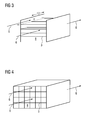
- FIGS. 2 to 6 Various convenient arrangements of the electrodes 2 are given. Due to the high reactivity of the OH ° radicals, these act only in relatively small surroundings of the electrodes 2. Furthermore, it is expedient that the electrodes 2, that is to say the anode 3 and the cathode 4, do not exceed 3000 cm 2 / ⁇ ( ⁇ cm). Remove from each other, so that the operating voltage and thus applied electric power is not too high. With a specific resistance of the medium to be treated of 100 ⁇ cm, this means a convenient electrode gap of 30 cm. For this reason, alternately one after another in alternating polarization anode 3 and cathode 4 are clamped in the form of grids or networks.
- transverse struts are arranged transversely to the flow direction 6 one behind the other and one above the other.
- FIG. 4 As well as in FIG. 3 is also in FIG. 4 given a further embodiment of a net-shaped electrode assembly. Again, cathode 4 and anode 3 are arranged one behind the other in the flow direction 6 alternately.
- the network is designed here in the form of a rectangular grid.
- the cross section of the electrodes 2 is adjusted according to the electric field distribution and the flow behavior of the sludge 1. So is both a round cross section as well as a wedge-shaped or a rectangular Cross section expedient.
- FIGS. 5 and 6 a concentric electrode arrangement described. These are tubular electrodes 2, which are arranged concentrically with each other.
- FIG. 6 is shown in cross-section, to build several concentric tubes as electrodes 2 into each other with alternating polarization.
- the applied electric field may be a continuous electric field. In principle, however, it has proven to be expedient to apply a pulsed electric field, since in this case higher electric fields can be generated at shorter pulse durations.
- Coated titanium or niobium in particular, has proven advantageous as the anode material.
- the coating for titanium and niobium is in particular platinum or iridium oxide or ruthenium oxide. Further, boron doped diamond coatings may be useful.
- Stainless steels can also be used if they have a chromium content of more than 20% and a nickel content of more than 20%. For the cathode, mild steel, stainless steel or carbon in graphite form has proven to be useful.
Landscapes
- Chemical & Material Sciences (AREA)
- Chemical Kinetics & Catalysis (AREA)
- Electrochemistry (AREA)
- General Chemical & Material Sciences (AREA)
- Life Sciences & Earth Sciences (AREA)
- Hydrology & Water Resources (AREA)
- Engineering & Computer Science (AREA)
- Environmental & Geological Engineering (AREA)
- Water Supply & Treatment (AREA)
- Organic Chemistry (AREA)
- Treatment Of Sludge (AREA)
- Water Treatment By Electricity Or Magnetism (AREA)
Applications Claiming Priority (1)
| Application Number | Priority Date | Filing Date | Title |
|---|---|---|---|
| DE102010041582A DE102010041582A1 (de) | 2010-09-29 | 2010-09-29 | Kombiniertes Verfahren zur Desinfektion, Verfahren zur Aufbereitung von Schlämmen |
Publications (1)
| Publication Number | Publication Date |
|---|---|
| EP2439178A1 true EP2439178A1 (fr) | 2012-04-11 |
Family
ID=45418337
Family Applications (1)
| Application Number | Title | Priority Date | Filing Date |
|---|---|---|---|
| EP11183095A Withdrawn EP2439178A1 (fr) | 2010-09-29 | 2011-09-28 | Procédé de traitement de boues |
Country Status (3)
| Country | Link |
|---|---|
| US (1) | US20120073985A1 (fr) |
| EP (1) | EP2439178A1 (fr) |
| DE (1) | DE102010041582A1 (fr) |
Cited By (1)
| Publication number | Priority date | Publication date | Assignee | Title |
|---|---|---|---|---|
| CN102718382A (zh) * | 2012-06-27 | 2012-10-10 | 常州浩瀚新材料科技有限公司 | 一种电化学直接氧化污泥的处理工艺 |
Families Citing this family (5)
| Publication number | Priority date | Publication date | Assignee | Title |
|---|---|---|---|---|
| WO2014179217A1 (fr) * | 2013-04-29 | 2014-11-06 | Save The World Air, Inc. | Appareil et procédé pour réduire la viscosité |
| ITMI20132015A1 (it) * | 2013-12-03 | 2015-06-04 | Industrie De Nora Spa | Cella elettrolitica dotata di coppie concentriche di elettrodi |
| CN108249722A (zh) * | 2018-03-21 | 2018-07-06 | 郝会杰 | 一种环保淤泥治理水循环利用设备 |
| CN109020111A (zh) * | 2018-07-25 | 2018-12-18 | 上海栋青睐生态科技有限公司 | 底泥削减处理装置 |
| CN118580897B (zh) * | 2024-08-01 | 2024-10-11 | 四川惟倍特科技有限公司 | 一种污泥制颗粒燃料系统及处理工艺 |
Citations (10)
| Publication number | Priority date | Publication date | Assignee | Title |
|---|---|---|---|---|
| EP0074776A2 (fr) | 1981-09-08 | 1983-03-23 | Betz Europe, Inc. | Procédé pour le traitement de boue biologique |
| DE3635268A1 (de) | 1985-10-16 | 1987-04-23 | Enso Gutzeit Oy | Verfahren zur waermebehandlung von bioschlamm |
| JPS62117699A (ja) * | 1985-11-16 | 1987-05-29 | Ishigaki Kiko Kk | 下水汚泥,し尿汚泥等の電解脱水方法 |
| JPS62298491A (ja) * | 1986-06-17 | 1987-12-25 | Ishigaki Kiko Kk | 汚泥等の電解処理装置 |
| DE9312198U1 (de) | 1993-08-14 | 1993-10-28 | Langbein & Engelbracht Gmbh & Co Kg, 44879 Bochum | Anordnung zur Reduzierung des Feuchtegehalts von Bioschlamm |
| US5630915A (en) * | 1994-01-11 | 1997-05-20 | Greene; Hugh W. | Liquid decontamination system using electrical discharge with gas injection |
| DE69810722T2 (de) | 1997-09-19 | 2003-11-13 | Kurita Water Industries, Ltd. | Verfahren zur Behandlung von Klärschlamm mit Ozon |
| DE102007056170A1 (de) | 2006-12-28 | 2008-11-06 | Dominik Peus | Semikontinuierliches Verfahren zur Herstellung von Brennstoff aus Biomasse |
| WO2009143629A1 (fr) * | 2008-05-30 | 2009-12-03 | Institut National De La Recherche Scientifique (Inrs) | Appareil et procédé pour la décontamination de déchets comprenant des molécules organiques toxiques |
| US20100078389A1 (en) * | 2008-10-01 | 2010-04-01 | Maria Elektorowicz | Method of Treating Sludge Material Using Electrokinetics |
Family Cites Families (2)
| Publication number | Priority date | Publication date | Assignee | Title |
|---|---|---|---|---|
| US6887368B2 (en) * | 2002-09-25 | 2005-05-03 | Ural Process Engineering Company, Ltd. | Method and device for electroextraction of heavy metals from technological solutions and wastewater |
| WO2009026208A2 (fr) * | 2007-08-23 | 2009-02-26 | Dow Global Technologies Inc. | Purification de saumure |
-
2010
- 2010-09-29 DE DE102010041582A patent/DE102010041582A1/de not_active Withdrawn
-
2011
- 2011-09-28 US US13/246,993 patent/US20120073985A1/en not_active Abandoned
- 2011-09-28 EP EP11183095A patent/EP2439178A1/fr not_active Withdrawn
Patent Citations (10)
| Publication number | Priority date | Publication date | Assignee | Title |
|---|---|---|---|---|
| EP0074776A2 (fr) | 1981-09-08 | 1983-03-23 | Betz Europe, Inc. | Procédé pour le traitement de boue biologique |
| DE3635268A1 (de) | 1985-10-16 | 1987-04-23 | Enso Gutzeit Oy | Verfahren zur waermebehandlung von bioschlamm |
| JPS62117699A (ja) * | 1985-11-16 | 1987-05-29 | Ishigaki Kiko Kk | 下水汚泥,し尿汚泥等の電解脱水方法 |
| JPS62298491A (ja) * | 1986-06-17 | 1987-12-25 | Ishigaki Kiko Kk | 汚泥等の電解処理装置 |
| DE9312198U1 (de) | 1993-08-14 | 1993-10-28 | Langbein & Engelbracht Gmbh & Co Kg, 44879 Bochum | Anordnung zur Reduzierung des Feuchtegehalts von Bioschlamm |
| US5630915A (en) * | 1994-01-11 | 1997-05-20 | Greene; Hugh W. | Liquid decontamination system using electrical discharge with gas injection |
| DE69810722T2 (de) | 1997-09-19 | 2003-11-13 | Kurita Water Industries, Ltd. | Verfahren zur Behandlung von Klärschlamm mit Ozon |
| DE102007056170A1 (de) | 2006-12-28 | 2008-11-06 | Dominik Peus | Semikontinuierliches Verfahren zur Herstellung von Brennstoff aus Biomasse |
| WO2009143629A1 (fr) * | 2008-05-30 | 2009-12-03 | Institut National De La Recherche Scientifique (Inrs) | Appareil et procédé pour la décontamination de déchets comprenant des molécules organiques toxiques |
| US20100078389A1 (en) * | 2008-10-01 | 2010-04-01 | Maria Elektorowicz | Method of Treating Sludge Material Using Electrokinetics |
Non-Patent Citations (2)
| Title |
|---|
| DATABASE WPI Section Ch Week 198727, 1987 Derwent World Patents Index; Class D15, AN 1987-188573, XP002668969 * |
| DATABASE WPI Section Ch Week 198806, 1988 Derwent World Patents Index; Class D15, AN 1988-039727, XP002668968 * |
Cited By (2)
| Publication number | Priority date | Publication date | Assignee | Title |
|---|---|---|---|---|
| CN102718382A (zh) * | 2012-06-27 | 2012-10-10 | 常州浩瀚新材料科技有限公司 | 一种电化学直接氧化污泥的处理工艺 |
| CN102718382B (zh) * | 2012-06-27 | 2014-01-15 | 常州浩瀚新材料科技有限公司 | 一种电化学直接氧化污泥的处理工艺 |
Also Published As
| Publication number | Publication date |
|---|---|
| US20120073985A1 (en) | 2012-03-29 |
| DE102010041582A1 (de) | 2012-03-29 |
Similar Documents
| Publication | Publication Date | Title |
|---|---|---|
| DE60011582T2 (de) | Vorrichtung und verfahren zur behandlung von mit organischen stoffen belastetem abwasser | |
| EP2439178A1 (fr) | Procédé de traitement de boues | |
| DE60129594T2 (de) | Vorrichtung zur reinigung von wasser, welches gelöste organische substanzen sowie spuren schädlicher stoffe enthält | |
| DE1299608B (de) | Verfahren und Vorrichtung zur elektrolytischen Entfernung von Spuren von Metallen aus nichtmetallischen waessrigen Salzloesungen | |
| DE60023958T2 (de) | Elektrode | |
| DE2430982A1 (de) | Einrichtung zum verringern der mikrobiologischen und chemischen aktivitaet von wasser | |
| DE102013011395A1 (de) | Verfahren zur Abwasserbehandlung und Einrichtung zur Durchführung dieses Verfahrens | |
| DE2604371A1 (de) | Verfahren zum elektrochemischen entfernen verunreinigender ionen aus einem ionisierenden medium sowie elektrochemische zelle zur durchfuehrung des verfahrens | |
| EP2188217A1 (fr) | Dispositif et procédé pour décomposer des substances nocives dans un liquide et utilisation d'un tel dispositif | |
| EP0862538B1 (fr) | Procede et dispositif de traitement d'eau chargee en micro-organismes et/ou en polluants | |
| CN101353193A (zh) | 水处理方法及设备 | |
| EP3539932B1 (fr) | Procédé d'optimisation de la déshydratation de boue d'un procédé d'épuration biologique | |
| DE4400308A1 (de) | Verfahren und Vorrichtung zur Schadstoffbeseitigung | |
| EP0322478A1 (fr) | Procédé et dispositif pour le traitement de l'eau par l'oxydation anodique, spécialement pour la production d'eau potable stérile | |
| DE102016119080A1 (de) | Vorrichtung zum elektrochemischen Behandeln von Abwasser | |
| DE60203393T2 (de) | Verfahren und vorrichtung zur unterwasserzersetzung organischer substanzen in elektrisch leitenden, wässrigen abfalllösungen | |
| EP1036769B1 (fr) | Appareil pour le traitement electrolytique de l eau ou de solutions aqueuses | |
| WO2019202161A2 (fr) | Réacteur de précipitation électrochimique comprenant une électrode en mouvement | |
| DE69802300T2 (de) | Behandlung von schädlichen flüssigkeiten | |
| EP1518828B1 (fr) | Procédé et dispositif d'oxydation anodique de cyanures dans des solutions aqueuses | |
| DE2122745A1 (fr) | ||
| EP1945578A1 (fr) | Optoreacteur | |
| WO2009050163A2 (fr) | Procédé de traitement électrochimique des eaux résiduaires à l'aide d'une électrode de diamant et de dioxyde de titane | |
| EP3249729A1 (fr) | Procédé et dispositifs de production de courant bioélectriques à partir de constituants organiques d'eaux usées | |
| WO2017072091A1 (fr) | Électrolyseur pour le traitement électrochimique de l'eau |
Legal Events
| Date | Code | Title | Description |
|---|---|---|---|
| AK | Designated contracting states |
Kind code of ref document: A1 Designated state(s): AL AT BE BG CH CY CZ DE DK EE ES FI FR GB GR HR HU IE IS IT LI LT LU LV MC MK MT NL NO PL PT RO RS SE SI SK SM TR |
|
| AX | Request for extension of the european patent |
Extension state: BA ME |
|
| PUAI | Public reference made under article 153(3) epc to a published international application that has entered the european phase |
Free format text: ORIGINAL CODE: 0009012 |
|
| STAA | Information on the status of an ep patent application or granted ep patent |
Free format text: STATUS: THE APPLICATION IS DEEMED TO BE WITHDRAWN |
|
| RAP1 | Party data changed (applicant data changed or rights of an application transferred) |
Owner name: SIEMENS AKTIENGESELLSCHAFT |
|
| 18D | Application deemed to be withdrawn |
Effective date: 20121012 |