EP2442225A2 - Modulo-betriebsverfahren und vorrichtung dafür - Google Patents
Modulo-betriebsverfahren und vorrichtung dafür Download PDFInfo
- Publication number
- EP2442225A2 EP2442225A2 EP10786375A EP10786375A EP2442225A2 EP 2442225 A2 EP2442225 A2 EP 2442225A2 EP 10786375 A EP10786375 A EP 10786375A EP 10786375 A EP10786375 A EP 10786375A EP 2442225 A2 EP2442225 A2 EP 2442225A2
- Authority
- EP
- European Patent Office
- Prior art keywords
- equal
- value
- output
- updated
- input
- Prior art date
- Legal status (The legal status is an assumption and is not a legal conclusion. Google has not performed a legal analysis and makes no representation as to the accuracy of the status listed.)
- Withdrawn
Links
Images


Classifications
-
- G—PHYSICS
- G06—COMPUTING OR CALCULATING; COUNTING
- G06F—ELECTRIC DIGITAL DATA PROCESSING
- G06F7/00—Methods or arrangements for processing data by operating upon the order or content of the data handled
- G06F7/60—Methods or arrangements for performing computations using a digital non-denominational number representation, i.e. number representation without radix; Computing devices using combinations of denominational and non-denominational quantity representations, e.g. using difunction pulse trains, STEELE computers, phase computers
- G06F7/72—Methods or arrangements for performing computations using a digital non-denominational number representation, i.e. number representation without radix; Computing devices using combinations of denominational and non-denominational quantity representations, e.g. using difunction pulse trains, STEELE computers, phase computers using residue arithmetic
-
- G—PHYSICS
- G06—COMPUTING OR CALCULATING; COUNTING
- G06F—ELECTRIC DIGITAL DATA PROCESSING
- G06F7/00—Methods or arrangements for processing data by operating upon the order or content of the data handled
-
- G—PHYSICS
- G06—COMPUTING OR CALCULATING; COUNTING
- G06F—ELECTRIC DIGITAL DATA PROCESSING
- G06F7/00—Methods or arrangements for processing data by operating upon the order or content of the data handled
- G06F7/38—Methods or arrangements for performing computations using exclusively denominational number representation, e.g. using binary, ternary, decimal representation
- G06F7/48—Methods or arrangements for performing computations using exclusively denominational number representation, e.g. using binary, ternary, decimal representation using non-contact-making devices, e.g. tube, solid state device; using unspecified devices
- G06F7/52—Multiplying; Dividing
-
- G—PHYSICS
- G06—COMPUTING OR CALCULATING; COUNTING
- G06F—ELECTRIC DIGITAL DATA PROCESSING
- G06F7/00—Methods or arrangements for processing data by operating upon the order or content of the data handled
- G06F7/38—Methods or arrangements for performing computations using exclusively denominational number representation, e.g. using binary, ternary, decimal representation
- G06F7/48—Methods or arrangements for performing computations using exclusively denominational number representation, e.g. using binary, ternary, decimal representation using non-contact-making devices, e.g. tube, solid state device; using unspecified devices
- G06F7/52—Multiplying; Dividing
- G06F7/535—Dividing only
-
- G—PHYSICS
- G06—COMPUTING OR CALCULATING; COUNTING
- G06F—ELECTRIC DIGITAL DATA PROCESSING
- G06F2207/00—Indexing scheme relating to methods or arrangements for processing data by operating upon the order or content of the data handled
- G06F2207/535—Indexing scheme relating to groups G06F7/535 - G06F7/5375
- G06F2207/5353—Restoring division
Definitions
- the present invention relates to a modulo operation method and apparatus and, more particularly, to a modulo operation method and apparatus that can be used to generate a preamble signal that is transmitted through a Physical Random Access Channel (PRACH) for synchronization acquisition in a Long Term Evolution (LTE) wireless communication system.
- PRACH Physical Random Access Channel
- Equation 1 a modulo operation specified by Equation 1 is used to generate a preamble signal, which is transmitted through the physical random access channel (PRACH) for synchronization acquisition.
- PRACH physical random access channel
- a linear search scheme is employed to physically implement the modulo operation in Equation 1.
- this scheme using comparison between the dividend a ⁇ b and the divisor N, subtraction and comparison operations are repeated until the value of (a ⁇ b) ⁇ N becomes less than the value of N, and the final result becomes the remainder.
- utilization of such a linear search scheme for the modulo operation of Equation 1 necessitates employment of a divider, which may increase hardware complexity and worsen synthesis timing.
- the present invention has been made in view of the above problems, and the present invention is to provide a modulo operation method and apparatus that can reduce the amount of computation and increase computation speed using a pipeline modulo operation.
- the present invention also provides a modulo operation method and apparatus that can perform a modulo operation without a divider.
- An aspect of the present invention is to provide a modulo operation method, in a case where the square of a divisor N is greater than or equal to a dividend C , including: determining the number of computation stages n satisfying 2 n ⁇ N ⁇ 2 n+1 ; performing an initialization operation by initializing a constant a to the smallest integer greater than or equal to half of N ; performing a first operation by subtracting, when C is greater than or equal to N ⁇ a (product of N and a ), the value of C by the value of N ⁇ a; and performing a second operation by assigning the smallest integer greater than or equal to half of a to the value of a, wherein the value of C is output as the result of modulo operation after the first operation and the second operation are repeated n times.
- the first operation when C is less than N ⁇ a, the value of C is unchanged.
- Another aspect of the present invention is to provide a modulo operation apparatus, in a case where the square of a divisor N is greater than or equal to a dividend C , including: a plurality of operation blocks connected in series, wherein each operation block comprises a multiplier taking N and a constant a as input to multiply N and a , a subtractor taking C and the output of the multiplier as input to subtract C by the output of the multiplier, and a first comparator taking C and the output of the subtractor to output, when C is greater than or equal to N ⁇ a, the output of the subtractor as updated C; and a control block computing the number of operation blocks n satisfying 2 n ⁇ N ⁇ 2 n+1 , setting the initial value of a to the smallest integer greater than or equal to half of N, and assigning the smallest integer greater than or equal to half of a input to the x-th operation block to the value of a input to the x+1-th operation block, wherein the updated value of C output by the n-th operation
- Still another aspect of the present invention is to provide a modulo operation apparatus, in a case where the square of a divisor N is greater than or equal to a dividend C , including: an operation block comprising a multiplier taking N and a constant a as input to multiply N and a , a subtractor taking C and the output of the multiplier as input to subtract C by the output of the multiplier, and a first comparator taking C and the output of the subtractor to output, when C is greater than or equal to N ⁇ a, the output of the subtractor as updated and feed updated C back to the subtractor; and a control block computing the number of repetition stages n satisfying 2 n ⁇ N ⁇ 2 n+1 , setting the initial value of a to the smallest integer greater than or equal to half of N, and assigning the smallest integer greater than or equal to half of a input to the x-th repetition stage to the value of a input to the x+1-th repetition stage, wherein the updated value of C output by the n-th repetition stage is the
- the amount of computation in a modulo operation or division operation does not increase in linear proportion to the magnitude of the divisor N but increases in proportion to log N. As a result, the total amount of computation decreases and computation speed increases.
- Generation of a PRACH preamble signal involves: cyclic shifting of Zadoff-Chu (ZC) sequences of length 839 to obtain ZC sequences with zero correlation zone (ZC-ZCZ); and computing the 839-point discrete Fourier transform (DFT) of ZC-ZCZ.
- ZC Zadoff-Chu
- ZC-ZCZ zero correlation zone
- DFT discrete Fourier transform
- direct use of a DFT block for PRACH may result in too high hardware complexity and memory waste, considering usage frequencies of the channel used only for random access.
- the DFT of ZC-ZCZ may be computed using constant amplitude zero autocorrelation (CAZAC) sequences similar to the DFT of ZC-ZCZ instead of directly computing 839-point DFT.
- CAZAC constant amplitude zero autocorrelation
- the u-th root Zadoff-Chu sequence of length (Nzc) 839 is defined by Equation 2.
- x n n e - j ⁇ ⁇ un ⁇ n + 1
- the discrete Fourier transform of a ZC sequence x u (n) may be represented as a CAZAC sequence given by Equation 3.
- a PRACH preamble signal is generated using ZC-ZCZ obtained by cyclic shifting of the ZC sequence (not using ZC-ZCZ itself), and ZC-ZCZ obtained by cyclic shifting of the ZC sequence (Equation 2) is given by Equation 4.
- x n , v n x u ⁇ n + Cv mod Nzc
- Equation 3 ZC sequence - CAZAC sequence relation
- Equation 4 ZC sequence - ZC-ZCZ sequence relation
- a preamble signal is generated through computation of the DFT of ZC-ZCZ sequences as in Equation 5.
- Equation 1 it is necessary to perform a modulo operation as in Equation 1 to obtain the value of Equation 5.
- a linear search scheme is employed to perform the modulo operation.
- the amount of computation is linearly proportional to the length Nzc, obtaining the remainder requires many computation stages and a long computation time.
- the present invention provides a modulo operation method that, for given C and N, when the modulo operation can be represented in a form of Equation 6, can produce the quotient x and the remainder m within a minimum number of computation stages (n).
- a ⁇ b Nx + m where , a ⁇ b ⁇ N 2
- a first value greater than ⁇ N 2 ⁇ is found; when x is determined to be present in an interval greater than ⁇ N 2 ⁇ a • b ⁇ N ⁇ N 2 ⁇ , a second value greater than ⁇ N 2 ⁇ + ⁇ ⁇ N 2 ⁇ 2 ⁇ is found, and when x is determined to be not present in the interval greater than ⁇ N 2 ⁇ a • b ⁇ N ⁇ N 2 ⁇ , a third value greater than ⁇ ⁇ N 2 ⁇ 2 ⁇ is found.
- n times may produce the quotient x and the remainder m, and the minimum number of computation stages for finding the quotient and the remainder may be set to n satisfying Equation 7. 2 n ⁇ N ⁇ 2 n + 1
- FIG. 1 is a flowchart of a modulo operation method for a wireless communication system according to an embodiment of the present invention.
- N the square of the divisor
- the number of computation stages n satisfying 2 n ⁇ N ⁇ 2 n+1 is determined (100). For example, as 2 3 ⁇ N ⁇ 2 3+1 (8 ⁇ 13 ⁇ 16), the number of computation stages for the modulo operation is 3.
- the dividend C is initialized to the value of a ⁇ b (i.e., 121) and the quotient Q is initialized to 0 (105).
- a 1 is set to 7 ⁇ 13 2 ⁇ .
- C is greater than or equal to N ⁇ a 1 at step 110
- the value of C is subtracted by the value of N ⁇ a 1 (115)
- the value of Q is incremented by a 1 (120)
- computation proceeds to step 125 (the next stage).
- C is less than N ⁇ a 1 at step 110
- computation proceeds to step 125 (the next stage).
- a 2 is ⁇ a 2 2 ⁇ (i.e., the smallest integer greater than or equal to half of a 1 ).
- a 2 is set to 4 ⁇ 7 2 ⁇ .
- a 3 is ⁇ a 2 2 ⁇ (i.e., the smallest integer greater than or equal to half of a 2 ). Hence, a 3 is set to 2 ⁇ 4 2 ⁇ .
- the value of C is subtracted by the value of N ⁇ a 3 (145), the value of Q is incremented by a 3 (150), and computation proceeds to the next stage.
- C is less than N ⁇ a 3 at step 140, computation proceeds to the next stage.
- the next stage is absent and hence the final result will be output.
- FIG. 2 is a block diagram of a modulo operation apparatus for a wireless communication system according to another embodiment of the present invention.
- operation blocks 200, 210 and 220 are depicted for three computation stages.
- those skilled in the art of the present invention may readily increase or decrease the number of operation blocks according to the magnitude of N.
- an operation block of the modulo operation apparatus in a wireless communication system includes a multiplier 201, a subtractor 202 and a first comparator 203 for modulo operation, and further includes an adder 204 and a second comparator 205 for division operation.
- the number of modulo operation blocks n satisfying 2 n ⁇ N ⁇ 2 n+1 is determined. For example, as 2 3 ⁇ N ⁇ 2 3+1 (8 ⁇ 13 ⁇ 16), the number of modulo operation blocks is 3.
- input C 1 (dividend) is initialized to the value of a ⁇ b and input a 1 (constant) is initialized to ⁇ N 2 ⁇ , and Q is initialized to 0.
- C 1 is set to 121
- a 1 is set to 7 ⁇ 13 2 ⁇ .
- the modulo operation is described first.
- an input constant a 1 is multiplied by the dividend N by the multiplier 201, and C 1 is subtracted by N ⁇ a 1 by the subtractor 202.
- the first comparator 203 outputs, when C 1 is greater than or equal to N ⁇ a 1 , the result of the subtractor 202 as an input (C 2 ) to the second-stage operation block 210, and outputs, when C 1 is less than N ⁇ a 1 , C 1 as an input (C 2 ) to the second-stage operation block 210.
- C 1 is 121 and N ⁇ a 1 is 91
- C 1 is greater than N ⁇ a 1 .
- the first comparator 203 outputs 30 (result of the subtractor 202) as an input (C 2 ) to the second-stage operation block 210.
- Q 1 and a 1 are added by the adder 204, and Q 1 and the output of the adder 204 are input to the second comparator 205.
- the second comparator 205 outputs, when C 1 is greater than or equal to N ⁇ a 1 , the result of the adder 204 as an input (Q 2 ) to the second-stage operation block 210, and outputs, when C 1 is less than N ⁇ a 1 , Q 1 as an input (Q 2 ) to the second-stage operation block 210.
- the second comparator 205 outputs 7 (output of the adder 204) as an input (Q 2 ) to the second-stage operation block 210.
- input a 2 is multiplied by N by the multiplier 211, and input C 2 is subtracted by N ⁇ a 2 by the subtractor 212.
- a 2 ⁇ a 1 2 ⁇ i.e., the smallest integer greater than or equal to half of a 1 ).
- a 2 is set to 4 ⁇ 7 2 ⁇ .
- the first comparator 213 outputs, when C 2 is greater than or equal to N ⁇ a 2 , the result of the subtractor 212 as an input (C 3 ) to the third-stage operation block 220, and outputs, when C 2 is less than N ⁇ a 2 , C 2 as an input (C 3 ) to the third-stage operation block 220.
- C 2 is 30 and N ⁇ a 2 is 52, C 2 is less than N ⁇ a 2 .
- the first comparator 213 outputs C 2 as an input (C 3 ) to the third-stage operation block 220.
- the second comparator 215 outputs, when C 2 is greater than or equal to N ⁇ a 2 , the result of the adder 214 as an input (Q 3 ) to the third-stage operation block 220, and outputs, when C 2 is less than N ⁇ a 2 , Q 2 as an input (Q 3 ) to the third-stage operation block 220.
- the second comparator 215 outputs 7 (Q 2 ) as an input (Q 3 ) to the third-stage operation block 220.
- a 3 is ⁇ a 2 2 ⁇ (i.e., the smallest integer greater than or equal to the half of a 2 ).
- a 3 is set to 2 ⁇ 4 2 ⁇ .
- the first comparator 223 outputs, when C 3 is greater than or equal to N ⁇ a 3 , the result of the subtractor 222 as the result of modulo operation, and outputs, when C 3 is less than N ⁇ a 3 , C 3 as the result of modulo operation.
- C 3 is 30 and N ⁇ a 3 is 26, C 3 is greater than N ⁇ a 3 .
- the first comparator 223 outputs 4 (output of the subtractor 222) as the result of modulo operation.
- the second comparator 225 outputs, when C 3 is greater than or equal to N ⁇ a 3 , the result of the adder 224 as the result of division operation, and outputs, when C 3 is less than N ⁇ a 3 , Q 3 as the result of division operation.
- the second comparator 225 outputs 9 (output of the adder 224) as the result of the division operation.
- the modulo operation apparatus for a wireless communication system may further include a control block (not shown) to compute the number of computation stages n and set constant a 1 to the smallest integer greater than or equal to half of the divisor N.
- the control block may set a x to the smallest integer greater than or equal to half of a x-1 and input a x to the x-th computation stage, and control n operation blocks to perform the modulo operation method of the present invention.
- FIG. 3 is a block diagram of a modulo operation apparatus for a wireless communication system according to another embodiment of the present invention.
- the modulo operation apparatus of FIG. 3 unlike the modulo operation apparatus of FIG. 2 composed of operation blocks connected in series, is composed of a single operation block 250 operating in a recursive manner.
- the operation block 250 operating in a recursive manner includes a multiplier 251, a subtractor 252 and a first comparator 253 for modulo operation, and further includes an adder 254 and a second comparator 255 for division operation.
- the modulo operation apparatus of FIG. 3 is configured so that the results of the x-1 th repetition operation are input to the x-th repetition operation, and includes a control block (not shown) to compute the number of repetition operations n and to output C and Q as the remainder and the quotient after n repetitions.
- control block initializes constant a to the smallest integer greater than or equal to half of the divisor N, and sets the value of a for x+1th repetition to the smallest integer greater than or equal to half of a at the x-th repetition.
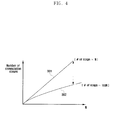
- FIG. 4 illustrates performance of the modulo operation method for a wireless communication system of the present invention in comparison to a related art modulo operation method.
- the number of computation stages in the method of the present invention is compared with that of a related art method.
- the modulo operation apparatus of the present invention performs a pipeline modulo operation of log N computation stages to thereby significantly reduce the number of computation stages and remarkably increase computation speed, in comparison to related art technology.
- Reference symbol 301 indicates performance of a related art modulo operation method based on linear search, where the number of computation stages increases in linear proportion to the divisor N.
- Reference symbol 302 indicates performance of the modulo operation method of the present invention, where the number of computation stages increases in proportion to the logarithm of the divisor N. Hence, as the divisor N increases, the effect of decrease in the number of computation stages increases.
Landscapes
- Engineering & Computer Science (AREA)
- Physics & Mathematics (AREA)
- General Physics & Mathematics (AREA)
- Theoretical Computer Science (AREA)
- Mathematical Optimization (AREA)
- Pure & Applied Mathematics (AREA)
- Mathematical Analysis (AREA)
- Computational Mathematics (AREA)
- General Engineering & Computer Science (AREA)
- Computing Systems (AREA)
- Mathematical Physics (AREA)
- Error Detection And Correction (AREA)
- Mobile Radio Communication Systems (AREA)
- Complex Calculations (AREA)
Applications Claiming Priority (2)
| Application Number | Priority Date | Filing Date | Title |
|---|---|---|---|
| KR1020090051480A KR101592920B1 (ko) | 2009-06-10 | 2009-06-10 | 모듈러 연산 방법 및 이를 위한 장치 |
| PCT/KR2010/003719 WO2010143892A2 (ko) | 2009-06-10 | 2010-06-10 | 나머지 연산 방법 및 이를 위한 장치 |
Publications (2)
| Publication Number | Publication Date |
|---|---|
| EP2442225A2 true EP2442225A2 (de) | 2012-04-18 |
| EP2442225A4 EP2442225A4 (de) | 2013-01-02 |
Family
ID=43309371
Family Applications (1)
| Application Number | Title | Priority Date | Filing Date |
|---|---|---|---|
| EP10786375A Withdrawn EP2442225A4 (de) | 2009-06-10 | 2010-06-10 | Modulo-betriebsverfahren und vorrichtung dafür |
Country Status (4)
| Country | Link |
|---|---|
| US (1) | US8880577B2 (de) |
| EP (1) | EP2442225A4 (de) |
| KR (1) | KR101592920B1 (de) |
| WO (1) | WO2010143892A2 (de) |
Families Citing this family (4)
| Publication number | Priority date | Publication date | Assignee | Title |
|---|---|---|---|---|
| US8569121B2 (en) | 2011-11-01 | 2013-10-29 | International Business Machines Corporation | Graphene and nanotube/nanowire transistor with a self-aligned gate structure on transparent substrates and method of making same |
| US9535656B2 (en) | 2014-03-14 | 2017-01-03 | International Business Machines Corporation | Pipelined modular reduction and division |
| KR102653018B1 (ko) | 2019-01-16 | 2024-03-29 | 삼성전자주식회사 | 랜덤 넘버를 이용하여 나머지 연산을 수행하는 보안 프로세서 및 이의 동작 방법 |
| US11507813B2 (en) * | 2020-06-01 | 2022-11-22 | Arm Limited | Modulo operation unit |
Family Cites Families (10)
| Publication number | Priority date | Publication date | Assignee | Title |
|---|---|---|---|---|
| US4550339A (en) | 1983-11-21 | 1985-10-29 | Rca Corporation | Binary divider as for a digital auto flesh circuit |
| GB8815868D0 (en) | 1988-07-04 | 1988-08-10 | British Aerospace | Digital signal processing |
| US5237525A (en) * | 1992-06-01 | 1993-08-17 | Motorola, Inc. | In a data processor an SRT divider having a negative divisor sticky detection circuit |
| JP3506753B2 (ja) * | 1994-02-28 | 2004-03-15 | 富士通株式会社 | 除算方法および除算装置 |
| US5563818A (en) * | 1994-12-12 | 1996-10-08 | International Business Machines Corporation | Method and system for performing floating-point division using selected approximation values |
| KR100195719B1 (ko) * | 1995-12-28 | 1999-06-15 | 전주범 | 나눗셈기 |
| KR100206116B1 (ko) * | 1996-01-17 | 1999-07-01 | 윤종용 | 나머지 계산방법 및 회로 |
| KR100253806B1 (ko) * | 1997-04-22 | 2000-04-15 | 구자홍 | 키 생성 방법 |
| KR100853787B1 (ko) * | 2004-12-31 | 2008-08-25 | 동부일렉트로닉스 주식회사 | 가변 진법 나눗셈 연산기 |
| US7519649B2 (en) * | 2005-02-10 | 2009-04-14 | International Business Machines Corporation | System and method for performing decimal division |
-
2009
- 2009-06-10 KR KR1020090051480A patent/KR101592920B1/ko not_active Expired - Fee Related
-
2010
- 2010-06-10 EP EP10786375A patent/EP2442225A4/de not_active Withdrawn
- 2010-06-10 US US13/377,650 patent/US8880577B2/en not_active Expired - Fee Related
- 2010-06-10 WO PCT/KR2010/003719 patent/WO2010143892A2/ko not_active Ceased
Also Published As
| Publication number | Publication date |
|---|---|
| WO2010143892A3 (ko) | 2011-04-28 |
| US20120089658A1 (en) | 2012-04-12 |
| US8880577B2 (en) | 2014-11-04 |
| KR20100132728A (ko) | 2010-12-20 |
| EP2442225A4 (de) | 2013-01-02 |
| WO2010143892A2 (ko) | 2010-12-16 |
| KR101592920B1 (ko) | 2016-02-12 |
Similar Documents
| Publication | Publication Date | Title |
|---|---|---|
| US8145692B2 (en) | Digital generation of an accelerated or decelerated chaotic numerical sequence | |
| US7937427B2 (en) | Digital generation of a chaotic numerical sequence | |
| US8180055B2 (en) | Cryptographic system incorporating a digitally generated chaotic numerical sequence | |
| US8588412B2 (en) | Mechanism for generating pseudorandom number sequences | |
| EP2332275B1 (de) | Effiziente zadoff-chu-sequenz-erzeugung | |
| US8880577B2 (en) | Modulo operation method and apparatus for same | |
| CN102959534B (zh) | 用于处理信号的方法和装置 | |
| JP3556461B2 (ja) | M系列の位相シフト係数算出方式 | |
| US20020174155A1 (en) | Method for calculating arithmetic inverse over finite fields for use in cryptography | |
| US20100115230A1 (en) | Hash functions using recurrency and arithmetic | |
| CN116127523B (zh) | 一种隐私计算中的数据处理方法、装置及电子设备 | |
| KR100457925B1 (ko) | 로그 변환과 선형 근사를 이용하여 주파수 오프셋을계산하는 방법 | |
| Czyżak et al. | Pipelined sceling of signed residue numbers with the mixed-radix conversion in the programmable gate array | |
| Gómez-Pérez et al. | Algebraic entropy, automorphisms and sparsity of algebraic dynamical systems and pseudorandom number generators | |
| Handayani et al. | Analysis of Geffe Generator LFSR properties on the application of algebraic attack | |
| CN115878077A (zh) | 真随机数生成方法、装置、电子设备及可读存储介质 | |
| CN120567637B (zh) | 一种高效计算zc序列dft的方法 | |
| CN114706557A (zh) | 一种asic芯片及蒙哥马利模乘的实现方法和装置 | |
| WO2018015464A1 (en) | Method and device to verify if a number is prime | |
| Ostafe et al. | On pseudorandom numbers from multivariate polynomial systems | |
| RU107613U1 (ru) | Устройство для приема дискретных сигналов | |
| RU2549524C1 (ru) | Генератор нелинейных псевдослучайных последовательностей | |
| JPWO2001067605A1 (ja) | 疑似ランダム信号生成方法及びその装置 | |
| RU2665269C1 (ru) | Способ подавления помехи множественного доступа в системе цифровой связи | |
| RU2343628C2 (ru) | Способ преобразования случайных чисел с произвольным законом распределения в случайные числа с равномерным законом распределения |
Legal Events
| Date | Code | Title | Description |
|---|---|---|---|
| PUAI | Public reference made under article 153(3) epc to a published international application that has entered the european phase |
Free format text: ORIGINAL CODE: 0009012 |
|
| 17P | Request for examination filed |
Effective date: 20111207 |
|
| AK | Designated contracting states |
Kind code of ref document: A2 Designated state(s): AL AT BE BG CH CY CZ DE DK EE ES FI FR GB GR HR HU IE IS IT LI LT LU LV MC MK MT NL NO PL PT RO SE SI SK SM TR |
|
| DAX | Request for extension of the european patent (deleted) | ||
| RAP1 | Party data changed (applicant data changed or rights of an application transferred) |
Owner name: SAMSUNG ELECTRONICS CO., LTD. |
|
| A4 | Supplementary search report drawn up and despatched |
Effective date: 20121204 |
|
| RIC1 | Information provided on ipc code assigned before grant |
Ipc: G06F 7/52 20060101ALI20121128BHEP Ipc: G06F 7/535 20060101ALI20121128BHEP Ipc: G06F 7/00 20060101ALI20121128BHEP Ipc: G06F 7/72 20060101AFI20121128BHEP |
|
| 17Q | First examination report despatched |
Effective date: 20150127 |
|
| GRAP | Despatch of communication of intention to grant a patent |
Free format text: ORIGINAL CODE: EPIDOSNIGR1 |
|
| INTG | Intention to grant announced |
Effective date: 20170116 |
|
| STAA | Information on the status of an ep patent application or granted ep patent |
Free format text: STATUS: THE APPLICATION IS DEEMED TO BE WITHDRAWN |
|
| 18D | Application deemed to be withdrawn |
Effective date: 20170527 |