EP2443059B1 - Procédé de production de dioxyde de chlore - Google Patents
Procédé de production de dioxyde de chlore Download PDFInfo
- Publication number
- EP2443059B1 EP2443059B1 EP10725142.3A EP10725142A EP2443059B1 EP 2443059 B1 EP2443059 B1 EP 2443059B1 EP 10725142 A EP10725142 A EP 10725142A EP 2443059 B1 EP2443059 B1 EP 2443059B1
- Authority
- EP
- European Patent Office
- Prior art keywords
- chlorine dioxide
- stripper
- aqueous solution
- kpa
- gas
- Prior art date
- Legal status (The legal status is an assumption and is not a legal conclusion. Google has not performed a legal analysis and makes no representation as to the accuracy of the status listed.)
- Active
Links
Images
Classifications
-
- C—CHEMISTRY; METALLURGY
- C01—INORGANIC CHEMISTRY
- C01B—NON-METALLIC ELEMENTS; COMPOUNDS THEREOF; METALLOIDS OR COMPOUNDS THEREOF NOT COVERED BY SUBCLASS C01C
- C01B11/00—Oxides or oxyacids of halogens; Salts thereof
- C01B11/02—Oxides of chlorine
- C01B11/022—Chlorine dioxide (ClO2)
- C01B11/023—Preparation from chlorites or chlorates
-
- C—CHEMISTRY; METALLURGY
- C01—INORGANIC CHEMISTRY
- C01B—NON-METALLIC ELEMENTS; COMPOUNDS THEREOF; METALLOIDS OR COMPOUNDS THEREOF NOT COVERED BY SUBCLASS C01C
- C01B11/00—Oxides or oxyacids of halogens; Salts thereof
- C01B11/02—Oxides of chlorine
- C01B11/022—Chlorine dioxide (ClO2)
- C01B11/023—Preparation from chlorites or chlorates
- C01B11/025—Preparation from chlorites or chlorates from chlorates without any other reaction reducing agent than chloride ions
-
- C—CHEMISTRY; METALLURGY
- C01—INORGANIC CHEMISTRY
- C01B—NON-METALLIC ELEMENTS; COMPOUNDS THEREOF; METALLOIDS OR COMPOUNDS THEREOF NOT COVERED BY SUBCLASS C01C
- C01B11/00—Oxides or oxyacids of halogens; Salts thereof
- C01B11/02—Oxides of chlorine
- C01B11/022—Chlorine dioxide (ClO2)
- C01B11/023—Preparation from chlorites or chlorates
- C01B11/026—Preparation from chlorites or chlorates from chlorate ions in the presence of a peroxidic compound, e.g. hydrogen peroxide, ozone, peroxysulfates
-
- C—CHEMISTRY; METALLURGY
- C01—INORGANIC CHEMISTRY
- C01B—NON-METALLIC ELEMENTS; COMPOUNDS THEREOF; METALLOIDS OR COMPOUNDS THEREOF NOT COVERED BY SUBCLASS C01C
- C01B11/00—Oxides or oxyacids of halogens; Salts thereof
- C01B11/02—Oxides of chlorine
- C01B11/022—Chlorine dioxide (ClO2)
- C01B11/028—Separation; Purification
Definitions
- the present invention relates to a process for the production of chlorine dioxide enabling generation of gaseous chlorine dioxide at selected pressure.
- the reaction medium is maintained under non-crystallising conditions, generally at substantially atmospheric pressure.
- depleted reaction medium from a first reaction vessel is brought to a second reaction vessel for further reactions to produce chlorine dioxide.
- Depleted reaction medium withdrawn from the final reaction vessel usually referred to as residual acid, contains acid, alkali metal salt of the acid and normally some unreacted alkali metal chlorate. Examples of non-crystallising chlorine dioxide generation processes are described in EP 612686 , WO 2006/033609 , JP 03-115102 and JP 88-008203 .
- reaction medium is maintained in a single reaction vessel under boiling conditions at subatmospheric pressure, wherein alkali metal salt of the acid is precipitated and withdrawn as a salt cake.
- alkali metal salt of the acid is precipitated and withdrawn as a salt cake.
- SVP single vessel processes
- Chlorine dioxide is normally used as an aqueous solution obtained in the production process, particularly in pulp bleaching. It has also been disclosed to use chlorine dioxide in gas phase, for example for removing lignin from wood chips as described in US patents 6569285 and 6752904 , or for treatment of flue gas as described in e.g. US patent 3023076 .
- WO 2009/010456 discloses a process for producing gaseous chlorine dioxide in a reaction vessel maintained at super-atmospheric pressure by bringing withdrawn gaseous chlorine dioxide to an aqueous absorption medium and withdrawing gaseous chlorine dioxide from the absorption medium.
- the present invention concerns a process for the continuous production of chlorine dioxide comprising generating chlorine dioxide in an aqueous reaction medium in a reaction vessel maintained at sub-atmospheric pressure, bringing gaseous chlorine dioxide from said reaction vessel to an absorption tower and contacting it therein with a flow of water to form an aqueous solution containing chlorine dioxide, bringing said aqueous solution containing chlorine dioxide to a stripper, blowing a gas through said aqueous solution of chlorine dioxide in the stripper to strip off from 10 to 100% of the chlorine dioxide entering the stripper and form a gaseous chlorine dioxide product obtained from the stripper with a partial pressure of from 0.5 to 20 kPa.
- the chlorine dioxide may, for example, be generated as described in the earlier mentioned US patents 5091166 , 5091167 , 5366714 and 5770171 , and WO 2006/062455 .
- the chlorine dioxide is preferably generated by reducing chlorate ions by means of a chemical reducing agent.
- Any known reducing agent may be used alone or in mixtures, such as at least one of chloride ions, sulfur dioxide, methanol and hydrogen peroxide, of which methanol and hydrogen peroxide, alone or in mixture with one or more other reducing agents, are particularly preferred.
- the pressure and the temperature are preferably set so to evaporate water from the reaction medium to dilute the chlorine dioxide formed and withdrawn from the reaction medium and brought from the reaction vessel.
- the reaction medium is maintained at a temperature from about 15 to about 100°C, most preferably from about 30 to about 85°C.
- the reaction medium is maintained at an absolute pressure from about 8 to about 80 kPa, preferably from about 8 to about 55 kPa, most preferably from about 10 to about 50 kPa.
- the reaction medium is maintained at its boiling point at the prevailing pressure.
- the evaporation of water from the reaction medium normally consumes more energy than generated in the process, this is preferably balanced by supplying heat to the reaction medium, for example by circulating reaction medium through a heater in a circulation conduit. Any kind of heater may be used, such as heat exchangers heated by steam or any other hot fluid medium.
- alkali metal chlorate such as chlorate of sodium, potassium or mixtures thereof. Normally sodium is preferred. It is also possible to feed the alkali metal chlorate as a pre-mixed solution with the hydrogen peroxide.
- concentration of alkali metal chlorate maintained in the reaction medium may vary within wide limits, for example from about 0.25 moles/dm 3 up to saturation, preferably from about 1.5 moles/dm 3 up to saturation, most preferably from about 2.5 moles/dm 3 up to saturation.
- the aqueous reaction medium in the reaction vessel is preferably acidic, for example having an acidity from about 0.5 to about 12 N or from about 1 to about 10 N, most preferably from about 1.5 to about 7 N.
- the acidity may be provided by feeding any suitable acid, preferably a mineral acid.
- suitable acid preferably a mineral acid.
- acids include sulfuric acid, hydrochloric acid, phosphoric acid and chloric acid, of which sulfuric acid is particularly preferred.
- sulfuric acid is used, it is preferably fed at a concentration from about 30 to about 98 wt%, most preferably from about 60 to about 85wt%. Sulfuric acid of low concentration is easier to mix with the reaction medium, but a high concentration gives the advantage of utilisation of the heat of dilution and not needing to evaporate a lot of water.
- the amount fed is preferably balanced to the amount of chlorate fed in order to arrive at a steady state concentration in the generator suitable for the reducing agent chosen.
- hydrogen peroxide is used as reducing agent, it is preferably fed in an amount from about 0.5 to about 2 moles per mole alkali metal chlorate fed, most preferably from about 0.5 to about 1 mole per mole alkali metal chlorate fed, particularly most preferably from about 0.5 to about 0.6 moles per mole alkali metal chlorate fed.
- methanol is used as reducing agent, it is preferably fed in an amount from about 0.2 to about 1 moles per mole alkali metal chlorate fed, most preferably from about 0.2 to about 0.8 mole per mole alkali metal chlorate fed, particularly most preferably from about 0.2 to about 0.4 moles per mole alkali metal chlorate fed.
- At least some of the alkali metal sulfate formed is normally withdrawn, preferably as a solid salt cake which may be removed on a conventional filter, and may in some cases be used as a by-product.
- electrochemically acidify some of the alkali metal sulfate and recycle it to the reaction medium to replace some of the sulfuric acid feed is described in e.g. US patents 4129484 , 5478446 , 5487881 , 5858322 and 632269 .
- Gaseous chlorine dioxide gas is withdrawn from the reaction medium, preferably together with evaporated water and optionally other gaseous components formed or added, such as oxygen in case hydrogen peroxide is used as reducing agent.
- concentration of chlorine dioxide in the withdrawn gas is preferably maintained at a partial pressure from about 1 to about 30 kPa or from about 5 to about 10 kPa.
- the total pressure is also made up from the amount of water vapor and soluble and insoluble gases.
- High system utilisation may, depending on the reaction vessel design, result in a co-transportation of reaction medium as aerosols, thereby bringing electrolytic components to the absorption tower together with the chlorine dioxide.
- electrolytic components for example sodium chlorate or sodium sulfate, may in the present invention be separated from the final gaseous chlorine dioxide product.
- the gaseous chlorine dioxide withdrawn from the reaction medium is brought to an absorption tower where it is contacted with a flow of water to form an aqueous solution containing chlorine dioxide.
- absorption tower any column or tower or the like where gas is contacted with a liquid flow to absorb water soluble compounds therein. Gas and liquid preferably flow counter-currently.
- plates or packing elements are preferably placed to provide interfacial surfaces where the mass transfer between the gas and the liquid can take place. Any conventional packing elements and plates can be used such as Raschig rings, Berl saddles, Intalox saddles, sieve plates and bubble cap plates.
- the absorption tower is specially adapted for processes using chloride ions as reducing agents.
- Such an absorption tower is described in Barr, A. et al., The development of an integrated chlorine dioxide process to produce chlorine dioxide solution with low chlorine content, Appita J.,Vol 59, No. 6, (2006 ).
- the chlorine dioxide concentration in the aqueous solution obtained from the absorption tower is preferably from about 5 to about 18 g/dm 3 , or from about 8 to about 12 g/ dm 3 .
- the temperature is preferably from about 0 to about 35°C, or from about 5 to about 25°C.
- the pH of the aqueous solution obtained from the absorption tower can vary within a wide range, partly dependent on the chlorine dioxide concentration, such as from about 0.8 to about 3.2. If methanol is used as reducing agent, the pH is preferably from about 1.0 to about 2.5, while if hydrogen peroxide is used as reducing agent, the pH is preferably from.about 2.0 to about 3.2.
- the aqueous solution in the absorption tower is acidified to suppress the absorption of elemental chlorine andj possibly present formic acid by decreasing the chlorine hydrolysis and depressing the deprotonation of formic acid. Elemental chlorine and formic acid are then brought with the off gas from the absorption tower and are thus separated from the chlorine dioxide.
- the pH in the chlorine dioxide solution is preferably kept as low as possible or at least below pH 2 and most preferably below pH 1.4. Adjustment of pH can be made by any acid, but preferably sulfuric or hydrochloric acid is used.
- the pH of the aqueous chlorine dioxide solution leaving the absorption tower is increased to from about 6.5 to about 7.8, which decreases the release of volatile by-products from the chlorine dioxide generation process during the following stripping.
- Adjustment of the pH can be made by any alkali source, but preferably sodium hydroxide is used.
- a very high yield of chlorine dioxide with respect to the amount of added chlorate ions may be obtained in the gas stream leaving the stripper.
- Such a yield may be from 96 % , preferably from 98 %, most preferably from 99 % with respect to the amount of added chlorate ions.
- Non-absorbed gas departed from the absorption tower containing for example inert gas, oxygen and water vapor and small amounts of chlorine dioxide, may be used for various purposes like flue gas treatment as described in e.g. US patents 3023076 and 7118720 , and in WO 2007/058936 .
- the chlorine dioxide may otherwise be scrubbed off in a scrubber.
- the aqueous solution containing chlorine dioxide is brought from the absorption tower to a stripper, wherein from 10 to 100% of the chlorine dioxide is stripped off by blowing a gas through the aqueous chlorine dioxide solution to form a gaseous chlorine dioxide product.
- gaseous chlorine dioxide product is meant the gas leaving the stripper.
- the gaseous chlorine dioxide product may comprise any non-absorbed part of the gas blown through the aqueous solution in the stripper.
- Any type of stripper, or stripper column may be used, for example filler columns and packed columns. Any conventional packing elements may be used, such as structured packing, Raschig rings, Berl saddles, Intalox saddles etc.
- the gas used for stripping is preferably an inert gas. Any available inert gas such as nitrogen or oxygen can be used, but for cost reasons it is usually preferred to use air. If the application allows, it may be possible to recover the inert gas and reuse it in the stripper.
- inert gas such as nitrogen or oxygen
- part, or all, of the aqueous solution from the stripper may be recirculated to the absorption tower, in order to recover any remaining chlorine dioxide.
- the recirculation rate of depleted aqueous solution may be from about 0% to about 100%, preferably from about 70% to about 90%.
- the recirculation rate determines the desired desorption efficiency of the stripper.
- aqueous solution from the stripper to the reaction vessel to convert any remaining chlorate or any other reactants to chlorine dioxide.
- Such part of the aqueous solution may be from about 10 to about 80 %, preferably from about 10 to about 30 %.
- the aqueous chlorine dioxide solution from the absorption tower may be heated in order to enhance the desorption in the stripper.
- the depleted aqueous solution from the stripper may be cooled before it is recirculated to the absorption tower. This may be done by use of any heating or cooling media available or by use of a heat pump.
- the gaseous chlorine dioxide product from the stripper is maintained at a total absolute pressure from about 10 kPa to about 2 MPa, such as from about 95 kPa to about 2 MPa or 105 kPa to 1 MPa.
- the gaseous chlorine dioxide product obtained from the stripper has a partial pressure of chlorine dioxide from 0.5 kPa to 20 kPa, or from about 4 kPa to about 12 kPa. If the partial pressure of chlorine dioxide is too high the risk for rapid decomposition of chlorine dioxide is imminent.
- a desired pressure may be achieved by maintaining the bottom of the absorption tower at a height relative a pump bringing the aqueous chlorine dioxide to the stripper, thus forming a stand pipe.
- the chlorine dioxide is preferably contained in a gas having a pressure above atmospheric in order to be able to be led to the flue gas.
- the pressure can be increased by increasing the selected height between the pump and the bottom of the absorption tower.
- Such a height may be from 5 m, or 10, or 15 m up to 50 m, depending on the pressure desired.
- a stand pipe may similarly be formed by selecting the height of the bottom of the reaction vessel in relation to the pump.
- the desired pressure may also be achieved by using a pressure control valve after the stripper, allowing a pump to increase the pressure of the gaseous chlorine dioxide.
- a pressure control valve is needed both on the gas outlet and the residual solution.
- the stripper may be situated on the ground floor.
- the process is operated so the gaseous chlorine dioxide product has a content of elemental chlorine less than about 1 wt %, more preferably less than 0.2 wt % of the total active chlorine.
- the process is operated so the gaseous chlorine dioxide product may be essentially free from electrolytic impurities as chlorate and sulfate when leaving the stripper, or may have a content of chlorate and sulfate less than 0.1 mg sodium chlorate or sodium sulfate per normal cubic meter dry gas, respectively
- the process is operated so the gaseous chlorine dioxide product leaving the stripper has a content of formic acid less than about 100 mg formic acid per normal cubic meter dry gas, or more preferably less than 1 mg formic acid per normal cubic meter dry gas.
- the gaseous chlorine dioxide product Due to the absorbing, gases not soluble in water are not obtained in the aqueous solution containing chlorine dioxide.
- the stripping further increases the purity of the gaseous chlorine dioxide product.
- the gaseous chlorine dioxide product has a high purity in respect of raw materials and unwanted by-products which can be carried out together with the gas stream from the reaction vessel.
- an aqueous chlorine dioxide product is obtained by bringing the gaseous chlorine dioxide product to another absorption tower to form an aqueous chlorine dioxide product of the above mentioned high purity.
- Conditions for the absorption tower may be as described above.
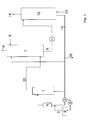
- a reaction vessel 1 holds a reaction medium under subatmospheric pressure.
- the reaction medium is circulated by a pump 2 through a circulation conduit 3 and a heater 4 (commonly called “reboiler”) and back to the reaction vessel 1 at a rate sufficient for keeping the temperature of the reaction medium at the boiling point.
- a sodium chlorate, sulfuric acid and a reducing agent such as methanol or hydrogen peroxide, are fed to the reaction vessel and reacted to form chlorine dioxide, sodium sulfate and, in case hydrogen peroxide is used, oxygen.
- Chlorine dioxide is withdrawn as a gas 20 together with evaporated water and optionally oxygen and is brought to an absorption tower 7.
- Sodium sulfate precipitates as a substantially neutral or acidic salt, depending on the acidity of the reaction medium.
- reaction medium is circulated through a filter 6 to separate and withdraw the solid sodium sulfate.
- the gaseous chlorine dioxide is contacted with a flow of water 8 to form an aqueous solution containing chlorine dioxide 9. Any non absorbed gas 10 will exit at the top of the absorption tower 7.
- the aqueous chlorine dioxide departs from the absorption tower 7 and is led by a pump 11 to a stripper 12.
- a gas 13, preferably an inert gas, usually air, is supplied to the bottom of the stripper 12 to strip off at least 10% chlorine dioxide entering the stripper 12 as a gaseous chlorine dioxide product 14 departing from the top of the stripper 12.
- an aqueous solution 15, in which part of the chlorine dioxide may remain, is withdrawn from the bottom of the stripper 12 and may fully or partially be recirculated to the absorption tower 7 or the reaction vessel 1.
- a stream purge 16 might be appropriate in order to maintain the water balance, depending on parameters such as the choice of chemistry, the outlet gas pressure and temperature, the choice of operating conditions in the chlorine dioxide generation and the operating conditions in the stripper. Depending on the operating conditions in the stripper, this stream 16 may contain various amounts of chlorine dioxide and should be treated accordingly. There might also be a demand for an aqueous chlorine dioxide solution for other purposes at the same site. It is then possible to use aqueous chlorine dioxide from the absorber 7, for example by taking out a side stream (not shown) departing from stream 9.
- the gas flow through the stripper may be continued to strip off chlorine dioxide from the stripper.
- the aqueous reaction medium in the reaction vessel 1 may contain about 150 g/ dm 3 NaClO 3 and about 340 g/ dm 3 H 2 SO 4 , while the gas leaving the reaction vessel may contain about 15-60% v/v of ClO 2 .
- the aqueous solution containing chlorine dioxide obtained in the absorption tower 7 may then have a temperature of about 10°C and contain about 10 g/ dm 3 ClO 2 .
- the partial pressure of the gaseous chlorine dioxide product obtained from the stripper 10 may be about 6 kPa and the total pressure of the gas stream leaving the stripper may be 105 kPa absolute.
Landscapes
- Chemical & Material Sciences (AREA)
- Organic Chemistry (AREA)
- Inorganic Chemistry (AREA)
- Life Sciences & Earth Sciences (AREA)
- General Life Sciences & Earth Sciences (AREA)
- Geology (AREA)
- Gas Separation By Absorption (AREA)
- Treating Waste Gases (AREA)
- Organic Low-Molecular-Weight Compounds And Preparation Thereof (AREA)
- Paper (AREA)
Claims (15)
- Procédé pour la production en continu de dioxyde de chlore comprenant le fait de générer du dioxyde de chlore dans un milieu de réaction aqueux dans une cuve de réaction maintenue à une pression sub-atmosphérique, d'amener le dioxyde de chlore gazeux depuis ladite cuve de réaction jusqu'à une tour d'absorption et de le mettre en contact dans celle-ci avec un flux d'eau pour former une solution aqueuse contenant du dioxyde de chlore, d'amener ladite solution aqueuse contenant du dioxyde de chlore jusqu'à une colonne de fractionnement, de souffler un gaz à travers ladite solution aqueuse de dioxyde de chlore dans la colonne de fractionnement pour séparer par entraînement de 10 à 100% du dioxyde de chlore entrant dans la colonne de fractionnement et de former un produit de dioxyde de chlore gazeux obtenu à partir de la colonne de fractionnement avec une pression partielle allant de 0,5 à 20 kPa.
- Procédé tel que revendiqué dans la revendication 1, dans lequel le dioxyde de chlore est généré par la réduction des ions chlorate à l'aide d'un agent de réduction chimique.
- Procédé tel que revendiqué dans la revendication 2, dans lequel ledit agent de réduction chimique est au moins l'un parmi le méthanol ou le peroxyde d'hydrogène.
- Procédé tel que revendiqué dans l'une quelconque des revendications précédentes, dans lequel de 40 à 95% du dioxyde de chlore entrant dans la colonne de fractionnement est séparé par entraînement.
- Procédé tel que revendiqué dans l'une quelconque des revendications précédentes, dans lequel de 85 à 95% du dioxyde de chlore entrant dans la colonne de fractionnement est séparé par entraînement.
- Procédé tel que revendiqué dans l'une quelconque des revendications précédentes, dans lequel ledit milieu de réaction est maintenu à une pression absolue d'environ 8 à environ 80 kPa.
- Procédé tel que revendiqué dans l'une quelconque des revendications précédentes, dans lequel ledit milieu de réaction est maintenu à son point d'ébullition à la pression régnante.
- Procédé tel que revendiqué dans l'une quelconque des revendications précédentes, dans lequel la température de la solution aqueuse contenant du dioxyde de chlore est d'environ 0 à environ 35°C.
- Procédé tel que revendiqué dans l'une des revendications précédentes, dans lequel le pH de la solution aqueuse de dioxyde de chlore provenant de la tour d'absorption est d'environ 6,5 à environ 7,8
- Procédé tel que revendiqué dans l'une quelconque des revendications précédentes, dans lequel un rendement total de dioxyde de chlore quittant la colonne de fractionnement est d'environ 96% par rapport aux ions chlorate ajoutés.
- Procédé tel que revendiqué dans l'une quelconque des revendications précédentes, dans lequel ledit produit de dioxyde de chlore gazeux est maintenu à une pression absolue totale d'environ 10 kPa à environ 2 MPa.
- Procédé tel que revendiqué dans l'une quelconque des revendications précédentes, dans lequel ledit produit de dioxyde de chlore gazeux est maintenu à une pression absolue totale d'environ 105 kPa à environ 1 MPa.
- Procédé tel que revendiqué dans l'une quelconque des revendications précédentes, dans lequel la solution aqueuse provenant de la colonne de fractionnement contenant du dioxyde de chlore restant est au moins en partie recyclée vers ladite tour d'absorption, ou vers ladite cuve de réaction.
- Procédé tel que revendiqué dans l'une quelconque des revendications précédentes, dans lequel le gaz soufflé à travers la solution aqueuse de dioxyde de chlore dans la colonne de fractionnement est un gaz inerte.
- Procédé tel que revendiqué dans la revendication 14, dans lequel ledit gaz inerte est l'air.
Priority Applications (2)
| Application Number | Priority Date | Filing Date | Title |
|---|---|---|---|
| PL10725142T PL2443059T3 (pl) | 2009-06-16 | 2010-06-11 | Proces wytwarzania dwutlenku chloru |
| EP10725142.3A EP2443059B1 (fr) | 2009-06-16 | 2010-06-11 | Procédé de production de dioxyde de chlore |
Applications Claiming Priority (4)
| Application Number | Priority Date | Filing Date | Title |
|---|---|---|---|
| US18741709P | 2009-06-16 | 2009-06-16 | |
| EP09162871 | 2009-06-16 | ||
| PCT/EP2010/058217 WO2010145996A1 (fr) | 2009-06-16 | 2010-06-11 | Procédé de production de dioxyde de chlore |
| EP10725142.3A EP2443059B1 (fr) | 2009-06-16 | 2010-06-11 | Procédé de production de dioxyde de chlore |
Publications (2)
| Publication Number | Publication Date |
|---|---|
| EP2443059A1 EP2443059A1 (fr) | 2012-04-25 |
| EP2443059B1 true EP2443059B1 (fr) | 2015-08-26 |
Family
ID=41179659
Family Applications (1)
| Application Number | Title | Priority Date | Filing Date |
|---|---|---|---|
| EP10725142.3A Active EP2443059B1 (fr) | 2009-06-16 | 2010-06-11 | Procédé de production de dioxyde de chlore |
Country Status (16)
| Country | Link |
|---|---|
| US (1) | US9340422B2 (fr) |
| EP (1) | EP2443059B1 (fr) |
| JP (1) | JP5848701B2 (fr) |
| CN (1) | CN102803131B (fr) |
| AU (1) | AU2010261878B2 (fr) |
| BR (1) | BRPI1009016A2 (fr) |
| CA (1) | CA2764953C (fr) |
| DK (1) | DK2443059T3 (fr) |
| ES (1) | ES2553738T3 (fr) |
| MX (1) | MX2011013588A (fr) |
| MY (1) | MY160853A (fr) |
| PL (1) | PL2443059T3 (fr) |
| PT (1) | PT2443059E (fr) |
| RU (1) | RU2527513C2 (fr) |
| WO (1) | WO2010145996A1 (fr) |
| ZA (1) | ZA201108619B (fr) |
Families Citing this family (4)
| Publication number | Priority date | Publication date | Assignee | Title |
|---|---|---|---|---|
| CN107673310A (zh) * | 2010-07-08 | 2018-02-09 | 阿克苏诺贝尔化学品国际有限公司 | 生产二氧化氯的方法 |
| CN103101883B (zh) * | 2013-03-01 | 2015-04-15 | 唐洪权 | 食品添加剂稳定态二氧化氯溶液生产及活化方法 |
| WO2017091599A1 (fr) * | 2015-11-25 | 2017-06-01 | Cheme Solutions Process Engineering, Inc. | Systèmes, réacteurs, procédés et compositions pour la production de dioxyde de chlore |
| US20200071166A1 (en) * | 2018-08-30 | 2020-03-05 | Guangxi University | Method for preparing high-purity chlorine dioxide by using methanol and hydrogen peroxide as reducing agent |
Family Cites Families (40)
| Publication number | Priority date | Publication date | Assignee | Title |
|---|---|---|---|---|
| US2108976A (en) * | 1934-08-15 | 1938-02-22 | Mathieson Alkali Works Inc | Production of chlorine dioxide |
| US3023076A (en) | 1957-09-03 | 1962-02-27 | Linde Eismasch Ag | Removal of nitric oxide from gas mixtures containing the same |
| US4086329A (en) * | 1974-12-13 | 1978-04-25 | Erco Industries Limited | Integrated chlorine dioxide producing system |
| DE2602897C3 (de) * | 1976-01-27 | 1981-08-06 | Kernforschungsanlage Jülich GmbH, 5170 Jülich | Verfahren zum Abtrennen von Spaltedelgasen aus Abgasen einer Wiederaufarbeitungsanlage für Kernbrennmaterial |
| CA1080434A (fr) * | 1976-03-19 | 1980-07-01 | Erco Industries Limited | Production elevee de dioxyde de chlore avec l'hc1 comme acide |
| US4129484A (en) | 1976-05-11 | 1978-12-12 | Kemanord Ab | Process for regeneration of spent reaction solutions |
| DE2917132A1 (de) * | 1979-04-27 | 1980-11-06 | Metallgesellschaft Ag | Verfahren zur herstellung von chlordioxid |
| US4501824A (en) * | 1982-02-01 | 1985-02-26 | Eltech Systems Corporation | Catalyst for making chlorine dioxide |
| SE452756B (sv) * | 1985-03-04 | 1987-12-14 | Eka Nobel Ab | Forfarande for framstellning av klordioxid |
| JPS638203A (ja) | 1986-06-26 | 1988-01-14 | Japan Carlit Co Ltd:The | 高純度の二酸化塩素を製造する方法 |
| SE463671B (sv) * | 1988-10-25 | 1991-01-07 | Eka Nobel Ab | Foerfarande foer framstaellning av klordioxid |
| JPH0621005B2 (ja) | 1989-09-29 | 1994-03-23 | ダイソー株式会社 | 二酸化塩素の製造法 |
| US5770171A (en) | 1990-03-05 | 1998-06-23 | Eka Nobel Inc. | Process for production of chlorine dioxide |
| SE9002262D0 (sv) * | 1990-06-27 | 1990-06-27 | Eka Nobel Ab | Foerfarande foer framstaellning av klorioxid |
| SE500042C2 (sv) * | 1990-08-31 | 1994-03-28 | Eka Nobel Ab | Förfarande för kontinuerlig framställning av klordioxid |
| SE500043C2 (sv) | 1990-08-31 | 1994-03-28 | Eka Nobel Ab | Förfarande för kontinuerlig framställning av klordioxid |
| US5324497A (en) | 1992-02-26 | 1994-06-28 | Westerlund G Oscar | Integrated procedure for high yield production of chlorine dioxide and apparatus used therefor |
| US5366714A (en) | 1992-06-09 | 1994-11-22 | Sterling Canada Inc. | Hydrogen peroxide-based chlorine dioxide process |
| US5380517B1 (en) | 1993-02-26 | 1999-01-19 | Eka Nobel Inc | Process for continuously producing chlorine dioxide |
| US5487881A (en) * | 1993-02-26 | 1996-01-30 | Eka Nobel Inc. | Process of producing chlorine dioxide |
| US5478446A (en) | 1993-07-02 | 1995-12-26 | Eka Nobel Inc. | Electrochemical process |
| CN1038123C (zh) | 1994-07-08 | 1998-04-22 | 南京理工大学 | 二氧化氯的制备方法及其发生装置 |
| NZ272769A (en) | 1994-08-18 | 1996-03-26 | Eka Nobel Inc | Process for producing chlorine dioxide by reducing chlorate in acidic reaction medium |
| US6585950B1 (en) | 1995-06-07 | 2003-07-01 | Eka Nobel Ab | Method of producing chlorine dioxide |
| SE9502077L (sv) | 1995-06-07 | 1996-08-22 | Eka Chemicals Ab | Sätt att framställa klordioxid |
| US6051135A (en) * | 1996-02-23 | 2000-04-18 | Water Technologies Limited | Apparatus for making aqueous chlorine dioxide and apparatus for treating water with aqueous chlorine dioxide |
| US6322690B1 (en) | 1999-11-26 | 2001-11-27 | Akzo Nobel N.V. | Chemical method |
| CA2333247C (fr) * | 2000-02-01 | 2010-07-20 | Sterling Canada, Inc. | Methode permettant d'ameliorer le rendement de reactions de synthese du dioxyde de chlore |
| US6752904B2 (en) | 2000-02-09 | 2004-06-22 | Akzo Nobel N.V. | Process for removal of lignin from lignocellulosic material |
| RU2188791C1 (ru) * | 2001-02-08 | 2002-09-10 | Государственное унитарное предприятие "Уральский научно-исследовательский химический институт с опытным заводом" | Способ и реактор получения раствора диоксида хлора |
| US7118720B1 (en) | 2001-04-27 | 2006-10-10 | The United States Of America As Represented By The United States Department Of Energy | Method for combined removal of mercury and nitrogen oxides from off-gas streams |
| US20030031621A1 (en) * | 2001-05-29 | 2003-02-13 | Alan Gravitt | Process and apparatus for the generation of chlorine dioxide using a replenished foam system |
| CN1186250C (zh) | 2002-10-31 | 2005-01-26 | 覃庆林 | 解吸气提法高纯度稳定态二氧化氯生产方法 |
| MX2007002706A (es) | 2004-09-24 | 2007-05-18 | Akzo Nobel Nv | Proceso para la produccion de dioxido de cloro. |
| CA2589714C (fr) | 2004-12-06 | 2010-04-06 | Akzo Nobel N.V. | Processus chimique et appareil |
| US8425866B2 (en) | 2005-11-14 | 2013-04-23 | The United States Of America As Represented By The Administrator Of The National Aeronautics And Space Administration | Control of emissions |
| CA2675574C (fr) * | 2006-04-06 | 2017-09-05 | Cdg Research Corporation | Utilisation de solutions aqueuses stables au stockage de dioxyde de chlore pour generer un dioxyde de chlore gazeux destine a une decontamination |
| WO2008085122A1 (fr) * | 2007-01-12 | 2008-07-17 | Akzo Nobel N.V. | Procédé de fabrication de dioxyde de chlore |
| SE0700047L (sv) * | 2007-01-12 | 2008-03-18 | Iggesund Tools Ab | Huggkniv samt förfarande för framställning av en huggkniv |
| TWI447065B (zh) * | 2007-07-13 | 2014-08-01 | Akzo Nobel Nv | 二氧化氯之製造方法 |
-
2010
- 2010-06-11 PT PT107251423T patent/PT2443059E/pt unknown
- 2010-06-11 MY MYPI2011006007A patent/MY160853A/en unknown
- 2010-06-11 DK DK10725142.3T patent/DK2443059T3/en active
- 2010-06-11 EP EP10725142.3A patent/EP2443059B1/fr active Active
- 2010-06-11 CA CA2764953A patent/CA2764953C/fr not_active Expired - Fee Related
- 2010-06-11 US US13/377,309 patent/US9340422B2/en active Active
- 2010-06-11 ES ES10725142.3T patent/ES2553738T3/es active Active
- 2010-06-11 MX MX2011013588A patent/MX2011013588A/es active IP Right Grant
- 2010-06-11 JP JP2012515443A patent/JP5848701B2/ja not_active Expired - Fee Related
- 2010-06-11 WO PCT/EP2010/058217 patent/WO2010145996A1/fr not_active Ceased
- 2010-06-11 PL PL10725142T patent/PL2443059T3/pl unknown
- 2010-06-11 BR BRPI1009016A patent/BRPI1009016A2/pt not_active Application Discontinuation
- 2010-06-11 RU RU2011154359/02A patent/RU2527513C2/ru active
- 2010-06-11 CN CN201080024427.5A patent/CN102803131B/zh active Active
- 2010-06-11 AU AU2010261878A patent/AU2010261878B2/en not_active Ceased
-
2011
- 2011-11-23 ZA ZA2011/08619A patent/ZA201108619B/en unknown
Also Published As
| Publication number | Publication date |
|---|---|
| CA2764953C (fr) | 2018-01-02 |
| US20120156125A1 (en) | 2012-06-21 |
| AU2010261878A1 (en) | 2011-12-15 |
| RU2527513C2 (ru) | 2014-09-10 |
| EP2443059A1 (fr) | 2012-04-25 |
| RU2011154359A (ru) | 2013-07-27 |
| CA2764953A1 (fr) | 2010-12-23 |
| BRPI1009016A2 (pt) | 2016-08-23 |
| JP5848701B2 (ja) | 2016-01-27 |
| DK2443059T3 (en) | 2015-12-07 |
| PT2443059E (pt) | 2015-12-01 |
| ES2553738T3 (es) | 2015-12-11 |
| MX2011013588A (es) | 2012-03-16 |
| JP2012530032A (ja) | 2012-11-29 |
| AU2010261878B2 (en) | 2013-08-01 |
| PL2443059T3 (pl) | 2016-02-29 |
| WO2010145996A1 (fr) | 2010-12-23 |
| CN102803131A (zh) | 2012-11-28 |
| US9340422B2 (en) | 2016-05-17 |
| ZA201108619B (en) | 2012-07-25 |
| CN102803131B (zh) | 2016-09-28 |
| MY160853A (en) | 2017-03-31 |
Similar Documents
| Publication | Publication Date | Title |
|---|---|---|
| EP2167421B1 (fr) | Procédé de fabrication de dioxyde de chlore | |
| FI72107B (fi) | Framstaellning av klordioxid under anvaendande av en syrablandning saosom inmatning | |
| EP2443059B1 (fr) | Procédé de production de dioxyde de chlore | |
| US5458858A (en) | Integrated procedure for high yield production of chlorine dioxide | |
| EP2488449B1 (fr) | Procédé de production de dioxyde de chlore | |
| FI83208B (fi) | Foerfarande foer framstaellning av klordioxid. | |
| FI79078B (fi) | Foerfarande foer framstaellning av klordioxid. | |
| CA3209720A1 (fr) | Methode et installation pour la production de chlorite de sodium | |
| JPS5924083B2 (ja) | 二酸化塩素−塩素水溶液の製法 |
Legal Events
| Date | Code | Title | Description |
|---|---|---|---|
| PUAI | Public reference made under article 153(3) epc to a published international application that has entered the european phase |
Free format text: ORIGINAL CODE: 0009012 |
|
| 17P | Request for examination filed |
Effective date: 20111111 |
|
| AK | Designated contracting states |
Kind code of ref document: A1 Designated state(s): AL AT BE BG CH CY CZ DE DK EE ES FI FR GB GR HR HU IE IS IT LI LT LU LV MC MK MT NL NO PL PT RO SE SI SK SM TR |
|
| DAX | Request for extension of the european patent (deleted) | ||
| 17Q | First examination report despatched |
Effective date: 20130516 |
|
| GRAP | Despatch of communication of intention to grant a patent |
Free format text: ORIGINAL CODE: EPIDOSNIGR1 |
|
| INTG | Intention to grant announced |
Effective date: 20150326 |
|
| GRAS | Grant fee paid |
Free format text: ORIGINAL CODE: EPIDOSNIGR3 |
|
| GRAA | (expected) grant |
Free format text: ORIGINAL CODE: 0009210 |
|
| AK | Designated contracting states |
Kind code of ref document: B1 Designated state(s): AL AT BE BG CH CY CZ DE DK EE ES FI FR GB GR HR HU IE IS IT LI LT LU LV MC MK MT NL NO PL PT RO SE SI SK SM TR |
|
| REG | Reference to a national code |
Ref country code: GB Ref legal event code: FG4D |
|
| REG | Reference to a national code |
Ref country code: CH Ref legal event code: EP |
|
| REG | Reference to a national code |
Ref country code: AT Ref legal event code: REF Ref document number: 745073 Country of ref document: AT Kind code of ref document: T Effective date: 20150915 |
|
| REG | Reference to a national code |
Ref country code: IE Ref legal event code: FG4D |
|
| REG | Reference to a national code |
Ref country code: DE Ref legal event code: R096 Ref document number: 602010026983 Country of ref document: DE |
|
| REG | Reference to a national code |
Ref country code: RO Ref legal event code: EPE |
|
| REG | Reference to a national code |
Ref country code: SE Ref legal event code: TRGR Ref country code: PT Ref legal event code: SC4A Free format text: AVAILABILITY OF NATIONAL TRANSLATION Effective date: 20151118 |
|
| REG | Reference to a national code |
Ref country code: DK Ref legal event code: T3 Effective date: 20151203 |
|
| REG | Reference to a national code |
Ref country code: ES Ref legal event code: FG2A Ref document number: 2553738 Country of ref document: ES Kind code of ref document: T3 Effective date: 20151211 |
|
| REG | Reference to a national code |
Ref country code: NO Ref legal event code: T2 Effective date: 20150826 |
|
| REG | Reference to a national code |
Ref country code: LT Ref legal event code: MG4D |
|
| PG25 | Lapsed in a contracting state [announced via postgrant information from national office to epo] |
Ref country code: LV Free format text: LAPSE BECAUSE OF FAILURE TO SUBMIT A TRANSLATION OF THE DESCRIPTION OR TO PAY THE FEE WITHIN THE PRESCRIBED TIME-LIMIT Effective date: 20150826 Ref country code: LT Free format text: LAPSE BECAUSE OF FAILURE TO SUBMIT A TRANSLATION OF THE DESCRIPTION OR TO PAY THE FEE WITHIN THE PRESCRIBED TIME-LIMIT Effective date: 20150826 |
|
| REG | Reference to a national code |
Ref country code: NL Ref legal event code: MP Effective date: 20150826 |
|
| PG25 | Lapsed in a contracting state [announced via postgrant information from national office to epo] |
Ref country code: HR Free format text: LAPSE BECAUSE OF FAILURE TO SUBMIT A TRANSLATION OF THE DESCRIPTION OR TO PAY THE FEE WITHIN THE PRESCRIBED TIME-LIMIT Effective date: 20150826 Ref country code: IS Free format text: LAPSE BECAUSE OF FAILURE TO SUBMIT A TRANSLATION OF THE DESCRIPTION OR TO PAY THE FEE WITHIN THE PRESCRIBED TIME-LIMIT Effective date: 20151226 |
|
| PG25 | Lapsed in a contracting state [announced via postgrant information from national office to epo] |
Ref country code: NL Free format text: LAPSE BECAUSE OF FAILURE TO SUBMIT A TRANSLATION OF THE DESCRIPTION OR TO PAY THE FEE WITHIN THE PRESCRIBED TIME-LIMIT Effective date: 20150826 |
|
| PG25 | Lapsed in a contracting state [announced via postgrant information from national office to epo] |
Ref country code: EE Free format text: LAPSE BECAUSE OF FAILURE TO SUBMIT A TRANSLATION OF THE DESCRIPTION OR TO PAY THE FEE WITHIN THE PRESCRIBED TIME-LIMIT Effective date: 20150826 Ref country code: SK Free format text: LAPSE BECAUSE OF FAILURE TO SUBMIT A TRANSLATION OF THE DESCRIPTION OR TO PAY THE FEE WITHIN THE PRESCRIBED TIME-LIMIT Effective date: 20150826 |
|
| REG | Reference to a national code |
Ref country code: DE Ref legal event code: R097 Ref document number: 602010026983 Country of ref document: DE |
|
| REG | Reference to a national code |
Ref country code: GR Ref legal event code: EP Ref document number: 20150402472 Country of ref document: GR Effective date: 20160201 |
|
| REG | Reference to a national code |
Ref country code: FR Ref legal event code: PLFP Year of fee payment: 7 |
|
| PLBE | No opposition filed within time limit |
Free format text: ORIGINAL CODE: 0009261 |
|
| STAA | Information on the status of an ep patent application or granted ep patent |
Free format text: STATUS: NO OPPOSITION FILED WITHIN TIME LIMIT |
|
| 26N | No opposition filed |
Effective date: 20160530 |
|
| PG25 | Lapsed in a contracting state [announced via postgrant information from national office to epo] |
Ref country code: SI Free format text: LAPSE BECAUSE OF FAILURE TO SUBMIT A TRANSLATION OF THE DESCRIPTION OR TO PAY THE FEE WITHIN THE PRESCRIBED TIME-LIMIT Effective date: 20150826 |
|
| PG25 | Lapsed in a contracting state [announced via postgrant information from national office to epo] |
Ref country code: BE Free format text: LAPSE BECAUSE OF FAILURE TO SUBMIT A TRANSLATION OF THE DESCRIPTION OR TO PAY THE FEE WITHIN THE PRESCRIBED TIME-LIMIT Effective date: 20150826 |
|
| PG25 | Lapsed in a contracting state [announced via postgrant information from national office to epo] |
Ref country code: MC Free format text: LAPSE BECAUSE OF FAILURE TO SUBMIT A TRANSLATION OF THE DESCRIPTION OR TO PAY THE FEE WITHIN THE PRESCRIBED TIME-LIMIT Effective date: 20150826 |
|
| REG | Reference to a national code |
Ref country code: CH Ref legal event code: PL |
|
| REG | Reference to a national code |
Ref country code: IE Ref legal event code: MM4A |
|
| PG25 | Lapsed in a contracting state [announced via postgrant information from national office to epo] |
Ref country code: CH Free format text: LAPSE BECAUSE OF NON-PAYMENT OF DUE FEES Effective date: 20160630 Ref country code: LI Free format text: LAPSE BECAUSE OF NON-PAYMENT OF DUE FEES Effective date: 20160630 |
|
| PG25 | Lapsed in a contracting state [announced via postgrant information from national office to epo] |
Ref country code: IE Free format text: LAPSE BECAUSE OF NON-PAYMENT OF DUE FEES Effective date: 20160611 |
|
| REG | Reference to a national code |
Ref country code: FR Ref legal event code: PLFP Year of fee payment: 8 |
|
| REG | Reference to a national code |
Ref country code: DE Ref legal event code: R082 Ref document number: 602010026983 Country of ref document: DE Representative=s name: MITSCHERLICH, PATENT- UND RECHTSANWAELTE PARTM, DE Ref country code: DE Ref legal event code: R081 Ref document number: 602010026983 Country of ref document: DE Owner name: AKZO NOBEL CHEMICALS INTERNATIONAL B.V., NL Free format text: FORMER OWNER: AKZO NOBEL N.V., ARNHEM, NL |
|
| REG | Reference to a national code |
Ref country code: NO Ref legal event code: CHAD Owner name: AKZO NOBEL CHEMICALS INTERNATIONAL B.V., NL |
|
| REG | Reference to a national code |
Ref country code: GB Ref legal event code: 732E Free format text: REGISTERED BETWEEN 20171227 AND 20171227 |
|
| REG | Reference to a national code |
Ref country code: ES Ref legal event code: PC2A Owner name: AKZO NOBEL CHEMICALS INTERNATIONAL B.V. Effective date: 20180122 |
|
| REG | Reference to a national code |
Ref country code: AT Ref legal event code: PC Ref document number: 745073 Country of ref document: AT Kind code of ref document: T Owner name: AKZO NOBEL CHEMICALS INTERNATIONAL B.V., NL Effective date: 20180117 |
|
| PG25 | Lapsed in a contracting state [announced via postgrant information from national office to epo] |
Ref country code: CY Free format text: LAPSE BECAUSE OF FAILURE TO SUBMIT A TRANSLATION OF THE DESCRIPTION OR TO PAY THE FEE WITHIN THE PRESCRIBED TIME-LIMIT Effective date: 20150826 Ref country code: SM Free format text: LAPSE BECAUSE OF FAILURE TO SUBMIT A TRANSLATION OF THE DESCRIPTION OR TO PAY THE FEE WITHIN THE PRESCRIBED TIME-LIMIT Effective date: 20150826 Ref country code: HU Free format text: LAPSE BECAUSE OF FAILURE TO SUBMIT A TRANSLATION OF THE DESCRIPTION OR TO PAY THE FEE WITHIN THE PRESCRIBED TIME-LIMIT; INVALID AB INITIO Effective date: 20100611 |
|
| REG | Reference to a national code |
Ref country code: FR Ref legal event code: PLFP Year of fee payment: 9 |
|
| PG25 | Lapsed in a contracting state [announced via postgrant information from national office to epo] |
Ref country code: MT Free format text: LAPSE BECAUSE OF NON-PAYMENT OF DUE FEES Effective date: 20160630 Ref country code: LU Free format text: LAPSE BECAUSE OF NON-PAYMENT OF DUE FEES Effective date: 20160611 Ref country code: MK Free format text: LAPSE BECAUSE OF FAILURE TO SUBMIT A TRANSLATION OF THE DESCRIPTION OR TO PAY THE FEE WITHIN THE PRESCRIBED TIME-LIMIT Effective date: 20150826 |
|
| REG | Reference to a national code |
Ref country code: FR Ref legal event code: TP Owner name: AKZO NOBEL CHEMICALS INTERNATIONAL B.V., NL Effective date: 20180515 |
|
| REG | Reference to a national code |
Ref country code: AT Ref legal event code: UEP Ref document number: 745073 Country of ref document: AT Kind code of ref document: T Effective date: 20150826 |
|
| PG25 | Lapsed in a contracting state [announced via postgrant information from national office to epo] |
Ref country code: AL Free format text: LAPSE BECAUSE OF FAILURE TO SUBMIT A TRANSLATION OF THE DESCRIPTION OR TO PAY THE FEE WITHIN THE PRESCRIBED TIME-LIMIT Effective date: 20150826 |
|
| PGFP | Annual fee paid to national office [announced via postgrant information from national office to epo] |
Ref country code: IT Payment date: 20190419 Year of fee payment: 10 Ref country code: FI Payment date: 20190627 Year of fee payment: 10 Ref country code: NO Payment date: 20190627 Year of fee payment: 10 Ref country code: DK Payment date: 20190627 Year of fee payment: 10 |
|
| PGFP | Annual fee paid to national office [announced via postgrant information from national office to epo] |
Ref country code: RO Payment date: 20190527 Year of fee payment: 10 Ref country code: GR Payment date: 20190627 Year of fee payment: 10 Ref country code: TR Payment date: 20190531 Year of fee payment: 10 Ref country code: FR Payment date: 20190625 Year of fee payment: 10 Ref country code: BG Payment date: 20190619 Year of fee payment: 10 |
|
| PGFP | Annual fee paid to national office [announced via postgrant information from national office to epo] |
Ref country code: ES Payment date: 20190701 Year of fee payment: 10 |
|
| REG | Reference to a national code |
Ref country code: FI Ref legal event code: MAE |
|
| REG | Reference to a national code |
Ref country code: DK Ref legal event code: EBP Effective date: 20200630 Ref country code: NO Ref legal event code: MMEP |
|
| PG25 | Lapsed in a contracting state [announced via postgrant information from national office to epo] |
Ref country code: PT Free format text: LAPSE BECAUSE OF NON-PAYMENT OF DUE FEES Effective date: 20201211 Ref country code: FI Free format text: LAPSE BECAUSE OF NON-PAYMENT OF DUE FEES Effective date: 20200611 Ref country code: RO Free format text: LAPSE BECAUSE OF NON-PAYMENT OF DUE FEES Effective date: 20200611 |
|
| REG | Reference to a national code |
Ref country code: AT Ref legal event code: MM01 Ref document number: 745073 Country of ref document: AT Kind code of ref document: T Effective date: 20200611 |
|
| PG25 | Lapsed in a contracting state [announced via postgrant information from national office to epo] |
Ref country code: GR Free format text: LAPSE BECAUSE OF NON-PAYMENT OF DUE FEES Effective date: 20210111 Ref country code: FR Free format text: LAPSE BECAUSE OF NON-PAYMENT OF DUE FEES Effective date: 20200630 Ref country code: NO Free format text: LAPSE BECAUSE OF NON-PAYMENT OF DUE FEES Effective date: 20200630 Ref country code: PT Free format text: LAPSE BECAUSE OF NON-PAYMENT OF DUE FEES Effective date: 20210114 |
|
| PG25 | Lapsed in a contracting state [announced via postgrant information from national office to epo] |
Ref country code: BG Free format text: LAPSE BECAUSE OF NON-PAYMENT OF DUE FEES Effective date: 20201231 Ref country code: AT Free format text: LAPSE BECAUSE OF NON-PAYMENT OF DUE FEES Effective date: 20200611 |
|
| PG25 | Lapsed in a contracting state [announced via postgrant information from national office to epo] |
Ref country code: DK Free format text: LAPSE BECAUSE OF NON-PAYMENT OF DUE FEES Effective date: 20200630 |
|
| PG25 | Lapsed in a contracting state [announced via postgrant information from national office to epo] |
Ref country code: IT Free format text: LAPSE BECAUSE OF NON-PAYMENT OF DUE FEES Effective date: 20200611 |
|
| REG | Reference to a national code |
Ref country code: ES Ref legal event code: FD2A Effective date: 20211029 |
|
| PG25 | Lapsed in a contracting state [announced via postgrant information from national office to epo] |
Ref country code: ES Free format text: LAPSE BECAUSE OF NON-PAYMENT OF DUE FEES Effective date: 20200612 |
|
| PG25 | Lapsed in a contracting state [announced via postgrant information from national office to epo] |
Ref country code: TR Free format text: LAPSE BECAUSE OF NON-PAYMENT OF DUE FEES Effective date: 20200611 |
|
| P01 | Opt-out of the competence of the unified patent court (upc) registered |
Effective date: 20230515 |
|
| PGFP | Annual fee paid to national office [announced via postgrant information from national office to epo] |
Ref country code: DE Payment date: 20230626 Year of fee payment: 14 Ref country code: CZ Payment date: 20230525 Year of fee payment: 14 |
|
| PGFP | Annual fee paid to national office [announced via postgrant information from national office to epo] |
Ref country code: PL Payment date: 20230519 Year of fee payment: 14 |
|
| PGFP | Annual fee paid to national office [announced via postgrant information from national office to epo] |
Ref country code: GB Payment date: 20230627 Year of fee payment: 14 |
|
| REG | Reference to a national code |
Ref country code: DE Ref legal event code: R119 Ref document number: 602010026983 Country of ref document: DE |
|
| PG25 | Lapsed in a contracting state [announced via postgrant information from national office to epo] |
Ref country code: CZ Free format text: LAPSE BECAUSE OF NON-PAYMENT OF DUE FEES Effective date: 20240611 |
|
| PG25 | Lapsed in a contracting state [announced via postgrant information from national office to epo] |
Ref country code: CZ Free format text: LAPSE BECAUSE OF NON-PAYMENT OF DUE FEES Effective date: 20240611 |
|
| GBPC | Gb: european patent ceased through non-payment of renewal fee |
Effective date: 20240611 |
|
| PG25 | Lapsed in a contracting state [announced via postgrant information from national office to epo] |
Ref country code: DE Free format text: LAPSE BECAUSE OF NON-PAYMENT OF DUE FEES Effective date: 20250101 |
|
| PG25 | Lapsed in a contracting state [announced via postgrant information from national office to epo] |
Ref country code: GB Free format text: LAPSE BECAUSE OF NON-PAYMENT OF DUE FEES Effective date: 20240611 |
|
| PGFP | Annual fee paid to national office [announced via postgrant information from national office to epo] |
Ref country code: SE Payment date: 20250627 Year of fee payment: 16 |
|
| PG25 | Lapsed in a contracting state [announced via postgrant information from national office to epo] |
Ref country code: PL Free format text: LAPSE BECAUSE OF NON-PAYMENT OF DUE FEES Effective date: 20240611 |