EP2446996B1 - Brazed plate heat exchanger of stainless steel with stainless steel brazing material - Google Patents
Brazed plate heat exchanger of stainless steel with stainless steel brazing material Download PDFInfo
- Publication number
- EP2446996B1 EP2446996B1 EP12152118.1A EP12152118A EP2446996B1 EP 2446996 B1 EP2446996 B1 EP 2446996B1 EP 12152118 A EP12152118 A EP 12152118A EP 2446996 B1 EP2446996 B1 EP 2446996B1
- Authority
- EP
- European Patent Office
- Prior art keywords
- brazed
- heat exchanger
- plates
- brazing
- temperature
- Prior art date
- Legal status (The legal status is an assumption and is not a legal conclusion. Google has not performed a legal analysis and makes no representation as to the accuracy of the status listed.)
- Active
Links
Images

Classifications
-
- B—PERFORMING OPERATIONS; TRANSPORTING
- B23—MACHINE TOOLS; METAL-WORKING NOT OTHERWISE PROVIDED FOR
- B23K—SOLDERING OR UNSOLDERING; WELDING; CLADDING OR PLATING BY SOLDERING OR WELDING; CUTTING BY APPLYING HEAT LOCALLY, e.g. FLAME CUTTING; WORKING BY LASER BEAM
- B23K1/00—Soldering, e.g. brazing, or unsoldering
- B23K1/19—Soldering, e.g. brazing, or unsoldering taking account of the properties of the materials to be soldered
-
- B—PERFORMING OPERATIONS; TRANSPORTING
- B22—CASTING; POWDER METALLURGY
- B22F—WORKING METALLIC POWDER; MANUFACTURE OF ARTICLES FROM METALLIC POWDER; MAKING METALLIC POWDER; APPARATUS OR DEVICES SPECIALLY ADAPTED FOR METALLIC POWDER
- B22F9/00—Making metallic powder or suspensions thereof
- B22F9/02—Making metallic powder or suspensions thereof using physical processes
- B22F9/04—Making metallic powder or suspensions thereof using physical processes starting from solid material, e.g. by crushing, grinding or milling
-
- B—PERFORMING OPERATIONS; TRANSPORTING
- B22—CASTING; POWDER METALLURGY
- B22F—WORKING METALLIC POWDER; MANUFACTURE OF ARTICLES FROM METALLIC POWDER; MAKING METALLIC POWDER; APPARATUS OR DEVICES SPECIALLY ADAPTED FOR METALLIC POWDER
- B22F9/00—Making metallic powder or suspensions thereof
- B22F9/02—Making metallic powder or suspensions thereof using physical processes
- B22F9/06—Making metallic powder or suspensions thereof using physical processes starting from liquid material
- B22F9/08—Making metallic powder or suspensions thereof using physical processes starting from liquid material by casting, e.g. through sieves or in water, by atomising or spraying
- B22F9/082—Making metallic powder or suspensions thereof using physical processes starting from liquid material by casting, e.g. through sieves or in water, by atomising or spraying atomising using a fluid
-
- B—PERFORMING OPERATIONS; TRANSPORTING
- B23—MACHINE TOOLS; METAL-WORKING NOT OTHERWISE PROVIDED FOR
- B23K—SOLDERING OR UNSOLDERING; WELDING; CLADDING OR PLATING BY SOLDERING OR WELDING; CUTTING BY APPLYING HEAT LOCALLY, e.g. FLAME CUTTING; WORKING BY LASER BEAM
- B23K1/00—Soldering, e.g. brazing, or unsoldering
-
- B—PERFORMING OPERATIONS; TRANSPORTING
- B23—MACHINE TOOLS; METAL-WORKING NOT OTHERWISE PROVIDED FOR
- B23K—SOLDERING OR UNSOLDERING; WELDING; CLADDING OR PLATING BY SOLDERING OR WELDING; CUTTING BY APPLYING HEAT LOCALLY, e.g. FLAME CUTTING; WORKING BY LASER BEAM
- B23K1/00—Soldering, e.g. brazing, or unsoldering
- B23K1/0008—Soldering, e.g. brazing, or unsoldering specially adapted for particular articles or work
-
- B—PERFORMING OPERATIONS; TRANSPORTING
- B23—MACHINE TOOLS; METAL-WORKING NOT OTHERWISE PROVIDED FOR
- B23K—SOLDERING OR UNSOLDERING; WELDING; CLADDING OR PLATING BY SOLDERING OR WELDING; CUTTING BY APPLYING HEAT LOCALLY, e.g. FLAME CUTTING; WORKING BY LASER BEAM
- B23K1/00—Soldering, e.g. brazing, or unsoldering
- B23K1/0008—Soldering, e.g. brazing, or unsoldering specially adapted for particular articles or work
- B23K1/0012—Brazing of heat exchangers
-
- B—PERFORMING OPERATIONS; TRANSPORTING
- B23—MACHINE TOOLS; METAL-WORKING NOT OTHERWISE PROVIDED FOR
- B23K—SOLDERING OR UNSOLDERING; WELDING; CLADDING OR PLATING BY SOLDERING OR WELDING; CUTTING BY APPLYING HEAT LOCALLY, e.g. FLAME CUTTING; WORKING BY LASER BEAM
- B23K1/00—Soldering, e.g. brazing, or unsoldering
- B23K1/008—Soldering within a furnace
-
- B—PERFORMING OPERATIONS; TRANSPORTING
- B23—MACHINE TOOLS; METAL-WORKING NOT OTHERWISE PROVIDED FOR
- B23K—SOLDERING OR UNSOLDERING; WELDING; CLADDING OR PLATING BY SOLDERING OR WELDING; CUTTING BY APPLYING HEAT LOCALLY, e.g. FLAME CUTTING; WORKING BY LASER BEAM
- B23K35/00—Rods, electrodes, materials, or media, for use in soldering, welding, or cutting
- B23K35/22—Rods, electrodes, materials, or media, for use in soldering, welding, or cutting characterised by the composition or nature of the material
- B23K35/24—Selection of soldering or welding materials proper
- B23K35/30—Selection of soldering or welding materials proper with the principal constituent melting at less than 1550°C
-
- B—PERFORMING OPERATIONS; TRANSPORTING
- B23—MACHINE TOOLS; METAL-WORKING NOT OTHERWISE PROVIDED FOR
- B23K—SOLDERING OR UNSOLDERING; WELDING; CLADDING OR PLATING BY SOLDERING OR WELDING; CUTTING BY APPLYING HEAT LOCALLY, e.g. FLAME CUTTING; WORKING BY LASER BEAM
- B23K35/00—Rods, electrodes, materials, or media, for use in soldering, welding, or cutting
- B23K35/22—Rods, electrodes, materials, or media, for use in soldering, welding, or cutting characterised by the composition or nature of the material
- B23K35/24—Selection of soldering or welding materials proper
- B23K35/30—Selection of soldering or welding materials proper with the principal constituent melting at less than 1550°C
- B23K35/3053—Fe as the principal constituent
-
- B—PERFORMING OPERATIONS; TRANSPORTING
- B32—LAYERED PRODUCTS
- B32B—LAYERED PRODUCTS, i.e. PRODUCTS BUILT-UP OF STRATA OF FLAT OR NON-FLAT, e.g. CELLULAR OR HONEYCOMB, FORM
- B32B15/00—Layered products comprising a layer of metal
- B32B15/01—Layered products comprising a layer of metal all layers being exclusively metallic
- B32B15/011—Layered products comprising a layer of metal all layers being exclusively metallic all layers being formed of iron alloys or steels
-
- C—CHEMISTRY; METALLURGY
- C22—METALLURGY; FERROUS OR NON-FERROUS ALLOYS; TREATMENT OF ALLOYS OR NON-FERROUS METALS
- C22C—ALLOYS
- C22C38/00—Ferrous alloys, e.g. steel alloys
- C22C38/002—Ferrous alloys, e.g. steel alloys containing In, Mg, or other elements not provided for in one single group C22C38/001 - C22C38/60
-
- C—CHEMISTRY; METALLURGY
- C22—METALLURGY; FERROUS OR NON-FERROUS ALLOYS; TREATMENT OF ALLOYS OR NON-FERROUS METALS
- C22C—ALLOYS
- C22C38/00—Ferrous alloys, e.g. steel alloys
- C22C38/18—Ferrous alloys, e.g. steel alloys containing chromium
- C22C38/34—Ferrous alloys, e.g. steel alloys containing chromium with more than 1.5% by weight of silicon
-
- C—CHEMISTRY; METALLURGY
- C22—METALLURGY; FERROUS OR NON-FERROUS ALLOYS; TREATMENT OF ALLOYS OR NON-FERROUS METALS
- C22C—ALLOYS
- C22C38/00—Ferrous alloys, e.g. steel alloys
- C22C38/18—Ferrous alloys, e.g. steel alloys containing chromium
- C22C38/40—Ferrous alloys, e.g. steel alloys containing chromium with nickel
- C22C38/54—Ferrous alloys, e.g. steel alloys containing chromium with nickel with boron
-
- F—MECHANICAL ENGINEERING; LIGHTING; HEATING; WEAPONS; BLASTING
- F28—HEAT EXCHANGE IN GENERAL
- F28D—HEAT-EXCHANGE APPARATUS, NOT PROVIDED FOR IN ANOTHER SUBCLASS, IN WHICH THE HEAT-EXCHANGE MEDIA DO NOT COME INTO DIRECT CONTACT
- F28D9/00—Heat-exchange apparatus having stationary plate-like or laminated conduit assemblies for both heat-exchange media, the media being in contact with different sides of a conduit wall
-
- F—MECHANICAL ENGINEERING; LIGHTING; HEATING; WEAPONS; BLASTING
- F28—HEAT EXCHANGE IN GENERAL
- F28F—DETAILS OF HEAT-EXCHANGE AND HEAT-TRANSFER APPARATUS, OF GENERAL APPLICATION
- F28F21/00—Constructions of heat-exchange apparatus characterised by the selection of particular materials
- F28F21/08—Constructions of heat-exchange apparatus characterised by the selection of particular materials of metal
- F28F21/081—Heat exchange elements made from metals or metal alloys
- F28F21/082—Heat exchange elements made from metals or metal alloys from steel or ferrous alloys
- F28F21/083—Heat exchange elements made from metals or metal alloys from steel or ferrous alloys from stainless steel
-
- F—MECHANICAL ENGINEERING; LIGHTING; HEATING; WEAPONS; BLASTING
- F28—HEAT EXCHANGE IN GENERAL
- F28F—DETAILS OF HEAT-EXCHANGE AND HEAT-TRANSFER APPARATUS, OF GENERAL APPLICATION
- F28F21/00—Constructions of heat-exchange apparatus characterised by the selection of particular materials
- F28F21/08—Constructions of heat-exchange apparatus characterised by the selection of particular materials of metal
- F28F21/089—Coatings, claddings or bonding layers made from metals or metal alloys
-
- F—MECHANICAL ENGINEERING; LIGHTING; HEATING; WEAPONS; BLASTING
- F28—HEAT EXCHANGE IN GENERAL
- F28F—DETAILS OF HEAT-EXCHANGE AND HEAT-TRANSFER APPARATUS, OF GENERAL APPLICATION
- F28F9/00—Casings; Header boxes; Auxiliary supports for elements; Auxiliary members within casings
-
- B—PERFORMING OPERATIONS; TRANSPORTING
- B22—CASTING; POWDER METALLURGY
- B22F—WORKING METALLIC POWDER; MANUFACTURE OF ARTICLES FROM METALLIC POWDER; MAKING METALLIC POWDER; APPARATUS OR DEVICES SPECIALLY ADAPTED FOR METALLIC POWDER
- B22F9/00—Making metallic powder or suspensions thereof
- B22F9/02—Making metallic powder or suspensions thereof using physical processes
- B22F9/04—Making metallic powder or suspensions thereof using physical processes starting from solid material, e.g. by crushing, grinding or milling
- B22F2009/041—Making metallic powder or suspensions thereof using physical processes starting from solid material, e.g. by crushing, grinding or milling by mechanical alloying, e.g. blending, milling
-
- B—PERFORMING OPERATIONS; TRANSPORTING
- B23—MACHINE TOOLS; METAL-WORKING NOT OTHERWISE PROVIDED FOR
- B23K—SOLDERING OR UNSOLDERING; WELDING; CLADDING OR PLATING BY SOLDERING OR WELDING; CUTTING BY APPLYING HEAT LOCALLY, e.g. FLAME CUTTING; WORKING BY LASER BEAM
- B23K2101/00—Articles made by soldering, welding or cutting
- B23K2101/04—Tubular or hollow articles
- B23K2101/14—Heat exchangers
-
- Y—GENERAL TAGGING OF NEW TECHNOLOGICAL DEVELOPMENTS; GENERAL TAGGING OF CROSS-SECTIONAL TECHNOLOGIES SPANNING OVER SEVERAL SECTIONS OF THE IPC; TECHNICAL SUBJECTS COVERED BY FORMER USPC CROSS-REFERENCE ART COLLECTIONS [XRACs] AND DIGESTS
- Y10—TECHNICAL SUBJECTS COVERED BY FORMER USPC
- Y10S—TECHNICAL SUBJECTS COVERED BY FORMER USPC CROSS-REFERENCE ART COLLECTIONS [XRACs] AND DIGESTS
- Y10S165/00—Heat exchange
- Y10S165/905—Materials of manufacture
-
- Y—GENERAL TAGGING OF NEW TECHNOLOGICAL DEVELOPMENTS; GENERAL TAGGING OF CROSS-SECTIONAL TECHNOLOGIES SPANNING OVER SEVERAL SECTIONS OF THE IPC; TECHNICAL SUBJECTS COVERED BY FORMER USPC CROSS-REFERENCE ART COLLECTIONS [XRACs] AND DIGESTS
- Y10—TECHNICAL SUBJECTS COVERED BY FORMER USPC
- Y10T—TECHNICAL SUBJECTS COVERED BY FORMER US CLASSIFICATION
- Y10T428/00—Stock material or miscellaneous articles
- Y10T428/12—All metal or with adjacent metals
- Y10T428/12347—Plural layers discontinuously bonded [e.g., spot-weld, mechanical fastener, etc.]
-
- Y—GENERAL TAGGING OF NEW TECHNOLOGICAL DEVELOPMENTS; GENERAL TAGGING OF CROSS-SECTIONAL TECHNOLOGIES SPANNING OVER SEVERAL SECTIONS OF THE IPC; TECHNICAL SUBJECTS COVERED BY FORMER USPC CROSS-REFERENCE ART COLLECTIONS [XRACs] AND DIGESTS
- Y10—TECHNICAL SUBJECTS COVERED BY FORMER USPC
- Y10T—TECHNICAL SUBJECTS COVERED BY FORMER US CLASSIFICATION
- Y10T428/00—Stock material or miscellaneous articles
- Y10T428/12—All metal or with adjacent metals
- Y10T428/12493—Composite; i.e., plural, adjacent, spatially distinct metal components [e.g., layers, joint, etc.]
- Y10T428/12771—Transition metal-base component
- Y10T428/12861—Group VIII or IB metal-base component
- Y10T428/12951—Fe-base component
- Y10T428/12958—Next to Fe-base component
-
- Y—GENERAL TAGGING OF NEW TECHNOLOGICAL DEVELOPMENTS; GENERAL TAGGING OF CROSS-SECTIONAL TECHNOLOGIES SPANNING OVER SEVERAL SECTIONS OF THE IPC; TECHNICAL SUBJECTS COVERED BY FORMER USPC CROSS-REFERENCE ART COLLECTIONS [XRACs] AND DIGESTS
- Y10—TECHNICAL SUBJECTS COVERED BY FORMER USPC
- Y10T—TECHNICAL SUBJECTS COVERED BY FORMER US CLASSIFICATION
- Y10T428/00—Stock material or miscellaneous articles
- Y10T428/12—All metal or with adjacent metals
- Y10T428/12493—Composite; i.e., plural, adjacent, spatially distinct metal components [e.g., layers, joint, etc.]
- Y10T428/12771—Transition metal-base component
- Y10T428/12861—Group VIII or IB metal-base component
- Y10T428/12951—Fe-base component
- Y10T428/12972—Containing 0.01-1.7% carbon [i.e., steel]
- Y10T428/12979—Containing more than 10% nonferrous elements [e.g., high alloy, stainless]
Definitions
- the present invention relates to a brazed plate heat exchanger, see claim 1.
- an iron-based brazing material suitable for brazing together thin walled heat exchanger plates, the brazing material being an alloy containing at least 50 wt% Fe, 0-30 wt% Cr, ⁇ 5 wt% Mn, 0-25 wt% Ni, ⁇ 7 wt% Mo, 0-1 wt% N, 6-20 wt% Si, and 0-2 wt% B.
- the present invention sets out to provide a large brazed plate heat exchanger with plates of stainless steel.
- brazed plate heat exchanger according to the invention as defined in claim 1.
- the brazed plate heat exchanger may be obtained by the method as defined in claim 13.
- brazing is used, but it should be understood that the term also comprises soldering, and that the material of the invention comprises soldering material and brazing material.
- One method of brazing comprises: step (i) applying an iron-based brazing filler material to parts of stainless steel; step (ii) optionally assembling the parts; step (iii) heating the parts from step (i) or step (ii) to a temperature of at least 1000°C in a non-oxidizing atmosphere, a reducing atmosphere, vacuum or combinations thereof, and heating the parts at the temperature of at least 1000°C for at least 15 minutes; step (iv) providing articles having an average hardness of less than 600 HV1 (Vickers hardness test - Part 1: Test method (ISO 6507-1:1997)) of the obtained brazed areas; and step (v) optionally repeating one or more of step (i), step (ii) and step (iii).
- step (iv) comprising sealing or filling joints, pores, cracks, gaps, or crevices larger than 76 ⁇ m.
- a brazed plate heat exchanger having a burst pressure of at least 65 Bar and comprising a heat exchange plate pack with plates having an area larger than 0.20 m 2 and a porthole area of at least 0.003 m 2 , the plates in the plate pack being of stainless steel and being brazed together with an iron based brazing filler material comprising at least 40 wt% Fe, 14-21 wt% Cr, 5-21 wt% Ni, 6-15 wt% Si, and 0.2-1.5 wt% B or the iron-based brazing filler material comprising at least 40 wt% Fe, 14-21 wt% Cr, 5-21 wt% Ni, 4-9 wt% Si, and 4-9 wt% P; wherein joints, pores, cracks, gaps or crevices in the plate pack are filled and sealed by the brazing material, and the brazed areas have an average hardness less than 600 HV1, and wherein the brazed areas have a silicon content of at least 2
- the brazed areas, joints, pores, cracks, gaps, or crevices can have a tensile strength of at least 110 Nmm 2 .
- Copper (Cu) has good capability to seal large crevices.
- One of the reasons for not using Cu brazed objects is the limitation of the properties of the Cu braze-filler, e.g. Cu can induce different types of corrosion problems.
- the most obvious problem is that copper is consumed due to corrosion.
- the consummation of copper can decrease the mechanical strength of the object and the object can begin to leak.
- the release of Cu corrosion products and Cu-ions into the media in an object can give rise to galvanic corrosion in other parts of the same system where the object is installed.
- Silver braze-filler might be an option, but are normally not used since the price for silver is high.
- Nickel (Ni) braze-fillers containing chromium (Cr) have better corrosion resistance than Cu braze-fillers, but Ni braze-fillers have some disadvantages.
- Ni braze-fillers have some disadvantages.
- One of those is that nickel can be released from the nickel braze when used in e.g. water applications.
- the amount of nickel in e.g. tap water is limited by legislations.
- Ni-ions can also give rise to galvanic corrosion in other parts of the same system where the object is installed.
- brazing filler metal for a specific application depends on variety of factors. Basic considerations are temperature and materials to be brazed. In any brazing process the brazing filler material must possess a solidus temperature that is high enough to provide the required properties to the brazed assembly. The process needs a liquidus temperature, which is low enough to be compatible with the temperature abilities of the parts to be joined.
- Disclosed herein is a method of producing articles of stainless steel by brazing a base material of stainless steel with an alloy having mainly the same composition as the base material, thus providing a homogenized joint of the alloy between the base material or base materials.
- the brazing alloy comprises iron as the main component, and the alloy can be an iron-based alloy or an iron-based brazing filler material.
- the iron-based brazing filler material can be produced by gas-or water atomization, by melt spinning, mechanical alloying or by crushing of ingots.
- brazing material wets parts of the objects, which are to be brazed together, and that the brazing material can flow into crevices, joints, pores etc. during brazing.
- the melting point of the brazing filler material is suitable below the melting point of the base material of the parts.
- a relevant property of the brazing filler material is the capability to fill crevices, joints, pores etc.
- the nickel-based brazing materials have inferior capability of filling crevices, thus large size objects such as large Ni-brazed heat exchangers are very hard to produce.
- the brazing material can be manufactured as a sheet, a powder, or a powder mixed with a binder forming a paste, or the brazing material may be dispersed in a mixture of binder and liquid, which can be painted or sprayed on a surface of base material.
- the iron-based brazing filler material may be applied as a powder or as a paste one way may be to apply strings or drops of iron-based brazing filler material by pressing it through a nozzle. Another way of applying the iron-based brazing filler material may be to apply a binder in form of drops or strings on the base material and then scatter brazing powder over the surface.
- One method comprises the following steps: step (i) applying an iron-based brazing filler material to parts of stainless steel; step (ii) optionally assembling the parts; step (iii) heating the parts from step (i) or step (ii) to a temperature of at least 1000°C in a non-oxidizing atmosphere, a reducing atmosphere, vacuum or combinations thereof, and heating the parts at the temperature of at least 1000°C for at least 15 minutes; step (iv) providing articles having an average hardness of less than 600 HV1 of the obtained brazed areas; and step (v) optionally repeating one or more of step (i), step (ii) and step (iii).
- Another method comprises the following steps: step (i) applying an iron-based brazing filler material to parts of stainless steel; step (ii) optionally assembling the parts; step (iii) heating the parts from step (i) or step (ii) to a temperature of at least 1000°C in a non-oxidizing atmosphere, a reducing atmosphere, vacuum or combinations thereof, and heating the parts at the temperature of at least 1000°C for at least 15 minutes; step (iv) sealing or filling joints, pores, cracks, gaps, or crevices larger than 76 ⁇ m; and step (v) optionally repeating one or more of step (i), step (ii) and step (iii).
- the method may also comprise repeating step (i), and applying the iron-based brazing filler material to one or more additional parts, or to the articles provided in step (iv); and assembling in step (ii) the parts or articles from repeating step (i) with one or more additional parts, or with the articles provided in step (iv), and repeating step (iii) and step (iv).
- This aspect enables the manufacture of articles having a complex design, which have to be brazed in a stepwise fashion.
- Step (iii) may comprise heating to a temperature of at least 1100°C, or heating to a temperature of at least 1150°C.
- the heating may be carried out for less than 15 minutes.
- the brazing can be for at least 15 minutes at a temperature above 1100°C, and longer brazing times are also relevant for many applications.
- the parts or articles may be heated to the temperature at which the brazing material melts.
- step (iii) may include preheating the parts to for example a temperature at least 400°C, at least 500°C or even at least 550°C and leaving the parts at that temperature for example at least 15 minutes, at least 30 minutes, at least 1 hour, or even longer, then raising the temperature to for example at least 900°C, at least 1000°C or even at least 1100°C the parts are left at this temperature to equalise the temperature in the parts that the temperature is equal all through the parts and brazing material.
- the time to equalise depends on size of the article to be brazed for smaller objects may shorter time be sufficient. Suitable times may be for example at least one hour, at least 2 hours, at least 3 hours, or even longer times.
- the temperature depends on the liquidus - solidus temperature of the brazing material and the composition of the brazing alloy and the melting point lowering elements. After equalising the temperature in the parts to be brazed the temperature is raised to a brazing temperature. Both brazing time and brazing temperature depends on brazing material but also on the size and shape of the article to be brazed.
- the brazing may be divided into A) melting the brazing material, B) flowing the brazing material by capillary force between adjacent surfaces and setting the melted brazing material, and C) diffuse the elements of the brazing material with the base material or alloy of the parts to be brazed.
- the brazing material diffuses with the adjacent surfaces so that they and the brazing material together constitute a partly homogeneous material region.
- the middle part will not be brazed because the brazing material will not melt, and the properties of the article will be inferior.
- brazing times and temperature are: heating to at least 1100°C and heating for at least 15 minutes according to one alternative aspect of the invention. Heating to at least 1100°C and heating for at least 30 minutes according to another alternative aspect of the invention. Heating to at least 1100°C and heating for at least 45 minutes according to yet another alternative of the invention. According to yet another alternative is the article heated for more than 60 minutes. According to a further alternative may the temperature be at least 1150°C and the time may be at least 25 minutes.
- a large heat exchanger may have several plates stacked together.
- the plate pack may comprise 10, 20, or more plates.
- a heat exchangers may have 100, 150, 200 or more plates.
- a large heat exchanger may be defined by the area of the heat exchanger plated another way of defining a big heat exchanger is the number of plates.
- the brazing material diffuses with the adjacent surfaces so that they and the brazing material together constitute a partly homogeneous material region.
- the method described herein provides for brazing together two planar surfaces by using an iron-based brazing material containing melting point reducer in such a way that the brazing material's capillary-induced positioning between the surfaces can be controlled.
- the iron based brazing filler material may be applied to planar surfaces or to large surfaces by the aid of capillary force breakers.
- the capillary force breakers can be in form of grooves, traces, paths, passages, v or u shaped tracks or pathways etc. or in form of nets etc.
- the iron-based brazing filler material may be applied into the capillary force breakers, i.e.
- the brazing filler material be applied close to the capillary force breakers.
- the applied iron-based brazing filler material will flow to the area where the capillary force may be broken and braze together the surfaces, which are adjacent to each other.
- the brazed area provides brazed, sealed or tight cervices, joints etc. between planar surface where it is hard otherwise to braze uniformly.
- the capillary force breakers enable also brazing of surfaces having large crevices, parts having odd shape, etc.
- a reactor channel may be functioning as a capillary force breaker.
- a plate having a reactor channel is applied with brazing material and a barrier plate or the like is placed in contact with the reactor channel plate. The flowing brazing material will stop and set at boarder of the reactor channel, which will seal the reactor plate against the barrier plate without filling the reactor channel with set brazing material.
- brazing material how far the brazing material can flow between two bordering surfaces depends partly on the brazing materials setting time and the distance between the surfaces, and the amount of brazing material. Since the brazing material "sticks" to each surface, which is to be brazed, the intermediate space between the surfaces becomes smaller. As the intermediate space becomes smaller while at the same time the brazing material sets, it also becomes more difficult for the brazing material to flow in between.
- the brazing may take place in presence of inert gas or active shielding gas.
- the heating or brazing may be carried out in presence of one or more of the gases selected from the group consisting of helium, argon, nitrogen, hydrogen, carbon dioxide, or one or more of the mentioned gases in combinations with vacuum.
- brazing areas such as for example brazed joints, pores, cracks, gaps, crevices etc. are provided having average hardness of less than 600 HV1. There may be brazing zones or brazing areas provided having average hardness of less than 500 HV1, less than 400 HV1, less than 350 HV1, or less than 300 HV1.
- the iron-based brazing filler materials can seal or fill pores, cracks, gaps, joints, or crevices larger than as large as 1000 ⁇ m, and may seal or fill pores, cracks, gaps, joints, or crevices up to 3000 ⁇ m or more. Also pores, cracks, gaps, joints, or crevices larger than 250 ⁇ m be sealed or filled by the iron-based brazing filler material with the provided brazed zone or brazed area having average hardness of less than 350 HV1. Also pores, cracks, gaps, joints, or crevices larger than 1000 ⁇ m may be sealed or filled by the iron-based brazing filler material and the provided brazed zone or brazed area having average hardness of less than 350 HV1.
- Method step (iv) may comprise sealing or filling of pores, cracks, gaps, joints, or crevices larger than larger than 300 ⁇ m, or combinations thereof, and providing brazed areas having an average hardness of less than 350 HV1 measured at a centre line or close to a centre line of the brazed area of filled crevices larger than 250 ⁇ m.
- method step (iv) may comprise sealing or filling of pores, cracks, gaps, joints, or crevices larger than larger than 350 ⁇ m, or combinations thereof, and providing brazed areas having an average hardness of less than 350 HV1 measured at a centre line or close to a centre line of the brazed area of filled crevices larger than 300 ⁇ m.
- method step (iv) may comprise sealing or filling of pores, cracks, gaps, joints, or crevices larger than larger than 500 ⁇ m, or combinations thereof, and providing brazed areas having an average hardness of less than 390 HV1 measured at a centre line or close to a centre line of the brazed area of filled crevices larger than 400 ⁇ m.
- the desired amount of brazing material is supplied to the contact points, which are to be brazed together in any of the described or other ways.
- the brazing material may cover an area that is somewhat larger than the contact joint point.
- the contact joint points may have a diameter of at least 0.5 mm.
- Iron-based brazing filler materials are disclosed in WO 02/38327 , WO 02/098600 , US 3,736,128 , US 4,402,742 , US 4,410,604 , US 4,516,716 , US 6,656,292 , or EP 0 418 606 .
- Iron-based brazing filler materials may comprise one or more of Si, B, P, Mn, C, or Hf.
- Brazed plate heat exchangers are made using iron-based brazing material comprising at least 40 wt% Fe, 14-21 wt% Cr, 5-21 wt% Ni, 6-15 wt% Si, 0.2-1.5 wt% B, comprising at least 40 wt% Fe, 14-21 wt% Cr, 5-21 wt% Ni, 4-9 wt% Si, 4-9 wt% P, and as an alternative balanced with other elements.
- brazing process is a metallic process and the respective surfaces for brazing take the form of metallic material, then iron-based brazing material during the brazing process diffuses with bordering surfaces, which are to be brazed together.
- the joint or seam between the two joined surfaces will more or less "disappear” during the brazing process according to one aspect of the invention.
- the brazed seam together and the surfaces of the metallic parts will become a unity with only small changes in material composition of the alloys.
- the brazed areas, pores, cracks, gaps, joints, or crevices can have a tensile strength of at least 110 N/mm 2 , or possibly of at least 120 N/mm 2 .
- brazed article of stainless steel namely a plate heat exchanger, which comprises at least one base material of stainless steel and a iron-based brazing filler material, wherein the obtained brazed areas, pores, cracks, gaps, joints, or crevices having an average hardness less than 600 HV1.
- the brazed article of stainless steel comprise at least one base material of stainless steel and an iron-based brazing filler material wherein the obtained brazed areas, pores, cracks, gaps, joints, or crevices having an average hardness less than 500 HV1.
- the brazed article of stainless steel comprise at least one base material of stainless steel and an iron-based brazing filler material wherein the obtained brazed areas, pores, cracks, gaps, joints, or crevices having an average hardness less than 450 HV1.
- brazed article of stainless steel comprise at least one base material of stainless steel and an iron-based brazing filler material wherein the obtained brazed areas, pores, cracks, gaps, joints, or crevices having an 5 average hardness less than 350 HV1.
- the "at least one base material of stainless steel” according to one alternative of the invention may one base material be of stainless steel brazed together by the iron-based brazing filler material.
- the "at least one base material of stainless steel” according to another alternative of the invention may one base material 10 be of stainless steel and another base material of another metal alloy brazed together by the iron-based brazing filler material.
- the brazed heat exchanger according to the invention has a burst pressure of at least 65 Bar.
- the burst pressure may be at least 80 Bar.
- the heat exchanger plates, brazed together may include endplates, adaptor plates, sealing plates, frame plates etc.
- Each of the heat exchanger plates comprise at least one port recess, which port recesses together form part of a port channel when the plates are placed on one another.
- the plates are stacked together in a plate stack or a plate pack in the heat exchanger.
- the plate package comprises between the plates a number of channels, which accommodate a number of media.
- the media in adjacent channels are subject to temperature transfer through the heat transfer plate in a conventional manner.
- the plates may comprise an edge, which may partly extend down and over the edge portion of an adjacent heat transfer plate in the plate stack. The edges of the plates seal against the adjacent heat transfer plate in such a way that a channel may be formed between the plates.
- This channel either allows flow of a medium or is closed so that no flow takes place and the channel is therefore empty.
- an adaptor plate or an endplate may be fitted to the package.
- the surfaces of the endplate or the adaptor plate are with may be planar so that contact surfaces between the surfaces may be maximised.
- the respective port recesses on the plates coincide, thereby forming a channel.
- brazing material may be applied round the port region between the plates.
- the brazing material may be placed in or close by a capillary force breaker, which may extend wholly or partly round the port region between the plates.
- brazing material may be applied on different pre-designed or predetermined parts of the plates. During the brazing process, the brazing material will become viscous and will flow from the applied parts out between the plates due to the action of capillary force.
- the advantage of applying brazing material on to predetermined places makes it possible to control volume and amount of the brazing material, and to control which parts of the surfaces to be brazed and which are not.
- brazing a heat exchanger at least three heat exchanger plates are needed, but it is usual that several plates are brazed together.
- a brazing method may either comprise brazing the article assembled with all its parts at the same time or may the article be brazed in a stepwise fashion where parts are first assembled and brazed together, and then assembled with further parts and brazed together, and so on using the same type of brazing material in each brazing cycle.
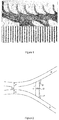
- Figure 1 is showing that the iron-based brazing filler material is able to fill large cervices, and that it is possible to braze with large quantities of brazing material.
- the large heat exchangers braze joints are therefore characterized in that there is lot of braze filler applied and also that large homogenisation zones are found. A part of the braze filler and part of the original plate thickness have been mixed into the homogenisation zone.
- Figure 2 is schematically showing relationships between different parameters in a brazed crevice or joint, brazed by filler material F.
- Letter A represent plate thickness of plate E which also represent base material E.
- B represent the smallest thickness of a brazed crevice or joint between base material E or plates E
- C represent the largest thickness of a brazed crevice or joint without any pores, cracks or passages
- Figure 3 is a photo showing a cross section of a joint on which hardness tests have been carried out.
- the average hardness is calculated as a numeric average and depends on the number of tests.
- braze-filler material was approximately 16 to 20g per 4 brazing points.
- a nickel based braze filler BNi-5 according to AWS A5.8 AMS specifications for braze-fillers was compared to iron-based braze-filler comprising 56 wt% Fe, 17 wt% Cr, 12 wt% Ni, 12 wt% Si, and 1 wt% B.
- the braze filler were applied to the test samples having 0.3-0.4 mm crevices, and the samples were heated in a furnace to a temperature of about 1200°C in a non-oxidative atmosphere.
- Table 1 Sample Ni-based BNi-5 Iron-based, [g] [N/mm 2 ] [N/mm 2 ] 16 109 123 18 110 126 20 106 151
- the iron based braze-filler not only have the capability of filling large crevices but also have a very high mechanical strength at large crevices, making them suitable for brazing for example large heat exchangers or planar surfaces of for example reactor plates. Tests were performed by comparing amount of braze filler to tensile strength, the results are summarised in Table 2.
- Table 2 Sample Iron based (invention) [g] [N/mm 2 ] 25 162 55 227
- Hardness tests were made in a joint at an equally seal gap between two plates of base material (type 316). The tests were performed on anequal distance from the base material, in the centre of the joint.
- Hardness measurements HV1 were performed according to ASTM E92-82 (Standard test method for Vickers Hardness of Metallic Materials) and EN ISO 6507-1 (Metallic materials - Vickers hardness test- Part 1: Test method (ISO 6507-1:1997), and a comparison was made between a joint of BNI-5 and a joint of Fe-based material 56 wt% Fe, 17 wt% Cr, 12 wt% Ni, 12 wt% Si, and 1 wt% B.
- BNi-5 joint is harder than the Fe-based material joint.
- BNi-5 joint shows less ductility and consequently lower strength than the iron-based filler joint according to the invention, which is illustrated by lower hardness values of the iron-based filler joint.
- BNi-5 joint is brittle compared to the iron-based filler joint.
- Hardness tests were preformed on a large joint sealed with Fe-based filler comprising 56 wt% Fe, 17 wt% Cr, 12 wt% Ni, 12 wt% Si, and 1 wt% B. The tests were performed where the brazed joint has sealed a gap larger than 1000 pm, and the positions where the tests were done as in Figure 3 , but the photo in Figure 3 is not a photo of the joint in this Example. The results are 349 HV1, 336 HV1, 210 HV1, 197 HV1, 250 HV1, 300 HV1, and 287 HV1, which gives average hardness of 275 HV1.
- the plate packs were cut into sections to be analysed if the iron-based filler in the centre part of the plate pack had melted or not.
- the tested parts were optically investigated.
Landscapes
- Engineering & Computer Science (AREA)
- Mechanical Engineering (AREA)
- Chemical & Material Sciences (AREA)
- Materials Engineering (AREA)
- General Engineering & Computer Science (AREA)
- Thermal Sciences (AREA)
- Physics & Mathematics (AREA)
- Metallurgy (AREA)
- Organic Chemistry (AREA)
- Details Of Heat-Exchange And Heat-Transfer (AREA)
- Ceramic Products (AREA)
- Manufacture Of Metal Powder And Suspensions Thereof (AREA)
- Powder Metallurgy (AREA)
- Pressure Welding/Diffusion-Bonding (AREA)
- Heat Treatment Of Articles (AREA)
Priority Applications (1)
| Application Number | Priority Date | Filing Date | Title |
|---|---|---|---|
| PL12152118T PL2446996T3 (pl) | 2005-05-26 | 2006-05-24 | Twardo lutowany płytowy wymiennik ciepła ze stali nierdzewnej z materiałem lutującym ze stali nierdzewnej |
Applications Claiming Priority (3)
| Application Number | Priority Date | Filing Date | Title |
|---|---|---|---|
| SE0501198A SE531092C2 (sv) | 2005-05-26 | 2005-05-26 | Metod för att sammanlöda två ytor samt en anordning innefattande två sammanlödda ytor |
| SE0501199A SE529913C2 (sv) | 2005-05-26 | 2005-05-26 | Förfarande för lödning av föremål av rostfritt stål, förfarande för lödning av värmeväxlare av rostfritt stål samt lött föremål samt lödd värmeväxlare |
| EP06747812.3A EP1888294B9 (en) | 2005-05-26 | 2006-05-24 | A method of brazing articles of stainless steel |
Related Parent Applications (3)
| Application Number | Title | Priority Date | Filing Date |
|---|---|---|---|
| EP06747812.3 Division | 2006-05-24 | ||
| EP06747812.3A Division EP1888294B9 (en) | 2005-05-26 | 2006-05-24 | A method of brazing articles of stainless steel |
| EP06747812.3A Division-Into EP1888294B9 (en) | 2005-05-26 | 2006-05-24 | A method of brazing articles of stainless steel |
Publications (2)
| Publication Number | Publication Date |
|---|---|
| EP2446996A1 EP2446996A1 (en) | 2012-05-02 |
| EP2446996B1 true EP2446996B1 (en) | 2017-04-26 |
Family
ID=37452285
Family Applications (2)
| Application Number | Title | Priority Date | Filing Date |
|---|---|---|---|
| EP12152118.1A Active EP2446996B1 (en) | 2005-05-26 | 2006-05-24 | Brazed plate heat exchanger of stainless steel with stainless steel brazing material |
| EP06747812.3A Active EP1888294B9 (en) | 2005-05-26 | 2006-05-24 | A method of brazing articles of stainless steel |
Family Applications After (1)
| Application Number | Title | Priority Date | Filing Date |
|---|---|---|---|
| EP06747812.3A Active EP1888294B9 (en) | 2005-05-26 | 2006-05-24 | A method of brazing articles of stainless steel |
Country Status (10)
| Country | Link |
|---|---|
| US (2) | US8857699B2 (da) |
| EP (2) | EP2446996B1 (da) |
| JP (2) | JP5215174B2 (da) |
| KR (1) | KR101329941B1 (da) |
| DK (2) | DK1888294T4 (da) |
| ES (1) | ES2483968T5 (da) |
| PL (2) | PL1888294T5 (da) |
| PT (1) | PT1888294E (da) |
| SI (1) | SI1888294T1 (da) |
| WO (1) | WO2006126953A1 (da) |
Cited By (1)
| Publication number | Priority date | Publication date | Assignee | Title |
|---|---|---|---|---|
| DE102022118344A1 (de) | 2021-07-26 | 2023-01-26 | Vacuumschmelze Gmbh & Co. Kg | Hartlotfolie, Gegenstand sowie Verfahren zum Hartlöten |
Families Citing this family (26)
| Publication number | Priority date | Publication date | Assignee | Title |
|---|---|---|---|---|
| SE523855C2 (sv) | 2000-11-10 | 2004-05-25 | Alfa Laval Corp Ab | Järnbaserat lodmaterial för sammanfogning av elememt och lödd produkt framställd härmed |
| US8894780B2 (en) | 2006-09-13 | 2014-11-25 | Vacuumschmelze Gmbh & Co. Kg | Nickel/iron-based braze and process for brazing |
| SE531988C2 (sv) * | 2006-11-17 | 2009-09-22 | Alfa Laval Corp Ab | Lodmaterial samt förfarande för lödning med detta material |
| DE102007028275A1 (de) | 2007-06-15 | 2008-12-18 | Vacuumschmelze Gmbh & Co. Kg | Hartlotfolie auf Eisen-Basis sowie Verfahren zum Hartlöten |
| EP2272619B9 (en) * | 2008-04-18 | 2013-11-20 | Fukuda Metal Foil&powder Co., Ltd. | Iron-base heat- and corrosion-resistant brazing filler metals |
| JP5212401B2 (ja) * | 2009-05-11 | 2013-06-19 | 新日鐵住金株式会社 | 接合用合金 |
| JP5546836B2 (ja) * | 2009-11-26 | 2014-07-09 | 山陽特殊製鋼株式会社 | Ni−Fe基合金ろう材 |
| MX2014002559A (es) * | 2011-09-05 | 2014-06-05 | Basf Corp | Metodo para aplicar material de soldadura para matriz de panal metalica, matriz de panal metalica y metodo para fabricar la misma. |
| EP2574420B1 (en) | 2011-09-29 | 2014-10-22 | Alfa Laval Corporate AB | Iron-based brazing composition and method of joining heat transfer plates |
| ES2706986T3 (es) * | 2012-03-28 | 2019-04-02 | Alfa Laval Corp Ab | Nuevo concepto de soldadura fuerte |
| WO2014008537A1 (en) * | 2012-07-09 | 2014-01-16 | Hugget Paul | Brazing method and composites produced thereby |
| EP2853332A1 (en) * | 2013-09-26 | 2015-04-01 | Alfa Laval Corporate AB | A novel brazing concept |
| DK2853333T3 (da) | 2013-09-26 | 2019-11-18 | Alfa Laval Corp Ab | Fremgangsmåde til samling af metaldele ved anvendelse af et smeltepunktsnedsættende lag |
| KR101818964B1 (ko) | 2015-07-24 | 2018-01-17 | 덕산하이메탈(주) | 발열 및 비정질 특성을 가진 저온 접합용 브레이징 합금 저온 접합 방법 |
| JP6042956B1 (ja) * | 2015-09-30 | 2016-12-14 | オリジン電気株式会社 | 半田付け製品の製造方法 |
| KR101874559B1 (ko) * | 2016-12-07 | 2018-08-02 | 동양피스톤 주식회사 | 차량 엔진용 피스톤 및 차량 엔진용 피스톤의 제조 방법 |
| DE102016124206A1 (de) * | 2016-12-13 | 2018-06-14 | Michael Rehberg | Plattenwärmetauscher-Herstellungsverfahren und Plattenwärmetauscher |
| DE112018003830T5 (de) | 2017-07-28 | 2020-09-10 | Dana Canada Corporation | Vorrichtung und verfahren zum ausrichten von teilen zum laserschweissen |
| WO2019018943A1 (en) | 2017-07-28 | 2019-01-31 | Dana Canada Corporation | ULTRA-THIN HEAT EXCHANGERS FOR HEAT MANAGEMENT |
| KR102064200B1 (ko) * | 2019-05-09 | 2020-01-09 | 천성민 | 판형 열교환기 조립체 및 판형 열교환기 제조 방법 |
| SE543405C2 (en) * | 2019-05-29 | 2021-01-05 | Alfa Laval Corp Ab | Method for joining metal parts |
| US11571762B2 (en) * | 2019-11-15 | 2023-02-07 | Rolls-Royce North American Technologies Inc. | Printing method to selectively deposit braze powders at one or more predetermined locations on a surface |
| US11420279B2 (en) | 2019-11-15 | 2022-08-23 | Rolls-Royce Corporation | Method of selectively bonding braze powders to a surface |
| US11565336B2 (en) | 2019-11-15 | 2023-01-31 | Rolls-Royce North American Technologies Inc. | Method of selectively bonding braze powders to a surface |
| US11298768B2 (en) | 2019-11-15 | 2022-04-12 | Rolls-Royce Corporation | Method of preparing a surface for diffusion bonding and method of diffusion bonding |
| JP7498133B2 (ja) * | 2021-03-25 | 2024-06-11 | 日本キヤリア株式会社 | 熱交換器および冷凍サイクル装置 |
Family Cites Families (32)
| Publication number | Priority date | Publication date | Assignee | Title |
|---|---|---|---|---|
| GB797800A (en) | 1956-04-24 | 1958-07-09 | Coast Metals Inc | Brazing alloys |
| US2843478A (en) | 1957-10-28 | 1958-07-15 | Ronald R Cost | High temperature brazing alloy for joining fe cr al materials and austenitic and ferritic stainless steels |
| US3736128A (en) | 1971-06-04 | 1973-05-29 | Pechiney Ugine Kuhlmann | Stainless steel with a high boron content |
| US4402742A (en) * | 1981-10-29 | 1983-09-06 | Get Products Corporation | Iron-nickel base brazing filler metal |
| US4410604A (en) * | 1981-11-16 | 1983-10-18 | The Garrett Corporation | Iron-based brazing alloy compositions and brazed assemblies with iron based brazing alloys |
| US4516716A (en) | 1982-11-18 | 1985-05-14 | Gte Products Corporation | Method of brazing with iron-based and hard surfacing alloys |
| JPS59101233A (ja) | 1982-11-30 | 1984-06-11 | Mitsui Eng & Shipbuild Co Ltd | 棒鋼自動曲げ加工装置 |
| JPS59101244A (ja) | 1982-11-30 | 1984-06-11 | Tsuchiya Mfg Co Ltd | 金属製ハニカム体の製造方法 |
| JPS62234655A (ja) * | 1986-04-02 | 1987-10-14 | Hitachi Ltd | 気密構造体の補修方法 |
| JPH0667551B2 (ja) * | 1987-05-13 | 1994-08-31 | 三菱重工業株式会社 | 積層耐熱合金板の製作方法 |
| EP0437626B1 (en) * | 1989-08-04 | 1994-12-28 | Showa Aircraft Industry Co., Ltd. | Heat resistant structure and method of manufacture thereof |
| NO179483C (no) | 1989-08-29 | 1996-10-16 | Sumitomo Metal Ind | Fremgangsmåte for å opprette diffusjonsbinding mellom korrosjonsbestandige materialer |
| JPH0715665Y2 (ja) * | 1991-02-01 | 1995-04-12 | 小島プレス工業株式会社 | 金属部材の接合構造 |
| US6200690B1 (en) * | 1995-05-22 | 2001-03-13 | Alliedsignal Inc. | Nickel-chromium-based brazing alloys |
| US6149051A (en) * | 1997-08-07 | 2000-11-21 | Alliedsignal Inc. | Braze titanium |
| FR2781399B1 (fr) | 1998-07-23 | 2000-08-18 | Sochata Energy 1 Soc | Procede de brasage-diffusion de pieces en superalliage |
| SE513784C2 (sv) * | 1999-03-09 | 2000-11-06 | Alfa Laval Ab | Permanent sammanfogad plattvärmeväxlare |
| DK1259509T3 (da) | 1999-11-22 | 2006-01-16 | Egyt Gyogyszervegyeszeti Gyar | Fremgangsmåde til fremstilling af 6-methyl-2-(4-methylphenyl)-imidazol[1,2-a]pyridin-3-(N,N-dimethylacetamid) og mellemprodukter |
| JP4288821B2 (ja) * | 2000-02-28 | 2009-07-01 | 日立金属株式会社 | 高温強度に優れた低熱膨張Fe基耐熱合金 |
| DE10053000A1 (de) * | 2000-10-25 | 2002-05-08 | Eaton Fluid Power Gmbh | Klimaanlage mit innerem Wärmetauscher und Wärmetauscherrohr für einen solchen |
| SE523855C2 (sv) * | 2000-11-10 | 2004-05-25 | Alfa Laval Corp Ab | Järnbaserat lodmaterial för sammanfogning av elememt och lödd produkt framställd härmed |
| KR100735893B1 (ko) * | 2000-12-28 | 2007-07-06 | 가부시키가이샤 브레이징 | 플레이트식 열 교환기 및 그 제조 방법 |
| SE519062C2 (sv) * | 2001-05-03 | 2003-01-07 | Alfa Laval Corp Ab | Sätt att sammanlöda tunna värmeväxlarplattor samt lödd plattvärmeväxlare framställd enligt sättet |
| SE524928C2 (sv) * | 2001-06-05 | 2004-10-26 | Alfa Laval Corp Ab | Järnbaserat lodmaterial för sammanfogning av element genom lödning samt lödd produkt framställd härmed |
| JP3848871B2 (ja) * | 2001-11-30 | 2006-11-22 | 三菱重工業株式会社 | 鉄系ろう材及び鉄系ろう材を使用したろう付け方法 |
| JP2003245713A (ja) * | 2002-02-21 | 2003-09-02 | Usui Kokusai Sangyo Kaisha Ltd | スーパーフェライト系ステンレス鋼製多重巻鋼管及びその製造方法 |
| US6656292B1 (en) * | 2002-06-13 | 2003-12-02 | Metzlas, Inc. | Iron-chromium base brazing filler metals |
| KR100487327B1 (ko) * | 2002-09-25 | 2005-05-03 | 엘지전자 주식회사 | 토스터를 갖는 전자레인지 |
| DE10252577B4 (de) * | 2002-11-12 | 2008-08-07 | Fraunhofer-Gesellschaft zur Förderung der angewandten Forschung e.V. | Verfahren zum Erzeugen einer Lotverbindung durch kapillaren Lotfluß |
| SE527509C2 (sv) * | 2003-10-17 | 2006-03-28 | Alfa Laval Corp Ab | Lödd plattvärmeväxlare med plattor av i huvudsak rostfritt stål och förfarande för tillverkning av en sådan plattvärmeväxlare |
| US20060090820A1 (en) * | 2004-11-01 | 2006-05-04 | Metglas, Inc. | Iron-based brazing filler metals |
| SE530011C2 (sv) * | 2006-06-05 | 2008-02-05 | Alfa Laval Corp Ab | Värmeväxlarplatta och plattvärmeväxlare |
-
2006
- 2006-05-24 KR KR1020077030093A patent/KR101329941B1/ko active Active
- 2006-05-24 DK DK06747812.3T patent/DK1888294T4/da active
- 2006-05-24 JP JP2008513417A patent/JP5215174B2/ja active Active
- 2006-05-24 SI SI200631804T patent/SI1888294T1/sl unknown
- 2006-05-24 US US11/915,184 patent/US8857699B2/en active Active
- 2006-05-24 DK DK12152118.1T patent/DK2446996T3/da active
- 2006-05-24 EP EP12152118.1A patent/EP2446996B1/en active Active
- 2006-05-24 PL PL06747812T patent/PL1888294T5/pl unknown
- 2006-05-24 WO PCT/SE2006/000618 patent/WO2006126953A1/en not_active Ceased
- 2006-05-24 ES ES06747812.3T patent/ES2483968T5/es active Active
- 2006-05-24 PL PL12152118T patent/PL2446996T3/pl unknown
- 2006-05-24 EP EP06747812.3A patent/EP1888294B9/en active Active
- 2006-05-24 PT PT06747812T patent/PT1888294E/pt unknown
-
2012
- 2012-12-25 JP JP2012281095A patent/JP5469738B2/ja active Active
-
2014
- 2014-09-10 US US14/482,729 patent/US20150053389A1/en not_active Abandoned
Non-Patent Citations (1)
| Title |
|---|
| None * |
Cited By (2)
| Publication number | Priority date | Publication date | Assignee | Title |
|---|---|---|---|---|
| DE102022118344A1 (de) | 2021-07-26 | 2023-01-26 | Vacuumschmelze Gmbh & Co. Kg | Hartlotfolie, Gegenstand sowie Verfahren zum Hartlöten |
| US12516402B2 (en) | 2021-07-26 | 2026-01-06 | Vacuumschmelze Gmbh & Co. Kg | Brazing foil, object and method for brazing |
Also Published As
| Publication number | Publication date |
|---|---|
| EP2446996A1 (en) | 2012-05-02 |
| ES2483968T5 (es) | 2017-06-28 |
| WO2006126953A1 (en) | 2006-11-30 |
| JP5215174B2 (ja) | 2013-06-19 |
| ES2483968T3 (es) | 2014-08-08 |
| PL2446996T3 (pl) | 2017-10-31 |
| PT1888294E (pt) | 2014-07-28 |
| EP1888294A1 (en) | 2008-02-20 |
| JP2008542030A (ja) | 2008-11-27 |
| EP1888294B2 (en) | 2017-01-25 |
| DK1888294T3 (da) | 2014-07-28 |
| SI1888294T1 (sl) | 2014-08-29 |
| US8857699B2 (en) | 2014-10-14 |
| JP5469738B2 (ja) | 2014-04-16 |
| EP1888294B1 (en) | 2014-05-07 |
| US20080199718A1 (en) | 2008-08-21 |
| PL1888294T3 (pl) | 2014-10-31 |
| JP2013099785A (ja) | 2013-05-23 |
| PL1888294T5 (pl) | 2017-10-31 |
| US20150053389A1 (en) | 2015-02-26 |
| EP1888294B9 (en) | 2017-04-12 |
| DK1888294T4 (da) | 2017-05-01 |
| KR20080015871A (ko) | 2008-02-20 |
| DK2446996T3 (da) | 2017-07-24 |
| KR101329941B1 (ko) | 2013-11-14 |
Similar Documents
| Publication | Publication Date | Title |
|---|---|---|
| EP2446996B1 (en) | Brazed plate heat exchanger of stainless steel with stainless steel brazing material | |
| US8287805B2 (en) | Brazing material | |
| EP2094431B1 (en) | Brazing material | |
| EP1864749B1 (en) | Brazing filler material, composite material for brazing and brazed structure joined by using those | |
| CN101184578B (zh) | 钎焊不锈钢制品的方法和由此方法获得的不锈钢钎焊制品 | |
| AU2014200267B2 (en) | Brazing material, a method of brazing, a brazed article and a paste comprising this brazing material |
Legal Events
| Date | Code | Title | Description |
|---|---|---|---|
| PUAI | Public reference made under article 153(3) epc to a published international application that has entered the european phase |
Free format text: ORIGINAL CODE: 0009012 |
|
| AC | Divisional application: reference to earlier application |
Ref document number: 1888294 Country of ref document: EP Kind code of ref document: P |
|
| AK | Designated contracting states |
Kind code of ref document: A1 Designated state(s): AT BE BG CH CY CZ DE DK EE ES FI FR GB GR HU IE IS IT LI LT LU LV MC NL PL PT RO SE SI SK TR |
|
| 17P | Request for examination filed |
Effective date: 20121024 |
|
| GRAP | Despatch of communication of intention to grant a patent |
Free format text: ORIGINAL CODE: EPIDOSNIGR1 |
|
| INTG | Intention to grant announced |
Effective date: 20160920 |
|
| GRAJ | Information related to disapproval of communication of intention to grant by the applicant or resumption of examination proceedings by the epo deleted |
Free format text: ORIGINAL CODE: EPIDOSDIGR1 |
|
| STAA | Information on the status of an ep patent application or granted ep patent |
Free format text: STATUS: REQUEST FOR EXAMINATION WAS MADE |
|
| INTC | Intention to grant announced (deleted) | ||
| GRAP | Despatch of communication of intention to grant a patent |
Free format text: ORIGINAL CODE: EPIDOSNIGR1 |
|
| STAA | Information on the status of an ep patent application or granted ep patent |
Free format text: STATUS: GRANT OF PATENT IS INTENDED |
|
| INTG | Intention to grant announced |
Effective date: 20170215 |
|
| GRAS | Grant fee paid |
Free format text: ORIGINAL CODE: EPIDOSNIGR3 |
|
| GRAA | (expected) grant |
Free format text: ORIGINAL CODE: 0009210 |
|
| STAA | Information on the status of an ep patent application or granted ep patent |
Free format text: STATUS: THE PATENT HAS BEEN GRANTED |
|
| AC | Divisional application: reference to earlier application |
Ref document number: 1888294 Country of ref document: EP Kind code of ref document: P |
|
| AK | Designated contracting states |
Kind code of ref document: B1 Designated state(s): AT BE BG CH CY CZ DE DK EE ES FI FR GB GR HU IE IS IT LI LT LU LV MC NL PL PT RO SE SI SK TR |
|
| REG | Reference to a national code |
Ref country code: GB Ref legal event code: FG4D |
|
| REG | Reference to a national code |
Ref country code: CH Ref legal event code: EP |
|
| REG | Reference to a national code |
Ref country code: AT Ref legal event code: REF Ref document number: 887442 Country of ref document: AT Kind code of ref document: T Effective date: 20170515 |
|
| REG | Reference to a national code |
Ref country code: IE Ref legal event code: FG4D |
|
| REG | Reference to a national code |
Ref country code: CH Ref legal event code: NV Representative=s name: SERVOPATENT GMBH, CH |
|
| REG | Reference to a national code |
Ref country code: DE Ref legal event code: R096 Ref document number: 602006052404 Country of ref document: DE |
|
| REG | Reference to a national code |
Ref country code: SE Ref legal event code: TRGR |
|
| RAP2 | Party data changed (patent owner data changed or rights of a patent transferred) |
Owner name: ALFA LAVAL CORPORATE AB |
|
| REG | Reference to a national code |
Ref country code: DK Ref legal event code: T3 Effective date: 20170721 |
|
| REG | Reference to a national code |
Ref country code: NL Ref legal event code: FP |
|
| REG | Reference to a national code |
Ref country code: LT Ref legal event code: MG4D |
|
| PG25 | Lapsed in a contracting state [announced via postgrant information from national office to epo] |
Ref country code: GR Free format text: LAPSE BECAUSE OF FAILURE TO SUBMIT A TRANSLATION OF THE DESCRIPTION OR TO PAY THE FEE WITHIN THE PRESCRIBED TIME-LIMIT Effective date: 20170727 Ref country code: LT Free format text: LAPSE BECAUSE OF FAILURE TO SUBMIT A TRANSLATION OF THE DESCRIPTION OR TO PAY THE FEE WITHIN THE PRESCRIBED TIME-LIMIT Effective date: 20170426 Ref country code: FI Free format text: LAPSE BECAUSE OF FAILURE TO SUBMIT A TRANSLATION OF THE DESCRIPTION OR TO PAY THE FEE WITHIN THE PRESCRIBED TIME-LIMIT Effective date: 20170426 Ref country code: ES Free format text: LAPSE BECAUSE OF FAILURE TO SUBMIT A TRANSLATION OF THE DESCRIPTION OR TO PAY THE FEE WITHIN THE PRESCRIBED TIME-LIMIT Effective date: 20170426 |
|
| PG25 | Lapsed in a contracting state [announced via postgrant information from national office to epo] |
Ref country code: LV Free format text: LAPSE BECAUSE OF FAILURE TO SUBMIT A TRANSLATION OF THE DESCRIPTION OR TO PAY THE FEE WITHIN THE PRESCRIBED TIME-LIMIT Effective date: 20170426 Ref country code: IS Free format text: LAPSE BECAUSE OF FAILURE TO SUBMIT A TRANSLATION OF THE DESCRIPTION OR TO PAY THE FEE WITHIN THE PRESCRIBED TIME-LIMIT Effective date: 20170826 Ref country code: BG Free format text: LAPSE BECAUSE OF FAILURE TO SUBMIT A TRANSLATION OF THE DESCRIPTION OR TO PAY THE FEE WITHIN THE PRESCRIBED TIME-LIMIT Effective date: 20170726 |
|
| REG | Reference to a national code |
Ref country code: SK Ref legal event code: T3 Ref document number: E 24888 Country of ref document: SK |
|
| REG | Reference to a national code |
Ref country code: DE Ref legal event code: R097 Ref document number: 602006052404 Country of ref document: DE |
|
| PG25 | Lapsed in a contracting state [announced via postgrant information from national office to epo] |
Ref country code: RO Free format text: LAPSE BECAUSE OF FAILURE TO SUBMIT A TRANSLATION OF THE DESCRIPTION OR TO PAY THE FEE WITHIN THE PRESCRIBED TIME-LIMIT Effective date: 20170426 Ref country code: EE Free format text: LAPSE BECAUSE OF FAILURE TO SUBMIT A TRANSLATION OF THE DESCRIPTION OR TO PAY THE FEE WITHIN THE PRESCRIBED TIME-LIMIT Effective date: 20170426 Ref country code: MC Free format text: LAPSE BECAUSE OF FAILURE TO SUBMIT A TRANSLATION OF THE DESCRIPTION OR TO PAY THE FEE WITHIN THE PRESCRIBED TIME-LIMIT Effective date: 20170426 Ref country code: CZ Free format text: LAPSE BECAUSE OF FAILURE TO SUBMIT A TRANSLATION OF THE DESCRIPTION OR TO PAY THE FEE WITHIN THE PRESCRIBED TIME-LIMIT Effective date: 20170426 |
|
| REG | Reference to a national code |
Ref country code: IE Ref legal event code: MM4A |
|
| PLBE | No opposition filed within time limit |
Free format text: ORIGINAL CODE: 0009261 |
|
| STAA | Information on the status of an ep patent application or granted ep patent |
Free format text: STATUS: NO OPPOSITION FILED WITHIN TIME LIMIT |
|
| REG | Reference to a national code |
Ref country code: DE Ref legal event code: R082 Ref document number: 602006052404 Country of ref document: DE Representative=s name: MARKS & CLERK (LUXEMBOURG) LLP, LU Ref country code: DE Ref legal event code: R081 Ref document number: 602006052404 Country of ref document: DE Owner name: ALFA LAVAL CORPORATE AB, SE Free format text: FORMER OWNER: ALFA LAVAL CORPORATE AB, TUMBA, SE |
|
| PG25 | Lapsed in a contracting state [announced via postgrant information from national office to epo] |
Ref country code: LU Free format text: LAPSE BECAUSE OF NON-PAYMENT OF DUE FEES Effective date: 20170524 |
|
| 26N | No opposition filed |
Effective date: 20180129 |
|
| REG | Reference to a national code |
Ref country code: BE Ref legal event code: MM Effective date: 20170531 |
|
| PG25 | Lapsed in a contracting state [announced via postgrant information from national office to epo] |
Ref country code: IE Free format text: LAPSE BECAUSE OF NON-PAYMENT OF DUE FEES Effective date: 20170524 |
|
| REG | Reference to a national code |
Ref country code: FR Ref legal event code: ST Effective date: 20180416 |
|
| PG25 | Lapsed in a contracting state [announced via postgrant information from national office to epo] |
Ref country code: SI Free format text: LAPSE BECAUSE OF FAILURE TO SUBMIT A TRANSLATION OF THE DESCRIPTION OR TO PAY THE FEE WITHIN THE PRESCRIBED TIME-LIMIT Effective date: 20170426 |
|
| PG25 | Lapsed in a contracting state [announced via postgrant information from national office to epo] |
Ref country code: BE Free format text: LAPSE BECAUSE OF NON-PAYMENT OF DUE FEES Effective date: 20170531 Ref country code: FR Free format text: LAPSE BECAUSE OF NON-PAYMENT OF DUE FEES Effective date: 20170626 |
|
| PG25 | Lapsed in a contracting state [announced via postgrant information from national office to epo] |
Ref country code: HU Free format text: LAPSE BECAUSE OF FAILURE TO SUBMIT A TRANSLATION OF THE DESCRIPTION OR TO PAY THE FEE WITHIN THE PRESCRIBED TIME-LIMIT; INVALID AB INITIO Effective date: 20060524 |
|
| PG25 | Lapsed in a contracting state [announced via postgrant information from national office to epo] |
Ref country code: CY Free format text: LAPSE BECAUSE OF NON-PAYMENT OF DUE FEES Effective date: 20170426 |
|
| PG25 | Lapsed in a contracting state [announced via postgrant information from national office to epo] |
Ref country code: TR Free format text: LAPSE BECAUSE OF FAILURE TO SUBMIT A TRANSLATION OF THE DESCRIPTION OR TO PAY THE FEE WITHIN THE PRESCRIBED TIME-LIMIT Effective date: 20170426 |
|
| REG | Reference to a national code |
Ref country code: AT Ref legal event code: UEP Ref document number: 887442 Country of ref document: AT Kind code of ref document: T Effective date: 20170426 |
|
| PG25 | Lapsed in a contracting state [announced via postgrant information from national office to epo] |
Ref country code: PT Free format text: LAPSE BECAUSE OF FAILURE TO SUBMIT A TRANSLATION OF THE DESCRIPTION OR TO PAY THE FEE WITHIN THE PRESCRIBED TIME-LIMIT Effective date: 20170426 |
|
| REG | Reference to a national code |
Ref country code: CH Ref legal event code: PCAR Free format text: NEW ADDRESS: WANNERSTRASSE 9/1, 8045 ZUERICH (CH) |
|
| P01 | Opt-out of the competence of the unified patent court (upc) registered |
Effective date: 20230412 |
|
| PGFP | Annual fee paid to national office [announced via postgrant information from national office to epo] |
Ref country code: SE Payment date: 20250310 Year of fee payment: 20 |
|
| PGFP | Annual fee paid to national office [announced via postgrant information from national office to epo] |
Ref country code: PL Payment date: 20250314 Year of fee payment: 20 |
|
| PGFP | Annual fee paid to national office [announced via postgrant information from national office to epo] |
Ref country code: NL Payment date: 20250409 Year of fee payment: 20 |
|
| PGFP | Annual fee paid to national office [announced via postgrant information from national office to epo] |
Ref country code: DE Payment date: 20250402 Year of fee payment: 20 |
|
| PGFP | Annual fee paid to national office [announced via postgrant information from national office to epo] |
Ref country code: GB Payment date: 20250401 Year of fee payment: 20 Ref country code: DK Payment date: 20250516 Year of fee payment: 20 |
|
| PGFP | Annual fee paid to national office [announced via postgrant information from national office to epo] |
Ref country code: IT Payment date: 20250422 Year of fee payment: 20 |
|
| PGFP | Annual fee paid to national office [announced via postgrant information from national office to epo] |
Ref country code: CH Payment date: 20250601 Year of fee payment: 20 |
|
| PGFP | Annual fee paid to national office [announced via postgrant information from national office to epo] |
Ref country code: AT Payment date: 20250425 Year of fee payment: 20 |
|
| PGFP | Annual fee paid to national office [announced via postgrant information from national office to epo] |
Ref country code: SK Payment date: 20250416 Year of fee payment: 20 |