EP2447085A2 - Träger für eine lithographische Druckplatte und vorsensibilisierte Druckplatte - Google Patents
Träger für eine lithographische Druckplatte und vorsensibilisierte Druckplatte Download PDFInfo
- Publication number
- EP2447085A2 EP2447085A2 EP20110174834 EP11174834A EP2447085A2 EP 2447085 A2 EP2447085 A2 EP 2447085A2 EP 20110174834 EP20110174834 EP 20110174834 EP 11174834 A EP11174834 A EP 11174834A EP 2447085 A2 EP2447085 A2 EP 2447085A2
- Authority
- EP
- European Patent Office
- Prior art keywords
- treatment
- aluminum
- plate
- lithographic printing
- solution
- Prior art date
- Legal status (The legal status is an assumption and is not a legal conclusion. Google has not performed a legal analysis and makes no representation as to the accuracy of the status listed.)
- Granted
Links
- 238000007639 printing Methods 0.000 title claims abstract description 86
- 229910052782 aluminium Inorganic materials 0.000 claims abstract description 146
- XAGFODPZIPBFFR-UHFFFAOYSA-N aluminium Chemical compound [Al] XAGFODPZIPBFFR-UHFFFAOYSA-N 0.000 claims abstract description 127
- 229910001593 boehmite Inorganic materials 0.000 claims abstract description 39
- FAHBNUUHRFUEAI-UHFFFAOYSA-M hydroxidooxidoaluminium Chemical compound O[Al]=O FAHBNUUHRFUEAI-UHFFFAOYSA-M 0.000 claims abstract description 39
- 239000010410 layer Substances 0.000 claims description 76
- 150000001875 compounds Chemical class 0.000 claims description 38
- 229920000642 polymer Polymers 0.000 claims description 30
- 239000011241 protective layer Substances 0.000 claims description 28
- 239000011230 binding agent Substances 0.000 claims description 16
- 239000011148 porous material Substances 0.000 claims description 14
- 230000001235 sensitizing effect Effects 0.000 claims description 12
- 239000003505 polymerization initiator Substances 0.000 claims description 10
- 238000007789 sealing Methods 0.000 claims description 4
- 230000015572 biosynthetic process Effects 0.000 abstract description 24
- 238000011282 treatment Methods 0.000 description 303
- XLYOFNOQVPJJNP-UHFFFAOYSA-N water Chemical compound O XLYOFNOQVPJJNP-UHFFFAOYSA-N 0.000 description 142
- 239000000243 solution Substances 0.000 description 104
- HEMHJVSKTPXQMS-UHFFFAOYSA-M Sodium hydroxide Chemical compound [OH-].[Na+] HEMHJVSKTPXQMS-UHFFFAOYSA-M 0.000 description 48
- -1 polyethylene terephthalate Polymers 0.000 description 42
- 238000007743 anodising Methods 0.000 description 31
- 239000003513 alkali Substances 0.000 description 30
- 239000007864 aqueous solution Substances 0.000 description 30
- VEXZGXHMUGYJMC-UHFFFAOYSA-N Hydrochloric acid Chemical compound Cl VEXZGXHMUGYJMC-UHFFFAOYSA-N 0.000 description 28
- 238000000034 method Methods 0.000 description 26
- 238000004519 manufacturing process Methods 0.000 description 25
- QAOWNCQODCNURD-UHFFFAOYSA-N Sulfuric acid Chemical compound OS(O)(=O)=O QAOWNCQODCNURD-UHFFFAOYSA-N 0.000 description 22
- 238000005530 etching Methods 0.000 description 22
- 238000000576 coating method Methods 0.000 description 21
- CAVCGVPGBKGDTG-UHFFFAOYSA-N alumanylidynemethyl(alumanylidynemethylalumanylidenemethylidene)alumane Chemical compound [Al]#C[Al]=C=[Al]C#[Al] CAVCGVPGBKGDTG-UHFFFAOYSA-N 0.000 description 20
- GRYLNZFGIOXLOG-UHFFFAOYSA-N Nitric acid Chemical compound O[N+]([O-])=O GRYLNZFGIOXLOG-UHFFFAOYSA-N 0.000 description 19
- 239000002253 acid Substances 0.000 description 18
- 239000011248 coating agent Substances 0.000 description 18
- 239000000975 dye Substances 0.000 description 17
- 229910017604 nitric acid Inorganic materials 0.000 description 17
- 239000004372 Polyvinyl alcohol Substances 0.000 description 16
- 229920002451 polyvinyl alcohol Polymers 0.000 description 16
- 235000011121 sodium hydroxide Nutrition 0.000 description 16
- 238000005507 spraying Methods 0.000 description 16
- KWYUFKZDYYNOTN-UHFFFAOYSA-M Potassium hydroxide Chemical compound [OH-].[K+] KWYUFKZDYYNOTN-UHFFFAOYSA-M 0.000 description 15
- 238000011161 development Methods 0.000 description 15
- VYPSYNLAJGMNEJ-UHFFFAOYSA-N Silicium dioxide Chemical compound O=[Si]=O VYPSYNLAJGMNEJ-UHFFFAOYSA-N 0.000 description 14
- QVGXLLKOCUKJST-UHFFFAOYSA-N atomic oxygen Chemical compound [O] QVGXLLKOCUKJST-UHFFFAOYSA-N 0.000 description 14
- 238000003486 chemical etching Methods 0.000 description 14
- 229910052760 oxygen Inorganic materials 0.000 description 14
- 239000001301 oxygen Substances 0.000 description 14
- OKTJSMMVPCPJKN-UHFFFAOYSA-N Carbon Chemical compound [C] OKTJSMMVPCPJKN-UHFFFAOYSA-N 0.000 description 13
- VSCWAEJMTAWNJL-UHFFFAOYSA-K aluminium trichloride Chemical compound Cl[Al](Cl)Cl VSCWAEJMTAWNJL-UHFFFAOYSA-K 0.000 description 12
- 229910052799 carbon Inorganic materials 0.000 description 12
- 230000005611 electricity Effects 0.000 description 12
- 239000011260 aqueous acid Substances 0.000 description 11
- 239000008151 electrolyte solution Substances 0.000 description 11
- 230000008569 process Effects 0.000 description 11
- 230000000694 effects Effects 0.000 description 10
- 229920001971 elastomer Polymers 0.000 description 10
- 239000005060 rubber Substances 0.000 description 10
- 238000005868 electrolysis reaction Methods 0.000 description 9
- 238000011156 evaluation Methods 0.000 description 9
- 239000000047 product Substances 0.000 description 9
- 239000007787 solid Substances 0.000 description 9
- 239000004094 surface-active agent Substances 0.000 description 9
- 229910000838 Al alloy Inorganic materials 0.000 description 8
- 238000006243 chemical reaction Methods 0.000 description 8
- 125000000217 alkyl group Chemical group 0.000 description 7
- 230000000903 blocking effect Effects 0.000 description 7
- 230000001965 increasing effect Effects 0.000 description 7
- 239000007921 spray Substances 0.000 description 7
- BNGXYYYYKUGPPF-UHFFFAOYSA-M (3-methylphenyl)methyl-triphenylphosphanium;chloride Chemical compound [Cl-].CC1=CC=CC(C[P+](C=2C=CC=CC=2)(C=2C=CC=CC=2)C=2C=CC=CC=2)=C1 BNGXYYYYKUGPPF-UHFFFAOYSA-M 0.000 description 6
- XEEYBQQBJWHFJM-UHFFFAOYSA-N Iron Chemical compound [Fe] XEEYBQQBJWHFJM-UHFFFAOYSA-N 0.000 description 6
- PXHVJJICTQNCMI-UHFFFAOYSA-N Nickel Chemical compound [Ni] PXHVJJICTQNCMI-UHFFFAOYSA-N 0.000 description 6
- WNROFYMDJYEPJX-UHFFFAOYSA-K aluminium hydroxide Chemical compound [OH-].[OH-].[OH-].[Al+3] WNROFYMDJYEPJX-UHFFFAOYSA-K 0.000 description 6
- 150000001408 amides Chemical class 0.000 description 6
- 230000000052 comparative effect Effects 0.000 description 6
- 238000001035 drying Methods 0.000 description 6
- 238000006116 polymerization reaction Methods 0.000 description 6
- 239000002699 waste material Substances 0.000 description 6
- 239000003795 chemical substances by application Substances 0.000 description 5
- 230000006872 improvement Effects 0.000 description 5
- 229910052751 metal Inorganic materials 0.000 description 5
- 239000002184 metal Substances 0.000 description 5
- 239000000203 mixture Substances 0.000 description 5
- 230000035699 permeability Effects 0.000 description 5
- 229920000036 polyvinylpyrrolidone Polymers 0.000 description 5
- 239000001267 polyvinylpyrrolidone Substances 0.000 description 5
- 235000013855 polyvinylpyrrolidone Nutrition 0.000 description 5
- 235000011118 potassium hydroxide Nutrition 0.000 description 5
- 239000000377 silicon dioxide Substances 0.000 description 5
- 239000002002 slurry Substances 0.000 description 5
- 239000000126 substance Substances 0.000 description 5
- 238000012719 thermal polymerization Methods 0.000 description 5
- 230000007704 transition Effects 0.000 description 5
- NLXLAEXVIDQMFP-UHFFFAOYSA-N Ammonia chloride Chemical compound [NH4+].[Cl-] NLXLAEXVIDQMFP-UHFFFAOYSA-N 0.000 description 4
- XUIMIQQOPSSXEZ-UHFFFAOYSA-N Silicon Chemical compound [Si] XUIMIQQOPSSXEZ-UHFFFAOYSA-N 0.000 description 4
- FAPWRFPIFSIZLT-UHFFFAOYSA-M Sodium chloride Chemical compound [Na+].[Cl-] FAPWRFPIFSIZLT-UHFFFAOYSA-M 0.000 description 4
- 239000000654 additive Substances 0.000 description 4
- 150000001732 carboxylic acid derivatives Chemical class 0.000 description 4
- 238000010349 cathodic reaction Methods 0.000 description 4
- 229910052681 coesite Inorganic materials 0.000 description 4
- 239000000470 constituent Substances 0.000 description 4
- 229910052906 cristobalite Inorganic materials 0.000 description 4
- 239000004148 curcumin Substances 0.000 description 4
- JHIVVAPYMSGYDF-UHFFFAOYSA-N cyclohexanone Chemical compound O=C1CCCCC1 JHIVVAPYMSGYDF-UHFFFAOYSA-N 0.000 description 4
- 239000003792 electrolyte Substances 0.000 description 4
- 150000002148 esters Chemical class 0.000 description 4
- 239000003112 inhibitor Substances 0.000 description 4
- 239000000463 material Substances 0.000 description 4
- 239000002736 nonionic surfactant Substances 0.000 description 4
- 230000035945 sensitivity Effects 0.000 description 4
- 229910052710 silicon Inorganic materials 0.000 description 4
- 239000010703 silicon Substances 0.000 description 4
- VWDWKYIASSYTQR-UHFFFAOYSA-N sodium nitrate Chemical compound [Na+].[O-][N+]([O-])=O VWDWKYIASSYTQR-UHFFFAOYSA-N 0.000 description 4
- 239000002904 solvent Substances 0.000 description 4
- 229910052682 stishovite Inorganic materials 0.000 description 4
- 125000003396 thiol group Chemical group [H]S* 0.000 description 4
- 229910052905 tridymite Inorganic materials 0.000 description 4
- 239000001052 yellow pigment Substances 0.000 description 4
- ZWEHNKRNPOVVGH-UHFFFAOYSA-N 2-Butanone Chemical compound CCC(C)=O ZWEHNKRNPOVVGH-UHFFFAOYSA-N 0.000 description 3
- RYGMFSIKBFXOCR-UHFFFAOYSA-N Copper Chemical compound [Cu] RYGMFSIKBFXOCR-UHFFFAOYSA-N 0.000 description 3
- IMROMDMJAWUWLK-UHFFFAOYSA-N Ethenol Chemical group OC=C IMROMDMJAWUWLK-UHFFFAOYSA-N 0.000 description 3
- FYYHWMGAXLPEAU-UHFFFAOYSA-N Magnesium Chemical compound [Mg] FYYHWMGAXLPEAU-UHFFFAOYSA-N 0.000 description 3
- OKKJLVBELUTLKV-UHFFFAOYSA-N Methanol Chemical compound OC OKKJLVBELUTLKV-UHFFFAOYSA-N 0.000 description 3
- MUBZPKHOEPUJKR-UHFFFAOYSA-N Oxalic acid Chemical compound OC(=O)C(O)=O MUBZPKHOEPUJKR-UHFFFAOYSA-N 0.000 description 3
- 239000004115 Sodium Silicate Substances 0.000 description 3
- RTAQQCXQSZGOHL-UHFFFAOYSA-N Titanium Chemical compound [Ti] RTAQQCXQSZGOHL-UHFFFAOYSA-N 0.000 description 3
- 230000000996 additive effect Effects 0.000 description 3
- 238000005275 alloying Methods 0.000 description 3
- 125000003178 carboxy group Chemical group [H]OC(*)=O 0.000 description 3
- 150000001733 carboxylic acid esters Chemical class 0.000 description 3
- 239000002738 chelating agent Substances 0.000 description 3
- 239000003086 colorant Substances 0.000 description 3
- 229910052802 copper Inorganic materials 0.000 description 3
- 239000010949 copper Substances 0.000 description 3
- 238000010586 diagram Methods 0.000 description 3
- 125000001033 ether group Chemical group 0.000 description 3
- 238000010438 heat treatment Methods 0.000 description 3
- 125000004435 hydrogen atom Chemical group [H]* 0.000 description 3
- 230000007062 hydrolysis Effects 0.000 description 3
- 238000006460 hydrolysis reaction Methods 0.000 description 3
- 239000012535 impurity Substances 0.000 description 3
- 229910001389 inorganic alkali salt Inorganic materials 0.000 description 3
- 229910052742 iron Inorganic materials 0.000 description 3
- 229910052749 magnesium Inorganic materials 0.000 description 3
- 239000011777 magnesium Substances 0.000 description 3
- WPBNNNQJVZRUHP-UHFFFAOYSA-L manganese(2+);methyl n-[[2-(methoxycarbonylcarbamothioylamino)phenyl]carbamothioyl]carbamate;n-[2-(sulfidocarbothioylamino)ethyl]carbamodithioate Chemical compound [Mn+2].[S-]C(=S)NCCNC([S-])=S.COC(=O)NC(=S)NC1=CC=CC=C1NC(=S)NC(=O)OC WPBNNNQJVZRUHP-UHFFFAOYSA-L 0.000 description 3
- 238000002156 mixing Methods 0.000 description 3
- 239000000178 monomer Substances 0.000 description 3
- 229910052759 nickel Inorganic materials 0.000 description 3
- TWNQGVIAIRXVLR-UHFFFAOYSA-N oxo(oxoalumanyloxy)alumane Chemical compound O=[Al]O[Al]=O TWNQGVIAIRXVLR-UHFFFAOYSA-N 0.000 description 3
- 125000004430 oxygen atom Chemical group O* 0.000 description 3
- 238000012545 processing Methods 0.000 description 3
- 230000001105 regulatory effect Effects 0.000 description 3
- 238000001878 scanning electron micrograph Methods 0.000 description 3
- NTHWMYGWWRZVTN-UHFFFAOYSA-N sodium silicate Chemical compound [Na+].[Na+].[O-][Si]([O-])=O NTHWMYGWWRZVTN-UHFFFAOYSA-N 0.000 description 3
- 229910052911 sodium silicate Inorganic materials 0.000 description 3
- 125000001424 substituent group Chemical group 0.000 description 3
- 229910052717 sulfur Inorganic materials 0.000 description 3
- 125000004434 sulfur atom Chemical group 0.000 description 3
- UEUXEKPTXMALOB-UHFFFAOYSA-J tetrasodium;2-[2-[bis(carboxylatomethyl)amino]ethyl-(carboxylatomethyl)amino]acetate Chemical compound [Na+].[Na+].[Na+].[Na+].[O-]C(=O)CN(CC([O-])=O)CCN(CC([O-])=O)CC([O-])=O UEUXEKPTXMALOB-UHFFFAOYSA-J 0.000 description 3
- 239000010936 titanium Substances 0.000 description 3
- 229910052719 titanium Inorganic materials 0.000 description 3
- 229910000859 α-Fe Inorganic materials 0.000 description 3
- LDXJRKWFNNFDSA-UHFFFAOYSA-N 2-(2,4,6,7-tetrahydrotriazolo[4,5-c]pyridin-5-yl)-1-[4-[2-[[3-(trifluoromethoxy)phenyl]methylamino]pyrimidin-5-yl]piperazin-1-yl]ethanone Chemical compound C1CN(CC2=NNN=C21)CC(=O)N3CCN(CC3)C4=CN=C(N=C4)NCC5=CC(=CC=C5)OC(F)(F)F LDXJRKWFNNFDSA-UHFFFAOYSA-N 0.000 description 2
- PAWQVTBBRAZDMG-UHFFFAOYSA-N 2-(3-bromo-2-fluorophenyl)acetic acid Chemical compound OC(=O)CC1=CC=CC(Br)=C1F PAWQVTBBRAZDMG-UHFFFAOYSA-N 0.000 description 2
- NIXOWILDQLNWCW-UHFFFAOYSA-N 2-Propenoic acid Natural products OC(=O)C=C NIXOWILDQLNWCW-UHFFFAOYSA-N 0.000 description 2
- YLZOPXRUQYQQID-UHFFFAOYSA-N 3-(2,4,6,7-tetrahydrotriazolo[4,5-c]pyridin-5-yl)-1-[4-[2-[[3-(trifluoromethoxy)phenyl]methylamino]pyrimidin-5-yl]piperazin-1-yl]propan-1-one Chemical compound N1N=NC=2CN(CCC=21)CCC(=O)N1CCN(CC1)C=1C=NC(=NC=1)NCC1=CC(=CC=C1)OC(F)(F)F YLZOPXRUQYQQID-UHFFFAOYSA-N 0.000 description 2
- VEXZGXHMUGYJMC-UHFFFAOYSA-M Chloride anion Chemical compound [Cl-] VEXZGXHMUGYJMC-UHFFFAOYSA-M 0.000 description 2
- RTZKZFJDLAIYFH-UHFFFAOYSA-N Diethyl ether Chemical compound CCOCC RTZKZFJDLAIYFH-UHFFFAOYSA-N 0.000 description 2
- NIQCNGHVCWTJSM-UHFFFAOYSA-N Dimethyl phthalate Chemical compound COC(=O)C1=CC=CC=C1C(=O)OC NIQCNGHVCWTJSM-UHFFFAOYSA-N 0.000 description 2
- LFQSCWFLJHTTHZ-UHFFFAOYSA-N Ethanol Chemical compound CCO LFQSCWFLJHTTHZ-UHFFFAOYSA-N 0.000 description 2
- PEDCQBHIVMGVHV-UHFFFAOYSA-N Glycerine Chemical compound OCC(O)CO PEDCQBHIVMGVHV-UHFFFAOYSA-N 0.000 description 2
- WHNWPMSKXPGLAX-UHFFFAOYSA-N N-Vinyl-2-pyrrolidone Chemical compound C=CN1CCCC1=O WHNWPMSKXPGLAX-UHFFFAOYSA-N 0.000 description 2
- AFCARXCZXQIEQB-UHFFFAOYSA-N N-[3-oxo-3-(2,4,6,7-tetrahydrotriazolo[4,5-c]pyridin-5-yl)propyl]-2-[[3-(trifluoromethoxy)phenyl]methylamino]pyrimidine-5-carboxamide Chemical compound O=C(CCNC(=O)C=1C=NC(=NC=1)NCC1=CC(=CC=C1)OC(F)(F)F)N1CC2=C(CC1)NN=N2 AFCARXCZXQIEQB-UHFFFAOYSA-N 0.000 description 2
- NHNBFGGVMKEFGY-UHFFFAOYSA-N Nitrate Chemical compound [O-][N+]([O-])=O NHNBFGGVMKEFGY-UHFFFAOYSA-N 0.000 description 2
- 239000004677 Nylon Substances 0.000 description 2
- MXRIRQGCELJRSN-UHFFFAOYSA-N O.O.O.[Al] Chemical compound O.O.O.[Al] MXRIRQGCELJRSN-UHFFFAOYSA-N 0.000 description 2
- BPQQTUXANYXVAA-UHFFFAOYSA-N Orthosilicate Chemical compound [O-][Si]([O-])([O-])[O-] BPQQTUXANYXVAA-UHFFFAOYSA-N 0.000 description 2
- 239000004111 Potassium silicate Substances 0.000 description 2
- CDBYLPFSWZWCQE-UHFFFAOYSA-L Sodium Carbonate Chemical compound [Na+].[Na+].[O-]C([O-])=O CDBYLPFSWZWCQE-UHFFFAOYSA-L 0.000 description 2
- PPBRXRYQALVLMV-UHFFFAOYSA-N Styrene Chemical compound C=CC1=CC=CC=C1 PPBRXRYQALVLMV-UHFFFAOYSA-N 0.000 description 2
- 238000007259 addition reaction Methods 0.000 description 2
- 125000001931 aliphatic group Chemical group 0.000 description 2
- 229910000272 alkali metal oxide Inorganic materials 0.000 description 2
- 229910052910 alkali metal silicate Inorganic materials 0.000 description 2
- PNEYBMLMFCGWSK-UHFFFAOYSA-N aluminium oxide Inorganic materials [O-2].[O-2].[O-2].[Al+3].[Al+3] PNEYBMLMFCGWSK-UHFFFAOYSA-N 0.000 description 2
- 150000001412 amines Chemical class 0.000 description 2
- 125000003277 amino group Chemical group 0.000 description 2
- 235000019270 ammonium chloride Nutrition 0.000 description 2
- 239000012298 atmosphere Substances 0.000 description 2
- 229920001577 copolymer Polymers 0.000 description 2
- 238000007334 copolymerization reaction Methods 0.000 description 2
- 230000007423 decrease Effects 0.000 description 2
- 230000007547 defect Effects 0.000 description 2
- 235000014113 dietary fatty acids Nutrition 0.000 description 2
- 239000002270 dispersing agent Substances 0.000 description 2
- 239000006185 dispersion Substances 0.000 description 2
- UKMSUNONTOPOIO-UHFFFAOYSA-N docosanoic acid Chemical compound CCCCCCCCCCCCCCCCCCCCCC(O)=O UKMSUNONTOPOIO-UHFFFAOYSA-N 0.000 description 2
- 238000005516 engineering process Methods 0.000 description 2
- 239000000194 fatty acid Substances 0.000 description 2
- 229930195729 fatty acid Natural products 0.000 description 2
- 150000004665 fatty acids Chemical class 0.000 description 2
- 238000004817 gas chromatography Methods 0.000 description 2
- 230000005484 gravity Effects 0.000 description 2
- 125000005843 halogen group Chemical group 0.000 description 2
- 238000006703 hydration reaction Methods 0.000 description 2
- 125000002887 hydroxy group Chemical group [H]O* 0.000 description 2
- 238000007654 immersion Methods 0.000 description 2
- 239000004615 ingredient Substances 0.000 description 2
- 230000002401 inhibitory effect Effects 0.000 description 2
- 239000003999 initiator Substances 0.000 description 2
- 238000011835 investigation Methods 0.000 description 2
- 229920003145 methacrylic acid copolymer Polymers 0.000 description 2
- 229940117841 methacrylic acid copolymer Drugs 0.000 description 2
- 125000000956 methoxy group Chemical group [H]C([H])([H])O* 0.000 description 2
- 238000006386 neutralization reaction Methods 0.000 description 2
- 229920001778 nylon Polymers 0.000 description 2
- 125000000962 organic group Chemical group 0.000 description 2
- 239000003960 organic solvent Substances 0.000 description 2
- 230000000704 physical effect Effects 0.000 description 2
- 239000000049 pigment Substances 0.000 description 2
- 229910052913 potassium silicate Inorganic materials 0.000 description 2
- NNHHDJVEYQHLHG-UHFFFAOYSA-N potassium silicate Chemical compound [K+].[K+].[O-][Si]([O-])=O NNHHDJVEYQHLHG-UHFFFAOYSA-N 0.000 description 2
- 235000019353 potassium silicate Nutrition 0.000 description 2
- 239000008262 pumice Substances 0.000 description 2
- 150000003839 salts Chemical class 0.000 description 2
- 229910052814 silicon oxide Inorganic materials 0.000 description 2
- 229910052708 sodium Inorganic materials 0.000 description 2
- 239000011734 sodium Substances 0.000 description 2
- 239000011780 sodium chloride Substances 0.000 description 2
- 235000010344 sodium nitrate Nutrition 0.000 description 2
- 239000004317 sodium nitrate Substances 0.000 description 2
- 238000003860 storage Methods 0.000 description 2
- 230000001629 suppression Effects 0.000 description 2
- 238000004381 surface treatment Methods 0.000 description 2
- 239000000725 suspension Substances 0.000 description 2
- LDHQCZJRKDOVOX-UHFFFAOYSA-N trans-crotonic acid Natural products CC=CC(O)=O LDHQCZJRKDOVOX-UHFFFAOYSA-N 0.000 description 2
- 125000004953 trihalomethyl group Chemical group 0.000 description 2
- 239000001043 yellow dye Substances 0.000 description 2
- OHVLMTFVQDZYHP-UHFFFAOYSA-N 1-(2,4,6,7-tetrahydrotriazolo[4,5-c]pyridin-5-yl)-2-[4-[2-[[3-(trifluoromethoxy)phenyl]methylamino]pyrimidin-5-yl]piperazin-1-yl]ethanone Chemical compound N1N=NC=2CN(CCC=21)C(CN1CCN(CC1)C=1C=NC(=NC=1)NCC1=CC(=CC=C1)OC(F)(F)F)=O OHVLMTFVQDZYHP-UHFFFAOYSA-N 0.000 description 1
- KZEVSDGEBAJOTK-UHFFFAOYSA-N 1-(2,4,6,7-tetrahydrotriazolo[4,5-c]pyridin-5-yl)-2-[5-[2-[[3-(trifluoromethoxy)phenyl]methylamino]pyrimidin-5-yl]-1,3,4-oxadiazol-2-yl]ethanone Chemical compound N1N=NC=2CN(CCC=21)C(CC=1OC(=NN=1)C=1C=NC(=NC=1)NCC1=CC(=CC=C1)OC(F)(F)F)=O KZEVSDGEBAJOTK-UHFFFAOYSA-N 0.000 description 1
- ARXJGSRGQADJSQ-UHFFFAOYSA-N 1-methoxypropan-2-ol Chemical compound COCC(C)O ARXJGSRGQADJSQ-UHFFFAOYSA-N 0.000 description 1
- AEQDJSLRWYMAQI-UHFFFAOYSA-N 2,3,9,10-tetramethoxy-6,8,13,13a-tetrahydro-5H-isoquinolino[2,1-b]isoquinoline Chemical compound C1CN2CC(C(=C(OC)C=C3)OC)=C3CC2C2=C1C=C(OC)C(OC)=C2 AEQDJSLRWYMAQI-UHFFFAOYSA-N 0.000 description 1
- SMZOUWXMTYCWNB-UHFFFAOYSA-N 2-(2-methoxy-5-methylphenyl)ethanamine Chemical compound COC1=CC=C(C)C=C1CCN SMZOUWXMTYCWNB-UHFFFAOYSA-N 0.000 description 1
- JAHNSTQSQJOJLO-UHFFFAOYSA-N 2-(3-fluorophenyl)-1h-imidazole Chemical compound FC1=CC=CC(C=2NC=CN=2)=C1 JAHNSTQSQJOJLO-UHFFFAOYSA-N 0.000 description 1
- VWVRASTUFJRTHW-UHFFFAOYSA-N 2-[3-(azetidin-3-yloxy)-4-[2-(2,3-dihydro-1H-inden-2-ylamino)pyrimidin-5-yl]pyrazol-1-yl]-1-(2,4,6,7-tetrahydrotriazolo[4,5-c]pyridin-5-yl)ethanone Chemical compound O=C(CN1C=C(C(OC2CNC2)=N1)C1=CN=C(NC2CC3=C(C2)C=CC=C3)N=C1)N1CCC2=C(C1)N=NN2 VWVRASTUFJRTHW-UHFFFAOYSA-N 0.000 description 1
- LPZOCVVDSHQFST-UHFFFAOYSA-N 2-[4-[2-(2,3-dihydro-1H-inden-2-ylamino)pyrimidin-5-yl]-3-ethylpyrazol-1-yl]-1-(2,4,6,7-tetrahydrotriazolo[4,5-c]pyridin-5-yl)ethanone Chemical compound C1C(CC2=CC=CC=C12)NC1=NC=C(C=N1)C=1C(=NN(C=1)CC(=O)N1CC2=C(CC1)NN=N2)CC LPZOCVVDSHQFST-UHFFFAOYSA-N 0.000 description 1
- JQMFQLVAJGZSQS-UHFFFAOYSA-N 2-[4-[2-(2,3-dihydro-1H-inden-2-ylamino)pyrimidin-5-yl]piperazin-1-yl]-N-(2-oxo-3H-1,3-benzoxazol-6-yl)acetamide Chemical compound C1C(CC2=CC=CC=C12)NC1=NC=C(C=N1)N1CCN(CC1)CC(=O)NC1=CC2=C(NC(O2)=O)C=C1 JQMFQLVAJGZSQS-UHFFFAOYSA-N 0.000 description 1
- JVKRKMWZYMKVTQ-UHFFFAOYSA-N 2-[4-[2-(2,3-dihydro-1H-inden-2-ylamino)pyrimidin-5-yl]pyrazol-1-yl]-N-(2-oxo-3H-1,3-benzoxazol-6-yl)acetamide Chemical compound C1C(CC2=CC=CC=C12)NC1=NC=C(C=N1)C=1C=NN(C=1)CC(=O)NC1=CC2=C(NC(O2)=O)C=C1 JVKRKMWZYMKVTQ-UHFFFAOYSA-N 0.000 description 1
- 125000003903 2-propenyl group Chemical group [H]C([*])([H])C([H])=C([H])[H] 0.000 description 1
- 235000021357 Behenic acid Nutrition 0.000 description 1
- VYZAMTAEIAYCRO-UHFFFAOYSA-N Chromium Chemical compound [Cr] VYZAMTAEIAYCRO-UHFFFAOYSA-N 0.000 description 1
- 229940090898 Desensitizer Drugs 0.000 description 1
- MQIUGAXCHLFZKX-UHFFFAOYSA-N Di-n-octyl phthalate Natural products CCCCCCCCOC(=O)C1=CC=CC=C1C(=O)OCCCCCCCC MQIUGAXCHLFZKX-UHFFFAOYSA-N 0.000 description 1
- ORAWFNKFUWGRJG-UHFFFAOYSA-N Docosanamide Chemical compound CCCCCCCCCCCCCCCCCCCCCC(N)=O ORAWFNKFUWGRJG-UHFFFAOYSA-N 0.000 description 1
- 229920002943 EPDM rubber Polymers 0.000 description 1
- 239000004593 Epoxy Substances 0.000 description 1
- 229920000084 Gum arabic Polymers 0.000 description 1
- CERQOIWHTDAKMF-UHFFFAOYSA-N Methacrylic acid Chemical compound CC(=C)C(O)=O CERQOIWHTDAKMF-UHFFFAOYSA-N 0.000 description 1
- 229920000881 Modified starch Polymers 0.000 description 1
- 229920003171 Poly (ethylene oxide) Polymers 0.000 description 1
- 229920003081 Povidone K 30 Polymers 0.000 description 1
- OFOBLEOULBTSOW-UHFFFAOYSA-N Propanedioic acid Natural products OC(=O)CC(O)=O OFOBLEOULBTSOW-UHFFFAOYSA-N 0.000 description 1
- 229910006069 SO3H Inorganic materials 0.000 description 1
- 241000978776 Senegalia senegal Species 0.000 description 1
- YSMRWXYRXBRSND-UHFFFAOYSA-N TOTP Chemical compound CC1=CC=CC=C1OP(=O)(OC=1C(=CC=CC=1)C)OC1=CC=CC=C1C YSMRWXYRXBRSND-UHFFFAOYSA-N 0.000 description 1
- 229920006311 Urethane elastomer Polymers 0.000 description 1
- QYKIQEUNHZKYBP-UHFFFAOYSA-N Vinyl ether Chemical compound C=COC=C QYKIQEUNHZKYBP-UHFFFAOYSA-N 0.000 description 1
- HCHKCACWOHOZIP-UHFFFAOYSA-N Zinc Chemical compound [Zn] HCHKCACWOHOZIP-UHFFFAOYSA-N 0.000 description 1
- 238000002835 absorbance Methods 0.000 description 1
- 238000010521 absorption reaction Methods 0.000 description 1
- 239000000205 acacia gum Substances 0.000 description 1
- 235000010489 acacia gum Nutrition 0.000 description 1
- DHKHKXVYLBGOIT-UHFFFAOYSA-N acetaldehyde Diethyl Acetal Natural products CCOC(C)OCC DHKHKXVYLBGOIT-UHFFFAOYSA-N 0.000 description 1
- 125000002777 acetyl group Chemical class [H]C([H])([H])C(*)=O 0.000 description 1
- 150000007513 acids Chemical class 0.000 description 1
- 238000007754 air knife coating Methods 0.000 description 1
- 125000002723 alicyclic group Chemical group 0.000 description 1
- 229910052783 alkali metal Inorganic materials 0.000 description 1
- 150000001340 alkali metals Chemical class 0.000 description 1
- 125000005037 alkyl phenyl group Chemical group 0.000 description 1
- 229940045714 alkyl sulfonate alkylating agent Drugs 0.000 description 1
- ANBBXQWFNXMHLD-UHFFFAOYSA-N aluminum;sodium;oxygen(2-) Chemical compound [O-2].[O-2].[Na+].[Al+3] ANBBXQWFNXMHLD-UHFFFAOYSA-N 0.000 description 1
- QGZKDVFQNNGYKY-UHFFFAOYSA-O ammonium group Chemical group [NH4+] QGZKDVFQNNGYKY-UHFFFAOYSA-O 0.000 description 1
- 239000003945 anionic surfactant Substances 0.000 description 1
- 238000000137 annealing Methods 0.000 description 1
- 238000002048 anodisation reaction Methods 0.000 description 1
- 150000001454 anthracenes Chemical class 0.000 description 1
- 230000002421 anti-septic effect Effects 0.000 description 1
- XKRFYHLGVUSROY-UHFFFAOYSA-N argon Substances [Ar] XKRFYHLGVUSROY-UHFFFAOYSA-N 0.000 description 1
- 229910052786 argon Inorganic materials 0.000 description 1
- 150000008365 aromatic ketones Chemical class 0.000 description 1
- 125000003118 aryl group Chemical group 0.000 description 1
- 125000000852 azido group Chemical group *N=[N+]=[N-] 0.000 description 1
- 125000000751 azo group Chemical group [*]N=N[*] 0.000 description 1
- 229940116226 behenic acid Drugs 0.000 description 1
- 238000005452 bending Methods 0.000 description 1
- ZYGHJZDHTFUPRJ-UHFFFAOYSA-N benzo-alpha-pyrone Natural products C1=CC=C2OC(=O)C=CC2=C1 ZYGHJZDHTFUPRJ-UHFFFAOYSA-N 0.000 description 1
- 150000001562 benzopyrans Chemical class 0.000 description 1
- BJQHLKABXJIVAM-UHFFFAOYSA-N bis(2-ethylhexyl) phthalate Chemical compound CCCCC(CC)COC(=O)C1=CC=CC=C1C(=O)OCC(CC)CCCC BJQHLKABXJIVAM-UHFFFAOYSA-N 0.000 description 1
- 229910052797 bismuth Inorganic materials 0.000 description 1
- JCXGWMGPZLAOME-UHFFFAOYSA-N bismuth atom Chemical compound [Bi] JCXGWMGPZLAOME-UHFFFAOYSA-N 0.000 description 1
- 238000009835 boiling Methods 0.000 description 1
- 230000001680 brushing effect Effects 0.000 description 1
- UIZLQMLDSWKZGC-UHFFFAOYSA-N cadmium helium Chemical compound [He].[Cd] UIZLQMLDSWKZGC-UHFFFAOYSA-N 0.000 description 1
- 150000001728 carbonyl compounds Chemical class 0.000 description 1
- 125000002843 carboxylic acid group Chemical group 0.000 description 1
- 150000001735 carboxylic acids Chemical class 0.000 description 1
- 239000012986 chain transfer agent Substances 0.000 description 1
- KRVSOGSZCMJSLX-UHFFFAOYSA-L chromic acid Substances O[Cr](O)(=O)=O KRVSOGSZCMJSLX-UHFFFAOYSA-L 0.000 description 1
- 229910052804 chromium Inorganic materials 0.000 description 1
- 239000011651 chromium Substances 0.000 description 1
- 239000011247 coating layer Substances 0.000 description 1
- 238000004040 coloring Methods 0.000 description 1
- 239000002131 composite material Substances 0.000 description 1
- 238000009833 condensation Methods 0.000 description 1
- 230000005494 condensation Effects 0.000 description 1
- 238000006482 condensation reaction Methods 0.000 description 1
- 229910052593 corundum Inorganic materials 0.000 description 1
- 235000001671 coumarin Nutrition 0.000 description 1
- 150000004775 coumarins Chemical class 0.000 description 1
- LDHQCZJRKDOVOX-NSCUHMNNSA-N crotonic acid Chemical compound C\C=C\C(O)=O LDHQCZJRKDOVOX-NSCUHMNNSA-N 0.000 description 1
- 239000013078 crystal Substances 0.000 description 1
- 238000005520 cutting process Methods 0.000 description 1
- 230000018044 dehydration Effects 0.000 description 1
- 238000006297 dehydration reaction Methods 0.000 description 1
- 238000013461 design Methods 0.000 description 1
- 239000000539 dimer Substances 0.000 description 1
- FBSAITBEAPNWJG-UHFFFAOYSA-N dimethyl phthalate Natural products CC(=O)OC1=CC=CC=C1OC(C)=O FBSAITBEAPNWJG-UHFFFAOYSA-N 0.000 description 1
- 229960001826 dimethylphthalate Drugs 0.000 description 1
- 238000003618 dip coating Methods 0.000 description 1
- 238000007598 dipping method Methods 0.000 description 1
- SZXQTJUDPRGNJN-UHFFFAOYSA-N dipropylene glycol Chemical compound OCCCOCCCO SZXQTJUDPRGNJN-UHFFFAOYSA-N 0.000 description 1
- 239000000839 emulsion Substances 0.000 description 1
- 230000002708 enhancing effect Effects 0.000 description 1
- 125000003700 epoxy group Chemical group 0.000 description 1
- 230000001747 exhibiting effect Effects 0.000 description 1
- 230000002349 favourable effect Effects 0.000 description 1
- 235000021588 free fatty acids Nutrition 0.000 description 1
- 125000000524 functional group Chemical group 0.000 description 1
- AWJWCTOOIBYHON-UHFFFAOYSA-N furo[3,4-b]pyrazine-5,7-dione Chemical compound C1=CN=C2C(=O)OC(=O)C2=N1 AWJWCTOOIBYHON-UHFFFAOYSA-N 0.000 description 1
- 238000001879 gelation Methods 0.000 description 1
- 235000011187 glycerol Nutrition 0.000 description 1
- 229910052736 halogen Inorganic materials 0.000 description 1
- 150000002367 halogens Chemical class 0.000 description 1
- CPBQJMYROZQQJC-UHFFFAOYSA-N helium neon Chemical compound [He].[Ne] CPBQJMYROZQQJC-UHFFFAOYSA-N 0.000 description 1
- 150000002433 hydrophilic molecules Chemical class 0.000 description 1
- 229920001477 hydrophilic polymer Polymers 0.000 description 1
- QWPPOHNGKGFGJK-UHFFFAOYSA-N hypochlorous acid Chemical compound ClO QWPPOHNGKGFGJK-UHFFFAOYSA-N 0.000 description 1
- 239000011256 inorganic filler Substances 0.000 description 1
- 229910003475 inorganic filler Inorganic materials 0.000 description 1
- 229910000765 intermetallic Inorganic materials 0.000 description 1
- 239000002563 ionic surfactant Substances 0.000 description 1
- LDHQCZJRKDOVOX-IHWYPQMZSA-N isocrotonic acid Chemical compound C\C=C/C(O)=O LDHQCZJRKDOVOX-IHWYPQMZSA-N 0.000 description 1
- 239000012948 isocyanate Substances 0.000 description 1
- 150000002513 isocyanates Chemical class 0.000 description 1
- 125000001261 isocyanato group Chemical group *N=C=O 0.000 description 1
- 239000007788 liquid Substances 0.000 description 1
- 239000010808 liquid waste Substances 0.000 description 1
- VZCYOOQTPOCHFL-UPHRSURJSA-N maleic acid Chemical compound OC(=O)\C=C/C(O)=O VZCYOOQTPOCHFL-UPHRSURJSA-N 0.000 description 1
- 239000011976 maleic acid Substances 0.000 description 1
- 230000007246 mechanism Effects 0.000 description 1
- QSHDDOUJBYECFT-UHFFFAOYSA-N mercury Chemical compound [Hg] QSHDDOUJBYECFT-UHFFFAOYSA-N 0.000 description 1
- DZVCFNFOPIZQKX-LTHRDKTGSA-M merocyanine Chemical compound [Na+].O=C1N(CCCC)C(=O)N(CCCC)C(=O)C1=C\C=C\C=C/1N(CCCS([O-])(=O)=O)C2=CC=CC=C2O\1 DZVCFNFOPIZQKX-LTHRDKTGSA-M 0.000 description 1
- 150000002736 metal compounds Chemical class 0.000 description 1
- 229910001507 metal halide Inorganic materials 0.000 description 1
- 150000005309 metal halides Chemical class 0.000 description 1
- 229910044991 metal oxide Inorganic materials 0.000 description 1
- 150000004706 metal oxides Chemical class 0.000 description 1
- LVHBHZANLOWSRM-UHFFFAOYSA-N methylenebutanedioic acid Natural products OC(=O)CC(=C)C(O)=O LVHBHZANLOWSRM-UHFFFAOYSA-N 0.000 description 1
- 235000019426 modified starch Nutrition 0.000 description 1
- 150000004682 monohydrates Chemical class 0.000 description 1
- AJDUTMFFZHIJEM-UHFFFAOYSA-N n-(9,10-dioxoanthracen-1-yl)-4-[4-[[4-[4-[(9,10-dioxoanthracen-1-yl)carbamoyl]phenyl]phenyl]diazenyl]phenyl]benzamide Chemical compound O=C1C2=CC=CC=C2C(=O)C2=C1C=CC=C2NC(=O)C(C=C1)=CC=C1C(C=C1)=CC=C1N=NC(C=C1)=CC=C1C(C=C1)=CC=C1C(=O)NC1=CC=CC2=C1C(=O)C1=CC=CC=C1C2=O AJDUTMFFZHIJEM-UHFFFAOYSA-N 0.000 description 1
- 230000000269 nucleophilic effect Effects 0.000 description 1
- 150000001451 organic peroxides Chemical class 0.000 description 1
- 235000006408 oxalic acid Nutrition 0.000 description 1
- 239000002245 particle Substances 0.000 description 1
- 150000003009 phosphonic acids Chemical class 0.000 description 1
- 239000002985 plastic film Substances 0.000 description 1
- 229920006255 plastic film Polymers 0.000 description 1
- 239000004014 plasticizer Substances 0.000 description 1
- 229920000191 poly(N-vinyl pyrrolidone) Polymers 0.000 description 1
- 238000006068 polycondensation reaction Methods 0.000 description 1
- 229920000139 polyethylene terephthalate Polymers 0.000 description 1
- 239000005020 polyethylene terephthalate Substances 0.000 description 1
- 239000002244 precipitate Substances 0.000 description 1
- 238000002360 preparation method Methods 0.000 description 1
- 239000010453 quartz Substances 0.000 description 1
- 230000009467 reduction Effects 0.000 description 1
- 238000007670 refining Methods 0.000 description 1
- 238000011160 research Methods 0.000 description 1
- 239000011347 resin Substances 0.000 description 1
- 229920005989 resin Polymers 0.000 description 1
- 230000004044 response Effects 0.000 description 1
- 239000011369 resultant mixture Substances 0.000 description 1
- 239000012487 rinsing solution Substances 0.000 description 1
- 239000008237 rinsing water Substances 0.000 description 1
- 238000005096 rolling process Methods 0.000 description 1
- 239000004576 sand Substances 0.000 description 1
- 238000007127 saponification reaction Methods 0.000 description 1
- 229920006395 saturated elastomer Polymers 0.000 description 1
- 239000004065 semiconductor Substances 0.000 description 1
- 229920002379 silicone rubber Polymers 0.000 description 1
- 239000004945 silicone rubber Substances 0.000 description 1
- 238000007767 slide coating Methods 0.000 description 1
- 238000007764 slot die coating Methods 0.000 description 1
- 229910001388 sodium aluminate Inorganic materials 0.000 description 1
- 229910000029 sodium carbonate Inorganic materials 0.000 description 1
- 235000017550 sodium carbonate Nutrition 0.000 description 1
- 239000000176 sodium gluconate Substances 0.000 description 1
- 235000012207 sodium gluconate Nutrition 0.000 description 1
- 229940005574 sodium gluconate Drugs 0.000 description 1
- 235000019795 sodium metasilicate Nutrition 0.000 description 1
- 239000011877 solvent mixture Substances 0.000 description 1
- 230000003595 spectral effect Effects 0.000 description 1
- 239000010935 stainless steel Substances 0.000 description 1
- 229910001220 stainless steel Inorganic materials 0.000 description 1
- 239000004575 stone Substances 0.000 description 1
- 238000006467 substitution reaction Methods 0.000 description 1
- 150000005846 sugar alcohols Polymers 0.000 description 1
- 230000003746 surface roughness Effects 0.000 description 1
- 230000008719 thickening Effects 0.000 description 1
- 125000005424 tosyloxy group Chemical group S(=O)(=O)(C1=CC=C(C)C=C1)O* 0.000 description 1
- VZCYOOQTPOCHFL-UHFFFAOYSA-N trans-butenedioic acid Natural products OC(=O)C=CC(O)=O VZCYOOQTPOCHFL-UHFFFAOYSA-N 0.000 description 1
- 238000013518 transcription Methods 0.000 description 1
- 230000035897 transcription Effects 0.000 description 1
- 239000013638 trimer Substances 0.000 description 1
- ZBZHVBPVQIHFJN-UHFFFAOYSA-N trimethylalumane Chemical compound C[Al](C)C.C[Al](C)C ZBZHVBPVQIHFJN-UHFFFAOYSA-N 0.000 description 1
- WFKWXMTUELFFGS-UHFFFAOYSA-N tungsten Chemical compound [W] WFKWXMTUELFFGS-UHFFFAOYSA-N 0.000 description 1
- 229910052721 tungsten Inorganic materials 0.000 description 1
- 239000010937 tungsten Substances 0.000 description 1
- 229920002554 vinyl polymer Polymers 0.000 description 1
- 238000011179 visual inspection Methods 0.000 description 1
- 229920003169 water-soluble polymer Polymers 0.000 description 1
- 229910052724 xenon Inorganic materials 0.000 description 1
- FHNFHKCVQCLJFQ-UHFFFAOYSA-N xenon atom Chemical compound [Xe] FHNFHKCVQCLJFQ-UHFFFAOYSA-N 0.000 description 1
- 229910001845 yogo sapphire Inorganic materials 0.000 description 1
- 229910052725 zinc Inorganic materials 0.000 description 1
- 239000011701 zinc Substances 0.000 description 1
Images


Classifications
-
- B—PERFORMING OPERATIONS; TRANSPORTING
- B41—PRINTING; LINING MACHINES; TYPEWRITERS; STAMPS
- B41N—PRINTING PLATES OR FOILS; MATERIALS FOR SURFACES USED IN PRINTING MACHINES FOR PRINTING, INKING, DAMPING, OR THE LIKE; PREPARING SUCH SURFACES FOR USE AND CONSERVING THEM
- B41N1/00—Printing plates or foils; Materials therefor
- B41N1/04—Printing plates or foils; Materials therefor metallic
- B41N1/08—Printing plates or foils; Materials therefor metallic for lithographic printing
- B41N1/083—Printing plates or foils; Materials therefor metallic for lithographic printing made of aluminium or aluminium alloys or having such surface layers
-
- B—PERFORMING OPERATIONS; TRANSPORTING
- B41—PRINTING; LINING MACHINES; TYPEWRITERS; STAMPS
- B41N—PRINTING PLATES OR FOILS; MATERIALS FOR SURFACES USED IN PRINTING MACHINES FOR PRINTING, INKING, DAMPING, OR THE LIKE; PREPARING SUCH SURFACES FOR USE AND CONSERVING THEM
- B41N3/00—Preparing for use and conserving printing surfaces
- B41N3/03—Chemical or electrical pretreatment
- B41N3/034—Chemical or electrical pretreatment characterised by the electrochemical treatment of the aluminum support, e.g. anodisation, electro-graining; Sealing of the anodised layer; Treatment of the anodic layer with inorganic compounds; Colouring of the anodic layer
-
- G—PHYSICS
- G03—PHOTOGRAPHY; CINEMATOGRAPHY; ANALOGOUS TECHNIQUES USING WAVES OTHER THAN OPTICAL WAVES; ELECTROGRAPHY; HOLOGRAPHY
- G03F—PHOTOMECHANICAL PRODUCTION OF TEXTURED OR PATTERNED SURFACES, e.g. FOR PRINTING, FOR PROCESSING OF SEMICONDUCTOR DEVICES; MATERIALS THEREFOR; ORIGINALS THEREFOR; APPARATUS SPECIALLY ADAPTED THEREFOR
- G03F7/00—Photomechanical, e.g. photolithographic, production of textured or patterned surfaces, e.g. printing surfaces; Materials therefor, e.g. comprising photoresists; Apparatus specially adapted therefor
- G03F7/004—Photosensitive materials
- G03F7/09—Photosensitive materials characterised by structural details, e.g. supports, auxiliary layers
-
- Y—GENERAL TAGGING OF NEW TECHNOLOGICAL DEVELOPMENTS; GENERAL TAGGING OF CROSS-SECTIONAL TECHNOLOGIES SPANNING OVER SEVERAL SECTIONS OF THE IPC; TECHNICAL SUBJECTS COVERED BY FORMER USPC CROSS-REFERENCE ART COLLECTIONS [XRACs] AND DIGESTS
- Y10—TECHNICAL SUBJECTS COVERED BY FORMER USPC
- Y10T—TECHNICAL SUBJECTS COVERED BY FORMER US CLASSIFICATION
- Y10T428/00—Stock material or miscellaneous articles
- Y10T428/249921—Web or sheet containing structurally defined element or component
- Y10T428/249953—Composite having voids in a component [e.g., porous, cellular, etc.]
- Y10T428/249978—Voids specified as micro
Definitions
- the present invention relates to lithographic printing plate supports and presensitized plates.
- a conventional presensitized plate widely used includes a hydrophilic aluminum support for lithographic printing plates (hereafter referred to as "lithographic printing plate support”), and an lipophilic, photosensitive layer provided on the support.
- the presensitized plate as such is subjected to mask exposure through a lith film, then to developing treatment for dissolving non-image areas to remove them, so as to obtain a desired lithographic printing plate.
- CTP computer-to-plate
- the lithographic printing plate support as above is obtained by subjecting an aluminum plate to such treatments as graining treatment and anodizing treatment.
- anodizing treatment may be followed by sealing treatment with water vapor for the improvement in various properties.
- JP 04-176690 A discloses sealing treatment carried out "in a chamber saturated with vapor at 100°C under 1 atmosphere" (page 9).
- JP 59-114100 A discloses the treatment with water vapor to be conducted after anodizing treatment under such conditions that the temperature is 120°C, the water vapor pressure is 700 Torr, and the treatment time is 10 seconds (Table 2 on page 9).
- an image dropout in round shape (also referred to as "round clear”) may be generated if printing is performed using the lithographic printing plate which is obtained by subjecting a presensitized plate stored for a long period of time to exposure and developing treatment.
- the present inventors found as a result of investigation on such image dropouts that a bulge with a diameter of about 100 ⁇ m may be formed in a photosensitive layer of a presensitized plate stored for a long period of time, and a bulge formed in the area to be exposed which is destined to be an image area causes an inadequate polymerization of the photosensitive layer to bring about a non-image portion after developing treatment, that is to say, makes an image dropout generated.
- the present inventors also investigated bulges formed in a photosensitive layer. It was found that, as shown in Fig. 1A , aluminum carbide (Al 4 C 3 ) 103 as an impurity present in the interface between metallic aluminum (Al) 101 and an anodized film 102 in a lithographic printing plate support reacts with water (H 2 O) fed through the anodized film 102 to yield aluminum hydroxide (Al(OH) 3 ) 104, which is represented by the following formula: Al 4 C 3 + 12 H 2 O ⁇ 4 (Al (OH) 3 ) + 3 CH 4 . As shown in Fig. 1B , the aluminum hydroxide 104 grows (increases in volume) to penetrate the anodized film 102 and push up a photosensitive layer 105 in a tented manner, with a bulge being thus formed.
- a bulge with a diameter of about 100 ⁇ m may be formed and make a microscopic image dropout on the order of 100 ⁇ m generated even if the aluminum carbide concentration is defined to be less than 10 ppm.
- the water which should react with aluminum carbide is considered to originate in rinsing treatment with water following graining treatment, anodizing treatment or the like conducted during the manufacture of a lithographic printing plate support.
- Moisture passing through the photosensitive layer or protective layer formed on a lithographic printing plate support that is moisture-permeable is also deemed to react with aluminum carbide.
- An object of the present invention is to provide a lithographic printing plate support which makes it possible to obtain a presensitized plate bringing about the lithographic printing plate which exhibits a high resistance to scumming and in which formation of bulges causing image dropouts is suppressed.
- the present inventors made diligent researches, and found that the scumming resistance is improved and formation of bulges causing image dropouts is suppressed by preparing a lithographic printing plate support so that boehmite protrusions may be present in micropores, while the mean height of boehmite protrusions on an anodized film may fall below a certain value.
- the present invention provides the lithographic printing plate support and presensitized plate as described in (1) through (4) below.
- the lithographic printing plate support can be provided that makes it possible to obtain a presensitized plate bringing about the lithographic printing plate which exhibits a high resistance to scumming and in which formation of bulges causing image dropouts is suppressed.
- the lithographic printing plate support of the present invention is the lithographic printing plate support which includes an aluminum plate and an anodized film of aluminum provided on the aluminum plate, and has a micropore extending in the anodized film in the direction of depth from a film surface opposite with a film surface facing the aluminum plate.
- the micropore is sealed at least partially on its inside with protrusions made of boehmite, and the protrusions made of boehmite which are located on the anodized film have a mean height of less than 15 nm.
- the method of manufacturing a lithographic printing plate support that is adapted to obtain the lithographic printing plate support of the present invention (hereafter also referred to as "the lithographic printing plate support manufacturing method of the present invention") is explained.
- the lithographic printing plate support manufacturing method of the present invention is the lithographic printing plate support manufacturing method in which an aluminum plate is subjected to anodizing treatment to obtain a lithographic printing plate support, and which includes the step of conducting the anodizing treatment and, subsequent to the anodizing treatment step, the step of conducting the treatment with water vapor in which the aluminum plate is brought into contact with water vapor at a temperature of 130 to 350°C.
- the aluminum plate to be used in the lithographic printing plate support manufacturing method of the present invention is initially described, then the individual steps of the manufacturing method are detailed.
- the aluminum plate to be used is composed of the aluminum-based metal which is dimensionally stable, that is to say, of aluminum or an aluminum alloy. Selection is made from among a pure aluminum plate, an aluminum alloy plate containing small amounts of alloying element or elements, and the plastic film or paper which aluminum (an aluminum alloy) is laminated to or evaporated on. A composite sheet having an aluminum sheet combined with a polyethylene terephthalate film, such as described in JP 48-18327 B , will also do.
- the plates composed of aluminum or an aluminum alloy as described above are collectively called "aluminum plate.”
- the alloying element or elements to be contained in an aluminum alloy plate are exemplified by silicon, iron, manganese, copper, magnesium, chromium, zinc, bismuth, nickel and titanium, and the alloying element content is not more than 10% by weight.
- the aluminum plate is desirably a pure aluminum plate, while it may contain trace amounts of foreign elements because aluminum of absolute purity is hard to produce for reasons of refining technology.
- the aluminum plate as such may be composed of a known material conventionally used, JIS A 1050, JIS A 1100, JIS A 3103 or JIS A 3005 material for instance.
- the aluminum plate additionally contains aluminum carbide (Al 4 C 3 ) as an inevitable impurity.
- the aluminum carbide concentration of the aluminum plate is preferably not more than 15 ppm, more preferably not more than 10 ppm, because formation of bulges causing image dropouts is further suppressed at concentrations within the range. While no particular limitation is imposed on the lower limit of the aluminum carbide concentration, it is normal that the aluminum carbide concentration is indispensably not less than 1 ppm.
- the aluminum carbide concentration is determined by gas chromatography (compliant with Light Metal Industrial Standard LIS-A07-1971).
- the aluminum plate is in the form of a web about 400 to 2000 mm wide and about 0.1 to 0.6 mm thick, and is subjected to treatment while continuously transported.
- the thickness may be selected as appropriate to the size of a printing press, the size of a printing plate, and the requirements of the user.
- the lithographic printing plate support manufacturing method of the present invention may include the step of conducting graining treatment, such as electrochemical graining treatment, on the surface of the above aluminum plate. It is preferable to conduct graining treatment before the anodizing treatment as described later, although graining treatment can be omitted if the aluminum plate already has a favorable surface profile.
- graining treatment such as electrochemical graining treatment
- Electrochemical graining treatment is suitable for the attainment of a lithographic printing plate having excellent printing properties because fine asperities (pits) are readily provided at the surface of an aluminum plate by the treatment.
- Electrochemical graining treatment is conducted using direct or alternating current in an aqueous solution chiefly containing nitric acid or hydrochloric acid.
- the aqueous solution for electrochemical graining treatment which chiefly contains nitric acid may be a nitric acid-based aqueous solution for the conventional electrochemical graining treatment using direct or alternating current, namely, the 1 to 100 g/L aqueous solution of nitric acid to which at least one out of nitric acid compounds containing nitrate ion, such as aluminum nitrate, sodium nitrate and ammonium nitrate; hydrochloric acid compounds containing chloride ion, such as aluminum chloride, sodium chloride and ammonium chloride; and so forth is added in an amount ranging from 1 g/L to the saturation amount.
- nitric acid-based aqueous solution for the conventional electrochemical graining treatment using direct or alternating current namely, the 1 to 100 g/L aqueous solution of nitric acid to which at least one out of nitric acid compounds containing nitrate ion, such as aluminum nitrate, sodium n
- metal such as iron, copper, manganese, nickel, titanium and magnesium, or silicon contained in an aluminum alloy may be dissolved.
- a preferred solution may be prepared by adding aluminum chloride and/or aluminum nitrate to a 0.5 to 2 wt% aqueous solution of nitric acid so that the resultant solution may have an aluminum ion concentration of 3 to 50 g/L.
- the solution temperature is preferably 10 to 90°C, and more preferably 40 to 80°C.
- the aqueous solution for electrochemical graining treatment which chiefly contains hydrochloric acid may be a hydrochloric acid-based aqueous solution for the conventional electrochemical graining treatment using direct or alternating current, namely, the 1 to 100 g/L aqueous solution of hydrochloric acid to which at least one out of nitric acid compounds containing nitrate ion, such as aluminum nitrate, sodium nitrate and ammonium nitrate; hydrochloric acid compounds containing chloride ion, such as aluminum chloride, sodium chloride and ammonium chloride; and so forth is added in an amount ranging from 1 g/L to the saturation amount.
- nitric acid compounds containing nitrate ion such as aluminum nitrate, sodium nitrate and ammonium nitrate
- hydrochloric acid compounds containing chloride ion such as aluminum chloride, sodium chloride and ammonium chloride
- metal such as iron, copper, manganese, nickel, titanium and magnesium, or silicon contained in an aluminum alloy may be dissolved.
- a preferred solution may be prepared by adding aluminum chloride and/or aluminum nitrate to a 0.5 to 2 wt% aqueous solution of hydrochloric acid so that the resultant solution may have an aluminum ion concentration of 3 to 50 g/L.
- the solution temperature is preferably 10 to 60°C, and more preferably 20 to 50°C. Hypochlorous acid may also be added.
- the AC source waveform for electrochemical graining treatment may be a sinusoidal, square, trapezoidal or triangular waveform. Preferred frequencies fall within the range of 0.1 to 250 Hz.
- Fig. 3 is a graph showing an exemplary waveform of alternating current used for electrochemical graining treatment in the lithographic printing plate support manufacturing method of the present invention.
- the time for anodic reaction is denoted by “ta”
- the time for cathodic reaction by "tc”
- the time for the transition of current from zero to peak by "tp”
- the current at peak on the anode cycle side by "Ia”'
- the current at peak on the cathode cycle side is denoted by "Ic”.
- the time tp for the transition of current from zero to peak is preferably 1 to 10 msec. If the time tp is shorter than 1 msec, a large source voltage is required upon the rise of the current waveform under the influence of the impedance of a power supply circuit, so that the cost of power supply equipment goes up.
- One cycle of alternating current used for electrochemical graining is preferably defined so that the ratio tc/ta between the time for cathodic reaction tc and the time for anodic reaction ta, both reactions occurring on the aluminum plate, may be 1 to 20, the ratio of the amount of electricity Qc at the time of cathodic reaction on the aluminum plate to the amount of electricity Qa at the time of anodic reaction, Qc/Qa, may be 0.3 to 20, and the time for anodic reaction ta may be 5 to 1000 msec.
- a ratio tc/ta of 2.5 to 15 and a ratio Qc/Qa of 2.5 to 15 are more preferred.
- the current density is preferably 10 to 200 A/dm 2 at either of the peak values Ia and Ic of a trapezoidal wave current on its anode and cathode cycle sides.
- the ratio Ic/Ia is preferably 0.3 to 20.
- the total amount of electricity used for the anodic reaction on the aluminum plate is preferably 25 to 1000 C/dm 2 at the end of electrochemical graining.
- a known electrolytic cell of a vertical, flat or radial type for use in surface treatment may be used, with such a radial-type cell as described in JP 5-195300 A being particularly preferred.
- the apparatus as shown in Fig. 4 may be used for electrochemical graining with alternating current.
- Fig. 4 is a schematic diagram showing an example of the radial-type cell which is adapted for electrochemical graining treatment using alternating current and conducted in the lithographic printing plate support manufacturing method of the present invention.
- Fig. 4 shows a principal electrolytic cell 50, an AC source 51, a radial drum roller 52, principal electrodes 53a and 53b, a solution feed inlet 54, an electrolyte solution 55, a slit 56, a solution passage 57, an auxiliary anode 58, an auxiliary anode cell 60, and an aluminum plate W. If two or more electrolytic cells are to be used, conditions for electrolysis may or may not vary with cell.
- the aluminum plate W is wound onto the radial drum roller 52 immersed in an electrolyte solution in the principal electrolytic cell 50, and subjected in the course of transportation to electrolysis treatment by means of the principal electrodes 53a and 53b connected with the AC source 51.
- the electrolyte solution 55 is fed from the solution feed inlet 54 through the slit 56 into the solution passage 57 between the radial drum roller 52 and the principal electrodes 53a and 53b.
- the aluminum plate W as treated in the principal electrolytic cell 50 is then subjected to another electrolysis treatment in the auxiliary anode cell 60.
- the auxiliary anode 58 is positioned opposite to the aluminum plate W, and the electrolyte solution 55 is so fed as to flow through the space between the auxiliary anode 58 and the aluminum plate W.
- Electrochemical graining treatment may also be conducted by passing direct current between an aluminum plate and electrodes opposite to the plate so as to carry out electrochemical graining.
- electrochemical graining treatment may be conducted as a sole treatment, or in combination with mechanical graining treatment and/or chemical graining treatment.
- electrochemical graining treatment is preferably conducted after the mechanical one.
- Mechanical graining treatment is generally conducted in order to impart a surface roughness Ra of 0.35 to 1.0 ⁇ m to the surface of an aluminum plate.
- Mechanical graining treatment is not particularly limited in conditions but may be conducted by following the method as described in JP 50-40047 B . It is also possible to carry out mechanical graining by a brush graining treatment using a pumice stone suspension, or a graining treatment through transcription.
- mechanical graining treatment is conducted with rotating nylon roller brushes having a bristle diameter of 0.2 to 1.61 mm, and a slurry of abrasive fed onto the aluminum plate surface.
- any known abrasive is usable, while silica sand, quartz, aluminum hydroxide, or a mixture thereof is preferred.
- the specific gravity of the slurry is preferably 1.05 to 1.3.
- mechanical graining may also be achieved by spraying an abrasive slurry, using wire brushes, or transferring asperities provided at the surface of a roll for rolling to an aluminum plate.
- Chemical graining treatment is not particularly limited either but may be conducted conventionally.
- Mechanical graining treatment is preferably followed by the chemical etching treatment as described below.
- Chemical etching treatment following mechanical graining treatment is conducted in order to smooth edges of asperities provided at the aluminum plate surface so that ink may be prevented from catching on the edges during printing and the scumming resistance of a lithographic printing plate may thus be improved, and remove unwanted matter such as abrasive particles remaining on the plate surface.
- Known chemical etching treatments include those with an acid or alkali, whereupon chemical etching treatment with an alkali solution (hereafter also referred to as "alkali etching treatment”) is particularly excellent in etching efficiency.
- the alkali agent to be used for the above alkali solution is not particularly limited, and preferred examples include caustic soda, caustic potash, sodium metasilicate, sodium carbonate, sodium aluminate, and sodium gluconate.
- the alkali agent may contain an aluminum ion.
- the concentration of the alkali solution is preferably not less than 0.01% by weight, and more preferably not less than 3% by weight, but preferably not more than 30% by weight, and more preferably not more than 25% by weight.
- the temperature of the alkali solution is preferably room temperature or higher, and more preferably 30°C or higher, but preferably not higher than 80°C, and more preferably not higher than 75°C.
- the etching amount is preferably not less than 0.1 g/m 2 , and more preferably not less than 1 g/m 2 , but preferably not more than 20 g/m 2 , and more preferably not more than 10 g/m 2 .
- the treatment time is preferably two seconds to five minutes depending on the etching amount, with a treatment time of two to ten seconds being more preferable from the viewpoint of increasing the productivity.
- alkali etching treatment has been conducted after mechanical graining treatment, it is preferable to conduct chemical etching treatment with an acid solution of low temperature (hereafter also referred to as "desmutting treatment") in order to remove products resulting from the alkali etching treatment.
- demutting treatment an acid solution of low temperature
- the acid to be used for the above acid solution is not particularly limited but exemplified by sulfuric acid, nitric acid, and hydrochloric acid.
- the concentration of the acid solution is preferably 1 to 50% by weight.
- the temperature of the acid solution is preferably 20 to 80°C. If the concentration and temperature of the acid solution fall within the above ranges, respectively, the lithographic printing plate in which the lithographic printing plate support of the present invention is used will have a much improved resistance to dotty scumming.
- electrochemical graining treatment is conducted after mechanical graining treatment and chemical etching treatment conducted if desired.
- Chemical etching treatment with an alkali solution containing caustic soda or the like may be conducted before electrochemical graining treatment even if the electrochemical graining treatment is to be conducted with no preceding mechanical graining treatment. In that case, impurities and so forth present in the vicinity of the aluminum plate surface can be removed.
- Electrochemical graining treatment is preferably followed by the chemical etching treatment as described below.
- Smut or intermetallic compounds are present on the surface of the aluminum plate as subjected to electrochemical graining treatment.
- chemical etching treatment following electrochemical graining treatment it is preferable especially for an efficient removal of smut to initially conduct chemical etching treatment with an alkali solution (alkali etching treatment).
- the chemical etching treatment with an alkali solution is preferably conducted under such conditions that the treatment temperature is 20 to 80°C, and the treatment time is 1 to 60 seconds.
- the alkali solution preferably contains aluminum ions.
- a chemical etching treatment with an acid solution of low temperature is preferably conducted in order to remove products resulting from the chemical graining treatment with an alkali solution.
- None of the chemical etching treatments as described above is particularly limited in method, with exemplary methods including immersion, showering, and coating.
- an anodized film as an aluminum oxide film having a micropore extending in the direction of depth (direction of film thickness) is formed on the surface of an aluminum plate (including the aluminum plate as subjected to the above graining treatment) by performing anodization on the aluminum plate with direct or alternating current caused to pass through the plate.
- electrolytes adapted for the formation of an anodized film are usable for anodizing treatment.
- sulfuric acid, hydrochloric acid, oxalic acid, chromic acid, or a mixture of such acids is used.
- the electrolyte concentration is selected as appropriate to the electrolyte to be used.
- Conditions for anodizing treatment vary with the electrolyte to be used. Typically preferred conditions are: an electrolyte solution concentration of 1 to 80% by weight; a solution temperature of 5 to 70°C; a current density of 5 to 60 A/dm 2 ; a voltage of 1 to 100 V; and an electrolysis time of ten seconds to five minutes.
- the amount of an anodized film formed is preferably 1.0 to 5.0 g/m 2 , and more preferably 1.5 to 4.0 g/m 2 . Amounts within the range allow a good press life and a high scratch resistance of non-image areas of a lithographic printing plate.
- the aluminum plate as described before (including the aluminum plate as subjected to the above graining treatment and/or the above anodizing treatment) is treated with water vapor, that is to say, the aluminum plate is brought into contact with water vapor.
- Water vapor for the water vapor treatment is 130 to 350°C in temperature.
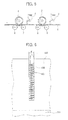
- Aluminum carbide (Al 4 C 3 ) present in the vicinity of the surface of the aluminum plate is converted into aluminum hydroxide (Al(OH) 3 ) by contact with water vapor (H 2 O) at a temperature within the above range, and as such grows (increases in volume).
- the photosensitive layer 105 as described later is formed along the aluminum hydroxide 104 having grown as shown in Fig. 2 . Since the aluminum hydroxide 104 has already finished growing (increasing in volume) when the photosensitive layer 105 is formed, and no more grows even if moisture is fed, the photosensitive layer 105 as formed will never be pushed up in time. Formation of bulges causing image dropouts is thus suppressed.
- a treatment with water vapor at 100°C or 120°C conducted after anodizing treatment generates boehmite protrusions on an anodized film.
- the aluminum plate as described before is reduced in strength due to an annealing effect if subjected to a treatment with water vapor at a temperature over 350°C
- the aluminum plate subjected to the water vapor treatment as above employing water vapor at a temperature not higher than 350°C maintains a high strength.
- the pressure under which the water vapor treatment is to be conducted is preferably 0.3 to 1 atm, and more preferably 0.5 to 1 atm.
- the treatment time is preferably 1 to 60 seconds.
- the temperature of the water vapor to be used for the water vapor treatment is preferably 150 to 350°C, more preferably 180 to 350°C, and even more preferably 200 to 350°C because more desirable effects are achieved at such temperatures.
- the method of bringing the aluminum plate into contact with water vapor is not particularly limited.
- the aluminum plate may be caused to run through a box filled with water vapor produced by boiling water, or water vapor may be ejected onto the aluminum plate directly through a steam nozzle.
- the lithographic printing plate support manufacturing method of the present invention may include the step of conducting hydrophilizing treatment subsequent to the steps of conducting the anodizing treatment and water vapor treatment as described above.
- hydrophilizing treatment the aluminum plate as subjected to the above anodizing treatment and water vapor treatment is further subjected to hydrophilization.
- JP 2005-254638 A is usable for hydrophilizing treatment, while it is preferable to carry out hydrophilization by immersion in an aqueous solution of alkali metal silicate such as sodium silicate and potassium silicate; application of a hydrophilic vinyl polymer or a hydrophilic compound to form a hydrophilic undercoat; or the like.
- alkali metal silicate such as sodium silicate and potassium silicate
- Hydrophilizing treatment with an aqueous solution of alkali metal silicate such as sodium silicate and potassium silicate may be conducted by following the methods and procedures as described in US Patents 2,714,066 and 3,181,461 .
- Hydrophilizing treatment utilizing a hydrophilic undercoat may be conducted by following the methods and procedures as described in JP 59-101651 A and JP 60-149491 A .
- the lithographic printing plate support manufacturing method of the present invention may include the step of conducting water preapplying treatment between the anodizing treatment and the water vapor treatment.
- preapplying treatment water is applied before the water vapor treatment to the anodized film which is formed on the surface of the aluminum plate as subjected to the anodizing treatment.
- condensed water on the surface of the anodized film is deemed to be removed by the drying effect of water vapor at 130 to 350°C (so-called superheated steam) used for the water vapor treatment.
- superheated steam at a higher temperature has a greater drying effect, that is to say, making superheated steam too hot will cause not only the water on the surface of the anodized film but in a micropore in the anodized film to be removed, which may suppress generation of boehmite protrusions in the micropore. In that case, formation of bulges causing image dropouts is suppressed less effectively (the mechanism to suppress bulge formation being described later).
- preapplying treatment is so conducted that an adequate amount of water may be added before the water vapor treatment so as to obtain more desirable effects of the water vapor treatment.
- Preapplying treatment is more effective as the water vapor treatment is conducted with water vapor of higher temperature.
- the temperature of water vapor used for the water vapor treatment is preferably 170 to 350°C.
- preapplying treatment also makes it possible to obtain similar effects in a reduced treatment time for the water vapor treatment.
- the aluminum plate as subjected to the anodizing treatment is dried before water is applied thereto.
- the method to be used for the drying is not particularly limited.
- the amount of water applied is 0.5 to 10 cc/m 2 , for instance, whereupon an amount of 1 to 6 cc/m 2 is preferable because more desirable effects are achieved.
- the water to be applied is preferably pure water, and its temperature is not particularly limited.
- the water applying method may be a common, wet coating method specifically exemplified by dip coating, roll coating, bar coating, blade coating, air-knife coating, slot-die coating, spray coating, and slide coating, whereupon roll coating of a contact type is particularly preferred from the viewpoint of application consistency.
- the material for the surface of a roll used is preferably rubber lest the anodized film be damaged by friction, with examples of usable rubbers including ethylene-propylene-diene (EPDM) rubber, silicone rubber, urethane rubber, polyvinyl alcohol (PVA), and FORTEM (manufactured by MEIJI RUBBER & CHEMICAL CO., LTD.).
- EPDM ethylene-propylene-diene
- silicone rubber silicone rubber
- urethane rubber polyvinyl alcohol
- FORTEM manufactured by MEIJI RUBBER & CHEMICAL CO., LTD.
- the amount of water applied can be controlled by modifying the diameter of a touch roll, the hardness of rubber, the touching width, the touching pressure, the thickness of a rubber layer, and so forth.
- the roll for roll coating may be provided in its surface with grooves parallel to the direction in which the aluminum plate is to be transported; grooves diagonal to the direction in which the aluminum plate is to be transported; latticed grooves; honeycombed grooves; or the like, as is the case with normal roll coating, so as to allow water to be applied more uniformly in amount across the width of the aluminum plate.
- the lithographic printing plate support of the present invention is a lithographic printing plate support obtained by the lithographic printing plate support manufacturing method of the present invention.
- Fig. 6 is a schematic cross-sectional view of part of the lithographic printing plate support of the present invention.
- a micropore 106 is sealed at least partially on its inside with boehmite protrusions 107.
- the boehmite protrusions 107 are generated from the inner wall of the micropore 106 by the hydration reaction between aluminum oxide and water, growing in the direction of the pore diameter (shown in Fig. 6 with "d") of the micropore 106.
- the height of the boehmite protrusions 107 as measured in the direction of pore diameter (d) is shown with "h.”
- the aluminum carbide 103 is prevented from growing as the aluminum hydroxide 104 and pushing up thereby the photosensitive layer 105 in time, which further suppresses formation of bulges causing image dropouts.
- a larger value of the ratio (h/d) between the mean height (h) of the boehmite protrusions 107 and the mean pore diameter (d) of the micropore 106 indicates that the micropore 106 is sealed with the boehmite protrusions 107 more significantly, and formation of bulges causing image dropouts is suppressed more effectively.
- the ratio (h/d) is preferably not less than 0.2, more preferably not less than 0.6, and even more preferably not less than 0.8.
- the mean pore diameter refers to the mean of pore diameters (d) of a single micropre 106
- the mean height refers to the mean of heights (h) of a plurality of boehmite protrusions 107 with which the micropore 106 in question is sealed.
- the mean pore diameter (d) of the micropore 106 and the mean height (h) of the boehmite protrusions 107 may be found by observing a cross section prepared in any manner (cutting, bending with use of a jig) under a scanning electron microscope (SEM) at a magnification of 250,000x, and analyzing a cross-sectional image obtained.
- SEM scanning electron microscope
- boehmite protrusions (not shown) causing scumming may be generated by the hydration reaction between aluminum oxide and water, and grow in the direction of height (upward in the drawing plane of Fig. 6 ).
- boehmite protrusions optionally generated on an anodized film have a smaller mean height of less than 15 nm and, moreover, their generation in itself is relatively small in amount.
- generation of boehmite protrusions on the anodized film 102 as a cause of scumming is suppressed in the present invention, so that a lithographic printing plate exhibiting a high resistance to scumming is obtained.
- the mean height of boehmite protrusions on the anodized film 102 is not more than 6 nm, whereupon the most preferred is that the anodized film 102 has substantially no boehmite protrusions thereon.
- the mean height of boehmite protrusions on the anodized film 102 may be determined using an SEM in the same way as the mean height (h) of the boehmite protrusions 107.
- boehmite protrusions on the anodized film 102 of the lithographic printing plate support of the present invention have a smaller mean height of less than 15 nm may be explained as follows.
- the lithographic printing plate support of the present invention can be made into a presensitized plate by providing an image recording layer, such as a photosensitive layer and a thermosensitive layer, on the support.
- an image recording layer such as a photosensitive layer and a thermosensitive layer
- examples include those of conventional positive-working type, conventional negative-working type, photopolymer type, thermal positive-working type, thermal negative-working type, and on-press-developable, non-processed type as described in paragraphs [0042] through [0198] of JP 2003-1956 A .
- the presensitized plate of the present invention preferably has a photosensitive layer provided on the lithographic printing plate support of the present invention, with the photosensitive layer containing (A) a sensitizing dye, (B) a polymerization initiator, (C) a polymerizable compound, and (D) a binder polymer, and more preferably has a protective layer provided on the photosensitive layer.
- the photosensitive layer of the presensitized plate of the present invention contains a sensitizing dye in response to the wavelength of the light from a light source for exposure.
- the sensitizing dye may have an absorption maximum in the wavelength region ranging from 350 to 450 nm and, in that case, is exemplified by merocyanine dyes, benzopyrans, coumarins, aromatic ketones, and anthracenes.
- the sensitizing dyes as described in paragraphs [0019] through [0056] of JP 2008-46528 A and so forth are mentioned as specific examples of usable sensitizing dyes.
- sensitizing dye such as the structure of the dye to be used, the way of usage, that is to say, the use of either a single dye or a combination of two or more dyes, and the amount of a dye added, are specified as appropriate.
- the amount of a sensitizing dye added in the case of a lithographic printing plate with a relatively small thickness, it is preferable to specify the amount of a sensitizing dye added so that the absorbance of the photosensitive layer may be 0.1 to 1.5, preferably 0.25 to 1.
- the sensitizing dye as added preferably comprises 0.05 to 30% by weight, more preferably 0.1 to 20% by weight, and most preferably 0.2 to 10% by weight of the total solids in the photosensitive layer.
- Usable polymerization initiators include trihalomethyl compounds, carbonyl compounds, organic peroxides, azo compounds, azido compounds, metallocene compounds, hexaaryl biimidazole compounds, organoboron compounds, disulfone compounds, oxime ester compounds, and onium salt compounds.
- at least one selected from the group consisting of hexaaryl biimidazole compounds, onium salts, trihalomethyl compounds and metallocene compounds is preferably used, with hexaaryl biimidazole compounds being particularly preferred.
- a polymerization initiator suitably used in the photosensitive layer may optionally be a single initiator or a combination of two or more initiators.
- the polymerization initiator as used in the photosensitive layer preferably comprises 0.01 to 20% by weight, more preferably 0.1 to 15% by weight, and even more preferably 1.0 to 10% by weight of the total solids in the photosensitive layer.
- the polymerizable compound to be contained in the photosensitive layer is an addition-polymerizable compound having at least one ethylenically unsaturated double bond, and is selected from among compounds having at least one, preferably at least two terminal, ethylenically unsaturated bonds.
- Such compounds are widely known in the technical field of the present invention, and are usable without any particular limitation. They take chemical forms including the forms of a monomer, a prepolymer, namely dimer, trimer or oligomer, a mixture thereof, and a copolymer thereof.
- Exemplary monomers include unsaturated carboxylic acids (e.g., acrylic acid, methacrylic acid, itaconic acid, crotonic acid, isocrotonic acid, maleic acid) as well as esters and amides thereof, with an ester from an unsaturated carboxylic acid and an aliphatic polyhydric alcohol compound, and an amide from an unsaturated carboxylic acid and an aliphatic polyvalent amine compound being suitable for use.
- unsaturated carboxylic acids e.g., acrylic acid, methacrylic acid, itaconic acid, crotonic acid, isocrotonic acid, maleic acid
- esters and amides thereof with an ester from an unsaturated carboxylic acid and an aliphatic polyhydric alcohol compound, and an amide from an unsaturated carboxylic acid and an aliphatic polyvalent amine compound being suitable for use.
- Also suitable for use are a product of the addition reaction of an unsaturated carboxylic acid ester or amide having a hydroxy group or a nucleophilic substituent such as an amino group and a mercapto group with a monofunctional or multifunctional isocyanate or epoxy, and a product of the dehydration condensation reaction of the above ester or amide with a monofunctional or multifunctional carboxylic acid.
- a product of the addition reaction of an unsaturated carboxylic acid ester or amide having an electrophilic substituent such as an isocyanato group and an epoxy group with a monofunctional or multifunctional alcohol, amine or thiol, and a product of the substitution reaction of an unsaturated carboxylic acid ester or amide having an eliminable substituent such as a halogen group and a tosyloxy group with a monofunctional or multifunctional alcohol, amine or thiol are suitable.
- the compounds in each of which the unsaturated carboxylic acid as above is replaced by an unsaturated phosphonic acid, styrene, vinyl ether or the like are also usable.
- the polymerizable compound as used in the photosensitive layer preferably comprises 5 to 80% by weight, more preferably 25 to 75% by weight, of the total solids in the photosensitive layer.
- the polymerizable compound may optionally be a single compound or a combination of two or more compounds.
- An organic high polymer soluble in or swellable with an alkaline water is used as a binder polymer because the binder polymer to be contained in the photosensitive layer as a film forming agent should at the same time be dissolved in an alkaline developer solution.
- the binder polymer as a polymer soluble in or swellable with an alkaline water is removed during development with an alkaline developer, and application of pressure by brushing as required.
- the binder polymer to be used is a binder polymer having the structural units as represented by the following formulae (1) through (3).
- R 1 and R 2 are each independently a hydrogen atom or an alkyl group with a carbon number of 1 to 6;
- R 3 is a hydrogen atom, an alkyl group with a carbon number of 1 to 6, or an alkyl group with a carbon number of 1 to 6 substituted with a hydroxy group, a halogen atom, an amino group, a methoxy group or a carboxy group;
- X is a functional group selected from among -COOH, -CO-W 1 -L 1 -COOH and -SO 3 H, where W 1 is an oxygen atom, a sulfur atom or -NH- group, and L 1 is a divalent organic group;
- the binder polymer to be used has appropriate molecular weight and acid value, whereupon a high polymer having a weight-average molecular weight of 5000 to 300,000 and an acid value of 0.5 to 200 is particularly preferred.
- the acid value refers to the number of milligrams of potassium hydroxide required for the neutralization of free fatty acids contained in one gram of sample. More preferable acid values fall within the range of 5.0 to 180, with an acid value of 10 to 150 being even more preferable.
- the ratio by weight of the total amount of the structural units as represented by formulae (1) and (3), respectively, to the amount of the structural unit as represented by formula (2) which has an ethylenically unsaturated double bond is preferably 0.1 to 3.0, more preferably 0.1 to 2.0, and most preferably 0.1 to 1.0.
- the structural units as represented by formulae (1) through (3) may be mixed together at any ratio as long as the ratio in question meets a molecular weight, an acid value and a double bond amount falling within their respective ranges as above. As long as the molecular weight, the acid value and the double bond amount are kept within their respective ranges as above, other structural unit than those represented by formulae (1) through (3) may be added.
- the binder polymer may be contained in the photosensitive layer in any amount, while the binder polymer content is generally specified to be not more than 90% by weight, preferably 10 to 90% by weight, and more preferably 30 to 80% by weight, taking account of the strength of images formed, and so forth.
- a water-soluble organic high polymer may be used if development is to be carried out with water.
- the water-soluble organic high polymer include an addition polymer having a carboxylic acid group on a side chain, such as are described in paragraph [0093] of JP 2008-46528 A .
- the binder polymer to be used has appropriate molecular weight and acid value, whereupon a high polymer having a weight-average molecular weight of 5000 to 300,000 and an acid value of 20 to 200 is particularly preferred.
- the photosensitive layer contains a mercapto compound having a mercapto group because the compound is effective at enhancing the sensitivity.
- the mercapto compounds as described in paragraphs [0096] through [0102] of JP 2008-46528 A , paragraphs [0078] through [0086] of JP 2008-89788 A , and the like are mentioned as examples of usable mercapto compounds.
- the mercapto compound as added generally comprises 0.5 to 20% by weight, preferably 1 to 15% by weight, and more preferably 1 to 10% by weight of the whole constituents of the photosensitive layer.
- thermal polymerization inhibitor It is desirable that a small amount of thermal polymerization inhibitor is added in order to prevent unwanted thermal polymerization in the photosensitive layer during the manufacture or storage of a presensitized plate.
- Suitable thermal polymerization inhibitors include those described in paragraph [0103] of JP 2008-46528 A .
- the thermal polymerization inhibitor as added preferably comprises about 0.01% to about 5% by weight of the total solids as constituents of the photosensitive layer.
- Behenic acid, behenic acid amide, or other higher fatty acid derivative may be added as required to make it present exclusively on the surface of the photosensitive layer being dried after coating, in order to prevent oxygen from inhibiting polymerization.
- the higher fatty acid derivative or the like as added preferably comprises about 0.5% to about 10% by weight of the total solids as constituents of the photosensitive layer.
- a colorant may also be added for the coloring of the photosensitive layer.
- Exemplary colorants include those described in paragraph [0103] of JP 2008-46528 A .
- the colorant as added preferably comprises about 0.5% to about 20% by weight of the total solids in the photosensitive layer.
- such an additive as an inorganic filler and a plasticizer, with the latter being exemplified by dioctyl phthalate, dimethyl phthalate and tricresyl phosphate, may be added for the improvement of the cured layer in physical properties.
- the additive for physical property improvement as added preferably comprises not more than 10% by weight of the total solids in the photosensitive layer.
- Suitable yellow dyes and pigments include the dyes as described in paragraph [0119] of JP 2008-89788 A .
- the solvent to be used may be an organic solvent, with specific examples including those described in paragraph [0104] of JP 2008-46528 A .
- the solvent may optionally be a single solvent or a solvent mixture.
- the solid concentration of the coating solution is generally 1 to 50% by weight.
- a surfactant may be added to the coating solution in order to improve the quality of a coated surface.
- the amount of the photosensitive layer as a coating film that is to be measured as the weight after drying is generally about 0.1 g to about 10 g/m 2 , with amounts of 0.3 to 5 g/m 2 being preferred, and amounts of 0.5 to 3 g/m 2 being more preferred.
- the protective layer as mentioned before preferably contains a water-soluble resin.
- the protective layer also serves as an oxygen blocking layer for blocking diffusive intrusion of oxygen inhibiting the polymerization reaction during exposure.
- the oxygen permeability A of the protective layer as measured at 25°C under a pressure of one atmosphere preferably falls within the range of 1.0 ⁇ A ⁇ 20 (mL/m 2 ⁇ day). With an extremely low oxygen permeability A of less than 1.0 (mL/m 2 ⁇ day), unwanted polymerization reaction may occur during the manufacture or storage of an unexposed presensitized plate, or unwanted fogging or thickening of image lines may occur during imagewise exposure. On the other hand, too high an oxygen permeability A over 20 (mL/m 2 ⁇ day) may reduce the sensitivity.
- Oxygen permeabilities A ranging from 1.5 to 12 (mL/m 2 ⁇ day) are more preferable, and those ranging from 2.0 to 8.0 (mL/m 2 ⁇ day) are even more preferable.
- a desired protective layer is essentially transparent to the light for exposure, has a good adhesion to the photosensitive layer, and is readily removable during a developing process following exposure. Efforts have been made to obtain such a protective layer, as described in detail in US Patent 3,458,311 and JP 55-49729 B .
- a water-soluble high-molecular compound of relatively high crystallinity is preferably used for the protective layer, with specific examples thereof including those described in paragraph [0108] of JP 2008-46528 A which may be used alone or in combination.
- use of polyvinyl alcohol as a chief component is most effective at obtaining a protective layer excellent in fundamental properties such as oxygen blocking property and removability upon development.
- the polyvinyl alcohol to be used for the protective layer may partially be substituted with an ester, ether or acetal as long as it contains non-substituted vinyl alcohol units imparting to it required oxygen blocking property and water solubility. It is also possible that part of the polyvinyl alcohol contains other monomer than vinyl alcohol as a copolymerizable component.
- a typical polyvinyl alcohol may have a hydrolysis rate of 71 to 100 mol% and contain 300 to 2400 polymerized repeating units. Specific examples of the polyvinyl alcohol include those described in paragraph [0109] of JP 2008-46528 A which may be used alone or in combination.
- the content of the polyvinyl alcohol in the protective layer is 20 to 95% by weight, with a content of 30 to 90% by weight being more preferred.
- Polyvinyl pyrrolidone or a modified polyvinyl pyrrolidone is suitable for use as a component mixed with the polyvinyl alcohol from the viewpoint of the oxygen blocking property, the removability upon development, and so forth.
- the content of polyvinyl pyrrolidone or a modified polyvinyl pyrrolidone in the protective layer is 3.5 to 80% by weight, preferably 10 to 60% by weight, and more preferably 15 to 30% by weight.
- Components of the protective layer (that is to say, whether or not PVA, a given additive or the like is to be used as a component), the amount of the protective layer as a coating film, and so forth are determined taking account of not only the oxygen blocking property and the removability upon development but the risk of causing fogging, the adhesion and the scratch resistance.
- a higher oxygen blocking property and, accordingly, a more desirable sensitivity are attained as PVA used has a higher hydrolysis rate (the content of non-substituted vinyl alcohol units in the protective layer is higher) and the protective layer has a larger thickness.
- the high-molecular compound to be used such as the above polyvinyl alcohol (PVA), may have a molecular weight of 2000 to 10,000,000, whereupon a compound with a molecular weight of 20,000 to 3,000,000 is suitably used.
- Glycerin, dipropylene glycol or the like may be added as another constituent of the protective layer in an amount equivalent to several percent by weight on the amount of a high-molecular compound used, so as to make the layer flexible. It is also possible to add an anionic surfactant such as sodium alkyl sulfates and sodium alkyl sulfonates; an ampholytic surfactant such as alkyl aminocarboxylate salts and alkyl aminodicarbosylte salts; or a nonionic surfactant such as polyoxyethylene alkyl phenyl ethers in an amount of several percent by weight on the amount of a high-molecular compound used.
- the protective layer suitably has a thickness of 0.5 to 5 ⁇ m, with a thickness of 1 to 3 ⁇ m being particularly suitable.
- the adhesion to the photosensitive layer and the scratch resistance are also very important from the viewpoint of handling a presensitized plate. If a hydrophilic layer made of a water-soluble polymer is formed on the photosensitive layer which is lipophilic, the layers are liable to be separated from each other due to a poor adhesion, so that oxygen intruding between the separated layers inhibits polymerization to cause such defects as an inadequate curing of the photosensitive layer.
- Various proposals have been offered in order to improve the adhesion between the two layers. For instance, it is described in the US patent applications with Serial Nos.
- the amount of the protective layer as a coating film is generally 0.1 g to 10 g/m 2 , preferably 0.5 to 5 g/m 2 , on dry weight basis.
- the presensitized plate of the present invention may have an undercoat provided between the lithographic printing plate support of the present invention and the photosensitive layer a described before.
- the amount of the undercoat as a coating film is preferably 2 to 1000 mg/m 2 , more preferably 5 to 200 mg/m 2 , and most preferably 10 to 50 mg/m 2 . While various techniques are applicable to the formation of the undercoat on the support, the most preferred for the achievement of an amount of the undercoat falling within the above range is the technique in which a solution for forming the undercoat is prepared, applied onto the support, then dried.
- a back coat may be provided on the back side of the support as required.
- the back coat is suitably exemplified by a coating layer composed of the metal oxide which is obtained by the hydrolysis and polycondensation of the organic high-molecular compound as disclosed in JP 5-45885 A or the organic or inorganic metal compound as disclosed in JP 6-35174 A .
- a coating layer composed of the metal oxide which is obtained by the hydrolysis and polycondensation of the organic high-molecular compound as disclosed in JP 5-45885 A or the organic or inorganic metal compound as disclosed in JP 6-35174 A .
- an alkoxy compound of silicon such as Si (OCH 3 ) 4 , Si (OC 2 H 5 ) 4 , Si (OC 3 H 7 ) 4 and Si (OC 4 H 9 ) 4 , is particularly preferred because such a compound is low in cost and readily available.
- a lithographic printing plate is prepared by subjecting the presensitized plate of the present invention to imagewise exposure and developing treatment.
- developing treatment development may be carried out using a developer solution.
- the developer solution to be used is not particularly limited, whereupon an aqueous solution containing an inorganic alkali salt and a surfactant, and generally having a pH of 11.0 to 12.7 may suitably be used.
- the inorganic alkali salt to be used is selected as appropriate, and exemplified by the inorganic alkali salts as described in paragraph [0162] of JP 2008-46528 A which may be used alone or in combination of two or more out of them.
- the developing capacity of the developer solution is readily controlled by modifying the mixing ratio between silicon oxide SiO 2 and alkali oxide M 2 O (M is an alkali metal or ammonium group) as ingredients of the silicate, and their concentrations.
- the aqueous alkali solution as above preferably has a mixing ratio between silicon oxide SiO 2 and alkali oxide M 2 O (SiO 2 /M 2 O; molar ratio) of 0.5 to 3.0, more preferably of 1.0 to 2.0.
- the SiO 2 and M 2 O as added preferably comprise 1 to 10% by weight, more preferably 3 to 8% by weight, and most preferably 4 to 7% by weight of the aqueous alkali solution. Under such concentrations, no reduction in developing or processing capacity occurs, no precipitates or crystals are generated, and, moreover, no gelation is observed during the neutralization when a waste solution is discarded, that is to say, liquid waste disposal is carried out without trouble.
- organic alkali agent may additionally be used for a delicate adjustment of the alkali concentration or improvement in solubility of the photosensitive layer.
- Usable organic alkali agents include those described in paragraph [0164] of JP 2008-46528 A which may be used alone or in combination of two or more out of them.
- the surfactant to be used is selected as appropriate, and exemplified by the surfactants as described in paragraph [0165] of JP 2008-46528 A .
- a nonionic surfactant having a polyoxyalkylene ether group is particularly preferred.
- nonionic surfactants each having a polyoxyalkylene ether group as described in paragraphs [0167] through [0171] of JP 2008-46528 A are suitable for use.
- the surfactant may optionally be a single surfactant or a combination of surfactants.
- the pH of the developer solution is generally 11.0 to 12.7, preferably 11.5 to 12.5, lest image areas or exposed areas be damaged during development.
- the conductivity of the developer solution is preferably 3 to 30 mS/cm, and more preferably 5 to 20 mS/cm.
- An image may be formed on the surface of an aluminum plate as a support by subjecting the presensitized plate of the present invention to imagewise exposure with actinic light from a conventional light source, such as a carbon arc lamp, a highpressure mercury-vapor lamp, a xenon lamp, a metal halide lamp, a fluorescent lamp, a tungsten lamp, a halogen lamp, a helium-cadmium laser, an argon ion laser, an FD-YAG laser, a helium-neon laser and a semiconductor laser (350 to 600 nm), then developing treatment with a developer solution.
- the light source for exposure is preferably a laser emitting at 350 to 600 nm.
- heating at a temperature of 50 to 140°C for one second to five minutes may be performed in order to increase the efficiency of photosensitive layer curing. Heating at a temperature falling within the above range is effective for the increase in efficiency of photosensitive layer curing with no layer residues due to dark polymerization in non-exposed areas.
- the protective layer may be removed in a known manner, that is to say, removed with the developer solution concurrently with the removal of non-exposed areas of the photosensitive layer, or alternatively, removed with water or hot water before the removal of non-exposed areas of the photosensitive layer by development.
- the antiseptic or the like as disclosed in JP 10-10754 A or the organic solvent or the like as disclosed in JP 8-278636 A may be contained in the water or hot water.
- the developer solution to be used for the developing treatment conducted on the presensitized plate of the present invention preferably contains a nonionic surfactant having a polyoxyalkylene ether group.
- the development with the developer solution as described above is performed on the presensitized plate of the present invention at a temperature of 0 to 60°C, preferably about 15 to 40°C, by following a routine procedure such that, for instance, the presensitized plate after exposure is immersed in the developer solution and as such scrubbed with a brush.
- the developer solution decreases in processing capacity as the throughput is increased.
- the processing capacity may be restored by adding the developer solution or replacing the developer solution by a fresh one.
- the presensitized plate is generally subjected to post-treatment with rinsing water, a rinsing solution containing a surfactant and so forth, or a desensitizer solution containing gum arabic, a starch derivative or the like, as described in JP 54-8002 A , JP 55-115045 A , JP 59-58431 A , and so forth.
- various treatments may be used in combination for the post-treatment to be conducted on the presensitized plate.
- a printing plate resulting from the treatments as described above may be improved in press life by subjecting it to post-exposure treatment based on the method as disclosed in JP 2000-89478 A , or heating treatment such as burning.
- the lithographic printing plate thus prepared is mounted on an offset press to make a large number of printed sheets.
- the 0.24 mm thick plates of aluminum alloy of quality 1S which had different aluminum carbide concentrations were each subjected to one of the graining treatments (A) through (C) as described below, with the relevant treatment being seen from Table 1 as shown later, then anodizing treatment, optional preapplying treatment, and water vapor treatment to manufacture a lithographic printing plate support.
- the aluminum carbide concentrations as set forth in Table 1 were determined by gas chromatography (compliant with Light Metal Industrial Standard LIS-A07-1971). Between treatment processes, rinsing treatment with water was indispensably conducted, and liquid was removed with nip rollers at the end of each rinsing treatment.
- An aluminum plate was subjected to etching treatment by spraying the plate with an aqueous solution of caustic soda having a caustic soda concentration of 26% by weight, an aluminum ion concentration of 6.5% by weight and a temperature of 70°C from a spray line. After the treatment, the aluminum plate was sprayed with water for rinsing. The amount of aluminum dissolved away from the plate surface to be subjected to electrochemical graining treatment was 5 g/m 2 .
- Desmutting treatment was then conducted in an aqueous nitric acid solution.
- the aqueous nitric acid solution used for the desmutting treatment was the waste from the aqueous nitric acid solution as used in the next step of electrochemical graining.
- the solution temperature was 35°C.
- Desmutting by spraying with a desmutting solution was performed for three seconds.
- electrochemical graining treatment was continuously conducted on the aluminum plate.
- the electrolyte solution for the treatment was prepared by adding aluminum nitrate to a 10.4 g/L aqueous solution of nitric acid at 35°C to make the solution have an aluminum ion concentration of 4.5 g/L.
- the AC source waveform was as shown in Fig. 3 , that is to say, an alternating current of trapezoidal waveform was employed for the electrochemical graining treatment on conditions that the time tp for the transition of current value from zero to peak was 0.8 msec and the duty ratio was 1:1.
- a carbon electrode was used as a counter electrode, and ferrite was used for an auxiliary anode.
- the electrolytic cell was as shown in Fig. 4 .
- the current density was 30 A/dm 2 at current peaks, and the current from a power source was shunted into the auxiliary anode at a ratio of 5%.
- the amount of electricity was 250 C/dm 2 as the total amount of electricity when the aluminum plate served as an anode. After the treatment, the aluminum plate was sprayed with water for rinsing.
- the aluminum plate thus obtained was subjected to etching treatment by spraying the plate with an aqueous solution of caustic soda having a caustic soda concentration of 5% by weight, an aluminum ion concentration of 0.5% by weight and a temperature of 50°C from a spray line. After the treatment, the aluminum plate was sprayed with water for rinsing. The amount of aluminum dissolved away was 0.2 g/m 2 .
- An aluminum plate was subjected to etching treatment by spraying the plate with an aqueous solution of caustic soda having a caustic soda concentration of 26% by weight, an aluminum ion concentration of 6.5% by weight and a temperature of 70°C from a spray line. After the treatment, the aluminum plate was sprayed with water for rinsing. The amount of aluminum dissolved away from the plate surface to be subjected to electrochemical graining treatment was 1.0 g/m 2 .
- Desmutting treatment was then conducted in an aqueous acid solution.
- the aqueous acid solution used for the desmutting treatment was a 150 g/L aqueous solution of sulfuric acid.
- the solution temperature was 30°C.
- Desmutting by spraying with a desmutting solution was performed for three seconds. After the treatment, the aluminum plate was rinsed with water.
- electrolytic graining treatment with alternating current was conducted on the aluminum plate using an electrolyte solution having a hydrochloric acid concentration of 14 g/L, an aluminum ion concentration of 13 g/L and a sulfuric acid concentration of 3 g/L.
- the temperature of the electrolyte solution was 30°C.
- the aluminum ion concentration was adjusted by addition of aluminum chloride.
- the alternating current as used had a sinusoidal waveform, with the positive and negative waveforms therein being symmetrical to each other, and a frequency of 50 Hz, whereupon the time for anodic reaction and the time for cathodic reaction in one cycle of the alternating current were such that the ratio between them was 1:1, and the current density was 75 A/dm 2 at peaks of the alternating current waveform.
- the amount of electricity was 450 C/dm 2 as the total amount of electricity used for the anodic reaction on the aluminum plate. Electrolysis was carried out by applying 125 C/dm 2 of electricity four times at intervals of four seconds. A carbon electrode was used as a counter electrode opposite to the aluminum plate. After the treatment, the aluminum plate was rinsed with water.
- the aluminum plate after the electrochemical graining treatment was subjected to etching treatment by spraying the plate with an aqueous solution of caustic soda having a caustic soda concentration of 5% by weight, an aluminum ion concentration of 0.5% by weight and a temperature of 35°C from a spray line.
- the amount of aluminum dissolved away from the plate surface as subjected to electrochemical graining treatment was 0.1 g/m 2 .
- the aluminum plate was rinsed with water.
- aqueous acid solution used for the desmutting treatment was a waste solution generated in the anodizing treatment process (170 g/L aqueous solution of sulfuric acid with 5.0 g/L aluminum ions dissolved therein). The solution temperature was 30°C. Desmutting by spraying with a desmutting solution was performed for three seconds.
- Fig. 5 shows an aluminum plate 1, roller brushes (namely, rollers having brush bristles set thereon) 2 and 4, an abrasive slurry 3, and support rollers 5, 6, 7 and 8.
- the abrasive had a median diameter of 30 ⁇ m, the brushes were four in number, and the brush rotating speed was 250 rpm.
- the material for the brush bristles was nylon 6.10, the bristle diameter was 0.3 mm, and the bristle length was 50 mm.
- the bristles were densely set in holes formed in a stainless steel cylinder having a diameter of 300 mm.
- the distance between two support rollers (each with a diameter of 200 mm) under each roller brush was 300 mm.
- the brush bristles were pressed against the aluminum plate to the extent that the load on a motor for rotatively driving the roller brushes was increased by 10 kW from that before the bristles were pressed against the aluminum plate.
- the brushes were rotated in the same direction as the direction in which the aluminum plate was moved.
- the aluminum plate thus obtained was subjected to etching treatment by spraying the plate with an aqueous solution of caustic soda having a caustic soda concentration of 26% by weight, an aluminum ion concentration of 6.5% by weight and a temperature of 70°C from a spray line. After the treatment, the aluminum plate was sprayed with water for rinsing. The amount of aluminum dissolved away was 10 g/m 2 .
- Desmutting treatment was then conducted in an aqueous nitric acid solution.
- the aqueous nitric acid solution used for the desmutting treatment was the waste from the aqueous nitric acid solution as used in the next step of electrochemical graining.
- the solution temperature was 35°C.
- Desmutting by spraying with a desmutting solution was performed for three seconds.
- electrochemical graining treatment was continuously conducted on the aluminum plate.
- the electrolyte solution for the treatment was prepared by adding aluminum nitrate to a 10.4 g/L aqueous solution of nitric acid at 35°C to make the solution have an aluminum ion concentration of 4.5 g/L.
- the AC source waveform was as shown in Fig. 3 , that is to say, an alternating current of trapezoidal waveform was employed for the electrochemical graining treatment on conditions that the time tp for the transition of current value from zero to peak was 0.8 msec and the duty ratio was 1:1.
- a carbon electrode was used as a counter electrode, and ferrite was used for an auxiliary anode.
- the electrolytic cell was as shown in Fig. 4 .
- the current density was 30 A/dm 2 at current peaks, and the current from a power source was shunted into the auxiliary anode at a ratio of 5%.
- the amount of electricity was 185 C/dm 2 as the total amount of electricity when the aluminum plate served as an anode. After the treatment, the aluminum plate was sprayed with water for rinsing.
- the aluminum plate thus obtained was subjected to etching treatment by spraying the plate with an aqueous solution of caustic soda having a caustic soda concentration of 5% by weight, an aluminum ion concentration of 0.5% by weight and a temperature of 50°C from a spray line. After the treatment, the aluminum plate was sprayed with water for rinsing. The amount of aluminum dissolved away was 0.5 g/m 2 .
- Desmutting treatment was then conducted in an aqueous sulfuric acid solution.
- the aqueous sulfuric acid solution used for the desmutting treatment had a sulfuric acid concentration of 170 g/L and an aluminum ion concentration of 5 g/L.
- the solution temperature was 30°C.
- Desmutting by spraying with a desmutting solution was performed for three seconds.
- electrochemical graining treatment was continuously conducted on the aluminum plate.
- the electrolyte solution for the treatment was prepared by adding aluminum chloride to a 6.2 g/L aqueous solution of hydrochloric acid at 35°C to make the solution have an aluminum ion concentration of 4.5 g/L.
- the AC source waveform was as shown in Fig. 3 , that is to say, an alternating current of trapezoidal waveform was employed for the electrochemical graining treatment on conditions that the time tp for the transition of current value from zero to peak was 0.8 msec and the duty ratio was 1:1.
- a carbon electrode was used as a counter electrode, and ferrite was used for an auxiliary anode.
- the electrolytic cell was as shown in Fig. 4 .
- the current density was 25 A/dm 2 at current peaks, and the amount of electricity used for the electrolysis in an aqueous hydrochloric acid solution was 63 C/dm 2 as the total amount of electricity when the aluminum plate served as an anode. After the treatment, the aluminum plate was sprayed with water for rinsing.
- the aluminum plate thus obtained was subjected to etching treatment by spraying the plate with an aqueous solution of caustic soda having a caustic soda concentration of 5% by weight, an aluminum ion concentration of 0.5% by weight and a temperature of 50°C from a spray line. After the treatment, the aluminum plate was sprayed with water for rinsing. The amount of aluminum dissolved away was 0.1 g/m 2 .
- the aluminum plate as subjected to one of graining treatments (A) through (C) was then subjected to anodizing treatment in a 20 wt% aqueous solution of sulfuric acid at 53°C for 50 seconds.
- Anodizing was carried out with a cathode positioned on a grained surface of the aluminum plate at a current density of 5 A/dm 2 .
- the amount of anodized film formed was 2.6 g/m 2 .
- Preapplying treatment was optionally conducted after the anodizing treatment.
- Preapplication of water was carried out by roll coating.
- the aluminum plate as subjected to the anodizing treatment was dipped in pure water in a dipping tank, then caused to pass through a roll so as to adjust the amount of water applied. Amounts of water applied were as set forth in the column "application amount [cc/m 2 ]" of Table 1 as shown later. The symbol "-" in the above column indicates that preapplying treatment was not conducted.
- the amount of water applied was adjusted by modifying conditions for a roll used (the touch roll diameter, the hardness of rubber, the touching width, the touching pressure, and the rubber layer thickness).
- the relationship between the application amount and the conditions for a roll used is set forth in Table 2 as shown later.
- Water vapor treatment was conducted on the aluminum plate after the above anodizing treatment (or preapplying treatment), with the treatment conditions, namely the water vapor temperature (in the column “Temperature [°C]”), the treatment time (in the column “Time [s]”) and the pressure condition (in the column “Pressure [atm]”), having been specified as set forth in Table 1 as shown later.
- the aluminum plate was introduced into a box filled with water vapor to bring the plate into contact with the vapor. The temperature and pressure of the water vapor were measured in the box. If the "Temperature,” “Time,” and “Pressure” for water vapor treatment are all set forth in the table as "-”, it is indicated that water vapor treatment was not conducted on the relevant aluminum plate.
- the ratio (h/d) as set forth in Table 1 is the mean of the ratios (h/d) of any five micropores observed in the SEM image by viewing the cross section of the anodized film from the top to the bottom.
- compositional Ratio of Solution for Forming Undercoat Polymer (P1) 0.3 parts by weight Pure water 60.0 parts by weight Methanol 939.7 parts by weight
- the photosensitive composition (1) whose compositional ratio is shown below was applied to each support using a bar coater, then dried at 90°C for one minute to form a photosensitive layer.
- the amount of the photosensitive layer after drying was 1.35 g/m 2 .
- Photosensitive Composition (1) Polymerizable compound (1) as below (PLEX 6661-O manufactured by Evonik Degussa Japan Co., Ltd) 1.69 parts by weight Binder polymer (1) as below 1.87 parts by weight Sensitizing dye (1) as below 0.13 parts by weight Polymerization initiator (1) as below 0.46 parts by weight Chain transfer agent (1) as below 0.44 parts by weight Dispersion of ⁇ -phthalocyanine pigment 1.70 parts by weight (15 parts by weight pigment; 10 parts by weight dispersant (allyl methacrylate-methacrylic acid copolymer with a weight-average molecular weight of 60,000 and a molar ratio of copolymerization of 83/17); 15 parts by weight cyclohexanone) Thermal polymerization inhibitor (N-nitrosophenyl hydroxylamine aluminum salt) 0.012 parts by weight Dispersion of yellow pigment 0.5 parts by weight (15 parts by weight Novoperm Yellow H2G (manufactured by parts by Clariant Corp.)
- the solution for applying protective layer whose compositional ratio is shown below was applied using a bar coater so that the amount of a protective layer applied might be 2.5 g/m 2 on dry weight basis, then dried at 120°C for one minute to obtain a presensitized plate.
- PVA 105 polyvinyl alcohol with a saponification rate of 98 mol% manufactured by KURARAY CO., LTD.
- PVP-K30 polyvinyl pyrrolidone manufactured by BASF Corp.
- EMALEX 710 manufactured by Nihon Emulsion Co., Ltd.
- Luviskol VA 64W manufactured by BASF Corp.
- Polymer (1) as above 0.05 parts by weight Pure water 36.5 parts by weight
- the presensitized plate thus obtained was left standing for 30 days so as to make bulges (each with a diameter of about 100 ⁇ m) formed at the plate surface.
- the plate was then subjected to imagewise exposure on a CTP machine Vx9600 (light source wavelength, 405 nm), a product of FUJIFILM Corp., so regulated that the quantity of light for exposure might be 0.05 mJ/cm 2 .
- development was performed on a PS processor InterPlater 850 HD manufactured by Glunz & Jensen Corp., whereupon the alkaline developer solution whose compositional ratio is shown below was charged in the processor and preheated to 25°C before use.
- the presensitized plate was evaluated with respect to the number of bulges indirectly by counting image dropouts (defects in aluminum) observed in an area of at least 400 cm 2 .
- the evaluation results are set forth in Table 1. For the evaluation, the following criteria were employed.
- a presensitized plate should not be evaluated as rank F or G with respect to the number of bulges.
- the presensitized plate as obtained was subjected to imagewise exposure on a CTP machine Vx9600 (light source wavelength, 405 nm), a product of FUJIFILM Corp., so regulated that the quantity of light for exposure might be 0.05 mJ/cm 2 .
- development was performed on a PS processor InterPlater 850 HD manufactured by Glunz & Jensen Corp., whereupon the alkaline developer solution whose compositional ratio is shown below was charged in the processor and preheated to 25°C before use.
- the lithographic printing plate thus prepared printing was performed on a Lithrone printing press manufactured by Komori Corporation using black ink DIC-GEOS (N) available from DIC Corporation.
- the press life of the lithographic printing plate was evaluated by the number of the printed sheets which had already been made from the printing plate at the time when the density of solid images began to decline on visual inspection. The evaluation results are set forth in Table 1.
- the presensitized plate as obtained was subjected to imagewise exposure on a CTP machine Vx9600 (light source wavelength, 405 nm), a product of FUJIFILM Corp., so regulated that the quantity of light for exposure might be 0.05 mJ/cm 2 .
- a PS processor InterPlater 850 HD manufactured by Glunz & Jensen Corp. whereupon the alkaline developer solution whose compositional ratio is shown below was charged in the processor and preheated to 25°C before use. It should be noted that the presensitized plates to be subjected to exposure and development were each excellent in sensitivity.
- lithographic printing plate With the lithographic printing plate thus prepared, printing was performed on a printing press Mitsubishi DAIYA F2 (manufactured by Mitsubishi Heavy Industries, Ltd.) using red ink DIC-GEOS (s). After 10,000 printed sheets were made, the lithographic printing plate was evaluated with respect to the scumming resistance by visually inspecting stains on the blanket. The evaluation results are set forth in Table 1. For the evaluation, the following criteria were employed. A: Almost no stains are on the blanket. B: The blanket is stained indeed but to an acceptable extent. C: The blanket is stained, and printed sheets are distinctly soiled.
- the mean height of boehmite protrusions on the anodized film was likely to be reduced as the water vapor for water vapor treatment was higher in temperature, or the treatment time was shorter.
- Examples 1 through 3 are compared with one another, in each of which the water vapor temperature was 130°C, the ratio (h/d) was larger and, accordingly, formation of bulges was suppressed more effectively as the treatment time was longer.
- the tendency applies to Examples 4 through 9 in each of which the water vapor temperature was 150°C, Examples 18 through 20 in each of which the water vapor temperature was 170°C, Examples 10 through 12 in each of which the water vapor temperature was 200°C, and Examples 17, 21 and 22 in each of which the water vapor temperature was 350°C.
- Example 6 When Examples 6, 13 and 14 are compared with one another, which were different from one another in aluminum carbide concentration, formation of bulges causing image dropouts was suppressed most effectively in Example 6 with the lowest aluminum carbide concentration (2 ppm).
- Examples 6, 15 and 16 are compared with one another, which were different from one another in conditions for graining treatment, formation of bulges causing image dropouts was suppressed effectively, and the scumming resistance was excellent in any of them irrespective of conditions for graining treatment.
- Example 2 in which the water vapor for water vapor treatment had a temperature of 130°C is compared with Examples 23 through 27 with the same water vapor temperature, 130°C, the ratio (h/d) was likely to be larger, leading to a more effective suppression of bulge formation, in Examples 23 through 27 with preapplying treatment than Example 2 without preapplying treatment even though other conditions were identically specified.
- the ratio (h/d) is also influenced by the amount of water applied in preapplying treatment.
- Example 23 the ratio (h/d) in Example 23 with preapplying treatment conducted with 0.5 cc/m 2 of water was not increased as compared with that in Example 2 without preapplying treatment, and the ratio (h/d) in Example 27 with preapplying treatment conducted with 10 cc/m 2 of water was slightly reduced as compared with that in Example 2.
- the ratio (h/d) in each of Examples 24 through 26 with preapplying treatment conducted with 1 to 6 cc/m 2 of water was larger than that in Example 2.
- Preapplying treatment was more effective as the water vapor for water vapor treatment was higher in temperature.
- the ratio (h/d) in Example 25 with preapplying treatment was about 1.2 times as large as that in Example 2 without preapplying treatment
- the ratio (h/d) in Example 29 with preapplying treatment was about 1.3 times as large as that in Example 19 without preapplying treatment when the water vapor temperature was 170°C.
Landscapes
- Engineering & Computer Science (AREA)
- Architecture (AREA)
- Structural Engineering (AREA)
- Physics & Mathematics (AREA)
- General Physics & Mathematics (AREA)
- Chemical & Material Sciences (AREA)
- Chemical Kinetics & Catalysis (AREA)
- Electrochemistry (AREA)
- Printing Plates And Materials Therefor (AREA)
- Materials For Photolithography (AREA)
- Photosensitive Polymer And Photoresist Processing (AREA)
Applications Claiming Priority (3)
| Application Number | Priority Date | Filing Date | Title |
|---|---|---|---|
| JP2010165784 | 2010-07-23 | ||
| JP2011039812 | 2011-02-25 | ||
| JP2011148202A JP2012187909A (ja) | 2010-07-23 | 2011-07-04 | 平版印刷版用支持体、および、平版印刷版原版 |
Publications (3)
| Publication Number | Publication Date |
|---|---|
| EP2447085A2 true EP2447085A2 (de) | 2012-05-02 |
| EP2447085A3 EP2447085A3 (de) | 2013-04-24 |
| EP2447085B1 EP2447085B1 (de) | 2014-03-19 |
Family
ID=45493910
Family Applications (1)
| Application Number | Title | Priority Date | Filing Date |
|---|---|---|---|
| EP20110174834 Not-in-force EP2447085B1 (de) | 2010-07-23 | 2011-07-21 | Träger für eine lithographische Druckplatte und vorsensibilisierte Druckplatte |
Country Status (4)
| Country | Link |
|---|---|
| US (1) | US8632949B2 (de) |
| EP (1) | EP2447085B1 (de) |
| JP (1) | JP2012187909A (de) |
| CN (1) | CN102402120B (de) |
Cited By (1)
| Publication number | Priority date | Publication date | Assignee | Title |
|---|---|---|---|---|
| EP3511173B1 (de) | 2017-10-31 | 2020-08-05 | FUJIFILM Corporation | Originalplatte einer flachdruckplatte, verfahren zur herstellung einer flachdruckplatte, druckverfahren und verfahren zur herstellung eines aluminiumträgerkörpers |
Families Citing this family (6)
| Publication number | Priority date | Publication date | Assignee | Title |
|---|---|---|---|---|
| CN104066591A (zh) * | 2012-01-24 | 2014-09-24 | 富士胶片株式会社 | 平版印刷版用支承体、平版印刷版用支承体的制造方法、以及平版印刷版原版 |
| WO2014017640A1 (ja) * | 2012-07-27 | 2014-01-30 | 富士フイルム株式会社 | 平版印刷版用支持体およびその製造方法、並びに、平版印刷版原版 |
| JP6562500B2 (ja) * | 2015-03-31 | 2019-08-21 | 地方独立行政法人山口県産業技術センター | 表面処理アルミニウム材とその製造方法 |
| EP3544821A4 (de) * | 2016-11-28 | 2020-09-09 | Shenzhen Zhong Chuang Green Plate Technology Co., Ltd. | Behandlungsverfahren für druckplatten |
| CN115612223B (zh) * | 2021-07-15 | 2025-07-25 | 乐凯华光印刷科技有限公司 | 一种聚乙烯醇衍生物和聚丙烯酸树脂的杂化聚合物和一种耐化学品热敏版 |
| JP7839797B2 (ja) * | 2021-08-31 | 2026-04-02 | 富士フイルム株式会社 | 平版印刷版用支持体、平版印刷版原版、平版印刷版の製造方法 |
Citations (25)
| Publication number | Priority date | Publication date | Assignee | Title |
|---|---|---|---|---|
| US2714066A (en) | 1950-12-06 | 1955-07-26 | Minnesota Mining & Mfg | Planographic printing plate |
| US3181461A (en) | 1963-05-23 | 1965-05-04 | Howard A Fromson | Photographic plate |
| US3458311A (en) | 1966-06-27 | 1969-07-29 | Du Pont | Photopolymerizable elements with solvent removable protective layers |
| JPS4818327B1 (de) | 1969-10-09 | 1973-06-05 | ||
| JPS5040047B2 (de) | 1971-09-06 | 1975-12-22 | ||
| JPS548002A (en) | 1977-06-17 | 1979-01-22 | Fuji Photo Film Co Ltd | Method of developing flat printing plate |
| JPS55115045A (en) | 1979-02-27 | 1980-09-04 | Fuji Photo Film Co Ltd | Printing plate preparation |
| JPS5549729B2 (de) | 1973-02-07 | 1980-12-13 | ||
| JPS5958431A (ja) | 1982-09-29 | 1984-04-04 | Konishiroku Photo Ind Co Ltd | 平版印刷版の製版方法 |
| JPS59101651A (ja) | 1982-12-02 | 1984-06-12 | Fuji Photo Film Co Ltd | 感光性平版印刷版 |
| US4456370A (en) | 1982-11-08 | 1984-06-26 | Xerox Corporation | Charge control system |
| JPS59114100A (ja) | 1982-12-21 | 1984-06-30 | Fuji Photo Film Co Ltd | 感光性平版印刷版の製造方法 |
| JPS60149491A (ja) | 1984-01-17 | 1985-08-06 | Fuji Photo Film Co Ltd | 感光性平版印刷版 |
| JPH04176690A (ja) | 1990-11-13 | 1992-06-24 | Fuji Photo Film Co Ltd | 平版印刷版用支持体の製造法 |
| JPH0545885A (ja) | 1991-08-19 | 1993-02-26 | Fuji Photo Film Co Ltd | 感光性平版印刷版 |
| JPH05195300A (ja) | 1992-01-23 | 1993-08-03 | Fuji Photo Film Co Ltd | 電解処理装置 |
| JPH0635174A (ja) | 1992-07-16 | 1994-02-10 | Fuji Photo Film Co Ltd | 感光性平版印刷版およびその処理方法 |
| JPH08278636A (ja) | 1995-04-06 | 1996-10-22 | Fuji Photo Film Co Ltd | 光重合性感光性平版印刷版の処理方法 |
| JPH1010754A (ja) | 1996-06-26 | 1998-01-16 | Konica Corp | 感光性平版印刷版の処理方法 |
| JP2000089478A (ja) | 1998-09-14 | 2000-03-31 | Fuji Photo Film Co Ltd | 光重合性平版印刷版の製版方法 |
| JP2003001956A (ja) | 2001-03-15 | 2003-01-08 | Fuji Photo Film Co Ltd | 平版印刷版用支持体および平版印刷版原版 |
| JP2005254638A (ja) | 2004-03-12 | 2005-09-22 | Fuji Photo Film Co Ltd | 平版印刷版用支持体の製造方法 |
| JP2006259536A (ja) | 2005-03-18 | 2006-09-28 | Fuji Photo Film Co Ltd | 感光性組成物および平版印刷版原版 |
| JP2008046528A (ja) | 2006-08-21 | 2008-02-28 | Fujifilm Corp | 光重合型感光性平版印刷版原版 |
| JP2008089788A (ja) | 2006-09-29 | 2008-04-17 | Fujifilm Corp | 光重合型感光性平版印刷版原版 |
Family Cites Families (6)
| Publication number | Priority date | Publication date | Assignee | Title |
|---|---|---|---|---|
| JP4138990B2 (ja) * | 1999-03-09 | 2008-08-27 | コダックグラフィックコミュニケーションズ株式会社 | 感光性平版印刷版 |
| US6806031B2 (en) * | 2000-05-15 | 2004-10-19 | Fuji Photo Film Co., Ltd. | Support for lithographic printing plate and presensitized plate |
| EP1219464B1 (de) * | 2000-12-20 | 2008-02-13 | FUJIFILM Corporation | Lithographischer Druckplattenvorläufer |
| JP2005043724A (ja) * | 2003-07-23 | 2005-02-17 | Fuji Photo Film Co Ltd | 光重合型平板印刷版 |
| DE602005000382T2 (de) * | 2004-01-20 | 2007-11-08 | Konica Minolta Medical & Graphic Inc. | Druckplattenmaterial und sein Entwicklungsverfahren |
| JP2006001183A (ja) * | 2004-06-18 | 2006-01-05 | Fuji Photo Film Co Ltd | 感光性平版印刷版および平版印刷方法 |
-
2011
- 2011-07-04 JP JP2011148202A patent/JP2012187909A/ja not_active Ceased
- 2011-07-21 CN CN201110205115.0A patent/CN102402120B/zh not_active Expired - Fee Related
- 2011-07-21 US US13/187,816 patent/US8632949B2/en not_active Expired - Fee Related
- 2011-07-21 EP EP20110174834 patent/EP2447085B1/de not_active Not-in-force
Patent Citations (25)
| Publication number | Priority date | Publication date | Assignee | Title |
|---|---|---|---|---|
| US2714066A (en) | 1950-12-06 | 1955-07-26 | Minnesota Mining & Mfg | Planographic printing plate |
| US3181461A (en) | 1963-05-23 | 1965-05-04 | Howard A Fromson | Photographic plate |
| US3458311A (en) | 1966-06-27 | 1969-07-29 | Du Pont | Photopolymerizable elements with solvent removable protective layers |
| JPS4818327B1 (de) | 1969-10-09 | 1973-06-05 | ||
| JPS5040047B2 (de) | 1971-09-06 | 1975-12-22 | ||
| JPS5549729B2 (de) | 1973-02-07 | 1980-12-13 | ||
| JPS548002A (en) | 1977-06-17 | 1979-01-22 | Fuji Photo Film Co Ltd | Method of developing flat printing plate |
| JPS55115045A (en) | 1979-02-27 | 1980-09-04 | Fuji Photo Film Co Ltd | Printing plate preparation |
| JPS5958431A (ja) | 1982-09-29 | 1984-04-04 | Konishiroku Photo Ind Co Ltd | 平版印刷版の製版方法 |
| US4456370A (en) | 1982-11-08 | 1984-06-26 | Xerox Corporation | Charge control system |
| JPS59101651A (ja) | 1982-12-02 | 1984-06-12 | Fuji Photo Film Co Ltd | 感光性平版印刷版 |
| JPS59114100A (ja) | 1982-12-21 | 1984-06-30 | Fuji Photo Film Co Ltd | 感光性平版印刷版の製造方法 |
| JPS60149491A (ja) | 1984-01-17 | 1985-08-06 | Fuji Photo Film Co Ltd | 感光性平版印刷版 |
| JPH04176690A (ja) | 1990-11-13 | 1992-06-24 | Fuji Photo Film Co Ltd | 平版印刷版用支持体の製造法 |
| JPH0545885A (ja) | 1991-08-19 | 1993-02-26 | Fuji Photo Film Co Ltd | 感光性平版印刷版 |
| JPH05195300A (ja) | 1992-01-23 | 1993-08-03 | Fuji Photo Film Co Ltd | 電解処理装置 |
| JPH0635174A (ja) | 1992-07-16 | 1994-02-10 | Fuji Photo Film Co Ltd | 感光性平版印刷版およびその処理方法 |
| JPH08278636A (ja) | 1995-04-06 | 1996-10-22 | Fuji Photo Film Co Ltd | 光重合性感光性平版印刷版の処理方法 |
| JPH1010754A (ja) | 1996-06-26 | 1998-01-16 | Konica Corp | 感光性平版印刷版の処理方法 |
| JP2000089478A (ja) | 1998-09-14 | 2000-03-31 | Fuji Photo Film Co Ltd | 光重合性平版印刷版の製版方法 |
| JP2003001956A (ja) | 2001-03-15 | 2003-01-08 | Fuji Photo Film Co Ltd | 平版印刷版用支持体および平版印刷版原版 |
| JP2005254638A (ja) | 2004-03-12 | 2005-09-22 | Fuji Photo Film Co Ltd | 平版印刷版用支持体の製造方法 |
| JP2006259536A (ja) | 2005-03-18 | 2006-09-28 | Fuji Photo Film Co Ltd | 感光性組成物および平版印刷版原版 |
| JP2008046528A (ja) | 2006-08-21 | 2008-02-28 | Fujifilm Corp | 光重合型感光性平版印刷版原版 |
| JP2008089788A (ja) | 2006-09-29 | 2008-04-17 | Fujifilm Corp | 光重合型感光性平版印刷版原版 |
Cited By (1)
| Publication number | Priority date | Publication date | Assignee | Title |
|---|---|---|---|---|
| EP3511173B1 (de) | 2017-10-31 | 2020-08-05 | FUJIFILM Corporation | Originalplatte einer flachdruckplatte, verfahren zur herstellung einer flachdruckplatte, druckverfahren und verfahren zur herstellung eines aluminiumträgerkörpers |
Also Published As
| Publication number | Publication date |
|---|---|
| JP2012187909A (ja) | 2012-10-04 |
| US20120021356A1 (en) | 2012-01-26 |
| US8632949B2 (en) | 2014-01-21 |
| CN102402120A (zh) | 2012-04-04 |
| EP2447085A3 (de) | 2013-04-24 |
| EP2447085B1 (de) | 2014-03-19 |
| CN102402120B (zh) | 2014-12-17 |
Similar Documents
| Publication | Publication Date | Title |
|---|---|---|
| EP2520439B1 (de) | Träger für eine planographiedruckplatte, verfahren zur herstellung des trägers für eine planographiedruckplatte und original-planographiedruckplatte | |
| EP2447085B1 (de) | Träger für eine lithographische Druckplatte und vorsensibilisierte Druckplatte | |
| EP2353882B1 (de) | Lithografische Druckplattenunterstützung, Verfahren zur Herstellung davon und vorbeschichtete Platte | |
| EP2594408B1 (de) | Lithografische Druckplattenträger und vorbeschichtete Platte | |
| EP1300257B1 (de) | Lithographisches Druckplattensubstrat und vorsensibilisierte Platte und Herstellungsverfahren für eine lithographische Druckplatte | |
| US20080102404A1 (en) | Aluminum alloy plate and support for lithographic printing plate | |
| JP2005254638A (ja) | 平版印刷版用支持体の製造方法 | |
| EP1531014B1 (de) | Walze zum Walzen und Träger für Flachdruckplatte | |
| US7442491B2 (en) | Aluminum alloy blank for lithographic printing plate and support for lithographic printing plate | |
| EP1625944B1 (de) | Verfahren zur Herstellung eines Trägers für eine lithographische Druckplatte | |
| EP1516744B1 (de) | Aluminiumlegierungrohling für lithographische Druckplatte und Träger für lithographische Druckplatte | |
| EP1442894B1 (de) | Träger für Flachdruckplatte, vorsensibilisierte Druckplatte und Verfahren zur deren Behandlung | |
| JP2006272745A (ja) | 平版印刷版用支持体および平版印刷版原版 | |
| US20080311510A1 (en) | Lithographic printing plate support and presensitized plate | |
| US20060049037A1 (en) | Method of manufacturing lithographic printing plate support | |
| EP1712368B1 (de) | Verfahren zur Herstellung eines Flachdruckplattenträgers | |
| JP2012040864A (ja) | 平版印刷版用支持体の製造方法、平版印刷版用支持体、および、平版印刷版原版 | |
| US20060057500A1 (en) | Method of manufacturing lithographic printing plate support | |
| JP3989421B2 (ja) | 平版印刷版用支持体および平版印刷版原版 | |
| JP3925718B2 (ja) | 平版印刷版用支持体および平版印刷版原版 | |
| JP2004243633A (ja) | 平版印刷版用支持体の製造方法 | |
| JP2005047084A (ja) | 平版印刷版用支持体の製造方法 | |
| JP2005047070A (ja) | 平版印刷版用支持体の製造方法 | |
| JP2006078724A (ja) | 平版印刷版原版 | |
| JP2005292179A (ja) | 平版印刷版原版 |
Legal Events
| Date | Code | Title | Description |
|---|---|---|---|
| PUAI | Public reference made under article 153(3) epc to a published international application that has entered the european phase |
Free format text: ORIGINAL CODE: 0009012 |
|
| AK | Designated contracting states |
Kind code of ref document: A2 Designated state(s): AL AT BE BG CH CY CZ DE DK EE ES FI FR GB GR HR HU IE IS IT LI LT LU LV MC MK MT NL NO PL PT RO RS SE SI SK SM TR |
|
| AX | Request for extension of the european patent |
Extension state: BA ME |
|
| PUAL | Search report despatched |
Free format text: ORIGINAL CODE: 0009013 |
|
| AK | Designated contracting states |
Kind code of ref document: A3 Designated state(s): AL AT BE BG CH CY CZ DE DK EE ES FI FR GB GR HR HU IE IS IT LI LT LU LV MC MK MT NL NO PL PT RO RS SE SI SK SM TR |
|
| AX | Request for extension of the european patent |
Extension state: BA ME |
|
| RIC1 | Information provided on ipc code assigned before grant |
Ipc: B41N 3/03 20060101ALI20130319BHEP Ipc: B41N 1/08 20060101AFI20130319BHEP Ipc: G03F 7/004 20060101ALI20130319BHEP |
|
| 17P | Request for examination filed |
Effective date: 20130618 |
|
| RBV | Designated contracting states (corrected) |
Designated state(s): AL AT BE BG CH CY CZ DE DK EE ES FI FR GB GR HR HU IE IS IT LI LT LU LV MC MK MT NL NO PL PT RO RS SE SI SK SM TR |
|
| GRAP | Despatch of communication of intention to grant a patent |
Free format text: ORIGINAL CODE: EPIDOSNIGR1 |
|
| RIC1 | Information provided on ipc code assigned before grant |
Ipc: B41N 1/08 20060101AFI20130918BHEP Ipc: B41N 3/03 20060101ALI20130918BHEP Ipc: G03F 7/004 20060101ALI20130918BHEP |
|
| INTG | Intention to grant announced |
Effective date: 20131011 |
|
| GRAS | Grant fee paid |
Free format text: ORIGINAL CODE: EPIDOSNIGR3 |
|
| GRAA | (expected) grant |
Free format text: ORIGINAL CODE: 0009210 |
|
| AK | Designated contracting states |
Kind code of ref document: B1 Designated state(s): AL AT BE BG CH CY CZ DE DK EE ES FI FR GB GR HR HU IE IS IT LI LT LU LV MC MK MT NL NO PL PT RO RS SE SI SK SM TR |
|
| REG | Reference to a national code |
Ref country code: GB Ref legal event code: FG4D |
|
| REG | Reference to a national code |
Ref country code: CH Ref legal event code: EP |
|
| REG | Reference to a national code |
Ref country code: IE Ref legal event code: FG4D |
|
| REG | Reference to a national code |
Ref country code: AT Ref legal event code: REF Ref document number: 657404 Country of ref document: AT Kind code of ref document: T Effective date: 20140415 |
|
| REG | Reference to a national code |
Ref country code: DE Ref legal event code: R096 Ref document number: 602011005423 Country of ref document: DE Effective date: 20140508 |
|
| PG25 | Lapsed in a contracting state [announced via postgrant information from national office to epo] |
Ref country code: NO Free format text: LAPSE BECAUSE OF FAILURE TO SUBMIT A TRANSLATION OF THE DESCRIPTION OR TO PAY THE FEE WITHIN THE PRESCRIBED TIME-LIMIT Effective date: 20140619 Ref country code: LT Free format text: LAPSE BECAUSE OF FAILURE TO SUBMIT A TRANSLATION OF THE DESCRIPTION OR TO PAY THE FEE WITHIN THE PRESCRIBED TIME-LIMIT Effective date: 20140319 |
|
| REG | Reference to a national code |
Ref country code: NL Ref legal event code: VDEP Effective date: 20140319 |
|
| REG | Reference to a national code |
Ref country code: AT Ref legal event code: MK05 Ref document number: 657404 Country of ref document: AT Kind code of ref document: T Effective date: 20140319 |
|
| REG | Reference to a national code |
Ref country code: LT Ref legal event code: MG4D |
|
| PG25 | Lapsed in a contracting state [announced via postgrant information from national office to epo] |
Ref country code: FI Free format text: LAPSE BECAUSE OF FAILURE TO SUBMIT A TRANSLATION OF THE DESCRIPTION OR TO PAY THE FEE WITHIN THE PRESCRIBED TIME-LIMIT Effective date: 20140319 Ref country code: SE Free format text: LAPSE BECAUSE OF FAILURE TO SUBMIT A TRANSLATION OF THE DESCRIPTION OR TO PAY THE FEE WITHIN THE PRESCRIBED TIME-LIMIT Effective date: 20140319 Ref country code: CY Free format text: LAPSE BECAUSE OF FAILURE TO SUBMIT A TRANSLATION OF THE DESCRIPTION OR TO PAY THE FEE WITHIN THE PRESCRIBED TIME-LIMIT Effective date: 20140319 |
|
| PG25 | Lapsed in a contracting state [announced via postgrant information from national office to epo] |
Ref country code: HR Free format text: LAPSE BECAUSE OF FAILURE TO SUBMIT A TRANSLATION OF THE DESCRIPTION OR TO PAY THE FEE WITHIN THE PRESCRIBED TIME-LIMIT Effective date: 20140319 Ref country code: LV Free format text: LAPSE BECAUSE OF FAILURE TO SUBMIT A TRANSLATION OF THE DESCRIPTION OR TO PAY THE FEE WITHIN THE PRESCRIBED TIME-LIMIT Effective date: 20140319 Ref country code: RS Free format text: LAPSE BECAUSE OF FAILURE TO SUBMIT A TRANSLATION OF THE DESCRIPTION OR TO PAY THE FEE WITHIN THE PRESCRIBED TIME-LIMIT Effective date: 20140319 |
|
| PG25 | Lapsed in a contracting state [announced via postgrant information from national office to epo] |
Ref country code: CZ Free format text: LAPSE BECAUSE OF FAILURE TO SUBMIT A TRANSLATION OF THE DESCRIPTION OR TO PAY THE FEE WITHIN THE PRESCRIBED TIME-LIMIT Effective date: 20140319 Ref country code: NL Free format text: LAPSE BECAUSE OF FAILURE TO SUBMIT A TRANSLATION OF THE DESCRIPTION OR TO PAY THE FEE WITHIN THE PRESCRIBED TIME-LIMIT Effective date: 20140319 Ref country code: IS Free format text: LAPSE BECAUSE OF FAILURE TO SUBMIT A TRANSLATION OF THE DESCRIPTION OR TO PAY THE FEE WITHIN THE PRESCRIBED TIME-LIMIT Effective date: 20140719 Ref country code: EE Free format text: LAPSE BECAUSE OF FAILURE TO SUBMIT A TRANSLATION OF THE DESCRIPTION OR TO PAY THE FEE WITHIN THE PRESCRIBED TIME-LIMIT Effective date: 20140319 Ref country code: RO Free format text: LAPSE BECAUSE OF FAILURE TO SUBMIT A TRANSLATION OF THE DESCRIPTION OR TO PAY THE FEE WITHIN THE PRESCRIBED TIME-LIMIT Effective date: 20140319 Ref country code: BE Free format text: LAPSE BECAUSE OF FAILURE TO SUBMIT A TRANSLATION OF THE DESCRIPTION OR TO PAY THE FEE WITHIN THE PRESCRIBED TIME-LIMIT Effective date: 20140319 Ref country code: BG Free format text: LAPSE BECAUSE OF FAILURE TO SUBMIT A TRANSLATION OF THE DESCRIPTION OR TO PAY THE FEE WITHIN THE PRESCRIBED TIME-LIMIT Effective date: 20140619 |
|
| PG25 | Lapsed in a contracting state [announced via postgrant information from national office to epo] |
Ref country code: AT Free format text: LAPSE BECAUSE OF FAILURE TO SUBMIT A TRANSLATION OF THE DESCRIPTION OR TO PAY THE FEE WITHIN THE PRESCRIBED TIME-LIMIT Effective date: 20140319 Ref country code: ES Free format text: LAPSE BECAUSE OF FAILURE TO SUBMIT A TRANSLATION OF THE DESCRIPTION OR TO PAY THE FEE WITHIN THE PRESCRIBED TIME-LIMIT Effective date: 20140319 Ref country code: PL Free format text: LAPSE BECAUSE OF FAILURE TO SUBMIT A TRANSLATION OF THE DESCRIPTION OR TO PAY THE FEE WITHIN THE PRESCRIBED TIME-LIMIT Effective date: 20140319 Ref country code: SK Free format text: LAPSE BECAUSE OF FAILURE TO SUBMIT A TRANSLATION OF THE DESCRIPTION OR TO PAY THE FEE WITHIN THE PRESCRIBED TIME-LIMIT Effective date: 20140319 |
|
| REG | Reference to a national code |
Ref country code: DE Ref legal event code: R097 Ref document number: 602011005423 Country of ref document: DE |
|
| PG25 | Lapsed in a contracting state [announced via postgrant information from national office to epo] |
Ref country code: PT Free format text: LAPSE BECAUSE OF FAILURE TO SUBMIT A TRANSLATION OF THE DESCRIPTION OR TO PAY THE FEE WITHIN THE PRESCRIBED TIME-LIMIT Effective date: 20140721 |
|
| PLBE | No opposition filed within time limit |
Free format text: ORIGINAL CODE: 0009261 |
|
| STAA | Information on the status of an ep patent application or granted ep patent |
Free format text: STATUS: NO OPPOSITION FILED WITHIN TIME LIMIT |
|
| PG25 | Lapsed in a contracting state [announced via postgrant information from national office to epo] |
Ref country code: DK Free format text: LAPSE BECAUSE OF FAILURE TO SUBMIT A TRANSLATION OF THE DESCRIPTION OR TO PAY THE FEE WITHIN THE PRESCRIBED TIME-LIMIT Effective date: 20140319 |
|
| 26N | No opposition filed |
Effective date: 20141222 |
|
| PG25 | Lapsed in a contracting state [announced via postgrant information from national office to epo] |
Ref country code: LU Free format text: LAPSE BECAUSE OF FAILURE TO SUBMIT A TRANSLATION OF THE DESCRIPTION OR TO PAY THE FEE WITHIN THE PRESCRIBED TIME-LIMIT Effective date: 20140721 |
|
| REG | Reference to a national code |
Ref country code: CH Ref legal event code: PL |
|
| PG25 | Lapsed in a contracting state [announced via postgrant information from national office to epo] |
Ref country code: IT Free format text: LAPSE BECAUSE OF FAILURE TO SUBMIT A TRANSLATION OF THE DESCRIPTION OR TO PAY THE FEE WITHIN THE PRESCRIBED TIME-LIMIT Effective date: 20140319 |
|
| REG | Reference to a national code |
Ref country code: DE Ref legal event code: R097 Ref document number: 602011005423 Country of ref document: DE Effective date: 20141222 |
|
| REG | Reference to a national code |
Ref country code: IE Ref legal event code: MM4A |
|
| REG | Reference to a national code |
Ref country code: FR Ref legal event code: ST Effective date: 20150331 |
|
| PG25 | Lapsed in a contracting state [announced via postgrant information from national office to epo] |
Ref country code: CH Free format text: LAPSE BECAUSE OF NON-PAYMENT OF DUE FEES Effective date: 20140731 Ref country code: LI Free format text: LAPSE BECAUSE OF NON-PAYMENT OF DUE FEES Effective date: 20140731 |
|
| PG25 | Lapsed in a contracting state [announced via postgrant information from national office to epo] |
Ref country code: FR Free format text: LAPSE BECAUSE OF NON-PAYMENT OF DUE FEES Effective date: 20140731 |
|
| PG25 | Lapsed in a contracting state [announced via postgrant information from national office to epo] |
Ref country code: SI Free format text: LAPSE BECAUSE OF FAILURE TO SUBMIT A TRANSLATION OF THE DESCRIPTION OR TO PAY THE FEE WITHIN THE PRESCRIBED TIME-LIMIT Effective date: 20140319 |
|
| PG25 | Lapsed in a contracting state [announced via postgrant information from national office to epo] |
Ref country code: IE Free format text: LAPSE BECAUSE OF NON-PAYMENT OF DUE FEES Effective date: 20140721 |
|
| PG25 | Lapsed in a contracting state [announced via postgrant information from national office to epo] |
Ref country code: MC Free format text: LAPSE BECAUSE OF FAILURE TO SUBMIT A TRANSLATION OF THE DESCRIPTION OR TO PAY THE FEE WITHIN THE PRESCRIBED TIME-LIMIT Effective date: 20140319 Ref country code: SM Free format text: LAPSE BECAUSE OF FAILURE TO SUBMIT A TRANSLATION OF THE DESCRIPTION OR TO PAY THE FEE WITHIN THE PRESCRIBED TIME-LIMIT Effective date: 20140319 |
|
| PG25 | Lapsed in a contracting state [announced via postgrant information from national office to epo] |
Ref country code: GR Free format text: LAPSE BECAUSE OF FAILURE TO SUBMIT A TRANSLATION OF THE DESCRIPTION OR TO PAY THE FEE WITHIN THE PRESCRIBED TIME-LIMIT Effective date: 20140620 Ref country code: MT Free format text: LAPSE BECAUSE OF FAILURE TO SUBMIT A TRANSLATION OF THE DESCRIPTION OR TO PAY THE FEE WITHIN THE PRESCRIBED TIME-LIMIT Effective date: 20140319 |
|
| PG25 | Lapsed in a contracting state [announced via postgrant information from national office to epo] |
Ref country code: HU Free format text: LAPSE BECAUSE OF FAILURE TO SUBMIT A TRANSLATION OF THE DESCRIPTION OR TO PAY THE FEE WITHIN THE PRESCRIBED TIME-LIMIT; INVALID AB INITIO Effective date: 20110721 Ref country code: TR Free format text: LAPSE BECAUSE OF FAILURE TO SUBMIT A TRANSLATION OF THE DESCRIPTION OR TO PAY THE FEE WITHIN THE PRESCRIBED TIME-LIMIT Effective date: 20140319 |
|
| PGFP | Annual fee paid to national office [announced via postgrant information from national office to epo] |
Ref country code: GB Payment date: 20170719 Year of fee payment: 7 Ref country code: DE Payment date: 20170719 Year of fee payment: 7 |
|
| PG25 | Lapsed in a contracting state [announced via postgrant information from national office to epo] |
Ref country code: MK Free format text: LAPSE BECAUSE OF FAILURE TO SUBMIT A TRANSLATION OF THE DESCRIPTION OR TO PAY THE FEE WITHIN THE PRESCRIBED TIME-LIMIT Effective date: 20140319 |
|
| PG25 | Lapsed in a contracting state [announced via postgrant information from national office to epo] |
Ref country code: AL Free format text: LAPSE BECAUSE OF FAILURE TO SUBMIT A TRANSLATION OF THE DESCRIPTION OR TO PAY THE FEE WITHIN THE PRESCRIBED TIME-LIMIT Effective date: 20140319 |
|
| REG | Reference to a national code |
Ref country code: DE Ref legal event code: R119 Ref document number: 602011005423 Country of ref document: DE |
|
| GBPC | Gb: european patent ceased through non-payment of renewal fee |
Effective date: 20180721 |
|
| PG25 | Lapsed in a contracting state [announced via postgrant information from national office to epo] |
Ref country code: GB Free format text: LAPSE BECAUSE OF NON-PAYMENT OF DUE FEES Effective date: 20180721 Ref country code: DE Free format text: LAPSE BECAUSE OF NON-PAYMENT OF DUE FEES Effective date: 20190201 |