EP2448154B1 - Récepteur de diffusion audio numérique et son procédé d'affichage du nom du service - Google Patents
Récepteur de diffusion audio numérique et son procédé d'affichage du nom du service Download PDFInfo
- Publication number
- EP2448154B1 EP2448154B1 EP11186333.8A EP11186333A EP2448154B1 EP 2448154 B1 EP2448154 B1 EP 2448154B1 EP 11186333 A EP11186333 A EP 11186333A EP 2448154 B1 EP2448154 B1 EP 2448154B1
- Authority
- EP
- European Patent Office
- Prior art keywords
- crc
- label information
- fib
- digital audio
- audio broadcasting
- Prior art date
- Legal status (The legal status is an assumption and is not a legal conclusion. Google has not performed a legal analysis and makes no representation as to the accuracy of the status listed.)
- Not-in-force
Links
- 238000000034 method Methods 0.000 title claims description 46
- 230000011664 signaling Effects 0.000 claims description 4
- 230000005540 biological transmission Effects 0.000 description 16
- 238000010586 diagram Methods 0.000 description 12
- 238000001514 detection method Methods 0.000 description 8
- 230000003247 decreasing effect Effects 0.000 description 4
- 230000005684 electric field Effects 0.000 description 4
- 238000013442 quality metrics Methods 0.000 description 4
- 101001121408 Homo sapiens L-amino-acid oxidase Proteins 0.000 description 3
- 102100026388 L-amino-acid oxidase Human genes 0.000 description 3
- 125000004122 cyclic group Chemical group 0.000 description 3
- 239000000284 extract Substances 0.000 description 3
- 101100066398 Caenorhabditis elegans fib-1 gene Proteins 0.000 description 1
- 239000004973 liquid crystal related substance Substances 0.000 description 1
- 239000003550 marker Substances 0.000 description 1
- 230000010363 phase shift Effects 0.000 description 1
- 239000004065 semiconductor Substances 0.000 description 1
Images






Classifications
-
- H—ELECTRICITY
- H04—ELECTRIC COMMUNICATION TECHNIQUE
- H04H—BROADCAST COMMUNICATION
- H04H20/00—Arrangements for broadcast or for distribution combined with broadcast
- H04H20/16—Arrangements for broadcast or for distribution of identical information repeatedly
-
- H—ELECTRICITY
- H04—ELECTRIC COMMUNICATION TECHNIQUE
- H04H—BROADCAST COMMUNICATION
- H04H60/00—Arrangements for broadcast applications with a direct linking to broadcast information or broadcast space-time; Broadcast-related systems
- H04H60/68—Systems specially adapted for using specific information, e.g. geographical or meteorological information
- H04H60/73—Systems specially adapted for using specific information, e.g. geographical or meteorological information using meta-information
- H04H60/74—Systems specially adapted for using specific information, e.g. geographical or meteorological information using meta-information using programme related information, e.g. title, composer or interpreter
-
- H—ELECTRICITY
- H04—ELECTRIC COMMUNICATION TECHNIQUE
- H04L—TRANSMISSION OF DIGITAL INFORMATION, e.g. TELEGRAPHIC COMMUNICATION
- H04L1/00—Arrangements for detecting or preventing errors in the information received
- H04L1/004—Arrangements for detecting or preventing errors in the information received by using forward error control
- H04L1/0056—Systems characterized by the type of code used
- H04L1/0061—Error detection codes
-
- H—ELECTRICITY
- H04—ELECTRIC COMMUNICATION TECHNIQUE
- H04L—TRANSMISSION OF DIGITAL INFORMATION, e.g. TELEGRAPHIC COMMUNICATION
- H04L1/00—Arrangements for detecting or preventing errors in the information received
- H04L1/20—Arrangements for detecting or preventing errors in the information received using signal quality detector
-
- H—ELECTRICITY
- H03—ELECTRONIC CIRCUITRY
- H03M—CODING; DECODING; CODE CONVERSION IN GENERAL
- H03M13/00—Coding, decoding or code conversion, for error detection or error correction; Coding theory basic assumptions; Coding bounds; Error probability evaluation methods; Channel models; Simulation or testing of codes
- H03M13/03—Error detection or forward error correction by redundancy in data representation, i.e. code words containing more digits than the source words
- H03M13/05—Error detection or forward error correction by redundancy in data representation, i.e. code words containing more digits than the source words using block codes, i.e. a predetermined number of check bits joined to a predetermined number of information bits
- H03M13/09—Error detection only, e.g. using cyclic redundancy check [CRC] codes or single parity bit
-
- H—ELECTRICITY
- H03—ELECTRONIC CIRCUITRY
- H03M—CODING; DECODING; CODE CONVERSION IN GENERAL
- H03M13/00—Coding, decoding or code conversion, for error detection or error correction; Coding theory basic assumptions; Coding bounds; Error probability evaluation methods; Channel models; Simulation or testing of codes
- H03M13/37—Decoding methods or techniques, not specific to the particular type of coding provided for in groups H03M13/03 - H03M13/35
- H03M13/39—Sequence estimation, i.e. using statistical methods for the reconstruction of the original codes
- H03M13/41—Sequence estimation, i.e. using statistical methods for the reconstruction of the original codes using the Viterbi algorithm or Viterbi processors
-
- H—ELECTRICITY
- H04—ELECTRIC COMMUNICATION TECHNIQUE
- H04H—BROADCAST COMMUNICATION
- H04H2201/00—Aspects of broadcast communication
- H04H2201/10—Aspects of broadcast communication characterised by the type of broadcast system
- H04H2201/20—Aspects of broadcast communication characterised by the type of broadcast system digital audio broadcasting [DAB]
-
- H—ELECTRICITY
- H04—ELECTRIC COMMUNICATION TECHNIQUE
- H04L—TRANSMISSION OF DIGITAL INFORMATION, e.g. TELEGRAPHIC COMMUNICATION
- H04L1/00—Arrangements for detecting or preventing errors in the information received
- H04L1/004—Arrangements for detecting or preventing errors in the information received by using forward error control
- H04L1/0045—Arrangements at the receiver end
- H04L1/0054—Maximum-likelihood or sequential decoding, e.g. Viterbi, Fano, ZJ algorithms
-
- H—ELECTRICITY
- H04—ELECTRIC COMMUNICATION TECHNIQUE
- H04L—TRANSMISSION OF DIGITAL INFORMATION, e.g. TELEGRAPHIC COMMUNICATION
- H04L1/00—Arrangements for detecting or preventing errors in the information received
- H04L1/004—Arrangements for detecting or preventing errors in the information received by using forward error control
- H04L1/0056—Systems characterized by the type of code used
- H04L1/0071—Use of interleaving
Definitions
- the present invention relates generally to digital audio broadcasting receivers and service label display methods of the same.
- the present invention relates to a digital audio broadcasting receiver having a function for displaying a name (i.e., a label) attached to a selected program (i.e., a service) that is being received and a label information display method of the same.
- DAB digital audio broadcasting
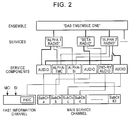
- Fig. 2 illustrates an example of a DAB service structure, which is basically a three-layer hierarchical tree structure.
- An ensemble at a top layer is units of services transmitted over carrier radio waves having the same center frequency.
- One ensemble includes a plurality of services at a middle layer.
- Each service includes a plurality of service components at a bottom layer.
- label data for realizing a function for displaying a name (i.e., a label) attached to each service is multiplexed into data of various services and is transmitted from broadcasting stations.
- a reception side e.g., a DAB receiver
- character data indicating a name of a service that is being received on a display device Users can recognize content of the currently received service by watching this displayed character data and determine whether the service is a desired one.
- an error detection code called cyclic redundancy check (CRC) is attached to broadcast signal data and transmitted as packet data at certain cycles in order to detect whether error-free broadcast signal data is transmitted from a transmission side to a reception side.
- the reception side divides the packet data into "payload” and a "CRC value”.
- the reception side calculates a CRC value of the received "payload” and then compares the calculated CRC value with the received "CRC value”.
- the "payload” and the "CRC value” mentioned herein correspond to an "FIB data field" and "CRC", respectively, in a structure of a fast information block (FIB) illustrated in Fig. 4 .
- the reception side (e.g., a DAB receiver) considers that the received data is error-free, loads the received "payload", and performs required processing. For example, the reception side acquires service label information from a fast information group (FIG) included in FIB data and displays a service name of a program on a screen of a display device.
- FOG fast information group
- the reception side considers that the received data contains an error and discards the received "payload". At this time, a currently displayed service name is maintained.
- a DAB receiver performs a CRC calculation regarding FIB data included in broadcast signal data transmitted from a broadcasting station and controls displaying of a service name (i.e., displaying of label information) based on a result of comparison of the calculation result with CRC data included in the FIB data.
- the display data is not updated until the CRC values match next time.
- the wrong service name is kept being displayed for that period, causing inconvenience for users.
- EP 0 833 468 A2 discloses a DAB radio that receives audio data, service label data as string data, and data for judging abridgement of each character of the service data.
- Each service label can be displayed properly on a display unit.
- An abridged representation judging unit judges whether each service label is displayed in an abridged representation or in a full representation, in accordance with the conditions of a maximum display size of the display unit, a user selection of representations, or the like. If it is judged that the service label is displayed in the abridged representation, a representation control unit forms a service label in the abridged representation in accordance with abridgement judging data to thereby display an abridged service label on the display unit.
- US 2005 048 923 A1 discloses a system and a method for bad frame indication of a speech frame includes estimating a signal-to-noise ratio (SNR) and checking a cyclic redundancy code (CRC) value of the speech frame.
- SNR signal-to-noise ratio
- CRC cyclic redundancy code
- a bad frame indication (BFI) flag is set.
- a receive signal quality metric of the speech frame is checked against a high threshold and, if need be, a low threshold.
- the BFI flag and the receive signal quality metric for the previous speech frame is checked when the current receive signal quality metric is between the high and low thresholds.
- the BFI flag is set according to the value of the SNR, the CRC value, the current and previous receive signal quality metrics, and the previous BFI flag.
- the present invention has been made in view of such problems in the related art and an object thereof is to provide digital audio broadcasting receivers capable of effectively handling a CRC detection error even when a reception state worsens and of decreasing frequency in displaying wrong label information and to provide label information display methods of the same.
- a digital audio broadcasting receiver includes: a display unit; a tuner for selecting a broadcast wave signal of a broadcasting station, in accordance with an instruction, from a transmitted digital broadcasting radio wave into which a plurality of broadcast programs are multiplexed; and a control unit for performing CRC calculations regarding a plurality of pieces of specific data included in the selected broadcast wave signal and controlling the display unit based on comparison of the calculation results with CRC data included in the plurality of pieces of specific data so that label information regarding a currently received program is displayed.
- the control unit stops the CRC calculation regarding a piece of specific data loaded at that time and controls the display unit so that the currently displayed label information is maintained.
- the digital audio broadcasting receiver may stop acquiring the label information from the pieces of specific data once the CRC calculation is stopped.
- a digital audio broadcasting receiver includes: a display unit; a tuner for selecting a broadcast wave signal of a broadcasting station, in accordance with an instruction, from a transmitted digital broadcasting radio wave into which a plurality of broadcast programs are multiplexed; and a control unit for performing CRC calculations regarding a plurality of pieces of specific data included in the selected broadcast wave signal and controlling the display unit based on comparison of the calculation results with CRC data included in the plurality of pieces of specific data so that label information regarding a currently received program is displayed.
- the control unit loads a plurality of pieces of specific data and performs the CRC calculation regarding each piece of specific data.
- the control unit controls the display unit so that the currently displayed label information is maintained.
- a digital audio broadcasting receiver includes: a display unit; a tuner for selecting a broadcast wave signal of a broadcasting station, in accordance with an instruction, from a transmitted digital broadcasting radio wave into which a plurality of broadcast programs are multiplexed; and a control unit for performing CRC calculations regarding a plurality of pieces of specific data included in the selected broadcast wave signal and controlling the display unit based on comparison of the calculation results with CRC data included in the plurality of pieces of specific data so that label information regarding a currently received program is displayed.
- the control unit sequentially loads a plurality of pieces of specific data and performs the CRC calculation regarding each piece of specific data.
- the control unit controls the display unit so that the displayed label information is updated based on label information included in a last piece of the successive pieces of specific data.
- a label information display method is provided that is carried out by the digital audio broadcasting receiver according to each of the aforementioned embodiments.
- a CRC calculation is performed regarding each of a plurality of pieces of specific data (e.g., each FIB in a DAB signal) included in a broadcast wave signal selected in accordance with an instruction from a transmitted radio wave of digital broadcasting (e.g., DAB) into which a plurality of broadcast programs are multiplexed.
- a transmitted radio wave of digital broadcasting e.g., DAB
- Fig. 1 is a block diagram illustrating a configuration of a digital audio broadcasting (DAB) receiver 20 according to an embodiment of the present invention.
- the DAB receiver 20 includes an antenna 1, a tuner 2, an analog-to-digital (A/D) converter 3, a baseband decoder 4, a control unit 5, a storage unit 6, an operation unit 7, and a display unit 8.
- the antenna 1 receives a digital broadcast radio wave in the orthogonal frequency division multiplexing (OFDM) format.
- OFDM orthogonal frequency division multiplexing
- the tuner 2 selectively extracts a broadcast wave signal having a reception frequency matching a desired channel from the radio wave of digital broadcasting, such as DAB and digital multimedia broadcasting (DMB), received through the antenna 1.
- the tuner 2 down-converts the extracted signal to a baseband and outputs the signal.
- the A/D converter 3 converts the down-converted analog baseband signal into a digital signal.
- the baseband decoder 4 includes a fast Fourier transform (FFT) unit 11, a demultiplexer 12, a channel decoder 13, an audio decoder 14, a program associated data (PAD) decoder 15, and a packet mode decoder 16.
- the FFT unit 11 performs fast Fourier transform on the baseband signal digitalized by the A/D converter 3 to acquire reception symbols.
- the demultiplexer 12 demultiplexes digital signals that are multiplexed (OFDM demodulation).
- the channel decoder 13 extracts a given music channel and a given data channel from a DAB transmission frame constituted by reception symbols resulting from the OFDM demodulation. Additionally, the channel decoder 13 divides the transmission frame into a fast information channel (FIC) and a main service channel (MSC) including a plurality of music channels and a plurality of data channels.
- FIC fast information channel
- MSC main service channel
- the channel decoder 13 also performs processing, such as deinterleave, Viterbi decoding, and energy dispersal descrambling, on a channel selected from the MSC by a user. Similarly, the channel decoder 13 performs processing, such as Viterbi decoding and energy dispersal descrambling, on the FIC.
- audio data included in the MSC is sent to the audio decoder 14, whereas non-audio data included the FIC, i.e., FIG data (described later) such as a program type, is sent to the control unit 5.
- the audio decoder 14 decodes audio data of a sub channel instructed by the control unit 5.
- the decoded signal i.e., the audio data
- the PAD decoder 15 decodes PAD and multimedia object transfer (MOT) data attached to a service and reconfigures data.
- the packet mode decoder 16 decodes a service-constituting packet extracted by the channel decoder 13 and reconfigures data.
- the control unit 5 such as a microcomputer, works in cooperation with other functional blocks (e.g., the tuner 2, the baseband decoder 4, the storage unit 6, the operation unit 7, and the display unit 8) to control various kinds of processing regarding reception of digital audio broadcasting.
- other functional blocks e.g., the tuner 2, the baseband decoder 4, the storage unit 6, the operation unit 7, and the display unit 8) to control various kinds of processing regarding reception of digital audio broadcasting.
- the control unit 5 Upon receiving a channel setting control signal in response to an operation of the operation unit 7 by a user, the control unit 5 determines a channel to be received by the tuner 2 and sets a reception frequency matching this channel in the tuner 2. More specifically, the control unit 5 specifies one ensemble from a plurality of ensembles (each ensemble is transmitted over a radio broadcasting wave modulated based on differential quadrature phase shift keying OFDM (DQPSK-OFDM) and a bandwidth of one ensample is approximately 1.5 MHz) and sends information on the specified ensemble to the tuner 2. Upon receiving this specification information, the tuner 2 extracts a signal of the specified ensemble (i.e., a selected broadcast wave signal), down-converts the extracted signal to a baseband, and outputs the baseband signal.
- DQPSK-OFDM differential quadrature phase shift keying OFDM
- the control unit 5 also works in cooperation with the PAD decoder 15 to reconfigure an MOT object, to analyze a fast information group (FIG) partially constituting a fast information block (FIB) included in the FIC divided by the channel decoder 13 and determine whether there is a broadcasting station that broadcasts the same content, and to control displaying of label information (i.e., a service name) as described later.
- FOG fast information group
- FIB fast information block
- the storage unit 6 such as a hard disk and a semiconductor memory, temporarily stores program information of a currently received broadcasting program and control information, such as an FIG contained in an FIC, through the control unit 5.
- the operation unit 7 includes various operation keys and buttons needed by users to operate the DAB receiver 20. This operation unit 7 gives an input instruction for selecting a desired broadcasting station to the tuner 2 through the control unit 5. Also, this operation unit 7 gives an input instruction for displaying label information (i.e., a service name) to the display unit 8 through the control unit 5.
- label information i.e., a service name
- the display unit 8 such as a liquid crystal display (LCD), displays data decoded by the PAD decoder 15 or the packet mode decoder 16. Additionally, the display unit 8 displays a menu screen allowing users to input various instructions. Further, as information relating to the present invention, the display unit 8 displays character data (i.e., a label) indicating a name of a selected program (i.e., a service) that is being received. When the display unit 8 includes a touch panel, this display unit 8 functions as the operation unit 7.
- LCD liquid crystal display
- control unit 5 works in cooperation with other functional blocks (such as the channel decoder 13, the storage unit 6, and the display unit 8) connected thereto to control displaying of label information (i.e., a service name) once a reception state worsens while the DAB receiver 20 is receiving a program (i.e., a service) of a broadcasting station selected by a user.
- label information i.e., a service name
- Fig. 2 illustrates an example of a DAB service structure, which is an excerpt from the DAB standard (EN300401).
- the DAB service structure is basically a three-layer hierarchical tree structure.
- An ensemble at a top layer is units of services transmitted over carrier radio waves having the same center frequency.
- One ensemble includes a plurality of services serving as a middle layer.
- Each service includes a plurality of service components serving as a bottom layer.
- An ensemble whose ensemble label (i.e., an ensemble name) is "DAB ensemble one" includes a plurality of services (e.g., six services) whose service labels are “alpha 1 radio", “beta radio”, “alpha 2 radio”, and so forth.
- a user receives a service selected from these services with the DAB receiver 20.
- the alpha 1 radio has one primary service component and two secondary service components.
- the primary service component is audio
- the secondary service components are a traffic message channel (TMC) and service information (SI).
- TMC traffic message channel
- SI service information
- the audio component and the service information are transmitted over different sub channels (SubCh) in an MSC.
- the TMC is transmitted over a fast information data channel (FIDC) in an FIC.
- FIDC fast information data channel
- the beta radio has two service components, both are audio and are transmitted over sub channels of the MSC.
- the alpha 2 radio includes a TMC and SI that are the same as those of the alpha 1 radio. Depending on switching, audio may be the same as that of the alpha 1 radio.
- Fig. 3 illustrates a structure of a DAB transmission frame.
- the transmission frame includes, sequentially from the top, a synchronization channel, an FIC, and an MSC.
- the synchronization channel is for identifying a frame and is used for basic demodulator functions, such as transmission frame synchronization, automatic frequency control, channel state estimation, and transmitter identification.
- the FIC allows a receiver to rapidly access necessary information and includes various kinds of control information needed for selecting a program (i.e., a service). As illustrated in Fig. 3 , the FIC includes a plurality of FIBs.
- the MSC is used for carrying video, audio, and data service components. As illustrated in Fig. 3 , the MSC includes a plurality of common interleaved frames (CIFs).
- each CIF a plurality of music sub channels and a plurality of general data sub channels are multiplexed.
- One sub channel corresponds to one program.
- specifications of transmission modes 1 to 4 are defined. Duration of one transmission frame and the numbers of FIBs and CIFs in one transmission frame differ for each transmission mode. For example, in a mode 1, the duration of one transmission frame is 96 ms and the numbers of the FIBs and CIFs in one transmission frame are 12 and 4, respectively.
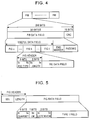
- Fig. 4 illustrates a structure of an FIB in DAB.
- One FIB contains 256 bits and includes an FIB data field occupying 30 bytes followed by a cyclic redundancy check word (CRC) occupying 16 bits.
- the FIB data field includes, sequentially from the top, a plurality of FIGs, one end marker, and one padding. This padding is a field for storing 0 that is filled in extra bits to make the FIB data field fit into units of bytes.
- the FIG part constitute a useful data field.
- Each FIG includes, sequentially from the top, an FIG type, length (representing bit-length of a following FIG data field), and an FIG data field.
- the FIG type and the length constitute an FIG header.
- FIG. 5 illustrates a structure of the FIG data field when the FIG type in the FIB illustrated in Fig. 4 is equal to 1 ("001" in 3-bit binary representation).
- This FIG data field includes, sequentially from the top, a character set (charaset), other ensemble (OE), extension, and a type 1 field.
- a 4-bit code of the charaset identifies a character set to limit character information included in the FIG type 1 field.
- the OE identifies whether this information is regarding this ensemble or another ensemble.
- the extension represents an extension number in the type 1 field.
- the type 1 field includes label information (i.e., data indicating a name attached to a service) and so forth.
- the FIG type 1 field for the extension 0 (also represented as " FIG1 /0") contains data associating an ID identifying an ensemble (i.e., an ensemble ID) and a label thereof (i.e., an ensemble label).
- An FIG1/1 contains data associating an ID identifying a service (i.e., a service ID) and a label thereof (i.e., a service label).
- An FIG1 / 4 contains data associating an ID identifying a service component (i.e., a service component ID) and a label thereof (i.e., a service component label).
- information of a list of all services and all service components belonging to the ensemble is transmitted in an FIG0/ 2 for each ensemble currently broadcasted.
- FIG types are various FIG types (eight types in total, i.e., FIG type 0-7) other then the aforementioned FIG types. Please refer to the DAB standard (EN300401) for details thereof.
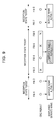
- Fig. 6 is a flowchart illustrating an example of processing for displaying a service name, according to a first embodiment, performed in a DAB receiver 20.
- Fig. 7 is a diagram for additionally describing processing content thereof.
- a program i.e., a service
- a reception state thereof is good in an initial state.
- a control unit 5 stores data of an ID of a selected service component and a label thereof, an ID of a service that the service component belongs to and a label thereof, and an ID of an ensemble that the service belongs to and a label thereof in a storage unit 6 with reference to information of an "FIG0/ 2 " extracted from a received signal.
- a "service" i.e., a middle layer, is selected as a label display layer through an operation unit 7 based on a user instruction.
- first step S11 the control unit 5 loads an FIB (e.g., an FIB 1 in the example in Fig. 7 ) and performs a CRC check.
- the CRC check is performed by dividing the loaded FIB data into payload and a CRC value (corresponding to an "FIB data field" and "CRC" in Fig. 4 , respectively), performing a CRC calculation of the received payload, and comparing the calculation result (i.e., a CRC value) with the received CRC value.
- next step S12 based on the CRC check result, the control unit 5 determines whether both CRC values match (YES) or not (NO). If the determination result indicates "YES”, the process proceeds to step S13. If the determination result indicates "NO”, the process proceeds to step S14.
- step S14 the control unit 5 determines that received data contains an error because the CRC values do not match and discards the FIB (i.e., the payload part).
- step S15 the control unit 5 determines whether an FIB following the discarded FIB (e.g., an FIB 2 in the example in Fig. 7 ) exists (YES) or not (NO). If the determination result indicates "YES”, the process returns to step S11 and the aforementioned processing is repeated. If the determination result indicates "NO”, this processing flow "ends".
- an FIB following the discarded FIB e.g., an FIB 2 in the example in Fig. 7
- step S13 the control unit 5 determines that the received data is error-free because the CRC values match.
- the control unit 5 acquires label information (i.e., data indicating a service name) from an FIG of the FIB.
- the control unit 5 displays the service name on a screen of a display unit 8. In an example in Fig. 7 , "ALPHA 1" is displayed as the service name.
- step S16 the control unit 5 determines whether a reception state of the currently received broadcast wave signal has worsened (YES) or not (NO). If the determination result indicates "YES”, the process proceeds to step S17. If the determination result indicates "NO”, the process returns to step S11 and the aforementioned processing is repeated.
- the reception state can be detected by acquiring information, such as an electric field intensity of a received signal and a bit error rate (BER), from the channel decoder 13, for example. Based on detection of this reception state, when reception strength falls below a certain threshold level or when the BER (or an error correction count) rises above a certain threshold, the control unit 5 determines that the reception state has worsened.
- information such as an electric field intensity of a received signal and a bit error rate (BER)
- BER bit error rate
- step S17 the control unit 5 stops the CRC check (such as a CRC calculation) regarding the FIB (e.g., an FIB 3 in the example in Fig. 7 ) loaded when it is determined that the reception state has worsened.
- the control unit 5 also stops acquiring the label information from an FIG in the FIB.
- step S18 the control unit 5 controls the display unit 8 so that the currently displayed service name (i.e., "ALPHA 1" in the example in Fig. 7 ) is maintained and part displaying the service name is grayed out.
- the currently displayed service name i.e., "ALPHA 1" in the example in Fig. 7
- step S19 by utilizing the reception-state detection method performed in step S16, the control unit 5 determines whether the reception state has recovered to a level equal to the predetermined threshold level or higher (or the predetermined threshold or lower) (YES) or not (NO). If the determination result indicates "YES”, the process returns to step S11 and the aforementioned processing is repeated. If the determination result indicates "NO”, the process returns to step S18 and the display part is kept being grayed out.
- a CRC calculation is performed for a plurality of FIBs ( Fig. 4 ) included in a selected broadcast wave signal during reception of a program (i.e., a service) of a broadcasting station selected by a user.
- a service name of the program is displayed on the display unit 8.
- the CRC calculation is stopped for an FIB loaded at that time (acquisition of the label information from an FIG included in the FIB is also stopped).
- the currently displayed service name e.g., "ALPHA 1" in Fig. 7
- the display part is "grayed out".
- Fig. 8 is a flowchart illustrating an example of processing for displaying a service name, according to a second embodiment, performed by a DAB receiver 20.
- Fig. 9 is a diagram for additionally describing processing content thereof.
- a control unit 5 determines whether a reception state of a currently received broadcast wave signal has worsened (YES) or not (NO) in a way similar to the processing performed in step S16. If the determination result indicates "YES”, the process proceeds to step S22. If the determination result indicates "NO”, the process returns to step S11 ( Fig. 6 ) and the aforementioned processing is repeated.
- next step S22 when the reception state has worsened, the control unit 5 loads a plurality of FIBs (e.g., four FIBs of FIB 3 to FIB 6 in an example illustrated in Fig. 9 ) and performs a CRC check on each FIB.
- a method of the CRC check is similar to that performed in step S11.
- timing of loading each FIB is set to be a multiple of a transmission cycle of a broadcast wave signal transmitted from a broadcasting station.
- DAB Guidelines and rules for implementation and operation; Part 1: System outline” published by European Telecommunications Standards Institute for details of the transmission cycle.
- the loading timing may be set uniformly for all FIGs included in an FIB or may be set individually for each FIG. Alternatively, a plurality of FIGs are put into a group in accordance with the transmission cycle (importance of the FIG data (necessity of rapid access) differs for each FIG depending on an FIG type) and the loading timing may be set for each group.
- next step S23 the control unit 5 determines whether a CRC error has occurred at a predetermined probability or higher in the plurality of checked CRC values (YES) or not (NO). If the determination result indicates "YES”, the process proceeds to step S24. If the determination result indicates "NO”, the process proceeds to step S26. In the example illustrated in Fig. 9 , the CRC error (indicated by "x") has occurred in three FIBs (i.e., FIB 3, FIB 5, and FIB 6) out of four FIBs. That is, mismatch of the CRC values occurs at a probability of 75%.
- step S24 the control unit 5 determines that an error has occurred in received data based on the CRC errors that have occurred at the predetermined probability or higher.
- the control unit 5 controls a display unit 8 in a way similar to the processing performed in step S18 ( Fig. 6 ) so that a currently displayed service name (i.e., "ALPHA 1" in the example illustrated in Fig. 9 ) is maintained and part displaying the service name is grayed out.
- a currently displayed service name i.e., "ALPHA 1" in the example illustrated in Fig. 9
- next step S25 the control unit 5 performs processing similar to that performed in step S19 ( Fig. 6 ) to determine whether the reception state has recovered (YES) or not (NO). If the determination result indicates "YES”, the process returns to step S11 ( Fig. 6 ) and the aforementioned processing is repeated. If the determination result indicates "NO”, the process returns to step S22 and the aforementioned processing is repeated.
- step S26 the control unit 5 determines that an error has not occurred in the received data based on the CRC error that occurs at a probability lower than the predetermined probability.
- the control unit 5 acquires label information (i.e., data indicating a service name) from an FIG of a last FIB having passed the CRC check.
- the control unit 5 displays the service name on a screen of the display unit 8. For example, in the example of the CRC result illustrated in Fig. 9 , the control unit 5 updates the displayed service name based on label information acquired from an FIG of the FIB 4 that has passed the CRC check (indicated by "O") last out of the FIBs 3 to 6.
- step S27 the control unit 5 performs processing similar to that performed in step S25 to determine whether the reception state has recovered (YES) or not (NO). If the determination result indicates "YES”, the process returns to step S11 ( Fig. 6 ) and the aforementioned processing is repeated. If the determination result indicates "NO”, the process returns to step S22 and the aforementioned processing is repeated.
- the determination errors are decreased in consideration of the reception state.
- a decrease in apparent operation speed is expected since an amount of discarded data that is considered as the determination error increases.
- the CRC calculations acquisition of the label information
- the control unit 5 determines that the error has not occurred in the received data.
- the control unit 5 updates display data based on the label information acquired from an FIG in a last FIB having passed the CRC check.
- Fig. 10 is a flowchart illustrating an example of processing for displaying a service name, according to a third embodiment, performed by a DAB receiver 20.
- Fig. 11 is a diagram for additionally describing processing content thereof.
- step S31 a control unit 5 performs processing similar to that performed in step S16 to determine whether a reception state of a currently received broadcast wave signal has worsened (YES) or not (NO). If the determination result indicates "YES”, the process proceeds to step S32. If the determination result indicates "NO”, the process returns to step S11 ( Fig. 6 ) and the aforementioned processing is repeated.
- next step S32 when the reception state has worsened, the control unit 5 sequentially loads FIBs (e.g., FIBs 3, 4, 5, ... in an example illustrated in Fig. 11 ) and performs a CRC check of each FIB.
- FIBs e.g., FIBs 3, 4, 5, ... in an example illustrated in Fig. 11
- a method of the CRC check is similar to that performed in step S11. Additionally, setting of timing of loading the FIBs is also similar to the method performed in step S22 ( Fig. 8 ).
- next step S33 the control unit 5 determines whether CRC values match N times in a row from the first FIB in process of checking the CRC values (YES) or not (NO). If the determination result indicates "YES”, the process proceeds to STEP S34. If the determination result indicates "NO”, the process proceeds to step S36. In the example illustrated in Fig. 11 , the CRC values match (indicated by O) regarding data of three successive FIBs (i.e., FIBs 3 to 5).
- step S34 the control unit 5 determines that an error has not occurred in received data since the CRC values match N times in a row.
- the control unit 5 acquires label information (i.e., data indicating a service name) from an FIG of an N-th FIB (i.e., a last FIB whose CRC values match).
- the control unit 5 displays the service name on a screen of a display unit 8.
- display data is updated based on label information acquired from an FIG of the FIB 5 whose CRC values match last in N successive times and "ALPHA 2" is displayed as a service name.
- next step S35 the control unit 5 performs processing similar to that performed in step S19 ( Fig. 6 ) to determine whether the reception state has recovered (YES) or not (NO). If the determination result indicates "YES”, the process returns to step S11 ( Fig. 6 ) and the aforementioned processing is repeated. If the determination result indicates "NO”, the process returns step S32 and the aforementioned processing is repeated.
- step S36 the control unit 5 determines that errors have occurred in the received data because the CRC values do not match N times in a row.
- the control unit 5 performs processing similar to that performed in step S18 ( Fig. 6 ) and controls the display unit 8 so that a currently displayed service name (e.g., "ALPHA 1" having been displayed before the reception state has worsened in the example illustrated in Fig. 11 ) is maintained and part displaying the service name is grayed out.
- a currently displayed service name e.g., "ALPHA 1" having been displayed before the reception state has worsened in the example illustrated in Fig. 11
- step S37 the control unit 5 performs processing similar to that performed in step S35 to determine whether the reception state has recovered (YES) or not (NO). If the determination result indicates "YES”, the process returns to step S11 ( Fig. 6 ) and the aforementioned processing is repeated. If the determination result indicates "NO”, the process returns to step S32 and the aforementioned processing is repeated.
- the control unit 5 determines that the error has not occurred in the received data.
- the control unit 5 updates the display data based on the label information acquired from an FIG of the last of the successive FIBs.
Landscapes
- Engineering & Computer Science (AREA)
- Signal Processing (AREA)
- Computer Networks & Wireless Communication (AREA)
- Quality & Reliability (AREA)
- Circuits Of Receivers In General (AREA)
Claims (6)
- Récepteur (20) pour diffusion audio numérique, comportant :un moyen d'affichage (8)un syntoniseur (2) pour sélectionner un signal d'onde de diffusion d'une station de diffusion conformément à une instruction, le signal d'onde de diffusion étant sélectionné d'après une onde radio de diffusion numérique émise dans laquelle est multiplexée une pluralité d'émissions diffusées ; etun moyen de commande (5) conçu pour :détecter un état de réception de signal d'onde de diffusion sélectionné en acquérant une intensité de champ électrique d'un signal reçu et/ou un taux d'erreur sur les bits TEB ; et poureffectuer des calculs de CRC sur un bloc d'information rapide BIR inclus dans le signal d'onde de diffusion sélectionné, pour commander le moyen d'affichage (8) d'après une comparaison des résultats des calculs avec les données de CRC incluses dans le bloc d'information rapide BIR et, lorsque l'état de réception du signal d'onde de diffusion sélectionné descend sous un niveau donné :charger une pluralité de blocs d'information rapides BIR et effectuer le calcul de CRC sur chaque BIR ;commander le moyen d'affichage (8) afin que les informations d'étiquetage affichées au même instant soient conservées, lorsque les résultats des calculs indiquent au moins trois fois de suite que les valeurs de CRC ne coïncident pas ; etcommander le moyen d'affichage (8) afin que les informations de labels affichées soient actualisées d'après les informations de labels incluses dans le bloc d'information rapide BIR dont les valeurs de CRC coïncident le plus récemment, lorsque les résultats des calculs indiquent au moins trois fois de suite que les valeurs de CRC coïncident.
- Récepteur (20) pour diffusion audio numérique selon la revendication 1, dans lequel le moyen de commande (5) est conçu pour commander le moyen d'affichage (8) de façon que les informations de labels affichées au même instant soient conservées, la partie affichant les informations de labels étant présentée sur fond gris.
- Récepteur (20) pour diffusion audio numérique selon l'une quelconque des revendications 1 et 2,
dans lequel la diffusion numérique comprend une diffusion audio numérique, et
dans lequel le bloc d'information rapide BIR est inclus dans un canal d'information rapide d'un signal de diffusion audio numérique. - Procédé d'affichage d'informations de labels mis en oeuvre par un récepteur (20) pour diffusion audio numérique dont une fonction consiste à effectuer des calculs de CRC sur un bloc d'information rapide BIR inclus dans un signal d'onde de diffusion et à commander un moyen d'affichage (8) d'après une comparaison des résultats des calculs avec les données de CRC incluses dans le bloc d'information rapide BIR, le signal d'onde de diffusion étant sélectionné d'après une onde radio de diffusion numérique émise conformément à une instruction, une pluralité d'émissions diffusées étant multiplexée dans l'onde radio de diffusion numérique,
le procédé d'affichage d'informations de labels du récepteur (20) pour diffusion audio numérique comportant :une première étape de détection d'un état de réception du signal d'onde de diffusion sélectionné (S16, S21, S31) en acquérant une intensité de champ électrique d'un signal reçu et/ou un taux d'erreur sur les bits (TEB) :une deuxième étape de chargement, une fois que l'état de réception descend sous un niveau donné, de blocs d'informations rapides BIR et d'exécution du calcul de CRC sur chaque BIR (S22, S32) ;une troisième étape de commande du moyen d'affichage (8) pour conserver les informations de labels affichées au même instant, quand les résultats des calculs indiquent au moins trois fois de suite que les valeurs de CRC ne coïncident pas ; etune quatrième étape de commande du moyen d'affichage (8) pour actualiser les informations de labels affichées d'après les informations de labels incluses dans le bloc d'information rapide BIR dont les valeurs de CRC coïncident le plus récemment, lorsque les résultats des calculs indiquent au moins trois fois de suite que les valeurs de CRC coïncident. - Procédé d'affichage d'informations de labels du récepteur (20) pour diffusion audio numérique selon la revendication 4, dans lequel la conservation des informations de labels affichées au même instant comprend une présentation du fond gris de la partie des informations de labels affichées (S18, S24, S36).
- Procédé d'affichage d'informations de labels du récepteur (20) pour diffusion audio numérique selon l'une quelconque des revendications 4 et 5,
dans lequel la diffusion numérique comprend une diffusion audio numérique, et
dans lequel le bloc d'information rapide BIR est inclus dans un canal d'information rapide d'un signal de diffusion audio numérique.
Applications Claiming Priority (1)
| Application Number | Priority Date | Filing Date | Title |
|---|---|---|---|
| JP2010239685A JP2012095033A (ja) | 2010-10-26 | 2010-10-26 | デジタルオーディオ放送受信装置及びそのラベル情報表示方法 |
Publications (2)
| Publication Number | Publication Date |
|---|---|
| EP2448154A1 EP2448154A1 (fr) | 2012-05-02 |
| EP2448154B1 true EP2448154B1 (fr) | 2016-08-17 |
Family
ID=45444389
Family Applications (1)
| Application Number | Title | Priority Date | Filing Date |
|---|---|---|---|
| EP11186333.8A Not-in-force EP2448154B1 (fr) | 2010-10-26 | 2011-10-24 | Récepteur de diffusion audio numérique et son procédé d'affichage du nom du service |
Country Status (2)
| Country | Link |
|---|---|
| EP (1) | EP2448154B1 (fr) |
| JP (1) | JP2012095033A (fr) |
Family Cites Families (8)
| Publication number | Priority date | Publication date | Assignee | Title |
|---|---|---|---|---|
| JPH09148954A (ja) * | 1995-11-24 | 1997-06-06 | Sony Corp | 受信機 |
| JP3225259B2 (ja) * | 1996-09-30 | 2001-11-05 | 株式会社ケンウッド | 放送受信機 |
| JPH10327111A (ja) * | 1997-05-26 | 1998-12-08 | Alpine Electron Inc | Dab受信機の番組受信方法 |
| JP3416487B2 (ja) * | 1997-09-29 | 2003-06-16 | 三洋電機株式会社 | Fm多重信号復調装置 |
| JP3830074B2 (ja) | 2000-06-15 | 2006-10-04 | 株式会社ケンウッド | ディジタル放送受信装置及びそのラベル表示方法 |
| US7127663B2 (en) * | 2003-08-28 | 2006-10-24 | Qualcomm Incorporate | Bad frame indicator for radio-telephone receivers in GSM mobile systems |
| FI20045318A0 (fi) * | 2004-09-01 | 2004-09-01 | Nokia Corp | Kommunikointijärjestelmä, vastaanotin, ja menetelmä arvioida vastaanotetun signaalin laatua |
| US20090172764A1 (en) * | 2005-12-07 | 2009-07-02 | Matsushita Electric Industrial Co., Ltd. | Broadcast receiving device, broadcast receiving method and data broadcast screen presentation program |
-
2010
- 2010-10-26 JP JP2010239685A patent/JP2012095033A/ja active Pending
-
2011
- 2011-10-24 EP EP11186333.8A patent/EP2448154B1/fr not_active Not-in-force
Also Published As
| Publication number | Publication date |
|---|---|
| EP2448154A1 (fr) | 2012-05-02 |
| JP2012095033A (ja) | 2012-05-17 |
Similar Documents
| Publication | Publication Date | Title |
|---|---|---|
| EP1746753A1 (fr) | Dispositif de réception ofdm, méthode de réception ofdm | |
| TW200922314A (en) | Methods for processing digital video signals and digital video receivers | |
| US7904019B2 (en) | Broadcast signal and receiver and method of decoding digital broadcast signal | |
| US20070002723A1 (en) | Signaling network ID in TPS bits | |
| US7835475B2 (en) | Digital broadcast receiver, mobile terminal and channel search method | |
| US8024725B2 (en) | Method of upgrading software through download in T-DMB terminal | |
| EP2448154B1 (fr) | Récepteur de diffusion audio numérique et son procédé d'affichage du nom du service | |
| US7804846B2 (en) | Robust deframing of MAC layer packets for mobile multimedia multicast system | |
| EP2360860B1 (fr) | Appareil de réception de diffusion audio numérique et procédé de réception de diffusion audio numérique | |
| JP5326672B2 (ja) | デジタル放送受信機及びその受信レベル判定方法、受信レベル判定プログラム | |
| CA2540976C (fr) | Procede et dispositif pour transmettre des donnees supplementaires relatives a des frequences d'emission numeriques alternatives, dans un systeme de transmission radio analogique | |
| JP5049188B2 (ja) | 地上デジタル放送受信装置及び地上デジタル放送受信方法 | |
| JP5710825B2 (ja) | デジタルオーディオ放送受信装置及びそのラベル情報表示方法 | |
| CN101188703A (zh) | 接收状态的判定方法以及利用了该方法的接收装置 | |
| JP2001044867A (ja) | 放送受信装置及び番組構成の変化を報知する報知方法 | |
| EP0833468B1 (fr) | Récepteur pour la réception de programmes radiophoniques multiplexés, comportant des données audiophoniques et des données supplémentaires | |
| EP1986427A2 (fr) | Procédé de formation de liste de canaux, appareil de réception, appareil d'affichage d'image, appareil de sortie sonore, et procédé de réglage de réception | |
| JP3751230B2 (ja) | デジタル多重化放送受信装置及びその制御方法 | |
| JP3531802B2 (ja) | ディジタル放送受信装置 | |
| JP5121543B2 (ja) | 地上デジタル放送受信装置及び地上デジタル放送受信方法 | |
| KR101304930B1 (ko) | 이동형 디지털 방송 환경에서 인접채널 방송서비스를 자동으로 링킹하기 위한 장치 및 방법, 그리고 이를 위한 방송서비스 자동링킹 프로그램을 기록한 컴퓨터로 판독가능한 기록매체 | |
| JP4161667B2 (ja) | 直交周波数分割多重信号の送信装置、受信装置、受信方法及び集積回路 | |
| KR101286335B1 (ko) | Dmb 베이스밴드 수신기 | |
| JP2012004641A (ja) | デジタルオーディオ放送受信装置及びデジタルオーディオ放送受信方法 | |
| JP2008536376A (ja) | 地上波デジタルマルチメディア放送システムにおける伝送識別情報の判定方法及び装置 |
Legal Events
| Date | Code | Title | Description |
|---|---|---|---|
| PUAI | Public reference made under article 153(3) epc to a published international application that has entered the european phase |
Free format text: ORIGINAL CODE: 0009012 |
|
| AK | Designated contracting states |
Kind code of ref document: A1 Designated state(s): AL AT BE BG CH CY CZ DE DK EE ES FI FR GB GR HR HU IE IS IT LI LT LU LV MC MK MT NL NO PL PT RO RS SE SI SK SM TR |
|
| AX | Request for extension of the european patent |
Extension state: BA ME |
|
| 17P | Request for examination filed |
Effective date: 20121010 |
|
| 17Q | First examination report despatched |
Effective date: 20150216 |
|
| GRAP | Despatch of communication of intention to grant a patent |
Free format text: ORIGINAL CODE: EPIDOSNIGR1 |
|
| RIC1 | Information provided on ipc code assigned before grant |
Ipc: H04L 1/00 20060101ALI20160415BHEP Ipc: H04H 60/74 20080101ALI20160415BHEP Ipc: H03M 13/09 20060101ALN20160415BHEP Ipc: H04H 20/16 20080101AFI20160415BHEP Ipc: H04L 1/20 20060101ALI20160415BHEP |
|
| INTG | Intention to grant announced |
Effective date: 20160506 |
|
| GRAS | Grant fee paid |
Free format text: ORIGINAL CODE: EPIDOSNIGR3 |
|
| GRAA | (expected) grant |
Free format text: ORIGINAL CODE: 0009210 |
|
| AK | Designated contracting states |
Kind code of ref document: B1 Designated state(s): AL AT BE BG CH CY CZ DE DK EE ES FI FR GB GR HR HU IE IS IT LI LT LU LV MC MK MT NL NO PL PT RO RS SE SI SK SM TR |
|
| REG | Reference to a national code |
Ref country code: GB Ref legal event code: FG4D |
|
| REG | Reference to a national code |
Ref country code: CH Ref legal event code: EP |
|
| REG | Reference to a national code |
Ref country code: IE Ref legal event code: FG4D |
|
| REG | Reference to a national code |
Ref country code: AT Ref legal event code: REF Ref document number: 821946 Country of ref document: AT Kind code of ref document: T Effective date: 20160915 |
|
| REG | Reference to a national code |
Ref country code: DE Ref legal event code: R096 Ref document number: 602011029262 Country of ref document: DE |
|
| REG | Reference to a national code |
Ref country code: FR Ref legal event code: PLFP Year of fee payment: 6 |
|
| REG | Reference to a national code |
Ref country code: NL Ref legal event code: MP Effective date: 20160817 |
|
| REG | Reference to a national code |
Ref country code: LT Ref legal event code: MG4D |
|
| REG | Reference to a national code |
Ref country code: AT Ref legal event code: MK05 Ref document number: 821946 Country of ref document: AT Kind code of ref document: T Effective date: 20160817 |
|
| PG25 | Lapsed in a contracting state [announced via postgrant information from national office to epo] |
Ref country code: NO Free format text: LAPSE BECAUSE OF FAILURE TO SUBMIT A TRANSLATION OF THE DESCRIPTION OR TO PAY THE FEE WITHIN THE PRESCRIBED TIME-LIMIT Effective date: 20161117 Ref country code: IT Free format text: LAPSE BECAUSE OF FAILURE TO SUBMIT A TRANSLATION OF THE DESCRIPTION OR TO PAY THE FEE WITHIN THE PRESCRIBED TIME-LIMIT Effective date: 20160817 Ref country code: FI Free format text: LAPSE BECAUSE OF FAILURE TO SUBMIT A TRANSLATION OF THE DESCRIPTION OR TO PAY THE FEE WITHIN THE PRESCRIBED TIME-LIMIT Effective date: 20160817 Ref country code: NL Free format text: LAPSE BECAUSE OF FAILURE TO SUBMIT A TRANSLATION OF THE DESCRIPTION OR TO PAY THE FEE WITHIN THE PRESCRIBED TIME-LIMIT Effective date: 20160817 Ref country code: HR Free format text: LAPSE BECAUSE OF FAILURE TO SUBMIT A TRANSLATION OF THE DESCRIPTION OR TO PAY THE FEE WITHIN THE PRESCRIBED TIME-LIMIT Effective date: 20160817 Ref country code: RS Free format text: LAPSE BECAUSE OF FAILURE TO SUBMIT A TRANSLATION OF THE DESCRIPTION OR TO PAY THE FEE WITHIN THE PRESCRIBED TIME-LIMIT Effective date: 20160817 Ref country code: LT Free format text: LAPSE BECAUSE OF FAILURE TO SUBMIT A TRANSLATION OF THE DESCRIPTION OR TO PAY THE FEE WITHIN THE PRESCRIBED TIME-LIMIT Effective date: 20160817 |
|
| PG25 | Lapsed in a contracting state [announced via postgrant information from national office to epo] |
Ref country code: PL Free format text: LAPSE BECAUSE OF FAILURE TO SUBMIT A TRANSLATION OF THE DESCRIPTION OR TO PAY THE FEE WITHIN THE PRESCRIBED TIME-LIMIT Effective date: 20160817 Ref country code: AT Free format text: LAPSE BECAUSE OF FAILURE TO SUBMIT A TRANSLATION OF THE DESCRIPTION OR TO PAY THE FEE WITHIN THE PRESCRIBED TIME-LIMIT Effective date: 20160817 Ref country code: PT Free format text: LAPSE BECAUSE OF FAILURE TO SUBMIT A TRANSLATION OF THE DESCRIPTION OR TO PAY THE FEE WITHIN THE PRESCRIBED TIME-LIMIT Effective date: 20161219 Ref country code: GR Free format text: LAPSE BECAUSE OF FAILURE TO SUBMIT A TRANSLATION OF THE DESCRIPTION OR TO PAY THE FEE WITHIN THE PRESCRIBED TIME-LIMIT Effective date: 20161118 Ref country code: LV Free format text: LAPSE BECAUSE OF FAILURE TO SUBMIT A TRANSLATION OF THE DESCRIPTION OR TO PAY THE FEE WITHIN THE PRESCRIBED TIME-LIMIT Effective date: 20160817 Ref country code: ES Free format text: LAPSE BECAUSE OF FAILURE TO SUBMIT A TRANSLATION OF THE DESCRIPTION OR TO PAY THE FEE WITHIN THE PRESCRIBED TIME-LIMIT Effective date: 20160817 Ref country code: SE Free format text: LAPSE BECAUSE OF FAILURE TO SUBMIT A TRANSLATION OF THE DESCRIPTION OR TO PAY THE FEE WITHIN THE PRESCRIBED TIME-LIMIT Effective date: 20160817 Ref country code: BE Free format text: LAPSE BECAUSE OF NON-PAYMENT OF DUE FEES Effective date: 20161031 |
|
| PG25 | Lapsed in a contracting state [announced via postgrant information from national office to epo] |
Ref country code: EE Free format text: LAPSE BECAUSE OF FAILURE TO SUBMIT A TRANSLATION OF THE DESCRIPTION OR TO PAY THE FEE WITHIN THE PRESCRIBED TIME-LIMIT Effective date: 20160817 Ref country code: RO Free format text: LAPSE BECAUSE OF FAILURE TO SUBMIT A TRANSLATION OF THE DESCRIPTION OR TO PAY THE FEE WITHIN THE PRESCRIBED TIME-LIMIT Effective date: 20160817 |
|
| REG | Reference to a national code |
Ref country code: DE Ref legal event code: R097 Ref document number: 602011029262 Country of ref document: DE |
|
| PG25 | Lapsed in a contracting state [announced via postgrant information from national office to epo] |
Ref country code: SK Free format text: LAPSE BECAUSE OF FAILURE TO SUBMIT A TRANSLATION OF THE DESCRIPTION OR TO PAY THE FEE WITHIN THE PRESCRIBED TIME-LIMIT Effective date: 20160817 Ref country code: BG Free format text: LAPSE BECAUSE OF FAILURE TO SUBMIT A TRANSLATION OF THE DESCRIPTION OR TO PAY THE FEE WITHIN THE PRESCRIBED TIME-LIMIT Effective date: 20161117 Ref country code: SM Free format text: LAPSE BECAUSE OF FAILURE TO SUBMIT A TRANSLATION OF THE DESCRIPTION OR TO PAY THE FEE WITHIN THE PRESCRIBED TIME-LIMIT Effective date: 20160817 Ref country code: CZ Free format text: LAPSE BECAUSE OF FAILURE TO SUBMIT A TRANSLATION OF THE DESCRIPTION OR TO PAY THE FEE WITHIN THE PRESCRIBED TIME-LIMIT Effective date: 20160817 Ref country code: BE Free format text: LAPSE BECAUSE OF FAILURE TO SUBMIT A TRANSLATION OF THE DESCRIPTION OR TO PAY THE FEE WITHIN THE PRESCRIBED TIME-LIMIT Effective date: 20160817 Ref country code: DK Free format text: LAPSE BECAUSE OF FAILURE TO SUBMIT A TRANSLATION OF THE DESCRIPTION OR TO PAY THE FEE WITHIN THE PRESCRIBED TIME-LIMIT Effective date: 20160817 |
|
| REG | Reference to a national code |
Ref country code: CH Ref legal event code: PL |
|
| PLBE | No opposition filed within time limit |
Free format text: ORIGINAL CODE: 0009261 |
|
| STAA | Information on the status of an ep patent application or granted ep patent |
Free format text: STATUS: NO OPPOSITION FILED WITHIN TIME LIMIT |
|
| REG | Reference to a national code |
Ref country code: DE Ref legal event code: R082 Ref document number: 602011029262 Country of ref document: DE Representative=s name: SCHMITT-NILSON SCHRAUD WAIBEL WOHLFROM PATENTA, DE |
|
| 26N | No opposition filed |
Effective date: 20170518 |
|
| REG | Reference to a national code |
Ref country code: IE Ref legal event code: MM4A |
|
| PG25 | Lapsed in a contracting state [announced via postgrant information from national office to epo] |
Ref country code: CH Free format text: LAPSE BECAUSE OF NON-PAYMENT OF DUE FEES Effective date: 20161031 Ref country code: LI Free format text: LAPSE BECAUSE OF NON-PAYMENT OF DUE FEES Effective date: 20161031 |
|
| PG25 | Lapsed in a contracting state [announced via postgrant information from national office to epo] |
Ref country code: SI Free format text: LAPSE BECAUSE OF FAILURE TO SUBMIT A TRANSLATION OF THE DESCRIPTION OR TO PAY THE FEE WITHIN THE PRESCRIBED TIME-LIMIT Effective date: 20160817 Ref country code: LU Free format text: LAPSE BECAUSE OF NON-PAYMENT OF DUE FEES Effective date: 20161024 |
|
| REG | Reference to a national code |
Ref country code: FR Ref legal event code: PLFP Year of fee payment: 7 |
|
| PG25 | Lapsed in a contracting state [announced via postgrant information from national office to epo] |
Ref country code: IE Free format text: LAPSE BECAUSE OF NON-PAYMENT OF DUE FEES Effective date: 20161024 |
|
| PG25 | Lapsed in a contracting state [announced via postgrant information from national office to epo] |
Ref country code: HU Free format text: LAPSE BECAUSE OF FAILURE TO SUBMIT A TRANSLATION OF THE DESCRIPTION OR TO PAY THE FEE WITHIN THE PRESCRIBED TIME-LIMIT; INVALID AB INITIO Effective date: 20111024 Ref country code: CY Free format text: LAPSE BECAUSE OF FAILURE TO SUBMIT A TRANSLATION OF THE DESCRIPTION OR TO PAY THE FEE WITHIN THE PRESCRIBED TIME-LIMIT Effective date: 20160817 |
|
| PG25 | Lapsed in a contracting state [announced via postgrant information from national office to epo] |
Ref country code: TR Free format text: LAPSE BECAUSE OF FAILURE TO SUBMIT A TRANSLATION OF THE DESCRIPTION OR TO PAY THE FEE WITHIN THE PRESCRIBED TIME-LIMIT Effective date: 20160817 Ref country code: MC Free format text: LAPSE BECAUSE OF FAILURE TO SUBMIT A TRANSLATION OF THE DESCRIPTION OR TO PAY THE FEE WITHIN THE PRESCRIBED TIME-LIMIT Effective date: 20160817 Ref country code: MK Free format text: LAPSE BECAUSE OF FAILURE TO SUBMIT A TRANSLATION OF THE DESCRIPTION OR TO PAY THE FEE WITHIN THE PRESCRIBED TIME-LIMIT Effective date: 20160817 Ref country code: IS Free format text: LAPSE BECAUSE OF FAILURE TO SUBMIT A TRANSLATION OF THE DESCRIPTION OR TO PAY THE FEE WITHIN THE PRESCRIBED TIME-LIMIT Effective date: 20160817 Ref country code: MT Free format text: LAPSE BECAUSE OF NON-PAYMENT OF DUE FEES Effective date: 20161031 |
|
| REG | Reference to a national code |
Ref country code: FR Ref legal event code: PLFP Year of fee payment: 8 |
|
| PG25 | Lapsed in a contracting state [announced via postgrant information from national office to epo] |
Ref country code: AL Free format text: LAPSE BECAUSE OF FAILURE TO SUBMIT A TRANSLATION OF THE DESCRIPTION OR TO PAY THE FEE WITHIN THE PRESCRIBED TIME-LIMIT Effective date: 20160817 |
|
| PGFP | Annual fee paid to national office [announced via postgrant information from national office to epo] |
Ref country code: GB Payment date: 20201022 Year of fee payment: 10 Ref country code: DE Payment date: 20201022 Year of fee payment: 10 Ref country code: FR Payment date: 20201022 Year of fee payment: 10 |
|
| REG | Reference to a national code |
Ref country code: DE Ref legal event code: R119 Ref document number: 602011029262 Country of ref document: DE |
|
| GBPC | Gb: european patent ceased through non-payment of renewal fee |
Effective date: 20211024 |
|
| PG25 | Lapsed in a contracting state [announced via postgrant information from national office to epo] |
Ref country code: GB Free format text: LAPSE BECAUSE OF NON-PAYMENT OF DUE FEES Effective date: 20211024 Ref country code: DE Free format text: LAPSE BECAUSE OF NON-PAYMENT OF DUE FEES Effective date: 20220503 |
|
| PG25 | Lapsed in a contracting state [announced via postgrant information from national office to epo] |
Ref country code: FR Free format text: LAPSE BECAUSE OF NON-PAYMENT OF DUE FEES Effective date: 20211031 |