EP2448962B1 - Insulin-derivate - Google Patents
Insulin-derivate Download PDFInfo
- Publication number
- EP2448962B1 EP2448962B1 EP10726515.9A EP10726515A EP2448962B1 EP 2448962 B1 EP2448962 B1 EP 2448962B1 EP 10726515 A EP10726515 A EP 10726515A EP 2448962 B1 EP2448962 B1 EP 2448962B1
- Authority
- EP
- European Patent Office
- Prior art keywords
- insulin
- human insulin
- desb30 human
- diboronobenzoylamino
- hexadecanoyl
- Prior art date
- Legal status (The legal status is an assumption and is not a legal conclusion. Google has not performed a legal analysis and makes no representation as to the accuracy of the status listed.)
- Not-in-force
Links
- 0 OB(c1cc(C(NCCCCCCCCCCCCCCCC(NCCCC[C@](C(O)=O)N[*+]C=C2CCC2)=O)=O)cc(B(O)O)c1)O Chemical compound OB(c1cc(C(NCCCCCCCCCCCCCCCC(NCCCC[C@](C(O)=O)N[*+]C=C2CCC2)=O)=O)cc(B(O)O)c1)O 0.000 description 2
- JPYNGDNSAMFVOQ-UHFFFAOYSA-N CC(c1cc(B(O)O)cc(B(O)O)c1)=O Chemical compound CC(c1cc(B(O)O)cc(B(O)O)c1)=O JPYNGDNSAMFVOQ-UHFFFAOYSA-N 0.000 description 1
- NLIWHYICYIEUJL-UHFFFAOYSA-N CS(c(cc1)ccc1S(O)O)(=O)=O Chemical compound CS(c(cc1)ccc1S(O)O)(=O)=O NLIWHYICYIEUJL-UHFFFAOYSA-N 0.000 description 1
- HZFFUMBZBGETES-UHFFFAOYSA-N CS(c1cccc(B(O)O)c1)(=O)=O Chemical compound CS(c1cccc(B(O)O)c1)(=O)=O HZFFUMBZBGETES-UHFFFAOYSA-N 0.000 description 1
Images


Classifications
-
- C—CHEMISTRY; METALLURGY
- C07—ORGANIC CHEMISTRY
- C07K—PEPTIDES
- C07K14/00—Peptides having more than 20 amino acids; Gastrins; Somatostatins; Melanotropins; Derivatives thereof
- C07K14/435—Peptides having more than 20 amino acids; Gastrins; Somatostatins; Melanotropins; Derivatives thereof from animals; from humans
- C07K14/575—Hormones
- C07K14/62—Insulins
-
- A—HUMAN NECESSITIES
- A61—MEDICAL OR VETERINARY SCIENCE; HYGIENE
- A61K—PREPARATIONS FOR MEDICAL, DENTAL OR TOILETRY PURPOSES
- A61K47/00—Medicinal preparations characterised by the non-active ingredients used, e.g. carriers or inert additives; Targeting or modifying agents chemically bound to the active ingredient
- A61K47/50—Medicinal preparations characterised by the non-active ingredients used, e.g. carriers or inert additives; Targeting or modifying agents chemically bound to the active ingredient the non-active ingredient being chemically bound to the active ingredient, e.g. polymer-drug conjugates
- A61K47/51—Medicinal preparations characterised by the non-active ingredients used, e.g. carriers or inert additives; Targeting or modifying agents chemically bound to the active ingredient the non-active ingredient being chemically bound to the active ingredient, e.g. polymer-drug conjugates the non-active ingredient being a modifying agent
- A61K47/54—Medicinal preparations characterised by the non-active ingredients used, e.g. carriers or inert additives; Targeting or modifying agents chemically bound to the active ingredient the non-active ingredient being chemically bound to the active ingredient, e.g. polymer-drug conjugates the non-active ingredient being a modifying agent the modifying agent being an organic compound
-
- A—HUMAN NECESSITIES
- A61—MEDICAL OR VETERINARY SCIENCE; HYGIENE
- A61P—SPECIFIC THERAPEUTIC ACTIVITY OF CHEMICAL COMPOUNDS OR MEDICINAL PREPARATIONS
- A61P3/00—Drugs for disorders of the metabolism
- A61P3/08—Drugs for disorders of the metabolism for glucose homeostasis
- A61P3/10—Drugs for disorders of the metabolism for glucose homeostasis for hyperglycaemia, e.g. antidiabetics
-
- A—HUMAN NECESSITIES
- A61—MEDICAL OR VETERINARY SCIENCE; HYGIENE
- A61K—PREPARATIONS FOR MEDICAL, DENTAL OR TOILETRY PURPOSES
- A61K38/00—Medicinal preparations containing peptides
Definitions
- the present invention relates to novel insulin derivatives which are useful in the treatment of diabetes and related aspects.
- blood glucose In man, insulin lowers blood glucose and is used for treatment of diabetes type 1 and type 2, with the goal of adjusting blood glucose towards healthy levels.
- blood glucose levels are regulated close to 5 mM during the fasting state, whereas values up towards 10 mM can occur for a few hours after a meal.
- Blood glucose levels are influenced by many factors such as timing and character of meals and insulin administrations, exercise, infections and more. Blood glucose can fluctuate widely and unpredictably in diabetes patients (for example, in the range 1-30 mM). It could therefore be helpful if an administered insulin drug could auto-adjust its activity or availability to suit the blood glucose level at any given time.
- such a glucose-sensitive insulin should have low or no activity or availability during situations of low blood glucose (below about 3 mM, i.e., hypoglycemia), and high activity or availability in response to high blood glucose (above about 10 mM, i.e., hyperglycrube).
- Glucose-modulated insulin release from subcutaneous insulin depots have been pursued by several principles, but subcutaneous depots generally suffer from problems of lag (delay) of compound distributions between tissue and the blood stream.
- the lag of glucose fluctuations from blood to subcutis is approximately 15 minutes, and the lag of insulin drug from release in subcutis to appearance in the circulation is in the range of 1 ⁇ 2-2 hours.
- Discovery of methods for formation of glucose-sensitive insulin as circulating depots could be advantageous because the lag to and from subcutis would be eliminated.
- Reversible binding to circulating proteins such as serum albumin can help prolonging the in vivo activity of drugs.
- Albumin binding as a protraction principle has been exploited for insulin and other peptides by conjugation of the drug with fatty acids, fatty diacids or related compounds, optionally incorporated via various linkers.
- US 5,478,575 relates to polymers having benzeneboronic acid groups and insulin complexes of same of a sugar response type.
- WO 01/92334 (Novo Nordisk A/S) relates to an insulin derivative containing a glucose-sensing group.
- WO 03/048195 Novartis A/S relates to an insulin derivative comprising a glucose-sensing group and a polyol moiety.
- An aspect of this invention relates to the furnishing of insulin derivatives which, after administration, delivers insulin as a function of the glucose concentration in the tissue.
- An aspect of this invention relates to the furnishing of insulin derivatives having low or no activity/availability during situations of low blood glucose levels, for example at levels below about 3 mM glucose.
- Another aspect of this invention relates to the furnishing of insulin derivatives having high activity/availability in response to high blood glucose levels, for example, above about 10 mM glucose.
- Another aspect of this invention relates to the furnishing of methods for formation of glucose-sensitive insulin as circulating depots.
- Another aspect of this invention relates to the furnishing of insulin derivatives having glucose-sensitive albumin binding.
- Another aspect of this invention relates to the furnishing of glucose-based insulin activity and/or release modulated in the circulation/blood steam.
- the object of this invention is to overcome or ameliorate at least one of the disadvantages of the prior art, or to provide a useful alternative.
- human insulin as used herein means the human insulin hormone whose structure and properties are well-known. Human insulin has two polypeptide chains, named the A-chain and the B-chain consisting of 21 and 30 amino acids, respectively.
- insulin or natural insulin as used herein covers human insulin and insulins of other species than human.
- insulin analogue covers a modified insulin wherein one or more amino acid residues have been substituted (exchanged) by other amino acid residues and/or wherein one or more amino acid residues have been deleted from the insulin and/or wherein one or more amino acid residues have been added and/or inserted to the insulin.
- an insulin analogue comprises less than 8 modifications (substitutions, deletions, additions (including insertions) and any combination thereof) relative to the parent insulin, alternatively less than 7 modifications relative to the parent insulin, alternatively less than 6 modifications relative to the parent insulin, alternatively less than 5 modifications relative to the parent insulin, alternatively less than 4 modifications relative to the parent insulin, alternatively less than 3 modifications relative to the parent insulin, alternatively less than 2 modifications relative to the parent insulin.
- desB30 natural insulin or an analogue thereof lacking the B30 amino acid residue.
- An insulin derivative is insulin carrying a group different from the natural amino acid residues and insulin analogues carrying a group different from the natural amino acid residues.
- An amino acid residue is an amino acid from which a hydrogen atom has been removed from an amino group and/or a hydroxy group has been removed from a carboxy group.
- an insulin residue or an insulin analogue residue is insulin or an insulin analogue wherein a hydrogen atom has been removed from one or two amino groups.
- alkyl as used herein covers a straight or branched alkyl group, preferably containing 1-8 carbon atoms, more preferred 1-4 carbon atoms, such as methyl, ethyl, propyl and isopropyl.
- C 1 -C 3 -alkyl covers an alkyl group with 1 through 3 carbon atoms such as methyl, ethyl, propyl and isopropyl.
- alkylene group or moiety is the divalent moiety corresponding to an alkyl group.
- C 1 -C 3 -alkylene covers an alkylene group with 1 through 3 carbon atoms such as methylene, ethylene, propylene and isopropylene.
- alkanoyl group is a group derived by the removal of a hydroxy group from a carboxylic group.
- R' is an alkyl group.
- the alkyl group present in the alkanoyl group is a straight or branched alkyl group which may contain 6-22 carbon atoms, preferably 10-20 carbon atoms.
- the insulin moiety is an insulin residue or an insulin analogue residue.
- Said insulin analogue can be an insulin analogue having the natural lysine residue in the B29 position or an insulin analogue having a lysine residue connected to the C terminal end of the A chain, i.e., a A22Lys insulin analogue.
- a moiety of the general formula -X-Y-Z and/or -X 1 -Y 1 -Z 1 is/are attached to an ⁇ amino group in a Lys (K) residue in an insulin analogue.
- this invention relates to insulin derivatives of the general formula la: Ins-X-Y-Z wherein Ins, X, Y and Z are as herein defined (and n is 1 and m is zero).
- the moiety -X-Y-Z is connected to an ⁇ amino group present in a B29 lysine residue or an ⁇ amino group present in a A22 lysine residue.
- this invention relates to insulin derivatives of the general formula Ib: Z 1 -Y 1 -X 1 -Ins-X-Y-Z wherein Ins, X, X 1 , Y, Y 1 , Z and Z 1 are as herein defined (and n and m are both 1).
- the moieties -X-Y-Z and -X 1 -Y 1 -Z 1 are connected to an ⁇ amino group present in a B29 lysine residue and an ⁇ amino group present in a A22 lysine residue.
- the ⁇ -amino alkanoyl group illustrated by the symbols Y and Y 1 is a divalent group/moiety.
- the amino group in said ⁇ -amino alkanoyl group is connected to the group illustrated by the symbol X (or X 1 ) and, simultaneously, the carbonyl group in said ⁇ -amino alkanoyl group is connected to the group illustrated by the symbol Z (or Z 1 ).
- the amino group in said ⁇ -amino alkanoyl group is connected to the group illustrated by the symbol Z (or Z 1 ) and, simultaneously, the carbonyl group in said ⁇ -amino alkanoyl group is connected to the group illustrated by the symbol X (or X 1 ).
- the glucose-sensitive insulins can be administered by subcutaneous injection where formation of depots will contribute to prolonged activity.
- the activity profile of the glucose-sensitively albumin-bound insulin in the circulation will be modulated by the blood glucose concentration at any given time.
- the insulin derivatives of this invention are long-acting due to albumin binding, and in some cases increased tendency to oligomerisation in the subcutaneous depot, ensuring slow diffusion to the circulation.
- the glucose-sensitive albumin binding regulates the free fraction of the insulin derivative of this invention in a glucose-dependent manner.
- the insulin receptor affinity of the compounds of this invention are within the desired range.
- insulin analogues polypeptides
- insulin analogues may for instance be produced by classical peptide synthesis, e.g., solid phase peptide synthesis using t-Boc or Fmoc chemistry or other well established techniques, see, e.g., Greene and Wuts, "Protective Groups in Organic Synthesis", John Wiley & Sons, 1999 .
- the insulin analogue may also be produced by a method which comprises culturing a host cell containing a DNA sequence encoding the analogue and capable of expressing the insulin analogue in a suitable nutrient medium under conditions permitting the expression of the insulin analogue.
- telomeres Several recombinant methods may be used in the production of human insulin and human insulin analogues.
- the recombinant cell should be modified such that the non-natural amino acids are incorporated into the analogue, for instance by use of tRNA mutants.
- the insulin analogues are prepared analogously to the preparation of known insulin analogues.
- the compounds of this invention are prepared in a manner known per se, for example, analogously to the preparation of known compounds or analogously to the preparation of similar compounds.
- the route of administration may be any route which effectively transports a compound of this invention to the desired or appropriate place in the body, such as parenterally, for example, subcutaneously, intramuscularly or intraveneously.
- a compound of this invention can be administered orally, pulmonary, rectally, transdermally, buccally, sublingually, or nasally.
- a compound of this invention is formulated analogously with the formulation of known insulins. Furthermore, for parenterally administration, a compound of this invention is administered analogously with the administration of known insulins and the physicians are familiar with this procedure.
- Parenteral administration can be performed by means of a syringe, optionally a pen-like syringe. Alternatively, parenteral administration can be performed by means of an infusion pump.
- Injectable compositions containing a compound of this invention can be prepared using the conventional techniques of the pharmaceutical industry which involve dissolving and mixing the ingredients as appropriate to give the desired end product.
- a compound of this invention is dissolved in an amount of water which is somewhat less than the final volume of the composition to be prepared.
- An isotonic agent, a preservative and a buffer is added as required and the pH value of the solution is adjusted, if necessary, using an acid, for example, hydrochloric acid, or a base, for example, aqueous sodium hydroxide, as needed.
- the volume of the solution is adjusted with water to give the desired concentration of the ingredients.
- an insulin preparation of this invention may be prepared by dissolving a compound of this invention in an aqueous medium at slightly acidic conditions, for example, in a concentration in the range from about 240 to about 2400 nmole/ml.
- the aqueous medium is made isotonic, for example, with sodium chloride or glycerol.
- the aqueous medium may contain zinc ions, buffers such as acetate and citrate and preservatives such as m-cresol or phenol.
- the pH value of the solution is adjusted towards neutrality without getting too close to the isoelectric point of the compound of this invention in order to avoid precipitation.
- the pH value of the final insulin preparation depends upon which compound of this invention is used, the concentration of zinc ions and the concentration of the compound of this invention.
- the insulin preparation is made sterile, for example, by sterile filtration.
- the insulin preparations of this invention are used similarly to the use of the known insulin preparations.
- the amount of a compound of this invention to be administered is decided in consultation with a practitioner who is familiar with the treatment of diabetes.
- the insulin moiety is illustrated by the expression "desB29, desB30 human insulin”.
- this does not mean that there is no B29 amino acid in the compound of example 1, because the B29 amino acid residue being lysine is illustrated in the chemical moiety connected to the "desB29, desB30 human insulin” moiety.
- insulin moiety in the chemical formula is illustrated by the expression "A14E, A22K, B25H, desA22, desB29, des B30 insulin”
- this does not mean that there are no amino cid residue in the A22 and the B29 positions, because the A22 and the B29 amino acid residues being lysine are illustrated in the chemical moiety connected to the "A14E, A22K, B25H, desA22, desB29, des B30 insulin” moiety (notice, for example, the number "2" appearing after the parenthesis in the formula).
- B29 N ⁇ and A22 N ⁇ indicates that the following group in the name is connected to the ⁇ amino group of the amino acid residue present in the B29 or A22 position, respectively.
- Hexadecandioic acid (40.0 g, 140 mmol) was suspended in toluene (250 ml) and the mixture was heated to reflux. N,N -Dimethylformamide di-tert-butyl acetal (76.3 g, 375 mmol) was added drop-wise over 4 hours. The mixture was refluxed overnight. The solvent was removed in vacuo at 50 °C, and the crude material was suspended in dichloromethane/ethyl acetate (500 ml, 1:1) and stirred for 15 mins. The solids were collected by filtration and triturated with dichloromethane (200 ml).
- 15-Isocyanatopentadecanoic acid tert-butyl ester (1.91 g, 5.6 mmol) was dissolved in tetrahydrofurane (20 mL), treated with 1 M aqueous NaOH (10 mL) and stirred at room temperature for 1 hour. Water (50 mL) was added and the mixture was extracted with ethyl acetate (2x 50 mL). The solution was dried over MgSO 4 and evaporated in vacuo to provide crude 15-amino-pentadecanoic acid tert-butyl ester (1.54 g, 88 %). LCMS: 314.5 Da (MH + ).
- Lithium 4-sulfinylphenylboronic acid N-methyldiethanolamine ester (100 mg, 0.364 mmol; P. Veds ⁇ , P.H. Ol,esen, T. Hoeg-Jensen, Synlett 2004, 892 ) was powdered by spatula, suspended in dichloromethane (2 mL), treated with N-chlorosuccinimide (49 mg, 0.364 mmol) and the mixture was stirred for 1 hour.
- 15-(4-Boronobenzenesulfonylamino)pentadecanoic acid tert-butyl ester (152 mg, 0.306 mmol) was dissolved in ethyl acetate (3 mL), treated with pinacol (43 mg, 0.367 mmol) and MgSO 4 (44 mg, 0.367 mmol), and stirred for 30 mins. The mixture was washed twice with water, with brine, dried over MgSO 4 , filtered and the solvent was removed in vacuo to provide 15-(4-pinacolylboronobenzenesulfonylamino)pentadecanoic acid tert-butyl ester (142 mg, 80 %).
- 15-(4-Pinacolylboronobenzenesulfonylamino)pentadecanoic acid tert-butyl ester (142 mg, 0.245 mmol) was treated with trifluoroacetic acid (6 mL) for 30 minutes. The solvent was removed in vacuo to provide 15-(4-pinacolylboronobenzenesulfonylamino)pentadecanoic acid (128 mg, 100 %).
- 15-(4-Pinacolylboronobenzenesulfonylamino)pentadecanoic acid (128 mg, 0.244 mmol) and N-hydroxysuccinimide (28 mg, 0.244 mmol) was dissolved in acetonitrile (1 mL), cooled with ice-bath and treated with N,N '-dicyclohexylcarbodiimide (50 mg, 0.244 mmol). The mixture was left overnight, filtered and the solvent was removed in vacuo to provide 15-(4-pinacolylboronobenzenesulfonylamino)pentadecanoic acid N-hydroxysuccimide ester (129 mg, 86%).
- DesB30 human insulin 500 mg, 88 uM was dissolved in 0.1 M Na 2 CO 3 (5 mL) and treated with 15-(4-pinacolylboronobenzenesulfonylamino)pentadecanoic acid N-hydroxysuccimide ester (65 mg, 105 uM) in aceonitrile (5 mL). After 30 mins, pH was adjusted to 5.5 using 1 M HCl and the precipitate was collected by centrifugation.
- the product was purified by RP-HPLC on C18 column using buffer A: 0.1 % trifluoroacetic acid in water, buffer B: 0.1 % trifluoroacetic acid in acetonitrile, gradient 26 to 60 % B over 40 mins.
- the product pools were partially evaporated in vacuo and freeze dried providing B29 N ⁇ -15-(4-boronobenzenesulfonylamino)pentadecanoyl desB30 human insulin (95 mg, 21 %).
- Albumin affinity of boronate fatty acid insulin derivatives towards human serum albumin can be evaluated by elution of the compounds through a chromatographic column carrying immobilized albumin (Chromtech Inc, HSA 50.3 column).
- the glucose sensitivity of insulin albumin binding can be determined by tuning glucose levels in the elution buffer and determine the shift in retention time as a function of the glucose concentration, table 1 below.
- iPrOH designates isopropanol.
- Insulin of example 22 (50 mg) was dissolved in aqueous hydrogen peroxide (500 mM, 5 mL) at room temperature and left for 20 hours.
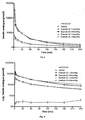
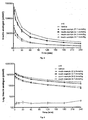
- I.v. bolus of a glucose-dependent insulin of example 22 or a non-glucose-dependent insulin of example 24 or vehicle in Wistar rats and ZDF rats (UIR100205-0143)
- Both the Wistar rats and the ZDF rats were allocated into 5 groups, 6 rats in each (eg 10 groups in total).
- the animals were dosed with an intravenous injection in a tail vein (1 ml/kg) of either vehicle (5 mM phosphate buffer, 140 mM NaCl, 70 ppm polysorbate 20, pH 7.4) or insulin of example 22 (i.e., a compound according to the present invention) or insulin of example 24 (i.e., a compound corresponding to the compound of example 22 but lacking the -B(OH) 2 group).
- Two doses of each analogue were tested: 1.2 nmol/kg or 3.6 nmol/kg in Wistar rats, and 3.6 nmol/kg or 7.2 nmol/kg in ZDF rats.
- Blood samples of 100 ⁇ l (tail tip capillary puncture) for determination of plasma insulin were collected in microvette tubes at time 3, 15, 30, 60, 120, 180 and 240 minutes after insulin dosing.
- Figures 3-6 show the plasma-elimination profiles of the two analogues (each in two doses) after an i.v. bolus injection to Wistar rats and ZDF rats.
- insulin of example 22 has a mean residence time (MRT) in Wistar rats of 158 ⁇ 42 min (low dose) and 121 ⁇ 10 min (high dose), whereas insulin of example 24 has MRT of 178 ⁇ 22 min (low dose) and 175 ⁇ 27 min (high dose).
- MRT mean residence time
- insulin of example 24 has MRT of 178 ⁇ 22 min (low dose) and 175 ⁇ 27 min (high dose).
- ZDF rats were for insulin of example 22, 144 ⁇ 21 min and 179 ⁇ 16 min and for insulin of example 24, 224 ⁇ 24 min and 203 ⁇ 14 min.
- glucose-dependent insulin of example 22 i.e., a compound according to the present invention
- non-glucose-dependent analogue insulin of example 24 under conditions of high blood glucose.
Landscapes
- Health & Medical Sciences (AREA)
- Chemical & Material Sciences (AREA)
- Life Sciences & Earth Sciences (AREA)
- Organic Chemistry (AREA)
- Diabetes (AREA)
- General Health & Medical Sciences (AREA)
- Medicinal Chemistry (AREA)
- Endocrinology (AREA)
- Proteomics, Peptides & Aminoacids (AREA)
- Toxicology (AREA)
- Biochemistry (AREA)
- Genetics & Genomics (AREA)
- Gastroenterology & Hepatology (AREA)
- Molecular Biology (AREA)
- Zoology (AREA)
- Biophysics (AREA)
- Engineering & Computer Science (AREA)
- Bioinformatics & Cheminformatics (AREA)
- Pharmacology & Pharmacy (AREA)
- Veterinary Medicine (AREA)
- Animal Behavior & Ethology (AREA)
- Public Health (AREA)
- Epidemiology (AREA)
- Emergency Medicine (AREA)
- Hematology (AREA)
- Obesity (AREA)
- Chemical Kinetics & Catalysis (AREA)
- General Chemical & Material Sciences (AREA)
- Nuclear Medicine, Radiotherapy & Molecular Imaging (AREA)
- Medicines That Contain Protein Lipid Enzymes And Other Medicines (AREA)
Claims (5)
- Insulinderivat der allgemeinen Formel I: (Z1-Y1-X1)m-Ins-(X-Y-Z)n, wobei n gleich null oder 1 ist; m gleich null oder 1 ist; mit der Maßgabe, dass nicht sowohl n als auch m gleich null sind; Ins Insulin oder ein Insulinanalog mit der vorliegend angegebenen Bedeutung repräsentiert, aus dem ein Wasserstoffatom aus einer in einem B29-Lysinrest und/oder in einem A22-Lysinrest vorliegenden ε-Aminogruppe entfernt wurde, und wobei die im N-terminalen Aminosäurerest in der A- und/oder B-Kette vorliegende Aminogruppe gegebenenfalls mit einer oder zwei Alkylgruppen (vorzugsweise Methyl oder Ethyl) substituiert ist, wobei die Gruppe(n) der allgemeinen Formel -X-Y-Z und/oder -X1-Y1-Z1 an eine ε-Aminogruppe in einem Lys(K)-Rest im Insulinmolekül gebunden ist/sind; X und X1 unabhängig voneinander für eine Bindung, eine Gruppierung der allgemeinen Formel -CO-(C1-C3-Alkylen)-CH(COOH)-NH-, wobei die Aminogruppe mit der Y/Y1-Gruppierung verbunden ist, oder eine Gruppierung der allgemeinen Formel -CO-(C1-C3-Alkylen)-SO2-NH-, wobei die Aminogruppe mit der Y/Y1-Grup-pierung verbunden ist, stehen; Y und Y1 unabhängig voneinander für eine ω-Aminoalkanoylgruppe mit 6 bis 22 Kohlenstoffatomen, und wobei ein Wasserstoffatom aus der ω-Aminogruppe entfernt wurde, stehen; und Z und Z1 unabhängig voneinander für eine Gruppe einer der beiden folgenden allgemeinen Formeln, -SO2-Ar bzw. -CO-Ar, stehen, wobei Ar für eine mit einer oder mehreren -B(OH)2-Gruppen und gegebenenfalls mit einem oder mehreren Halogen-atomen substituierte Phenylgruppe steht.
- Insulinderivat nach Anspruch 1 mit der allgemeinen Formel I: (Z1-Y1-X1)m-Ins-(X-Y-Z)n, wobei n gleich null oder 1 ist; m gleich null oder 1 ist; mit der Maßgabe, dass nicht sowohl n als auch m gleich null sind; Ins Insulin oder ein Insulinanalog mit der vorliegend angegebenen Bedeutung repräsentiert, aus dem ein Wasserstoffatom aus einer in einem B29-Lysinrest und/oder in einem A22-Lysinrest vorliegenden ε-Aminogruppe entfernt wurde, und wobei die im N-terminalen Aminosäurerest in der A- und/oder B-Kette vorliegende Aminogruppe gegebenenfalls mit einer oder zwei Alkylgruppen (vorzugsweise Methyl oder Ethyl) substituiert ist, wobei die Gruppe(n) der allgemeinen Formel -X-Y-Z und/oder -X1-Y1-Z1 an eine ε-Aminogruppe in einem Lys(K)-Rest im Insulinmolekül gebunden ist/sind; X und X1 unabhängig voneinander für eine Bindung, eine γ-Glutamylgruppe, wobei die Aminogruppe mit der Y/Y1-Gruppierung verbunden ist, oder eine Gruppierung der allgemeinen Formel -CO-(C1-C3-Alkylen)-SO2-NH-, wobei die Aminogruppe mit der Y/Y1-Grup-pierung verbunden ist, stehen; Y und Y1 unabhängig voneinander für eine ω-Aminoalkanoylgruppe mit 6 bis 22 Kohlenstoffatomen, und wobei ein Wasserstoffatom aus der ω-Aminogruppe entfernt wurde, stehen; und Z und Z1 unabhängig voneinander für eine Gruppe einer der beiden folgenden allgemeinen Formeln, -SO2-Ar bzw. -CO-Ar, stehen, wobei Ar für eine mit einer oder mehreren -B(OH)2-Gruppen und gegebenenfalls mit einem oder mehreren Halogen-atomen substituierte Phenylgruppe steht.
- Verbindung nach einem der vorhergehenden Ansprüche, soweit möglich, ausgewählt aus der Gruppe bestehend aus B29N ε-15-(4-Boronobenzol-sulfonylamino)pentadecanoyl-desB30-Humaninsulin; A22N ε-16-(2,3-Difluor-4-boronobenzoylamino)hexadecanoyl-B29N(epsilon)-16-(2,3-difluor-4-boronobenzoylamino)hexadecanoyl-A14E-A22K-B25H-desB30-Humaninsulin; B29N ε-12-(3-Boronobenzolsulfonylamino)dodecanoyl-desB30-Humaninsulin; B29N ε-16-(2,3-Difluor-4-boronobenzoylamino)hexadecanoyl-γ-L-glutamyl-desB30-Humaninsulin; B29N ε-16-(3,5-Diboronobenzoylamino)hexadecanoyl-desB30-Humaninsulin; B29N ε-16-(2,3-Difluor-4-boronobenzoylamino)hexadecanoyl-desB30-Humaninsulin; B29N ε-16-(3-Fluor-4-boronobenzoylamino)hexadecanoyl-desB30-Humaninsulin; B29N ε-16-(3-Fluor-4-boronobenzoylamino)hexadecanoyl-γ-L-glutamyl-desB30-Humaninsulin; B29N ε-16-(2,6-Difluor-4-boronobenzoylamino)hexadecanoyl-desB30-Humaninsulin; A1 (N,N-Dimethyl),B1(N,N-dimethyl),B29N ε-15-(4-Boronobenzolsulfonylamino)pentadecanoyl-desB30-Humaninsulin; A22N ε-16-(3,5-Diboronobenzoylamino)hexadecanoyl-A22K-B29R-desB30-Humaninsulin; A22N ε-16-(3,5-Diboronobenzoylamino)hexadecanoyl-A14E-A22K-B25H-B29R-desB30-Humaninsulin; A22N ε-16-(3,5-Diboronobenzoylamino)hexadecanoyl-L-γ-glutamyl-A14E-A22K-B25H-B29R-desB30-Humaninsulin; B29-N ε-{4-[16-(3-Boronobenzolsulfonylamino)hexadecanoyl-sulfamoyl]butanoyl}-desB30-Humaninsulin; A22N ε-15-(3,5-Diboronobenzoylamino)pentadecanoyl-B29N ε-15-(3,5-diboronobenzoylamino)pentadecandioyl-A14E-A22K-B25H-desB30-Humaninsulin; A22N ε-15-(3,5-Diboronobenzoylamino)pentadecanoyl-B29N ε-15-(3,5-diboronobenzoylamino)pentadecandioyl-A22K-desB30-Humaninsulin; B29N ε-16-(3,5-Diboronobenzoylamino)-hexadecanoyl-L-γ-glutamyl-A14E-B25H-desB30-Humaninsulin; A22N ε-15-(3,5-Diboronobenzoylamino)pentadecanoyl-γ-L-glutamyl-B29N ε-15-(3,5-diboronobenzoylamino)pentadecandioyl-γ-L-glutamyl-A14E-A22K-B25H-desB30-Humaninsulin; B29N ε-{4-[16-(3-Boronobenzolsulfonylamino)hexadecanoylsulfamoyl]-butanoyl}-A14E-B25H-desB30-Humaninsulin; A22N ε-12-(3,5-Diboronobenzoylamino)dodecanoyl-B29N ε-12-(3,5-diboronobenzoylamino)dodecandioyl-A14E-A22K-B25H-desB30-Humaninsulin; A22N ε-12-(3,5-Diboronobenzoylamino)dodecanoyl-B29N ε-12-(3,5-diboronobenzoylamino)dodecandioyl-A22K-desB30-Humaninsulin; B29N ε-16-(2,3-Difluor-4-boronobenzoylamino)hexadecanoyl-A14E-B25H-desB30-Humaninsulin; A22N ε-12-(3,5-Diboronobenzoylamino)dodecanoyl-gamma-L-glutamyl-B29N ε-12-(3,5-diboronobenzoylamino)dodecandioylgamma-L-glutamyl-A22K-desB30-Humaninsulin; A22N ε-12-(3,5-Diboronobenzoylamino)dodecanoyl-gamma-L-glutamyl-B29N ε-12-(3,5-diboronobenzoylamino)-dodecandioyl-gamma-L-glutamyl-A14E-A22K-B25H-desB30-Humaninsulin; B29N ε-16-(2,6-Difluor-4-boronobenzoylamino)pentadecanoyl-A14E-B25H-desB30-Humaninsulin; B29N ε-16-(2,6-Difluor-4-boronobenzoylamino)hexadecanoyl-A14E-B25H-desB30-Humaninsulin; und B29N ε-16-(4-Boronobenzoylamino)hexadecanoyl-A14E-B25H-desB30-Humaninsulin.
- Insulinderivat nach einem der vorhergehenden Ansprüche zur Verwendung als Arzneimittel.
- Insulinderivat nach einem der vorhergehenden Produktansprüche zur Verwendung bei der Behandlung von Diabetes.
Priority Applications (1)
| Application Number | Priority Date | Filing Date | Title |
|---|---|---|---|
| EP10726515.9A EP2448962B1 (de) | 2009-06-30 | 2010-06-29 | Insulin-derivate |
Applications Claiming Priority (4)
| Application Number | Priority Date | Filing Date | Title |
|---|---|---|---|
| EP09164103 | 2009-06-30 | ||
| US23511209P | 2009-08-19 | 2009-08-19 | |
| EP10726515.9A EP2448962B1 (de) | 2009-06-30 | 2010-06-29 | Insulin-derivate |
| PCT/EP2010/059194 WO2011000823A1 (en) | 2009-06-30 | 2010-06-29 | Insulin derivatives |
Publications (2)
| Publication Number | Publication Date |
|---|---|
| EP2448962A1 EP2448962A1 (de) | 2012-05-09 |
| EP2448962B1 true EP2448962B1 (de) | 2016-10-19 |
Family
ID=40974550
Family Applications (1)
| Application Number | Title | Priority Date | Filing Date |
|---|---|---|---|
| EP10726515.9A Not-in-force EP2448962B1 (de) | 2009-06-30 | 2010-06-29 | Insulin-derivate |
Country Status (4)
| Country | Link |
|---|---|
| US (5) | US20120184487A1 (de) |
| EP (1) | EP2448962B1 (de) |
| ES (1) | ES2611040T3 (de) |
| WO (1) | WO2011000823A1 (de) |
Families Citing this family (19)
| Publication number | Priority date | Publication date | Assignee | Title |
|---|---|---|---|---|
| BRPI1007457A2 (pt) | 2009-01-28 | 2015-08-25 | Smartcells Inc | Conjungado, formulação de liberação prolongada, e, sistema de distribuição de bomba. |
| WO2010088286A1 (en) | 2009-01-28 | 2010-08-05 | Smartcells, Inc. | Synthetic conjugates and uses thereof |
| WO2010088300A1 (en) | 2009-01-28 | 2010-08-05 | Smartcells, Inc. | Crystalline insulin-conjugates |
| WO2010088268A1 (en) | 2009-01-28 | 2010-08-05 | Smartcells, Inc. | Exogenously triggered controlled release materials and uses thereof |
| WO2010107520A1 (en) | 2009-03-20 | 2010-09-23 | Smartcells, Inc. | Soluble non-depot insulin conjugates and uses thereof |
| US8623345B2 (en) | 2009-03-20 | 2014-01-07 | Smartcells | Terminally-functionalized conjugates and uses thereof |
| EP2598522A4 (de) | 2010-07-28 | 2014-11-12 | Smartcells Inc | Rekombinante lektine, bindungsstellenmodifizierte lektine und anwendungen davon |
| JP2013535467A (ja) | 2010-07-28 | 2013-09-12 | スマートセルズ・インコーポレイテツド | 組換えにより発現されたインスリンポリペプチドおよびその使用 |
| AU2011282977A1 (en) | 2010-07-28 | 2013-02-21 | Smartcells, Inc. | Drug-ligand conjugates, synthesis thereof, and intermediates thereto |
| WO2014093696A2 (en) * | 2012-12-12 | 2014-06-19 | Massachusetts Institute Of Technology | Insulin derivatives for diabetes treatment |
| KR20160065930A (ko) | 2013-10-04 | 2016-06-09 | 머크 샤프 앤드 돔 코포레이션 | 글루코스-반응성 인슐린 접합체 |
| AR099569A1 (es) | 2014-02-28 | 2016-08-03 | Novo Nordisk As | Derivados de insulina y los usos médicos de estos |
| WO2016164596A2 (en) | 2015-04-07 | 2016-10-13 | Novozymes A/S | Methods for selecting enzymes having lipase activity |
| ES2908373T3 (es) | 2015-08-25 | 2022-04-28 | Novo Nordisk As | Nuevos derivados de insulina y los usos médicos de los mismos |
| CA3025988A1 (en) | 2016-06-02 | 2017-12-07 | Sanofi | Conjugates of a pharmaceutical agent and a moiety capable of binding to a glucose sensing protein |
| CN117624207A (zh) | 2017-11-09 | 2024-03-01 | 诺和诺德股份有限公司 | 葡萄糖敏感性白蛋白结合衍生物 |
| CN111433193A (zh) | 2017-12-01 | 2020-07-17 | 赛诺菲 | 药剂和能够结合至葡萄糖传感蛋白的部分的新型缀合物 |
| JP7640462B2 (ja) | 2019-03-29 | 2025-03-05 | ノヴォ ノルディスク アー/エス | グルコース感受性インスリン誘導体 |
| DK4073097T3 (da) | 2019-12-11 | 2024-08-19 | Novo Nordisk As | Nye insulinanaloger og anvendelser heraf |
Family Cites Families (5)
| Publication number | Priority date | Publication date | Assignee | Title |
|---|---|---|---|---|
| KR930001305B1 (ko) | 1989-10-19 | 1993-02-25 | 니뽕 유우시 가부시끼가이샤 | 당 응답형 고분자 복합체(Polymer Complexes of Sugar Response Type) |
| US7316999B2 (en) * | 2000-06-02 | 2008-01-08 | Novo Nordisk A/S | Glucose dependent release of insulin from glucose sensing insulin derivatives |
| JP2003535106A (ja) | 2000-06-02 | 2003-11-25 | ノボ ノルディスク アクティーゼルスカブ | グルコース検知性インスリン誘導体からの、インスリンのグルコース依存性放出 |
| EP1453860A2 (de) | 2001-12-02 | 2004-09-08 | Novo Nordisk A/S | Neue glukoseabhängige insuline |
| RU2524150C2 (ru) | 2006-09-22 | 2014-07-27 | Ново Нордиск А/С | Аналоги инсулина, устойчивые к протеазам |
-
2010
- 2010-06-29 EP EP10726515.9A patent/EP2448962B1/de not_active Not-in-force
- 2010-06-29 US US13/377,956 patent/US20120184487A1/en not_active Abandoned
- 2010-06-29 ES ES10726515.9T patent/ES2611040T3/es active Active
- 2010-06-29 WO PCT/EP2010/059194 patent/WO2011000823A1/en not_active Ceased
-
2016
- 2016-04-18 US US15/131,672 patent/US20160229902A1/en not_active Abandoned
-
2018
- 2018-07-20 US US16/040,684 patent/US20180371045A1/en not_active Abandoned
-
2020
- 2020-02-07 US US16/784,643 patent/US20200172593A1/en not_active Abandoned
- 2020-10-07 US US17/065,060 patent/US20210024604A1/en not_active Abandoned
Also Published As
| Publication number | Publication date |
|---|---|
| US20180371045A1 (en) | 2018-12-27 |
| US20120184487A1 (en) | 2012-07-19 |
| WO2011000823A1 (en) | 2011-01-06 |
| ES2611040T3 (es) | 2017-05-04 |
| US20200172593A1 (en) | 2020-06-04 |
| EP2448962A1 (de) | 2012-05-09 |
| US20210024604A1 (en) | 2021-01-28 |
| US20160229902A1 (en) | 2016-08-11 |
Similar Documents
| Publication | Publication Date | Title |
|---|---|---|
| EP2448962B1 (de) | Insulin-derivate | |
| US8722620B2 (en) | Insulin derivatives | |
| EP1969004B1 (de) | Ein acyliertes insulin und zink enthaltende zusammensetzungen und verfahren zur herstellung dieser zusammensetzungen | |
| EP2910569B1 (de) | Proteasestabilisierte, acylierte Insulinanaloga | |
| JP5695909B2 (ja) | 極度に遅延した時間作用プロファイルを有する新規なインスリン誘導体 | |
| US9260503B2 (en) | Multi-substituted insulins | |
| JPH0469128B2 (de) | ||
| NO340925B1 (no) | Nye insulinderivater | |
| EP0194864A2 (de) | Peptide | |
| US20090099064A1 (en) | Derivatized insulin oligomers | |
| EP2820038B1 (de) | Glp-1-prodrugs | |
| RS61137B1 (sr) | A22k, desb27, b29r, des b30, na epsilon poziciji lizina 22 acilovanog analoga humanog insulina | |
| EP2852400B1 (de) | Insulinanalog oder pharmazeutisch unbedenkliches salz davon, pharmazeutische zusammensetzung mit verlängerter therapeutischen wirkung, verwendung des insulinanalogs, dosierungsverfahren und verfahren zur behandlung von diabetes |
Legal Events
| Date | Code | Title | Description |
|---|---|---|---|
| PUAI | Public reference made under article 153(3) epc to a published international application that has entered the european phase |
Free format text: ORIGINAL CODE: 0009012 |
|
| 17P | Request for examination filed |
Effective date: 20120130 |
|
| AK | Designated contracting states |
Kind code of ref document: A1 Designated state(s): AL AT BE BG CH CY CZ DE DK EE ES FI FR GB GR HR HU IE IS IT LI LT LU LV MC MK MT NL NO PL PT RO SE SI SK SM TR |
|
| DAX | Request for extension of the european patent (deleted) | ||
| GRAP | Despatch of communication of intention to grant a patent |
Free format text: ORIGINAL CODE: EPIDOSNIGR1 |
|
| INTG | Intention to grant announced |
Effective date: 20160518 |
|
| GRAS | Grant fee paid |
Free format text: ORIGINAL CODE: EPIDOSNIGR3 |
|
| GRAA | (expected) grant |
Free format text: ORIGINAL CODE: 0009210 |
|
| AK | Designated contracting states |
Kind code of ref document: B1 Designated state(s): AL AT BE BG CH CY CZ DE DK EE ES FI FR GB GR HR HU IE IS IT LI LT LU LV MC MK MT NL NO PL PT RO SE SI SK SM TR |
|
| REG | Reference to a national code |
Ref country code: GB Ref legal event code: FG4D |
|
| REG | Reference to a national code |
Ref country code: CH Ref legal event code: EP |
|
| REG | Reference to a national code |
Ref country code: AT Ref legal event code: REF Ref document number: 838252 Country of ref document: AT Kind code of ref document: T Effective date: 20161115 |
|
| REG | Reference to a national code |
Ref country code: IE Ref legal event code: FG4D |
|
| REG | Reference to a national code |
Ref country code: DE Ref legal event code: R096 Ref document number: 602010037300 Country of ref document: DE |
|
| REG | Reference to a national code |
Ref country code: NL Ref legal event code: MP Effective date: 20161019 |
|
| REG | Reference to a national code |
Ref country code: LT Ref legal event code: MG4D |
|
| PG25 | Lapsed in a contracting state [announced via postgrant information from national office to epo] |
Ref country code: LV Free format text: LAPSE BECAUSE OF FAILURE TO SUBMIT A TRANSLATION OF THE DESCRIPTION OR TO PAY THE FEE WITHIN THE PRESCRIBED TIME-LIMIT Effective date: 20161019 |
|
| REG | Reference to a national code |
Ref country code: AT Ref legal event code: MK05 Ref document number: 838252 Country of ref document: AT Kind code of ref document: T Effective date: 20161019 |
|
| PG25 | Lapsed in a contracting state [announced via postgrant information from national office to epo] |
Ref country code: SE Free format text: LAPSE BECAUSE OF FAILURE TO SUBMIT A TRANSLATION OF THE DESCRIPTION OR TO PAY THE FEE WITHIN THE PRESCRIBED TIME-LIMIT Effective date: 20161019 Ref country code: GR Free format text: LAPSE BECAUSE OF FAILURE TO SUBMIT A TRANSLATION OF THE DESCRIPTION OR TO PAY THE FEE WITHIN THE PRESCRIBED TIME-LIMIT Effective date: 20170120 Ref country code: NO Free format text: LAPSE BECAUSE OF FAILURE TO SUBMIT A TRANSLATION OF THE DESCRIPTION OR TO PAY THE FEE WITHIN THE PRESCRIBED TIME-LIMIT Effective date: 20170119 Ref country code: LT Free format text: LAPSE BECAUSE OF FAILURE TO SUBMIT A TRANSLATION OF THE DESCRIPTION OR TO PAY THE FEE WITHIN THE PRESCRIBED TIME-LIMIT Effective date: 20161019 |
|
| REG | Reference to a national code |
Ref country code: ES Ref legal event code: FG2A Ref document number: 2611040 Country of ref document: ES Kind code of ref document: T3 Effective date: 20170504 |
|
| REG | Reference to a national code |
Ref country code: FR Ref legal event code: PLFP Year of fee payment: 8 |
|
| PG25 | Lapsed in a contracting state [announced via postgrant information from national office to epo] |
Ref country code: PT Free format text: LAPSE BECAUSE OF FAILURE TO SUBMIT A TRANSLATION OF THE DESCRIPTION OR TO PAY THE FEE WITHIN THE PRESCRIBED TIME-LIMIT Effective date: 20170220 Ref country code: BE Free format text: LAPSE BECAUSE OF FAILURE TO SUBMIT A TRANSLATION OF THE DESCRIPTION OR TO PAY THE FEE WITHIN THE PRESCRIBED TIME-LIMIT Effective date: 20161019 Ref country code: PL Free format text: LAPSE BECAUSE OF FAILURE TO SUBMIT A TRANSLATION OF THE DESCRIPTION OR TO PAY THE FEE WITHIN THE PRESCRIBED TIME-LIMIT Effective date: 20161019 Ref country code: HR Free format text: LAPSE BECAUSE OF FAILURE TO SUBMIT A TRANSLATION OF THE DESCRIPTION OR TO PAY THE FEE WITHIN THE PRESCRIBED TIME-LIMIT Effective date: 20161019 Ref country code: AT Free format text: LAPSE BECAUSE OF FAILURE TO SUBMIT A TRANSLATION OF THE DESCRIPTION OR TO PAY THE FEE WITHIN THE PRESCRIBED TIME-LIMIT Effective date: 20161019 Ref country code: IS Free format text: LAPSE BECAUSE OF FAILURE TO SUBMIT A TRANSLATION OF THE DESCRIPTION OR TO PAY THE FEE WITHIN THE PRESCRIBED TIME-LIMIT Effective date: 20170219 Ref country code: FI Free format text: LAPSE BECAUSE OF FAILURE TO SUBMIT A TRANSLATION OF THE DESCRIPTION OR TO PAY THE FEE WITHIN THE PRESCRIBED TIME-LIMIT Effective date: 20161019 Ref country code: NL Free format text: LAPSE BECAUSE OF FAILURE TO SUBMIT A TRANSLATION OF THE DESCRIPTION OR TO PAY THE FEE WITHIN THE PRESCRIBED TIME-LIMIT Effective date: 20161019 |
|
| REG | Reference to a national code |
Ref country code: DE Ref legal event code: R097 Ref document number: 602010037300 Country of ref document: DE |
|
| PG25 | Lapsed in a contracting state [announced via postgrant information from national office to epo] |
Ref country code: CZ Free format text: LAPSE BECAUSE OF FAILURE TO SUBMIT A TRANSLATION OF THE DESCRIPTION OR TO PAY THE FEE WITHIN THE PRESCRIBED TIME-LIMIT Effective date: 20161019 Ref country code: SK Free format text: LAPSE BECAUSE OF FAILURE TO SUBMIT A TRANSLATION OF THE DESCRIPTION OR TO PAY THE FEE WITHIN THE PRESCRIBED TIME-LIMIT Effective date: 20161019 Ref country code: RO Free format text: LAPSE BECAUSE OF FAILURE TO SUBMIT A TRANSLATION OF THE DESCRIPTION OR TO PAY THE FEE WITHIN THE PRESCRIBED TIME-LIMIT Effective date: 20161019 Ref country code: DK Free format text: LAPSE BECAUSE OF FAILURE TO SUBMIT A TRANSLATION OF THE DESCRIPTION OR TO PAY THE FEE WITHIN THE PRESCRIBED TIME-LIMIT Effective date: 20161019 Ref country code: EE Free format text: LAPSE BECAUSE OF FAILURE TO SUBMIT A TRANSLATION OF THE DESCRIPTION OR TO PAY THE FEE WITHIN THE PRESCRIBED TIME-LIMIT Effective date: 20161019 |
|
| PLBE | No opposition filed within time limit |
Free format text: ORIGINAL CODE: 0009261 |
|
| STAA | Information on the status of an ep patent application or granted ep patent |
Free format text: STATUS: NO OPPOSITION FILED WITHIN TIME LIMIT |
|
| PG25 | Lapsed in a contracting state [announced via postgrant information from national office to epo] |
Ref country code: BG Free format text: LAPSE BECAUSE OF FAILURE TO SUBMIT A TRANSLATION OF THE DESCRIPTION OR TO PAY THE FEE WITHIN THE PRESCRIBED TIME-LIMIT Effective date: 20170119 Ref country code: SM Free format text: LAPSE BECAUSE OF FAILURE TO SUBMIT A TRANSLATION OF THE DESCRIPTION OR TO PAY THE FEE WITHIN THE PRESCRIBED TIME-LIMIT Effective date: 20161019 |
|
| 26N | No opposition filed |
Effective date: 20170720 |
|
| PG25 | Lapsed in a contracting state [announced via postgrant information from national office to epo] |
Ref country code: SI Free format text: LAPSE BECAUSE OF FAILURE TO SUBMIT A TRANSLATION OF THE DESCRIPTION OR TO PAY THE FEE WITHIN THE PRESCRIBED TIME-LIMIT Effective date: 20161019 |
|
| PG25 | Lapsed in a contracting state [announced via postgrant information from national office to epo] |
Ref country code: MC Free format text: LAPSE BECAUSE OF FAILURE TO SUBMIT A TRANSLATION OF THE DESCRIPTION OR TO PAY THE FEE WITHIN THE PRESCRIBED TIME-LIMIT Effective date: 20161019 |
|
| REG | Reference to a national code |
Ref country code: CH Ref legal event code: PL |
|
| REG | Reference to a national code |
Ref country code: IE Ref legal event code: MM4A |
|
| PG25 | Lapsed in a contracting state [announced via postgrant information from national office to epo] |
Ref country code: LU Free format text: LAPSE BECAUSE OF NON-PAYMENT OF DUE FEES Effective date: 20170629 Ref country code: IE Free format text: LAPSE BECAUSE OF NON-PAYMENT OF DUE FEES Effective date: 20170629 Ref country code: LI Free format text: LAPSE BECAUSE OF NON-PAYMENT OF DUE FEES Effective date: 20170630 Ref country code: CH Free format text: LAPSE BECAUSE OF NON-PAYMENT OF DUE FEES Effective date: 20170630 |
|
| REG | Reference to a national code |
Ref country code: FR Ref legal event code: PLFP Year of fee payment: 9 |
|
| PG25 | Lapsed in a contracting state [announced via postgrant information from national office to epo] |
Ref country code: MT Free format text: LAPSE BECAUSE OF NON-PAYMENT OF DUE FEES Effective date: 20170629 |
|
| PG25 | Lapsed in a contracting state [announced via postgrant information from national office to epo] |
Ref country code: HU Free format text: LAPSE BECAUSE OF FAILURE TO SUBMIT A TRANSLATION OF THE DESCRIPTION OR TO PAY THE FEE WITHIN THE PRESCRIBED TIME-LIMIT; INVALID AB INITIO Effective date: 20100629 |
|
| PG25 | Lapsed in a contracting state [announced via postgrant information from national office to epo] |
Ref country code: CY Free format text: LAPSE BECAUSE OF NON-PAYMENT OF DUE FEES Effective date: 20161019 |
|
| PG25 | Lapsed in a contracting state [announced via postgrant information from national office to epo] |
Ref country code: MK Free format text: LAPSE BECAUSE OF FAILURE TO SUBMIT A TRANSLATION OF THE DESCRIPTION OR TO PAY THE FEE WITHIN THE PRESCRIBED TIME-LIMIT Effective date: 20161019 |
|
| PG25 | Lapsed in a contracting state [announced via postgrant information from national office to epo] |
Ref country code: TR Free format text: LAPSE BECAUSE OF FAILURE TO SUBMIT A TRANSLATION OF THE DESCRIPTION OR TO PAY THE FEE WITHIN THE PRESCRIBED TIME-LIMIT Effective date: 20161019 |
|
| PG25 | Lapsed in a contracting state [announced via postgrant information from national office to epo] |
Ref country code: AL Free format text: LAPSE BECAUSE OF FAILURE TO SUBMIT A TRANSLATION OF THE DESCRIPTION OR TO PAY THE FEE WITHIN THE PRESCRIBED TIME-LIMIT Effective date: 20161019 |
|
| PGFP | Annual fee paid to national office [announced via postgrant information from national office to epo] |
Ref country code: FR Payment date: 20200520 Year of fee payment: 11 Ref country code: DE Payment date: 20200519 Year of fee payment: 11 |
|
| PGFP | Annual fee paid to national office [announced via postgrant information from national office to epo] |
Ref country code: IT Payment date: 20200519 Year of fee payment: 11 Ref country code: GB Payment date: 20200525 Year of fee payment: 11 |
|
| PGFP | Annual fee paid to national office [announced via postgrant information from national office to epo] |
Ref country code: ES Payment date: 20200701 Year of fee payment: 11 |
|
| REG | Reference to a national code |
Ref country code: DE Ref legal event code: R119 Ref document number: 602010037300 Country of ref document: DE |
|
| GBPC | Gb: european patent ceased through non-payment of renewal fee |
Effective date: 20210629 |
|
| PG25 | Lapsed in a contracting state [announced via postgrant information from national office to epo] |
Ref country code: GB Free format text: LAPSE BECAUSE OF NON-PAYMENT OF DUE FEES Effective date: 20210629 Ref country code: DE Free format text: LAPSE BECAUSE OF NON-PAYMENT OF DUE FEES Effective date: 20220101 |
|
| PG25 | Lapsed in a contracting state [announced via postgrant information from national office to epo] |
Ref country code: FR Free format text: LAPSE BECAUSE OF NON-PAYMENT OF DUE FEES Effective date: 20210630 |
|
| PG25 | Lapsed in a contracting state [announced via postgrant information from national office to epo] |
Ref country code: IT Free format text: LAPSE BECAUSE OF NON-PAYMENT OF DUE FEES Effective date: 20210629 |
|
| REG | Reference to a national code |
Ref country code: ES Ref legal event code: FD2A Effective date: 20220902 |
|
| PG25 | Lapsed in a contracting state [announced via postgrant information from national office to epo] |
Ref country code: ES Free format text: LAPSE BECAUSE OF NON-PAYMENT OF DUE FEES Effective date: 20210630 |