EP2450176A1 - Raccord de soudage à filament chauffant - Google Patents
Raccord de soudage à filament chauffant Download PDFInfo
- Publication number
- EP2450176A1 EP2450176A1 EP10189916A EP10189916A EP2450176A1 EP 2450176 A1 EP2450176 A1 EP 2450176A1 EP 10189916 A EP10189916 A EP 10189916A EP 10189916 A EP10189916 A EP 10189916A EP 2450176 A1 EP2450176 A1 EP 2450176A1
- Authority
- EP
- European Patent Office
- Prior art keywords
- heating wire
- fitting
- welding
- heating
- sleeve
- Prior art date
- Legal status (The legal status is an assumption and is not a legal conclusion. Google has not performed a legal analysis and makes no representation as to the accuracy of the status listed.)
- Withdrawn
Links
- 238000010438 heat treatment Methods 0.000 title claims abstract description 49
- 238000003466 welding Methods 0.000 claims abstract description 50
- 238000004804 winding Methods 0.000 claims abstract description 36
- 229920001169 thermoplastic Polymers 0.000 claims abstract description 5
- 239000004416 thermosoftening plastic Substances 0.000 claims abstract description 5
- 230000008878 coupling Effects 0.000 claims abstract description 4
- 238000010168 coupling process Methods 0.000 claims abstract description 4
- 238000005859 coupling reaction Methods 0.000 claims abstract description 4
- 210000002445 nipple Anatomy 0.000 claims description 18
- 239000004033 plastic Substances 0.000 claims description 12
- 229920003023 plastic Polymers 0.000 claims description 12
- 238000009730 filament winding Methods 0.000 claims 1
- 238000012546 transfer Methods 0.000 description 4
- 208000010201 Exanthema Diseases 0.000 description 2
- 230000015572 biosynthetic process Effects 0.000 description 2
- 238000010276 construction Methods 0.000 description 2
- 201000005884 exanthem Diseases 0.000 description 2
- 238000003780 insertion Methods 0.000 description 2
- 230000037431 insertion Effects 0.000 description 2
- 238000000034 method Methods 0.000 description 2
- 206010037844 rash Diseases 0.000 description 2
- 239000003570 air Substances 0.000 description 1
- 239000012141 concentrate Substances 0.000 description 1
- 238000005260 corrosion Methods 0.000 description 1
- 230000007797 corrosion Effects 0.000 description 1
- 230000007423 decrease Effects 0.000 description 1
- 230000001419 dependent effect Effects 0.000 description 1
- 238000013461 design Methods 0.000 description 1
- 238000009826 distribution Methods 0.000 description 1
- 230000005489 elastic deformation Effects 0.000 description 1
- 238000009434 installation Methods 0.000 description 1
- 238000004519 manufacturing process Methods 0.000 description 1
- 239000000463 material Substances 0.000 description 1
- 238000002844 melting Methods 0.000 description 1
- 230000008018 melting Effects 0.000 description 1
- 238000013021 overheating Methods 0.000 description 1
- 239000000779 smoke Substances 0.000 description 1
- 239000000126 substance Substances 0.000 description 1
- 239000002351 wastewater Substances 0.000 description 1
- XLYOFNOQVPJJNP-UHFFFAOYSA-N water Substances O XLYOFNOQVPJJNP-UHFFFAOYSA-N 0.000 description 1
Images

Classifications
-
- F—MECHANICAL ENGINEERING; LIGHTING; HEATING; WEAPONS; BLASTING
- F16—ENGINEERING ELEMENTS AND UNITS; GENERAL MEASURES FOR PRODUCING AND MAINTAINING EFFECTIVE FUNCTIONING OF MACHINES OR INSTALLATIONS; THERMAL INSULATION IN GENERAL
- F16L—PIPES; JOINTS OR FITTINGS FOR PIPES; SUPPORTS FOR PIPES, CABLES OR PROTECTIVE TUBING; MEANS FOR THERMAL INSULATION IN GENERAL
- F16L47/00—Connecting arrangements or other fittings specially adapted to be made of plastics or to be used with pipes made of plastics
- F16L47/02—Welded joints; Adhesive joints
- F16L47/03—Welded joints with an electrical resistance incorporated in the joint
-
- B—PERFORMING OPERATIONS; TRANSPORTING
- B29—WORKING OF PLASTICS; WORKING OF SUBSTANCES IN A PLASTIC STATE IN GENERAL
- B29C—SHAPING OR JOINING OF PLASTICS; SHAPING OF MATERIAL IN A PLASTIC STATE, NOT OTHERWISE PROVIDED FOR; AFTER-TREATMENT OF THE SHAPED PRODUCTS, e.g. REPAIRING
- B29C65/00—Joining or sealing of preformed parts, e.g. welding of plastics materials; Apparatus therefor
- B29C65/02—Joining or sealing of preformed parts, e.g. welding of plastics materials; Apparatus therefor by heating, with or without pressure
- B29C65/34—Joining or sealing of preformed parts, e.g. welding of plastics materials; Apparatus therefor by heating, with or without pressure using heated elements which remain in the joint, e.g. "verlorenes Schweisselement"
- B29C65/3404—Joining or sealing of preformed parts, e.g. welding of plastics materials; Apparatus therefor by heating, with or without pressure using heated elements which remain in the joint, e.g. "verlorenes Schweisselement" characterised by the type of heated elements which remain in the joint
- B29C65/342—Joining or sealing of preformed parts, e.g. welding of plastics materials; Apparatus therefor by heating, with or without pressure using heated elements which remain in the joint, e.g. "verlorenes Schweisselement" characterised by the type of heated elements which remain in the joint comprising at least a single wire, e.g. in the form of a winding
- B29C65/3432—Joining or sealing of preformed parts, e.g. welding of plastics materials; Apparatus therefor by heating, with or without pressure using heated elements which remain in the joint, e.g. "verlorenes Schweisselement" characterised by the type of heated elements which remain in the joint comprising at least a single wire, e.g. in the form of a winding comprising several wires, e.g. in the form of several independent windings
-
- B—PERFORMING OPERATIONS; TRANSPORTING
- B29—WORKING OF PLASTICS; WORKING OF SUBSTANCES IN A PLASTIC STATE IN GENERAL
- B29C—SHAPING OR JOINING OF PLASTICS; SHAPING OF MATERIAL IN A PLASTIC STATE, NOT OTHERWISE PROVIDED FOR; AFTER-TREATMENT OF THE SHAPED PRODUCTS, e.g. REPAIRING
- B29C65/00—Joining or sealing of preformed parts, e.g. welding of plastics materials; Apparatus therefor
- B29C65/02—Joining or sealing of preformed parts, e.g. welding of plastics materials; Apparatus therefor by heating, with or without pressure
- B29C65/34—Joining or sealing of preformed parts, e.g. welding of plastics materials; Apparatus therefor by heating, with or without pressure using heated elements which remain in the joint, e.g. "verlorenes Schweisselement"
- B29C65/3468—Joining or sealing of preformed parts, e.g. welding of plastics materials; Apparatus therefor by heating, with or without pressure using heated elements which remain in the joint, e.g. "verlorenes Schweisselement" characterised by the means for supplying heat to said heated elements which remain in the join, e.g. special electrical connectors of windings
-
- B—PERFORMING OPERATIONS; TRANSPORTING
- B29—WORKING OF PLASTICS; WORKING OF SUBSTANCES IN A PLASTIC STATE IN GENERAL
- B29C—SHAPING OR JOINING OF PLASTICS; SHAPING OF MATERIAL IN A PLASTIC STATE, NOT OTHERWISE PROVIDED FOR; AFTER-TREATMENT OF THE SHAPED PRODUCTS, e.g. REPAIRING
- B29C65/00—Joining or sealing of preformed parts, e.g. welding of plastics materials; Apparatus therefor
- B29C65/02—Joining or sealing of preformed parts, e.g. welding of plastics materials; Apparatus therefor by heating, with or without pressure
- B29C65/34—Joining or sealing of preformed parts, e.g. welding of plastics materials; Apparatus therefor by heating, with or without pressure using heated elements which remain in the joint, e.g. "verlorenes Schweisselement"
- B29C65/3472—Joining or sealing of preformed parts, e.g. welding of plastics materials; Apparatus therefor by heating, with or without pressure using heated elements which remain in the joint, e.g. "verlorenes Schweisselement" characterised by the composition of the heated elements which remain in the joint
- B29C65/3476—Joining or sealing of preformed parts, e.g. welding of plastics materials; Apparatus therefor by heating, with or without pressure using heated elements which remain in the joint, e.g. "verlorenes Schweisselement" characterised by the composition of the heated elements which remain in the joint being metallic
-
- B—PERFORMING OPERATIONS; TRANSPORTING
- B29—WORKING OF PLASTICS; WORKING OF SUBSTANCES IN A PLASTIC STATE IN GENERAL
- B29C—SHAPING OR JOINING OF PLASTICS; SHAPING OF MATERIAL IN A PLASTIC STATE, NOT OTHERWISE PROVIDED FOR; AFTER-TREATMENT OF THE SHAPED PRODUCTS, e.g. REPAIRING
- B29C66/00—General aspects of processes or apparatus for joining preformed parts
- B29C66/01—General aspects dealing with the joint area or with the area to be joined
- B29C66/05—Particular design of joint configurations
- B29C66/10—Particular design of joint configurations particular design of the joint cross-sections
- B29C66/12—Joint cross-sections combining only two joint-segments; Tongue and groove joints; Tenon and mortise joints; Stepped joint cross-sections
- B29C66/122—Joint cross-sections combining only two joint-segments, i.e. one of the parts to be joined comprising only two joint-segments in the joint cross-section
- B29C66/1222—Joint cross-sections combining only two joint-segments, i.e. one of the parts to be joined comprising only two joint-segments in the joint cross-section comprising at least a lapped joint-segment
-
- B—PERFORMING OPERATIONS; TRANSPORTING
- B29—WORKING OF PLASTICS; WORKING OF SUBSTANCES IN A PLASTIC STATE IN GENERAL
- B29C—SHAPING OR JOINING OF PLASTICS; SHAPING OF MATERIAL IN A PLASTIC STATE, NOT OTHERWISE PROVIDED FOR; AFTER-TREATMENT OF THE SHAPED PRODUCTS, e.g. REPAIRING
- B29C66/00—General aspects of processes or apparatus for joining preformed parts
- B29C66/01—General aspects dealing with the joint area or with the area to be joined
- B29C66/05—Particular design of joint configurations
- B29C66/10—Particular design of joint configurations particular design of the joint cross-sections
- B29C66/12—Joint cross-sections combining only two joint-segments; Tongue and groove joints; Tenon and mortise joints; Stepped joint cross-sections
- B29C66/122—Joint cross-sections combining only two joint-segments, i.e. one of the parts to be joined comprising only two joint-segments in the joint cross-section
- B29C66/1224—Joint cross-sections combining only two joint-segments, i.e. one of the parts to be joined comprising only two joint-segments in the joint cross-section comprising at least a butt joint-segment
-
- B—PERFORMING OPERATIONS; TRANSPORTING
- B29—WORKING OF PLASTICS; WORKING OF SUBSTANCES IN A PLASTIC STATE IN GENERAL
- B29C—SHAPING OR JOINING OF PLASTICS; SHAPING OF MATERIAL IN A PLASTIC STATE, NOT OTHERWISE PROVIDED FOR; AFTER-TREATMENT OF THE SHAPED PRODUCTS, e.g. REPAIRING
- B29C66/00—General aspects of processes or apparatus for joining preformed parts
- B29C66/01—General aspects dealing with the joint area or with the area to be joined
- B29C66/05—Particular design of joint configurations
- B29C66/20—Particular design of joint configurations particular design of the joint lines, e.g. of the weld lines
- B29C66/22—Particular design of joint configurations particular design of the joint lines, e.g. of the weld lines said joint lines being in the form of recurring patterns
- B29C66/221—Particular design of joint configurations particular design of the joint lines, e.g. of the weld lines said joint lines being in the form of recurring patterns being in the form of a sinusoidal wave
-
- B—PERFORMING OPERATIONS; TRANSPORTING
- B29—WORKING OF PLASTICS; WORKING OF SUBSTANCES IN A PLASTIC STATE IN GENERAL
- B29C—SHAPING OR JOINING OF PLASTICS; SHAPING OF MATERIAL IN A PLASTIC STATE, NOT OTHERWISE PROVIDED FOR; AFTER-TREATMENT OF THE SHAPED PRODUCTS, e.g. REPAIRING
- B29C66/00—General aspects of processes or apparatus for joining preformed parts
- B29C66/01—General aspects dealing with the joint area or with the area to be joined
- B29C66/347—General aspects dealing with the joint area or with the area to be joined using particular temperature distributions or gradients; using particular heat distributions or gradients
- B29C66/3472—General aspects dealing with the joint area or with the area to be joined using particular temperature distributions or gradients; using particular heat distributions or gradients in the plane of the joint, e.g. along the joint line in the plane of the joint or perpendicular to the joint line in the plane of the joint
-
- B—PERFORMING OPERATIONS; TRANSPORTING
- B29—WORKING OF PLASTICS; WORKING OF SUBSTANCES IN A PLASTIC STATE IN GENERAL
- B29C—SHAPING OR JOINING OF PLASTICS; SHAPING OF MATERIAL IN A PLASTIC STATE, NOT OTHERWISE PROVIDED FOR; AFTER-TREATMENT OF THE SHAPED PRODUCTS, e.g. REPAIRING
- B29C66/00—General aspects of processes or apparatus for joining preformed parts
- B29C66/50—General aspects of joining tubular articles; General aspects of joining long products, i.e. bars or profiled elements; General aspects of joining single elements to tubular articles, hollow articles or bars; General aspects of joining several hollow-preforms to form hollow or tubular articles
- B29C66/51—Joining tubular articles, profiled elements or bars; Joining single elements to tubular articles, hollow articles or bars; Joining several hollow-preforms to form hollow or tubular articles
- B29C66/52—Joining tubular articles, bars or profiled elements
- B29C66/522—Joining tubular articles
- B29C66/5221—Joining tubular articles for forming coaxial connections, i.e. the tubular articles to be joined forming a zero angle relative to each other
-
- B—PERFORMING OPERATIONS; TRANSPORTING
- B29—WORKING OF PLASTICS; WORKING OF SUBSTANCES IN A PLASTIC STATE IN GENERAL
- B29C—SHAPING OR JOINING OF PLASTICS; SHAPING OF MATERIAL IN A PLASTIC STATE, NOT OTHERWISE PROVIDED FOR; AFTER-TREATMENT OF THE SHAPED PRODUCTS, e.g. REPAIRING
- B29C66/00—General aspects of processes or apparatus for joining preformed parts
- B29C66/50—General aspects of joining tubular articles; General aspects of joining long products, i.e. bars or profiled elements; General aspects of joining single elements to tubular articles, hollow articles or bars; General aspects of joining several hollow-preforms to form hollow or tubular articles
- B29C66/51—Joining tubular articles, profiled elements or bars; Joining single elements to tubular articles, hollow articles or bars; Joining several hollow-preforms to form hollow or tubular articles
- B29C66/52—Joining tubular articles, bars or profiled elements
- B29C66/522—Joining tubular articles
- B29C66/5229—Joining tubular articles involving the use of a socket
- B29C66/52291—Joining tubular articles involving the use of a socket said socket comprising a stop
- B29C66/52292—Joining tubular articles involving the use of a socket said socket comprising a stop said stop being internal
-
- B—PERFORMING OPERATIONS; TRANSPORTING
- B29—WORKING OF PLASTICS; WORKING OF SUBSTANCES IN A PLASTIC STATE IN GENERAL
- B29C—SHAPING OR JOINING OF PLASTICS; SHAPING OF MATERIAL IN A PLASTIC STATE, NOT OTHERWISE PROVIDED FOR; AFTER-TREATMENT OF THE SHAPED PRODUCTS, e.g. REPAIRING
- B29C66/00—General aspects of processes or apparatus for joining preformed parts
- B29C66/01—General aspects dealing with the joint area or with the area to be joined
- B29C66/05—Particular design of joint configurations
- B29C66/20—Particular design of joint configurations particular design of the joint lines, e.g. of the weld lines
- B29C66/22—Particular design of joint configurations particular design of the joint lines, e.g. of the weld lines said joint lines being in the form of recurring patterns
- B29C66/223—Particular design of joint configurations particular design of the joint lines, e.g. of the weld lines said joint lines being in the form of recurring patterns being in the form of a triangle wave or of a sawtooth wave, e.g. zigzagged
-
- B—PERFORMING OPERATIONS; TRANSPORTING
- B29—WORKING OF PLASTICS; WORKING OF SUBSTANCES IN A PLASTIC STATE IN GENERAL
- B29C—SHAPING OR JOINING OF PLASTICS; SHAPING OF MATERIAL IN A PLASTIC STATE, NOT OTHERWISE PROVIDED FOR; AFTER-TREATMENT OF THE SHAPED PRODUCTS, e.g. REPAIRING
- B29C66/00—General aspects of processes or apparatus for joining preformed parts
- B29C66/70—General aspects of processes or apparatus for joining preformed parts characterised by the composition, physical properties or the structure of the material of the parts to be joined; Joining with non-plastics material
- B29C66/73—General aspects of processes or apparatus for joining preformed parts characterised by the composition, physical properties or the structure of the material of the parts to be joined; Joining with non-plastics material characterised by the intensive physical properties of the material of the parts to be joined, by the optical properties of the material of the parts to be joined, by the extensive physical properties of the parts to be joined, by the state of the material of the parts to be joined or by the material of the parts to be joined being a thermoplastic or a thermoset
- B29C66/739—General aspects of processes or apparatus for joining preformed parts characterised by the composition, physical properties or the structure of the material of the parts to be joined; Joining with non-plastics material characterised by the intensive physical properties of the material of the parts to be joined, by the optical properties of the material of the parts to be joined, by the extensive physical properties of the parts to be joined, by the state of the material of the parts to be joined or by the material of the parts to be joined being a thermoplastic or a thermoset characterised by the material of the parts to be joined being a thermoplastic or a thermoset
- B29C66/7392—General aspects of processes or apparatus for joining preformed parts characterised by the composition, physical properties or the structure of the material of the parts to be joined; Joining with non-plastics material characterised by the intensive physical properties of the material of the parts to be joined, by the optical properties of the material of the parts to be joined, by the extensive physical properties of the parts to be joined, by the state of the material of the parts to be joined or by the material of the parts to be joined being a thermoplastic or a thermoset characterised by the material of the parts to be joined being a thermoplastic or a thermoset characterised by the material of at least one of the parts being a thermoplastic
- B29C66/73921—General aspects of processes or apparatus for joining preformed parts characterised by the composition, physical properties or the structure of the material of the parts to be joined; Joining with non-plastics material characterised by the intensive physical properties of the material of the parts to be joined, by the optical properties of the material of the parts to be joined, by the extensive physical properties of the parts to be joined, by the state of the material of the parts to be joined or by the material of the parts to be joined being a thermoplastic or a thermoset characterised by the material of the parts to be joined being a thermoplastic or a thermoset characterised by the material of at least one of the parts being a thermoplastic characterised by the materials of both parts being thermoplastics
Definitions
- the invention relates to Schuetzlschweissfittings with a cylindrical coupling body for welding pipes made of thermoplastic or other weldable plastics, comprising at least two Walkerdrahtwicklungen each having a plurality of turns having any distance from each other and contacts for supplying the electric current.
- Wire exit means that as the wire heats up, the wire expands and takes up more space. Since the wire chooses the least path of resistance, it expands in the direction in which it has little plastic to displace, and thus in the direction of the inside diameter of the electrofusion socket. Since now the length of the heating wire is not distributed regularly, but cumulates the length at one point, often takes place through the increased space requirement of the wire, a wire outlet.
- the DE 43 32 196 C2 describes a welding sleeve, which guarantees the most uniform possible welding a shit with a pipe.
- the welding sleeve is composed of a sleeve body and an inner sleeve part, which has grooves for receiving the resistance wire together.
- the pitch of the groove and thus the winding spacing is less than in the middle region of a heating zone. Due to the higher winding density at the beginning and at the end of each heating zone, a greater heating capacity is created in the more closely wound areas, which compensates for the larger heat losses in these areas, so that a uniform welding connection is achieved in the entire area of the heating zone.
- the electric welding sleeves allow no deformation, ie that the electric welding sleeves can not be necked or are compressible and thereby the gap between the electric welding sleeve and pipe remains, which in turn can result in poor heat transfer and thus poor welding of electric welding sleeve with the respective pipe components with appropriate column width.
- the Community Design 000926357-0001 represents a pipe connection part which is cone-shaped and has wedge-shaped cuts along the circumference to adapt to the circumstances.
- the heating coil runs around the wedge-shaped cuts.
- the heating wire winding is wavy, preferably sinusoidal, and the fitting is therefore deformable. Due to the wave-shaped course, the electrofusion fitting is made possible by elastic deformation and the sleeve or nipple can thereby be compressed. In this way it is possible that the electric welding sleeve, which has a larger inner diameter than the tube to be inserted has an outer diameter for assembly reasons, can be compressed by a clamping tool.
- the pitch of the corrugated heating wire winding or the distances of the turns to each other can be constant as well as variable, they are adjusted accordingly to the pipe dimension and the material. In a variable course is usually at the beginning and at the end of the heating zone, the slope and consequently the spacing of the turns less to increase the heating power in the outer areas of the Schuchtlschweissfittings, with other pitch gradients are conceivable.
- the slope of the winding extends in the direction of the longitudinal axis of the connected or welded pipe sections. It is also conceivable
- Bankchtlschweissfittings such as sleeves and nipples merge more than two pipe sections, such as a Y-shaped or T-shaped connection element.
- the sleeve as well as the nipple may have a stop on which the tubing sections must be slid. When the pipeline component stops at the stop, it is ensured that the pipeline sections have been pushed far enough into the sleeve or over the nipple.
- the deflection or the amplitude of the heating wire winding must also be adjusted individually to the size of the pipeline, whereby the deflection does not exceed the value of 10 mm. Normally, six to twelve cycles of the undulating wire are provided along a turn of the heating wire winding, the number of cycles is also pipe diameter dependent.
- the amplitude and the deflection as well as the number and length of the cycles remain constant during the course of each winding along the circumference.
- One way of designing the wave-shaped winding is to produce a continuous or curved heating wire winding, that is, the direction changes of the wire are generated by arcs.
- the heating wire winding can be wound up in a zigzag manner or discontinuously along the diameter; in this variant, the changes of direction of the wire abruptly and are deflected at one point in the other direction.
- the invention is additionally characterized by the fact that the heating wire winding can also be attached to the outer diameter of a nipple and, as a result, pipe sections can also be received over their inner diameter.
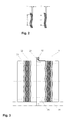
- Fig. 1 is a Schuetzlsch spaenfitting 1 for connecting plastic piping components shown in a longitudinal section.
- the Schuchtlsch spaenfitting 1 includes a sleeve 2 which is made of a thermoplastic, weldable plastic.
- a respective pipe section 14 is inserted in each case on both sides, in order subsequently to weld the pipe sections 14 tightly with the electrofusion fitting 1.
- the longitudinal axes of the two assembled pipe sections 14 and the longitudinal axis of the Schuchtlschweissfittings 1 are aligned with each other.
- the electrofusion fitting 1 is divided into different annular zones along the longitudinal axis.
- the cold zone 6 is arranged on the one outer side of the electrofusion fitting 1, which is followed by the welding zone 7 in which the heating wire of the corrugated winding 3 'extends.
- the cold zone 8 In the middle of the fitting 1 is the cold zone 8 between the two windings 3, 3 ' is arranged. What follows the welding zone 9 and then a final cold zone 10.
- Such a division into the different zones causes an optimal pressure distribution of the electrofusion fitting 1 during the welding process on the pipes.
- the volume of the melting plastic of the sleeve 2 and the pipe in the region of the welding zones 7, 9 and flows into the region of the cold zones 6, 8 10 where he then solidifies and thereby dams the flowing plastic and so on Pressure increase caused in the welding zone 7, 9.
- the inserted pipe section 14 can be pushed together against each other to the middle of the Schuchtlschweissfitting 1. It is also possible in the middle of the Schuchtlschweissfittings 1 nubs provide that serves as a stop 23 for the pipe sections 14. This ensures that both pipe sections 14 have been inserted sufficiently deep into the electrofusion fitting 1.
- the sleeve 2 has on the outer circumference in each case at both ends of a slope 5 for reducing the outer diameter, whereby the elasticity increases and the insertion of the corresponding pipeline is simplified.
- Phases 4 are provided at each of the two ports for easy insertion of the pipe sections 14.
- the heating wires are wound at a short distance from the inner diameter of the sleeve 2 in wavy or wavy lines 3, 3 '.
- a cycle 11 11 'of the undulating wire of the in Fig. 2 is repeatedly shown periodically along the spiral heating wire 3 3 '.
- the slope of the heating wire is arbitrary, can be both constant and variable that, for example, during a winding, the slope is low first and then increases and decreases towards the end again.
- the deflection 13, 13 'and the amplitude of the winding is also arbitrary and is usually adapted to the application and the diameter, with a maximum value of 10 mm should not be exceeded.
- the number of cycles 11, 11 'of the undulating winding per turn is in most cases between six and twelve cycles 11, 11', depending on the diameter of the electrofusion fitting 1 and the diameter of the pipe section 14, respectively.
- a further advantage with this type of heating wire winding 3, 3 ' is that the longitudinal extent of the heating wire is distributed over the individual cycles 11, 11' and not as in straight wound windings, the longitudinal expansion accumulates at the point at which there is the least resistance , whereby the entire elongation of the wire concentrates on a point and thereby passes through the heating wire through the outer layer of the inner diameter of the sleeve 2, whereby an undesirable wire exit comes about. Due to the wave-shaped arrangement, the elongation distributed to the individual cycles 11, 11 'and thereby the heating wire at no Place so strong that it emerges from the plastic.
- the wave-shaped, preferably sinusoidal heating wire winding 3, 3 ' can be produced both with rounding so steadily 3' as well as with a square, zigzag so unsteady 3 laid heating wire.
- the heating wire winding 3, 3 ' is connected to an electrical voltage via the contacts 12.
- Fig. 3 shows Schudrahtwicklungen 21 which are located on an outer diameter of a nipple 20.
- the pipe section 22 is pushed onto the nipple 20 and then welded.
- the outer diameter of the nipple 20 is thus pressed against the inner diameter of the pipe sections 22, which is an optimal prerequisite for the heat transfer.
- nipples can be produced in embodiments in which more than two pipe sections can be connected, such as Y-shaped or T-shaped nipple. Furthermore, connections at angles are also conceivable here, for. B. 45 °, 60 °, 120 °, etc., as well as different pipe diameters are adaptable to the same nipple, in which the individual outlets of the nipple have different diameters.
Landscapes
- Engineering & Computer Science (AREA)
- Mechanical Engineering (AREA)
- General Engineering & Computer Science (AREA)
- Lining Or Joining Of Plastics Or The Like (AREA)
- Branch Pipes, Bends, And The Like (AREA)
Priority Applications (2)
| Application Number | Priority Date | Filing Date | Title |
|---|---|---|---|
| EP10189916A EP2450176A1 (fr) | 2010-11-04 | 2010-11-04 | Raccord de soudage à filament chauffant |
| US13/289,198 US20120111503A1 (en) | 2010-11-04 | 2011-11-04 | Heating coil welding fitting |
Applications Claiming Priority (1)
| Application Number | Priority Date | Filing Date | Title |
|---|---|---|---|
| EP10189916A EP2450176A1 (fr) | 2010-11-04 | 2010-11-04 | Raccord de soudage à filament chauffant |
Publications (1)
| Publication Number | Publication Date |
|---|---|
| EP2450176A1 true EP2450176A1 (fr) | 2012-05-09 |
Family
ID=43920737
Family Applications (1)
| Application Number | Title | Priority Date | Filing Date |
|---|---|---|---|
| EP10189916A Withdrawn EP2450176A1 (fr) | 2010-11-04 | 2010-11-04 | Raccord de soudage à filament chauffant |
Country Status (2)
| Country | Link |
|---|---|
| US (1) | US20120111503A1 (fr) |
| EP (1) | EP2450176A1 (fr) |
Citations (11)
| Publication number | Priority date | Publication date | Assignee | Title |
|---|---|---|---|---|
| CH423382A (fr) * | 1965-04-21 | 1966-10-31 | Rothenbach Ernest | Procédé d'assemblage bout à bout et de jonction de deux organes cylindriques présentant des sections pratiquement égales, élément de jonction pour la mise en oeuvre de ce procédé et assemblage obtenu au moyen de ce dernier |
| DE8427320U1 (de) * | 1984-12-13 | kabelmetal electro GmbH, 3000 Hannover | Muffe in einer Durchgangs- bzw. Abzweigungsverbindung für wärmeisolierte Leitungsrohre | |
| EP0190810A1 (fr) * | 1985-02-08 | 1986-08-13 | Dürotan Rör A/S | Méthode de jonction des extrémités de tubes plastiques et manchon de raccordement s'y rapportant |
| DE8910407U1 (de) * | 1989-08-31 | 1989-11-16 | Kunststoffwerk Höhn GmbH, 5439 Höhn | Rohrstück und zugehörender Elektroschweißfitting |
| US5500510A (en) * | 1994-11-02 | 1996-03-19 | Toua Kokyu Tugitevarubu Seizo Co. | Method of automatically controlling the fusion process between thermoplastic articles |
| DE4332196C2 (de) | 1993-09-22 | 1996-09-19 | Fischer Georg Rohrleitung | Schweißmuffe aus thermoplastischem Material |
| JPH11294673A (ja) | 1998-04-10 | 1999-10-29 | Mitsui Chem Inc | エレクトロフュージョン継手 |
| EP1087171A1 (fr) * | 1999-08-27 | 2001-03-28 | Star Pipe, AS Dansk Rorindustri | Manchon d'électrosoudage et procédé pour sa fabrication |
| JP2004211846A (ja) * | 2003-01-07 | 2004-07-29 | Dainippon Plastics Co Ltd | 管接続構造体、管接続構造体セット及びそれを用いた管接続方法 |
| JP2007100952A (ja) * | 2005-09-08 | 2007-04-19 | Dainippon Plastics Co Ltd | 熱可塑性樹脂製管の接続方法、接続用管セットおよび接続用管 |
| US20070145736A1 (en) * | 2001-03-12 | 2007-06-28 | Karl-Heinz Krah Gmbh | Electrofusion socket forming system |
Family Cites Families (5)
| Publication number | Priority date | Publication date | Assignee | Title |
|---|---|---|---|---|
| US2813960A (en) * | 1952-01-25 | 1957-11-19 | Bethge Walther | Electric surface heater |
| NL8400816A (nl) * | 1984-03-14 | 1985-10-01 | Wavin Bv | Werkwijze voor het vervaardigen van buismoffen en -fittings, alsmede inrichting voor het uitvoeren van deze werkwijze en buismof of -fitting vervaardigd volgens deze werkwijze. |
| US4684789A (en) * | 1986-04-17 | 1987-08-04 | Central Plastics Company | Thermoplastic fitting electric welding method and apparatus |
| US4947012A (en) * | 1989-05-19 | 1990-08-07 | Minnesota Mining And Manufacturing Company | Electrofusion marker |
| DE102007014049B3 (de) * | 2007-03-21 | 2008-12-04 | Friatec Ag | Ausgleichselement zum Verbinden von Bauteilen |
-
2010
- 2010-11-04 EP EP10189916A patent/EP2450176A1/fr not_active Withdrawn
-
2011
- 2011-11-04 US US13/289,198 patent/US20120111503A1/en not_active Abandoned
Patent Citations (11)
| Publication number | Priority date | Publication date | Assignee | Title |
|---|---|---|---|---|
| DE8427320U1 (de) * | 1984-12-13 | kabelmetal electro GmbH, 3000 Hannover | Muffe in einer Durchgangs- bzw. Abzweigungsverbindung für wärmeisolierte Leitungsrohre | |
| CH423382A (fr) * | 1965-04-21 | 1966-10-31 | Rothenbach Ernest | Procédé d'assemblage bout à bout et de jonction de deux organes cylindriques présentant des sections pratiquement égales, élément de jonction pour la mise en oeuvre de ce procédé et assemblage obtenu au moyen de ce dernier |
| EP0190810A1 (fr) * | 1985-02-08 | 1986-08-13 | Dürotan Rör A/S | Méthode de jonction des extrémités de tubes plastiques et manchon de raccordement s'y rapportant |
| DE8910407U1 (de) * | 1989-08-31 | 1989-11-16 | Kunststoffwerk Höhn GmbH, 5439 Höhn | Rohrstück und zugehörender Elektroschweißfitting |
| DE4332196C2 (de) | 1993-09-22 | 1996-09-19 | Fischer Georg Rohrleitung | Schweißmuffe aus thermoplastischem Material |
| US5500510A (en) * | 1994-11-02 | 1996-03-19 | Toua Kokyu Tugitevarubu Seizo Co. | Method of automatically controlling the fusion process between thermoplastic articles |
| JPH11294673A (ja) | 1998-04-10 | 1999-10-29 | Mitsui Chem Inc | エレクトロフュージョン継手 |
| EP1087171A1 (fr) * | 1999-08-27 | 2001-03-28 | Star Pipe, AS Dansk Rorindustri | Manchon d'électrosoudage et procédé pour sa fabrication |
| US20070145736A1 (en) * | 2001-03-12 | 2007-06-28 | Karl-Heinz Krah Gmbh | Electrofusion socket forming system |
| JP2004211846A (ja) * | 2003-01-07 | 2004-07-29 | Dainippon Plastics Co Ltd | 管接続構造体、管接続構造体セット及びそれを用いた管接続方法 |
| JP2007100952A (ja) * | 2005-09-08 | 2007-04-19 | Dainippon Plastics Co Ltd | 熱可塑性樹脂製管の接続方法、接続用管セットおよび接続用管 |
Non-Patent Citations (1)
| Title |
|---|
| OHIM OFFICE FOR HARMONIZATION IN THE INTERNAL MARKET: "Gemeinschaftgeschmacksmuster 000926357-0007", BLATT FÜR GEMEINSCHAFTSGESCHMACKSMUSTER 2008/111, 2 June 2008 (2008-06-02), pages 114 - 115, XP002636018, Retrieved from the Internet <URL:ftp://ftp.oami.europa.eu/bulletin/rcd/2008/2008_111.pdf> [retrieved on 20110509] * |
Also Published As
| Publication number | Publication date |
|---|---|
| US20120111503A1 (en) | 2012-05-10 |
Similar Documents
| Publication | Publication Date | Title |
|---|---|---|
| EP2527703B1 (fr) | Conduite de fluide | |
| EP2132024B1 (fr) | Élément compensateur pour relier des éléments de construction | |
| CH623128A5 (fr) | ||
| EP3158250B1 (fr) | Conduite de fluide | |
| AT406505B (de) | Verteileranordnung | |
| EP2443984B1 (fr) | Echangeur thermique coaxial pour un appareil ménager | |
| EP3056847B1 (fr) | Dispositif et procede destines a la thermoregulation d'un corps | |
| DE102010031520A1 (de) | Elektrischer Heizkörper und Durchlauferhitzer | |
| DE3132602C2 (fr) | ||
| DE102011007542B4 (de) | Durchlauferhitzer | |
| EP0819892B1 (fr) | Echangeur de chaleur pour la production d'eau sanitaire | |
| DE19543083C2 (de) | Verfahren zum Verbinden aus schweißfähigem Kunststoff bestehender Wellrohre | |
| DE102009048578B4 (de) | Verbindungselement zum Verschweißen von Kunststoffrohren | |
| EP1108190B1 (fr) | Tube ou systeme tubulaire pour collecteurs de canalisations, de circuits de chauffage et de chaudieres | |
| EP2450176A1 (fr) | Raccord de soudage à filament chauffant | |
| DE102013108881B4 (de) | Muffenverbindung | |
| DE202014003776U1 (de) | Kunststoffrohr | |
| DE69510770T2 (de) | Rohrverbindung und Verfahren zur seiner Herstellung | |
| EP0780620A1 (fr) | Tuyau ou pièce similaire, avec embout électrique, procédé pour la fabrication de l'embout électrique et procédé pour le raccordement de deux tels tuyaux ou pièces similaires | |
| EP0793792B1 (fr) | Evaporateur pour appareil frigorifique a compression / canal capillaire | |
| WO2011057594A1 (fr) | Échangeur thermique à tubes concentriques | |
| EP3575662A1 (fr) | Bande de soudage électrique | |
| EP2287540A2 (fr) | Dispositif de chauffage de liquide | |
| DE202006016308U1 (de) | Vorrichtung zur Entnahme von Wärme | |
| DE102012110150B4 (de) | Durchlauferhitzer |
Legal Events
| Date | Code | Title | Description |
|---|---|---|---|
| PUAI | Public reference made under article 153(3) epc to a published international application that has entered the european phase |
Free format text: ORIGINAL CODE: 0009012 |
|
| AK | Designated contracting states |
Kind code of ref document: A1 Designated state(s): AL AT BE BG CH CY CZ DE DK EE ES FI FR GB GR HR HU IE IS IT LI LT LU LV MC MK MT NL NO PL PT RO RS SE SI SK SM TR |
|
| AX | Request for extension of the european patent |
Extension state: BA ME |
|
| 17P | Request for examination filed |
Effective date: 20121023 |
|
| 17Q | First examination report despatched |
Effective date: 20130125 |
|
| STAA | Information on the status of an ep patent application or granted ep patent |
Free format text: STATUS: THE APPLICATION IS DEEMED TO BE WITHDRAWN |
|
| 18D | Application deemed to be withdrawn |
Effective date: 20130605 |