EP2454311B1 - Procédé et dispositif pour fabriquer une matière polymère partiellement cristalline - Google Patents
Procédé et dispositif pour fabriquer une matière polymère partiellement cristalline Download PDFInfo
- Publication number
- EP2454311B1 EP2454311B1 EP10803436.4A EP10803436A EP2454311B1 EP 2454311 B1 EP2454311 B1 EP 2454311B1 EP 10803436 A EP10803436 A EP 10803436A EP 2454311 B1 EP2454311 B1 EP 2454311B1
- Authority
- EP
- European Patent Office
- Prior art keywords
- polymeric material
- crystallization reactor
- crystallization
- partially crystalline
- crystalline polymeric
- Prior art date
- Legal status (The legal status is an assumption and is not a legal conclusion. Google has not performed a legal analysis and makes no representation as to the accuracy of the status listed.)
- Active
Links
Images


Classifications
-
- B—PERFORMING OPERATIONS; TRANSPORTING
- B01—PHYSICAL OR CHEMICAL PROCESSES OR APPARATUS IN GENERAL
- B01J—CHEMICAL OR PHYSICAL PROCESSES, e.g. CATALYSIS OR COLLOID CHEMISTRY; THEIR RELEVANT APPARATUS
- B01J8/00—Chemical or physical processes in general, conducted in the presence of fluids and solid particles; Apparatus for such processes
- B01J8/0015—Feeding of the particles in the reactor; Evacuation of the particles out of the reactor
- B01J8/003—Feeding of the particles in the reactor; Evacuation of the particles out of the reactor in a downward flow
-
- B—PERFORMING OPERATIONS; TRANSPORTING
- B29—WORKING OF PLASTICS; WORKING OF SUBSTANCES IN A PLASTIC STATE IN GENERAL
- B29B—PREPARATION OR PRETREATMENT OF THE MATERIAL TO BE SHAPED; MAKING GRANULES OR PREFORMS; RECOVERY OF PLASTICS OR OTHER CONSTITUENTS OF WASTE MATERIAL CONTAINING PLASTICS
- B29B9/00—Making granules
- B29B9/16—Auxiliary treatment of granules
-
- C—CHEMISTRY; METALLURGY
- C08—ORGANIC MACROMOLECULAR COMPOUNDS; THEIR PREPARATION OR CHEMICAL WORKING-UP; COMPOSITIONS BASED THEREON
- C08G—MACROMOLECULAR COMPOUNDS OBTAINED OTHERWISE THAN BY REACTIONS ONLY INVOLVING UNSATURATED CARBON-TO-CARBON BONDS
- C08G63/00—Macromolecular compounds obtained by reactions forming a carboxylic ester link in the main chain of the macromolecule
- C08G63/88—Post-polymerisation treatment
-
- B—PERFORMING OPERATIONS; TRANSPORTING
- B01—PHYSICAL OR CHEMICAL PROCESSES OR APPARATUS IN GENERAL
- B01J—CHEMICAL OR PHYSICAL PROCESSES, e.g. CATALYSIS OR COLLOID CHEMISTRY; THEIR RELEVANT APPARATUS
- B01J2208/00—Processes carried out in the presence of solid particles; Reactors therefor
- B01J2208/00743—Feeding or discharging of solids
- B01J2208/00752—Feeding
-
- B—PERFORMING OPERATIONS; TRANSPORTING
- B01—PHYSICAL OR CHEMICAL PROCESSES OR APPARATUS IN GENERAL
- B01J—CHEMICAL OR PHYSICAL PROCESSES, e.g. CATALYSIS OR COLLOID CHEMISTRY; THEIR RELEVANT APPARATUS
- B01J2219/00—Chemical, physical or physico-chemical processes in general; Their relevant apparatus
- B01J2219/00274—Sequential or parallel reactions; Apparatus and devices for combinatorial chemistry or for making arrays; Chemical library technology
- B01J2219/00277—Apparatus
- B01J2219/00351—Means for dispensing and evacuation of reagents
- B01J2219/00421—Means for dispensing and evacuation of reagents using centrifugation
-
- B—PERFORMING OPERATIONS; TRANSPORTING
- B29—WORKING OF PLASTICS; WORKING OF SUBSTANCES IN A PLASTIC STATE IN GENERAL
- B29B—PREPARATION OR PRETREATMENT OF THE MATERIAL TO BE SHAPED; MAKING GRANULES OR PREFORMS; RECOVERY OF PLASTICS OR OTHER CONSTITUENTS OF WASTE MATERIAL CONTAINING PLASTICS
- B29B9/00—Making granules
- B29B9/16—Auxiliary treatment of granules
- B29B2009/165—Crystallizing granules
-
- Y—GENERAL TAGGING OF NEW TECHNOLOGICAL DEVELOPMENTS; GENERAL TAGGING OF CROSS-SECTIONAL TECHNOLOGIES SPANNING OVER SEVERAL SECTIONS OF THE IPC; TECHNICAL SUBJECTS COVERED BY FORMER USPC CROSS-REFERENCE ART COLLECTIONS [XRACs] AND DIGESTS
- Y10—TECHNICAL SUBJECTS COVERED BY FORMER USPC
- Y10T—TECHNICAL SUBJECTS COVERED BY FORMER US CLASSIFICATION
- Y10T117/00—Single-crystal, oriented-crystal, and epitaxy growth processes; non-coating apparatus therefor
- Y10T117/10—Apparatus
-
- Y—GENERAL TAGGING OF NEW TECHNOLOGICAL DEVELOPMENTS; GENERAL TAGGING OF CROSS-SECTIONAL TECHNOLOGIES SPANNING OVER SEVERAL SECTIONS OF THE IPC; TECHNICAL SUBJECTS COVERED BY FORMER USPC CROSS-REFERENCE ART COLLECTIONS [XRACs] AND DIGESTS
- Y10—TECHNICAL SUBJECTS COVERED BY FORMER USPC
- Y10T—TECHNICAL SUBJECTS COVERED BY FORMER US CLASSIFICATION
- Y10T117/00—Single-crystal, oriented-crystal, and epitaxy growth processes; non-coating apparatus therefor
- Y10T117/10—Apparatus
- Y10T117/1004—Apparatus with means for measuring, testing, or sensing
Definitions
- the invention relates to a method for producing semicrystalline polymer material according to the preamble of claim 1 and to an apparatus for carrying out the method according to the preamble of claim 6.
- Processes for the crystallization of polymers are known in numerous variants and are primarily used to facilitate the storage, transport, treatment or further processing of the polymers and to influence the properties of these polymers.
- the crystallization depends on various parameters, such as the temperature during crystallization, the molecular weight of the polymer, the type of polymer, but also on the moisture, solvents, pressure or any fillers in the polymer.
- the crystallization or the degree of crystallization has a significant influence on the optical, mechanical, thermal and chemical properties of the polymer.
- thermoplastic polymers for example polyethylene terephthalate (PET)
- PET polyethylene terephthalate
- the JP 2007 023153 A describes a process for crystallizing polyesters in which a small amount of crystallized polyester granules is added to the amorphous polyester.
- Raw granules to mix a certain proportion of already partially crystalline granules to obtain the flowability of the particles in the crystallization reactor This is achieved in that the non-sticky semi-crystalline granules slide between the amorphous granules and overall the granules remain particulate even at higher temperatures and do not stick together.
- the backmixing of the semicrystalline material to the amorphous raw granules is a rather critical process, as in the backmixing directly into the crystallization reactor - as is currently common practice in the art - no adequate mixing is ensured and can be achieved and it at least in some areas of the reactor comes to sticky esters of amorphous granules.
- the object is achieved by the characterizing features of claim 1. It is envisaged that the diverted semi-crystalline polymer material is combined and mixed prior to its back-mixing in the crystallization reactor with the prone to bond untreated and predominantly amorphous raw polymer material and only then the mixture is introduced into the crystallization reactor.
- This procedure has the advantage that intensive mixing can take place even before the crystallization reactor and possible sticking is already prevented at a stage in front of the crystallization reactor. A formation of sticky esters in the crystallization reactor is thereby precluded, since a mixture which does not tend to adhere already enters the crystallization reactor. In this way, the preservation of the flowability is permanently guaranteed and the crystallization can be conducted effectively and homogeneously.
- the object is achieved in that the transfer line opens into the addition port.
- the feed port opens into the crystallization vessel above the material level.
- the transfer line connects to the crystallization vessel in an area below the material level.
- amorphous raw granules is to be understood not only exclusively or 100% amorphous granules without any fraction of crystallization, but a granulate that would classify a person skilled in the art as predominantly amorphous or too amorphous to meet the desired requirements.
- the combining and mixing of the branched semicrystalline polymer material to the raw polymer material takes place in a region outside the crystallization reactor, in particular in a feed nozzle. In this way, an effective mixing is achieved and the risk of sticking effectively reduced.
- the semicrystalline polymer material discharged from the crystallization reactor in particular via a vertical screw conveyor, is brought to a height above the crystallization reactor and the branched semi-crystalline polymer material then slides under gravity, in particular via a material chute, to the feed zone for its backmixing ,
- the potential energy of the granules can be easily converted by the action of gravity into kinetic energy and receives the granules in a simple manner, a certain flow rate, which is subsequently advantageous for the good mixing.
- the heating of the polymer takes place in the crystallization reactor without the supply of external heating energy or without additional heating means.
- the heat required for a successful and rapid crystallization advantageously comes exclusively from the internal energy of the granules and / or arises during the exothermic crystallization.
- the transfer line comprises, in particular directly connected to the crystallization reactor, conveying means, preferably a vertical screw conveyor, with which the emerging from the crystallization reactor semi-crystalline polymer material can be conveyed to a height above the crystallization reactor.
- conveying means preferably a vertical screw conveyor
- the transfer section it is advantageous for the transfer section to comprise a material chute, preferably designed as a tube, which, starting from an upper region of the conveying means, opens obliquely into the feed neck, wherein the material chute preferably has an average inclination angle ⁇ to the horizontal between 15 ° and 50 °, in particular between 20 ° and 30 °.
- the Wegzumischende material from a certain height level under the action of gravity slip down and be mixed without additional funding at an increased speed to the crude polymer.
- the mentioned inclination angle ⁇ is advantageous for the material chute.
- the addition nozzle is arranged in an upper edge region of the crystallization reactor and / or, in particular at an angle ⁇ between 25 ° and 60 °, in particular 30 ° to 40 ° to the horizontal, inclined downwards, whereby the polymer material slip into the crystallization reactor can, get that, too predominantly amorphous raw granules a certain speed and slips into the crystallization reactor.
- the material chute has a, close to the conveyor, upper portion and a, the addition nozzle near bottom end portion or buckling portion, wherein the buckling portion is set to the addition of connecting piece at an angle or bent downwards, the angle ⁇ between the upper portion of the material chute and the kink portion, in particular between 60 ° and 140 °, preferably between 90 ° and 100 °.
- the buckling section acts like a baffle plate. The semicrystalline polymers encounter with increased speed on the opposite wall of the kinked portion and are thereby vortexed. In this way, there is a better distribution and a variation of the directions of movement and velocities of the individual particles and it is a stratification of the two material streams avoided in the feed neck.
- the central axis of the connecting piece with the central axis of the kink portion an acute angle ⁇ preferably between 20 ° and 55 °, in particular 30 ° to 40 °.
- the material flows thus meet one another under substantially similarly aligned directional vectors, although nevertheless no stratification takes place in the connecting piece.
- the center axis of the kink portion is aligned almost vertically, in particular at an angle ⁇ to the vertical between 0 ° and 45 °, in particular between 15 ° and 25 °.
- the rebounding granules fall in this way almost in free fall down into the feed neck.
- center axis of the kink portion and the center axis of the addition nozzle define a plane which divides the crystallization reactor into two substantially equal subspaces, and the conveying means or the central axis of the vertical screw conveyor lies in this plane.
- the upper section of the material chute is aligned with the plane at an angle ⁇ , in particular between 10 ° and 30 °, and / or the conveying means or the center axis of the vertical conveyor screw lies outside the plane. Due to the space-saving eccentric arrangement of the vertical conveyor and the view of the material chute folded from above, a further impulse can be given to the particles to be remixed.
- the width of the material slide increases in front of the buckling section and optionally changes its cross-sectional shape.
- a good mixing and a uniform introduction of the already mixed granules advantageously provides that widens the addition port in its near the end of the crystallization reactor fan-shaped. As a result, the granules are better distributed in the crystallization reactor.
- a number of straight recessed grooves is formed in the lower sliding surface of the addition nozzle.
- the raw polymer material which enters via the feed opening and also the partially crystalline material which is coming from above thus slip in these grooves and are thus distributed uniformly over the entire width of the feed neck, whereby thorough mixing takes place and a wider and relatively thinner and correspondingly easily homogeneous. and mixable material flow passes into the crystallization reactor.
- the heights or depths and / or the widths of the channels increase downstream or in the flow direction, whereby an additional homogenization and homogenization of the material takes place.
- a further discharge opening is provided for dispensing, -penali the discharge is deeper than or at the same level as the opening to which the material chute is connected, is located.
- a control device with which that portion of the semi-crystalline polymer material which is branched into the material chute and / or that portion of the semi-crystalline polymer material which is discharged via the discharge opening, is adjustable. This can be done easily and effectively control the backmixing.
- the semi-crystalline material can also be branched off directly from the crystallization reactor by means of a separate draw-off.
- a container for collecting and storing and / or a container for further processing of the semicrystalline polymer material for example a SSP container
- the connection is advantageously made via a screw conveyor, with which the amount of semi-crystalline granules to be discharged can be controlled.
- a centrifuge for the deposition of surface moisture and any fines is arranged before the crystallization reactor or before the feed nozzle, with which the raw polymer material is introduced at an increased speed, preferably tangentially into the feed nozzle.
- the amorphous raw granules entering the feed port thus retain the velocity pulse assigned to them in the centrifuge. This is subsequently used for the admixture and the good mixing.
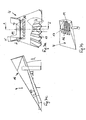
- Fig. 1 an exemplary, particularly advantageous embodiment of the device according to the invention is shown in side view.
- a crystallization reactor 1 which is designed in the usual manner in the form of a cylindrical container with a horizontal bottom and vertical side walls.
- a mixing and stirring unit 2 Inside the crystallization reactor 1 is a mixing and stirring unit 2. In the present case, this is arranged on two superposed planes.
- the mixing and stirring device 2 comprises rotating vanes or rods, which respectively rotate in a horizontal and ground-parallel plane and are arranged on a common vertical drive rod. They serve to permanently move the polymer material present in the crystallization reactor 1, to mix them and to keep them in a flowable, lumpy form.
- the crystallization reactor 1 optionally has means for heating and / or cooling the polymer material.
- the heating can be done from the outside via a jacket heating or from the inside via heated mixing and stirring 2. Essentially, however, the granules still have sufficient internal energy and heat, so that no additional heating is necessary. In addition, the crystallization process is exothermic, which may even require cooling to avoid partial melting of the granules.
- the temperature of the granules must be kept permanently above the glass transition temperature and below the melting point for effective crystallization.
- the optimum crystallization rate is at a temperature of about 174 ° C.
- a feed port 4 is arranged, via which the material is introduced into the crystallization reactor 1.
- the feed port 4 is in operation above the material level of the moving particles.
- the access port 4 is inclined at an angle ⁇ of about 30 to 40 ° obliquely downwards, whereby the polymer material can slide independently into the crystallization reactor 1.
- the feed 4 Before the feed 4 is a centrifuge 12.
- the centrifuge 12 the freshly formed raw granules for the deposition of its surface moisture and possibly fine fraction is treated.
- the raw polymer material is fed into the centrifuge 12 at the bottom and the particles are swirled upwards, receiving some momentum and velocities.
- the feed opening 14 Via the feed opening 14, which connects the uppermost region of the centrifuge 12 with the beginning of the feed neck, the still amorphous Rohpolymerteilchen be fed into the feed port 4.
- a discharge opening 15 is provided at the level of the lower mixing and stirring tool 2, from which the treated and now partially crystalline polymer material from the crystallization reactor 1 can be discharged.
- the discharge opening 15 is in operation below the material level of the moving particles.
- the beginning of a transfer section 3, 5 is connected, via which a part of the semi-crystalline polymer material in the crystallization reactor 1 is traceable.
- the transfer section 3, 5 comprises a directly connected to the crystallization reactor 1 conveyor 3 in the form of a vertical screw conveyor 3.
- This vertical screw conveyor 3 rotates at a rotational speed of about 100 to 150 revolutions per minute and promotes even in partially fed state emerging from the crystallization reactor 1 semi-crystalline polymer material to a height level above the crystallization reactor 1, in this case in about twice the height of the height of the crystallization reactor. 1
- an opening 11 is formed, through which the material is introduced into a tubular closed material chute 5.
- the material chute 5 is inclined at an average inclination angle ⁇ measured to the horizontal of about 30 ° to 40 °.
- the material slide 5 does not open straight, but with the formation of a certain angle in the feed port 4 a. In this way, a back-mixing circuit is formed, via which the semi-crystalline, non-sticky granules are added to the sticky amorphous raw granules.
- the material chute 5 has an upper section 8 near the conveying means 3 and a lower bending section 7 approaching the feed connection 4.
- the buckling section 7 is set to the supply port 4 towards angled and bent downwards, in the present case at an angle ⁇ of about 95 °.
- the buckling section 7 or the center axis of the buckling section 7 is aligned relatively vertically or vertically, in the present case at an angle ⁇ of about 15 to 20 ° to the solder.
- the buckling portion 7 and the connecting piece 4 are aligned at an acute angle ⁇ to each other and include their central axes an angle of about 35 °.
- the two streams of material thus meet each other at increased speeds at this acute angle and mix.
- Fig. 4 the device according to the invention is shown from above. It can be seen that the center axes of the kink portion 7 and the addition stub 4 define or span a plane 9.
- This vertically oriented plane 9 divides the crystallization reactor 1 substantially into two equal subspaces.
- the vertical conveyor screw 3 is not in this plane 9.
- the upper portion 8 of the material slide 5 is aligned at an angle ⁇ of about 20 ° to the plane 9.
- the vertical screw conveyor 3 is also arranged in the plane 9 or is the vertical longitudinal axis of the vertical screw conveyor 3 in this plane. 9
- Fig. 2 and Fig. 3 it can be seen that the width of the material chute 5 widens downward. In the area directly in front of the buckling section 7 widens the material slide 5 conically at substantially constant height. In addition, the cross-sectional shape of the material slide 5 changes from approximately circular to rectangular just before the beginning of the buckling section 7.
- Fig. 6a and 6b the region of a possible embodiment of the connecting piece 4 is shown in detail view, namely in an overall view and in a lateral sectional view. Visible is the end region of the material slide 5, in which the cross section changes to a rectangular shape. Connected thereto in flow connection through the angle ⁇ , the buckling portion 7 with its effect as a baffle plate 18. Subsequently, the buckling section 7 opens downstream from above via the recess 16 and at an acute angle in the central region of the oblique addition nozzle 4.
- the addition port 4 is wider down to conical.
- Fig. 7a, b and c is a possible embodiment of the feed neck 4 shown in detail.
- Fig. 7a shows a view from the front, with parts of the top cover have been removed for clarity.
- Fig. 7b shows an overall view.
- Fig. 7c shows a view from the side in which the oblique inclination of the connecting piece 4 at the angle ⁇ , in the present case about 20 °, can be seen.
- the feed port 4 widens down to fan-shaped and has a number of straight grooves 17 on its lower slip surface. These grooves 17 extend in the direction of flow from the centrifuge 12 to the crystallization container 1.
- the central groove 17 is aligned parallel to the plane 9, the left and right adjoining grooves 17 fan-shaped outwardly inclined, whereby the upper edges between the grooves 17 are not aligned parallel to each other are, but diverge slightly.
- Each groove 17 has a triangular cross-section and has two flank surfaces which are angled towards each other and thus form the recessed groove 17 in which the material can slip.
- the two flank surfaces are employed in the present embodiment at an angle of approximately 90 ° to each other.
- each groove 17 increases downwardly to continuously close to 170 to 180% of the height or depth at the upper end of each groove 17.
- the width of each groove 17 increases in the same extent.
- Each groove 17 is therefore straight, inclined downwards and their height or depth and their width increase towards the bottom.
- the raw polymer material which enters via the feed opening 14 and also the semi-crystalline material coming from above thus slip into these grooves 17 and are thus distributed uniformly over the entire width of the feed nozzle 4, whereby thorough mixing takes place and a broad stream of material passes into the crystallization reactor 1 ,
- a further discharge opening 10 is provided, via which the semicrystalline polymer leaves the backmixing circuit.
- This discharge opening 10 is lower or maximum at the same height as the opening 11, in the present case on the opposite side of the opening 11.
- Connected thereto is a non-compressing screw conveyor 13 with increasing inclination.
- This screw conveyor 13 is controllable and thus the proportion of discharged polymer can be accurately sized, which also allows the degree of backmixing or the backmixing ratio can be precisely adjusted.
- the semi-crystalline material can also be branched off directly from the reactor 1 and discharged from the cycle.
- a container 6 connects to the storage and / or further treatment of the polymer material.
- Such containers are known from the prior art, only by way of example can this container 6 be an octabin or an SSP reactor.
- the process is initiated by - not shown here - a polymer melt conveyed by an extruder via a granulator in a known manner first formed into strands and then crushed into granules. Subsequently, the granules are dried in the centrifuge 12 and freed of dust or fines and then pass through the addition of opening 14 in the region of the addition nozzle 4.
- the granules are still hot or possibly even melted in their interior. They still have enough heat of their own to effectively support and facilitate the drying of the residual moisture and the subsequent crystallization without the need for additional heating. On the other hand, they are cold enough not to deform or maintain their shape. In any case, these still predominantly amorphous, warm raw granules are very sensitive to sticking and tend, especially when they are motionless together, to cake together to form a cake, which makes the processing difficult and should be prevented.
- the predominantly amorphous and hot raw granules to be treated are now introduced from the centrifuge 12 into the feed port 4 at a certain speed and subsequently slip through the oblique inclination of the feed port 4 into the crystallization reactor 1. There they remain for a certain amount adjustable residence time in conditions where the crystallization rate is greatest, and are kept lumpy with constant movement. They anneal and there is at least partially a formation of semi-crystalline areas and the degree of crystallinity increases.
- the now semi-crystalline polymer materials are discharged through the opening 15 in the lower region of the crystallization reactor 1 and reach the vertical screw conveyor 3. From this they are conveyed upwards to a height of about twice the height of the crystallization reactor 1.
- the discharge 10th to the container 6 is still closed, so that at the beginning of the entire semi-crystalline granules is mixed back.
- the semicrystalline granules passes through the opening 11 in the material chute 5 and slips along them under the action of gravity. It receives a certain speed and also a certain momentum and then bounces in the bending area 7 on the baffle plate or the baffle 18. As a result, the granules are braked, jumbled and the granules collide against each other and against the walls and get different directions and relative velocities. The good distribution is achieved by slowing down the granules.
- the mixing of the two streams of material takes place. On the one hand flows in the feed port 4, the predominantly amorphous raw granules. On the other hand, falls down from above the bouncing region 7 rebounding semi-crystalline granules. In this way, the two material streams mix in a region of the feed nozzle 4 even before the crystallization reactor 1.
- the structural design and the geometry of the feed nozzle 4 results in a good mixing and no stratification of the material flows.
- the semi-crystalline polymer particles which do not tend to bond in this way are homogeneously and statistically well distributed between the adhesive amorphous particles and, overall, an intensive homogeneous mixing is produced, which is introduced into the crystallization reactor 1 via the fan-shaped widening of the addition nozzle 4 and there without closing stick, can be moved by the mixing and stirring elements 2.
- the present process is carried out continuously and, after a certain equilibrium has been established in the process, gradually Discharge opening 10 is opened and reduces the backmixing ratio. Less semicrystalline material is then diverted and remixed, and a portion of the material is transferred via the non-compressing screw conveyor 13 into the container 6, in this case an octabin.
- any container eg a silo or a SSP container, may also be provided.
- the correct backmixing ratio or the discharge of the finished material from the backmixing circuit is controlled essentially via the rotational speed of the vertical screw conveyor 3 and / or via the rotational speed of the connecting screw 13 to the container 6. It is also conceivable to open or close the openings 11 and 10 via adjustable slides as needed.
- Amorphous PET coming from the dryer or the centrifuge 12 is introduced into the feed port 4 at a temperature of about 130 ° C. with a mass flow of 350 kg / h.
- semi-crystalline PET passes through the material chute 5 with a temperature of about 145 ° C with a mass flow of 850 kg / h in the feed port 4.
- the intensive mixing and then the introduction into the crystallization reactor first
- Suitable polymers for such treatment are crystallizable thermoplastic polymers.
- the polymers are obtained from their monomers by a polymerization reaction such as free radical, anionic or cationic polymerization, polyaddition or polycondensation.
- Particularly suitable are crystallizable thermoplastic polycondensates, such as polyamide, polyester, polycarbonate, polyhydroxyalkanoates, polylactides or copolymers thereof.
- Polyesters are polymers which are usually obtained by polycondensation from their monomers, a diol component and a dicarboxylic acid component.
- Typical examples of the polyesters are polyethylene terephthalate (PET), polybutylene terephthalate (PBT) and polyethylene naphthalate (PEN), which are used either as a homopolymer or as copolymers.
- Suitable polyethylene terephthalates have an intrinsic viscosity in the range of 0.3 to 1 dl / g, measured with 0.5 g of PET in 100 ml of phenol / dichlorobenzene (1: 1).
- the polylactides are polymers which can be obtained directly from dehydration of lactic acid or by ring-opening polymerization from its cyclic dimers (lactides).
- the inventive method and the device have also proved to be advantageous for PLA.
- the polymer may be a virgin material or a recyclate.
- recycled materials recycled polymers from post-industrial or consumer-use collected and reprocessed polymers (post-consumer) are referred to.
- Additives may be added to the polymer.
- Suitable additives include, for example, catalysts, dyes and pigments, UV blockers, processing aids, stabilizers, impact modifiers, chemical and physical blowing agents, fillers, nucleating agents, flame retardants, plasticizers, barrier or mechanical properties enhancing particles, reinforcing bodies such as spheres or fibers, and reactive substances such as oxygen absorbers, acetaldehyde absorbers or molecular weight-increasing substances, etc.
- polymer melt production takes place in apparatuses or reactors known from the prior art.
- polymerization reactors in question in which polymers are prepared in the liquid phase, such as stirred tank, cage reactors or disk reactors, or apparatus in which previously prepared polymers are melted, such as extruder or kneader.
- the polymer melt production can be continuous or batchwise. However, continuous processes are preferred for further processing.
- Undesirable volatiles such as impurities from a recyclate, remaining solvents from the polymer production and monomers, dimers, oligomers or cleavage products from the polymer melt production can be removed via a degassing device, such as thin-film evaporator or extruder, in particular multi-screw extruder, such as twin-screw extruder or ring extruder.
- a degassing device such as thin-film evaporator or extruder, in particular multi-screw extruder, such as twin-screw extruder or ring extruder.
- For processing a polymer melt may include other process steps such as pressure generation, filtration, a temperature control or mixing.
- the particles can be formed from the polymer melt in various ways. Applicable is comminution of chunks, strands or ribbons formed from the polymer melt, or direct forming of particles by, for example, dripping or sputtering. Most granulation methods are used, wherein individual polymer strands are formed from the polymer melt in an outlet device, in particular a nozzle or nozzle plate. For the preparation of granules from the polymer strands known in the art granulation techniques, such as strand granulation, water ring granulation, underwater granulation or top granulation (hot face - granulation), dripping or spraying can be used.
- the polymer strands emerging from the melt channels are solidified and separated into a plurality of individual granules, wherein the separation can take place before or after solidification.
- water in the name of the granulators
- other liquid media may be used.
- the separation into particles takes place for example by an independent drop formation, by the use of a liquid shear medium or by a mechanical separation, in particular cutting. While an independent or forced by a shear medium drop formation takes place at the nozzle exit, cutting can be done both directly at the nozzle outlet or only after passing through a treatment section.
- Solidification of the polymer melt is accomplished by cooling with the aid of one or more cooling fluids, which may be gaseous (eg, air, nitrogen, or CO2) or liquid (eg, water or ethylene glycol) cooling media, or a combination thereof. If a liquid cooling medium is used, this must be subsequently separated from the particles. This can be done for example by suction, by a gas stream, by a baffle dryer or a centrifugal dryer.
- the mean particle size should be between 0.5 mm and 10 mm, preferably between 1.5 mm and 5 mm and in particular between 2 and 3.5 mm.
- the mean particle size is the statistical average of the mean particle diameter, which is the average of particle height, length and width.
- the preferred granulate weight is between 2 and 100 mg, in particular above 5 mg, more preferably above 10 mg and especially below 50 mg, particularly preferably below 30 mg.
- the particles should preferably have a defined granular form, such as, for example, cylindrical, spherical, drop-shaped, spherical or a design form, as described, for example, in US Pat EP 541,674 (Yau ) is proposed.
- Solid particles or porous particles obtained, for example, by sintering, foaming and the like can be used.
- the cooling of the particles can be done as part of particle production or continued after particle production. It can be used the same cooling fluid as in the particle production. But it can also be used other cooling fluids. Alternatively, other cooling devices known in the art may be used.
- the step relevant for the present invention for at least partial crystallization takes place in a crystallization reactor.
- the crystallization can be continuous or batchwise.
- the crystallization takes place by thermal means.
- the necessary heat supply for example, via a heated wall of the crystallization reactor, over heated Installations in the crystallization reactor, by radiation or by blowing in a hot process gas, preferably via the internal heat of the particles or flakes.
- the crystallization should be carried out at a suitable temperature over a suitable residence time.
- at least one degree of crystallization should advantageously be achieved, which allows a further thermal treatment, such as, for example, drying or solid-state polycondensation, without adhesions or lumps forming there.
- the appropriate temperature range can be seen by recording the crystallization half-life as measured by DSC as a function of temperature.
- the crystallizing polymer particles should be kept in motion relative to each other. This can be done for example by the use of a stirrer, a moving container or under the action of a fluidizing gas.
- Suitable crystallization reactors are vibrating reactors, rotating reactors, reactors with agitators, as well as reactors through which a process gas flows, wherein the flow rate of the process gas must be sufficient to move the polymer particles.
- Particularly suitable crystallization reactors are fluidized bed or fluidized bed crystallizers.
- Several devices for producing particles may be connected to a crystallizer. This results in the advantage that in the case of alternating operation of a plurality of devices for the production of particles, a constant amount of particles is supplied to the crystallization device.
- another step is taken for thermal treatment. This may be, for example, a step for further formation of the crystal structure, a step for drying or moistening and / or a step for solid state polycondensation (SSP).
- SSP solid state polycondensation
- the polymer particles may be cooled to a suitable temperature for storage.
- the cooling is carried out by methods known in the art, for example in plate heat exchangers, in fluidized bed coolers, in conveyors with an excess of cooling medium, by direct entry into a cooling liquid or by contact with a cold surface. Cooling by air is particularly advantageous in PET or PA, since these materials are hygroscopic.
- the polymer particles can be processed into products such as fibers, tapes, tubes, films, extrusion blow molded parts, injection molded parts or sintered parts.
- polyethylene terephthalate is to a large extent processed into hollow bodies, in particular bottles.
- the polymer particles can also be directly after crystallization or after the further step for thermal treatment to be processed into products.
Landscapes
- Chemical & Material Sciences (AREA)
- Organic Chemistry (AREA)
- Chemical Kinetics & Catalysis (AREA)
- Health & Medical Sciences (AREA)
- Medicinal Chemistry (AREA)
- Polymers & Plastics (AREA)
- Engineering & Computer Science (AREA)
- Mechanical Engineering (AREA)
- Processing And Handling Of Plastics And Other Materials For Molding In General (AREA)
- Processes Of Treating Macromolecular Substances (AREA)
- Polyesters Or Polycarbonates (AREA)
- Addition Polymer Or Copolymer, Post-Treatments, Or Chemical Modifications (AREA)
Claims (15)
- Procédé pour produire un matériau polymère partiellement cristallin, le matériau polymère brut à traiter, principalement amorphe, notamment des granules, étant introduit dans un réacteur (1) de cristallisation, y étant au moins partiellement cristallisé sous réchauffement, mais sans se fondre, le matériau polymère partiellement cristallin ainsi obtenu étant ensuite déchargé du réacteur (1) de cristallisation et au moins une partie de ce matériau polymère partiellement cristallin étant dérivé et rétromélangé dans le réacteur (1) de cristallisation afin de réduire la tendance à coller du matériau polymère, caractérisé en ce que le matériau partiellement cristallin dérivé est mis en contact et mélangé avec le matériau polymère brut avant être rétromélangé dans le réacteur (1) et en ce que le mélange est effectué et après inséré dans le réacteur (1) de cristallisation.
- Procédé selon la revendication 1, caractérisé en ce que la mise en contact et le mélange du matériau polymère partiellement cristallin dérivé et le matériau polymère brut a lieu à l'extérieur du réacteur (1) de cristallisation, notamment dans un embout d'addition (4).
- Procédé selon la revendication 2 ou 3, caractérisé en ce que le matériau polymère partiellement cristallin déchargé du réacteur (1) de cristallisation est amené, notamment à l'aide d'une vis sans fin (3) verticale, à une hauteur au-dessus du réacteur (1) de cristallisation et en ce que le matériau polymère partiellement cristallin ensuite glisse sous l'action de la gravité et notamment à travers une rampe (5) d'alimentation vers la zone d'addition en vue de son rétromélange.
- Procédé selon l'une des revendications 1 à 3, caractérisé en ce que et le matériau polymère partiellement cristallin dérivé et le matériau polymère brut sont, à l'endroit et au moment de leur rencontre, en écoulement avec une certaine vélocité d'écoulement, les sens d'écoulement des deux écoulements de matériau se rencontrant notamment sous un angle aigu ε, de préférence de entre 20 ° et 55 °, notamment de 30 ° à 40 °.
- Procédé selon l'une des revendications 1 à 4, caractérisé en ce que et le polymère partiellement cristallin dérivé et le matériau polymère brut sont constamment maintenus en morceaux et à écoulement facile pendant chaque étape du procédé et/ou en ce que le réchauffement du polymère dans le réacteur (1) de cristallisations a lieu sans l'addition d'énergie de chauffage externe, notamment exclusivement à travers l'énergie interne des granules et/ou de la chaleur produite lors de la cristallisation.
- Dispositif pour appliquer le procédé selon l'une des revendications 1 à 5, comportant un réacteur (1) de cristallisation avec des moyens (2) pour remuer et maintenir en morceaux le matériau polymère présent dans le réacteur (1) de cristallisation, notamment des outils mécaniques de pour mélanger et remuer, et avec un embout d'addition (4) situé dans la zone supérieure du réacteur (1) de cristallisation, à travers lequel le matériau polymère brut, principalement amorphe, à traiter, peut être introduit, un tronçon (3, 5) de transfert étant relié au réacteur (1) de cristallisation, à travers lequel au moins une partie du matériau polymère partiellement cristallin peut être rétromélangé dans le réacteur (1) de cristallisation, caractérisé en ce que le tronçon (3,5) de transfert débouche dans l'embout d'addition (4).
- Dispositif selon la revendication 6, caractérisé en ce que le tronçon (3,5) de transfert comporte un moyen (3) de transport, de préférence une vis sans fin (3) verticale, notamment relié dans la zone inférieure et/ou directement au réacteur (1) de cristallisation, à travers lequel le matériau polymère partiellement cristallin s'écoulant du réacteur (1) de cristallisation peut être transporté jusqu'à une hauteur au-dessus du réacteur (1) de cristallisation.
- Dispositif selon la revendication 6 ou 7, caractérisé en ce que le tronçon (3,5) de transfert comporte une rampe (5) d'alimentation, de préférence sous forme to tuyau, qui débouche de façon oblique dans l'embout (4) d'addition, à partir d'une zone supérieure du moyen (3) de transport, la rampe (5) d'alimentation présentant de préférence un angle d'inclinaison β moyen par rapport à l'horizontale de entre 15 ° et 50 °, notamment entre 20 ° et 30°.
- Dispositif selon l'une des revendications 6 à 8, caractérisé en ce que l'embout (4) d'addition est disposé dans une zone de bord supérieure du réacteur (1) de cristallisation et/ou incliné vers le bas notamment sous un angle δ de entre 25 ° et 60 °, notamment de 30 ° à 40 °, par rapport à l'horizontale, grâce à quoi le matériau polymère peut glisser dans le réacteur (1) de cristallisation sous l'action de la gravité.
- Dispositif selon l'une des revendications 6 à 9, caractérisé en ce que la rampe (5) à alimentation comporte une portion (8) supérieure près du moyen (3) de transport, et une zone la plus inférieure ou une portion (7) de pli près de l'embout (4) d'addition, la portion (7) de pli étant disposée angulairement ou pliée vers le bas vers l'embout (4) d'addition , l'angle α entre la portion (8) supérieure de la rampe (5) d'alimentation et la portion (7) de pli est notamment de entre 60 ° et 140 °, de préférence entre 90 ° et 100 °.
- Dispositif selon l'une des revendications 6 à 10, caractérisé en ce que l'axe central de l'embout (4) d'addition fait avec l'axe central de la portion (7) de pli un angle aigu ε, de préférence entre 20 ° et 55 °, notamment de 30° 40 °.
- Dispositif selon l'une des revendications 6 à 11, caractérisé en ce que l'axe central de la portion (7) de pli est orienté sous un angle ζ par rapport à la verticale de entre 0 ° et 45 °, notamment entre 15 ° et 25 °
et/ou
en ce que l'axe central de la portion (7) de pli et l'axe central de l'embout (4) d'addition définissent ou fixent un plan (9), normalement vertical, divisant le réacteur (1) de cristallisation en deux espaces partiels essentiellement de la même dimension, étant de préférence prévu que le moyen (3) de transport ou l'axe central de la vis sans fin (3) verticale sont également situés dans le plan (9) - Dispositif selon l'une des revendications 6 à12, caractérisé en ce que l'embout (4) d'addition s'élargit en éventail dans sa zone d'extrémité près du réacteur (1) de cristallisation,
et/ou
en ce que dans la surface de glissement inférieure de l'embout (4) d'addition un nombre de canaux (17) disposés dans le sens longitudinal et creusés de façon rectiligne est formé, les hauteurs ou profondeurs et/ou largeurs des canaux (17) augmentant en aval ou dans le sens d'écoulement. - Dispositif selon l'une des revendications 6 à 13, caractérisé en ce que dans la vis sans fin (3) verticale une autre ouverture (10) de décharge est formée pour la décharge, l'ouverture (10) de décharge étant située plus bas ou au maximum au même niveau que l'ouverture (11) reliée à la rampe (5) d'alimentation.
- Dispositif selon l'une des revendications 6 à 14, caractérisé en ce que une installation de contrôle est prévue, à travers laquelle peut être réglée la partie du matériau polymère partiellement cristallin étant déviée dans la rampe (5) d'alimentation et/ou la partie du matériau polymère partiellement cristallin étant déchargée à travers l'ouverture (10) de décharge,
et/ou
en ce qu'un réservoir (6) pour recueillir et/ou transformer ultérieurement le matériau polymère partiellement cristallin est raccordé au moyen (3) de transport ou à l'ouverture (10) de décharge, par exemple par une vis sans fin
et/ou
en ce que une centrifuge (12) pour déposer l'humidité superficielle et de fines éventuelles est disposée avant le réacteur (1) de cristallisation ou l'embout (4) d'addition, par laquelle le matériau polymère brut est inséré avec une vélocité accélérée, de préférence tangentiellement, dans l'embout (4) d'addition.
Priority Applications (2)
| Application Number | Priority Date | Filing Date | Title |
|---|---|---|---|
| PL10803436T PL2454311T3 (pl) | 2009-12-28 | 2010-12-27 | Sposób i urządzenie do wytwarzania częściowo krystalicznej substancji polimerowej |
| SI201030460T SI2454311T1 (sl) | 2009-12-28 | 2010-12-27 | Postopek in naprava za proizvodnjo semikristaliniäśnega polimernega materiala |
Applications Claiming Priority (2)
| Application Number | Priority Date | Filing Date | Title |
|---|---|---|---|
| AT0204309A AT508252B1 (de) | 2009-12-28 | 2009-12-28 | Verfahren und vorrichtung zur herstellung von teilkristallinem polymermaterial |
| PCT/AT2010/000494 WO2011079342A1 (fr) | 2009-12-28 | 2010-12-27 | Procédé et dispositif pour fabriquer une matière polymère partiellement cristalline |
Publications (2)
| Publication Number | Publication Date |
|---|---|
| EP2454311A1 EP2454311A1 (fr) | 2012-05-23 |
| EP2454311B1 true EP2454311B1 (fr) | 2013-10-30 |
Family
ID=43302221
Family Applications (1)
| Application Number | Title | Priority Date | Filing Date |
|---|---|---|---|
| EP10803436.4A Active EP2454311B1 (fr) | 2009-12-28 | 2010-12-27 | Procédé et dispositif pour fabriquer une matière polymère partiellement cristalline |
Country Status (20)
| Country | Link |
|---|---|
| US (1) | US8932404B2 (fr) |
| EP (1) | EP2454311B1 (fr) |
| JP (1) | JP5697688B2 (fr) |
| KR (1) | KR101870770B1 (fr) |
| CN (1) | CN102439060B (fr) |
| AT (1) | AT508252B1 (fr) |
| AU (1) | AU2010339053B2 (fr) |
| BR (1) | BRPI1014144B1 (fr) |
| CA (1) | CA2751779A1 (fr) |
| DK (1) | DK2454311T3 (fr) |
| ES (1) | ES2436453T3 (fr) |
| MX (1) | MX2011011388A (fr) |
| PL (1) | PL2454311T3 (fr) |
| PT (1) | PT2454311E (fr) |
| RU (1) | RU2550356C2 (fr) |
| SI (1) | SI2454311T1 (fr) |
| TW (1) | TWI453064B (fr) |
| UA (1) | UA103663C2 (fr) |
| WO (1) | WO2011079342A1 (fr) |
| ZA (1) | ZA201106716B (fr) |
Families Citing this family (1)
| Publication number | Priority date | Publication date | Assignee | Title |
|---|---|---|---|---|
| EP3650186B1 (fr) * | 2018-11-08 | 2023-07-19 | Polymetrix AG | Procédé et dispositif de cristallisation directe de polycondensats |
Family Cites Families (17)
| Publication number | Priority date | Publication date | Assignee | Title |
|---|---|---|---|---|
| NL96018C (fr) | 1957-02-20 | |||
| US3544525A (en) | 1968-03-26 | 1970-12-01 | Allied Chem | Process for crystallization,drying and solid-state polymerization of polyesters |
| US3746688A (en) | 1971-08-04 | 1973-07-17 | Monsanto Co | Continuous drying and crystallization process for polyesters |
| US4158738A (en) * | 1977-05-26 | 1979-06-19 | E. I. Du Pont De Nemours And Company | Process for the production of fiber-grade terephthalic acid |
| USH1510H (en) * | 1988-06-23 | 1995-12-05 | The United States Of America As Represented By The Secretary Of The Navy | Continuous process for crystallizing nitroguanidine |
| US5145742A (en) | 1990-08-03 | 1992-09-08 | Eastman Kodak Company | Polymer pellet configuration for solid-state polymerization |
| DE59208466D1 (de) * | 1992-11-13 | 1997-06-12 | Fischer Karl Ind Gmbh | Verfahren und Vorrichtung zum kontinuierlichen Kristallisieren von Kunststoffgranulat |
| US5919872A (en) | 1997-06-12 | 1999-07-06 | Shell Oil Company | Process for crystallizing blends of polyethylene terephthalate and polyethylene isophthalate |
| JP3563993B2 (ja) * | 1999-03-23 | 2004-09-08 | 有限会社佐藤化成工業所 | バッチ式プラスチック結晶化装置 |
| DE19938583A1 (de) | 1999-08-18 | 2001-02-22 | Buehler Ag | Verfahren und Vorrichtung zur Herstellung von kristallisationsfähigem Kunststoffmaterial |
| JP2002018844A (ja) * | 2000-07-13 | 2002-01-22 | Toray Ind Inc | ポリエステル粒状体の融着防止装置および表面結晶化ポリエステル粒状体の製造方法 |
| US6717959B2 (en) * | 2000-12-28 | 2004-04-06 | Siemens Information And Communication Networks, Inc. | Methods and apparatus for automatically detecting call appearance values for each primary directory number on a basic rate interface |
| ES2291741T3 (es) * | 2002-09-25 | 2008-03-01 | STARLINGER & CO. GESELLSCHAFT MBH | Procedimiento y dispositivo para incrementar la viscosidad intrinseca de un material de poliester mediante un polimerizacion de estado solido. |
| RU2292362C2 (ru) * | 2003-10-17 | 2007-01-27 | Бкг Брукманн Унд Крейенборг Гранулиртехник Гмбх | Способ термической обработки гранул полиэтилентерефталата и устройство для ее осуществления |
| JP2007023153A (ja) * | 2005-07-15 | 2007-02-01 | Nippon Ester Co Ltd | ポリエステルペレットの乾燥方法 |
| JP2007297522A (ja) * | 2006-04-29 | 2007-11-15 | Toray Ind Inc | ポリエステル共重合体の製造方法 |
| DE102007040135A1 (de) * | 2007-08-24 | 2009-02-26 | Bkg Bruckmann & Kreyenborg Granuliertechnik Gmbh | Verfahren zur Herstellung von Polyester-Granulaten aus hochviskosen Polyester-Schmelzen sowie Vorrichtung zur Herstellung der Polyester-Granulate |
-
2009
- 2009-12-28 AT AT0204309A patent/AT508252B1/de active
-
2010
- 2010-12-27 US US13/320,010 patent/US8932404B2/en active Active
- 2010-12-27 BR BRPI1014144A patent/BRPI1014144B1/pt active IP Right Grant
- 2010-12-27 JP JP2012545009A patent/JP5697688B2/ja active Active
- 2010-12-27 MX MX2011011388A patent/MX2011011388A/es active IP Right Grant
- 2010-12-27 PT PT108034364T patent/PT2454311E/pt unknown
- 2010-12-27 UA UAA201112308A patent/UA103663C2/uk unknown
- 2010-12-27 CN CN201080021079.6A patent/CN102439060B/zh active Active
- 2010-12-27 TW TW099146155A patent/TWI453064B/zh not_active IP Right Cessation
- 2010-12-27 EP EP10803436.4A patent/EP2454311B1/fr active Active
- 2010-12-27 WO PCT/AT2010/000494 patent/WO2011079342A1/fr not_active Ceased
- 2010-12-27 KR KR1020117024318A patent/KR101870770B1/ko active Active
- 2010-12-27 CA CA2751779A patent/CA2751779A1/fr not_active Abandoned
- 2010-12-27 DK DK10803436.4T patent/DK2454311T3/da active
- 2010-12-27 AU AU2010339053A patent/AU2010339053B2/en not_active Ceased
- 2010-12-27 PL PL10803436T patent/PL2454311T3/pl unknown
- 2010-12-27 RU RU2011137883/04A patent/RU2550356C2/ru not_active IP Right Cessation
- 2010-12-27 ES ES10803436.4T patent/ES2436453T3/es active Active
- 2010-12-27 SI SI201030460T patent/SI2454311T1/sl unknown
-
2011
- 2011-09-14 ZA ZA2011/06716A patent/ZA201106716B/en unknown
Also Published As
| Publication number | Publication date |
|---|---|
| US8932404B2 (en) | 2015-01-13 |
| JP5697688B2 (ja) | 2015-04-08 |
| WO2011079342A1 (fr) | 2011-07-07 |
| KR20120111925A (ko) | 2012-10-11 |
| AU2010339053A1 (en) | 2011-09-22 |
| RU2550356C2 (ru) | 2015-05-10 |
| DK2454311T3 (da) | 2014-02-03 |
| AU2010339053B2 (en) | 2013-06-06 |
| CA2751779A1 (fr) | 2011-07-07 |
| TW201138949A (en) | 2011-11-16 |
| CN102439060A (zh) | 2012-05-02 |
| MX2011011388A (es) | 2011-11-18 |
| UA103663C2 (uk) | 2013-11-11 |
| RU2011137883A (ru) | 2013-03-20 |
| EP2454311A1 (fr) | 2012-05-23 |
| US20120165497A1 (en) | 2012-06-28 |
| KR101870770B1 (ko) | 2018-06-25 |
| AT508252B1 (de) | 2010-12-15 |
| CN102439060B (zh) | 2014-03-12 |
| SI2454311T1 (sl) | 2014-04-30 |
| BRPI1014144A2 (pt) | 2016-04-26 |
| ES2436453T3 (es) | 2014-01-02 |
| PL2454311T3 (pl) | 2014-06-30 |
| PT2454311E (pt) | 2013-11-19 |
| JP2013515787A (ja) | 2013-05-09 |
| BRPI1014144B1 (pt) | 2019-12-24 |
| TWI453064B (zh) | 2014-09-21 |
| ZA201106716B (en) | 2012-08-29 |
| AT508252A4 (de) | 2010-12-15 |
Similar Documents
| Publication | Publication Date | Title |
|---|---|---|
| EP0379684B1 (fr) | Procédé et dispositif pour la cristallisation en continu de polyester | |
| DE60027653T2 (de) | Verfahren zur Herstellung von aromatischen flüssigkristallinen Polyestern und die damit hergestellten Folien | |
| EP2021116B1 (fr) | Procédé et dispositif de recyclage de matériau polyester | |
| EP2209599B1 (fr) | Procédé pour cristalliser des polymères cristallisables présentant une tendance à l'adhésion élevée | |
| DE69008452T2 (de) | Rieselfähige Teilchen aus klebenden Stoffen und Verfahren zu deren Herstellung. | |
| DE1905677A1 (de) | Verfahren zum Kristallisieren von Polyestern | |
| EP2433771B1 (fr) | Procédé d'augmentation du poids moléculaire en utilisant la chaleur résiduelle de granulés de polyester | |
| WO2007104579A1 (fr) | Procédé et dispositif de cristallisation de matière polyester | |
| EP2398598B1 (fr) | Procédé de production de granulés de polyester à haute rendement sur une ligne | |
| EP2101972B1 (fr) | Procédé de production de granulés de polycondensat cristallisés homogènes | |
| EP2712881A1 (fr) | Procédé et dispositif de cristallisation directe de polymères sous gaz inerte | |
| DE102013015190A1 (de) | Verfahren zur Herstellung von oberflächig kristallinen sphärischen Granulaten mittelsTrockenheißabschlag und Vorrichtung zur Durchführung des Verfahrens | |
| EP3650186B1 (fr) | Procédé et dispositif de cristallisation directe de polycondensats | |
| DE102006027176A1 (de) | Verfahren und Vorrichtung zur Verringerung des Acetaldehydgehaltes von Polyestergranulat | |
| DE69523122T2 (de) | Verfahren zur Polymerisation im festen Zustand von geschäumtem Polyethylennaphthalat | |
| EP2033753A2 (fr) | Procédé et dispositif de fabrication d'un granulé de polyester selon le procédé de cristallisation à chaud latente | |
| EP3363841B1 (fr) | Procédé et dispositif de cristallisation directe de polycondensats | |
| EP2454311B1 (fr) | Procédé et dispositif pour fabriquer une matière polymère partiellement cristalline | |
| DE102005026354A1 (de) | Verfahren zur thermischen Behandlung von Polyesterpellets, um eine Teilkristallisation zu erreichen | |
| EP2043831B1 (fr) | Procédé de cristallisation d'un polymère cristallisant lentement et granulés polymères | |
| DE102007026737A1 (de) | Verfahren zur Kristallisation eines langsam kristallisierenden Polymeren | |
| DE2212768B1 (de) | Verfahren und Vorrichtung zur Herstellung von Polykondensaten in fester Phase durch Polykondensieren von Praekondensaten |
Legal Events
| Date | Code | Title | Description |
|---|---|---|---|
| PUAI | Public reference made under article 153(3) epc to a published international application that has entered the european phase |
Free format text: ORIGINAL CODE: 0009012 |
|
| 17P | Request for examination filed |
Effective date: 20120116 |
|
| AK | Designated contracting states |
Kind code of ref document: A1 Designated state(s): AL AT BE BG CH CY CZ DE DK EE ES FI FR GB GR HR HU IE IS IT LI LT LU LV MC MK MT NL NO PL PT RO RS SE SI SK SM TR |
|
| DAX | Request for extension of the european patent (deleted) | ||
| GRAP | Despatch of communication of intention to grant a patent |
Free format text: ORIGINAL CODE: EPIDOSNIGR1 |
|
| INTG | Intention to grant announced |
Effective date: 20130408 |
|
| GRAS | Grant fee paid |
Free format text: ORIGINAL CODE: EPIDOSNIGR3 |
|
| GRAP | Despatch of communication of intention to grant a patent |
Free format text: ORIGINAL CODE: EPIDOSNIGR1 |
|
| GRAA | (expected) grant |
Free format text: ORIGINAL CODE: 0009210 |
|
| INTG | Intention to grant announced |
Effective date: 20130916 |
|
| AK | Designated contracting states |
Kind code of ref document: B1 Designated state(s): AL AT BE BG CH CY CZ DE DK EE ES FI FR GB GR HR HU IE IS IT LI LT LU LV MC MK MT NL NO PL PT RO RS SE SI SK SM TR |
|
| REG | Reference to a national code |
Ref country code: GB Ref legal event code: FG4D Free format text: NOT ENGLISH |
|
| REG | Reference to a national code |
Ref country code: CH Ref legal event code: EP |
|
| REG | Reference to a national code |
Ref country code: AT Ref legal event code: REF Ref document number: 638471 Country of ref document: AT Kind code of ref document: T Effective date: 20131115 |
|
| REG | Reference to a national code |
Ref country code: PT Ref legal event code: SC4A Free format text: AVAILABILITY OF NATIONAL TRANSLATION Effective date: 20131112 |
|
| REG | Reference to a national code |
Ref country code: IE Ref legal event code: FG4D Free format text: LANGUAGE OF EP DOCUMENT: GERMAN |
|
| REG | Reference to a national code |
Ref country code: CH Ref legal event code: NV Representative=s name: PATWIL AG, CH |
|
| REG | Reference to a national code |
Ref country code: SE Ref legal event code: TRGR |
|
| REG | Reference to a national code |
Ref country code: DE Ref legal event code: R096 Ref document number: 502010005241 Country of ref document: DE Effective date: 20131224 |
|
| REG | Reference to a national code |
Ref country code: ES Ref legal event code: FG2A Ref document number: 2436453 Country of ref document: ES Kind code of ref document: T3 Effective date: 20140102 |
|
| REG | Reference to a national code |
Ref country code: RO Ref legal event code: EPE |
|
| REG | Reference to a national code |
Ref country code: DK Ref legal event code: T3 Effective date: 20140128 |
|
| REG | Reference to a national code |
Ref country code: NL Ref legal event code: T3 |
|
| REG | Reference to a national code |
Ref country code: LT Ref legal event code: MG4D |
|
| PG25 | Lapsed in a contracting state [announced via postgrant information from national office to epo] |
Ref country code: LT Free format text: LAPSE BECAUSE OF FAILURE TO SUBMIT A TRANSLATION OF THE DESCRIPTION OR TO PAY THE FEE WITHIN THE PRESCRIBED TIME-LIMIT Effective date: 20131030 Ref country code: IS Free format text: LAPSE BECAUSE OF FAILURE TO SUBMIT A TRANSLATION OF THE DESCRIPTION OR TO PAY THE FEE WITHIN THE PRESCRIBED TIME-LIMIT Effective date: 20140228 Ref country code: NO Free format text: LAPSE BECAUSE OF FAILURE TO SUBMIT A TRANSLATION OF THE DESCRIPTION OR TO PAY THE FEE WITHIN THE PRESCRIBED TIME-LIMIT Effective date: 20140130 Ref country code: FI Free format text: LAPSE BECAUSE OF FAILURE TO SUBMIT A TRANSLATION OF THE DESCRIPTION OR TO PAY THE FEE WITHIN THE PRESCRIBED TIME-LIMIT Effective date: 20131030 Ref country code: HR Free format text: LAPSE BECAUSE OF FAILURE TO SUBMIT A TRANSLATION OF THE DESCRIPTION OR TO PAY THE FEE WITHIN THE PRESCRIBED TIME-LIMIT Effective date: 20131030 |
|
| REG | Reference to a national code |
Ref country code: SK Ref legal event code: T3 Ref document number: E 15704 Country of ref document: SK |
|
| PG25 | Lapsed in a contracting state [announced via postgrant information from national office to epo] |
Ref country code: RS Free format text: LAPSE BECAUSE OF FAILURE TO SUBMIT A TRANSLATION OF THE DESCRIPTION OR TO PAY THE FEE WITHIN THE PRESCRIBED TIME-LIMIT Effective date: 20131030 Ref country code: CY Free format text: LAPSE BECAUSE OF FAILURE TO SUBMIT A TRANSLATION OF THE DESCRIPTION OR TO PAY THE FEE WITHIN THE PRESCRIBED TIME-LIMIT Effective date: 20131030 Ref country code: LV Free format text: LAPSE BECAUSE OF FAILURE TO SUBMIT A TRANSLATION OF THE DESCRIPTION OR TO PAY THE FEE WITHIN THE PRESCRIBED TIME-LIMIT Effective date: 20131030 |
|
| REG | Reference to a national code |
Ref country code: PL Ref legal event code: T3 |
|
| PG25 | Lapsed in a contracting state [announced via postgrant information from national office to epo] |
Ref country code: EE Free format text: LAPSE BECAUSE OF FAILURE TO SUBMIT A TRANSLATION OF THE DESCRIPTION OR TO PAY THE FEE WITHIN THE PRESCRIBED TIME-LIMIT Effective date: 20131030 Ref country code: MC Free format text: LAPSE BECAUSE OF FAILURE TO SUBMIT A TRANSLATION OF THE DESCRIPTION OR TO PAY THE FEE WITHIN THE PRESCRIBED TIME-LIMIT Effective date: 20131030 |
|
| REG | Reference to a national code |
Ref country code: DE Ref legal event code: R097 Ref document number: 502010005241 Country of ref document: DE |
|
| PLBE | No opposition filed within time limit |
Free format text: ORIGINAL CODE: 0009261 |
|
| STAA | Information on the status of an ep patent application or granted ep patent |
Free format text: STATUS: NO OPPOSITION FILED WITHIN TIME LIMIT |
|
| REG | Reference to a national code |
Ref country code: IE Ref legal event code: MM4A |
|
| 26N | No opposition filed |
Effective date: 20140731 |
|
| PG25 | Lapsed in a contracting state [announced via postgrant information from national office to epo] |
Ref country code: IE Free format text: LAPSE BECAUSE OF NON-PAYMENT OF DUE FEES Effective date: 20131227 |
|
| REG | Reference to a national code |
Ref country code: DE Ref legal event code: R097 Ref document number: 502010005241 Country of ref document: DE Effective date: 20140731 |
|
| REG | Reference to a national code |
Ref country code: HU Ref legal event code: AG4A Ref document number: E021190 Country of ref document: HU |
|
| PG25 | Lapsed in a contracting state [announced via postgrant information from national office to epo] |
Ref country code: SM Free format text: LAPSE BECAUSE OF FAILURE TO SUBMIT A TRANSLATION OF THE DESCRIPTION OR TO PAY THE FEE WITHIN THE PRESCRIBED TIME-LIMIT Effective date: 20131030 |
|
| PG25 | Lapsed in a contracting state [announced via postgrant information from national office to epo] |
Ref country code: MK Free format text: LAPSE BECAUSE OF FAILURE TO SUBMIT A TRANSLATION OF THE DESCRIPTION OR TO PAY THE FEE WITHIN THE PRESCRIBED TIME-LIMIT Effective date: 20131030 |
|
| PG25 | Lapsed in a contracting state [announced via postgrant information from national office to epo] |
Ref country code: MT Free format text: LAPSE BECAUSE OF FAILURE TO SUBMIT A TRANSLATION OF THE DESCRIPTION OR TO PAY THE FEE WITHIN THE PRESCRIBED TIME-LIMIT Effective date: 20131030 Ref country code: GR Free format text: LAPSE BECAUSE OF NON-PAYMENT OF DUE FEES Effective date: 20131030 |
|
| REG | Reference to a national code |
Ref country code: FR Ref legal event code: PLFP Year of fee payment: 6 |
|
| PG25 | Lapsed in a contracting state [announced via postgrant information from national office to epo] |
Ref country code: GR Free format text: LAPSE BECAUSE OF FAILURE TO SUBMIT A TRANSLATION OF THE DESCRIPTION OR TO PAY THE FEE WITHIN THE PRESCRIBED TIME-LIMIT Effective date: 20140131 |
|
| REG | Reference to a national code |
Ref country code: FR Ref legal event code: PLFP Year of fee payment: 7 |
|
| PGFP | Annual fee paid to national office [announced via postgrant information from national office to epo] |
Ref country code: LU Payment date: 20161227 Year of fee payment: 7 Ref country code: HU Payment date: 20161221 Year of fee payment: 7 Ref country code: CH Payment date: 20161221 Year of fee payment: 7 Ref country code: CZ Payment date: 20161223 Year of fee payment: 7 Ref country code: DK Payment date: 20161221 Year of fee payment: 7 Ref country code: GB Payment date: 20161222 Year of fee payment: 7 Ref country code: SK Payment date: 20161223 Year of fee payment: 7 |
|
| PGFP | Annual fee paid to national office [announced via postgrant information from national office to epo] |
Ref country code: SI Payment date: 20161129 Year of fee payment: 7 Ref country code: PL Payment date: 20161220 Year of fee payment: 7 Ref country code: SE Payment date: 20161221 Year of fee payment: 7 Ref country code: BG Payment date: 20161223 Year of fee payment: 7 Ref country code: BE Payment date: 20161221 Year of fee payment: 7 Ref country code: PT Payment date: 20161222 Year of fee payment: 7 Ref country code: RO Payment date: 20161124 Year of fee payment: 7 Ref country code: FR Payment date: 20161222 Year of fee payment: 7 |
|
| PGFP | Annual fee paid to national office [announced via postgrant information from national office to epo] |
Ref country code: IT Payment date: 20161223 Year of fee payment: 7 |
|
| REG | Reference to a national code |
Ref country code: HU Ref legal event code: HC9C Owner name: EREMA ENGINEERING RECYCLING MASCHINEN UND ANLA, AT |
|
| REG | Reference to a national code |
Ref country code: DK Ref legal event code: EBP Effective date: 20171231 |
|
| PG25 | Lapsed in a contracting state [announced via postgrant information from national office to epo] |
Ref country code: PT Free format text: LAPSE BECAUSE OF NON-PAYMENT OF DUE FEES Effective date: 20180627 |
|
| REG | Reference to a national code |
Ref country code: CH Ref legal event code: PL |
|
| GBPC | Gb: european patent ceased through non-payment of renewal fee |
Effective date: 20171227 |
|
| PG25 | Lapsed in a contracting state [announced via postgrant information from national office to epo] |
Ref country code: RO Free format text: LAPSE BECAUSE OF NON-PAYMENT OF DUE FEES Effective date: 20171227 Ref country code: SE Free format text: LAPSE BECAUSE OF NON-PAYMENT OF DUE FEES Effective date: 20171228 |
|
| REG | Reference to a national code |
Ref country code: SK Ref legal event code: MM4A Ref document number: E 15704 Country of ref document: SK Effective date: 20171227 |
|
| PG25 | Lapsed in a contracting state [announced via postgrant information from national office to epo] |
Ref country code: LU Free format text: LAPSE BECAUSE OF NON-PAYMENT OF DUE FEES Effective date: 20171227 |
|
| REG | Reference to a national code |
Ref country code: SI Ref legal event code: KO00 Effective date: 20180806 Ref country code: FR Ref legal event code: ST Effective date: 20180831 |
|
| REG | Reference to a national code |
Ref country code: BE Ref legal event code: MM Effective date: 20171231 |
|
| PG25 | Lapsed in a contracting state [announced via postgrant information from national office to epo] |
Ref country code: IT Free format text: LAPSE BECAUSE OF NON-PAYMENT OF DUE FEES Effective date: 20171227 Ref country code: AL Free format text: LAPSE BECAUSE OF FAILURE TO SUBMIT A TRANSLATION OF THE DESCRIPTION OR TO PAY THE FEE WITHIN THE PRESCRIBED TIME-LIMIT Effective date: 20131030 Ref country code: HU Free format text: LAPSE BECAUSE OF NON-PAYMENT OF DUE FEES Effective date: 20171228 Ref country code: FR Free format text: LAPSE BECAUSE OF NON-PAYMENT OF DUE FEES Effective date: 20180102 |
|
| PG25 | Lapsed in a contracting state [announced via postgrant information from national office to epo] |
Ref country code: GB Free format text: LAPSE BECAUSE OF NON-PAYMENT OF DUE FEES Effective date: 20171227 Ref country code: CZ Free format text: LAPSE BECAUSE OF NON-PAYMENT OF DUE FEES Effective date: 20171227 Ref country code: SI Free format text: LAPSE BECAUSE OF NON-PAYMENT OF DUE FEES Effective date: 20171228 Ref country code: CH Free format text: LAPSE BECAUSE OF NON-PAYMENT OF DUE FEES Effective date: 20171231 Ref country code: SK Free format text: LAPSE BECAUSE OF NON-PAYMENT OF DUE FEES Effective date: 20171227 Ref country code: LI Free format text: LAPSE BECAUSE OF NON-PAYMENT OF DUE FEES Effective date: 20171231 Ref country code: BE Free format text: LAPSE BECAUSE OF NON-PAYMENT OF DUE FEES Effective date: 20171231 |
|
| PG25 | Lapsed in a contracting state [announced via postgrant information from national office to epo] |
Ref country code: DK Free format text: LAPSE BECAUSE OF NON-PAYMENT OF DUE FEES Effective date: 20171231 Ref country code: BG Free format text: LAPSE BECAUSE OF NON-PAYMENT OF DUE FEES Effective date: 20180706 |
|
| PG25 | Lapsed in a contracting state [announced via postgrant information from national office to epo] |
Ref country code: PL Free format text: LAPSE BECAUSE OF NON-PAYMENT OF DUE FEES Effective date: 20171227 |
|
| PGFP | Annual fee paid to national office [announced via postgrant information from national office to epo] |
Ref country code: DE Payment date: 20251211 Year of fee payment: 16 |
|
| PGFP | Annual fee paid to national office [announced via postgrant information from national office to epo] |
Ref country code: AT Payment date: 20251215 Year of fee payment: 16 |
|
| PGFP | Annual fee paid to national office [announced via postgrant information from national office to epo] |
Ref country code: NL Payment date: 20251219 Year of fee payment: 16 |
|
| PGFP | Annual fee paid to national office [announced via postgrant information from national office to epo] |
Ref country code: TR Payment date: 20251222 Year of fee payment: 16 |
|
| PGFP | Annual fee paid to national office [announced via postgrant information from national office to epo] |
Ref country code: ES Payment date: 20260130 Year of fee payment: 16 |