EP2455949A1 - Metalllaminiertes substrat zur verwendung als oxidsupraleitendes oxiddrahtmaterial und herstellungsverfahren dafür - Google Patents
Metalllaminiertes substrat zur verwendung als oxidsupraleitendes oxiddrahtmaterial und herstellungsverfahren dafür Download PDFInfo
- Publication number
- EP2455949A1 EP2455949A1 EP10799591A EP10799591A EP2455949A1 EP 2455949 A1 EP2455949 A1 EP 2455949A1 EP 10799591 A EP10799591 A EP 10799591A EP 10799591 A EP10799591 A EP 10799591A EP 2455949 A1 EP2455949 A1 EP 2455949A1
- Authority
- EP
- European Patent Office
- Prior art keywords
- copper
- copper foil
- metal sheet
- superconducting wire
- oxide superconducting
- Prior art date
- Legal status (The legal status is an assumption and is not a legal conclusion. Google has not performed a legal analysis and makes no representation as to the accuracy of the status listed.)
- Granted
Links
Images


Classifications
-
- H—ELECTRICITY
- H01—ELECTRIC ELEMENTS
- H01B—CABLES; CONDUCTORS; INSULATORS; SELECTION OF MATERIALS FOR THEIR CONDUCTIVE, INSULATING OR DIELECTRIC PROPERTIES
- H01B12/00—Superconductive or hyperconductive conductors, cables, or transmission lines
- H01B12/02—Superconductive or hyperconductive conductors, cables, or transmission lines characterised by their form
- H01B12/06—Films or wires on bases or cores
-
- B—PERFORMING OPERATIONS; TRANSPORTING
- B32—LAYERED PRODUCTS
- B32B—LAYERED PRODUCTS, i.e. PRODUCTS BUILT-UP OF STRATA OF FLAT OR NON-FLAT, e.g. CELLULAR OR HONEYCOMB, FORM
- B32B15/00—Layered products comprising a layer of metal
- B32B15/01—Layered products comprising a layer of metal all layers being exclusively metallic
-
- B—PERFORMING OPERATIONS; TRANSPORTING
- B32—LAYERED PRODUCTS
- B32B—LAYERED PRODUCTS, i.e. PRODUCTS BUILT-UP OF STRATA OF FLAT OR NON-FLAT, e.g. CELLULAR OR HONEYCOMB, FORM
- B32B15/00—Layered products comprising a layer of metal
- B32B15/01—Layered products comprising a layer of metal all layers being exclusively metallic
- B32B15/013—Layered products comprising a layer of metal all layers being exclusively metallic one layer being formed of an iron alloy or steel, another layer being formed of a metal other than iron or aluminium
- B32B15/015—Layered products comprising a layer of metal all layers being exclusively metallic one layer being formed of an iron alloy or steel, another layer being formed of a metal other than iron or aluminium the said other metal being copper or nickel or an alloy thereof
-
- B—PERFORMING OPERATIONS; TRANSPORTING
- B32—LAYERED PRODUCTS
- B32B—LAYERED PRODUCTS, i.e. PRODUCTS BUILT-UP OF STRATA OF FLAT OR NON-FLAT, e.g. CELLULAR OR HONEYCOMB, FORM
- B32B15/00—Layered products comprising a layer of metal
- B32B15/04—Layered products comprising a layer of metal comprising metal as the main or only constituent of a layer, which is next to another layer of the same or of a different material
-
- B—PERFORMING OPERATIONS; TRANSPORTING
- B32—LAYERED PRODUCTS
- B32B—LAYERED PRODUCTS, i.e. PRODUCTS BUILT-UP OF STRATA OF FLAT OR NON-FLAT, e.g. CELLULAR OR HONEYCOMB, FORM
- B32B15/00—Layered products comprising a layer of metal
- B32B15/20—Layered products comprising a layer of metal comprising aluminium or copper
-
- C—CHEMISTRY; METALLURGY
- C22—METALLURGY; FERROUS OR NON-FERROUS ALLOYS; TREATMENT OF ALLOYS OR NON-FERROUS METALS
- C22C—ALLOYS
- C22C9/00—Alloys based on copper
-
- C—CHEMISTRY; METALLURGY
- C22—METALLURGY; FERROUS OR NON-FERROUS ALLOYS; TREATMENT OF ALLOYS OR NON-FERROUS METALS
- C22F—CHANGING THE PHYSICAL STRUCTURE OF NON-FERROUS METALS AND NON-FERROUS ALLOYS
- C22F1/00—Changing the physical structure of non-ferrous metals or alloys by heat treatment or by hot or cold working
- C22F1/08—Changing the physical structure of non-ferrous metals or alloys by heat treatment or by hot or cold working of copper or alloys based thereon
-
- H—ELECTRICITY
- H01—ELECTRIC ELEMENTS
- H01B—CABLES; CONDUCTORS; INSULATORS; SELECTION OF MATERIALS FOR THEIR CONDUCTIVE, INSULATING OR DIELECTRIC PROPERTIES
- H01B13/00—Apparatus or processes specially adapted for manufacturing conductors or cables
-
- H—ELECTRICITY
- H10—SEMICONDUCTOR DEVICES; ELECTRIC SOLID-STATE DEVICES NOT OTHERWISE PROVIDED FOR
- H10N—ELECTRIC SOLID-STATE DEVICES NOT OTHERWISE PROVIDED FOR
- H10N60/00—Superconducting devices
- H10N60/01—Manufacture or treatment
- H10N60/0268—Manufacture or treatment of devices comprising copper oxide
- H10N60/0296—Processes for depositing or forming copper oxide superconductor layers
- H10N60/0576—Processes for depositing or forming copper oxide superconductor layers characterised by the substrate
-
- Y—GENERAL TAGGING OF NEW TECHNOLOGICAL DEVELOPMENTS; GENERAL TAGGING OF CROSS-SECTIONAL TECHNOLOGIES SPANNING OVER SEVERAL SECTIONS OF THE IPC; TECHNICAL SUBJECTS COVERED BY FORMER USPC CROSS-REFERENCE ART COLLECTIONS [XRACs] AND DIGESTS
- Y10—TECHNICAL SUBJECTS COVERED BY FORMER USPC
- Y10T—TECHNICAL SUBJECTS COVERED BY FORMER US CLASSIFICATION
- Y10T428/00—Stock material or miscellaneous articles
- Y10T428/12—All metal or with adjacent metals
- Y10T428/12493—Composite; i.e., plural, adjacent, spatially distinct metal components [e.g., layers, joint, etc.]
- Y10T428/12771—Transition metal-base component
- Y10T428/12861—Group VIII or IB metal-base component
- Y10T428/12903—Cu-base component
Definitions
- the present invention relates to a method of manufacturing a metal laminated substrate for an oxide superconducting wire and a metal laminated substrate for an oxide superconducting wire.
- an intermediate layer having high crystal orientation CeO 2 or zirconia doped yttrium oxide (YSZ)
- a superconducting film RE123 film: RE: Y, Gd, Ho or the like
- IBAD method ion-beam-assisted deposition method
- RABITS method where an oxide film is formed on a metal substrate which is biaxially textured in advance.
- an oxide superconducting wire manufactured on the RABiTS method is advantageous.
- a metal substrate there has been disclosed a substrate where copper is laminated to a stainless steel substrate, and is biaxially textured, and an intermediate layer made of nickel is laminated to the copper layer (see patent document 1, for example).
- the orientation of copper laminated to the stainless steel substrate is not sufficient thus giving rise to a drawback that scratches or grooves may be formed on a surface of copper.
- the manufacturing method disclosed in patent document 2 adopts the means where copper is textured and, thereafter, copper is laminated to the stainless steel substrate by cold rolling. In this manner, the textured copper is rolled and hence, there may be a case where the texture of copper is degraded or scratches or grooves are formed on a surface of copper due to such rolling. Accordingly, the texture of the nickel layer, a superconducting layer or the like laminated to copper is deteriorated thus giving rise to a drawback that properties of a superconductor are declined.
- the crystal orientation of copper is achieved by heat treatment after laminating copper to the substrate and hence, compared to a prior art, copper can be highly oriented so that the formation of scratches or grooves on the surface of copper can be prevented.
- sputter etching to the surface of copper foil and the surface of the nonmagnetic metal sheet at a temperature below the crystal orientation temperature of copper, an absorbed material can be removed while keeping a crystal state of the copper foil substantially equal to a crystal state of the copper foil before etching without recrystallizing the copper foil and, at the same time, the laminated substrate can ensure sufficient adhesion while keeping a crystal state of the copper foil substantially equal to a crystal state of the copper foil before etching by controlling a rolling reduction condition.
- the laminated substrate can keep the crystal state of the copper foil substantially equal to a crystal state of the copper before etching is performed and hence, crystals of copper can be highly oriented by heat treatment performed after the lamination.
- a metal laminated substrate for an oxide superconducting wire in a state where a copper foil to which rolling is applied at a draft of 90% or more is heldat a temperature below a recrystallization temperature, an absorbed material on a surface of the copper foil is removed by applying sputter etching to the surface of the copper foil; an absorbed material on a surface of a nonmagnetic metal sheet is removed by applying sputter etching to the surface of the nonmagnetic metal sheet; the copper foil and the metal sheet are bonded to each other by reduction rolls at an applied pressure of 300MPa to 1500MPa; crystals of the copper are biaxially textured by heating a laminated body obtained by bonding at a recrystallization temperature or above; and a protective layer is formed on a copper-side surface of the laminated body by coating.
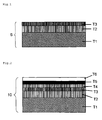
- Fig. 1 is a schematic cross-sectional view showing the constitution of a metal laminated substrate for an oxide superconducting wire 5A which can be obtained by the manufacturing method of the present invention.
- the metal laminated substrate for an oxide superconducting wire 5A is formed of a nonmagnetic metal sheet T1 which constitutes a metal substrate, a copper foil T2 (copper layer) which is laminated to the nonmagnetic metal sheet T1, and a Ni layer (protective layer) T3 which is formed on the copper foil T2 by coating.
- the nonmagnetic metal sheet T1 a metal sheet which plays a role of a reinforcing plate for the copper foil, forms a nonmagnetic material (anti-ferromagnetic material or paramagnetic material) at a temperature of 77K where an oxide superconducting wire is used, and has higher strength than the copper foil can be named. Further, it is preferable that the nonmagnetic metal sheet T1 is a metal sheet in a state where the nonmagnetic metal sheet T1 is softened as much as possible, that is, the nonmagnetic metal sheet T1 is preferably formed of a so-called annealed material (O material).
- O material annealed material
- the copper foil which is a bonding counterpart a copper foil which is hardened by applying cold-rolling at a high draft is used and hence, a contact area of the above-mentionedbonding boundary is ensured under pressure as low pressure as possible so that warping of the nonmagnetic metal sheet T1 after rolling can be reduced.
- a specific example of the nonmagnetic metal sheet T1 for example, an annealed material formed of a stainless steel sheet such as SUS316L can be named, and a thickness of the nonmagnetic metal sheet T1 is preferably set to 0.05mm or more and 0.2mm or less, for example.
- the reason the thickness of the nonmagnetic metal sheet T1 is set to 0.05m or more is to allow the nonmagnetic metal sheet T1 to ensure sufficient strength, and the reason the thickness of the nonmagnetic metal sheet T1 is set to 0.2mm or less is to allow the non magnetic metal sheet T1 to have workability at the time of working a superconducting material.
- the copper foil T2 it is preferable to use a so-called full hard material which is made of copper or a copper alloy (both copper and copper alloy referred to as a copper foil in this specification) which is subjected to cold rolling at a draft of 90% or more.
- the reason the draft is set to 90% or more is that when a copper foil is subjected to cold rolling at a draft of less than 90%, there exists a possibility that Cu will not be biaxially textured in the heat treatment which is performed after rolling.
- a thickness of the copper foil T2 is preferably set to 7 ⁇ m or more and 50 ⁇ m or less.
- the composition of the copper foil is preferably formed such that a Cu base is added 100ppm or more and by 1% or less in total of elements to be added such as Ag, Sn, Zn, Zr, O and N.
- elements to be added such as Ag, Sn, Zn, Zr, O and N.
- the metal laminated substrate manufactured by a manufacturing method of this embodiment is a substrate for an oxide superconducting wire and hence, an oxide intermediate layer made of CeO 2 or YSZ is formed on the metal laminated substrate in an oxidizing atmosphere at a high temperature of 600°C or above in a succeeding process.
- an oxide intermediate layer made of CeO 2 or YSZ is formed on the metal laminated substrate in an oxidizing atmosphere at a high temperature of 600°C or above in a succeeding process.
- the oxide intermediate layer is directly formed on a surface of copper by coating, there may be a case where it is difficult to uniformly ensure the adhesion due to oxidation of a surface of copper. Accordingly, it is preferable that a Ni layer is formed on the surface of the copper foil by coating after the heat treatment is performed.
- any method can be used provided that the Ni layer is epitaxially grown such that high biaxial texture of the copper foil is succeeded.
- an electrolytic Ni plating method is preferably used. Any bath such as a usual watt bath, a chloride bath, a sulfamic acid bath or the like may be used as an electrolytic Ni plating bath provided that matted plating or semi-glossy plating is acquired.
- a thickness of the Ni plating layer is preferably as thin as possible, and it is necessary to prevent the diffusion of metal into a base when the oxide intermediate layer is formed in a succeeding process. Accordingly, a thickness of the Ni plating layer is preferably set to 1 ⁇ m to 3 ⁇ m.
- the definition of Ni in this specification covers Ni alloy.
- the nonmagnetic metal sheet T1 and the copper foil T2 are cleaned and, thereafter, the nonmagnetic metal sheet T1 and the copper foil T2 are bonded to each other by reduction rolls.
- a cleaning method any one of a dry method, a wet method and the combination of the dry method and the wet method may be used.
- treatment such as sputtering using an inert gas (Ar, Ne or the like) in a vacuum state or etching using ion beams in a vacuum state is preferably performed.
- the nonmagnetic metal sheet T1 and the copper foil T2 are subjected to usual sulfuric acid pickling, dipping into an alkali cleaning liquid or the like, are subjected to degreasing treatment by electrolysis and, thereafter, are cleaned with water and are dried.
- a surface activation bonding device D1 shown in Fig. 5 dry etching of the metal sheet and the copper foil is continuously performed before reduction rolling by the reduction rolls thus removing an absorption layer or an oxide film layer on surfaces of the metal sheet and the copper foil.
- a nonmagnetic metal sheet L1 and a copper foil L2 are prepared as elongated coils having a width of 150mm to 600mm, and are mounted on recoiler portions S1, S2 of a surface activation bonding device D1 respectively.
- the nonmagnetic metal sheet L1 and the copper foil L2 which are conveyed from the recoiler portions S1, S2 are continuously conveyed to a surface activation treatment step where activation treatment is applied to two bonding surfaces in advance and, thereafter, the nonmagnetic metal sheet L1 and the copper foil L2 are brought into pressure contact with each other by cold rolling.
- the surface activation treatment is performed by applying sputter etching treatment wherein the nonmagnetic metal sheet L1 and the copper foil L2 having bonding surfaces are used as one-side electrodes A (S3) which are connected to a ground respectively, a glow discharge is generated by applying an AC current of 1 to 50MHz between one-side electrodes A and the other-side electrodes B (S4) which are supported in an insulated manner, and an area of the electrode which is exposed in plasma generated by the glow discharge is not more than 1/3 of an area of the electrodes B.
- an inert gas argon, neon, xenon, krypton or a gas mixture containing at least one kind of gas selected from a group consisting of these gases is applicable.
- the sputter etching treatment surfaces to be bonded of the nonmagnetic metal sheet L1 and the copper foil L2 are subj ected to sputtering by an inert gas so that surface absorption layers and surface oxide films are removed whereby the bonding surfaces are activated.
- the electrodes A (S3) take the form of cooling rolls thus preventing the elevation of temperatures of respectivematerials to be conveyed.
- the nonmagnetic metal sheet L1 and the copper foil L2 are continuously conveyed to a pressure bonding roll step (S5) so that the activated surfaces are pressure-bonded to each other.
- a pressure bonding roll step S5
- the activation processed surfaces are oxidized again during the conveyance thus influencing the adhesion.
- a laminated body which is formed by bonding the nonmagnetic metal sheet L1 and the copper foil L2 to each other in a close contact manner through the above-mentioned pressure bonding step is conveyed to a winding step (S6), and is wound in this step.
- a recrystallization start temperature of the copper foil is approximately 150°C and hence, when the temperature of the copper foil is elevated to 150°C or above during sputter etching treatment, the recrystallization of the copper foil occurs so that texturing of the copper foil is performed before bonding.
- strain is introduced into the copper foil so that the biaxial texture of the copper foil is deteriorated. In this case, strain introduced by rolling is trivial and hence, even when heat treatment is applied to the copper foil, the copper foil cannot be biaxially textured.
- the temperature of the copper foil is preferably held at a temperature which falls within a range of a room temperature to 100°C or below.
- the temperature of the metal sheet is preferably held at a temperature which falls within a range of a room temperature to 100°C.
- the degree of vacuum in this step is set high for preventing the re-absorption to the surface, it is sufficient that the degree of vacuum is set to 10 -5 pa or more and 10 -2 Pa or less.
- the bonding between the nonmagnetic metal sheet and the copper foil is lowered due to the re-absorption of oxygen into the surface of the nonmagnetic metal sheet and into the surface of the copper foil. Accordingly, it is also preferable to perform the bonding under pressure in a non-oxidizing atmosphere, for example, in an inert gas atmosphere such as an Ar gas.
- Applying of pressure by the reduction rolls is performed for ensuring an adhesion area of a bonding boundary between the nonmagnetic metal sheet and the copper foil as well as for exposing a base of the nonmagnetic metal sheet by peeling a partial surface oxidized film layer by making use of friction which occurs in the bonding boundary at the time of rolling reduction. It is preferable to apply a pressure of 300MPa or more. By removing the absorbed material layer by sputter etching and by applying pressure of 300MPa or more, it is possible to acquire adhesion strength by bonding of 0.1N/cm or more in terms of 180° peel strength.
- the metal sheet is a strength reinforcing material
- the copper foil to be laminated is also full hard and hence, both materials are hard.
- a pressure of 600MPa or more and 1.5GPa or less it is preferable to apply a pressure of 600MPa or more and 1.5GPa or less.
- a pressure exceeding 1.5GPa may be applied, and it is confirmed that the biaxial texture is not deteriorated after the heat treatment at a draft of up to 30%.
- the appliedpressure exceeds 1. 5GPa, cracks occur on a surface of the copper foil and, at the same time, the biaxial texture of the copper foil after rolling and heat treatment is deteriorated.
- the laminated body is subjected to heat treatment so as to texture the copper foil and hence, the copper foil T2 are biaxially textured. Thereafter, aprotective layer T3 is formed on a copper-foil-T2 side surface of the laminated body. It is sufficient to set the heat treatment temperature to a temperature of 150°C or above provided that adhesion between the copper foil and the nonmagnetic metal sheet is ensured. In this embodiment, in the case where an annealed material formed of a stainless steel sheet is used as the nonmagnetic metal sheet, strength of the nonmagnetic metal sheet is hardly changed by heat treatment.
- the nonmagnetic metal sheet also sufficiently plays a role of a strength reinforcing material.
- Table 1 shows, the relationship among an Ar sputter etching time, a pressure applied by reduction rolls in a subsequent bonding step, and adhesion strength (in terms of 180° peel strength) between the bonded materials when a highly drafted copper foil having a width of 200mm and a thickness of 18 ⁇ m and added with 200ppm of Ag and a stainless steel sheet made of SUS316L (annealed material) having a thickness of 100 ⁇ m are made to pass using a surface activation bonding device shown in Fig. 5 .
- the plasma output is set to 200W, and a sheet passing speed is changed so as to change a time for sputtering a bonding surface.
- Bonding is performed by changing a pressure applied by reduction rolls within a range of 100MPa to 1500MPa. Further, to confirm whether or not a temperature of copper is elevated so that the texture of copper is changed during sputter etching, the c-axis crystal orientation of the (200) plane of the post bonding sample is measured using the ⁇ /2 ⁇ measurement in the X-ray diffraction.
- the biaxial texture is not generated when c-axis orientation rate of a (200) plane after bonding is within 30% and the biaxial texture (recrystallization) is generated when c-axis orientation of the (200) plane after bonding exceeds 30%.
- Fig. 6 shows the relationship between the crystal orientation rate and the heat treatment holding time of a rolled copper foil (200) plane added with 200ppm of Ag. After the heat treatment, the c-axis orientation rate of the (200) plane by performing the ⁇ /2 ⁇ measurement using an X-ray diffraction apparatus is measured.
- the c-axis crystal orientation indicates a rate of X-ray diffraction intensity of the (200) plane (expressed as I (200)) with respect to the total of the X-ray diffraction intensity of a (111) plane, the X-ray diffraction intensity of the (200) plane, the X-ray diffraction intensity of a (220) plane and the X-ray diffraction intensity of a (311) plane (expressed as ⁇ I(hkl)), and a (200) plane crystal orientation rate is expressed by a following formula.
- results onproperties of laminatedmetal substrates made of Cu/SUS316L before Ni layer coating is formed are shown together with corresponding results of comparison examples.
- a thickness of the copper foil used in this experiment and a thickness of an oxide film of the stainless steel sheet are measured using an Auger electron microscope before bonding and these thicknesses are 5nm and 10nm respectively.
- sputtering of Si is measured as a standard, and sputter speeds of copper and stainless steel are obtained based on a sputtering rate.
- a sputter device in this bonding device is required to perform sputtering with RF output of 200W for 5 minutes.
- surface states described in remarks in Table 1 are estimated surface states after sputter etching.
- Table 2 shows the degree of biaxial orientation of a (200) plane on a copper foil side after holding the laminated substrate made of Cu/SUS316L shown in the embodiment 1 in a non-oxidizing atmosphere at a temperature of 150°C to 950°C for 5 minutes to 4 hours, and the degree of biaxial orientation of a (200) plane and a c-axis crystal orientation rate of a protective layer (Ni layer) when Ni plating having a thickness of 1 ⁇ m is applied to a copper foil surface side after heat treatment together with corresponding values of comparison experimental examples.
- Ni plating is performed using a usual watt bath with current density of 4A/dm 2 , at a bath temperature of 60°C and with pH3.
- ⁇ of copper when the metal laminated substrates of the comparison experimental examples 1-5 (sputter time: 120 seconds, applied pressure: 300MPa) described in the embodiment 1 are subjected to heat treatment is also indicated.
- the biaxial texture is generated once before bonding and, thereafter, the pressure of 300 MPa is applied to the sample in the bonding step and hence, strain is introduced into the copper foil. Accordingly, even after the heat treatment is finished, the biaxial orientation is deteriorated and ⁇ exhibits a value of 6° or more.
- the sample is subjected to heat treatment at a relatively high temperature of 850°, the secondary recrystallization is generated due to the introduction of strain and hence, the texture largely collapses.
- FIG. 2 is a schematic cross-sectional view showing the constitution of an oxide superconducting wire 10A where an intermediate layer T4, an oxide superconducting layer T5, a protective film T6 are stacked in order on a metal laminated substrate for an oxide superconducting wire 5A shorn in Fig. 1 .
- the oxide superconducting wire 10A is manufactured in such a manner that an intermediate layer made of CeO 2 , YSZ, SrTiO 3 , MgO or the like is formed on a protective layer T3 as a film in an epitaxial manner using a sputter method or the like, the superconducting layer formed of a Y123 based thin film or the like is formed as a film by a laser ablation method or the like, and a layer made of Ag, Cu or the like is further laminated to the superconducting layer as the protective film.
- Fig. 3 is a schematic cross-sectional view showing the constitution of a metal laminated plate for an oxide superconducting wire, that is, a metal laminated plate for an oxide superconducting wire 5B which is formed by laminating a copper foil T2 to both surfaces of a nonmagnetic metal sheet T1 by surface activation bonding and, after heat treatment, by applying a protective layer T3 formed of a Ni layer to both outer surfaces of the copper foils T2 by coating.
- Fig. 4 is a schematic cross-sectional view showing the constitution of an oxide superconducting wire 10B which uses the metal laminatedplate for an oxide superconducting wire shown in Fig. 3 .
- the copper is biaxially textured by applying heat treatment after copper is laminated to the substrate. Accordingly, compared to the prior art, copper can be highly oriented so that the formation of scratches or grooves on the surface of copper film can be prevented . According to the present invention, by performing sputter etching of copper while holding a temperature below a crystallization start temperature of copper, the copper film can be laminated to the substrate with a smaller change in copper in a draft state compared to the prior art so that copper can have sharp biaxial texture compared to the prior art when copper which is reduced by rolling reduction is oriented by the heat treatment after the rolling reduction.
- the present invention can realize both an adhesive force and the sharp biaxial texture of copper which the substrate is required to satisfy simultaneously by controlling the pressure applying condition whereby the present invention has extremely high industrial applicability.
Landscapes
- Chemical & Material Sciences (AREA)
- Engineering & Computer Science (AREA)
- Materials Engineering (AREA)
- Mechanical Engineering (AREA)
- Metallurgy (AREA)
- Organic Chemistry (AREA)
- Manufacturing & Machinery (AREA)
- Thermal Sciences (AREA)
- Crystallography & Structural Chemistry (AREA)
- Physics & Mathematics (AREA)
- Superconductors And Manufacturing Methods Therefor (AREA)
- Pressure Welding/Diffusion-Bonding (AREA)
- ing And Chemical Polishing (AREA)
Applications Claiming Priority (2)
| Application Number | Priority Date | Filing Date | Title |
|---|---|---|---|
| JP2009169531 | 2009-07-17 | ||
| PCT/JP2010/004460 WO2011007527A1 (ja) | 2009-07-17 | 2010-07-08 | 酸化物超電導線材用金属積層基板の製造方法及び酸化物超電導線材用金属積層基板 |
Publications (3)
| Publication Number | Publication Date |
|---|---|
| EP2455949A1 true EP2455949A1 (de) | 2012-05-23 |
| EP2455949A4 EP2455949A4 (de) | 2015-04-22 |
| EP2455949B1 EP2455949B1 (de) | 2016-08-31 |
Family
ID=43449139
Family Applications (1)
| Application Number | Title | Priority Date | Filing Date |
|---|---|---|---|
| EP10799591.2A Not-in-force EP2455949B1 (de) | 2009-07-17 | 2010-07-08 | Metalllaminiertes substrat zur verwendung als oxidsupraleiterdrahtmaterial und herstellungsverfahren dafür |
Country Status (7)
| Country | Link |
|---|---|
| US (1) | US8815777B2 (de) |
| EP (1) | EP2455949B1 (de) |
| JP (1) | JP5723773B2 (de) |
| KR (1) | KR101680756B1 (de) |
| CN (1) | CN102473486B (de) |
| IN (1) | IN2012DN00632A (de) |
| WO (1) | WO2011007527A1 (de) |
Cited By (1)
| Publication number | Priority date | Publication date | Assignee | Title |
|---|---|---|---|---|
| EP2503560A4 (de) * | 2009-11-20 | 2017-12-20 | Toyo Kohan Co., Ltd. | Substrat für eine supraleitende verbindung und verfahren zur herstellung des substrats |
Families Citing this family (14)
| Publication number | Priority date | Publication date | Assignee | Title |
|---|---|---|---|---|
| JP5650099B2 (ja) * | 2011-11-22 | 2015-01-07 | Jx日鉱日石金属株式会社 | 超電導膜形成用圧延銅箔 |
| JP5650098B2 (ja) * | 2011-11-22 | 2015-01-07 | Jx日鉱日石金属株式会社 | 超電導膜形成用圧延銅箔 |
| JP5705107B2 (ja) * | 2011-12-28 | 2015-04-22 | Jx日鉱日石金属株式会社 | 超電導膜形成用圧延銅箔 |
| JP5367927B1 (ja) * | 2012-04-16 | 2013-12-11 | 古河電気工業株式会社 | 超電導成膜用基材及び超電導線並びに超電導線の製造方法 |
| JP5904869B2 (ja) * | 2012-05-11 | 2016-04-20 | Jx金属株式会社 | 超電導膜形成用圧延銅箔の製造方法 |
| US9478961B2 (en) * | 2012-05-29 | 2016-10-25 | Korea Institute Of Industrial Technology | Iron bus bar having copper layer, and method for manufacturing same |
| US10087552B2 (en) * | 2012-10-05 | 2018-10-02 | Toyo Kohan Co., Ltd. | Substrate for epitaxial growth, manufacturing method therefor, and substrate for superconducting wire |
| US10174420B2 (en) * | 2013-09-04 | 2019-01-08 | Toyo Kohan Co., Ltd. | Method for forming oxide layer, laminated substrate for epitaxial growth, and method for producing the same |
| JP6244142B2 (ja) * | 2013-09-04 | 2017-12-06 | 東洋鋼鈑株式会社 | 超電導線材用基板及びその製造方法、並びに超電導線材 |
| CN104538543B (zh) * | 2014-12-11 | 2017-06-20 | 西部超导材料科技股份有限公司 | 一种低温超导线材用NbTi棒的制备方法 |
| CN115572928A (zh) * | 2015-10-23 | 2023-01-06 | 东洋钢钣株式会社 | 外延生长用基板及其制造方法 |
| WO2018181721A1 (ja) * | 2017-03-29 | 2018-10-04 | 東洋鋼鈑株式会社 | 圧延接合体 |
| DE112018007737T5 (de) * | 2018-06-15 | 2021-02-25 | Sumitomo Electric Industries, Ltd. | Supraleitender Draht, geschichteter supraleitender Draht, supraleitende Spule und supraleitendes Kabel |
| JP7618390B2 (ja) * | 2020-04-22 | 2025-01-21 | 東洋鋼鈑株式会社 | 金属積層フィルム及びその製造方法 |
Family Cites Families (5)
| Publication number | Priority date | Publication date | Assignee | Title |
|---|---|---|---|---|
| JP3587956B2 (ja) * | 1997-06-10 | 2004-11-10 | 古河電気工業株式会社 | 酸化物超電導線材およびその製造方法 |
| US7816303B2 (en) * | 2004-10-01 | 2010-10-19 | American Superconductor Corporation | Architecture for high temperature superconductor wire |
| JP5123462B2 (ja) | 2004-10-27 | 2013-01-23 | 住友電気工業株式会社 | 膜形成用配向基板および超電導線材ならびに膜形成用配向基板の製造方法 |
| JP5074083B2 (ja) * | 2007-04-17 | 2012-11-14 | 中部電力株式会社 | エピタキシャル薄膜形成用のクラッド配向金属基板及びその製造方法 |
| JP5382911B2 (ja) | 2008-11-12 | 2014-01-08 | 東洋鋼鈑株式会社 | 酸化物超電導線材用金属積層基板の製造方法及び該基板を用いた酸化物超電導線材 |
-
2010
- 2010-07-08 US US13/383,957 patent/US8815777B2/en active Active
- 2010-07-08 JP JP2011522708A patent/JP5723773B2/ja not_active Expired - Fee Related
- 2010-07-08 KR KR1020117030690A patent/KR101680756B1/ko not_active Expired - Fee Related
- 2010-07-08 IN IN632DEN2012 patent/IN2012DN00632A/en unknown
- 2010-07-08 WO PCT/JP2010/004460 patent/WO2011007527A1/ja not_active Ceased
- 2010-07-08 CN CN2010800280233A patent/CN102473486B/zh active Active
- 2010-07-08 EP EP10799591.2A patent/EP2455949B1/de not_active Not-in-force
Cited By (1)
| Publication number | Priority date | Publication date | Assignee | Title |
|---|---|---|---|---|
| EP2503560A4 (de) * | 2009-11-20 | 2017-12-20 | Toyo Kohan Co., Ltd. | Substrat für eine supraleitende verbindung und verfahren zur herstellung des substrats |
Also Published As
| Publication number | Publication date |
|---|---|
| US20120208703A1 (en) | 2012-08-16 |
| CN102473486B (zh) | 2013-07-17 |
| WO2011007527A1 (ja) | 2011-01-20 |
| KR20120038410A (ko) | 2012-04-23 |
| IN2012DN00632A (de) | 2015-08-21 |
| JP5723773B2 (ja) | 2015-05-27 |
| JPWO2011007527A1 (ja) | 2012-12-20 |
| CN102473486A (zh) | 2012-05-23 |
| EP2455949B1 (de) | 2016-08-31 |
| KR101680756B1 (ko) | 2016-11-29 |
| US8815777B2 (en) | 2014-08-26 |
| EP2455949A4 (de) | 2015-04-22 |
Similar Documents
| Publication | Publication Date | Title |
|---|---|---|
| EP2455949B1 (de) | Metalllaminiertes substrat zur verwendung als oxidsupraleiterdrahtmaterial und herstellungsverfahren dafür | |
| US8993064B2 (en) | Substrate for superconducting compound and method for manufacturing the substrate | |
| EP2357656B1 (de) | Verfahren zur herstellung eines metalllaminierten substrats für einen oxid-supraleitungsdraht und oxid-supraleitungsdraht, der das substrat verwendet | |
| EP2360715B1 (de) | Verfahren zur herstellung eines laminierten metallsubstrats für die herstellung eines halbleiterbauelements und laminiertes metallsubstrat für die herstellung eines halbleiterbauelements | |
| CN106716559B (zh) | 超导线材用基板及其制造方法、以及超导线材 | |
| KR102188566B1 (ko) | 초전도 선재용 기판 및 그 제조 방법과 초전도 선재 | |
| JP5918920B2 (ja) | 超電導化合物用基板及びその製造方法 | |
| JP6948621B2 (ja) | エピタキシャル成長用基板及びその製造方法 |
Legal Events
| Date | Code | Title | Description |
|---|---|---|---|
| PUAI | Public reference made under article 153(3) epc to a published international application that has entered the european phase |
Free format text: ORIGINAL CODE: 0009012 |
|
| 17P | Request for examination filed |
Effective date: 20120130 |
|
| AK | Designated contracting states |
Kind code of ref document: A1 Designated state(s): AL AT BE BG CH CY CZ DE DK EE ES FI FR GB GR HR HU IE IS IT LI LT LU LV MC MK MT NL NO PL PT RO SE SI SK SM TR |
|
| DAX | Request for extension of the european patent (deleted) | ||
| RA4 | Supplementary search report drawn up and despatched (corrected) |
Effective date: 20150324 |
|
| RIC1 | Information provided on ipc code assigned before grant |
Ipc: B23K 20/04 20060101ALI20150318BHEP Ipc: H01B 12/06 20060101ALI20150318BHEP Ipc: C22F 1/08 20060101ALI20150318BHEP Ipc: C22C 9/00 20060101ALI20150318BHEP Ipc: C22F 1/00 20060101ALI20150318BHEP Ipc: C22C 9/04 20060101ALI20150318BHEP Ipc: C01G 1/00 20060101ALI20150318BHEP Ipc: H01B 13/00 20060101AFI20150318BHEP Ipc: C22C 9/02 20060101ALI20150318BHEP Ipc: C23F 4/00 20060101ALI20150318BHEP |
|
| REG | Reference to a national code |
Ref country code: DE Ref legal event code: R079 Ref document number: 602010036087 Country of ref document: DE Free format text: PREVIOUS MAIN CLASS: H01B0013000000 Ipc: H01L0039240000 |
|
| RIC1 | Information provided on ipc code assigned before grant |
Ipc: H01L 39/24 20060101AFI20151211BHEP |
|
| GRAP | Despatch of communication of intention to grant a patent |
Free format text: ORIGINAL CODE: EPIDOSNIGR1 |
|
| INTG | Intention to grant announced |
Effective date: 20160125 |
|
| GRAS | Grant fee paid |
Free format text: ORIGINAL CODE: EPIDOSNIGR3 |
|
| GRAA | (expected) grant |
Free format text: ORIGINAL CODE: 0009210 |
|
| AK | Designated contracting states |
Kind code of ref document: B1 Designated state(s): AL AT BE BG CH CY CZ DE DK EE ES FI FR GB GR HR HU IE IS IT LI LT LU LV MC MK MT NL NO PL PT RO SE SI SK SM TR |
|
| REG | Reference to a national code |
Ref country code: CH Ref legal event code: EP Ref country code: GB Ref legal event code: FG4D |
|
| REG | Reference to a national code |
Ref country code: IE Ref legal event code: FG4D |
|
| REG | Reference to a national code |
Ref country code: DE Ref legal event code: R096 Ref document number: 602010036087 Country of ref document: DE |
|
| REG | Reference to a national code |
Ref country code: AT Ref legal event code: REF Ref document number: 825657 Country of ref document: AT Kind code of ref document: T Effective date: 20161015 |
|
| REG | Reference to a national code |
Ref country code: LT Ref legal event code: MG4D |
|
| REG | Reference to a national code |
Ref country code: NL Ref legal event code: MP Effective date: 20160831 |
|
| REG | Reference to a national code |
Ref country code: AT Ref legal event code: MK05 Ref document number: 825657 Country of ref document: AT Kind code of ref document: T Effective date: 20160831 |
|
| PG25 | Lapsed in a contracting state [announced via postgrant information from national office to epo] |
Ref country code: HR Free format text: LAPSE BECAUSE OF FAILURE TO SUBMIT A TRANSLATION OF THE DESCRIPTION OR TO PAY THE FEE WITHIN THE PRESCRIBED TIME-LIMIT Effective date: 20160831 Ref country code: NO Free format text: LAPSE BECAUSE OF FAILURE TO SUBMIT A TRANSLATION OF THE DESCRIPTION OR TO PAY THE FEE WITHIN THE PRESCRIBED TIME-LIMIT Effective date: 20161130 Ref country code: LT Free format text: LAPSE BECAUSE OF FAILURE TO SUBMIT A TRANSLATION OF THE DESCRIPTION OR TO PAY THE FEE WITHIN THE PRESCRIBED TIME-LIMIT Effective date: 20160831 Ref country code: FI Free format text: LAPSE BECAUSE OF FAILURE TO SUBMIT A TRANSLATION OF THE DESCRIPTION OR TO PAY THE FEE WITHIN THE PRESCRIBED TIME-LIMIT Effective date: 20160831 |
|
| PG25 | Lapsed in a contracting state [announced via postgrant information from national office to epo] |
Ref country code: ES Free format text: LAPSE BECAUSE OF FAILURE TO SUBMIT A TRANSLATION OF THE DESCRIPTION OR TO PAY THE FEE WITHIN THE PRESCRIBED TIME-LIMIT Effective date: 20160831 Ref country code: AT Free format text: LAPSE BECAUSE OF FAILURE TO SUBMIT A TRANSLATION OF THE DESCRIPTION OR TO PAY THE FEE WITHIN THE PRESCRIBED TIME-LIMIT Effective date: 20160831 Ref country code: GR Free format text: LAPSE BECAUSE OF FAILURE TO SUBMIT A TRANSLATION OF THE DESCRIPTION OR TO PAY THE FEE WITHIN THE PRESCRIBED TIME-LIMIT Effective date: 20161201 Ref country code: SE Free format text: LAPSE BECAUSE OF FAILURE TO SUBMIT A TRANSLATION OF THE DESCRIPTION OR TO PAY THE FEE WITHIN THE PRESCRIBED TIME-LIMIT Effective date: 20160831 Ref country code: LV Free format text: LAPSE BECAUSE OF FAILURE TO SUBMIT A TRANSLATION OF THE DESCRIPTION OR TO PAY THE FEE WITHIN THE PRESCRIBED TIME-LIMIT Effective date: 20160831 Ref country code: NL Free format text: LAPSE BECAUSE OF FAILURE TO SUBMIT A TRANSLATION OF THE DESCRIPTION OR TO PAY THE FEE WITHIN THE PRESCRIBED TIME-LIMIT Effective date: 20160831 |
|
| PG25 | Lapsed in a contracting state [announced via postgrant information from national office to epo] |
Ref country code: RO Free format text: LAPSE BECAUSE OF FAILURE TO SUBMIT A TRANSLATION OF THE DESCRIPTION OR TO PAY THE FEE WITHIN THE PRESCRIBED TIME-LIMIT Effective date: 20160831 Ref country code: EE Free format text: LAPSE BECAUSE OF FAILURE TO SUBMIT A TRANSLATION OF THE DESCRIPTION OR TO PAY THE FEE WITHIN THE PRESCRIBED TIME-LIMIT Effective date: 20160831 |
|
| PG25 | Lapsed in a contracting state [announced via postgrant information from national office to epo] |
Ref country code: BE Free format text: LAPSE BECAUSE OF FAILURE TO SUBMIT A TRANSLATION OF THE DESCRIPTION OR TO PAY THE FEE WITHIN THE PRESCRIBED TIME-LIMIT Effective date: 20160831 Ref country code: BG Free format text: LAPSE BECAUSE OF FAILURE TO SUBMIT A TRANSLATION OF THE DESCRIPTION OR TO PAY THE FEE WITHIN THE PRESCRIBED TIME-LIMIT Effective date: 20161130 Ref country code: PL Free format text: LAPSE BECAUSE OF FAILURE TO SUBMIT A TRANSLATION OF THE DESCRIPTION OR TO PAY THE FEE WITHIN THE PRESCRIBED TIME-LIMIT Effective date: 20160831 Ref country code: CZ Free format text: LAPSE BECAUSE OF FAILURE TO SUBMIT A TRANSLATION OF THE DESCRIPTION OR TO PAY THE FEE WITHIN THE PRESCRIBED TIME-LIMIT Effective date: 20160831 Ref country code: PT Free format text: LAPSE BECAUSE OF FAILURE TO SUBMIT A TRANSLATION OF THE DESCRIPTION OR TO PAY THE FEE WITHIN THE PRESCRIBED TIME-LIMIT Effective date: 20170102 Ref country code: SM Free format text: LAPSE BECAUSE OF FAILURE TO SUBMIT A TRANSLATION OF THE DESCRIPTION OR TO PAY THE FEE WITHIN THE PRESCRIBED TIME-LIMIT Effective date: 20160831 Ref country code: SK Free format text: LAPSE BECAUSE OF FAILURE TO SUBMIT A TRANSLATION OF THE DESCRIPTION OR TO PAY THE FEE WITHIN THE PRESCRIBED TIME-LIMIT Effective date: 20160831 Ref country code: DK Free format text: LAPSE BECAUSE OF FAILURE TO SUBMIT A TRANSLATION OF THE DESCRIPTION OR TO PAY THE FEE WITHIN THE PRESCRIBED TIME-LIMIT Effective date: 20160831 |
|
| REG | Reference to a national code |
Ref country code: DE Ref legal event code: R097 Ref document number: 602010036087 Country of ref document: DE |
|
| PG25 | Lapsed in a contracting state [announced via postgrant information from national office to epo] |
Ref country code: IT Free format text: LAPSE BECAUSE OF FAILURE TO SUBMIT A TRANSLATION OF THE DESCRIPTION OR TO PAY THE FEE WITHIN THE PRESCRIBED TIME-LIMIT Effective date: 20160831 |
|
| PLBE | No opposition filed within time limit |
Free format text: ORIGINAL CODE: 0009261 |
|
| STAA | Information on the status of an ep patent application or granted ep patent |
Free format text: STATUS: NO OPPOSITION FILED WITHIN TIME LIMIT |
|
| 26N | No opposition filed |
Effective date: 20170601 |
|
| PG25 | Lapsed in a contracting state [announced via postgrant information from national office to epo] |
Ref country code: SI Free format text: LAPSE BECAUSE OF FAILURE TO SUBMIT A TRANSLATION OF THE DESCRIPTION OR TO PAY THE FEE WITHIN THE PRESCRIBED TIME-LIMIT Effective date: 20160831 |
|
| REG | Reference to a national code |
Ref country code: CH Ref legal event code: PL |
|
| GBPC | Gb: european patent ceased through non-payment of renewal fee |
Effective date: 20170708 |
|
| REG | Reference to a national code |
Ref country code: IE Ref legal event code: MM4A |
|
| REG | Reference to a national code |
Ref country code: FR Ref legal event code: ST Effective date: 20180330 |
|
| PG25 | Lapsed in a contracting state [announced via postgrant information from national office to epo] |
Ref country code: IE Free format text: LAPSE BECAUSE OF NON-PAYMENT OF DUE FEES Effective date: 20170708 Ref country code: GB Free format text: LAPSE BECAUSE OF NON-PAYMENT OF DUE FEES Effective date: 20170708 Ref country code: CH Free format text: LAPSE BECAUSE OF NON-PAYMENT OF DUE FEES Effective date: 20170731 Ref country code: LI Free format text: LAPSE BECAUSE OF NON-PAYMENT OF DUE FEES Effective date: 20170731 |
|
| PG25 | Lapsed in a contracting state [announced via postgrant information from national office to epo] |
Ref country code: FR Free format text: LAPSE BECAUSE OF NON-PAYMENT OF DUE FEES Effective date: 20170731 |
|
| PG25 | Lapsed in a contracting state [announced via postgrant information from national office to epo] |
Ref country code: LU Free format text: LAPSE BECAUSE OF NON-PAYMENT OF DUE FEES Effective date: 20170708 |
|
| PG25 | Lapsed in a contracting state [announced via postgrant information from national office to epo] |
Ref country code: MT Free format text: LAPSE BECAUSE OF NON-PAYMENT OF DUE FEES Effective date: 20170708 |
|
| PG25 | Lapsed in a contracting state [announced via postgrant information from national office to epo] |
Ref country code: AL Free format text: LAPSE BECAUSE OF FAILURE TO SUBMIT A TRANSLATION OF THE DESCRIPTION OR TO PAY THE FEE WITHIN THE PRESCRIBED TIME-LIMIT Effective date: 20160831 |
|
| PG25 | Lapsed in a contracting state [announced via postgrant information from national office to epo] |
Ref country code: MC Free format text: LAPSE BECAUSE OF FAILURE TO SUBMIT A TRANSLATION OF THE DESCRIPTION OR TO PAY THE FEE WITHIN THE PRESCRIBED TIME-LIMIT Effective date: 20160831 Ref country code: HU Free format text: LAPSE BECAUSE OF FAILURE TO SUBMIT A TRANSLATION OF THE DESCRIPTION OR TO PAY THE FEE WITHIN THE PRESCRIBED TIME-LIMIT; INVALID AB INITIO Effective date: 20100708 |
|
| PG25 | Lapsed in a contracting state [announced via postgrant information from national office to epo] |
Ref country code: CY Free format text: LAPSE BECAUSE OF NON-PAYMENT OF DUE FEES Effective date: 20160831 |
|
| PG25 | Lapsed in a contracting state [announced via postgrant information from national office to epo] |
Ref country code: MK Free format text: LAPSE BECAUSE OF FAILURE TO SUBMIT A TRANSLATION OF THE DESCRIPTION OR TO PAY THE FEE WITHIN THE PRESCRIBED TIME-LIMIT Effective date: 20160831 |
|
| PG25 | Lapsed in a contracting state [announced via postgrant information from national office to epo] |
Ref country code: TR Free format text: LAPSE BECAUSE OF FAILURE TO SUBMIT A TRANSLATION OF THE DESCRIPTION OR TO PAY THE FEE WITHIN THE PRESCRIBED TIME-LIMIT Effective date: 20160831 |
|
| PG25 | Lapsed in a contracting state [announced via postgrant information from national office to epo] |
Ref country code: IS Free format text: LAPSE BECAUSE OF FAILURE TO SUBMIT A TRANSLATION OF THE DESCRIPTION OR TO PAY THE FEE WITHIN THE PRESCRIBED TIME-LIMIT Effective date: 20161231 |
|
| REG | Reference to a national code |
Ref country code: DE Ref legal event code: R079 Ref document number: 602010036087 Country of ref document: DE Free format text: PREVIOUS MAIN CLASS: H01L0039240000 Ipc: H10N0060010000 |
|
| P01 | Opt-out of the competence of the unified patent court (upc) registered |
Effective date: 20230524 |
|
| PGFP | Annual fee paid to national office [announced via postgrant information from national office to epo] |
Ref country code: DE Payment date: 20240719 Year of fee payment: 15 |
|
| REG | Reference to a national code |
Ref country code: DE Ref legal event code: R119 Ref document number: 602010036087 Country of ref document: DE |
|
| PG25 | Lapsed in a contracting state [announced via postgrant information from national office to epo] |
Ref country code: DE Free format text: LAPSE BECAUSE OF NON-PAYMENT OF DUE FEES Effective date: 20260203 |