EP2455979A1 - Dichtungsmittelplatte für solarzellen und dichtungsmittel-integriertes grundmaterial - Google Patents
Dichtungsmittelplatte für solarzellen und dichtungsmittel-integriertes grundmaterial Download PDFInfo
- Publication number
- EP2455979A1 EP2455979A1 EP10799824A EP10799824A EP2455979A1 EP 2455979 A1 EP2455979 A1 EP 2455979A1 EP 10799824 A EP10799824 A EP 10799824A EP 10799824 A EP10799824 A EP 10799824A EP 2455979 A1 EP2455979 A1 EP 2455979A1
- Authority
- EP
- European Patent Office
- Prior art keywords
- sealant
- solar cell
- resin
- hardness
- sheet
- Prior art date
- Legal status (The legal status is an assumption and is not a legal conclusion. Google has not performed a legal analysis and makes no representation as to the accuracy of the status listed.)
- Withdrawn
Links
- 238000007789 sealing Methods 0.000 title claims description 11
- 239000000463 material Substances 0.000 title description 4
- 229920005989 resin Polymers 0.000 claims abstract description 155
- 239000011347 resin Substances 0.000 claims abstract description 155
- 239000000565 sealant Substances 0.000 claims abstract description 95
- 239000000203 mixture Substances 0.000 claims abstract description 70
- 239000000178 monomer Substances 0.000 claims abstract description 67
- 229920001187 thermosetting polymer Polymers 0.000 claims abstract description 59
- 239000003973 paint Substances 0.000 claims abstract description 56
- 239000011248 coating agent Substances 0.000 claims abstract description 54
- 238000000576 coating method Methods 0.000 claims abstract description 54
- 239000000758 substrate Substances 0.000 claims abstract description 38
- -1 tertiary amine compound Chemical class 0.000 claims abstract description 38
- QGZKDVFQNNGYKY-UHFFFAOYSA-O ammonium group Chemical group [NH4+] QGZKDVFQNNGYKY-UHFFFAOYSA-O 0.000 claims abstract description 31
- 125000003700 epoxy group Chemical group 0.000 claims abstract description 25
- 125000005370 alkoxysilyl group Chemical group 0.000 claims abstract description 23
- 239000002270 dispersing agent Substances 0.000 claims abstract description 17
- 150000007524 organic acids Chemical class 0.000 claims abstract description 12
- 239000007788 liquid Substances 0.000 description 63
- 239000006185 dispersion Substances 0.000 description 61
- 239000002245 particle Substances 0.000 description 49
- 238000004519 manufacturing process Methods 0.000 description 42
- 238000000034 method Methods 0.000 description 22
- 239000004925 Acrylic resin Substances 0.000 description 20
- 229920000178 Acrylic resin Polymers 0.000 description 20
- 230000000052 comparative effect Effects 0.000 description 19
- XLYOFNOQVPJJNP-UHFFFAOYSA-N water Substances O XLYOFNOQVPJJNP-UHFFFAOYSA-N 0.000 description 19
- 238000006243 chemical reaction Methods 0.000 description 16
- QTBSBXVTEAMEQO-UHFFFAOYSA-N Acetic acid Chemical compound CC(O)=O QTBSBXVTEAMEQO-UHFFFAOYSA-N 0.000 description 14
- SOGAXMICEFXMKE-UHFFFAOYSA-N Butylmethacrylate Chemical compound CCCCOC(=O)C(C)=C SOGAXMICEFXMKE-UHFFFAOYSA-N 0.000 description 14
- PPBRXRYQALVLMV-UHFFFAOYSA-N Styrene Chemical compound C=CC1=CC=CC=C1 PPBRXRYQALVLMV-UHFFFAOYSA-N 0.000 description 14
- 238000000465 moulding Methods 0.000 description 14
- 239000007787 solid Substances 0.000 description 14
- LFQSCWFLJHTTHZ-UHFFFAOYSA-N Ethanol Chemical compound CCO LFQSCWFLJHTTHZ-UHFFFAOYSA-N 0.000 description 12
- 239000010410 layer Substances 0.000 description 12
- 238000011109 contamination Methods 0.000 description 11
- 238000011156 evaluation Methods 0.000 description 11
- 230000032683 aging Effects 0.000 description 10
- XAGFODPZIPBFFR-UHFFFAOYSA-N aluminium Chemical compound [Al] XAGFODPZIPBFFR-UHFFFAOYSA-N 0.000 description 10
- 229910052782 aluminium Inorganic materials 0.000 description 10
- 239000003822 epoxy resin Substances 0.000 description 10
- 239000005038 ethylene vinyl acetate Substances 0.000 description 10
- 229920000647 polyepoxide Polymers 0.000 description 10
- VVQNEPGJFQJSBK-UHFFFAOYSA-N Methyl methacrylate Chemical compound COC(=O)C(C)=C VVQNEPGJFQJSBK-UHFFFAOYSA-N 0.000 description 9
- HEMHJVSKTPXQMS-UHFFFAOYSA-M Sodium hydroxide Chemical compound [OH-].[Na+] HEMHJVSKTPXQMS-UHFFFAOYSA-M 0.000 description 9
- DQXBYHZEEUGOBF-UHFFFAOYSA-N but-3-enoic acid;ethene Chemical compound C=C.OC(=O)CC=C DQXBYHZEEUGOBF-UHFFFAOYSA-N 0.000 description 9
- 230000007797 corrosion Effects 0.000 description 9
- 238000005260 corrosion Methods 0.000 description 9
- 239000000839 emulsion Substances 0.000 description 9
- 229920001200 poly(ethylene-vinyl acetate) Polymers 0.000 description 9
- 239000000853 adhesive Substances 0.000 description 8
- 230000001070 adhesive effect Effects 0.000 description 8
- 239000003999 initiator Substances 0.000 description 8
- 239000000243 solution Substances 0.000 description 8
- 238000004383 yellowing Methods 0.000 description 8
- 125000004432 carbon atom Chemical group C* 0.000 description 7
- 230000006866 deterioration Effects 0.000 description 7
- URDOJQUSEUXVRP-UHFFFAOYSA-N 3-triethoxysilylpropyl 2-methylprop-2-enoate Chemical compound CCO[Si](OCC)(OCC)CCCOC(=O)C(C)=C URDOJQUSEUXVRP-UHFFFAOYSA-N 0.000 description 6
- OKKJLVBELUTLKV-UHFFFAOYSA-N Methanol Chemical compound OC OKKJLVBELUTLKV-UHFFFAOYSA-N 0.000 description 6
- NTIZESTWPVYFNL-UHFFFAOYSA-N Methyl isobutyl ketone Chemical compound CC(C)CC(C)=O NTIZESTWPVYFNL-UHFFFAOYSA-N 0.000 description 6
- 239000007864 aqueous solution Substances 0.000 description 6
- 239000011230 binding agent Substances 0.000 description 6
- 150000001875 compounds Chemical class 0.000 description 6
- 239000011521 glass Substances 0.000 description 6
- JVTAAEKCZFNVCJ-UHFFFAOYSA-N lactic acid Chemical compound CC(O)C(O)=O JVTAAEKCZFNVCJ-UHFFFAOYSA-N 0.000 description 6
- 238000002356 laser light scattering Methods 0.000 description 6
- 229920000139 polyethylene terephthalate Polymers 0.000 description 6
- 239000005020 polyethylene terephthalate Substances 0.000 description 6
- 239000000047 product Substances 0.000 description 6
- 238000005956 quaternization reaction Methods 0.000 description 6
- 229960000583 acetic acid Drugs 0.000 description 5
- 239000008367 deionised water Substances 0.000 description 5
- 229910021641 deionized water Inorganic materials 0.000 description 5
- WNAHIZMDSQCWRP-UHFFFAOYSA-N dodecane-1-thiol Chemical compound CCCCCCCCCCCCS WNAHIZMDSQCWRP-UHFFFAOYSA-N 0.000 description 5
- 230000009477 glass transition Effects 0.000 description 5
- 230000002265 prevention Effects 0.000 description 5
- 238000003860 storage Methods 0.000 description 5
- VGGSQFUCUMXWEO-UHFFFAOYSA-N Ethene Chemical compound C=C VGGSQFUCUMXWEO-UHFFFAOYSA-N 0.000 description 4
- 239000005977 Ethylene Substances 0.000 description 4
- 235000011054 acetic acid Nutrition 0.000 description 4
- 239000008135 aqueous vehicle Substances 0.000 description 4
- 230000004888 barrier function Effects 0.000 description 4
- PXKLMJQFEQBVLD-UHFFFAOYSA-N bisphenol F Chemical compound C1=CC(O)=CC=C1CC1=CC=C(O)C=C1 PXKLMJQFEQBVLD-UHFFFAOYSA-N 0.000 description 4
- 229920001577 copolymer Polymers 0.000 description 4
- 238000010227 cup method (microbiological evaluation) Methods 0.000 description 4
- 230000000694 effects Effects 0.000 description 4
- 239000012948 isocyanate Substances 0.000 description 4
- 150000002513 isocyanates Chemical class 0.000 description 4
- 239000004848 polyfunctional curative Substances 0.000 description 4
- POAOYUHQDCAZBD-UHFFFAOYSA-N 2-butoxyethanol Chemical compound CCCCOCCO POAOYUHQDCAZBD-UHFFFAOYSA-N 0.000 description 3
- 239000004593 Epoxy Substances 0.000 description 3
- WOBHKFSMXKNTIM-UHFFFAOYSA-N Hydroxyethyl methacrylate Chemical compound CC(=C)C(=O)OCCO WOBHKFSMXKNTIM-UHFFFAOYSA-N 0.000 description 3
- ZMANZCXQSJIPKH-UHFFFAOYSA-N Triethylamine Chemical compound CCN(CC)CC ZMANZCXQSJIPKH-UHFFFAOYSA-N 0.000 description 3
- 239000004840 adhesive resin Substances 0.000 description 3
- 229920006223 adhesive resin Polymers 0.000 description 3
- 238000007720 emulsion polymerization reaction Methods 0.000 description 3
- 239000004310 lactic acid Substances 0.000 description 3
- 235000014655 lactic acid Nutrition 0.000 description 3
- 238000002844 melting Methods 0.000 description 3
- 230000008018 melting Effects 0.000 description 3
- 238000006386 neutralization reaction Methods 0.000 description 3
- FVQMJJQUGGVLEP-UHFFFAOYSA-N (2-methylpropan-2-yl)oxy 2-ethylhexaneperoxoate Chemical compound CCCCC(CC)C(=O)OOOC(C)(C)C FVQMJJQUGGVLEP-UHFFFAOYSA-N 0.000 description 2
- 229920002818 (Hydroxyethyl)methacrylate Polymers 0.000 description 2
- PTBDIHRZYDMNKB-UHFFFAOYSA-N 2,2-Bis(hydroxymethyl)propionic acid Chemical compound OCC(C)(CO)C(O)=O PTBDIHRZYDMNKB-UHFFFAOYSA-N 0.000 description 2
- OZAIFHULBGXAKX-UHFFFAOYSA-N 2-(2-cyanopropan-2-yldiazenyl)-2-methylpropanenitrile Chemical compound N#CC(C)(C)N=NC(C)(C)C#N OZAIFHULBGXAKX-UHFFFAOYSA-N 0.000 description 2
- WDQMWEYDKDCEHT-UHFFFAOYSA-N 2-ethylhexyl 2-methylprop-2-enoate Chemical compound CCCCC(CC)COC(=O)C(C)=C WDQMWEYDKDCEHT-UHFFFAOYSA-N 0.000 description 2
- OMIGHNLMNHATMP-UHFFFAOYSA-N 2-hydroxyethyl prop-2-enoate Chemical compound OCCOC(=O)C=C OMIGHNLMNHATMP-UHFFFAOYSA-N 0.000 description 2
- DOYKFSOCSXVQAN-UHFFFAOYSA-N 3-[diethoxy(methyl)silyl]propyl 2-methylprop-2-enoate Chemical compound CCO[Si](C)(OCC)CCCOC(=O)C(C)=C DOYKFSOCSXVQAN-UHFFFAOYSA-N 0.000 description 2
- LZMNXXQIQIHFGC-UHFFFAOYSA-N 3-[dimethoxy(methyl)silyl]propyl 2-methylprop-2-enoate Chemical compound CO[Si](C)(OC)CCCOC(=O)C(C)=C LZMNXXQIQIHFGC-UHFFFAOYSA-N 0.000 description 2
- XDLMVUHYZWKMMD-UHFFFAOYSA-N 3-trimethoxysilylpropyl 2-methylprop-2-enoate Chemical compound CO[Si](OC)(OC)CCCOC(=O)C(C)=C XDLMVUHYZWKMMD-UHFFFAOYSA-N 0.000 description 2
- VPWNQTHUCYMVMZ-UHFFFAOYSA-N 4,4'-sulfonyldiphenol Chemical compound C1=CC(O)=CC=C1S(=O)(=O)C1=CC=C(O)C=C1 VPWNQTHUCYMVMZ-UHFFFAOYSA-N 0.000 description 2
- 229920002799 BoPET Polymers 0.000 description 2
- KAKZBPTYRLMSJV-UHFFFAOYSA-N Butadiene Chemical compound C=CC=C KAKZBPTYRLMSJV-UHFFFAOYSA-N 0.000 description 2
- FERIUCNNQQJTOY-UHFFFAOYSA-N Butyric acid Chemical compound CCCC(O)=O FERIUCNNQQJTOY-UHFFFAOYSA-N 0.000 description 2
- 239000004971 Cross linker Substances 0.000 description 2
- BRLQWZUYTZBJKN-UHFFFAOYSA-N Epichlorohydrin Chemical compound ClCC1CO1 BRLQWZUYTZBJKN-UHFFFAOYSA-N 0.000 description 2
- VEXZGXHMUGYJMC-UHFFFAOYSA-N Hydrochloric acid Chemical compound Cl VEXZGXHMUGYJMC-UHFFFAOYSA-N 0.000 description 2
- RRHGJUQNOFWUDK-UHFFFAOYSA-N Isoprene Chemical compound CC(=C)C=C RRHGJUQNOFWUDK-UHFFFAOYSA-N 0.000 description 2
- 229920000106 Liquid crystal polymer Polymers 0.000 description 2
- 239000004977 Liquid-crystal polymers (LCPs) Substances 0.000 description 2
- BAPJBEWLBFYGME-UHFFFAOYSA-N Methyl acrylate Chemical compound COC(=O)C=C BAPJBEWLBFYGME-UHFFFAOYSA-N 0.000 description 2
- OKJIRPAQVSHGFK-UHFFFAOYSA-N N-acetylglycine Chemical compound CC(=O)NCC(O)=O OKJIRPAQVSHGFK-UHFFFAOYSA-N 0.000 description 2
- UEEJHVSXFDXPFK-UHFFFAOYSA-N N-dimethylaminoethanol Chemical compound CN(C)CCO UEEJHVSXFDXPFK-UHFFFAOYSA-N 0.000 description 2
- ISWSIDIOOBJBQZ-UHFFFAOYSA-N Phenol Chemical compound OC1=CC=CC=C1 ISWSIDIOOBJBQZ-UHFFFAOYSA-N 0.000 description 2
- NBIIXXVUZAFLBC-UHFFFAOYSA-N Phosphoric acid Chemical compound OP(O)(O)=O NBIIXXVUZAFLBC-UHFFFAOYSA-N 0.000 description 2
- 239000004698 Polyethylene Substances 0.000 description 2
- 239000002202 Polyethylene glycol Substances 0.000 description 2
- 239000004734 Polyphenylene sulfide Substances 0.000 description 2
- 239000004743 Polypropylene Substances 0.000 description 2
- QAOWNCQODCNURD-UHFFFAOYSA-N Sulfuric acid Chemical compound OS(O)(=O)=O QAOWNCQODCNURD-UHFFFAOYSA-N 0.000 description 2
- XXROGKLTLUQVRX-UHFFFAOYSA-N allyl alcohol Chemical compound OCC=C XXROGKLTLUQVRX-UHFFFAOYSA-N 0.000 description 2
- MTHSVFCYNBDYFN-UHFFFAOYSA-N anhydrous diethylene glycol Natural products OCCOCCO MTHSVFCYNBDYFN-UHFFFAOYSA-N 0.000 description 2
- 150000001491 aromatic compounds Chemical class 0.000 description 2
- LWMFAFLIWMPZSX-UHFFFAOYSA-N bis[2-(4,5-dihydro-1h-imidazol-2-yl)propan-2-yl]diazene Chemical compound N=1CCNC=1C(C)(C)N=NC(C)(C)C1=NCCN1 LWMFAFLIWMPZSX-UHFFFAOYSA-N 0.000 description 2
- IISBACLAFKSPIT-UHFFFAOYSA-N bisphenol A Chemical compound C=1C=C(O)C=CC=1C(C)(C)C1=CC=C(O)C=C1 IISBACLAFKSPIT-UHFFFAOYSA-N 0.000 description 2
- CQEYYJKEWSMYFG-UHFFFAOYSA-N butyl acrylate Chemical compound CCCCOC(=O)C=C CQEYYJKEWSMYFG-UHFFFAOYSA-N 0.000 description 2
- 239000007795 chemical reaction product Substances 0.000 description 2
- 239000011162 core material Substances 0.000 description 2
- 238000004132 cross linking Methods 0.000 description 2
- 229960002887 deanol Drugs 0.000 description 2
- 150000001993 dienes Chemical class 0.000 description 2
- XBDQKXXYIPTUBI-UHFFFAOYSA-N dimethylselenoniopropionate Natural products CCC(O)=O XBDQKXXYIPTUBI-UHFFFAOYSA-N 0.000 description 2
- USIUVYZYUHIAEV-UHFFFAOYSA-N diphenyl ether Chemical compound C=1C=CC=CC=1OC1=CC=CC=C1 USIUVYZYUHIAEV-UHFFFAOYSA-N 0.000 description 2
- LQZZUXJYWNFBMV-UHFFFAOYSA-N dodecan-1-ol Chemical compound CCCCCCCCCCCCO LQZZUXJYWNFBMV-UHFFFAOYSA-N 0.000 description 2
- 239000003995 emulsifying agent Substances 0.000 description 2
- 150000002170 ethers Chemical class 0.000 description 2
- LYCAIKOWRPUZTN-UHFFFAOYSA-N ethylene glycol Natural products OCCO LYCAIKOWRPUZTN-UHFFFAOYSA-N 0.000 description 2
- 229920006244 ethylene-ethyl acrylate Polymers 0.000 description 2
- 238000001125 extrusion Methods 0.000 description 2
- 229920000578 graft copolymer Polymers 0.000 description 2
- ZSIAUFGUXNUGDI-UHFFFAOYSA-N hexan-1-ol Chemical compound CCCCCCO ZSIAUFGUXNUGDI-UHFFFAOYSA-N 0.000 description 2
- IQPQWNKOIGAROB-UHFFFAOYSA-N isocyanate group Chemical group [N-]=C=O IQPQWNKOIGAROB-UHFFFAOYSA-N 0.000 description 2
- 239000000155 melt Substances 0.000 description 2
- BDAGIHXWWSANSR-UHFFFAOYSA-N methanoic acid Natural products OC=O BDAGIHXWWSANSR-UHFFFAOYSA-N 0.000 description 2
- DNIAPMSPPWPWGF-UHFFFAOYSA-N monopropylene glycol Natural products CC(O)CO DNIAPMSPPWPWGF-UHFFFAOYSA-N 0.000 description 2
- 230000007935 neutral effect Effects 0.000 description 2
- 150000002825 nitriles Chemical class 0.000 description 2
- GLDOVTGHNKAZLK-UHFFFAOYSA-N octadecan-1-ol Chemical compound CCCCCCCCCCCCCCCCCCO GLDOVTGHNKAZLK-UHFFFAOYSA-N 0.000 description 2
- 150000002978 peroxides Chemical class 0.000 description 2
- 229920003207 poly(ethylene-2,6-naphthalate) Polymers 0.000 description 2
- 229920001707 polybutylene terephthalate Polymers 0.000 description 2
- 229920001223 polyethylene glycol Polymers 0.000 description 2
- 239000011112 polyethylene naphthalate Substances 0.000 description 2
- 239000003505 polymerization initiator Substances 0.000 description 2
- 229920000069 polyphenylene sulfide Polymers 0.000 description 2
- 229920001451 polypropylene glycol Polymers 0.000 description 2
- 229920002620 polyvinyl fluoride Polymers 0.000 description 2
- 238000012545 processing Methods 0.000 description 2
- 239000011541 reaction mixture Substances 0.000 description 2
- 239000011342 resin composition Substances 0.000 description 2
- 229910000077 silane Inorganic materials 0.000 description 2
- 239000002904 solvent Substances 0.000 description 2
- GETQZCLCWQTVFV-UHFFFAOYSA-N trimethylamine Chemical compound CN(C)C GETQZCLCWQTVFV-UHFFFAOYSA-N 0.000 description 2
- 229920001567 vinyl ester resin Polymers 0.000 description 2
- RWCHFQMCWQLPAS-UHFFFAOYSA-N (1-tert-butylcyclohexyl) 2-methylprop-2-enoate Chemical compound CC(=C)C(=O)OC1(C(C)(C)C)CCCCC1 RWCHFQMCWQLPAS-UHFFFAOYSA-N 0.000 description 1
- XPEMPJFPRCHICU-UHFFFAOYSA-N (1-tert-butylcyclohexyl) prop-2-enoate Chemical compound C=CC(=O)OC1(C(C)(C)C)CCCCC1 XPEMPJFPRCHICU-UHFFFAOYSA-N 0.000 description 1
- JHPBZFOKBAGZBL-UHFFFAOYSA-N (3-hydroxy-2,2,4-trimethylpentyl) 2-methylprop-2-enoate Chemical compound CC(C)C(O)C(C)(C)COC(=O)C(C)=C JHPBZFOKBAGZBL-UHFFFAOYSA-N 0.000 description 1
- PSGCQDPCAWOCSH-UHFFFAOYSA-N (4,7,7-trimethyl-3-bicyclo[2.2.1]heptanyl) prop-2-enoate Chemical compound C1CC2(C)C(OC(=O)C=C)CC1C2(C)C PSGCQDPCAWOCSH-UHFFFAOYSA-N 0.000 description 1
- KBPLFHHGFOOTCA-UHFFFAOYSA-N 1-Octanol Chemical compound CCCCCCCCO KBPLFHHGFOOTCA-UHFFFAOYSA-N 0.000 description 1
- KTZVZZJJVJQZHV-UHFFFAOYSA-N 1-chloro-4-ethenylbenzene Chemical compound ClC1=CC=C(C=C)C=C1 KTZVZZJJVJQZHV-UHFFFAOYSA-N 0.000 description 1
- IGGDKDTUCAWDAN-UHFFFAOYSA-N 1-vinylnaphthalene Chemical compound C1=CC=C2C(C=C)=CC=CC2=C1 IGGDKDTUCAWDAN-UHFFFAOYSA-N 0.000 description 1
- CCTFAOUOYLVUFG-UHFFFAOYSA-N 2-(1-amino-1-imino-2-methylpropan-2-yl)azo-2-methylpropanimidamide Chemical compound NC(=N)C(C)(C)N=NC(C)(C)C(N)=N CCTFAOUOYLVUFG-UHFFFAOYSA-N 0.000 description 1
- AVTLBBWTUPQRAY-UHFFFAOYSA-N 2-(2-cyanobutan-2-yldiazenyl)-2-methylbutanenitrile Chemical compound CCC(C)(C#N)N=NC(C)(CC)C#N AVTLBBWTUPQRAY-UHFFFAOYSA-N 0.000 description 1
- OHJYHAOODFPJOD-UHFFFAOYSA-N 2-(2-ethylhexoxy)ethanol Chemical compound CCCCC(CC)COCCO OHJYHAOODFPJOD-UHFFFAOYSA-N 0.000 description 1
- HIXDQWDOVZUNNA-UHFFFAOYSA-N 2-(3,4-dimethoxyphenyl)-5-hydroxy-7-methoxychromen-4-one Chemical compound C=1C(OC)=CC(O)=C(C(C=2)=O)C=1OC=2C1=CC=C(OC)C(OC)=C1 HIXDQWDOVZUNNA-UHFFFAOYSA-N 0.000 description 1
- GOXQRTZXKQZDDN-UHFFFAOYSA-N 2-Ethylhexyl acrylate Chemical compound CCCCC(CC)COC(=O)C=C GOXQRTZXKQZDDN-UHFFFAOYSA-N 0.000 description 1
- WYGWHHGCAGTUCH-UHFFFAOYSA-N 2-[(2-cyano-4-methylpentan-2-yl)diazenyl]-2,4-dimethylpentanenitrile Chemical compound CC(C)CC(C)(C#N)N=NC(C)(C#N)CC(C)C WYGWHHGCAGTUCH-UHFFFAOYSA-N 0.000 description 1
- YIWUKEYIRIRTPP-UHFFFAOYSA-N 2-ethylhexan-1-ol Chemical compound CCCCC(CC)CO YIWUKEYIRIRTPP-UHFFFAOYSA-N 0.000 description 1
- IEVADDDOVGMCSI-UHFFFAOYSA-N 2-hydroxybutyl 2-methylprop-2-enoate Chemical compound CCC(O)COC(=O)C(C)=C IEVADDDOVGMCSI-UHFFFAOYSA-N 0.000 description 1
- QTWJRLJHJPIABL-UHFFFAOYSA-N 2-methylphenol;3-methylphenol;4-methylphenol Chemical compound CC1=CC=C(O)C=C1.CC1=CC=CC(O)=C1.CC1=CC=CC=C1O QTWJRLJHJPIABL-UHFFFAOYSA-N 0.000 description 1
- BYDRTKVGBRTTIT-UHFFFAOYSA-N 2-methylprop-2-en-1-ol Chemical compound CC(=C)CO BYDRTKVGBRTTIT-UHFFFAOYSA-N 0.000 description 1
- RUMACXVDVNRZJZ-UHFFFAOYSA-N 2-methylpropyl 2-methylprop-2-enoate Chemical compound CC(C)COC(=O)C(C)=C RUMACXVDVNRZJZ-UHFFFAOYSA-N 0.000 description 1
- CFVWNXQPGQOHRJ-UHFFFAOYSA-N 2-methylpropyl prop-2-enoate Chemical compound CC(C)COC(=O)C=C CFVWNXQPGQOHRJ-UHFFFAOYSA-N 0.000 description 1
- WDGCBNTXZHJTHJ-UHFFFAOYSA-N 2h-1,3-oxazol-2-id-4-one Chemical group O=C1CO[C-]=N1 WDGCBNTXZHJTHJ-UHFFFAOYSA-N 0.000 description 1
- DXIJHCSGLOHNES-UHFFFAOYSA-N 3,3-dimethylbut-1-enylbenzene Chemical compound CC(C)(C)C=CC1=CC=CC=C1 DXIJHCSGLOHNES-UHFFFAOYSA-N 0.000 description 1
- UDWIZRDPCQAYRF-UHFFFAOYSA-N 3-[diethoxy(methyl)silyl]propyl prop-2-enoate Chemical compound CCO[Si](C)(OCC)CCCOC(=O)C=C UDWIZRDPCQAYRF-UHFFFAOYSA-N 0.000 description 1
- MCDBEBOBROAQSH-UHFFFAOYSA-N 3-[dimethoxy(methyl)silyl]propyl prop-2-enoate Chemical compound CO[Si](C)(OC)CCCOC(=O)C=C MCDBEBOBROAQSH-UHFFFAOYSA-N 0.000 description 1
- JSOZORWBKQSQCJ-UHFFFAOYSA-N 3-[ethoxy(dimethyl)silyl]propyl 2-methylprop-2-enoate Chemical compound CCO[Si](C)(C)CCCOC(=O)C(C)=C JSOZORWBKQSQCJ-UHFFFAOYSA-N 0.000 description 1
- DGBFOBNYTYHFPN-UHFFFAOYSA-N 3-[ethoxy(dimethyl)silyl]propyl prop-2-enoate Chemical compound CCO[Si](C)(C)CCCOC(=O)C=C DGBFOBNYTYHFPN-UHFFFAOYSA-N 0.000 description 1
- JBDMKOVTOUIKFI-UHFFFAOYSA-N 3-[methoxy(dimethyl)silyl]propyl 2-methylprop-2-enoate Chemical compound CO[Si](C)(C)CCCOC(=O)C(C)=C JBDMKOVTOUIKFI-UHFFFAOYSA-N 0.000 description 1
- ZCRUJAKCJLCJCP-UHFFFAOYSA-N 3-[methoxy(dimethyl)silyl]propyl prop-2-enoate Chemical compound CO[Si](C)(C)CCCOC(=O)C=C ZCRUJAKCJLCJCP-UHFFFAOYSA-N 0.000 description 1
- GNSFRPWPOGYVLO-UHFFFAOYSA-N 3-hydroxypropyl 2-methylprop-2-enoate Chemical compound CC(=C)C(=O)OCCCO GNSFRPWPOGYVLO-UHFFFAOYSA-N 0.000 description 1
- QZPSOSOOLFHYRR-UHFFFAOYSA-N 3-hydroxypropyl prop-2-enoate Chemical compound OCCCOC(=O)C=C QZPSOSOOLFHYRR-UHFFFAOYSA-N 0.000 description 1
- XDQWJFXZTAWJST-UHFFFAOYSA-N 3-triethoxysilylpropyl prop-2-enoate Chemical compound CCO[Si](OCC)(OCC)CCCOC(=O)C=C XDQWJFXZTAWJST-UHFFFAOYSA-N 0.000 description 1
- VFXXTYGQYWRHJP-UHFFFAOYSA-N 4,4'-azobis(4-cyanopentanoic acid) Chemical compound OC(=O)CCC(C)(C#N)N=NC(C)(CCC(O)=O)C#N VFXXTYGQYWRHJP-UHFFFAOYSA-N 0.000 description 1
- OSWFIVFLDKOXQC-UHFFFAOYSA-N 4-(3-methoxyphenyl)aniline Chemical compound COC1=CC=CC(C=2C=CC(N)=CC=2)=C1 OSWFIVFLDKOXQC-UHFFFAOYSA-N 0.000 description 1
- NDWUBGAGUCISDV-UHFFFAOYSA-N 4-hydroxybutyl prop-2-enoate Chemical compound OCCCCOC(=O)C=C NDWUBGAGUCISDV-UHFFFAOYSA-N 0.000 description 1
- 102100026788 ATP synthase subunit C lysine N-methyltransferase Human genes 0.000 description 1
- NIXOWILDQLNWCW-UHFFFAOYSA-M Acrylate Chemical compound [O-]C(=O)C=C NIXOWILDQLNWCW-UHFFFAOYSA-M 0.000 description 1
- NLHHRLWOUZZQLW-UHFFFAOYSA-N Acrylonitrile Chemical compound C=CC#N NLHHRLWOUZZQLW-UHFFFAOYSA-N 0.000 description 1
- 239000004342 Benzoyl peroxide Substances 0.000 description 1
- OMPJBNCRMGITSC-UHFFFAOYSA-N Benzoylperoxide Chemical compound C=1C=CC=CC=1C(=O)OOC(=O)C1=CC=CC=C1 OMPJBNCRMGITSC-UHFFFAOYSA-N 0.000 description 1
- 229930185605 Bisphenol Natural products 0.000 description 1
- OKTJSMMVPCPJKN-UHFFFAOYSA-N Carbon Chemical compound [C] OKTJSMMVPCPJKN-UHFFFAOYSA-N 0.000 description 1
- JIGUQPWFLRLWPJ-UHFFFAOYSA-N Ethyl acrylate Chemical compound CCOC(=O)C=C JIGUQPWFLRLWPJ-UHFFFAOYSA-N 0.000 description 1
- 101000833848 Homo sapiens ATP synthase subunit C lysine N-methyltransferase Proteins 0.000 description 1
- YIVJZNGAASQVEM-UHFFFAOYSA-N Lauroyl peroxide Chemical compound CCCCCCCCCCCC(=O)OOC(=O)CCCCCCCCCCC YIVJZNGAASQVEM-UHFFFAOYSA-N 0.000 description 1
- CERQOIWHTDAKMF-UHFFFAOYSA-M Methacrylate Chemical compound CC(=C)C([O-])=O CERQOIWHTDAKMF-UHFFFAOYSA-M 0.000 description 1
- LSDPWZHWYPCBBB-UHFFFAOYSA-N Methanethiol Chemical compound SC LSDPWZHWYPCBBB-UHFFFAOYSA-N 0.000 description 1
- UIHCLUNTQKBZGK-UHFFFAOYSA-N Methyl isobutyl ketone Natural products CCC(C)C(C)=O UIHCLUNTQKBZGK-UHFFFAOYSA-N 0.000 description 1
- GYCMBHHDWRMZGG-UHFFFAOYSA-N Methylacrylonitrile Chemical compound CC(=C)C#N GYCMBHHDWRMZGG-UHFFFAOYSA-N 0.000 description 1
- LJLLAWRMBZNPMO-UHFFFAOYSA-N N-acetyl-beta-alanine Chemical compound CC(=O)NCCC(O)=O LJLLAWRMBZNPMO-UHFFFAOYSA-N 0.000 description 1
- OPKOKAMJFNKNAS-UHFFFAOYSA-N N-methylethanolamine Chemical compound CNCCO OPKOKAMJFNKNAS-UHFFFAOYSA-N 0.000 description 1
- 229920002292 Nylon 6 Polymers 0.000 description 1
- 229920002302 Nylon 6,6 Polymers 0.000 description 1
- 239000004721 Polyphenylene oxide Substances 0.000 description 1
- 239000004793 Polystyrene Substances 0.000 description 1
- XTXRWKRVRITETP-UHFFFAOYSA-N Vinyl acetate Chemical compound CC(=O)OC=C XTXRWKRVRITETP-UHFFFAOYSA-N 0.000 description 1
- IAXXETNIOYFMLW-COPLHBTASA-N [(1s,3s,4s)-4,7,7-trimethyl-3-bicyclo[2.2.1]heptanyl] 2-methylprop-2-enoate Chemical compound C1C[C@]2(C)[C@@H](OC(=O)C(=C)C)C[C@H]1C2(C)C IAXXETNIOYFMLW-COPLHBTASA-N 0.000 description 1
- ULQMPOIOSDXIGC-UHFFFAOYSA-N [2,2-dimethyl-3-(2-methylprop-2-enoyloxy)propyl] 2-methylprop-2-enoate Chemical compound CC(=C)C(=O)OCC(C)(C)COC(=O)C(C)=C ULQMPOIOSDXIGC-UHFFFAOYSA-N 0.000 description 1
- UKLDJPRMSDWDSL-UHFFFAOYSA-L [dibutyl(dodecanoyloxy)stannyl] dodecanoate Chemical compound CCCCCCCCCCCC(=O)O[Sn](CCCC)(CCCC)OC(=O)CCCCCCCCCCC UKLDJPRMSDWDSL-UHFFFAOYSA-L 0.000 description 1
- 239000002253 acid Substances 0.000 description 1
- NIXOWILDQLNWCW-UHFFFAOYSA-N acrylic acid group Chemical group C(C=C)(=O)O NIXOWILDQLNWCW-UHFFFAOYSA-N 0.000 description 1
- 239000012790 adhesive layer Substances 0.000 description 1
- 125000003545 alkoxy group Chemical group 0.000 description 1
- XYLMUPLGERFSHI-UHFFFAOYSA-N alpha-Methylstyrene Chemical compound CC(=C)C1=CC=CC=C1 XYLMUPLGERFSHI-UHFFFAOYSA-N 0.000 description 1
- 229910000147 aluminium phosphate Inorganic materials 0.000 description 1
- 150000001412 amines Chemical class 0.000 description 1
- LHIJANUOQQMGNT-UHFFFAOYSA-N aminoethylethanolamine Chemical compound NCCNCCO LHIJANUOQQMGNT-UHFFFAOYSA-N 0.000 description 1
- ROOXNKNUYICQNP-UHFFFAOYSA-N ammonium peroxydisulfate Substances [NH4+].[NH4+].[O-]S(=O)(=O)OOS([O-])(=O)=O ROOXNKNUYICQNP-UHFFFAOYSA-N 0.000 description 1
- VAZSKTXWXKYQJF-UHFFFAOYSA-N ammonium persulfate Chemical compound [NH4+].[NH4+].[O-]S(=O)OOS([O-])=O VAZSKTXWXKYQJF-UHFFFAOYSA-N 0.000 description 1
- 229910001870 ammonium persulfate Inorganic materials 0.000 description 1
- 238000004458 analytical method Methods 0.000 description 1
- 150000001449 anionic compounds Chemical class 0.000 description 1
- 239000003963 antioxidant agent Substances 0.000 description 1
- 230000003078 antioxidant effect Effects 0.000 description 1
- 235000019400 benzoyl peroxide Nutrition 0.000 description 1
- 230000001588 bifunctional effect Effects 0.000 description 1
- 229940106691 bisphenol a Drugs 0.000 description 1
- KGBXLFKZBHKPEV-UHFFFAOYSA-N boric acid Chemical compound OB(O)O KGBXLFKZBHKPEV-UHFFFAOYSA-N 0.000 description 1
- 239000004327 boric acid Substances 0.000 description 1
- 235000010338 boric acid Nutrition 0.000 description 1
- 239000006227 byproduct Substances 0.000 description 1
- 229910052799 carbon Inorganic materials 0.000 description 1
- 150000001732 carboxylic acid derivatives Chemical class 0.000 description 1
- 150000001767 cationic compounds Chemical class 0.000 description 1
- 239000012986 chain transfer agent Substances 0.000 description 1
- 239000003795 chemical substances by application Substances 0.000 description 1
- 238000009833 condensation Methods 0.000 description 1
- 230000005494 condensation Effects 0.000 description 1
- 238000007334 copolymerization reaction Methods 0.000 description 1
- 229930003836 cresol Natural products 0.000 description 1
- HPXRVTGHNJAIIH-UHFFFAOYSA-N cyclohexanol Chemical compound OC1CCCCC1 HPXRVTGHNJAIIH-UHFFFAOYSA-N 0.000 description 1
- OIWOHHBRDFKZNC-UHFFFAOYSA-N cyclohexyl 2-methylprop-2-enoate Chemical compound CC(=C)C(=O)OC1CCCCC1 OIWOHHBRDFKZNC-UHFFFAOYSA-N 0.000 description 1
- 230000007423 decrease Effects 0.000 description 1
- 230000007547 defect Effects 0.000 description 1
- JGFBRKRYDCGYKD-UHFFFAOYSA-N dibutyl(oxo)tin Chemical compound CCCC[Sn](=O)CCCC JGFBRKRYDCGYKD-UHFFFAOYSA-N 0.000 description 1
- 239000012975 dibutyltin dilaurate Substances 0.000 description 1
- ZBCBWPMODOFKDW-UHFFFAOYSA-N diethanolamine Chemical compound OCCNCCO ZBCBWPMODOFKDW-UHFFFAOYSA-N 0.000 description 1
- GKJOAFQHSUBART-UHFFFAOYSA-N diethoxymethyl(2-phenylethenyl)silane Chemical compound CCOC(OCC)[SiH2]C=CC1=CC=CC=C1 GKJOAFQHSUBART-UHFFFAOYSA-N 0.000 description 1
- ISRJTGUYHVPAOR-UHFFFAOYSA-N dihydrodicyclopentadienyl acrylate Chemical compound C1CC2C3C(OC(=O)C=C)C=CC3C1C2 ISRJTGUYHVPAOR-UHFFFAOYSA-N 0.000 description 1
- BNVCOKMIDUASKD-UHFFFAOYSA-N dimethoxymethyl(2-phenylethenyl)silane Chemical compound COC(OC)[SiH2]C=CC1=CC=CC=C1 BNVCOKMIDUASKD-UHFFFAOYSA-N 0.000 description 1
- 239000012972 dimethylethanolamine Substances 0.000 description 1
- 230000008034 disappearance Effects 0.000 description 1
- GMSCBRSQMRDRCD-UHFFFAOYSA-N dodecyl 2-methylprop-2-enoate Chemical compound CCCCCCCCCCCCOC(=O)C(C)=C GMSCBRSQMRDRCD-UHFFFAOYSA-N 0.000 description 1
- 238000001035 drying Methods 0.000 description 1
- 238000004945 emulsification Methods 0.000 description 1
- 230000007613 environmental effect Effects 0.000 description 1
- 150000002148 esters Chemical group 0.000 description 1
- UIWXSTHGICQLQT-UHFFFAOYSA-N ethenyl propanoate Chemical compound CCC(=O)OC=C UIWXSTHGICQLQT-UHFFFAOYSA-N 0.000 description 1
- FWDBOZPQNFPOLF-UHFFFAOYSA-N ethenyl(triethoxy)silane Chemical compound CCO[Si](OCC)(OCC)C=C FWDBOZPQNFPOLF-UHFFFAOYSA-N 0.000 description 1
- NKSJNEHGWDZZQF-UHFFFAOYSA-N ethenyl(trimethoxy)silane Chemical compound CO[Si](OC)(OC)C=C NKSJNEHGWDZZQF-UHFFFAOYSA-N 0.000 description 1
- MBGQQKKTDDNCSG-UHFFFAOYSA-N ethenyl-diethoxy-methylsilane Chemical compound CCO[Si](C)(C=C)OCC MBGQQKKTDDNCSG-UHFFFAOYSA-N 0.000 description 1
- ZLNAFSPCNATQPQ-UHFFFAOYSA-N ethenyl-dimethoxy-methylsilane Chemical compound CO[Si](C)(OC)C=C ZLNAFSPCNATQPQ-UHFFFAOYSA-N 0.000 description 1
- RTZKZFJDLAIYFH-UHFFFAOYSA-N ether Substances CCOCC RTZKZFJDLAIYFH-UHFFFAOYSA-N 0.000 description 1
- DECIPOUIJURFOJ-UHFFFAOYSA-N ethoxyquin Chemical compound N1C(C)(C)C=C(C)C2=CC(OCC)=CC=C21 DECIPOUIJURFOJ-UHFFFAOYSA-N 0.000 description 1
- SUPCQIBBMFXVTL-UHFFFAOYSA-N ethyl 2-methylprop-2-enoate Chemical compound CCOC(=O)C(C)=C SUPCQIBBMFXVTL-UHFFFAOYSA-N 0.000 description 1
- 239000000945 filler Substances 0.000 description 1
- 239000005329 float glass Substances 0.000 description 1
- 235000019253 formic acid Nutrition 0.000 description 1
- 125000000524 functional group Chemical group 0.000 description 1
- 239000012362 glacial acetic acid Substances 0.000 description 1
- VOZRXNHHFUQHIL-UHFFFAOYSA-N glycidyl methacrylate Chemical compound CC(=C)C(=O)OCC1CO1 VOZRXNHHFUQHIL-UHFFFAOYSA-N 0.000 description 1
- 238000010438 heat treatment Methods 0.000 description 1
- 238000007731 hot pressing Methods 0.000 description 1
- 230000007062 hydrolysis Effects 0.000 description 1
- 238000006460 hydrolysis reaction Methods 0.000 description 1
- 125000002887 hydroxy group Chemical group [H]O* 0.000 description 1
- 238000002329 infrared spectrum Methods 0.000 description 1
- 239000004615 ingredient Substances 0.000 description 1
- 238000003780 insertion Methods 0.000 description 1
- 230000037431 insertion Effects 0.000 description 1
- 238000009413 insulation Methods 0.000 description 1
- JEIPFZHSYJVQDO-UHFFFAOYSA-N iron(III) oxide Inorganic materials O=[Fe]O[Fe]=O JEIPFZHSYJVQDO-UHFFFAOYSA-N 0.000 description 1
- 229940119545 isobornyl methacrylate Drugs 0.000 description 1
- NIMLQBUJDJZYEJ-UHFFFAOYSA-N isophorone diisocyanate Chemical compound CC1(C)CC(N=C=O)CC(C)(CN=C=O)C1 NIMLQBUJDJZYEJ-UHFFFAOYSA-N 0.000 description 1
- 239000004611 light stabiliser Substances 0.000 description 1
- 238000000691 measurement method Methods 0.000 description 1
- CRVGTESFCCXCTH-UHFFFAOYSA-N methyl diethanolamine Chemical compound OCCN(C)CCO CRVGTESFCCXCTH-UHFFFAOYSA-N 0.000 description 1
- 238000002156 mixing Methods 0.000 description 1
- XTAZYLNFDRKIHJ-UHFFFAOYSA-N n,n-dioctyloctan-1-amine Chemical compound CCCCCCCCN(CCCCCCCC)CCCCCCCC XTAZYLNFDRKIHJ-UHFFFAOYSA-N 0.000 description 1
- QYZFTMMPKCOTAN-UHFFFAOYSA-N n-[2-(2-hydroxyethylamino)ethyl]-2-[[1-[2-(2-hydroxyethylamino)ethylamino]-2-methyl-1-oxopropan-2-yl]diazenyl]-2-methylpropanamide Chemical compound OCCNCCNC(=O)C(C)(C)N=NC(C)(C)C(=O)NCCNCCO QYZFTMMPKCOTAN-UHFFFAOYSA-N 0.000 description 1
- WHIVNJATOVLWBW-UHFFFAOYSA-N n-butan-2-ylidenehydroxylamine Chemical compound CCC(C)=NO WHIVNJATOVLWBW-UHFFFAOYSA-N 0.000 description 1
- GOQYKNQRPGWPLP-UHFFFAOYSA-N n-heptadecyl alcohol Natural products CCCCCCCCCCCCCCCCCO GOQYKNQRPGWPLP-UHFFFAOYSA-N 0.000 description 1
- 150000001451 organic peroxides Chemical class 0.000 description 1
- 239000003960 organic solvent Substances 0.000 description 1
- UCUUFSAXZMGPGH-UHFFFAOYSA-N penta-1,4-dien-3-one Chemical compound C=CC(=O)C=C UCUUFSAXZMGPGH-UHFFFAOYSA-N 0.000 description 1
- PNJWIWWMYCMZRO-UHFFFAOYSA-N pent‐4‐en‐2‐one Natural products CC(=O)CC=C PNJWIWWMYCMZRO-UHFFFAOYSA-N 0.000 description 1
- WRAQQYDMVSCOTE-UHFFFAOYSA-N phenyl prop-2-enoate Chemical compound C=CC(=O)OC1=CC=CC=C1 WRAQQYDMVSCOTE-UHFFFAOYSA-N 0.000 description 1
- 239000004417 polycarbonate Substances 0.000 description 1
- 229920005668 polycarbonate resin Polymers 0.000 description 1
- 229920005906 polyester polyol Polymers 0.000 description 1
- 229920000570 polyether Polymers 0.000 description 1
- 229920000573 polyethylene Polymers 0.000 description 1
- 229920000642 polymer Polymers 0.000 description 1
- 238000006116 polymerization reaction Methods 0.000 description 1
- 229920005862 polyol Polymers 0.000 description 1
- 150000003077 polyols Chemical class 0.000 description 1
- 150000008442 polyphenolic compounds Chemical class 0.000 description 1
- 235000013824 polyphenols Nutrition 0.000 description 1
- 229920001155 polypropylene Polymers 0.000 description 1
- 229920002223 polystyrene Polymers 0.000 description 1
- USHAGKDGDHPEEY-UHFFFAOYSA-L potassium persulfate Chemical compound [K+].[K+].[O-]S(=O)(=O)OOS([O-])(=O)=O USHAGKDGDHPEEY-UHFFFAOYSA-L 0.000 description 1
- 238000010248 power generation Methods 0.000 description 1
- FZYCEURIEDTWNS-UHFFFAOYSA-N prop-1-en-2-ylbenzene Chemical compound CC(=C)C1=CC=CC=C1.CC(=C)C1=CC=CC=C1 FZYCEURIEDTWNS-UHFFFAOYSA-N 0.000 description 1
- BOQSSGDQNWEFSX-UHFFFAOYSA-N propan-2-yl 2-methylprop-2-enoate Chemical compound CC(C)OC(=O)C(C)=C BOQSSGDQNWEFSX-UHFFFAOYSA-N 0.000 description 1
- LYBIZMNPXTXVMV-UHFFFAOYSA-N propan-2-yl prop-2-enoate Chemical compound CC(C)OC(=O)C=C LYBIZMNPXTXVMV-UHFFFAOYSA-N 0.000 description 1
- 235000019260 propionic acid Nutrition 0.000 description 1
- NHARPDSAXCBDDR-UHFFFAOYSA-N propyl 2-methylprop-2-enoate Chemical compound CCCOC(=O)C(C)=C NHARPDSAXCBDDR-UHFFFAOYSA-N 0.000 description 1
- PNXMTCDJUBJHQJ-UHFFFAOYSA-N propyl prop-2-enoate Chemical compound CCCOC(=O)C=C PNXMTCDJUBJHQJ-UHFFFAOYSA-N 0.000 description 1
- QQONPFPTGQHPMA-UHFFFAOYSA-N propylene Natural products CC=C QQONPFPTGQHPMA-UHFFFAOYSA-N 0.000 description 1
- 125000004805 propylene group Chemical group [H]C([H])([H])C([H])([*:1])C([H])([H])[*:2] 0.000 description 1
- IUVKMZGDUIUOCP-BTNSXGMBSA-N quinbolone Chemical compound O([C@H]1CC[C@H]2[C@H]3[C@@H]([C@]4(C=CC(=O)C=C4CC3)C)CC[C@@]21C)C1=CCCC1 IUVKMZGDUIUOCP-BTNSXGMBSA-N 0.000 description 1
- 239000002994 raw material Substances 0.000 description 1
- 239000002356 single layer Substances 0.000 description 1
- 239000000344 soap Substances 0.000 description 1
- 239000000126 substance Substances 0.000 description 1
- SJMYWORNLPSJQO-UHFFFAOYSA-N tert-butyl 2-methylprop-2-enoate Chemical compound CC(=C)C(=O)OC(C)(C)C SJMYWORNLPSJQO-UHFFFAOYSA-N 0.000 description 1
- GJBRNHKUVLOCEB-UHFFFAOYSA-N tert-butyl benzenecarboperoxoate Chemical compound CC(C)(C)OOC(=O)C1=CC=CC=C1 GJBRNHKUVLOCEB-UHFFFAOYSA-N 0.000 description 1
- ISXSCDLOGDJUNJ-UHFFFAOYSA-N tert-butyl prop-2-enoate Chemical compound CC(C)(C)OC(=O)C=C ISXSCDLOGDJUNJ-UHFFFAOYSA-N 0.000 description 1
- 150000003512 tertiary amines Chemical class 0.000 description 1
- 125000001302 tertiary amino group Chemical group 0.000 description 1
- 238000012360 testing method Methods 0.000 description 1
- RUELTTOHQODFPA-UHFFFAOYSA-N toluene 2,6-diisocyanate Chemical compound CC1=C(N=C=O)C=CC=C1N=C=O RUELTTOHQODFPA-UHFFFAOYSA-N 0.000 description 1
- IMFACGCPASFAPR-UHFFFAOYSA-N tributylamine Chemical compound CCCCN(CCCC)CCCC IMFACGCPASFAPR-UHFFFAOYSA-N 0.000 description 1
- UUVZTKMMRCCGHN-UHFFFAOYSA-N triethoxy(2-phenylethenyl)silane Chemical compound CCO[Si](OCC)(OCC)C=CC1=CC=CC=C1 UUVZTKMMRCCGHN-UHFFFAOYSA-N 0.000 description 1
- JRSJRHKJPOJTMS-UHFFFAOYSA-N trimethoxy(2-phenylethenyl)silane Chemical compound CO[Si](OC)(OC)C=CC1=CC=CC=C1 JRSJRHKJPOJTMS-UHFFFAOYSA-N 0.000 description 1
- 229920002554 vinyl polymer Polymers 0.000 description 1
- 230000000007 visual effect Effects 0.000 description 1
- PAPBSGBWRJIAAV-UHFFFAOYSA-N ε-Caprolactone Chemical compound O=C1CCCCCO1 PAPBSGBWRJIAAV-UHFFFAOYSA-N 0.000 description 1
Images
Classifications
-
- C—CHEMISTRY; METALLURGY
- C09—DYES; PAINTS; POLISHES; NATURAL RESINS; ADHESIVES; COMPOSITIONS NOT OTHERWISE PROVIDED FOR; APPLICATIONS OF MATERIALS NOT OTHERWISE PROVIDED FOR
- C09J—ADHESIVES; NON-MECHANICAL ASPECTS OF ADHESIVE PROCESSES IN GENERAL; ADHESIVE PROCESSES NOT PROVIDED FOR ELSEWHERE; USE OF MATERIALS AS ADHESIVES
- C09J175/00—Adhesives based on polyureas or polyurethanes; Adhesives based on derivatives of such polymers
- C09J175/04—Polyurethanes
-
- H—ELECTRICITY
- H10—SEMICONDUCTOR DEVICES; ELECTRIC SOLID-STATE DEVICES NOT OTHERWISE PROVIDED FOR
- H10F—INORGANIC SEMICONDUCTOR DEVICES SENSITIVE TO INFRARED RADIATION, LIGHT, ELECTROMAGNETIC RADIATION OF SHORTER WAVELENGTH OR CORPUSCULAR RADIATION
- H10F19/00—Integrated devices, or assemblies of multiple devices, comprising at least one photovoltaic cell covered by group H10F10/00, e.g. photovoltaic modules
- H10F19/80—Encapsulations or containers for integrated devices, or assemblies of multiple devices, having photovoltaic cells
-
- C—CHEMISTRY; METALLURGY
- C08—ORGANIC MACROMOLECULAR COMPOUNDS; THEIR PREPARATION OR CHEMICAL WORKING-UP; COMPOSITIONS BASED THEREON
- C08F—MACROMOLECULAR COMPOUNDS OBTAINED BY REACTIONS ONLY INVOLVING CARBON-TO-CARBON UNSATURATED BONDS
- C08F2/00—Processes of polymerisation
- C08F2/12—Polymerisation in non-solvents
- C08F2/16—Aqueous medium
- C08F2/22—Emulsion polymerisation
- C08F2/24—Emulsion polymerisation with the aid of emulsifying agents
- C08F2/28—Emulsion polymerisation with the aid of emulsifying agents cationic
-
- C—CHEMISTRY; METALLURGY
- C08—ORGANIC MACROMOLECULAR COMPOUNDS; THEIR PREPARATION OR CHEMICAL WORKING-UP; COMPOSITIONS BASED THEREON
- C08F—MACROMOLECULAR COMPOUNDS OBTAINED BY REACTIONS ONLY INVOLVING CARBON-TO-CARBON UNSATURATED BONDS
- C08F8/00—Chemical modification by after-treatment
- C08F8/44—Preparation of metal salts or ammonium salts
-
- C—CHEMISTRY; METALLURGY
- C08—ORGANIC MACROMOLECULAR COMPOUNDS; THEIR PREPARATION OR CHEMICAL WORKING-UP; COMPOSITIONS BASED THEREON
- C08G—MACROMOLECULAR COMPOUNDS OBTAINED OTHERWISE THAN BY REACTIONS ONLY INVOLVING UNSATURATED CARBON-TO-CARBON BONDS
- C08G18/00—Polymeric products of isocyanates or isothiocyanates
- C08G18/06—Polymeric products of isocyanates or isothiocyanates with compounds having active hydrogen
- C08G18/28—Polymeric products of isocyanates or isothiocyanates with compounds having active hydrogen characterised by the compounds used containing active hydrogen
- C08G18/2805—Compounds having only one group containing active hydrogen
- C08G18/2815—Monohydroxy compounds
- C08G18/283—Compounds containing ether groups, e.g. oxyalkylated monohydroxy compounds
-
- C—CHEMISTRY; METALLURGY
- C08—ORGANIC MACROMOLECULAR COMPOUNDS; THEIR PREPARATION OR CHEMICAL WORKING-UP; COMPOSITIONS BASED THEREON
- C08G—MACROMOLECULAR COMPOUNDS OBTAINED OTHERWISE THAN BY REACTIONS ONLY INVOLVING UNSATURATED CARBON-TO-CARBON BONDS
- C08G18/00—Polymeric products of isocyanates or isothiocyanates
- C08G18/06—Polymeric products of isocyanates or isothiocyanates with compounds having active hydrogen
- C08G18/28—Polymeric products of isocyanates or isothiocyanates with compounds having active hydrogen characterised by the compounds used containing active hydrogen
- C08G18/40—High-molecular-weight compounds
- C08G18/58—Epoxy resins
-
- C—CHEMISTRY; METALLURGY
- C08—ORGANIC MACROMOLECULAR COMPOUNDS; THEIR PREPARATION OR CHEMICAL WORKING-UP; COMPOSITIONS BASED THEREON
- C08G—MACROMOLECULAR COMPOUNDS OBTAINED OTHERWISE THAN BY REACTIONS ONLY INVOLVING UNSATURATED CARBON-TO-CARBON BONDS
- C08G18/00—Polymeric products of isocyanates or isothiocyanates
- C08G18/06—Polymeric products of isocyanates or isothiocyanates with compounds having active hydrogen
- C08G18/70—Polymeric products of isocyanates or isothiocyanates with compounds having active hydrogen characterised by the isocyanates or isothiocyanates used
- C08G18/72—Polyisocyanates or polyisothiocyanates
- C08G18/74—Polyisocyanates or polyisothiocyanates cyclic
- C08G18/75—Polyisocyanates or polyisothiocyanates cyclic cycloaliphatic
- C08G18/751—Polyisocyanates or polyisothiocyanates cyclic cycloaliphatic containing only one cycloaliphatic ring
- C08G18/752—Polyisocyanates or polyisothiocyanates cyclic cycloaliphatic containing only one cycloaliphatic ring containing at least one isocyanate or isothiocyanate group linked to the cycloaliphatic ring by means of an aliphatic group
- C08G18/753—Polyisocyanates or polyisothiocyanates cyclic cycloaliphatic containing only one cycloaliphatic ring containing at least one isocyanate or isothiocyanate group linked to the cycloaliphatic ring by means of an aliphatic group containing one isocyanate or isothiocyanate group linked to the cycloaliphatic ring by means of an aliphatic group having a primary carbon atom next to the isocyanate or isothiocyanate group
- C08G18/755—Polyisocyanates or polyisothiocyanates cyclic cycloaliphatic containing only one cycloaliphatic ring containing at least one isocyanate or isothiocyanate group linked to the cycloaliphatic ring by means of an aliphatic group containing one isocyanate or isothiocyanate group linked to the cycloaliphatic ring by means of an aliphatic group having a primary carbon atom next to the isocyanate or isothiocyanate group and at least one isocyanate or isothiocyanate group linked to a secondary carbon atom of the cycloaliphatic ring, e.g. isophorone diisocyanate
-
- C—CHEMISTRY; METALLURGY
- C08—ORGANIC MACROMOLECULAR COMPOUNDS; THEIR PREPARATION OR CHEMICAL WORKING-UP; COMPOSITIONS BASED THEREON
- C08G—MACROMOLECULAR COMPOUNDS OBTAINED OTHERWISE THAN BY REACTIONS ONLY INVOLVING UNSATURATED CARBON-TO-CARBON BONDS
- C08G18/00—Polymeric products of isocyanates or isothiocyanates
- C08G18/06—Polymeric products of isocyanates or isothiocyanates with compounds having active hydrogen
- C08G18/70—Polymeric products of isocyanates or isothiocyanates with compounds having active hydrogen characterised by the isocyanates or isothiocyanates used
- C08G18/72—Polyisocyanates or polyisothiocyanates
- C08G18/74—Polyisocyanates or polyisothiocyanates cyclic
- C08G18/76—Polyisocyanates or polyisothiocyanates cyclic aromatic
- C08G18/7614—Polyisocyanates or polyisothiocyanates cyclic aromatic containing only one aromatic ring
- C08G18/7621—Polyisocyanates or polyisothiocyanates cyclic aromatic containing only one aromatic ring being toluene diisocyanate including isomer mixtures
-
- C—CHEMISTRY; METALLURGY
- C08—ORGANIC MACROMOLECULAR COMPOUNDS; THEIR PREPARATION OR CHEMICAL WORKING-UP; COMPOSITIONS BASED THEREON
- C08G—MACROMOLECULAR COMPOUNDS OBTAINED OTHERWISE THAN BY REACTIONS ONLY INVOLVING UNSATURATED CARBON-TO-CARBON BONDS
- C08G18/00—Polymeric products of isocyanates or isothiocyanates
- C08G18/06—Polymeric products of isocyanates or isothiocyanates with compounds having active hydrogen
- C08G18/70—Polymeric products of isocyanates or isothiocyanates with compounds having active hydrogen characterised by the isocyanates or isothiocyanates used
- C08G18/72—Polyisocyanates or polyisothiocyanates
- C08G18/80—Masked polyisocyanates
- C08G18/8061—Masked polyisocyanates masked with compounds having only one group containing active hydrogen
- C08G18/807—Masked polyisocyanates masked with compounds having only one group containing active hydrogen with nitrogen containing compounds
- C08G18/8077—Oximes
-
- C—CHEMISTRY; METALLURGY
- C08—ORGANIC MACROMOLECULAR COMPOUNDS; THEIR PREPARATION OR CHEMICAL WORKING-UP; COMPOSITIONS BASED THEREON
- C08G—MACROMOLECULAR COMPOUNDS OBTAINED OTHERWISE THAN BY REACTIONS ONLY INVOLVING UNSATURATED CARBON-TO-CARBON BONDS
- C08G18/00—Polymeric products of isocyanates or isothiocyanates
- C08G18/06—Polymeric products of isocyanates or isothiocyanates with compounds having active hydrogen
- C08G18/83—Chemically modified polymers
- C08G18/831—Chemically modified polymers by oxygen-containing compounds inclusive of carbonic acid halogenides, carboxylic acid halogenides and epoxy halides
-
- C—CHEMISTRY; METALLURGY
- C08—ORGANIC MACROMOLECULAR COMPOUNDS; THEIR PREPARATION OR CHEMICAL WORKING-UP; COMPOSITIONS BASED THEREON
- C08L—COMPOSITIONS OF MACROMOLECULAR COMPOUNDS
- C08L43/00—Compositions of homopolymers or copolymers of compounds having one or more unsaturated aliphatic radicals, each having only one carbon-to-carbon double bond, and containing boron, silicon, phosphorus, selenium, tellurium or a metal; Compositions of derivatives of such polymers
- C08L43/04—Homopolymers or copolymers of monomers containing silicon
-
- C—CHEMISTRY; METALLURGY
- C09—DYES; PAINTS; POLISHES; NATURAL RESINS; ADHESIVES; COMPOSITIONS NOT OTHERWISE PROVIDED FOR; APPLICATIONS OF MATERIALS NOT OTHERWISE PROVIDED FOR
- C09D—COATING COMPOSITIONS, e.g. PAINTS, VARNISHES OR LACQUERS; FILLING PASTES; CHEMICAL PAINT OR INK REMOVERS; INKS; CORRECTING FLUIDS; WOODSTAINS; PASTES OR SOLIDS FOR COLOURING OR PRINTING; USE OF MATERIALS THEREFOR
- C09D133/00—Coating compositions based on homopolymers or copolymers of compounds having one or more unsaturated aliphatic radicals, each having only one carbon-to-carbon double bond, and at least one being terminated by only one carboxyl radical, or of salts, anhydrides, esters, amides, imides, or nitriles thereof; Coating compositions based on derivatives of such polymers
- C09D133/04—Homopolymers or copolymers of esters
- C09D133/06—Homopolymers or copolymers of esters of esters containing only carbon, hydrogen and oxygen, the oxygen atom being present only as part of the carboxyl radical
- C09D133/10—Homopolymers or copolymers of methacrylic acid esters
-
- C—CHEMISTRY; METALLURGY
- C09—DYES; PAINTS; POLISHES; NATURAL RESINS; ADHESIVES; COMPOSITIONS NOT OTHERWISE PROVIDED FOR; APPLICATIONS OF MATERIALS NOT OTHERWISE PROVIDED FOR
- C09D—COATING COMPOSITIONS, e.g. PAINTS, VARNISHES OR LACQUERS; FILLING PASTES; CHEMICAL PAINT OR INK REMOVERS; INKS; CORRECTING FLUIDS; WOODSTAINS; PASTES OR SOLIDS FOR COLOURING OR PRINTING; USE OF MATERIALS THEREFOR
- C09D143/00—Coating compositions based on homopolymers or copolymers of compounds having one or more unsaturated aliphatic radicals, each having only one carbon-to-carbon double bond, and containing boron, silicon, phosphorus, selenium, tellurium, or a metal; Coating compositions based on derivatives of such polymers
- C09D143/04—Homopolymers or copolymers of monomers containing silicon
-
- C—CHEMISTRY; METALLURGY
- C09—DYES; PAINTS; POLISHES; NATURAL RESINS; ADHESIVES; COMPOSITIONS NOT OTHERWISE PROVIDED FOR; APPLICATIONS OF MATERIALS NOT OTHERWISE PROVIDED FOR
- C09D—COATING COMPOSITIONS, e.g. PAINTS, VARNISHES OR LACQUERS; FILLING PASTES; CHEMICAL PAINT OR INK REMOVERS; INKS; CORRECTING FLUIDS; WOODSTAINS; PASTES OR SOLIDS FOR COLOURING OR PRINTING; USE OF MATERIALS THEREFOR
- C09D5/00—Coating compositions, e.g. paints, varnishes or lacquers, characterised by their physical nature or the effects produced; Filling pastes
- C09D5/02—Emulsion paints including aerosols
-
- H—ELECTRICITY
- H10—SEMICONDUCTOR DEVICES; ELECTRIC SOLID-STATE DEVICES NOT OTHERWISE PROVIDED FOR
- H10F—INORGANIC SEMICONDUCTOR DEVICES SENSITIVE TO INFRARED RADIATION, LIGHT, ELECTROMAGNETIC RADIATION OF SHORTER WAVELENGTH OR CORPUSCULAR RADIATION
- H10F19/00—Integrated devices, or assemblies of multiple devices, comprising at least one photovoltaic cell covered by group H10F10/00, e.g. photovoltaic modules
- H10F19/80—Encapsulations or containers for integrated devices, or assemblies of multiple devices, having photovoltaic cells
- H10F19/804—Materials of encapsulations
-
- C—CHEMISTRY; METALLURGY
- C08—ORGANIC MACROMOLECULAR COMPOUNDS; THEIR PREPARATION OR CHEMICAL WORKING-UP; COMPOSITIONS BASED THEREON
- C08F—MACROMOLECULAR COMPOUNDS OBTAINED BY REACTIONS ONLY INVOLVING CARBON-TO-CARBON UNSATURATED BONDS
- C08F220/00—Copolymers of compounds having one or more unsaturated aliphatic radicals, each having only one carbon-to-carbon double bond, and only one being terminated by only one carboxyl radical or a salt, anhydride ester, amide, imide or nitrile thereof
- C08F220/02—Monocarboxylic acids having less than ten carbon atoms; Derivatives thereof
- C08F220/10—Esters
- C08F220/12—Esters of monohydric alcohols or phenols
- C08F220/14—Methyl esters, e.g. methyl (meth)acrylate
-
- C—CHEMISTRY; METALLURGY
- C08—ORGANIC MACROMOLECULAR COMPOUNDS; THEIR PREPARATION OR CHEMICAL WORKING-UP; COMPOSITIONS BASED THEREON
- C08F—MACROMOLECULAR COMPOUNDS OBTAINED BY REACTIONS ONLY INVOLVING CARBON-TO-CARBON UNSATURATED BONDS
- C08F220/00—Copolymers of compounds having one or more unsaturated aliphatic radicals, each having only one carbon-to-carbon double bond, and only one being terminated by only one carboxyl radical or a salt, anhydride ester, amide, imide or nitrile thereof
- C08F220/02—Monocarboxylic acids having less than ten carbon atoms; Derivatives thereof
- C08F220/10—Esters
- C08F220/12—Esters of monohydric alcohols or phenols
- C08F220/16—Esters of monohydric alcohols or phenols of phenols or of alcohols containing two or more carbon atoms
- C08F220/18—Esters of monohydric alcohols or phenols of phenols or of alcohols containing two or more carbon atoms with acrylic or methacrylic acids
- C08F220/1808—C8-(meth)acrylate, e.g. isooctyl (meth)acrylate or 2-ethylhexyl (meth)acrylate
-
- Y—GENERAL TAGGING OF NEW TECHNOLOGICAL DEVELOPMENTS; GENERAL TAGGING OF CROSS-SECTIONAL TECHNOLOGIES SPANNING OVER SEVERAL SECTIONS OF THE IPC; TECHNICAL SUBJECTS COVERED BY FORMER USPC CROSS-REFERENCE ART COLLECTIONS [XRACs] AND DIGESTS
- Y02—TECHNOLOGIES OR APPLICATIONS FOR MITIGATION OR ADAPTATION AGAINST CLIMATE CHANGE
- Y02E—REDUCTION OF GREENHOUSE GAS [GHG] EMISSIONS, RELATED TO ENERGY GENERATION, TRANSMISSION OR DISTRIBUTION
- Y02E10/00—Energy generation through renewable energy sources
- Y02E10/50—Photovoltaic [PV] energy
-
- Y—GENERAL TAGGING OF NEW TECHNOLOGICAL DEVELOPMENTS; GENERAL TAGGING OF CROSS-SECTIONAL TECHNOLOGIES SPANNING OVER SEVERAL SECTIONS OF THE IPC; TECHNICAL SUBJECTS COVERED BY FORMER USPC CROSS-REFERENCE ART COLLECTIONS [XRACs] AND DIGESTS
- Y10—TECHNICAL SUBJECTS COVERED BY FORMER USPC
- Y10T—TECHNICAL SUBJECTS COVERED BY FORMER US CLASSIFICATION
- Y10T428/00—Stock material or miscellaneous articles
- Y10T428/26—Web or sheet containing structurally defined element or component, the element or component having a specified physical dimension
- Y10T428/263—Coating layer not in excess of 5 mils thick or equivalent
- Y10T428/264—Up to 3 mils
- Y10T428/265—1 mil or less
-
- Y—GENERAL TAGGING OF NEW TECHNOLOGICAL DEVELOPMENTS; GENERAL TAGGING OF CROSS-SECTIONAL TECHNOLOGIES SPANNING OVER SEVERAL SECTIONS OF THE IPC; TECHNICAL SUBJECTS COVERED BY FORMER USPC CROSS-REFERENCE ART COLLECTIONS [XRACs] AND DIGESTS
- Y10—TECHNICAL SUBJECTS COVERED BY FORMER USPC
- Y10T—TECHNICAL SUBJECTS COVERED BY FORMER US CLASSIFICATION
- Y10T428/00—Stock material or miscellaneous articles
- Y10T428/31504—Composite [nonstructural laminate]
- Y10T428/31511—Of epoxy ether
Definitions
- the present invention relates to a solar cell sealant sheet and a sealant-integrated substrate for use in a solar cell module.
- a solar cell module has, as basic elements, a solar cell element, a protection sheet member supporting the solar cell element (a back sheet), and a transparent light receiving plate (such as a glass plate) provided on the light receiving side of the solar cell element.
- the solar cell element is sealed between the protection sheet and the transparent light receiving plate for protecting the solar cell element from the external environment.
- This sealing structure is realized by forming a layered body and then giving a shape to the layered body by vacuum-pressure molding with application of heat, wherein the layered body is formed by interposing a sealant sheet made of an ethylene vinyl acetate (EVA) resin between the transparent light receiving plate and the solar cell element, and between the protection sheet member and the solar cell element.
- EVA ethylene vinyl acetate
- the sealant sheets In related-art solar cell modules, sheets formed of an EVA resin composition are used as the sealant sheets as described above.
- the EVA resin sheet basically tends to cause deterioration and change of properties, such as yellowing, cracks, and bubbles, when used for a long period of time.
- the occurrence of the deterioration and change of properties of the sealant sheet triggers corrosion of the solar cell element.
- the corrosion of the solar cell element begins, the power generation capacity of the solar cell module decreases drastically.
- environmental conditions for using the solar cell module change into more severe state, the occurrence of such phenomena of the deterioration and the change of properties tends to increase.
- Such susceptibility to the usage environment also causes limitation in applications of the related-art solar cells.
- Patent Literature 1 discloses an adhesive sheet and a sheet for a solar cell filler which are made of an ethylene resin that has the same excellent properties as the EVA resin and hardly causes the deterioration and change of properties of the resin sheet. That is, Patent Literature 1 proposes use of a sheet member as the sealant sheet, wherein the sheet member is formed by extruding a graft polymer or a copolymer of alkoxysilane using an extruder into a single layer sheet or a layered sheet with a core member made of an ethylene resin.
- the sealant sheet is interposed between the back surface protection sheet (back sheet) and a glass plate serving as the light receiving side transparent plate so as to sandwich the solar cell element.
- the layered body obtained by interposing the sealant sheet is subjected to vacuum-pressure molding with application of heat (hereinafter, the process may be referred to as heat vacuum-pressure molding) so as to seal the solar cell element.
- Patent Literature 1 has a problem of an increased workload because the method requires a step to insert the sealant sheet in addition to insertion of the back sheet in the same manner as the related-art sealing method using the EVA resin as the sealant sheet.
- the sealant sheet used in Patent Literature 1 is an adhesive sheet obtained by extrusion forming.
- This adhesive sheet is a moisture-curable sheet. Accordingly, increase in thickness of the adhesive layer of alkoxysilane exacerbates, upon module assembling, access of moisture necessary for curing the adhesive sheet to the central part in the thickness direction of the sheet, resulting in a shortage of moisture. With the shortage of moisture necessary to cure the adhesive sheet, the adhesive sheet is insufficiently cured in the time period for molding. The insufficiently cured part in the adhesive sheet melts and overflows. The melting and overflowing adhesive resin in a plasticized state sticks to an assembly board surface of a molding apparatus, to cause contamination.
- Patent Literature 1 Japanese Patent Application Laid-open No. 2002-235048 A
- the sealant sheets are interposed between the back surface protection sheet and the light receiving side transparent plate and sandwich the solar cell element, and the resulting layered body is subjected to the heat vacuum-pressure molding.
- the sealant sheet is once plasticized with heat in this vacuum-pressure molding, so as to be tightly bonded to the solar cell element.
- the sealant sheet is cured so as to seal the solar cell element.
- the use of the related-art sealant causes a problem in that the sealant in the plasticized state overflows to the periphery of the solar cell module, and sticks to the assembly apparatus, to cause contamination.
- An object of the present invention is to provide a solar cell sealant sheet and a sealant-integrated substrate that can seal and bond a solar cell element without causing a problem in the assembly steps of the solar cell module in that the sealant in the plasticized state overflows to the periphery of a solar cell module, and sticks to an assembly apparatus, to cause contamination.
- the present invention provides a solar cell sealant sheet and a sealant-integrated substrate that employ the following features.
- a sealant-integrated substrate for a solar cell that is for forming a solar cell module that has two kinds of substrates that are a light receiving side transparent plate and a back surface protection sheet, and a sealant that seals a solar cell element between the substrates
- the sealant-integrated substrate comprising, as the sealant, a coating film of a water-soluble thermosetting resin particle paint obtained by emulsion-polymerizing a monomer mixture containing an a,p-ethylenically unsaturated monomer having an alkoxysilyl group in a presence of a resin serving as a dispersant, said resin having a quaternized ammonium group that has been obtained by addition of a tertiary amine compound and an organic acid to having an epoxy group, wherein a hardness (B) in terms of a pencil hardness of the coating film after being thermally cured is 4B or higher, a hardness ratio (B/A) of the hardness (B) after being thermally cured relative to
- the solar cell sealant sheet and the sealant-integrated substrate according to the present invention have an effect that the solar cell element can be sealed and bonded without causing a problem in the assembly step of the solar cell module in that the sealant in the plasticized state overflows to the periphery of the solar cell module, sticks to the assembly apparatus, to cause contamination.
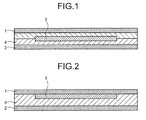
- FIG. 1 is a cross-sectional structural view illustrating an example of a solar cell module formed by using a solar cell sealant sheet or a sealant-integrated substrate according to the present invention.
- FIG. 2 is a cross-sectional structural view illustrating another example of a solar cell module formed by using the solar cell sealant sheet or the sealant-integrated substrate according to the present invention.
- FIGS. 1 and 2 are cross-sectional structural views illustrating examples of a solar cell module formed by using a solar cell sealant sheet or a sealant-integrated substrate according to the present invention.
- a solar cell element 3 is sealed between a transparent plate 1 provided on the light receiving side and a back surface protection sheet 2 while sandwiched by a sealant 4.
- the solar cell element 3 is disposed so as to make contact with the transparent plate 1 provided on the light receiving side, and sealed with the sealant 4 filled between the transparent plate 1 and the back surface protection sheet 2.
- the sealant 4 is obtained by thermally curing a coating film of a specific water-soluble thermosetting resin particle-dispersed paint, which is described later, or a sealant sheet of the coating film.
- the coating film is formed by applying the paint on a surface of the transparent plate 1 or/and the back surface protection sheet 2, wherein the surface is the one facing the solar cell element 3.
- the transparent plate 1 or the back surface protection sheet 2 with the coating film layered thereon corresponds to a sealant-integrated substrate defined in the present Invention.
- the coating film is layered on both the transparent plate 1 and the back surface protection sheet 2.
- the coating film is layered only on the back surface protection sheet 2.
- the sealant sheet may be obtained by applying the paint on another resin sheet, drying the applied paint, and peeling the dried coating film off the resin sheet.
- two sealant sheets are prepared. Upon assembling the solar cell module, the two sealant sheets are disposed between the transparent plate 1 and the back surface protection sheet 2 so as to sandwich the solar cell element 3. Thereafter, a layered body composed of (the transparent plate 1)-(the sealant sheet)-(the solar cell element 3)-(the sealant sheet)-(the back surface protection sheet 2) is subjected to vacuum-pressure molding with application of heat, so that the sealant sheets of the layered body are thermally cured to be the sealant 4.
- FIG. 1 two sealant sheets are prepared. Upon assembling the solar cell module, the two sealant sheets are disposed between the transparent plate 1 and the back surface protection sheet 2 so as to sandwich the solar cell element 3. Thereafter, a layered body composed of (the transparent plate 1)-(the sealant sheet)-(the solar cell element 3)-(the sealant sheet)-(the back surface protection
- the sealant sheet is disposed so as to cover the solar cell element 3 abutted to the transparent plate 1, and the back surface protection sheet 2 is disposed outside the sealant sheet.
- a layered body composed of (the transparent plate 1)-(the solar cell element 3)-(the sealant sheet)-(the back surface protection sheet 2) is subjected to vacuum-pressure molding with application of heat.
- the sealant sheet is thermally cured to be the sealant 4 sealing the surrounding of the solar cell element 3 in a state of being contact with the transparent plate 1.
- the thickness of the sealant 4 is preferably set in a range from 30 ⁇ m to 400 ⁇ m depending on its application. In order to form the sealant 4 with the aforementioned film thickness, the thicknesses of the coating film and the sealant sheet are appropriately adjusted in a range from 30 ⁇ m to 400 ⁇ m.
- the coating film constituting the sealant sheet for use in the present invention has a pencil hardness (B) after being thermally cured of 4B or higher.
- the coating film has a characteristic that a hardness ratio (B/A) of the hardness (B) after being thermally cured relative to a hardness (A) before being heated is 1.1 or higher.
- An inorganic glass plate is typically used as the transparent plate 1.
- An acrylic organic glass and any transparent resin sheet may also be used as the transparent plate 1.
- a resin film produced by extrusion of any one of or a mixture of resins each having an insulation property may be used.
- the resins may include PE (polyethylene), PP (polypropylene), PET (polyethylene terephthalate), PEN (polyethylene naphthalate), PBT (polybutylene terephthalate), LCP (liquid crystal polymer), PVF (polyvinyl fluoride), PPS (polyphenylenesulfide), polyamide (nylon 6, and nylon 66), and PC (polycarbonate) resins.
- PE polyethylene
- PP polypropylene
- PET polyethylene terephthalate
- PEN polyethylene naphthalate
- PBT polybutylene terephthalate
- LCP liquid crystal polymer
- PVF polyvinyl fluoride
- PPS polyphenylenesulfide
- polyamide nylon 6, and nylon 66
- PC polycarbonate
- the paint for forming the aforementioned coating film is a water-soluble thermosetting resin-dispersed paint.
- the paint contains a resin having a quaternized ammonium group that is used as a dispersant.
- the resin is the one obtained by addition of a tertiary amine compound and an organic acid to a resin having an epoxy group.
- This dispersant is emulsion-polymerized with a monomer mixture containing an ⁇ , ⁇ -ethylenically unsaturated monomer having an alkoxysilyl group, so that water-soluble thermosetting resin particles is obtained.
- An alkoxysilane paint is prepared such that the paint contains from 3 to 20% by weight of the resulting water-soluble thermosetting resin particles as a solid content.
- the resulting paint may be used as the water-soluble thermosetting resin-dispersed paint in the present invention.
- the thick coating film formed with the paint is once plasticized with the heat in vacuum-pressure molding in the assembling process of the solar cell module, to be tightly bonded to the solar cell element.
- the plasticized coating film is thereafter cured so as to seal the solar cell element. This process does not involve such a phenomenon that the coating film in a plasticized state overflows to the periphery of the solar cell module, and sticks to the assembly apparatus to cause contamination. Employment of such a coating film enables sealing of the solar cell element with high accuracy. As a result, a high quality solar cell module can be obtained.
- the solid content weight ratio of the resin having the ammonium group (dispersant) relative to the monomer mixture may be from 5/95 to 20/80.
- the ratio of the ⁇ , ⁇ -ethylenically unsaturated monomer having the alkoxysilyl group in the monomer mixture may be from 5 to 35% by weight.
- a weight average molecular weight of the water-soluble thermosetting resin may be from 6000 to 12000.
- a glass-transition temperature of the monomer mixture may be from 50 to 100°C.
- the water-soluble thermosetting resin may further include an alcohol having 1 to 18 carbon atoms. The molar quantity content of the alcohol may be from 2 to 5 times larger than that of the ⁇ , ⁇ -ethylenically unsaturated monomer having the alkoxysilyl group.
- the resin having the ammonium group is used as the dispersant, wherein the resin is a quaternized ammonium resin obtained by adding the tertiary amine compound and the organic acid to the resin having the epoxy group.
- the dispersant With the dispersant, the monomer mixture containing the ⁇ , ⁇ -ethylenically unsaturated monomer having the alkoxysilyl group is emulsion-polymerized.
- the paint contains from 3 to 20% by weight of the water-soluble thermosetting resin particles as the resin solid content.
- the paint may contain an epoxy resin and/or an acrylic resin having an amine-modified epoxy group.
- the paint may also contain the resin having the ammonium group as the binder component.
- the water-soluble thermosetting resin before being heated is in a non-crosslinking state.
- the resin particles constituting the coating film start melting and simultaneously water attached to the surfaces of the resin particles becomes moisture and diffuses in the region between the particles.
- the moisture reacts with the alkoxyl groups constituting the resin particles to form alkoxysilyl groups.
- condensation between the alkoxysilyl groups proceeds.
- the hardness of the coating film increases in a uniform manner in the film thickness direction. Consequently, the coating film is homogeneously cured by the homogeneous moisture.
- the solar cell element is sealed with the sealant obtained by homogeneous curing of the coating film, to thereby achieve very high airtightness.
- the coating film when used, no insufficiency in curing of the coating film occurs in the process in which the coating film is once plasticized and then cured with the heat in vacuum-pressure molding in the assembling process of the solar cell module. Consequently, the use of the coating film can prevent a phenomenon which occurs when the related-art sealant sheet is used, in which an adhesive resin melts and overflows due to insufficient curing of the sheet, and the adhesive resin in the plasticized state sticks to an assembly board surface of the molding apparatus to cause contamination.
- the resin particles can be dispersed in a uniform state in the coating film.
- the glass-transition temperature of the monomer mixture at a high temperature, stability of the monomer mixture in a paint component that will serve as the binder can be enhanced.
- the molecular weight of the resin particle By setting the molecular weight of the resin particle to a lower value, flowability of the paint can be enhanced.
- the resin having the ammonium group has from 2 to 15 ammonium groups per molecule.
- the number of ammonium groups is greater than 15 per molecule, a water-resistant property may lower, whereas, when the number of ammonium groups is smaller than 2 per molecule, it is difficult to obtain the desired water-soluble thermosetting resin-dispersed paint.
- the resin having the ammonium group for use is a quaternized resin obtained by adding the tertiary amine compound and the organic acid to the resin having the epoxy group.
- a resin obtained by quaternizing a resin having a tertiary amino group with the organic acid is used, the water-soluble thermosetting resin-dispersed paint obtained using such a resin may have a problem in storage stability.
- the resin having an epoxy group may include an epoxy resin and an acrylic resin.
- the epoxy resin is not limited to a specific type, and general examples thereof may include a polyphenol polyglycidyl ether type epoxy resin that is a reaction product of a polycyclicphenol compound with epichlorohydrin, wherein the polycyclicphenol compound may be bisphenol-A, bisphenol-F, bisphenol-S, phenolnovolack, and cresolnovolack.
- a resin obtained by chain extension of the epoxy resin exemplified in the above with, e.g., bifunctional polyester polyol, polyether polyol, bisphenols, and a dibasic carboxylic acid.
- the epoxy equivalent of the epoxy resin is from 600 to 1200.
- the acrylic resin for use may be an acrylic resin having an epoxy group that is obtained by copolymerizing the ⁇ , ⁇ -ethylenically unsaturated monomer having an epoxy group, such as glycidil (meth)acrylate, with another ⁇ , ⁇ -ethylenically unsaturated monomer.
- the epoxy group is ring-opened by the tertiary amine to form the ammonium group.
- the amount of the ⁇ , ⁇ -ethylenically unsaturated monomer having the epoxy group may thus be determined based on the aforementioned preferable number of ammonium groups.
- the other ⁇ , ⁇ -ethylenically unsaturated monomer for use may be an ⁇ , ⁇ -ethylenically unsaturated monomer that does not react with the epoxy group, among typical ⁇ , ⁇ -ethylenically unsaturated monomers examples of which will be enumerated in the description of manufacture of the water-soluble thermosetting resin particles.
- the solubility parameter of the monomer for copolymerization for obtaining the acrylic resin having the epoxy group is preferably six or more.
- the monomer having the solubility parameter of less than six may cause a problem of adhesion insufficiency between the resin and the substrate (the transparent plate 1 and/or the back surface protection sheet 2).
- the solubility parameter is referred to by a person skilled in the art as solubility parameter (sometimes also abbreviated as SP).
- the solubility parameter is a index of hydrophilicity or hydrophobicity of a resin, and also an important index to determine compatibility between resins.
- the solubility parameter is numerically quantified based on a turbidity measurement method such as the method described in the following literature. Reference literature: K. W. Suh, D.H. Clarke, J. Polymer. Sci., A-1,5,1671 (1967 ).
- the acrylic resin having an epoxy group may be obtained by a typical method, in which the aforementioned monomers are solution-polymerized using a well-known initiator.
- a number average molecular weight of the acrylic resin having an epoxy group obtained in this manner is preferably from 5000 to 20000. When the number average molecular weight is more than 20000, viscosity of the resin increases to excessively high level that is unsuitable as an emulsifier whereas, when the number average molecular weight is less than 5000, it is difficult to obtain desired water-based resin particles.
- the quaternization may be achieved by preliminarily mixing the tertiary amine compound and the organic acid, and then adding the mixture to the resin having an epoxy group as a quaternization agent.
- Examples of the tertiary amine compound for incorporating the ammonium group in the resin may include trimethylamine, triethylamine, tributylamine, trioctylamine, dimethylethanolamine, and methyldiethanolamine.
- the amount of the tertiary amine compound may be determined depending on the amount of the ammonium group to be incorporated.
- Examples of the organic acid may include formic acid, acetic acid, lactic acid, propionic acid, boric acid, butyric acid, dimethylolpropionic acid, hydrochloric acid, sulfuric acid, phosphoric acid, N-acetylglycine, and N-acetyl- ⁇ -alanine.
- lactic acid, acetic acid, and dimethylolpropionic acid are preferable in terms of stability in the emulsification process.
- the molar ratio of the epoxy group included in the acrylic resin having an epoxy group, the tertiary amine compound, and the organic acid are preferably from 1/1/1 to 1/1/2.
- the quaternization reaction is generally performed over 2 to 10 hours. If needed, the materials under the reaction may be heated at from 60 to 100°C.
- Examples of the ⁇ , ⁇ -ethylenically unsaturated monomer having the alkoxysilyl group may include ⁇ -methacryloxypropyltrimethoxysilane, ⁇ -acryloxypropylmethyldimethoxysilane, ⁇ -methacryloxypropylmethyldimethoxysilane, ⁇ -acryloxypropyldimethylmethoxysilane, ⁇ -methacryloxypropyldimethylmethoxysilane, ⁇ -acryloxypropyltriethoxysilane, ⁇ -methacryloxypropyltriethoxysilane, ⁇ -acryloxypropylmethyldiethoxysilane, ⁇ -methacryloxypropyl-methyldiethoxysilane, ⁇ -acryloxypropyldimethylethoxysilane, ⁇ -methacryloxypropyldimethylethoxysilane, vinyltrimethoxysilane, vinylmethyldimethoxysilane, vinyltriethoxys
- ⁇ -methacryloxypropyltrimethoxysilane, ⁇ -methaoryloxypropyltriethoxysilane, ⁇ -methacryloxypropylmethyldimethoxysilane, and ⁇ -methacryloxypropylmethyldiethoxysilane are more preferable because they are well polymerized with other ⁇ , ⁇ -ethylenically unsaturated monomer, and easily industrially available.
- the monomer mixture contains a general ⁇ , ⁇ -ethylenically unsaturated monomer, in addition to the a, ⁇ -ethylenically unsaturated monomer having the alkoxysilyl group.
- the general ⁇ , ⁇ -ethylenically unsaturated monomer may include an ⁇ , ⁇ -ethylenically unsaturated monomer having a hydroxyl group, such as hydroxyethyl acrylate, hydroxyethyl methacrylate, hydroxypropyl acrylate, hydroxypropyl methacrylate, hydroxybutyl acrylate, hydroxybutyl methacrylate, allyl alcohol, methacryl alcohol, and a hydroxyethyl acrylate or hydroxyethyl methacrylate adduct of ⁇ -caprolactone.
- examples of the ⁇ , ⁇ ethylenically unsaturated monomer having no reactive functional group may include acrylic ester or methacrylic ester (e.g., methyl acrylate, methyl methacrylate, ethyl acrylate, ethyl methacrylate, n-propyl acrylate, n-propyl methacrylate, isopropyl acrylate, isopropyl methacrylate, n-butyl acrylate, n-butyl methacrylate, isobutyl acrylate, isobutyl methacrylate, t-butyl acrylate, t-butyl methacrylate, 2-ethylhexyl acrylate, 2-ethylhexyl methacrylate, lauryl methacrylate, phenyl acrylate, isobornyl acrylate, isobornyl methacrylate, cyclohexyl methacrylate,
- the ratio of the ⁇ , ⁇ -ethylenically unsaturated monomer having the alkoxysilyl group in the monomer mixture may be 5 to 35% by weight. When the ratio is less than 5% by weight, overflow prevention may not become sufficient whereas, when the ratio is more than 35% by weight, storage stability may become insufficient.
- the glass-transition temperature of the monomer mixture is from 50 to 100°C.
- the glass-transition temperature is lower than 50°C, storage stability may become insufficient whereas, when the glass-transition temperature is higher than 100°C, overflow prevention may become insufficient.
- Preferable lower limit is 60°C whereas preferable upper limit is 95°C.
- the solubility parameter of the monomer mixture is from 9 to 12.
- adhesion with the resin film may become insufficient whereas, when the solubility parameter is more than 12, an outer appearance and a rust prevention property of the coating film formed with an alkoxysilane adhesive paint in which the resin is used tend to lower.
- the monomer mixture may contain an alcohol having 4 to 18 carbon atoms. Containing an alcohol having 6 to 18 carbon atoms, the monomer mixture can improve storage stability of the water-soluble thermosetting resin-dispersed paint of the present invention.
- Examples of the alcohol having 6 to 18 carbon atoms may include straight chain aliphatic alcohols (e.g., hexyl alcohol, octyl alcohol, lauryl alcohol, and stearyl alcohol), branched aliphatic alcohols (e.g., 2-ethylhexyl alcohol, and cyclohexyl alcohol), polyethylene glycol ethers (e.g., ethylene glycol monoalkyl ethers, diethylene glycol monoalkyl ethers, triethylene glycol monoalkyl ethers, and polyethylene glycol phenyl ether), polypropylene glycol ethers (e.g., propylene glycol monoalkyl ethers, dipropylene glycol monoalkyl ethers, tripropylene glycol monoalkyl ethers, and polypropylene glycol phenyl ether), and aromatic alcohols (e.g., phenol, and cresol).
- straight chain aliphatic alcohols e.g.
- the molar content of the alcohol may be set from 2 to 5 times that of the ⁇ , ⁇ -ethylenically unsaturated monomer having the alkoxysilyl group.
- the water-soluble thermosetting resin-dispersed paint thus obtained for use in the present invention substantially contains a predetermined amount of the alcohol having 6 to 18 carbon atoms.
- the emulsion-polymerization for obtaining the water-soluble thermosetting resin-dispersed paint may be performed by a well-known method. Specifically, the polymerization may be performed by adding the resin having the ammonium group as a dispersant to an aqueous vehicle containing water and, if necessary, an organic solvent such as alcohol, and then adding dropwise the monomer mixture and a polymerization initiator into the aqueous vehicle while the aqueous vehicle is heated and stirred. The dropwise addition of the monomer mixture may be performed by adding dropwise a monomer mixture that has been preliminarily emulsified using a dispersant and water.
- the emulsion-polymerization may be performed by the following method.
- the aforementioned dispersant is dissolved in the aqueous vehicle.
- the initiator is added dropwise while the aqueous vesicle is heated and stirred.
- part of the monomer mixture is added dropwise.
- remaining monomer mixture that has been preliminarily emulsified by using the dispersant and water is added dropwise.
- This method can reduce deviation of the particle size of the resin from a desired particle size. As a result, preferable water-soluble thermosetting resin particles can be formed.
- Examples of the preferably used polymerization initiator may include: azo oil compounds (e.g., azobisisobutyronitrile, 2,2'-azobis(2-methylbutyronitrile), 2,2'-azobis(2-(2-imidazolin-2-ylypropane), and 2,2'-azobis(2,4-dimethylvaleronitrile); aqueous compounds (e.g., anionic compounds such as 4,4'-azobis(4-cyanovaleric acid), 2,2-azobis(N-(2-carbaxyethyl)-2-methylpropionamidine), and cationic compounds such as 2,2'-azobis(2-methylpropionamidine); redox oil peroxides (e, g., benzoyl peroxide, para-chlorobenzoyl peroxide, lauroyl peroxide, and t-butyl perbenzoate); and aqueous peroxides (e.g., potassium persulfate, and ammonium per
- dispersants that are usually used by persons skilled in the art and reactive emulsifying agents may be used together.
- examples thereof may include Antox MS-60 (a trade name of a product manufactured by Nippon Nyukazai Co., Ltd.), Eleminol JS-2 (a trade name of a product manufactured by Sanyo Chemical Industries, Ltd.), Adekalia Soap NE-20 (a trade name of a product manufacture by Asahi Denka Co., Ltd.), and Aquaron HS-10 (a trade name of a product manufactured by Daiichi Kogyo Seiyaku Co., Ltd).
- the blend ratio of the resin having the ammonium group used as the dispersant relative to the monomer mixture is preferably adjusted in a range from 5/95 to 20/80 by the solid content weight ratio.
- the blend solid content ratio is less than 5/95, the monomer particles in the dispersed solution are cohered to form aggregates, which lead to deterioration in smoothness of the coating film and defect in solar cell element sealing.
- the blend solid content ratio is more than 20/80, the sealant tends to overflow.
- a chain transfer agent such as mercaptan such as laurylmercaptan, and ⁇ -methylstyrene dimer for adjusting molecular weight of the resin.
- the reaction temperature is determined by the initiator.
- the reaction temperature is preferably from 60 to 90°C when an azo-based initiator is used.
- the reaction temperature is preferably from 30 to 70°C.
- the reaction duration is from 1 to 8 hours.
- the amount of the initiator relative to the total amount of the ( ⁇ , ⁇ -ethylenically unsaturated monomer mixture is generally from 0.1 to 5% by weight, and preferably from 0.2 to 2% by weight.
- the average particle size of dispersed resin particles in the water-soluble thermosetting resin-dispersed paint thus obtained is in a range from 0.05 to 0.30 ⁇ m.
- the particle size may be controlled by, e.g., adjusting the composition of the monomer mixture and emulsion polymerization conditions.
- the weight average molecular weight of the water-soluble thermosetting resin is from 6000 to 12000.
- the sealant may extensively overflow whereas, when the weight average molecular weight is more than 12000, the smoothness of the coating film may lower.
- the water-soluble thermosetting resin-dispersed paint for use in the present invention is an alkoxysilane paint containing from 3 to 20% by weight of the water-soluble thermosetting resin as the resin solid content.
- the binder component is preferably the epoxy resin and/or the acrylic resin obtained by the amine-moditication of .the epoxy group.
- the binder component may contain the resin having the ammonium group.
- the water-soluble thermosetting resin-dispersed paint for use in the present invention may be obtained by adding a predetermined amount of the water-soluble thermosetting resin to a usual water-based paint emulsion composition.
- the emulsion composition of the water-based alkoxysilane paint may include the emulsion composition containing the epoxy resin and/or the acrylic resin having the amine-modified epoxy group as the binder resin, and a block isocyanate as a hardener.
- a reaction container 120 parts of butyl cellosolve was placed, and heated at 120°C and stirred.
- An initiator solution and monomers are simultaneously added dropwise thereinto over 3 hours, wherein the initiator solution is a mixture of 2 parts of t-butylperoxy-2-ethylhexanoate and 10 parts of butyl cellosolve, and wherein the monomers are composed of 19 parts of glycidyl methacrylate, 60 parts of 2-ethylhexyl methacrylate, 20 parts of 2-hydroxyethyl methacrylate, and 1 part of n-butyl methacrylate, and has a solubility parameter of 10.1.
- the acrylic resin having epoxy groups thus obtained had a number average molecular weight of 8500 and a weight average molecular weight of 17900, which were measured by a GPC using polystyrene standards. Then, 7 parts of dimethylaminoethanol and 15 parts of a 50% lactic acid aqueous solution were added to the acrylic resin, and the mixture was heated at 80°C, to perform quaternization. Heating was ceased at the time when an acid number was equal to or smaller than one, and an increase in viscosity plateaued. In this manner, an acrylic resin having ammonium groups was obtained. The number of ammonium groups per molecule of the acrylic resin having ammonium groups was 8.2.
- a resin dispersion liquid Bla 70 parts of the acrylic resin having ammonium groups manufactured in Manufacturing Example 1 and 250 parts of deionized water were mixed to obtain a resin dispersion liquid Bla. Apart from the resin dispersion liquid Bla, 170 parts of methyl methacrylate, 40 parts of styrene, 30 parts of n-butyl methacrylate, 30 parts of ⁇ -methacryloxypropyltriethoxysilane, and 1 part of laurylmercaptan are mixed and stirred, to obtain a mixed resin dispersion liquid (a monomer mixture containing the ⁇ , ⁇ -ethylenically unsaturated monomer having the alkoxysilyl group) B1b. The mixed resin dispersion liquid B1b was added to the resin dispersion liquid B1a, and then they were stirred, to obtain a pre-emulsion. The pre-emulsion is designated as a resin dispersion liquid B1.
- the resin dispersion liquid B1 was added dropwise over 40 minutes into the resin dispersion liquid A1. After aging of the resulting mixed resin dispersion liquid for 60 minutes, the mixed resin dispersion liquid was cooled down, to obtain a water-based resin particle dispersion liquid AB1.
- the resulting water-soluble thermosetting resin dispersion liquid AB1 had a nonvolatile content of 38%, a pH of 5.0, and an average particle size of 90 nm. The average particle size was measured by a laser light scattering method.
- a resin dispersion liquid B2a 70 parts of the acrylic resin having ammonium groups manufactured in Manufacturing Example 1 and 270 parts of deionized water were mixed to obtain a resin dispersion liquid B2a.
- a resin dispersion liquid B2a 150 parts of methyl methacrylate, 35 parts of styrene, 25 parts of n-butyl methacrylate, 60 parts of ⁇ -methacryloxypropyltriethoxysilane, and 1 part of iaurylmercaptan were mixed and stirred, to obtain a mixed resin dispersion liquid (a mixture containing the ⁇ , ⁇ -ethylenically unsaturated monomer having the alkoxysilyl group) B2b.
- the mixed resin dispersion liquid B2b was added to the resin dispersion liquid B2a, and then they were stirred, to obtain a pre-emulsion.
- the pre-emulsion is designated as a resin dispersion liquid B2.
- the resin dispersion liquid B2 was added dropwise over 40 minutes into the resin dispersion liquid A2. After aging of the resulting mixed resin dispersion liquid for 60 minutes, the mixed resin dispersion liquid was cooled down, to obtain a water-soluble thermosetting resin dispersion liquid AB2.
- the resulting water-based resin particle dispersion liquid AB2 had a nonvolatile content of 37%, a pH of 4.7, and an average particle size of 100 nm. The average particle size was measured by the laser light scattering method.
- a water-soluble thermosetting resin particle dispersion liquid AB3 was obtained in the same manner as in Manufacturing Example 4 except that the composition of the mixed resin dispersion liquid (the mixture containing the ⁇ , ⁇ -ethylenically unsaturated monomer having the alkoxysilyl group) B1b was changed.
- the changed composition was composed of 150 parts of methyl methacrylate, 35 parts of styrene, 55 parts of n-butyl acrylate, 30 parts of ⁇ -methacryloxypropyltriethoxysilane, and 1 part of laurylmercaptan.
- the resulting water-based resin particle dispersion liquid AB3 had a nonvolatile content of 38%, a pH of 5.0, and an average particle size of 90 nm. The average particle size was measured by the laser light scattering method.
- a water-based resin particle dispersion liquid AB4 was obtained in the same manner as in Manufacturing Example 4 except that the composition of the mixed resin dispersion liquid (the mixture containing the ⁇ , ⁇ -ethylenically unsaturated monomer having the alkoxysilyl group) B1b was changed.
- the changed composition was composed of 150 parts of methyl methacrylate, 35 parts of styrene, 55 parts of n-butyl methacrylate, 30 parts of ⁇ -methacryloxypropyltriethoxysilane, 1 part of laurylmercaptan, and 40 parts of lauryl alcohol.
- the resulting water-soluble thermosetting resin dispersion liquid AB4 had a nonvolatile content of 38%, a pH of 5.0, and an average particle size of 90 nm. The average particle size was measured by a laser light scattering method.
- a comparative water-soluble thermosetting resin particle dispersion liquid C1 was obtained in the same manner as in Manufacturing Example 4 except that the composition of the mixed resin dispersion liquid (the mixture containing the ⁇ , ⁇ -ethylenically unsaturated monomer having the alkoxysilyl group) B1b was changed to a composition containing no ⁇ , ⁇ -ethylenically unsaturated monomer having the alkoxysilyl group.
- the changed composition was composed of 160 parts of methyl methacrylate, 45 parts of styrene, 65 parts of n-butyl methacrylate, and 1 part of laurylmercaptan.
- the resulting comparative water-soluble thermosetting resin particle dispersion liquid C1 had a nonvolatile content of 38%, a pH of 5.0, and an average particle size of 90 nm. The average particle size was measured by a laser light scattering method.
- a comparative water-soluble thermosetting resin particle dispersion liquid C2 was obtained in the same manner as in Manufacturing Example 5 except that the composition of the mixed resin dispersion liquid (the mixture containing the ⁇ , ⁇ -ethylenically unsaturated monomer having the alkoxysilyl group) B2b was changed.
- the changed composition was composed of 165 parts of methyl methacrylate, 30 parts of styrene, 25 parts of n-butyl methacrylate, 30 parts of ⁇ -methacryloxypropyltriethoxysilane, and 25 parts of neopentyl glycol dimethacrylate.
- the resulting comparative water-soluble thermosetting resin particle dispersion liquid C2 had a nonvolatile content of 38%, a pH of 5.0, and an average particle size of 90 nm. The average particle size was measured by a laser light scattering method.
- the substrate resin obtained in Manufacturing Example 2 and the block isocyanate hardener obtained in Manufacturing Example 3 were uniformly mixed at the solid content blend ratio of 75:25, and thereafter a solvent was added to the mixture by an amount of 3% relative to the solid content.
- a glacial acetic acid was added so as to neutralize the mixture to have a neutralization ratio of 43%.
- ion-exchanged water was added so as to gradually dilute the mixture.
- MIBK was removed under reduced pressure so that the solid content was 36%. As a result, a main emulsion was obtained.
- the paint P1 was applied on both surfaces of PET (having a thickness of 50 ⁇ m) with a thickness of 100 ⁇ m.
- the hardness of the coating film was measured before and after being heated at 150°C for 5 minutes.
- the gas barrier property (JIS Z0208 cup method (40°C x 90% RH)) after being cured was 0.1 g/m 2 •24 hrs.
- Alkoxysilane paint compositions containing water-soluble thermosetting resin particles (water-soluble thermosetting resin-dispersed paints) P2, P3, and P4 were prepared in the same manner as Example 1 except that the water soluble thermosetting resin particle-dispersed liquids were changed to the dispersed liquids AB2, AB3, and AB4, respectively, obtained by Manufacturing Examples 5 to 7, respectively.
- Each of the paints P2, P3, and P4 was applied on both surfaces of a PET film (having a thickness of 50 ⁇ m) with a thickness of 100 ⁇ m.
- the hardness of each coating film was measured before and after being heated at 150°C for 5 minutes.
- the hardness (A) before being heated was 40, 45, and 48 (JIS hardness A), respectively, whereas the hardness (B) after being heated was 66, 59, and 58 (hardness ratios (B/A) are 1.5, 1.3, and 1.2), respectively.
- the gas barrier property (JIS Z0208 cup method (40°C ⁇ 90% RH)) after being cured was 0.2, 0.4, and 0.8 g/m 2 •24 hrs, respectively.
- Each of the two kinds of paint compositions Pc1 and Pc2 was applied on both surfaces of PET (having a thickness of 50 ⁇ m) with a thickness of 100 ⁇ m.
- the hardness of each coating film was measured before and after being heated at 150°C for 5 minutes.
- the hardness (A) before being heated was 40 and 47 (JIS hardness A), respectively, whereas the hardness (B) after being heated was 38 and 43 (hardness ratios (B/A) are 0.1 and 0.9), respectively.
- the gas barrier property (JIS Z0208 cup method (40°C x 90% PH)) after being cured was 23 and 18 g/m 2 •24 hrs, respectively.
- the related-art sealant sheet was a layered sheet prepared with an extruder and composed of a core material of an ethylene resin and a graft polymer or a copolymer of alkoxysilane.
- a hindered amine light stabilizer and 0.1 parts by weight of a phenol antioxidant were added to a silane modified ethylene-ethyl acrylate copolymer in which 0.8% by weight of alkoxysilane was graft-polymerized at 83°C, which is the melting point of the silane modified ethylene-ethyl acrylate copolymer, to prepare a copolymer composition.
- the copolymer composition was extruded by an extruding method at 150°C to form a sheet having a thickness of 100 ⁇ m. From the resulting sheet, two sheets were cut out.
- the two cut sheets were laminated on both surfaces of PET (having a thickness of 50 ⁇ m) by hot pressing under the conditions of 150°C for 5 minutes, so that a layered body was formed.
- the gas barrier property JIS Z0208 cup method (40°C x 90% PH)) of the layered body was measured, and the value was 17 g/m 2 •24 hrs.
- a solar cell element was sealed with the paint compositions obtained in Examples 1 to 4 and Comparative Examples 1 to 3, and sealing properties were evaluated.
- An aluminum plate having a thickness of 0.3 mm was used as a substitute for the solar cell element.
- a mock solar cell module for evaluation was assembled in the following manner.
- the layer structure of the mock solar cell module was as follows: an aluminum plate (substitute element) was placed on a sealant layer of a back sheet (back surface protection sheet integrated with a sealant); a sealant sheet was layered thereon so as to cover the aluminum plate; and lastly, a light receiving side transparent plate was layered.
- a float glass having a thickness of 3 mm was prepared as the light receiving side transparent plate.
- a back surface protection sheet integrated with a sealant (sealant-integrated substrate) was prepared in which a sealant layer having a thickness of 0.3 mm was layered on a PET film having a thickness of 125 ⁇ m.
- the sealant layers of the back sheets were composed of each of the dried coating films of the paint compositions obtained in Examples 1 to 4 and comparative Examples 1 to 3.
- the sealant sheet the dried coating films (having a thickness of 0.3 mm) of the paint compositions obtained in Examples 1. to 4 and Comparative Examples 1 to 3 were prepared.
- the layered bodies had the sealant sheets and the sealant layers of the back sheets that were composed of each of the dried coating films of the paint compositions obtained in Examples 1 to 4 and Comparative Examples 1 to 3.
- Each of the layered bodies was molded by vacuum heat press at 130°C for 20 minutes, to obtain mock solar cell modules.
- the present invention can provide the solar cell sealant sheet and the sealant-integrated substrate that can seal and bond a solar cell element without causing a problem in that a sealant in the plasticized state overflows to the periphery of a solar cell module, and sticks to an assembly apparatus to cause contamination in the assembly step of the solar cell module.
Landscapes
- Chemical & Material Sciences (AREA)
- Organic Chemistry (AREA)
- Health & Medical Sciences (AREA)
- Chemical Kinetics & Catalysis (AREA)
- Medicinal Chemistry (AREA)
- Polymers & Plastics (AREA)
- Engineering & Computer Science (AREA)
- Life Sciences & Earth Sciences (AREA)
- General Chemical & Material Sciences (AREA)
- Materials Engineering (AREA)
- Wood Science & Technology (AREA)
- Dispersion Chemistry (AREA)
- Paints Or Removers (AREA)
- Sealing Material Composition (AREA)
- Polymerisation Methods In General (AREA)
- Addition Polymer Or Copolymer, Post-Treatments, Or Chemical Modifications (AREA)
- Photovoltaic Devices (AREA)
Applications Claiming Priority (2)
| Application Number | Priority Date | Filing Date | Title |
|---|---|---|---|
| JP2009166615 | 2009-07-15 | ||
| PCT/JP2010/061802 WO2011007766A1 (ja) | 2009-07-15 | 2010-07-12 | 太陽電池用封止剤シートおよび封止剤一体型基材 |
Publications (1)
| Publication Number | Publication Date |
|---|---|
| EP2455979A1 true EP2455979A1 (de) | 2012-05-23 |
Family
ID=43449373
Family Applications (1)
| Application Number | Title | Priority Date | Filing Date |
|---|---|---|---|
| EP10799824A Withdrawn EP2455979A1 (de) | 2009-07-15 | 2010-07-12 | Dichtungsmittelplatte für solarzellen und dichtungsmittel-integriertes grundmaterial |
Country Status (6)
| Country | Link |
|---|---|
| US (1) | US20120167985A1 (de) |
| EP (1) | EP2455979A1 (de) |
| JP (1) | JP4709330B2 (de) |
| KR (1) | KR101290225B1 (de) |
| CN (1) | CN102473771A (de) |
| WO (1) | WO2011007766A1 (de) |
Families Citing this family (3)
| Publication number | Priority date | Publication date | Assignee | Title |
|---|---|---|---|---|
| US20130240019A1 (en) * | 2012-03-14 | 2013-09-19 | Ppg Industries Ohio, Inc. | Coating-encapsulated photovoltaic modules and methods of making same |
| CN111910860A (zh) * | 2020-08-14 | 2020-11-10 | 安徽山水空间装饰有限责任公司 | 一种墙纸铺贴方法 |
| JP6924887B1 (ja) * | 2020-11-02 | 2021-08-25 | ジョジアン ジンコ ソーラー カンパニー リミテッド | 光起電力モジュール |
Family Cites Families (4)
| Publication number | Priority date | Publication date | Assignee | Title |
|---|---|---|---|---|
| JP3648756B2 (ja) * | 1994-03-22 | 2005-05-18 | Jsr株式会社 | 半導体素子用コーテイング材 |
| JP5052714B2 (ja) * | 2001-02-09 | 2012-10-17 | 三菱樹脂株式会社 | 接着性シート、太陽電池充填材用シート及びそれを用いた太陽電池 |
| JP2005162916A (ja) * | 2003-12-04 | 2005-06-23 | Nippon Paint Co Ltd | 水性樹脂粒子およびこれを含むカチオン電着塗料組成物 |
| ES2370009T3 (es) * | 2006-08-22 | 2011-12-09 | Asahi Glass Company, Limited | Composición endurecible. |
-
2010
- 2010-07-12 EP EP10799824A patent/EP2455979A1/de not_active Withdrawn
- 2010-07-12 CN CN2010800316095A patent/CN102473771A/zh active Pending
- 2010-07-12 US US13/383,285 patent/US20120167985A1/en not_active Abandoned
- 2010-07-12 KR KR1020127000978A patent/KR101290225B1/ko not_active Expired - Fee Related
- 2010-07-12 WO PCT/JP2010/061802 patent/WO2011007766A1/ja not_active Ceased
- 2010-07-12 JP JP2010549976A patent/JP4709330B2/ja not_active Expired - Fee Related
Non-Patent Citations (1)
| Title |
|---|
| See references of WO2011007766A1 * |
Also Published As
| Publication number | Publication date |
|---|---|
| WO2011007766A1 (ja) | 2011-01-20 |
| US20120167985A1 (en) | 2012-07-05 |
| KR20120030534A (ko) | 2012-03-28 |
| KR101290225B1 (ko) | 2013-07-30 |
| JPWO2011007766A1 (ja) | 2012-12-27 |
| CN102473771A (zh) | 2012-05-23 |
| JP4709330B2 (ja) | 2011-06-22 |
Similar Documents
| Publication | Publication Date | Title |
|---|---|---|
| KR101615514B1 (ko) | 전지 포장재용 폴리우레탄 접착제, 전지용 포장재, 전지 용기 및 전지 | |
| EP2087060B1 (de) | Acrylhaftkleber für polarisationsplatte mit photoinitiatorgruppe | |
| US8765833B2 (en) | UV-curable optical resin adhesive composition | |
| EP2226371A2 (de) | Haftzusammensetzung, haftfähige polarisatorplatte und flüssigkristallanzeigevorrichtung damit | |
| EP2618383A1 (de) | Basismaterial für ein solarzellenmodul und verfahren zu seiner herstellung | |
| EP2671930A1 (de) | Klebstoff für rückseitige folie einer solarzelle | |
| EP2455978A1 (de) | Rückseitiges schutzblech für solarzellen und herstellungsverfahren dafür | |
| CN110776854B (zh) | 粘着片及层叠体 | |
| JP6511994B2 (ja) | 硬化性接着性樹脂組成物、およびそれを用いてなる太陽電池裏面保護シート | |
| US20120167985A1 (en) | Solar cell sealant sheet and sealant-integrated substrate | |
| JP6115106B2 (ja) | 硬化性コーティング組成物、積層ポリエステル樹脂フィルム及び太陽電池バックシート | |
| KR101127105B1 (ko) | 점착제 조성물 및 이것을 이용한 광학부재 | |
| JP2008156539A (ja) | 近赤外線吸収フィルム用バインダー樹脂およびこれを利用する近赤外線吸収フィルター | |
| CN114574151A (zh) | 喷墨用液态光学胶 | |
| KR101411010B1 (ko) | 점착제 조성물 및 이를 이용한 표면 보호 필름 | |
| JP6531464B2 (ja) | 樹脂組成物 | |
| JP2018104635A (ja) | 活性エネルギー線硬化性接着剤組成物、偏光板用接着剤組成物、偏光板用接着剤およびそれを用いた偏光板 | |
| JP7686465B2 (ja) | ポリシロキサンの製造方法、およびポリシロキサンの利用 | |
| JP2008024818A (ja) | 粘着性組成物 | |
| JP2013074170A (ja) | 易接着層組成物、及びそれを用いた易接着性裏面保護シート | |
| JP7014880B2 (ja) | 粘着フィルム | |
| TWI736652B (zh) | 光學透明黏著劑組成物、包含其之光學透明黏著劑膜及平板顯示器裝置 | |
| JP6201498B2 (ja) | 太陽電池モジュール用の裏面保護シート | |
| JP2015166451A (ja) | 黒色硬化性接着性樹脂組成物、およびそれを用いてなる太陽電池裏面保護シート | |
| JP6531415B2 (ja) | 黒色硬化性樹脂組成物、およびそれを用いてなる太陽電池裏面保護シート |
Legal Events
| Date | Code | Title | Description |
|---|---|---|---|
| PUAI | Public reference made under article 153(3) epc to a published international application that has entered the european phase |
Free format text: ORIGINAL CODE: 0009012 |
|
| 17P | Request for examination filed |
Effective date: 20120113 |
|
| AK | Designated contracting states |
Kind code of ref document: A1 Designated state(s): AL AT BE BG CH CY CZ DE DK EE ES FI FR GB GR HR HU IE IS IT LI LT LU LV MC MK MT NL NO PL PT RO SE SI SK SM TR |
|
| DAX | Request for extension of the european patent (deleted) | ||
| STAA | Information on the status of an ep patent application or granted ep patent |
Free format text: STATUS: THE APPLICATION HAS BEEN WITHDRAWN |
|
| 18W | Application withdrawn |
Effective date: 20140523 |