EP2459588B1 - PROCÉDÉ DE DÉTECTION ET D'IDENTIFICATION D'UNE VARIANTE DE SOUCHE DE C. DIFFICILE DANS UN ÉCHANTILLON& xA; - Google Patents
PROCÉDÉ DE DÉTECTION ET D'IDENTIFICATION D'UNE VARIANTE DE SOUCHE DE C. DIFFICILE DANS UN ÉCHANTILLON& xA; Download PDFInfo
- Publication number
- EP2459588B1 EP2459588B1 EP09776017.7A EP09776017A EP2459588B1 EP 2459588 B1 EP2459588 B1 EP 2459588B1 EP 09776017 A EP09776017 A EP 09776017A EP 2459588 B1 EP2459588 B1 EP 2459588B1
- Authority
- EP
- European Patent Office
- Prior art keywords
- antibody
- group
- tcdb
- antibodies
- toxin
- Prior art date
- Legal status (The legal status is an assumption and is not a legal conclusion. Google has not performed a legal analysis and makes no representation as to the accuracy of the status listed.)
- Not-in-force
Links
Images



Classifications
-
- G—PHYSICS
- G01—MEASURING; TESTING
- G01N—INVESTIGATING OR ANALYSING MATERIALS BY DETERMINING THEIR CHEMICAL OR PHYSICAL PROPERTIES
- G01N33/00—Investigating or analysing materials by specific methods not covered by groups G01N1/00 - G01N31/00
- G01N33/48—Biological material, e.g. blood, urine; Haemocytometers
- G01N33/50—Chemical analysis of biological material, e.g. blood, urine; Testing involving biospecific ligand binding methods; Immunological testing
- G01N33/53—Immunoassay; Biospecific binding assay; Materials therefor
- G01N33/569—Immunoassay; Biospecific binding assay; Materials therefor for microorganisms, e.g. protozoa, bacteria, viruses
- G01N33/56911—Bacteria
-
- C—CHEMISTRY; METALLURGY
- C07—ORGANIC CHEMISTRY
- C07K—PEPTIDES
- C07K14/00—Peptides having more than 20 amino acids; Gastrins; Somatostatins; Melanotropins; Derivatives thereof
- C07K14/195—Peptides having more than 20 amino acids; Gastrins; Somatostatins; Melanotropins; Derivatives thereof from bacteria
- C07K14/33—Peptides having more than 20 amino acids; Gastrins; Somatostatins; Melanotropins; Derivatives thereof from bacteria from Clostridium (G)
-
- C—CHEMISTRY; METALLURGY
- C07—ORGANIC CHEMISTRY
- C07K—PEPTIDES
- C07K16/00—Immunoglobulins [IG], e.g. monoclonal or polyclonal antibodies
- C07K16/12—Immunoglobulins [IG], e.g. monoclonal or polyclonal antibodies against material from bacteria
- C07K16/1267—Gram-positive bacteria
- C07K16/1282—Clostridium (G)
-
- C—CHEMISTRY; METALLURGY
- C07—ORGANIC CHEMISTRY
- C07K—PEPTIDES
- C07K2317/00—Immunoglobulins specific features
- C07K2317/30—Immunoglobulins specific features characterized by aspects of specificity or valency
- C07K2317/33—Crossreactivity, e.g. for species or epitope, or lack of said crossreactivity
-
- G—PHYSICS
- G01—MEASURING; TESTING
- G01N—INVESTIGATING OR ANALYSING MATERIALS BY DETERMINING THEIR CHEMICAL OR PHYSICAL PROPERTIES
- G01N2333/00—Assays involving biological materials from specific organisms or of a specific nature
- G01N2333/195—Assays involving biological materials from specific organisms or of a specific nature from bacteria
- G01N2333/33—Assays involving biological materials from specific organisms or of a specific nature from bacteria from Clostridium (G)
Definitions
- Clostridium difficile is an obligate anaerobic, Gram-positive rod-shaped bacterium with a length of 3-6 ⁇ m and a width of approximately 0.5 ⁇ m.
- the genus Clostridium belongs to the family of Bacillaceae.
- the discovery of C. difficile as an important causative agent of antibiotic-associated colitis occurred in the late 1970s.
- the name C. difficile is due to the slow growth in the culture and the difficult isolation of the bacterium.
- On supplemented blood agar plates large, gray-shining colonies grow without hemolysis.
- C. difficile has the ability to sporulate. In this way, the bacteria can survive even under extreme environmental conditions
- Clostridium difficile-associated disease varies in severity depending on the virulence of the present C. difficile strain. The clinical picture ranges from mild diarrhea to severe pseudomembranous colitis with fever and convulsive abdominal pain and the risk of serious complications such as colonic perforation, sepsis and toxic megacolon.
- the virulence factors are primarily an enterotoxin (toxin A) and a cytotoxin (toxin B).
- the toxins belong to the family of large clostridial toxins (LCT) and have a glycosyltransferase activity.
- LCT large clostridial toxins
- some strains possess the genes for the binary toxin CDT (ADP-ribosyltransferase), which is discussed as another virulence factor.
- strains of toxinotype 0. These include strains with different ribotypes, eg 001, 003 and 012. Strains of toxin type 0 are characterized by the presence of the genes for the two toxins A and B, whereas the genes for the binary toxin are missing.
- the variant C. difficile strains isolated in connection with these severe infections possess both the genes for the toxins A ( tcdA ) and B ( tcdB ) as well as the genes for the CDT and exhibit partial deletions in their regulator gene tcdC .
- C. difficile strains of the PCR ribotype 027, toxinotype III, REA-B1 and PFGE NAP1 have an 18 bp deletion and frameshift at position 117 in the tcdC regulatory gene, indicating their enhanced toxin production in vitro and as a result Reason for their increased virulence is suspected.
- These strains are further characterized by having altered surface proteins and increased adherence to human gut epithelial cells as compared to the other C. difficile strains.
- these strains are resistant to antibiotics of the drug class fluoroquinolone and to the antibiotic Erythromycin - presumably due to mutations in the genes for gyrA / B and the 23sRNA.
- Cd-027-hv highly virulent C. difficile strains.
- Cd-027-hv has previously been shown to affect patients with more than 60 years of age by infection with C. difficile , but is also found in younger patients and also outside hospitals in patients with little risk to date. His lethality is compared to the previously proven C. difficile strains increased by a factor of five.
- strains are classified as ribotype 017, toxin type VIII and serotype F. These strains are essentially characterized by having a 1.7 kb deletion in the tcdA gene and no toxin A due to a premature stop codon.
- the strains have antibiotic resistance to clindamycin and fluoroquinolones, lacking the genes for the binary toxin CDT, and in addition, the regulatory gene tcdC has no deletion.
- An increased occurrence of such strains is reported, inter alia, from the USA, Japan, Israel, Ireland and the Netherlands. The mortality in patients with such infections is 14-66% higher than that of the standard strains.
- Cd-017-hv highly virulent C. difficile strains.
- Diagnostic evidence of C. difficile is usually carried out by the detection of toxin A, in some cases also by the combined detection of toxin A and B.
- Evidence of variant C. Difficile strains are not possible with these methods. The variant strains are either not detected at all (toxin A negative strains) or not separately.
- C. difficile Difficile strains need to be typed.
- Method for typing C. difficile are known in the art, eg toxin typing, serotyping, ribotyping or typing by PFGE or REA.
- all these processes are labor intensive and time-consuming, can only be carried out by specialized laboratories and require in advance the elaborate isolation of the C in question. difficile strains.
- the present invention is therefore based on the object of providing a method for the rapid and reliable detection and identification of variant C. difficile strains in a sample, in particular a patient sample (of a human or animal patient).
- the problems to be solved in the course of this task are that (i) that the toxins of the various C. difficile strains do not differ by a unique region, (ii) that it is not trivial to detect specific antibodies to the LCTs of a particular C.
- the EU is financing a special research program no. 37870, acronym "EACCAD", which deals with the research of the cd-027-hv strains and among other things the generation of such antibodies against the LCTs of Cd-027-hv (iii) that the binary toxin CDT is also formed by other C. difficile strains, and (iv) that mutations in certain genes, such as tcdC, are generally not immunologically detectable in stool samples.
- the highly virulent variant C. difficile strain Cd-027-hv is characterized by the reaction pattern "+ - ++ +" in the order of groups I, II, III, IV, V, VI
- the also highly virulent C. difficile strain Cd-017-hv is characterized by the reaction pattern "++ - + -" (also in the order of groups I, II, III, IV, V, VI).
- the reaction pattern of the three groups II, IV and VI namely "- ++ "(in the order of groups II, IV, VI) sufficient for the distinction or identification of the C. difficile strain Cd-017-hv is the reaction pattern of the three groups II, IV and VI, namely "+ + -" (also in the order of groups II, IV, VI) sufficient.
- the inventive method replaced in the conventional examination method, the first three steps (toxin detection, bacterial culture, antibiotic resistance test) and allows in a much shorter time, namely a few hours compared to conventionally several days, at least one reliable exclusion diagnosis in the Cases in which there is no infection with the variants to be tested C. difficile strain eg Cd-027-hv .
- the time-consuming and expensive further steps (4, 5 and 6) in the conventional examination method need only be carried out if and only if the method according to the invention is based on the presence of the variant C to be checked. difficile strain, eg Cd-027-hv or Cd-017-hv .
- preventive measures such as isolation, quarantine, strict hygiene measures can be used specifically when the risk of Cd-027-hv infection or Cd-017-hv infection is actually highly given due to the result of the detection test according to the invention.
- the antibodies of groups I to VI are preferably monoclonal antibodies.
- all natural, biotechnologically produced or genetically engineered antibody alternatives known to the person skilled in the art are also suitable as antibodies for the method according to the invention, for example camel antibodies (nanobodies), affibodies, anticalins, cysteine-knot mini-proteins.
- the at least one antibody from group I is the monoclonal antibody 2CV (DSM ACC 2321) or the monoclonal antibody TGC 35 (DSM ACC2918), and / or the at least one Antibody from group II is the monoclonal antibody TGC23 (DSM ACC2917), and / or the at least one antibody from group III is the monoclonal antibody TGC41 (DSM ACC2919), and / or the at least one antibody from group IV is the monoclonal antibody TGC16 (DSM ACC2915), and / or the at least one antibody from group V is the monoclonal antibody TGC 19 (DSM ACC2916) and / or the at least one antibody from group VI is the monoclonal antibody TTC8 (DSM ACC 2322).
- the body exudate sample is preferably a stool sample in practice, and the body tissue sample is preferably a blood sample.
- step (b) the sample is brought into contact with one antibody from each of the groups I, IV and VI, and in step (c) a positive reaction of the antibodies from the groups I , IV and VI indicate the presence of a highly virulent, variant C. difficile strain.
- step (b) the sample containing in each case at least one antibody from each of the antibody groups II, group IV and group VI, and that in step (c) a positive reaction of the antibodies from group IV and group VI and a negative reaction of the / Antibody (s) from group II the presence of a highly virulent variant C. difficile strain of type ribotype 027, PFGE-NAP1, REA-B1, indicating toxinotype III.
- This embodiment can be further extended by additionally bringing the sample into contact with at least one antibody of the antibody group I and / or the antibody group III and / or the antibody group V in step (b), and additionally in step (c) positive reaction of the antibody (s) from group I and group V and a negative reaction of the antibody (s) from group III the presence of a highly virulent variant C. difficile strain of type ribotype 027, PFGE-NAP1, REA-B1, indicating toxinotype III.
- step (b) the sample is brought into contact with in each case at least one antibody from each of the antibody groups group II, group IV and group VI, and in step (c) a positive reaction of the antibodies from group II and group IV and a negative reaction of the antibody (s) of group VI indicates the presence of a highly virulent variant C. difficile strain of the type ribotype 017, toxinotype VIII and serotype F.
- This embodiment can be further extended by additionally bringing the sample into contact with at least one antibody of the antibody group I and / or the antibody group III and / or the antibody group V in step (b), and additionally in step (c) positive reaction of the antibody (s) from group I and a negative reaction of the antibodies from group III and group V the presence of a highly virulent variant C. difficile strain of the type ribotype 017, toxinotype VIII and serotype F indicates.
- the object on which the present invention is based is also achieved by the provision of the monoclonal antibody obtained by the DSMZ, Braunschweig, Germany, since June 5, 2008 under the number DSM ACC2916 (TGC 19) deposited hybridoma cell line is produced, and for use in the inventive method for the detection and identification of variant C. difficile strains, in particular in the process variant for detection and for the identification of the C. difficile strain ribotype 027, PFGE-NAP1, REA-B1 and toxin type III are suitable and intended.
- the stated object is further achieved with the provision of the monoclonal antibody which is produced by the hybridoma cell line deposited with the DSMZ, Braunschweig, Germany since June 5, 2008 under the number DSM ACC2917 (TGC 23) and which is suitable for use in the invention
- Method for the detection and identification of variants C. difficile strains in particular in the variant of the method for the detection and identification of the C. difficile strain ribotype 017, toxin type VIII and serotype F is suitable and intended.
- the above object is also achieved by providing the monoclonal antibody produced by the hybridoma cell line deposited at DSMZ, Braunschweig, Germany under number DSM ACC2915 (TGC 16), and for use in the method for the detection and identification of a hybridoma cell line Variant C. difficile strain in a sample, in particular, in particular in the process variants for the detection and identification of C. difficile strains having the ribotype 017, toxinotype VIII and serotype F and / or of C. difficile strains having the ribotype 027, PFGE NAP1, REA-B1 and toxin type III are suitable and intended.
- the stated object is also achieved by providing the monoclonal antibody which is produced by the hybridoma cell line deposited at DSMZ, Braunschweig, Germany under number DSM ACC2918 (TGC 35), and for use in the method for detection and identification a variant C. difficile strain in a sample, in particular, especially in the Process variants for the detection and identification of C. difficile strains with the ribotype 017, toxinotype VIII and serotype F and / or of C. difficile strains with the ribotype 027, PFGE-NAP1, REA-B1 and toxinotype III is designed and provided
- Example 1 Preparation of Monoclonal Antibodies Specific to Toxin B of C. to react difficile
- strains were prepared according to the ribotyping method of Stubbs et al. 1999 ribotyped. The results obtained are shown in FIG. Fig. 1 shown. It has been shown that strain 1470 corresponds to ribotype 017 and strain 7002/8 ribotype 027, while strains VPI-10463 and 8864 are not yet officially designated ribotypes.
- the toxin B (TcdB-10463) expressed by strain VPI-10463 is generally referred to in the art as a standard toxin.
- Strain 8864 produces a variant of this toxin B (TcdB-8864), which differs from the standard toxin, especially in the C-terminal receptor binding domain (Soehn et al., 1998).
- Strain 1470 expresses a toxin B (TcdB-1470) which differs from the standard toxin B, in particular in the N-terminal enzymatic domain (von Eichel-Streiber et al., 1995).
- toxin B of strain 7002/8 ribotype 027 is unknown.
- sequences of TcdB-027 were determined in two other Cd-027-hv strains (strain QCD-32g58, Genbank Acc No. NZ_AML00000000, strain R20291, www.sanger.ac.uk ).
- a comparison of these TcdB-027 sequences with the standard toxin B and other variant TcdB toxins reveals that TcdB-027 in the N-terminal enzymatic domain resembles the standard toxin TcdB-10463, but in the C-terminal domain variant toxin TcdB-8864.
- toxins A and B were purified from the supernatant of these cultures as described in Moos et al. (2000). The purity of the toxins was checked in the Coomassie gel (cf. Fig. 2 ).
- TcdB of the C. difficile strains VPI-10463, 8864 and 1470 were inactivated by the methods known and well known in the art and the success of the inactivation in the cytotoxicity test was checked.
- mice In a number of approaches, several mice each were initially immunized with the inactivated toxin B variants TcdB-8864 and TcdB-1470 and the standard toxin TcdB 10163 and subsequently subjected to two booster immunizations.
- the titre of the animals against the immunogen was determined and the spleens removed if a significant titre had developed.
- the isolated spleen cells were fused to the mouse myeloma cell line X63Ag8.653 (ATCC CRL1580) by the methods known and commonly used in the art, and the fusion cells were subsequently selected and cloned.
- the obtained hybridoma clones were screened immunologically for the production of specific monoclonal antibodies against toxin B used for immunization.
- the antibodies were purified from cell culture supernatant.
- the hybridoma cell lines were grown in serum-free medium ISF-1 (Biochrom, Berlin, Germany) and then cultivated in a volume of 250 ml in a spinner system (Bellco, Vineland, USA) at 50 rpm until the vitality of the culture decreases to less than 30% fell off.
- the supernatant of the culture was analyzed by means of a protein A column (HiTrap MabSelect SuRe, GE Healthcare, Freiburg, Germany). purified.
- the concentration of the purified antibodies was 1-2mg / ml, the purity was checked in the Coomassie gel.
- Example 1 To detect the toxins, the monoclonal antibodies generated in Example 1 were used.
- TGC 35 A characteristic representative of these so-called pan-TcdB antibodies is the antibody TGC 35.
- the hybridoma cell line which produces this TGC 35 has been in the DSMZ (German Collection of Microorganisms and Cell Cultures, Braunschweig, Germany) since June 5, 2008 under the number DSM ACC2918 deposited.
- TcdB-10463 react specifically with the standard toxin TcdB-10463.
- a representative of this antibody group is antibody TGC 41.
- the hybridoma cell line producing this TGC 41 has been deposited with the DSMZ since June 5, 2008 under the number DSM ACC2919.
- the antibody TGC 16 does not bind to the standard toxin B, but to the variant toxins TcdB-8864, TcdB-017 and TcdB-027.
- the hybridoma cell line producing this TGC 16 has been deposited with the DSMZ since June 5, 2008 under the number DSM ACC2915.
- the antibody TGC 19 does not bind to the standard toxin B or the variant toxin TcdB-017, but to the variant toxins TcdB-8864 and TcdB-027.
- the hybridoma cell line producing this TGC 19 has been deposited with the DSMZ since June 5, 2008 under the number DSM ACC2916.
- the antibodies were tested in a capture ELISA for their antigen detection limit.
- ELISA plates were incubated per well with 50 ⁇ l of coating buffer (50 mM Na 2 CO 3 , 50 mM NaHCO 3 , pH 9.6) and 250 ng of the respective antibody for 3 h at room temperature and the antibody was attached to the ELISA plate.
- Non-specific binding sites were blocked by subsequent incubation with 200 ul 5x WAPU (12.5 mL TritonX100, 62,5ml 1M Tris-HCl pH 7.5, 62,5ml of a 20% gelatin solution, ad 500ml with H2 O) for a period of 30 minutes blocked.
- TGC 16 binds TcdB-8864, TcdB-017 and Tcd-027, respectively, within the glycosyltransferase domain and in the region of amino acid positions 122 to 261.
- TGC 19 binds TcdB-8864 and Tcd-027, respectively, in the region beyond the glycosyltransferase domain between amino acid positions 543 and 2366th
- TGC 23 binds standard toxin and TcdB-017, respectively, in the ligand endomaine with distance from the C-terminal end between amino acid positions 1692 and 2113.
- TGC 35 binds standard toxin, TcdB-8864, TcdB-017 and Tcd-027, respectively within the translocation domain between the glycosyltransferase domain at the N-terminal end of the toxin and the ligand endomaine at the C-terminal end between amino acid positions 543 and 1692.
- TGC 41 binds standard toxin analogous to TGC 16, ie within the glycosyltransferase domain and there in the range of amino acid positions 122 to 261.
- TGC 16 and TGC 41 bind in the same toxin B region, namely the glycosyltransferase, but of different toxin B variants, namely standard toxin (TGC 41) and TcdB-8864, TcdB-017 and Tcd -027 on the other hand (TGC 16).
- toxin B This is the first time that a region in toxin B has been identified that allows a specific distinction between the standard toxin B TcdB-10463 and the variant toxins TcdB-8864, TcdB-017 and Tcd-027. Surprisingly, this region is precisely the glycosyltransferase domain that mediates the enzymatic activity of toxin B. The enzymatic activity is basically the same for all toxin B.
- group II The group of those antibodies which reacts with both the standard toxin and the toxin TcdB-017 but not with the variant toxins TcdB-027 and TcdB-8864 is referred to hereafter as group II.
- a typical member of this group is the monoclonal antibody TGC 23.
- group III The group of those antibodies which reacts with the standard toxin TcdB-10463, but not with the variant toxins TcdB-027, TcdB-8864 and TcdB-1470, is referred to below as group III.
- a typical member of this group is the monoclonal antibody TGC 41.
- group IV The group of those antibodies which does not interact with the standard toxin B, but with the toxins TcdB-8864, TcdB-017 and TcdB-027, is hereinafter referred to as group IV.
- a typical member of this group is the monoclonal antibody TGC 16.
- group V The group of those antibodies which does not react with the standard toxin B or the toxin TcdB-017, but with the toxins TcdB-8864 and TcdB-027, is referred to below as group V.
- a typical member of this group is the monoclonal antibody TGC19.
- pan-TcdA-specific antibodies which is referred to below as group VI.
- a typical member of this group is the monoclonal antibody TTC8 (known from EP 0994904 ).
- Example 3 Detection of LCTs in Capture ELISA - Preparation of Antigen Antibody Reference Patterns for Known Variant C. difficile strains using antibody groups I, II, IV and VI
- C. difficile strains Rx 1 , Rx 2 , Rx i known in the prior art and to be tested for presence in each case are at least toxin B, preferably both large clostridial toxins (LCTs) (in the form of culture supernatant or purified toxins).
- LCT-Rx 1 , LCT-Rx 2 , LCT-Rx i a reaction test is carried out with in each case at least one antibody from preferably each of the antibody groups I to VI.
- C. difficile strains 10463, 8864, 1470 and 7002/8 were grown as described in Example 1 and 50 ⁇ l aliquots of the culture supernatant were added to the antibody coated microtiter plates. Unspecifically bound proteins were removed by washing three times with TBST (150 mM NaCl, 10 mM Tris, 0.05% Tween20, pH 8.0). Subsequently, the optionally bound by the respective antibody toxins were detected with 50 ⁇ l polyclonal anti-toxin B serum (266ng / ml) in the capture ELISA. Development was by alkaline phosphatase using standard methods.
- strain 8864 reacts positively with the antibodies TGC 35 / group I and TGC 16 / group IV and negative with TGC 23 / group II and TTC8 / group VI (see Fig. 5B ).
- strain 1470 (ribotype 017) reacts positively with the antibodies TGC 35 / group I, TGC 23 / group II and TGC 16 / group IV and negative with TTC8 / group VI (see Fig. 5C ).
- strain 7002/8 (ribotype 027) reacts positively with the antibodies TGC 35 / group I, TGC 16 / group IV and TTC8 / group VI and negative with TGC 23 / group II (see Fig. 5D ).
- reaction pattern "+ - +++" of toxin B of an unknown C. difficile strain with the antibodies of the six antibody groups is allowed in the order of group I, group II, group III, group IV, group V, group VI the conclusion that the unknown C. difficile strain or ribotype-027, including the highly virulent strains Cd-027-hv .
- reaction pattern "++ - + -" of toxin B of an unknown C. difficile strain with the antibodies of the six antibody groups is allowed in the order of group I, group II, group III, group IV, group V, group VI the conclusion that the unknown C. difficile strain is or is a ribotype 017, including the highly virulent strains Cd-017-hv .
- Example 4 Identification of C. difficile ribotypes using antigen-antibody reaction reference patterns
- the preparation of the antigen-antibody reaction reference pattern is carried out as described in Example 3.
- the examined C. strain is grown by known methods and the supernatant or purified toxins are tested.
- at least one antibody from at least two, preferably three or four of the groups I, II, III, IV, V and VI, for example the antibodies TGC 16, TGC 19, TGC 23, TGC 41, TGC 35 and TTC8 with the expert known and common methods applied to a suitable surface, such as a membrane.
- identification antibodies Suitable methods for this are known to the person skilled in the art, for example the ELISA or so-called “lateral flow” methods such as those in US Pat EP 1143248 described.
- each batch is freed (washed) from unbound sample material.
- a detection antibody is used.
- detection antibodies polyclonal sera can be used against toxin A and toxin B (monospecific or cross-reactive), or antibodies from one or more of groups I, II, III, IV, V or VI can be used.
- target epitope is different from the target epitopes of the identification antibodies or, in principle, is present several times in each toxin, so that the detection antibody binds the toxin together can bind to the identification antibody.
- the detection antibodies are labeled with suitable markers such as colloidal gold, carbon or latex particles or enzymatic markers such as HRP (Horse Radish Peroxidase) or alkaline phosphatase.
- the detection antibody is added to the preparation either before the application of the sample or together with the sample or after completion of the process-specific reaction time between identification antibody and sample.
- the marker signals "+” or "-” obtained for each identification antibody are assembled in the reaction pattern.
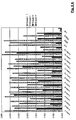
- Such a reaction pattern may look like, for example Fig. 5A , The comparison with the reference samples in this case leads to the conclusion (or suspected diagnosis) that the C. difficile strain VPI-10463 is present.
- the comparison with the reference samples leads to the conclusion (the suspected diagnosis) that the C. difficile strain 8864 is present.
- the comparison with the reference samples leads to the conclusion (the suspected diagnosis) that the C. difficile strain 1470 or a C. difficile strain of the ribotype 017 is present.
- the comparison with the reference samples leads to the conclusion (the suspected diagnosis) that the C. difficile strain 7002/8 or a C. difficile strain of ribotype 027 is present.
- Example 5 Analysis of various C. difficile strains with antibodies of groups I, II, IV, VI
- the inventive method for the identification and detection of variant C was . difficile strains from a number of strains of known ribotype, namely 19 ribotype 027 strains (Lumc-1, Lumc-2, Lumc-3, Lumc-4, Lumc-5, Lumc-6, Lumc-8, Lumc-9, Lumc-10, Lumc-11, Lumc-12, Lumc-13, Lumc-14, Lumc-16, Lumc-17, Lumc-19, Lumc-20, Lumc-21, 7002-42), 4 strains of the ribotype 017 (Lumc-22, Lumc-23, Lumc-40, Lumc-41), 2 strains of ribotype 001 (7002-29, 7002-43) and a strain of ribotype 014 (Lumc-31).
- strains VPI-10463, 8864 and 7002/8 were used.
- Group I, II, IV, and VI antibodies were used in a capture ELISA, and the resulting reaction patterns compared to the established reference patterns (see Example 3).
- the different C. difficile strains were grown as described in Example 1 and the supernatant used in the subsequent experiments.
- the antibodies TGC 35 (group I), TGC 23 (group II), TGC 16 (group IV) and TTC8 (group VI) were attached to the ELISA plates as described in example 3. In each case, 250 ⁇ g / well of TGC 23, 128 ⁇ g / well of TGC 16 and TGC 35, and 1 ⁇ l / well of TTC8 were used and the plates were subsequently washed in PBS.
- the non-specific binding sites of the plates were first blocked by incubation for 1 h at 37 ° C in PBS + 3% BSA. Then 50 .mu.l / well of the supernatant of C were. applied to difficile cultures and the plates incubated again for 1 h at 37 ° C. Unbound proteins were removed by washing three times with PBS + 3% BSA.
- biotin-labeled polyclonal anti-toxin B serum (0.32 ⁇ g / ml) was used as the detection antibody.
- the antibody TTC8 in biotinylated form was also used as a detection antibody.
Landscapes
- Health & Medical Sciences (AREA)
- Chemical & Material Sciences (AREA)
- Life Sciences & Earth Sciences (AREA)
- Organic Chemistry (AREA)
- Immunology (AREA)
- Molecular Biology (AREA)
- Biochemistry (AREA)
- General Health & Medical Sciences (AREA)
- Engineering & Computer Science (AREA)
- Medicinal Chemistry (AREA)
- Urology & Nephrology (AREA)
- Biophysics (AREA)
- Proteomics, Peptides & Aminoacids (AREA)
- Hematology (AREA)
- Biomedical Technology (AREA)
- Genetics & Genomics (AREA)
- Food Science & Technology (AREA)
- Pathology (AREA)
- Cell Biology (AREA)
- Tropical Medicine & Parasitology (AREA)
- Microbiology (AREA)
- Gastroenterology & Hepatology (AREA)
- Biotechnology (AREA)
- Analytical Chemistry (AREA)
- Virology (AREA)
- General Physics & Mathematics (AREA)
- Physics & Mathematics (AREA)
- Peptides Or Proteins (AREA)
- Preparation Of Compounds By Using Micro-Organisms (AREA)
- Micro-Organisms Or Cultivation Processes Thereof (AREA)
- Measuring Or Testing Involving Enzymes Or Micro-Organisms (AREA)
Claims (17)
- Procédé in vitro de détection et d'identification dans un échantillon d'une souche de C. difficile variante, produisant des LCT et virulente, caractérisé par les étapes suivantes :(a) mise en contact d'un échantillon d'excrétion corporelle et/ou d'un échantillon de tissu corporel avec au moins un anticorps de respectivement au moins trois des groupes d'anticorps groupe I, groupe II, groupe III, groupe IV, groupe V et groupe VI,le groupe I comprenant les anticorps suivants : anticorps monoclonal 2CV (DSM ACC 2321), anticorps monoclonal TGC 35 (DSM ACC2918) et anticorps pan-TcdB,le groupe II comprenant les anticorps suivants : anticorps monoclonal TGC23 (DSM ACC2917) et des anticorps qui réagissent avec les toxines TcdB-10463 et TcdB-017, mais par contre ne réagissent pas avec les toxines TcdB-8864 et TcdB-027le groupe III comprenant les anticorps suivants : anticorps monoclonal TGC41 (DSM ACC2919) et des anticorps qui réagissent avec TcdB-10463, mais par contre ne réagissent pas avec les toxines TcdB-8864, TcdB-017 et TcdB-027le groupe IV comprenant les anticorps suivants : anticorps monoclonal TGC 16 (DSM ACC2915) et des anticorps qui réagissent avec les toxines TcdB-8864, TcdB-017 et TcdB-027, mais qui par contre ne réagissent pas avec la toxine TcdB-10463le groupe V comprenant les anticorps suivants : anticorps monoclonal TGC 19 (DSM ACC2916) et des anticorps qui réagissent avec les toxines TcdB-8864 et TcdB-027, mais qui par contre ne réagissent pas les toxines TcdB-10463 et TcdB-017le groupe VI comprenant les anticorps suivants : anticorps monoclonal TTC8 (DSM ACC 2322) et anticorps pan-TcdA ;étant précisé queTcdB-10463 signifie toxine B de la souche C. difficile VPI-10463,TcdB-8864 signifie toxine B de la souche C. difficile 8864,TcdB-017 signifie toxine B de souches C. difficile de ribotype 017, notamment la toxine B de la souche C. difficile 1470,TcdB-027 signifie toxine B de souches C. difficile de ribotype 027, notamment la toxine B de la souche C. difficile 7002/8(b) détection de la réaction de l'anticorps et établissement d'un modèle de réaction, un symbole positif (par exemple "+") pour une réaction d'anticorps détectée positive et un symbole négatif (par exemple "-") pour une réaction d'anticorps détectée négative étant attribué à chaque anticorps de chaque groupe d'anticorps I à IV utilisé à l'étape (a), et(c) comparaison du modèle de réaction obtenu en (b) avec des modèles de référence qui sont obtenues par le fait qu'au moins l'une des grandes toxines clostridiales (LCT) LCT-Rx1, LCT-Rx2, LCT-Rxi des souches C. difficile Rx1, Rx2, Rxi connues de l'état de la technique et dont la présence est à vérifier dans le test de détection, est utilisée dans un test de réaction avec les anticorps choisis à l'étape (a) parmi les au moins trois groupes d'anticorps I à VI, et que les résultats de réaction obtenus pour chaque LCT et les au moins trois des groupes d'anticorps I à VI sont enregistrés à la façon d'un modèle de telle sorte qu'à chaque groupe d'anticorps est attribué soit un symbole positif (par exemple "+") dans le cas d'une réaction d'anticorps détectée positive soit un symbole négatif (par exemple "-") dans le cas d'une réaction d'anticorps détectée négative,(d) évaluation d'une concordance entre le modèle de réaction obtenu en (b) et un modèle de référence comme étant un d'indice que la souche de C. difficile du modèle de référence correspondant se trouve dans l'échantillon.
- Procédé selon la revendication 1, caractérisé en ce que les anticorps sont des anticorps monoclonaux.
- Procédé selon la revendication 1 ou 2, caractérisé en ce que le au moins un anticorps du groupe IV et l'anticorps monoclonal TGC 16 (DSM ACC2915).
- Procédé selon l'une des revendications 1 à 3, caractérisé en ce que le au moins un anticorps du groupe V est l'anticorps monoclonal TGC 19 (DSM ACC2916).
- Procédé selon l'une des revendications 1 à 4, caractérisé en ce que le au moins un anticorps du groupe VI est l'anticorps monoclonal TTC8 (DSM ACC 2322).
- Procédé selon l'une des revendications 1 à 5, caractérisé en ce que le au moins un anticorps du groupe I est l'anticorps monoclonal 2CV (DSM ACC 2321) ou l'anticorps monoclonal TGC 35 (DSM ACC2918).
- Procédé selon l'une des revendications 1 à 6, caractérisé en ce que le au moins un anticorps du groupe II est l'anticorps monoclonal TGC23 (DSM ACC2917).
- Procédé selon l'une des revendications 1 à 7, caractérisé en ce que le au moins un anticorps du groupe III est l'anticorps monoclonal TGC41 (DSM ACC2919).
- Procédé selon l'une des revendications 1 à 8, caractérisé en ce que
à l'étape (a), l'échantillon est mis en contact avec un anticorps de chacun des groupes I, IV et VI, et en ce que
à l'étape (b) une réaction positive des anticorps des groupes I, IV et VI indique la présence d'une souche variante hautement virulente de C. difficile. - Procédé selon l'une des revendications 1 à 8, caractérisé en ce que
à l'étape (a), l'échantillon est mis en contact avec au moins un anticorps de chacun des groupes d'anticorps groupe II, groupe IV et groupe VI, et en ce que
à l'étape (b) une réaction positive des anticorps du groupe IV et du groupe VI et une réaction négative du/des anticorps du groupe II indiquent la présence de la souche hautement virulente C. difficile de ribotype 027, PFGE-NAP1, REA-B1 et de toxinotype III. - Procédé selon la revendication 10, caractérisé en ce que
à l'étape (a), l'échantillon est mis en contact en outre avec au moins un anticorps du groupe d'anticorps I et/ou du groupe d'anticorps III et/ou du groupe d'anticorps V, et en ce que
à l'étape (b), de plus, une réaction positive du/des anticorps du groupe I et du groupe V et une réaction négative du/des anticorps du groupe III indiquent la présence de la souche hautement virulente de C. difficile de ribotype 027, PFGE-NAP1, REA-B1 et de toxinotype III. - Procédé selon l'une des revendications 1 à 8, caractérisé en ce que
à l'étape (a), l'échantillon est mis en contact avec au moins un anticorps de chacun des groupes d'anticorps groupe II, groupe IV et groupe VI, et en ce que
à l'étape (b) une réaction positive des anticorps du groupe II et du groupe IV et une réaction négative du/des anticorps du groupe VI indiquent la présence de la souche hautement virulente C. difficile de ribotype 017, de toxinotype VIII et de sérotype F. - Procédé selon la revendication 12, caractérisé en ce que
à l'étape (a), l'échantillon est en outre mis en contact avec au moins un anticorps du groupe d'anticorps I et/ou du groupe d'anticorps III et/ou du groupe d'anticorps V, et en ce que
à l'étape (b), en plus, une réaction positive du/des anticorps du groupe I et une réaction négative des anticorps du groupe III et du groupe V indiquent la présence de la souche hautement virulente C. difficile de ribotype 017, de toxinotype VIII et de sérotype F. - Utilisation dans un procédé selon l'une des revendications 1 à 13 de l'anticorps monoclonal produit par la lignée cellulaire d'hybridome déposée auprès du DSMZ, Braunschweig, Allemagne, sous le numéro DSM ACC2916 (TGC 19).
- Utilisation dans un procédé selon l'une des revendications 1 à 13 de l'anticorps monoclonal produit par la lignée cellulaire d'hybridome déposée auprès du DSMZ, Braunschweig, Allemagne, sous le numéro DSM ACC2917 (TGC 23).
- Utilisation dans un procédé selon l'une des revendications 1 à 13, en particulier selon l'une des revendications 10 à 13, de l'anticorps monoclonal produit par la lignée cellulaire d'hybridome déposée auprès du DSMZ, Braunschweig, Allemagne, sous le numéro DSM ACC2915 (TGC 16).
- Utilisation dans un procédé selon l'une des revendications 1 à 13 de l'anticorps monoclonal produit par la lignée cellulaire d'hybridome déposée auprès du DSMZ, Braunschweig, Allemagne, sous le numéro DSM ACC2918 (TGC 35).
Applications Claiming Priority (1)
| Application Number | Priority Date | Filing Date | Title |
|---|---|---|---|
| PCT/DE2009/001044 WO2011012098A1 (fr) | 2009-07-27 | 2009-07-27 | Procédé de détection et d'identification d'une variante de souche de c. difficile dans un échantillon |
Publications (2)
| Publication Number | Publication Date |
|---|---|
| EP2459588A1 EP2459588A1 (fr) | 2012-06-06 |
| EP2459588B1 true EP2459588B1 (fr) | 2016-06-29 |
Family
ID=41314484
Family Applications (1)
| Application Number | Title | Priority Date | Filing Date |
|---|---|---|---|
| EP09776017.7A Not-in-force EP2459588B1 (fr) | 2009-07-27 | 2009-07-27 | PROCÉDÉ DE DÉTECTION ET D'IDENTIFICATION D'UNE VARIANTE DE SOUCHE DE C. DIFFICILE DANS UN ÉCHANTILLON& xA; |
Country Status (7)
| Country | Link |
|---|---|
| EP (1) | EP2459588B1 (fr) |
| JP (1) | JP5591332B2 (fr) |
| CN (1) | CN102482331B (fr) |
| AU (1) | AU2009350614B2 (fr) |
| CA (1) | CA2768528C (fr) |
| ES (1) | ES2589606T3 (fr) |
| WO (1) | WO2011012098A1 (fr) |
Cited By (1)
| Publication number | Priority date | Publication date | Assignee | Title |
|---|---|---|---|---|
| CN111499738A (zh) * | 2020-06-03 | 2020-08-07 | 郑州师范学院 | 一种抗艰难梭菌肠毒素a的抗体 |
Families Citing this family (6)
| Publication number | Priority date | Publication date | Assignee | Title |
|---|---|---|---|---|
| CN102590515B (zh) * | 2012-01-13 | 2014-07-30 | 张春华 | 艰难梭菌外毒素a检测试剂盒及组成该试剂盒的单克隆抗体 |
| US9133527B2 (en) * | 2012-05-11 | 2015-09-15 | Techlab, Inc. | Cell wall protein CwpV (CD0514) as a diagnostic marker for Clostridium difficile ribotype 027 |
| CN105451762A (zh) * | 2013-04-22 | 2016-03-30 | 俄克拉荷马州大学评议会 | 艰难梭菌疫苗及使用方法 |
| CN105779569B (zh) * | 2014-12-15 | 2020-06-26 | 西南科技大学 | 一种基于pfge分析菌株之间的差异基因的方法 |
| WO2016130923A1 (fr) | 2015-02-13 | 2016-08-18 | Quanterix Corporation | Dosages immunologiques pour la détection différentielle de clostridium difficile |
| US20190211377A1 (en) * | 2016-12-22 | 2019-07-11 | Roche Molecular Systems, Inc. | Cobra probes to detect a marker for epidemic ribotypes of clostridium difficile |
Family Cites Families (10)
| Publication number | Priority date | Publication date | Assignee | Title |
|---|---|---|---|---|
| US4879218A (en) * | 1982-09-13 | 1989-11-07 | Virginia Tech Intellectual Properties, Inc. | Antibody for C.difficile |
| DE3471661D1 (en) * | 1984-03-02 | 1988-07-07 | Tracy Dale Wilkins | Toxins and antibodies of c. difficile |
| US5231003A (en) * | 1990-05-11 | 1993-07-27 | Cambridge Bioscience Corporation | Monoclonal antibodies specific for toxin b of clostridium difficile |
| US6319665B1 (en) * | 1994-06-07 | 2001-11-20 | Inverness Medical Technology, Inc. | Home test kit and method with telephone verification of results |
| US5965375A (en) * | 1997-04-04 | 1999-10-12 | Biosite Diagnostics | Diagnostic tests and kits for Clostridium difficile |
| DE19739685A1 (de) * | 1997-09-10 | 1999-03-11 | Eichel Streiber Christoph Von | Monoklonale Antikörper zur Therapie und Prophylaxe von Erkrankungen durch Clostridium difficile |
| JP2000292427A (ja) * | 1999-04-02 | 2000-10-20 | Internatl Reagents Corp | 抗原もしくは抗体の測定法および試薬 |
| JP2004132892A (ja) * | 2002-10-11 | 2004-04-30 | Japan Clinical Laboratories Inc | 免疫クロマト測定法及びキット |
| DK2270045T3 (en) * | 2004-02-06 | 2015-04-07 | Univ Massachusetts | ANTIBODIES AGAINST CLOSTRIDIUM DIFFICILE TOXINES AND APPLICATIONS THEREOF |
| DE102008029688B4 (de) * | 2008-06-24 | 2016-06-23 | Biodics Gmbh | Verfahren zum Nachweis und zur Identifikation eines varianten C. difficile Stammes in einer Probe |
-
2009
- 2009-07-27 AU AU2009350614A patent/AU2009350614B2/en not_active Ceased
- 2009-07-27 JP JP2012521958A patent/JP5591332B2/ja not_active Expired - Fee Related
- 2009-07-27 ES ES09776017.7T patent/ES2589606T3/es active Active
- 2009-07-27 CA CA2768528A patent/CA2768528C/fr not_active Expired - Fee Related
- 2009-07-27 WO PCT/DE2009/001044 patent/WO2011012098A1/fr not_active Ceased
- 2009-07-27 CN CN200980160527.8A patent/CN102482331B/zh not_active Expired - Fee Related
- 2009-07-27 EP EP09776017.7A patent/EP2459588B1/fr not_active Not-in-force
Cited By (1)
| Publication number | Priority date | Publication date | Assignee | Title |
|---|---|---|---|---|
| CN111499738A (zh) * | 2020-06-03 | 2020-08-07 | 郑州师范学院 | 一种抗艰难梭菌肠毒素a的抗体 |
Also Published As
| Publication number | Publication date |
|---|---|
| CN102482331B (zh) | 2014-12-24 |
| ES2589606T3 (es) | 2016-11-15 |
| CN102482331A (zh) | 2012-05-30 |
| AU2009350614B2 (en) | 2013-04-04 |
| AU2009350614A1 (en) | 2012-02-02 |
| CA2768528C (fr) | 2017-05-23 |
| EP2459588A1 (fr) | 2012-06-06 |
| JP2013500479A (ja) | 2013-01-07 |
| JP5591332B2 (ja) | 2014-09-17 |
| CA2768528A1 (fr) | 2011-02-03 |
| WO2011012098A1 (fr) | 2011-02-03 |
Similar Documents
| Publication | Publication Date | Title |
|---|---|---|
| EP2459588B1 (fr) | PROCÉDÉ DE DÉTECTION ET D'IDENTIFICATION D'UNE VARIANTE DE SOUCHE DE C. DIFFICILE DANS UN ÉCHANTILLON& xA; | |
| EP1125130B1 (fr) | Determination de la presence de micro-organismes resistant aux acides dans des selles | |
| EP0394819B1 (fr) | Anticorps spécifiques contre la troponine T, leur production et leur utilisation dans un réactif pour la détermination de nécroses du myocarde | |
| DE102014000857A1 (de) | Hybridom-Zelllinie (My-C-cC0C2-235-3H8) und deren Verwendung zur Herstellung eines monoklonalen Antikörpers gegen das humane, herzspezifische Myosin Binding Protein C (C-protein, MYBPC3, cMyBP-C oder My-C) | |
| EP0537497A2 (fr) | Anticorps monoclonaux contre mycoplasma pneumoniae, hybridomes les produisant, procédé pour leur préparation et leur application | |
| DE3942999A1 (de) | Verfahren zum nachweis von malignen erkrankungen | |
| DE102014000856A1 (de) | Hybridom-Zelllinie (My-C-cC0C2-259-1A4) und deren Verwendung zur Herstellung eines monoklonalen Antikörpers gegen das humane, herzspezifische Myosin Binding Protein C (C-protein, MYBPC3, cMyBP-C oder My-C) | |
| DE69513649T2 (de) | Verfahren zum nachweis der gegenwart einer mykobakterien-spezies und testsatz sowie antikörpes zur verwendung in diesem verfahren | |
| DE102008029688B4 (de) | Verfahren zum Nachweis und zur Identifikation eines varianten C. difficile Stammes in einer Probe | |
| EP3194436B1 (fr) | Anticorps monoclonaux dirigés contre la protéine tau humaine | |
| DE69322847T2 (de) | Monoklonaler Antikörper gegen menschliches Ceruloplasmin | |
| US8889363B2 (en) | Method for the detection and identification of a variant C. difficile strain in a sample | |
| DE102009034119A1 (de) | Verfahren, insbesondere Enzyme-linked Immunosorbent Assay (ELISA), zum in vitro Nachweis von Amyloid beta Autoantikörpern, Mikrotiterplatte und Testkit | |
| EP1913394B1 (fr) | Système de test servant au dépistage de salmonelles | |
| WO2002057785A1 (fr) | Procede de detection de maladies pancreatiques et gastro-intestinales | |
| DE3686277T2 (de) | Verfahren zur auslese von hybridomen, die spezifische antikoerper gegen unzugaengliche zelloberflaecheantigene erzeugen. | |
| EP3682242A1 (fr) | Procédé de détection du virus de la maladie borna aigüe (bdv) et trousse de diagnostic associée, notamment en association avec des procédés pour distinguer les infections bvd aigües des infections bvd chroniques et dormantes et trousses de diagnostic associées | |
| DE102007022669A1 (de) | Verwendung von CRMP1 als Marker für chronisch psychiatrische Erkrankungen | |
| EP0381991B1 (fr) | Procédé pour la détermination immunologique de bactéries du genre Aeromonas et de l'espèce Vibrio cholerae | |
| EP3502697B1 (fr) | Détection de toxines de liaison au cholestérol | |
| DE102008029834A1 (de) | Verfahren zum spezifischen Nachweis von MAP-Antikörpern | |
| DE3420926A1 (de) | Verfahren und reagenz zur differenzierten bestimmung von isoenzymen der alkalischen phosphatase sowie hierzu geeigneter monoklonaler antikoerper | |
| DE102005047292A1 (de) | Verfahren zum Nachweis der Aktivität ADP-ribosylierender Enzyme | |
| EP2219030A1 (fr) | Dispositif de vérification sérologique d'infections de Yersinia et/ou leurs maladies subséquentes et utilisation des protéines MyfA et PsaA de Y. enterocolitica et Y. pseudotuberculosis en tant qu'antigènes recombinés | |
| WO2001073440A2 (fr) | Detection de germes e.coli diarrhogenes |
Legal Events
| Date | Code | Title | Description |
|---|---|---|---|
| PUAI | Public reference made under article 153(3) epc to a published international application that has entered the european phase |
Free format text: ORIGINAL CODE: 0009012 |
|
| 17P | Request for examination filed |
Effective date: 20100826 |
|
| AK | Designated contracting states |
Kind code of ref document: A1 Designated state(s): AT BE BG CH CY CZ DE DK EE ES FI FR GB GR HR HU IE IS IT LI LT LU LV MC MK MT NL NO PL PT RO SE SI SK SM TR |
|
| RIN1 | Information on inventor provided before grant (corrected) |
Inventor name: VON EICHELSTREIBER, CHRISTOPH Inventor name: GISCH, KARINA Inventor name: BRAUN, VEIT Inventor name: MOOS, MICHAEL |
|
| DAX | Request for extension of the european patent (deleted) | ||
| 17Q | First examination report despatched |
Effective date: 20150331 |
|
| GRAP | Despatch of communication of intention to grant a patent |
Free format text: ORIGINAL CODE: EPIDOSNIGR1 |
|
| INTG | Intention to grant announced |
Effective date: 20151026 |
|
| GRAS | Grant fee paid |
Free format text: ORIGINAL CODE: EPIDOSNIGR3 |
|
| INTG | Intention to grant announced |
Effective date: 20160308 |
|
| GRAA | (expected) grant |
Free format text: ORIGINAL CODE: 0009210 |
|
| AK | Designated contracting states |
Kind code of ref document: B1 Designated state(s): AT BE BG CH CY CZ DE DK EE ES FI FR GB GR HR HU IE IS IT LI LT LU LV MC MK MT NL NO PL PT RO SE SI SK SM TR |
|
| REG | Reference to a national code |
Ref country code: GB Ref legal event code: FG4D Free format text: NOT ENGLISH |
|
| REG | Reference to a national code |
Ref country code: CH Ref legal event code: EP |
|
| REG | Reference to a national code |
Ref country code: AT Ref legal event code: REF Ref document number: 809032 Country of ref document: AT Kind code of ref document: T Effective date: 20160715 |
|
| REG | Reference to a national code |
Ref country code: IE Ref legal event code: FG4D Free format text: LANGUAGE OF EP DOCUMENT: GERMAN |
|
| REG | Reference to a national code |
Ref country code: DE Ref legal event code: R096 Ref document number: 502009012753 Country of ref document: DE |
|
| REG | Reference to a national code |
Ref country code: FR Ref legal event code: PLFP Year of fee payment: 8 |
|
| REG | Reference to a national code |
Ref country code: NL Ref legal event code: FP |
|
| REG | Reference to a national code |
Ref country code: LT Ref legal event code: MG4D |
|
| PG25 | Lapsed in a contracting state [announced via postgrant information from national office to epo] |
Ref country code: FI Free format text: LAPSE BECAUSE OF FAILURE TO SUBMIT A TRANSLATION OF THE DESCRIPTION OR TO PAY THE FEE WITHIN THE PRESCRIBED TIME-LIMIT Effective date: 20160629 Ref country code: NO Free format text: LAPSE BECAUSE OF FAILURE TO SUBMIT A TRANSLATION OF THE DESCRIPTION OR TO PAY THE FEE WITHIN THE PRESCRIBED TIME-LIMIT Effective date: 20160929 Ref country code: LT Free format text: LAPSE BECAUSE OF FAILURE TO SUBMIT A TRANSLATION OF THE DESCRIPTION OR TO PAY THE FEE WITHIN THE PRESCRIBED TIME-LIMIT Effective date: 20160629 |
|
| REG | Reference to a national code |
Ref country code: ES Ref legal event code: FG2A Ref document number: 2589606 Country of ref document: ES Kind code of ref document: T3 Effective date: 20161115 |
|
| PG25 | Lapsed in a contracting state [announced via postgrant information from national office to epo] |
Ref country code: SE Free format text: LAPSE BECAUSE OF FAILURE TO SUBMIT A TRANSLATION OF THE DESCRIPTION OR TO PAY THE FEE WITHIN THE PRESCRIBED TIME-LIMIT Effective date: 20160629 Ref country code: LV Free format text: LAPSE BECAUSE OF FAILURE TO SUBMIT A TRANSLATION OF THE DESCRIPTION OR TO PAY THE FEE WITHIN THE PRESCRIBED TIME-LIMIT Effective date: 20160629 Ref country code: HR Free format text: LAPSE BECAUSE OF FAILURE TO SUBMIT A TRANSLATION OF THE DESCRIPTION OR TO PAY THE FEE WITHIN THE PRESCRIBED TIME-LIMIT Effective date: 20160629 Ref country code: GR Free format text: LAPSE BECAUSE OF FAILURE TO SUBMIT A TRANSLATION OF THE DESCRIPTION OR TO PAY THE FEE WITHIN THE PRESCRIBED TIME-LIMIT Effective date: 20160930 |
|
| PG25 | Lapsed in a contracting state [announced via postgrant information from national office to epo] |
Ref country code: CZ Free format text: LAPSE BECAUSE OF FAILURE TO SUBMIT A TRANSLATION OF THE DESCRIPTION OR TO PAY THE FEE WITHIN THE PRESCRIBED TIME-LIMIT Effective date: 20160629 Ref country code: IS Free format text: LAPSE BECAUSE OF FAILURE TO SUBMIT A TRANSLATION OF THE DESCRIPTION OR TO PAY THE FEE WITHIN THE PRESCRIBED TIME-LIMIT Effective date: 20161029 Ref country code: SK Free format text: LAPSE BECAUSE OF FAILURE TO SUBMIT A TRANSLATION OF THE DESCRIPTION OR TO PAY THE FEE WITHIN THE PRESCRIBED TIME-LIMIT Effective date: 20160629 Ref country code: EE Free format text: LAPSE BECAUSE OF FAILURE TO SUBMIT A TRANSLATION OF THE DESCRIPTION OR TO PAY THE FEE WITHIN THE PRESCRIBED TIME-LIMIT Effective date: 20160629 Ref country code: IT Free format text: LAPSE BECAUSE OF FAILURE TO SUBMIT A TRANSLATION OF THE DESCRIPTION OR TO PAY THE FEE WITHIN THE PRESCRIBED TIME-LIMIT Effective date: 20160629 Ref country code: RO Free format text: LAPSE BECAUSE OF FAILURE TO SUBMIT A TRANSLATION OF THE DESCRIPTION OR TO PAY THE FEE WITHIN THE PRESCRIBED TIME-LIMIT Effective date: 20160629 |
|
| REG | Reference to a national code |
Ref country code: DE Ref legal event code: R119 Ref document number: 502009012753 Country of ref document: DE |
|
| PG25 | Lapsed in a contracting state [announced via postgrant information from national office to epo] |
Ref country code: PT Free format text: LAPSE BECAUSE OF FAILURE TO SUBMIT A TRANSLATION OF THE DESCRIPTION OR TO PAY THE FEE WITHIN THE PRESCRIBED TIME-LIMIT Effective date: 20161031 Ref country code: PL Free format text: LAPSE BECAUSE OF FAILURE TO SUBMIT A TRANSLATION OF THE DESCRIPTION OR TO PAY THE FEE WITHIN THE PRESCRIBED TIME-LIMIT Effective date: 20160629 Ref country code: SM Free format text: LAPSE BECAUSE OF FAILURE TO SUBMIT A TRANSLATION OF THE DESCRIPTION OR TO PAY THE FEE WITHIN THE PRESCRIBED TIME-LIMIT Effective date: 20160629 |
|
| PG25 | Lapsed in a contracting state [announced via postgrant information from national office to epo] |
Ref country code: DE Free format text: LAPSE BECAUSE OF NON-PAYMENT OF DUE FEES Effective date: 20170201 |
|
| PLBE | No opposition filed within time limit |
Free format text: ORIGINAL CODE: 0009261 |
|
| STAA | Information on the status of an ep patent application or granted ep patent |
Free format text: STATUS: NO OPPOSITION FILED WITHIN TIME LIMIT |
|
| PG25 | Lapsed in a contracting state [announced via postgrant information from national office to epo] |
Ref country code: DK Free format text: LAPSE BECAUSE OF FAILURE TO SUBMIT A TRANSLATION OF THE DESCRIPTION OR TO PAY THE FEE WITHIN THE PRESCRIBED TIME-LIMIT Effective date: 20160629 |
|
| 26N | No opposition filed |
Effective date: 20170330 |
|
| REG | Reference to a national code |
Ref country code: CH Ref legal event code: NV Representative=s name: PATENTANWALT DIPL.-ING. (UNI.) WOLFGANG HEISEL, CH |
|
| REG | Reference to a national code |
Ref country code: FR Ref legal event code: PLFP Year of fee payment: 9 |
|
| PG25 | Lapsed in a contracting state [announced via postgrant information from national office to epo] |
Ref country code: LU Free format text: LAPSE BECAUSE OF NON-PAYMENT OF DUE FEES Effective date: 20160727 Ref country code: BG Free format text: LAPSE BECAUSE OF FAILURE TO SUBMIT A TRANSLATION OF THE DESCRIPTION OR TO PAY THE FEE WITHIN THE PRESCRIBED TIME-LIMIT Effective date: 20160929 Ref country code: SI Free format text: LAPSE BECAUSE OF FAILURE TO SUBMIT A TRANSLATION OF THE DESCRIPTION OR TO PAY THE FEE WITHIN THE PRESCRIBED TIME-LIMIT Effective date: 20160629 |
|
| PGFP | Annual fee paid to national office [announced via postgrant information from national office to epo] |
Ref country code: CH Payment date: 20170724 Year of fee payment: 9 |
|
| PGFP | Annual fee paid to national office [announced via postgrant information from national office to epo] |
Ref country code: IE Payment date: 20170724 Year of fee payment: 9 Ref country code: AT Payment date: 20170719 Year of fee payment: 9 Ref country code: BE Payment date: 20170720 Year of fee payment: 9 |
|
| PG25 | Lapsed in a contracting state [announced via postgrant information from national office to epo] |
Ref country code: CY Free format text: LAPSE BECAUSE OF FAILURE TO SUBMIT A TRANSLATION OF THE DESCRIPTION OR TO PAY THE FEE WITHIN THE PRESCRIBED TIME-LIMIT Effective date: 20160629 Ref country code: HU Free format text: LAPSE BECAUSE OF FAILURE TO SUBMIT A TRANSLATION OF THE DESCRIPTION OR TO PAY THE FEE WITHIN THE PRESCRIBED TIME-LIMIT; INVALID AB INITIO Effective date: 20090727 |
|
| PG25 | Lapsed in a contracting state [announced via postgrant information from national office to epo] |
Ref country code: MT Free format text: LAPSE BECAUSE OF FAILURE TO SUBMIT A TRANSLATION OF THE DESCRIPTION OR TO PAY THE FEE WITHIN THE PRESCRIBED TIME-LIMIT Effective date: 20160629 Ref country code: MK Free format text: LAPSE BECAUSE OF FAILURE TO SUBMIT A TRANSLATION OF THE DESCRIPTION OR TO PAY THE FEE WITHIN THE PRESCRIBED TIME-LIMIT Effective date: 20160629 Ref country code: MC Free format text: LAPSE BECAUSE OF FAILURE TO SUBMIT A TRANSLATION OF THE DESCRIPTION OR TO PAY THE FEE WITHIN THE PRESCRIBED TIME-LIMIT Effective date: 20160629 Ref country code: TR Free format text: LAPSE BECAUSE OF FAILURE TO SUBMIT A TRANSLATION OF THE DESCRIPTION OR TO PAY THE FEE WITHIN THE PRESCRIBED TIME-LIMIT Effective date: 20160629 |
|
| REG | Reference to a national code |
Ref country code: FR Ref legal event code: PLFP Year of fee payment: 10 |
|
| REG | Reference to a national code |
Ref country code: CH Ref legal event code: PL |
|
| REG | Reference to a national code |
Ref country code: AT Ref legal event code: MM01 Ref document number: 809032 Country of ref document: AT Kind code of ref document: T Effective date: 20180727 |
|
| REG | Reference to a national code |
Ref country code: BE Ref legal event code: MM Effective date: 20180731 |
|
| PG25 | Lapsed in a contracting state [announced via postgrant information from national office to epo] |
Ref country code: LI Free format text: LAPSE BECAUSE OF NON-PAYMENT OF DUE FEES Effective date: 20180731 Ref country code: CH Free format text: LAPSE BECAUSE OF NON-PAYMENT OF DUE FEES Effective date: 20180731 Ref country code: AT Free format text: LAPSE BECAUSE OF NON-PAYMENT OF DUE FEES Effective date: 20180727 |
|
| REG | Reference to a national code |
Ref country code: IE Ref legal event code: MM4A |
|
| PG25 | Lapsed in a contracting state [announced via postgrant information from national office to epo] |
Ref country code: BE Free format text: LAPSE BECAUSE OF NON-PAYMENT OF DUE FEES Effective date: 20180731 |
|
| PG25 | Lapsed in a contracting state [announced via postgrant information from national office to epo] |
Ref country code: IE Free format text: LAPSE BECAUSE OF NON-PAYMENT OF DUE FEES Effective date: 20180727 |
|
| PGFP | Annual fee paid to national office [announced via postgrant information from national office to epo] |
Ref country code: NL Payment date: 20200729 Year of fee payment: 12 |
|
| PGFP | Annual fee paid to national office [announced via postgrant information from national office to epo] |
Ref country code: FR Payment date: 20200728 Year of fee payment: 12 Ref country code: GB Payment date: 20200724 Year of fee payment: 12 |
|
| REG | Reference to a national code |
Ref country code: NL Ref legal event code: MM Effective date: 20210801 |
|
| GBPC | Gb: european patent ceased through non-payment of renewal fee |
Effective date: 20210727 |
|
| PG25 | Lapsed in a contracting state [announced via postgrant information from national office to epo] |
Ref country code: GB Free format text: LAPSE BECAUSE OF NON-PAYMENT OF DUE FEES Effective date: 20210727 |
|
| PG25 | Lapsed in a contracting state [announced via postgrant information from national office to epo] |
Ref country code: NL Free format text: LAPSE BECAUSE OF NON-PAYMENT OF DUE FEES Effective date: 20210801 Ref country code: FR Free format text: LAPSE BECAUSE OF NON-PAYMENT OF DUE FEES Effective date: 20210731 |
|
| PGFP | Annual fee paid to national office [announced via postgrant information from national office to epo] |
Ref country code: ES Payment date: 20230821 Year of fee payment: 15 |
|
| REG | Reference to a national code |
Ref country code: ES Ref legal event code: FD2A Effective date: 20250904 |
|
| PG25 | Lapsed in a contracting state [announced via postgrant information from national office to epo] |
Ref country code: ES Free format text: LAPSE BECAUSE OF NON-PAYMENT OF DUE FEES Effective date: 20240728 |