EP2461679B1 - Impfstoffstabilisator - Google Patents
Impfstoffstabilisator Download PDFInfo
- Publication number
- EP2461679B1 EP2461679B1 EP10804910.7A EP10804910A EP2461679B1 EP 2461679 B1 EP2461679 B1 EP 2461679B1 EP 10804910 A EP10804910 A EP 10804910A EP 2461679 B1 EP2461679 B1 EP 2461679B1
- Authority
- EP
- European Patent Office
- Prior art keywords
- formulation
- millimolar
- virus
- vaccine
- inactivated
- Prior art date
- Legal status (The legal status is an assumption and is not a legal conclusion. Google has not performed a legal analysis and makes no representation as to the accuracy of the status listed.)
- Active
Links
Images
Classifications
-
- A—HUMAN NECESSITIES
- A01—AGRICULTURE; FORESTRY; ANIMAL HUSBANDRY; HUNTING; TRAPPING; FISHING
- A01N—PRESERVATION OF BODIES OF HUMANS OR ANIMALS OR PLANTS OR PARTS THEREOF; BIOCIDES, e.g. AS DISINFECTANTS, AS PESTICIDES OR AS HERBICIDES; PEST REPELLANTS OR ATTRACTANTS; PLANT GROWTH REGULATORS
- A01N1/00—Preservation of bodies of humans or animals, or parts thereof
- A01N1/10—Preservation of living parts
- A01N1/12—Chemical aspects of preservation
- A01N1/122—Preservation or perfusion media
-
- A—HUMAN NECESSITIES
- A61—MEDICAL OR VETERINARY SCIENCE; HYGIENE
- A61K—PREPARATIONS FOR MEDICAL, DENTAL OR TOILETRY PURPOSES
- A61K31/00—Medicinal preparations containing organic active ingredients
- A61K31/13—Amines
-
- A—HUMAN NECESSITIES
- A61—MEDICAL OR VETERINARY SCIENCE; HYGIENE
- A61K—PREPARATIONS FOR MEDICAL, DENTAL OR TOILETRY PURPOSES
- A61K39/00—Medicinal preparations containing antigens or antibodies
- A61K39/12—Viral antigens
-
- A—HUMAN NECESSITIES
- A61—MEDICAL OR VETERINARY SCIENCE; HYGIENE
- A61K—PREPARATIONS FOR MEDICAL, DENTAL OR TOILETRY PURPOSES
- A61K47/00—Medicinal preparations characterised by the non-active ingredients used, e.g. carriers or inert additives; Targeting or modifying agents chemically bound to the active ingredient
- A61K47/02—Inorganic compounds
-
- A—HUMAN NECESSITIES
- A61—MEDICAL OR VETERINARY SCIENCE; HYGIENE
- A61K—PREPARATIONS FOR MEDICAL, DENTAL OR TOILETRY PURPOSES
- A61K47/00—Medicinal preparations characterised by the non-active ingredients used, e.g. carriers or inert additives; Targeting or modifying agents chemically bound to the active ingredient
- A61K47/06—Organic compounds, e.g. natural or synthetic hydrocarbons, polyolefins, mineral oil, petrolatum or ozokerite
- A61K47/16—Organic compounds, e.g. natural or synthetic hydrocarbons, polyolefins, mineral oil, petrolatum or ozokerite containing nitrogen, e.g. nitro-, nitroso-, azo-compounds, nitriles, cyanates
- A61K47/18—Amines; Amides; Ureas; Quaternary ammonium compounds; Amino acids; Oligopeptides having up to five amino acids
-
- A—HUMAN NECESSITIES
- A61—MEDICAL OR VETERINARY SCIENCE; HYGIENE
- A61K—PREPARATIONS FOR MEDICAL, DENTAL OR TOILETRY PURPOSES
- A61K47/00—Medicinal preparations characterised by the non-active ingredients used, e.g. carriers or inert additives; Targeting or modifying agents chemically bound to the active ingredient
- A61K47/06—Organic compounds, e.g. natural or synthetic hydrocarbons, polyolefins, mineral oil, petrolatum or ozokerite
- A61K47/16—Organic compounds, e.g. natural or synthetic hydrocarbons, polyolefins, mineral oil, petrolatum or ozokerite containing nitrogen, e.g. nitro-, nitroso-, azo-compounds, nitriles, cyanates
- A61K47/18—Amines; Amides; Ureas; Quaternary ammonium compounds; Amino acids; Oligopeptides having up to five amino acids
- A61K47/183—Amino acids, e.g. glycine, EDTA or aspartame
-
- A—HUMAN NECESSITIES
- A61—MEDICAL OR VETERINARY SCIENCE; HYGIENE
- A61K—PREPARATIONS FOR MEDICAL, DENTAL OR TOILETRY PURPOSES
- A61K47/00—Medicinal preparations characterised by the non-active ingredients used, e.g. carriers or inert additives; Targeting or modifying agents chemically bound to the active ingredient
- A61K47/06—Organic compounds, e.g. natural or synthetic hydrocarbons, polyolefins, mineral oil, petrolatum or ozokerite
- A61K47/26—Carbohydrates, e.g. sugar alcohols, amino sugars, nucleic acids, mono-, di- or oligo-saccharides; Derivatives thereof, e.g. polysorbates, sorbitan fatty acid esters or glycyrrhizin
-
- A—HUMAN NECESSITIES
- A61—MEDICAL OR VETERINARY SCIENCE; HYGIENE
- A61K—PREPARATIONS FOR MEDICAL, DENTAL OR TOILETRY PURPOSES
- A61K9/00—Medicinal preparations characterised by special physical form
- A61K9/0012—Galenical forms characterised by the site of application
- A61K9/0019—Injectable compositions; Intramuscular, intravenous, arterial, subcutaneous administration; Compositions to be administered through the skin in an invasive manner
-
- A—HUMAN NECESSITIES
- A61—MEDICAL OR VETERINARY SCIENCE; HYGIENE
- A61P—SPECIFIC THERAPEUTIC ACTIVITY OF CHEMICAL COMPOUNDS OR MEDICINAL PREPARATIONS
- A61P31/00—Antiinfectives, i.e. antibiotics, antiseptics, chemotherapeutics
- A61P31/12—Antivirals
-
- A—HUMAN NECESSITIES
- A61—MEDICAL OR VETERINARY SCIENCE; HYGIENE
- A61P—SPECIFIC THERAPEUTIC ACTIVITY OF CHEMICAL COMPOUNDS OR MEDICINAL PREPARATIONS
- A61P37/00—Drugs for immunological or allergic disorders
- A61P37/02—Immunomodulators
- A61P37/04—Immunostimulants
-
- A—HUMAN NECESSITIES
- A61—MEDICAL OR VETERINARY SCIENCE; HYGIENE
- A61K—PREPARATIONS FOR MEDICAL, DENTAL OR TOILETRY PURPOSES
- A61K39/00—Medicinal preparations containing antigens or antibodies
- A61K2039/51—Medicinal preparations containing antigens or antibodies comprising whole cells, viruses or DNA/RNA
- A61K2039/525—Virus
- A61K2039/5252—Virus inactivated (killed)
-
- C—CHEMISTRY; METALLURGY
- C12—BIOCHEMISTRY; BEER; SPIRITS; WINE; VINEGAR; MICROBIOLOGY; ENZYMOLOGY; MUTATION OR GENETIC ENGINEERING
- C12N—MICROORGANISMS OR ENZYMES; COMPOSITIONS THEREOF; PROPAGATING, PRESERVING, OR MAINTAINING MICROORGANISMS; MUTATION OR GENETIC ENGINEERING; CULTURE MEDIA
- C12N2770/00—MICROORGANISMS OR ENZYMES; COMPOSITIONS THEREOF; PROPAGATING, PRESERVING, OR MAINTAINING MICROORGANISMS; MUTATION OR GENETIC ENGINEERING; CULTURE MEDIA ssRNA viruses positive-sense
- C12N2770/00011—Details
- C12N2770/24011—Flaviviridae
- C12N2770/24111—Flavivirus, e.g. yellow fever virus, dengue, JEV
- C12N2770/24134—Use of virus or viral component as vaccine, e.g. live-attenuated or inactivated virus, VLP, viral protein
-
- Y—GENERAL TAGGING OF NEW TECHNOLOGICAL DEVELOPMENTS; GENERAL TAGGING OF CROSS-SECTIONAL TECHNOLOGIES SPANNING OVER SEVERAL SECTIONS OF THE IPC; TECHNICAL SUBJECTS COVERED BY FORMER USPC CROSS-REFERENCE ART COLLECTIONS [XRACs] AND DIGESTS
- Y02—TECHNOLOGIES OR APPLICATIONS FOR MITIGATION OR ADAPTATION AGAINST CLIMATE CHANGE
- Y02A—TECHNOLOGIES FOR ADAPTATION TO CLIMATE CHANGE
- Y02A50/00—TECHNOLOGIES FOR ADAPTATION TO CLIMATE CHANGE in human health protection, e.g. against extreme weather
- Y02A50/30—Against vector-borne diseases, e.g. mosquito-borne, fly-borne, tick-borne or waterborne diseases whose impact is exacerbated by climate change
Definitions
- This invention relates to a compositions and methods capable of stabilizing a biological product, such as, for example, a vaccine formulation.
- a biological product is a product that may be prepared using living organisms.
- virus or bacteria may be produced for use in vaccines by using live tissue cells as a substrate.
- Humulin is another biological product; it is synthesized in a non-disease-producing strain of Escherichia coli bacteria that has been genetically altered to produce human insulin.
- Lyophilized vaccines are reasonably stable and can be stored at about 4° to 8° C.
- the liquid, reconstituted preparation loses potency while standing at room temperature. This can result in insufficient titer to confer immunity and may therefore result in the failure of an immunization program.
- US 5 580 856 A encompasses a method for increasing the recovery of soluble proteins, i.e., the native monomeric protein, or for decreasing the amount of aggregated proteins upon reconstitution of a dried protein. This is achieved by the use of a variety of chemicals in an aqueous solution, such as osmolytes, lyotropic salts, water soluble synthetic and natural polymers, surfactants, sulfated polysaccharides, proteins and buffers. However, it does not teach a method or formulation that enhances the thermostability and shelf life of a biological product.
- US 2007/243185 A1 relates to a composition and method for the stabilization of a pharmaceutical composition including an Fc containing polypeptide.
- the stabilization effect is provided by an aggregation inhibitor selected from L-arginine or L-cysteine, and the composition may optionally include a buffer, a tonicity modifier and/or an excipient.
- the composition may be formulated at a pH between pH 6.0 and 7.0.
- US 2005/032183 A1 provides crystalline forms of TNFR2 polypeptide, such as a crystal of etanercept, as well as methods for making crystals of TNFR2 polypeptides. Appropriate aqueous solvents or aqueous solvent containing appropriate crystallization agents are used to produce the crystals.
- US 2008/166784 A1 concerns a method for the stabilization of enveloped viruses for -20 degree Celsius storage in the presence of a non-reducing saccharide.
- US 2008/166784 A1 does not disclose the use of a tertiary amine N-oxide, nor does it show enhanced thermostability of the viruses above freezing.
- Arakawa et al.: XP025483705 reviewed factors affecting short and long term stability of proteins, including protein stability in solution, freeze dried and freeze thawed.
- a number of protein stabilizers were mentioned, including sugars, amino acids, amines, polyols and some salts. However the stabilizers were not used together as a formulation.
- US 6 051 238 A relates to lyophilized vaccines which has increased thermostability.
- the formulation includes a 6-carbon polyhydric alcohol (e.g., sorbitol), a disaccharide (e.g., sucrose) and a buffer.
- a 6-carbon polyhydric alcohol e.g., sorbitol
- a disaccharide e.g., sucrose
- a buffer e.g., glycerol
- POPC 1-palmitoyl-2-oleoyl-sn-glycero-3-phosphocholine
- One embodiment of the invention is a formulation capable of enhancing thermostability and shelf-life of a biological product, the formulation comprising: a tertiary amine N-oxide or a derivative thereof represented by the formulae: wherein R 1 , R 2 , and R 3 may be identical or different and each is a straight or branched lower alkyl group having from 1 to 4 carbon atoms; the formulation comprising an inorganic salt; glutamic acid or a salt thereof; a polyol; a physiologically acceptable buffer, and a pharmaceutically acceptable carrier; wherein the biological product is a vaccine chosen from an inactivated virus, an attenuated virus, and a live virus: and wherein the formulation comprises an antigen constituent
- the tertiary amine N-oxide is trimethylamine-N-oxide, (CH 3 )NO.
- Another embodiment of the invention is a vaccine comprising an inactivated or attenuated virus, an adjuvant, and a stabilizer comprising from about one millimolar to about 50 millimolar magnesium chloride, MgCl 2 ; from about 8 millimolar to about 200 millimolar glutamic acid; from about 0.05 millimolar to about 2.5 millimolar mannitol; from about one millimolar to about 500 millimolar trimethylamine-N-oxide; and an amount of a physiologically acceptable buffer effective to adjust or maintain the pH at from about 6.5 to about 8.5, and preferably to about 7.5.
- Yet another embodiment of the invention is a formulation capable of enhancing thermostability and shelf- life of a biological product, the formulation comprising: from about one millimolar to about 200 millimolar glutamic acid; from abut 0.05 millimolar to about 5 millimolar mannitol; from about 0.01 milligram per milliliter to about 0.1 milligram per milliliter protamine, and from about 0.01 percent to about 1 percent dextrose, and an amount of a physiologically acceptable buffer effective to adjust or maintain the pH at from about 6.5 to about 8.5, and preferably to about 7.5.
- the invention also relates to a formulation comprising: an inactivated virus or an attenuated virus; alum; trimethylamine-N-oxide; mannitol; glutamic acid; magnesium chloride, MgC12; sodium chloride; and a suitable buffer to maintain the pH of the formulation at about 7.5.
- the formulation may comprise from about 0.1 percent (w/v) to about 0.5 percent (w/v) alum, and preferably about 0.2 percent (w/v) alum; from about 1.5 millimolar to about 20 millimolar trimethylamine-N- oxide, preferably about 2 millimolar trimethylamine-N-oxide; from about 0.05 millimolar to about 2 millimolar mannitol, preferably from about 0.1 millimolar to about 1.1 millimolar mannitol; from about 8 millimolar to about 150 millimolar glutamic acid, preferably from about 10 millimolar to about 100 millimolar glutamic acid; and from about 100 millimolar to about 500 millimolar sodium chloride, preferably from about 145 millimolar to about 500 millimolar sodium chloride.
- the disclosed formulations provide unexpectedly diminished reduction in titer of vaccines and other biological products for an extended time as compared to such products incorporating currently available stabilizers.
- the enhanced stability of the disclosed formulations may be particularly important for liquid and lyophilized viral vaccines.
- the disclosed formulations are free of most or all components of animal origin, for example, serum, albumin, and gelatin, and therefore present a lower risk of allergic reaction in an individual to whom the formulation is administered.
- the disclosed formulations being substantially free of contamination that can accompany components of animal origin, and are more uniform from one batch to another than are formulations having animal origin components.
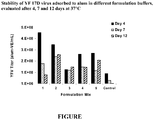
- the Figure is a graph showing the stability of YF 17D virus adsorbed to alum in different stabilization formulations according to an embodiment of the invention, evaluated after 4, 7 and 12 days at 37°C.
- the inventors of the disclosed subject matter designed a study to screen for chemicals that could impart stability to an inactivated virus in solution, in particular, to an alum-adsorbed yellow fever virus. Following high throughput screening, many combinations were selected for testing. From those, certain combinations produced an unexpected, significant increase in stability.
- Some of the components of the disclosed formulation have, to the best of the inventors' knowledge, never been used previously for stabilizing biological formulations, in particular, vaccine formulations.
- a formulation capable of enhancing thermostability and shelf- life of a biological product comprising: a tertiary amine N-oxide or a derivative thereof represented by the formulae: wherein R 1 , R 2 , and R 3 may be identical or different and each is a straight or branched lower alkyl group having from 1 to 4 carbon atoms; the formulation comprising an inorganic salt; glutamic acid, HOOC(CH 2 ) 2 CH(NH 2 )COOH or a salt thereof; a polyol; a physiologically acceptable buffer, and a pharmaceutically acceptable carrier; wherein the biological product is a vaccine chosen from an inactivated virus, an attenuated virus, and a live virus; and wherein the formulation comprises an antigen constituent .
- the tertiary amine N-oxide is trimethylamine-N-oxide, (CH 3 ) 3 NO.
- lower alkyl group denotes alkyl groups having 1-4 carbon atoms.
- R 1 , R 2 , and R 3 may each be chosen independently from a methyl, an ethyl, a propyl, an n-butyl, and an isobutyl group.
- the inorganic salt is magnesium chloride, MgCl 2 .
- the polyol may be a C3 to a C8 polyol, for example, mannitol, C 6 H 8 (OH) 6 .
- the concentration of trimethylamine-N-oxide may be from about 1.5 millimolar (mM) to about 800 mM, or from about 2 mM to about 600 mM, or typically from about 2.0 mM to about 20 mM.
- the concentration of magnesium chloride (MgCl 2 ) may be from about 0.8 mM to about 80 mM, or from about 5 mM to about 50 mM, and typically from about 1 mM to about 12 mM.
- the concentration of glutamic acid may be from about 5 mM to about 500 mM, or from about 7 mM to about 300 mM, and typically from about 8 mM to about 100 mM.
- the concentration of mannitol may be from about 0.01 percent (w/v) to about 5 percent (w/v), or from about 0.01 percent to about one (1) percent, or typically about 0.02 percent.
- w/v refers to the concentration of a solution expressed as a "weight/volume percentage” or percentage solution. The percentage is calculated from the weight of solute in grams (g), divided by the total volume of solution in milliliters (mL).
- the concentration of mannitol may be from about 0.05 mM to about 2 mM in a vaccine formulation or in a stabilizer solution, each according to an embodiment of the invention, and preferably from about 0.11 mM to about 1.1 mM.
- the physiologically acceptable buffer may be present in an amount effective to adjust or maintain the pH at from about 6.5 to about 8.5, or from about 7.0 to about 8.0, and typically about 7.5.
- a suitable buffer may be a tris buffer, for example, Tris HCl, also known as: 2-Amino-2-(hydroxymethyl)-1,3-propanediol, hydrochloride; and Tris (hydroxymethyl) aminomethane Hydrochloride; or a phosphate buffer.
- Tris HCl also known as: 2-Amino-2-(hydroxymethyl)-1,3-propanediol, hydrochloride; and Tris (hydroxymethyl) aminomethane Hydrochloride; or a phosphate buffer.
- Tris HCl also known as: 2-Amino-2-(hydroxymethyl)-1,3-propanediol, hydrochloride
- Tris (hydroxymethyl) aminomethane Hydrochloride Tris (hydroxymethyl) aminomethane Hydrochloride
- a preferred embodiment of the invention is a vaccine formulation comprising an inactivated or an attenuated virus, such as, for example, a yellow fever virus, the vaccine formulation comprising from about 1.2 millimolar (mM) to about 12 millimolar (mM) magnesium chloride (MgCl 2 ), from about 10 mM to about 100 mM glutamic acid, from about 0.1 mM to about 1.1 mM mannitol, and from about 2.0 mM to about 20 mM trimethylamine-N-oxide, and an amount of a physiologically acceptable buffer effective to adjust and/or maintain the pH at from about 6.5 to about 8.5, or preferably from about 7.0 to about 8.0.
- mM millimolar
- MgCl 2 millimolar magnesium chloride
- a formulation capable of enhancing thermostability and shelf- life of a biological product comprises: from about one millimolar to about 200 millimolar glutamic acid, from abut 0.05 mM to about 5 mM mannitol, from about 0.01 milligram per milliliter to about 0.1 milligram per milliliter protamine, and from about 0.01 percent to about 1 percent dextrose, and an amount of a physiologically acceptable buffer effective to adjust or maintain the pH at from about 6.5 to about 8.5, and preferably about 7.5.
- the concentration of protamine may also be from about 0.005 milligram to about 0.2 milligram.
- the concentration of the other components in the protamine-based formulation may be, for example, as disclosed above for the formulation based on trimethylamine-N-oxide.
- Any of the disclosed formulations may comprise an adjuvant such as aluminum hydroxide.
- Any of the disclosed formulations may be suitable for extending the shelf life and/or the efficacy of insulin.
- any of the disclosed formulations may be suitable for a biological product comprising an inactivated virus, an attenuated virus, a live virus, and combinations thereof.
- An inactivated virus or an attenuated virus suitable for use with the formulation may be a yellow fever virus.
- the biological product may comprise a single bacteria or more than one bacteria, or a combination of bacteria and one or more viruses.
- compositions including vaccines intended for use by any species, including, for example, human, feline, canine, equine, porcine, bovine, ovine.
- Embodiments of these formulations can be used in the stabilization of proteins, including recombinant proteins, liquid enzyme compositions, and viral- delivered vectors, for example.
- vaccine refers to a suspension of live, attenuated, or inactivated (killed) microorganisms such as viruses, bacteria, rickettsiae, or of other antigens such as antigenic proteins and other substances derived from them, administered for prevention, amelioration, or treatment of infectious diseases.
- An attenuated vaccine is a vaccine prepared from live microorganisms or viruses subjected to adverse conditions leading to loss of their virulence but retention of their ability to induce protective immunity.
- An attenuated vaccine is also known as a "replicative vaccine" because it contains organisms that are able to reproduce.
- a formulation according to an embodiment of the invention may be an acellular vaccine, a cell-free vaccine prepared from purified antigenic components of cell-free microorganisms, carrying less risk than whole-cell preparations.
- cell-free vaccine is anthrax vaccine, a cell-free protein extract of cultures of Bacillus anthracis, used to immunize against anthrax.
- a subunit vaccine is a vaccine containing no viral nucleic acid, and containing only small amounts of nonviral antigens derived from the culture medium. Cell-free vaccines and subunit vaccines are less likely to cause adverse reactions than a vaccine containing attenuated bacteria or a whole, attenuated or inactivated virion.
- the disclosed formulation may be suitable for enhancing the stability of a vaccine preparation comprising an antigen constituent.
- Any of the disclosed formulation may be used in a vaccine comprising a particle chosen from a virus-like particle, a subunit, a toxoid, a plasmid, a peptide, a polypeptide, a fusion protein, a conjugated protein, a polysaccharide, a conjugated polysaccharide, a recombinant protein, a DNA, an RNA, and combinations thereof.
- the disclosed formulation may enhance the stability of a biological product including an inactivated virus or an attenuated virus chosen from St. Louis encephalitis virus, Japanese encephalitis virus, tick-borne encephalitis viruses, dengue virus, Kyasanur Forest disease virus, and combinations thereof.
- the stability of a composition including an inactivated virus or an attenuated virus chosen from measles, mumps, rubella, varicella, polio, hepatitis A, hepatitis B, herpes simplex 1, herpes simplex 2, rabies, influenza A, influenza B, H1N1, rotavirus, and combinations thereof, may be enhanced by any of the disclosed formulations.
- An embodiment of the invention is a vaccine or other biological composition including a bacteria chosen from Feline Bordetella, Bordetella bronchiseptica, and combinations thereof.
- the disclosed formulation may be suitable for the following types of vaccines, including, without limitation: an autogenous vaccine prepared from microorganisms freshly isolated from the lesion of the patient who is to be treated with it; a BCG vaccine (the Calmette-Guerin strain of Mycobacterium bovis) used to immunize against tuberculosis and in treatment of bladder cancer; a cholera vaccine a preparation of killed Vibrio cholerae, used in immunization against cholera; diphtheria and tetanus toxoids and pertussis vaccine (DTP), a combination of diphtheria and tetanus toxoids and pertussis vaccine; used for simultaneous immunization against diphtheria, tetanus, and whooping cough; diphtheria and tetanus toxoids and pertussis vaccine adsorbed and Haemophilus b conjugate vaccine, a combination of diphtheria toxoid, tetanus toxoid
- hepatitis B v. [recombinant] a human diploid cell vaccine (HDCV) such as rabies vaccine
- an influenza virus vaccine for example, a trivalent vaccine containing two influenza A virus strains and one influenza B virus strain, or an H1N1 vaccine
- a Lyme disease vaccine (recombinant OspA), a preparation of outer surface protein A (OspA), and a cell surface lipoprotein of Borrelia burgdorferi, produced by recombinant technology
- MMR measles and rubella virus vaccine live
- MMR measles and rubella virus vaccine live
- measles and rubella virus vaccine a combination of live, attenuated measles and rubella viruses
- typhoid vaccine any of several preparations of Salmonella typhi used for immunization against typhoid fever, including a parenteral heat- and phenol-inactivated bacteria vaccine, an oral live vaccine prepared from the attenuated strain Ty21a, and a parenteral vaccine prepared from typhoid Vi capsular polysaccharide
- varicella virus vaccine live a preparation of live, attenuated human herpesvirus 3 (varicella-zoster virus) used to immunize against varicella and herpes zoster.
- a vaccine formulation according to the invention may comprise aluminum hydroxide as adjuvant and pharmaceutical excipients such as physiological saline solution, pH-controlling agents, preservatives, organic solvents, hydrophobic agents, and surfactants.
- pharmaceutical excipients such as physiological saline solution, pH-controlling agents, preservatives, organic solvents, hydrophobic agents, and surfactants.
- a vaccine may be stabilized by adding to the vaccine an amount of a formulation disclosed herein effective to stabilize the vaccine.
- a vaccine stabilized according to any formulation disclosed herein may be administered by a method comprising administering the vaccine by intramuscular injection.
- a method for treating and/or preventing a disease in a subject may comprise administering to the subject a vaccine according to any stabilizer formulation disclosed herein in an amount sufficient to treat or prevent the disease.
- the Bulk Drug Substance is at the appropriate concentration for the high dose; the inactivated virus is in formulation buffer (target formulation: 10 mM Tris, 145-500 mM NaCl, pH 7.5). The final NaCl concentration will be dependent upon the dilution factor required to achieve the target potency of the Bulk Drug Substance.
- the Bulk Drug Substance is diluted ten fold with dilution buffer (10 mM Tris, 145 mM NaCl, pH 7.5) to prepare Sub-Batch M at the mid dose level.
- the Bulk Drug substance is diluted one hundred fold with dilution buffer to prepare Sub-Batch L at the low dose level.
- the remaining Bulk Drug Substance becomes the Sub-Batch H which is the starting material for the high dose material. All three sub-batches are stored in sterile PETG bottles at 2-8°C.
- Aluminum hydroxide is added to the Pre-Formulation Sub-batch in its PETG container to achieve an approximate final concentration of 0.2% in the Bulk Drug Product.
- One part of 2% Alhydrogel (Brenntag Biosector) is added to 8 parts of the Pre-Formulation Sub-batch.
- the sub-batch is thoroughly mixed for approximately 4 hours at 2-8°C.
- the alum-adsorbed sub-batch is then stored at 2-8°C until excipient buffer addition. This is the Alum Formulated Inactivated Virus.
- Tubes containing YFV in the presence or absence of 0.2% alum (final concentration) were mixed at 2-8°C for > 4 hr.
- the solutions containing YFV ⁇ alum mixtures were clarified by centrifugation at approximately 3000 rpm for 10 min at room temperature, and supernatant fluids were collected. The amount of YFV remaining in solution (not adsorbed) was measured using the 2E10 monoclonal ELISA assay for alum bound material.
- the amount of YF antigen in the control sample was set as 100% and ELISA results obtained for the samples containing 0.2% alum were used to calculate the percent YFV antigen not adsorbed to alum. The results indicated that only 0.09% of the antigen was not bound to alum.
- a number of experiments were performed in an effort to show desorption of the YF virus antigen from alum under conditions that preserve the YF antigen. Neither high pH (pH 10) nor high salt (0.5M NaCl) were effective ways to desorb virus from the alum. Addition of Excipients: Stabilization of the alum adsorbed virus bulk
- excipients are added to stabilize the alum formulated, inactivated virus.
- the formulated virus is adjusted to an approximate final concentration of 10 mM Tris HCl, 145 - 500 mM NaCl, 12 mM MgCl 2 , 100 mM glutamic acid, 1.1 mM mannitol, 20 mM trimethylamine-N-oxide, pH 7.5.
- a ten-fold concentrated solution of excipients is prepared with a target composition of 10 mM Tris HCl, 145 mM NaCl, 120 mM MgCl 2 , 1000 mM glutamic acid, 11 mM mannitol, 200 mM trimethylamine-N-oxide, pH 7.5
- 10x concentrated excipient solution is added to 9 parts of alum formulated, inactivated virus.
- the resulting suspension is mixed for > 5 min at 2-8°C to form the Bulk Drug Product which is stored at 2-8°C until filling.
- the bulk drug product is stored at 2 to 8°C in PETG plastic bottles that are provided sterilized by gamma irradiation.
- the product contact surface of the plastic PETG bottles is comprised of polyethylene terephthalate glycol copolyester. Product contact surfaces in the bottles have been demonstrated to meet USP ⁇ 88> Class VI standards.
- Table 2.2.9 lists the five formulation conditions that produced the highest stability of virus compared to the no excipient control (10 mM Tris, 145 mM NaCl, pH 7.5). Inactivated, alum-formulated YF virus containing 10 mM Tris, 145 mM NaCl, pH 7.5 was incubated at 37°C for 12 days in the presence of the 5 different formulation mixtures (Table 2.2.9).
- the YF virus titer was determined on days 4, 7 and 12 using the 2E10 monoclonal ELISA format that measures alum-bound virus (Section 2.2.7.1.3); the titers for formulations containing excipient mixtures were compared to the titer of control sample containing NaCl-Tris HCl only. The results are expressed as alum-ELISA Units. As shown in FIG. 1 , formulation mixes 2 and 5 provided the highest stability at Day 12. The high concentration of mannitol made formulation mix 2 impractical; therefore formulation mix number 5 was selected as the basis for the final formulation.
- the Figure is a graph showing the stability of YF 17D virus adsorbed to alum in different formulation buffers, evaluated after 4, 7 and 12 days at 37°C.
- the YF titer measured by the 2E10 monoclonal ELISA, alum is plotted for the five formulations tested.
- the formulations are indicated by number on the X-axis; the compositions are shown in the table below.
- the solid black bars represent the titer at 4 days of incubation, the gray bars represent the titer at 7 days of incubation and the diagonally hatched bars represent the titer at 12 days of incubation.
- alum- formulated YF 17D virus containing 10 mM Tris, 11.8 mM MgCl 2 , 94 mM Glutamic acid, 1.1 mM Mannitol, 18.7 mM Trimethylamine-N-oxide, pH 7.5 was incubated at 37°C for 4 days in the presence of 150, 300, 500 and 700mM NaCl.
- the control sample contained 10 mM Tris, 145 mM NaCl.
- YF virus titer was determined using the 2E10 monoclonal ELISA format that measures alum-bound virus. Alum-formulated YF virus was most stable at 150 mM NaCl.
- the stability of the formulated, inactivated alum bound virus decreased as the salt concentration increased. Based on these data, a range of 145 - 500 mM NaCl was determined to provide an acceptable stability profile for the final formulation.
- a beta-propiolactone (BPL) inactivated whole virion vaccine adsorbed to aluminum hydroxide (“alum”) adjuvant was prepared.
- the vaccine provided as a suspension for injection to be administered by intramuscular injections, was manufactured from YF 17D strain grown in continuous African green monkey kidney (Vera) cell culture. The virus was harvested from Vera cell culture fluid, purified by depth filtration, ultrafiltration, inactivated with beta- propiolactone (BPL), further purified by chromatography, adsorbed to aluminum hydroxide adjuvant and formulated with stabilizers according to an embodiment of the invention.
- the vaccine was formulated to contain 0.2% alum, 10 mM Tris HCI, 145 - 500 mM NaCl, 1.2 mM MgC12 , 10 mM glutamic acid, 0.11 mM mannitol, 2.0 mM trimethylamine-N-oxide; pH 7.5.
Landscapes
- Health & Medical Sciences (AREA)
- Life Sciences & Earth Sciences (AREA)
- Chemical & Material Sciences (AREA)
- General Health & Medical Sciences (AREA)
- Pharmacology & Pharmacy (AREA)
- Public Health (AREA)
- Veterinary Medicine (AREA)
- Animal Behavior & Ethology (AREA)
- Medicinal Chemistry (AREA)
- Epidemiology (AREA)
- Engineering & Computer Science (AREA)
- Chemical Kinetics & Catalysis (AREA)
- General Chemical & Material Sciences (AREA)
- Oil, Petroleum & Natural Gas (AREA)
- Proteomics, Peptides & Aminoacids (AREA)
- Immunology (AREA)
- Virology (AREA)
- Inorganic Chemistry (AREA)
- Molecular Biology (AREA)
- Biochemistry (AREA)
- Dermatology (AREA)
- Dentistry (AREA)
- Nuclear Medicine, Radiotherapy & Molecular Imaging (AREA)
- Organic Chemistry (AREA)
- Wood Science & Technology (AREA)
- Zoology (AREA)
- Environmental Sciences (AREA)
- Microbiology (AREA)
- Mycology (AREA)
- Communicable Diseases (AREA)
- Oncology (AREA)
- Bioinformatics & Cheminformatics (AREA)
- Medicines Containing Antibodies Or Antigens For Use As Internal Diagnostic Agents (AREA)
- Medicinal Preparation (AREA)
Claims (20)
- Formulierung, die in der Lage ist, die Thermostabilität und Gebrauchsfähigkeitsdauer eines biologischen Produkts zu verbessern, wobei die Formulierung umfasst: ein tertiäres Amin-N-oxid oder ein Derivat davon, dargestellt durch die Formeln:
 worin R1, R2, und R3 identisch oder verschieden sein können und jedes eine geradkettige oder verzweigtkettige niedere Alkyl-Gruppe ist, die 1 bis 4 Kohlenstoffatome aufweist; wobei die Formulierung weiter ein anorganisches Salz; Glutaminsäure oder ein Salz davon; ein Polyol; einen physiologisch verträglichen Puffer und einen pharmazeutisch verträglichen Träger umfasst;wobei das biologische Produkt ein Impfstoff ist, der ausgewählt ist aus einem inaktivierten Virus, einem attenuierten Virus und einem Lebenden Virus; undwobei die Formulierung einen Antigenbestandteil umfasst.
 - Formulierung nach Anspruch 1, wobei das tertiäre Amin-N-oxid Trimethylamin-N-oxid, (CH3)3NO, ist.
- Formulierung nach Anspruch 1, wobei das anorganische Salz Magnesiumchlorid, MgCl2, ist.
- Formulierung nach Anspruch 1, wobei das Polyol Mannit, C6H8(OH)6, ist.
- Formulierung nach Anspruch 2, wobei die Konzentration von Trimethylamin-N-oxid, (CH3)3NO, von etwa 1,5 Millimol bis etwa 800 Millimol beträgt.
- Formulierung nach Anspruch 3, wobei die Konzentration von Magnesiumchlorid, MgCl2, von etwa 0,8 Millimol bis etwa 80 Millimol beträgt.
- Formulierung nach Anspruch 1, wobei die Konzentration von Glutaminsäure von etwa 5 Millimol bis etwa 500 Millimol beträgt.
- Formulierung nach Anspruch 4, wobei die Konzentration von Mannit, C6H8(OH)6, von etwa 0,01 Prozent (Gew./Vol.) bis etwa 5 Prozent (Gew./Vol.) beträgt.
- Formulierung nach Anspruch 1, wobei der physiologisch verträgliche Puffer in einer Menge vorhanden ist, die wirksam ist, um den pH-Wert bei etwa 6,5 bis etwa 8,5 einzustellen.
- Formulierung nach Anspruch 1, wobei der Puffer ein Tris-Puffer oder ein Phosphat-Puffer ist.
- Formulierung nach Anspruch 1, wobei das Virus ein inaktiviertes Virus ist.
- Formulierung nach Anspruch 1, wobei das inaktivierte Virus oder das attenuierte Virus ein Gelbfieber-Virus ist.
- Formulierung nach Anspruch 1, wobei das inaktivierte Virus oder das attenuierte Virus ausgewählt ist aus St. Louis-Enzephalitis-Virus, Japanischem Enzephalitis-Virus, von Zecken übertragenen Enzephalitis-Viren, Dengue-Virus, Virus des Kyasanur-Waldfiebers sowie Kombinationen davon.
- Formulierung nach Anspruch 1, wobei das inaktivierte Virus oder das attenuierte Virus ausgewählt ist aus Masern, Mumps, Röteln, Varizellen, Polio, Hepatitis A, Hepatitis B, Herpes simplex 1, Herpes simplex 2, Tollwut, Influenza A, Influenza B, H1N1, Rotavirus und Kombinationen davon.
- Impfstoff, umfassend ein inaktiviertes oder attenuiertes Virus, ein Adjuvans und einen Stabilisator, umfassend von etwa 1 Millimol bis etwa 50 Millimol Magnesiumchlorid, MgCl2; von etwa 8 Millimol bis etwa 200 Millimol Glutaminsäure; von etwa 0,05 Millimol bis etwa 2,5 Millimol Mannit; von etwa eins Millimol bis etwa 500 Millimol Trimethylamin-N-Oxid; und eine Menge eines physiologisch verträglichen Puffers, die wirksam ist, um den pH-Wert bei etwa 6,5 bis etwa 8,5 einzustellen oder zu halten.
- Formulierung, die in der Lage ist, die Thermostabilität und Gebrauchsfähigkeitsdauer eines biologischen Produkts zu verbessern, wobei die Formulierung umfasst: von etwa eins Millimol bis etwa 200 Millimol Glutaminsäure, etwa 0,05 Millimol bis etwa 5 Millimol Mannit, etwa 0,01 Milligramm pro Milliliter bis etwa 0,1 Milligramm pro Milliliter Protamin und von etwa 0,01 Prozent bis etwa 1 Prozent Dextrose und eine Menge eines physiologisch verträglichen Puffers, die wirksam ist, um den pH-Wert auf etwa 6,5 bis etwa 8,5 einzustellen oder halten.
- Formulierung, umfassend: ein inaktiviertes Virus oder ein attenuiertes Virus; Alaun; Trimethylamin-N-oxid; Mannit; Glutaminsäure; Magnesiumchlorid, MgCl2; Natriumchlorid; und einen geeigneten Puffer, um den pH-Wert der Formulierung bei etwa 7,5 zu halten.
- Formulierung nach Anspruch 17, umfassend etwa 0,1 Prozent (Gew./Vol.), bis etwa 0,5 Prozent (Gew./Vol.) Alaun; etwa 1,5 Millimol bis etwa 20 Millimol Trimethylamin-N-oxid; von etwa 0,05 Millimol bis etwa 2 Millimol Mannit; von etwa 8 Millimol bis etwa 150 Millimol Glutaminsäure; und von etwa 100 Millimol bis etwa 500 Millimol Natriumchlorid.
- Verfahren zum Stabilisieren eines Impfstoffes, ausgewählt aus einem inaktivierten Virus, einem attenuierten Virus und einem lebenden Virus, wobei das Verfahren das Zugeben einer Menge einer Formulierung zu dem Impfstoff umfasst, die wirksam ist, um den Impfstoff zu stabilisieren, wobei die Formulierung umfasst:ein tertiäres Amin-N-oxid oder ein Derivat davon, dargestellt durch die Formel:
 worin R1, R2, und R3 identisch oder verschieden sein können und jedes eine geradkettige oder verzweigtkettige niedere Alkyl-Gruppe ist, die 1 bis 4 Kohlenstoffatome aufweist;wobei die Formulierung weiter ein anorganisches Salz; Glutaminsäure oder ein Salz davon; ein Polyol; einen physiologisch verträglichen Puffer und einen pharmazeutisch verträglichen Träger umfasst;wobei die Formulierung ein Antigenbestandteil umfasst.
 - Impfstoff nach einem der Ansprüche 1, 15, 17 oder 18 zur Verwendung in einem Verfahren zur Behandlung und/oder Vorbeugung einer Krankheit in einem Patienten, wobei das Verfahren das Verabreichen des Impfstoffs an den Patienten in einer Menge umfasst, die ausreichend ist, um die Erkrankung zu behandeln oder ihr vorzubeugen.
Applications Claiming Priority (2)
| Application Number | Priority Date | Filing Date | Title |
|---|---|---|---|
| US22915309P | 2009-07-28 | 2009-07-28 | |
| PCT/US2010/043019 WO2011014418A1 (en) | 2009-07-28 | 2010-07-23 | Vaccine stabilizer |
Publications (3)
| Publication Number | Publication Date |
|---|---|
| EP2461679A1 EP2461679A1 (de) | 2012-06-13 |
| EP2461679A4 EP2461679A4 (de) | 2014-05-07 |
| EP2461679B1 true EP2461679B1 (de) | 2019-02-13 |
Family
ID=43529651
Family Applications (1)
| Application Number | Title | Priority Date | Filing Date |
|---|---|---|---|
| EP10804910.7A Active EP2461679B1 (de) | 2009-07-28 | 2010-07-23 | Impfstoffstabilisator |
Country Status (5)
| Country | Link |
|---|---|
| US (2) | US9248107B2 (de) |
| EP (1) | EP2461679B1 (de) |
| CA (1) | CA2769011C (de) |
| TR (1) | TR201903546T4 (de) |
| WO (1) | WO2011014418A1 (de) |
Families Citing this family (2)
| Publication number | Priority date | Publication date | Assignee | Title |
|---|---|---|---|---|
| EP2461679B1 (de) * | 2009-07-28 | 2019-02-13 | GE Healthcare Bio-Sciences Corp. | Impfstoffstabilisator |
| AU2019254473A1 (en) * | 2018-04-16 | 2020-12-03 | Merck Patent Gmbh | Additives for protein formulations to improve thermal stability |
Family Cites Families (10)
| Publication number | Priority date | Publication date | Assignee | Title |
|---|---|---|---|---|
| US5580856A (en) | 1994-07-15 | 1996-12-03 | Prestrelski; Steven J. | Formulation of a reconstituted protein, and method and kit for the production thereof |
| US6051238A (en) | 1996-12-20 | 2000-04-18 | Merck & Co., Inc. | Stabilizers for lyophilized mumps vaccines |
| HK1046004B (en) * | 1999-11-12 | 2013-11-08 | Fibrogen, Inc. | Recombinant gelatins |
| SI1478394T1 (sl) * | 2002-02-27 | 2008-12-31 | Immunex Corp | STABILIZIRAN TNFR-Fc SESTAVEK Z ARGININOM |
| JP2006512102A (ja) * | 2002-04-11 | 2006-04-13 | メディミューン・ヴァクシンズ・インコーポレーテッド | 噴霧乾燥による生物活性材料の防腐 |
| JP2007521315A (ja) | 2003-08-01 | 2007-08-02 | アムジェン インコーポレイテッド | 結晶性腫瘍壊死因子レセプター2ポリペプチド |
| JP5110696B2 (ja) | 2004-11-05 | 2012-12-26 | ウェルスタット バイオロジクス コーポレイション | 安定かつ濾過可能なエンベロープで覆われたウイルス処方物 |
| US20070111231A1 (en) * | 2005-08-23 | 2007-05-17 | Illumigen Biosciences, Inc. | Detection of mutations in a gene associated with resistance to viral infection, OAS2 and OAS3 |
| KR101378872B1 (ko) | 2006-09-26 | 2014-04-11 | 인펙셔스 디지즈 리서치 인스티튜트 (아이디알아이) | 합성 애주번트를 함유하는 백신 조성물 |
| EP2461679B1 (de) * | 2009-07-28 | 2019-02-13 | GE Healthcare Bio-Sciences Corp. | Impfstoffstabilisator |
-
2010
- 2010-07-23 EP EP10804910.7A patent/EP2461679B1/de active Active
- 2010-07-23 TR TR2019/03546T patent/TR201903546T4/tr unknown
- 2010-07-23 WO PCT/US2010/043019 patent/WO2011014418A1/en not_active Ceased
- 2010-07-23 CA CA2769011A patent/CA2769011C/en active Active
-
2012
- 2012-01-20 US US13/355,158 patent/US9248107B2/en active Active
-
2016
- 2016-01-11 US US14/992,350 patent/US9821064B2/en active Active
Non-Patent Citations (1)
| Title |
|---|
| None * |
Also Published As
| Publication number | Publication date |
|---|---|
| CA2769011C (en) | 2017-06-06 |
| WO2011014418A1 (en) | 2011-02-03 |
| CA2769011A1 (en) | 2011-02-03 |
| EP2461679A4 (de) | 2014-05-07 |
| US20160120982A1 (en) | 2016-05-05 |
| US9248107B2 (en) | 2016-02-02 |
| EP2461679A1 (de) | 2012-06-13 |
| TR201903546T4 (tr) | 2019-04-22 |
| US9821064B2 (en) | 2017-11-21 |
| US20120201849A1 (en) | 2012-08-09 |
Similar Documents
| Publication | Publication Date | Title |
|---|---|---|
| Dumpa et al. | Stability of vaccines | |
| Burke et al. | Formulation, stability, and delivery of live attenuated vaccines for human use | |
| TWI670085B (zh) | 液體穩定之豬病毒疫苗 | |
| TWI812650B (zh) | 包含特別是減毒活重組黃病毒的穩定疫苗組成物以及製備其的製程 | |
| BRPI9710460B1 (pt) | composição imunogênica multi-valente e composição de vacina | |
| SK142194A3 (en) | Combined vaccines comprising hepatitis b surface antigen and other antigens | |
| AU2016210743A1 (en) | Inactivated dengue virus vaccine | |
| BR112020000999A2 (pt) | composição imunogênica tendo estabilidade aperfeiçoada, imunogenicidade melhorada e reatogenicidade reduzida e processo para a sua preparação | |
| WO2000023104A1 (en) | Freeze-dried hepatitis a attenuated live vaccine and its stabilizer | |
| KR102822878B1 (ko) | 감소된 용량의 불활성화된 폴리오바이러스를 포함하는 조합 백신 조성물 및 그의 제조 방법 | |
| CN102196817B (zh) | 具有全细胞百日咳的联合疫苗 | |
| JP2024532292A (ja) | 脂質ナノエマルション粒子に吸着したmRNAの凍結乾燥製剤 | |
| CN1062770C (zh) | 甲肝-麻疹二联疫苗及其生产方法 | |
| KR102607295B1 (ko) | 다가 백신 조성물 | |
| CN101969994B (zh) | 能够稳定地长期保存的日本脑炎疫苗的制造方法及该疫苗的用途 | |
| US20100183675A1 (en) | Stable vaccine compositions and methods of use | |
| US9821064B2 (en) | Vaccine stabilizer | |
| EP2381959A1 (de) | Stabile impfstoffzusammensetzungen und anwendungsverfahren | |
| Payton et al. | Lyophilized vaccine development | |
| Bird | New Formulation Development Strategies for Inactivated Polio Vaccines to Aid in Worldwide Eradication of Polio | |
| BR112019003419B1 (pt) | Vacina combinada e processo de fabricação de uma vacina combinada | |
| Bronzino et al. | Vaccine Production | |
| HK1153927B (en) | Method of producing japanese encephalitis vaccine stably storable over long time and use of the vaccine |
Legal Events
| Date | Code | Title | Description |
|---|---|---|---|
| PUAI | Public reference made under article 153(3) epc to a published international application that has entered the european phase |
Free format text: ORIGINAL CODE: 0009012 |
|
| 17P | Request for examination filed |
Effective date: 20120221 |
|
| AK | Designated contracting states |
Kind code of ref document: A1 Designated state(s): AL AT BE BG CH CY CZ DE DK EE ES FI FR GB GR HR HU IE IS IT LI LT LU LV MC MK MT NL NO PL PT RO SE SI SK SM TR |
|
| DAX | Request for extension of the european patent (deleted) | ||
| RAP1 | Party data changed (applicant data changed or rights of an application transferred) |
Owner name: GE HEALTHCARE BIO-SCIENCES CORP. |
|
| A4 | Supplementary search report drawn up and despatched |
Effective date: 20140403 |
|
| RIC1 | Information provided on ipc code assigned before grant |
Ipc: A61K 31/13 20060101ALI20140328BHEP Ipc: A61K 47/02 20060101ALI20140328BHEP Ipc: A01N 33/24 20060101AFI20140328BHEP Ipc: A61K 47/18 20060101ALI20140328BHEP |
|
| 17Q | First examination report despatched |
Effective date: 20150311 |
|
| STAA | Information on the status of an ep patent application or granted ep patent |
Free format text: STATUS: EXAMINATION IS IN PROGRESS |
|
| GRAP | Despatch of communication of intention to grant a patent |
Free format text: ORIGINAL CODE: EPIDOSNIGR1 |
|
| STAA | Information on the status of an ep patent application or granted ep patent |
Free format text: STATUS: GRANT OF PATENT IS INTENDED |
|
| RIC1 | Information provided on ipc code assigned before grant |
Ipc: A61K 47/18 20060101ALI20180409BHEP Ipc: A61K 39/12 20060101ALI20180409BHEP Ipc: A01N 33/24 20060101AFI20180409BHEP Ipc: A61K 39/00 20060101ALI20180409BHEP Ipc: A61K 9/00 20060101ALI20180409BHEP Ipc: A61K 47/26 20060101ALI20180409BHEP Ipc: A61K 31/13 20060101ALI20180409BHEP Ipc: A01N 1/02 20060101ALI20180409BHEP Ipc: A61K 47/02 20060101ALI20180409BHEP |
|
| INTG | Intention to grant announced |
Effective date: 20180509 |
|
| GRAS | Grant fee paid |
Free format text: ORIGINAL CODE: EPIDOSNIGR3 |
|
| RAP1 | Party data changed (applicant data changed or rights of an application transferred) |
Owner name: GE HEALTHCARE BIO-SCIENCES CORP. |
|
| GRAA | (expected) grant |
Free format text: ORIGINAL CODE: 0009210 |
|
| STAA | Information on the status of an ep patent application or granted ep patent |
Free format text: STATUS: THE PATENT HAS BEEN GRANTED |
|
| AK | Designated contracting states |
Kind code of ref document: B1 Designated state(s): AL AT BE BG CH CY CZ DE DK EE ES FI FR GB GR HR HU IE IS IT LI LT LU LV MC MK MT NL NO PL PT RO SE SI SK SM TR |
|
| REG | Reference to a national code |
Ref country code: GB Ref legal event code: FG4D |
|
| REG | Reference to a national code |
Ref country code: AT Ref legal event code: REF Ref document number: 1095688 Country of ref document: AT Kind code of ref document: T Effective date: 20190215 Ref country code: CH Ref legal event code: EP |
|
| REG | Reference to a national code |
Ref country code: IE Ref legal event code: FG4D |
|
| REG | Reference to a national code |
Ref country code: DE Ref legal event code: R096 Ref document number: 602010056979 Country of ref document: DE |
|
| REG | Reference to a national code |
Ref country code: LT Ref legal event code: MG4D |
|
| REG | Reference to a national code |
Ref country code: NL Ref legal event code: MP Effective date: 20190213 |
|
| PG25 | Lapsed in a contracting state [announced via postgrant information from national office to epo] |
Ref country code: LT Free format text: LAPSE BECAUSE OF FAILURE TO SUBMIT A TRANSLATION OF THE DESCRIPTION OR TO PAY THE FEE WITHIN THE PRESCRIBED TIME-LIMIT Effective date: 20190213 Ref country code: FI Free format text: LAPSE BECAUSE OF FAILURE TO SUBMIT A TRANSLATION OF THE DESCRIPTION OR TO PAY THE FEE WITHIN THE PRESCRIBED TIME-LIMIT Effective date: 20190213 Ref country code: NO Free format text: LAPSE BECAUSE OF FAILURE TO SUBMIT A TRANSLATION OF THE DESCRIPTION OR TO PAY THE FEE WITHIN THE PRESCRIBED TIME-LIMIT Effective date: 20190513 Ref country code: NL Free format text: LAPSE BECAUSE OF FAILURE TO SUBMIT A TRANSLATION OF THE DESCRIPTION OR TO PAY THE FEE WITHIN THE PRESCRIBED TIME-LIMIT Effective date: 20190213 Ref country code: SE Free format text: LAPSE BECAUSE OF FAILURE TO SUBMIT A TRANSLATION OF THE DESCRIPTION OR TO PAY THE FEE WITHIN THE PRESCRIBED TIME-LIMIT Effective date: 20190213 Ref country code: PT Free format text: LAPSE BECAUSE OF FAILURE TO SUBMIT A TRANSLATION OF THE DESCRIPTION OR TO PAY THE FEE WITHIN THE PRESCRIBED TIME-LIMIT Effective date: 20190613 |
|
| PG25 | Lapsed in a contracting state [announced via postgrant information from national office to epo] |
Ref country code: HR Free format text: LAPSE BECAUSE OF FAILURE TO SUBMIT A TRANSLATION OF THE DESCRIPTION OR TO PAY THE FEE WITHIN THE PRESCRIBED TIME-LIMIT Effective date: 20190213 Ref country code: GR Free format text: LAPSE BECAUSE OF FAILURE TO SUBMIT A TRANSLATION OF THE DESCRIPTION OR TO PAY THE FEE WITHIN THE PRESCRIBED TIME-LIMIT Effective date: 20190514 Ref country code: LV Free format text: LAPSE BECAUSE OF FAILURE TO SUBMIT A TRANSLATION OF THE DESCRIPTION OR TO PAY THE FEE WITHIN THE PRESCRIBED TIME-LIMIT Effective date: 20190213 Ref country code: BG Free format text: LAPSE BECAUSE OF FAILURE TO SUBMIT A TRANSLATION OF THE DESCRIPTION OR TO PAY THE FEE WITHIN THE PRESCRIBED TIME-LIMIT Effective date: 20190513 |
|
| REG | Reference to a national code |
Ref country code: AT Ref legal event code: MK05 Ref document number: 1095688 Country of ref document: AT Kind code of ref document: T Effective date: 20190213 |
|
| PG25 | Lapsed in a contracting state [announced via postgrant information from national office to epo] |
Ref country code: CZ Free format text: LAPSE BECAUSE OF FAILURE TO SUBMIT A TRANSLATION OF THE DESCRIPTION OR TO PAY THE FEE WITHIN THE PRESCRIBED TIME-LIMIT Effective date: 20190213 Ref country code: ES Free format text: LAPSE BECAUSE OF FAILURE TO SUBMIT A TRANSLATION OF THE DESCRIPTION OR TO PAY THE FEE WITHIN THE PRESCRIBED TIME-LIMIT Effective date: 20190213 Ref country code: EE Free format text: LAPSE BECAUSE OF FAILURE TO SUBMIT A TRANSLATION OF THE DESCRIPTION OR TO PAY THE FEE WITHIN THE PRESCRIBED TIME-LIMIT Effective date: 20190213 Ref country code: DK Free format text: LAPSE BECAUSE OF FAILURE TO SUBMIT A TRANSLATION OF THE DESCRIPTION OR TO PAY THE FEE WITHIN THE PRESCRIBED TIME-LIMIT Effective date: 20190213 Ref country code: AL Free format text: LAPSE BECAUSE OF FAILURE TO SUBMIT A TRANSLATION OF THE DESCRIPTION OR TO PAY THE FEE WITHIN THE PRESCRIBED TIME-LIMIT Effective date: 20190213 Ref country code: SK Free format text: LAPSE BECAUSE OF FAILURE TO SUBMIT A TRANSLATION OF THE DESCRIPTION OR TO PAY THE FEE WITHIN THE PRESCRIBED TIME-LIMIT Effective date: 20190213 Ref country code: RO Free format text: LAPSE BECAUSE OF FAILURE TO SUBMIT A TRANSLATION OF THE DESCRIPTION OR TO PAY THE FEE WITHIN THE PRESCRIBED TIME-LIMIT Effective date: 20190213 |
|
| REG | Reference to a national code |
Ref country code: DE Ref legal event code: R097 Ref document number: 602010056979 Country of ref document: DE |
|
| PG25 | Lapsed in a contracting state [announced via postgrant information from national office to epo] |
Ref country code: PL Free format text: LAPSE BECAUSE OF FAILURE TO SUBMIT A TRANSLATION OF THE DESCRIPTION OR TO PAY THE FEE WITHIN THE PRESCRIBED TIME-LIMIT Effective date: 20190213 Ref country code: SM Free format text: LAPSE BECAUSE OF FAILURE TO SUBMIT A TRANSLATION OF THE DESCRIPTION OR TO PAY THE FEE WITHIN THE PRESCRIBED TIME-LIMIT Effective date: 20190213 |
|
| PLBE | No opposition filed within time limit |
Free format text: ORIGINAL CODE: 0009261 |
|
| STAA | Information on the status of an ep patent application or granted ep patent |
Free format text: STATUS: NO OPPOSITION FILED WITHIN TIME LIMIT |
|
| PG25 | Lapsed in a contracting state [announced via postgrant information from national office to epo] |
Ref country code: AT Free format text: LAPSE BECAUSE OF FAILURE TO SUBMIT A TRANSLATION OF THE DESCRIPTION OR TO PAY THE FEE WITHIN THE PRESCRIBED TIME-LIMIT Effective date: 20190213 |
|
| 26N | No opposition filed |
Effective date: 20191114 |
|
| PG25 | Lapsed in a contracting state [announced via postgrant information from national office to epo] |
Ref country code: MC Free format text: LAPSE BECAUSE OF FAILURE TO SUBMIT A TRANSLATION OF THE DESCRIPTION OR TO PAY THE FEE WITHIN THE PRESCRIBED TIME-LIMIT Effective date: 20190213 Ref country code: SI Free format text: LAPSE BECAUSE OF FAILURE TO SUBMIT A TRANSLATION OF THE DESCRIPTION OR TO PAY THE FEE WITHIN THE PRESCRIBED TIME-LIMIT Effective date: 20190213 |
|
| REG | Reference to a national code |
Ref country code: CH Ref legal event code: PL |
|
| PG25 | Lapsed in a contracting state [announced via postgrant information from national office to epo] |
Ref country code: LI Free format text: LAPSE BECAUSE OF NON-PAYMENT OF DUE FEES Effective date: 20190731 Ref country code: CH Free format text: LAPSE BECAUSE OF NON-PAYMENT OF DUE FEES Effective date: 20190731 Ref country code: LU Free format text: LAPSE BECAUSE OF NON-PAYMENT OF DUE FEES Effective date: 20190723 |
|
| REG | Reference to a national code |
Ref country code: DE Ref legal event code: R081 Ref document number: 602010056979 Country of ref document: DE Owner name: GLOBAL LIFE SCIENCES SOLUTIONS USA LLC (N. D. , US Free format text: FORMER OWNER: GE HEALTHCARE BIO-SCIENCES CORP., MARLBOROUGH, MASS., US |
|
| REG | Reference to a national code |
Ref country code: BE Ref legal event code: HC Owner name: GLOBAL LIFE SCIENCES SOLUTIONS USA LLC; US Free format text: DETAILS ASSIGNMENT: CHANGE OF OWNER(S), CHANGEMENT DE NOM DU PROPRIETAIRE; FORMER OWNER NAME: GE HEALTHCARE BIO-SCIENCES CORP. Effective date: 20201211 |
|
| PG25 | Lapsed in a contracting state [announced via postgrant information from national office to epo] |
Ref country code: CY Free format text: LAPSE BECAUSE OF FAILURE TO SUBMIT A TRANSLATION OF THE DESCRIPTION OR TO PAY THE FEE WITHIN THE PRESCRIBED TIME-LIMIT Effective date: 20190213 |
|
| PG25 | Lapsed in a contracting state [announced via postgrant information from national office to epo] |
Ref country code: MT Free format text: LAPSE BECAUSE OF FAILURE TO SUBMIT A TRANSLATION OF THE DESCRIPTION OR TO PAY THE FEE WITHIN THE PRESCRIBED TIME-LIMIT Effective date: 20190213 Ref country code: HU Free format text: LAPSE BECAUSE OF FAILURE TO SUBMIT A TRANSLATION OF THE DESCRIPTION OR TO PAY THE FEE WITHIN THE PRESCRIBED TIME-LIMIT; INVALID AB INITIO Effective date: 20100723 |
|
| PG25 | Lapsed in a contracting state [announced via postgrant information from national office to epo] |
Ref country code: MK Free format text: LAPSE BECAUSE OF FAILURE TO SUBMIT A TRANSLATION OF THE DESCRIPTION OR TO PAY THE FEE WITHIN THE PRESCRIBED TIME-LIMIT Effective date: 20190213 |
|
| P01 | Opt-out of the competence of the unified patent court (upc) registered |
Effective date: 20230526 |
|
| PGFP | Annual fee paid to national office [announced via postgrant information from national office to epo] |
Ref country code: DE Payment date: 20250728 Year of fee payment: 16 |
|
| PGFP | Annual fee paid to national office [announced via postgrant information from national office to epo] |
Ref country code: TR Payment date: 20250704 Year of fee payment: 16 Ref country code: IT Payment date: 20250721 Year of fee payment: 16 |
|
| PGFP | Annual fee paid to national office [announced via postgrant information from national office to epo] |
Ref country code: GB Payment date: 20250722 Year of fee payment: 16 Ref country code: BE Payment date: 20250724 Year of fee payment: 16 |
|
| PGFP | Annual fee paid to national office [announced via postgrant information from national office to epo] |
Ref country code: FR Payment date: 20250725 Year of fee payment: 16 |
|
| PGFP | Annual fee paid to national office [announced via postgrant information from national office to epo] |
Ref country code: IE Payment date: 20250718 Year of fee payment: 16 |
|
| PGFP | Annual fee paid to national office [announced via postgrant information from national office to epo] |
Ref country code: IS Payment date: 20250729 Year of fee payment: 16 |