EP2467592B1 - Kraftstoffhochdruckpumpe - Google Patents
Kraftstoffhochdruckpumpe Download PDFInfo
- Publication number
- EP2467592B1 EP2467592B1 EP10728193.3A EP10728193A EP2467592B1 EP 2467592 B1 EP2467592 B1 EP 2467592B1 EP 10728193 A EP10728193 A EP 10728193A EP 2467592 B1 EP2467592 B1 EP 2467592B1
- Authority
- EP
- European Patent Office
- Prior art keywords
- pump housing
- housing
- housing part
- pump
- pressure fuel
- Prior art date
- Legal status (The legal status is an assumption and is not a legal conclusion. Google has not performed a legal analysis and makes no representation as to the accuracy of the status listed.)
- Active
Links
Images
Classifications
-
- F—MECHANICAL ENGINEERING; LIGHTING; HEATING; WEAPONS; BLASTING
- F02—COMBUSTION ENGINES; HOT-GAS OR COMBUSTION-PRODUCT ENGINE PLANTS
- F02M—SUPPLYING COMBUSTION ENGINES IN GENERAL WITH COMBUSTIBLE MIXTURES OR CONSTITUENTS THEREOF
- F02M59/00—Pumps specially adapted for fuel-injection and not provided for in groups F02M39/00 -F02M57/00, e.g. rotary cylinder-block type of pumps
- F02M59/44—Details, components parts, or accessories not provided for in, or of interest apart from, the apparatus of groups F02M59/02 - F02M59/42; Pumps having transducers, e.g. to measure displacement of pump rack or piston
- F02M59/48—Assembling; Disassembling; Replacing
-
- F—MECHANICAL ENGINEERING; LIGHTING; HEATING; WEAPONS; BLASTING
- F04—POSITIVE - DISPLACEMENT MACHINES FOR LIQUIDS; PUMPS FOR LIQUIDS OR ELASTIC FLUIDS
- F04B—POSITIVE-DISPLACEMENT MACHINES FOR LIQUIDS; PUMPS
- F04B1/00—Multi-cylinder machines or pumps characterised by number or arrangement of cylinders
- F04B1/04—Multi-cylinder machines or pumps characterised by number or arrangement of cylinders having cylinders in star- or fan-arrangement
- F04B1/0404—Details or component parts
-
- F—MECHANICAL ENGINEERING; LIGHTING; HEATING; WEAPONS; BLASTING
- F04—POSITIVE - DISPLACEMENT MACHINES FOR LIQUIDS; PUMPS FOR LIQUIDS OR ELASTIC FLUIDS
- F04B—POSITIVE-DISPLACEMENT MACHINES FOR LIQUIDS; PUMPS
- F04B53/00—Component parts, details or accessories not provided for in, or of interest apart from, groups F04B1/00 - F04B23/00 or F04B39/00 - F04B47/00
- F04B53/16—Casings; Cylinders; Cylinder liners or heads; Fluid connections
-
- F—MECHANICAL ENGINEERING; LIGHTING; HEATING; WEAPONS; BLASTING
- F04—POSITIVE - DISPLACEMENT MACHINES FOR LIQUIDS; PUMPS FOR LIQUIDS OR ELASTIC FLUIDS
- F04B—POSITIVE-DISPLACEMENT MACHINES FOR LIQUIDS; PUMPS
- F04B9/00—Piston machines or pumps characterised by the driving or driven means to or from their working members
- F04B9/02—Piston machines or pumps characterised by the driving or driven means to or from their working members the means being mechanical
- F04B9/04—Piston machines or pumps characterised by the driving or driven means to or from their working members the means being mechanical the means being cams, eccentrics or pin-and-slot mechanisms
- F04B9/042—Piston machines or pumps characterised by the driving or driven means to or from their working members the means being mechanical the means being cams, eccentrics or pin-and-slot mechanisms the means being cams
-
- F—MECHANICAL ENGINEERING; LIGHTING; HEATING; WEAPONS; BLASTING
- F16—ENGINEERING ELEMENTS AND UNITS; GENERAL MEASURES FOR PRODUCING AND MAINTAINING EFFECTIVE FUNCTIONING OF MACHINES OR INSTALLATIONS; THERMAL INSULATION IN GENERAL
- F16C—SHAFTS; FLEXIBLE SHAFTS; ELEMENTS OR CRANKSHAFT MECHANISMS; ROTARY BODIES OTHER THAN GEARING ELEMENTS; BEARINGS
- F16C35/00—Rigid support of bearing units; Housings, e.g. caps, covers
- F16C35/02—Rigid support of bearing units; Housings, e.g. caps, covers in the case of sliding-contact bearings
Definitions
- the invention relates to a high-pressure fuel pump of an internal combustion engine with the features of the preamble of claim 1.
- Such high pressure pumps are well known in the art. They are used in motor vehicles in particular to promote fuel, preferably diesel fuel, in a high-pressure accumulator, from where the fuel is injected under high pressure into the combustion chamber of the internal combustion engine.
- a high-pressure pump has a drive shaft with a cam or eccentric drive, by means of which a pump piston of at least one pump element is driven to a stroke movement. In the suction stroke of the pump piston fuel is sucked from a low pressure region and compressed in the delivery stroke of the pump piston in the pump working chamber, then to be supplied under high pressure standing the high-pressure accumulator.
- the high-pressure pump should be simple and therefore inexpensive to manufacture.
- the proposed high-pressure fuel pump has a pump housing in which is received for actuating at least one pump housing arranged in the pump element, a drive shaft with a cam or Exzentertrieb and is rotatably mounted about a drive shaft longitudinal axis.
- the pump housing comprises a housing part with a bearing bore.
- the housing part is connected to the pump housing via a frictional press connection, wherein the frictional press connection is formed in that the housing part has at least one portion which has a radial excess relative to a recess of the pump housing, in which the housing part is inserted.
- the press connection is preferably designed such that axial forces introduced via the drive shaft can also be accommodated.
- a screw is thus unnecessary, so that the attachment of the housing part can be done without screws on the pump housing.
- the formation of a flange is unnecessary, so the total material and thus Weight can be saved. Furthermore, eliminates the costly production of holes for receiving the mounting screws, so that overall simplifies the production and thus made more cost-effective.
- the housing part to form the frictional press connection a first portion a and a second portion b with radial excess relative to the recess of the pump housing, so that two press dressings are formed for frictional connection of the housing part with the pump housing.
- the first section a and the second section b are arranged spaced from one another in the axial direction relative to the drive shaft longitudinal axis.
- a large axial distance allows alignment of the housing part over a large length in the axial direction and thus ensures the Koaxialtmaschine of the housing part to the pump housing.
- the axial distance is therefore preferably chosen as large as possible.
- the frictional connection of the housing part with the pump housing via two axially spaced-apart press dressings also has the advantage that between the two sections a and b can be formed with radial excess a usable as a return groove annulus.
- a return bore for returning the bearing lubricant quantity into the system return flows into this annular space.
- the return bore may be formed as a radial bore or obliquely extending in a wall region of the housing part.
- An annular space as a return groove, that is a circumferential return groove has the advantage that even with a different angular position of the return bores in the housing part and in the pump housing the connection to the system return is guaranteed.
- the circumferential return groove is sealed by the further inside pressing connection of the section a with respect to the pump interior. This can be dispensed with the arrangement of a sealing ring. If leaks nevertheless occur, no serious effects are to be expected since the leakage takes place inside the pump.
- the radial excess of the first portion a of the housing part with respect to the recess of the pump housing differs from that radial excess of the second section b.
- the radial excess of the second portion b is greater than that of the first section a selected.
- the press connection in the region of the second section b also has a sealing function.
- the press connection can therefore replace a sealing ring for sealing the annular space from the outside.
- the radial oversize and the axial extension of the section a and / or the section b for producing a press connection are selected such that the minimum pressing force is> 5 kN and a common axial compressive force of about 1 kN can be accommodated.
- an annular groove is therefore preferably provided in the pump housing in the region of at least one press connection, which causes an elastic deformation of the pump housing and thus a decoupling in the region of the press connection.
- the annular groove provided for decoupling the pump housing is preferably arranged coaxially to the recess of the pump housing, in which the housing part is inserted.
- the annular groove extends from an end face of the pump housing substantially axially and is advantageously equipped with a notch-sensitive radius.
- a corresponding annular groove may also be formed in an end face of the housing part in order to counteract undesired deformations. If the arrangement of a plain bearing bush in the bearing bore of the housing part is provided, this may be cylindrical or formed as a collar bushing.
- annular groove is used for decoupling the pump housing, its axial extent is preferably chosen to be greater than the axial extent of the respective pressing area, the relief of which is provided by the annular groove. That is, the axial extent of the annular groove is preferably selected to be larger than the axial extent of the sections a or b with radial oversize. As a result, an uneven surface pressure in the longitudinal direction can be avoided. Wieterhin preferably the axial extent of the annular groove is at least 20% greater than the axial extent of the respective pressing range selected.
- an interlocking connection of the housing part to the pump housing is additionally provided for axially securing the housing part within the recess of the pump housing.
- the positive connection can be effected for example by at least one screw or at least one pin.
- the at least one screw or the at least one pin is guided perpendicular to the drive shaft longitudinal axis.
- an explosive or retaining ring can be used to produce a positive connection. Due to the additional positive connection, the high-pressure pump is also suitable for applications with particularly high requirements.
- the housing part and the pump housing made of the same material, so that the housing part and the pump housing have the same values in terms of Young's modulus and thermal expansion coefficient.
- An operational release of at least one press connection can thus be largely excluded.
- An additional positive connection is therefore usually unnecessary.
- any sealing function is permanently ensured in a pressing area. If different materials are used to produce the housing part and the pump housing, it must be ensured, especially if the housing part is fastened to the pump housing via at least one press connection, that the minimum pressing force is sufficient to ensure the holding function over the entire operating temperature range.
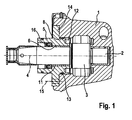
- the in the Fig. 1 illustrated and known from the prior art high-pressure pump comprises a pump housing 1, in which for receiving and rotatable mounting of a drive shaft 2 about a drive shaft longitudinal axis 4, a flange-shaped housing part 5 is added. To form a sliding bearing a plain bearing bush 11 is inserted in a bearing bore 6 of the housing part 5. The drive shaft 2 is guided through the plain bearing bushing 11 and held at the end in a further bearing arrangement designed as a slide bearing in the pump housing 1. Between the two slide bearings, the drive shaft 2 has a cam drive 3 for actuating a pump piston (not shown) of at least one pump element (also not shown) for conveying fuel.
- the housing part 5 is struck axially on the pump housing 1 via its flange 14.
- the flange 14 is screwed by at least one screw 15 with the pump housing.
- 4 or 6 screws 15 are arranged at the same angular distance from one another in the flange 14 for fastening the housing part 5.
- the screws 15 cause a positive connection through which axial forces introduced via the drive shaft 2 can be accommodated.
- Via a cylindrical projection on the flange 14, the housing part 5 is also supported in the radial direction in a recess 8 of the pump housing 1.
- At least one sealing ring 13 is arranged to prevent the escape of a certain Lagerschmiermenge.
- a corresponding function has a shaft seal 16, which seals the bearing gap between the drive shaft 2 and the housing part 5 to the outside.
- annular groove 12 is formed in an end face of the housing part 5, which ensures a certain elastic deformability of the housing part 5 in the edge region of the bearing.
- the elastic deformability brought about by the annular groove 12 is particularly advantageous when high transverse forces from the cam drive 3 act on the drive shaft 2 and thus lead to a tilting of the drive shaft 2 with respect to the drive shaft longitudinal axis 4. In such a case, the edge regions of the bearing experience a high load, which, however, can be reduced by a corresponding elastic deformation.
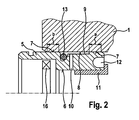
- a erfidnungsdorfe high-pressure pump differs from the high-pressure pump described above in that the housing part 5 is frictionally connected to the pump housing 1 via a press connection 7, wherein the frictional press connection is produced in that the housing part 5 in at least one section a, b, a radial excess relative to the recess 8 of the pump housing 1 has, in which the housing part 5 is received.
- a screwing of the housing part 5 with the pump housing 1 is thus unnecessary, so that the formation of a flange 14 is not required. This saves material and weight.
- the housing part 5 of the embodiments of Figures 2 and 3 is therefore substantially hollow cylindrical.
- a press connection 7 is considered to be sufficient over only a radially oversized portion a for fixing the housing part 5 on the pump housing 1, the embodiment with two press dressings for the reasons mentioned below is preferred.
- the housing part 5 has two sections a and b, which have a radial excess with respect to the recess 8 of the pump housing 1.
- a press connection 7 is produced in sections a and b.
- the sections a and b are axially spaced from one another on the housing part 5, so that an annular space 9 is formed between the sections a and b.
- the annular space 9 is used as a return groove to supply via a return bore 10 a certain amount of bearing lubricant back to a system return (not shown).
- the return bore 10 is designed as a radial bore.
- section b Opposite the pump interior of the annular space 9 is sealed by the press connection 7 of the section a, the radial excess is dimensioned such that the press connection 7 at the same time exerts a sealing function.
- section b has no axial excess sufficient for the exercise of a sealing function, so that the annular space 9 is sealed to the outside via a sealing ring 13.
- Such a sealing ring 13 is dispensable, although the radial excess of the portion b relative to the recess 8 of the pump housing 1 is raised to a corresponding level.
- the sealing of the drive shaft 2 relative to the housing part 5 takes over a shaft seal 16th
- FIG. 2 In the embodiment of the FIG. 2 is in the bearing bore 6 of the housing part 5 a collar bushing used as a plain bearing bush 11.
- the housing part 5 in this area has an annular groove 12 introduced on the front side, on account of which the edge region of the housing part 5 can deform elastically. Deformation of the plain bearing bush is prevented, so that the bearing capacity of the bearing is still ensured.
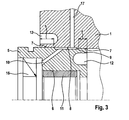
- annular groove 12 may also be formed on an end face of the pump housing 1.
- the annular groove 12 compensates in the present example, the interference pressure of the press connection 7 of the section b, by allowing an elastic deformation of the pump housing 1.
- FIG. 3 continues to differ from that of the FIG. 2 by the plain bearing bush 11 is cylindrical and not designed as a collar bushing.
- a collar portion 18 may be formed on the housing part 5.
- the return bore 10 is not designed as a radial bore, but running obliquely. About the annulus 10, the return bore 10 is in communication with a housing bore 17, which in turn is connected to the system return.
Landscapes
- Engineering & Computer Science (AREA)
- General Engineering & Computer Science (AREA)
- Mechanical Engineering (AREA)
- Chemical & Material Sciences (AREA)
- Combustion & Propulsion (AREA)
- Fuel-Injection Apparatus (AREA)
- Details And Applications Of Rotary Liquid Pumps (AREA)
- Details Of Reciprocating Pumps (AREA)
Description
- Die Erfindung betrifft eine Kraftstoffhochdruckpumpe einer Brennkraftmaschine mit den Merkmalen des Oberbegriffes des Anspruchs 1.
- Derartige Hochdruckpumpen sind aus dem Stand der Technik hinlänglich bekannt. Sie werden in Kraftfahrzeugen insbesondere dazu eingesetzt, Kraftstoff, vorzugsweise Dieselkraftstoff, in einen Hochdruckspeicher zu fördern, von wo aus der Kraftstoff unter hohem Druck in den Brennraum der Brennkraftmaschine eingespritzt wird. Hierzu weist eine solche Hochdruckpumpe eine Antriebswelle mit einem Nocken- oder Exzentertrieb auf, mittels derer ein Pumpenkolben wenigstens eines Pumpenelementes zu einer Hubbewegung angetrieben wird. Im Saughub des Pumpenkolbens wird Kraftstoff aus einem Niederdruckbereich angesaugt und im Förderhub des Pumpenkolbens im Pumpenarbeitsraum verdichtet, um dann unter hohem Druck stehend dem Hochdruckspeicher zugeführt zu werden.
- Aufgrund der hohen Förderdrücke besteht bei derartigen Pumpen regelmäßig das Problem, dass große Kräfte, und zwar radial als auch axial wirksame Kräfte in Bezug auf die Antriebswellenlängsachse, auf die Antriebswelle einwirken, welche durch die Lageranordnungen der Antriebswelle aufgenommen werden müssen. Um bei Auftreten hoher Radialkräfte und einer damit einhergehenden Schrägstellung der Antriebswelle hohe Kantenpressungen in den Randbereichen der Lageranordnungen zu verhindern wird beispielsweise in der Offenlegungsschrift
DE 10 2006 051 332 A1 vorgeschlagen, einen in einer Lagerbohrung aufgenommenen Lagerwellenabschnitt der Antriebswelle oder die Kontur der Lagerbohrung ballig auszuführen, so dass in der Lagermitte eine geringere Lagerluft als in den Lagerrandbereichen verbleibt. Somit kann eine gewisse Schrägstellung der Antriebswelle aufgrund einwirkender Radialkräfte besser toleriert werden. Zur Aufnahme der Axialkräfte ist die Lageranordnung in einem Flanschteil ausgebildet, das über wenigstens eine Schraubverbindung formschlüssig mit dem Gehäuse der Hochdruckpumpe verbunden ist. - Aus der
DE 10 2008 007 224 A1 geht ferner eine Pumpenanordnung mit wenigstens drei gekoppelten Gehäusemodulen hervor, wobei die Kopplung über eine Schraub- und Pressverbindung erfolgt. - Ausgehend von einer gattungsgemäßen Hochdruckpumpe der vorstehend genannten Art ist es Aufgabe der vorliegenden Erfindung, eine Hochdruckpumpe mit einer verbesserten Lageranordnung der Antriebswelle zu schaffen. Insbesondere soll die Hochdruckpumpe einfach und damit kostengünstig herzustellen sein.
- Zur Lösung der Aufgabe wird eine Hochdruckpumpe mit den Merkmalen des Anspruchs 1 vorgeschlagen. Vorteilhafte Weiterbildungen der Erfindung werden in den Unteransprüchen angegeben.
- Die vorgeschlagene Kraftstoffhochdruckpumpe weist ein Pumpengehäuse auf, in dem zur Betätigung wenigstens eines im Pumpengehäuse angeordneten Pumpenelementes eine Antriebswelle mit einem Nocken- oder Exzentertrieb aufgenommen und drehbar um eine Antriebswellenlängsachse gelagert ist. Zur Aufnahme und drehbaren Lagerung der Antriebswelle umfasst das Pumpengehäuse ein Gehäuseteil mit einer Lagerbohrung. Das Gehäuseteil ist über eine reibschlüssige Pressverbindung mit dem Pumpengehäuse verbunden, wobei die reibschlüssige Pressverbindung dadurch ausgebildet wird, dass das Gehäuseteil wenigstens einen Abschnitt besitzt, der ein radiales Übermaß gegenüber einer Ausnehmung des Pumpengehäuses besitzt, in welche das Gehäuseteil eingesetzt ist. Dabei ist die Pressverbindung vorzugsweise derart ausgelegt, dass hierüber auch über die Antriebswelle eingeleitete Axialkräfte aufgenommen werden können. Eine Schraubverbindung ist damit entbehrlich, so dass die Befestigung des Gehäuseteils am Pumpengehäuse schraubenlos erfolgen kann. Auch die Ausbildung eines Flansches ist entbehrlich, so das insgesamt Material und damit Gewicht eingespart werden kann. Ferner entfällt die aufwendige Herstellung von Bohrungen zur Aufnahme der Befestigungsschrauben, so dass insgesamt die Herstellung vereinfacht und damit kostengünstiger gestaltet wird.
- Erfindungsgemäß besitzt das Gehäuseteil zur Ausbildung der reibschlüssigen Pressverbindung einen ersten Abschnitt a und einen zweiten Abschnitt b mit radialem Übermaß gegenüber der Ausnehmung des Pumpengehäuses, so dass zwei Pressverbände zur reibschlüssigen Verbindung des Gehäuseteils mit dem Pumpengehäuse ausgebildet werden. Dabei sind der erste Abschnitt a und der zweite Abschnitt b in axialer Richtung bezogen auf die Antriebswellenlängsachse zueinander beabstandet angeordnet. Ein großer axialer Abstand ermöglicht eine Ausrichtung des Gehäuseteils über eine große Länge in axialer Richtung und gewährleistet somit die Koaxialtität des Gehäuseteils zum Pumpengehäuse. In entsprechender Weise ist der axiale Abstand daher bevorzugt möglichst groß gewählt.
- Die reibschlüssige Verbindung des Gehäuseteils mit dem Pumpengehäuse über zwei axial zueinander beabstandete Pressverbände weist zudem den Vorteil auf, dass zwischen den beiden Abschnitten a und b mit radialem Übermaß ein als Rücklaufnut nutzbarer Ringraum ausgebildet werden kann. Erfindungsgemäß mündet in diesen Ringraum eine Rücklaufbohrung zur Rückführung der Lagerschmiermenge in den Systemrücklauf. Die Rücklaufbohrung kann als Radialbohrung oder schräg verlaufend in einem Wandungsbereich des Gehäuseteils ausgebildet sein. Ein Ringraum als Rücklaufnut, das heißt eine umlaufende Rücklaufnut, besitzt den Vorteil, dass auch bei einer unterschiedlichen Winkellage der Rücklaufbohrungen im Gehäuseteil und im Pumpengehäuse der Anschluss an den Systemrücklauf gewährleistet ist. Bevorzugt wird die umlaufende Rücklaufnut durch die weiter innen liegende Pressverbindung des Abschnitts a gegenüber dem Pumpeninnenraum abgedichtet. Dadurch kann auf die Anordnung eines Dichtringes verzichtet werden. Sollten dennoch Undichtigkeiten auftreten, sind keine schwerwiegenden Auswirkungen zu erwarten, da die Leckage pumpenintern erfolgt.
- Vorzugsweise unterscheidet sich das radiale Übermaß des ersten Abschnitts a des Gehäuseteils gegenüber der Ausnehmung des Pumpengehäuses von dem radialen Übermaß des zweiten Abschnitts b. Weiterhin vorzugsweise ist das radiale Übermaß des zweiten Abschnitts b größer als das des ersten Abschnitts a gewählt. Durch eine entsprechende Ausbildung der Abschnitte a und b wird zum Einen eine ausreichende Pressverbindung in beiden Abschnitten sichergestellt, zum Anderen der Einpressvorgang erleichtert.
- Vorteilhafterweise besitzt die Pressverbindung im Bereich des zweiten Abschnitts b ebenfalls eine Dichtfunktion. Bei Anwendungen mit geringen Anforderungen, das heißt geringen, auf die Antriebswelle einwirkenden Kräften, kann die Pressverbindung demnach einen Dichtring zur Abdichtung des Ringraumes gegenüber dem Außenraum ersetzen.
- Vorzugsweise sind das radiale Übermaß und die axiale Erstreckung des Abschnitts a und/oder des Abschnitts b zur Herstellung einer Pressverbindung derart gewählt, dass die Mindestpresskraft > 5 kN beträgt und eine gängige Axialpresskraft von etwa 1 kN aufgenommen werden kann.
- Aufgrund des Pressübermaßes kann es im Bereich der Pressverbindung zu einer unerwünschten Verformung der Lagerbohrung sowie hieran angrenzender Bauteile kommen. Zur Ausbildung eines Gleitlagers kann beispielsweise eine Gleitlagerbuchse in der Lagerbohrung aufgenommen sein, so dass das Pressübermaß eine Verformung der Lagerbuchse bewirken kann. Dadurch kann ggf. die Tragfähigkeit des Lagers herabgesetzt werden. Zur Vermeidung derartiger Verformungen ist daher bevorzugt im Pumpengehäuse im Bereich wenigstens einer Pressverbindung eine Ringnut vorgesehen, die eine elastische Verformung des Pumpengehäuses und damit eine Entkopplung im Bereich der Pressverbindung bewirkt. Somit sind hohe Haltekräfte ohne plastische Verformung angrenzender Bauteile und ohne Spannbildung im Pressbereich realisierbar. Aufgrund der Entkopplung kann die Presskraft sogar noch weiter angehoben werden.
- Gemäß einer bevorzugten Ausführungsform ist die zur Entkopplung des Pumpengehäuses vorgesehene Ringnut vorzugsweise koaxial zur Ausnehmung des Pumpengehäuses angeordnet, in der das Gehäuseteil eingesetzt ist. Die Ringnut erstreckt sich von einer Stirnfläche des Pumpengehäuses aus im Wesentlichen axial und ist vorteilhafterweise mit einem kerbunempfindlichen Radius ausgestattet. Alternativ oder ergänzend kann auch in einer Stirnfläche des Gehäuseteils eine entsprechende Ringnut ausgebildet sein, um unerwünschten Verformungen entgegen zu wirken. Sofern die Anordnung einer Gleitlagerbuchse in der Lager bohrung des Gehäuseteils vorgesehen ist, kann diese zylinderförmig oder als Bundbuchse ausgebildet sein.
- Kommt eine Ringnut zur Entkopplung des Pumpengehäuses zum Einsatz, ist vorzugsweise deren axiale Erstreckung größer als die axiale Erstreckung des jeweiligen Pressbereiches gewählt, zu deren Entlastung die Ringnut beiträgt. Das heißt, dass die axiale Erstreckung der Ringnut vorzugsweise größer als die axiale Erstreckung der Abschnitte a oder b mit radialem Übermaß gewählt ist. Dadurch kann eine ungleiche Flächenpressung in Längsrichtung vermieden werden. Wieterhin vorzugweise ist die axiale Erstreckung der Ringnut mindestens 20% größer als die axiale Erstreckung des jeweiligen Pressbereiches gewählt.
- Gemäß einer bevorzugten Ausführungsform ist zur axialen Lagesicherung des Gehäuseteils innerhalb der Ausnehmung des Pumpengehäuses zusätzlich eine formschlüssige Verbindung des Gehäuseteils mit dem Pumpengehäuse vorgesehen. Die formschlüssige Verbindung kann beispielsweise durch wenigstens eine Schraube oder wenigstens einen Stift bewirkt werden. Vorzugsweise ist die wenigstens eine Schraube oder der wenigstens eine Stift senkrecht zur Antriebswellenlängsachse geführt. Alternativ kann zur Herstellung einer formschlüssigen Verbindung auch ein Spreng- oder Sicherungsring eingesetzt werden. Aufgrund der zusätzlichen formschlüssigen Verbindung ist die Hochdruckpumpe auch für Anwendungen mit besonders hohen Anforderungen geeignet.
- Vorteilhafterweise bestehen das Gehäuseteil und das Pumpengehäuse aus dem gleichen Werkstoff, so dass das Gehäuseteil und das Pumpengehäuse die gleichen Werte hinsichtlich E-Modul und Temperaturausdehnungskoeffizient aufweisen. Ein betriebsbedingtes Lösen der wenigstens einen Pressverbindung kann damit weitestgehend ausgeschlossen werden. Eine zusätzliche formschlüssige Verbindung ist demnach in der Regel entbehrlich. Zudem bleibt eine etwaige Dichtfunktion in einem Pressbereich dauerhaft gewährleistet. Werden unterschiedliche Werkstoffe zur Herstellung des Gehäuseteils und des Pumpengehäuses verwendet, muss - insbesondere bei alleiniger Befestigung des Gehäuseteils am Pumpengehäuse über wenigstens eine Pressverbindung - sichergestellt sein, dass die Mindestpresskraft ausreicht, um die Haltefunktion übder den gesamten Bereich der Betriebstemperatur zu gewährleisten.
- Ausführungsbeispiele der Erfindung werden nachfolgend anhand der Zeichnungen näher erläutert. Es zeigen:
-
Fig. 1 einen Teilschnitt durch eine bekannte Hochdruckpumpe im Bereich der Lagerung der Antriebswelle, -
Fig. 2 einen Teilschnitt durch eine erfindungsgmäße Hochdruckpumpe mit vergrößerter Darstellung des Lagerbereiches und -
Fig. 3 einen Teilschnitt durch eine alternative Ausführungsform einer erfindungsgemäßen Hochdruckpumpe mit vergrößerter Darstellung des Lagerbereiches. - Die in der
Fig 1 dargestellte und aus dem Stand der Technik bekannte Hochdruckpumpe umfasst ein Pumpengehäuse 1, in welches zur Aufnahme und drehbaren Lagerung einer Antriebswelle 2 um eine Antriebswellenlängsachse 4 ein flanschartig ausgebildetes Gehäuseteil 5 aufgenommen ist. Zur Ausbildung eines Gleitlagers ist in einer Lagerbohrung 6 des Gehäuseteils 5 eine Gleitlagerbuchse 11 eingesetzt. Die Antriebswelle 2 ist durch die Gleitlagerbuchse 11 hindurch geführt und endseitig in einer weiteren als Gleitlager ausgebildeten Lageranordnung im Pumpengehäuse 1 gehalten. Zwischen den beiden Gleitlagern weist die Antriebswelle 2 einen Nockentrieb 3 zur Betätigung eines Pumpenkolbens (nicht dargestellt) wenigstens eines Pumpenelementes (ebenfalls nicht dargestellt) zur Förderung von Kraftstoff auf. - Das Gehäuseteil 5 ist über seinen Flansch 14 axial am Pumpengehäuse 1 angeschlagen. Zur Befestigung wird der Flansch 14 über wenigstens eine Schraube 15 mit dem Pumpengehäuse verschraubt. Üblicherweise sind 4 oder 6 Schrauben 15 im gleichen Winkelabstand zueinander im Flansch 14 zur Befestigung des Gehäuseteils 5 angeordnet. Die Schrauben 15 bewirken eine formschlüssige Verbindung, durch welche über die Antriebswelle 2 eingeleitete Axialkräfte aufgenommen werden können. Über einen zylinderförmigen Ansatz am Flansch 14 ist das Gehäuseteil 5 zudem in radialer Richtung in einer Ausnehmung 8 des Pumpengehäuses 1 abgestützt.
- Zwischen der Ausnehmung 8 des Pumpengehäuses 1 und dem Gehäuseteil 5 ist wenigstens ein Dichtring 13 angeordnet, der den Austritt einer gewissen Lagerschmiermenge verhindern soll. Eine entsprechende Funktion besitzt ein Wellendichtring 16, der den Lagerspalt zwischen der Antriebswelle 2 und dem Gehäuseteil 5 nach außen abdichtet.
- De Weiteren ist in einer Stirnfläche des Gehäuseteils 5 eine Ringnut 12 ausgebildet, die eine gewisse elastische Verformbarkeit des Gehäuseteils 5 im Randbereich des Lagers gewährleistet. Die durch die Ringnut 12 bewirkte elastische Verformbarkeit ist insbesondere dann von Vorteil, wenn hohe Querkräfte aus dem Nockentrieb 3 auf die Antriebswelle 2 wirken und somit zu einem Verkippen der Antriebswelle 2 gegenüber der Antriebswellenlängsachse 4 führten. In einem solchen Fall erfahren die Randbereiche des Lagers eine hohe Belastung, die jedoch durch eine entsprechende elastische Verformung herabgesetzt werden kann.
- Eine erfidnungsgemäße Hochdruckpumpe entsprechend der
Figuren 2 und3 unterscheidet sich von der vorstehend beschriebenen Hochdruckpumpe dadurch, dass das Gehäuseteil 5 mit dem Pumpengehäuse 1 über eine Pressverbindung 7 reibschlüssig verbunden ist, wobei die reibschlüssige Pressverbindung dadurch hergestellt wird, dass das Gehäuseteil 5 in wenigstens einem Abschnitt a, b ein radiales Übermaß gegenüber der Ausnehmung 8 des Pumpengehäuses 1 besitzt, in welcher das Gehäuseteil 5 aufgenommen ist. Eine Verschraubung des Gehäuseteils 5 mit dem Pumpengehäuse 1 ist somit entbehrlich, so dass auch die Ausbildung eines Flansches 14 nicht erforderlich ist. Daduch wird Material und Gewicht eingespart. Das Gehäuseteil 5 der Ausführungsformen derFiguren 2 und3 ist daher im Wesentlichen hohlzylinderförmig ausgebildet. - Gleichwohl die Ausbildung einer Pressverbindung 7 über lediglich einen ein radiales Übermaß aufweisenden Abschnitt a zur Befestigung des Gehäuseteils 5 am Pumpengehäuse 1 als ausreichend angesehen wird, wird die Ausführung mit zwei Pressverbänden aus den nachfolgend genannten Gründen bevorzugt.
- Bei dem ersten, in
Figur 2 dargestellten Ausführungsbeispiel weist das Gehäuseteil 5 zwei Abschnitte a und b auf, die gegenüber der Ausnehmung 8 des Pumpengehäuses 1 ein radiales Übermaß besitzen. Somit wird in den Abschnitten a und b jeweils eine Pressverbindung 7 hergestellt. Die Abschnitte a und b sind axial beabstandet zueinander am Gehäuseteil 5 angeordnet, so dass zwischen den Abschnitten a und b ein Ringraum 9 ausgebildet wird. Der Ringraum 9 dient als Rücklaufnut, um über eine Rücklaufbohrung 10 eine gewisse Lagerschmiermenge wieder einem Systemrücklauf (nicht dargestellt) zuzuführen. Bei dem Ausführungsbeispiel derFigur 2 ist die Rücklaufbohrung 10 als Radialbohrung ausgeführt. Gegenüber dem Pumpeninnenraum ist der Ringraum 9 durch die Pressverbindung 7 des Abschnitts a abgedichtet, dessen radiales Übermaß derart bemessen ist, dass die Pressverbindung 7 zugleich eine Dichtfunktion ausübt. Der Abschnitt b weist dagegen kein zur Ausübung einer Dichtfunktion ausreichendes axiales Übermaß auf, so dass der Ringraum 9 nach außen hin über einen Dichtring 13 abgedichtet wird. Ein solcher Dichtring 13 ist entbehrlich, wenn auch das radiale Übermaß des Abschnitts b gegenüber der Ausnehmung 8 des Pumpengehäuses 1 auf ein entsprechendes Maß angehoben wird. Die Abdichtung der Antriebswelle 2 gegenüber dem Gehäuseteil 5 übernimmt ein Wellendichtring 16. - Bei dem Ausführungsbeispiel der
Figur 2 ist in die Lagerbohrung 6 des Gehäuseteils 5 eine Bundbuchse als Gleitlagerbuchse 11 eingesetzt. Um einer Verformung der Gleitlagerbuchse 11 aufgrund des Pressübermaßes des Abschnitts a entgegen zu wirken, weist das Gehäuseteil 5 in diesem Bereich eine stirnseitig eingebrachte Ringnut 12 auf, aufgrund derer sich der Randbereich des Gehäuseteils 5 elastisch verformen kann. Eine Verformung der Gleitlagerbuchse wird dadurch verhindert, so dass die Tragfähikeit des Lagers weiterhin gewährleistet ist. - Wie in dem zweiten Ausführungsbeispiel der
Figur 3 gezeigt, kann eine Ringnut 12 auch an einer Stirnfläche des Pumpengehäuses 1 ausgebildet sein. Die Ringnut 12 kompensiert in dem vorliegenden Beispiel das Pressübermaß der Pressverbindung 7 des Abschnittes b, indem sie eine elastische Verformung des Pumpengehäuses 1 ermöglicht. - Das Ausführungsbeispiel der
Figur 3 unterscheidet sich weiterhin von dem derFigur 2 , indem die Gleitlagerbuchse 11 zylinderförmig und nicht als Bundbuchse ausgebildet ist. Um die Gleitlagerbuchse 11 in ihrer axialen Lage zu sichern, kann ein Bundbereich 18 am Gehäuseteil 5 ausgebildet sein. Ferner ist als weiteres Unterscheidungsmerkmal die Rücklaufbohrung 10 nicht als Radialbohrung, sondern schräg verlaufend ausgeführt. Über den Ringraum 10 steht die Rücklaufbohrung 10 in Verbindung mit einer Gehäusebohrung 17, die wiederum an den Systemrücklauf angeschlossen ist. - Die verschiedenen, in Zusammenhang mit den Ausführungsbeispielen der
Figuren 2 und 3 beschriebenen Aussattungsmerkmale können jeweils alternativ oder in beliebiger Kombination zum Einsatz gelangen. Die Erfindung ist daher ausdrücklich nicht auf die dargestellten Ausführungsbeispiele beschränkt.
Claims (7)
- Kraftstoffhochdruckpumpe einer Brennkraftmaschine mit einem Pumpengehäuse (1), in dem zur Betätigung wenigstens eines im Pumpengehäuse (1) angeordneten Pumpenelementes eine Antriebswelle (2) mit einem Nocken- oder Exzentertrieb (3) aufgenommen und drehbar um eine Antriebswellenlängsachse (4) gelagert ist, wobei das Pumpengehäuse (1) zur Aufnahme und drehbaren Lagerung der Antriebswelle (2) ein Gehäuseteil (5) mit einer Lagerbohrung (6) umfasst, das über eine reibschlüssige Pressverbindung (7) mit dem Pumpengehäuse (1) verbunden ist,
wobei das Gehäuseteil (5) einen ersten Abschnitt (a) und einen zweiten Abschnitt (b) mit radialem Übermaß gegenüber einer Ausnehmung (8) des Pumpengehäuses (1), in welche das Gehäuseteil (5) eingesetzt ist, zur Ausbildung der reibschlüssigen Pressverbindung (7) besitzt, wobei der erste Abschnitt (a) und der zweite Abschnitt (b) in axialer Richtung bezogen auf die Antriebswellenlängsachse (4) zueinander beabstandet sind,
dadurch gekennzeichnet, dass zwischen den beiden Abschnitten (a, b) ein Ringraum (9) als Rücklaufnut verbleibt, in den eine Rücklaufbohrung (10) mündet. - Kraftstoffhochdruckpumpe nach einem der vorhergehenden Ansprüche,
dadurch gekennzeichnet, dass sich das radiale Übermaß des ersten Abschnitts (a) und des zweiten Abschnitts (b) des Gehäuseteils (5) gegenüber der Ausnehmung (8) des Pumpengehäuses (1) unterscheidet, wobei vorzugsweise das radiale Übermaß des zweiten Abschnitts (b) größer gewählt ist. - Kraftstoffhochdruckpumpe nach einem der vorhergehenden Ansprüche,
dadurch gekennzeichnet, dass die Pressverbindung im Bereich des zweiten Abschnitts (b) zudem eine Dichtfunktion besitzt. - Kraftstoffhochdruckpumpe nach einem der vorhergehenden Ansprüche,
dadurch gekennzeichnet, dass zur Vermeidung einer Verformung der Lagerbohrung (6) des Gehäuseteils (5) oder einer in der Lagerbohrung (6) angeordneten Gleitlagerbuchse (11) im Pumpengehäuse (1) im Bereich wenigstens einer Pressverbindung (7) eine Ringnut (12) vorgesehen ist, die eine elastische Verformung des Pumpengehäuses (1) und damit eine Entkopplung im Bereich der Pressverbindung (7) bewirkt, wobei die Ringnut (12) vorzugsweise koaxial zur Ausnehmung (8) des Pumpengehäuses (1) angeordnet und mit einem kerbunempfindlichen Radius augestattet ist. - Kraftstoffhochdruckpumpe nach Anspruch 4,
dadurch gekennzeichnet, dass die axiale Erstreckung der Ringnut (12) im Pumpengehäuse (1) größer als die axiale Erstreckung des jeweiligen Abschnitts (a, b) mit radialem Übermaß gewählt ist, wobei die axiale Erstreckung der Ringnut (12) vorzugsweise mindestens 20% größer gewählt ist. - Krafttsoffhochdruckpumpe nach einem der vorhergehenden Ansprüche,
dadurch gekennzeichnet, dass zur axialen Lagesicherung des Gehäuseteils (5) innerhalb der Ausnehmung (8) des Pumpengehäuses (1) zusätzlich eine formschlüssige Verbindung des Gehäuseteils (5) mit dem Pumpengehäuse (1) vorgesehen ist. - Krafttsoffhochdruckpumpe nach einem der vorhergehenden Ansprüche,
dadurch gekennzeichnet, dass das Gehäuseteil (5) und das Pumpengehäuse (1) aus dem gleichen Werkstoff bestehen.
Applications Claiming Priority (2)
| Application Number | Priority Date | Filing Date | Title |
|---|---|---|---|
| DE200910028795 DE102009028795A1 (de) | 2009-08-21 | 2009-08-21 | Kraftstoffhochdruckpumpe |
| PCT/EP2010/058914 WO2011020635A1 (de) | 2009-08-21 | 2010-06-23 | Kraftstoffhochdruckpumpe |
Publications (2)
| Publication Number | Publication Date |
|---|---|
| EP2467592A1 EP2467592A1 (de) | 2012-06-27 |
| EP2467592B1 true EP2467592B1 (de) | 2013-08-14 |
Family
ID=42670439
Family Applications (1)
| Application Number | Title | Priority Date | Filing Date |
|---|---|---|---|
| EP10728193.3A Active EP2467592B1 (de) | 2009-08-21 | 2010-06-23 | Kraftstoffhochdruckpumpe |
Country Status (7)
| Country | Link |
|---|---|
| EP (1) | EP2467592B1 (de) |
| JP (1) | JP5379307B2 (de) |
| KR (1) | KR101694571B1 (de) |
| CN (1) | CN102483017B (de) |
| DE (1) | DE102009028795A1 (de) |
| RU (1) | RU2556954C2 (de) |
| WO (1) | WO2011020635A1 (de) |
Families Citing this family (3)
| Publication number | Priority date | Publication date | Assignee | Title |
|---|---|---|---|---|
| DE102012210184A1 (de) * | 2012-06-18 | 2013-12-19 | Robert Bosch Gmbh | Hochdruckpumpe für ein Kraftstoffeinspritzsystem |
| KR102097882B1 (ko) * | 2016-02-02 | 2020-04-06 | 바르실라 핀랜드 오이 | 베어링 배열체 |
| DE102018216850A1 (de) * | 2018-10-01 | 2020-04-02 | Robert Bosch Gmbh | Kraftstoffhochdruckpumpe mit einem Anschlussstutzen |
Family Cites Families (12)
| Publication number | Priority date | Publication date | Assignee | Title |
|---|---|---|---|---|
| US5215449A (en) * | 1991-12-05 | 1993-06-01 | Stanadyne Automotive Corp. | Distributor type fuel injection pump |
| US5688110A (en) * | 1995-06-02 | 1997-11-18 | Stanadyne Automotive Corp. | Fuel pump arrangement having cam driven low and high pressure reciprocating plunger pump units |
| DE19916376A1 (de) * | 1999-04-12 | 2000-10-19 | Mannesmann Rexroth Ag | Pumpengehäuse |
| JP3875441B2 (ja) * | 2000-01-26 | 2007-01-31 | 三菱電機株式会社 | 高圧燃料ポンプ |
| KR100362808B1 (ko) * | 2000-04-21 | 2002-11-27 | 삼성광주전자 주식회사 | 수지몰드형 무브러시 직류모터 및 그 제조방법 |
| DE10029431A1 (de) * | 2000-06-15 | 2001-12-20 | Siemens Ag | Bohrungsanordnung mit einer aus mindestens zwei Bohrungen gebildeten Verschneidung sowie Verfahren zu deren Herstellung |
| DE10221305A1 (de) * | 2002-05-14 | 2003-11-27 | Bosch Gmbh Robert | Radialkolbenpumpe für Kraftstoffeinspritzsystem mit verbesserter Hochdruckfestigkeit |
| DE10259178A1 (de) * | 2002-12-18 | 2004-07-08 | Robert Bosch Gmbh | Hochdruckpumpe für eine Kraftstoffspritzeinrichtung einer Brennkraftmaschine |
| JP4614740B2 (ja) * | 2004-11-17 | 2011-01-19 | パナソニック株式会社 | スピンドルモータ |
| DE102006051332A1 (de) | 2006-10-31 | 2008-05-08 | Robert Bosch Gmbh | Förderpumpe, insbesondere zur Förderung von Dieselkraftstoff mit einer verbesserten Lagerung der Antriebswelle |
| DE102007048853A1 (de) * | 2007-10-11 | 2009-04-16 | Robert Bosch Gmbh | Flansch einer Hochdruckkraftstoffpumpe |
| DE102008007224A1 (de) * | 2008-02-01 | 2009-08-06 | Continental Automotive Gmbh | Pumpenanordnung zur Förderung eines Fluids, Verfahren zur Herstellung einer Pumpenanordnung und System mit einer Pumpenanordnung |
-
2009
- 2009-08-21 DE DE200910028795 patent/DE102009028795A1/de not_active Withdrawn
-
2010
- 2010-06-23 CN CN201080037048.XA patent/CN102483017B/zh active Active
- 2010-06-23 JP JP2012525100A patent/JP5379307B2/ja not_active Expired - Fee Related
- 2010-06-23 WO PCT/EP2010/058914 patent/WO2011020635A1/de not_active Ceased
- 2010-06-23 KR KR1020127004316A patent/KR101694571B1/ko not_active Expired - Fee Related
- 2010-06-23 RU RU2012110484/06A patent/RU2556954C2/ru active
- 2010-06-23 EP EP10728193.3A patent/EP2467592B1/de active Active
Also Published As
| Publication number | Publication date |
|---|---|
| CN102483017B (zh) | 2014-10-29 |
| KR101694571B1 (ko) | 2017-01-17 |
| DE102009028795A1 (de) | 2011-02-24 |
| WO2011020635A1 (de) | 2011-02-24 |
| KR20120046750A (ko) | 2012-05-10 |
| EP2467592A1 (de) | 2012-06-27 |
| JP5379307B2 (ja) | 2013-12-25 |
| RU2556954C2 (ru) | 2015-07-20 |
| RU2012110484A (ru) | 2013-10-27 |
| JP2013502523A (ja) | 2013-01-24 |
| CN102483017A (zh) | 2012-05-30 |
Similar Documents
| Publication | Publication Date | Title |
|---|---|---|
| DE102004063074B4 (de) | Kolbenpumpe, insbesondere Kraftstoff-Hochdruckpumpe für eine Brennkraftmaschine | |
| DE10161715A1 (de) | Elektrische Hilfskraftlenkung für Kraftfahrzeuge | |
| WO2018059900A1 (de) | ROLLENSTÖßEL FÜR EINE KOLBENPUMPE, KOLBENPUMPE | |
| WO1997005388A1 (de) | Kolbenpumpe | |
| EP3421802A1 (de) | Gaspumpe mit druckentlastung zur reduzierung des anfahrdrehmoments | |
| WO2020136269A1 (de) | Rotationspumpe mit axialer kompensation, auslassdichtung für eine pumpe sowie vormontierte pumpeneinheit | |
| EP4314560B1 (de) | Innenzahnradfluidmaschine sowie verfahren zum herstellen einer innenzahnradfluidmaschine | |
| AT519652B1 (de) | Dichtungsvorrichtung und Hydraulikkolben mit Dichtungsvorrichtung | |
| WO2011020635A1 (de) | Kraftstoffhochdruckpumpe | |
| EP3903006A1 (de) | Rotationspumpe mit axialer kompensation, auslassdichtung für eine pumpe sowie vormontierte pumpeneinheit | |
| EP2419635A1 (de) | Kolbenpumpe mit nockenantrieb, insbesondere kraftstoffpumpe | |
| WO2011098314A1 (de) | Kraftstoffhochdruckpumpe | |
| EP1929154B1 (de) | Kolbenpumpe | |
| WO2012080340A1 (de) | Hochdruckpumpe | |
| EP1156212B1 (de) | Axialkolbenmaschine mit in Führungsbuchsen einer Zylindertrommel verschiebbar gelagerten Kolben | |
| EP2207958B1 (de) | Radialkolbenpumpe mit einem prismatischen grundkörper für ein kraftstoffeinspritzsystem | |
| WO2007138093A1 (de) | Verstellbare verdrängerpumpe | |
| WO2017148841A1 (de) | Pumpenkolben für eine kolben-kraftstoffhochdruckpumpe sowie kolben-kraftstoffhochdruckpumpe | |
| DE102009028997A1 (de) | Kraftstoffhochdruckpumpe | |
| DE102020203529B3 (de) | Anordnung und Verfahren zum Herstellen einer Anordnung für eine Kraftstoffhochdruckpumpe und Kraftstoffhochdruckpumpe für ein Kraftfahrzeug | |
| EP2872778B1 (de) | Hochdruckpumpe | |
| EP1515883A1 (de) | Motor-pumpen-aggregat, insbesondere für schlupfgeregelte bremssysteme | |
| WO2018069134A1 (de) | Rollenstössel für eine kolbenpumpe, kolbenpumpe | |
| DE102022213122A1 (de) | Kolbenpumpe, insbesondere Kraftstoff-Hochdruckpumpe für ein Kraftstoffsystem einer Brennkraftmaschine | |
| DE102015210798B4 (de) | Kraftstoffhochdruckpumpe |
Legal Events
| Date | Code | Title | Description |
|---|---|---|---|
| PUAI | Public reference made under article 153(3) epc to a published international application that has entered the european phase |
Free format text: ORIGINAL CODE: 0009012 |
|
| 17P | Request for examination filed |
Effective date: 20120321 |
|
| AK | Designated contracting states |
Kind code of ref document: A1 Designated state(s): AL AT BE BG CH CY CZ DE DK EE ES FI FR GB GR HR HU IE IS IT LI LT LU LV MC MK MT NL NO PL PT RO SE SI SK SM TR |
|
| DAX | Request for extension of the european patent (deleted) | ||
| GRAP | Despatch of communication of intention to grant a patent |
Free format text: ORIGINAL CODE: EPIDOSNIGR1 |
|
| INTG | Intention to grant announced |
Effective date: 20130426 |
|
| GRAS | Grant fee paid |
Free format text: ORIGINAL CODE: EPIDOSNIGR3 |
|
| GRAA | (expected) grant |
Free format text: ORIGINAL CODE: 0009210 |
|
| AK | Designated contracting states |
Kind code of ref document: B1 Designated state(s): AL AT BE BG CH CY CZ DE DK EE ES FI FR GB GR HR HU IE IS IT LI LT LU LV MC MK MT NL NO PL PT RO SE SI SK SM TR |
|
| REG | Reference to a national code |
Ref country code: GB Ref legal event code: FG4D Free format text: NOT ENGLISH |
|
| REG | Reference to a national code |
Ref country code: CH Ref legal event code: EP Ref country code: AT Ref legal event code: REF Ref document number: 627019 Country of ref document: AT Kind code of ref document: T Effective date: 20130815 |
|
| REG | Reference to a national code |
Ref country code: IE Ref legal event code: FG4D Free format text: LANGUAGE OF EP DOCUMENT: GERMAN |
|
| REG | Reference to a national code |
Ref country code: DE Ref legal event code: R096 Ref document number: 502010004383 Country of ref document: DE Effective date: 20131010 |
|
| REG | Reference to a national code |
Ref country code: NL Ref legal event code: VDEP Effective date: 20130814 |
|
| REG | Reference to a national code |
Ref country code: LT Ref legal event code: MG4D |
|
| PG25 | Lapsed in a contracting state [announced via postgrant information from national office to epo] |
Ref country code: NO Free format text: LAPSE BECAUSE OF FAILURE TO SUBMIT A TRANSLATION OF THE DESCRIPTION OR TO PAY THE FEE WITHIN THE PRESCRIBED TIME-LIMIT Effective date: 20131114 Ref country code: SE Free format text: LAPSE BECAUSE OF FAILURE TO SUBMIT A TRANSLATION OF THE DESCRIPTION OR TO PAY THE FEE WITHIN THE PRESCRIBED TIME-LIMIT Effective date: 20130814 Ref country code: CY Free format text: LAPSE BECAUSE OF FAILURE TO SUBMIT A TRANSLATION OF THE DESCRIPTION OR TO PAY THE FEE WITHIN THE PRESCRIBED TIME-LIMIT Effective date: 20130828 Ref country code: LT Free format text: LAPSE BECAUSE OF FAILURE TO SUBMIT A TRANSLATION OF THE DESCRIPTION OR TO PAY THE FEE WITHIN THE PRESCRIBED TIME-LIMIT Effective date: 20130814 Ref country code: PT Free format text: LAPSE BECAUSE OF FAILURE TO SUBMIT A TRANSLATION OF THE DESCRIPTION OR TO PAY THE FEE WITHIN THE PRESCRIBED TIME-LIMIT Effective date: 20131216 Ref country code: IS Free format text: LAPSE BECAUSE OF FAILURE TO SUBMIT A TRANSLATION OF THE DESCRIPTION OR TO PAY THE FEE WITHIN THE PRESCRIBED TIME-LIMIT Effective date: 20131214 Ref country code: HR Free format text: LAPSE BECAUSE OF FAILURE TO SUBMIT A TRANSLATION OF THE DESCRIPTION OR TO PAY THE FEE WITHIN THE PRESCRIBED TIME-LIMIT Effective date: 20130814 |
|
| PG25 | Lapsed in a contracting state [announced via postgrant information from national office to epo] |
Ref country code: LV Free format text: LAPSE BECAUSE OF FAILURE TO SUBMIT A TRANSLATION OF THE DESCRIPTION OR TO PAY THE FEE WITHIN THE PRESCRIBED TIME-LIMIT Effective date: 20130814 Ref country code: GR Free format text: LAPSE BECAUSE OF FAILURE TO SUBMIT A TRANSLATION OF THE DESCRIPTION OR TO PAY THE FEE WITHIN THE PRESCRIBED TIME-LIMIT Effective date: 20131115 Ref country code: PL Free format text: LAPSE BECAUSE OF FAILURE TO SUBMIT A TRANSLATION OF THE DESCRIPTION OR TO PAY THE FEE WITHIN THE PRESCRIBED TIME-LIMIT Effective date: 20130814 Ref country code: FI Free format text: LAPSE BECAUSE OF FAILURE TO SUBMIT A TRANSLATION OF THE DESCRIPTION OR TO PAY THE FEE WITHIN THE PRESCRIBED TIME-LIMIT Effective date: 20130814 Ref country code: SI Free format text: LAPSE BECAUSE OF FAILURE TO SUBMIT A TRANSLATION OF THE DESCRIPTION OR TO PAY THE FEE WITHIN THE PRESCRIBED TIME-LIMIT Effective date: 20130814 |
|
| PG25 | Lapsed in a contracting state [announced via postgrant information from national office to epo] |
Ref country code: CY Free format text: LAPSE BECAUSE OF FAILURE TO SUBMIT A TRANSLATION OF THE DESCRIPTION OR TO PAY THE FEE WITHIN THE PRESCRIBED TIME-LIMIT Effective date: 20130814 |
|
| PG25 | Lapsed in a contracting state [announced via postgrant information from national office to epo] |
Ref country code: DK Free format text: LAPSE BECAUSE OF FAILURE TO SUBMIT A TRANSLATION OF THE DESCRIPTION OR TO PAY THE FEE WITHIN THE PRESCRIBED TIME-LIMIT Effective date: 20130814 Ref country code: SK Free format text: LAPSE BECAUSE OF FAILURE TO SUBMIT A TRANSLATION OF THE DESCRIPTION OR TO PAY THE FEE WITHIN THE PRESCRIBED TIME-LIMIT Effective date: 20130814 Ref country code: RO Free format text: LAPSE BECAUSE OF FAILURE TO SUBMIT A TRANSLATION OF THE DESCRIPTION OR TO PAY THE FEE WITHIN THE PRESCRIBED TIME-LIMIT Effective date: 20130814 Ref country code: CZ Free format text: LAPSE BECAUSE OF FAILURE TO SUBMIT A TRANSLATION OF THE DESCRIPTION OR TO PAY THE FEE WITHIN THE PRESCRIBED TIME-LIMIT Effective date: 20130814 Ref country code: NL Free format text: LAPSE BECAUSE OF FAILURE TO SUBMIT A TRANSLATION OF THE DESCRIPTION OR TO PAY THE FEE WITHIN THE PRESCRIBED TIME-LIMIT Effective date: 20130814 Ref country code: EE Free format text: LAPSE BECAUSE OF FAILURE TO SUBMIT A TRANSLATION OF THE DESCRIPTION OR TO PAY THE FEE WITHIN THE PRESCRIBED TIME-LIMIT Effective date: 20130814 |
|
| PG25 | Lapsed in a contracting state [announced via postgrant information from national office to epo] |
Ref country code: IT Free format text: LAPSE BECAUSE OF FAILURE TO SUBMIT A TRANSLATION OF THE DESCRIPTION OR TO PAY THE FEE WITHIN THE PRESCRIBED TIME-LIMIT Effective date: 20130814 Ref country code: ES Free format text: LAPSE BECAUSE OF FAILURE TO SUBMIT A TRANSLATION OF THE DESCRIPTION OR TO PAY THE FEE WITHIN THE PRESCRIBED TIME-LIMIT Effective date: 20130814 |
|
| PLBE | No opposition filed within time limit |
Free format text: ORIGINAL CODE: 0009261 |
|
| STAA | Information on the status of an ep patent application or granted ep patent |
Free format text: STATUS: NO OPPOSITION FILED WITHIN TIME LIMIT |
|
| 26N | No opposition filed |
Effective date: 20140515 |
|
| REG | Reference to a national code |
Ref country code: DE Ref legal event code: R097 Ref document number: 502010004383 Country of ref document: DE Effective date: 20140515 |
|
| PG25 | Lapsed in a contracting state [announced via postgrant information from national office to epo] |
Ref country code: MC Free format text: LAPSE BECAUSE OF FAILURE TO SUBMIT A TRANSLATION OF THE DESCRIPTION OR TO PAY THE FEE WITHIN THE PRESCRIBED TIME-LIMIT Effective date: 20130814 Ref country code: LU Free format text: LAPSE BECAUSE OF FAILURE TO SUBMIT A TRANSLATION OF THE DESCRIPTION OR TO PAY THE FEE WITHIN THE PRESCRIBED TIME-LIMIT Effective date: 20140623 |
|
| REG | Reference to a national code |
Ref country code: CH Ref legal event code: PL |
|
| GBPC | Gb: european patent ceased through non-payment of renewal fee |
Effective date: 20140623 |
|
| REG | Reference to a national code |
Ref country code: IE Ref legal event code: MM4A |
|
| REG | Reference to a national code |
Ref country code: FR Ref legal event code: ST Effective date: 20150227 |
|
| PG25 | Lapsed in a contracting state [announced via postgrant information from national office to epo] |
Ref country code: LI Free format text: LAPSE BECAUSE OF NON-PAYMENT OF DUE FEES Effective date: 20140630 Ref country code: CH Free format text: LAPSE BECAUSE OF NON-PAYMENT OF DUE FEES Effective date: 20140630 Ref country code: IE Free format text: LAPSE BECAUSE OF NON-PAYMENT OF DUE FEES Effective date: 20140623 |
|
| PG25 | Lapsed in a contracting state [announced via postgrant information from national office to epo] |
Ref country code: FR Free format text: LAPSE BECAUSE OF NON-PAYMENT OF DUE FEES Effective date: 20140630 Ref country code: GB Free format text: LAPSE BECAUSE OF NON-PAYMENT OF DUE FEES Effective date: 20140623 |
|
| PG25 | Lapsed in a contracting state [announced via postgrant information from national office to epo] |
Ref country code: MT Free format text: LAPSE BECAUSE OF FAILURE TO SUBMIT A TRANSLATION OF THE DESCRIPTION OR TO PAY THE FEE WITHIN THE PRESCRIBED TIME-LIMIT Effective date: 20130814 |
|
| PG25 | Lapsed in a contracting state [announced via postgrant information from national office to epo] |
Ref country code: SM Free format text: LAPSE BECAUSE OF FAILURE TO SUBMIT A TRANSLATION OF THE DESCRIPTION OR TO PAY THE FEE WITHIN THE PRESCRIBED TIME-LIMIT Effective date: 20130814 |
|
| PG25 | Lapsed in a contracting state [announced via postgrant information from national office to epo] |
Ref country code: BG Free format text: LAPSE BECAUSE OF FAILURE TO SUBMIT A TRANSLATION OF THE DESCRIPTION OR TO PAY THE FEE WITHIN THE PRESCRIBED TIME-LIMIT Effective date: 20130814 |
|
| PG25 | Lapsed in a contracting state [announced via postgrant information from national office to epo] |
Ref country code: BE Free format text: LAPSE BECAUSE OF FAILURE TO SUBMIT A TRANSLATION OF THE DESCRIPTION OR TO PAY THE FEE WITHIN THE PRESCRIBED TIME-LIMIT Effective date: 20140630 Ref country code: HU Free format text: LAPSE BECAUSE OF FAILURE TO SUBMIT A TRANSLATION OF THE DESCRIPTION OR TO PAY THE FEE WITHIN THE PRESCRIBED TIME-LIMIT; INVALID AB INITIO Effective date: 20100623 Ref country code: TR Free format text: LAPSE BECAUSE OF FAILURE TO SUBMIT A TRANSLATION OF THE DESCRIPTION OR TO PAY THE FEE WITHIN THE PRESCRIBED TIME-LIMIT Effective date: 20130814 |
|
| REG | Reference to a national code |
Ref country code: AT Ref legal event code: MM01 Ref document number: 627019 Country of ref document: AT Kind code of ref document: T Effective date: 20150623 |
|
| PG25 | Lapsed in a contracting state [announced via postgrant information from national office to epo] |
Ref country code: AT Free format text: LAPSE BECAUSE OF NON-PAYMENT OF DUE FEES Effective date: 20150623 |
|
| PG25 | Lapsed in a contracting state [announced via postgrant information from national office to epo] |
Ref country code: MK Free format text: LAPSE BECAUSE OF FAILURE TO SUBMIT A TRANSLATION OF THE DESCRIPTION OR TO PAY THE FEE WITHIN THE PRESCRIBED TIME-LIMIT Effective date: 20130814 |
|
| PG25 | Lapsed in a contracting state [announced via postgrant information from national office to epo] |
Ref country code: AL Free format text: LAPSE BECAUSE OF FAILURE TO SUBMIT A TRANSLATION OF THE DESCRIPTION OR TO PAY THE FEE WITHIN THE PRESCRIBED TIME-LIMIT Effective date: 20130814 |
|
| PGFP | Annual fee paid to national office [announced via postgrant information from national office to epo] |
Ref country code: DE Payment date: 20250814 Year of fee payment: 16 |