EP2468355A1 - Vorrichtung und Verfahren zur Implantation eines elektrischen Simulationssystems und einer blattartigen elektrischen Simulationsleitung - Google Patents
Vorrichtung und Verfahren zur Implantation eines elektrischen Simulationssystems und einer blattartigen elektrischen Simulationsleitung Download PDFInfo
- Publication number
- EP2468355A1 EP2468355A1 EP12157400A EP12157400A EP2468355A1 EP 2468355 A1 EP2468355 A1 EP 2468355A1 EP 12157400 A EP12157400 A EP 12157400A EP 12157400 A EP12157400 A EP 12157400A EP 2468355 A1 EP2468355 A1 EP 2468355A1
- Authority
- EP
- European Patent Office
- Prior art keywords
- outer sheath
- introducer
- electrical stimulation
- inner penetrator
- lead
- Prior art date
- Legal status (The legal status is an assumption and is not a legal conclusion. Google has not performed a legal analysis and makes no representation as to the accuracy of the status listed.)
- Granted
Links
- 230000000638 stimulation Effects 0.000 title claims abstract description 109
- 238000000034 method Methods 0.000 title description 31
- 210000000944 nerve tissue Anatomy 0.000 claims abstract description 33
- 238000003780 insertion Methods 0.000 claims abstract description 28
- 230000037431 insertion Effects 0.000 claims abstract description 28
- 210000001519 tissue Anatomy 0.000 claims description 40
- 210000000578 peripheral nerve Anatomy 0.000 claims description 19
- 210000004749 ligamentum flavum Anatomy 0.000 claims description 16
- 238000002594 fluoroscopy Methods 0.000 claims description 11
- 210000001032 spinal nerve Anatomy 0.000 claims description 11
- 239000000463 material Substances 0.000 claims description 6
- RTAQQCXQSZGOHL-UHFFFAOYSA-N Titanium Chemical compound [Ti] RTAQQCXQSZGOHL-UHFFFAOYSA-N 0.000 claims description 3
- 229910052751 metal Inorganic materials 0.000 claims description 3
- 239000002184 metal Substances 0.000 claims description 3
- 229920000260 silastic Polymers 0.000 claims description 3
- 229910001220 stainless steel Inorganic materials 0.000 claims description 3
- 239000010935 stainless steel Substances 0.000 claims description 3
- 239000010936 titanium Substances 0.000 claims description 3
- 229910001200 Ferrotitanium Inorganic materials 0.000 claims description 2
- 238000012800 visualization Methods 0.000 claims description 2
- 239000007943 implant Substances 0.000 description 10
- 210000000278 spinal cord Anatomy 0.000 description 6
- 241001269524 Dura Species 0.000 description 4
- 230000008569 process Effects 0.000 description 4
- 208000002193 Pain Diseases 0.000 description 3
- 230000004007 neuromodulation Effects 0.000 description 3
- 230000007480 spreading Effects 0.000 description 3
- 230000004075 alteration Effects 0.000 description 2
- 210000003484 anatomy Anatomy 0.000 description 2
- 239000000835 fiber Substances 0.000 description 2
- 230000006872 improvement Effects 0.000 description 2
- 238000002684 laminectomy Methods 0.000 description 2
- 238000012986 modification Methods 0.000 description 2
- 230000004048 modification Effects 0.000 description 2
- 210000003205 muscle Anatomy 0.000 description 2
- 210000005036 nerve Anatomy 0.000 description 2
- 230000007383 nerve stimulation Effects 0.000 description 2
- 206010033675 panniculitis Diseases 0.000 description 2
- 208000035824 paresthesia Diseases 0.000 description 2
- 230000004044 response Effects 0.000 description 2
- 239000007787 solid Substances 0.000 description 2
- 238000007920 subcutaneous administration Methods 0.000 description 2
- 210000004304 subcutaneous tissue Anatomy 0.000 description 2
- 238000006467 substitution reaction Methods 0.000 description 2
- 230000001225 therapeutic effect Effects 0.000 description 2
- 208000000094 Chronic Pain Diseases 0.000 description 1
- 241000088844 Nothocestrum Species 0.000 description 1
- 241000282860 Procaviidae Species 0.000 description 1
- 238000005452 bending Methods 0.000 description 1
- 210000004556 brain Anatomy 0.000 description 1
- 210000001217 buttock Anatomy 0.000 description 1
- 210000003169 central nervous system Anatomy 0.000 description 1
- 230000000694 effects Effects 0.000 description 1
- 238000002513 implantation Methods 0.000 description 1
- 238000012977 invasive surgical procedure Methods 0.000 description 1
- 210000003041 ligament Anatomy 0.000 description 1
- 238000007726 management method Methods 0.000 description 1
- 238000002324 minimally invasive surgery Methods 0.000 description 1
- 231100000862 numbness Toxicity 0.000 description 1
- 229920000642 polymer Polymers 0.000 description 1
- 238000002271 resection Methods 0.000 description 1
- 230000035807 sensation Effects 0.000 description 1
- 238000010561 standard procedure Methods 0.000 description 1
- 229910052719 titanium Inorganic materials 0.000 description 1
- 238000012795 verification Methods 0.000 description 1
Images




Classifications
-
- A—HUMAN NECESSITIES
- A61—MEDICAL OR VETERINARY SCIENCE; HYGIENE
- A61B—DIAGNOSIS; SURGERY; IDENTIFICATION
- A61B17/00—Surgical instruments, devices or methods
- A61B17/34—Trocars; Puncturing needles
- A61B17/3415—Trocars; Puncturing needles for introducing tubes or catheters, e.g. gastrostomy tubes, drain catheters
-
- A—HUMAN NECESSITIES
- A61—MEDICAL OR VETERINARY SCIENCE; HYGIENE
- A61B—DIAGNOSIS; SURGERY; IDENTIFICATION
- A61B17/00—Surgical instruments, devices or methods
- A61B17/34—Trocars; Puncturing needles
- A61B17/3468—Trocars; Puncturing needles for implanting or removing devices, e.g. prostheses, implants, seeds, wires
-
- A—HUMAN NECESSITIES
- A61—MEDICAL OR VETERINARY SCIENCE; HYGIENE
- A61N—ELECTROTHERAPY; MAGNETOTHERAPY; RADIATION THERAPY; ULTRASOUND THERAPY
- A61N1/00—Electrotherapy; Circuits therefor
- A61N1/02—Details
- A61N1/04—Electrodes
- A61N1/05—Electrodes for implantation or insertion into the body, e.g. heart electrode
- A61N1/0551—Spinal or peripheral nerve electrodes
- A61N1/0553—Paddle shaped electrodes, e.g. for laminotomy
-
- A—HUMAN NECESSITIES
- A61—MEDICAL OR VETERINARY SCIENCE; HYGIENE
- A61B—DIAGNOSIS; SURGERY; IDENTIFICATION
- A61B17/00—Surgical instruments, devices or methods
- A61B17/34—Trocars; Puncturing needles
- A61B17/3401—Puncturing needles for the peridural or subarachnoid space or the plexus, e.g. for anaesthesia
-
- A—HUMAN NECESSITIES
- A61—MEDICAL OR VETERINARY SCIENCE; HYGIENE
- A61N—ELECTROTHERAPY; MAGNETOTHERAPY; RADIATION THERAPY; ULTRASOUND THERAPY
- A61N1/00—Electrotherapy; Circuits therefor
- A61N1/18—Applying electric currents by contact electrodes
- A61N1/32—Applying electric currents by contact electrodes alternating or intermittent currents
- A61N1/36—Applying electric currents by contact electrodes alternating or intermittent currents for stimulation
- A61N1/36014—External stimulators, e.g. with patch electrodes
- A61N1/36017—External stimulators, e.g. with patch electrodes with leads or electrodes penetrating the skin
-
- A—HUMAN NECESSITIES
- A61—MEDICAL OR VETERINARY SCIENCE; HYGIENE
- A61N—ELECTROTHERAPY; MAGNETOTHERAPY; RADIATION THERAPY; ULTRASOUND THERAPY
- A61N1/00—Electrotherapy; Circuits therefor
- A61N1/18—Applying electric currents by contact electrodes
- A61N1/32—Applying electric currents by contact electrodes alternating or intermittent currents
- A61N1/36—Applying electric currents by contact electrodes alternating or intermittent currents for stimulation
- A61N1/3605—Implantable neurostimulators for stimulating central or peripheral nerve system
Definitions
- This invention relates generally to electrical stimulation leads for medical applications and in particular to an apparatus and method for implanting an electrical stimulation system that includes a paddle style electrical stimulation lead.
- Electrodes are used to treat regions of the body that are affected by chronic pain from a variety of etiologies.
- One method of delivering electrical energy is to implant an electrode and position it in a precise location adjacent the spinal cord such that stimulation of the electrode causes a subjective sensation of numbness or tingling in the affected region of the body, known as "paresthesia.” Pain managing electrical energy is commonly delivered through electrodes positioned external to the dura layer surrounding the spinal cord.
- the electrodes may be carried by either of two primary vehicles: a percutaneous lead and a laminotomy or "paddle" lead.
- Percutaneous leads commonly have three or more equally-spaced electrodes. They are positioned above the dura layer using a needle that is passed through the skin, between the desired vertebrae and onto the top of the dura. Percutaneous leads deliver energy radially in all directions because of the circumferential nature of the electrode. Percutaneous leads can be implanted using a minimally invasive technique. In a typical percutaneous lead placement, a trial stimulation procedure is performed to determine the optimal location for the lead. Here, a needle is placed through the skin and between the desired vertebrae. The percutaneous lead is then threaded through the needle into the desired location over the spinal cord dura. Percutaneous leads may also be positioned in other regions of the body near peripheral nerves for the same purpose.
- Laminotomy or paddle style leads have a paddle-like configuration typically possess multiple electrodes arranged in one or more independent columns.
- Paddle style leads provide a more focused energy delivery than percutaneous leads because electrodes may be present on only one surface of the lead.
- Paddle style leads may be desirable in curtain situations because they provide more direct stimulation to a specific surface and require less energy to produce a desired effect. Because paddle style leads are larger than percutaneous leads, they have historically required surgical implantation through a procedure known as partial laminectomy that requires the resection and removal of vertebral tissue.
- the present invention provides an introducer and process for implanting a paddle style electrical stimulation lead.
- an introducer for implanting an electrical stimulation lead to enable electrical stimulation of nerve tissue.
- the introducer includes an outer sheath and an inner penetrator.
- the outer sheath is configured to accommodate insertion of the electrical stimulation lead through the outer sheath and may be inserted into a human body near the nerve tissue
- the inner penetrator is removably housed within the outer sheath and includes an inner channel configured to accommodate a guide wire.
- the inner penetrator may be advanced along the guide wire to a desired location relative to the nerve tissue and removed from the outer sheath leaving the outer sheath substantially in position for insertion of the electrical stimulation lead through the outer sheath into position proximate the nerve tissue.
- a method for implanting an electrical stimulation lead to enable electrical stimulation of nerve tissue includes inserting a needle into tissue, removing the needle, forming a tract for the electrical stimulation lead by spreading tissue using an introducer including an outer sheath and an inner penetrator removably housed within the outer sheath, removing the inner penetrator, leaving the outer sheath substantially in position, and inserting the electrical stimulation lead through the outer sheath until the electrical stimulation lead is positioned proximate the nerve tissue.
- a method for implanting an electrical stimulation lead in a minimally invasive percutaneous manner to enable electrical stimulation of a human's spinal nerve tissue.
- the method includes inserting a needle into the human's epidural space and inserting a guide wire through the needle until an end of the guide wire is positioned in the epidural space at a desired location relative to the spinal nerve tissue to be stimulated. The position of the guide wire in the epidural space is verified using fluoroscopy. The needle is then removed, leaving the guide wire substantially in position.
- the outer sheath of the introducer has a width of at least approximately two times its height. The position of the introducer in the epidural space is verified using fluoroscopy.
- the guide wire and the inner penetrator of the introducer are then removed, leaving the outer sheath of the introducer substantially in position.
- the paddle style electrical stimulation lead is then through the outer sheath of the introducer until the paddle style electrical stimulation lead is positioned in the epidural space proximate the nerve tissue to be stimulated.
- the position of the paddle style electrical stimulation lead in the epidural space is verified using fluoroscopy.
- a method of implanting a system to enable electrical stimulation of a human's nerve tissue includes inserting a needle into tissue proximate the nerve tissue to be stimulated. A guide wire is inserted through the needle until an end of the guide wire is positioned at a desired location relative to nerve tissue to be stimulated. The needle is then removed, leaving the guide wire substantially in position.
- the guide wire and the inner penetrator of the introducer are then removed, leaving the outer sheath of the introducer substantially in position.
- An electrical stimulation lead is then inserted through the outer sheath of the introducer until the electrical stimulation lead is positioned proximate the peripheral nerve tissue to be stimulated.
- the outer sheath is removed.
- the electrical stimulation lead is connected to a generator. A subcutaneous pocket is created for the generator and the generator is inserted into it.
- a system for implanting an electrical stimulation lead to enable electrical stimulation of a human's spinal nerve tissue includes an outer sheath and an inner penetrator.
- the outer sheath is configured to accommodate insertion of the electrical stimulation lead through the outer sheath and may be inserted through the human's skin and into the human's epidural space.
- the inner penetrator is removably housed within the outer sheath and includes an inner channel configured to accommodate a guide wire.
- the inner penetrator may be advanced along the guide wire until an end of the inner penetrator is positioned in the epidural space at a desired location relative to spinal nerve tissue to be stimulated, the outer sheath forming an insertion tract as the inner penetrator advances along the guide wire.
- the inner penetrator is configured to be removed from the outer sheath leaving the outer sheath substantially in position for insertion of the electrical stimulation lead through the outer sheath into position proximate the spinal nerve tissue to be stimulated.
- the system also includes an implantable generator to power the electrical stimulation lead.
- a needle for introduction of a paddle style electrical stimulation lead near a spinal column, of a human includes in combination a body having a proximal end and a distal end, a lumen having a continuous oblong cross section defined by a solid outer wall, and a stylet having a handle at a proximal end and a solid body extending from the proximal end to a distal end and adapted to be inserted within the lumen, the improvement comprising a raised circumferential ridge configured to create resistance when the circumferential ridge contacts the human's ligamentum flavum.
- Certain embodiments may provide one or more technical advantages. For example, certain embodiments may allow a paddle style electrical stimulation lead to be inserted using a minimally invasive procedure, using an introducer, rather than a partial laminectomy or other more invasive surgical procedure. Certain embodiments may provide a. guide wire, introducer and paddle style electrical stimulation lead composed in part or entirely of radio-opaque material to allow for fluoroscopic verification of the position of the guide wire, introducer and lead. Certain embodiments may provide an inner penetrator including a hollow tip configured to extend beyond the outer sheath, the tip having a raised circumferential ridge configured to create resistance when the circumferential ridge contacts the human's tissue. Certain embodiments may provide all, some, or none of these advantages. Certain embodiments may provide one or more other technical advantages, one or more of which may be readily apparent to those skilled in the art from the figures, description and claims included herein.
- an introducer for implanting an electrical stimulation lead to enable electrical stimulation of nerve tissue comprising:
- the lead may be greater than 1.5 millimeters in width.
- the electrical stimulation lead may have a width of at least approximately two times its height.
- the electrical stimulation lead may be a paddle style lead.
- the nerve tissue may comprise spinal nerve tissue and the desired location may comprise an epidural space of the human.
- the nerve tissue may comprise a peripheral nerve.
- the inner penetrator may comprise a hollow tip configured to extend beyond the outer sheath.
- the outer sheath may have a raised circumferential ridge configured to create resistance when the circumferential ridge contacts the human's ligamentum flavum.
- the inner penetrator and outer sheath may comprise one or more radio-opaque markers for visualization using fluoroscopy.
- the outer sheath may have a substantially oval cross-section.
- the outer sheath may have a substantially oblong cross-section.
- the outer sheath may be formed of metal comprising titanium or stainless steel.
- the inner penetrator may be formed from one or more of plastic, silastic, or a polymeric material.
- the tip of the outer penetrator may be tapered.
- the tip of the inner penetrator and the tip of the outer sheath may comprise a curved portion to allow passage of the inner penetrator and outer sheath around an anatomical obstruction.
- the inner penetrator may be configured to be advanced until an end of the inner penetrator is positioned in the human's epidural space at a desired location relative to the nerve tissue such that the outer sheath forms an insertion tract for the electrical stimulation lead as the inner penetrator advances along the guide wire.
- Also disclosed herein is a method of implanting an electrical stimulation lead to enable electrical stimulation of nerve tissue, comprising:
- the method may further comprise:
- the electrical stimulation lead may comprise a paddle style lead.
- the nerve tissue may comprise spinal nerve tissue and the electrical stimulation lead may be positioned in an epidural space of a human.
- the nerve tissue may comprise a peripheral nerve.
- the method may further comprise verifying the position of one or more of the guide wire, introducer, and the electrical stimulation lead using fluoroscopy.
- the tip of the introducer may be tapered and hollow.
- the tip of the introducer may comprise a curved portion to allow passage of the introducer around an anatomical obstruction.
- the outer sheath may comprise a circumferential ridge configured to create resistance when the circumferential ridge contacts a ligamentum flavum of a human.
- The may comprise a removable stylet configured to be removed before inserting the guide wire.
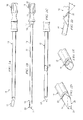
- FIGURE 1A illustrates an example introducer 10 for implanting a paddle style electrical stimulation lead percutaneously.
- Introducer 10 may be used to percutaneously introduce a percutaneous or paddle style lead into the epidural space of a user who requires electrical stimulation treatment directed to spinal nerve tissue, for example, for pain management.
- paddle style leads generally have a width about two times the height of the face of the paddle.
- introducer 10 may be used to implant a percutaneous or paddle style lead into other tissue for electrostimulation treatment of a peripheral nerve.
- introducer 10 includes an outer sheath 12 and an inner penetrator 14.
- FIGURE 1B illustrates an example inner penetrator 14 disassembled from outer sheath 12.
- Inner penetrator 14 includes handle 16, connector 17, and body 18 having proximal end 19 and distal end or tip 20. Tip 20 may be tapered.
- Connector 17 connects handle 16 to body 18.
- An inner channel 22 is formed through handle 16 and body 18 and connects opening 26 of handle 16 to opening 21 of tip 20.
- Inner channel 22 may be configured to attach to a syringe.
- Inner channel 22 is wide enough to accommodate guide wires of various sizes along which introduce 10 may be advanced during use.
- Channel 22 may taper or otherwise decrease in diameter as it traverses connector 17 at the handle-body junction.
- Inner penetrator 14 may be formed from a plastic, such as silastic or another polymer, or any other suitable material.
- Tip 20 of inner penetrator 14 may be curved as shown in FIGURES 1A-C or may be curved into any other suitable shapes by an operator before inserting the introducer.
- inner penetrator 14 may be bent or curved into a suitable configuration to allow passage around an anatomical obstruction, or formed into any other shape suitable for particular anatomic regions of the body.
- FIGURE 1C illustrates outer sheath 12 disassembled from inner penetrator 14.
- the lumen of outer sheath 12 may range in width, for example from approximately 2mm to approximately 6mm.
- the lumen may be oblong, oval, or substantially rectangular as needed to accommodate paddle style of various configurations.
- Outer sheath 12 may taper slightly at tip 29. Tip 29 of outer sheath 12 may be beveled to allow cashier passage through tissue and to allow inner penetrator 14 to protrude out of tip 29.
- Outer sheath 12 is preferably formed from a metal, such as stainless steel or titanium, or any other suitable material that is stiff and resists bending when outer sheath 12 is inserted through the paravertebral tissue and into the epidural space.
- inner penetrator 14 includes tapered tip 20 shown in FIGURE ID. Tapered tip 20 protrudes out of outer sheath 12. Tapered tip 20 preferably allows introducer 10 to pass easily over a guide wire without creating a false passage in an undesirable location in the tissue.
- tip 20 includes a raised circumferential shoulder or ridge 23 configured to provide an indication or "feel” to a physician as raised ridge 23 comes in contact with the ligamentum flavum.
- This "feel” occurs when raised ridge 23 conies in contact with the ligamentum flavum causing a slight resistance, pressure, or “notch” feel to the physician as raised ridge 23 comes in contact with and passes through the ligamentum flavum.
- this aspect may provide an important indication to the physician as to the location of outer sheath 12 and thus introducer 10 as a whole.
- Such a raised ridge 23 can also be applied to needles or cutting devices that otherwise fail to provide physicians sufficient "feel” or a locative indication as the needle cuts thiougl-i the ligamentum flavum.
- the edge of outer sheath 12 in FIGURE. IE could be configured into a cutting surface for a paddle insertion type needle, The improvement of raised ridge 23 on such a cutting device would provide the needed "feel” or indication to the physician as to where the needle was in the human tissue, thus providing confidence to the physician, as the physician uses such a large needle, that the needle has not yet entered the interthecal space.
- raised ridge 23 assists in spreading the fibers of the paravertebral muscle and ligaments as it is inserted.
- Raised ridge 23 may be angled to assist insertion, for example, at an angle of thirty-five to forty-five degrees or any other angle that would facilitate passage of outer sheath through tissue.
- raised ridge 23 ultimately makes contact with the ligamentum flavum and rests against it during insertion of a guide wire and an electrical stimulation lead.
- outer sheath 12, inner penetrator 14, or both may be formed from radio-opaque material or may include radio-opaque markers that allow the position of outer sheath 12, inner penetrator 14, or both to be visualized with fluoroscopy or plain x-rays, for example, during the insertion process to insure proper positioning in the epidural space.
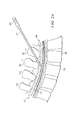
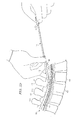
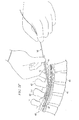
- FIGURES 2A-F illustrate an example method of implanting a paddle style electrical stimulation lead into a human's epidural space using an example introducer 10.
- Spinal cord 47 is also shown.
- a location between two vertebrae is selected for the procedure.
- the site may be selected using fluoroscopy.
- the first step in performing the procedure is to insert needle 41, preferably at an angle, into the skin, and through the subcutaneous tissue and ligamentum flavum 44 of the spine, and into a human's epidural space 40.
- the introducer might be inserted at an angle of approximately thirty-five to approximately forty-five degrees.
- FIGURE 2A illustrates insertion of needle 41 through the skin between spinous processes 42 of two vertebrae 43. Entry into epidural space 40 by needle 41 may be confirmed using standard methods such as the "loss-of-resistance" technique after stylet 45, or inner portion of needle 41, is removed.
- guide wire 46 may be inserted through needle 41 into epidural space 40, shown in FIGURE 2B .
- a guide wire is used in a preferred embodiment of the method of insertion but is not required to insert a paddle style lead through the introducer. This part of the procedure may be performed under fluoroscopic guidance for example. Fluoroscopy may be used to check the position of guide wire 46 in epidural space 40 before inserting introducer 10. Once the tip of guide wire 46 is within epidural space 40, needle 41 is removed.
- introducer 10 may then be inserted, preferably at an angle of approximately thirty-five to approximately forty-five degrees, although the exact angle may differ depending on technique and a patient's anatomy, over guide wire 46 and into epidural space 40 using guide wire 46 as a guide.
- the technique of passing introducer 10 over guide wire 46 helps ensure proper placement of introducer 10 into epidural space 40 and helps avoid inadvertent passage of introducer 10 into an unsuitable location.
- the operator may choose to cut the skin around the insertion site with a scalpel to facilitate subsequent entry of introducer 10 through the needle entry site.
- introducer 10 As introducer 10 is passed through the skin it elongates the hole in the skin made by needle 41. As introducer 10 is passed deeper into the paravertebral tissues, it spreads the fibers of tissue, muscle and ligamentum flavum 44 and forms a tract through these tissues and into epidural space 40, preferably without cutting the tissues. At the level in the tissues where introducer 10 meets and penetrates ligamentum flavum 44 there is a second loss of resistance when inner penetrator 14 has completely penetrated the ligamentum flavum 44. Shoulder or ridge 23 of outer sheath 12 is preferably lodged against ligamentum flavum 44 during insertion of a paddle style lead.
- inner penetrator 14 and guide wire 46 may be removed, leaving outer sheath 12 positioned in epidural space 40, as shown in FIGURE 2D .
- paddle style lead 50 may then be inserted through outer sheath 12 and positioned at an optimal vertebral level, using fluoroscopy for example, for the desired therapeutic effect.
- outer sheath 12 may then be removed leaving only paddle style lead 50 in epidural space 40, where paddle style lead 50 can be further manipulated if necessary to achieve a desired therapeutic effect.
- Paddle style lead 50 may be secured by suturing it to a spinous process.
- introducer 10 may be used to implant paddle style lead 50 into epidural space 40 for spinal nerve stimulation.
- the same or an analogous, perhaps smaller, introducer 10 may be used to implant an analogous paddle style lead 50 into any appropriate region of the body for peripheral nerve stimulation.
- a paddle style lead 50 may have an outer sheath 12 and lumen 28 with a width of approximately 1mm to approximately 3mm.
- a similar method of insertion may be used to implant a paddle style electrical stimulation lead into a human's peripheral nerve tissue.
- a site for insertion in tissue near a nerve is selected.
- the first step in performing the procedure is to insert a needle into the skin and through the subcutaneous tissue and into tissue near a peripheral nerve. If the needle has a stylet, it may be removed and a guide wire may be inserted through the needle and into the tissue near a peripheral nerve. A guide wire may not be required. Fluoroscopy may or may not be used to guide insertion of a guide wire into tissue near a peripheral nerve.
- introducer 10 may be inserted, preferably at an angle that would depend on the anatomy of the body near the peripheral nerve to be stimulated. As introducer 10 is passed through tissues, it elongates the tract made by a needle or guide wire and spreads the tissue. After positioning introducer 10 in tissue adjacent to the peripheral nerve to be stimulated, inner penetrator 14 is removed. A paddle style lead mar then be inserted through outer sheath 12. Outer sheath 12 may then be removed leaving only the paddle style lead in position near the peripheral nerve to be stimulated.
- FIGURES 3A and 3B there are shown two embodiments of a stimulation system 200, 300 in accordance with the present invention.
- the stimulation systems generate and apply a stimulus to a tissue or to a certain location of a body.
- the system 200, 300 includes a stimulation or energy source 210, 310 and a lead 50 for application of the stimulus.
- the lead 110 shown in FIGURES 3A and 3B is the paddle style lead 50 of the present invention.
- the stimulation system 200 includes the lead 50 that is coupled to the stimulation source 210.
- the stimulation source 210 includes an implantable pulse generator (IPG).
- IPG implantable pulse generator
- an implantable pulse generator (IPG) is implanted within the body (not shown) that is to receive electrical stimulation from the stimulation source 210.
- An example IPG may be one manufactured by Advanced Neuromodulation Systems, Inc., such as the Genesis® System, part numbers 3604, 3608, 3609, and 3644.
- the stimulation system 300 includes the lead 50 that is coupled to the stimulation source 310.
- the stimulation source 310 includes a wireless receiver.
- the stimulation source 310 comprising a wireless receiver is implanted within the body (not shown) that is to receive electrical stimulation from the stimulation source 310.
- An example wireless receiver 310 may be wireless receivers manufactured by advanced Neuromodulation Systems, Inc., such as the Renew® System, part numbers 3408 and 3416.
- the wireless receiver (not shown) within stimulation source 310 is capable of receiving wireless signals from a wireless transmitter 320.
- the wireless signals are represented in FIGURE. 3B by wireless link symbol 330.
- the wireless transmitter 320 and a controller 340 are located outside of the body that is to receive electrical stimulation from the stimulation source 310.
- a user of the stimulation source 310 may use the controller 340 to provide control signals for the operation of the stimulation source 310.
- the controller 340 provides control signals to the wireless transmitter 320.
- the wireless transmitter 320 transmits the control signals (and power) to the receiver in the stimulation source 310 and the stimulation source 310 uses the control signals to vary the signal parameter of the electrical signals that are transmitted through lead 110 to the stimulation site.
- An example wireless transmitter 320 may be those transmitters manufactured by advanced Neuromodulation Systems, Inc., such as the Renew® System, part numbers 3508 and 3516.
- the connectors are not visible in FIGURES 3A and 3B because the contact electrodes are situated within a receptacle (not shown) of the stimulation source 210, 310.
- the connectors are in electrical contact with a generator (not shown) of electrical signals within the stimulation source 210, 310.
- the stimulation source 210, 310 generates and sends electrical signals via the lead 50 to the electrodes 160.
- the electrodes 160 are located at a stimulation site (not shown) within the body that is to receive electrical stimulation from the electrical signals.
- a stimulation site may be, for example, adjacent to one or more nerves in the central nervous system (e.g., spinal cord) or peripheral nerves.
- the stimulation source 210, 310 is capable of controlling the electrical signals by varying signal parameters (e.g., intensity, duration, frequency) in response to control signals that are provided to the stimulation source 210, 310.
- Lead 110 extends from the insertion site to the implant site (the area of placement of the generator).
- the implant site is typically a subcutaneous pocket that receives and houses the IPG or receiver (providing stimulation source 210, 310).
- the implant site is usually positioned a distance away from the stimulation site, such as near the buttocks or other place in the torso area. In most cases, the implant site (and insertion site) is located in the lower back area, and lead 110 may extend through the epidural space (or other space) in the spine to the stimulation site (e.g., middle or upper back, neck, or brain aieas).
- the system of leads and/or extensions may be subject to mechanical forces and movement in response to body movement.
- FIGURE 4 illustrates the steps that may be used to implant a stimulation system 200, 300 into a human.
Landscapes
- Health & Medical Sciences (AREA)
- Life Sciences & Earth Sciences (AREA)
- Surgery (AREA)
- Animal Behavior & Ethology (AREA)
- General Health & Medical Sciences (AREA)
- Engineering & Computer Science (AREA)
- Biomedical Technology (AREA)
- Heart & Thoracic Surgery (AREA)
- Nuclear Medicine, Radiotherapy & Molecular Imaging (AREA)
- Veterinary Medicine (AREA)
- Public Health (AREA)
- Medical Informatics (AREA)
- Pathology (AREA)
- Molecular Biology (AREA)
- Neurology (AREA)
- Neurosurgery (AREA)
- Orthopedic Medicine & Surgery (AREA)
- Cardiology (AREA)
- Radiology & Medical Imaging (AREA)
- Gastroenterology & Hepatology (AREA)
- Electrotherapy Devices (AREA)
Applications Claiming Priority (2)
| Application Number | Priority Date | Filing Date | Title |
|---|---|---|---|
| US10/637,342 US20050033393A1 (en) | 2003-08-08 | 2003-08-08 | Apparatus and method for implanting an electrical stimulation system and a paddle style electrical stimulation lead |
| EP04779566A EP1656180B1 (de) | 2003-08-08 | 2004-07-28 | Gerät zur implantation eines elektrischen stimulationssystems und elektrische stimulationsleitung vom paddel-typ |
Related Parent Applications (2)
| Application Number | Title | Priority Date | Filing Date |
|---|---|---|---|
| EP04779566A Division EP1656180B1 (de) | 2003-08-08 | 2004-07-28 | Gerät zur implantation eines elektrischen stimulationssystems und elektrische stimulationsleitung vom paddel-typ |
| EP04779566.1 Division | 2004-07-28 |
Publications (2)
| Publication Number | Publication Date |
|---|---|
| EP2468355A1 true EP2468355A1 (de) | 2012-06-27 |
| EP2468355B1 EP2468355B1 (de) | 2015-11-18 |
Family
ID=34116596
Family Applications (2)
| Application Number | Title | Priority Date | Filing Date |
|---|---|---|---|
| EP12157400.8A Expired - Lifetime EP2468355B1 (de) | 2003-08-08 | 2004-07-28 | Vorrichtung zur Implantation eines elektrischen Simulationssystems und einer blattartigen elektrischen Simulationsleitung |
| EP04779566A Expired - Lifetime EP1656180B1 (de) | 2003-08-08 | 2004-07-28 | Gerät zur implantation eines elektrischen stimulationssystems und elektrische stimulationsleitung vom paddel-typ |
Family Applications After (1)
| Application Number | Title | Priority Date | Filing Date |
|---|---|---|---|
| EP04779566A Expired - Lifetime EP1656180B1 (de) | 2003-08-08 | 2004-07-28 | Gerät zur implantation eines elektrischen stimulationssystems und elektrische stimulationsleitung vom paddel-typ |
Country Status (4)
| Country | Link |
|---|---|
| US (1) | US20050033393A1 (de) |
| EP (2) | EP2468355B1 (de) |
| AT (1) | ATE553811T1 (de) |
| WO (1) | WO2005016447A2 (de) |
Families Citing this family (101)
| Publication number | Priority date | Publication date | Assignee | Title |
|---|---|---|---|---|
| US20050288758A1 (en) * | 2003-08-08 | 2005-12-29 | Jones Timothy S | Methods and apparatuses for implanting and removing an electrical stimulation lead |
| US7359755B2 (en) * | 2003-08-08 | 2008-04-15 | Advanced Neuromodulation Systems, Inc. | Method and apparatus for implanting an electrical stimulation lead using a flexible introducer |
| US8340779B2 (en) | 2003-08-29 | 2012-12-25 | Medtronic, Inc. | Percutaneous flat lead introducer |
| WO2005030323A1 (en) * | 2003-09-26 | 2005-04-07 | Advanced Neuromodulation Systems, Inc. | Electrical stimulation system including a device for partially shielding electrical energy emitted from one or more electrical stimulation leads implanted in a human’s body |
| US20050090801A1 (en) * | 2003-10-27 | 2005-04-28 | Racz N. S. | Safety spinal catheter |
| NL1025830C2 (nl) * | 2004-03-26 | 2005-02-22 | Eric Berreklouw | Samenstel omvattende een ring voor bevestiging in een door lichaamsweefsel omgeven doorgang alsmede een applicator voor het in de doorgang plaatsen van de ring. |
| JP5132310B2 (ja) * | 2004-09-08 | 2013-01-30 | スパイナル・モデュレーション・インコーポレイテッド | 神経刺激の方法及びシステム |
| US20120277839A1 (en) | 2004-09-08 | 2012-11-01 | Kramer Jeffery M | Selective stimulation to modulate the sympathetic nervous system |
| US9205261B2 (en) | 2004-09-08 | 2015-12-08 | The Board Of Trustees Of The Leland Stanford Junior University | Neurostimulation methods and systems |
| US20090018507A1 (en) * | 2007-07-09 | 2009-01-15 | Baxano, Inc. | Spinal access system and method |
| US7578819B2 (en) * | 2005-05-16 | 2009-08-25 | Baxano, Inc. | Spinal access and neural localization |
| US7938830B2 (en) * | 2004-10-15 | 2011-05-10 | Baxano, Inc. | Powered tissue modification devices and methods |
| US7738968B2 (en) | 2004-10-15 | 2010-06-15 | Baxano, Inc. | Devices and methods for selective surgical removal of tissue |
| US7959577B2 (en) | 2007-09-06 | 2011-06-14 | Baxano, Inc. | Method, system, and apparatus for neural localization |
| US9247952B2 (en) * | 2004-10-15 | 2016-02-02 | Amendia, Inc. | Devices and methods for tissue access |
| AU2005295589B2 (en) | 2004-10-15 | 2009-12-03 | Baxano, Inc. | Devices and methods for tissue removal |
| US20100331883A1 (en) | 2004-10-15 | 2010-12-30 | Schmitz Gregory P | Access and tissue modification systems and methods |
| US8617163B2 (en) | 2004-10-15 | 2013-12-31 | Baxano Surgical, Inc. | Methods, systems and devices for carpal tunnel release |
| US7857813B2 (en) | 2006-08-29 | 2010-12-28 | Baxano, Inc. | Tissue access guidewire system and method |
| US8430881B2 (en) * | 2004-10-15 | 2013-04-30 | Baxano, Inc. | Mechanical tissue modification devices and methods |
| US9101386B2 (en) | 2004-10-15 | 2015-08-11 | Amendia, Inc. | Devices and methods for treating tissue |
| US7887538B2 (en) * | 2005-10-15 | 2011-02-15 | Baxano, Inc. | Methods and apparatus for tissue modification |
| US20090171381A1 (en) * | 2007-12-28 | 2009-07-02 | Schmitz Gregory P | Devices, methods and systems for neural localization |
| US8221397B2 (en) | 2004-10-15 | 2012-07-17 | Baxano, Inc. | Devices and methods for tissue modification |
| US8048080B2 (en) | 2004-10-15 | 2011-11-01 | Baxano, Inc. | Flexible tissue rasp |
| US8257356B2 (en) | 2004-10-15 | 2012-09-04 | Baxano, Inc. | Guidewire exchange systems to treat spinal stenosis |
| US8062300B2 (en) | 2006-05-04 | 2011-11-22 | Baxano, Inc. | Tissue removal with at least partially flexible devices |
| US20110190772A1 (en) | 2004-10-15 | 2011-08-04 | Vahid Saadat | Powered tissue modification devices and methods |
| US7738969B2 (en) | 2004-10-15 | 2010-06-15 | Baxano, Inc. | Devices and methods for selective surgical removal of tissue |
| US7792591B2 (en) * | 2005-06-09 | 2010-09-07 | Medtronic, Inc. | Introducer for therapy delivery elements |
| US8092456B2 (en) * | 2005-10-15 | 2012-01-10 | Baxano, Inc. | Multiple pathways for spinal nerve root decompression from a single access point |
| US8366712B2 (en) | 2005-10-15 | 2013-02-05 | Baxano, Inc. | Multiple pathways for spinal nerve root decompression from a single access point |
| US8062298B2 (en) | 2005-10-15 | 2011-11-22 | Baxano, Inc. | Flexible tissue removal devices and methods |
| US20080091227A1 (en) * | 2006-08-25 | 2008-04-17 | Baxano, Inc. | Surgical probe and method of making |
| US8019442B1 (en) | 2006-10-25 | 2011-09-13 | Advanced Neuromodulation Systems, Inc. | Assembly kit for creating paddle-style lead from one or several percutaneous leads and method of lead implantation |
| US20080132979A1 (en) * | 2006-11-30 | 2008-06-05 | Medtronic, Inc. | Method of implanting a medical lead |
| WO2008070809A2 (en) | 2006-12-06 | 2008-06-12 | Spinal Modulation, Inc. | Implantable flexible circuit leads and methods of use |
| WO2008070808A2 (en) | 2006-12-06 | 2008-06-12 | Spinal Modulation, Inc. | Expandable stimulation leads and methods of use |
| CN101588839A (zh) * | 2006-12-06 | 2009-11-25 | 脊髓调制公司 | 用于脊椎刺激的分组导线 |
| AU2007329253B2 (en) | 2006-12-06 | 2014-03-27 | Spinal Modulation, Inc. | Delivery devices, systems and methods for stimulating nerve tissue on multiple spinal levels |
| CA2671250A1 (en) | 2006-12-06 | 2008-06-12 | Spinal Modulation, Inc. | Hard tissue anchors and delivery devices |
| US7987001B2 (en) * | 2007-01-25 | 2011-07-26 | Warsaw Orthopedic, Inc. | Surgical navigational and neuromonitoring instrument |
| US20080183068A1 (en) * | 2007-01-25 | 2008-07-31 | Warsaw Orthopedic, Inc. | Integrated Visualization of Surgical Navigational and Neural Monitoring Information |
| US20080183188A1 (en) * | 2007-01-25 | 2008-07-31 | Warsaw Orthopedic, Inc. | Integrated Surgical Navigational and Neuromonitoring System |
| US8374673B2 (en) * | 2007-01-25 | 2013-02-12 | Warsaw Orthopedic, Inc. | Integrated surgical navigational and neuromonitoring system having automated surgical assistance and control |
| US20080183074A1 (en) * | 2007-01-25 | 2008-07-31 | Warsaw Orthopedic, Inc. | Method and apparatus for coordinated display of anatomical and neuromonitoring information |
| AU2008210504B2 (en) | 2007-01-29 | 2012-07-26 | Spinal Modulation, Inc. | Sutureless lead retention features |
| WO2008108758A1 (en) | 2007-03-07 | 2008-09-12 | Enpath Medical, Inc. | Self fixing spinal cord stimulation lead and delivery system |
| US9008782B2 (en) * | 2007-10-26 | 2015-04-14 | Medtronic, Inc. | Occipital nerve stimulation |
| JP5004771B2 (ja) * | 2007-11-22 | 2012-08-22 | 株式会社リコー | 画像形成装置 |
| US8192436B2 (en) | 2007-12-07 | 2012-06-05 | Baxano, Inc. | Tissue modification devices |
| NZ586548A (en) * | 2008-01-14 | 2012-07-27 | Custom Med Applications Inc | Flexible spinal needle assembly with an internal flow element configured to avoid kinking or restriction of the needle |
| US8287496B2 (en) * | 2008-01-17 | 2012-10-16 | Custom Medical Applications, Inc. | Flow elements for use with flexible spinal needles, needle assemblies and methods therefor |
| EP2252365B1 (de) * | 2008-02-21 | 2013-10-16 | Boston Scientific Neuromodulation Corporation | Temporäre identifizierungsvorrichtung für neurostimulationsleiter |
| USD597667S1 (en) * | 2008-03-20 | 2009-08-04 | Custom Medical Applications, Inc. | Flexible spinal needle |
| US9492655B2 (en) * | 2008-04-25 | 2016-11-15 | Boston Scientific Neuromodulation Corporation | Stimulation system with percutaneously deliverable paddle lead and methods of making and using |
| WO2010009093A2 (en) * | 2008-07-14 | 2010-01-21 | Baxano, Inc | Tissue modification devices |
| US8398641B2 (en) | 2008-07-01 | 2013-03-19 | Baxano, Inc. | Tissue modification devices and methods |
| US9314253B2 (en) | 2008-07-01 | 2016-04-19 | Amendia, Inc. | Tissue modification devices and methods |
| US8409206B2 (en) | 2008-07-01 | 2013-04-02 | Baxano, Inc. | Tissue modification devices and methods |
| US20100030227A1 (en) * | 2008-07-31 | 2010-02-04 | Medtronic, Inc. | Medical lead implantation |
| US7941227B2 (en) * | 2008-09-03 | 2011-05-10 | Boston Scientific Neuromodulation Corporation | Implantable electric stimulation system and methods of making and using |
| JP5643764B2 (ja) * | 2008-10-27 | 2014-12-17 | スパイナル・モデュレーション・インコーポレイテッドSpinal Modulation Inc. | 選択的刺激システムおよび医学的状態の信号パラメータ |
| US8874235B1 (en) | 2008-12-12 | 2014-10-28 | Greatbatch Ltd. | Self fixing spinal cord stimulation paddle lead |
| DK2396072T3 (da) * | 2009-01-14 | 2013-04-08 | Spinal Modulation Inc | Stimulerende elektrode-leveringssystem |
| EP2405823A4 (de) | 2009-03-13 | 2012-07-04 | Baxano Inc | Vorrichtungen und verfahren für flexible nervenortung |
| JP2012521801A (ja) | 2009-03-24 | 2012-09-20 | スパイナル・モデュレーション・インコーポレイテッド | 錯感覚に対する閾値以下の刺激を伴う疼痛の管理 |
| WO2010132816A2 (en) | 2009-05-15 | 2010-11-18 | Spinal Modulation, Inc. | Methods, systems and devices for neuromodulating spinal anatomy |
| US8394102B2 (en) * | 2009-06-25 | 2013-03-12 | Baxano, Inc. | Surgical tools for treatment of spinal stenosis |
| WO2011041203A2 (en) | 2009-09-30 | 2011-04-07 | Mayo Foundation For Medical Education And Research | Percutaneous placement of electrodes |
| US11045221B2 (en) * | 2009-10-30 | 2021-06-29 | Medtronic, Inc. | Steerable percutaneous paddle stimulation lead |
| CN103079489B (zh) | 2010-05-10 | 2016-11-16 | 脊髓调制公司 | 用于减少迁移的方法、系统和装置 |
| EP2670478B1 (de) | 2011-02-02 | 2016-07-27 | Spinal Modulation Inc. | Vorrichtungen und systeme zur gezielten behandlung von bewegungsleiden |
| US8986382B2 (en) * | 2011-05-03 | 2015-03-24 | Boston Scientific Neuromodulation Corporation | Tissue fixation and repair systems and methods |
| WO2013067538A1 (en) | 2011-11-04 | 2013-05-10 | Nevro Corporation | Medical device communication and charding assemblies for use with implantable signal generators |
| US10751081B2 (en) * | 2012-03-30 | 2020-08-25 | Medtronic, Inc. | Methods and tools for clearing the epidural space in preparation for medical lead implantation |
| US9440076B2 (en) | 2013-03-15 | 2016-09-13 | Globus Medical, Inc. | Spinal cord stimulator system |
| US10080896B2 (en) | 2013-03-15 | 2018-09-25 | Cirtec Medical Corp. | Implantable pulse generator that generates spinal cord stimulation signals for a human body |
| US10226628B2 (en) | 2013-03-15 | 2019-03-12 | Cirtec Medical Corp. | Implantable pulse generator that generates spinal cord stimulation signals for a human body |
| US10016604B2 (en) | 2013-03-15 | 2018-07-10 | Globus Medical, Inc. | Implantable pulse generator that generates spinal cord stimulation signals for a human body |
| US10413730B2 (en) | 2013-03-15 | 2019-09-17 | Cirtec Medical Corp. | Implantable pulse generator that generates spinal cord stimulation signals for a human body |
| CN105246536B (zh) * | 2013-04-05 | 2018-09-21 | J·J·加尔加诺 | 带有分段式稳定系统的导管组件 |
| US9517334B2 (en) | 2013-08-19 | 2016-12-13 | Boston Scientific Neuromodulation Corporation | Lead anchors and systems and methods employing the lead anchors |
| US10292831B2 (en) | 2015-03-20 | 2019-05-21 | Intelligent Implants Limited | System and method for dynamically stimulating bone growth |
| US9636498B2 (en) | 2015-08-03 | 2017-05-02 | Boston Scientific Neuromodulation Corporation | Lead anchor with a wedge and systems using the lead anchor |
| CA3002033A1 (en) | 2015-10-15 | 2017-04-20 | Spr Therapeutics, Llc | Apparatus and method for positioning, implanting and using a stimulation lead |
| US11135437B2 (en) | 2015-10-15 | 2021-10-05 | Spr Therapeutics, Inc. | Apparatus and method for positioning, implanting and using a stimulation lead |
| US10617880B2 (en) | 2015-12-08 | 2020-04-14 | Intelligent Implants Limited | System and method for an electrical implant device with increased patient compliance |
| WO2017151438A1 (en) | 2016-02-29 | 2017-09-08 | Boston Scientific Neuromodulation Corporation | Lead anchor for an electrical stimulation system |
| US10369354B2 (en) | 2016-05-17 | 2019-08-06 | Boston Scientific Neuromodulation Corporation | Systems and method for anchoring a lead for neurostimulation of a target anatomy |
| US10709886B2 (en) | 2017-02-28 | 2020-07-14 | Boston Scientific Neuromodulation Corporation | Electrical stimulation leads and systems with elongate anchoring elements and methods of making and using |
| US10835739B2 (en) | 2017-03-24 | 2020-11-17 | Boston Scientific Neuromodulation Corporation | Electrical stimulation leads and systems with elongate anchoring elements and methods of making and using |
| US10857351B2 (en) | 2017-04-28 | 2020-12-08 | Boston Scientific Neuromodulation Corporation | Lead anchors for electrical stimulation leads and systems and methods of making and using |
| US11166745B2 (en) | 2017-09-12 | 2021-11-09 | Jessica Jameson | Multi-port epidural needle |
| AU2019261983B2 (en) | 2018-05-01 | 2024-12-05 | Nevro Corp. | A 2.4 GHz radio antenna for implanted medical devices, and associated systems and methods |
| US11576789B2 (en) | 2018-10-03 | 2023-02-14 | Intelligent Implants Limited | System and method to alter bone growth in a targeted spatial region for the use with implants |
| US11633223B2 (en) | 2018-12-20 | 2023-04-25 | Integrity Implants Inc. | Surgical guidance device |
| US11844706B2 (en) | 2019-03-20 | 2023-12-19 | Grabango Co. | System and method for positioning and orienting an orthopedic implant |
| JP7476308B2 (ja) | 2019-11-01 | 2024-04-30 | インテリジェント インプランツ リミテッド | インプラント内に電子コンポーネントを埋め込むためのシステム及び方法 |
| US12582818B2 (en) | 2021-03-25 | 2026-03-24 | Intelligent Implants Limited | System and method for scaling orthopedic implant stimulation |
| WO2024238333A2 (en) * | 2023-05-12 | 2024-11-21 | University Of Pittsburgh - Of The Commonwealth System Of Higher Education | Needle for delivery of multiple extending elements to tissue |
Citations (2)
| Publication number | Priority date | Publication date | Assignee | Title |
|---|---|---|---|---|
| US20020147485A1 (en) * | 2000-11-15 | 2002-10-10 | George Mamo | Minimally invasive apparatus for implanting a sacral stimulation lead |
| WO2003013650A1 (en) * | 2001-08-10 | 2003-02-20 | Advanced Neuromodulation Systems, Inc. | Stimulation/sensing lead adapted for percutaneous insertion |
Family Cites Families (17)
| Publication number | Priority date | Publication date | Assignee | Title |
|---|---|---|---|---|
| US4512351A (en) * | 1982-11-19 | 1985-04-23 | Cordis Corporation | Percutaneous lead introducing system and method |
| US4573448A (en) * | 1983-10-05 | 1986-03-04 | Pilling Co. | Method for decompressing herniated intervertebral discs |
| US5478806A (en) * | 1989-11-22 | 1995-12-26 | Enzon, Inc. | Enhancement of antitumor therapy with hemoglobin-based conjugates |
| WO1992008513A1 (en) * | 1990-11-20 | 1992-05-29 | Interventional Thermodynamics, Inc. | Tension guide and dilator |
| US5275504A (en) * | 1991-05-09 | 1994-01-04 | Linear Dynamics, Inc. | Glass bead application sensor system |
| US5255691A (en) * | 1991-11-13 | 1993-10-26 | Medtronic, Inc. | Percutaneous epidural lead introducing system and method |
| US5431676A (en) * | 1993-03-05 | 1995-07-11 | Innerdyne Medical, Inc. | Trocar system having expandable port |
| US5562695A (en) * | 1995-01-10 | 1996-10-08 | Obenchain; Theodore G. | Nerve deflecting conduit needle and method |
| US5792044A (en) * | 1996-03-22 | 1998-08-11 | Danek Medical, Inc. | Devices and methods for percutaneous surgery |
| US6530902B1 (en) * | 1998-01-23 | 2003-03-11 | Medtronic, Inc. | Cannula placement system |
| US6104960A (en) * | 1998-07-13 | 2000-08-15 | Medtronic, Inc. | System and method for providing medical electrical stimulation to a portion of the nervous system |
| US6055456A (en) * | 1999-04-29 | 2000-04-25 | Medtronic, Inc. | Single and multi-polar implantable lead for sacral nerve electrical stimulation |
| US6309401B1 (en) * | 1999-04-30 | 2001-10-30 | Vladimir Redko | Apparatus and method for percutaneous implant of a paddle style lead |
| US6249707B1 (en) * | 1999-04-30 | 2001-06-19 | Medtronic, Inc. | Apparatus and method for percutaneous implant of a paddle style lead |
| US6971393B1 (en) * | 2000-11-15 | 2005-12-06 | George Mamo | Minimally invasive method for implanting a sacral stimulation lead |
| US7359755B2 (en) * | 2003-08-08 | 2008-04-15 | Advanced Neuromodulation Systems, Inc. | Method and apparatus for implanting an electrical stimulation lead using a flexible introducer |
| US20050288758A1 (en) * | 2003-08-08 | 2005-12-29 | Jones Timothy S | Methods and apparatuses for implanting and removing an electrical stimulation lead |
-
2003
- 2003-08-08 US US10/637,342 patent/US20050033393A1/en not_active Abandoned
-
2004
- 2004-07-28 EP EP12157400.8A patent/EP2468355B1/de not_active Expired - Lifetime
- 2004-07-28 AT AT04779566T patent/ATE553811T1/de active
- 2004-07-28 WO PCT/US2004/024552 patent/WO2005016447A2/en not_active Ceased
- 2004-07-28 EP EP04779566A patent/EP1656180B1/de not_active Expired - Lifetime
Patent Citations (2)
| Publication number | Priority date | Publication date | Assignee | Title |
|---|---|---|---|---|
| US20020147485A1 (en) * | 2000-11-15 | 2002-10-10 | George Mamo | Minimally invasive apparatus for implanting a sacral stimulation lead |
| WO2003013650A1 (en) * | 2001-08-10 | 2003-02-20 | Advanced Neuromodulation Systems, Inc. | Stimulation/sensing lead adapted for percutaneous insertion |
Also Published As
| Publication number | Publication date |
|---|---|
| WO2005016447A3 (en) | 2005-12-15 |
| US20050033393A1 (en) | 2005-02-10 |
| ATE553811T1 (de) | 2012-05-15 |
| EP1656180B1 (de) | 2012-04-18 |
| WO2005016447A2 (en) | 2005-02-24 |
| EP1656180A2 (de) | 2006-05-17 |
| EP2468355B1 (de) | 2015-11-18 |
Similar Documents
| Publication | Publication Date | Title |
|---|---|---|
| EP2468355B1 (de) | Vorrichtung zur Implantation eines elektrischen Simulationssystems und einer blattartigen elektrischen Simulationsleitung | |
| EP1877129B1 (de) | Vorrichtung zur implantierung einer leitung zur elektrischen stimulierung unter verwendung einer flexiblen einführvorrichtung | |
| US20050288758A1 (en) | Methods and apparatuses for implanting and removing an electrical stimulation lead | |
| US8180461B2 (en) | Minimally invasive apparatus for implanting a sacral stimulation lead | |
| EP1048270B1 (de) | Vorrichtung zum perkutanimplantieren eines schaufelförmigen Leiters | |
| US8774924B2 (en) | Peripheral nerve stimulation | |
| US10925637B2 (en) | Methods of implanting electrode leads for use with implantable neuromuscular electrical stimulator | |
| US20080132979A1 (en) | Method of implanting a medical lead | |
| US9067056B2 (en) | Lead spacer tool | |
| US10751527B2 (en) | Device and method for percutaneous placement and anchoring of stimulating electrodes in spine | |
| US20110202097A1 (en) | System and method for electrically probing and providing medical electrical stimulation | |
| US9750508B1 (en) | Insulated pedicle access system and related methods | |
| WO2003011361A2 (en) | Medical needle | |
| EP2497434B1 (de) | Epiduralnadel zur Rückenmarkstimulation | |
| US20250025687A1 (en) | Medical lead and method of securing medical electrode leads | |
| US20220087714A1 (en) | Multi-port epidural needle | |
| US10245435B1 (en) | Wireless neural stimulator implantation | |
| RU2611901C1 (ru) | Способ хронической электростимуляции спинного мозга |
Legal Events
| Date | Code | Title | Description |
|---|---|---|---|
| AC | Divisional application: reference to earlier application |
Ref document number: 1656180 Country of ref document: EP Kind code of ref document: P |
|
| AK | Designated contracting states |
Kind code of ref document: A1 Designated state(s): AT BE BG CH CY CZ DE DK EE ES FI FR GB GR HU IE IT LI LU MC NL PL PT RO SE SI SK TR |
|
| PUAI | Public reference made under article 153(3) epc to a published international application that has entered the european phase |
Free format text: ORIGINAL CODE: 0009012 |
|
| 17P | Request for examination filed |
Effective date: 20121224 |
|
| 17Q | First examination report despatched |
Effective date: 20130819 |
|
| GRAP | Despatch of communication of intention to grant a patent |
Free format text: ORIGINAL CODE: EPIDOSNIGR1 |
|
| INTG | Intention to grant announced |
Effective date: 20150617 |
|
| GRAS | Grant fee paid |
Free format text: ORIGINAL CODE: EPIDOSNIGR3 |
|
| GRAA | (expected) grant |
Free format text: ORIGINAL CODE: 0009210 |
|
| AC | Divisional application: reference to earlier application |
Ref document number: 1656180 Country of ref document: EP Kind code of ref document: P |
|
| AK | Designated contracting states |
Kind code of ref document: B1 Designated state(s): AT BE BG CH CY CZ DE DK EE ES FI FR GB GR HU IE IT LI LU MC NL PL PT RO SE SI SK TR |
|
| REG | Reference to a national code |
Ref country code: GB Ref legal event code: FG4D |
|
| REG | Reference to a national code |
Ref country code: CH Ref legal event code: EP Ref country code: CH Ref legal event code: NV Representative=s name: BOVARD AG, CH |
|
| REG | Reference to a national code |
Ref country code: AT Ref legal event code: REF Ref document number: 761200 Country of ref document: AT Kind code of ref document: T Effective date: 20151215 |
|
| REG | Reference to a national code |
Ref country code: IE Ref legal event code: FG4D |
|
| REG | Reference to a national code |
Ref country code: DE Ref legal event code: R096 Ref document number: 602004048280 Country of ref document: DE |
|
| REG | Reference to a national code |
Ref country code: NL Ref legal event code: MP Effective date: 20160218 |
|
| REG | Reference to a national code |
Ref country code: AT Ref legal event code: MK05 Ref document number: 761200 Country of ref document: AT Kind code of ref document: T Effective date: 20151118 |
|
| PG25 | Lapsed in a contracting state [announced via postgrant information from national office to epo] |
Ref country code: NL Free format text: LAPSE BECAUSE OF FAILURE TO SUBMIT A TRANSLATION OF THE DESCRIPTION OR TO PAY THE FEE WITHIN THE PRESCRIBED TIME-LIMIT Effective date: 20151118 Ref country code: ES Free format text: LAPSE BECAUSE OF FAILURE TO SUBMIT A TRANSLATION OF THE DESCRIPTION OR TO PAY THE FEE WITHIN THE PRESCRIBED TIME-LIMIT Effective date: 20151118 |
|
| PG25 | Lapsed in a contracting state [announced via postgrant information from national office to epo] |
Ref country code: PL Free format text: LAPSE BECAUSE OF FAILURE TO SUBMIT A TRANSLATION OF THE DESCRIPTION OR TO PAY THE FEE WITHIN THE PRESCRIBED TIME-LIMIT Effective date: 20151118 Ref country code: PT Free format text: LAPSE BECAUSE OF FAILURE TO SUBMIT A TRANSLATION OF THE DESCRIPTION OR TO PAY THE FEE WITHIN THE PRESCRIBED TIME-LIMIT Effective date: 20160318 Ref country code: FI Free format text: LAPSE BECAUSE OF FAILURE TO SUBMIT A TRANSLATION OF THE DESCRIPTION OR TO PAY THE FEE WITHIN THE PRESCRIBED TIME-LIMIT Effective date: 20151118 Ref country code: AT Free format text: LAPSE BECAUSE OF FAILURE TO SUBMIT A TRANSLATION OF THE DESCRIPTION OR TO PAY THE FEE WITHIN THE PRESCRIBED TIME-LIMIT Effective date: 20151118 Ref country code: GR Free format text: LAPSE BECAUSE OF FAILURE TO SUBMIT A TRANSLATION OF THE DESCRIPTION OR TO PAY THE FEE WITHIN THE PRESCRIBED TIME-LIMIT Effective date: 20160219 Ref country code: SE Free format text: LAPSE BECAUSE OF FAILURE TO SUBMIT A TRANSLATION OF THE DESCRIPTION OR TO PAY THE FEE WITHIN THE PRESCRIBED TIME-LIMIT Effective date: 20151118 |
|
| REG | Reference to a national code |
Ref country code: FR Ref legal event code: PLFP Year of fee payment: 13 |
|
| PG25 | Lapsed in a contracting state [announced via postgrant information from national office to epo] |
Ref country code: CZ Free format text: LAPSE BECAUSE OF FAILURE TO SUBMIT A TRANSLATION OF THE DESCRIPTION OR TO PAY THE FEE WITHIN THE PRESCRIBED TIME-LIMIT Effective date: 20151118 |
|
| REG | Reference to a national code |
Ref country code: DE Ref legal event code: R097 Ref document number: 602004048280 Country of ref document: DE |
|
| PG25 | Lapsed in a contracting state [announced via postgrant information from national office to epo] |
Ref country code: EE Free format text: LAPSE BECAUSE OF FAILURE TO SUBMIT A TRANSLATION OF THE DESCRIPTION OR TO PAY THE FEE WITHIN THE PRESCRIBED TIME-LIMIT Effective date: 20151118 Ref country code: RO Free format text: LAPSE BECAUSE OF FAILURE TO SUBMIT A TRANSLATION OF THE DESCRIPTION OR TO PAY THE FEE WITHIN THE PRESCRIBED TIME-LIMIT Effective date: 20151118 Ref country code: DK Free format text: LAPSE BECAUSE OF FAILURE TO SUBMIT A TRANSLATION OF THE DESCRIPTION OR TO PAY THE FEE WITHIN THE PRESCRIBED TIME-LIMIT Effective date: 20151118 Ref country code: SK Free format text: LAPSE BECAUSE OF FAILURE TO SUBMIT A TRANSLATION OF THE DESCRIPTION OR TO PAY THE FEE WITHIN THE PRESCRIBED TIME-LIMIT Effective date: 20151118 |
|
| PLBE | No opposition filed within time limit |
Free format text: ORIGINAL CODE: 0009261 |
|
| STAA | Information on the status of an ep patent application or granted ep patent |
Free format text: STATUS: NO OPPOSITION FILED WITHIN TIME LIMIT |
|
| 26N | No opposition filed |
Effective date: 20160819 |
|
| PG25 | Lapsed in a contracting state [announced via postgrant information from national office to epo] |
Ref country code: SI Free format text: LAPSE BECAUSE OF FAILURE TO SUBMIT A TRANSLATION OF THE DESCRIPTION OR TO PAY THE FEE WITHIN THE PRESCRIBED TIME-LIMIT Effective date: 20151118 |
|
| PG25 | Lapsed in a contracting state [announced via postgrant information from national office to epo] |
Ref country code: BE Free format text: LAPSE BECAUSE OF FAILURE TO SUBMIT A TRANSLATION OF THE DESCRIPTION OR TO PAY THE FEE WITHIN THE PRESCRIBED TIME-LIMIT Effective date: 20151118 |
|
| GBPC | Gb: european patent ceased through non-payment of renewal fee |
Effective date: 20160728 |
|
| PG25 | Lapsed in a contracting state [announced via postgrant information from national office to epo] |
Ref country code: MC Free format text: LAPSE BECAUSE OF FAILURE TO SUBMIT A TRANSLATION OF THE DESCRIPTION OR TO PAY THE FEE WITHIN THE PRESCRIBED TIME-LIMIT Effective date: 20151118 |
|
| PG25 | Lapsed in a contracting state [announced via postgrant information from national office to epo] |
Ref country code: GB Free format text: LAPSE BECAUSE OF NON-PAYMENT OF DUE FEES Effective date: 20160728 |
|
| REG | Reference to a national code |
Ref country code: FR Ref legal event code: PLFP Year of fee payment: 14 |
|
| PG25 | Lapsed in a contracting state [announced via postgrant information from national office to epo] |
Ref country code: LU Free format text: LAPSE BECAUSE OF NON-PAYMENT OF DUE FEES Effective date: 20160728 |
|
| PG25 | Lapsed in a contracting state [announced via postgrant information from national office to epo] |
Ref country code: HU Free format text: LAPSE BECAUSE OF FAILURE TO SUBMIT A TRANSLATION OF THE DESCRIPTION OR TO PAY THE FEE WITHIN THE PRESCRIBED TIME-LIMIT; INVALID AB INITIO Effective date: 20040728 Ref country code: CY Free format text: LAPSE BECAUSE OF FAILURE TO SUBMIT A TRANSLATION OF THE DESCRIPTION OR TO PAY THE FEE WITHIN THE PRESCRIBED TIME-LIMIT Effective date: 20151118 |
|
| REG | Reference to a national code |
Ref country code: FR Ref legal event code: PLFP Year of fee payment: 15 |
|
| PG25 | Lapsed in a contracting state [announced via postgrant information from national office to epo] |
Ref country code: TR Free format text: LAPSE BECAUSE OF FAILURE TO SUBMIT A TRANSLATION OF THE DESCRIPTION OR TO PAY THE FEE WITHIN THE PRESCRIBED TIME-LIMIT Effective date: 20151118 |
|
| PG25 | Lapsed in a contracting state [announced via postgrant information from national office to epo] |
Ref country code: BG Free format text: LAPSE BECAUSE OF FAILURE TO SUBMIT A TRANSLATION OF THE DESCRIPTION OR TO PAY THE FEE WITHIN THE PRESCRIBED TIME-LIMIT Effective date: 20151118 |
|
| PGFP | Annual fee paid to national office [announced via postgrant information from national office to epo] |
Ref country code: IE Payment date: 20220627 Year of fee payment: 19 |
|
| PGFP | Annual fee paid to national office [announced via postgrant information from national office to epo] |
Ref country code: FR Payment date: 20220616 Year of fee payment: 19 |
|
| PGFP | Annual fee paid to national office [announced via postgrant information from national office to epo] |
Ref country code: IT Payment date: 20220728 Year of fee payment: 19 Ref country code: DE Payment date: 20220615 Year of fee payment: 19 |
|
| PGFP | Annual fee paid to national office [announced via postgrant information from national office to epo] |
Ref country code: CH Payment date: 20220801 Year of fee payment: 19 |
|
| P01 | Opt-out of the competence of the unified patent court (upc) registered |
Effective date: 20230530 |
|
| REG | Reference to a national code |
Ref country code: DE Ref legal event code: R119 Ref document number: 602004048280 Country of ref document: DE |
|
| REG | Reference to a national code |
Ref country code: CH Ref legal event code: PL |
|
| REG | Reference to a national code |
Ref country code: IE Ref legal event code: MM4A |
|
| PG25 | Lapsed in a contracting state [announced via postgrant information from national office to epo] |
Ref country code: DE Free format text: LAPSE BECAUSE OF NON-PAYMENT OF DUE FEES Effective date: 20240201 Ref country code: CH Free format text: LAPSE BECAUSE OF NON-PAYMENT OF DUE FEES Effective date: 20230731 |
|
| PG25 | Lapsed in a contracting state [announced via postgrant information from national office to epo] |
Ref country code: FR Free format text: LAPSE BECAUSE OF NON-PAYMENT OF DUE FEES Effective date: 20230731 |
|
| PG25 | Lapsed in a contracting state [announced via postgrant information from national office to epo] |
Ref country code: IE Free format text: LAPSE BECAUSE OF NON-PAYMENT OF DUE FEES Effective date: 20230728 |
|
| PG25 | Lapsed in a contracting state [announced via postgrant information from national office to epo] |
Ref country code: IT Free format text: LAPSE BECAUSE OF NON-PAYMENT OF DUE FEES Effective date: 20230728 Ref country code: IE Free format text: LAPSE BECAUSE OF NON-PAYMENT OF DUE FEES Effective date: 20230728 |