EP2468703B1 - Procédé d'éthénolyse de polyterpènes - Google Patents
Procédé d'éthénolyse de polyterpènes Download PDFInfo
- Publication number
- EP2468703B1 EP2468703B1 EP10196233.0A EP10196233A EP2468703B1 EP 2468703 B1 EP2468703 B1 EP 2468703B1 EP 10196233 A EP10196233 A EP 10196233A EP 2468703 B1 EP2468703 B1 EP 2468703B1
- Authority
- EP
- European Patent Office
- Prior art keywords
- nhc
- carbon atoms
- independently
- reactor
- ewg
- Prior art date
- Legal status (The legal status is an assumption and is not a legal conclusion. Google has not performed a legal analysis and makes no representation as to the accuracy of the status listed.)
- Not-in-force
Links
Classifications
-
- C—CHEMISTRY; METALLURGY
- C07—ORGANIC CHEMISTRY
- C07C—ACYCLIC OR CARBOCYCLIC COMPOUNDS
- C07C11/00—Aliphatic unsaturated hydrocarbons
- C07C11/21—Alkatrienes; Alkatetraenes; Other alkapolyenes
-
- A—HUMAN NECESSITIES
- A01—AGRICULTURE; FORESTRY; ANIMAL HUSBANDRY; HUNTING; TRAPPING; FISHING
- A01N—PRESERVATION OF BODIES OF HUMANS OR ANIMALS OR PLANTS OR PARTS THEREOF; BIOCIDES, e.g. AS DISINFECTANTS, AS PESTICIDES OR AS HERBICIDES; PEST REPELLANTS OR ATTRACTANTS; PLANT GROWTH REGULATORS
- A01N49/00—Biocides, pest repellants or attractants, or plant growth regulators, containing compounds containing the group, wherein m+n>=1, both X together may also mean —Y— or a direct carbon-to-carbon bond, and the carbon atoms marked with an asterisk are not part of any ring system other than that which may be formed by the atoms X, the carbon atoms in square brackets being part of any acyclic or cyclic structure, or the group, wherein A means a carbon atom or Y, n>=0, and not more than one of these carbon atoms being a member of the same ring system, e.g. juvenile insect hormones or mimics thereof
-
- C—CHEMISTRY; METALLURGY
- C07—ORGANIC CHEMISTRY
- C07C—ACYCLIC OR CARBOCYCLIC COMPOUNDS
- C07C6/00—Preparation of hydrocarbons from hydrocarbons containing a different number of carbon atoms by redistribution reactions
- C07C6/02—Metathesis reactions at an unsaturated carbon-to-carbon bond
- C07C6/04—Metathesis reactions at an unsaturated carbon-to-carbon bond at a carbon-to-carbon double bond
-
- C—CHEMISTRY; METALLURGY
- C08—ORGANIC MACROMOLECULAR COMPOUNDS; THEIR PREPARATION OR CHEMICAL WORKING-UP; COMPOSITIONS BASED THEREON
- C08C—TREATMENT OR CHEMICAL MODIFICATION OF RUBBERS
- C08C19/00—Chemical modification of rubber
- C08C19/08—Depolymerisation
-
- B—PERFORMING OPERATIONS; TRANSPORTING
- B01—PHYSICAL OR CHEMICAL PROCESSES OR APPARATUS IN GENERAL
- B01J—CHEMICAL OR PHYSICAL PROCESSES, e.g. CATALYSIS OR COLLOID CHEMISTRY; THEIR RELEVANT APPARATUS
- B01J2531/00—Additional information regarding catalytic systems classified in B01J31/00
- B01J2531/60—Complexes comprising metals of Group VI (VIA or VIB) as the central metal
- B01J2531/66—Tungsten
-
- B—PERFORMING OPERATIONS; TRANSPORTING
- B01—PHYSICAL OR CHEMICAL PROCESSES OR APPARATUS IN GENERAL
- B01J—CHEMICAL OR PHYSICAL PROCESSES, e.g. CATALYSIS OR COLLOID CHEMISTRY; THEIR RELEVANT APPARATUS
- B01J2531/00—Additional information regarding catalytic systems classified in B01J31/00
- B01J2531/80—Complexes comprising metals of Group VIII as the central metal
- B01J2531/82—Metals of the platinum group
- B01J2531/821—Ruthenium
-
- B—PERFORMING OPERATIONS; TRANSPORTING
- B01—PHYSICAL OR CHEMICAL PROCESSES OR APPARATUS IN GENERAL
- B01J—CHEMICAL OR PHYSICAL PROCESSES, e.g. CATALYSIS OR COLLOID CHEMISTRY; THEIR RELEVANT APPARATUS
- B01J2531/00—Additional information regarding catalytic systems classified in B01J31/00
- B01J2531/80—Complexes comprising metals of Group VIII as the central metal
- B01J2531/82—Metals of the platinum group
- B01J2531/825—Osmium
-
- B—PERFORMING OPERATIONS; TRANSPORTING
- B01—PHYSICAL OR CHEMICAL PROCESSES OR APPARATUS IN GENERAL
- B01J—CHEMICAL OR PHYSICAL PROCESSES, e.g. CATALYSIS OR COLLOID CHEMISTRY; THEIR RELEVANT APPARATUS
- B01J31/00—Catalysts comprising hydrides, coordination complexes or organic compounds
- B01J31/16—Catalysts comprising hydrides, coordination complexes or organic compounds containing coordination complexes
- B01J31/22—Organic complexes
- B01J31/2265—Carbenes or carbynes, i.e.(image)
-
- B—PERFORMING OPERATIONS; TRANSPORTING
- B01—PHYSICAL OR CHEMICAL PROCESSES OR APPARATUS IN GENERAL
- B01J—CHEMICAL OR PHYSICAL PROCESSES, e.g. CATALYSIS OR COLLOID CHEMISTRY; THEIR RELEVANT APPARATUS
- B01J31/00—Catalysts comprising hydrides, coordination complexes or organic compounds
- B01J31/16—Catalysts comprising hydrides, coordination complexes or organic compounds containing coordination complexes
- B01J31/22—Organic complexes
- B01J31/2265—Carbenes or carbynes, i.e.(image)
- B01J31/2269—Heterocyclic carbenes
- B01J31/2273—Heterocyclic carbenes with only nitrogen as heteroatomic ring members, e.g. 1,3-diarylimidazoline-2-ylidenes
-
- C—CHEMISTRY; METALLURGY
- C07—ORGANIC CHEMISTRY
- C07C—ACYCLIC OR CARBOCYCLIC COMPOUNDS
- C07C2531/00—Catalysts comprising hydrides, coordination complexes or organic compounds
- C07C2531/16—Catalysts comprising hydrides, coordination complexes or organic compounds containing coordination complexes
- C07C2531/22—Organic complexes
Definitions
- the present invention relates to the fields of organic chemistry, organometallic chemistry and polymer chemistry.
- Etheneolysis is a specific variant of the olefin metathesis reaction between an internal olefin and ethene to yield terminal olefins.
- the ethenolysis of vegetable oils is an example of the ethenolysis of doubly alkylated double bonds.
- oleic acid is used here, usually as a corresponding ester.
- Olefin metathesis reactions of higher-substituted (triple or quadruply alkylated) double bonds are considerably more difficult since the spatially more demanding substituents complicate the ethenolysis.
- the US 2010/0022789 A1 describes catalytic compositions for the metathesis of unsaturated fatty acids with olefins and corresponding metathesis processes.
- the catalytic composition comprises a ruthenium-carbene complex of the Grubbs-Hoveyda type.
- the preparation of the catalyst compositions according to the invention and the metathesis of methyl oleate are disclosed. However, no metathesis reactions on triply substituted double bonds are described.
- the WO 2008/010961 A1 describes the preparation of terminal alkenes from internal alkenes and ethene by olefin metathesis.
- ruthenium and osmium catalysts of the Grubbs II and Grubbs Hoveyda type are used.
- the internal olefin is a glyceride and / or in the ethenolysis, a seed oil is added.
- the exemplary embodiments relate exclusively to the ethenolysis of glycerides or reactions in the presence of germ oils. By way of example, the ethenolysis of methyl oleate to methyl 9-decenoate is shown.
- the WO 2008/046106 A2 also describes the preparation of terminal alkenes from internal alkenes by olefin metathesis. It uses Grubbs II and Grubbs Hoveyda catalysts with ruthenium as the central atom.
- an olefinic substrate comprising at least one internal olefin is reacted with a cross-metathesis partner comprising an alpha-olefinic reactant in the presence of a ruthenium alkylidene metathesis catalyst under reaction conditions which allow a cross metathesis reaction wherein the reaction temperature is at least 35 ° C.
- the internal olefins are glycerides which optionally include a (germ) oil.
- the exemplary embodiments relate exclusively to fatty acid methyl esters; Reaction products of ethenolysis are 1-decene, 2-undecene, 3-dodecene, methyl 9-decenoate and methyl 9-dodecenoate.
- An ethenolysis of Olefins with triply substituted double bonds is neither in this document nor in WO 2008/010961 A1 shown.
- the ruthenium-carbene complex is a so-called NHC complex, ie a complex of an N -heterocyclic carbene.
- NHC complex ie a complex of an N -heterocyclic carbene.
- terpenes are highly heterogeneous and very large group of chemical compounds that naturally occur as secondary ingredients in organisms. They are formally derived from isoprene and are characterized by a large variety of carbon skeletons and low number of functional groups. The vast majority of all terpenes contains triply substituted double bonds. There are over 30,000 terpenes known. Most terpenes are natural products, mainly of plant and rare animal origin.
- the terpenes are the main component of the essential oils produced in plants.
- the terpenes can be subdivided into isoprene units which have the same number of carbon atoms. Each isoprene unit comprises five carbon atoms.
- Terpenes with 5 carbon atoms are called hemiterpenes (C 5 ), with ten monoterpenes (C 10 ), with 15 sesquiterpenes (C 15 ), with 20 diterpenes (C 20 ), with 25 sesterterpenes (C 25 ), with 30 triterpenes (C 30 ) and with 40 tetraterpenes (C 40 ).
- Terpenes with more than 8 isoprene units, ie with more than 40 carbon atoms are called Polyterpenes (greater than C 40 ). It is also distinguished whether the isoprene units head-tail , head-head or tail-tail are connected. This is called "biogenetic isoprene rule". The side of the isoprene unit containing the isopropyl group is called the head , and the end of the isopropyl unit which is unsubstituted is called tail , in the sense of linking the units to longer building blocks.
- terpenes are, for example, natural rubber (a polyterpene) and squalene (a triterpene). Natural rubber and squalene contain triple-substituted double bonds.
- Natural rubber is a class of elastic polymers that are preferably derived from the latex or the leaves of various tropical plants.
- the most important source of natural rubber is the rubber tree (Hevea brasiliensis), as well as, for example, the balata tree, the apple tree, the gutta-percha or the guayul plant.
- a particular feature of Hevea brasiliensis natural rubber, which distinguishes it from synthetic rubber (polyisoprene), is the high stereoregularity (> 99.5% cis double bonds) of the natural material.
- a variant of natural rubber, gutta-percha is also stereoregular, but contains primarily trans double bonds.
- degradation reactions are particularly useful, especially for natural rubber, because a small number of stereochemically well-defined products can be expected.
- the molecular mass of Hevea Brasiliensis natural rubber typically ranges from 100,000 to 1,000,000 g / mol. Because of its high degree of stereoregularity in terms of double bond geometry and head-to-tail orientation, natural rubber should be a more valuable source of ethenolysis reactions than synthetically made polyisoprene rubber.
- the ethenolysis of synthetically produced polyisoprene rubber inevitably leads to the formation of numerous isomeric olefins due to the significantly lower stereoregularity compared to natural rubber.
- the ethenolysis of natural rubber i.
- Squalene is a triterpene, containing six isoprene units. Three each of these isoprene units are linked to sesquiterpenes with head-to-tail orientation, and the two sesquiterpene units are in tail-tail orientation connected with each other. Squalene is produced by all higher plant and animal organisms. For example, it plays an important role in the biosynthesis of cholesterol, steroid hormones and vitamin D and is an essential component of skin lipids. The processing of various oils, especially olive oil and shark liver oil, is the main source of squalene.
- Terpenes are often biologically and pharmacologically interesting. They can be used as environmentally friendly insecticides by attracting insects as traps in pheromones. In addition, many have antimicrobial effects. Many terpenes are used as fragrances or flavorings in perfumes and cosmetic products. So far, however, only a fraction of the theoretically conceivable terpenes actually exist and characterized.
- NHC etg ligand ie the electron-deficient ligand
- the NHC etg ligand usually acts as a leaving group, the cleavage of which leads to the activation of the catalyst.
- H Plenio “Synthesis and RCM Activity of [(NHC) (NHCewg) RuCl2 (3-phenylindenylid-1-ene)] Complexes", Organometallics 2010, 29, 2761-2766 and in S Wolf
- H Plenio “Facile synthesis of [(NHC) (NHCewg) RuCl2 (CHPh)] complexes”
- J Org Chem 2010, 695, 2418-2422 the synthesis of further NHC-NHC ewg complexes of ruthenium and their use for ring-closing metathesis are disclosed.
- the object of the invention is to provide a process for the ethenolysis of acyclic polyterpenes comprising triply substituted double bonds.
- polyterpenes comprising triply substituted acyclic double bonds are degradable by means of ethenolysis, provided that the ethenolysis takes place in the presence of the catalysts described above and under the abovementioned reaction conditions.
- the process according to the invention makes it possible to largely suppress the secondary metathesis reaction of the vinyl end groups and, in contrast to previously known processes Etheneolytic reactions of terpenes a comparatively small number of degradation products.
- catalyst complexes selected from [(NHC) (NHC ewg ) MeX 2 (CHPh)] and [(NHC) (NHC ewg ) MeX 2 (3-phenylindenylid-1-ene)] are used, in which Ph stands for a phenyl group .
- NHC and NHC ewg represent N -heterocyclic carbene ligands, with NHC being more electron-rich than NHC ewg .
- Electron-donating groups are functional groups with a positive inductive and / or positive mesomeric effect (+ I effect, + M effect).
- Such substituents increase the electron density of the neighboring atoms via one or more chemical bonds, wherein the increase in the electron density of the neighboring atoms decreases with increasing distance from the electron-donating substituent.
- Atoms or groups of atoms whose electron density is increased by electron-donating substituents are called "electron-rich”.
- electron-withdrawing groups are functional groups with a negative inductive and / or negative mesomeric effect (-I effect, -M effect). They reduce the electron density of neighboring atoms by one or more chemical bonds, and the electron-withdrawing effect on neighboring atoms also decreases with increasing distance from the electron-withdrawing substituent.
- NHC is at least as electron-rich as NHC ewg
- the electron density of the NCN group is at least as high in the NHC ligand as in the NHC ewg ligand , specifically independent of absolute numerical values of the electron density. It is also possible that the NHC etg ligand does not carry any electron-withdrawing substituents, because as long as the ligand NHC is more electron-rich, NHC ewg is the electron-poor carbene ligand as defined above. NHC is more electron-rich than NHC ewg .
- the metal Me is selected from Ru and Os.
- the ligand X is a halide or pseudohalide selected from F, Cl, Br, I, CN, SCN, OCN, NCO.
- the grouping represents the NHC ligand and the grouping the NHC ewg ligand.
- the catalyst complex to be used according to the invention becomes active during the process according to the invention by dissociation of the NHC ewg group. This is the grouping the catalyst complexes to be used according to the invention. The remainder of the catalyst complex remaining after cleavage of the NHC ewg group is the catalytically active species. It could be shown that the slower the NHC ewg group is split off, the better the method according to the invention works.
- Such catalysts are also known to the person skilled in the art as so-called latent catalysts ( US Pat. S. Monsaert, AL Vila, R. Drozdzak, PVD Voort, F. Verpoort, Chem. Soc. Rev. 2009, 38, 3360-3372 ). These Catalysts are characterized at room temperature by a hardly existing catalytic activity and are only z. B. activated by increasing the temperature.
- the inventive method is particularly suitable for the ethenolysis for the degradation of naturally occurring acyclic polyterpenes with triply substituted double bonds by means of ethene by olefin metathesis catalysts.
- it is also suitable for other acyclic terpenes with triply substituted double bonds.
- Naturally occurring polyterpenes with triply substituted double bonds are in particular natural rubber and squalene.
- the prior art does not yet know of a process which allows the degradation of polyterpenes with triply substituted acyclic double bonds to compounds according to claim 10.
- the polyterpene is comprising triple-substituted acyclic double bonds selected from natural rubber, squalene and liquid natural rubber.
- Squalene has the empirical formula C 30 H 50 and is therefore a triterpene, while polyterpenes according to the generally customary definition comprise at least 40 carbon atoms.
- polyterpene also includes squalene.
- natural rubber encompasses both natural cis-1,4-polyisoprene and natural trans-1,4-polyisoprene (gutta-percha).
- Liquid Natural Rubber is produced industrially by the controlled degradation of natural rubber with chemical reagents (eg phenylhydrazine in the presence of atmospheric oxygen). The result is rubber molecules with shortened chain length or reduced molecular mass. Typical commercially available products have molecular weights in the range of 30,000 to 60,000 g / mol.
- alkyl groups having 1 to 20 carbon atoms are selected from methyl, ethyl, n-propyl, isopropyl, 1-butyl, 2-butyl, tert-butyl, 1-pentyl, 2-pentyl, 3-pentyl, 3 Methylbutyl, 2,2-dimethylpropyl and all isomers of hexyl, heptyl, octyl, nonyl, decyl, undecyl, dodecyl, Tridecyl, tetradecyl, pentadecyl, hexadecyl, heptadecyl, octadecyl, nonadecyl and eicosyl.
- cyclic alkyl and alkenyl groups must contain at least three carbon atoms.
- “annular” groups are understood to mean those groups in which all carbon atoms are involved in ring formation.
- cyclic groups may optionally contain acyclic carbon atoms.
- Ring-shaped alkyl groups in the context of the present invention are propyl, butyl, pentyl, hexyl, heptyl, octyl, nonyl, decyl, undecenyl, dodecenyl, tridecenyl, tetradecenyl, pentadecenyl, hexadecenyl, Heptadecenyl, octadecenyl, nonadecenyl and eicosyl rings.
- R 1, R 2, R 3, R 4, R 6, R 7 and R 8 cyclic alkyl groups they will be selected from the above-mentioned ring-shaped alkyl groups, which carry no further substituents, and from said annular alkyl groups, which in turn are bonded to one or more acyclic alkyl groups.
- R 9 and R 10 are a linear or branched alkyl group having 1 to 4 carbon atoms, this is selected from methyl, ethyl, 1-propyl, 2-propyl, 1-butyl, 2-butyl and tert-butyl ,
- the central atom Me of the catalyst complex to be used according to the invention is selected from ruthenium and osmium.
- the central atom Me is ruthenium.
- the radical R 6 of the catalyst complex is a hydrogen atom or a methyl group
- the radicals R 7 and R 8 are hydrogen atoms
- the radicals R 9 and R 10 represent methyl groups.
- radicals R 1 and R 2 are independently selected from -H, -Cl, -NO 2 , -CN and 3,5-dinitro-2,4,6-trimethylphenyl.
- radicals R 3 and R 4 are independently selected from methyl, ethyl and isopropyl groups.
- radicals R 1 and R 2 are independently selected from -H, -Cl, -NO 2 , -CN and 3,5-dinitro-2,4,6-trimethylphenyl, and the radicals R 3 and R 4 are independently selected from methyl, ethyl and isopropyl groups.
- the polyterpene and the catalyst complex are brought into contact with one another in a pressure-resistant reactor.
- the terpene can be introduced into the reactor and then the catalyst can be added or vice versa, or both can be added simultaneously.
- the reaction can be carried out continuously or discontinuously.
- the continuous reaction can advantageously be carried out in a membrane reactor.
- the polyterpene and the catalyst complex are brought into contact with one another without the addition of a solvent and then further processed according to steps b) to f) of the process according to the invention.
- polyterpene and / or catalyst are dissolved in a solvent before they are brought into contact with one another.
- the solvents used should be distinguished in particular by the fact that they can dissolve the corresponding terpenes well. "Good dissolution” here means that the concentration of the polyterpene in the solution is at least 2% by weight, preferably at least 5% by weight. If the polyterpene used is natural rubber or squalene, nonpolar solvents are particularly advantageous.
- Suitable solvents include, but are not limited to, linear or cyclic alkanes such as n-pentane, n-hexane, n-heptane, cyclohexane and cycloheptane; aromatics such as benzene, hexadeuterobenzene and toluene, organocarbonates such as dimethyl carbonate and diethyl carbonate, ethers such as diethyl ether and tetrahydrofuran, tetramethylsilane, halogenated hydrocarbons such as trichloromethane, dichloromethane and 1,2-dichloroethane and perfluorinated hydrocarbons such as Hexafluorobenzene and mixtures of said solvents.
- linear or cyclic alkanes such as n-pentane, n-hexane, n-heptane, cyclohexane and cycloheptane
- aromatics such
- solvents readily dissolve natural rubber, squalene and also other polyterpenes. He can apply this knowledge without departing from the scope of the claims.
- the solvents mentioned and their mixtures are also suitable for dissolving the catalyst. If both polyterpene and catalyst are dissolved in a solvent or solvent mixture prior to contacting, it is advantageous, but not essential, to use the same solvent or solvent mixture for both. If the polyterpene is dissolved in a solvent or solvent mixture, its concentration in the solution is 0.1 to less than 100% by weight, with a solution containing 100% by weight polyterpene corresponding to the pure polyterpene without solvent.
- the polyterpene is brought into contact with so much catalyst that there are from 0.001 to 0.1 mol% of catalyst per double bond.
- catalyst that there are from 0.001 to 0.1 mol% of catalyst per double bond.
- Particularly advantageous are 0.01 to 0.1 mol% of catalyst per double bond, in dissolved form or as a pure substance.
- reactor stands for a delimited space (container, container) in which specific processes take place under defined conditions.
- Pressure-resistant reactors in the context of the present invention are containers that can push up to max. Withstand 100 bar. The required compressive strength of the chosen reactor depends on the chosen pressure in the subsequent reaction with ethene in step c); the reactor must withstand this pressure.
- Such reactors are known to the person skilled in the art. It may be, for example, pressure-resistant glass or stainless steel reactors.
- the ethenolysis is carried out with a solution of the polyterpene, this must be degassed before starting the ethenolysis. This can be done by already using degassed solvent when preparing the solution. alternative It is also possible first to prepare the polyterpene solution and then to degas it.
- the oxygen content in the reactor after rinsing is less than 1% by volume.
- Suitable shielding gases are helium, neon, argon, xenon and nitrogen. Particularly advantageous are argon and nitrogen.
- the polyterpene can be dissolved in a solvent as described above, wherein the preparation of this solution can also be carried out under a protective gas atmosphere. The same applies to the optional preparation of a catalyst solution.
- Crucial is the use of inert gas only to reduce the oxygen content in the reactor prior to the beginning of ethenolysis as indicated.
- shielding gas can optionally be used, but it does not necessarily have to be used prior to ethenolysis. After purging with inert gas, the reactor is purged with ethene to remove residuals of other gases.
- the ethenolysis is carried out at an ethylene pressure of 1 to 100 bar and a temperature of 60 ° C. to 150 ° C. for 15 minutes to 24 hours.
- the ethene pressure is advantageously 3 to 20 bar.
- the ethenolysis is carried out for 1 h to 4 h.
- the ethene pressure is from 3 to 20 bar
- the reaction temperature is from 100 ° C. to 120 ° C.
- the reaction time is from 1 hour to 4 hours.
- a reaction control is possible for example by means of gas chromatography (GC).
- GC gas chromatography
- the addition of ethene is stopped, then the reactor is cooled to room temperature and, if appropriate, depressurized to ambient pressure.
- ambient pressure is meant the air pressure in the space surrounding the reactor.
- reaction products obtained can then be separated, for example by fractional distillation, by nanofiltration (SNRF, solvent resistant nanofiltration) or ultrafiltration.
- SNRF nanofiltration
- ultrafiltration ultrafiltration
- the ethenolysis of the invention begins only at temperatures greater than or equal to 50 ° C and in the presence of ethene.
- the reaction is expediently carried out in the abovementioned temperature range from 60.degree. C. to 150.degree.
- the amount of catalyst complex used controls the product distribution.
- At high catalyst loading all triple-substituted double bonds are converted into terminal double bonds. In the case of natural rubber, this would mean that only 2-methyl-hexa-1,5-diene is produced.
- the catalyst mixture is adjusted so that the desired products are preferably generated.
- the person skilled in the art can easily determine the amount of catalyst required on the basis of his specialist knowledge without departing from the scope of the patent claims.
- the inventive method provides a mixture of cleavage products. If it is preferred to obtain cleavage products within certain molecular weight limits, the membrane reactor can be configured so that molecules below this limit can pass through the membrane and be able to be discharged out of the reactor. Larger molecules remain in the reaction space. This gentle process also makes it possible to decompose inadequately cleaved products by adding catalyst, so that an overall accumulation of the molecules is within the desired molecular weight range.
- the inventive method is particularly suitable for the ethenolysis for the degradation of naturally occurring acyclic polyterpenes comprising triple-substituted double bonds. But it is also suitable for the degradation of other acyclic polyterpenes with triply substituted double bonds.
- Naturally occurring acyclic polyterpenes with triply substituted double bonds are in particular natural rubber and squalene.
- the term "natural rubber” encompasses both cis- and trans-1,4-polyisoprene (gutta-percha) of natural origin.
- Liquid Natural Rubber is produced industrially by the controlled degradation of natural rubber with chemical reagents (eg phenylhydrazine in the presence of atmospheric oxygen). This results in rubber molecules with shortened chain length.
- Liquid Natural Rubber products have molecular weights in the range of 30,000 to 60,000 g / mol.
- the present invention provides for the first time low molecular weight acyclic terpene derivatives according to the formulas (II) to (IVd).
- low molecular weight is meant terpene derivatives having a maximum of 10 isoprene units.
- this starting material comprises 6 isoprene units, and its degradation products inevitably comprise less than 6 isoprene units.
- the derivative is generally referred to as a derived substance of similar structure to a corresponding parent substance.
- Derivatives are substances whose molecules are substituted in place of an H atom or a functional group with another atom or another atomic group or in which one or more atoms / atomic groups have been removed.
- the base substance is a terpene
- the functional group is an isoprene unit.
- terpene derivatives according to the invention one or more hydrogen atoms or isoprene units are substituted by other alkyl or alkylene groups in accordance with the above definition.
- degradation products are obtained with up to ten isoprene units.
- the degradation products with two to seven isoprene units are shown by way of example:
- the degradation products which can be obtained by means of the process according to the invention are compounds of the formulas (II) to (IVc), ie degradation products of natural rubber, squalene or liquid natural rubber.
- Compounds according to formulas (II) and (III) are degradation products of natural rubber, wherein formula (II) degradation products of natural cis-1,4-polyisoprene and formula (III) to degradation products of natural trans-1,4 Polyisoprene (gutta-percha).
- formula (IVa), (IVb) and (IVc) are new, previously unknown degradation products of squalene.
- the degradation products of polyterpenes produced by the method according to the invention can be used for the production of insect pheromones for biological pest control and for the production of odor and flavoring substances for perfumes and cosmetic products.
- the solution is then replenished to 200 ml and filtered again 150 ml.
- the filtrate is concentrated on a rotary evaporator to about 5 mL From the residue, the individual cleavage products are obtained by column chromatography (eluent: pentane or cyclohexane) or by distillation (vacuum distillation) in pure form. (Characterization data see regulation LNR)
- the solution is then made up to 200 ml again and again filtered off 150 ml.
- the filtrate is concentrated on a rotary evaporator to about 5 mL From the residue, the individual cleavage products obtained by column chromatography (eluent: pentane or cyclohexane) or by distillation (vacuum distillation) in pure form.
Landscapes
- Chemical & Material Sciences (AREA)
- Organic Chemistry (AREA)
- Life Sciences & Earth Sciences (AREA)
- Health & Medical Sciences (AREA)
- Chemical Kinetics & Catalysis (AREA)
- Pest Control & Pesticides (AREA)
- Engineering & Computer Science (AREA)
- Medicinal Chemistry (AREA)
- Agronomy & Crop Science (AREA)
- Insects & Arthropods (AREA)
- General Chemical & Material Sciences (AREA)
- Plant Pathology (AREA)
- Polymers & Plastics (AREA)
- Dentistry (AREA)
- General Health & Medical Sciences (AREA)
- Wood Science & Technology (AREA)
- Zoology (AREA)
- Environmental Sciences (AREA)
- Organic Low-Molecular-Weight Compounds And Preparation Thereof (AREA)
- Separation, Recovery Or Treatment Of Waste Materials Containing Plastics (AREA)
- Catalysts (AREA)
Claims (9)
- Procédé d'éthénolyse de polyterpènes acycliques, qui comprennent des doubles liaisons substituées trois fois, comprenant les étapes consistant à :a) mettre en contact un polyterpène avec un complexe catalytique choisi parmi [(NHC) (NHCewg) MeX2 (CHPh)] et [(NHC) (NHCewg)MeX2 (3-phénylindénylid-1-ène)] dans un réacteur résistant à la pression, dans lequel :• NHC et NHCewg désignent des ligands carbènes N-hétérocycliques, où NHC est plus riche en électrons que NHCewg,• Me est choisi parmi Ru et Os, et• X est choisi parmi F, Cl, Br, I, CN, SCN, OCN et NCO,b) rincer le réacteur avec un gaz de protection,c) rincer le réacteur avec de l'éthène,d) faire réagir le mélange de polyterpène et de complexe catalytique avec de l'éthène sous une pression de l'éthène de 1 à 100 bars et à une température de 60 à 150 °C pendant 15 min à 24 h,e) mettre fin à l'addition d'éthène, refroidir à température ambiante et éventuellement détendre à la pression ambiante, etf) séparer éventuellement les produits de séparation obtenus.
- Procédé selon la revendication 1, caractérisé en ce que le complexe catalytique est choisi parmi les composés de formule (I) :
 R1 et R2 représentent, indépendamment l'un de l'autre, -H, -F, -Cl, -Br, -I, -CN, -SCN, -OCN, -NCO, -NO2 ou un groupement alkyle linéaire, ramifié ou cyclique avec 1 à 20 atomes de carbone,R3 et R4 représentent, indépendamment l'un de l'autre, -H, un groupement alkyle linéaire, ramifié ou cyclique avec 1 à 20 atomes de carbone ou un groupement choisi parmi les suivants :
 R11, R12 et R13 représentent, indépendamment l'un de l'autre, -H, -F, -Cl, -Br, -I, -CN, -SCN, -OCN, -NCO, -NO2 ou un groupement alkyle linéaire ou ramifié avec 1 à 20 atomes de carbone,R14, R15 et R16 représentent, indépendamment l'un de l'autre, -H ou un groupement alkyle linéaire ou ramifié avec 1 à 20 atomes de carbone, etZ représente -NO2 ou -SO3H,R5 représente un groupement :
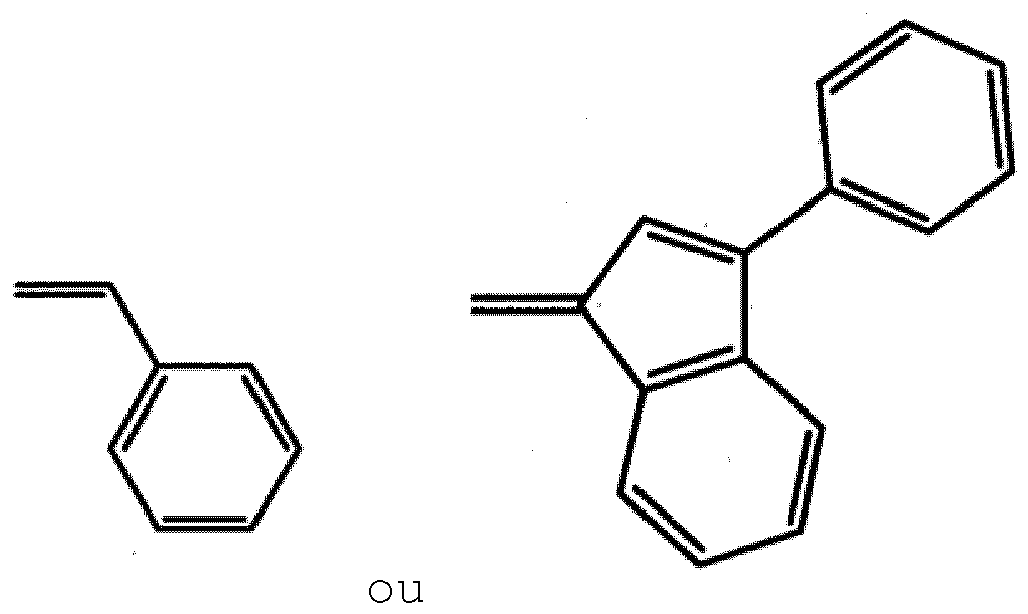 R6 représente -H ou un groupement alkyle linéaire, ramifié ou cyclique avec 1 à 20 atomes de carbone etR7 et R8 représentent, indépendamment l'un de l'autre, -H, -F, -Cl, -Br, -I, -CN, -SCN, -OCN, -NCO, -NO2, -OH, -SH, -NH2, -OCH3 ou un groupement alkyle linéaire, ramifié ou cyclique avec 1 à 20 atomes de carbone,R9 et R10 représentent, indépendamment l'un de l'autre, un groupement alkyle linéaire ou ramifié avec 1 à 4 atomes de carbone, etMe représente Ru ou Os,X représente un halogène ou un pseudo-halogène choisi parmi -F, -Cl, -Br, -I, -CN, -SCN, -OCN, -NCO et
- Procédé selon l'une quelconque des revendications 1 et 2, caractérisé en ce que le polyterpène est choisi parmi le caoutchouc naturel, le caoutchouc naturel liquide et le squalène.
- Procédé selon l'une quelconque des revendications 1 à 3, caractérisé en ce que l'atome central Me du complexe catalytique est le ruthénium.
- Procédé selon l'une quelconque des revendications 1 à 4, caractérisé en ce que le résidu R6 est un atome d'hydrogène ou un groupement méthyle, les résidus R7 et R8 sont des atomes d'hydrogène et les résidus R9 et R10 représentent des groupements méthyle.
- Procédé selon l'une quelconque des revendications 1 à 5, caractérisé en ce que les résidus R1 et R2 sont choisis, indépendamment l'un de l'autre, parmi -H, -Cl, -NO2, -CN et 3,5-dinitro-2,4,6-triméthylphényle.
- Procédé selon l'une quelconque des revendications 1 à 6, caractérisé en ce que les résidus R3 et R4 sont choisis, indépendamment l'un de l'autre, parmi les groupements méthyle, éthyle et isopropyle.
- Procédé selon l'une quelconque des revendications 1 à 7, caractérisé en ce que l'on utilise 0,01 à 0,1 % en mole du complexe catalytique par double liaison du polyterpène.
- Procédé selon l'une quelconque des revendications 1 à 8, caractérisé en ce que la pression de l'éthène atteint 3 à 20 bars, la température réactionnelle 100 à 120 °C et la durée de la réaction 1 à 4 h.
Priority Applications (2)
| Application Number | Priority Date | Filing Date | Title |
|---|---|---|---|
| EP10196233.0A EP2468703B1 (fr) | 2010-12-21 | 2010-12-21 | Procédé d'éthénolyse de polyterpènes |
| PCT/EP2011/073493 WO2012085013A1 (fr) | 2010-12-21 | 2011-12-20 | Procédé pour l'éthénolyse de polyterpènes et produits de décomposition pouvant être obtenus à partir dudit procédé |
Applications Claiming Priority (1)
| Application Number | Priority Date | Filing Date | Title |
|---|---|---|---|
| EP10196233.0A EP2468703B1 (fr) | 2010-12-21 | 2010-12-21 | Procédé d'éthénolyse de polyterpènes |
Publications (2)
| Publication Number | Publication Date |
|---|---|
| EP2468703A1 EP2468703A1 (fr) | 2012-06-27 |
| EP2468703B1 true EP2468703B1 (fr) | 2015-04-15 |
Family
ID=43608669
Family Applications (1)
| Application Number | Title | Priority Date | Filing Date |
|---|---|---|---|
| EP10196233.0A Not-in-force EP2468703B1 (fr) | 2010-12-21 | 2010-12-21 | Procédé d'éthénolyse de polyterpènes |
Country Status (2)
| Country | Link |
|---|---|
| EP (1) | EP2468703B1 (fr) |
| WO (1) | WO2012085013A1 (fr) |
Families Citing this family (1)
| Publication number | Priority date | Publication date | Assignee | Title |
|---|---|---|---|---|
| EP3500557B1 (fr) * | 2016-08-19 | 2025-03-05 | Umicore AG & Co. KG | Catalyseurs de métathèse d'oléfines |
Family Cites Families (4)
| Publication number | Priority date | Publication date | Assignee | Title |
|---|---|---|---|---|
| DD30730A1 (de) * | 1961-10-21 | 1966-02-25 | Verfahren zur Herstellung von 2,6,10-Trimetyl-2,6,10-dodekatrien-ol-12 (Farnesol) | |
| WO2008010961A2 (fr) | 2006-07-13 | 2008-01-24 | Elevance Renewable Sciences, Inc. | Synthèse d'alcènes à double liaison terminale à partir d'alcènes à double liaison interne et d'éthylène via la métathèse d'oléfines |
| WO2008046106A2 (fr) | 2006-10-13 | 2008-04-17 | Elevance Renewable Sciences, Inc. | Synthèse d'alcènes terminaux à partir d'alcènes internes via la métathèse d'oléfines |
| FR2934178B1 (fr) | 2008-07-25 | 2010-09-10 | Rhodia Operations | Compositions catalytiques pour la metathese de corps gras insatures avec des olefines et procedes de metathese les mettant en oeuvre |
-
2010
- 2010-12-21 EP EP10196233.0A patent/EP2468703B1/fr not_active Not-in-force
-
2011
- 2011-12-20 WO PCT/EP2011/073493 patent/WO2012085013A1/fr not_active Ceased
Also Published As
| Publication number | Publication date |
|---|---|
| WO2012085013A1 (fr) | 2012-06-28 |
| EP2468703A1 (fr) | 2012-06-27 |
| WO2012085013A9 (fr) | 2012-09-27 |
Similar Documents
| Publication | Publication Date | Title |
|---|---|---|
| EP3489213B1 (fr) | Composition destinée à l'utilisation dans un procédé de production de composés carbonyles optiquement actifs | |
| EP2091958B1 (fr) | Ligands biphosphite pour l'hydroformylation catalysée par des métaux de transition | |
| EP2139835B1 (fr) | Procédé pour produire des composés carbonyle optiquement actifs | |
| DE2922757C2 (de) | Verfahren zur Hydroformylierung von olefinischen Verbindungen | |
| DE69806053T2 (de) | Hochwirksame kationische ruthenium und osmiumkomplexe für die metathesereaktionen | |
| DE102010041821A1 (de) | Einsatz von Supported Ionic Liquid Phase (SILP) Katalysatorsystemen in der Hydroformylierung von olefinhaltigen Gemischen zu Aldehydgemischen mit hohem Anteil von in 2-Stellung unverzweigten Aldehyden | |
| DE2813963A1 (de) | Verfahren zur hydroformylierung unter anwendung verbesserter katalysatoren, die rhodium und diphosphinoliganden enthalten | |
| EP2861552A1 (fr) | Procédé de production de cétones macrocycliques | |
| DE3130805A1 (de) | Neue ruthenium/kohle-hydrierkatalysatoren, deren herstellung und verwendung zur selektiven hydrierung von ungesaettigten carbonylverbindungen | |
| DE2538364B2 (de) | Verfahren zur herstellung von butandiolen | |
| DE102006038934A1 (de) | Herstellung von α-Hydroxyketonen über Carbenkatalysierte Umpolungsreaktion von Aldehyden | |
| EP2468703B1 (fr) | Procédé d'éthénolyse de polyterpènes | |
| EP0437690B1 (fr) | Procédé pour l'hydrogénation asymétrique de dérivés alpha-cétocarbonyliques en dérivés alpha-hydroxycarbonyliques optiquement actifs | |
| DE2003371C3 (de) | Verfahren zur Disproportionierung äthylenisch ungesättigter Verbindungen | |
| DE69510927T2 (de) | Verfahren zur herstellung von optisch aktiven verbindungen | |
| DE69402106T2 (de) | Verfahren zur Herstellung von 2-Formyl-1,4-Butandiol | |
| EP3272731A1 (fr) | Procede de production d'esters d'acides di- ou tricarboxyliques par alkoxy-carbonylation en utilisant des liaisons doubles conjuguees | |
| EP3297982B1 (fr) | Oxidation de limonène | |
| EP4008710B1 (fr) | Procédé d'hydroformylation des oléfines en phase homogène | |
| DE2516698A1 (de) | Neue wolframverbindungen | |
| EP2415738B1 (fr) | Procédé de fabrication d'alcanes saturés linéaires à partir d'alcools primaires | |
| EP1760055A2 (fr) | Alkylation allylique catalysée par le fer | |
| DE69914520T2 (de) | Herstellung von ungesättigten Aldehyden aus Propargylalcohol und konjugierten Diolefinen | |
| EP2657216B1 (fr) | Procédé de basculement du farnésol au nérolidol en présence d'alpha-bisabolol | |
| DE3101673A1 (de) | Verfahren zur katalytischen reduktion von ungesaettigten ketonen |
Legal Events
| Date | Code | Title | Description |
|---|---|---|---|
| AK | Designated contracting states |
Kind code of ref document: A1 Designated state(s): AL AT BE BG CH CY CZ DE DK EE ES FI FR GB GR HR HU IE IS IT LI LT LU LV MC MK MT NL NO PL PT RO RS SE SI SK SM TR |
|
| AX | Request for extension of the european patent |
Extension state: BA ME |
|
| PUAI | Public reference made under article 153(3) epc to a published international application that has entered the european phase |
Free format text: ORIGINAL CODE: 0009012 |
|
| 17P | Request for examination filed |
Effective date: 20130102 |
|
| 17Q | First examination report despatched |
Effective date: 20140306 |
|
| RIC1 | Information provided on ipc code assigned before grant |
Ipc: C08C 19/08 20060101ALI20141001BHEP Ipc: C07C 11/21 20060101AFI20141001BHEP Ipc: C07C 6/04 20060101ALI20141001BHEP |
|
| GRAP | Despatch of communication of intention to grant a patent |
Free format text: ORIGINAL CODE: EPIDOSNIGR1 |
|
| INTG | Intention to grant announced |
Effective date: 20141110 |
|
| GRAS | Grant fee paid |
Free format text: ORIGINAL CODE: EPIDOSNIGR3 |
|
| GRAA | (expected) grant |
Free format text: ORIGINAL CODE: 0009210 |
|
| AK | Designated contracting states |
Kind code of ref document: B1 Designated state(s): AL AT BE BG CH CY CZ DE DK EE ES FI FR GB GR HR HU IE IS IT LI LT LU LV MC MK MT NL NO PL PT RO RS SE SI SK SM TR |
|
| REG | Reference to a national code |
Ref country code: GB Ref legal event code: FG4D Free format text: NOT ENGLISH Ref country code: CH Ref legal event code: EP |
|
| REG | Reference to a national code |
Ref country code: IE Ref legal event code: FG4D Free format text: LANGUAGE OF EP DOCUMENT: GERMAN |
|
| REG | Reference to a national code |
Ref country code: AT Ref legal event code: REF Ref document number: 721863 Country of ref document: AT Kind code of ref document: T Effective date: 20150515 |
|
| REG | Reference to a national code |
Ref country code: DE Ref legal event code: R096 Ref document number: 502010009343 Country of ref document: DE Effective date: 20150528 |
|
| REG | Reference to a national code |
Ref country code: NL Ref legal event code: VDEP Effective date: 20150415 |
|
| REG | Reference to a national code |
Ref country code: LT Ref legal event code: MG4D |
|
| PG25 | Lapsed in a contracting state [announced via postgrant information from national office to epo] |
Ref country code: NL Free format text: LAPSE BECAUSE OF FAILURE TO SUBMIT A TRANSLATION OF THE DESCRIPTION OR TO PAY THE FEE WITHIN THE PRESCRIBED TIME-LIMIT Effective date: 20150415 |
|
| PG25 | Lapsed in a contracting state [announced via postgrant information from national office to epo] |
Ref country code: FI Free format text: LAPSE BECAUSE OF FAILURE TO SUBMIT A TRANSLATION OF THE DESCRIPTION OR TO PAY THE FEE WITHIN THE PRESCRIBED TIME-LIMIT Effective date: 20150415 Ref country code: ES Free format text: LAPSE BECAUSE OF FAILURE TO SUBMIT A TRANSLATION OF THE DESCRIPTION OR TO PAY THE FEE WITHIN THE PRESCRIBED TIME-LIMIT Effective date: 20150415 Ref country code: HR Free format text: LAPSE BECAUSE OF FAILURE TO SUBMIT A TRANSLATION OF THE DESCRIPTION OR TO PAY THE FEE WITHIN THE PRESCRIBED TIME-LIMIT Effective date: 20150415 Ref country code: LT Free format text: LAPSE BECAUSE OF FAILURE TO SUBMIT A TRANSLATION OF THE DESCRIPTION OR TO PAY THE FEE WITHIN THE PRESCRIBED TIME-LIMIT Effective date: 20150415 Ref country code: NO Free format text: LAPSE BECAUSE OF FAILURE TO SUBMIT A TRANSLATION OF THE DESCRIPTION OR TO PAY THE FEE WITHIN THE PRESCRIBED TIME-LIMIT Effective date: 20150715 Ref country code: PT Free format text: LAPSE BECAUSE OF FAILURE TO SUBMIT A TRANSLATION OF THE DESCRIPTION OR TO PAY THE FEE WITHIN THE PRESCRIBED TIME-LIMIT Effective date: 20150817 |
|
| PG25 | Lapsed in a contracting state [announced via postgrant information from national office to epo] |
Ref country code: GR Free format text: LAPSE BECAUSE OF FAILURE TO SUBMIT A TRANSLATION OF THE DESCRIPTION OR TO PAY THE FEE WITHIN THE PRESCRIBED TIME-LIMIT Effective date: 20150716 Ref country code: LV Free format text: LAPSE BECAUSE OF FAILURE TO SUBMIT A TRANSLATION OF THE DESCRIPTION OR TO PAY THE FEE WITHIN THE PRESCRIBED TIME-LIMIT Effective date: 20150415 Ref country code: RS Free format text: LAPSE BECAUSE OF FAILURE TO SUBMIT A TRANSLATION OF THE DESCRIPTION OR TO PAY THE FEE WITHIN THE PRESCRIBED TIME-LIMIT Effective date: 20150415 Ref country code: IS Free format text: LAPSE BECAUSE OF FAILURE TO SUBMIT A TRANSLATION OF THE DESCRIPTION OR TO PAY THE FEE WITHIN THE PRESCRIBED TIME-LIMIT Effective date: 20150815 |
|
| REG | Reference to a national code |
Ref country code: DE Ref legal event code: R097 Ref document number: 502010009343 Country of ref document: DE |
|
| PG25 | Lapsed in a contracting state [announced via postgrant information from national office to epo] |
Ref country code: EE Free format text: LAPSE BECAUSE OF FAILURE TO SUBMIT A TRANSLATION OF THE DESCRIPTION OR TO PAY THE FEE WITHIN THE PRESCRIBED TIME-LIMIT Effective date: 20150415 Ref country code: DK Free format text: LAPSE BECAUSE OF FAILURE TO SUBMIT A TRANSLATION OF THE DESCRIPTION OR TO PAY THE FEE WITHIN THE PRESCRIBED TIME-LIMIT Effective date: 20150415 |
|
| PLBE | No opposition filed within time limit |
Free format text: ORIGINAL CODE: 0009261 |
|
| STAA | Information on the status of an ep patent application or granted ep patent |
Free format text: STATUS: NO OPPOSITION FILED WITHIN TIME LIMIT |
|
| PG25 | Lapsed in a contracting state [announced via postgrant information from national office to epo] |
Ref country code: CZ Free format text: LAPSE BECAUSE OF FAILURE TO SUBMIT A TRANSLATION OF THE DESCRIPTION OR TO PAY THE FEE WITHIN THE PRESCRIBED TIME-LIMIT Effective date: 20150415 Ref country code: PL Free format text: LAPSE BECAUSE OF FAILURE TO SUBMIT A TRANSLATION OF THE DESCRIPTION OR TO PAY THE FEE WITHIN THE PRESCRIBED TIME-LIMIT Effective date: 20150415 Ref country code: SK Free format text: LAPSE BECAUSE OF FAILURE TO SUBMIT A TRANSLATION OF THE DESCRIPTION OR TO PAY THE FEE WITHIN THE PRESCRIBED TIME-LIMIT Effective date: 20150415 Ref country code: RO Free format text: LAPSE BECAUSE OF NON-PAYMENT OF DUE FEES Effective date: 20150415 |
|
| 26N | No opposition filed |
Effective date: 20160118 |
|
| PG25 | Lapsed in a contracting state [announced via postgrant information from national office to epo] |
Ref country code: IT Free format text: LAPSE BECAUSE OF FAILURE TO SUBMIT A TRANSLATION OF THE DESCRIPTION OR TO PAY THE FEE WITHIN THE PRESCRIBED TIME-LIMIT Effective date: 20150415 |
|
| PG25 | Lapsed in a contracting state [announced via postgrant information from national office to epo] |
Ref country code: BE Free format text: LAPSE BECAUSE OF NON-PAYMENT OF DUE FEES Effective date: 20151231 Ref country code: SI Free format text: LAPSE BECAUSE OF FAILURE TO SUBMIT A TRANSLATION OF THE DESCRIPTION OR TO PAY THE FEE WITHIN THE PRESCRIBED TIME-LIMIT Effective date: 20150415 |
|
| PG25 | Lapsed in a contracting state [announced via postgrant information from national office to epo] |
Ref country code: MC Free format text: LAPSE BECAUSE OF FAILURE TO SUBMIT A TRANSLATION OF THE DESCRIPTION OR TO PAY THE FEE WITHIN THE PRESCRIBED TIME-LIMIT Effective date: 20150415 Ref country code: LU Free format text: LAPSE BECAUSE OF FAILURE TO SUBMIT A TRANSLATION OF THE DESCRIPTION OR TO PAY THE FEE WITHIN THE PRESCRIBED TIME-LIMIT Effective date: 20151221 |
|
| REG | Reference to a national code |
Ref country code: CH Ref legal event code: PL |
|
| GBPC | Gb: european patent ceased through non-payment of renewal fee |
Effective date: 20151221 |
|
| REG | Reference to a national code |
Ref country code: IE Ref legal event code: MM4A |
|
| REG | Reference to a national code |
Ref country code: FR Ref legal event code: ST Effective date: 20160831 |
|
| PG25 | Lapsed in a contracting state [announced via postgrant information from national office to epo] |
Ref country code: GB Free format text: LAPSE BECAUSE OF NON-PAYMENT OF DUE FEES Effective date: 20151221 Ref country code: LI Free format text: LAPSE BECAUSE OF NON-PAYMENT OF DUE FEES Effective date: 20151231 Ref country code: IE Free format text: LAPSE BECAUSE OF NON-PAYMENT OF DUE FEES Effective date: 20151221 Ref country code: CH Free format text: LAPSE BECAUSE OF NON-PAYMENT OF DUE FEES Effective date: 20151231 |
|
| PG25 | Lapsed in a contracting state [announced via postgrant information from national office to epo] |
Ref country code: FR Free format text: LAPSE BECAUSE OF NON-PAYMENT OF DUE FEES Effective date: 20151231 |
|
| REG | Reference to a national code |
Ref country code: AT Ref legal event code: MM01 Ref document number: 721863 Country of ref document: AT Kind code of ref document: T Effective date: 20151221 |
|
| PG25 | Lapsed in a contracting state [announced via postgrant information from national office to epo] |
Ref country code: AT Free format text: LAPSE BECAUSE OF NON-PAYMENT OF DUE FEES Effective date: 20151221 Ref country code: HU Free format text: LAPSE BECAUSE OF FAILURE TO SUBMIT A TRANSLATION OF THE DESCRIPTION OR TO PAY THE FEE WITHIN THE PRESCRIBED TIME-LIMIT; INVALID AB INITIO Effective date: 20101221 Ref country code: BG Free format text: LAPSE BECAUSE OF FAILURE TO SUBMIT A TRANSLATION OF THE DESCRIPTION OR TO PAY THE FEE WITHIN THE PRESCRIBED TIME-LIMIT Effective date: 20150415 Ref country code: SM Free format text: LAPSE BECAUSE OF FAILURE TO SUBMIT A TRANSLATION OF THE DESCRIPTION OR TO PAY THE FEE WITHIN THE PRESCRIBED TIME-LIMIT Effective date: 20150415 |
|
| PG25 | Lapsed in a contracting state [announced via postgrant information from national office to epo] |
Ref country code: SE Free format text: LAPSE BECAUSE OF FAILURE TO SUBMIT A TRANSLATION OF THE DESCRIPTION OR TO PAY THE FEE WITHIN THE PRESCRIBED TIME-LIMIT Effective date: 20150415 Ref country code: CY Free format text: LAPSE BECAUSE OF FAILURE TO SUBMIT A TRANSLATION OF THE DESCRIPTION OR TO PAY THE FEE WITHIN THE PRESCRIBED TIME-LIMIT Effective date: 20150415 |
|
| PG25 | Lapsed in a contracting state [announced via postgrant information from national office to epo] |
Ref country code: TR Free format text: LAPSE BECAUSE OF FAILURE TO SUBMIT A TRANSLATION OF THE DESCRIPTION OR TO PAY THE FEE WITHIN THE PRESCRIBED TIME-LIMIT Effective date: 20150415 Ref country code: MT Free format text: LAPSE BECAUSE OF FAILURE TO SUBMIT A TRANSLATION OF THE DESCRIPTION OR TO PAY THE FEE WITHIN THE PRESCRIBED TIME-LIMIT Effective date: 20150415 |
|
| REG | Reference to a national code |
Ref country code: DE Ref legal event code: R082 Ref document number: 502010009343 Country of ref document: DE Representative=s name: 2K PATENTANWAELTE BLASBERG KEWITZ & REICHEL PA, DE |
|
| PG25 | Lapsed in a contracting state [announced via postgrant information from national office to epo] |
Ref country code: MK Free format text: LAPSE BECAUSE OF FAILURE TO SUBMIT A TRANSLATION OF THE DESCRIPTION OR TO PAY THE FEE WITHIN THE PRESCRIBED TIME-LIMIT Effective date: 20150415 |
|
| PG25 | Lapsed in a contracting state [announced via postgrant information from national office to epo] |
Ref country code: AL Free format text: LAPSE BECAUSE OF FAILURE TO SUBMIT A TRANSLATION OF THE DESCRIPTION OR TO PAY THE FEE WITHIN THE PRESCRIBED TIME-LIMIT Effective date: 20150415 |
|
| PGFP | Annual fee paid to national office [announced via postgrant information from national office to epo] |
Ref country code: DE Payment date: 20211220 Year of fee payment: 12 |
|
| REG | Reference to a national code |
Ref country code: DE Ref legal event code: R119 Ref document number: 502010009343 Country of ref document: DE |
|
| PG25 | Lapsed in a contracting state [announced via postgrant information from national office to epo] |
Ref country code: DE Free format text: LAPSE BECAUSE OF NON-PAYMENT OF DUE FEES Effective date: 20230701 |