EP2471914B1 - Mutante formiatdehydrogenase, dafür codierendes gen und verfahren zur herstellung von nadh - Google Patents
Mutante formiatdehydrogenase, dafür codierendes gen und verfahren zur herstellung von nadh Download PDFInfo
- Publication number
- EP2471914B1 EP2471914B1 EP09848035.3A EP09848035A EP2471914B1 EP 2471914 B1 EP2471914 B1 EP 2471914B1 EP 09848035 A EP09848035 A EP 09848035A EP 2471914 B1 EP2471914 B1 EP 2471914B1
- Authority
- EP
- European Patent Office
- Prior art keywords
- substitution
- formate dehydrogenase
- mutant
- amino acid
- valine
- Prior art date
- Legal status (The legal status is an assumption and is not a legal conclusion. Google has not performed a legal analysis and makes no representation as to the accuracy of the status listed.)
- Not-in-force
Links
- 108090000698 Formate Dehydrogenases Proteins 0.000 title claims description 297
- 108090000623 proteins and genes Proteins 0.000 title claims description 25
- 238000004519 manufacturing process Methods 0.000 title claims description 15
- 238000006467 substitution reaction Methods 0.000 claims description 116
- 230000035772 mutation Effects 0.000 claims description 68
- 150000001413 amino acids Chemical group 0.000 claims description 51
- KZSNJWFQEVHDMF-UHFFFAOYSA-N Valine Natural products CC(C)C(N)C(O)=O KZSNJWFQEVHDMF-UHFFFAOYSA-N 0.000 claims description 47
- KZSNJWFQEVHDMF-BYPYZUCNSA-N L-valine Chemical compound CC(C)[C@H](N)C(O)=O KZSNJWFQEVHDMF-BYPYZUCNSA-N 0.000 claims description 46
- 239000004474 valine Substances 0.000 claims description 46
- AGPKZVBTJJNPAG-WHFBIAKZSA-N L-isoleucine Chemical compound CC[C@H](C)[C@H](N)C(O)=O AGPKZVBTJJNPAG-WHFBIAKZSA-N 0.000 claims description 43
- AGPKZVBTJJNPAG-UHFFFAOYSA-N isoleucine Natural products CCC(C)C(N)C(O)=O AGPKZVBTJJNPAG-UHFFFAOYSA-N 0.000 claims description 42
- 229960000310 isoleucine Drugs 0.000 claims description 42
- DHMQDGOQFOQNFH-UHFFFAOYSA-N Glycine Chemical compound NCC(O)=O DHMQDGOQFOQNFH-UHFFFAOYSA-N 0.000 claims description 41
- 229930027945 nicotinamide-adenine dinucleotide Natural products 0.000 claims description 35
- BOPGDPNILDQYTO-NNYOXOHSSA-N nicotinamide-adenine dinucleotide Chemical compound C1=CCC(C(=O)N)=CN1[C@H]1[C@H](O)[C@H](O)[C@@H](COP(O)(=O)OP(O)(=O)OC[C@@H]2[C@H]([C@@H](O)[C@@H](O2)N2C3=NC=NC(N)=C3N=C2)O)O1 BOPGDPNILDQYTO-NNYOXOHSSA-N 0.000 claims description 35
- 238000006243 chemical reaction Methods 0.000 claims description 33
- ZDXPYRJPNDTMRX-UHFFFAOYSA-N glutamine Natural products OC(=O)C(N)CCC(N)=O ZDXPYRJPNDTMRX-UHFFFAOYSA-N 0.000 claims description 31
- DCXYFEDJOCDNAF-REOHCLBHSA-N L-asparagine Chemical compound OC(=O)[C@@H](N)CC(N)=O DCXYFEDJOCDNAF-REOHCLBHSA-N 0.000 claims description 26
- ROHFNLRQFUQHCH-UHFFFAOYSA-N Leucine Natural products CC(C)CC(N)C(O)=O ROHFNLRQFUQHCH-UHFFFAOYSA-N 0.000 claims description 26
- HNDVDQJCIGZPNO-UHFFFAOYSA-N histidine Natural products OC(=O)C(N)CC1=CN=CN1 HNDVDQJCIGZPNO-UHFFFAOYSA-N 0.000 claims description 26
- 239000004475 Arginine Substances 0.000 claims description 25
- DCXYFEDJOCDNAF-UHFFFAOYSA-N Asparagine Natural products OC(=O)C(N)CC(N)=O DCXYFEDJOCDNAF-UHFFFAOYSA-N 0.000 claims description 25
- ROHFNLRQFUQHCH-YFKPBYRVSA-N L-leucine Chemical compound CC(C)C[C@H](N)C(O)=O ROHFNLRQFUQHCH-YFKPBYRVSA-N 0.000 claims description 25
- ODKSFYDXXFIFQN-UHFFFAOYSA-N arginine Natural products OC(=O)C(N)CCCNC(N)=N ODKSFYDXXFIFQN-UHFFFAOYSA-N 0.000 claims description 25
- 235000009582 asparagine Nutrition 0.000 claims description 25
- 229960001230 asparagine Drugs 0.000 claims description 25
- BDAGIHXWWSANSR-UHFFFAOYSA-N methanoic acid Natural products OC=O BDAGIHXWWSANSR-UHFFFAOYSA-N 0.000 claims description 24
- WHUUTDBJXJRKMK-UHFFFAOYSA-N Glutamic acid Natural products OC(=O)C(N)CCC(O)=O WHUUTDBJXJRKMK-UHFFFAOYSA-N 0.000 claims description 21
- FWMNVWWHGCHHJJ-SKKKGAJSSA-N 4-amino-1-[(2r)-6-amino-2-[[(2r)-2-[[(2r)-2-[[(2r)-2-amino-3-phenylpropanoyl]amino]-3-phenylpropanoyl]amino]-4-methylpentanoyl]amino]hexanoyl]piperidine-4-carboxylic acid Chemical compound C([C@H](C(=O)N[C@H](CC(C)C)C(=O)N[C@H](CCCCN)C(=O)N1CCC(N)(CC1)C(O)=O)NC(=O)[C@H](N)CC=1C=CC=CC=1)C1=CC=CC=C1 FWMNVWWHGCHHJJ-SKKKGAJSSA-N 0.000 claims description 20
- 239000004471 Glycine Substances 0.000 claims description 20
- CKLJMWTZIZZHCS-REOHCLBHSA-N L-aspartic acid Chemical compound OC(=O)[C@@H](N)CC(O)=O CKLJMWTZIZZHCS-REOHCLBHSA-N 0.000 claims description 19
- KDXKERNSBIXSRK-UHFFFAOYSA-N Lysine Natural products NCCCCC(N)C(O)=O KDXKERNSBIXSRK-UHFFFAOYSA-N 0.000 claims description 19
- BAWFJGJZGIEFAR-NNYOXOHSSA-O NAD(+) Chemical compound NC(=O)C1=CC=C[N+]([C@H]2[C@@H]([C@H](O)[C@@H](COP(O)(=O)OP(O)(=O)OC[C@@H]3[C@H]([C@@H](O)[C@@H](O3)N3C4=NC=NC(N)=C4N=C3)O)O2)O)=C1 BAWFJGJZGIEFAR-NNYOXOHSSA-O 0.000 claims description 19
- 235000013922 glutamic acid Nutrition 0.000 claims description 19
- 239000004220 glutamic acid Substances 0.000 claims description 19
- 239000004472 Lysine Substances 0.000 claims description 17
- 235000003704 aspartic acid Nutrition 0.000 claims description 17
- OQFSQFPPLPISGP-UHFFFAOYSA-N beta-carboxyaspartic acid Natural products OC(=O)C(N)C(C(O)=O)C(O)=O OQFSQFPPLPISGP-UHFFFAOYSA-N 0.000 claims description 17
- OUYCCCASQSFEME-QMMMGPOBSA-N L-tyrosine Chemical compound OC(=O)[C@@H](N)CC1=CC=C(O)C=C1 OUYCCCASQSFEME-QMMMGPOBSA-N 0.000 claims description 13
- FFEARJCKVFRZRR-BYPYZUCNSA-N L-methionine Chemical compound CSCC[C@H](N)C(O)=O FFEARJCKVFRZRR-BYPYZUCNSA-N 0.000 claims description 12
- COLNVLDHVKWLRT-QMMMGPOBSA-N L-phenylalanine Chemical compound OC(=O)[C@@H](N)CC1=CC=CC=C1 COLNVLDHVKWLRT-QMMMGPOBSA-N 0.000 claims description 12
- 235000019253 formic acid Nutrition 0.000 claims description 12
- 229930182817 methionine Natural products 0.000 claims description 12
- OUYCCCASQSFEME-UHFFFAOYSA-N tyrosine Natural products OC(=O)C(N)CC1=CC=C(O)C=C1 OUYCCCASQSFEME-UHFFFAOYSA-N 0.000 claims description 12
- OSWFIVFLDKOXQC-UHFFFAOYSA-N 4-(3-methoxyphenyl)aniline Chemical compound COC1=CC=CC(C=2C=CC(N)=CC=2)=C1 OSWFIVFLDKOXQC-UHFFFAOYSA-N 0.000 claims description 11
- QNAYBMKLOCPYGJ-REOHCLBHSA-N L-alanine Chemical compound C[C@H](N)C(O)=O QNAYBMKLOCPYGJ-REOHCLBHSA-N 0.000 claims description 10
- 235000004279 alanine Nutrition 0.000 claims description 10
- COLNVLDHVKWLRT-UHFFFAOYSA-N phenylalanine Natural products OC(=O)C(N)CC1=CC=CC=C1 COLNVLDHVKWLRT-UHFFFAOYSA-N 0.000 claims description 10
- ONIBWKKTOPOVIA-UHFFFAOYSA-N Proline Natural products OC(=O)C1CCCN1 ONIBWKKTOPOVIA-UHFFFAOYSA-N 0.000 claims description 9
- ZDXPYRJPNDTMRX-VKHMYHEASA-N L-glutamine Chemical compound OC(=O)[C@@H](N)CCC(N)=O ZDXPYRJPNDTMRX-VKHMYHEASA-N 0.000 claims description 8
- ONIBWKKTOPOVIA-BYPYZUCNSA-N L-Proline Chemical compound OC(=O)[C@@H]1CCCN1 ONIBWKKTOPOVIA-BYPYZUCNSA-N 0.000 claims description 7
- 102220179352 rs371106978 Human genes 0.000 description 72
- 102220282577 rs757116652 Human genes 0.000 description 71
- 102220124369 rs886043651 Human genes 0.000 description 68
- 230000000694 effects Effects 0.000 description 58
- 125000003275 alpha amino acid group Chemical group 0.000 description 48
- 235000001014 amino acid Nutrition 0.000 description 45
- 229940024606 amino acid Drugs 0.000 description 44
- 102200009189 rs56014374 Human genes 0.000 description 30
- 241000223195 Fusarium graminearum Species 0.000 description 24
- 125000000539 amino acid group Chemical group 0.000 description 24
- 239000000243 solution Substances 0.000 description 24
- 238000000034 method Methods 0.000 description 21
- UHPMCKVQTMMPCG-UHFFFAOYSA-N 5,8-dihydroxy-2-methoxy-6-methyl-7-(2-oxopropyl)naphthalene-1,4-dione Chemical compound CC1=C(CC(C)=O)C(O)=C2C(=O)C(OC)=CC(=O)C2=C1O UHPMCKVQTMMPCG-UHFFFAOYSA-N 0.000 description 17
- 241000223218 Fusarium Species 0.000 description 17
- 102220502745 Putative C->U-editing enzyme APOBEC-4_Q159L_mutation Human genes 0.000 description 17
- 238000012360 testing method Methods 0.000 description 17
- 230000001133 acceleration Effects 0.000 description 16
- 238000010586 diagram Methods 0.000 description 16
- 230000014509 gene expression Effects 0.000 description 16
- 102000004190 Enzymes Human genes 0.000 description 15
- 108090000790 Enzymes Proteins 0.000 description 15
- 239000013598 vector Substances 0.000 description 15
- 239000013612 plasmid Substances 0.000 description 14
- 230000012010 growth Effects 0.000 description 13
- 239000000203 mixture Substances 0.000 description 13
- CURLTUGMZLYLDI-UHFFFAOYSA-N Carbon dioxide Chemical compound O=C=O CURLTUGMZLYLDI-UHFFFAOYSA-N 0.000 description 12
- 102200144532 rs142951029 Human genes 0.000 description 11
- 102000004169 proteins and genes Human genes 0.000 description 10
- XLYOFNOQVPJJNP-UHFFFAOYSA-N water Substances O XLYOFNOQVPJJNP-UHFFFAOYSA-N 0.000 description 10
- -1 formic acid ions Chemical class 0.000 description 9
- 238000002703 mutagenesis Methods 0.000 description 9
- 235000018102 proteins Nutrition 0.000 description 9
- 230000014616 translation Effects 0.000 description 9
- 241000222124 [Candida] boidinii Species 0.000 description 8
- 230000001747 exhibiting effect Effects 0.000 description 8
- 238000005259 measurement Methods 0.000 description 8
- 239000002773 nucleotide Substances 0.000 description 8
- 125000003729 nucleotide group Chemical group 0.000 description 8
- 239000000126 substance Substances 0.000 description 8
- 241000191338 Candida methylica Species 0.000 description 7
- 102220483098 Ornithine decarboxylase antizyme 1_H155V_mutation Human genes 0.000 description 7
- 241000694307 Paracoccus sp. 12-A Species 0.000 description 7
- 240000004808 Saccharomyces cerevisiae Species 0.000 description 7
- 235000014680 Saccharomyces cerevisiae Nutrition 0.000 description 7
- 230000003698 anagen phase Effects 0.000 description 7
- 229910002092 carbon dioxide Inorganic materials 0.000 description 7
- 230000001939 inductive effect Effects 0.000 description 7
- 239000002609 medium Substances 0.000 description 7
- 231100000350 mutagenesis Toxicity 0.000 description 7
- 239000000047 product Substances 0.000 description 7
- 238000000746 purification Methods 0.000 description 7
- 238000013519 translation Methods 0.000 description 7
- 241000588724 Escherichia coli Species 0.000 description 6
- TWRXJAOTZQYOKJ-UHFFFAOYSA-L Magnesium chloride Chemical compound [Mg+2].[Cl-].[Cl-] TWRXJAOTZQYOKJ-UHFFFAOYSA-L 0.000 description 6
- 241000187644 Mycobacterium vaccae Species 0.000 description 6
- 238000004458 analytical method Methods 0.000 description 6
- 239000000872 buffer Substances 0.000 description 6
- 239000000287 crude extract Substances 0.000 description 6
- 239000000725 suspension Substances 0.000 description 6
- 108091032973 (ribonucleotides)n+m Proteins 0.000 description 5
- 125000001931 aliphatic group Chemical group 0.000 description 5
- 239000001569 carbon dioxide Substances 0.000 description 5
- 238000005119 centrifugation Methods 0.000 description 5
- 239000003153 chemical reaction reagent Substances 0.000 description 5
- 230000002209 hydrophobic effect Effects 0.000 description 5
- JUJBNYBVVQSIOU-UHFFFAOYSA-M sodium;4-[2-(4-iodophenyl)-3-(4-nitrophenyl)tetrazol-2-ium-5-yl]benzene-1,3-disulfonate Chemical compound [Na+].C1=CC([N+](=O)[O-])=CC=C1N1[N+](C=2C=CC(I)=CC=2)=NC(C=2C(=CC(=CC=2)S([O-])(=O)=O)S([O-])(=O)=O)=N1 JUJBNYBVVQSIOU-UHFFFAOYSA-M 0.000 description 5
- 238000005406 washing Methods 0.000 description 5
- 241000196324 Embryophyta Species 0.000 description 4
- 241001522878 Escherichia coli B Species 0.000 description 4
- CSNNHWWHGAXBCP-UHFFFAOYSA-L Magnesium sulfate Chemical compound [Mg+2].[O-][S+2]([O-])([O-])[O-] CSNNHWWHGAXBCP-UHFFFAOYSA-L 0.000 description 4
- 241001464814 Pseudomonas sp. 101 Species 0.000 description 4
- FAPWRFPIFSIZLT-UHFFFAOYSA-M Sodium chloride Chemical compound [Na+].[Cl-] FAPWRFPIFSIZLT-UHFFFAOYSA-M 0.000 description 4
- 125000003118 aryl group Chemical group 0.000 description 4
- 238000011156 evaluation Methods 0.000 description 4
- 239000012634 fragment Substances 0.000 description 4
- 230000006698 induction Effects 0.000 description 4
- 125000001570 methylene group Chemical group [H]C([H])([*:1])[*:2] 0.000 description 4
- 230000000813 microbial effect Effects 0.000 description 4
- 244000005700 microbiome Species 0.000 description 4
- VMGAPWLDMVPYIA-HIDZBRGKSA-N n'-amino-n-iminomethanimidamide Chemical compound N\N=C\N=N VMGAPWLDMVPYIA-HIDZBRGKSA-N 0.000 description 4
- 230000008929 regeneration Effects 0.000 description 4
- 238000011069 regeneration method Methods 0.000 description 4
- BOLDJAUMGUJJKM-LSDHHAIUSA-N renifolin D Natural products CC(=C)[C@@H]1Cc2c(O)c(O)ccc2[C@H]1CC(=O)c3ccc(O)cc3O BOLDJAUMGUJJKM-LSDHHAIUSA-N 0.000 description 4
- 108091008146 restriction endonucleases Proteins 0.000 description 4
- UHOVQNZJYSORNB-UHFFFAOYSA-N Benzene Chemical compound C1=CC=CC=C1 UHOVQNZJYSORNB-UHFFFAOYSA-N 0.000 description 3
- OKTJSMMVPCPJKN-UHFFFAOYSA-N Carbon Chemical compound [C] OKTJSMMVPCPJKN-UHFFFAOYSA-N 0.000 description 3
- 108010014303 DNA-directed DNA polymerase Proteins 0.000 description 3
- 102000016928 DNA-directed DNA polymerase Human genes 0.000 description 3
- QIVBCDIJIAJPQS-VIFPVBQESA-N L-tryptophane Chemical group C1=CC=C2C(C[C@H](N)C(O)=O)=CNC2=C1 QIVBCDIJIAJPQS-VIFPVBQESA-N 0.000 description 3
- 101000702488 Rattus norvegicus High affinity cationic amino acid transporter 1 Proteins 0.000 description 3
- QIVBCDIJIAJPQS-UHFFFAOYSA-N Tryptophan Chemical group C1=CC=C2C(CC(N)C(O)=O)=CNC2=C1 QIVBCDIJIAJPQS-UHFFFAOYSA-N 0.000 description 3
- 125000003178 carboxy group Chemical group [H]OC(*)=O 0.000 description 3
- 230000003197 catalytic effect Effects 0.000 description 3
- 238000010367 cloning Methods 0.000 description 3
- 238000012258 culturing Methods 0.000 description 3
- 239000012153 distilled water Substances 0.000 description 3
- 238000010828 elution Methods 0.000 description 3
- 238000006911 enzymatic reaction Methods 0.000 description 3
- 238000000605 extraction Methods 0.000 description 3
- 239000000499 gel Substances 0.000 description 3
- 229910001629 magnesium chloride Inorganic materials 0.000 description 3
- 230000007935 neutral effect Effects 0.000 description 3
- 238000002360 preparation method Methods 0.000 description 3
- 108090000765 processed proteins & peptides Proteins 0.000 description 3
- 102220023659 rs397515081 Human genes 0.000 description 3
- 102220079596 rs550420394 Human genes 0.000 description 3
- 238000002741 site-directed mutagenesis Methods 0.000 description 3
- 239000000758 substrate Substances 0.000 description 3
- 239000006228 supernatant Substances 0.000 description 3
- 230000004083 survival effect Effects 0.000 description 3
- 230000002103 transcriptional effect Effects 0.000 description 3
- 241001198387 Escherichia coli BL21(DE3) Species 0.000 description 2
- 230000005526 G1 to G0 transition Effects 0.000 description 2
- AYFVYJQAPQTCCC-GBXIJSLDSA-N L-threonine Chemical compound C[C@@H](O)[C@H](N)C(O)=O AYFVYJQAPQTCCC-GBXIJSLDSA-N 0.000 description 2
- 239000007993 MOPS buffer Substances 0.000 description 2
- 238000009004 PCR Kit Methods 0.000 description 2
- 102000006382 Ribonucleases Human genes 0.000 description 2
- 108010083644 Ribonucleases Proteins 0.000 description 2
- 239000004280 Sodium formate Substances 0.000 description 2
- 238000002835 absorbance Methods 0.000 description 2
- 230000002378 acidificating effect Effects 0.000 description 2
- 238000007792 addition Methods 0.000 description 2
- 238000000246 agarose gel electrophoresis Methods 0.000 description 2
- 125000003368 amide group Chemical group 0.000 description 2
- 125000003277 amino group Chemical group 0.000 description 2
- 230000003321 amplification Effects 0.000 description 2
- 238000010804 cDNA synthesis Methods 0.000 description 2
- 229910052799 carbon Inorganic materials 0.000 description 2
- 239000002299 complementary DNA Substances 0.000 description 2
- 239000000306 component Substances 0.000 description 2
- 238000012217 deletion Methods 0.000 description 2
- 230000037430 deletion Effects 0.000 description 2
- 238000005115 demineralization Methods 0.000 description 2
- 230000002328 demineralizing effect Effects 0.000 description 2
- 238000011067 equilibration Methods 0.000 description 2
- 239000013604 expression vector Substances 0.000 description 2
- 238000005194 fractionation Methods 0.000 description 2
- 238000010438 heat treatment Methods 0.000 description 2
- 125000002887 hydroxy group Chemical group [H]O* 0.000 description 2
- 229910052588 hydroxylapatite Inorganic materials 0.000 description 2
- 125000002883 imidazolyl group Chemical group 0.000 description 2
- 125000001841 imino group Chemical group [H]N=* 0.000 description 2
- 125000001909 leucine group Chemical group [H]N(*)C(C(*)=O)C([H])([H])C(C([H])([H])[H])C([H])([H])[H] 0.000 description 2
- 239000007788 liquid Substances 0.000 description 2
- 229910052943 magnesium sulfate Inorganic materials 0.000 description 2
- 239000011159 matrix material Substances 0.000 description 2
- 125000000956 methoxy group Chemical group [H]C([H])([H])O* 0.000 description 2
- 229950006238 nadide Drugs 0.000 description 2
- 238000003199 nucleic acid amplification method Methods 0.000 description 2
- XYJRXVWERLGGKC-UHFFFAOYSA-D pentacalcium;hydroxide;triphosphate Chemical compound [OH-].[Ca+2].[Ca+2].[Ca+2].[Ca+2].[Ca+2].[O-]P([O-])([O-])=O.[O-]P([O-])([O-])=O.[O-]P([O-])([O-])=O XYJRXVWERLGGKC-UHFFFAOYSA-D 0.000 description 2
- 108091033319 polynucleotide Proteins 0.000 description 2
- 239000002157 polynucleotide Substances 0.000 description 2
- 102000040430 polynucleotide Human genes 0.000 description 2
- 229920001184 polypeptide Polymers 0.000 description 2
- 102000004196 processed proteins & peptides Human genes 0.000 description 2
- 235000004252 protein component Nutrition 0.000 description 2
- 239000011780 sodium chloride Substances 0.000 description 2
- HLBBKKJFGFRGMU-UHFFFAOYSA-M sodium formate Chemical compound [Na+].[O-]C=O HLBBKKJFGFRGMU-UHFFFAOYSA-M 0.000 description 2
- 235000019254 sodium formate Nutrition 0.000 description 2
- 239000008223 sterile water Substances 0.000 description 2
- HDTRYLNUVZCQOY-UHFFFAOYSA-N α-D-glucopyranosyl-α-D-glucopyranoside Natural products OC1C(O)C(O)C(CO)OC1OC1C(O)C(O)C(O)C(CO)O1 HDTRYLNUVZCQOY-UHFFFAOYSA-N 0.000 description 1
- 241000023308 Acca Species 0.000 description 1
- 241000193830 Bacillus <bacterium> Species 0.000 description 1
- 241000894006 Bacteria Species 0.000 description 1
- 241000588807 Bordetella Species 0.000 description 1
- 238000009010 Bradford assay Methods 0.000 description 1
- 101100000858 Caenorhabditis elegans act-3 gene Proteins 0.000 description 1
- 241001583756 Cryptococcus neoformans var. neoformans JEC21 Species 0.000 description 1
- 101710088194 Dehydrogenase Proteins 0.000 description 1
- 102000016911 Deoxyribonucleases Human genes 0.000 description 1
- 108010053770 Deoxyribonucleases Proteins 0.000 description 1
- 241000764734 Francisella tularensis subsp. tularensis SCHU S4 Species 0.000 description 1
- WQZGKKKJIJFFOK-GASJEMHNSA-N Glucose Natural products OC[C@H]1OC(O)[C@H](O)[C@@H](O)[C@@H]1O WQZGKKKJIJFFOK-GASJEMHNSA-N 0.000 description 1
- 241000228404 Histoplasma capsulatum Species 0.000 description 1
- HEFNNWSXXWATRW-UHFFFAOYSA-N Ibuprofen Chemical compound CC(C)CC1=CC=C(C(C)C(O)=O)C=C1 HEFNNWSXXWATRW-UHFFFAOYSA-N 0.000 description 1
- 102100034343 Integrase Human genes 0.000 description 1
- 238000012218 Kunkel's method Methods 0.000 description 1
- ODKSFYDXXFIFQN-BYPYZUCNSA-P L-argininium(2+) Chemical group NC(=[NH2+])NCCC[C@H]([NH3+])C(O)=O ODKSFYDXXFIFQN-BYPYZUCNSA-P 0.000 description 1
- HNDVDQJCIGZPNO-YFKPBYRVSA-N L-histidine Chemical compound OC(=O)[C@@H](N)CC1=CN=CN1 HNDVDQJCIGZPNO-YFKPBYRVSA-N 0.000 description 1
- 241000589248 Legionella Species 0.000 description 1
- 208000007764 Legionnaires' Disease Diseases 0.000 description 1
- 241001465754 Metazoa Species 0.000 description 1
- 241000052923 Mycobacterium avium subsp. paratuberculosis K-10 Species 0.000 description 1
- 102000006746 NADH Dehydrogenase Human genes 0.000 description 1
- 229910019142 PO4 Inorganic materials 0.000 description 1
- 241000589774 Pseudomonas sp. Species 0.000 description 1
- 108010092799 RNA-directed DNA polymerase Proteins 0.000 description 1
- MTCFGRXMJLQNBG-UHFFFAOYSA-N Serine Natural products OCC(N)C(O)=O MTCFGRXMJLQNBG-UHFFFAOYSA-N 0.000 description 1
- 244000061456 Solanum tuberosum Species 0.000 description 1
- 235000002595 Solanum tuberosum Nutrition 0.000 description 1
- 241000191967 Staphylococcus aureus Species 0.000 description 1
- AYFVYJQAPQTCCC-UHFFFAOYSA-N Threonine Natural products CC(O)C(N)C(O)=O AYFVYJQAPQTCCC-UHFFFAOYSA-N 0.000 description 1
- 239000004473 Threonine Substances 0.000 description 1
- HDTRYLNUVZCQOY-WSWWMNSNSA-N Trehalose Natural products O[C@@H]1[C@@H](O)[C@@H](O)[C@@H](CO)O[C@@H]1O[C@@H]1[C@H](O)[C@@H](O)[C@@H](O)[C@@H](CO)O1 HDTRYLNUVZCQOY-WSWWMNSNSA-N 0.000 description 1
- 229920004890 Triton X-100 Polymers 0.000 description 1
- 239000013504 Triton X-100 Substances 0.000 description 1
- 238000010521 absorption reaction Methods 0.000 description 1
- 239000002253 acid Substances 0.000 description 1
- 238000001042 affinity chromatography Methods 0.000 description 1
- 239000011543 agarose gel Substances 0.000 description 1
- HDTRYLNUVZCQOY-LIZSDCNHSA-N alpha,alpha-trehalose Chemical compound O[C@@H]1[C@@H](O)[C@H](O)[C@@H](CO)O[C@@H]1O[C@@H]1[C@H](O)[C@@H](O)[C@H](O)[C@@H](CO)O1 HDTRYLNUVZCQOY-LIZSDCNHSA-N 0.000 description 1
- 230000004075 alteration Effects 0.000 description 1
- 238000012870 ammonium sulfate precipitation Methods 0.000 description 1
- AVKUERGKIZMTKX-NJBDSQKTSA-N ampicillin Chemical compound C1([C@@H](N)C(=O)N[C@H]2[C@H]3SC([C@@H](N3C2=O)C(O)=O)(C)C)=CC=CC=C1 AVKUERGKIZMTKX-NJBDSQKTSA-N 0.000 description 1
- 229960000723 ampicillin Drugs 0.000 description 1
- 239000011324 bead Substances 0.000 description 1
- 150000001555 benzenes Chemical class 0.000 description 1
- 238000002306 biochemical method Methods 0.000 description 1
- 230000015572 biosynthetic process Effects 0.000 description 1
- 239000001506 calcium phosphate Substances 0.000 description 1
- 229910000389 calcium phosphate Inorganic materials 0.000 description 1
- 235000011010 calcium phosphates Nutrition 0.000 description 1
- 239000003054 catalyst Substances 0.000 description 1
- 239000005515 coenzyme Substances 0.000 description 1
- 238000004040 coloring Methods 0.000 description 1
- 230000000295 complement effect Effects 0.000 description 1
- 238000004590 computer program Methods 0.000 description 1
- 238000010276 construction Methods 0.000 description 1
- 238000001816 cooling Methods 0.000 description 1
- 235000018417 cysteine Nutrition 0.000 description 1
- XUJNEKJLAYXESH-UHFFFAOYSA-N cysteine Natural products SCC(N)C(O)=O XUJNEKJLAYXESH-UHFFFAOYSA-N 0.000 description 1
- SUYVUBYJARFZHO-RRKCRQDMSA-N dATP Chemical compound C1=NC=2C(N)=NC=NC=2N1[C@H]1C[C@H](O)[C@@H](COP(O)(=O)OP(O)(=O)OP(O)(O)=O)O1 SUYVUBYJARFZHO-RRKCRQDMSA-N 0.000 description 1
- SUYVUBYJARFZHO-UHFFFAOYSA-N dATP Natural products C1=NC=2C(N)=NC=NC=2N1C1CC(O)C(COP(O)(=O)OP(O)(=O)OP(O)(O)=O)O1 SUYVUBYJARFZHO-UHFFFAOYSA-N 0.000 description 1
- RGWHQCVHVJXOKC-SHYZEUOFSA-J dCTP(4-) Chemical compound O=C1N=C(N)C=CN1[C@@H]1O[C@H](COP([O-])(=O)OP([O-])(=O)OP([O-])([O-])=O)[C@@H](O)C1 RGWHQCVHVJXOKC-SHYZEUOFSA-J 0.000 description 1
- HAAZLUGHYHWQIW-KVQBGUIXSA-N dGTP Chemical compound C1=NC=2C(=O)NC(N)=NC=2N1[C@H]1C[C@H](O)[C@@H](COP(O)(=O)OP(O)(=O)OP(O)(O)=O)O1 HAAZLUGHYHWQIW-KVQBGUIXSA-N 0.000 description 1
- NHVNXKFIZYSCEB-XLPZGREQSA-N dTTP Chemical compound O=C1NC(=O)C(C)=CN1[C@@H]1O[C@H](COP(O)(=O)OP(O)(=O)OP(O)(O)=O)[C@@H](O)C1 NHVNXKFIZYSCEB-XLPZGREQSA-N 0.000 description 1
- 230000003247 decreasing effect Effects 0.000 description 1
- 238000006731 degradation reaction Methods 0.000 description 1
- 239000008121 dextrose Substances 0.000 description 1
- ZPWVASYFFYYZEW-UHFFFAOYSA-L dipotassium hydrogen phosphate Chemical compound [K+].[K+].OP([O-])([O-])=O ZPWVASYFFYYZEW-UHFFFAOYSA-L 0.000 description 1
- 229910000396 dipotassium phosphate Inorganic materials 0.000 description 1
- 238000004520 electroporation Methods 0.000 description 1
- 101150086278 fdh gene Proteins 0.000 description 1
- 238000005227 gel permeation chromatography Methods 0.000 description 1
- 238000011331 genomic analysis Methods 0.000 description 1
- 239000011521 glass Substances 0.000 description 1
- 125000000291 glutamic acid group Chemical group N[C@@H](CCC(O)=O)C(=O)* 0.000 description 1
- 125000000404 glutamine group Chemical group N[C@@H](CCC(N)=O)C(=O)* 0.000 description 1
- 238000009396 hybridization Methods 0.000 description 1
- 229930195733 hydrocarbon Natural products 0.000 description 1
- 150000002430 hydrocarbons Chemical class 0.000 description 1
- 239000001257 hydrogen Substances 0.000 description 1
- 229910052739 hydrogen Inorganic materials 0.000 description 1
- 238000000338 in vitro Methods 0.000 description 1
- 238000009776 industrial production Methods 0.000 description 1
- 230000000977 initiatory effect Effects 0.000 description 1
- 238000003780 insertion Methods 0.000 description 1
- 230000037431 insertion Effects 0.000 description 1
- 238000005342 ion exchange Methods 0.000 description 1
- 238000004255 ion exchange chromatography Methods 0.000 description 1
- 238000002955 isolation Methods 0.000 description 1
- 125000000741 isoleucyl group Chemical group [H]N([H])C(C(C([H])([H])[H])C([H])([H])C([H])([H])[H])C(=O)O* 0.000 description 1
- 238000001638 lipofection Methods 0.000 description 1
- 239000006166 lysate Substances 0.000 description 1
- 230000001404 mediated effect Effects 0.000 description 1
- 239000012533 medium component Substances 0.000 description 1
- 108020004999 messenger RNA Proteins 0.000 description 1
- 125000002496 methyl group Chemical group [H]C([H])([H])* 0.000 description 1
- 238000002156 mixing Methods 0.000 description 1
- 238000010369 molecular cloning Methods 0.000 description 1
- 229910052757 nitrogen Inorganic materials 0.000 description 1
- 125000004433 nitrogen atom Chemical group N* 0.000 description 1
- 230000003287 optical effect Effects 0.000 description 1
- 230000008520 organization Effects 0.000 description 1
- 230000002018 overexpression Effects 0.000 description 1
- 230000033116 oxidation-reduction process Effects 0.000 description 1
- 125000004430 oxygen atom Chemical group O* 0.000 description 1
- 239000013600 plasmid vector Substances 0.000 description 1
- 239000008057 potassium phosphate buffer Substances 0.000 description 1
- 239000001965 potato dextrose agar Substances 0.000 description 1
- 230000004952 protein activity Effects 0.000 description 1
- 238000002731 protein assay Methods 0.000 description 1
- 238000000164 protein isolation Methods 0.000 description 1
- 238000001742 protein purification Methods 0.000 description 1
- 238000006722 reduction reaction Methods 0.000 description 1
- 238000011160 research Methods 0.000 description 1
- 230000027756 respiratory electron transport chain Effects 0.000 description 1
- 239000003161 ribonuclease inhibitor Substances 0.000 description 1
- 102200149390 rs2107732 Human genes 0.000 description 1
- 102220075203 rs796052502 Human genes 0.000 description 1
- 230000035945 sensitivity Effects 0.000 description 1
- 239000011734 sodium Substances 0.000 description 1
- 238000012916 structural analysis Methods 0.000 description 1
- 238000003786 synthesis reaction Methods 0.000 description 1
- 238000013518 transcription Methods 0.000 description 1
- 230000035897 transcription Effects 0.000 description 1
- 238000011426 transformation method Methods 0.000 description 1
- QORWJWZARLRLPR-UHFFFAOYSA-H tricalcium bis(phosphate) Chemical compound [Ca+2].[Ca+2].[Ca+2].[O-]P([O-])([O-])=O.[O-]P([O-])([O-])=O QORWJWZARLRLPR-UHFFFAOYSA-H 0.000 description 1
- 125000001493 tyrosinyl group Chemical group [H]OC1=C([H])C([H])=C(C([H])=C1[H])C([H])([H])C([H])(N([H])[H])C(*)=O 0.000 description 1
Images









Classifications
-
- C—CHEMISTRY; METALLURGY
- C12—BIOCHEMISTRY; BEER; SPIRITS; WINE; VINEGAR; MICROBIOLOGY; ENZYMOLOGY; MUTATION OR GENETIC ENGINEERING
- C12Y—ENZYMES
- C12Y102/00—Oxidoreductases acting on the aldehyde or oxo group of donors (1.2)
- C12Y102/01—Oxidoreductases acting on the aldehyde or oxo group of donors (1.2) with NAD+ or NADP+ as acceptor (1.2.1)
- C12Y102/01002—Formate dehydrogenase (1.2.1.2)
-
- C—CHEMISTRY; METALLURGY
- C12—BIOCHEMISTRY; BEER; SPIRITS; WINE; VINEGAR; MICROBIOLOGY; ENZYMOLOGY; MUTATION OR GENETIC ENGINEERING
- C12P—FERMENTATION OR ENZYME-USING PROCESSES TO SYNTHESISE A DESIRED CHEMICAL COMPOUND OR COMPOSITION OR TO SEPARATE OPTICAL ISOMERS FROM A RACEMIC MIXTURE
- C12P19/00—Preparation of compounds containing saccharide radicals
- C12P19/26—Preparation of nitrogen-containing carbohydrates
- C12P19/28—N-glycosides
- C12P19/30—Nucleotides
- C12P19/36—Dinucleotides, e.g. nicotineamide-adenine dinucleotide phosphate
-
- C—CHEMISTRY; METALLURGY
- C12—BIOCHEMISTRY; BEER; SPIRITS; WINE; VINEGAR; MICROBIOLOGY; ENZYMOLOGY; MUTATION OR GENETIC ENGINEERING
- C12N—MICROORGANISMS OR ENZYMES; COMPOSITIONS THEREOF; PROPAGATING, PRESERVING, OR MAINTAINING MICROORGANISMS; MUTATION OR GENETIC ENGINEERING; CULTURE MEDIA
- C12N9/00—Enzymes; Proenzymes; Compositions thereof; Processes for preparing, activating, inhibiting, separating or purifying enzymes
- C12N9/0004—Oxidoreductases (1.)
- C12N9/0008—Oxidoreductases (1.) acting on the aldehyde or oxo group of donors (1.2)
Definitions
- the present invention relates to mutant formate dehydrogenases having substitutional mutations at specific sites in a wild-type formate dehydrogenase, genes encoding the mutant formate dehydrogenases, and a method for producing NADH.
- Formate dehydrogenase reduces NAD + to reduced nicotinamide adenine dinucleotide (NADH) and oxidizes formic acid to carbon dioxide in the presence of oxidized nicotinamide adenine dinucleotide (NAD + ), formic acid, and water. Based on the enzyme reaction, formate dehydrogenase is used for a system for regeneration of NADH from NAD + .
- Conventionally known examples of formate dehydrogenase include Candida boidinii (ATCC32195)-derived formate dehydrogenase as described in JP Patent Publication (Kokai) No.
- BIOCHEMISTRY Moscow
- Vol. 69, No. 11, 2004, pp. 1252-1267 Biokhimiya, Vol. 69, No. 11, 2004, pp. 1537-1554
- the specific activity of formate dehydrogenase is not so significant compared with that of various enzymes.
- a method for producing NADH using a formate dehydrogenase reduction reaction to result in NADH can be said to result in poor productivity because of the low specific activity of formate dehydrogenase.
- an object of the present invention is to provide, as a result of a search for a useful substitutional mutation in the formate dehydrogenase according to this patent application and conventionally known formate dehydrogenases, mutant formate dehydrogenase having better durability than conventionally known mutant formate dehydrogenases, a gene encoding the mutant formate dehydrogenase, and a method for producing NADH using the mutant formate dehydrogenase.
- mutant formate dehydrogenase according to the present invention comprises any one amino acid sequence of the following amino acid sequences A) to C) and thus has improved durability:
- mutant formate dehydrogenase according to the present invention preferably further comprises 1 to 3 substitutional mutations selected from the group consisting of, with respect to the amino acid sequence A):
- mutant formate dehydrogenase according to the present invention preferably further comprises 1 to 3 substitutional mutations selected from the group consisting of, with respect to the amino acid sequence B):
- mutant formate dehydrogenase according to the present invention preferably further comprises 1 to 3 substitutional mutations selected from the group consisting of, with respect to the amino acid sequence C):
- the method for producing NADH according to the present invention comprises causing the above-mentioned mutant formate dehydrogenase according to the present invention to act on a reaction system containing formic acid and NAD + .
- the mutant formate dehydrogenase according to the present invention has a feature such that the durability is significantly improved compared with formate dehydrogenase before mutation thereof due to a novel substitutional mutation(s).
- NADH known as a very expensive substance can be produced with good productivity.
- NADH production using the mutant formate dehydrogenase according to the present invention enables industrial production of NADH.
- the mutant formate dehydrogenase according to the present invention has an amino acid sequence that has substitutions of specific amino acid residues in a formate dehydrogenase.
- formate dehydrogenase is not particularly limited, as long as it has amino acid residues to be substituted as specifically described later and formate dehydrogenase activity.
- formate dehydrogenase is an enzyme, which is classified into EC1.2.1.2 under the enzyme classification, oxidizes formic acid ions to carbon dioxide, and has activity of catalyzing a reaction for reducing NAD + ions to NADH.
- the formate dehydrogenase may be a plant-derived enzyme, an animal-derived enzyme, or a microorganism-derived enzyme.
- the microorganism-derived formate dehydrogenase include various formate dehydrogenases as disclosed in the overview concerning formate dehydrogenase ( Biomolecular Engineering 23 (2006) 98-110 ). More specifically, the present invention can be applied to Staphylococcus aureus -derived formate dehydrogenase ( Baba, T. et al., Lancet 359, 1819-1827, 2002 ), Mycobacterium avium subsp. paratuberculosis str.k10 ( Li et al., Proc. Natl. Acad. Sci. U.S.A.
- the present invention can also be applied to Pseudomonas sp.101-derived formate dehydrogenase, Mycobacterium vaccae N10.-derived formate dehydrogenase, Candida boidini -derived formate dehydrogenase, Candida methylica -derived formate dehydrogenase, Saccharomyces cerevisiae -derived formate dehydrogenase, and Paracoccus sp.12-A-derived formate dehydrogenase disclosed in the above overview.
- the present invention is preferably applied to Gibberella zeae -derived formate dehydrogenase that has been previously applied for a patent ( JP Patent Application No. 2008-100448 ).
- Gibberella zeae -derived formate dehydrogenase exhibits specific activity significantly better than that of the above-mentioned conventionally known formate dehydrogenases.
- the nucleotide sequence of a gene encoding Gibberella zeae -derived formate dehydrogenase is shown in SEQ ID NO: 1.
- the amino acid sequence of Gibberella zeae -derived formate dehydrogenase is shown in SEQ ID NO: 2.
- Fusarium strains preserved at the American Type Culture Collection (ATCC) under ATCC No. 10910, No. 20271, No. 20272, No. 20274, No. 24689, No. 28106, or No. 48063 can be used.
- ATCC American Type Culture Collection
- Fusarium strains are preserved at the ATCC under registration name of Fusarium graminearum. If Gibberella zeae is registered under another name, this can also be used herein.
- Gibberella zeae to be used herein indicates Fusarium graminearum at the perfect stage (teleomorph).
- Fusarium preserved at the NITE Biological Resource Center (NBRC) under NBRC No. 4474, No. 5269, No. 6608, No. 7160, No. 7520, No. 7772, No. 8850, or No. 9462 can also be used herein.
- formate dehydrogenase may also be obtained without using microbial strains preserved at institutions such as ATCC and NBRC, but instead using Fusarium independently isolated from nature.
- the amino acid sequence of Pseudomonas sp.101-derived formate dehydrogenase is shown in SEQ ID NO: 3.
- the amino acid sequence of Mycobacterium vaccae N10.-derived formate dehydrogenase is shown in SEQ ID NO: 4.
- the nucleotide sequence of a gene encoding Candida boidini-derived formate dehydrogenase is shown in SEQ ID NO: 5.
- the amino acid sequence of Candida boidini -derived formate dehydrogenase is shown in SEQ ID NO: 6.
- the nucleotide sequence of a gene encoding Candida methylica -derived formate dehydrogenase is shown in SEQ ID NO: 7.
- the amino acid sequence of Candida methylica -derived formate dehydrogenase is shown in SEQ ID NO: 8.
- the nucleotide sequence of a gene encoding Saccharomyces cerevisiae -derived formate dehydrogenase is shown in SEQ ID NO: 9.
- the amino acid sequence of Saccharomyces cerevisiae -derived formate dehydrogenase is shown in SEQ ID NO: 10.
- the nucleotide sequence of a gene encoding Paracoccus sp.12-A-derived formate dehydrogenase is shown in SEQ ID NO: 11.
- the amino acid sequence of Paracoccus sp.12-A-derived formate dehydrogenase is shown in SEQ ID NO: 12.
- Formate dehydrogenase that can be used in the present invention is not limited to the one consisting of the amino acid sequence shown in SEQ ID NO: 2, 3, 4, 6, 8, 10, or 12.
- An example thereof to be used herein may be formate dehydrogenase that comprises an amino acid sequence that has a deletion, a substitution, an addition, or an insertion of 1 or a plurality of amino acids excluding amino acid residues to be substituted as described in detail later, with respect to the amino acid sequence shown in SEQ ID NO: 2, 3, 4, 6, 8, 10, or 12, and has catalytic activity in a reaction wherein formic acid and NAD + are substrates and carbon dioxide and NADH are products.
- a plurality of amino acids refers to, for example, 1 to 30, preferably 1 to 20, more preferably, 1 to 10, further more preferably 1 to 5, and particularly preferably 1 to 3 amino acids.
- deletion, substitution, or addition of amino acids can be performed by altering the nucleotide sequence encoding the above gene by a technique known in the art. Mutation can be introduced into a nucleotide sequence by known techniques such as Kunkel method or Gapped duplex method or methods according thereto.
- mutation is introduced using a mutagenesis kit using site-directed mutagenesis (e.g., Mutant-K and Mutant-G (both are commercial names, TAKARA)) or a LA PCR in vitro Mutagenesis series kit (trade name, TAKARA).
- site-directed mutagenesis e.g., Mutant-K and Mutant-G (both are commercial names, TAKARA)
- LA PCR in vitro Mutagenesis series kit (trade name, TAKARA).
- the value of homology refers to a value that is found using a database with default setting, in which a computer program with blast algorithm mounted therein and gene sequence information are stored.
- a protein that can be used as formate dehydrogenase in the present invention is a protein that is encoded by polynucleotide hybridizing under stringent conditions to polynucleotide complementary to a portion of or the entire nucleotide sequence shown in SEQ ID NO: 1, 5, 7, 9, or 11 and has catalytic activity in a reaction in which formic acid and NAD + are substrates and carbon dioxide and NADH are products.
- hybridizing under stringent conditions means that binding is maintained under washing conditions of 60°C and 2 x SSC.
- Hybridization can be performed by a conventionally known method such as the method described in J. Sambrook et al. Molecular Cloning, A Laboratory Manual, 2nd Ed., Cold Spring Harbor Laboratory (1989 ).
- the mutant formate dehydrogenase according to the present invention is prepared by substituting a plurality of predetermined amino acid residues in the above-mentioned formate dehydrogenase, having significantly improved durability compared with that of formate dehydrogenase before amino acid substitution.
- amino acid residues to be substituted can be specified using numerical values counted from the N-terminus on the basis of Gibberella zeae -derived formate dehydrogenase consisting of the amino acid sequence shown in SEQ ID NO: 2.
- amino acid residues to be substituted, which are specified with specific numerical values found on the basis of the amino acid sequence shown in SEQ ID NO: 2 are represented by different numerical values depending on the types of formate dehydrogenase.
- Xth (or Xrd) amino acid residue (at position X) in the amino acid sequence shown in SEQ ID NO: 2 an amino acid residue (corresponding to the Xth or Xrd amino acid residue) in formate dehydrogenase that has an amino acid sequence differing from the amino acid sequence shown in SEQ ID NO: 2 is represented by a numerical value differing from "X.”
- amino acid residue in an amino acid sequence differing from the amino acid sequence shown in SEQ ID NO: 2 corresponding to such a predetermined amino acid residue in the amino acid sequence shown in SEQ ID NO: 2 can be specified by multiple alignment analysis for a plurality of amino acid sequences including the amino acid sequence shown in SEQ ID NO: 2.
- Multiple alignment analysis can be easily performed by persons killed in the art using a CLUSTAL W (1.83) multiple sequence alignment program (that can be used with DDBJ of the National Institute of Genetics (http://clustalw.ddbj.nig.ac.jp/top-j.html)), for example. But the example thereof is not limited thereto.
- amino acid residues corresponding to predetermined amino acid residues in the amino acid sequence shown in SEQ ID NO: 2 can also be specified in the different amino acid sequence.
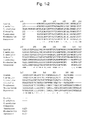
- Fig. 1 shows the results of multiple alignment analysis for Gibberella zeae -derived formate dehydrogenase (SEQ ID NO: 2), Pseudomonas sp.101-derived formate dehydrogenase (SEQ ID NO: 3), Mycobacterium vaccae N10.-derived formate dehydrogenase (SEQ ID NO: 4), Candida boidini-derived formate dehydrogenase (SEQ ID NO: 6), Candida methylica-derived formate dehydrogenase (SEQ ID NO: 8), Saccharomyces cerevisiae-derived formate dehydrogenase (SEQ ID NO: 10), and Paracoccus sp.12-A-derived formate dehydrogenase (SEQ ID NO: 12).
- formate dehydrogenases other than these specific formate dehydrogenases can also be similarly subjected to multiple alignment analysis, so that they can be compared with Gibberella zeae -derived formate dehydrogenase (SEQ ID NO: 2).
- amino acids to be substituted are denoted on the basis of the amino acid sequence shown in SEQ ID NO: 2; that is, Gibberella zeae -derived formate dehydrogenase.
- numerical values representing the positions of amino acids differ for different formate dehydrogenases.
- mutant formate dehydrogenase according to the present invention include quadruple mutant formate dehydrogenase, which has substitutional mutations of amino acid residues at 4 positions described later and mutant formate dehydrogenase, which has other substitutional mutations at 1 to 3 positions of the quadruple mutant formate dehydrogenase.
- the quadruple mutant formate dehydrogenase according to the present invention has the amino acid sequence shown in any one of the following A) to C):
- examples of “other amino acids” are not particularly limited and may be any amino acids, as long as the durability of formate dehydrogenase after mutation is significantly improved compared with that of formate dehydrogenase before mutation. Durability can be evaluated with remaining activity found after an object is left to stand at 37°C for 500 hours. In addition, durability may also be evaluated with an acceleration test, by which an object is left to stand at 37°C for 500 hours (e.g., under conditions wherein an object is left to stand at 52°C to 58°C for 30 minutes to 50 minutes).
- the expression "durability is improved” means that remaining activity after mutagenesis is statistically significantly higher than that of wild-type formate dehydrogenase before mutagenesis.
- the enzyme activity of mutant formate dehydrogenase and the same of formate dehydrogenase before substitutional mutation can be determined by appropriately using conventionally known techniques. For example, through direct or indirect measurement of the amount of NADH generated according to the following formula (reaction formula) or the amounts of components consumed according to the following reaction formula, the enzyme activity of formate dehydrogenase contributing to the following formula can be measured.
- reaction formula reaction formula
- NADH NADH
- a substitutional mutation of the 73 rd glycine to alanine, a substitutional mutation of the 99 th valine to isoleucine, a substitutional mutation of the 153 rd valine to isoleucine, a substitutional mutation of the 155 th histidine to glutamine or lysine, a substitutional mutation of the 159 th glutamine to leucine, and a substitutional mutation of the 298 th asparagine to tyrosine are preferred.
- amino acids specifically preferable as amino acids after substitution are exemplified, but the examples of amino acids after substitution are not limited to the above examples.
- reference (1) McKee Biochemistry (Biochemistry: the molecular basis of life)" 3rd ed., Chapter 5 Amino Acid ⁇ Peptide ⁇ Protein 5.1 Amino acid, Edition: Atsushi Ichikawa, supervised translation: Shinichi Fukuoka, publisher: Ryosuke Sone, publishing office: Kagaku-Dojin Publishing Company, Inc., ISBN4-7598-0944-9 ), it is well known that amino acids are classified based on side chains having similar properties (e.g., chemical properties and physical size).
- amino acid side chain groups to be taken into consideration for multiple alignment may be determined based on indices such as chemical properties, physical size, and the like. These groups are shown by score matrix (BLOSUM) disclosed in reference (2) as groups of amino acids having the score of 0 or more and amino acids preferably having the score of 1 or more.
- BLOSUM score matrix
- amino acids having properties analogous to each other can be classified into the following 8 groups. Therefore, amino acids after substitution are preferably amino acids that are classified in groups including the above exemplified amino acids.
- amino acids after substitution are preferably amino acids that are classified in groups including the above exemplified amino acids.
- the 99 th valine in Gibberella zeae -derived formate dehydrogenase is preferably substituted with isoleucin, or may be substituted with leucine, methionine, or valine that is classified in the following 1) aliphatic hydrophobic amino acid group in which isoleucine is classified.
- the 159 th glutamine in Gibberella zeae -derived formate dehydrogenase is preferably substituted with leucine, or may be substituted with isoleucine, methionine, or valine that is classified in the following 1) aliphatic hydrophobic amino acid group in which leucine is classified.
- the 298 th asparagine in Gibberella zeae -derived formate dehydrogenase is preferably substituted with tyrosine, or may be substituted with phenylalanine or tryptophan that is classified in the following 7) aromatic group in which tyrosine is classified or with histidine that is classified in the following 8) ring & polar group.
- This group is a group of neutral non-polar amino acids (described in reference (1) above) having aliphatic hydrophobic side chains, which is composed of V (Val, valine), L (Leu, leucine), I (Ile, isoleucine), and M (Met, methionine).
- FGACWP is not included in the "aliphatic hydrophobic amino acid group" because of the following reasons.
- G (Gly, glycine) or A (Ala, alanine) is of the same size as or smaller than a methyl group and thus has a weak non-polar effect.
- C Cys, cysteine
- F Phenylalanine
- W Trp, tryptophan
- P Pro, proline
- P has a strong imino acid effect, so as to fix the angle of the main chain of the polypeptide.
- This group is a group of neutral polar amino acids having hydroxymethylene groups in the side chains, which is composed of S (Ser, serine) and T (Thr, threonine). Hydroxyl groups existing in S and T side chains are sugar-binding sites, so that the sites are often important for polypeptides (proteins) to have specific activity.
- This group is a group of amino acids having acidic carboxyl groups in the side chains, which is composed of D (Asp, aspartic acid) and E (Glu, glutamic acid).
- This group is a group of basic amino acids, which is composed of K (Lys, lysine) and R (Arg, arginine). These K and R are positively charged within a wide pH range and thus have basic properties. Meanwhile, H (His, histidine) that is classified as basic amino acid is almost never ionized at pH 7 and thus is not classified in this group.
- This group is characterized in that methylene groups bind as side chains to all carbon elements at position ⁇ beyond which a polar group is present.
- the group is also characterized in that the physical sizes of methylene groups as non-polar groups closely resemble to each other, which is composed of N (Asn, asparagine, and the polar group is an amide group), D (Asp, aspartic acid, and the polar group is a carboxyl group), and H (His, histidine, and the polar group is an imidazole group).
- This group is characterized in that linear hydrocarbons each having carbon chain length longer than a dimethylene group bind as side chains to all carbon elements at position ⁇ beyond which a polar group is present, and the physical sizes of dimethylene groups as non-polar groups closely resemble from each other.
- the group is composed of E (Glu, glutamic acid, and the polar group is a carboxyl group), K (Lys, lysine, and the polar group is an amino group), Q (Gln, glutamine, and the polar group is an amide group), and R (Arg, arginine, and the polar groups are an imino group and an amino group).
- This group is a group of aromatic amino acids having benzene nuclei in side chains and is characterized by chemical properties peculiar to the aromatic group.
- the group is composed of F (Phe, phenylalanine), Y (Tyr, tyrosine), and W (Trp, tryptophan).
- This group is a group of amino acids having ring structures in side chains, in addition to polarity, which is composed of H (H, histidine, and both ring structure and polar group are imidazole groups), Y (Tyr, tyrosine, and the ring structure is a benzene nucleus and the polar group is a hydroxyl group).
- Quintuple, hexatic, and septuple mutant formate dehydrogenases can be obtained by further introducing 1 to 3 substitutional mutations to the above-mentioned quadruple mutant formate dehydrogenase.
- further 1 to 3 substitutional mutations include amino acids at positions other than mutation positions in the above amino acid sequences A) to C), such as the 31 st isoleucine, the 50 th arginine, the 60 th glutamic acid, the 64 th isoleucine, the 73 rd glycine, the 82 nd lysine, the 136 th isoleucine, the 155 th histidine, the 159 th glutamine, the 239 th methionine, the 286 th aspartic acid, the 287 th histidine, the 293 rd glutamic acid, the 298 th asparagine, and the 343 rd asparagine in the amino acid sequence shown in SEQ ID NO: 2.
- Amino acid residues listed herein are not particularly limited, as long as the durability of formate dehydrogenase after mutation is significantly improved compared with the same of wild-type formate dehydrogenase, and may be substituted with any amino acid.
- a substitutional mutation of the 31 st isoleucine to leucine a substitutional mutation of the 50 th arginine to glycine, a substitutional mutation of the 60 th glutamic acid to valine, a substitutional mutation of the 64 th isoleucine to valine, a substitutional mutation of the 73 rd glycine to alanine, a substitutional mutation of the 82 nd lysine to arginine, a substitutional mutation of the 136 th isoleucine to valine, a substitutional mutation of the 155 th histidine to glutamine or lysine, a substitutional mutation of the 159 th glutamine to leucine or asparagine, a substitutional mutation
- an example of the quintuple mutant formate dehydrogenase is a mutant formate dehydrogenase having substitutional mutation (abbreviated as G73A using single character codes for amino acids, and the same applies to the following) of the 73 rd glycine to alanine, V99I, V153I, H155Q, and N298Y.
- G73A substitutional mutation
- the quintuple mutant formate dehydrogenase having these G73A, V99I, V153I, H155Q, and N298Y can exhibit good durability as defined above while maintaining specific activity equivalent to that of a wild-type formate dehydrogenase.
- an example of the quintuple mutant formate dehydrogenase is a mutant formate dehydrogenase having G73A, V99I, V153I, H155Q, and H287Q.
- the quintuple mutant formate dehydrogenase having these G73A, V99I, V153I, H155Q, and H287Q can also exhibit good durability.
- an example of the quintuple mutant formate dehydrogenase is a mutant formate dehydrogenase having G73A, V99I, V153I, H155K, and N298Y.
- the quintuple mutant formate dehydrogenase having these G73A, V99I, V153I, H155K, and N298Y can also exhibit good durability.
- the quintuple mutant formate dehydrogenase having G73A, V99I, V153I, H155K, and N298Y was compared with the quintuple mutant formate dehydrogenase having G73A, V99I, V153I, H155Q, and N298Y in terms of durability.
- the quintuple mutant formate dehydrogenase having G73A, V99I, V153I, H155K, and N298Y exhibited better durability. Therefore, it can be understood that lysine is more preferable than glutamine as amino acid after substitutional mutation of the 155 th histidine.
- examples of the quintuple mutant formate dehydrogenase include a mutant formate dehydrogenase having G73A, V99I, V153I, Q159L, and N298Y, and a mutant formate dehydrogenase having V99I, V153I, H155Q, H287Q, and N298Y.
- These quintuple mutant formate dehydrogenases can also exhibit durability better than that of the wild-type formate dehydrogenase, in a manner equivalent to that of the quintuple mutant formate dehydrogenase having G73A, V99I, V153I, H155Q, and N298Y.
- examples of the quintuple mutant formate dehydrogenase include a mutant formate dehydrogenase having E60V, G73A, V99I, V153I, and H155Q, and a mutant formate dehydrogenase having E60V, V99I, V153I, H155Q, and N298Y. These quintuple mutant formate dehydrogenases can also exhibit higher degrees of durability than wild-type formate dehydrogenase.
- hexatic mutant formate dehydrogenase is prepared by further introducing one substitutional mutation selected from M239L, K82R, H287Q, E60V, I31L, I136V, and E293D into the quintuple mutant formate dehydrogenase having G73A, V99I, V153I, H155Q, and N298Y.
- the hexatic mutant formate dehydrogenase can exhibit a higher degree of durability than the quintuple mutant formate dehydrogenase having G73A, V99I, V153I, H155Q, and N298Y.
- a hexatic mutant formate dehydrogenase having G73A, V99I, V153I, H155Q, M239L, and N298Y can exhibit not only a high degree of durability as described above, but also better specific activity than the wild-type formate dehydrogenase.
- an example of the hexatic mutant formate dehydrogenase is the one prepared by introducing M239L into the above quintuple mutant formate dehydrogenase having G73A, V99I, V153I, Q159L, and N298Y.
- M239L Through introduction of M239L, specific activity can be improved while maintaining durability equivalent to that of the above quintuple mutant formate dehydrogenase having G73A, V99I, V153I, Q159L, and N298Y.
- an example of the hexatic mutant formate dehydrogenase is the one prepared by introducing H287P into the quintuple mutant formate dehydrogenase having G73A, V99I, V153I, H155Q, and N298Y.
- the hexatic mutant formate dehydrogenase prepared by introducing H287Q into the quintuple mutant formate dehydrogenase having G73A, V99I, V153I, H155Q, and N298Y as described above, decreased specific activity was observed. Therefore, it can be understood that as an amino acid after substitutional mutation of the 287 t histidine, glutamine is more preferable than proline.
- hexatic mutant formate dehydrogenase is the one prepared by introducing R50G or N343R into the quintuple mutant formate dehydrogenase having G73A, V99I, V153I, H155Q, and N298Y.
- These hexatic mutant formate dehydrogenases can also exhibit durability equivalent to that of the quintuple mutant formate dehydrogenase having G73A, V99I, V 153I, H155Q, and N298Y.
- an example of the hexatic mutant formate dehydrogenase is the one prepared by introducing K82R or Q159L into the quintuple mutant formate dehydrogenase having G73A, V99I, V153I, H155K, and N298Y.
- the hexatic mutant formate dehydrogenase can exhibit durability better than that of the quintuple mutant formate dehydrogenase having G73A, V99I, V153I, H155K, and N298Y.
- examples of the hexatic mutant formate dehydrogenase include a mutant formate dehydrogenase having I64V, G73A, V99I, V153I, H155Q, and N298Y and a mutant formate dehydrogenase having G73A, V99I, V153I, H155Q, Q159N, and N298Y.
- These quintuple mutant formate dehydrogenases can also exhibit durability better than that of wild-type formate dehydrogenase.
- septuple mutant formate dehydrogenase is the one prepared by introducing K82R into the above hexatic mutant formate dehydrogenase having G73A, V99I, V153I, H155Q, M239L, and N298Y.
- the septuple mutant formate dehydrogenase can exhibit both durability and specific activity better than those of the above hexatic mutant formate dehydrogenase having G73A, V99I, V 153I, H155Q, M239L, and N298Y.
- examples of the septuple mutant formate dehydrogenase include a septuple mutant formate dehydrogenase having G73A, K82R, V99I, V153I, H155Q, H287Q, and N298Y, a septuple mutant formate dehydrogenase having G73A, V99I, V153I, H155Q, Q159L, M239L, and N298Y, and a septuple mutant formate dehydrogenase having G73A, V99I, V153I, H155Q, Q159L, H287Q, and N298Y.
- These septuple mutant formate dehydrogenases can also exhibit durability better than that of wild-type formate dehydrogenase.
- septuple mutant formate dehydrogenase examples include a septuple mutant formate dehydrogenase having G73A, V99I, V153I, H155Q, D286F, H287P, and N298Y and a septuple mutant formate dehydrogenase having G73A, V99I, V 153I, H155Q, D286F, H287P, and N298Y.
- septuple mutant formate dehydrogenases can also exhibit durability better than that of wild-type formate dehydrogenase.
- mutant formate dehydrogenase derived from Fusarium ( Gibberella zeae )-derived formate dehydrogenase exhibits very high specific activity even before substitutional mutation. Therefore, a mutant formate dehydrogenase derived from Fusarium-derived formate dehydrogenase is preferable since the durability and/or specific activity thereof are significantly higher than those of mutant formate dehydrogenases derived from other organisms-derived formate dehydrogenases.
- the Fusarium-derived formate dehydrogenase cannot be obtained by conventionally known methods for protein production. Therefore, obtainment of the Fusarium-derived mutant formate dehydrogenase by conventionally known methods for protein production is also difficult.
- the Fusarium-derived mutant formate dehydrogenase can be produced according to techniques described below.
- a method for producing the Fusarium-derived formate dehydrogenase comprises preparing a host by introducing a vector in which a Fusarium-derived formate dehydrogenase gene is arranged under control of an inducible promoter, culturing the host, inducing the expression of the formate dehydrogenase gene after the logarithmic growth phase, culturing the host at a temperature that is lower than the optimum temperature for the growth of the host and allows the survival of the host, and thus causing the expression of the formate dehydrogenase within the host.
- any conventionally known promoter can be used without particular limitation.
- an inducible promoter exhibiting transcriptional activity in the presence of isopropyl- ⁇ -thiogalactopyranoside (IPTG) can be used.
- IPTG isopropyl- ⁇ -thiogalactopyranoside
- examples of such a promoter include Trp promoter, Lac promoter, Trc promoter, and Tac promoter.
- another promoter exhibiting transcriptional activity in the presence of an inducing substance other than IPTG and another promoter exhibiting transcriptional activity according to culture conditions of medium components, temperature, and the like can also be used as inducible promoters.
- any vector can be used without particular limitation in the method for producing the Fusarium-derived formate dehydrogenase, as long as it is replicable within the above host.
- a vector may be either a plasmid vector or a phage vector.
- Specific examples of a vector include pCDF series, pRSF series, and pET series.
- a host to be used herein is not particularly limited, as long as it enables transcription from a promoter incorporated into an expression vector.
- an expression vector is a pET (T7 promoter)-based vector
- Escherichia coli BL21 (DE3) can be used.
- transformation methods various techniques generally known as transformation methods can be applied.
- specific techniques for example, a calcium phosphate method, electroporation, lipofection, and the like can be applied.
- a host into which a vector has been introduced is cultured, and then the expression of the formate dehydrogenase gene is induced after the logarithmic growth phase.
- Culture conditions for a host before induction of the expression of the formate dehydrogenase gene are not particularly limited.
- the culture conditions may be appropriately determined in view of the optimum temperature and the optimum pH for the growth of the relevant host. However, the growth of the host is observed while continuing culture.
- Requirement 1 is to induce the expression of the formate dehydrogenase gene and requirement 2 is to culture the host at a temperature that is lower than the optimum temperature for the growth of the host, but allows the survival of the host.
- the expression “after the logarithmic growth phase” refers to the time point at which the tangential slope begins to decrease from a portion that is an approximately straight line with a predetermined slope on a growth curve that is created by plotting the times for culture on the horizontal axis and a logarithmic scale representing the number of cells on the vertical axis.
- a culture curve can be created by measuring OD600 nm in a medium.
- the expression of the formate dehydrogenase gene is induced, the expression is preferably induced when the growth has passed the logarithmic growth phase and then entered the stationary phase.
- stationary phase refers to a period during which the tangential slope of the above growth curve becomes almost 0.
- the optimum temperature for the growth of a host is known to fall within a temperature range that differs depending on host.
- the optimum growth temperature is 37°C.
- a temperature range that enables the growth of E. coli is between 15°C and 37°C. Therefore, when the Escherichia coli B strain is used as a host, a range of temperatures that are lower than the optimum temperature for the growth of the host and allow the survival of the host is a temperature range between 15°C and 37°C.
- culture is preferably continued at a culture temperature of about 20°C.
- the above temperature range is employed when the growth of the host has passed the logarithmic growth phase, so that the formate dehydrogenase gene is expressed and formate dehydrogenase exhibiting very high specific activity is generated within the host.
- the target formate dehydrogenase is produced within the host.
- Microorganisms or cells are then disrupted and then a crude enzyme suspension is prepared.
- the crude enzyme suspension contains the formate dehydrogenase exhibiting very high specific activity. Therefore, the thus obtained crude enzyme suspension can be directly used.
- the formate dehydrogenase can also be isolated and purified from the thus obtained crude enzyme suspension.
- biochemical methods to be employed for protein isolation and purification can be used independently or appropriately in combination, such as ammonium sulfate precipitation, gel chromatography, ion exchange chromatography, and affinity chromatography.
- the thus isolated and purified formate dehydrogenase can be used in a form suspended in a buffer or the like with predetermined pH.
- mutant formate dehydrogenase exhibits durability significantly higher than that of formate dehydrogenase before mutagenesis, so that it can be used in any reaction system as a good alternative for conventionally known formate dehydrogenase used therein.
- An example of a utilization form of the mutant formate dehydrogenase is an NADH regeneration system. NADH is used in various enzyme reactions and then converted to NAD + . NADH is used as a coenzyme when an optical isomer is biologically synthesized in the fields of chemical industry and pharmaceutical industry, for example.
- NADH regeneration system refers to a system by which NAD + remaining in a reaction system is reduced to result in NADH, NADH is recovered, and then NADH is used again in the above enzyme reaction.
- the above mutant formate dehydrogenase is caused to act on a reaction system containing formic acid and NAD + , so that the NAD + can be reduced and NADH can be synthesized.
- the mutant formate dehydrogenase is used for the NADH regeneration system, so that NADH can be efficiently produced from NAD + contained in the reaction system.
- the mutant formate dehydrogenase exhibits durability significantly better than that of conventionally known formate dehydrogenase.
- the mutant formate dehydrogenase can maintain high activity for a period longer than formate dehydrogenase before mutagenesis. Accordingly, through the use of the mutant formate dehydrogenase, NADH productivity can be significantly improved compared with a case in which conventionally known formate dehydrogenase is used.
- Reagents used herein were produced by NACALAI TESQUE, INC., unless otherwise specified.
- KPB Potassium phosphate buffer
- 0.5 M KPB (581 mg/50ml, pH 7.5) was prepared and then sterilized with a 0.22- ⁇ m filter (Millipore).
- Methoxy PMS was prepared to 0.5 mg/ml with distilled water.
- WST1 was prepared to 8 mg/ml with distilled water.
- Potato dextrose broth (24 g/L, Difco) was adjusted to pH 7, autoclaved, and then used.
- LB Broth (20 g/L, Difco) was autoclaved and then used. Before use thereof, ampicillin (SIGMA) was added to the LB medium to 50 ⁇ g/ml.
- SIGMA ampicillin
- MgCl 2 ⁇ 6H 2 O (2.03 g/100 ml) was autoclaved and then used.
- NBRC NITE Biological Resource Center
- NITE National Institute of Technology
- RNA PCR Kit Takara Bio Inc.
- Table 1 shows the composition of the reaction solution.
- a cDNA synthesis reaction was performed using the reaction solution with the above composition and a reaction cycle of 50°C for 2 hours, 99°C for 5 minutes, and then 4°C.
- Table 2 shows the composition of components in 50 ⁇ l of the reaction solution.
- Table 2 Composition of reaction solution 1x Pyrobest buffer 200 ⁇ M dNTPs mixture 2.5U Pyrobest DNA polymerase 50pmol Primer(forward) 50pmol Primer (reverse) 10 ⁇ l cDNA solution Sterile water was added, so that the liquid volume was 50 ⁇ l.
- PCR was performed using the reaction solution with the above composition by, after 95°C for 1 minute, repeating 25 reaction cycles each consisting of 95°C for 30 seconds, 60°C for 30 seconds, and 72°C for 1 minute, followed by 72°C for 10 minutes and then 4°C.
- Gib FDH1-F-Nde I forward
- CGC CAT ATG GTC AAG GTT CTT GCA GTT C SEQ ID NO: 13
- Gib FDH1-R reverse
- CTA TTT CTT CTC ACG CTG ACC SEQ ID NO: 14
- PCR products obtained were confirmed by agarose gel electrophoresis.
- a PCR product purified from agarose gel using a MinElute Gel Extraction Kit (QIAGEN) was subcloned (GzFDH/pT7) using a pT7 Blue T-vector (Novagen) and JM109 competent cells (Takara Bio Inc.) (see Fig. 2 ).
- the isolated formate dehydrogenase gene sequence was 100% consistent (amino acid level) with the sequence (Genbank No. XP_386303) disclosed in the database.
- the plasmid (FDH/pT7) prepared in 2-2-2 was treated with restriction enzymes Nde I/ Eco R I.
- Table 3 shows the composition of the reaction solution. Treatment with restriction enzymes was performed under reaction conditions of 37°C for 2 hours. Table 3 (Composition of reaction solution) Final concentration 1X Universal buffer H 25U NdeI 25U EcoRI 5 ⁇ g GzFDH/pT7 Sterile water was added, so that the total volume was 20 ⁇ l.
- Wild-type FDH is mutant FDH resulting from substitution of the 99th valine in FDH with isoleucine.
- an independent mutant formate dehydrogenase gene was first prepared by introducing a V99I mutation into wild-type FDH, and then a V153I/H155Q mutation or a V153I/Q159L mutation were introduced into the gene, so as to prepare a triple mutant formate dehydrogenase gene.
- An N298Y mutation, a G73A mutation, an H287Q mutation, or an E60V mutation was then introduced into the triple mutant formate dehydrogenase gene, so that a quadruple mutant formate dehydrogenase was prepared.
- quintuple-to-septuple mutant formate dehydrogenase genes were similarly prepared. Quintuple-to-septuple mutant formate dehydrogenase genes shown in Table 7 were used for (4) Evaluation of the properties of recombinant FDH described later.
- PCR was performed using the plasmids constructed in the previous section (3-1) as templates. The resulting amplification products were used as templates for translation reaction. For PCR, Single-F and Single-R1 were used as a primer pair. The composition of the solution for PCR is shown in Table 8.
- PCR was performed using a reaction solution with the above composition under conditions of: 94°C for 2 minutes, and then 30 reaction cycles each consisting of 94°C for 15 seconds, and 68°C for 1 minute and 30 seconds, followed by 68°C for 2 minutes and then 4°C.
- An about 1.4-kbp fragment amplified by PCR was purified using a MinElute PCR Purification Kit and then used for translation reaction.
- the translation reaction was performed using the DNA fragment purified in 4-1-1 as a template and an EcoPro T7 system (Novagen). The method was performed according to the protocols for the kit.
- mutant enzymes in S30 were evaluated with an acceleration test.
- the procedures are as described below.
- the translation product prepared in 4-1-2 was dispensed to PCR tubes (1.8 ⁇ l each) and then heated with a thermal cycler at 52°C, 56°C, or 57°C. Tubes were removed every 0, 25, and 50 minutes after the initiation of heating and then exposed briefly to and cooled with ice. Subsequently, 98 ⁇ l of the resultants were added to each tube containing a reagent for activity measurement with the composition shown in Table 9. The resultants were then heated with a thermal cycler at 37°C (for about 30 minutes). Tubes were removed and then exposed briefly to ice to stop the reaction.
- a formic acid degradation reaction mediated by an FDH catalyst is represented by the following formula. HCOO- + NAD+ ⁇ CO 2 + NADH
- Methoxy PMS which is an electron transfer substance and WST1, which is an oxidation-reduction coloring indicator (both produced by DOJINDO), were added, so that the reaction proceeds as per the following formula.
- measurement of yellow formazan with absorbance at a wavelength of 438 nm enables the determination of the amount of degraded formic acid.
- the absorption coefficient of yellow formazan was about 6 times that of NADH, enabling determination with higher sensitivity than that possible with direct measurement of NADH.
- Yellow formazan was determined by measurement of absorbance at 430 nm using a plate reader (Spectrafluor Plus: TECAN), so that the activity of FDH having a plurality of amino acid mutations prepared in 4-1-2 could be evaluated.
- G. zeae -derived FDH (wild-type and mutant) was expressed as described below.
- an Escherichia coli BL21 (DE3) strain prepared by introducing the recombinant plasmid 5B-2 constructed in the previous (3-1) and a strain prepared by introducing wild-type FDH were used.
- Pre-culture was performed using an LB medium (5 ml) at 37°C for 22 hours.
- Cells were inoculated to an LB medium (500 ml), so as to obtain a 1.5% culture solution for pre-culture, and then main culture was performed at 37°C for 4 hours (O.D.600: 3-).
- IPTG was added to a final concentration of 1 mM, and then culture was performed at 20°C for 16 hours (O.D.600: 3.5-4.1).
- the culture solution was briefly exposed to ice to cool the solution and then cells were collected.
- the culture solution was divided into two 500-ml tubes, followed by centrifugation at 5200 rpm for 10 minutes at 4°C. The supernatants were discarded, 60 ml of 10 mM KPB (pH7.5) was added to cells for suspension, 120 ml of the suspension was separated into three disruption tubes only for a 50-ml multibead shocker (Yasui Kikai Corporation), and then centrifugation was performed again at 5600 rpm for 5 minutes at 4°C, so that cells were obtained.
- a crude extract was prepared according to the procedures. First, a step that involves shaking at 6000 rpm for 120 seconds and after 60 seconds of interval and shaking again under the same conditions was repeated 3 times. Subsequently, centrifugation was performed at 6000 rpm for 20 minutes at 4°C and then the supernatant was recovered. Centrifugation was then performed at 6000 rpm for 10 minutes at 4°C and then the supernatants were filtered using a 0.45- ⁇ m filter (Millipore), so that a crude extract was prepared.
- a step that involves shaking at 6000 rpm for 120 seconds and after 60 seconds of interval and shaking again under the same conditions was repeated 3 times. Subsequently, centrifugation was performed at 6000 rpm for 20 minutes at 4°C and then the supernatant was recovered. Centrifugation was then performed at 6000 rpm for 10 minutes at 4°C and then the supernatants were filtered using a 0.45- ⁇ m filter (Millipore), so that a crude
- the crude extract prepared in the above section 4-3-2 was fractionated using a HiTrap Q FF column (5 ml) (GE HEALTHCARE BIOSCIENCE).
- the procedures are as follows. First, 25 ml of 10 mM KPB (pH 7.5) was supplied to the column at a flow rate of 1 ml/min and then equilibration was performed. Next, the crude extract was supplied at a flow rate of 1 ml/min for binding of protein components. Next, 25 ml of 10 mM KPB (pH 7.5) was supplied to the column at a flow rate of 1 ml/min and then washing was performed.
- fractions obtained by the elution step fractions for which peaks of FDH activity had been observed were used as samples for secondary purification using a hydroxy apatite column.
- fractionation total of 49 fractions was performed so that the amount of each fraction was 0.5 ml.
- Wild-type FDH and mutant FDH (5B-2) were each adjusted to have a concentration of 0.067 mg/ml.
- Each of the thus obtained enzyme solutions was dispensed at 5 ⁇ l per 0.2-ml tube (BIO-RAD) to 0.7M MOPS (pH 7.5), 10 mg/ml BSA, and 0.3 M trehalose, and then the remaining activity was measured after 500 hours of heating with a thermal cycler (BIO-RAD) at 37°C.
- Fig. 3 shows the results of the durability test performed in (4-4) above.
- the quintuple mutant formate dehydrogenase (G73A, V99I, V153I, H155Q, and N298Y) denoted with the plasmid name "5B-2" could maintain 80% or more activity even after a time period during which the wild-type formate dehydrogenase almost completely lost such activity.
- the quintuple mutant formate dehydrogenase denoted with the plasmid name "5B-2” can be said to be an enzyme having extremely high durability.
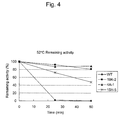
- Fig. 4 shows the results of an acceleration test for durability (performed in (4-2) above) for the 3 types of quadruple mutant formate dehydrogenase obtained in (3-1) above.
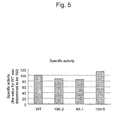
- Fig. 5 shows the results of measuring specific activity of these 3 types of quadruple mutant formate dehydrogenase and wild-type formate dehydrogenase.
- the 3 types of quadruple mutant formate dehydrogenase obtained in (3-1) above exhibited specific activity almost equivalent to that of the wild-type.
- the 3 types of quadruple mutant formate dehydrogenase obtained in (3-1) above were found to have significantly improved durability compared with the wild-type.
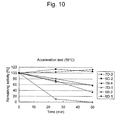
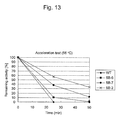
- Fig. 6 to Fig. 14 show the results of an acceleration test for durability performed for the quintuple mutant formate dehydrogenase, the hexatic mutant formate dehydrogenase, and the septuple mutant formate dehydrogenase obtained in (3-1) above and the wild-type formate dehydrogenase.
- Fig. 15 and Fig. 16 show the results of measuring the specific activity of the quintuple mutant formate dehydrogenase, the hexatic mutant formate dehydrogenase, and the septuple mutant formate dehydrogenase obtained in (3-1) above and the wild-type formate dehydrogenase.
- Fig. 15 and Fig. 16 show the results of measuring the specific activity of the quintuple mutant formate dehydrogenase, the hexatic mutant formate dehydrogenase, and the septuple mutant formate dehydrogenase obtained in (3-1) above and the wild-type formate dehydrogenase
- FIG. 16 show the results as relative values when the specific activity of the wild-type formate dehydrogenase is designated as 1. Also, Fig. 15 shows the results for mutant formate dehydrogenases that exhibited specific activity equivalent to that of the wild-type formate dehydrogenase are shown together. Also, Fig. 16 mainly shows the results of mutant formate dehydrogenases that exhibited specific activity slightly inferior to that of the wild-type formate dehydrogenase.
- mutant formate dehydrogenases denoted with plasmid names 5B-2, 5B-4, 5C-2, 6B-1, 6B-11, 6B-2, 6B-3, 6B-5, 6B-7, 6B-8, 6C-1, and 7B-3 exhibited good durability while exhibiting specific activity equivalent to that of the wild-type formate dehydrogenase.
- mutant formate dehydrogenases denoted with 5A-2, 5B-5, 6A-1, 6B-4, 6B-6, 6B-9, 6C-2, 6D-1, 7B-4, 7D-1, and 7D-2 exhibited good durability while exhibiting specific activity slightly inferior to that of the wild-type formate dehydrogenase.
- mutant formate dehydrogenases denoted with the plasmid names 5B-6, 5B-7, 6B-10, 6B-12, 7B-1, and 7B-2 exhibited higher degrees of durability than the wild-type formate dehydrogenase, although they were inferior to the above mutant formate dehydrogenases in terms of specific activity and/or durability.
Landscapes
- Chemical & Material Sciences (AREA)
- Organic Chemistry (AREA)
- Life Sciences & Earth Sciences (AREA)
- Health & Medical Sciences (AREA)
- Engineering & Computer Science (AREA)
- Zoology (AREA)
- Wood Science & Technology (AREA)
- Genetics & Genomics (AREA)
- Bioinformatics & Cheminformatics (AREA)
- General Health & Medical Sciences (AREA)
- Biochemistry (AREA)
- General Engineering & Computer Science (AREA)
- Microbiology (AREA)
- Biotechnology (AREA)
- Molecular Biology (AREA)
- General Chemical & Material Sciences (AREA)
- Chemical Kinetics & Catalysis (AREA)
- Medicinal Chemistry (AREA)
- Biomedical Technology (AREA)
- Enzymes And Modification Thereof (AREA)
- Micro-Organisms Or Cultivation Processes Thereof (AREA)
- Preparation Of Compounds By Using Micro-Organisms (AREA)
Claims (6)
- Mutierte Formiatdehydrogenase mit verbesserter Haltbarkeit im Vergleich zur Haltbarkeit einer Formiatdehydrogenase vom Wildtyp, bestehend aus der in SEQ ID NO: 2 gezeigten Aminosäuresequenz, wobei die mutierte Formiatdehydrogenase eine der folgenden Aminosäuresequenzen umfasst:A) eine Aminosäuresequenz, bei der das Valin 99 durch Isoleucin substituiert ist, das Valin 153 durch Isoleucin substituiert ist, das Histidin 155 durch Glutamin substituiert ist und das Asparagin 298 durch Tyrosin substituiert ist;B) eine Aminosäuresequenz, bei der das Glycin 73 durch Alanin substituiert ist, das Valin 99 durch Isoleucin substituiert ist, das Valin 153 durch Isoleucin substituiert ist und das Histidin 155 durch Glutamin substituiert ist; undC) eine Aminosäuresequenz, bei der das Glycin 73 durch Alanin substituiert ist, das Valin 99 durch Isoleucin substituiert ist, das Valin 153 durch Isoleucin substituiert ist und das Glutamin 159 durch Leucin substituiert ist;bei der aus der in SEQ ID NO: 2 gezeigten Aminosäuresequenz bestehenden Formiatdehydrogenase.
- Mutierte Formiatdehydrogenase nach Anspruch 1, weiterhin mit 1 bis 3 Substitutionsmutationen ausgewählt aus der Gruppe bestehend aus, bezogen auf die Aminosäuresequenz A),
einer Substitution des Isoleucin 31 durch Leucin, einer Substitution des Arginin 50 durch Glycin, einer Substitution der Glutaminsäure 60 durch Valin, einer Substitution des Isoleucin 64 durch Valin, einer Substitution des Glycin 73 durch Alanin, einer Substitution des Lysin 82 durch Arginin, einer Substitution des Isoleucin 136 durch Valin, einer Substitution des Glutamin 159 durch Leucin oder Asparagin, einer Substitution des Methionin 239 durch Leucin, einer Substitution der Asparaginsäure 286 durch Phenylalanin, einer Substitution des Histidin 287 durch Glutamin oder Prolin, einer Substitution der Gluaminsäure 293 durch Asparaginsäure und einer Substitution des Asparagin 343 durch Arginin. - Mutierte Formiatdehydrogenase nach Anspruch 1, weiterhin mit 1 bis 3 Substitutionsmutationen ausgewählt aus der Gruppe bestehend aus, bezogen auf die Aminosäuresequenz B),
einer Substitution des Isoleucin 31 durch Leucin, einer Substitution des Arginin 50 durch Glycin, einer Substitution der Glutaminsäure 60 durch Valin, einer Substitution des Isoleucin 64 durch Valin, einer Substitution des Lysin 82 durch Arginin, einer Substitution des Isoleucin 136 durch Valin, einer Substitution des Glutamin 159 durch Leucin oder Asparagin, einer Substitution des Methionins 239 durch Leucin, einer Substitution der Asparaginsäure 286 durch Phenylalanin, einer Substitution des Histidins 287 durch Glutamin oder Prolin, einer Substitution der Glutaminsäure 293 durch Asparaginsäure, einer Substitution des Asparagins 298 durch Tyrosin und einer Substitution des Asparagins 343 durch Arginin. - Mutierte Formiatdehydrogenase nach Anspruch 1, weiterhin mit 1 bis 3 Substitutionsmutationen ausgewählt aus der Gruppe bestehend aus, bezogen auf die Aminosäuresequenz C),
einer Substitution des Isoleucin 31 durch Leucin, einer Substitution des Arginin 50 durch Glycin, einer Substitution der Glutaminsäure 60 durch Valin, einer Substitution des Isoleucin 64 durch Valin, einer Substitution des Lysin 82 durch Arginin, einer Substitution des Isoleucin 136 durch Valin, einer Substitution des Histidin 155 durch Glutamin oder Lysin, einer Substitution des Methionin 239 durch Leucin, einer Substitution der Asparaginsäure 286 durch Phenylalanin, einer Substitution des Histidin 287 durch Glutamin oder Prolin, einer Substitution der Glutaminsäure 293 durch Asparaginsäure, einer Substitution des Asparagin 298 durch Tyrosin und einer Substitution des Asparagin 343 durch Arginin. - Gen, codierend für die mutierte Formiatdehydrogenase nach einem der Ansprüche 1 bis 4.
- Verfahren zur Herstellung von NADH, bei dem man die mutierte Formiatdehydrogenase nach einem der Ansprüche 1 bis 4 auf ein Ameisensäure und NAD+ enthaltendes Reaktionssystem einwirken lässt.
Applications Claiming Priority (1)
| Application Number | Priority Date | Filing Date | Title |
|---|---|---|---|
| PCT/JP2009/063743 WO2011016102A1 (ja) | 2009-08-03 | 2009-08-03 | 変異型ギ酸脱水素酵素、これをコードする遺伝子及びnadhの製造方法 |
Publications (3)
| Publication Number | Publication Date |
|---|---|
| EP2471914A1 EP2471914A1 (de) | 2012-07-04 |
| EP2471914A4 EP2471914A4 (de) | 2013-03-20 |
| EP2471914B1 true EP2471914B1 (de) | 2014-10-08 |
Family
ID=43544024
Family Applications (1)
| Application Number | Title | Priority Date | Filing Date |
|---|---|---|---|
| EP09848035.3A Not-in-force EP2471914B1 (de) | 2009-08-03 | 2009-08-03 | Mutante formiatdehydrogenase, dafür codierendes gen und verfahren zur herstellung von nadh |
Country Status (4)
| Country | Link |
|---|---|
| US (1) | US8481294B2 (de) |
| EP (1) | EP2471914B1 (de) |
| JP (1) | JP5605361B2 (de) |
| WO (1) | WO2011016102A1 (de) |
Families Citing this family (5)
| Publication number | Priority date | Publication date | Assignee | Title |
|---|---|---|---|---|
| WO2013051685A1 (ja) | 2011-10-07 | 2013-04-11 | 味の素株式会社 | 変異型γ-グルタミルトランスフェラーゼ、及び、γ-グルタミルバリルグリシン又はその塩の製造法 |
| CN104342406B (zh) * | 2013-07-26 | 2017-03-08 | 南京朗恩生物科技有限公司 | 热稳定性增强的甲酸脱氢酶突变体及其制备方法 |
| CN107109443B (zh) * | 2014-11-06 | 2021-11-02 | 庆尚大学校产学协力团 | 阿洛酮糖的制备方法 |
| CN106479988B (zh) * | 2016-11-08 | 2019-08-06 | 江南大学 | 一种酶活和稳定性提高的甲酸脱氢酶突变体及其构建方法 |
| CN117603924B (zh) * | 2023-04-25 | 2024-05-17 | 杭州力文所生物科技有限公司 | 蛋白可溶性表达提高的甲酸脱氢酶突变体及其应用 |
Family Cites Families (20)
| Publication number | Priority date | Publication date | Assignee | Title |
|---|---|---|---|---|
| JPS63313580A (ja) | 1987-06-15 | 1988-12-21 | Sagami Chem Res Center | 蟻酸脱水素酵素 |
| JPH06102019B2 (ja) | 1989-07-31 | 1994-12-14 | 工業技術院長 | ギ酸脱水素酵素及びその製造方法 |
| JPH1023896A (ja) | 1996-05-07 | 1998-01-27 | Unitika Ltd | 組換えプラスミド、それにより形質転換された大腸菌、その培養物及びそれを用いたアミノ酸又はその誘導体の製造方法 |
| DE19753350A1 (de) | 1997-12-03 | 1999-06-10 | Degussa | Neue Mutanten der Formiatdehydrogenase aus Candida boidinii, neue Gensequenzen diese codierend sowie Verwendung der neuen Formiatdehydrogenasen |
| JP2000069971A (ja) | 1998-08-28 | 2000-03-07 | Tadayuki Imanaka | 新規な耐熱性蟻酸脱水素酵素 |
| JP2000078970A (ja) | 1998-09-04 | 2000-03-21 | Unitika Ltd | ギ酸脱水素酵素及びその製造方法 |
| JP2000245471A (ja) | 1999-03-01 | 2000-09-12 | Unitika Ltd | ギ酸脱水素酵素遺伝子、それを含有する組換えベクター、その組換えベクターを含有する形質転換体及びその形質転換体を用いたギ酸脱水素酵素の製造方法 |
| JP3448609B2 (ja) | 1999-03-04 | 2003-09-22 | 奈良先端科学技術大学院大学長 | 植物の光酸化障害を回避させる方法 |
| JP2003339390A (ja) | 1999-03-04 | 2003-12-02 | Nara Institute Of Science & Technology | 蟻酸デヒドロゲナーゼポリペプチド、当該ポリペプチドをコード化するdnaフラグメント |
| AU2002224136A1 (en) | 2000-12-04 | 2002-06-18 | Kaneka Corporation | Novel formate dehydrogenase and process for producing the same |
| JP2002233395A (ja) | 2001-02-06 | 2002-08-20 | Mitsubishi Rayon Co Ltd | 補酵素nadhの再生方法 |
| DE10146589A1 (de) | 2001-09-21 | 2003-04-10 | Degussa | Neue Mutanten der Formiatdehydrogenase aus Candida boidinii |
| JP4116349B2 (ja) | 2002-07-10 | 2008-07-09 | 株式会社カネカ | 補酵素依存型を改変したギ酸脱水素酵素 |
| US20040115691A1 (en) * | 2002-07-10 | 2004-06-17 | Rozzell J. David | Mutants of enzymes and methods for their use |
| DE10327454A1 (de) | 2003-06-18 | 2005-01-20 | Juelich Enzyme Products Gmbh | Oxidoreduktase aus Pichia capsulata |
| JP2008100448A (ja) | 2006-10-20 | 2008-05-01 | Toyoda Gosei Co Ltd | ウエザストリップ |
| JP5332277B2 (ja) | 2008-04-08 | 2013-11-06 | トヨタ自動車株式会社 | Nadhの製造方法及びギ酸脱水素酵素の製造方法 |
| JP2010041971A (ja) * | 2008-08-14 | 2010-02-25 | Toyota Motor Corp | 変異型ギ酸脱水素酵素、これをコードする遺伝子及びnadhの製造方法 |
| JP5381113B2 (ja) * | 2009-01-16 | 2014-01-08 | トヨタ自動車株式会社 | 変異型ギ酸脱水素酵素、これをコードする遺伝子及びnadhの製造方法 |
| EP2447365B1 (de) * | 2009-06-15 | 2019-03-27 | Toyota Jidosha Kabushiki Kaisha | Verwendung von einer lösung für zellfreie proteinsynthese und verfahren zur zellfreien proteinsynthese |
-
2009
- 2009-08-03 EP EP09848035.3A patent/EP2471914B1/de not_active Not-in-force
- 2009-08-03 WO PCT/JP2009/063743 patent/WO2011016102A1/ja not_active Ceased
- 2009-08-03 JP JP2011525702A patent/JP5605361B2/ja not_active Expired - Fee Related
- 2009-08-03 US US13/388,943 patent/US8481294B2/en not_active Expired - Fee Related
Also Published As
| Publication number | Publication date |
|---|---|
| EP2471914A1 (de) | 2012-07-04 |
| US8481294B2 (en) | 2013-07-09 |
| WO2011016102A1 (ja) | 2011-02-10 |
| JPWO2011016102A1 (ja) | 2013-01-10 |
| EP2471914A4 (de) | 2013-03-20 |
| US20120129222A1 (en) | 2012-05-24 |
| JP5605361B2 (ja) | 2014-10-15 |
Similar Documents
| Publication | Publication Date | Title |
|---|---|---|
| CN102066552B (zh) | 细胞法产生葡糖二酸 | |
| Leimkühler et al. | Xanthine dehydrogenase from the phototrophic purple bacterium Rhodobacter capsulatus is more similar to its eukaryotic counterparts than to prokaryotic molybdenum enzymes | |
| EP2527436B1 (de) | Nadh-oxidase-mutant von erhöhter stabilität und seine verwendung | |
| CN106754775B (zh) | 一种羰基还原酶突变体及其基因与应用 | |
| Pire et al. | Heterologous overexpression of glucose dehydrogenase from the halophilic archaeon Haloferax mediterranei, an enzyme of the medium chain dehydrogenase/reductase family | |
| CA2862558A1 (en) | Novel methanol dehydrogenase enzymes from bacillus | |
| EP2471914B1 (de) | Mutante formiatdehydrogenase, dafür codierendes gen und verfahren zur herstellung von nadh | |
| Kanchanarach et al. | Characterization of thermotolerant Acetobacter pasteurianus strains and their quinoprotein alcohol dehydrogenases | |
| Brünker et al. | Cloning, nucleotide sequence and expression of a mannitol dehydrogenase gene from Pseudomonas fluorescens DSM 50106 in Escherichia coli | |
| Watanabe et al. | A novel α-ketoglutaric semialdehyde dehydrogenase: evolutionary insight into an alternative pathway of bacterial L-arabinose metabolism | |
| Watanabe et al. | α-Ketoglutaric semialdehyde dehydrogenase isozymes involved in metabolic pathways of D-glucarate, D-galactarate, and hydroxy-L-proline: molecular and metabolic convergent evolution | |
| JP2024016188A (ja) | 改変型菊酸エステラーゼ | |
| JP5867586B2 (ja) | 炭化水素合成酵素遺伝子及びその利用 | |
| Yep et al. | Determinants of substrate specificity in KdcA, a thiamin diphosphate-dependent decarboxylase | |
| Zhang et al. | Characterization of a novel type III alcohol dehydrogenase from Thermococcus barophilus Ch5 | |
| KR101721396B1 (ko) | 향상된 전환 활성을 가지는 l-아라비노스 이성화효소 변이체 및 이를 이용한 d-타가토스의 생산 방법 | |
| Fujii et al. | Novel fungal phenylpyruvate reductase belongs to d-isomer-specific 2-hydroxyacid dehydrogenase family | |
| JP5381113B2 (ja) | 変異型ギ酸脱水素酵素、これをコードする遺伝子及びnadhの製造方法 | |
| KR102362873B1 (ko) | 타카투론산 에피머화 효소 변이체 및 이를 이용한 과당으로부터 타카토스의 생산방법 | |
| WO2013002277A1 (ja) | 酵素機能改変方法及びその変異体 | |
| JP5332277B2 (ja) | Nadhの製造方法及びギ酸脱水素酵素の製造方法 | |
| JP2010041971A (ja) | 変異型ギ酸脱水素酵素、これをコードする遺伝子及びnadhの製造方法 | |
| Wang et al. | Cloning, expression and characterization of D-aminoacylase from Achromobacter xylosoxidans subsp. denitrificans ATCC 15173 | |
| Chen et al. | Molecular cloning and characterisation of a novel xanthine oxidase from Cellulosimicrobium cellulans ATCC21606 | |
| Yamada et al. | A new aldehyde oxidase catalyzing the conversion of glycolaldehyde to glycolate from Burkholderia sp. AIU 129 |
Legal Events
| Date | Code | Title | Description |
|---|---|---|---|
| PUAI | Public reference made under article 153(3) epc to a published international application that has entered the european phase |
Free format text: ORIGINAL CODE: 0009012 |
|
| 17P | Request for examination filed |
Effective date: 20120221 |
|
| AK | Designated contracting states |
Kind code of ref document: A1 Designated state(s): AT BE BG CH CY CZ DE DK EE ES FI FR GB GR HR HU IE IS IT LI LT LU LV MC MK MT NL NO PL PT RO SE SI SK SM TR |
|
| DAX | Request for extension of the european patent (deleted) | ||
| RAP1 | Party data changed (applicant data changed or rights of an application transferred) |
Owner name: TOYOTA JIDOSHA KABUSHIKI KAISHA |
|
| A4 | Supplementary search report drawn up and despatched |
Effective date: 20130220 |
|
| RIC1 | Information provided on ipc code assigned before grant |
Ipc: C12N 15/09 20060101AFI20130208BHEP Ipc: C12N 9/04 20060101ALI20130208BHEP Ipc: C12P 17/16 20060101ALI20130208BHEP |
|
| 17Q | First examination report despatched |
Effective date: 20131031 |
|
| GRAP | Despatch of communication of intention to grant a patent |
Free format text: ORIGINAL CODE: EPIDOSNIGR1 |
|
| GRAJ | Information related to disapproval of communication of intention to grant by the applicant or resumption of examination proceedings by the epo deleted |
Free format text: ORIGINAL CODE: EPIDOSDIGR1 |
|
| GRAP | Despatch of communication of intention to grant a patent |
Free format text: ORIGINAL CODE: EPIDOSNIGR1 |
|
| INTG | Intention to grant announced |
Effective date: 20140415 |
|
| INTC | Intention to grant announced (deleted) | ||
| INTG | Intention to grant announced |
Effective date: 20140430 |
|
| GRAS | Grant fee paid |
Free format text: ORIGINAL CODE: EPIDOSNIGR3 |
|
| GRAA | (expected) grant |
Free format text: ORIGINAL CODE: 0009210 |
|
| AK | Designated contracting states |
Kind code of ref document: B1 Designated state(s): AT BE BG CH CY CZ DE DK EE ES FI FR GB GR HR HU IE IS IT LI LT LU LV MC MK MT NL NO PL PT RO SE SI SK SM TR |
|
| REG | Reference to a national code |
Ref country code: GB Ref legal event code: FG4D |
|
| REG | Reference to a national code |
Ref country code: AT Ref legal event code: REF Ref document number: 690627 Country of ref document: AT Kind code of ref document: T Effective date: 20141015 Ref country code: CH Ref legal event code: EP |
|
| REG | Reference to a national code |
Ref country code: IE Ref legal event code: FG4D |
|
| REG | Reference to a national code |
Ref country code: DE Ref legal event code: R096 Ref document number: 602009027140 Country of ref document: DE Effective date: 20141120 |
|
| REG | Reference to a national code |
Ref country code: NL Ref legal event code: VDEP Effective date: 20141008 |
|
| REG | Reference to a national code |
Ref country code: AT Ref legal event code: MK05 Ref document number: 690627 Country of ref document: AT Kind code of ref document: T Effective date: 20141008 |
|
| REG | Reference to a national code |
Ref country code: LT Ref legal event code: MG4D |
|
| PG25 | Lapsed in a contracting state [announced via postgrant information from national office to epo] |
Ref country code: NL Free format text: LAPSE BECAUSE OF FAILURE TO SUBMIT A TRANSLATION OF THE DESCRIPTION OR TO PAY THE FEE WITHIN THE PRESCRIBED TIME-LIMIT Effective date: 20141008 |
|
| PG25 | Lapsed in a contracting state [announced via postgrant information from national office to epo] |
Ref country code: PT Free format text: LAPSE BECAUSE OF FAILURE TO SUBMIT A TRANSLATION OF THE DESCRIPTION OR TO PAY THE FEE WITHIN THE PRESCRIBED TIME-LIMIT Effective date: 20150209 Ref country code: ES Free format text: LAPSE BECAUSE OF FAILURE TO SUBMIT A TRANSLATION OF THE DESCRIPTION OR TO PAY THE FEE WITHIN THE PRESCRIBED TIME-LIMIT Effective date: 20141008 Ref country code: LT Free format text: LAPSE BECAUSE OF FAILURE TO SUBMIT A TRANSLATION OF THE DESCRIPTION OR TO PAY THE FEE WITHIN THE PRESCRIBED TIME-LIMIT Effective date: 20141008 Ref country code: IS Free format text: LAPSE BECAUSE OF FAILURE TO SUBMIT A TRANSLATION OF THE DESCRIPTION OR TO PAY THE FEE WITHIN THE PRESCRIBED TIME-LIMIT Effective date: 20150208 Ref country code: FI Free format text: LAPSE BECAUSE OF FAILURE TO SUBMIT A TRANSLATION OF THE DESCRIPTION OR TO PAY THE FEE WITHIN THE PRESCRIBED TIME-LIMIT Effective date: 20141008 Ref country code: NO Free format text: LAPSE BECAUSE OF FAILURE TO SUBMIT A TRANSLATION OF THE DESCRIPTION OR TO PAY THE FEE WITHIN THE PRESCRIBED TIME-LIMIT Effective date: 20150108 |
|
| PG25 | Lapsed in a contracting state [announced via postgrant information from national office to epo] |
Ref country code: GR Free format text: LAPSE BECAUSE OF FAILURE TO SUBMIT A TRANSLATION OF THE DESCRIPTION OR TO PAY THE FEE WITHIN THE PRESCRIBED TIME-LIMIT Effective date: 20150109 Ref country code: CY Free format text: LAPSE BECAUSE OF FAILURE TO SUBMIT A TRANSLATION OF THE DESCRIPTION OR TO PAY THE FEE WITHIN THE PRESCRIBED TIME-LIMIT Effective date: 20141008 Ref country code: HR Free format text: LAPSE BECAUSE OF FAILURE TO SUBMIT A TRANSLATION OF THE DESCRIPTION OR TO PAY THE FEE WITHIN THE PRESCRIBED TIME-LIMIT Effective date: 20141008 Ref country code: SE Free format text: LAPSE BECAUSE OF FAILURE TO SUBMIT A TRANSLATION OF THE DESCRIPTION OR TO PAY THE FEE WITHIN THE PRESCRIBED TIME-LIMIT Effective date: 20141008 Ref country code: LV Free format text: LAPSE BECAUSE OF FAILURE TO SUBMIT A TRANSLATION OF THE DESCRIPTION OR TO PAY THE FEE WITHIN THE PRESCRIBED TIME-LIMIT Effective date: 20141008 Ref country code: PL Free format text: LAPSE BECAUSE OF FAILURE TO SUBMIT A TRANSLATION OF THE DESCRIPTION OR TO PAY THE FEE WITHIN THE PRESCRIBED TIME-LIMIT Effective date: 20141008 Ref country code: AT Free format text: LAPSE BECAUSE OF FAILURE TO SUBMIT A TRANSLATION OF THE DESCRIPTION OR TO PAY THE FEE WITHIN THE PRESCRIBED TIME-LIMIT Effective date: 20141008 |
|
| REG | Reference to a national code |
Ref country code: DE Ref legal event code: R084 Ref document number: 602009027140 Country of ref document: DE |
|
| REG | Reference to a national code |
Ref country code: DE Ref legal event code: R097 Ref document number: 602009027140 Country of ref document: DE |
|
| PG25 | Lapsed in a contracting state [announced via postgrant information from national office to epo] |
Ref country code: SK Free format text: LAPSE BECAUSE OF FAILURE TO SUBMIT A TRANSLATION OF THE DESCRIPTION OR TO PAY THE FEE WITHIN THE PRESCRIBED TIME-LIMIT Effective date: 20141008 Ref country code: CZ Free format text: LAPSE BECAUSE OF FAILURE TO SUBMIT A TRANSLATION OF THE DESCRIPTION OR TO PAY THE FEE WITHIN THE PRESCRIBED TIME-LIMIT Effective date: 20141008 Ref country code: EE Free format text: LAPSE BECAUSE OF FAILURE TO SUBMIT A TRANSLATION OF THE DESCRIPTION OR TO PAY THE FEE WITHIN THE PRESCRIBED TIME-LIMIT Effective date: 20141008 Ref country code: RO Free format text: LAPSE BECAUSE OF FAILURE TO SUBMIT A TRANSLATION OF THE DESCRIPTION OR TO PAY THE FEE WITHIN THE PRESCRIBED TIME-LIMIT Effective date: 20141008 Ref country code: DK Free format text: LAPSE BECAUSE OF FAILURE TO SUBMIT A TRANSLATION OF THE DESCRIPTION OR TO PAY THE FEE WITHIN THE PRESCRIBED TIME-LIMIT Effective date: 20141008 |
|
| PLBE | No opposition filed within time limit |
Free format text: ORIGINAL CODE: 0009261 |
|
| STAA | Information on the status of an ep patent application or granted ep patent |
Free format text: STATUS: NO OPPOSITION FILED WITHIN TIME LIMIT |
|
| PG25 | Lapsed in a contracting state [announced via postgrant information from national office to epo] |
Ref country code: IT Free format text: LAPSE BECAUSE OF FAILURE TO SUBMIT A TRANSLATION OF THE DESCRIPTION OR TO PAY THE FEE WITHIN THE PRESCRIBED TIME-LIMIT Effective date: 20141008 |
|
| 26N | No opposition filed |
Effective date: 20150709 |
|
| PG25 | Lapsed in a contracting state [announced via postgrant information from national office to epo] |
Ref country code: SI Free format text: LAPSE BECAUSE OF FAILURE TO SUBMIT A TRANSLATION OF THE DESCRIPTION OR TO PAY THE FEE WITHIN THE PRESCRIBED TIME-LIMIT Effective date: 20141008 |
|
| PG25 | Lapsed in a contracting state [announced via postgrant information from national office to epo] |
Ref country code: MC Free format text: LAPSE BECAUSE OF FAILURE TO SUBMIT A TRANSLATION OF THE DESCRIPTION OR TO PAY THE FEE WITHIN THE PRESCRIBED TIME-LIMIT Effective date: 20141008 Ref country code: LU Free format text: LAPSE BECAUSE OF FAILURE TO SUBMIT A TRANSLATION OF THE DESCRIPTION OR TO PAY THE FEE WITHIN THE PRESCRIBED TIME-LIMIT Effective date: 20150803 |
|
| REG | Reference to a national code |
Ref country code: CH Ref legal event code: PL |
|
| GBPC | Gb: european patent ceased through non-payment of renewal fee |
Effective date: 20150803 |
|
| PG25 | Lapsed in a contracting state [announced via postgrant information from national office to epo] |
Ref country code: LI Free format text: LAPSE BECAUSE OF NON-PAYMENT OF DUE FEES Effective date: 20150831 Ref country code: CH Free format text: LAPSE BECAUSE OF NON-PAYMENT OF DUE FEES Effective date: 20150831 |
|
| REG | Reference to a national code |
Ref country code: IE Ref legal event code: MM4A |
|
| REG | Reference to a national code |
Ref country code: FR Ref legal event code: ST Effective date: 20160429 |
|
| PG25 | Lapsed in a contracting state [announced via postgrant information from national office to epo] |
Ref country code: GB Free format text: LAPSE BECAUSE OF NON-PAYMENT OF DUE FEES Effective date: 20150803 Ref country code: IE Free format text: LAPSE BECAUSE OF NON-PAYMENT OF DUE FEES Effective date: 20150803 |
|
| PG25 | Lapsed in a contracting state [announced via postgrant information from national office to epo] |
Ref country code: FR Free format text: LAPSE BECAUSE OF NON-PAYMENT OF DUE FEES Effective date: 20150831 |
|
| PG25 | Lapsed in a contracting state [announced via postgrant information from national office to epo] |
Ref country code: MT Free format text: LAPSE BECAUSE OF FAILURE TO SUBMIT A TRANSLATION OF THE DESCRIPTION OR TO PAY THE FEE WITHIN THE PRESCRIBED TIME-LIMIT Effective date: 20141008 |
|
| PG25 | Lapsed in a contracting state [announced via postgrant information from national office to epo] |
Ref country code: SM Free format text: LAPSE BECAUSE OF FAILURE TO SUBMIT A TRANSLATION OF THE DESCRIPTION OR TO PAY THE FEE WITHIN THE PRESCRIBED TIME-LIMIT Effective date: 20141008 Ref country code: BG Free format text: LAPSE BECAUSE OF FAILURE TO SUBMIT A TRANSLATION OF THE DESCRIPTION OR TO PAY THE FEE WITHIN THE PRESCRIBED TIME-LIMIT Effective date: 20141008 Ref country code: HU Free format text: LAPSE BECAUSE OF FAILURE TO SUBMIT A TRANSLATION OF THE DESCRIPTION OR TO PAY THE FEE WITHIN THE PRESCRIBED TIME-LIMIT; INVALID AB INITIO Effective date: 20090803 |
|
| PG25 | Lapsed in a contracting state [announced via postgrant information from national office to epo] |
Ref country code: TR Free format text: LAPSE BECAUSE OF FAILURE TO SUBMIT A TRANSLATION OF THE DESCRIPTION OR TO PAY THE FEE WITHIN THE PRESCRIBED TIME-LIMIT Effective date: 20141008 |
|
| PG25 | Lapsed in a contracting state [announced via postgrant information from national office to epo] |
Ref country code: BE Free format text: LAPSE BECAUSE OF FAILURE TO SUBMIT A TRANSLATION OF THE DESCRIPTION OR TO PAY THE FEE WITHIN THE PRESCRIBED TIME-LIMIT Effective date: 20141008 |
|
| PG25 | Lapsed in a contracting state [announced via postgrant information from national office to epo] |
Ref country code: MK Free format text: LAPSE BECAUSE OF FAILURE TO SUBMIT A TRANSLATION OF THE DESCRIPTION OR TO PAY THE FEE WITHIN THE PRESCRIBED TIME-LIMIT Effective date: 20141008 |
|
| REG | Reference to a national code |
Ref country code: DE Ref legal event code: R082 Ref document number: 602009027140 Country of ref document: DE Representative=s name: D YOUNG & CO LLP, DE |
|
| PGFP | Annual fee paid to national office [announced via postgrant information from national office to epo] |
Ref country code: DE Payment date: 20210630 Year of fee payment: 13 |
|
| REG | Reference to a national code |
Ref country code: DE Ref legal event code: R119 Ref document number: 602009027140 Country of ref document: DE |
|
| PG25 | Lapsed in a contracting state [announced via postgrant information from national office to epo] |
Ref country code: DE Free format text: LAPSE BECAUSE OF NON-PAYMENT OF DUE FEES Effective date: 20230301 |