EP2472570A2 - Mémoires non volatiles avec grilles flottantes façonnées - Google Patents
Mémoires non volatiles avec grilles flottantes façonnées Download PDFInfo
- Publication number
- EP2472570A2 EP2472570A2 EP12162688A EP12162688A EP2472570A2 EP 2472570 A2 EP2472570 A2 EP 2472570A2 EP 12162688 A EP12162688 A EP 12162688A EP 12162688 A EP12162688 A EP 12162688A EP 2472570 A2 EP2472570 A2 EP 2472570A2
- Authority
- EP
- European Patent Office
- Prior art keywords
- floating gates
- along
- cross
- orientation
- floating
- Prior art date
- Legal status (The legal status is an assumption and is not a legal conclusion. Google has not performed a legal analysis and makes no representation as to the accuracy of the status listed.)
- Withdrawn
Links
- 230000015654 memory Effects 0.000 title claims abstract description 75
- 238000000034 method Methods 0.000 claims description 27
- 230000008569 process Effects 0.000 claims description 10
- 238000002955 isolation Methods 0.000 claims description 5
- 239000010410 layer Substances 0.000 description 88
- 230000000873 masking effect Effects 0.000 description 36
- 230000008878 coupling Effects 0.000 description 18
- 238000010168 coupling process Methods 0.000 description 18
- 238000005859 coupling reaction Methods 0.000 description 18
- 238000005530 etching Methods 0.000 description 18
- 239000000758 substrate Substances 0.000 description 18
- 229910021420 polycrystalline silicon Inorganic materials 0.000 description 13
- 229920005591 polysilicon Polymers 0.000 description 13
- 230000006870 function Effects 0.000 description 12
- 239000003989 dielectric material Substances 0.000 description 8
- VYPSYNLAJGMNEJ-UHFFFAOYSA-N Silicium dioxide Chemical compound O=[Si]=O VYPSYNLAJGMNEJ-UHFFFAOYSA-N 0.000 description 6
- XUIMIQQOPSSXEZ-UHFFFAOYSA-N Silicon Chemical compound [Si] XUIMIQQOPSSXEZ-UHFFFAOYSA-N 0.000 description 5
- 238000013459 approach Methods 0.000 description 5
- 230000009467 reduction Effects 0.000 description 5
- 229910052710 silicon Inorganic materials 0.000 description 5
- 239000010703 silicon Substances 0.000 description 5
- 238000009792 diffusion process Methods 0.000 description 4
- 230000015572 biosynthetic process Effects 0.000 description 3
- 238000004519 manufacturing process Methods 0.000 description 3
- 239000000463 material Substances 0.000 description 3
- 229910052751 metal Inorganic materials 0.000 description 3
- 239000002184 metal Substances 0.000 description 3
- 235000012239 silicon dioxide Nutrition 0.000 description 3
- 239000000377 silicon dioxide Substances 0.000 description 3
- 238000003860 storage Methods 0.000 description 3
- 238000003491 array Methods 0.000 description 2
- 238000005229 chemical vapour deposition Methods 0.000 description 2
- 239000004020 conductor Substances 0.000 description 2
- 238000000151 deposition Methods 0.000 description 2
- 230000008021 deposition Effects 0.000 description 2
- 238000000059 patterning Methods 0.000 description 2
- 238000005498 polishing Methods 0.000 description 2
- 238000012545 processing Methods 0.000 description 2
- 229910021332 silicide Inorganic materials 0.000 description 2
- FVBUAEGBCNSCDD-UHFFFAOYSA-N silicide(4-) Chemical compound [Si-4] FVBUAEGBCNSCDD-UHFFFAOYSA-N 0.000 description 2
- 239000000126 substance Substances 0.000 description 2
- 229910052721 tungsten Inorganic materials 0.000 description 2
- 239000010937 tungsten Substances 0.000 description 2
- 229910052581 Si3N4 Inorganic materials 0.000 description 1
- 230000004888 barrier function Effects 0.000 description 1
- 230000008901 benefit Effects 0.000 description 1
- 239000003990 capacitor Substances 0.000 description 1
- 238000000576 coating method Methods 0.000 description 1
- 229910017052 cobalt Inorganic materials 0.000 description 1
- 239000010941 cobalt Substances 0.000 description 1
- GUTLYIVDDKVIGB-UHFFFAOYSA-N cobalt atom Chemical compound [Co] GUTLYIVDDKVIGB-UHFFFAOYSA-N 0.000 description 1
- 230000000295 complement effect Effects 0.000 description 1
- 150000001875 compounds Chemical class 0.000 description 1
- 230000007547 defect Effects 0.000 description 1
- 230000001419 dependent effect Effects 0.000 description 1
- 238000010586 diagram Methods 0.000 description 1
- 230000009977 dual effect Effects 0.000 description 1
- 230000000694 effects Effects 0.000 description 1
- 230000005684 electric field Effects 0.000 description 1
- 239000012535 impurity Substances 0.000 description 1
- 150000002739 metals Chemical class 0.000 description 1
- 230000004048 modification Effects 0.000 description 1
- 238000012986 modification Methods 0.000 description 1
- RUFLMLWJRZAWLJ-UHFFFAOYSA-N nickel silicide Chemical compound [Ni]=[Si]=[Ni] RUFLMLWJRZAWLJ-UHFFFAOYSA-N 0.000 description 1
- 229910021334 nickel silicide Inorganic materials 0.000 description 1
- 230000003647 oxidation Effects 0.000 description 1
- 238000007254 oxidation reaction Methods 0.000 description 1
- 230000003071 parasitic effect Effects 0.000 description 1
- 230000003252 repetitive effect Effects 0.000 description 1
- 238000007493 shaping process Methods 0.000 description 1
- HQVNEWCFYHHQES-UHFFFAOYSA-N silicon nitride Chemical compound N12[Si]34N5[Si]62N3[Si]51N64 HQVNEWCFYHHQES-UHFFFAOYSA-N 0.000 description 1
- 239000002356 single layer Substances 0.000 description 1
- 238000012546 transfer Methods 0.000 description 1
- WFKWXMTUELFFGS-UHFFFAOYSA-N tungsten Chemical compound [W] WFKWXMTUELFFGS-UHFFFAOYSA-N 0.000 description 1
- WQJQOUPTWCFRMM-UHFFFAOYSA-N tungsten disilicide Chemical compound [Si]#[W]#[Si] WQJQOUPTWCFRMM-UHFFFAOYSA-N 0.000 description 1
- -1 tungsten nitride Chemical class 0.000 description 1
- 229910021342 tungsten silicide Inorganic materials 0.000 description 1
Images






Classifications
-
- H—ELECTRICITY
- H10—SEMICONDUCTOR DEVICES; ELECTRIC SOLID-STATE DEVICES NOT OTHERWISE PROVIDED FOR
- H10B—ELECTRONIC MEMORY DEVICES
- H10B41/00—Electrically erasable-and-programmable ROM [EEPROM] devices comprising floating gates
- H10B41/30—Electrically erasable-and-programmable ROM [EEPROM] devices comprising floating gates characterised by the memory core region
-
- H—ELECTRICITY
- H10—SEMICONDUCTOR DEVICES; ELECTRIC SOLID-STATE DEVICES NOT OTHERWISE PROVIDED FOR
- H10B—ELECTRONIC MEMORY DEVICES
- H10B41/00—Electrically erasable-and-programmable ROM [EEPROM] devices comprising floating gates
- H10B41/30—Electrically erasable-and-programmable ROM [EEPROM] devices comprising floating gates characterised by the memory core region
- H10B41/35—Electrically erasable-and-programmable ROM [EEPROM] devices comprising floating gates characterised by the memory core region with a cell select transistor, e.g. NAND
-
- H—ELECTRICITY
- H10—SEMICONDUCTOR DEVICES; ELECTRIC SOLID-STATE DEVICES NOT OTHERWISE PROVIDED FOR
- H10D—INORGANIC ELECTRIC SEMICONDUCTOR DEVICES
- H10D30/00—Field-effect transistors [FET]
- H10D30/01—Manufacture or treatment
- H10D30/021—Manufacture or treatment of FETs having insulated gates [IGFET]
- H10D30/0411—Manufacture or treatment of FETs having insulated gates [IGFET] of FETs having floating gates
-
- H—ELECTRICITY
- H10—SEMICONDUCTOR DEVICES; ELECTRIC SOLID-STATE DEVICES NOT OTHERWISE PROVIDED FOR
- H10D—INORGANIC ELECTRIC SEMICONDUCTOR DEVICES
- H10D30/00—Field-effect transistors [FET]
- H10D30/60—Insulated-gate field-effect transistors [IGFET]
- H10D30/68—Floating-gate IGFETs
-
- H—ELECTRICITY
- H10—SEMICONDUCTOR DEVICES; ELECTRIC SOLID-STATE DEVICES NOT OTHERWISE PROVIDED FOR
- H10D—INORGANIC ELECTRIC SEMICONDUCTOR DEVICES
- H10D30/00—Field-effect transistors [FET]
- H10D30/60—Insulated-gate field-effect transistors [IGFET]
- H10D30/68—Floating-gate IGFETs
- H10D30/6891—Floating-gate IGFETs characterised by the shapes, relative sizes or dispositions of the floating gate electrode
-
- H—ELECTRICITY
- H10—SEMICONDUCTOR DEVICES; ELECTRIC SOLID-STATE DEVICES NOT OTHERWISE PROVIDED FOR
- H10D—INORGANIC ELECTRIC SEMICONDUCTOR DEVICES
- H10D64/00—Electrodes of devices having potential barriers
- H10D64/01—Manufacture or treatment
- H10D64/031—Manufacture or treatment of data-storage electrodes
- H10D64/035—Manufacture or treatment of data-storage electrodes comprising conductor-insulator-conductor-insulator-semiconductor structures
Definitions
- the present application relates to nonvolatile memories and methods of forming nonvolatile memories.
- this application relates to shaping of floating gates and different arrangements of shaped floating gates in nonvolatile memories.
- a NAND array a series of strings of more than two memory cells, such as 16 or 32, are connected to one another such that the source of one is also the drain of the other in order to form columns of cells.
- each NAND string consisting of, for example, 32 floating gate memory cells in series is terminated by two select transistors, one at each end of the string.
- the drain side select transistor's source diffusion is the same as drain of the last cell on the string.
- the drain of the drain side select transistor is connected to a global bit line.
- Global bit lines extend in a perpendicular orientation with respect to the word lines.
- Each NAND string resides under a particular bit line that provides access to it.
- a global bit line may span many thousands of NAND strings.
- the source side diffusion of the first floating gate transistor in the NAND string is the same as the drain of the source side select transistor.
- the source of the source side select transistor is typically connected to a shared line that runs parallel to the word lines.
- Word lines extend across cells spanning a large number of these columns. An individual cell within a column is read and verified during programming by causing the remaining cells in the string to be over driven so that the current flowing through a string is dependent upon the level of charge stored in the addressed cell.
- An example of a NAND architecture array and its operation as part of a memory system is found in United States Patent No. 6,046,935 .
- the floating gate of the cell is positioned over one portion of the channel and the word line (also referred to as a control gate) is positioned over the other channel portion as well as over the floating gate.
- the word line also referred to as a control gate
- the word line extends over a row of floating gates. Examples of such cells, their uses in memory systems and methods of manufacturing them arc given in United States Patent Nos. 5,070,032 , 5,095,344 , 5,315,541 , 5,343,063 , 5,661,053 , and 6,281,075 .
- a modification of this split-channel flash EEPROM cell adds a steering gate positioned between the floating gate and the word line.
- Each steering gate of an array extends over one column of floating gates, perpendicular to the word line. The effect is to relieve the word line from having to perform two functions at the same time when reading or programming a selected cell. Those two functions are (1) to serve as a gate of a select transistor, thus requiring a proper voltage to turn the select transistor on and off, and (2) to drive the voltage of the floating gate to a desired level through an electric field (capacitive) coupling between the word line and the floating gate. It is often difficult to perform both of these functions in an optimum manner with a single voltage.
- the word line need only perform function (1), while the added steering gate performs function (2).
- the use of steering gates in a flash EEPROM array is described, for example, in United States Patent Nos. 5,313,421 and 6,222,762 .
- the floating gate of a cell is programmed by injecting electrons from the substrate to the floating gate. This is accomplished by having the proper doping in the channel region and applying the proper voltages to the source, drain and remaining gate(s).
- Two techniques for removing charge from floating gates to erase memory cells are used in the three types of memory cell arrays described above.
- One is to erase to the substrate by applying appropriate voltages to the source, drain and other gate(s) that cause electrons to tunnel through a portion of a dielectric layer between the floating gate and the substrate.
- the other erase technique is to transfer electrons from the floating gate to another gate through a tunnel dielectric layer positioned between them.
- a third erase gate is provided for that purpose.
- the floating gate is erased to the word line, without the necessity to add a fourth gate.
- flash EEPROM systems As in most all integrated circuit applications, the pressure to shrink the silicon substrate area required to implement some integrated circuit function also exists with flash EEPROM systems. It is continually desired to increase the amount of digital data that can be stored in a given area of a silicon substrate, in order to increase the storage capacity of a given size memory card and other types of packages, or to both increase capacity and decrease size.
- One way to increase the storage density of data is to store more than one bit of data per memory cell. This is accomplished by dividing a window of a floating gate charge level voltage range into more than two states. The use of four such states allows each cell to store two bits of data, eight states stores three bits of data per cell, and so on.
- a multiple state flash EEPROM structure and operation is described in United States Patent Nos. 5,043,940 and 5,172,338 .
- Increased data density can also be achieved by reducing the physical size of the memory cells and/or the overall array.
- Shrinking the size of integrated circuits is commonly performed for all types of circuits as processing techniques improve over time to permit implementing smaller feature sizes. But there are usually limits of how far a given circuit layout can be shrunk in this manner, since there is often at least one feature that is limited as to how much it can be shrunk, thus limiting the amount that the overall layout can be shrunk. When this happens, designers will turn to a new or different layout or architecture of the circuit being implemented in order to reduce the amount of silicon area required to perform its functions. The shrinking of the above-described flash EEPROM integrated circuit systems can reach similar limits.
- Another flash EEPROM architecture utilizes a dual floating gate memory cell along with the storage of multiple states on each floating gate.
- two floating gates are included over its channel between source and drain diffusions with a select transistor in between them.
- a steering gate is included along each column of floating gates and a word line is provided thereover along each row of floating gates.
- the amount of current flowing through the cell is then a function of the amount of charge on the floating gate of interest but not of the other floating gate in the same cell. Examples of this cell array architecture and operating techniques are described in United States Patent Nos. 5,712,180 , 6,103,573 and 6,151,248 .
- the amount of field coupling between the floating gates and the control gates passing over them is carefully controlled.
- the amount of coupling determines the percentage of a voltage placed on the control gate that is coupled to its floating gates.
- the percentage coupling is determined by a number of factors including the amount of surface area of the floating gate that overlaps a surface of the control gate. It is often desired to maximize the percentage coupling between the floating and control gates by maximizing the amount of overlapping area.
- Yuan et al in United States Patent No. 5,343,063 .
- the approach described in that patent is to make the floating gates thicker than usual to provide large vertical surfaces that may be coupled with the control gates.
- Another approach that increases area coupling a floating gate and a control gate is described by Yuan in United States Patent No. 6,908,817 .
- a floating gate that is L-shaped in cross section along the word line direction presents an L-shaped facet to an adjacent floating gate in the bit line direction.
- two neighboring floating gates that reside on two neighboring word lines will present L-shaped facets to one another.
- the L-shaped facet may have less area than a conventional rectangular floating gate, while maintaining the same (or better) coupling between the floating gate and the overlying word line.
- the parasitic coupling between two neighboring floating gates that reside on two neighboring word lines may be reduced further than the facet area reduction alone would indicate.
- an L-shaped floating gate may substantially reduce the distance of the furthest points on the L-shaped facets from their own control gate, allowing these distances to become smaller than the floating gate to floating gate distance, and thereby reducing the floating gate to floating gate capacitance beyond the reduction provided by facet area reduction. More field lines emanating from the L-shape facet can now turn and terminate on their own control gate rather than extending across and terminating on the adjacent floating gate that resides below a neighboring word line. All the floating gates along a NAND string of floating gate memory cells may have the same orientation in one embodiment. In another embodiment, floating gates along a string are L-shaped with alternating orientations.
- Floating gates alternate between having an L-orientation and a reverse-L-orientation.
- One advantage of such alternating orientations is that opposing facets of adjacent floating gates in the bit line direction have reduced capacitive coupling.
- orientations of L-shaped floating gates alternate along the word line direction. This may be in addition to alternating along the bit line direction.
- other asymmetrical shapes of floating gates may be formed and arranged to have alternating orientations.
- a gate dielectric layer is formed over a surface of a substrate and a first conductive layer is formed over the gate dielectric layer.
- a masking layer is formed over the first conductive layer and a resist layer is formed over the masking layer.
- the resist layer is patterned and the pattern transferred to the masking layer, forming masking portions.
- These masking portions are then used to form STI structures extending in the y-direction.
- STI structures divide the first conductive layer into first conductive portions.
- Masking portions are then replaced by second conductive portions. The first and second conductive portions are in contact and form electrically continuous conductive portions that extend in the y-direction.
- These conductive portions may be formed into L-shaped floating gates by partially etching them using a patterned etch mask. Different etch masks may be used depending on the desired orientations of L-shaped floating gates. Partial etching causes areas of conductive portions to be partially etched in a vertical direction. Etched areas extend along a sidewall of an STI structure, leaving a narrowed conductive portion that extends along a sidewall of an adjacent STI structure. Subsequently, the etch mask is removed and STI structures are etched back. Then a dielectric layer or a combination of dielectric layers is deposited and a conductive layer is deposited over the dielectric layer(s). Separate word lines are formed from the conductive layer and conductive portions are separated into separate floating gates in the same etch step so that these features are self-aligned.
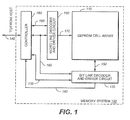
- FIG. 1 An example of a memory system 100 incorporating various aspects of the present invention is generally illustrated in the block diagram of Figure 1 .
- a large number of individually addressable memory cells are arranged in a regular array 110 of rows and columns, although other physical arrangements of cells are certainly possible.
- Bit lines designated herein to extend along columns of the array 110 of cells, are electrically connected with a bit line decoder and driver circuit 130 through lines 150.
- Word lines which are designated in this description to extend along rows of the array 110 of cells, are electrically connected through lines 170 to a word line decoder and driver circuit 190.
- Each of the decoders 130 and 190 receives memory cell addresses over a bus 160 from a memory controller 180.
- the decoder and driving circuits are also connected to the controller 180 over respective control and status signal lines 135 and 195.
- the controller 180 is connectable through lines 140 to a host device (not shown).
- the host may be a personal computer, notebook computer, digital camera, audio player, various other hand held electronic devices, and the like.
- the memory system 100 of Figure 1 will commonly be implemented as a removable memory, such as a card, according to one of several existing physical and electrical standards, such as one from the PCMCIA, the CompactFlashTM Association, the MMCTM Association, and others.
- the lines 140 terminate in a connector on the card that interfaces with a complementary connector of the host device.
- the electrical interface of many cards follows the ATA standard, wherein the memory system appears to the host as if it was a magnetic disk drive. Other memory card interface standards also exist.
- a memory system of the type shown in Figure 1 may be permanently embedded in the host device.
- the decoder and driver circuits 130 and 190 generate appropriate voltages in their respective lines of the array 110, as addressed over the bus 160, according to control signals in respective control and status lines 135 and 195, to execute programming, reading and erasing functions. Any status signals, including voltage levels and other array parameters, are provided by the array 110 to the controller 180 over the same control and status lines 135 and 195.
- a plurality of sense amplifiers within the circuit 130 receive current or voltage levels that are indicative of the states of addressed memory cells within the array 110, and provides the controller 180 with information about those states over lines 145 during a read operation.
- a large number of sense amplifiers are usually used in order to be able to read the states of a large number of memory cells in parallel.
- one row of cells is typically addressed at a time through the circuits 190 for accessing a number of cells in the addressed row that are selected by the circuit 130.
- all cells in each of many rows are typically addressed together as a block for simultaneous erasure.
- FIG. 2 A plan view of an example of a NAND memory cell array 110 formed on a silicon substrate is shown in Figure 2 , wherein a small part of its repetitive structure of conductive elements is illustrated with little detail of dielectric layers that exist between the elements, for clarity of explanation.
- Shallow Trench Isolation (STI) structures 210a-d arc formed extending through the surface of the substrate.
- the STI structures are shown to be spaced apart in a first direction (x-direction), with lengths extending in a second direction (y-direction), these first and second directions being essentially orthogonal with each other.
- each string 220a-c includes many memory devices connected in series.
- Figure 2 shows portions of three such strings 220a-c with three memory cells shown for each string.
- strings 220a-c contain additional cells that are not shown in Figure 2 .
- the array 110 contains additional strings that are not represented in Figure 2 . This type of array may have thousands of strings with 16, 32 or more cells in each string.
- An exemplary memory cell 224 includes a floating gate 230 and conductive source/drain regions 240a-b in the substrate adjacent to floating gate 230, on either side in the y-direction.
- STI structures 210b, 210c form isolating elements that electrically isolate source/drain regions 240a, 240b from source/drain and channel regions of cells in adjacent strings 220a, 220c.
- Source/drain regions, including source/drain regions 240a, 240b electrically connect one cell to the next cell thus forming a string 220b.
- the source/drain regions 240a, 240b in this example are formed by implanting impurities into the substrate in the required areas.
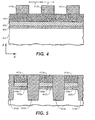
- Figure 4 shows a cross sectional view of the nonvolatile memory array of Figure 2 , along the x-direction, at an earlier stage of fabrication.
- the cross section of Figure 4 is indicated by I-I in Figure 2 .
- Figure 4 shows a gate dielectric layer 405 extending over substrate 407 and a first conductive layer 409 extending over gate dielectric layer 405.
- gate dielectric layer 405 is formed of Silicon Dioxide that is grown by oxidation of the Silicon surface of substrate 407.
- first conductive layer 409 may be formed of polysilicon by Chemical Vapor Deposition (CVD) or otherwise.
- a masking layer 411 of dielectric (Silicon Nitride in this example) extends over first conductive layer 409.
- the masking layer can be composed of one or more conductive materials such as doped polysilicon.
- Gate dielectric 405, first conductive layer 409 and masking layer 411 may all be formed as blanket layers that extend over the entire substrate 407.
- Resist portions 413a-c overlie masking layer 411.
- Resist portions 413a-c are formed according to a pattern that is lithographically established. In this case, resist portions 413a-c have a dimension in the x-direction that is equal to the minimum feature size (F) of the lithographic process used to form them. Resist portions 413a-c are also spaced apart in the x-direction a distance equal to F.
- resist portions may have an x-dimension that is greater than F, or using resist slimming or other techniques, may have an x-dimension that is less than F.
- Resist portions 413a-c extend in the y-direction (perpendicular to the view of Figure 4 ). The pattern established by resist portions 413a-c is used to pattern masking layer 411 into masking portions, which in turn are used as an etch mask to form STI structures.
- Figure 5 shows the structure of Figure 4 , in the same view, after formation of the masking portions 411a-c from masking layer 411 and formation of STI structures 515a-d.
- Masking portions 411a-c are formed by etching masking layer 411 with resist portions 413a-c in place so that the pattern of resist portions 413a-c is transferred to masking layer 411. Then, masking portions 411a-c are used as a mask for subsequent etching of the first conductive layer 409, gate dielectric layer 405 and underlying substrate 407 to form STI trenches. In etching through the first conductive layer 409, first conductive layer 409 is divided up into first conductive portions 409a-c that extend as strips in the y-direction.
- Gate dielectric layer 405 is similarly divided into dielectric portions 405a-c. Because first conductive portions 409a-c are formed by the same step that forms STI trenches, these features are self-aligned. STI trenches are filled with dielectric or dielectrics (deposited Silicon Dioxide in this example) to form STI structures 515a-d. At least one dielectric material may be deposited so that it fills STI trenches and covers masking portions 411a-c and may then be planarized, for example, by utilizing chemical/mechanical polishing so that any dielectric material overlying masking portions 411a-c is removed.
- dielectric or dielectrics deposited Silicon Dioxide in this example
- Second conductive portions 617a-c may be formed of polysilicon. Polysilicon may be deposited as a blanket layer and then planarized so that any polysilicon overlying STI structures 515a-d is removed. A first conductive potion 409a and a second conductive portion 617a may be considered to form a single conductive portion 618a. Conductive portions 618b and 618c are similarly formed from first and second portions. In a first embodiment, shown in Figure 6A , the entire volume previously occupied by a masking portion is filled with polysilicon. Alternatively, if masking portions 411a-c are conductive, this replacement step is unnecessary as masking portions 411 a-c form second conductive portions.
- a polysilicon layer is deposited that does not fill the entire volume previously occupied by a masking portion.
- An additional dielectric layer is added over the polysilicon layer and then planarization is performed.
- the thickness X2 of second conductive portions 619a-c may be made smaller and thickness X2 may be carefully controlled.
- Second conductive portions 619a-c directly overlie first conductive portions 409a-c and are in electrical contact with first conductive portions 449a-c. Therefore, a second conductive portion 619a and the first conductive portion 409a over which it lies may be considered as a single conductive portion 621a.
- Conductive portions 621b and 621c are similarly formed of first and second portions. In either embodiment, after planarization, masking portions are formed over the planarized surface of second conductive portions and STI structures.
- Figure 7A shows the structure of Figure 6A with masking portions 723a-c extending over STI structures 515a-d and over conductive portions 618a-c.
- a masking layer may be formed of resist that is deposited as a blanket layer and subsequently patterned to form masking portions 723a-c.
- the resist layer is simply patterned into a series of elongated portions that extend in the y-direction and that have a width of F (other patterns will be discussed later).
- Masking portions 723a-c are located so that an individual resist portion 723a partially overlies an STI structure 515a and partially overlies a conductive portion 618a.
- resist portions 723a-c are used as an etch mask to etch conductive portions 618a-c as shown.
- Anisotropic etching is used to etch in a vertical direction and the etch chemistry is selective to polysilicon so that STI structures 515a-d are not substantially etched.
- Etching may stop at the interface between first conductive portions 409a-c and second conductive portions 617a-c or at some other level. Etching may extend into first conductive portions 409a-c, or may stop at some level above first conductive portions 409a-c.
- An additional wet etch may be performed after the anisotropic etch.
- the optional wet etch may serve to further narrow the vertical and the horizontal dimensions of the L-shaped conductive portions 618a-c.
- an optional step consisting of a partial or a complete fill may be performed to fill volumes created by etching with dielectric material.
- the filling material can then be planarized to remove excess filling material that extends above the conductive portions.
- the dielectric filling and subsequent planarization may not be necessary.
- an etchback of dielectric material including STI structures 515a-d is performed. This etchback is selective to dielectric over polysilicon and may be an anisotropic dry etch. In some cases this selectivity makes the filling with dielectric filling material and subsequent planarization unnecessary.
- any remaining dielectric material 725 that was deposited over conductive portion 621a may be removed by the etchback step as shown in Figure 8B .
- this thickness, X2 is not determined by alignment and may be more tightly controlled than a dimension determined by alignment.
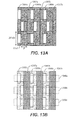
- Figure 11 shows an arrangement of floating gates of three adjacent rows 1141a-c according to another embodiment of the present invention. All floating gates are L-shaped as before. However, floating gates of one row have one orientation and floating gates of an adjacent row have an opposite orientation. Floating gates of row 1141b can be considered to have an L orientation, while floating gates of adjacent rows 1141a, 1141c can be considered to have a reverse-L orientation. This arrangement reduces coupling between the upper portions of floating gates of different rows. Opposing floating gates of adjacent rows have opposite orientations so that upper portions are not directly opposing each other. For example, upper portions 1143a and 1143b do not directly oppose each other. This reduces capacitive coupling between these parts of the floating gates.
- the orientation of floating gates alternates from one row to the next with all the floating gates of a particular row having the same orientation.
- even numbered rows may have floating gates with a first orientation and odd numbered rows may have floating gates with the opposite orientation.
- Such an arrangement is not limited to floating gates that are L-shaped, but may be applied to floating gates having any asymmetric shape in cross section along the x-direction.
- floating gates may have a triangular shape in cross section along the x-direction.
- Floating gates with the arrangement shown in Figure 11 may be formed in a similar manner to those of Figure 10 described above, but with some differences in the pattern used for etching conductive portions to form L-shaped cross sectional profiles.
- FIG 14 shows another alternative arrangement of floating gates according to another embodiment of the present invention.
- floating gates are L-shaped in cross section along the x-direction.
- a floating gate of one row 1461b has the opposite orientation to opposing floating gates of adjacent rows 1461a, 1461c.
- floating gates alternate in their orientation along a row such as row 1461b.
- alternate floating gates along a row have a first orientation (L-orientation) while remaining alternate floating gates along the row have a second orientation (reverse-L orientation).
- floating gates may have alternating orientations along a row but not along a column.
- all the floating gates in a particular column may have the same orientation, but floating gates of neighboring columns have a different orientation.
- Such floating gates may be formed using a resist pattern that consists of strips running in the column direction to partially overlie conductive portions on either side of an STI structure.
Landscapes
- Non-Volatile Memory (AREA)
- Semiconductor Memories (AREA)
Applications Claiming Priority (3)
| Application Number | Priority Date | Filing Date | Title |
|---|---|---|---|
| US11/465,038 US7494860B2 (en) | 2006-08-16 | 2006-08-16 | Methods of forming nonvolatile memories with L-shaped floating gates |
| US11/465,025 US7755132B2 (en) | 2006-08-16 | 2006-08-16 | Nonvolatile memories with shaped floating gates |
| EP07799975A EP2054925A2 (fr) | 2006-08-16 | 2007-08-02 | Mémoires non volatiles avec grilles flottantes façonnées |
Related Parent Applications (1)
| Application Number | Title | Priority Date | Filing Date |
|---|---|---|---|
| EP07799975.3 Division | 2007-08-02 |
Publications (2)
| Publication Number | Publication Date |
|---|---|
| EP2472570A2 true EP2472570A2 (fr) | 2012-07-04 |
| EP2472570A3 EP2472570A3 (fr) | 2013-07-17 |
Family
ID=38739493
Family Applications (2)
| Application Number | Title | Priority Date | Filing Date |
|---|---|---|---|
| EP12162688.1A Withdrawn EP2472570A3 (fr) | 2006-08-16 | 2007-08-02 | Mémoires non volatiles avec grilles flottantes façonnées |
| EP07799975A Withdrawn EP2054925A2 (fr) | 2006-08-16 | 2007-08-02 | Mémoires non volatiles avec grilles flottantes façonnées |
Family Applications After (1)
| Application Number | Title | Priority Date | Filing Date |
|---|---|---|---|
| EP07799975A Withdrawn EP2054925A2 (fr) | 2006-08-16 | 2007-08-02 | Mémoires non volatiles avec grilles flottantes façonnées |
Country Status (5)
| Country | Link |
|---|---|
| EP (2) | EP2472570A3 (fr) |
| JP (1) | JP5178721B2 (fr) |
| KR (2) | KR20120041806A (fr) |
| TW (1) | TWI356472B (fr) |
| WO (1) | WO2008021736A2 (fr) |
Cited By (1)
| Publication number | Priority date | Publication date | Assignee | Title |
|---|---|---|---|---|
| CN102938406A (zh) * | 2012-11-21 | 2013-02-20 | 上海宏力半导体制造有限公司 | 分栅式闪存及其形成方法 |
Families Citing this family (4)
| Publication number | Priority date | Publication date | Assignee | Title |
|---|---|---|---|---|
| JP5091504B2 (ja) * | 2007-02-28 | 2012-12-05 | 株式会社東芝 | 半導体記憶装置 |
| JP4929300B2 (ja) * | 2009-02-25 | 2012-05-09 | 株式会社東芝 | マルチドットフラッシュメモリ及びその製造方法 |
| CN102969346B (zh) * | 2011-08-31 | 2016-08-10 | 硅存储技术公司 | 具有带改进耦合比的浮栅和耦合栅的非易失性存储器单元 |
| US11282844B2 (en) * | 2018-06-27 | 2022-03-22 | Ememory Technology Inc. | Erasable programmable non-volatile memory including two floating gate transistors with the same floating gate |
Citations (16)
| Publication number | Priority date | Publication date | Assignee | Title |
|---|---|---|---|---|
| US5043940A (en) | 1988-06-08 | 1991-08-27 | Eliyahou Harari | Flash EEPROM memory systems having multistate storage cells |
| US5070032A (en) | 1989-03-15 | 1991-12-03 | Sundisk Corporation | Method of making dense flash eeprom semiconductor memory structures |
| US5095344A (en) | 1988-06-08 | 1992-03-10 | Eliyahou Harari | Highly compact eprom and flash eeprom devices |
| US5172338A (en) | 1989-04-13 | 1992-12-15 | Sundisk Corporation | Multi-state EEprom read and write circuits and techniques |
| US5297148A (en) | 1989-04-13 | 1994-03-22 | Sundisk Corporation | Flash eeprom system |
| US5313421A (en) | 1992-01-14 | 1994-05-17 | Sundisk Corporation | EEPROM with split gate source side injection |
| US5315541A (en) | 1992-07-24 | 1994-05-24 | Sundisk Corporation | Segmented column memory array |
| US5343063A (en) | 1990-12-18 | 1994-08-30 | Sundisk Corporation | Dense vertical programmable read only memory cell structure and processes for making them |
| US5661053A (en) | 1994-05-25 | 1997-08-26 | Sandisk Corporation | Method of making dense flash EEPROM cell array and peripheral supporting circuits formed in deposited field oxide with the use of spacers |
| US5712180A (en) | 1992-01-14 | 1998-01-27 | Sundisk Corporation | EEPROM with split gate source side injection |
| US6046935A (en) | 1996-03-18 | 2000-04-04 | Kabushiki Kaisha Toshiba | Semiconductor device and memory system |
| US6103573A (en) | 1999-06-30 | 2000-08-15 | Sandisk Corporation | Processing techniques for making a dual floating gate EEPROM cell array |
| US6151248A (en) | 1999-06-30 | 2000-11-21 | Sandisk Corporation | Dual floating gate EEPROM cell array with steering gates shared by adjacent cells |
| US6222762B1 (en) | 1992-01-14 | 2001-04-24 | Sandisk Corporation | Multi-state memory |
| US6281075B1 (en) | 1999-01-27 | 2001-08-28 | Sandisk Corporation | Method of controlling of floating gate oxide growth by use of an oxygen barrier |
| US6908817B2 (en) | 2002-10-09 | 2005-06-21 | Sandisk Corporation | Flash memory array with increased coupling between floating and control gates |
Family Cites Families (16)
| Publication number | Priority date | Publication date | Assignee | Title |
|---|---|---|---|---|
| JP2908163B2 (ja) * | 1993-02-25 | 1999-06-21 | 株式会社東芝 | 半導体装置の製造方法 |
| US5459091A (en) | 1993-10-12 | 1995-10-17 | Goldstar Electron Co., Ltd. | Method for fabricating a non-volatile memory device |
| KR100223927B1 (ko) * | 1996-07-31 | 1999-10-15 | 구본준 | 전계 효과 트랜지스터 및 그 제조방법 |
| US6040220A (en) * | 1997-10-14 | 2000-03-21 | Advanced Micro Devices, Inc. | Asymmetrical transistor formed from a gate conductor of unequal thickness |
| JP3984020B2 (ja) * | 2000-10-30 | 2007-09-26 | 株式会社東芝 | 不揮発性半導体記憶装置 |
| US6541815B1 (en) * | 2001-10-11 | 2003-04-01 | International Business Machines Corporation | High-density dual-cell flash memory structure |
| US7411246B2 (en) * | 2002-04-01 | 2008-08-12 | Silicon Storage Technology, Inc. | Self aligned method of forming a semiconductor memory array of floating gate memory cells with buried bit-line and raised source line, and a memory array made thereby |
| TW569435B (en) * | 2002-12-17 | 2004-01-01 | Nanya Technology Corp | A stacked gate flash memory and the method of fabricating the same |
| US6746920B1 (en) * | 2003-01-07 | 2004-06-08 | Megawin Technology Co., Ltd. | Fabrication method of flash memory device with L-shaped floating gate |
| US6875660B2 (en) * | 2003-02-26 | 2005-04-05 | Powerchip Semiconductor Corp. | Method of manufacturing high coupling ratio flash memory having sidewall spacer floating gate electrode |
| JP2004356381A (ja) * | 2003-05-29 | 2004-12-16 | Innotech Corp | 半導体記憶装置の製造方法 |
| US6822287B1 (en) * | 2003-05-30 | 2004-11-23 | Silicon Storage Technology, Inc. | Array of integrated circuit units with strapping lines to prevent punch through |
| US7183153B2 (en) * | 2004-03-12 | 2007-02-27 | Sandisk Corporation | Method of manufacturing self aligned non-volatile memory cells |
| JPWO2006070474A1 (ja) * | 2004-12-28 | 2008-06-12 | スパンション エルエルシー | 半導体装置の製造方法 |
| JP2007073957A (ja) * | 2005-09-02 | 2007-03-22 | Samsung Electronics Co Ltd | 不揮発性メモリ装置及びその形成方法 |
| JP4829015B2 (ja) * | 2006-06-20 | 2011-11-30 | 株式会社東芝 | 不揮発性半導体記憶装置 |
-
2007
- 2007-08-02 WO PCT/US2007/075041 patent/WO2008021736A2/fr not_active Ceased
- 2007-08-02 JP JP2009524727A patent/JP5178721B2/ja not_active Expired - Fee Related
- 2007-08-02 EP EP12162688.1A patent/EP2472570A3/fr not_active Withdrawn
- 2007-08-02 KR KR1020127007127A patent/KR20120041806A/ko not_active Ceased
- 2007-08-02 EP EP07799975A patent/EP2054925A2/fr not_active Withdrawn
- 2007-08-02 KR KR1020097004609A patent/KR101166563B1/ko not_active Expired - Fee Related
- 2007-08-14 TW TW096130025A patent/TWI356472B/zh not_active IP Right Cessation
Patent Citations (17)
| Publication number | Priority date | Publication date | Assignee | Title |
|---|---|---|---|---|
| US5043940A (en) | 1988-06-08 | 1991-08-27 | Eliyahou Harari | Flash EEPROM memory systems having multistate storage cells |
| US5095344A (en) | 1988-06-08 | 1992-03-10 | Eliyahou Harari | Highly compact eprom and flash eeprom devices |
| US5070032A (en) | 1989-03-15 | 1991-12-03 | Sundisk Corporation | Method of making dense flash eeprom semiconductor memory structures |
| US5172338B1 (en) | 1989-04-13 | 1997-07-08 | Sandisk Corp | Multi-state eeprom read and write circuits and techniques |
| US5297148A (en) | 1989-04-13 | 1994-03-22 | Sundisk Corporation | Flash eeprom system |
| US5172338A (en) | 1989-04-13 | 1992-12-15 | Sundisk Corporation | Multi-state EEprom read and write circuits and techniques |
| US5343063A (en) | 1990-12-18 | 1994-08-30 | Sundisk Corporation | Dense vertical programmable read only memory cell structure and processes for making them |
| US5712180A (en) | 1992-01-14 | 1998-01-27 | Sundisk Corporation | EEPROM with split gate source side injection |
| US5313421A (en) | 1992-01-14 | 1994-05-17 | Sundisk Corporation | EEPROM with split gate source side injection |
| US6222762B1 (en) | 1992-01-14 | 2001-04-24 | Sandisk Corporation | Multi-state memory |
| US5315541A (en) | 1992-07-24 | 1994-05-24 | Sundisk Corporation | Segmented column memory array |
| US5661053A (en) | 1994-05-25 | 1997-08-26 | Sandisk Corporation | Method of making dense flash EEPROM cell array and peripheral supporting circuits formed in deposited field oxide with the use of spacers |
| US6046935A (en) | 1996-03-18 | 2000-04-04 | Kabushiki Kaisha Toshiba | Semiconductor device and memory system |
| US6281075B1 (en) | 1999-01-27 | 2001-08-28 | Sandisk Corporation | Method of controlling of floating gate oxide growth by use of an oxygen barrier |
| US6103573A (en) | 1999-06-30 | 2000-08-15 | Sandisk Corporation | Processing techniques for making a dual floating gate EEPROM cell array |
| US6151248A (en) | 1999-06-30 | 2000-11-21 | Sandisk Corporation | Dual floating gate EEPROM cell array with steering gates shared by adjacent cells |
| US6908817B2 (en) | 2002-10-09 | 2005-06-21 | Sandisk Corporation | Flash memory array with increased coupling between floating and control gates |
Cited By (2)
| Publication number | Priority date | Publication date | Assignee | Title |
|---|---|---|---|---|
| CN102938406A (zh) * | 2012-11-21 | 2013-02-20 | 上海宏力半导体制造有限公司 | 分栅式闪存及其形成方法 |
| CN102938406B (zh) * | 2012-11-21 | 2016-12-21 | 上海华虹宏力半导体制造有限公司 | 分栅式闪存及其形成方法 |
Also Published As
| Publication number | Publication date |
|---|---|
| TWI356472B (en) | 2012-01-11 |
| KR20090077752A (ko) | 2009-07-15 |
| JP2010501119A (ja) | 2010-01-14 |
| WO2008021736A2 (fr) | 2008-02-21 |
| KR101166563B1 (ko) | 2012-07-19 |
| JP5178721B2 (ja) | 2013-04-10 |
| KR20120041806A (ko) | 2012-05-02 |
| EP2054925A2 (fr) | 2009-05-06 |
| WO2008021736A3 (fr) | 2008-08-07 |
| TW200816396A (en) | 2008-04-01 |
| EP2472570A3 (fr) | 2013-07-17 |
Similar Documents
| Publication | Publication Date | Title |
|---|---|---|
| US7183153B2 (en) | Method of manufacturing self aligned non-volatile memory cells | |
| US7517756B2 (en) | Flash memory array with increased coupling between floating and control gates | |
| EP1636834B1 (fr) | Procédé de fabrication d'une matrice de cellules de mémoire ayant une structure à grille flottante comportant des saillies verticales | |
| US7910434B2 (en) | Method of reducing coupling between floating gates in nonvolatile memory | |
| US6512263B1 (en) | Non-volatile memory cell array having discontinuous source and drain diffusions contacted by continuous bit line conductors and methods of forming | |
| KR100965112B1 (ko) | 스케일링가능 자체정렬 듀얼 플로팅 게이트 메모리 셀어레이 및 이 어레이를 형성하기 위한 방법 | |
| US7755132B2 (en) | Nonvolatile memories with shaped floating gates | |
| EP2472570A2 (fr) | Mémoires non volatiles avec grilles flottantes façonnées | |
| US7494860B2 (en) | Methods of forming nonvolatile memories with L-shaped floating gates | |
| US20080074920A1 (en) | Nonvolatile Memory with Reduced Coupling Between Floating Gates | |
| WO2008036484A2 (fr) | Mémoire non volatile à couplage réduit entre grilles flottantes |
Legal Events
| Date | Code | Title | Description |
|---|---|---|---|
| AC | Divisional application: reference to earlier application |
Ref document number: 2054925 Country of ref document: EP Kind code of ref document: P |
|
| AK | Designated contracting states |
Kind code of ref document: A2 Designated state(s): AT BE BG CH CY CZ DE DK EE ES FI FR GB GR HU IE IS IT LI LT LU LV MC MT NL PL PT RO SE SI SK TR |
|
| PUAI | Public reference made under article 153(3) epc to a published international application that has entered the european phase |
Free format text: ORIGINAL CODE: 0009012 |
|
| RIN1 | Information on inventor provided before grant (corrected) |
Inventor name: MOKHLESI, NIMA |
|
| PUAL | Search report despatched |
Free format text: ORIGINAL CODE: 0009013 |
|
| AK | Designated contracting states |
Kind code of ref document: A3 Designated state(s): AT BE BG CH CY CZ DE DK EE ES FI FR GB GR HU IE IS IT LI LT LU LV MC MT NL PL PT RO SE SI SK TR |
|
| RIC1 | Information provided on ipc code assigned before grant |
Ipc: H01L 27/115 20060101ALI20130607BHEP Ipc: H01L 29/423 20060101ALI20130607BHEP Ipc: H01L 21/28 20060101AFI20130607BHEP Ipc: H01L 21/3213 20060101ALI20130607BHEP Ipc: H01L 21/8247 20060101ALI20130607BHEP |
|
| 17P | Request for examination filed |
Effective date: 20140116 |
|
| RBV | Designated contracting states (corrected) |
Designated state(s): AT BE BG CH CY CZ DE DK EE ES FI FR GB GR HU IE IS IT LI LT LU LV MC MT NL PL PT RO SE SI SK TR |
|
| 17Q | First examination report despatched |
Effective date: 20150921 |
|
| STAA | Information on the status of an ep patent application or granted ep patent |
Free format text: STATUS: THE APPLICATION IS DEEMED TO BE WITHDRAWN |
|
| 18D | Application deemed to be withdrawn |
Effective date: 20160202 |