EP2473006A2 - LED-Beleuchtungsvorrichtung und Beleuchtungsbefestigung damit - Google Patents
LED-Beleuchtungsvorrichtung und Beleuchtungsbefestigung damit Download PDFInfo
- Publication number
- EP2473006A2 EP2473006A2 EP11194629A EP11194629A EP2473006A2 EP 2473006 A2 EP2473006 A2 EP 2473006A2 EP 11194629 A EP11194629 A EP 11194629A EP 11194629 A EP11194629 A EP 11194629A EP 2473006 A2 EP2473006 A2 EP 2473006A2
- Authority
- EP
- European Patent Office
- Prior art keywords
- voltage
- led
- lighting device
- power conversion
- lamp
- Prior art date
- Legal status (The legal status is an assumption and is not a legal conclusion. Google has not performed a legal analysis and makes no representation as to the accuracy of the status listed.)
- Withdrawn
Links
- 238000005286 illumination Methods 0.000 title claims description 15
- 238000001514 detection method Methods 0.000 claims abstract description 58
- 238000006243 chemical reaction Methods 0.000 claims abstract description 43
- 230000007423 decrease Effects 0.000 claims description 15
- 230000003247 decreasing effect Effects 0.000 claims description 4
- 230000005856 abnormality Effects 0.000 description 5
- 230000006866 deterioration Effects 0.000 description 4
- 239000011521 glass Substances 0.000 description 4
- 238000012544 monitoring process Methods 0.000 description 4
- 238000010586 diagram Methods 0.000 description 3
- 239000000463 material Substances 0.000 description 3
- 230000000903 blocking effect Effects 0.000 description 2
- 239000003990 capacitor Substances 0.000 description 2
- 230000000694 effects Effects 0.000 description 2
- 230000006870 function Effects 0.000 description 2
- 238000000034 method Methods 0.000 description 2
- 230000008569 process Effects 0.000 description 2
- 239000011347 resin Substances 0.000 description 2
- 229920005989 resin Polymers 0.000 description 2
- 230000002159 abnormal effect Effects 0.000 description 1
- 230000008901 benefit Effects 0.000 description 1
- 230000008859 change Effects 0.000 description 1
- 238000007796 conventional method Methods 0.000 description 1
- 230000005611 electricity Effects 0.000 description 1
- 230000005669 field effect Effects 0.000 description 1
- 230000004907 flux Effects 0.000 description 1
- 230000006872 improvement Effects 0.000 description 1
- 239000002184 metal Substances 0.000 description 1
- 239000004065 semiconductor Substances 0.000 description 1
- 239000000758 substrate Substances 0.000 description 1
Images


Classifications
-
- H—ELECTRICITY
- H05—ELECTRIC TECHNIQUES NOT OTHERWISE PROVIDED FOR
- H05B—ELECTRIC HEATING; ELECTRIC LIGHT SOURCES NOT OTHERWISE PROVIDED FOR; CIRCUIT ARRANGEMENTS FOR ELECTRIC LIGHT SOURCES, IN GENERAL
- H05B45/00—Circuit arrangements for operating light-emitting diodes [LED]
- H05B45/50—Circuit arrangements for operating light-emitting diodes [LED] responsive to malfunctions or undesirable behaviour of LEDs; responsive to LED life; Protective circuits
-
- H—ELECTRICITY
- H05—ELECTRIC TECHNIQUES NOT OTHERWISE PROVIDED FOR
- H05B—ELECTRIC HEATING; ELECTRIC LIGHT SOURCES NOT OTHERWISE PROVIDED FOR; CIRCUIT ARRANGEMENTS FOR ELECTRIC LIGHT SOURCES, IN GENERAL
- H05B45/00—Circuit arrangements for operating light-emitting diodes [LED]
- H05B45/30—Driver circuits
- H05B45/37—Converter circuits
- H05B45/3725—Switched mode power supply [SMPS]
- H05B45/38—Switched mode power supply [SMPS] using boost topology
Definitions
- the present invention relates to an LED lighting device for lighting an LED (a Light-Emitting Diode) and to an illumination fixture using the same.
- Patent Literature 1 discloses an LED lamp having a shape close to that of the conventional straight tube fluorescent lamp.
- This LED lamp includes: a light source block configured by mounting many LEDs on a mounting substrate formed in a band-plate shape; a straight glass tube for internally storing the light source block; a base for blocking both ends of the glass tube; and a terminal pin for supplying electricity to the light source block, the terminal pin projecting from a side surface of the base.
- the above-mentioned LED lamp is detachably attached to a lamp socket provided to a dedicate illumination fixture, and then is lighted when electric power (a direct-current power) is supplied via the lamp socket from the LED lighting device mounted on the illumination fixture.
- Patent Literature 2 As a conventional example of the LED lighting device, there is a device disclosed in Patent Literature 2.
- a voltage (an output voltage) applied to an LED lamp (a lamp socket) and a current (an output current) flowing to the LED lamp are detected, and control (a constant current control) to adjust the output voltage so that the output current can be the same as a target value (for example, a rated current of the LED lamp) is performed.
- a target value for example, a rated current of the LED lamp
- the LED lighting device decreases or stops the output voltage under the lamp abnormality monitoring control, and accordingly it can be prevented to apply an excessive stress to the circuit components constituting the LED lighting device.
- the lamp abnormality monitoring control does not normally function. For example, if an LED chip of one LED lamp is opened due to trouble and an LED chip of the other LED lamp short-circuits due to the trouble, a lamp voltage (a forward voltage) of the former LED lamp is increased; however, the lamp voltage (the forward voltage) of the latter LED lamp results in stepping-down. For this reason, since the output voltage of the LED lighting device does not change despite the troubles of both two LED lamps, the lamp abnormality monitoring control does not function, and accordingly there is a possibility that the output voltage of the LED lighting device is not decreased or stopped.
- the present invention is achieved in consideration of the above-mentioned problems, and intends to control the output by reliably detecting the trouble of the LED lamp even in the case of lighting a plurality of LED lamps in series.
- An LED lighting device of the present invention includes: a power conversion part able to vary an output voltage and to which two LED lamps are connected in series between output terminals via respective lamp sockets; a current detection part for detecting an output current outputted from the power conversion part; a first voltage detection part for detecting a voltage between the output terminals of the power conversion part; a second voltage detection part for detecting a voltage applied to one LED lamp of the two LED lamps; and a control part for increasing and decreasing the output voltage by controlling the power conversion part so that the output current detected by the current detection part can be the same as a target value, wherein the control part decreases the output voltage by controlling the power conversion part when at least any one of: a second detection voltage detected by the second voltage detection part; and a difference voltage between a first detection voltage detected by the first voltage detection part and the second detection voltage is not in a predetermined normal range.
- control part counts an accumulated lighting time of the LED lamp, and after the accumulated lighting time passed a predetermined switch time, monotonically decreases an upper limit value of the normal range as the accumulated lighting time advances.
- the control part resets the accumulated lighting time to zero.
- the control part does not reset the accumulated lighting time even in the case where the reset condition is satisfied.
- An illumination fixture of the present invention includes: any of the above-mentioned LED lighting device; the two pairs of lamp sockets; and a fixture body for retaining the LED lighting device and the two pairs of lamp sockets.
- An LED lighting device and an illumination fixture of the present invention have an effect that enables the control of the output by reliably detecting the trouble of the LED lamp even in the case of lighting a plurality of LED lamps in series.
- Fig. 1 is a circuit block diagram showing the embodiment of an LED lighting device according to the present invention.
- the LED lamps 110A and 110B lighted by the LED lighting device have the similar configuration to the LED lamp described in Patent Literature 1. That is, the LED lamps 110A and 110B include: a series circuit where a plurality of pairs (only three combinations in the drawing) of two light-emitting diodes 111 that are connected in parallel; resistors Rx1 and Rx2 connected to the series circuit in parallel; a straight glass tube (refer to Fig. 4 ); and bases (not shown in the drawing) for blocking both ends of the glass tube. Meanwhile, a pair of terminal pins (not shown in the drawing) connected to the output terminal of the LED lighting device via the lamp sockets 120A and 120B is provided to the base in a protruding condition. Then, a direct-current (an output current Io) is supplied to a light-emitting diode 111 from the lamp sockets 120A and 120B via the terminal pin.
- an output current Io an output current
- the LED lighting device includes: an AC/DC converter 1, a power conversion part 2, a current detection part 3, a first voltage detection part 4A, a second voltage detection part 4B, a control part 5, a connection judgment part 6, a constant voltage source 7, and so on.
- the AC/DC converter 1 converts an alternating current voltage supplied from a commercial alternating-current power source 100 into a desired direct-current voltage, and for example, includes a conventionally-known step-up chopper circuit (a power factor improvement circuit).
- the power conversion part 2 includes: a semiconductor switching element (hereinafter abbreviated to a switching element) 20 such as a bipolar transistor and a field-effect transistor; an inductor L, a diode D, and a conventionally-known chopper circuit having a capacitor C2.
- a semiconductor switching element hereinafter abbreviated to a switching element 20 such as a bipolar transistor and a field-effect transistor
- an inductor L such as a bipolar transistor and a field-effect transistor
- a conventionally-known chopper circuit having a capacitor C2.
- a first connector 121A and a second connector 121B are connected in parallel between output terminals of the power conversion part 2, and further lamp sockets 120A and 120B are connected in series to each of the connectors 121A and 121B. That is, two LED lamps 110A and 110B attached to the lamp sockets 120A and 120B are connected in series between the output terminals of the power conversion part 2 via the connectors 121A and 121B and via the
- the first voltage detection part 4A includes a series circuit of: a Zener diode 8 and dividing resistors R1 and R2 each connected in series between the output terminals (between both terminals of the capacitor C2) of the power conversion part 2. And, a first detection voltage (a voltage proportional to an output voltage Vo) VS 1 divided by the dividing resistors R1 and R2 is outputted from the first voltage detection part 4A to the control part 5.
- the second voltage detection part 4B detects a voltage (a lamp voltage) V1 applied to the LED lamp 110B via one connector 121B and one lamp socket 120B, and outputs a second detection voltage VS2 proportional to the lamp voltage V1 to the control part 5. Meanwhile, the second voltage detection part 4B has the same circuit configuration as that of the first voltage detection part 4A, and accordingly illustration of the detailed circuit configuration will be omitted.
- the current detection part 3 includes a detecting resistor R3 inserted between the output terminal on a negative potential side of the power conversion part 2 and a negative electrode side of the lamp socket 120B. And, the stepping-down of voltage of the detecting resistor R3 due to the output current Io is outputted as a detection voltage from the current detection part 3 to the control part 5.
- the control part 5 includes a controlling integrated circuit or of a microcontroller and a memory, controls the power conversion part 2 so that the output current Io detected by the current detection part 3 can coincide to a target value, and thus increases and decreases the output voltage Vo.
- the control part 5 includes the microcontroller and the memory, data of rated current value of the LED lamps 110A and 110B are preliminarily stored in the memory.
- the microcontroller converts the detected voltage received from the current detection part 3 into a magnitude of the output current Io (a current value), adjusts an on-duty ratio of the switching element 20 so that the current value can coincide to the rated current value (the target value) stored in the memory, and thus increases and decreases the output voltage Vo. That is, the control part 5 performs the constant current control to supply a constant current (the rated current) to the LED lamps 110A and 110B.
- Vf the forward voltage
- the control part 5 may perform the constant current control, for example, within at least a range from 35V to 70V so that a plurality of LED lamps each having different voltages can be used.
- the control part 5 controls the power conversion part 2 to stop the output voltage.
- the constant voltage source 7 includes: a resistor R4 whose one end is connected to the output terminal on a higher potential side of the AC/DC converter 1; and a Zener diode 70 whose cathode is connected to the other terminal of the resistor R4 and whose anode is connected to the negative potential side of the lamp socket 120B.
- a constant voltage (a Zener voltage Vz) generated between both ends (between the cathode and the anode) of the Zener diode 70 is applied via the resistor R5 to the lamp sockets 120A and 120B to a connection judgment part 6, respectively. Meanwhile, the constant voltage (the Zener voltage) applied from the constant voltage source 7 is required to be lower than the sum of the rated voltages of the LED lamps 110A and 110B.
- the constant voltage the Zener voltage
- the constant voltage the Zener voltage
- the constant voltage the Zener voltage applied from the constant voltage source 7 is required to be a lower voltage than the dangerous voltage.
- a voltage value of the dangerous voltage slightly varies depending on specifications; however, the voltage value generally is a voltage exceeding 50V in a direct-current.
- the connection judgment part 6 includes: a series circuit of three resistors R5, R6, and R7 connected between a cathode of the Zener diode 70 and a negative potential side of the lamp socket 120B; and a comparator 60 for comparing the stepping-down of voltage of the resistor (detecting resistor) R7 with a threshold voltage Vref. Meanwhile, a connection point between two resistors R5 and R6 is connected to the positive potential side of the lamp socket 120A.
- the threshold voltage Vref inputted to the negative terminal of the comparator 60 is set to be an intermediate value between: the stepping-down of voltage in the resistor R7 under the loaded state; and the stepping-down of voltage in the resistor R7 under the unloaded state. Accordingly, the output of the comparator 60 becomes an H-level under the unloaded state, and becomes an L-level under the loaded level. Meanwhile, the output of the comparator 60 (the judgment result by the connection judgment part 6) is inputted to the control part 5, and then the control part 5 controls the power conversion part 2 to be operated or not to be operated in accordance with the output of the comparator 60.
- the AC/DC converter 1 operates to output the direct-current voltage.
- the constant voltage (the Zener voltage Vz) is applied from the constant voltage source 7 to the connection judgment part 6 and the lamp sockets 120A and 120B.
- the Zener diode 8 having a higher Zener voltage than that of the Zener diode 70 of the constant voltage source 7 is connected to a connection point between the first voltage detection part 4A and the positive potential (the high potential) side of the power conversion part 2. Accordingly, in the process where the output voltage of the AC/DC converter 1 rises, the first voltage detection part 4A is separated from the connection judgment part 6 and the constant current source 7 until the voltage of the connection point between the resistors R5 and R6 exceeds the Zener voltage of the Zener diode 8. That is, in comparison with the case where the Zener diode 8 is not employed, the time until the output voltage of the constant voltage source 7 is stabilized can be shortened.
- the second voltage detection part 4B includes a Zener diode having a higher Zener voltage than that of the Zener diode 70 in the same manner as the first voltage detection part 4A. Accordingly, the second voltage detection part 4B is separated until the voltage of the connection point between the resistors Rx1 and Rx2 of the LED lamp 110A and 110B exceeds the Zener voltage higher than the Zener voltage of the Zener diode 70.
- connection judgment part 6 judges: the loaded state and the unloaded state.
- the control part 5 operates the power conversion part 2 to start the constant current control. Meanwhile, in the case where the judgment result of the connection judgment part 6 is the unloaded state, the control part 5 does not make the power conversion part 2 operate.
- the control part 5 stops the operation of the power conversion part 2 until the connection judgment part 6 judges connection or disconnection of the LED lamps 110A and 110B. Then, after the connection judgment part 6 determines the connection (the loaded state), the control part 5 starts the operation of the power conversion part 2, and accordingly the voltage of the rated voltage or more is not applied to the LED lamps 110A and 110B. As the result, since the current flowing when the LED lamps 110A and 110B are attached to the lamp sockets 120A and 120B is suppressed, the trouble of the LED lamps 110A and 110B can be prevented.
- the control part 5 determines that the LED lamp 110B has the trouble and then stops the power conversion part 2. In the same manner, when the voltage between both terminals of the LED lamp 110A having the disconnection trouble rises and then the difference voltage between the first detection voltage VS1 and the second detection voltage VS2 exceeds the upper limit value, the control part 5 determines that the LED lamp 110A has the trouble and then stops the power conversion part 2.
- the control part 5 stops the operation of the power conversion part 2, the LED lamps 110A and 110B having the trouble can be prevented from being continuously used. And, according to the present embodiment, there is an advantage that the trouble of the LED lamps 110A and 110B can be detected certainly to perform the output control even in the case where the plurality of LED lamps 110A and 110B are lighted in series. Meanwhile, the control part 5 stops the power conversion part 2 in the unloaded state and in the trouble state in the present embodiment; however, the control part 5 does not have to stop the power conversion part 2 necessarily.
- the control part 5 may control the power conversion part 2 to limit the output voltage Vo so that the output voltage Vo can be the lower limit value or less sufficiently lower than the rated voltage of the LED lamps 110A and 110B.
- the connection judgment part 6 may judge: the loaded state and the unloaded state, and then if the judgment result is the loaded state, the control part 5 may make the AC/DC converter 1 and the power conversion part 2 operate.
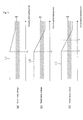
- the control part 5 counts accumulated lighting times of the LED lamps 110A and 110B with use of a timer incorporated in the microcontroller, and, as shown by a solid line L1 in Fig. 2(a) , after the accumulated lighting time (a horizontal axis) passes a predetermined switch time T1, the control part 5 monotonically decreases the upper limit value as the accumulated lighting time advances. Meanwhile, a hatched region S in Fig. 2 shows a region of the rated voltages including individual variability that the LED lamp 110A and 110B may have.
- the switch time T1 is set to be the same time as the rated life of the LED lamp (a life defined by a decline of light flux or a rated life of a circuit component composing the LED lamp) and as the rated life of the LED lighting device (a rated life of a circuit component composing the LED lighting device).
- the control part 5 is not necessarily required to linearly decrease the upper limit value, and for example, may decrease the upper limit value in a stepwise fashion.
- the control part 5 does not decrease the upper limit value to be the rated voltage (the region S) of the LED lamps 110A and 110B or less; however, as shown by the solid line L1 in Fig. 2(b) , the control part 5 may decrease the upper limit value to be the rated voltage (the region S) of the LED lamps 110A and 110B or less.
- the control part 5 when a predetermined reset condition is satisfied, the control part 5 resets the accumulated lighting time to be zero.
- the reset condition is to determine the loaded state (replacement of the LED lamps 110A and 110B), for example, after the connection judgment part 6 determined the unloaded state when the power conversion part 2 operates again after stopping due to the output voltage exceeding the upper limit value.
- the control part 5 decreases the upper limit value to be the rated voltage (the region S) or less of the LED lamps 110A and 110B, it is preferable not to reset the accumulated lighting time after passing a time (a reset non-operable time) T2 when the solid line L1 of the upper limit value intersects the region S as shown in Fig. 2(c) , even in the case where the reset condition is satisfied.
- the upper limit value is monotonically reduced with the passage of time, a time when the LED lamps 110A and 110B become unable to be lighted will vary due to variation of the aged deterioration of the LED lamps 110A and 110B, and thus it can be prevented that the LED lamps 110A and 110B become unable to be lighted at the same time also in a general office where the plurality of illumination fixture are used.
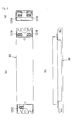
- the LED lighting device according to the present embodiment is housed in a metallic case 90 as shown in Fig. 3 .
- a metallic case 90 As shown in Fig. 3 , connectors 121A and 121B to be connected to the lamp sockets 120A and 120B are provided.
- connector 121C To the other end side of the case 90 in a longitudinal direction, connector 121C to be connected to the commercial alternating-current power source 100 is provided.
- the LED lighting device housed in the case 90 as described above is, for example, mounted on an illumination fixture shown in Fig. 4 .
- the illumination fixture includes: a fixture body 130 directly attached to a ceiling; and two pairs of lamp sockets 120A and 120B provided to the fixture body 130. Meanwhile, one of the pairs of lamp sockets 120A and 120B is used for power supply, and the other lamp socket 120C is used for the ground.
- the fixture body 130 is formed of a rectangular metal plate, the lamp sockets 120A and 120B for power supply are attached on one end side in the longitudinal direction, the lamp socket 120C for the ground is attached on the other side, and further the LED lighting device housed in the case 90 is attached on a lower surface side.
- a reflective plate 131 whose side-surface shape seen in the longitudinal direction is substantially triangle is attached on the lower side of the fixture body 130, and the LED lamps 110A and 110B are arranged on the lower side of the reflective plate 131.
- the lamp sockets 120A and 120B for power supply have the same structure as that of the lamp socket for the commonly- known straight tube fluorescent lamp, and accordingly there is a possibility that a direct current is supplied to a filament part when the fluorescent lamps are attached to the lamp sockets 120A and 120B by mistake.
- the output voltage detected by the voltage detection part 4 falls below a predetermined value ( ⁇ the rated voltage)
- the power conversion part 2 is stopped as described above, and accordingly even in the case where the fluorescent lamp is attached by mistake, there is no possibility that an unsafe phenomenon and the trouble of the lighting device occur.
- a user cannot make a distinction between the safe and the unsafe regarding the mistaken attachment of the fluorescent lamp.
- the mistaken attachment may be prevented by forming electrode shapes of the bases of the LED lamps 110A and 110B to be different from the structure of the fluorescent lamp, and the lamp sockets 120A, 120B, and 120C may be formed to have the same structures as the same structure as those of the bases of the LED lamps 110A and 110B.
- the above-mentioned switch time T1 may be set to the substantially same time as an operating time for which there is not possibility of causing the unsafe phenomenon due to deterioration of the resin material of: the lamp sockets 120A, 120B, and 120C and the LED lamps 110A and 110B.
Landscapes
- Circuit Arrangement For Electric Light Sources In General (AREA)
- Led Devices (AREA)
Applications Claiming Priority (1)
| Application Number | Priority Date | Filing Date | Title |
|---|---|---|---|
| JP2010292761A JP5760171B2 (ja) | 2010-12-28 | 2010-12-28 | Led点灯装置及びそれを用いた照明器具 |
Publications (2)
| Publication Number | Publication Date |
|---|---|
| EP2473006A2 true EP2473006A2 (de) | 2012-07-04 |
| EP2473006A3 EP2473006A3 (de) | 2014-05-14 |
Family
ID=45495579
Family Applications (2)
| Application Number | Title | Priority Date | Filing Date |
|---|---|---|---|
| EP11194629.9A Withdrawn EP2473006A3 (de) | 2010-12-28 | 2011-12-20 | LED-Beleuchtungsvorrichtung und Beleuchtungsbefestigung damit |
| EP11010171.4A Not-in-force EP2473003B1 (de) | 2010-12-28 | 2011-12-23 | LED-Lichtvorrichtung und Beleuchtungsvorrichtung damit |
Family Applications After (1)
| Application Number | Title | Priority Date | Filing Date |
|---|---|---|---|
| EP11010171.4A Not-in-force EP2473003B1 (de) | 2010-12-28 | 2011-12-23 | LED-Lichtvorrichtung und Beleuchtungsvorrichtung damit |
Country Status (4)
| Country | Link |
|---|---|
| US (1) | US8786201B2 (de) |
| EP (2) | EP2473006A3 (de) |
| JP (1) | JP5760171B2 (de) |
| CN (1) | CN102548140B (de) |
Families Citing this family (23)
| Publication number | Priority date | Publication date | Assignee | Title |
|---|---|---|---|---|
| JP5904324B2 (ja) * | 2011-02-25 | 2016-04-13 | 東芝ライテック株式会社 | Ledランプ点灯装置および照明器具 |
| JP5214003B2 (ja) * | 2011-08-12 | 2013-06-19 | シャープ株式会社 | 電源装置及び照明装置 |
| JP6079099B2 (ja) * | 2012-09-27 | 2017-02-15 | 市光工業株式会社 | 故障診断装置及び車両用灯具 |
| JP2014108018A (ja) * | 2012-11-29 | 2014-06-09 | Sharp Corp | 電源装置 |
| JP6062227B2 (ja) * | 2012-11-29 | 2017-01-18 | シャープ株式会社 | 電源装置 |
| JP5988214B2 (ja) * | 2012-12-04 | 2016-09-07 | パナソニックIpマネジメント株式会社 | 点灯装置およびそれを用いた照明器具 |
| US9565782B2 (en) | 2013-02-15 | 2017-02-07 | Ecosense Lighting Inc. | Field replaceable power supply cartridge |
| DE102013216153A1 (de) | 2013-08-14 | 2015-02-19 | Osram Gmbh | Elektronisches Vorschaltgerät zum Betreiben mindestens einer ersten und einer zweiten Kaskade von LEDs |
| US10477636B1 (en) | 2014-10-28 | 2019-11-12 | Ecosense Lighting Inc. | Lighting systems having multiple light sources |
| CN104507215B (zh) * | 2014-12-04 | 2018-05-04 | 苏州工业园区海的机电科技有限公司 | Led模组点亮检测装置及其点亮检测方法 |
| US11306897B2 (en) | 2015-02-09 | 2022-04-19 | Ecosense Lighting Inc. | Lighting systems generating partially-collimated light emissions |
| US9869450B2 (en) | 2015-02-09 | 2018-01-16 | Ecosense Lighting Inc. | Lighting systems having a truncated parabolic- or hyperbolic-conical light reflector, or a total internal reflection lens; and having another light reflector |
| US9651216B2 (en) | 2015-03-03 | 2017-05-16 | Ecosense Lighting Inc. | Lighting systems including asymmetric lens modules for selectable light distribution |
| US9568665B2 (en) | 2015-03-03 | 2017-02-14 | Ecosense Lighting Inc. | Lighting systems including lens modules for selectable light distribution |
| US9651227B2 (en) | 2015-03-03 | 2017-05-16 | Ecosense Lighting Inc. | Low-profile lighting system having pivotable lighting enclosure |
| US9746159B1 (en) | 2015-03-03 | 2017-08-29 | Ecosense Lighting Inc. | Lighting system having a sealing system |
| USD785218S1 (en) | 2015-07-06 | 2017-04-25 | Ecosense Lighting Inc. | LED luminaire having a mounting system |
| USD782093S1 (en) | 2015-07-20 | 2017-03-21 | Ecosense Lighting Inc. | LED luminaire having a mounting system |
| USD782094S1 (en) | 2015-07-20 | 2017-03-21 | Ecosense Lighting Inc. | LED luminaire having a mounting system |
| US9651232B1 (en) | 2015-08-03 | 2017-05-16 | Ecosense Lighting Inc. | Lighting system having a mounting device |
| DE102018122067A1 (de) * | 2018-09-11 | 2020-03-12 | HELLA GmbH & Co. KGaA | LED-Leuchtvorrichtung mit Fehlerdetektion und Kraftfahrzeug |
| JP7278171B2 (ja) * | 2019-08-08 | 2023-05-19 | シーシーエス株式会社 | Led玉切れ検知機構及びこれを用いたled光照射システム |
| KR102217889B1 (ko) * | 2020-05-26 | 2021-02-19 | 박영기 | 누계전류량 특이값 검출 기반의 led디지털사이니지 불량감지시스템 |
Citations (2)
| Publication number | Priority date | Publication date | Assignee | Title |
|---|---|---|---|---|
| JP2006210271A (ja) | 2005-01-31 | 2006-08-10 | Matsushita Electric Works Ltd | Led駆動装置、及びそれを用いた照明装置 |
| JP2009043447A (ja) | 2007-08-06 | 2009-02-26 | Sharp Corp | 照明装置 |
Family Cites Families (15)
| Publication number | Priority date | Publication date | Assignee | Title |
|---|---|---|---|---|
| DE19734750C2 (de) | 1997-08-12 | 2003-04-30 | Reitter & Schefenacker Gmbh | Heckleuchte von Kraftfahrzeugen |
| JP4148224B2 (ja) * | 2005-01-31 | 2008-09-10 | 松下電工株式会社 | Led駆動装置、及びそれを用いた照明装置 |
| JP4500172B2 (ja) * | 2005-01-31 | 2010-07-14 | パナソニック電工株式会社 | Led駆動装置、照明装置、照明器具 |
| JP2006210219A (ja) | 2005-01-31 | 2006-08-10 | Koito Mfg Co Ltd | 車両用灯具の点灯制御回路 |
| JP5085033B2 (ja) | 2005-12-12 | 2012-11-28 | 株式会社小糸製作所 | 車両用発光装置 |
| US7800876B2 (en) * | 2006-01-09 | 2010-09-21 | Microsemi Corp. - Analog Mixed Signal Group Ltd. | Fault detection mechanism for LED backlighting |
| JP2009542188A (ja) | 2006-06-26 | 2009-11-26 | コーニンクレッカ フィリップス エレクトロニクス エヌ ヴィ | 負荷を一定電流で駆動する駆動回路 |
| JP2008210271A (ja) | 2007-02-27 | 2008-09-11 | Kujirai Media Create:Kk | 記憶媒体製造方法、および情報処理システム |
| JP2009111035A (ja) | 2007-10-26 | 2009-05-21 | Panasonic Electric Works Co Ltd | 発光ダイオード駆動装置、発光ダイオード駆動装置を用いた照明装置、車室内用照明装置、車両用照明装置 |
| CN101534594A (zh) | 2008-03-12 | 2009-09-16 | 奇美电子股份有限公司 | 发光二极管串列的短路保护电路及其方法 |
| JP2009302296A (ja) * | 2008-06-13 | 2009-12-24 | Panasonic Electric Works Co Ltd | 発光ダイオード駆動装置並びにそれを用いた照明器具、車室内用照明装置、車両用照明装置 |
| JP2010113897A (ja) * | 2008-11-05 | 2010-05-20 | Panasonic Corp | 照明装置 |
| US8466619B2 (en) * | 2008-11-11 | 2013-06-18 | Dongbu Hitek Co., Ltd. | Illumination apparatus and driving method thereof |
| US8044667B2 (en) | 2009-04-20 | 2011-10-25 | Infineon Technologies Ag | Failure detection for series of electrical loads |
| TWI388115B (zh) * | 2009-08-13 | 2013-03-01 | Green Solution Tech Co Ltd | 電源轉換驅動電路及螢光燈管驅動電路 |
-
2010
- 2010-12-28 JP JP2010292761A patent/JP5760171B2/ja active Active
-
2011
- 2011-12-15 US US13/326,386 patent/US8786201B2/en not_active Expired - Fee Related
- 2011-12-20 EP EP11194629.9A patent/EP2473006A3/de not_active Withdrawn
- 2011-12-23 EP EP11010171.4A patent/EP2473003B1/de not_active Not-in-force
- 2011-12-26 CN CN201110441266.6A patent/CN102548140B/zh not_active Expired - Fee Related
Patent Citations (2)
| Publication number | Priority date | Publication date | Assignee | Title |
|---|---|---|---|---|
| JP2006210271A (ja) | 2005-01-31 | 2006-08-10 | Matsushita Electric Works Ltd | Led駆動装置、及びそれを用いた照明装置 |
| JP2009043447A (ja) | 2007-08-06 | 2009-02-26 | Sharp Corp | 照明装置 |
Also Published As
| Publication number | Publication date |
|---|---|
| EP2473006A3 (de) | 2014-05-14 |
| CN102548140B (zh) | 2014-08-27 |
| JP2012142358A (ja) | 2012-07-26 |
| EP2473003A3 (de) | 2014-05-14 |
| EP2473003B1 (de) | 2018-10-10 |
| CN102548140A (zh) | 2012-07-04 |
| US8786201B2 (en) | 2014-07-22 |
| US20120161649A1 (en) | 2012-06-28 |
| JP5760171B2 (ja) | 2015-08-05 |
| EP2473003A2 (de) | 2012-07-04 |
Similar Documents
| Publication | Publication Date | Title |
|---|---|---|
| EP2473006A2 (de) | LED-Beleuchtungsvorrichtung und Beleuchtungsbefestigung damit | |
| US8564210B2 (en) | Light source module and lighting apparatus, and illumination apparatus using same | |
| US8581512B2 (en) | Light source module, lighting apparatus, and illumination device using the same | |
| CN102651938B (zh) | 点灯装置以及照明装置 | |
| US8575857B2 (en) | LED lighting device | |
| US8853949B2 (en) | LED driver with end-of-life detection circuitry | |
| JP5379921B2 (ja) | Led点灯装置及びそれを用いた照明器具 | |
| JP5480668B2 (ja) | 光源モジュール、点灯装置およびそれを用いた照明器具 | |
| CN102438350B (zh) | Led点灯装置及使用该led点灯装置的照明器具 | |
| JP5645250B2 (ja) | Led点灯装置及びそれを用いた照明器具 | |
| CN102316638B (zh) | Led点灯装置及使用了该led点灯装置的照明器具 | |
| JP2016170893A (ja) | 発光素子点灯装置、発光モジュール及び照明器具 |
Legal Events
| Date | Code | Title | Description |
|---|---|---|---|
| AK | Designated contracting states |
Kind code of ref document: A2 Designated state(s): AL AT BE BG CH CY CZ DE DK EE ES FI FR GB GR HR HU IE IS IT LI LT LU LV MC MK MT NL NO PL PT RO RS SE SI SK SM TR |
|
| AX | Request for extension of the european patent |
Extension state: BA ME |
|
| PUAI | Public reference made under article 153(3) epc to a published international application that has entered the european phase |
Free format text: ORIGINAL CODE: 0009012 |
|
| PUAL | Search report despatched |
Free format text: ORIGINAL CODE: 0009013 |
|
| AK | Designated contracting states |
Kind code of ref document: A3 Designated state(s): AL AT BE BG CH CY CZ DE DK EE ES FI FR GB GR HR HU IE IS IT LI LT LU LV MC MK MT NL NO PL PT RO RS SE SI SK SM TR |
|
| AX | Request for extension of the european patent |
Extension state: BA ME |
|
| RIC1 | Information provided on ipc code assigned before grant |
Ipc: H05B 33/08 20060101AFI20140410BHEP |
|
| STAA | Information on the status of an ep patent application or granted ep patent |
Free format text: STATUS: THE APPLICATION IS DEEMED TO BE WITHDRAWN |
|
| 18D | Application deemed to be withdrawn |
Effective date: 20141115 |