EP2473041B1 - Modulateurs de points de contrôle du cycle cellulaire et leur utilisation en combinaison avec des inhibiteurs de kinase de point de contrôle - Google Patents
Modulateurs de points de contrôle du cycle cellulaire et leur utilisation en combinaison avec des inhibiteurs de kinase de point de contrôle Download PDFInfo
- Publication number
- EP2473041B1 EP2473041B1 EP10814320.7A EP10814320A EP2473041B1 EP 2473041 B1 EP2473041 B1 EP 2473041B1 EP 10814320 A EP10814320 A EP 10814320A EP 2473041 B1 EP2473041 B1 EP 2473041B1
- Authority
- EP
- European Patent Office
- Prior art keywords
- ring
- alkyl
- aryl
- heteroaryl
- moiety
- Prior art date
- Legal status (The legal status is an assumption and is not a legal conclusion. Google has not performed a legal analysis and makes no representation as to the accuracy of the status listed.)
- Active
Links
- 0 C[C@@](CN1CCCCC1)O[C@@](*)C1(C*)**1 Chemical compound C[C@@](CN1CCCCC1)O[C@@](*)C1(C*)**1 0.000 description 7
- YQURLNGUWNDBIR-UHFFFAOYSA-N CN1CC(CNC2)C2C1 Chemical compound CN1CC(CNC2)C2C1 YQURLNGUWNDBIR-UHFFFAOYSA-N 0.000 description 2
- KAUMXIFOBGXMIF-UHFFFAOYSA-N CN(C1)CC2C1COC2 Chemical compound CN(C1)CC2C1COC2 KAUMXIFOBGXMIF-UHFFFAOYSA-N 0.000 description 1
- NZKRDLVNDPRDCU-UHFFFAOYSA-N CN1CC(NCCC2)=C2CC1 Chemical compound CN1CC(NCCC2)=C2CC1 NZKRDLVNDPRDCU-UHFFFAOYSA-N 0.000 description 1
- ACSQOHDWJKTBRH-UHFFFAOYSA-N CN1CC2NCCCC2C1 Chemical compound CN1CC2NCCCC2C1 ACSQOHDWJKTBRH-UHFFFAOYSA-N 0.000 description 1
- DDYHWAGZGNBPGX-UHFFFAOYSA-N CN1Cc2cnccc2C1 Chemical compound CN1Cc2cnccc2C1 DDYHWAGZGNBPGX-UHFFFAOYSA-N 0.000 description 1
- CFAPHOLBVIDQAZ-UHFFFAOYSA-N CN1Cc2ncc[n]2CC1 Chemical compound CN1Cc2ncc[n]2CC1 CFAPHOLBVIDQAZ-UHFFFAOYSA-N 0.000 description 1
- CWZCHSVGUHAEPA-CAWMZFRYSA-N CNC(CN(CC(CC1(F)F)O[C@H]1N(C=CC(N)=N1)C1=O)CC1)=C1C(OCc(cc1)ccc1F)=N Chemical compound CNC(CN(CC(CC1(F)F)O[C@H]1N(C=CC(N)=N1)C1=O)CC1)=C1C(OCc(cc1)ccc1F)=N CWZCHSVGUHAEPA-CAWMZFRYSA-N 0.000 description 1
- CGRVMHQSGJAPES-SBXXRYSUSA-N CNC(CN(CC(CC1(F)F)O[C@H]1N(C=CC(N)=N1)C1=O)CC1)=C1C=N Chemical compound CNC(CN(CC(CC1(F)F)O[C@H]1N(C=CC(N)=N1)C1=O)CC1)=C1C=N CGRVMHQSGJAPES-SBXXRYSUSA-N 0.000 description 1
- QAYMPOTXMJCQFK-MGPUTAFESA-O CNC(CN(C[C@H](CC1(F)F)O[C@H]1N(C=CC(N)=N1)C1=O)CC1)=C1C(c1ccccc1)=[NH2+] Chemical compound CNC(CN(C[C@H](CC1(F)F)O[C@H]1N(C=CC(N)=N1)C1=O)CC1)=C1C(c1ccccc1)=[NH2+] QAYMPOTXMJCQFK-MGPUTAFESA-O 0.000 description 1
- LGKWQESPJNWNTP-CAAWGYFGSA-N C[n]1ncc(C2)c1CN2[C@@H](C1)[C@@]1(C1)O[C@](C2)(C2N(C=CC(N)=N2)C2=O)C1(F)F Chemical compound C[n]1ncc(C2)c1CN2[C@@H](C1)[C@@]1(C1)O[C@](C2)(C2N(C=CC(N)=N2)C2=O)C1(F)F LGKWQESPJNWNTP-CAAWGYFGSA-N 0.000 description 1
- JNYSRKCMJLUZRT-UHFFFAOYSA-N Cc1n[s]c(Nc([n]2nc3)cc(C4CNCCC4)nc2c3-c2c[o]c(C#N)c2)c1 Chemical compound Cc1n[s]c(Nc([n]2nc3)cc(C4CNCCC4)nc2c3-c2c[o]c(C#N)c2)c1 JNYSRKCMJLUZRT-UHFFFAOYSA-N 0.000 description 1
- SOWNQPVCUZJIJV-OFCLPDCHSA-N N/C=C1\NCCN(CC(CC2(F)F)O[C@H]2N(C=CC(N)=N2)C2=O)C1 Chemical compound N/C=C1\NCCN(CC(CC2(F)F)O[C@H]2N(C=CC(N)=N2)C2=O)C1 SOWNQPVCUZJIJV-OFCLPDCHSA-N 0.000 description 1
- ZCQYQMDSRMONHM-JOPIAHFSSA-N NC(C=CN1[C@@H]2OC(CN(CC3)CC(C=C4)=C3NC4=O)CC2(F)F)=NC1=O Chemical compound NC(C=CN1[C@@H]2OC(CN(CC3)CC(C=C4)=C3NC4=O)CC2(F)F)=NC1=O ZCQYQMDSRMONHM-JOPIAHFSSA-N 0.000 description 1
- VQCDFLNAJIXYSZ-SBXXRYSUSA-N NC(C=CN1[C@@H]2OC(CN3Cc4ncncc4CC3)CC2(F)F)=NC1=O Chemical compound NC(C=CN1[C@@H]2OC(CN3Cc4ncncc4CC3)CC2(F)F)=NC1=O VQCDFLNAJIXYSZ-SBXXRYSUSA-N 0.000 description 1
- ZIKLSJDKDBWNSO-MNQMDZLKSA-N NC(C=CN1[C@@H]2O[C@H](CN(CC/C3=C/C(O)=N)CC3=N)CC2(F)F)=NC1=O Chemical compound NC(C=CN1[C@@H]2O[C@H](CN(CC/C3=C/C(O)=N)CC3=N)CC2(F)F)=NC1=O ZIKLSJDKDBWNSO-MNQMDZLKSA-N 0.000 description 1
- KUIMQBAUCHOBLH-QFBILLFUSA-N NC(C=CN1[C@@H]2O[C@H](CN(CC3)CC(C=N)=C3Nc3cc(F)ccc3)CC2(F)F)=NC1=O Chemical compound NC(C=CN1[C@@H]2O[C@H](CN(CC3)CC(C=N)=C3Nc3cc(F)ccc3)CC2(F)F)=NC1=O KUIMQBAUCHOBLH-QFBILLFUSA-N 0.000 description 1
- MJWNNRWLWKUYQK-BLLLJJGKSA-N NC(C=CN1[C@@H]2O[C@H](CN(CC3)Cc4c3c(F)cc(F)c4)CC2(F)F)=NC1=O Chemical compound NC(C=CN1[C@@H]2O[C@H](CN(CC3)Cc4c3c(F)cc(F)c4)CC2(F)F)=NC1=O MJWNNRWLWKUYQK-BLLLJJGKSA-N 0.000 description 1
- KEQZFXNFHFLORL-QJAMILHHSA-O NC(C=CN1[C@@H]2O[C@H](CN(CCN3)C/C3=C/C(O)=[NH2+])CC2(F)F)=NC1=O Chemical compound NC(C=CN1[C@@H]2O[C@H](CN(CCN3)C/C3=C/C(O)=[NH2+])CC2(F)F)=NC1=O KEQZFXNFHFLORL-QJAMILHHSA-O 0.000 description 1
- NNYKPDRCYQZTSO-BLLLJJGKSA-N NC(C=CN1[C@@H]2O[C@H](CN(CCc3c4)Cc3cc(F)c4O)CC2(F)F)=NC1=O Chemical compound NC(C=CN1[C@@H]2O[C@H](CN(CCc3c4)Cc3cc(F)c4O)CC2(F)F)=NC1=O NNYKPDRCYQZTSO-BLLLJJGKSA-N 0.000 description 1
- AONOGYCCECTOGF-BLLLJJGKSA-N NC(C=CN1[C@@H]2O[C@H](CN(CCc3c4)Cc3cc(O)c4F)CC2(F)F)=NC1=O Chemical compound NC(C=CN1[C@@H]2O[C@H](CN(CCc3c4)Cc3cc(O)c4F)CC2(F)F)=NC1=O AONOGYCCECTOGF-BLLLJJGKSA-N 0.000 description 1
- CZFFEYWOAZNBPZ-MEDUHNTESA-N NC(C=CN1[C@@H]2O[C@H](CN(CCc3ccc4F)Cc3c4F)CC2(F)F)=NC1=O Chemical compound NC(C=CN1[C@@H]2O[C@H](CN(CCc3ccc4F)Cc3c4F)CC2(F)F)=NC1=O CZFFEYWOAZNBPZ-MEDUHNTESA-N 0.000 description 1
- NKEHWUISQNTJHZ-DOBMPVPNSA-N NC(C=CN1[C@@H]2O[C@H](CN(Cc3nc(N)ncc33)C3c3cccc(Cl)c3)CC2(F)F)=NC1=O Chemical compound NC(C=CN1[C@@H]2O[C@H](CN(Cc3nc(N)ncc33)C3c3cccc(Cl)c3)CC2(F)F)=NC1=O NKEHWUISQNTJHZ-DOBMPVPNSA-N 0.000 description 1
- VMEOAPWBTGDFJT-GXSJLCMTSA-N NC(C=CN1[C@@H]2O[C@H](CN3CCOCC3)CC2(F)F)=NC1=O Chemical compound NC(C=CN1[C@@H]2O[C@H](CN3CCOCC3)CC2(F)F)=NC1=O VMEOAPWBTGDFJT-GXSJLCMTSA-N 0.000 description 1
- CPKKGZAIWCWEKT-GXFFZTMASA-N NC(C=CN1[C@@H]2O[C@H](CN3Cc4ncc[n]4CC3)CC2(F)F)=NC1=O Chemical compound NC(C=CN1[C@@H]2O[C@H](CN3Cc4ncc[n]4CC3)CC2(F)F)=NC1=O CPKKGZAIWCWEKT-GXFFZTMASA-N 0.000 description 1
Classifications
-
- A—HUMAN NECESSITIES
- A61—MEDICAL OR VETERINARY SCIENCE; HYGIENE
- A61K—PREPARATIONS FOR MEDICAL, DENTAL OR TOILETRY PURPOSES
- A61K31/00—Medicinal preparations containing organic active ingredients
- A61K31/70—Carbohydrates; Sugars; Derivatives thereof
-
- A—HUMAN NECESSITIES
- A61—MEDICAL OR VETERINARY SCIENCE; HYGIENE
- A61P—SPECIFIC THERAPEUTIC ACTIVITY OF CHEMICAL COMPOUNDS OR MEDICINAL PREPARATIONS
- A61P35/00—Antineoplastic agents
-
- C—CHEMISTRY; METALLURGY
- C07—ORGANIC CHEMISTRY
- C07D—HETEROCYCLIC COMPOUNDS
- C07D405/00—Heterocyclic compounds containing both one or more hetero rings having oxygen atoms as the only ring hetero atoms, and one or more rings having nitrogen as the only ring hetero atom
- C07D405/02—Heterocyclic compounds containing both one or more hetero rings having oxygen atoms as the only ring hetero atoms, and one or more rings having nitrogen as the only ring hetero atom containing two hetero rings
- C07D405/04—Heterocyclic compounds containing both one or more hetero rings having oxygen atoms as the only ring hetero atoms, and one or more rings having nitrogen as the only ring hetero atom containing two hetero rings directly linked by a ring-member-to-ring-member bond
-
- C—CHEMISTRY; METALLURGY
- C07—ORGANIC CHEMISTRY
- C07D—HETEROCYCLIC COMPOUNDS
- C07D405/00—Heterocyclic compounds containing both one or more hetero rings having oxygen atoms as the only ring hetero atoms, and one or more rings having nitrogen as the only ring hetero atom
- C07D405/14—Heterocyclic compounds containing both one or more hetero rings having oxygen atoms as the only ring hetero atoms, and one or more rings having nitrogen as the only ring hetero atom containing three or more hetero rings
-
- C—CHEMISTRY; METALLURGY
- C07—ORGANIC CHEMISTRY
- C07D—HETEROCYCLIC COMPOUNDS
- C07D471/00—Heterocyclic compounds containing nitrogen atoms as the only ring hetero atoms in the condensed system, at least one ring being a six-membered ring with one nitrogen atom, not provided for by groups C07D451/00 - C07D463/00
- C07D471/02—Heterocyclic compounds containing nitrogen atoms as the only ring hetero atoms in the condensed system, at least one ring being a six-membered ring with one nitrogen atom, not provided for by groups C07D451/00 - C07D463/00 in which the condensed system contains two hetero rings
- C07D471/04—Ortho-condensed systems
-
- C—CHEMISTRY; METALLURGY
- C07—ORGANIC CHEMISTRY
- C07D—HETEROCYCLIC COMPOUNDS
- C07D487/00—Heterocyclic compounds containing nitrogen atoms as the only ring hetero atoms in the condensed system, not provided for by groups C07D451/00 - C07D477/00
- C07D487/02—Heterocyclic compounds containing nitrogen atoms as the only ring hetero atoms in the condensed system, not provided for by groups C07D451/00 - C07D477/00 in which the condensed system contains two hetero rings
- C07D487/04—Ortho-condensed systems
-
- C—CHEMISTRY; METALLURGY
- C07—ORGANIC CHEMISTRY
- C07D—HETEROCYCLIC COMPOUNDS
- C07D498/00—Heterocyclic compounds containing in the condensed system at least one hetero ring having nitrogen and oxygen atoms as the only ring hetero atoms
- C07D498/02—Heterocyclic compounds containing in the condensed system at least one hetero ring having nitrogen and oxygen atoms as the only ring hetero atoms in which the condensed system contains two hetero rings
- C07D498/04—Ortho-condensed systems
-
- C—CHEMISTRY; METALLURGY
- C07—ORGANIC CHEMISTRY
- C07D—HETEROCYCLIC COMPOUNDS
- C07D513/00—Heterocyclic compounds containing in the condensed system at least one hetero ring having nitrogen and sulfur atoms as the only ring hetero atoms, not provided for in groups C07D463/00, C07D477/00 or C07D499/00 - C07D507/00
- C07D513/02—Heterocyclic compounds containing in the condensed system at least one hetero ring having nitrogen and sulfur atoms as the only ring hetero atoms, not provided for in groups C07D463/00, C07D477/00 or C07D499/00 - C07D507/00 in which the condensed system contains two hetero rings
- C07D513/04—Ortho-condensed systems
-
- C—CHEMISTRY; METALLURGY
- C07—ORGANIC CHEMISTRY
- C07H—SUGARS; DERIVATIVES THEREOF; NUCLEOSIDES; NUCLEOTIDES; NUCLEIC ACIDS
- C07H19/00—Compounds containing a hetero ring sharing one ring hetero atom with a saccharide radical; Nucleosides; Mononucleotides; Anhydro-derivatives thereof
- C07H19/02—Compounds containing a hetero ring sharing one ring hetero atom with a saccharide radical; Nucleosides; Mononucleotides; Anhydro-derivatives thereof sharing nitrogen
- C07H19/04—Heterocyclic radicals containing only nitrogen atoms as ring hetero atom
- C07H19/06—Pyrimidine radicals
-
- C—CHEMISTRY; METALLURGY
- C07—ORGANIC CHEMISTRY
- C07H—SUGARS; DERIVATIVES THEREOF; NUCLEOSIDES; NUCLEOTIDES; NUCLEIC ACIDS
- C07H19/00—Compounds containing a hetero ring sharing one ring hetero atom with a saccharide radical; Nucleosides; Mononucleotides; Anhydro-derivatives thereof
- C07H19/02—Compounds containing a hetero ring sharing one ring hetero atom with a saccharide radical; Nucleosides; Mononucleotides; Anhydro-derivatives thereof sharing nitrogen
- C07H19/04—Heterocyclic radicals containing only nitrogen atoms as ring hetero atom
- C07H19/23—Heterocyclic radicals containing two or more heterocyclic rings condensed among themselves or condensed with a common carbocyclic ring system, not provided for in groups C07H19/14 - C07H19/22
Definitions
- the invention discloses novel compounds as targeted mechanism-based modulators of the cell cycle checkpoints, particularly checkpoint kinase 1 ("Chk1"), pharmaceutical compositions containing the compounds, and compounds and compositions for use to treat diseases such as, for example, cancer, inflammation, arthritis, viral diseases, neurodegenerative diseases such as Alzheimer's disease, cardiovascular diseases, and fungal diseases. They could also be useful as inhibitors of ribonucleotide reductase ("RNR").
- RNR ribonucleotide reductase
- the invention also relates to the combination of the present compounds and at least one checkpoint kinase inhibitor for use in treating cancers, pharmaceutical compositions comprising the combination of drugs for such use as well as pharmaceutical kits.
- checkpoints are built into the machinery of the cell proliferation cycle where cells make a commitment to commence and accurately regulate DNA synthesis to repair DNA damage or to undergo cell death. Unlike normal cells, cancer cells have lost checkpoint control and have an uncontrolled proliferation drive. The approximately 10 16 cell multiplications in the human lifetime, together with inevitable errors in DNA replication and exposure to ultraviolet rays and mutagens, underscores the requirement for checkpoint functions.
- Major checkpoints occur at G1/S phase and at the G2/M phase transitions where cells make a commitment to repair DNA or undergo apoptosis. Cells are generally thought to undergo apoptosis when DNA damage is irreparable ( Li, C J et al. (1999) Proc. Natl. Acad. Sci. USA 96:13369-13374 ).
- Checkpoint kinases e.g., Chk1, Chk2, and the like
- Checkpoints prevent cell cycle progression at inappropriate times, such as in response to DNA damage, and maintain the metabolic balance of cells while the cell is arrested, and in some instances can induce apoptosis (programmed cell death) when the requirements of the checkpoint have not been met.
- Checkpoint control can occur in the G1 phase (prior to DNA synthesis) during S-phase (the replication checkpoint) and in G2, prior to entry into mitosis.
- DNA replication checkpoint Another important cellular checkpoint is the DNA replication checkpoint, also mediated by CHK1, an essential serine/threonine kinase, which is active during DNA synthesis and functions to coordinate the progression of the cell cycle.
- CHK1 an essential serine/threonine kinase
- the replication checkpoint ensures appropriate control of DNA polymerase progression, order of replication origin firing and suppression of mitosis.
- the replication checkpoint becomes critical for maintaining viability, acting to stabilize and preserve the replication fork complexes. Collapse of an active replication fork leads to rapid generation of double strand DNA breaks and cell death. Replication fork collapse is an irretrievable and catastrophic event for a cell.
- checkpoint modulators therapeutic agents that modulate cell cycle checkpoints generally are referred to herein as “checkpoint modulators.”
- Therapeutic agents that activate cell cycle checkpoint kinases generally are referred to herein as “checkpoint kinase activators.”
- Therapeutic agents that activate the checkpoint kinase designated “Chk1” (pronounced “check one") are referred to herein as “Chk1 activators.”
- Therapeutic agents that activate the checkpoint kinase designated “Chk2” are referred to herein as “Chk2 activators.”
- Inhibitors of such checkpoint kinases generally and specifically, are referred to herein as “checkpoint kinase inhibitors", “Chk1 inhibitors” and “Chk2 inhibitors” and the like.
- Inhibition of various DNA damage and replication check points therefore is expected to assist in preventing cells from repairing therapeutically induced DNA damage or suppressing replication fork collapse (and other downstream consequences of replication checkpoint activation) and to thus sensitize targeted cells to such therapeutic agents. Such sensitization is in turn expected to increase the therapeutic index of these therapies.
- beta.-lapachone induces necrosis in human breast cancer cells, and apoptosis in ovary, colon, and pancreatic cancer cells through induction of caspase ( Li, Y Z et al., Molecular Medicine (1999) 5:232-239 ).
- beta-lapachone when combined with Taxol® (paclitaxel; Bristol-Myers Squibb Co., New York, New York) at moderate doses, has effective anti-tumor activity in human ovarian, prostate and breast cancer xenograft models in nude mice. No signs of toxicity to the mice were observed, and no weight loss was recorded during the subsequent two months following treatment during which the tumors did not reappear (See Li, C J et al. Proc. Natl. Acad. Sci. USA (1999) 96:13369-13374 ). Taxol is believed to act at the G2/M phase transition of the cell cycle.
- Taxol® paclitaxel; Bristol-Myers Squibb Co., New York, New York
- Inhibitors of checkpoint kinases are known.
- commonly assigned US 2007/0083044 and US 2007/0082900 both published April 12, 2007 describes several pyrazolopyrimidines as protein kinase inhibitors, including checkpoint kinase inhibitors and methods of using them.
- commonly assigned US 2007/0117804 published May 24, 2007 describes several imidazopyrazines as protein kinase inhibitors, including checkpoint kinase inhibitors and methods of using them.
- S. Ashwell et al, Expert Opin. Investig. Drugs (2008) 17(9): 1331-1340 describe several checkpoint kinase inhibitors, particularly those in development.
- Gemcitabine (Formula I; 2',2'-difluoro-2'-deoxycytidine; dFdC) is a pyrimidine analog that has shown activity in various solid tumors, including non-small cell lung cancer (NSCLC), small cell lung cancer, head and neck squamous cell cancer, germ cell tumors, lymphomas (cutaneous T-cell and Hodgkins' disease), mesothelioma, and tumors of the bladder, breast, ovary, cervix, pancreas, and biliary tract, as well as some hematologic malignancies.
- NSCLC non-small cell lung cancer
- small cell lung cancer small cell lung cancer
- head and neck squamous cell cancer germ cell tumors
- lymphomas cutaneous T-cell and Hodgkins' disease
- mesothelioma mesothelioma
- Gemzar® Hertel et al., Cancer Res. 50, 4417-4422 (1990 ); U.S. 4,808,614 and 5,464,826 ) and sold by Lilly under the trade name, Gemzar®.
- Gemcitabine is a deoxycytidine analog with structural similarities to cytarabine (Ara-C®).
- Gemcitabine is metabolized intracellularly by nucleoside kinases to the active diphosphate (Formula II; dFdCDP) and triphosphate (Formula III; dFdCTP) nucleotide metabolites.
- the cytotoxic effect of gemcitabine is generally attributed to the actions of diphosphate and the triphosphate nucleotides, which lead to inhibition of DNA synthesis.
- Gemcitabine diphosphate (dFdCDP) inhibits ribonucleotide reductase (RNR), which is essential for DNA synthesis and is responsible for catalyzing the reactions that generate the deoxynucleotide triphosphates for DNA synthesis.
- RNR ribonucleotide reductase
- Inhibition of RNR by the diphosphate nucleotide causes a reduction in the concentration of the deoxynucleotides, including deoxycytidine triphosphate (dCTP).
- dCTP deoxycytidine triphosphate
- Gemcitabine triphosphate (dFdCTP) competes with dCTP for incorporation into DNA.
- the reduction in the intracellular concentration of dCTP (by the action of the diphosphate) further enhances the incorporation of gemcitabine triphosphate into DNA, a process referred to as self-potentiation.
- self-potentiation After the gemcitabine nucleotide is incorporated into DNA, only one additional nucleotide is added to the growing DNA strand.
- gemcitabine induces an S-phase arrest in the cell cycle, and triggers apoptosis in both human leukemic cells and solid tumors. Tolis et al., Eur. J. Cancer, 35, 797-808 (1999 ). In addition to its cytotoxic effect, gemcitabine is a potent radiosensitizer.
- Gemcitabine has been investigated as a radiosensitizer for rodent and human tumor cells, including those found in pancreatic, non-small cell lung, head and neck, colorectal, breast, and cervical cancer. Pauwels et al., Oncologist 10(1), 34-51 (2005 ).
- RNR inhibitor is hydroxyurea (HU) or hydroxycarbamide, (Formula IV; brand names include Hydrea® from Bristol-Myers Squibb): is an antineoplastic drug used in hematological malignancies. Its mechanism of action is believed to be based on its inhibition of the enzyme ribonucleotide reductase by scavenging tyrosyl free radicals.
- this invention provides novel compounds and pharmaceutical compositions for use in the treatment of cancer and precancerous conditions.
- this invention provides novel compounds as cell cycle checkpoint modulators and pharmaceutical compositions containing them for use in the treatment of cancer and precancerous conditions.
- this invention provides novel compounds as modulators of cell cycle checkpoints, for example CHk-1, and pharmaceutical compositions containing them for use in the treatment of cancer and precancerous conditions.
- this invention provides compounds according to the present invention for use in treating precancerous conditions or cancer.
- this invention provides compounds which modulate cell cycle checkpoints in combination with agents which inhibit checkpoint kinase for use in treating precancerous conditions or cancer.
- this invention provides compounds which activate checkpoint kinases in combination with agents which inhibit checkpoint kinase for use in treating precancerous conditions or cancer.
- the present invention provides compounds, as well as pharmaceutically acceptable salts and solvates thereof, said compounds being represented by Formula V: wherein:
- compositions comprising at least one compound of Formula V.
- this invention provides pharmaceutical compositions comprising at least one compound of Formula V and at least one pharmaceutically acceptable carrier.
- this invention potentially provides at least one compound of Formula V for use in inhibiting RNR.
- this invention potentially provides at least one compound of Formula V for use in modulating cell cycle checkpoint modulators.
- this invention potentially provides at least one compound of Formula V for use in modulating cell cycle checkpoint modulators, especially Chk-1.
- this invention provides a composition comprising at least one compound of Formula V for use in modulating cell cycle checkpoint modulators.
- this invention provides a composition comprising at least one compound of Formula V for use in modulating cell cycle checkpoint modulators, especially Chk-1.
- this invention provides at least one compound of Formula V for use in activating checkpoint kinases.
- compositions comprising at least one compound of Formula V and at least one checkpoint kinase inhibitor.
- this invention provides at least one compound of Formula V for use in inhibiting DNA synthesis.
- this invention provides a composition comprising at least one compound of Formula V and at least one checkpoint kinase 1 inhibitor for use in inhibiting DNA synthesis.
- the moieties: the ring marked A, G, X, Y, R 2 , R 4 , R 5 , R 6 and R 7 are independently selected.
- G is H.
- G is halo
- G is Br.
- X is H.
- X is F
- X is -OR 2 .
- X is alkyl
- X is alkoxy-.
- X is aryloxy-.
- X is heteroaryloxy-.
- Y is H.
- Y is F
- Y is -OR 2 .
- Y is alkyl
- Y is alkoxy-.
- Y is aryloxy-.
- Y is heteroaryloxy-.
- the ring moiety is a piperidinyl ring fused with an aryl ring.
- the ring moiety is a piperazinyl ring fused with an aryl ring.
- the ring moiety is a pyrrolidinyl ring fused with an aryl ring.
- the ring moiety is a pyrrolidinyl ring fused with a heteroaryl ring.
- the ring moiety is a pyrrolidinyl ring fused with a heterocyclyl ring.
- the ring moiety is a piperidinyl ring fused with a heteroaryl ring.
- the ring moiety is a pyrrolidinyl ring fused with a heterocyclyl ring.
- the ring moiety is a piperazinyl ring fused with a heteroaryl ring.
- the ring moiety is a piperazinyl ring fused with a heterocyclyl ring.
- the ring moiety is a morpholinyl ring fused with an aryl ring.
- the ring moiety is a morpholinyl ring fused with a heteroaryl ring.
- the ring moiety is a morpholinyl ring fused with a heterocyclyl ring.
- R 2 is H.
- R 2 is alkyl
- R 2 is aryl
- R 2 is heteroaryl
- R 4 is H.
- R 4 is alkyl
- R 4 is aryl
- R 4 is heteroaryl
- R 5 is H.
- R 5 is alkyl
- R 5 is aryl
- R 5 is heteroaryl
- the moiety: is: wherein the pyrrolidinyl ring is fused with an aryl, heteroaryl or heterocyclyl ring, wherein each of said heterocyclyl and heterocyclenyl ring of A and said aryl, heteroaryl and heterocyclyl fused ring can be unsubstituted or optionally independently substituted with one or more moieties which can be the same or different and are independently selected from halo, CN, alkyl, alkenyl, haloalkyl, cycloalkyl, aryl, arylalkyl, alkoxy, heteroaryl, heteroarylalkyl, heterocyclyl and heterocyclylalkyl.
- the moiety: is: wherein the piperidinyl ring is fused with an aryl, heteroaryl or heterocyclyl ring, wherein each of said heterocyclyl and heteorcyclenyl ring of A and said aryl, heteroaryl and heterocyclyl fused ring can be unsubstituted or optionally independently substituted with one or more moieties which can be the same or different and are independently selected from halo, CN, alkyl, alkenyl, haloalkyl, cycloalkyl, aryl, arylalkyl, alkoxy, heteroaryl, heteroarylalkyl, heterocyclyl and heterocyclylalkyl.
- the moiety: is: wherein the piperazinyl ring is fused with an aryl, heteroaryl or heterocyclyl ring, wherein each of said heterocyclyl and heteorcyclenyl ring of A and said aryl, heteroaryl and heterocyclyl fused ring can be unsubstituted or optionally independently substituted with one or more moieties which can be the same or different and are independently selected from halo, CN, alkyl, alkenyl, haloalkyl, cycloalkyl, aryl, arylalkyl, alkoxy, heteroaryl, heteroarylalkyl, heterocyclyl and heterocyclylalkyl.
- the moiety: is: wherein the morpholinyl ring is fused with an aryl, heteroaryl or heterocyclyl ring, wherein each of said heterocyclyl and heteorcyclenyl ring of A and said aryl, heteroaryl and heterocyclyl fused ring can be unsubstituted or optionally independently substituted with one or more moieties which can be the same or different and are independently selected from halo, CN, alkyl, alkenyl, haloalkyl, cycloalkyl, aryl, arylalkyl, alkoxy, heteroaryl, heteroarylalkyl, heterocyclyl and heterocyclylalkyl.
- the moieties: the ring marked A, G, X, Y, R 2 , R 4 , R 5 , R 6 and R 7 are independently selected.
- “Mammal” means humans and other mammalian animals.
- Alkyl means an aliphatic hydrocarbon group which may be straight or branched and comprising about 1 to about 20 carbon atoms in the chain. Preferred alkyl groups contain about 1 to about 12 carbon atoms in the chain. More preferred alkyl groups contain about 1 to about 6 carbon atoms in the chain. Branched means that one or more lower alkyl groups such as methyl, ethyl or propyl, are attached to a linear alkyl chain. "Lower alkyl” means a group having about 1 to about 6 carbon atoms in the chain which may be straight or branched.
- suitable alkyl groups include methyl, ethyl, n-propyl, isopropyl and t-butyl.
- Alkenyl means an aliphatic hydrocarbon group containing at least one carbon-carbon double bond and which may be straight or branched and comprising about 2 to about 15 carbon atoms in the chain.
- Preferred alkenyl groups have about 2 to about 12 carbon atoms in the chain; and more preferably about 2 to about 6 carbon atoms in the chain.
- Branched means that one or more lower alkyl groups such as methyl, ethyl or propyl, are attached to a linear alkenyl chain.
- “Lower alkenyl” means about 2 to about 6 carbon atoms in the chain which may be straight or branched.
- alkenyl may be unsubstituted or optionally substituted by one or more substituents which may be the same or different, each substituent being independently selected from the group consisting of halo, alkyl. aryl, cycloalkyl, cyano, alkoxy and -S(alkyl).
- suitable alkenyl groups include ethenyl, propenyl, n-butenyl, 3-methylbut-2-enyl, n-pentenyl, octenyl and decenyl.
- Alkylene means a difunctional group obtained by removal of a hydrogen atom from an alkyl group that is defined above.
- alkylene include methylene, ethylene and propylene.
- Alkynyl means an aliphatic hydrocarbon group containing at least one carbon-carbon triple bond and which may be straight or branched and comprising about 2 to about 15 carbon atoms in the chain.
- Preferred alkynyl groups have about 2 to about 12 carbon atoms in the chain; and more preferably about 2 to about 4 carbon atoms in the chain.
- Branched means that one or more lower alkyl groups such as methyl, ethyl or propyl, are attached to a linear alkynyl chain.
- “Lower alkynyl” means about 2 to about 6 carbon atoms in the chain which may be straight or branched.
- alkynyl groups include ethynyl, propynyl, 2-butynyl and 3-methylbutynyl.
- Alkynyl may be unsubstituted or optionally substituted by one or more substituents which may be the same or different, each substituent being independently selected from the group consisting of alkyl, aryl and cycloalkyl.
- Aryl means an aromatic monocyclic or multicyclic ring system comprising about 6 to about 14 carbon atoms, preferably about 6 to about 10 carbon atoms.
- the aryl group can be optionally substituted with one or more "ring system substituents" which may be the same or different, and are as defined herein.
- suitable aryl groups include phenyl and naphthyl.
- Heteroaryl means an aromatic monocyclic or multicyclic ring system comprising about 5 to about 14 ring atoms, preferably about 5 to about 10 ring atoms, in which one or more of the ring atoms is an element other than carbon, for example nitrogen, oxygen or sulfur, alone or in combination. Preferred heteroaryls contain about 5 to about 6 ring atoms.
- the "heteroaryl” can be optionally substituted by one or more "ring system substituents" which may be the same or different, and are as defined herein.
- the prefix aza, oxa or thia before the heteroaryl root name means that at least a nitrogen, oxygen or sulfur atom respectively, is present as a ring atom.
- heteroaryl may also include a heteroaryl as defined above fused to an aryl as defined above.
- suitable heteroaryls include pyridyl, pyrazinyl, furanyl, thienyl, pyrimidinyl, pyridone (including N-substituted pyridones), isoxazolyl, isothiazolyl, oxazolyl, thiazolyl, pyrazolyl, furazanyl, pyrrolyl, pyrazolyl, triazolyl, 1,2,4-thiadiazolyl, pyrazinyl, pyridazinyl, quinoxalinyl, phthalazinyl, oxindolyl, imidazo[1,2-a]pyridinyl, imidazo[2,1-b]thiazolyl, benzofurazany
- Aralkyl or “arylalkyl” means an aryl-alkyl- group in which the aryl and alkyl are as previously described. Preferred aralkyls comprise a lower alkyl group. Non-limiting examples of suitable aralkyl groups include benzyl, 2-phenethyl and naphthalenylmethyl. The bond to the parent moiety is through the alkyl.
- Alkylaryl means an alkyl-aryl- group in which the alkyl and aryl are as previously described. Preferred alkylaryls comprise a lower alkyl group. Non-limiting example of a suitable alkylaryl group is tolyl. The bond to the parent moiety is through the aryl.
- Cycloalkyl means a non-aromatic mono- or multicyclic ring system comprising about 3 to about 10 carbon atoms, preferably about 5 to about 10 carbon atoms. Preferred cycloalkyl rings contain about 5 to about 7 ring atoms.
- the cycloalkyl can be optionally substituted with one or more "ring system substituents" which may be the same or different, and are as defined above.
- suitable monocyclic cycloalkyls include cyclopropyl, cyclopentyl, cyclohexyl, cycloheptyl and the like.
- suitable multicyclic cycloalkyls include 1-decalinyl, norbornyl, adamantyl and the like.
- Cycloalkylalkyl means a cycloalkyl moiety as defined above linked via an alkyl moiety (defined above) to a parent core.
- suitable cycloalkylalkyls include cyclohexylmethyl, adamantylmethyl and the like.
- Cycloalkenyl means a non-aromatic mono or multicyclic ring system comprising about 3 to about 10 carbon atoms, preferably about 5 to about 10 carbon atoms which contains at least one carbon-carbon double bond. Preferred cycloalkenyl rings contain about 5 to about 7 ring atoms.
- the cycloalkenyl can be optionally substituted with one or more "ring system substituents" which may be the same or different, and are as defined above.
- suitable monocyclic cycloalkenyls include cyclopentenyl, cyclohexenyl, cyclohepta-1,3-dienyl, and the like.
- Non-limiting example of a suitable multicyclic cycloalkenyl is norbornylenyl.
- Cycloalkenylalkyl means a cycloalkenyl moiety as defined above linked via an alkyl moiety (defined above) to a parent core.
- suitable cycloalkenylalkyls include cyclopentenylmethyl, cyclohexenylmethyl and the like.
- Halogen means fluorine, chlorine, bromine, or iodine. Preferred are fluorine, chlorine and bromine.
- Ring system substituent means a substituent attached to an aromatic or non-aromatic ring system which, for example, replaces an available hydrogen on the ring system.
- Ring system substituents may be the same or different, each being independently selected from the group consisting of alkyl, alkenyl, alkynyl, aryl, heteroaryl, aralkyl, alkylaryl, heteroaralkyl, heteroarylalkenyl, heteroarylalkynyl, alkylheteroaryl, hydroxy, hydroxyalkyl, alkoxy, aryloxy, aralkoxy, acyl, aroyl, halo, nitro, cyano, carboxy, alkoxycarbonyl, aryloxycarbonyl, aralkoxycarbonyl, alkylsulfonyl, arylsulfonyl, heteroarylsulfonyl, alkylthio, arylthio, heteroarylthio, aralkylthio
- Ring system substituent may also mean a single moiety which simultaneously replaces two available hydrogens on two adjacent carbon atoms (one H on each carbon) on a ring system.
- Examples of such moiety are methylene dioxy, ethylenedioxy, -C(CH 3 ) 2 - and the like which form moieties such as, for example:
- Heteroarylalkyl means a heteroaryl moiety as defined above linked via an alkyl moiety (defined above) to a parent core.
- suitable heteroaryls include 2-pyridinylmethyl, quinolinylmethyl and the like.
- Heterocyclyl means a non-aromatic saturated monocyclic or multicyclic ring system comprising about 3 to about 10 ring atoms, preferably about 5 to about 10 ring atoms, in which one or more of the atoms in the ring system is an element other than carbon, for example nitrogen, oxygen or sulfur, alone or in combination. There are no adjacent oxygen and/or sulfur atoms present in the ring system.
- Preferred heterocyclyls contain about 5 to about 6 ring atoms.
- the prefix aza, oxa or thia before the heterocyclyl root name means that at least a nitrogen, oxygen or sulfur atom respectively is present as a ring atom.
- Any -NH in a heterocyclyl ring may exist protected such as, for example, as an -N(Boc), -N(CBz), -N(Tos) group and the like; such protections are also considered part of this invention.
- the heterocyclyl can be optionally substituted by one or more "ring system substituents" which may be the same or different, and are as defined herein.
- heterocyclyl can be optionally oxidized to the corresponding N-oxide, S-oxide or S,S-dioxide.
- suitable monocyclic heterocyclyl rings include piperidyl, pyrrolidinyl, piperazinyl, morpholinyl, thiomorpholinyl, thiazolidinyl, 1,4-dioxanyl, tetrahydrofuranyl, tetrahydrothiophenyl, lactam, lactone, and the like.
- Heterocyclylalkyl means a heterocyclyl moiety as defined above linked via an alkyl moiety (defined above) to a parent core.
- suitable heterocyclylalkyls include piperidinylmethyl, piperazinylmethyl and the like.
- Heterocyclenyl means a non-aromatic monocyclic or multicyclic ring system comprising about 3 to about 10 ring atoms, preferably about 5 to about 10 ring atoms, in which one or more of the atoms in the ring system is an element other than carbon, for example nitrogen, oxygen or sulfur atom, alone or in combination, and which contains at least one carbon-carbon double bond or carbon-nitrogen double bond. There are no adjacent oxygen and/or sulfur atoms present in the ring system.
- Preferred heterocyclenyl rings contain about 5 to about 6 ring atoms.
- the prefix aza, oxa or thia before the heterocyclenyl root name means that at least a nitrogen, oxygen or sulfur atom respectively is present as a ring atom.
- the heterocyclenyl can be optionally substituted by one or more ring system substituents, wherein "ring system substituent" is as defined above.
- the nitrogen or sulfur atom of the heterocyclenyl can be optionally oxidized to the corresponding N-oxide, S-oxide or S,S-dioxide.
- heterocyclenyl groups include 1,2,3,4-tetrahydropyridinyl, 1,2-dihydropyridinyl, 1,4-dihydropyridinyl, 1,2,3,6-tetrahydropyridinyl, 1,4,5,6-tetrahydropyrimidinyl, 2-pyrrolinyl, 3-pyrrolinyl, 2-imidazolinyl, 2-pyrazolinyl, dihydroimidazolyl, dihydrooxazolyl, dihydrooxadiazolyl, dihydrothiazolyl, 3,4-dihydro-2H-pyranyl, dihydrofuranyl, fluorodihydrofuranyl, 7-oxabicyclo[2.2.1]heptenyl, dihydrothiophenyl, dihydrothiopyranyl, and the like.
- Heterocyclenylalkyl means a heterocyclenyl moiety as defined above linked via an alkyl moiety (defined above) to a parent core.
- hetero-atom containing ring systems of this invention there are no hydroxyl groups on carbon atoms adjacent to a N, O or S, as well as there are no N or S groups on carbon adjacent to another heteroatom.
- N, O or S there are no N or S groups on carbon adjacent to another heteroatom.
- Alkynylalkyl means an alkynyl-alkyl- group in which the alkynyl and alkyl are as previously described. Preferred alkynylalkyls contain a lower alkynyl and a lower alkyl group. The bond to the parent moiety is through the alkyl. Non-limiting examples of suitable alkynylalkyl groups include propargylmethyl.
- Heteroaralkyl means a heteroaryl-alkyl- group in which the heteroaryl and alkyl are as previously described. Preferred heteroaralkyls contain a lower alkyl group. Non-limiting examples of suitable aralkyl groups include pyridylmethyl, and quinolin-3-ylmethyl. The bond to the parent moiety is through the alkyl.
- Hydroxyalkyl means a HO-alkyl- group in which alkyl is as previously defined. Preferred hydroxyalkyls contain lower alkyl. Non-limiting examples of suitable hydroxyalkyl groups include hydroxymethyl and 2-hydroxyethyl.
- acyl means an H-C(O)-, alkyl-C(O)- or cycloalkyl-C(O)-, group in which the various groups are as previously described.
- the bond to the parent moiety is through the carbonyl.
- Preferred acyls contain a lower alkyl.
- suitable acyl groups include formyl, acetyl and propanoyl.
- Aroyl means an aryl-C(O)- group in which the aryl group is as previously described. The bond to the parent moiety is through the carbonyl.
- suitable groups include benzoyl and 1- naphthoyl.
- Alkoxy means an alkyl-O- group in which the alkyl group is as previously described.
- suitable alkoxy groups include methoxy, ethoxy, n-propoxy, isopropoxy and n-butoxy.
- the bond to the parent moiety is through the ether oxygen.
- Aryloxy means an aryl-O- group in which the aryl group is as previously described.
- suitable aryloxy groups include phenoxy and naphthoxy.
- the bond to the parent moiety is through the ether oxygen.
- Alkyloxy means an aralkyl-O- group in which the aralkyl group is as previously described.
- suitable aralkyloxy groups include benzyloxy and 1- or 2-naphthalenemethoxy.
- the bond to the parent moiety is through the ether oxygen.
- Alkylthio means an alkyl-S- group in which the alkyl group is as previously described.
- suitable alkylthio groups include methylthio and ethylthio.
- the bond to the parent moiety is through the sulfur.
- Arylthio means an aryl-S- group in which the aryl group is as previously described.
- suitable arylthio groups include phenylthio and naphthylthio.
- the bond to the parent moiety is through the sulfur.
- Alkylthio means an aralkyl-S- group in which the aralkyl group is as previously described.
- Non-limiting example of a suitable aralkylthio group is benzylthio.
- the bond to the parent moiety is through the sulfur.
- Alkoxycarbonyl means an alkyl-O-CO- group.
- suitable alkoxycarbonyl groups include methoxycarbonyl and ethoxycarbonyl.
- the bond to the parent moiety is through the carbonyl.
- Aryloxycarbonyl means an aryl-O-C(O)- group.
- suitable aryloxycarbonyl groups include phenoxycarbonyl and naphthoxycarbonyl.
- the bond to the parent moiety is through the carbonyl.
- Alkoxycarbonyl means an aralkyl-O-C(O)- group.
- a suitable aralkoxycarbonyl group is benzyloxycarbonyl.
- the bond to the parent moiety is through the carbonyl.
- Alkylsulfonyl means an alkyl-S(O 2 )- group. Preferred groups are those in which the alkyl group is lower alkyl. The bond to the parent moiety is through the sulfonyl.
- Arylsulfonyl means an aryl-S(O 2 )- group. The bond to the parent moiety is through the sulfonyl.
- substituted means that one or more hydrogens on the designated atom is replaced with a selection from the indicated group, provided that the designated atom's normal valency under the existing circumstances is not exceeded, and that the substitution results in a stable compound. Combinations of substituents and/or variables are permissible only if such combinations result in stable compounds.
- stable compound' or “stable structure” is meant a compound that is sufficiently robust to survive isolation to a useful degree of purity from a reaction mixture, and formulation into an efficacious therapeutic agent.
- purified refers to the physical state of said compound after being isolated from a synthetic process (e.g. from a reaction mixture), or natural source or combination thereof.
- purified refers to the physical state of said compound after being obtained from a purification process or processes described herein or well known to the skilled artisan (e.g., chromatography, recrystallization and the like), in sufficient purity to be characterizable by standard analytical techniques described herein or well known to the skilled artisan.
- any carbon as well as heteroatom with unsatisfied valences in the text, schemes, examples and Tables herein is assumed to have the sufficient number of hydrogen atom(s) to satisfy the valences. And any one or more of these hydrogen atoms can be deuterium.
- protecting groups When a functional group in a compound is termed "protected", this means that the group is in modified form to preclude undesired side reactions at the protected site when the compound is subjected to a reaction. Suitable protecting groups will be recognized by those with ordinary skill in the art as well as by reference to standard textbooks such as, for example, T. W. Greene et al, Protective Groups in organic Synthesis (1991), Wiley, New York .
- variable e.g., aryl, heterocycle, R 2 , etc.
- its definition on each occurrence is independent of its definition at every other occurrence.
- composition is intended to encompass a product comprising the specified ingredients in the specified amounts, as well as any product which results, directly or indirectly, from combination of the specified ingredients in the specified amounts.
- Prodrugs and solvates of the compounds of the invention are also contemplated herein, but are not part of the invention.
- a discussion of prodrugs is provided in T. Higuchi and V. Stella, Pro-drugs as Novel Delivery Systems (1987) 14 of the A.C.S. Symposium Series , and in Bioreversible Carriers in Drug Design, (1987) Edward B. Roche, ed., American Pharmaceutical Association and Pergamon Press .
- the term "prodrug” means a compound (e.g, a drug precursor) that is transformed in vivo to yield a compound of Formula V or a pharmaceutically acceptable salt, hydrate or solvate of the compound.
- the transformation may occur by various mechanisms (e.g., by metabolic or chemical processes), such as, for example, through hydrolysis in blood.
- mechanisms e.g., by metabolic or chemical processes
- prodrugs are provided by T. Higuchi and W. Stella, "Pro-drugs as Novel Delivery Systems," Vol. 14 of the A.C.S. Symposium Series , and in Bioreversible Carriers in Drug Design, ed. Edward B. Roche, American Pharmaceutical Association and Pergamon Press, 1987 .
- a prodrug can comprise an ester formed by the replacement of the hydrogen atom of the acid group with a group such as, for example, (C 1 -C 8 )alkyl, (C 2 -C 12 )alkanoyloxymethyl, 1-(alkanoyloxy)ethyl having from 4 to 9 carbon atoms, 1-methyl-1-(alkanoyloxy)-ethyl having from 5 to 10 carbon atoms, alkoxycarbonyloxymethyl having from 3 to 6 carbon atoms, 1-(alkoxycarbonyloxy)ethyl having from 4 to 7 carbon atoms, 1-methyl-1-(alkoxycarbonyloxy)ethyl having from 5 to 8 carbon atoms, N-(alkoxycarbonyl)aminomethyl having from 3 to 9 carbon atoms, 1-(N-(alkoxycarbonyl)aminomethyl having from 3 to 9 carbon atoms, 1-(N-(alkoxycarbonyl)aminomethyl having from 3 to 9 carbon
- a prodrug can be formed by the replacement of the hydrogen atom of the alcohol group with a group such as, for example, (C 1 -C 6 )alkanoyloxymethyl, 1-((C 1 -C 6 )alkanoyloxy)ethyl, 1-methyl-1-((C 1 -C 6 )alkanoyloxy)ethyl, (C 1 -C 6 )alkoxycarbonyloxymethyl, N-(C 1 -C 6 )alkoxycarbonylaminomethyl, succinoyl, (C 1 -C 6 )alkanoyl, ⁇ -amino(C 1 -C 4 )alkanyl, arylacyl and ⁇ -aminoacyl, or ⁇ -aminoacyl- ⁇ -aminoacyl, where each ⁇ -aminoacyl group is independently selected from the naturally occurring L-amino acids, P(O)(
- a prodrug can be formed by the replacement of a hydrogen atom in the amine group with a group such as, for example, R-carbonyl, RO-carbonyl, NRR'-carbonyl where R and R' are each independently (C 1 -C 10 )alkyl, (C 3 -C 7 ) cycloalkyl, benzyl, or R-carbonyl is a natural ⁇ -aminoacyl or natural ⁇ -aminoacyl, -C(OH)C(O)OY 1 wherein Y 1 is H, (C 1 -C 6 )alkyl or benzyl, -C(OY 2 )Y 3 wherein Y 2 is (C 1 -C 4 ) alkyl and Y 3 is (C 1 -C 6 )alkyl, carboxy (C 1 -C 6 )alkyl, amino(C 1 -C 4 )alkyl or mono-N
- One or more compounds of the invention may exist in unsolvated as well as solvated forms with pharmaceutically acceptable solvents such as water, ethanol, and the like, and it is intended that the invention embrace both solvated and unsolvated forms.
- “Solvate” means a physical association of a compound of this invention with one or more solvent molecules. This physical association involves varying degrees of ionic and covalent bonding, including hydrogen bonding. In certain instances the solvate will be capable of isolation, for example when one or more solvent molecules are incorporated in the crystal lattice of the crystalline solid. "Solvate” encompasses both solution-phase and isolatable solvates. Non-limiting examples of suitable solvates include ethanolates, methanolates, and the like.
- “Hydrate” is a solvate wherein the solvent molecule is H 2 O.
- One or more compounds of the invention may optionally be converted to a solvate.
- Preparation of solvates is generally known.
- M. Caira et al, J. Pharmaceutical Sci., 93(3), 601-611 (2004 ) describe the preparation of the solvates of the antifungal fluconazole in ethyl acetate as well as from water.
- Similar preparations of solvates, hemisolvate, hydrates and the like are described by E. C. van Tonder et al, AAPS PharmSciTech., 5(1), article 12 (2004 ); and A. L. Bingham et al, Chem. Commun., 603-604 (2001 ).
- a typical, non-limiting, process involves dissolving the inventive compound in desired amounts of the desired solvent (organic or water or mixtures thereof) at a higher than ambient temperature, and cooling the solution at a rate sufficient to form crystals which are then isolated by standard methods.
- Analytical techniques such as, for example I. R. spectroscopy, show the presence of the solvent (or water) in the crystals as a solvate (or hydrate).
- the compounds of Formula V can form salts which are also within the scope of this invention.
- Reference to a compound of Formula V herein is understood to include reference to salts thereof, unless otherwise indicated.
- the term "salt(s)", as employed herein, denotes acidic salts formed with inorganic and/or organic acids, as well as basic salts formed with inorganic and/or organic bases.
- zwitterions inner salts may be formed and are included within the term "salt(s)" as used herein.
- Salts of the compounds of the Formula V may be formed, for example, by reacting a compound of Formula V with an amount of acid or base, such as an equivalent amount, in a medium such as one in which the salt precipitates or in an aqueous medium followed by lyophilization.
- Exemplary acid addition salts include acetates, ascorbates, benzoates, benzenesulfonates, bisulfates, borates, butyrates, citrates, camphorates, camphorsulfonates, fumarates, hydrochlorides, hydrobromides, hydroiodides, lactates, maleates, methanesulfonates, naphthalenesulfonates, nitrates, oxalates, phosphates, propionates, salicylates, succinates, sulfates, tartarates, thiocyanates, toluenesulfonates (also known as tosylates,) and the like.
- Exemplary basic salts include ammonium salts, alkali metal salts such as sodium, lithium, and potassium salts, alkaline earth metal salts such as calcium and magnesium salts, salts with organic bases (for example, organic amines) such as dicyclohexylamines, t-butyl amines, and salts with amino acids such as arginine, lysine and the like.
- Basic nitrogen-containing groups may be quarternized with agents such as lower alkyl halides (e.g. methyl, ethyl, and butyl chlorides, bromides and iodides), dialkyl sulfates (e.g.
- dimethyl, diethyl, and dibutyl sulfates dimethyl, diethyl, and dibutyl sulfates
- long chain halides e.g. decyl, lauryl, and stearyl chlorides, bromides and iodides
- aralkyl halides e.g. benzyl and phenethyl bromides
- esters of the present compounds include the following groups: (1) carboxylic acid esters obtained by esterification of the hydroxy groups, in which the non-carbonyl moiety of the carboxylic acid portion of the ester grouping is selected from straight or branched chain alkyl (for example, acetyl, n-propyl, t-butyl, or n-butyl), alkoxyalkyl (for example, methoxymethyl), aralkyl (for example, benzyl), aryloxyalkyl (for example, phenoxymethyl), aryl (for example, phenyl optionally substituted with, for example, halogen, C 1-4 alkyl, or C 1-4 alkoxy or amino); (2) sulfonate esters, such as alkyl- or aralkylsulfonyl (for example, methanesulfonyl); (3) amino acid esters (for example, L-valyl or L-isoleucyl); (4) phosphoric acid
- Compounds of Formula V, and salts, solvates, esters and prodrugs thereof, may exist in their tautomeric form (for example, as an amide or imino ether).
- the compounds of Formula V may contain asymmetric or chiral centers, and, therefore, exist in different stereoisomeric forms. It is intended that all stereoisomeric forms of the compounds of Formula V as well as mixtures thereof, including racemic mixtures, form part of the present invention.
- the present invention embraces all geometric and positional isomers. For example, if a compound of Formula V incorporates a double bond or a fused ring, both the cis- and trans-forms, as well as mixtures, are embraced within the scope of the invention.
- Diastereomeric mixtures can be separated into their individual diastereomers on the basis of their physical chemical differences by methods well known to those skilled in the art, such as, for example, by chromatography and/or fractional crystallization.
- Enantiomers can be separated by converting the enantiomeric mixture into a diastereomeric mixture by reaction with an appropriate optically active compound (e.g., chiral auxiliary such as a chiral alcohol or Mosher's acid chloride), separating the diastereomers and converting (e.g., hydrolyzing) the individual diastereomers to the corresponding pure enantiomers.
- an appropriate optically active compound e.g., chiral auxiliary such as a chiral alcohol or Mosher's acid chloride
- some of the compounds of Formula V may be atropisomers (e.g., substituted biaryls) and are considered as part of this invention.
- Enantiomers can also be separated by use of chiral HPLC column.
- All stereoisomers (for example, geometric isomers, optical isomers and the like) of the present compounds including those of the salts and solvates), such as those which may exist due to asymmetric carbons on various substituents, including enantiomeric forms (which may exist even in the absence of asymmetric carbons), rotameric forms, atropisomers, and diastereomeric forms, are contemplated within the scope of this invention, as are positional isomers (such as, for example, 4-pyridyl and 3-pyridyl).
- positional isomers such as, for example, 4-pyridyl and 3-pyridyl.
- keto-enol and imine-enamine forms of the compounds are included in the invention.
- Individual stereoisomers of the compounds of the invention may, for example, be substantially free of other isomers, or may be admixed, for example, as racemates or with all other, or other selected, stereoisomers.
- the chiral centers of the present invention can have the S or R configuration as defined by the IUPAC 1974 Recommendations.
- salt is intended to equally apply to the salt, solvate, ester and prodrug of enantiomers, stereoisomers, rotamers, tautomers, positional isomers, racemates or prodrugs of the inventive compounds.
- the present invention also embraces isotopically-labelled compounds of the present invention which are identical to those recited herein, but for the fact that one or more atoms are replaced by an atom having an atomic mass or mass number different from the atomic mass or mass number usually found in nature.
- isotopes that can be incorporated into compounds of the invention include isotopes of hydrogen, carbon, nitrogen, oxygen, phosphorus, fluorine and chlorine, such as 2 H, 3 H, 13 C, 14 C, 15 N, 18 O, 17 O, 31 P, 32 P, 35 S, 18 F, and 36 Cl, respectively.
- Certain isotopically-labelled compounds of Formula V are useful in compound and/or substrate tissue distribution assays. Tritiated (i.e., 3 H) and carbon-14 (i.e., 14 C) isotopes are particularly preferred for their ease of preparation and detectability. Further, substitution with heavier isotopes such as deuterium (i.e., 2 H) may afford certain therapeutic advantages resulting from greater metabolic stability (e.g., increased in vivo half-life or reduced dosage requirements) and hence may be preferred in some circumstances.
- Isotopically labelled compounds of Formula V can generally be prepared by following procedures analogous to those disclosed in the Schemes and/or in the Examples hereinbelow, by substituting an appropriate isotopically labelled reagent for a non-isotopically labelled reagent.
- an anti-cancer effect may be one or more of inhibiting further growth of tumor or cancer cells, reducing the likelihood or eliminating metastatsis or producing cell death in the tumor or cancer cells, resulting in a shrinkage of the tumor or a reduction in the number of cancer cells or preventing the regrowth of a tumor or cancer after the patient's tumor or cancer is in remission.
- cancer is used throughout the specification to refer to the pathological process that results in the formation and growth of a cancerous or malignant neoplasm, i.e., abnormal tissue that grows by cellular proliferation, often more rapidly than normal and continues to grow after the stimuli that initiated the new growth cease.
- Malignant neoplasms show partial or complete lack of structural organization and functional coordination with the normal tissue and most invade surrounding tissues, metastasize to several sites, and are likely to recur after attempted removal and to cause the death of the patient unless adequately treated.
- neoplasia is used to describe all cancerous disease states and embraces or encompasses the pathological process associated with malignant hematogenous, ascitic and solid tumors.
- Representative cancers include, for example, stomach, colon, rectal, liver, pancreatic, lung, breast, cervix uteri, corpus uteri, ovary, prostate, testis, bladder, renal, brain/CNS, head and neck, throat, Hodgkin's disease, non-Hodgkin's lymphoma, multiple myeloma, leukemia, melanoma, acute lymphocytic leukemia, acute myelogenous leukemia, Ewing's sarcoma, small cell lung cancer, choriocarcinoma, rhabdomyosarcoma, Wilms' tumor, neuroblastoma, hairy cell leukemia, mouth/pharynx, oesophagus, larynx, kidney cancer and lymphoma, among others, which may be treated by one or more compounds according to the present invention.
- tumor is used to describe a malignant or benign growth or tumefacent.
- precancerous refers to a state in which cells are growing in an uncontrolled manner and where that growth has yet to develop into a cancerous growth.
- the compounds according to the invention have the desired profile of a checkpoint modulator such as, for example, mechanism-based activation of CHK-1, synergy with CHK-1 inhibitor and the like.
- a checkpoint modulator such as, for example, mechanism-based activation of CHK-1, synergy with CHK-1 inhibitor and the like.
- Several RNR inhibitors possess such profile.
- the compounds according to the invention have pharmacological properties; in particular, the compounds of Formula V can be useful as targeted mechanism-based modulators of checkpoints.
- the compounds of Formula V can be useful as targeted mechanism-based activators of checkpoint kinases such as, for example, checkpoint kinase1 ("Chk1"), checkpoint kinase2 (“Chk2”) and the like. They are especially targeted mechanism-based activators of Chk1.
- this invention includes methods of modulating cell cycle checkpoints in a patient in a mechanism-based pathway by administering therapeutically effective amounts of at least one compound of Formula V to said patient.
- this invention includes methods of activating checkpoint kinases (e.g., Chk1, Chk2, and the like) in a patient in a mechanism-based pathway by administering therapeutically effective amounts of at least one compound of Formula V to said patient.
- checkpoint kinases e.g., Chk1, Chk2, and the like
- the invention also includes methods of treating a cancer in a patient by administering at least one compound of Formula V to said patient.
- the invention also includes methods of treating a cancer in a patient by administering at least one compound of Formula V to activate Checkpoint kinases, e.g., Chk1, in said patient.
- Checkpoint kinases e.g., Chk1
- compositions e.g., pharmaceutical compositions comprising at least one compound of Formula V.
- inert, pharmaceutically acceptable carriers can be either solid or liquid.
- Solid form preparations include powders, tablets, dispersible granules, capsules, cachets and suppositories.
- the powders and tablets may be comprised of from about 5 to about 95 percent active ingredient.
- Suitable solid carriers are known in the art, e.g., magnesium carbonate, magnesium stearate, talc, sugar or lactose. Tablets, powders, cachets and capsules can be used as solid dosage forms suitable for oral administration.
- Other carriers include Poloxamer, Povidone K17, Povidone K12, Tween 80, ethanol, Cremophor/ethanol, polyethylene glycol (PEG) 400, propylene glycol, Trappsol, alpha-cyclodextrin or analogs thereof, beta-cyclodextrin or analogs thereof, or gamma-cyclodextrin or analogs thereof.
- PEG polyethylene glycol
- Cremophor/ethanol polyethylene glycol
- Trappsol alpha-cyclodextrin or analogs thereof, beta-cyclodextrin or analogs thereof, or gamma-cyclodextrin or analogs thereof.
- Examples of pharmaceutically acceptable carriers and methods of manufacture for various compositions may be found in A. Gennaro (ed.), Remington's Pharmaceutical Sciences, 18th Edition, (1990), Mack Publishing Co., Easton, Pennsylvania .
- the therapeutic agents of the present invention are preferably formulated in pharmaceutical compositions and then, in accordance with the methods of the invention, administered to a subject, such as a human subject, in a variety of forms adapted to the chosen route of administration.
- the therapeutic agents may be formulated for intravenous administration.
- the formulations may, however, include those suitable for oral, rectal, vaginal, topical, nasal, ophthalmic, or other parenteral administration (including subcutaneous, intramuscular, intrathecal, intraperitoneal and intratumoral, in addition to intravenous) administration.
- Formulations suitable for parenteral administration conveniently include a sterile aqueous preparation of the active agent, or dispersions of sterile powders of the active agent, which are preferably isotonic with the blood of the recipient.
- Parenteral administration of the therapeutic agents e.g., through an I.V. drip
- Isotonic agents that can be included in the liquid preparation include sugars, buffers, and sodium chloride. Solutions of the active agents can be prepared in water, optionally mixed with a nontoxic surfactant.
- Dispersions of the active agent can be prepared in water, ethanol, a polyol (such as glycerol, propylene glycol, liquid polyethylene glycols, and the like), vegetable oils, glycerol esters, and mixtures thereof.
- the ultimate dosage form is sterile, fluid, and stable under the conditions of manufacture and storage.
- the necessary fluidity can be achieved, for example, by using liposomes, by employing the appropriate particle size in the case of dispersions, or by using surfactants.
- Sterilization of a liquid preparation can be achieved by any convenient method that preserves the bioactivity of the active agent, preferably by filter sterilization. Preferred methods for preparing powders include vacuum drying and freeze drying of the sterile injectible solutions.
- antimicrobial agents for example, antibacterial, antiviral and antifungal agents including parabens, chlorobutanol, phenol, sorbic acid, thimerosal, and the like.
- Absorption of the active agents over a prolonged period can be achieved by including agents for delaying, for example, aluminum monostearate and gelatin.
- Formulations of the present invention suitable for oral administration may be presented as discrete units such as tablets, troches, capsules, lozenges, wafers, or cachets, each containing a predetermined amount of the active agent as a powder or granules, as liposomes containing the first and/or second therapeutic agents, or as a solution or suspension in an aqueous liquor or non-aqueous liquid such as a syrup, an elixir, an emulsion, or a draught.
- Such compositions and preparations may contain at least about 0.1 wt-% of the active agent.
- the amounts of the therapeutic agents should be such that the dosage level will be effective to produce the desired result in the subject.
- Nasal spray formulations include purified aqueous solutions of the active agent with preservative agents and isotonic agents. Such formulations are preferably adjusted to a pH and isotonic state compatible with the nasal mucous membranes. Formulations for rectal or vaginal administration may be presented as a suppository with a suitable carrier such as cocoa butter, or hydrogenated fats or hydrogenated fatty carboxylic acids. Ophthalmic formulations are prepared by a similar method to the nasal spray, except that the pH and isotonic factors are preferably adjusted to match that of the eye. Topical formulations include the active agent dissolved or suspended in one or more media such as mineral oil, petroleum, polyhydroxy alcohols, or other bases used for topical pharmaceutical formulations.
- the tablets, troches, pills, capsules, and the like may also contain one or more of the following: a binder such as gum tragacanth, acacia, corn starch or gelatin; an excipient such as dicalcium phosphate; a disintegrating agent such as corn starch, potato starch, alginic acid, and the like; a lubricant such as magnesium stearate; a sweetening agent such as sucrose, fructose, lactose, or aspartame; and a natural or artificial flavoring agent.
- a binder such as gum tragacanth, acacia, corn starch or gelatin
- an excipient such as dicalcium phosphate
- a disintegrating agent such as corn starch, potato starch, alginic acid, and the like
- a lubricant such as magnesium stearate
- a sweetening agent such as sucrose, fructose, lactose, or aspartame
- Various other materials may be present as coatings or to otherwise modify the physical form of the solid unit dosage form.
- tablets, pills, or capsules may be coated with gelatin, wax, shellac, sugar, and the like.
- a syrup or elixir may contain one or more of a sweetening agent, a preservative such as methyl- or propylparaben, an agent to retard crystallization of the sugar, an agent to increase the solubility of any other ingredient, such as a polyhydric alcohol, for example glycerol or sorbitol, a dye, and flavoring agent.
- the material used in preparing any unit dosage form is substantially nontoxic in the amounts employed.
- the active agent may be incorporated into sustained-release preparations and devices.
- the compound is administered orally, intraperitoneally, or intravenously or intrathecally or some suitable combination(s) thereof.
- the therapeutic agents described in the present disclosure can be administered to a subject alone or together (coadministered, optionally, but not necessarily, in a single formulation) with other active agents as described herein, and are preferably administered with a pharmaceutically acceptable buffer.
- the therapeutic agents can be combined with a variety of physiological acceptable carriers, additives for delivery to a subject, including a variety of diluents or excipients known to those of ordinary skill in the art.
- isotonic saline is preferred.
- a cream including a carrier such as dimethylsulfoxide (DMSO), or other agents typically found in topical creams that do not block or inhibit activity of the peptide, can be used.
- DMSO dimethylsulfoxide
- Other suitable carriers include, but are not limited to, alcohol, phosphate buffered saline, and other balanced salt solutions.
- the formulations may be conveniently presented in unit dosage form and may be prepared by any of the methods well known in the art of pharmacy.
- such methods include the step of bringing the therapeutic agent (i.e., the active agent) into association with a carrier that constitutes one or more accessory ingredients.
- the formulations are prepared by uniformly and intimately bringing the active agent into association with a liquid carrier, a finely divided solid carrier, or both, and then, if necessary, shaping the product into the desired formulations.
- the methods of the invention include administering the therapeutic agents to a subject in an amount effective to produce the desired effect.
- the therapeutic agents can be administered as a single dose or in multiple doses.
- Useful dosages of the active agents can be determined by comparing their in vitro activity and the in vivo activity in animal models.
- the actual dosage employed may be varied depending upon the requirements of the patient and the severity of the condition being treated. Determination of the proper dosage regimen for a particular situation is within the skill of the art. For convenience, the total daily dosage may be divided and administered in portions during the day as required.
- a typical recommended daily dosage regimen for oral administration can range from about 1 mg/day to about 500 mg/day, preferably 1 mg/day to 200 mg/day, in two to four divided doses.
- kits comprising a therapeutically effective amount of at least one compound of Formula V, or a pharmaceutically acceptable salt, solvate, ester or prodrug of said compound and a pharmaceutically acceptable carrier, vehicle or diluent.
- the first and second therapeutic agents may be administered together or separately in a single dose or in multiple doses.
- Administration of the second therapeutic agent after administration of the first therapeutic agent provides the advantage of providing time for the first therapeutic agent to enrich receptor expression in the cancer cells, thereby facilitating targeting of the second therapeutic agent to the cancer.
- the second therapeutic agent may be administered as much as two weeks after the administration of the first therapeutic agent or as little as two days afterward or even sooner, such as 24 hours after administration of the first therapeutic agent.
- the second therapeutic is administered about 3 to 6 days following the administration of the first therapeutic agent.
- treatment of a subject afflicted with a cancer or precancerous condition by administering a first and second therapeutic may result in an additive effect. More preferably, treatment by administering a first and second therapeutic agent results in a synergistic therapeutic effect.
- a synergistic effect occurs when treatment by a first therapeutic agent in conjunction with a second therapeutic agent results in a reduction in tumor load or growth delay that is greater than the reduction in tumor load or growth delay that is observed when the effects of separate treatment by the first therapeutic agent and the second therapeutic agent of the invention are added together, where the dosages and treatment schedules are otherwise the same when used individually or in combination.
- a synergistic effect with a ratio of at least 2 i.e., at least 200%) is provided by the method of the invention, and more preferably the synergistic effect has a ratio of at least 3 (i.e., at least 300%).
- compositions e.g., a pharmaceutical composition, comprising at least one compound of Formula V, or a pharmaceutically acceptable salt, solvate, ester or prodrug thereof, in combination with at least one Checkpoint kinase inhibitor, such as, Chk1 inhibitor, Chk2 inhibitor and the like, or a pharmaceutically acceptable salt, solvate, ester or prodrug thereof.
- the pharmaceutical composition comprises at least one compound of Formula V, or a pharmaceutically acceptable salt, solvate, ester or prodrug thereof, in combination with at least one Chk1 inhibitor, or a pharmaceutically acceptable salt, solvate, ester or prodrug thereof.
- Suitable Chk1 inhibitors for such combinations are disclosed in the afore-mentioned US 2007/0083044 , US 2007/0082900 , US 2007/0105864 and US 2007/0117804 .
- Other suitable Checkpoint kinase inhibitors include, for example, UCN-01 (KW-24101; 7-Hydroxystaurosporine; from Kyowa Hakko Kogyo Co., Ltd., Tokyo, Japan and Keryx Biopharmaceuticals, Inc., New York, New York), Lilly/ICOS IC83/LY2603618 (from Eli Lilly, Indianapolis, Indiana), XL-844 (EXEL-9844 from Exelixis), AZD7762 (from Astra Zeneca), PF-394691 (from Pfizer), PF-473336 (from Pfizer) and the like.
- Non-limiting examples of preferred Chk1 inhibitors are pyrazolopyrimidine compounds or imidazopyrazine compounds, or a pharmaceutically acceptable salt, solvate, ester or prodrug thereof.
- suitable pyrazolopyrimidines are disclosed in US 2007/0072881 , US 7,161,003 , US 7,119,200 , US 7,196,078 , US 7,067,661 , US 7,205,308 , US 2007/0072880 , US 7,078,525 , US 7,196,092 , US 2007/0072882 , US 7,084,271 , and US 7,074,924 .
- Non-limiting examples of suitable imidazopyrazines are disclosed in US 6,919,341 , US 2006/0106023 , US 2007/0105864 , US 2007/0117804 , US 7,186,740 , US Application Serial No. 11 /758,243 (filed June 5, 2007 ), US 7,511,040 and WO 2008/156614 .
- Such checkpoint inhibitors therein should be considered as being useful as combination agents in the treatments envisaged in the use of the present inventive compounds too. They are not being repeated here for the sake of brevity.
- Non-limiting examples of such additional anticancer agents include, but are not limited to, a cytostatic agent, cisplatin, doxorubicin, liposomal doxorubicin (e.g., Caelyx®, Myocet®, Doxil®), taxotere, taxol, etoposide, irinotecan, camptostar, topotecan, paclitaxel, docetaxel, epothilones, tamoxifen, 5-fluorouracil, methoxtrexate, temozolomide, cyclophosphamide, SCH 66336, R115777®, L778, 123®, BMS 214662®, Iressa®, Tarceva®, antibodies to EGFR, antibodies to IGFR (including, for example, those published in US 2005/0136063 published June 23, 2005 ), KSP inhibitors (such as, for example, those published in WO 2006/098962 and WO 2006/098961
- the present invention relates to a compound for use in a method for treating inflammation, arthritis, viral diseases, neurodegenerative diseases such as Alzheimer's disease, cardiovascular diseases, and fungal diseases in a subject by administering to the subject at least one cell cycle checkpoint modulator of Formula V, or a pharmaceutically acceptable salt, solvate, ester or prodrug thereof.
- the present invention relates to a compound for use in a method for treating inflammation, arthritis, viral diseases, neurodegenerative diseases such as Alzheimer's disease, cardiovascular diseases, and fungal diseases in a subject by administering to the subject at least one cell cycle checkpoint modulator of Formula V, or a pharmaceutically acceptable salt, solvate, ester or prodrug thereof, in combination with a suitable second agent such as an anti-inflammatory agent, anti-infective, antifungal, antimicrobial, cardiovascular or central nervous system agent.
- a suitable second agent such as an anti-inflammatory agent, anti-infective, antifungal, antimicrobial, cardiovascular or central nervous system agent.
- the present invention relates to a compound for use in a method for treating cancer in a subject by administering to the subject at least one cell cycle checkpoint modulator of Formula V, or a pharmaceutically acceptable salt, solvate, ester or prodrug thereof, together with a Checkpoint kinase inhibitor, e.g., Chk1 inhibitor, Chk2 inhibitor and the like,, or a pharmaceutically acceptable salt, solvate, ester or prodrug thereof, in a therapeutically effective amount, under conditions such that the cancer is treated.
- the Checkpoint kinase inhibitor is Chk1 inhibitor.
- cancer is selected from the group consisting of multiple myeloma, chronic myelogenous leukemia, pancreatic cancer, non-small cell lung cancer, lung cancer, breast cancer, colon cancer, ovarian cancer, prostate cancer, malignant melanoma, non-melanoma skin cancers, hematologic tumors, hematologic tumors, hematologic malignancies, childhood leukemia, childhood lymphomas, multiple myeloma, Hodgkin's disease, lymphomas of lymphocytic origin, lymphomas of cutaneous origin, acute leukemia, chronic leukemia, acute lymphoblastic leukemia, acute myelocytic leukemia, chronic myelocytic leukemia, plasma cell neoplasm, lymphoid neoplasm and cancers associated with AIDS.
- Non-limiting examples of the cancer include: tumor of the bladder, breast (including BRCA-mutated breast cancer, colorectal, colon, kidney, liver, lung, small cell lung cancer, non-small cell lung cancer, head and neck, esophagus, bladder, gall bladder, ovary, pancreas, stomach, cervix, thyroid, prostate, and skin, including squamous cell carcinoma; leukemia, acute lymphocytic leukemia, acute lymphoblastic leukemia, B-cell lymphoma, T- cell lymphoma, Hodgkins lymphoma, non-Hodgkins lymphoma, hairy cell lymphoma, mantle cell lymphoma, myeloma and Burkett's lymphoma; chronic lymphocytic leukemia ("CLL”), acute and chronic myelogenous leukemia, myelodysplastic syndrome and promyelocytic leukemia; fibrosarcoma, rhabdomyosarcoma; head and
- the pharmacological properties of the compounds of this invention may be confirmed by a number of pharmacological assays.
- the exemplified pharmacological assays which are described herein below have been carried out with compounds according to the invention and their salts, solvates, esters or prodrugs.
- NMR spectra were acquired on the following instruments: 500 MHZ NMR (Varian), 400 MHz NMR (Varian) using CD 3 OD, CDCl 3 or DMSO-d 6 as solvents.
- LC-MS data was obtained using an Agilent 1100 series quadropole mass spectrometer using electroscopy ionization.
- Normal phase silica gel chromatography was either accomplished on a Biotage instrument using a 60 A 12/M, 25/M, or 40/M flash cartridges, or on a Jones Flash Master Personal instrument using Isolute flash SI 5g, 10g, 20g, 50g, or 70 g cartridges, or on ISCO CombiFlash Rf system using RediSep Rf silica gel, basic alumina or amine columns.
- Compound 30 was prepared according a previously described procedure ( T. Guzi et al, WO 2009061781 ).
- the purpose of the assay was to determine the levels of phospho-H2AX in U20S cells that have been co-exposed with a compound of the instant invention and a Chk1 inhibitor.
- the compounds of the present invention that were used in this assay are shown below in Table 2.
- the Chk1 inhibitor that was used in the assay is a pyrazolopyrimidine compound shown below:
Landscapes
- Chemical & Material Sciences (AREA)
- Organic Chemistry (AREA)
- Health & Medical Sciences (AREA)
- Life Sciences & Earth Sciences (AREA)
- General Health & Medical Sciences (AREA)
- Molecular Biology (AREA)
- Engineering & Computer Science (AREA)
- Biochemistry (AREA)
- Biotechnology (AREA)
- Genetics & Genomics (AREA)
- Medicinal Chemistry (AREA)
- Pharmacology & Pharmacy (AREA)
- Animal Behavior & Ethology (AREA)
- Public Health (AREA)
- Veterinary Medicine (AREA)
- Epidemiology (AREA)
- Chemical Kinetics & Catalysis (AREA)
- General Chemical & Material Sciences (AREA)
- Nuclear Medicine, Radiotherapy & Molecular Imaging (AREA)
- Pharmaceuticals Containing Other Organic And Inorganic Compounds (AREA)
Claims (12)
- Composé, un sel pharmaceutiquement acceptable de celui-ci, ledit composé étant représenté par la Formule V:
 G est H ou un halo;X est choisi dans le groupe constitué par H, F, OR2 et un alkyle;Y est choisi dans le groupe constitué par H, F, OR2 et un alkyle;R2 est choisi dans le groupe constitué par H, un -alkyle, un -aryle et un - hétéroaryle, dans lequel chacun desdits alkyle, aryle et hétéroaryle peut être non substitué ou optionnellement indépendamment substitué avec un ou plusieurs groupes qui peuvent être identiques ou différents et sont indépendamment choisis dans le groupe constitué par un halo, un cyano, un alkyle, un alcényle, un alcynyle, un hydroxyle, un alcoxy, un aryloxy, un alkylthio, un arylthio, un aryle, un hétéroaryle, un hétérocyclyle, un hétérocyclényle, un cycloalkyle, un cycloalcényle, -OH, un hétéroaryloxy, -NHR4, - NR4R5, -C(O)H, un -C(O)alkyle, un -C(O)aryle, un -C(O)hétéroaryle, -C(O)NHR4, - C(O)NR4R5; ouR4 et R5 dans -NR4R5 peuvent être reliés au N dudit -NR4R5 pour former un cycle hétérocyclyle de 5-8 membres contenant 1-3 hétéroatomes incluant le N dudit -NR4R5, et indépendamment R4 et R5 dans ledit -C(O)NR4R5 peuvent être reliés au N dudit - C(O)NR4R5 pour former un cycle hétérocyclyle de 5-8 membres contenant 1-3 hétéroatomes incluant le N dudit -C(O)NR4R5;R4 est choisi dans le groupe constitué par H, un -alkyle, un -aryle et un - hétéroaryle, dans lequel chacun desdits alkyle, aryle et hétéroaryle peut être non substitué ou optionnellement indépendamment substitué avec un ou plusieurs groupes qui peuvent être identiques ou différents et sont indépendamment choisis dans le groupe constitué par un halo, un cyano, un alkyle, un alcényle, un alcynyle, un hydroxyle, un alcoxy, un aryloxy, un alkylthio, un arylthio, un aryle, un hétéroaryle, un hétérocyclyle, un hétérocyclényle, un cycloalkyle, un cycloalcényle, -OH, -OR6, -NHR6, -N(alkyl)R6, - N(aryl)R6, -N(hétéroaryl)R6, -C(O)H, -C(O)R6, -C(O)NHR6, -C(O)N(alkyl)R6, - C(O)N(aryl)R6 et -C(O)N(hétéroaryl)R6;R5 est choisi dans le groupe constitué par H, un -alkyle, un -aryle et un - hétéroaryle, dans lequel chacun desdits alkyle, aryle et hétéroaryle peut être non substitué ou optionnellement indépendamment substitué avec un ou plusieurs groupes qui peuvent être identiques ou différents et sont indépendamment choisis dans le groupe constitué par un halo, un cyano, un alkyle, un alcényle, un alcynyle, un hydroxyle, un alcoxy, un aryloxy, un alkylthio, un arylthio, un aryle, un hétéroaryle, un hétérocyclyle, un hétérocyclényle, un cycloalkyle, un cycloalcényle, -OH, -OR7, -NHR7, -N(alkyl)R7, - N(aryl)R7, -N(hétéroaryl)R7, -C(O)H, -C(O)R7, -C(O)NHR7, -C(O)N(alkyl)R7, - C(O)N(aryl)R7 et -C(O)N(hétéroaryl)R7;R6 est choisi dans le groupe constitué par un -alkyle, -aryle et un -hétéroaryle;R7 est choisi dans le groupe constitué par un -alkyle, un -aryle et un -hétéroaryle;la fraction:
 dans lequel le cycle pyrrolidinyle est condensé avec un cycle aryle, hétéroaryle ou hétérocyclyle, dans lequel chacun desdits cycles hétérocyclyle et hétérocyclényle de A et desdits cycles condensés aryle, hétéroaryle et hétérocyclyle peut être non substitué ou optionnellement indépendamment substitué avec une ou plusieurs fractions qui peuvent être identiques ou différentes et sont indépendamment choisies parmi un halo, CN, un alkyle, un alcényle, un haloalkyle, un cycloalkyle, un aryle, un arylalkyle, un alcoxy, un hétéroaryle, un hétéroarylalkyle, un hétérocyclyle et un hétérocyclylalkyle,
ou dans lequel le cycle pipéridinyle est:condensé avec un cycle aryle, hétéroaryle ou hétérocyclyle, dans lequel chacun desdits cycles hétérocyclyle et hétérocyclényle de A et desdits cycles condensés aryle, hétéroaryle et hétérocyclyle peut être non substitué ou optionnellement indépendamment substitué avec une ou plusieurs fractions qui peuvent être identiques ou différentes et sont indépendamment choisies parmi un halo, CN, un alkyle, un alcényle, un haloalkyle, un cycloalkyle, un aryle, un arylalkyle, un alcoxy, un hétéroaryle, un hétéroarylalkyle, un hétérocyclyle et un hétérocyclylalkyle,ou
 dans lequel le cycle pipérazinyle est:condensé avec un cycle aryle, hétéroaryle ou hétérocyclyle, dans lequel chacun desdits cycles hétérocyclyle et hétérocyclényle de A et desdits cycles condensés aryle, hétéroaryle et hétérocyclyle peut être non substitué ou optionnellement indépendamment substitué avec une ou plusieurs fractions qui peuvent être identiques ou différentes et sont indépendamment choisies parmi un halo, CN, un alkyle, un alcényle, un haloalkyle, un cycloalkyle, un aryle, un arylalkyle, un alcoxy, un hétéroaryle, un hétéroarylalkyle, un hétérocyclyle et un hétérocyclylalkyle,ou
 dans lequel le cycle morpholinyle est:condensé avec un cycle aryle, hétéroaryle ou hétérocyclyle, dans lequel chacun desdits cycles hétérocyclyle et hétérocyclényle de A et desdits cycles condensés aryle, hétéroaryle et hétérocyclyle peut être non substitué ou optionnellement indépendamment substitué avec une ou plusieurs fractions qui peuvent être identiques ou différentes et sont indépendamment choisies parmi un halo, CN, un alkyle, un alcényle, un haloalkyle, un cycloalkyle, un aryle, un arylalkyle, un alcoxy, un hétéroaryle, un hétéroarylalkyle, un hétérocyclyle et un hétérocyclylalkyle,dans lequel:« alkyle » signifie un groupe hydrocarbure aliphatique qui peut être droit ou ramifié et comprenant d'environ 1 à environ 6 atomes de carbone;« alcényle » signifie un groupe hydrocarbure aliphatique contenant au moins une liaison double carbone-carbone et qui peut être droit ou ramifié et comprenant d'environ 2 à environ 6 atomes de carbone dans la chaîne;« alcynyle » signifie un groupe hydrocarbure aliphatique contenant au moins une liaison triple carbone-carbone et qui peut être droit ou ramifié et comprenant d'environ 2 à environ 4 atomes de carbone dans la chaîne;« aryle » signifie un système cyclique monocyclique ou multicyclique aromatique comprenant d'environ 6 à environ 14 atomes de carbone;« hétéroaryle » signifie un système cyclique monocyclique ou multicyclique aromatique comprenant d'environ 5 à environ 14 atomes de cycle;« aralkyle » ou « arylalkyle » signifie un groupe aryl-alkyl- dans lequel l'aryle et l'alkyle sont tels que décrits précédemment;« cycloalkyle » signifie un système cyclique mono- ou multicyclique non aromatique comprenant d'environ 3 à environ 10 atomes de carbone;« cycloalcényle » signifie un système cyclique mono- ou multicyclique non aromatique comprenant d'environ 3 à environ 10 atomes de carbone qui contient au moins une liaison double carbone-carbone;« hétérocyclyle » signifie un système cyclique monocyclique ou multicyclique saturé non aromatique comprenant d'environ 3 à environ 10 atomes de cycle,« hétérocyclyle » inclut aussi les cycles hétérocyclyles tels que décrits ci-dessus dans lesquels =O remplace deux hydrogènes disponibles sur le même atome de carbone de cycle;« hétérocyclényle » signifie un système cyclique monocyclique ou multicyclique non aromatique comprenant d'environ 3 à environ 10 atomes de cycle, dans lequel un ou plusieurs des atomes dans le système cyclique est un élément autre qu'un carbone, par exemple un atome d'azote, d'oxygène ou de soufre, seul ou en combinaison, et qui contient au moins une liaison double carbone-carbone ou une liaison double carbone-azote;« alcoxy » signifie un groupe alkyl-O- dans lequel le groupe alkyle est tel que décrit précédemment;« aryloxy » signifie un groupe aryl-O- dans lequel le groupe aryle est tel que décrit précédemment. Des exemples non limitatifs de groupes aryloxy appropriés incluent un phénoxy et un naphtoxy. La liaison à la fraction parente se fait par l'oxygène de l'éther.« alkylthio » signifie un groupe alkyl-S- dans lequel le groupe alkyle est tel que décrit précédemment, et« arylthio » signifie un groupe aryl-S- dans lequel le groupe aryle est tel que décrit précédemment;dans lequel:l' « alkyle » peut être non substitué ou optionnellement substitué par un ou plusieurs substituants qui peuvent être identiques ou différents, chaque substituant étant indépendamment choisi dans le groupe constitué par un halo, un alkyle, un aryle, un cycloalkyle, un cyano, un hydroxy, un alcoxy, un alkylthio, un amino, une oxime (par ex., =N-OH), un -NH(alkyle), un -NH(cycloalkyle), un -N(alkyle)2, un -OC(O)-alkyle, un -O-C(O)-aryle, un -O-C(O)-cycloalkyle, -SF5, un carboxy et un -C(O)O-alkyle;l' « alcényle » peut être non substitué ou optionnellement substitué par un ou plusieurs substituants qui peuvent être identiques ou différents, chaque substituant étant indépendamment choisi dans le groupe constitué par un halo, un alkyle, un aryle, un cycloalkyle, un cyano, un alcoxy et un -S(alkyle);l' « alcynyle » peut être non substitué ou optionnellement substitué par un ou plusieurs substituants qui peuvent être identiques ou différents, chaque substituant étant indépendamment choisi dans le groupe constitué par un alkyle, un aryle et un cycloalkyle;les groupes « aryle », « hétéroaryle », « cycloalcényle », « cycloalkyle », « hétérocyclyle » et « hétérocyclylalkyle » peuvent être optionnellement substitués avec un ou plusieurs « substituants de système cyclique » qui peuvent être identiques ou différents et sont tels que définis ici;le « substituant de système cyclique » signifie un substituant attaché à un système cyclique aromatique ou non aromatique qui, par exemple, remplace un hydrogène disponible sur le système cyclique. Les substituants de système cyclique peuvent être identiques ou différents, chacun étant indépendamment choisi dans le groupe constitué par un alkyle, un alcényle, un alcynyle, un aryle, un hétéroaryle, un aralkyle, un alkylaryle, un hétéroaralkyle, un hétéroarylalcényle, un hétéroarylalcynyle, un alkylhétéroaryle, un hydroxy, un hydroxyalkyle, un alcoxy, un aryloxy, un aralcoxy, un acyle, un aroyle, un halo, un nitro, un cyano, un carboxy, un alcoxycarbonyle, un aryloxycarbonyle, un aralcoxycarbonyle, un alkylsulfonyle, un arylsulfonyle, un hétéroarylsulfonyle, un alkylthio, un arylthio, un hétéroarylthio, un aralkylthio, un hétéroaralkylthio, un cycloalkyle, un hétérocyclyle, -SF5, -OSF5 (pour un aryle), un -OC(O)-alkyle, un -O-C(O)-aryle, un -O-C(O)-cycloalkyle, -C(=N-CN)-NH2, -C(=NH)-NH2, un -C(=NH)-NH(alkyle), une oxime (par ex., =N-OH), -NY1Y2, -alkyl-NY1Y2, - C(O)NY1Y2, -SO2NY1Y2 et -SO2NY1Y2, dans lequel Y1 et Y2 peuvent être identiques ou différents et sont indépendamment choisis dans le groupe constitué par un hydrogène, un alkyle, un aryle, un cycloalkyle et un aralkyle. Le « substituant de système cyclique » peut aussi signifier une seule fraction qui remplace simultanément deux hydrogènes disponibles sur deux atomes de carbone adjacents (un H sur chaque carbone) sur un système cyclique.
 - Composé selon la revendication 1, dans lequel la fraction cyclique A est:
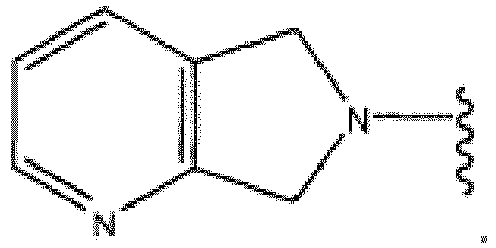
- Composé selon la revendication 1, dans lequel la fraction cyclique A est:

- Composé selon la revendication 1, dans lequel la fraction cyclique A est:

- Composé selon la revendication 1, dans lequel la fraction cyclique A est:

- Composé selon la revendication 1, dans lequel la fraction cyclique A est:

- Composé selon la revendication 1, dans lequel la fraction cyclique A est:

- Composé selon la revendication 1 choisi dans le groupe constitué de:


- Composition pharmaceutique comprenant au moins un composé selon l'une quelconque des revendications précédentes ou un sel pharmaceutiquement acceptable de celui-ci et des supports pharmaceutiquement acceptables.
- Composé selon l'une quelconque des revendications 1 à 8 ou un sel pharmaceutiquement acceptable de celui-ci pour une utilisation dans la thérapie.
- Composé selon l'une quelconque des revendications 1 à 8 ou un sel pharmaceutiquement acceptable de celui-ci pour une utilisation dans le traitement d'un cancer.
- Combinaison comprenant un composé selon l'une quelconque des revendications 1 à 8 ou un sel pharmaceutiquement acceptable de celui-ci et au moins un inhibiteur de kinase de point de contrôle.
Applications Claiming Priority (2)
| Application Number | Priority Date | Filing Date | Title |
|---|---|---|---|
| US23986009P | 2009-09-04 | 2009-09-04 | |
| PCT/US2010/046936 WO2011028638A1 (fr) | 2009-09-04 | 2010-08-27 | Modulateurs de points de contrôle du cycle cellulaire et leur utilisation en combinaison avec des inhibiteurs de kinase de point de contrôle |
Publications (3)
| Publication Number | Publication Date |
|---|---|
| EP2473041A1 EP2473041A1 (fr) | 2012-07-11 |
| EP2473041A4 EP2473041A4 (fr) | 2013-01-23 |
| EP2473041B1 true EP2473041B1 (fr) | 2018-03-07 |
Family
ID=43649593
Family Applications (1)
| Application Number | Title | Priority Date | Filing Date |
|---|---|---|---|
| EP10814320.7A Active EP2473041B1 (fr) | 2009-09-04 | 2010-08-27 | Modulateurs de points de contrôle du cycle cellulaire et leur utilisation en combinaison avec des inhibiteurs de kinase de point de contrôle |
Country Status (3)
| Country | Link |
|---|---|
| US (1) | US8993535B2 (fr) |
| EP (1) | EP2473041B1 (fr) |
| WO (1) | WO2011028638A1 (fr) |
Families Citing this family (6)
| Publication number | Priority date | Publication date | Assignee | Title |
|---|---|---|---|---|
| JP2011503084A (ja) | 2007-11-07 | 2011-01-27 | シェーリング コーポレイション | 新規の細胞周期チェックポイント調節剤およびこれらの調節剤とチェックポイント阻害剤との併用 |
| CN112472699A (zh) | 2013-07-26 | 2021-03-12 | 种族肿瘤学公司 | 改善比生群及衍生物的治疗益处的组合方法 |
| BR112020018094A2 (pt) | 2018-03-08 | 2020-12-22 | Incyte Corporation | Compostos de aminopirazina diol como inibidores de pi3k-¿ |
| US11046658B2 (en) | 2018-07-02 | 2021-06-29 | Incyte Corporation | Aminopyrazine derivatives as PI3K-γ inhibitors |
| WO2020041051A1 (fr) * | 2018-08-20 | 2020-02-27 | Cure Biopharma Inc. | Promédicaments de gemcitabine |
| GB202016708D0 (en) | 2020-10-21 | 2020-12-02 | Univ Birmingham | Uses of chk2 inhibitors |
Family Cites Families (31)
| Publication number | Priority date | Publication date | Assignee | Title |
|---|---|---|---|---|
| US3281410A (en) * | 1964-06-29 | 1966-10-25 | Syntex Corp | 5'-deoxy-5'-pyridinium nucleoside salts and derivatives thereof |
| US4526988A (en) | 1983-03-10 | 1985-07-02 | Eli Lilly And Company | Difluoro antivirals and intermediate therefor |
| EP0184365B1 (fr) | 1984-12-04 | 1993-08-04 | Eli Lilly And Company | Traitement de tumeurs chez les mammifères |
| US4938949A (en) | 1988-09-12 | 1990-07-03 | University Of New York | Treatment of damaged bone marrow and dosage units therefor |
| US6749988B2 (en) * | 2000-11-29 | 2004-06-15 | Shin-Etsu Chemical Co., Ltd. | Amine compounds, resist compositions and patterning process |
| US7161003B1 (en) | 2002-09-04 | 2007-01-09 | Schering Corporation | Pyrazolopyrimidines as cyclin dependent kinase inhibitors |
| DE60313872T2 (de) | 2002-09-04 | 2008-01-17 | Schering Corp. | Pyrazoloä1,5-aüpyrimidine als hemmstoffe cyclin-abhängiger kinasen |
| US7205308B2 (en) | 2002-09-04 | 2007-04-17 | Schering Corporation | Trisubstituted 7-aminopyrazolopyrimidines as cyclin dependent kinase inhibitors |
| MY141978A (en) | 2002-09-04 | 2010-08-16 | Schering Corp | Pyrazolopyrimidines as cyclin dependent kinase inhibitors |
| ES2285164T3 (es) | 2002-09-04 | 2007-11-16 | Schering Corporation | Pirazolopirimidinas como inhibidores de quinasas dependientes de ciclina. |
| US7196078B2 (en) | 2002-09-04 | 2007-03-27 | Schering Corpoartion | Trisubstituted and tetrasubstituted pyrazolopyrimidines as cyclin dependent kinase inhibitors |
| US7119200B2 (en) | 2002-09-04 | 2006-10-10 | Schering Corporation | Pyrazolopyrimidines as cyclin dependent kinase inhibitors |
| US7563798B2 (en) | 2002-09-04 | 2009-07-21 | Schering Corporation | Substituted pyrazolo[1,5-a]pyrimidines as protein kinase inhibitors |
| US7196092B2 (en) | 2002-09-04 | 2007-03-27 | Schering Corporation | N-heteroaryl pyrazolopyrimidines as cyclin dependent kinase inhibitors |
| CA2497539A1 (fr) | 2002-09-04 | 2004-03-18 | Schering Corporation | Pyrazolopyrimidines utiles en tant qu'inhibiteurs de kinasesdependantes des cyclines |
| US7601724B2 (en) | 2002-09-04 | 2009-10-13 | Schering Corporation | Substituted pyrazolo[1,5-a]pyrimidines as protein kinase inhibitors |
| US7605155B2 (en) | 2002-09-04 | 2009-10-20 | Schering Corporation | Substituted pyrazolo[1,5-a]pyrimidines as protein kinase inhibitors |
| NZ538685A (en) | 2002-09-23 | 2008-02-29 | Schering Corp | Imidazopyrazines as cyclin dependent kinase inhibitors |
| NZ538686A (en) | 2002-09-23 | 2008-01-31 | Schering Corp | Novel imidazopyrazines as cyclin dependent kinase inhibitors |
| US7576085B2 (en) | 2002-09-23 | 2009-08-18 | Schering Corporation | Imidazopyrazines as cyclin dependent kinase inhibitors |
| TW200526684A (en) | 2003-11-21 | 2005-08-16 | Schering Corp | Anti-IGFR1 antibody therapeutic combinations |
| EP1863571A1 (fr) | 2005-03-09 | 2007-12-12 | Shering Corporation | Composes inhibant l'activite de la kinesine ksp |
| JP2008533018A (ja) | 2005-03-09 | 2008-08-21 | シェーリング コーポレイション | KSPキネシン活性を阻害するための縮合チエノ[2,3−b]ピリジン化合物および縮合チアゾロ[5,4−b]ピリジン化合物 |
| US7521557B2 (en) | 2005-05-20 | 2009-04-21 | Bristol-Myers Squibb Company | Pyrrolopyridine-based inhibitors of dipeptidyl peptidase IV and methods |
| BRPI0616985B1 (pt) | 2005-10-06 | 2021-10-26 | Merck Sharp & Dohme Corp. | Composto de pirazolo[1,5-a]pirimidina, e, uso de um composto |
| JP5052518B2 (ja) | 2005-10-06 | 2012-10-17 | シェーリング コーポレイション | プロテインキナーゼインヒビターとしてのピラゾロピリミジン |
| US20070117804A1 (en) | 2005-11-10 | 2007-05-24 | Schering Corporation | Imidazopyrazines as protein kinase inhibitors |
| TW200803863A (en) | 2005-11-10 | 2008-01-16 | Schering Corp | Method for inhibiting protein kinases |
| EP2079746A2 (fr) | 2006-11-08 | 2009-07-22 | Schering Corporation | Imidazopyrazines comme inhibiteurs de protéines kinases |
| CA2690557A1 (fr) | 2007-06-14 | 2008-12-24 | Schering Corporation | Imidazopyrazines comme inhibiteurs de la proteine kinase |
| JP2011503084A (ja) | 2007-11-07 | 2011-01-27 | シェーリング コーポレイション | 新規の細胞周期チェックポイント調節剤およびこれらの調節剤とチェックポイント阻害剤との併用 |
-
2010
- 2010-08-27 EP EP10814320.7A patent/EP2473041B1/fr active Active
- 2010-08-27 WO PCT/US2010/046936 patent/WO2011028638A1/fr not_active Ceased
- 2010-08-27 US US13/393,571 patent/US8993535B2/en active Active
Non-Patent Citations (1)
| Title |
|---|
| LABROLI MARC A ET AL: "The identification of novel 5'-amino gemcitabine analogs as potent RRM1 inhibi", BIOORGANIC & MEDICINAL CHEMISTRY, vol. 22, no. 7, 15 February 2014 (2014-02-15), pages 2303 - 2310, XP028835532, ISSN: 0968-0896, DOI: 10.1016/J.BMC.2014.02.007 * |
Also Published As
| Publication number | Publication date |
|---|---|
| EP2473041A1 (fr) | 2012-07-11 |
| WO2011028638A1 (fr) | 2011-03-10 |
| EP2473041A4 (fr) | 2013-01-23 |
| US8993535B2 (en) | 2015-03-31 |
| US20120184505A1 (en) | 2012-07-19 |
Similar Documents
| Publication | Publication Date | Title |
|---|---|---|
| EP2217611B1 (fr) | Nouveaux modulateurs de points de contrôle du cycle cellulaire et leur utilisation en combinaison avec des inhibiteurs de kinase de point de contrôle | |
| EP2069349B1 (fr) | Nouvelles pyrazolopyrimidines servant d'inhibiteurs de kinases cycline-dépendantes | |
| EP1931676B1 (fr) | Pyrazolopyrimidines en tant qu'inhibiteurs de protéines kinases | |
| US7205308B2 (en) | Trisubstituted 7-aminopyrazolopyrimidines as cyclin dependent kinase inhibitors | |
| EP2069348B1 (fr) | Nouvelles pyrazolopyrimidines servant d'inhibiteurs de kinases cycline-dépendantes | |
| US20070275963A1 (en) | PYRAZOLO[1,5-a]PYRIMIDINES | |
| US7642266B2 (en) | Substituted pyrazolo[1,5-a]pyrimidines as protein kinase inhibitors | |
| US20070082902A1 (en) | Pyrazolopyrimidines as protein kinase inhibitors | |
| US20090175852A1 (en) | Imidazopyrazines as protein kinase inhibitors | |
| WO2008057512A2 (fr) | Imidazopyrazines comme inhibiteurs de protéines kinases | |
| WO2007044441A2 (fr) | Methodes destinees a inhiber des proteines kinases | |
| WO2007044401A2 (fr) | Nouvelles pyrazolopyrimidines servant d'inhibiteurs de kinases dépendantes des cyclines (cdk) | |
| EP2473041B1 (fr) | Modulateurs de points de contrôle du cycle cellulaire et leur utilisation en combinaison avec des inhibiteurs de kinase de point de contrôle | |
| AU2006302435B2 (en) | Use of pyrazolo [1 , 5 -a] pyrimidine derivatives for inhibiting protein kinases methods for inhibiting protein kinases |
Legal Events
| Date | Code | Title | Description |
|---|---|---|---|
| PUAI | Public reference made under article 153(3) epc to a published international application that has entered the european phase |
Free format text: ORIGINAL CODE: 0009012 |
|
| 17P | Request for examination filed |
Effective date: 20120404 |
|
| AK | Designated contracting states |
Kind code of ref document: A1 Designated state(s): AL AT BE BG CH CY CZ DE DK EE ES FI FR GB GR HR HU IE IS IT LI LT LU LV MC MK MT NL NO PL PT RO SE SI SK SM TR |
|
| RAP1 | Party data changed (applicant data changed or rights of an application transferred) |
Owner name: MERCK SHARP & DOHME CORP. |
|
| DAX | Request for extension of the european patent (deleted) | ||
| REG | Reference to a national code |
Ref country code: DE Ref legal event code: R079 Ref document number: 602010049079 Country of ref document: DE Free format text: PREVIOUS MAIN CLASS: A01N0043040000 Ipc: C07D0405040000 |
|
| A4 | Supplementary search report drawn up and despatched |
Effective date: 20130103 |
|
| RIC1 | Information provided on ipc code assigned before grant |
Ipc: C07D 487/04 20060101ALI20121219BHEP Ipc: C07D 405/04 20060101AFI20121219BHEP Ipc: C07D 513/04 20060101ALI20121219BHEP Ipc: C07D 498/04 20060101ALI20121219BHEP Ipc: C07D 471/04 20060101ALI20121219BHEP Ipc: A61K 31/70 20060101ALI20121219BHEP Ipc: C07D 405/14 20060101ALI20121219BHEP Ipc: A61P 35/00 20060101ALI20121219BHEP Ipc: C07H 19/06 20060101ALI20121219BHEP |
|
| 17Q | First examination report despatched |
Effective date: 20160201 |
|
| GRAP | Despatch of communication of intention to grant a patent |
Free format text: ORIGINAL CODE: EPIDOSNIGR1 |
|
| INTG | Intention to grant announced |
Effective date: 20170929 |
|
| GRAS | Grant fee paid |
Free format text: ORIGINAL CODE: EPIDOSNIGR3 |
|
| GRAA | (expected) grant |
Free format text: ORIGINAL CODE: 0009210 |
|
| AK | Designated contracting states |
Kind code of ref document: B1 Designated state(s): AL AT BE BG CH CY CZ DE DK EE ES FI FR GB GR HR HU IE IS IT LI LT LU LV MC MK MT NL NO PL PT RO SE SI SK SM TR |
|
| REG | Reference to a national code |
Ref country code: GB Ref legal event code: FG4D |
|
| REG | Reference to a national code |
Ref country code: CH Ref legal event code: EP Ref country code: AT Ref legal event code: REF Ref document number: 976424 Country of ref document: AT Kind code of ref document: T Effective date: 20180315 |
|
| REG | Reference to a national code |
Ref country code: IE Ref legal event code: FG4D |
|
| REG | Reference to a national code |
Ref country code: DE Ref legal event code: R096 Ref document number: 602010049079 Country of ref document: DE |
|
| REG | Reference to a national code |
Ref country code: NL Ref legal event code: MP Effective date: 20180307 |
|
| REG | Reference to a national code |
Ref country code: FR Ref legal event code: PLFP Year of fee payment: 9 |
|
| REG | Reference to a national code |
Ref country code: LT Ref legal event code: MG4D |
|
| PG25 | Lapsed in a contracting state [announced via postgrant information from national office to epo] |
Ref country code: NO Free format text: LAPSE BECAUSE OF FAILURE TO SUBMIT A TRANSLATION OF THE DESCRIPTION OR TO PAY THE FEE WITHIN THE PRESCRIBED TIME-LIMIT Effective date: 20180607 Ref country code: ES Free format text: LAPSE BECAUSE OF FAILURE TO SUBMIT A TRANSLATION OF THE DESCRIPTION OR TO PAY THE FEE WITHIN THE PRESCRIBED TIME-LIMIT Effective date: 20180307 Ref country code: LT Free format text: LAPSE BECAUSE OF FAILURE TO SUBMIT A TRANSLATION OF THE DESCRIPTION OR TO PAY THE FEE WITHIN THE PRESCRIBED TIME-LIMIT Effective date: 20180307 Ref country code: HR Free format text: LAPSE BECAUSE OF FAILURE TO SUBMIT A TRANSLATION OF THE DESCRIPTION OR TO PAY THE FEE WITHIN THE PRESCRIBED TIME-LIMIT Effective date: 20180307 Ref country code: CY Free format text: LAPSE BECAUSE OF FAILURE TO SUBMIT A TRANSLATION OF THE DESCRIPTION OR TO PAY THE FEE WITHIN THE PRESCRIBED TIME-LIMIT Effective date: 20180307 Ref country code: FI Free format text: LAPSE BECAUSE OF FAILURE TO SUBMIT A TRANSLATION OF THE DESCRIPTION OR TO PAY THE FEE WITHIN THE PRESCRIBED TIME-LIMIT Effective date: 20180307 |
|
| REG | Reference to a national code |
Ref country code: AT Ref legal event code: MK05 Ref document number: 976424 Country of ref document: AT Kind code of ref document: T Effective date: 20180307 |
|
| PG25 | Lapsed in a contracting state [announced via postgrant information from national office to epo] |
Ref country code: BG Free format text: LAPSE BECAUSE OF FAILURE TO SUBMIT A TRANSLATION OF THE DESCRIPTION OR TO PAY THE FEE WITHIN THE PRESCRIBED TIME-LIMIT Effective date: 20180607 Ref country code: GR Free format text: LAPSE BECAUSE OF FAILURE TO SUBMIT A TRANSLATION OF THE DESCRIPTION OR TO PAY THE FEE WITHIN THE PRESCRIBED TIME-LIMIT Effective date: 20180608 Ref country code: LV Free format text: LAPSE BECAUSE OF FAILURE TO SUBMIT A TRANSLATION OF THE DESCRIPTION OR TO PAY THE FEE WITHIN THE PRESCRIBED TIME-LIMIT Effective date: 20180307 Ref country code: SE Free format text: LAPSE BECAUSE OF FAILURE TO SUBMIT A TRANSLATION OF THE DESCRIPTION OR TO PAY THE FEE WITHIN THE PRESCRIBED TIME-LIMIT Effective date: 20180307 |
|
| PG25 | Lapsed in a contracting state [announced via postgrant information from national office to epo] |
Ref country code: EE Free format text: LAPSE BECAUSE OF FAILURE TO SUBMIT A TRANSLATION OF THE DESCRIPTION OR TO PAY THE FEE WITHIN THE PRESCRIBED TIME-LIMIT Effective date: 20180307 Ref country code: PL Free format text: LAPSE BECAUSE OF FAILURE TO SUBMIT A TRANSLATION OF THE DESCRIPTION OR TO PAY THE FEE WITHIN THE PRESCRIBED TIME-LIMIT Effective date: 20180307 Ref country code: AL Free format text: LAPSE BECAUSE OF FAILURE TO SUBMIT A TRANSLATION OF THE DESCRIPTION OR TO PAY THE FEE WITHIN THE PRESCRIBED TIME-LIMIT Effective date: 20180307 Ref country code: IT Free format text: LAPSE BECAUSE OF FAILURE TO SUBMIT A TRANSLATION OF THE DESCRIPTION OR TO PAY THE FEE WITHIN THE PRESCRIBED TIME-LIMIT Effective date: 20180307 Ref country code: NL Free format text: LAPSE BECAUSE OF FAILURE TO SUBMIT A TRANSLATION OF THE DESCRIPTION OR TO PAY THE FEE WITHIN THE PRESCRIBED TIME-LIMIT Effective date: 20180307 Ref country code: RO Free format text: LAPSE BECAUSE OF FAILURE TO SUBMIT A TRANSLATION OF THE DESCRIPTION OR TO PAY THE FEE WITHIN THE PRESCRIBED TIME-LIMIT Effective date: 20180307 |
|
| PG25 | Lapsed in a contracting state [announced via postgrant information from national office to epo] |
Ref country code: AT Free format text: LAPSE BECAUSE OF FAILURE TO SUBMIT A TRANSLATION OF THE DESCRIPTION OR TO PAY THE FEE WITHIN THE PRESCRIBED TIME-LIMIT Effective date: 20180307 Ref country code: CZ Free format text: LAPSE BECAUSE OF FAILURE TO SUBMIT A TRANSLATION OF THE DESCRIPTION OR TO PAY THE FEE WITHIN THE PRESCRIBED TIME-LIMIT Effective date: 20180307 Ref country code: SM Free format text: LAPSE BECAUSE OF FAILURE TO SUBMIT A TRANSLATION OF THE DESCRIPTION OR TO PAY THE FEE WITHIN THE PRESCRIBED TIME-LIMIT Effective date: 20180307 Ref country code: SK Free format text: LAPSE BECAUSE OF FAILURE TO SUBMIT A TRANSLATION OF THE DESCRIPTION OR TO PAY THE FEE WITHIN THE PRESCRIBED TIME-LIMIT Effective date: 20180307 |
|
| REG | Reference to a national code |
Ref country code: DE Ref legal event code: R097 Ref document number: 602010049079 Country of ref document: DE |
|
| PG25 | Lapsed in a contracting state [announced via postgrant information from national office to epo] |
Ref country code: PT Free format text: LAPSE BECAUSE OF FAILURE TO SUBMIT A TRANSLATION OF THE DESCRIPTION OR TO PAY THE FEE WITHIN THE PRESCRIBED TIME-LIMIT Effective date: 20180709 |
|
| PLBE | No opposition filed within time limit |
Free format text: ORIGINAL CODE: 0009261 |
|
| STAA | Information on the status of an ep patent application or granted ep patent |
Free format text: STATUS: NO OPPOSITION FILED WITHIN TIME LIMIT |
|
| PG25 | Lapsed in a contracting state [announced via postgrant information from national office to epo] |
Ref country code: DK Free format text: LAPSE BECAUSE OF FAILURE TO SUBMIT A TRANSLATION OF THE DESCRIPTION OR TO PAY THE FEE WITHIN THE PRESCRIBED TIME-LIMIT Effective date: 20180307 |
|
| 26N | No opposition filed |
Effective date: 20181210 |
|
| PG25 | Lapsed in a contracting state [announced via postgrant information from national office to epo] |
Ref country code: SI Free format text: LAPSE BECAUSE OF FAILURE TO SUBMIT A TRANSLATION OF THE DESCRIPTION OR TO PAY THE FEE WITHIN THE PRESCRIBED TIME-LIMIT Effective date: 20180307 |
|
| PG25 | Lapsed in a contracting state [announced via postgrant information from national office to epo] |
Ref country code: MC Free format text: LAPSE BECAUSE OF FAILURE TO SUBMIT A TRANSLATION OF THE DESCRIPTION OR TO PAY THE FEE WITHIN THE PRESCRIBED TIME-LIMIT Effective date: 20180307 |
|
| REG | Reference to a national code |
Ref country code: CH Ref legal event code: PL |
|
| PG25 | Lapsed in a contracting state [announced via postgrant information from national office to epo] |
Ref country code: LU Free format text: LAPSE BECAUSE OF NON-PAYMENT OF DUE FEES Effective date: 20180827 Ref country code: CH Free format text: LAPSE BECAUSE OF NON-PAYMENT OF DUE FEES Effective date: 20180831 Ref country code: LI Free format text: LAPSE BECAUSE OF NON-PAYMENT OF DUE FEES Effective date: 20180831 |
|
| REG | Reference to a national code |
Ref country code: BE Ref legal event code: MM Effective date: 20180831 |
|
| PG25 | Lapsed in a contracting state [announced via postgrant information from national office to epo] |
Ref country code: BE Free format text: LAPSE BECAUSE OF NON-PAYMENT OF DUE FEES Effective date: 20180831 |
|
| PG25 | Lapsed in a contracting state [announced via postgrant information from national office to epo] |
Ref country code: MT Free format text: LAPSE BECAUSE OF NON-PAYMENT OF DUE FEES Effective date: 20180827 |
|
| PG25 | Lapsed in a contracting state [announced via postgrant information from national office to epo] |
Ref country code: TR Free format text: LAPSE BECAUSE OF FAILURE TO SUBMIT A TRANSLATION OF THE DESCRIPTION OR TO PAY THE FEE WITHIN THE PRESCRIBED TIME-LIMIT Effective date: 20180307 |
|
| PG25 | Lapsed in a contracting state [announced via postgrant information from national office to epo] |
Ref country code: HU Free format text: LAPSE BECAUSE OF FAILURE TO SUBMIT A TRANSLATION OF THE DESCRIPTION OR TO PAY THE FEE WITHIN THE PRESCRIBED TIME-LIMIT; INVALID AB INITIO Effective date: 20100827 |
|
| PG25 | Lapsed in a contracting state [announced via postgrant information from national office to epo] |
Ref country code: IE Free format text: LAPSE BECAUSE OF NON-PAYMENT OF DUE FEES Effective date: 20180827 Ref country code: MK Free format text: LAPSE BECAUSE OF NON-PAYMENT OF DUE FEES Effective date: 20180307 |
|
| PG25 | Lapsed in a contracting state [announced via postgrant information from national office to epo] |
Ref country code: IS Free format text: LAPSE BECAUSE OF FAILURE TO SUBMIT A TRANSLATION OF THE DESCRIPTION OR TO PAY THE FEE WITHIN THE PRESCRIBED TIME-LIMIT Effective date: 20180707 |
|
| REG | Reference to a national code |
Ref country code: DE Ref legal event code: R081 Ref document number: 602010049079 Country of ref document: DE Owner name: MERCK SHARP & DOHME LLC, RAHWAY, US Free format text: FORMER OWNER: MERCK SHARP & DOHME CORP., RAHWAY, N.J., US |
|
| REG | Reference to a national code |
Ref country code: GB Ref legal event code: 732E Free format text: REGISTERED BETWEEN 20220908 AND 20220914 |
|
| PGFP | Annual fee paid to national office [announced via postgrant information from national office to epo] |
Ref country code: DE Payment date: 20250709 Year of fee payment: 16 |
|
| PGFP | Annual fee paid to national office [announced via postgrant information from national office to epo] |
Ref country code: GB Payment date: 20250710 Year of fee payment: 16 |
|
| PGFP | Annual fee paid to national office [announced via postgrant information from national office to epo] |
Ref country code: FR Payment date: 20250709 Year of fee payment: 16 |