EP2473629B1 - Identifizierung von virus tropismus - Google Patents
Identifizierung von virus tropismus Download PDFInfo
- Publication number
- EP2473629B1 EP2473629B1 EP10763790.2A EP10763790A EP2473629B1 EP 2473629 B1 EP2473629 B1 EP 2473629B1 EP 10763790 A EP10763790 A EP 10763790A EP 2473629 B1 EP2473629 B1 EP 2473629B1
- Authority
- EP
- European Patent Office
- Prior art keywords
- hsa
- receptor
- mir
- virus
- cell
- Prior art date
- Legal status (The legal status is an assumption and is not a legal conclusion. Google has not performed a legal analysis and makes no representation as to the accuracy of the status listed.)
- Not-in-force
Links
Images
Classifications
-
- C—CHEMISTRY; METALLURGY
- C12—BIOCHEMISTRY; BEER; SPIRITS; WINE; VINEGAR; MICROBIOLOGY; ENZYMOLOGY; MUTATION OR GENETIC ENGINEERING
- C12Q—MEASURING OR TESTING PROCESSES INVOLVING ENZYMES, NUCLEIC ACIDS OR MICROORGANISMS; COMPOSITIONS OR TEST PAPERS THEREFOR; PROCESSES OF PREPARING SUCH COMPOSITIONS; CONDITION-RESPONSIVE CONTROL IN MICROBIOLOGICAL OR ENZYMOLOGICAL PROCESSES
- C12Q1/00—Measuring or testing processes involving enzymes, nucleic acids or microorganisms; Compositions therefor; Processes of preparing such compositions
- C12Q1/68—Measuring or testing processes involving enzymes, nucleic acids or microorganisms; Compositions therefor; Processes of preparing such compositions involving nucleic acids
- C12Q1/6813—Hybridisation assays
Definitions
- the present invention as defined by claims 1-16 relates to a method of characterizing the cellular tropism of a virus, including Human Immunodeficiency Virus (HIV), and in particular the ability of the HIV virus to use CXCR4 receptors and / or CCR5 to enter the cells.
- HIV Human Immunodeficiency Virus
- the entry of the HIV virus into cells involves several viral proteins including the gp41 and gp120 envelope proteins.
- the first step in the replication cycle of the HIV virus involves the attachment of the virus to helper T4 cells by interaction of the gp120 protein with the CD4 cell protein.
- the HIV virus must interact with a cellular co-receptor.
- the most important co-receptors in vivo are the CXCR4 and CCR5 chemokine receptors.
- the use of the different co-receptors is associated with the evolution of the immunodeficiency and, consequently, of the infection: at the beginning of the infection, the so-called R5 viruses interact with the co-receptor CCR5, then at a stage more advanced, some viruses use the co-receptor CXCR4 (so-called X4 virus).
- the viral population comprises either a mixture of R5 and X4 viruses, or R5 / X4 double tropism viruses.
- the R5 viruses can directly induce the onset of AIDS, however it is the appearance of X4 virus that is usually associated with the development of the disease. It is therefore essential to be able to detect early onset of X4 viruses in the patient.
- the TROFILE test is a phenotypic test for the HIV virus proposed by Monogram Biosciences and Pfizer.
- a vector library containing the regions encoding the HIV envelope of a patient is made. These vectors are then amplified and the envelope coding regions are cloned into a vector expressing an HIV virus lacking envelope protein and expressing the luciferase gene.
- recombinant viruses obtained from these vectors are used to infect cells expressing CD4 and CCR5 or CXCR4. The ability of a virus to infect these cells is determined by measuring the light emission produced by luciferase.
- the object of the present invention is to provide such tests.
- the present invention as defined by claims 1-16 stems from the unexpected finding by the inventors that the expression of miRNA in a cell susceptible to be infected by an HIV virus is modulated according to the co-receptor used. by the HIV virus to enter the cell.
- miRNA refers to an RNA class, typically 20 to 25 nucleotides in length, involved in the post-transcriptional regulation of specific genes by degrading or blocking the translation of mRNA from the transcription of these genes.
- target mRNA of a miRNA is meant mRNA which is known or has been determined to be degraded or whose translation is blocked by said miRNA.
- MiRNAS are described in particular in Griffiths-Jones ((2004) Nucleic Acids Res 32: D109-D111 ), in Griffiths-Jones et al. ((2008) Nucleic Acids Res 36: D154-D158 ) and in the miRNA database (miRBase, http://microARN.sanger.ac.uk).
- virus includes all types of viruses.
- the virus may be selected from the group of viruses whose variants or species are more or less pathogenic, for example retroviruses, in particular the HIV virus, influenza viruses, coronaviruses, measles viruses, herpesviruses (including EBV, Simplex and CMV viruses), papillomaviruses.
- the virus is a retrovirus selected from human retroviruses including HIV, HTLV-I and XMRV.
- the virus is HIV and in particular the HIV-1 and HIV-2 viruses (in particular described in the database HIV databases, http: //www.hiv.
- the viruses used to carry out the infections may, for example, be prototype viruses such as the HIV-1, NL4.3, HIV-2 ROD or HIV-1 NLAD8 viruses or viruses. of a patient.
- the HIV viruses according to the invention can use one or more co-receptors to enter the target cells.
- the HIV viruses used use only one type of co-receptor to enter a cell.
- the term "patient” refers to a human being infected with a virus.
- the virus is HIV.
- the patient may then have developed an AIDS (Acquired Immunodeficiency Syndrome).
- the patient is on anti-retroviral treatment, for example under HAART treatment (highly active anti-retroviral therapy ("Highly Active Anti Retroviral Therapy”)).
- receptor and “cell receptor” according to the invention denote a cell surface structure, generally a protein, involved in the recognition of a target cell by a virus and generally resulting in the attachment of this virus to the target cell.
- co-receptor and “cellular co-receptor” include all of the cell surface proteins participating in the entry of the virus excluding the cellular receptor.
- co-receptor When the virus is HIV, the terms “co-receptor” and “cellular co-receptor” more specifically encompass all of the cell surface proteins involved in the entry of the virus in addition to the interaction between the virus and the virus. CD4 cell receptor.
- the entry of an HIV virus into a host cell involves fusion between the cell and viral membranes.
- the co-receptor may be selected from the group consisting of CXCR4, CCR5, CCR3, CCR2, CCR1, CCR4, CCR8, CCR9, CXCR2, STRL33, V28, gpr1, gpr15 and ChemR23.
- the co-receiver is CCR5 or CXCR4.
- CXCR4 is also known as Fusin, LESTR and NPY3R.
- the CRCR4 gene preferably refers here to the sequence of the human CXCR4 gene whose mRNA sequence may, for example, be SEQ ID NO: 1 or any allelic or polymorphic variant thereof, as well as the orthologous sequences present in other genes. species.
- the CXCR4 gene encodes the CXCR4 protein that can have the sequence represented by SEQ ID NO: 2 or any natural variant thereof.
- CCR5 is also known as CKR-5 and CMKRB5.
- the CCR5 gene preferably denotes the sequence of the human CCR5 gene whose mRNA sequence may, for example, be SEQ ID NO: 3 or any allelic or polymorphic variant thereof, as well as the orthologous sequences present in other sequences. species.
- the CCR5 gene encodes the CCR5 protein that may have the sequence represented by SEO ID NO: 4 or any natural variant thereof.
- CCR3 is also known as CC-CKR-3, CKR-3 and CMKBR3.
- the CCR3 gene preferably refers here to the sequence of the human CCR3 gene whose mRNA sequence may, for example, be SEQ ID NO: 5 or any allelic or polymorphic variant thereof, as well as the orthologous sequences present in other sequences. species.
- the CCR3 gene encodes the CCR3 protein that can have the sequence represented by SEQ ID NO: 6 or any natural variant thereof.
- CCR2 is also known as CCR2b and CMKBR2.
- the CCR2 gene here preferably designates the sequence of the human CCR2 gene whose mRNA sequence may, for example, be SEQ ID NO: 7 or any allelic or polymorphic variant thereof, as well as the orthologous sequences present in other sequences. species.
- the CCR2 gene encodes the CCR2 protein that can have the sequence represented by SEQ ID NO: 8 or any natural variant thereof.
- CCR1 is also known as CKR1 and CMKBR1.
- the CCR11 gene preferably refers here to the sequence of the human CCR1 gene whose mRNA sequence may, for example, be SEQ ID NO: 9 or any allelic or polymorphic variant thereof, as well as the orthologous sequences present in other sequences. species.
- the CCR1 gene encodes the CCR1 protein that may have the sequence represented by SEQ ID NO: 10 or any natural variant thereof.
- CCR4 is also known as CKR-4.
- the CCR4 gene preferably denotes the sequence of the human CCR4 gene whose mRNA sequence may for example be SEQ ID NO: 11 or any allelic or polymorphic variant thereof as well as the orthologous sequences present in other species.
- the CCR4 gene encodes the sequentially present CCR4 protein represented by SEQ ID NO: 12 or any naturally occurring variant thereof.
- CCR8 is also known as ChemR1, TER1 and CMKBR8.
- the CCR8 gene preferably refers here to the sequence of the human CCR8 gene whose mRNA sequence may, for example, be SEQ ID NO: 13 or any allelic or polymorphic variant thereof, as well as the orthologous sequences present in other sequences. species.
- the CCR8 gene encodes the CCR8 protein that can have the sequence represented by SEQ ID NO: 14 or any natural variant thereof.
- CCR9 is also known as D6.
- the CCR9 gene preferably refers here to the sequence of the human CCR9 gene whose mRNA sequence may, for example, be SEQ ID NO: 15 or any allelic or polymorphic variant thereof, as well as the orthologous sequences present in other sequences. species.
- the CCR9 gene encodes the CCR9 protein that can have the sequence represented by SEQ ID NO: 16 or any natural variant thereof.
- CXCR2 is also known as IL-8RB.
- the CXCR2 gene preferably refers here to the sequence of the human CXCR2 gene whose mRNA sequence may, for example, be SEQ ID NO: 17 or any allelic or polymorphic variant thereof, as well as the orthologous sequences present in other sequences. species.
- the CXCR2 gene encodes the CXCR2 protein that may have the sequence represented by SEQ ID NO: 18 or any natural variant thereof.
- STRL33 is also known as Bonzo, CXCR6 and TYMSTR.
- the STRL33 gene here preferably designates the sequence of the human STRL33 gene whose mRNA sequence may, for example, be SEQ ID NO: 19 or any allelic or polymorphic variant thereof, as well as the orthologous sequences present in other sequences. species.
- the STRL33 gene encodes the STRL33 protein that can have the sequence represented by SEQ ID NO: 20 or any natural variant thereof.
- V28 is also known as CMKBRL1, CX3CR1 and GPR13.
- the V28 gene preferably denotes the sequence of the human V28 gene whose mRNA sequence may, for example, be SEQ ID NO: 21 or any allelic or polymorphic variant thereof, as well as the orthologous sequences present in other genes. species.
- the V28 gene encodes the V28 protein that may have the sequence represented by SEQ ID NO: 22 or any natural variant thereof.
- the gpr1 or GPR1 gene preferably refers here to the sequence of the human gpr1 gene whose mRNA sequence may, for example, be SEQ ID NO: 23 or any allelic or polymorphic variant thereof, as well as the orthologous sequences present in d other species.
- the gpr1 gene encodes the gpr1 protein having the sequence represented by SEQ ID NO: 24 or any natural variant thereof.
- the gpr15 gene preferably refers to the sequence of the human gpr15 gene whose mRNA sequence may, for example, be SEQ ID NO: 25 or any allelic or polymorphic variant thereof, as well as the orthologous sequences present in other genes. species.
- the gpr15 gene encodes the gpr15 protein that may have the sequence represented by SEQ ID NO: 26 or any natural variant thereof.
- Apj is also known as angiotensin-receptor-like, apelin receptor (APLNR) and AGTRL1.
- the Apj gene preferably denotes the sequence of the human Apj gene whose mRNA sequence may, for example, be SEQ ID NO: 27 or any allelic or polymorphic variant thereof, as well as the orthologous sequences present in other genes. species.
- the Apj gene encodes the Apj protein that may have the sequence represented by SEQ ID NO: 28 or any natural variant thereof.
- the ChemR23 gene is also known as CMKLR1 and DEZ.
- the ChemR23 gene here preferably refers to the sequence of the human ChemR23 gene whose mRNA sequence may, for example, be SEQ ID NO: 29 or any allelic or polymorphic variant thereof, as well as the orthologous sequences present in other genes. species.
- the ChemR23 gene encodes the ChemR23 protein that can have the sequence represented by SEQ ID NO: 30 or any natural variant thereof.
- test cell is understood to mean any cell capable of being infected by a virus according to the invention.
- virus when the virus is HIV, the test cell according to the invention expresses CD4, a first and at least one other co-receptor of the HIV virus as defined above.
- the test cell according to the invention expresses CXCR4 and CCR5.
- a test cell according to the invention can express naturally these receptors or be genetically modified to express these receptors.
- the test cell according to the invention may for example be a dendritic cell, a cell derived from lymphoid (preferentially a T lymphocyte) or myeloid (preferentially a macrophage), an epithelial cell or a fibroblast cell line.
- the test cell according to the invention is selected from the group comprising Jurkat cells (in particular described in Schneider et al. Int J Cancer (1997) 19 (5): 621-6 ), for example the Jurkat E6-1 cell clone (ATCC No: TIB-152), the Jurkat-CCR5 cells (described in particular in Alkhatib et al. (1996) Science 272: 1955-1958 and AIDS reagent NIBSC, UK). Even more preferentially, the test cell according to the invention is a Jurkat-CCR5 cell.
- the level of microRNA expression or target mRNA expression level in the test cells can be measured by any techniques known to those skilled in the art. Many methods are known that make it possible to quantify RNA, for example, methods based on reverse transcription PCR (RT-PCR) using oligonucleotides specific for RNA sequences or methods allowing hybridization of these RNAs. duplicates or triplicates of these RNAs with probes under stringent conditions.
- RT-PCR reverse transcription PCR
- the stringent conditions according to the invention may comprise a hybridization step of 10 to 20 hours, preferably 16 hours, at a temperature of 40 to 50 ° C., preferably at 50 ° C., in the presence of an equivalent ionic strength. to that induced by a concentration of 500mM to 2M NaCl, preferably 1M NaCl.
- buffer solutions such as Tris or MES, EDTA, Tween and BSA (bovine serum albumin).
- the levels of expression of the microRNAs or of their target mRNAs thus measured, in a test cell respectively infected with a first virus using a first co-receptor and with at least one other virus using another co-receptor, may make it possible to identify microRNAs or their target mRNA whose expression is modulated during infection by each of the viruses compared to uninfected cells.
- the identification of microRNAs or their target mRNA whose expression is modulated during Infection with each virus can be performed by comparing the expression levels of the miRNAs or their target mRNAs measured after infection by each of the viruses with the level of expression of said miRNAs or said target mRNAs in uninfected cells.
- a microRNA or its target mRNAs to be considered to have modulated expression when the test cells are infected with a virus, that expression is increased or decreased relative to the expression in the uninfected test cells of a log2 of the ratio (expression of said miRNA in infected cells / expression of said miRNA in uninfected cells) greater than 0.5 or less than -0.5 respectively.
- microRNAs or their target mRNAs identified as having modulated expression during infection by each of the viruses can then be compared to select the miRNAs or their target mRNAs whose expression is specifically modified by the use of a receptor by the virus.
- modification of the level of specific expression of the use of a co-receptor is meant a modification, increase or decrease of the expression sufficient to identify the co-receptor used by the virus.
- Uninfected test cells or "cells not infected with the patient's virus” means cells that have not been brought into contact with any virus whatsoever, but also cells infected with a virus, in particular a virus.
- retroviruses whose cellular co-receptors are presented by the test cells but are distinct from the first co-receptor or at least one other co-receptor used by the virus to enter the test cell in the methods according to the invention.
- this virus may be an HIV virus pseudotyped by a VSV type amphotropic envelope or the PFV-1 virus.
- a miRNA or its target mRNA is increased upon infection with a first HIV virus using the CXCR4 co-receptor in Jurkat-CCR5 cells (expressing CXCR4 and CCR5) by the expression of miRNA or a target mRNA thereof in uninfected Jurkat-CCR5 cells and that the expression of this miRNA or a target mRNA thereof is not increased upon infection with a second HIV virus using the CCR5 co-receptor in Jurkat-CCR5 cells relative to the expression of the miRNA or one of its target mRNAs in the uninfected Jurkat-CCR5 cells, while increasing the expression of said miRNA or said target mRNA is specific for the use of the CXCR4 receptor by the HIV virus.
- the levels of expression of the microRNAs or their target mRNAs thus measured in a test cell after infection respectively with a virus using a first co-receptor and at least one other virus using another co-receptor can then be compared directly with each other. This comparison then makes it possible to identify the microRNAs or their target mRNA whose modification of the expression is specific to the use of the first coreceptor or at least one other co-receptor by the virus.
- the methods according to the invention may also comprise an additional step making it possible to identify the target mRNAs of the characteristic micro-RNAs thus identified, the modification of the level of expression of which is specific to the use of a co-receptor by a virus for enter a cell.
- MiRNA targets can be identified in databases, including miRBase (http://microrna.sanger.ac.uk/, and in particular described in Griffiths-Jones et al (2008) Nucleic Acids Res 36 , Griffiths-Jones et al. (2006) Nucleic Acids Res 34 , Griffiths-Jones et al. (2004) Nucleic Acids Research 32 ) and TargetScan ( http://www.targetscan.org/ and in particular described in Lewis et al. (2005) Cell 120: 15-20 , Grimson et al. (2007) Molecular Cell 27: 91-105 , Friedman et al. (2009) Genome Research 19: 92-105 ).
- patient sample that may include the HIV virus includes all biological fluids or tissues from a patient that may contain viruses such as, for example, peripheral blood, genital mucosa, lymphoid tissue, cerebral fluid - spinal, placenta or breast milk.
- viruses such as, for example, peripheral blood, genital mucosa, lymphoid tissue, cerebral fluid - spinal, placenta or breast milk.
- the sample can be put directly in contact with the test cells.
- the viruses are extracted from the sample before contact with the host cells.
- the viruses of the patients can come from primary isolates derived from a biological sample and be obtained by any method known to those skilled in the art, for example, the isolation of HIV viruses can be carried out by co-culture lymphocytes of HIV-infected patients with seronegative donor lymphocytes for HIV, in particular according to the technique described by Barre-Sinoussi et al ((1983) Science 220 (4599): 868-71 ).
- the peripheral blood of a patient infected with the HIV virus can also be treated so as to separate the plasma from the cells (as described in particular by Fang et al. (1995) Proc. Natl. Acad. Sci. USA 92: 12110-4 ).
- the level of expression of at least one miRNA and / or at least one target mRNA of this miRNA is measured.
- this miRNA and / or its target mRNA has been identified as having a modification of the level of expression specific to the use of the virus of a co-receptor.
- this miRNA and / or its target mRNA has been identified by a method according to the invention.
- the virus identification method in a patient according to the invention can be used to identify viruses using CXCR4 and / or CCR5.
- this miRNA and / or its target mRNA will then have been identified as having a modification of the level of expression specific to the use by the HIV virus of the CXCR4 and / or CCR5 receptor.
- this miRNA and / or its target mRNA will have been identified by the miRNA identification method according to the invention.
- the method according to the invention is implemented to identify the presence or absence of virus using the CXCR4 co-receptor in a patient.
- the method according to the invention can also be performed several times on samples from the same patient taken at different times over time in order to identify the appearance of viruses using the CXCR4 receptor and thus to follow the evolution. of the disease in this patient.
- the predetermined value may be a single value such as, for example, a level or average of expression levels of a given miRNA or a given target mRNA.
- the predetermined value may be the value of the expression of a given miRNA or a given target mRNA in a cell expressing this co-receptor and infected with a reference virus known to use this co-receptor to enter the cell.
- the predetermined value may be the value of the expression of a given miRNA or target mRNA in a cell expressing CXCR4 or CCR5 after infection with a reference HIV virus using CXCR4 or CCR5 to enter a cell.
- the comparison between the obtained expression value and the predetermined value makes it possible to determine whether or not the studied virus uses the same co-receptor as the reference virus to enter the cells. For example, if the value obtained is close from the predetermined value, it is possible to deduce that a co-receptor used by the tested virus is identical to that used by the reference virus to enter the cells.
- near value preferably means values that do not differ by more than 50%, 40%, 30%, 20% or 10% and even more preferably less than 5%.
- the reference value may also be, for example, the value of the expression of a given miRNA or target mRNA in an uninfected cell and thus in the absence of infection by the patient's virus.
- the expression of said miRNA or said target mRNA is modulated, increased or decreased, specifically after infection of the cell with a reference virus using a given co-receptor relative to the expression in an uninfected cell.
- the increase or decrease in the expression value of a miRNA or a target mRNA of the same nature as that previously determined indicates a use of the same co-receptor by the viruses.
- the step of comparing the level of expression with a determined value (iii) in the method of identifying a co-receptor used by a virus of an infected patient according to the invention is then preferably implemented by determining if the expression level of at least one miRNA and / or at least one miRNA target mRNA is increased or decreased relative to the level of expression of the at least one miRNA and / or the at least one target mRNA. miRNA in uninfected test cells.
- measuring the expression of one or more target microRNAs or mRNAs, the expression of which has been shown to be specifically modified (increased or decreased) by reference HIV viruses using the CXCR4 co-receptor, in uninfected cells can be compared to measurements of the expression of said target microRNA or mRNA in cells after infection with viruses of a patient. In the absence of predefined modulations of some microRNAs, this test will identify that CXCR4 is not a co-receptor used by the patient's HIV virus.
- CXCR4 is a co-receptor used by the HIV virus of the patient
- a virus may be a double-tropism virus for example , which can use CCR5 and CXCR4.
- the miRNA whose expression is determined can be, for example, selected from the group consisting of hsa-miR-574-5p (in particular of SEQ ID NO: 31, ugagugugugugugugugugugugugu), hsa-miR-663 (in particular of SEQ ID NO : 32, aggcggggcgccgcgggaccgc), hsa-miR-149 * (in particular of SEQ ID NO: 33, agggagggacgggggcugugc), hsa-miR-575 (in particular of SEQ ID NO: 34, gagccaguuggacaggagc), hsa-miR-638 (in particular of SEQ ID NO: 35, agggaucgcgggcggguggcggccu), hsa-miR-181b (in particular of SEQ ID NO: 36, aacauucauugcugucggugggu), hsa-let-7g
- the miRNAs whose expression is determined can also be allelic or polymorphic variants of SEQ ID NO: 31 to 40 as well as orthologous sequences present in other species derived from miRNAs of sequence SEQ ID NO: 31 to 40 and filling the same function, in particular regulating the expression of the same target mRNAs.
- these miRNAs can derive miRNAs of SEQ ID NO: 31-40 sequence by one or more nucleic acid mutations.
- the mRNA whose expression is determined can be, for example, selected from the group consisting of miRNA target mRNAs of SEQ ID NOs: 31 to 40 or miRNAs derived therefrom.
- target mRNAs can be identified in databases as described above.
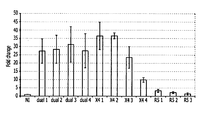
- FIG. 1 Expression of hsa-miR-638 in response to infection with primary HIV-1 isolates of CXCR4, CCR5 tropism or dual tropism viruses.
- Jurkat-CCR5 cells are infected with 4 DUAL isolates (dual 1, dual 2, dual 3, dual 4), 4 CXCR4 isolates (X4 1, X4 2, X4 3, X4 4) and 3 CCR5 isolates (R5 1, R5 2, R5 3).
- the cells Three days post-infection, the cells are lysed and the RNAs are analyzed by RT-qPCR directed against hsa-miR-638.
- the expression of hsa-miR-638 in the infected cells is normalized by the expression of uninfected Jurkat R5 control cells (NI).
- the viruses used in this study are the HIV-1 NL4.3 and HIV-2 ROD prototype viruses both using the CXCR4 co-receptor, the HIV-1 NLAD8 virus using the CCR5 co-receptor, and viruses derived from isolates.
- using the co-receptor CXCR4 (3 isolates named X4 1, X4 2, X4 3 and X4 4)
- using the co-receptor CCR5 (3 isolates named R5 1, R5 2 and R5 3) or that can use both co-receptors CXCR4 and CCR5 receptors (four isolates named dual 1, dual 2, dual 3 and dual 4) as well as another retrovirus, PFV-1, using neither CD4 nor CXCR4 nor CCR5 for its entry.
- Jurkat and Jurkat-CCR5 cell lines expressing CCR5 stably are used.
- the Jurkat and Jurkat-CCR5 cells are infected for 3 days with two infectious doses of HIV-1 NL4.3, HIV-2 ROD in order to take into account modulations linked to the multiplicity of infection.
- Jurkat-CCR5 cells are infected for 3 days with HIV-1 NLAD8 or PFV-1.
- the Jurkat-CCR5 cells are infected for 3 days by the viruses X4 1, X4 2, X4 3 and X4 4, R5 1, R5 2, R5 3, dual 1, dual 2, dual 3 or dual 4.
- Jurkat cells Uninfected CCR5 are used as a control (NI).
- RNAs Three days after infection with the prototype viruses, the RNAs are extracted and subjected to microRNA chip analysis (LC Sciences or Affymetrix).
- hsa-miR-368 Three days after virus infection from primary isolates, the cells are lysed and the expression of hsa-miR-368 is analyzed by RT-qPCR. The expression of hsa-miR-368 in the infected cells is normalized to the expression of hsa-miR-368 in uninfected Jurkat-CCR5 control cells (NI).
- microRNA whose expression is increased when infected with NLAD8 hsa-miR-19a hsa-miR-30b hsa-miR-19b hsa-miR-23b hsa-miR-30e hsa-miR-128 hsa-miR-29a hsa-miR-106a hsa-miR-29c hsa-miR-15a hsa-miR-342-3p hsa-miR-17 hsa-miR-30c hsa-miR-222 hsa-miR-92b hsa-miR-30d hsa-miR-1280 hsa-miR-93 hsa-miR-16 hsa-miR-150 hsa-miR-18b hsa-let-7i hsa-miR-92a hsa
- microRNA whose expression is decreased during infection with NL4.3, ROD and NLAD8 hsa-miR-181b hsa-miR-374b hsa-miR-26b hsa-miR-181d hsa-let-7c hsa-miR-98 hsa-miR-7 hsa-let-7e hsa-miR-9
- microRNA expression is increased upon NL4.3 or ROD infection but is not increased upon NLAD8 infection.
- the expression of 4 microRNAs is specifically decreased during infection with NL4.3 or ROD but is not decreased during NLAD8 infection (Table 4).
- No microRNA whose expression is increased or decreased specifically during NL4.3 or ROD infection is affected by PFV-1 infection.
- hsa-miR-574-5p increased 33 hsa-miR-663 increased 34 hsa-miR-149 * increased 35 hsa-miR-575 increased 36 hsa-miR-638 increased 37 hsa-miR-181b decreased 38 hsa-let-7g decreased 39 hsa-miR-30a decreased 40 hsa-miR-148a decreased 41 hsa-miR-9 * decreased 42
- Jurkat-CCR5 cells (expressing both the CXCR4 receptor and the CCR5 receptor) are infected with viruses derived from primary isolates using the CXCR4 co-receptor (X4 1, X4 2, X4 3 and X4 4), using the co-receiver CCR5 (R5 1, R5 2 and R5 3) or can use the two co-receivers CXCR4 and CCR5 (dual 1, dual 2, dual 3 and dual 4).
- hsa-miR-638 in infected or uninfected cells (NI, control) is measured after 3 days. As expected and as shown in Figure 1, expression of hsa-miR-638 is not altered in uninfected cells. This expression is also not statistically modified in virus-infected cells using only CCR5 as a co-receptor to enter cells (R5 1, R5 2 and R5 3) (FIG.1). On the other hand, this expression is significantly increased in the cells having been infected by a virus capable of using the CXCR4 co-receptor to enter the cells (X4 1, X4 2, X4 3, X4 4, dual 1, dual 2, dual 3 and dual 4) (FIG 1).
Landscapes
- Chemical & Material Sciences (AREA)
- Organic Chemistry (AREA)
- Life Sciences & Earth Sciences (AREA)
- Zoology (AREA)
- Wood Science & Technology (AREA)
- Proteomics, Peptides & Aminoacids (AREA)
- Health & Medical Sciences (AREA)
- Engineering & Computer Science (AREA)
- Microbiology (AREA)
- Immunology (AREA)
- Physics & Mathematics (AREA)
- Molecular Biology (AREA)
- Biotechnology (AREA)
- Biophysics (AREA)
- Analytical Chemistry (AREA)
- Biochemistry (AREA)
- Bioinformatics & Cheminformatics (AREA)
- General Engineering & Computer Science (AREA)
- General Health & Medical Sciences (AREA)
- Genetics & Genomics (AREA)
- Measuring Or Testing Involving Enzymes Or Micro-Organisms (AREA)
Claims (16)
- in vitro-Identifikationsmethode von microRNA oder ihrer Ziel-mRNA, deren Expression bei der Infektion von Zellen durch ein Virus, das einen Zellrezeptor und mindestens einen Zell-Corezeptor verwendet, um in die Zelle einzudringen, in Abhängigkeit vom von dem Virus für sein Eindringen in die Zellen verwendeten Zell-Corezeptor speziell modifiziert ist, die umfasst:i) Bestimmen der Expressionsniveaus von microRNA in einer Testzelle, die einen Rezeptor, einen ersten Corezeptor und mindestens einen anderen Corezeptor exprimiert, nach Infektion jeweils durch ein erstes Virus, das den ersten Corezeptor verwendet, und durch mindestens ein anderes Virus, das einen anderen Corezeptor verwendet,ii) Identifizieren der microRNA, deren Expressionsniveau bei der Infektion durch jedes der Viren im Verhältnis zum Expressionsniveau in nicht infizierten Zellen moduliert ist,iii) Vergleichen der derart identifizierten microRNA,iv) Auswählen der microRNA, deren Modifikation des Expressionsniveaus für die Verwendung eines Corezeptors spezifisch ist,v) eventuell identifizieren der Ziel-mRNA der derart ausgewählten microRNA.
- Methode nach Anspruch 1, wobei die Testzelle einen ersten und einen zweiten Corezeptor exprimiert und von einem ersten Virus, das den ersten Corezeptor verwendet, und einem zweiten Virus, das den zweiten Corezeptor verwendet, um in die Zelle einzudringen, infiziert ist.
- Methode nach Anspruch 1 oder 2, wobei die Viren Retroviren sind.
- Methode nach einem der Ansprüche 1 bis 3, wobei die Viren HIV-Viren sind.
- Methode nach Anspruch 4, wobei der von einem der HIV-Viren verwendete Corezeptor aus der Gruppe ausgewählt ist, die von CXCR4, CCR5, CCR3, CCR2, CCR1 , CCR4, CCR8, CCR9, CXCR2, STRL33, V28, gprl, gprl 5 und ChemR23 gebildet ist.
- Methode nach Anspruch 5, wobei der von dem ersten HIV-Virus verwendete Corezeptor CXCR4 ist und der von dem zweiten HIV-Virus verwendete Corezeptor CCR5 ist.
- Methode nach einem der Ansprüche 4 bis 6, wobei die Testzellen die Jurkat-CCR5-Zellen sind.
- in vitro-Identifikationsmethode eines Zell-Corezeptors, der von einem Virus verwendet wird, das einen Zellrezeptor und mindestens einen Zell-Corezeptor verwendet, um bei einem von dem Virus infizierten Patienten in eine Zelle einzudringen , die umfasst:i) Inkontaktversetzen einer Probe des Patienten, die das Virus enthalten könnte, mit einer Testzelle, die einen Zellrezeptor des Virus und mindestens einen Zell-Corezeptor des Virus exprimiert,ii) Bestimmen des Expressionsniveaus mindestens einer miRNA, deren Expressionsniveau in Abhängigkeit von dem Zell-Corezeptor, der von dem Virus für sein Eindringen in die Zellen verwendet wird, speziell modifiziert ist, und/oder mindestens einer Ziel-mRNA der miRNA in der Testzelle,iii) Vergleichen des Expressionsniveaus mit einem vorbestimmten Wert,iv) Ableiten daraus, ob das Virus einen Zell-Corezeptor benutzt, der von der Testzelle exprimiert wird, oder nicht.
- Methode nach Anspruch 8, wobei der vorbestimmte Wert das Expressionsniveau der miRNA oder der mRNA in einer nicht infizierten Testzelle ist.
- Methode nach Anspruch 8 oder 9, wobei das Virus das HIV-Virus ist und wobei die Testzelle den Zellrezeptor CD4 exprimiert.
- Methode nach Anspruch 10, wobei die Testzelle einen Zell-Corezeptor exprimiert, der aus der Gruppe ausgewählt ist, die von CXCR4, CCR5, CCR3, CCR2, CCR1, CCR4, CCR8, CCR9, CXCR2, STRL33, V28, gprl, gpr15 und ChemR23 gebildet ist.
- Methode nach Anspruch 10, wobei die Testzelle CXCR4 exprimiert.
- Methode nach einem der Ansprüche 10 bis 12, wobei die microRNA aus der Gruppe ausgewählt ist, die von hsa-miR574-5p, hsa-miR-663, hsa-miR-149*, hsa-miR-575, hsa-miR-638, hsa-miR-181 b, hsa-let-7g, hsa-miR-30a, hsa-miR-148a und hsa-miR-9* gebildet ist.
- Methode nach Anspruch 13, wobei eine Erhöhung der Expression mindestens einer microRNA, ausgewählt aus der Gruppe umfassend hsa-miR574-5p, hsa-miR-663, hsa-miR-149*, hsa-miR-575, hsa-miR-638, oder eine Verringerung der Expression mindestens einer microRNA, ausgewählt aus der Gruppe unfassend hsa-miR-181b, hsa-let-7g, hsa-miR-30a, hsa-miR-148a und hsa-miR-9*, anzeigt, dass CXCR4 ein von dem HIV-Virus verwendeter Corezeptor ist.
- Methode nach einem der Ansprüche 8 bis 14, wobei das Expressionsniveau der microRNA oder die Menge von mRNA durch RT-PCR oder mit Hilfe eines Mikrochips gemessen wird.
- Methode nach einem der Ansprüche 10 bis 15, wobei die Testzellen aus der Gruppe ausgewählt sind, die von den Jurkat-Zellen und den Jurkat-CCR5-Zellen gebildet ist.
Applications Claiming Priority (2)
| Application Number | Priority Date | Filing Date | Title |
|---|---|---|---|
| FR0956045A FR2949789B1 (fr) | 2009-09-04 | 2009-09-04 | Identification du tropisme cellulaire de virus |
| PCT/FR2010/051817 WO2011027075A1 (fr) | 2009-09-04 | 2010-09-01 | Identification du tropisme cellulaire de virus |
Publications (3)
| Publication Number | Publication Date |
|---|---|
| EP2473629A1 EP2473629A1 (de) | 2012-07-11 |
| EP2473629B1 true EP2473629B1 (de) | 2015-02-25 |
| EP2473629B8 EP2473629B8 (de) | 2015-05-13 |
Family
ID=42077918
Family Applications (1)
| Application Number | Title | Priority Date | Filing Date |
|---|---|---|---|
| EP20100763790 Not-in-force EP2473629B8 (de) | 2009-09-04 | 2010-09-01 | Identifizierung von virus tropismus |
Country Status (11)
| Country | Link |
|---|---|
| US (1) | US9175334B2 (de) |
| EP (1) | EP2473629B8 (de) |
| JP (1) | JP5837496B2 (de) |
| CN (1) | CN102812131B (de) |
| AU (1) | AU2010291028B2 (de) |
| CA (1) | CA2773068A1 (de) |
| ES (1) | ES2537121T3 (de) |
| FR (1) | FR2949789B1 (de) |
| IN (1) | IN2012DN01932A (de) |
| WO (1) | WO2011027075A1 (de) |
| ZA (1) | ZA201202432B (de) |
Families Citing this family (3)
| Publication number | Priority date | Publication date | Assignee | Title |
|---|---|---|---|---|
| WO2012155066A2 (en) * | 2011-05-11 | 2012-11-15 | Shaomeng Wang | Spiro-oxindole mdm2 antagonists |
| US20150057173A1 (en) * | 2012-03-19 | 2015-02-26 | Prestizia | Methods for determining the tropism and receptor usage of a virus, in particular hiv, in body samples taken from the circulation |
| EP2813578A1 (de) * | 2013-06-14 | 2014-12-17 | Prestizia | Verfahren zur Detektion einer infektiösen Substanz, insbesondere HIV1, mittels langer nicht-kodierender RNA |
Family Cites Families (2)
| Publication number | Priority date | Publication date | Assignee | Title |
|---|---|---|---|---|
| US7393634B1 (en) * | 1999-10-12 | 2008-07-01 | United States Of America As Represented By The Secretary Of The Air Force | Screening for disease susceptibility by genotyping the CCR5 and CCR2 genes |
| WO2009033185A1 (en) * | 2007-09-06 | 2009-03-12 | University Of Massachusetts | Virus-specific mirna signatures for diagnosis and therapeutic treatment of viral infection |
-
2009
- 2009-09-04 FR FR0956045A patent/FR2949789B1/fr not_active Expired - Fee Related
-
2010
- 2010-09-01 US US13/394,002 patent/US9175334B2/en not_active Expired - Fee Related
- 2010-09-01 WO PCT/FR2010/051817 patent/WO2011027075A1/fr not_active Ceased
- 2010-09-01 EP EP20100763790 patent/EP2473629B8/de not_active Not-in-force
- 2010-09-01 AU AU2010291028A patent/AU2010291028B2/en not_active Ceased
- 2010-09-01 IN IN1932DEN2012 patent/IN2012DN01932A/en unknown
- 2010-09-01 CN CN201080050205.0A patent/CN102812131B/zh not_active Expired - Fee Related
- 2010-09-01 JP JP2012527369A patent/JP5837496B2/ja not_active Expired - Fee Related
- 2010-09-01 CA CA2773068A patent/CA2773068A1/fr not_active Abandoned
- 2010-09-01 ES ES10763790.2T patent/ES2537121T3/es active Active
-
2012
- 2012-04-03 ZA ZA2012/02432A patent/ZA201202432B/en unknown
Also Published As
| Publication number | Publication date |
|---|---|
| CA2773068A1 (fr) | 2011-03-10 |
| ZA201202432B (en) | 2012-12-27 |
| IN2012DN01932A (de) | 2015-07-24 |
| FR2949789A1 (fr) | 2011-03-11 |
| CN102812131B (zh) | 2016-08-10 |
| WO2011027075A1 (fr) | 2011-03-10 |
| US20130040832A1 (en) | 2013-02-14 |
| FR2949789B1 (fr) | 2011-12-09 |
| JP5837496B2 (ja) | 2015-12-24 |
| ES2537121T3 (es) | 2015-06-02 |
| AU2010291028B2 (en) | 2015-11-19 |
| US9175334B2 (en) | 2015-11-03 |
| EP2473629A1 (de) | 2012-07-11 |
| JP2013503620A (ja) | 2013-02-04 |
| EP2473629B8 (de) | 2015-05-13 |
| CN102812131A (zh) | 2012-12-05 |
| AU2010291028A1 (en) | 2012-04-19 |
Similar Documents
| Publication | Publication Date | Title |
|---|---|---|
| Swaminathan et al. | Differential regulation of the Let-7 family of microRNAs in CD4+ T cells alters IL-10 expression | |
| EP2510122B1 (de) | Verwendung von mi-rnas als biomarker zur diagnose von gliomen | |
| KR102575595B1 (ko) | miRNA-124 바이오마커 | |
| CA2858465A1 (fr) | Procedes pour le diagnostic et le suivi therapeutique de dystrophies musculaires | |
| CN102858997A (zh) | 用于监测细胞状态和用于永生间充质干细胞的方法 | |
| FR2877350A1 (fr) | IDENTIFICATION ET UTILISATION DE miRNAs IMPLIQUES DANS LA DIFFERENCIATION DE CELLULES ISSUES D'UNE LEUCEMIE MYELOIDE | |
| FR3085689A1 (fr) | Procede pour determiner in vitro ou ex vivo le statut immunitaire d'un individu | |
| EP2473629B1 (de) | Identifizierung von virus tropismus | |
| US9617606B2 (en) | Oligonucleotide for HIV detection, HIV detection kit, and HIV detection method | |
| EP3814532A1 (de) | Verfahren zur bestimmung des immunstatus eines individuums in vitro oder ex vivo | |
| US20180355427A1 (en) | Method for diagnosing cardiomyopathies | |
| FR2970975A1 (fr) | Procede et kit pour determiner in vitro le statut immunitaire d'un individu | |
| WO2013068600A1 (en) | Medicament for the treatment of cardiac disease | |
| US9567634B2 (en) | Method for detecting or measuring the impact of a viral vector composition on eukaryotic cells and biomarkers used thereof | |
| Sirois et al. | R5 and X4 HIV viruses differentially modulate host gene expression in resting CD4+ T cells | |
| WO2020120778A1 (fr) | Méthode d'identification de cellules infectees par le vih | |
| Chen | The Impact of HIV-1 Tat and Morphine on MicroRNA-Mediated Neuroinflammation in HIV-Associated Neurocognitive Disorders | |
| FR2953529A1 (fr) | Utilisation de mi arns comme biomarqueurs dans le diagnostic de gliomes | |
| Lopez | Investigating the Molecular Mechanisms Involved in the Mechanosensation of Neural Stem Cell Differentiation | |
| WO2024149906A1 (en) | Cell context-specific gene regulation using inhibitory rnas | |
| FR2968673A1 (fr) | Methode de diagnostic in vitro intra-tissulaire pour diagnostiquer les tumeurs du cerveau | |
| Lu et al. | Characterisation of microRNAs in the heart | |
| Yeung et al. | Microarray Profiling of microRNA Changes in Cells That Express HIV-1 Proteins | |
| HK1206070B (en) | Method for detecting or measuring the impact of a viral vector composition on eukaryotic cells and biomarkers used thereof |
Legal Events
| Date | Code | Title | Description |
|---|---|---|---|
| PUAI | Public reference made under article 153(3) epc to a published international application that has entered the european phase |
Free format text: ORIGINAL CODE: 0009012 |
|
| 17P | Request for examination filed |
Effective date: 20120302 |
|
| AK | Designated contracting states |
Kind code of ref document: A1 Designated state(s): AL AT BE BG CH CY CZ DE DK EE ES FI FR GB GR HR HU IE IS IT LI LT LU LV MC MK MT NL NO PL PT RO SE SI SK SM TR |
|
| DAX | Request for extension of the european patent (deleted) | ||
| RAP1 | Party data changed (applicant data changed or rights of an application transferred) |
Owner name: CENTRE NATIONAL DE LA RECHERCHE SCIENTIFIQUE (C.N. Owner name: ASSISTANCE PUBLIQUE HOPITAUX DE PARIS Owner name: UNIVERSITE PARIS DIDEROT - PARIS 7 Owner name: UNIVERSITE MONTPELLIER 2, SCIENCES ET TECHNIQUES |
|
| GRAP | Despatch of communication of intention to grant a patent |
Free format text: ORIGINAL CODE: EPIDOSNIGR1 |
|
| INTG | Intention to grant announced |
Effective date: 20140305 |
|
| GRAP | Despatch of communication of intention to grant a patent |
Free format text: ORIGINAL CODE: EPIDOSNIGR1 |
|
| INTG | Intention to grant announced |
Effective date: 20140916 |
|
| GRAS | Grant fee paid |
Free format text: ORIGINAL CODE: EPIDOSNIGR3 |
|
| GRAA | (expected) grant |
Free format text: ORIGINAL CODE: 0009210 |
|
| AK | Designated contracting states |
Kind code of ref document: B1 Designated state(s): AL AT BE BG CH CY CZ DE DK EE ES FI FR GB GR HR HU IE IS IT LI LT LU LV MC MK MT NL NO PL PT RO SE SI SK SM TR |
|
| REG | Reference to a national code |
Ref country code: GB Ref legal event code: FG4D Free format text: NOT ENGLISH |
|
| REG | Reference to a national code |
Ref country code: CH Ref legal event code: EP |
|
| REG | Reference to a national code |
Ref country code: IE Ref legal event code: FG4D Free format text: LANGUAGE OF EP DOCUMENT: FRENCH |
|
| REG | Reference to a national code |
Ref country code: DE Ref legal event code: R096 Ref document number: 602010022592 Country of ref document: DE Effective date: 20150409 |
|
| RAP2 | Party data changed (patent owner data changed or rights of a patent transferred) |
Owner name: CENTRE NATIONAL DE LA RECHERCHE SCIENTIFIQUE (CNRS Owner name: UNIVERSITE DE MONTPELLIER Owner name: ASSISTANCE PUBLIQUE HOPITAUX DE PARIS Owner name: UNIVERSITE PARIS DIDEROT - PARIS 7 |
|
| REG | Reference to a national code |
Ref country code: AT Ref legal event code: REF Ref document number: 712076 Country of ref document: AT Kind code of ref document: T Effective date: 20150415 |
|
| RAP2 | Party data changed (patent owner data changed or rights of a patent transferred) |
Owner name: CENTRE NATIONAL DE LA RECHERCHE SCIENTIFIQUE (CNRS Owner name: UNIVERSITE DE MONTPELLIER Owner name: ASSISTANCE PUBLIQUE HOPITAUX DE PARIS Owner name: UNIVERSITE PARIS DIDEROT - PARIS 7 |
|
| REG | Reference to a national code |
Ref country code: ES Ref legal event code: FG2A Ref document number: 2537121 Country of ref document: ES Kind code of ref document: T3 Effective date: 20150602 |
|
| REG | Reference to a national code |
Ref country code: CH Ref legal event code: NV Representative=s name: ARNOLD AND SIEDSMA AG, CH |
|
| REG | Reference to a national code |
Ref country code: NL Ref legal event code: VDEP Effective date: 20150225 |
|
| REG | Reference to a national code |
Ref country code: AT Ref legal event code: MK05 Ref document number: 712076 Country of ref document: AT Kind code of ref document: T Effective date: 20150225 |
|
| REG | Reference to a national code |
Ref country code: LT Ref legal event code: MG4D |
|
| PG25 | Lapsed in a contracting state [announced via postgrant information from national office to epo] |
Ref country code: FI Free format text: LAPSE BECAUSE OF FAILURE TO SUBMIT A TRANSLATION OF THE DESCRIPTION OR TO PAY THE FEE WITHIN THE PRESCRIBED TIME-LIMIT Effective date: 20150225 Ref country code: HR Free format text: LAPSE BECAUSE OF FAILURE TO SUBMIT A TRANSLATION OF THE DESCRIPTION OR TO PAY THE FEE WITHIN THE PRESCRIBED TIME-LIMIT Effective date: 20150225 Ref country code: NO Free format text: LAPSE BECAUSE OF FAILURE TO SUBMIT A TRANSLATION OF THE DESCRIPTION OR TO PAY THE FEE WITHIN THE PRESCRIBED TIME-LIMIT Effective date: 20150525 Ref country code: SE Free format text: LAPSE BECAUSE OF FAILURE TO SUBMIT A TRANSLATION OF THE DESCRIPTION OR TO PAY THE FEE WITHIN THE PRESCRIBED TIME-LIMIT Effective date: 20150225 Ref country code: LT Free format text: LAPSE BECAUSE OF FAILURE TO SUBMIT A TRANSLATION OF THE DESCRIPTION OR TO PAY THE FEE WITHIN THE PRESCRIBED TIME-LIMIT Effective date: 20150225 |
|
| PG25 | Lapsed in a contracting state [announced via postgrant information from national office to epo] |
Ref country code: GR Free format text: LAPSE BECAUSE OF FAILURE TO SUBMIT A TRANSLATION OF THE DESCRIPTION OR TO PAY THE FEE WITHIN THE PRESCRIBED TIME-LIMIT Effective date: 20150526 Ref country code: AT Free format text: LAPSE BECAUSE OF FAILURE TO SUBMIT A TRANSLATION OF THE DESCRIPTION OR TO PAY THE FEE WITHIN THE PRESCRIBED TIME-LIMIT Effective date: 20150225 Ref country code: LV Free format text: LAPSE BECAUSE OF FAILURE TO SUBMIT A TRANSLATION OF THE DESCRIPTION OR TO PAY THE FEE WITHIN THE PRESCRIBED TIME-LIMIT Effective date: 20150225 Ref country code: IS Free format text: LAPSE BECAUSE OF FAILURE TO SUBMIT A TRANSLATION OF THE DESCRIPTION OR TO PAY THE FEE WITHIN THE PRESCRIBED TIME-LIMIT Effective date: 20150625 |
|
| PG25 | Lapsed in a contracting state [announced via postgrant information from national office to epo] |
Ref country code: NL Free format text: LAPSE BECAUSE OF FAILURE TO SUBMIT A TRANSLATION OF THE DESCRIPTION OR TO PAY THE FEE WITHIN THE PRESCRIBED TIME-LIMIT Effective date: 20150225 |
|
| PG25 | Lapsed in a contracting state [announced via postgrant information from national office to epo] |
Ref country code: CZ Free format text: LAPSE BECAUSE OF FAILURE TO SUBMIT A TRANSLATION OF THE DESCRIPTION OR TO PAY THE FEE WITHIN THE PRESCRIBED TIME-LIMIT Effective date: 20150225 Ref country code: RO Free format text: LAPSE BECAUSE OF FAILURE TO SUBMIT A TRANSLATION OF THE DESCRIPTION OR TO PAY THE FEE WITHIN THE PRESCRIBED TIME-LIMIT Effective date: 20150225 Ref country code: EE Free format text: LAPSE BECAUSE OF FAILURE TO SUBMIT A TRANSLATION OF THE DESCRIPTION OR TO PAY THE FEE WITHIN THE PRESCRIBED TIME-LIMIT Effective date: 20150225 Ref country code: SK Free format text: LAPSE BECAUSE OF FAILURE TO SUBMIT A TRANSLATION OF THE DESCRIPTION OR TO PAY THE FEE WITHIN THE PRESCRIBED TIME-LIMIT Effective date: 20150225 Ref country code: DK Free format text: LAPSE BECAUSE OF FAILURE TO SUBMIT A TRANSLATION OF THE DESCRIPTION OR TO PAY THE FEE WITHIN THE PRESCRIBED TIME-LIMIT Effective date: 20150225 |
|
| REG | Reference to a national code |
Ref country code: DE Ref legal event code: R097 Ref document number: 602010022592 Country of ref document: DE |
|
| PG25 | Lapsed in a contracting state [announced via postgrant information from national office to epo] |
Ref country code: PL Free format text: LAPSE BECAUSE OF FAILURE TO SUBMIT A TRANSLATION OF THE DESCRIPTION OR TO PAY THE FEE WITHIN THE PRESCRIBED TIME-LIMIT Effective date: 20150225 |
|
| PLBE | No opposition filed within time limit |
Free format text: ORIGINAL CODE: 0009261 |
|
| STAA | Information on the status of an ep patent application or granted ep patent |
Free format text: STATUS: NO OPPOSITION FILED WITHIN TIME LIMIT |
|
| 26N | No opposition filed |
Effective date: 20151126 |
|
| PG25 | Lapsed in a contracting state [announced via postgrant information from national office to epo] |
Ref country code: SI Free format text: LAPSE BECAUSE OF FAILURE TO SUBMIT A TRANSLATION OF THE DESCRIPTION OR TO PAY THE FEE WITHIN THE PRESCRIBED TIME-LIMIT Effective date: 20150225 |
|
| PG25 | Lapsed in a contracting state [announced via postgrant information from national office to epo] |
Ref country code: LU Free format text: LAPSE BECAUSE OF FAILURE TO SUBMIT A TRANSLATION OF THE DESCRIPTION OR TO PAY THE FEE WITHIN THE PRESCRIBED TIME-LIMIT Effective date: 20150901 Ref country code: MC Free format text: LAPSE BECAUSE OF FAILURE TO SUBMIT A TRANSLATION OF THE DESCRIPTION OR TO PAY THE FEE WITHIN THE PRESCRIBED TIME-LIMIT Effective date: 20150225 |
|
| REG | Reference to a national code |
Ref country code: IE Ref legal event code: MM4A |
|
| PG25 | Lapsed in a contracting state [announced via postgrant information from national office to epo] |
Ref country code: IE Free format text: LAPSE BECAUSE OF NON-PAYMENT OF DUE FEES Effective date: 20150901 |
|
| REG | Reference to a national code |
Ref country code: FR Ref legal event code: PLFP Year of fee payment: 7 |
|
| PGFP | Annual fee paid to national office [announced via postgrant information from national office to epo] |
Ref country code: CH Payment date: 20160829 Year of fee payment: 7 Ref country code: IT Payment date: 20160826 Year of fee payment: 7 Ref country code: GB Payment date: 20160825 Year of fee payment: 7 Ref country code: DE Payment date: 20160823 Year of fee payment: 7 |
|
| PGFP | Annual fee paid to national office [announced via postgrant information from national office to epo] |
Ref country code: FR Payment date: 20160822 Year of fee payment: 7 |
|
| PGFP | Annual fee paid to national office [announced via postgrant information from national office to epo] |
Ref country code: ES Payment date: 20160824 Year of fee payment: 7 |
|
| PG25 | Lapsed in a contracting state [announced via postgrant information from national office to epo] |
Ref country code: MT Free format text: LAPSE BECAUSE OF FAILURE TO SUBMIT A TRANSLATION OF THE DESCRIPTION OR TO PAY THE FEE WITHIN THE PRESCRIBED TIME-LIMIT Effective date: 20150225 |
|
| PG25 | Lapsed in a contracting state [announced via postgrant information from national office to epo] |
Ref country code: BG Free format text: LAPSE BECAUSE OF FAILURE TO SUBMIT A TRANSLATION OF THE DESCRIPTION OR TO PAY THE FEE WITHIN THE PRESCRIBED TIME-LIMIT Effective date: 20150225 Ref country code: SM Free format text: LAPSE BECAUSE OF FAILURE TO SUBMIT A TRANSLATION OF THE DESCRIPTION OR TO PAY THE FEE WITHIN THE PRESCRIBED TIME-LIMIT Effective date: 20150225 Ref country code: HU Free format text: LAPSE BECAUSE OF FAILURE TO SUBMIT A TRANSLATION OF THE DESCRIPTION OR TO PAY THE FEE WITHIN THE PRESCRIBED TIME-LIMIT; INVALID AB INITIO Effective date: 20100901 |
|
| PG25 | Lapsed in a contracting state [announced via postgrant information from national office to epo] |
Ref country code: CY Free format text: LAPSE BECAUSE OF FAILURE TO SUBMIT A TRANSLATION OF THE DESCRIPTION OR TO PAY THE FEE WITHIN THE PRESCRIBED TIME-LIMIT Effective date: 20150225 |
|
| PG25 | Lapsed in a contracting state [announced via postgrant information from national office to epo] |
Ref country code: BE Free format text: LAPSE BECAUSE OF NON-PAYMENT OF DUE FEES Effective date: 20150930 |
|
| PG25 | Lapsed in a contracting state [announced via postgrant information from national office to epo] |
Ref country code: TR Free format text: LAPSE BECAUSE OF FAILURE TO SUBMIT A TRANSLATION OF THE DESCRIPTION OR TO PAY THE FEE WITHIN THE PRESCRIBED TIME-LIMIT Effective date: 20150225 |
|
| REG | Reference to a national code |
Ref country code: DE Ref legal event code: R119 Ref document number: 602010022592 Country of ref document: DE |
|
| REG | Reference to a national code |
Ref country code: CH Ref legal event code: PL |
|
| GBPC | Gb: european patent ceased through non-payment of renewal fee |
Effective date: 20170901 |
|
| PG25 | Lapsed in a contracting state [announced via postgrant information from national office to epo] |
Ref country code: MK Free format text: LAPSE BECAUSE OF FAILURE TO SUBMIT A TRANSLATION OF THE DESCRIPTION OR TO PAY THE FEE WITHIN THE PRESCRIBED TIME-LIMIT Effective date: 20150225 Ref country code: PT Free format text: LAPSE BECAUSE OF FAILURE TO SUBMIT A TRANSLATION OF THE DESCRIPTION OR TO PAY THE FEE WITHIN THE PRESCRIBED TIME-LIMIT Effective date: 20150225 |
|
| REG | Reference to a national code |
Ref country code: FR Ref legal event code: ST Effective date: 20180531 |
|
| PG25 | Lapsed in a contracting state [announced via postgrant information from national office to epo] |
Ref country code: CH Free format text: LAPSE BECAUSE OF NON-PAYMENT OF DUE FEES Effective date: 20170930 Ref country code: DE Free format text: LAPSE BECAUSE OF NON-PAYMENT OF DUE FEES Effective date: 20180404 Ref country code: LI Free format text: LAPSE BECAUSE OF NON-PAYMENT OF DUE FEES Effective date: 20170930 Ref country code: GB Free format text: LAPSE BECAUSE OF NON-PAYMENT OF DUE FEES Effective date: 20170901 |
|
| PG25 | Lapsed in a contracting state [announced via postgrant information from national office to epo] |
Ref country code: FR Free format text: LAPSE BECAUSE OF NON-PAYMENT OF DUE FEES Effective date: 20171002 Ref country code: IT Free format text: LAPSE BECAUSE OF NON-PAYMENT OF DUE FEES Effective date: 20170901 |
|
| REG | Reference to a national code |
Ref country code: ES Ref legal event code: FD2A Effective date: 20181024 |
|
| PG25 | Lapsed in a contracting state [announced via postgrant information from national office to epo] |
Ref country code: AL Free format text: LAPSE BECAUSE OF FAILURE TO SUBMIT A TRANSLATION OF THE DESCRIPTION OR TO PAY THE FEE WITHIN THE PRESCRIBED TIME-LIMIT Effective date: 20150225 |
|
| PG25 | Lapsed in a contracting state [announced via postgrant information from national office to epo] |
Ref country code: ES Free format text: LAPSE BECAUSE OF NON-PAYMENT OF DUE FEES Effective date: 20170902 |