EP2474590A2 - Particules de phosphore et procédé de fabrication - Google Patents
Particules de phosphore et procédé de fabrication Download PDFInfo
- Publication number
- EP2474590A2 EP2474590A2 EP12150171A EP12150171A EP2474590A2 EP 2474590 A2 EP2474590 A2 EP 2474590A2 EP 12150171 A EP12150171 A EP 12150171A EP 12150171 A EP12150171 A EP 12150171A EP 2474590 A2 EP2474590 A2 EP 2474590A2
- Authority
- EP
- European Patent Office
- Prior art keywords
- particles
- phosphor particles
- phosphor
- particle size
- powder
- Prior art date
- Legal status (The legal status is an assumption and is not a legal conclusion. Google has not performed a legal analysis and makes no representation as to the accuracy of the status listed.)
- Granted
Links
Images




Classifications
-
- C—CHEMISTRY; METALLURGY
- C09—DYES; PAINTS; POLISHES; NATURAL RESINS; ADHESIVES; COMPOSITIONS NOT OTHERWISE PROVIDED FOR; APPLICATIONS OF MATERIALS NOT OTHERWISE PROVIDED FOR
- C09K—MATERIALS FOR MISCELLANEOUS APPLICATIONS, NOT PROVIDED FOR ELSEWHERE
- C09K11/00—Luminescent materials, e.g. electroluminescent or chemiluminescent
- C09K11/08—Luminescent materials, e.g. electroluminescent or chemiluminescent containing inorganic luminescent materials
- C09K11/77—Luminescent materials, e.g. electroluminescent or chemiluminescent containing inorganic luminescent materials containing rare earth metals
-
- C—CHEMISTRY; METALLURGY
- C01—INORGANIC CHEMISTRY
- C01F—COMPOUNDS OF THE METALS BERYLLIUM, MAGNESIUM, ALUMINIUM, CALCIUM, STRONTIUM, BARIUM, RADIUM, THORIUM, OR OF THE RARE-EARTH METALS
- C01F17/00—Compounds of rare earth metals
- C01F17/30—Compounds containing rare earth metals and at least one element other than a rare earth metal, oxygen or hydrogen, e.g. La4S3Br6
- C01F17/32—Compounds containing rare earth metals and at least one element other than a rare earth metal, oxygen or hydrogen, e.g. La4S3Br6 oxide or hydroxide being the only anion, e.g. NaCeO2 or MgxCayEuO
- C01F17/34—Aluminates, e.g. YAlO3 or Y3-xGdxAl5O12
-
- C—CHEMISTRY; METALLURGY
- C09—DYES; PAINTS; POLISHES; NATURAL RESINS; ADHESIVES; COMPOSITIONS NOT OTHERWISE PROVIDED FOR; APPLICATIONS OF MATERIALS NOT OTHERWISE PROVIDED FOR
- C09K—MATERIALS FOR MISCELLANEOUS APPLICATIONS, NOT PROVIDED FOR ELSEWHERE
- C09K11/00—Luminescent materials, e.g. electroluminescent or chemiluminescent
- C09K11/08—Luminescent materials, e.g. electroluminescent or chemiluminescent containing inorganic luminescent materials
- C09K11/77—Luminescent materials, e.g. electroluminescent or chemiluminescent containing inorganic luminescent materials containing rare earth metals
- C09K11/7766—Luminescent materials, e.g. electroluminescent or chemiluminescent containing inorganic luminescent materials containing rare earth metals containing two or more rare earth metals
- C09K11/7774—Aluminates
-
- C—CHEMISTRY; METALLURGY
- C01—INORGANIC CHEMISTRY
- C01P—INDEXING SCHEME RELATING TO STRUCTURAL AND PHYSICAL ASPECTS OF SOLID INORGANIC COMPOUNDS
- C01P2002/00—Crystal-structural characteristics
- C01P2002/50—Solid solutions
-
- C—CHEMISTRY; METALLURGY
- C01—INORGANIC CHEMISTRY
- C01P—INDEXING SCHEME RELATING TO STRUCTURAL AND PHYSICAL ASPECTS OF SOLID INORGANIC COMPOUNDS
- C01P2002/00—Crystal-structural characteristics
- C01P2002/70—Crystal-structural characteristics defined by measured X-ray, neutron or electron diffraction data
- C01P2002/72—Crystal-structural characteristics defined by measured X-ray, neutron or electron diffraction data by d-values or two theta-values, e.g. as X-ray diagram
-
- C—CHEMISTRY; METALLURGY
- C01—INORGANIC CHEMISTRY
- C01P—INDEXING SCHEME RELATING TO STRUCTURAL AND PHYSICAL ASPECTS OF SOLID INORGANIC COMPOUNDS
- C01P2002/00—Crystal-structural characteristics
- C01P2002/80—Crystal-structural characteristics defined by measured data other than those specified in group C01P2002/70
- C01P2002/84—Crystal-structural characteristics defined by measured data other than those specified in group C01P2002/70 by UV- or VIS- data
-
- C—CHEMISTRY; METALLURGY
- C01—INORGANIC CHEMISTRY
- C01P—INDEXING SCHEME RELATING TO STRUCTURAL AND PHYSICAL ASPECTS OF SOLID INORGANIC COMPOUNDS
- C01P2002/00—Crystal-structural characteristics
- C01P2002/80—Crystal-structural characteristics defined by measured data other than those specified in group C01P2002/70
- C01P2002/85—Crystal-structural characteristics defined by measured data other than those specified in group C01P2002/70 by XPS, EDX or EDAX data
-
- C—CHEMISTRY; METALLURGY
- C01—INORGANIC CHEMISTRY
- C01P—INDEXING SCHEME RELATING TO STRUCTURAL AND PHYSICAL ASPECTS OF SOLID INORGANIC COMPOUNDS
- C01P2004/00—Particle morphology
- C01P2004/01—Particle morphology depicted by an image
- C01P2004/03—Particle morphology depicted by an image obtained by SEM
-
- C—CHEMISTRY; METALLURGY
- C01—INORGANIC CHEMISTRY
- C01P—INDEXING SCHEME RELATING TO STRUCTURAL AND PHYSICAL ASPECTS OF SOLID INORGANIC COMPOUNDS
- C01P2004/00—Particle morphology
- C01P2004/30—Particle morphology extending in three dimensions
-
- C—CHEMISTRY; METALLURGY
- C01—INORGANIC CHEMISTRY
- C01P—INDEXING SCHEME RELATING TO STRUCTURAL AND PHYSICAL ASPECTS OF SOLID INORGANIC COMPOUNDS
- C01P2004/00—Particle morphology
- C01P2004/60—Particles characterised by their size
- C01P2004/61—Micrometer sized, i.e. from 1-100 micrometer
-
- C—CHEMISTRY; METALLURGY
- C01—INORGANIC CHEMISTRY
- C01P—INDEXING SCHEME RELATING TO STRUCTURAL AND PHYSICAL ASPECTS OF SOLID INORGANIC COMPOUNDS
- C01P2004/00—Particle morphology
- C01P2004/60—Particles characterised by their size
- C01P2004/62—Submicrometer sized, i.e. from 0.1-1 micrometer
Definitions
- This invention relates to phosphor particles suitable for use in illuminating devices such as general purpose light sources, backlight sources and headlight sources, and light-emitting diodes, and more particularly in illuminating devices including a phosphor capable of converting the wavelength of emission from a light source, and white light-emitting diodes; and a method of preparing the phosphor particles.
- LEDs Light-emitting diodes
- white LEDs find a rapidly expanding share in the market as the next-generation light source to replace incandescent lamps, fluorescent lamps, cold cathode fluorescent lamps (CCFL), and halogen lamps.
- the white LEDs are arrived at by combining a blue LED with a phosphor capable of emission upon blue light excitation.
- yellow light-emitting phosphors are combined with blue LEDs to produce pseudo-white light.
- yellow light-emitting phosphors examples include Y 3 AlO 12 : Ce , (Y, Gd) 3 (Al, Ga) 5 O 12 :Ce, (Y, Gd) 3 Al 5 O 12 : Ce, Tb 3 Al 5 O 12 : Ce, CaGa 2 S 4 :Eu, (Sr,Ca,Ba) 2 SiO 4 :Eu, and Ca- ⁇ -SiAlON:Eu.
- the phosphor When a phosphor is synthesized by such a conventional method of particle mixing and solid-phase reaction, the phosphor is generally composed of elements in a constant atomic ratio because the synthesis relies on crystal growth in the flux.
- the element which is introduced as the luminescent center is affected by the ionic radius of the matrix element of the crystal lattice. In the case of growth in the flux or melt, there is a tendency that an element having a different ionic radius, especially an element as the luminescent center having a larger ionic radius than the matrix element is kept out of the crystal during crystal growth.
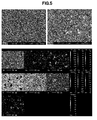
- Ce phosphor which is a typical example in JP 3700502 , Ce 3+ ion to be introduced has a greater ionic radius than Y 3+ ion to be substituted thereby. Then, the prior art method based on crystal growth from the source powder in the flux is difficult to introduce a desired amount of Ce 3+ ion into crystals because Ce 3+ ion tends to be kept out of Y 3 Al 5 O 12 crystals in the course of crystal growth. In fact, when phosphor particles obtained from crystal growth by this method are analyzed for the distribution of elements, it is seen that Ce 3+ ion is concentrated at sites other than the crystal grains (see FIG. 5 , for example).
- Patent Document 1 JP 3700502 ( USP 5998925 , EP 0936682 )
- An object herein is to provide new and useful phosphor particles which are good or improved in emission efficiency relative to the prior art, and methods of preparing such phosphor particles.
- A is at least one rare earth element selected from Y, Gd, and Lu
- these phosphor particles can be prepared by providing a powder oxide or oxides containing one or more of the elements A, B, and C in compositional formula (1) as a starting material, using one powder oxide in which the elements A, B, and C are present in an atomic ratio of C/(A+B) > 5/3 or mixing two or more powder oxides such that the elements A, B, and C may be present in an atomic ratio of C/(A+B) > 5/3, granulating the powder oxide or powder oxide mixture into granules with an average particle size of 5 to 65 ⁇ m, melting the granules in a plasma and solidifying outside the plasma, thereby obtaining spherical particles, and heat treating the particles in a non-oxidizing atmosphere at a temperature of higher than 800° C to 1, 700° C.
- the primary particles have a particle size of 0.1 to 5 ⁇ m.
- the invention provides a method for preparing the phosphor particles defined above, including the steps of providing a powder oxide or oxides containing one or more of the elements A, B, and C in compositional formula (1) as a starting material, using one powder oxide in which the elements A, B, and C are present in an atomic ratio of C/(A+B) > 5/3 or mixing two or more powder oxides such that the elements A, B, and C may be present in an atomic ratio of C/(A+B) > 5/3, granulating the powder oxide or powder oxide mixture into granules with an average particle size of 5 to 65 ⁇ m, melting the granules in a plasma and solidifying outside the plasma, thereby obtaining spherical particles, and heat treating the particles in a non-oxidizing atmosphere at a temperature of higher than 800°C to 1,700°C.
- Particles as obtained by the present methods are a further aspect.
- the rare earth element serving as the luminescent center is more uniformly dispersed than in the prior art phosphor particles.
- the particles are advantageously used as a yellow light-emitting phosphor of a high emission efficiency.
- the term “phosphor” refers to a fluorescent substance.
- particles and “powder” are equivalent in that the powder is a grouping of particles.
- the garnet phase has a crystalline structure in which the element represented by B in compositional formula (1) (referred to as element B, hereinafter) serving as the luminescent center substitutes at some of the sites, in the crystal lattice, of the element represented by A in compositional formula (1) (referred to as element A, hereinafter) and in which the element represented by C in compositional formula (1) (referred to as element C, hereinafter) further substitutes (typically element C substitutes at sites of element A though the substitution site is not particularly limited). It is believed that in the garnet phase, the substitution of element A (which is otherwise less liable to substitution) by element B is promoted, achieving a full dispersion of element B in the phosphor particles. The garnet phase having such a crystalline structure could not be prepared by the prior art method.
- the phosphor particles including such a garnet phase are prepared by providing a powder oxide or oxides containing one or more of the elements A, B, and C in compositional formula (1) as a starting material, using one powder oxide in which the elements A, B, and C are present in an atomic ratio of C/(A+B) > 5/3 or mixing two or more powder oxides such that the elements A, B, and C may be present in an atomic ratio of C/(A+B) > 5/3, preferably C/(A+B) ⁇ 5.02/2.98, and its upper limit may be preferably C/(A+B) ⁇ 6/2, more preferably C/(A+B) ⁇ 5.6/2.4, granulating the powder oxide or powder oxide mixture into granules with an average article size of 5 to 65 ⁇ m, melting the granules in a plasma and solidifying outside the plasma, thereby obtaining spherical particles, and heat treating the particles in a non-oxidizing atmosphere at a temperature of higher than 800°C
- Two or more starting oxides are mixed such that the elements A, B, and C may be present in a desired ratio.
- the mixture is granulated.
- the granules are passed through a plasma where they are melted and become droplets. As the droplets move past the plasma, they are cooled and solidified. Once melted and solidified, the granules transform to composite oxide particles of amorphous nature. There are formed spherical particles having a size which ranges from the size of granules with an average particle size of 5 to 65 ⁇ m.
- the inventive method is characterized by introducing granules into a plasma and solidifying again, whereby spherical particles having an average particle size of 5 to 50 ⁇ m are formed in an amorphous state having respective elements uniformly dispersed. A minimal variation of composition among particles is also characteristic.
- the spherical particles as heat treated are available as polycrystalline secondary particles since they are obtained from formation of a multiplicity of minute crystalline primary particles upon crystallization and agglomeration of such primary particles.
- the garnet phase having the composition represented by compositional formula (1) has a structure having further element C substituted therein, although the structure of the garnet phase of the phosphor particles of the invention is not limited thereto. It is believed that typically in the structure, element B is not substituted by element C, and element A is substituted by element C. Since element C has a smaller ionic radius than element A, it is believed that the occupation of element C at some sites of element A contributes to a likelihood of element B being incorporated in the crystal lattice.
- the invention is advantageous in that diffusion of element B in the particle interior is easier because the particles obtained from melting and solidification is amorphous for the most part and the size of phosphor particles is substantially determined prior to crystallization by heat treatment, and that element B is more uniformly incorporated in crystals since element B can move to no sites other than in the particle interior.
- the prior art method of preparing phosphor particles has a problem associated with the addition of a flux during the steps of mixing source oxides and firing. If the flux is used, element B which should essentially be introduced into the garnet phase of phosphor particles tends to be taken into a fraction not contributing to fluorescence, and specifically combined with a component of the flux to form such a fraction. This is proven, when phosphor particles are prepared by the prior art method using barium fluoride as the flux and cerium as element B, for example, by the observation of peaks assigned to BaCeOF 3 on X-ray diffraction analysis and the distribution of individual elements on electron probe microanalysis (see FIGS. 5 and 6 , for example).
- element A to be substituted has a smaller ionic radius than element B to be introduced as the luminescent center
- the phosphor particles prepared by the prior art method have a tendency that element B serving as the luminescent center is difficultly taken into the crystal lattice during crystal growth in the flux. For this reason, it is believed impossible to introduce element B serving as the luminescent center into the crystal lattice of the garnet phase of phosphor particles in a high concentration.
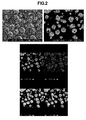
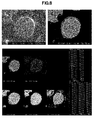
- the phosphor particles proposed here can have element B uniformly dispersed in the interior of phosphor particles. It is possible to effectively introduce element B serving as the luminescent center into the crystal lattice of the garnet phase of phosphor particles (see FIG. 2 , for example).
- Phosphor particles are prepared by first selecting a metal oxide(s) from single metal oxides, composite metal oxides, and metal oxide mixtures in accordance with the metal species in the desired phosphor particles, to provide a phosphor-forming composition.
- the phosphor-forming composition is dispersed in deionized water or an organic solvent to form a slurry.
- the composite metal oxide or metal oxide mixture may be prepared, for example, by the following method.
- a co-precipitate is first prepared by selecting suitable metal salts from salts of metal elements to constitute the phosphor particles (for example, nitrates and chlorides of Y, Gd, Lu, Ce, Nd, Tb, Al, and Ga), dissolving the metal salts in water, and co-precipitating the aqueous solution.
- it may be prepared by selecting suitable starting materials from the metal salts and metal oxides described above, forming an aqueous solution or slurry thereof, and co-precipitating the aqueous solution or slurry.
- the resulting co-precipitate is fired at 800 to 1,500°C in air, obtaining the composite oxide or oxide mixture.
- the firing time is usually 1 to 10 hours.
- a slurry of phosphor-forming composition is prepared.
- organic additives such as dispersant and binder may be added to the slurry of the phosphor-forming composition.
- the slurry may be optionally milled into a slurry of fine particles preferably having an average particle size of 0.01 to 2.0 ⁇ m.
- a granulation technique generally spherical granules (precursor) of the desired particle size may be prepared from the slurry.
- Suitable granulation techniques include air atomizing with two-fluid nozzle or four-fluid nozzle, fluidized-bed granulation, centrifugal atomization, tumbling granulation, agitation granulation, compression granulation (such as by rubber or isostatic pressing), extrusion granulation, and disintegration granulation.
- the granules are compositionally uniform among them due to granulation from slurry.
- the granules preferably have a size of 5 to 65 ⁇ m, and specifically a size substantially equivalent to the phosphor particles obtained therefrom after heat treatment, for example, an average particle size corresponding to 100 to 130% of that of phosphor particles after heat treatment.
- the granules are passed through a plasma where they are melted into droplets.
- the plasma source used herein may be a high-frequency plasma or direct-current plasma.
- the temperature of the plasma should be higher than the melting points of the source metal oxides including rare earth oxides, aluminum oxide, and gallium oxide.
- the droplets are cooled and solidified into particles again.
- These particles are spherical amorphous particles which exhibit very broad peaks on XRD analysis.
- the particles as such have a low phosphor quantum efficiency, which is usually as low as 40 to 60%.
- the absorptance of exciting light is as low as 50 to 70%. Therefore, the particles resulting from plasma melting must be heat treated in a non-oxidizing atmosphere, for example, a rare gas atmosphere such as argon or helium, a nitrogen atmosphere, or a similar atmosphere in which the inert gas is, in part, replaced by a reducing gas such as hydrogen before the desired crystalline phosphor particles can be obtained.
- a non-oxidizing atmosphere is used as the heat treating atmosphere to avoid oxidation of element B serving as the luminescent center.
- the temperature of heat treatment should be higher than 800°C, preferably 900°C or higher, more preferably 1,000°C or higher to provide for full crystal growth in phosphor particles. Since the fusion of phosphor particles can adversely affect the distribution of particle size of phosphor particles, the heating temperature should be up to 1,700°C, preferably up to 1,600°C, and more preferably up to 1,500°C.
- the heat treatment may be carried out in two or more divided modes for purposes of preventing fusion of phosphor particles.
- a garnet phase of the composition containing element C richer than in the prior art is formed as the crystal phase, and element B contributing to emission is effectively taken in the crystals.
- the phosphor particles generally have an absorptance of at least 85%, specifically at least 90% of exciting light and an internal quantum efficiency of at least 94% at an excitation wavelength of 450 nm, indicating a high emission efficiency.
- the phosphor particles are suited as a phosphor for converting the wavelength of light from a light-emitting component of a LED.
- the phosphor particles can be advantageously used in a LED as well as an illuminating device and a backlight device using the LED.
- a powder mixture was obtained by mixing a yttrium oxide (Y 2 O 3 ) powder of 99.9% purity having an average particle size of 1.0 ⁇ m, an aluminum oxide (Al 2 O 3 ) powder of 99.0% purity having an average particle size of 0.5 ⁇ m, and a cerium oxide (CeO 2 ) powder of 99.9% purity having an average particle size of 0.2 ⁇ m in such amounts to give a molar ratio Y:Al:Ce of 2.94:5.5:0.06.
- 1,000 g of the powder mixture was milled for 6 hours together with 1,500 g of deionized water, 10 g of poly(ammonium acrylic acid), and 2 g of carboxymethyl cellulose.
- the resulting slurry was granulated through a two-fluid nozzle, obtaining granules having an average particle size of 22 ⁇ m.
- the granules were heat treated in air at 1,000°C for 2 hours to burn off the organic matter.
- the granules were passed through an argon plasma where they were melted. The melt was then solidified again, obtaining spherical particles. On qualitative analysis by XRD, the particles were found amorphous.
- the spherical particles were heat treated in argon gas containing 1 vol% of hydrogen gas at 1,350°C for 5 hours, yielding phosphor particles.
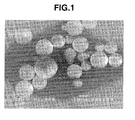
- each phosphor particle is a secondary particle composed of agglomerated primary particles and looks to have a spherical or substantially spherical shape. From the microscopic image, the average particle size of phosphor particles and the particle size of primary particles of which the phosphor particles were composed were measured. The results are shown in Table 1.
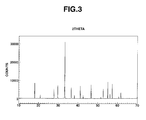
- the phosphor particles were further analyzed by XRD, with the result shown in FIG. 3 .
- the diffraction pattern of the phosphor particles, as to the major phase is coincident with the diffraction peaks of yttrium-aluminum garnet phase, proving that the phosphor particles contain the garnet phase as the major phase. Alumina and extra phases other than the garnet phase were not observed.
- a powder mixture was obtained by mixing a yttrium oxide (Y 2 O 3 ) powder of 99.9% purity having an average particle size of 1.0 ⁇ m, an aluminum oxide (Al 2 O 3 ) powder of 99.0% purity having an average particle size of 3.0 ⁇ m, and a cerium oxide (CeO 2 ) powder of 99.9% purity having an average particle size of 0.2 ⁇ m in such amounts to give a molar ratio Y:Al:Ce of 2.94:5.5:0.06.
- Y:Al:Ce yttrium oxide
- Al 2 O 3 aluminum oxide
- CeO 2 cerium oxide
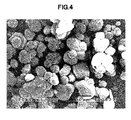
- the phosphor particles thus obtained were observed under an electron microscope. A photomicrograph is shown in FIG. 4 .
- the phosphor particles looked to have a polyhedral shape, with crystal faces observed. From the microscopic image, the average particle size of phosphor particles was measured. The results are also shown in Table 1.
- the phosphor particles were further analyzed by XRD, with the result shown in FIG. 6 .
- the diffraction pattern of the phosphor particles, as to the major phase is coincident with the diffraction peaks of yttrium-aluminum garnet phase, proving that the phosphor particles contain the garnet phase as the major phase.
- phases of BaCeOF 3 and the like were observed.
- a powder mixture was obtained by mixing a yttrium oxide (Y 2 O 3 ) powder of 99.9% purity having an average particle size of 1.0 ⁇ m, an aluminum oxide (Al 2 O 3 ) powder of 99.0% purity having an average particle size of 0.5 ⁇ m, and a cerium oxide (CeO 2 ) powder of 99.9% purity having an average particle size of 0.2 ⁇ m in such amounts to give a molar ratio Y:Al:Ce of 2.94:4.8:0.06.
- 1,000 g of the powder mixture was milled for 6 hours together with 1,500 g of deionized water, 10 g of poly(ammonium acrylic acid), and 2 g of carboxymethyl cellulose.
- the resulting slurry was granulated through a two-fluid nozzle, obtaining granules having an average particle size of 15 ⁇ m.
- the granules were heat treated in air at 1,000°C for 2 hours to burn off the organic matter.
- the granules were passed through an argon plasma where they were melted. The melt was then solidified again, obtaining spherical particles. On qualitative analysis by XRD, the particles were found amorphous.
- the spherical particles were heat treated in argon gas containing 1 vol% of hydrogen gas at 1,350°C for 5 hours, yielding phosphor particles.
- each phosphor particle is a secondary particle composed of agglomerated primary particles and looks to have a spherical or substantially spherical shape. From the microscopic image, the average particle size of phosphor particles and the particle size of primary particles of which the phosphor particles were composed were measured. The results are shown in Table 1.
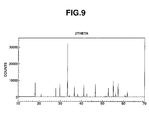
- the phosphor particles were further analyzed by XRD, with the result shown in FIG. 9 .
- the diffraction pattern of the phosphor particles, as to the major phase is coincident with the diffraction peaks of yttrium-aluminum garnet phase, proving that the phosphor particles contain the garnet phase as the major phase.
- phases of yttrium-aluminate (YAP) and the like were observed.
- a powder mixture was obtained by mixing a Lutetium oxide (Lu 2 O 3 ) powder of 99.9% purity having an average particle size of 1.0 ⁇ m, an aluminum oxide (Al 2 O 3 ) powder of 99.0% purity having an average particle size of 0.5 ⁇ m, and a cerium oxide (CeO 2 ) powder of 99.9% purity having an average particle size of 0.2 ⁇ m in such amounts to give a molar ratio Lu:Al:Ce of 2.94:5.5:0.06.
- 1,000 g of the powder mixture was milled for 6 hours together with 1,500 g of deionized water, 10 g of poly(ammonium acrylic acid), and 2 g of carboxymethyl cellulose.
- the resulting slurry was granulated through a two-fluid nozzle, obtaining granules having an average particle size of 20 ⁇ m.
- the granules were heat treated in air at 1,400°C for 2 hours to burn off the organic matter.
- the granules were passed through an argon plasma where they were melted. The melt was then solidified again, obtaining spherical particles. On qualitative analysis by XRD, the particles were found amorphous.
- the spherical particles were heat treated in argon gas containing 1 vol% of hydrogen gas at 1,350°C for 5 hours, yielding phosphor particles.
- each phosphor particle is a secondary particle composed of agglomerated primary particles and looks to have a spherical or substantially spherical shape. From the microscopic image, the average particle size of phosphor particles and the particle size of primary particles of which the phosphor particles were composed were measured. The results are shown in Table 1.
- the phosphor particles were further analyzed by XRD, with the result shown in FIG. 11 .
- the diffraction pattern of the phosphor particles, as to the major phase is coincident with the diffraction peaks of lutetium-aluminum garnet phase, proving that the phosphor particles contain the garnet phase as the major phase. Alumina and extra phases other than the garnet phase were not observed.
Landscapes
- Chemical & Material Sciences (AREA)
- Organic Chemistry (AREA)
- Inorganic Chemistry (AREA)
- Engineering & Computer Science (AREA)
- Materials Engineering (AREA)
- Life Sciences & Earth Sciences (AREA)
- Geology (AREA)
- Luminescent Compositions (AREA)
Applications Claiming Priority (1)
| Application Number | Priority Date | Filing Date | Title |
|---|---|---|---|
| JP2011001123 | 2011-01-06 |
Publications (3)
| Publication Number | Publication Date |
|---|---|
| EP2474590A2 true EP2474590A2 (fr) | 2012-07-11 |
| EP2474590A3 EP2474590A3 (fr) | 2014-03-19 |
| EP2474590B1 EP2474590B1 (fr) | 2014-11-12 |
Family
ID=45507423
Family Applications (1)
| Application Number | Title | Priority Date | Filing Date |
|---|---|---|---|
| EP12150171.2A Ceased EP2474590B1 (fr) | 2011-01-06 | 2012-01-04 | Particules de luminophore et procédé de fabrication |
Country Status (6)
| Country | Link |
|---|---|
| US (1) | US8865022B2 (fr) |
| EP (1) | EP2474590B1 (fr) |
| JP (2) | JP5041191B2 (fr) |
| KR (1) | KR101633662B1 (fr) |
| CN (1) | CN102618277B (fr) |
| TW (1) | TWI515288B (fr) |
Cited By (3)
| Publication number | Priority date | Publication date | Assignee | Title |
|---|---|---|---|---|
| EP2824160A1 (fr) * | 2013-06-25 | 2015-01-14 | Shin-Etsu Chemical Co., Ltd. | Luminaire extérieur |
| US9193903B2 (en) * | 2012-03-15 | 2015-11-24 | Kabushiki Kaisha Toshiba | Solid scintillator, radiation detector, and radiation examination device |
| RU2682554C1 (ru) * | 2017-12-28 | 2019-03-19 | Федеральное государственное унитарное предприятие "Институт химических реактивов и особо чистых химических веществ Национального исследовательского центра "Курчатовский институт" | Способ получения поликристаллических сцинтилляционных материалов в форме порошков |
Families Citing this family (11)
| Publication number | Priority date | Publication date | Assignee | Title |
|---|---|---|---|---|
| US9617469B2 (en) | 2011-01-06 | 2017-04-11 | Shin-Etsu Chemical Co., Ltd. | Phosphor particles, making method, and light-emitting diode |
| EP2607449B1 (fr) * | 2011-12-22 | 2014-04-02 | Shin-Etsu Chemical Co., Ltd. | Préparation de phosphore grenat dopé à l'yttrium-cerium-aluminum |
| US20140175968A1 (en) * | 2012-12-21 | 2014-06-26 | Shin-Etsu Chemical Co., Ltd. | Yttrium-cerium-aluminum garnet phosphor and light-emitting device |
| CN104884574A (zh) * | 2012-12-28 | 2015-09-02 | 信越化学工业株式会社 | 含有荧光体的树脂成型体、发光装置和树脂粒料 |
| CN104253198B (zh) * | 2014-09-18 | 2017-01-25 | 华中科技大学 | 一种荧光粉复合颗粒、其制备方法及应用 |
| CN106896632A (zh) | 2015-12-03 | 2017-06-27 | 精工爱普生株式会社 | 荧光体、波长转换元件、光源装置和投影仪 |
| JP2018053227A (ja) * | 2015-12-03 | 2018-04-05 | セイコーエプソン株式会社 | 蛍光体、波長変換素子、光源装置およびプロジェクター |
| US10355175B2 (en) * | 2016-03-10 | 2019-07-16 | Panasonic Intellectual Property Management Co., Ltd. | Light emitting device |
| JP6428813B2 (ja) * | 2017-03-13 | 2018-11-28 | 信越化学工業株式会社 | 発光装置 |
| WO2020013016A1 (fr) * | 2018-07-11 | 2020-01-16 | 日本特殊陶業株式会社 | Élément de conversion de longueur d'onde optique et dispositif électroluminescent |
| KR102675945B1 (ko) | 2018-09-18 | 2024-06-17 | 삼성전자주식회사 | 발광 장치 |
Citations (1)
| Publication number | Priority date | Publication date | Assignee | Title |
|---|---|---|---|---|
| JP3700502B2 (ja) | 1996-07-29 | 2005-09-28 | 日亜化学工業株式会社 | 発光ダイオード |
Family Cites Families (16)
| Publication number | Priority date | Publication date | Assignee | Title |
|---|---|---|---|---|
| JPH0745655B2 (ja) * | 1985-11-07 | 1995-05-17 | 化成オプトニクス株式会社 | 蛍光体の製造方法 |
| EP0292616B1 (fr) | 1987-05-26 | 1992-05-20 | Agfa-Gevaert N.V. | Conversion de rayons-X en rayons lumineux |
| JP3141634B2 (ja) | 1993-08-03 | 2001-03-05 | セイコーエプソン株式会社 | 半導体装置の製造方法及び樹脂封止用金型 |
| JP3469425B2 (ja) * | 1996-03-15 | 2003-11-25 | 株式会社東芝 | 蛍光体およびその製造方法 |
| US5851428A (en) | 1996-03-15 | 1998-12-22 | Kabushiki Kaisha Toshiba | Phosphor and manufacturing method thereof |
| JP3445473B2 (ja) | 1997-07-25 | 2003-09-08 | 株式会社東芝 | 蛍光体及び蛍光膜 |
| JP3906352B2 (ja) * | 2000-03-27 | 2007-04-18 | 独立行政法人物質・材料研究機構 | Yag透明焼結体の製造方法 |
| JP4663927B2 (ja) * | 2001-08-29 | 2011-04-06 | 信越化学工業株式会社 | 希土類含有酸化物部材 |
| DE10223988A1 (de) * | 2002-05-29 | 2003-12-18 | Siemens Ag | Leuchtstoffpulver, Verfahren zum Herstellen des Leuchtstoffpulvers und Leuchtstoffkörper mit dem Leuchtstoffpulver |
| CN1796486A (zh) * | 2004-12-22 | 2006-07-05 | 典通科技股份有限公司 | 高效率荧光粉及其制法 |
| US20060165898A1 (en) * | 2005-01-21 | 2006-07-27 | Cabot Corporation | Controlling flame temperature in a flame spray reaction process |
| WO2008134418A1 (fr) * | 2007-04-24 | 2008-11-06 | Nanocerox, Inc. | Grenat d'yttrium aluminium polycristallin fritté et utilisation de celui-ci dans des dispositifs optiques |
| US8461535B2 (en) * | 2009-05-20 | 2013-06-11 | Lawrence Livermore National Security, Llc | Phase stable rare earth garnets |
| JP5323131B2 (ja) * | 2010-06-09 | 2013-10-23 | 信越化学工業株式会社 | 蛍光粒子及び発光ダイオード並びにこれらを用いた照明装置及び液晶パネル用バックライト装置 |
| JP5609775B2 (ja) * | 2010-06-09 | 2014-10-22 | 信越化学工業株式会社 | 酸化物蛍光粒子の製造方法及び発光デバイス |
| US9617469B2 (en) * | 2011-01-06 | 2017-04-11 | Shin-Etsu Chemical Co., Ltd. | Phosphor particles, making method, and light-emitting diode |
-
2011
- 2011-12-23 US US13/336,137 patent/US8865022B2/en not_active Expired - Fee Related
- 2011-12-27 JP JP2011285300A patent/JP5041191B2/ja not_active Expired - Fee Related
- 2011-12-28 KR KR1020110144891A patent/KR101633662B1/ko not_active Expired - Fee Related
-
2012
- 2012-01-04 EP EP12150171.2A patent/EP2474590B1/fr not_active Ceased
- 2012-01-05 TW TW101100447A patent/TWI515288B/zh not_active IP Right Cessation
- 2012-01-06 CN CN201210047417.4A patent/CN102618277B/zh not_active Expired - Fee Related
- 2012-05-22 JP JP2012116619A patent/JP5110336B2/ja not_active Expired - Fee Related
Patent Citations (1)
| Publication number | Priority date | Publication date | Assignee | Title |
|---|---|---|---|---|
| JP3700502B2 (ja) | 1996-07-29 | 2005-09-28 | 日亜化学工業株式会社 | 発光ダイオード |
Cited By (4)
| Publication number | Priority date | Publication date | Assignee | Title |
|---|---|---|---|---|
| US9193903B2 (en) * | 2012-03-15 | 2015-11-24 | Kabushiki Kaisha Toshiba | Solid scintillator, radiation detector, and radiation examination device |
| EP2824160A1 (fr) * | 2013-06-25 | 2015-01-14 | Shin-Etsu Chemical Co., Ltd. | Luminaire extérieur |
| US9978913B2 (en) | 2013-06-25 | 2018-05-22 | Shin-Etsu Chemical Co., Ltd. | Outdoor luminaire |
| RU2682554C1 (ru) * | 2017-12-28 | 2019-03-19 | Федеральное государственное унитарное предприятие "Институт химических реактивов и особо чистых химических веществ Национального исследовательского центра "Курчатовский институт" | Способ получения поликристаллических сцинтилляционных материалов в форме порошков |
Also Published As
| Publication number | Publication date |
|---|---|
| KR20120080131A (ko) | 2012-07-16 |
| CN102618277B (zh) | 2015-01-28 |
| EP2474590A3 (fr) | 2014-03-19 |
| KR101633662B1 (ko) | 2016-06-27 |
| JP2012153904A (ja) | 2012-08-16 |
| US20120175559A1 (en) | 2012-07-12 |
| CN102618277A (zh) | 2012-08-01 |
| TWI515288B (zh) | 2016-01-01 |
| US8865022B2 (en) | 2014-10-21 |
| TW201243029A (en) | 2012-11-01 |
| JP2012153881A (ja) | 2012-08-16 |
| EP2474590B1 (fr) | 2014-11-12 |
| JP5110336B2 (ja) | 2012-12-26 |
| JP5041191B2 (ja) | 2012-10-03 |
Similar Documents
| Publication | Publication Date | Title |
|---|---|---|
| EP2474590B1 (fr) | Particules de luminophore et procédé de fabrication | |
| EP2474589B1 (fr) | Particules de phosphore, procédé de fabrication et diode électroluminescente | |
| US9062251B2 (en) | Phosphor particles, light-emitting diode, and illuminating device and liquid crystal panel backlight device using them | |
| EP2607449B1 (fr) | Préparation de phosphore grenat dopé à l'yttrium-cerium-aluminum | |
| EP2607448B1 (fr) | Phosphore grenat dopé à l'yttrium-cerium-aluminum et dispositif électroluminescent | |
| EP2690154A1 (fr) | Procédé de fabrication d'un précurseur de phosphore, phosphore et convertisseur de longueur d'onde | |
| US20140175968A1 (en) | Yttrium-cerium-aluminum garnet phosphor and light-emitting device |
Legal Events
| Date | Code | Title | Description |
|---|---|---|---|
| PUAI | Public reference made under article 153(3) epc to a published international application that has entered the european phase |
Free format text: ORIGINAL CODE: 0009012 |
|
| AK | Designated contracting states |
Kind code of ref document: A2 Designated state(s): AL AT BE BG CH CY CZ DE DK EE ES FI FR GB GR HR HU IE IS IT LI LT LU LV MC MK MT NL NO PL PT RO RS SE SI SK SM TR |
|
| AX | Request for extension of the european patent |
Extension state: BA ME |
|
| PUAL | Search report despatched |
Free format text: ORIGINAL CODE: 0009013 |
|
| AK | Designated contracting states |
Kind code of ref document: A3 Designated state(s): AL AT BE BG CH CY CZ DE DK EE ES FI FR GB GR HR HU IE IS IT LI LT LU LV MC MK MT NL NO PL PT RO RS SE SI SK SM TR |
|
| AX | Request for extension of the european patent |
Extension state: BA ME |
|
| RIC1 | Information provided on ipc code assigned before grant |
Ipc: C09K 11/80 20060101AFI20140213BHEP |
|
| 17P | Request for examination filed |
Effective date: 20140416 |
|
| RBV | Designated contracting states (corrected) |
Designated state(s): AL AT BE BG CH CY CZ DE DK EE ES FI FR GB GR HR HU IE IS IT LI LT LU LV MC MK MT NL NO PL PT RO RS SE SI SK SM TR |
|
| GRAP | Despatch of communication of intention to grant a patent |
Free format text: ORIGINAL CODE: EPIDOSNIGR1 |
|
| INTG | Intention to grant announced |
Effective date: 20140619 |
|
| GRAS | Grant fee paid |
Free format text: ORIGINAL CODE: EPIDOSNIGR3 |
|
| GRAA | (expected) grant |
Free format text: ORIGINAL CODE: 0009210 |
|
| RBV | Designated contracting states (corrected) |
Designated state(s): DE FR GB NL |
|
| AK | Designated contracting states |
Kind code of ref document: B1 Designated state(s): DE FR GB NL |
|
| REG | Reference to a national code |
Ref country code: GB Ref legal event code: FG4D |
|
| REG | Reference to a national code |
Ref country code: DE Ref legal event code: R096 Ref document number: 602012003706 Country of ref document: DE Effective date: 20141224 |
|
| REG | Reference to a national code |
Ref country code: FR Ref legal event code: PLFP Year of fee payment: 4 |
|
| REG | Reference to a national code |
Ref country code: NL Ref legal event code: T3 |
|
| REG | Reference to a national code |
Ref country code: DE Ref legal event code: R097 Ref document number: 602012003706 Country of ref document: DE |
|
| PLBE | No opposition filed within time limit |
Free format text: ORIGINAL CODE: 0009261 |
|
| STAA | Information on the status of an ep patent application or granted ep patent |
Free format text: STATUS: NO OPPOSITION FILED WITHIN TIME LIMIT |
|
| 26N | No opposition filed |
Effective date: 20150813 |
|
| REG | Reference to a national code |
Ref country code: FR Ref legal event code: PLFP Year of fee payment: 5 |
|
| REG | Reference to a national code |
Ref country code: FR Ref legal event code: PLFP Year of fee payment: 6 |
|
| REG | Reference to a national code |
Ref country code: FR Ref legal event code: PLFP Year of fee payment: 7 |
|
| PGFP | Annual fee paid to national office [announced via postgrant information from national office to epo] |
Ref country code: FR Payment date: 20171211 Year of fee payment: 7 |
|
| PGFP | Annual fee paid to national office [announced via postgrant information from national office to epo] |
Ref country code: GB Payment date: 20180103 Year of fee payment: 7 Ref country code: DE Payment date: 20171222 Year of fee payment: 7 |
|
| REG | Reference to a national code |
Ref country code: DE Ref legal event code: R119 Ref document number: 602012003706 Country of ref document: DE |
|
| GBPC | Gb: european patent ceased through non-payment of renewal fee |
Effective date: 20190104 |
|
| PG25 | Lapsed in a contracting state [announced via postgrant information from national office to epo] |
Ref country code: DE Free format text: LAPSE BECAUSE OF NON-PAYMENT OF DUE FEES Effective date: 20190801 Ref country code: FR Free format text: LAPSE BECAUSE OF NON-PAYMENT OF DUE FEES Effective date: 20190131 |
|
| PG25 | Lapsed in a contracting state [announced via postgrant information from national office to epo] |
Ref country code: GB Free format text: LAPSE BECAUSE OF NON-PAYMENT OF DUE FEES Effective date: 20190104 |
|
| PGFP | Annual fee paid to national office [announced via postgrant information from national office to epo] |
Ref country code: NL Payment date: 20191212 Year of fee payment: 9 |
|
| REG | Reference to a national code |
Ref country code: NL Ref legal event code: MM Effective date: 20210201 |
|
| PG25 | Lapsed in a contracting state [announced via postgrant information from national office to epo] |
Ref country code: NL Free format text: LAPSE BECAUSE OF NON-PAYMENT OF DUE FEES Effective date: 20210201 |