EP2476846A2 - Fensterhebervorrichtung - Google Patents
Fensterhebervorrichtung Download PDFInfo
- Publication number
- EP2476846A2 EP2476846A2 EP12150946A EP12150946A EP2476846A2 EP 2476846 A2 EP2476846 A2 EP 2476846A2 EP 12150946 A EP12150946 A EP 12150946A EP 12150946 A EP12150946 A EP 12150946A EP 2476846 A2 EP2476846 A2 EP 2476846A2
- Authority
- EP
- European Patent Office
- Prior art keywords
- pulse
- movable member
- motor
- pulses
- basis
- Prior art date
- Legal status (The legal status is an assumption and is not a legal conclusion. Google has not performed a legal analysis and makes no representation as to the accuracy of the status listed.)
- Withdrawn
Links
- 238000001514 detection method Methods 0.000 claims abstract description 62
- 230000007423 decrease Effects 0.000 description 5
- 238000010586 diagram Methods 0.000 description 4
- 230000007257 malfunction Effects 0.000 description 4
- 238000000034 method Methods 0.000 description 2
- 238000012544 monitoring process Methods 0.000 description 1
Images



Classifications
-
- E—FIXED CONSTRUCTIONS
- E05—LOCKS; KEYS; WINDOW OR DOOR FITTINGS; SAFES
- E05F—DEVICES FOR MOVING WINGS INTO OPEN OR CLOSED POSITION; CHECKS FOR WINGS; WING FITTINGS NOT OTHERWISE PROVIDED FOR, CONCERNED WITH THE FUNCTIONING OF THE WING
- E05F15/00—Power-operated mechanisms for wings
-
- E—FIXED CONSTRUCTIONS
- E05—LOCKS; KEYS; WINDOW OR DOOR FITTINGS; SAFES
- E05F—DEVICES FOR MOVING WINGS INTO OPEN OR CLOSED POSITION; CHECKS FOR WINGS; WING FITTINGS NOT OTHERWISE PROVIDED FOR, CONCERNED WITH THE FUNCTIONING OF THE WING
- E05F15/00—Power-operated mechanisms for wings
- E05F15/60—Power-operated mechanisms for wings using electrical actuators
- E05F15/603—Power-operated mechanisms for wings using electrical actuators using rotary electromotors
- E05F15/665—Power-operated mechanisms for wings using electrical actuators using rotary electromotors for vertically-sliding wings
- E05F15/689—Power-operated mechanisms for wings using electrical actuators using rotary electromotors for vertically-sliding wings specially adapted for vehicle windows
- E05F15/695—Control circuits therefor
-
- E—FIXED CONSTRUCTIONS
- E05—LOCKS; KEYS; WINDOW OR DOOR FITTINGS; SAFES
- E05F—DEVICES FOR MOVING WINGS INTO OPEN OR CLOSED POSITION; CHECKS FOR WINGS; WING FITTINGS NOT OTHERWISE PROVIDED FOR, CONCERNED WITH THE FUNCTIONING OF THE WING
- E05F15/00—Power-operated mechanisms for wings
- E05F15/40—Safety devices, e.g. detection of obstructions or end positions
- E05F15/41—Detection by monitoring transmitted force or torque; Safety couplings with activation dependent upon torque or force, e.g. slip couplings
-
- E—FIXED CONSTRUCTIONS
- E05—LOCKS; KEYS; WINDOW OR DOOR FITTINGS; SAFES
- E05Y—INDEXING SCHEME ASSOCIATED WITH SUBCLASSES E05D AND E05F, RELATING TO CONSTRUCTION ELEMENTS, ELECTRIC CONTROL, POWER SUPPLY, POWER SIGNAL OR TRANSMISSION, USER INTERFACES, MOUNTING OR COUPLING, DETAILS, ACCESSORIES, AUXILIARY OPERATIONS NOT OTHERWISE PROVIDED FOR, APPLICATION THEREOF
- E05Y2400/00—Electronic control; Electrical power; Power supply; Power or signal transmission; User interfaces
- E05Y2400/10—Electronic control
- E05Y2400/52—Safety arrangements associated with the wing motor
- E05Y2400/53—Wing impact prevention or reduction
- E05Y2400/54—Obstruction or resistance detection
- E05Y2400/57—Disabling thereof
-
- E—FIXED CONSTRUCTIONS
- E05—LOCKS; KEYS; WINDOW OR DOOR FITTINGS; SAFES
- E05Y—INDEXING SCHEME ASSOCIATED WITH SUBCLASSES E05D AND E05F, RELATING TO CONSTRUCTION ELEMENTS, ELECTRIC CONTROL, POWER SUPPLY, POWER SIGNAL OR TRANSMISSION, USER INTERFACES, MOUNTING OR COUPLING, DETAILS, ACCESSORIES, AUXILIARY OPERATIONS NOT OTHERWISE PROVIDED FOR, APPLICATION THEREOF
- E05Y2800/00—Details, accessories and auxiliary operations not otherwise provided for
- E05Y2800/74—Specific positions
- E05Y2800/748—Specific positions end
-
- E—FIXED CONSTRUCTIONS
- E05—LOCKS; KEYS; WINDOW OR DOOR FITTINGS; SAFES
- E05Y—INDEXING SCHEME ASSOCIATED WITH SUBCLASSES E05D AND E05F, RELATING TO CONSTRUCTION ELEMENTS, ELECTRIC CONTROL, POWER SUPPLY, POWER SIGNAL OR TRANSMISSION, USER INTERFACES, MOUNTING OR COUPLING, DETAILS, ACCESSORIES, AUXILIARY OPERATIONS NOT OTHERWISE PROVIDED FOR, APPLICATION THEREOF
- E05Y2900/00—Application of doors, windows, wings or fittings thereof
- E05Y2900/50—Application of doors, windows, wings or fittings thereof for vehicles
- E05Y2900/53—Type of wing
- E05Y2900/55—Windows
Definitions
- the present invention relates to a power window apparatus that opens and closes a pane or the like of an automobile with electric power, and in particular, relates to a power window apparatus having a pinch detecting function.
- a typical power window apparatus has a pinch detecting function capable of detecting a pinch of a foreign object between a pane and a frame of a window.
- the pinch detecting function is realized by detection of a change in torque of a motor driving the pane. In the case where a pinch is detected, control is performed such that raising the pane is stopped and the direction of rotation of the motor is reversed in order to lower the pane.
- the torque of the motor changes.
- a predetermined range extending from the upper end of the window is set to a non-detection area in which if the torque of the motor changes, a pinch is not determined.
- the width of the non-detection area is set so that the above-described two cases can be reliably distinguished from each other. If the non-detection area can be reduced, a pinch of a thinner foreign object can be detected. Accordingly, the accuracy of pinch detection can be increased.
- a change in torque is detected in response to a change in pulse period measured by a pulse measuring unit attached to the motor.
- a distance of movement of the pane for each pulse period is previously known. Accordingly, a distance of movement of the pane can be detected.
- the number of rotations of the motor decreases, so that the pulse period measured by the pulse measuring unit increases.
- the position of the pane relative to the upper end of the window has to be detected.
- the position of the pane in contact with the upper end of the window is previously set as a reference position.
- an amount of change from the reference position is counted in order to detect the position of the pane relative to the upper end of the window.
- the reference position of the pane is reset each time the pane comes into contact with the upper end of the window.
- the position of the pane does not change further but the motor slightly rotates under the influence of damper characteristics and then stops.
- a stop position of the motor is set to the above-described reference position, the reference position differs from an actual position of the pane. If the amount of difference between the positions is constant at all times, any problems will not occur. Actually, however, a locked-rotor torque changes depending on a voltage applied to the motor. Accordingly, the amount of difference between the positions is also affected by the voltage.
- Electric power is supplied to the motor from a battery of the automobile.
- a voltage fluctuates depending on a condition of the automobile, for example, whether the engine has started, alternatively, whether another device uses the battery. Consequently, the reference position of the pane varies depending on a condition of the automobile.
- the non-detection area is reset on the basis of a moving speed of the pane.
- the present invention has been made in consideration of the above problems and provides a power window apparatus with increased accuracy of pinch detection realized by accurately setting a reference position of a pane to reduce a non-detection area.
- a power window apparatus includes a movable member that constitutes a window of a vehicle, a motor that drives the movable member, a pulse generator that generates a pulse as the motor rotates, and a controller that controls the motor.
- the controller includes a reference position setting unit that sets a pulse reference value corresponding to an upper-end lock position, serving as a reference position of the movable member, a position detecting unit that detects a level of the height of the movable member relative to the reference position by adding the number of pulses from the pulse generator to the pulse reference value corresponding to the reference position, a lock detecting unit that, on the basis of the period of pulses from the pulse generator, detects a locked or unlocked state of the motor, a pinch detecting unit that, in the case where the lock detecting unit detects the locked state of the motor, determines, on the basis of whether the level of the height of the movable member detected by the position detecting unit is positioned in a non-detection area set near the reference position, whether the movable member has reached the upper-end lock position or a pinch has occurred in the movable member, and a voltage detecting unit that detects a driving voltage applied to the motor.
- the pinch detecting unit determines that the movable
- the driving voltage applied to the motor varies, the error between an actual position of the movable member and the position thereof detected on the basis of the number of pulses can be reduced.
- the accuracy of detection of the position of the movable member can be increased. If a narrow non-detection area is set, malfunction can be prevented and the pinch of a thinner object can be detected.
- the reference position setting unit may calculate, on the basis of a previously measured relationship between a voltage at the upper-end lock position and a difference in the number of pulses relative to the pulse reference value at a reference voltage, a difference in the number of pulses associated with the driving voltage applied to the motor detected by the voltage detecting unit, add the calculated difference in the number of pulses to the pulse reference value at the reference voltage, and set the obtained value as the pulse reference value at the driving voltage.
- the upper-end lock position can be corrected and set by processing of pulse signals from the pulse generator. This can be realized by simple processing.
- the controller may further include an area setting unit that sets a pulse value corresponding to the position of the lower end of the non-detection area. While the movable member is being driven so as to be closed, the area setting unit corrects the pulse value corresponding to the lower end position of the non-detection area on the basis of the driving voltage applied to the motor detected by the voltage detecting unit and sets the corrected pulse value.
- a pinch can be detected with higher accuracy than a case where the lower end position of the non-detection area is set on the basis of a pulse reference value corresponding to a reference position set at the last time when the movable member was opened or closed. Accordingly, even if a narrower non-detection area is set, malfunction can be prevented and the pinch of a thinner object can be detected.
- the area setting unit may calculate, on the basis of a previously measured relationship between a voltage at the upper-end lock position and a difference in the number of pulses relative to the pulse reference value at a reference voltage, a difference in the number of pulses associated with the driving voltage applied to the motor detected by the voltage detecting unit, add the calculated difference in the number of pulses to the pulse value corresponding to the lower end position of the non-detection area at the reference voltage, and set the obtained value as the pulse value corresponding to the lower end position of the non-detection area at the driving voltage.
- the upper-end lock position can be corrected and set by processing of pulse signals from the pulse generator. This can be achieved by simple processing.
- Fig. 1 is a schematic diagram of a configuration of a power window apparatus according to the present embodiment.
- the power window apparatus according to this embodiment includes a movable member 2, serving as a pane, provided for a door 1 of a vehicle, such as an automobile, a window driving unit 4 that includes a motor 5 for raising and lowering the movable member 2, and a vehicle device 6 that controls the window driving unit 4.
- a vehicle device 6 is illustrated in the door 1 for the sake of convenience, the device may be disposed at any position in the vehicle.
- the door 1 has an opening 1a.
- This opening 1a is opened and closed by upward and downward movements of the movable member 2.
- the opening 1a is opened.
- the opening 1a is closed.
- the opening 1a is completely closed.
- the upper side of the movable member 2 comes into contact with an upper sash 3 constituting the upper side of the door 1.
- the window driving unit 4 is received in the door 1 and is linked to the movable member 2, such that the unit can move the member upward and downward.
- a power source for movement is the motor 5 provided for the window driving unit 4.
- the motor 5 is rotatable both forward and backward. The rotation of the motor 5 in one direction causes the movable member 2 to be driven upward and the rotation thereof in the other direction causes the movable member 2 to be driven downward. Controlling the rotation of the motor 5 enables opening and closing of the opening 1a to be controlled with the movable member 2.
- Fig. 2 illustrates a mechanism for controlling the motor 5.
- Two pulse generators 13 are arranged around the motor 5.
- the pulse generators 13 may be built in or externally attached to the motor 5.
- the pulse generators 13 are each configured to generate a pulse signal as the motor 5 rotates.
- pulse signals from the pulse generators 13 since a signal is generated each time the motor 5 rotates by a predetermined angle, the number of pulse signals is counted, thus measuring the amount of rotation of the motor 5.
- the period of pulse signals is detected, thus measuring a rotational speed of the motor 5.
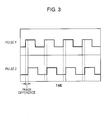
- Fig. 3 illustrates pulse signals from the pulse generators 13.
- a pulse 1 represents a pulse signal from one of the two pulse generators 13 and a pulse 2 represents a pulse signal from the other pulse generator 13.
- the two pulse generators 13 generate signals different only in phase.
- the direction of rotation of the motor 5 can be determined on the basis of whether the difference in phase between the pulse signals is positive or negative relative to either of the pulse signals as a reference. In the following description, it is assumed that the direction in which the movable member 2 is lowered is a forward direction and the direction in which the movable member 2 is raised is a negative direction.
- the vehicle device 6 performs power supply control for the motor 5 and processing of the pulse signals from the pulse generators 13.
- the vehicle device 6 includes a switch 11 disposed in the interior of the vehicle and a controller 10 that performs various controls.
- the controller 10 controls the motor 5 in accordance with an operation of the switch 11 and processes the pulse signals from the pulse generators 13.
- a pinch in the movable member 2 hereinafter, also referred to as a "pinch in the movable member 2"
- the controller 10 automatically controls the motor 5.
- the vehicle device 6 is supplied with electric power from a power supply 12. This power allows the motor 5 to be driven. Since the power supply 12 is a typical automobile battery, a voltage fluctuates depending on a condition of the vehicle, for example, whether the engine has operated, or, whether another device, such as an air conditioner, has operated. In this embodiment, it is assumed that a reference voltage is 12 V and the voltage fluctuates in the range of about 10 V to about 16 V.
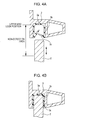
- Figs. 4A and 4B are enlarged cross-sectional views of the upper end of the movable member 2 and the upper sash 3.
- Fig. 4A illustrates a state in which the upper end of the movable member 2 is positioned near the upper sash 3.
- Fig. 4B illustrates a state in which the upper end of the movable member 2 is in contact with the upper sash 3, namely, the upper end thereof has reached the upper-end lock position.
- the upper sash 3 has a downwardly facing recess 3a, which receives a rubber airtight seal 3b that fits the recess 3a.
- the airtight seal 3b is generally U-shaped in cross-section such that the seal fits the recess 3a and has inwardly extending fins 3c arranged on both ends of an opening of the recess 3a.
- the movable member 2 has a thickness that substantially fits the width of the airtight seal 3b received in the recess 3a. Accordingly, the movable member 2 can enter a space defined by the airtight seal 3b.
- the position of the surface of the downwardly facing inner wall of the airtight seal 3b is the upper-end lock position of the movable member 2.
- the movable member is stopped.
- a range between the upper-end lock position and a lower position a predetermined distance away therefrom is the non-detection area in which a pinch is not determined for detection of a pinch in the movable member 2.
- a pinch in the movable member 2 is detected in response to detection of a sudden decrease in rotational speed corresponding to the torque of the motor 5 detected on the basis of pulse signals from the pulse generators 13. If the movable member 2 reaches the upper-end lock position, a similar decrease in rotational speed will occur. The non-detection area is therefore provided in order to distinguish between the decreases.
- the distance of movement of the movable member 2 can be detected on the basis of the number of pulses generated from each pulse generator 13. Accordingly, while the movable member 2 is in the upper-end lock position, the upper-end lock position is set to a reference position and a pulse reference value corresponding to the reference position is set. The number of pulses in the positive and negative directions relative to the reference position is detected, thus detecting the position of the movable member 2.
- the fins 3c of the airtight seal 3b are deformed such that the fins are pressed in contact with the movable member 2, thus ensuring the airtightness of the interior of the vehicle.
- the movable member 2 is moved upward and reaches the upper-end lock position, the movable member 2 is not moved further but the motor 5 slightly rotates depending on damper characteristics and then stops. If the movable member 2 has stopped, therefore, some pulse signals will be generated from the pulse generators 13. After that, while the motor 5 is stopping, the pulse reference value corresponding to the reference position is reset. Accordingly, a little deviation occurs between the actual upper-end lock position and the reference position based on the detected number of pulses.
- the non-detection area is set so as to have a certain margin in consideration of this deviation.
- the amount of rotation of the motor 5 after the movable member 2 stops varies depending on a driving voltage applied to the motor 5. Accordingly, if the driving voltage applied to the motor 5 varies, the amount of deviation between the actual upper-end lock position and the reference position based on the detected number of pulses also changes.
- Fig. 5 illustrates the relationship between the driving voltage applied to the motor 5 and the deviation between the actual upper-end lock position and the reference position based on the detected number of pulses.
- the amount of deviation between the actual upper-end lock position and the reference position based on the detected number of pulses is represented by the number of pulses. The amount of deviation is zero at a reference voltage of 12 V.
- the pulse reference value may be corrected on the basis of the relationship illustrated in Fig. 5 .
- the relationship of Fig. 5 has to be previously measured.
- the controller 10 of the vehicle device 6 includes the following components to perform pinch detection and reference position setting.
- a position detecting unit detects the height of the movable member 2 relative to the reference position by adding the number of pulses generated from each pulse generator 13 to a pulse reference value corresponding to a reference position.
- a reference position setting unit sets the pulse reference value corresponding to the reference position.
- a lock detecting unit detects, on the basis of the period of pulses from the pulse generator 13, a locked or unlocked state of the motor 5.
- a pinch detecting unit determines, on the basis of whether the height of the movable member detected by the position detecting unit is positioned in a non-detection area set near the reference position, whether the movable member has reached the upper-end lock position or a pinch has occurred in the movable member.
- a voltage detecting unit detects a driving voltage applied to the motor 5.
- Fig. 6 is a flowchart of pinch detection and reference position setting performed while the movable member 2 is being raised. While the movable member 2 is being raised (S1), the position detecting unit counts the number of pulses from each pulse generator 13 and updates the position of the movable member 2 at any time. The lock detecting unit monitors a change in torque of the motor 5 (S2) and continues monitoring if there is no change in torque. The torque of the motor 5 is calculated using the number of rotations of the motor 5 obtained from the period of pulses from each pulse generator 13. In the case where a rate of change in torque exceeds a predetermined value, a change in torque is detected. If the torque has changed, a locked state of the motor is detected.
- a change in torque may be detected on the basis of a rate of change in number of rotations of the motor without calculation of the torque using the period of pulses.
- a change in torque may be calculated on the basis of a current to drive the motor or a rate of change in current.
- the pinch detecting unit determines whether the movable member 2 is positioned in the non-detection area (S3).
- a pulse value corresponding to the position of the lower end of the area has previously been set below the pulse reference value corresponding to the reference position by a predetermined number of pulses.
- a determination is made as to whether a pulse value corresponding to the position of the movable member 2 detected by the position detecting unit is in the range from the pulse reference value to the pulse value corresponding to the lower end position of the non-detection area.
- the pinch detecting unit determines that a pinch has occurred (S4). In this case, the controller 10 performs control such that the motor 5 is reversed to lower the movable member 2 (S5). Thus, the pinch is removed.
- the pinch detecting unit determines that the movable member 2 has reached the upper-end lock position (S6).
- the voltage detecting unit detects a driving voltage applied to the motor 5 (S7).
- the reference position setting unit corrects the pulse reference value and sets the corrected value (S8). Since the pulse value corresponding to the lower end position of the non-detection area is set below the pulse reference value by a predetermined number of pulses as described above, this pulse value is also set in accordance with setting of the pulse reference value.
- the pulse reference value is set to zero when a driving voltage applied to the motor 5 is the reference voltage (12 V). In this case, when the movable member 2 is again lowered, the number of pulses is added to zero in the positive direction. The position of the movable member 2 is detected on the assumption that the position corresponds to the added number of pulses.
- the reference position setting unit may calculate the difference in the number of pulses associated with the driving voltage applied to the motor 5 detected in S7 by the voltage detecting unit on the basis of the relationship of Fig. 5 and set the obtained value as a pulse reference value. For example, in the case where a driving voltage applied to the motor 5 is 14 V, a difference in the number of pulses is -5. The pulse reference value is therefore set to -5. When the movable member 2 is again lowered, the number of pulses is added to -5 in the positive direction and the position of the movable member 2 is detected on the assumption that the position corresponds to the added number of pulses.
- the pulse reference value is set on the basis of a driving voltage applied to the motor 5. Accordingly, if a driving voltage applied to the motor 5 varies, the error between the actual position of the movable member 2 and the position of the movable member 2 detected on the basis of the number of pulses can be reduced. Consequently, the accuracy of detection of the position of the movable member 2 can be increased.
- a narrow non-detection area is set, malfunction can be prevented and the pinch of a thinner object can be detected.
- the controller 10 stops the motor 5 (S9) and completes the control during raising of the movable member 2.
- the pulse reference value set in S8 is used to detect the position of the movable member 2 at the next time when the movable member 2 is opened or closed.
- the pulse value corresponding to the lower end position of the non-detection area is set simultaneously with setting of the reference position.
- This pulse value may be corrected on the basis of a driving voltage applied to the motor 5 while the movable member 2 is being driven so as to be closed, namely, the movable member is being raised. If a pinch in the movable member 2 has occurred, the deviation between the actual position of the movable member 2 and the position of the movable member 2 detected on the basis of the number of pulses occurs depending on a driving voltage applied to the motor 5. Accordingly, the lower end position of the non-detection area is corrected on the basis of a driving voltage applied to the motor 5 during raising of the movable member 2, so that a pinch can be detected with higher accuracy.
- the controller 10 may further include an area setting unit.
- Fig. 7 illustrates the relationship between the voltage and the number of pulses in correction of the lower end position of the non-detection area.
- a solid line indicates a pulse value corresponding to the lower end position of the non-detection area and a broken line indicates a pulse value corresponding to the reference position.
- a pulse value which corresponds to the reference position and is indicated by the broken line, corresponds to the reference position based on a driving voltage applied to the motor 5 during raising of the movable member 2. In other words, this pulse value represents a pulse reference value to be reset when the movable member 2 reaches the upper-end lock position.
- the lower end position of the non-detection area is set such that the corresponding pulse value is below the pulse reference value to be reset when the movable member 2 reaches the upper-end lock position by 25 pulses. Accordingly, the pulse value corresponding to the lower end position of the non-detection area is set to 25 in the case where a driving voltage applied to the motor 5 during raising is the reference voltage (12 V).
- a pulse value based on the driving voltage in Fig. 7 is set to a pulse value corresponding to the lower end position of the non-detection area. This setting is performed by the area setting unit during raising of the movable member 2 in S1 in Fig. 6 .
- the area setting unit sets a pulse value corresponding to the lower end position of the non-detection area to 30.
- This pulse value is used to determine, in S3 in Fig. 6 , whether the movable member 2 is positioned in the non-detection area.
- the driving voltage applied to the motor 5 is 10 V
- a pulse value corresponding to the position of the movable member 2 detected in S3 by the position detecting unit is less than 30, it is determined that the movable member 2 is positioned in the non-detection area. If this pulse value is greater than or equal to 30, it is determined that the movable member 2 is not positioned in the non-detection area.
- a pulse value corresponding to the lower end position of the non-detection area may be set on the basis of a driving voltage applied to the motor 5 during raising of the movable member 2. Consequently, a pinch can be detected with higher accuracy than a case where the lower end position of the non-detection area is set on the basis of a pulse reference value corresponding to a reference position set at the last time when the movable member was opened or closed.
- a narrower non-detection area is set, malfunction can be prevented and the pinch of a thinner object can be detected.
- the relationship between the measured voltage and the difference in pulse value is used in the embodiments.
- the axis of abscissas in Fig. 5 or 7 may indicate a motor drive current or motor torque.
- the lock detecting unit detects a change in torque on the basis of the period of pulses from each pulse generator. Instead, a current to drive the motor or a rate of change in current may be used.
Landscapes
- Power-Operated Mechanisms For Wings (AREA)
- Window Of Vehicle (AREA)
Applications Claiming Priority (1)
| Application Number | Priority Date | Filing Date | Title |
|---|---|---|---|
| JP2011004775A JP2012144923A (ja) | 2011-01-13 | 2011-01-13 | パワーウインドウ装置 |
Publications (1)
| Publication Number | Publication Date |
|---|---|
| EP2476846A2 true EP2476846A2 (de) | 2012-07-18 |
Family
ID=45464439
Family Applications (1)
| Application Number | Title | Priority Date | Filing Date |
|---|---|---|---|
| EP12150946A Withdrawn EP2476846A2 (de) | 2011-01-13 | 2012-01-12 | Fensterhebervorrichtung |
Country Status (3)
| Country | Link |
|---|---|
| US (1) | US20120180394A1 (de) |
| EP (1) | EP2476846A2 (de) |
| JP (1) | JP2012144923A (de) |
Cited By (3)
| Publication number | Priority date | Publication date | Assignee | Title |
|---|---|---|---|---|
| EP3115538A1 (de) * | 2015-07-08 | 2017-01-11 | Aisin Seiki Kabushiki Kaisha | Antriebsvorrichtung |
| EP3263817A1 (de) * | 2016-07-01 | 2018-01-03 | Alps Electric Co., Ltd. | Öffnungs-/schliesssteuerungsvorrichtung |
| US10301860B2 (en) | 2016-07-01 | 2019-05-28 | Alps Alpine Co., Ltd. | Opening/closing control device |
Families Citing this family (18)
| Publication number | Priority date | Publication date | Assignee | Title |
|---|---|---|---|---|
| US9260882B2 (en) | 2009-03-12 | 2016-02-16 | Ford Global Technologies, Llc | Universal global latch system |
| DE102010064213A1 (de) * | 2010-12-27 | 2012-06-28 | Robert Bosch Gmbh | Verfahren und Vorrichtung zum Bereitstellen einer Bewegungsangabe, insbesondere für eine Blockiererkennung eines Schließsystems |
| US9551166B2 (en) | 2011-11-02 | 2017-01-24 | Ford Global Technologies, Llc | Electronic interior door release system |
| US9416565B2 (en) | 2013-11-21 | 2016-08-16 | Ford Global Technologies, Llc | Piezo based energy harvesting for e-latch systems |
| US10273725B2 (en) | 2014-05-13 | 2019-04-30 | Ford Global Technologies, Llc | Customer coaching method for location of E-latch backup handles |
| US10119308B2 (en) | 2014-05-13 | 2018-11-06 | Ford Global Technologies, Llc | Powered latch system for vehicle doors and control system therefor |
| US9903142B2 (en) | 2014-05-13 | 2018-02-27 | Ford Global Technologies, Llc | Vehicle door handle and powered latch system |
| US10323442B2 (en) | 2014-05-13 | 2019-06-18 | Ford Global Technologies, Llc | Electronic safe door unlatching operations |
| US9909344B2 (en) | 2014-08-26 | 2018-03-06 | Ford Global Technologies, Llc | Keyless vehicle door latch system with powered backup unlock feature |
| US9725069B2 (en) | 2015-10-12 | 2017-08-08 | Ford Global Technologies, Llc | Keyless vehicle systems |
| US10227810B2 (en) | 2016-08-03 | 2019-03-12 | Ford Global Technologies, Llc | Priority driven power side door open/close operations |
| US10087671B2 (en) | 2016-08-04 | 2018-10-02 | Ford Global Technologies, Llc | Powered driven door presenter for vehicle doors |
| US10329823B2 (en) | 2016-08-24 | 2019-06-25 | Ford Global Technologies, Llc | Anti-pinch control system for powered vehicle doors |
| US10458171B2 (en) * | 2016-09-19 | 2019-10-29 | Ford Global Technologies, Llc | Anti-pinch logic for door opening actuator |
| US10604970B2 (en) | 2017-05-04 | 2020-03-31 | Ford Global Technologies, Llc | Method to detect end-of-life in latches |
| US10907386B2 (en) | 2018-06-07 | 2021-02-02 | Ford Global Technologies, Llc | Side door pushbutton releases |
| KR102639711B1 (ko) * | 2018-10-29 | 2024-02-21 | 현대자동차주식회사 | 차량의 윈도우 제어장치 및 방법 |
| CN109209103B (zh) * | 2018-11-01 | 2020-10-16 | 大陆汽车电子(长春)有限公司 | 用于车辆电动部件的防夹控制方法和控制器 |
Citations (1)
| Publication number | Priority date | Publication date | Assignee | Title |
|---|---|---|---|---|
| JP3455319B2 (ja) | 1995-03-15 | 2003-10-14 | 株式会社東海理化電機製作所 | 車両用パワーウインドレギュレータの制御装置 |
Family Cites Families (14)
| Publication number | Priority date | Publication date | Assignee | Title |
|---|---|---|---|---|
| JP2849293B2 (ja) * | 1992-10-21 | 1999-01-20 | 株式会社小糸製作所 | 安全装置を備えるパワーウインド装置 |
| JP3555180B2 (ja) * | 1994-06-24 | 2004-08-18 | 住友電装株式会社 | 自動窓開閉機構における挟込防止装置 |
| JPH08240071A (ja) * | 1995-03-06 | 1996-09-17 | Toyota Motor Corp | 挟み込み検知範囲決定方法 |
| JP2000274140A (ja) * | 1999-03-23 | 2000-10-03 | Koito Mfg Co Ltd | パワーウインドの安全装置 |
| DE10024382A1 (de) * | 1999-05-21 | 2001-02-22 | Jidosha Denki Kogyo Kk | Scheibenheber-Steuervorrichtung |
| JP3722675B2 (ja) * | 2000-07-28 | 2005-11-30 | アルプス電気株式会社 | パワーウインド装置及びその制御方法 |
| TW574467B (en) * | 2002-06-28 | 2004-02-01 | Aisin Seiki | Trapping detection device of opening/closing member |
| JP3924548B2 (ja) * | 2003-04-22 | 2007-06-06 | 株式会社東海理化電機製作所 | ウィンドウガラスの挟み込み有無検出装置 |
| US7362068B2 (en) * | 2003-07-23 | 2008-04-22 | Asmo Co., Ltd. | Closing member control system |
| JP2006002441A (ja) * | 2004-06-17 | 2006-01-05 | Aisin Seiki Co Ltd | 車両用開閉体駆動装置 |
| US7259532B2 (en) * | 2004-12-02 | 2007-08-21 | Alps Electric Co., Ltd. | Power window apparatus with function of pinching detection |
| US7690152B2 (en) * | 2005-03-30 | 2010-04-06 | Asmo Co., Ltd. | Opening and closing member control system |
| DE502005003314D1 (de) * | 2005-04-20 | 2008-04-30 | Arvinmeritor Gmbh | Verfahren zum Ansteuern eines Antriebs eines Schliess-und Öffnungssystems eines Fahrzeugs |
| DE102008025247B4 (de) * | 2007-05-28 | 2018-05-24 | Asmo Co., Ltd. | Steuervorrichtung für eine Schließtafel |
-
2011
- 2011-01-13 JP JP2011004775A patent/JP2012144923A/ja not_active Withdrawn
-
2012
- 2012-01-12 US US13/349,248 patent/US20120180394A1/en not_active Abandoned
- 2012-01-12 EP EP12150946A patent/EP2476846A2/de not_active Withdrawn
Patent Citations (1)
| Publication number | Priority date | Publication date | Assignee | Title |
|---|---|---|---|---|
| JP3455319B2 (ja) | 1995-03-15 | 2003-10-14 | 株式会社東海理化電機製作所 | 車両用パワーウインドレギュレータの制御装置 |
Cited By (3)
| Publication number | Priority date | Publication date | Assignee | Title |
|---|---|---|---|---|
| EP3115538A1 (de) * | 2015-07-08 | 2017-01-11 | Aisin Seiki Kabushiki Kaisha | Antriebsvorrichtung |
| EP3263817A1 (de) * | 2016-07-01 | 2018-01-03 | Alps Electric Co., Ltd. | Öffnungs-/schliesssteuerungsvorrichtung |
| US10301860B2 (en) | 2016-07-01 | 2019-05-28 | Alps Alpine Co., Ltd. | Opening/closing control device |
Also Published As
| Publication number | Publication date |
|---|---|
| US20120180394A1 (en) | 2012-07-19 |
| JP2012144923A (ja) | 2012-08-02 |
Similar Documents
| Publication | Publication Date | Title |
|---|---|---|
| EP2476846A2 (de) | Fensterhebervorrichtung | |
| US9121214B2 (en) | Opening and closing member control apparatus and method for controlling opening and closing member | |
| US7812554B2 (en) | Control device for opening/closing member | |
| US6946811B2 (en) | Entrapment detecting device for an opening/closing member | |
| US10060171B2 (en) | Openable and closable member control apparatus | |
| TW574467B (en) | Trapping detection device of opening/closing member | |
| US10337230B2 (en) | Control device for opening and closing bodies | |
| JP2005351042A (ja) | 開閉体制御装置 | |
| JP6337283B2 (ja) | 開閉部材制御装置及び開閉部材制御方法 | |
| US5543693A (en) | Method for the control of the opening and closing process of electrically-driven device | |
| JP2016160574A (ja) | 開閉部材制御装置及び開閉部材制御方法 | |
| US9777527B2 (en) | Window lifter for a vehicle and method for operating such a window lifter | |
| US7541759B2 (en) | Panel member control system | |
| CN105229250B (zh) | 车窗的防夹保护方法、防夹保护单元及车门的调节系统 | |
| KR101728324B1 (ko) | 이동 가능한 부재의 위치 점을 결정하는 방법 | |
| KR102299494B1 (ko) | 차량의 윈도 제어 장치 및 그 방법 | |
| JP2845427B2 (ja) | 窓ガラス開閉装置 | |
| JP6130697B2 (ja) | 開閉部材制御装置 | |
| US9856689B2 (en) | Method and device for determining the offset of an electric window lift system | |
| JP3675096B2 (ja) | ウインドウ開閉制御装置 | |
| CN104271376B (zh) | 用于控制机动车中的窗玻璃的移动的方法和电子控制单元 | |
| JP4981431B2 (ja) | 車両用開閉体の制御装置 | |
| JP4922974B2 (ja) | 開閉体の駆動制御装置 | |
| KR102063266B1 (ko) | 차량환경에 따른 오토 트렁크 제어 방법 및 시스템 | |
| JP2003529697A (ja) | 終端位置に達するまでの残り動作時間を求める方法 |
Legal Events
| Date | Code | Title | Description |
|---|---|---|---|
| PUAI | Public reference made under article 153(3) epc to a published international application that has entered the european phase |
Free format text: ORIGINAL CODE: 0009012 |
|
| AK | Designated contracting states |
Kind code of ref document: A2 Designated state(s): AL AT BE BG CH CY CZ DE DK EE ES FI FR GB GR HR HU IE IS IT LI LT LU LV MC MK MT NL NO PL PT RO RS SE SI SK SM TR |
|
| AX | Request for extension of the european patent |
Extension state: BA ME |
|
| STAA | Information on the status of an ep patent application or granted ep patent |
Free format text: STATUS: THE APPLICATION HAS BEEN WITHDRAWN |
|
| 18W | Application withdrawn |
Effective date: 20130215 |