EP2479182B1 - Nouveau groupe protecteur pour synthétiser de l'arn et dérivé de celui-ci - Google Patents
Nouveau groupe protecteur pour synthétiser de l'arn et dérivé de celui-ci Download PDFInfo
- Publication number
- EP2479182B1 EP2479182B1 EP10817185.1A EP10817185A EP2479182B1 EP 2479182 B1 EP2479182 B1 EP 2479182B1 EP 10817185 A EP10817185 A EP 10817185A EP 2479182 B1 EP2479182 B1 EP 2479182B1
- Authority
- EP
- European Patent Office
- Prior art keywords
- group
- compound
- ribonucleotide
- derivative
- protected
- Prior art date
- Legal status (The legal status is an assumption and is not a legal conclusion. Google has not performed a legal analysis and makes no representation as to the accuracy of the status listed.)
- Active
Links
Classifications
-
- C—CHEMISTRY; METALLURGY
- C07—ORGANIC CHEMISTRY
- C07F—ACYCLIC, CARBOCYCLIC OR HETEROCYCLIC COMPOUNDS CONTAINING ELEMENTS OTHER THAN CARBON, HYDROGEN, HALOGEN, OXYGEN, NITROGEN, SULFUR, SELENIUM OR TELLURIUM
- C07F9/00—Compounds containing elements of Groups 5 or 15 of the Periodic Table
- C07F9/02—Phosphorus compounds
- C07F9/547—Heterocyclic compounds, e.g. containing phosphorus as a ring hetero atom
- C07F9/6558—Heterocyclic compounds, e.g. containing phosphorus as a ring hetero atom containing at least two different or differently substituted hetero rings neither condensed among themselves nor condensed with a common carbocyclic ring or ring system
- C07F9/65586—Heterocyclic compounds, e.g. containing phosphorus as a ring hetero atom containing at least two different or differently substituted hetero rings neither condensed among themselves nor condensed with a common carbocyclic ring or ring system at least one of the hetero rings does not contain nitrogen as ring hetero atom
-
- C—CHEMISTRY; METALLURGY
- C07—ORGANIC CHEMISTRY
- C07F—ACYCLIC, CARBOCYCLIC OR HETEROCYCLIC COMPOUNDS CONTAINING ELEMENTS OTHER THAN CARBON, HYDROGEN, HALOGEN, OXYGEN, NITROGEN, SULFUR, SELENIUM OR TELLURIUM
- C07F9/00—Compounds containing elements of Groups 5 or 15 of the Periodic Table
- C07F9/02—Phosphorus compounds
- C07F9/547—Heterocyclic compounds, e.g. containing phosphorus as a ring hetero atom
- C07F9/6561—Heterocyclic compounds, e.g. containing phosphorus as a ring hetero atom containing systems of two or more relevant hetero rings condensed among themselves or condensed with a common carbocyclic ring or ring system, with or without other non-condensed hetero rings
- C07F9/65616—Heterocyclic compounds, e.g. containing phosphorus as a ring hetero atom containing systems of two or more relevant hetero rings condensed among themselves or condensed with a common carbocyclic ring or ring system, with or without other non-condensed hetero rings containing the ring system having three or more than three double bonds between ring members or between ring members and non-ring members, e.g. purine or analogs
-
- C—CHEMISTRY; METALLURGY
- C07—ORGANIC CHEMISTRY
- C07F—ACYCLIC, CARBOCYCLIC OR HETEROCYCLIC COMPOUNDS CONTAINING ELEMENTS OTHER THAN CARBON, HYDROGEN, HALOGEN, OXYGEN, NITROGEN, SULFUR, SELENIUM OR TELLURIUM
- C07F9/00—Compounds containing elements of Groups 5 or 15 of the Periodic Table
- C07F9/02—Phosphorus compounds
- C07F9/547—Heterocyclic compounds, e.g. containing phosphorus as a ring hetero atom
- C07F9/6564—Heterocyclic compounds, e.g. containing phosphorus as a ring hetero atom having phosphorus atoms, with or without nitrogen, oxygen, sulfur, selenium or tellurium atoms, as ring hetero atoms
- C07F9/6581—Heterocyclic compounds, e.g. containing phosphorus as a ring hetero atom having phosphorus atoms, with or without nitrogen, oxygen, sulfur, selenium or tellurium atoms, as ring hetero atoms having phosphorus and nitrogen atoms with or without oxygen or sulfur atoms, as ring hetero atoms
- C07F9/6584—Heterocyclic compounds, e.g. containing phosphorus as a ring hetero atom having phosphorus atoms, with or without nitrogen, oxygen, sulfur, selenium or tellurium atoms, as ring hetero atoms having phosphorus and nitrogen atoms with or without oxygen or sulfur atoms, as ring hetero atoms having one phosphorus atom as ring hetero atom
- C07F9/65842—Cyclic amide derivatives of acids of phosphorus, in which one nitrogen atom belongs to the ring
- C07F9/65844—Cyclic amide derivatives of acids of phosphorus, in which one nitrogen atom belongs to the ring the phosphorus atom being part of a five-membered ring which may be condensed with another ring system
-
- C—CHEMISTRY; METALLURGY
- C07—ORGANIC CHEMISTRY
- C07H—SUGARS; DERIVATIVES THEREOF; NUCLEOSIDES; NUCLEOTIDES; NUCLEIC ACIDS
- C07H19/00—Compounds containing a hetero ring sharing one ring hetero atom with a saccharide radical; Nucleosides; Mononucleotides; Anhydro-derivatives thereof
- C07H19/02—Compounds containing a hetero ring sharing one ring hetero atom with a saccharide radical; Nucleosides; Mononucleotides; Anhydro-derivatives thereof sharing nitrogen
- C07H19/04—Heterocyclic radicals containing only nitrogen atoms as ring hetero atom
- C07H19/06—Pyrimidine radicals
- C07H19/067—Pyrimidine radicals with ribosyl as the saccharide radical
-
- C—CHEMISTRY; METALLURGY
- C07—ORGANIC CHEMISTRY
- C07H—SUGARS; DERIVATIVES THEREOF; NUCLEOSIDES; NUCLEOTIDES; NUCLEIC ACIDS
- C07H19/00—Compounds containing a hetero ring sharing one ring hetero atom with a saccharide radical; Nucleosides; Mononucleotides; Anhydro-derivatives thereof
- C07H19/02—Compounds containing a hetero ring sharing one ring hetero atom with a saccharide radical; Nucleosides; Mononucleotides; Anhydro-derivatives thereof sharing nitrogen
- C07H19/04—Heterocyclic radicals containing only nitrogen atoms as ring hetero atom
- C07H19/16—Purine radicals
- C07H19/167—Purine radicals with ribosyl as the saccharide radical
-
- Y—GENERAL TAGGING OF NEW TECHNOLOGICAL DEVELOPMENTS; GENERAL TAGGING OF CROSS-SECTIONAL TECHNOLOGIES SPANNING OVER SEVERAL SECTIONS OF THE IPC; TECHNICAL SUBJECTS COVERED BY FORMER USPC CROSS-REFERENCE ART COLLECTIONS [XRACs] AND DIGESTS
- Y02—TECHNOLOGIES OR APPLICATIONS FOR MITIGATION OR ADAPTATION AGAINST CLIMATE CHANGE
- Y02P—CLIMATE CHANGE MITIGATION TECHNOLOGIES IN THE PRODUCTION OR PROCESSING OF GOODS
- Y02P20/00—Technologies relating to chemical industry
- Y02P20/50—Improvements relating to the production of bulk chemicals
- Y02P20/55—Design of synthesis routes, e.g. reducing the use of auxiliary or protecting groups
Definitions
- the present invention relates to a ribonucleoside or a ribonucleotide, or a derivative thereof, wherein the oxygen atom of 2'-hydroxyl group is protected with a protective group.
- Oligoribonucleic acids have variety of usefulness such as applicability as active ingredients of medicaments for controlling expression of genes including antisense RNA and RNAi, as well as applicability as RNA probes for gene analyses. Oligoribonucleic acids can generally be prepared by the solid-phase synthetic method using a pliosplioroamidite compound ( J. Am. Chem. Soc., 109, 7845, 1987 ).
- ⁇ -D-ribose of ribonucleotide constituting ribonucleic acid has hydroxyl group at the 2-position (in the specification, this hydroxyl group is referred to as "2'-hydroxyl group" for ribonucleotides and derivatives thereof, as well as for ribonucleosides and derivatives thereof), production of oligoribonucleic acids based on the solid phase synthetic method has a problem that production yield is significantly influenced by type of protective group for this 2'-hydroxyl group, unlike the methods for producing deoxyribonucleic acids (DNA).
- DNA deoxyribonucleic acids
- protective groups of the 2'-hydroxyl group used for the oligoribonucleic acid preparation there are known silyl type protective groups such as tertbutyldimethylsilyl (TBDMS) group and triisopropylsilyl (TIPS) group described in the aforementioned publication ( J. Am. Chem. Soc., 109, 7845, 1987 ).
- TBDMS tertbutyldimethylsilyl
- TIPS triisopropylsilyl
- TBDMS when used as a protective group of the 2'-hydroxyl group, TBDMS may translocates to a 3'-hydroxyl group at the time of pliosplioroamidation of the 3'-hydroxyl group.
- the TBDMS group since the TBDMS group is three-dimensionally bulky, the group also has a problem of reduced efficiency of condensation reaction for generating a nucleotide bond due to steric hindrance.
- a protective group represented by -CH 2 -O-CH 2 -CH 2 -WG 1 has been proposed as a protective group of the 2'-hydroxyl group used in the preparation of oligoribonucleic acids (International Patent Publication WO2006/22323 , WG 1 in the formula represents an electron withdrawing group), and a protective group using cyano group as the electron withdrawing group represented by WG 1 (-CH 2 -O-CH 2 -CH 2 -C this protective group may also be referred to as "CEM”) is specifically disclosed in the aforementioned publication.
- This protective group has characteristic features that the group has little steric hindrance, and can be removed by treatment with fluoride ion under neutral conditions.
- this protective group also has a problem that removal efficiency at the time of treatment with fluoride ions is not fully satisfactory, and strict control of water content in a solvent used for the process of removing the protective group is required, which is undesirable from a viewpoint of manufacturing cost.
- the CEE group it is known that acrylonitrile is generated in the reaction system at the time of deprotection to cause a side reaction with the nucleobase moieties, and therefore, addition of a scavenger to the reaction system is essential, which causes problems from viewpoints of manufacturing cost and load on the environment.
- An object of the present invention is to provide a protective group for the 2'-hydroxyl group of a ribonucleoside, a ribonucleotide or a derivative thereof used for the production of oligoribonucleic acids and the like.
- the object of the present invention is to provide a protective group as mentioned above which is stable under the reaction conditions of the nucleic acid synthesis cycle, and has little steric hindrance, and which is removable under mild conditions using fluoride ions as a base ( Chem. Rev., 80, 429, 1980 ), or removable in the presence of a nucleophile scavenger such as a silylating reagent, or under strongly basic conditions.
- the inventors of the present invention conducted various researches to achieve the aforementioned object, and as a result, they found that a protective group represented by the following general formula (I) had superior properties that the group was stable under the reaction conditions of the nucleic acid synthesis cycle and the group had little steric hindrance, and that the group was very efficiently and quickly removable by treatment with fluoride ions under mild conditions, and was easily removable even in the presence of water, which allows the use of a usually available solvent, per se, in the deprotection process without any particular consideration on moisture content of the solvent. Furthermore, they also found that the group was quickly removable even under strongly basic conditions in the presence of a nucleophile scavenger such as a silylating reagent. The present invention was accomplished on the basis of the aforementioned findings.
- the present invention thus provides a ribonucleoside or a ribonucleotide, or a derivative thereof, wherein the oxygen atom of 2'-hydroxyl group is protected with a protective group, wherein the protective group is represented by the following general formula (I): wherein, the oxygen atom attached with * represents oxygen atom of 2'-hydroxyl group of a ribonucleoside, or a ribonucleotide or a derivative thereof; R 1 and R 2 both represent hydrogen atom, R 3 and R 4 represent hydrogen atom, and R 5 and R 6 independently represent a fluoro-substituted C 1-6 alkyl group, wherein the derivative is a protected ribonulceoside, a protected ribonucleotide, an oligonucleotide, a reactive ribonucleotide compound used for the synthesis of oligonucleotides, or a nucleotide compound or oligonucleotide compound immobilized on
- ribonucleosides or a ribonucleotides, or derivatives thereof wherein R 5 and R 6 represent the same fluoro-substituted C 1-6 alkyl group; wherein R 5 and R 6 represent the same perfluoro(C 1-6 alkyl) group; or wherein both R 5 and R 6 represent trifluorometliyl group.
- ribonucleoside or a ribonucleotide, or derivative thereof, which is a phosphoroamidite compound is also provided.
- Preferred examples of the derivative of ribonucleotide or ribonucleoside include a phosphoroamidite compound represented by the following general formula (II): wherein, B represents a natural or non-natural nucleobase which may have a protective group; R 1 , R 2 , R 3 , R 4 , R 5 , and R 6 have the same meanings as those defined above; R 11 represents a trityl group which may have a substituent (two phenyl groups among three phenyl groups constituting the trityl group may bind to each other via oxygen atom to form a xanthene ring); R 12 and R 13 independently represent a C 1-6 alkyl group, or R 12 and R 13 may bind to each other to form a saturated 5- or 6-membered ring (this ring may have one or two or more oxygen atoms or sulfur atoms as ring-constituting atoms); R 14 and R 15 independently represent hydrogen atom or a C
- the present invention provides a method for preparing an oligoribonucleic acid by using the aforementioned phosplioroamidite compound.
- the present invention also provides a reagent for protecting 2'-hydroxyl group of a ribonucleoside, a ribonucleotide, or a derivative thereof, which comprises a compound represented by the following general formula (III): [in the formula, R 3 , R 4 , R 5 , and R 6 have the same meanings as those defined above, R 21 represents hydroxyl group, R 22 -S-C(R 1 )(R 2 )-O- (in the formula, R 22 represent a C 1-6 alkyl group, and R 1 and R 2 have the same meanings as those defined above), or X-C(R 1 )(R 2 )-O- (in the formula, X represents a leaving group, and R 1 and R 2 have the same meanings as those defined above)].
- R 21 represents hydroxyl group
- R 22 -S-C(R 1 )(R 2 )-O- in the formula, R 22 represent a C 1-6 alkyl group, and R 1 and R
- Preferred examples of the leaving group include chlorine atom, bromine atom, an alkylsulfonyl group such as methanesulfonyl group, an arylsulfonyl group such as p-toluenesulfonyl group, and the like.
- a method for introducing the protective group according to general formula (I) in which R 1 to R 6 have the same meaning as above which comprises the step of reacting the reagent comprising a compound represented by the following general formula (III): wherein, R 3 , R 4 , R 5 , and R 6 have the same meanings as those defined above, wherein R 21 is hydroxyl group and a ribonucleoside, a ribonucleotide or a derivative thereof of which 2'-hydroxyl group is protected with a C 1-6 alkylthiomethyl group, wherein the derivative is a protected ribonulceoside, a protected ribonucleotide, an oligonucleotide, a reactive ribonucleotide compound used for the synthesis of oligonucleotides, or a nucleotide compound or oligonucleotide compound immobilized on a solid phase and protected with one or more protective groups and a method for introducing the protective group according to general
- the protective group represented by the aforementioned general formula (I) is stable under the reaction conditions of the nucleic acid synthetic cycle and having little steric hindrance, and can be very efficiently removed in a short time by, for example, a treatment with a fluorine compound under mild conditions. Therefore, the group has ideal properties as a protective group for the 2'-hydroxyl group of a ribonucleoside, a ribonucleotide, or a derivative thereof.
- the aforementioned protective group also has a superior property that the group can be easily removed even in the presence of water, and an ordinarily available solvent without any treatment can be used for the deprotection step particularly regardless of moisture content of the solvent. Therefore, the group has a desirable property from a viewpoint of saving manufacturing cost.
- the group can be quickly removed even under strongly basic conditions in the presence of a nucleophile scavenger such as a silylating reagent, and therefore, the group also has an advantage that the group will allow multiple step deprotection as used in conventional methods unnecessary by appropriately choosing combination of protective groups.
- the oxygen atom attached with * in the aforementioned general formula (I) represents oxygen atom of the 2'-hydroxyl group of a ribonucleoside, a ribonucleotide, or a derivative thereof.
- the base constituting the ribonucleoside, ribonucleotide, or derivative thereof is not particularly limited, and any natural or non-natural base can be used.
- pyrimidine bases such as cytosine and uracil
- purine bases such as adenine and guanine
- modified bases such as 5-methylcytosine, 5-hydroxymethylcytosine, 5-fluorouracil, 5-methyluracil, 2-thiouracil, 6-azauracil, 5-hydroxyuracil, 2,6-diaminopurine, 8-azaadenine, 8-azaguanine and isoguanine can also be used.
- the aforementioned bases may have one or two or more arbitrary substituents. Types, number, and substituting positions of the substituents are not particularly limited, and when two or more substituents exist, they may be the same or different. Examples of the substituents include, for example, a halogen atom, oxo group, thioxo group, nitro group, nitroso group, cyano group, isocyano group, cyanato group, tiocyanato group, isocyanato group, isothiocyanato group, hydroxy group, sulfanyl group, carboxy group, sulfanylcarbonyl group, oxalo group, mesoxalo group, thiocarboxy group, dithiocarboxy group, carbamoyl group, thiocarbamoyl group, sulfo group, sulfamoyl group, sulfino group, sulfinamoyl group, sul
- substituents exemplified above may further be substituted with one or two or more kinds of other substituents.
- substituents include, for example, a C 1 to C 6 halogenated alkyl group (for example, chloromethyl group, dichloromethyl group, trichloromethyl group, difluoromethyl group, trifluoromethyl group, 2,2,2-trifluoroethyl group, pentafluoroethyl group, and the like), a C 1 to C 6 halogenated alkoxy group (for example, trifluoromethoxy group, pentafluoroethoxy group, and the like), a carboxy-substituted C 1 to C 6 alkyl group (for example, carboxymethyl group, carboxyethyl group, and the like), a C 1 to C 6 alkyl-substituted amino group (for example, methylamino group, ethylamino group, and the like), and the like, but the substituents are not
- ribonucleoside a compound consisting of D-ribose to which the aforementioned base bonds, preferably cytidine, uridine, adenosine, guanosine or the like, can be used
- ribonucleotide a compound consisting of a ribonucleoside to which phosphoric acid bonds at the 3'-position via an ester bond, preferably cytidine 3'-phosphate, uridine 3'-phosphate, adenosine 3'-phosphate, guanosine 3'-phosphate and the like, can be used.
- Examples of the derivative of ribonucleoside include, for example, a protected ribonucleoside, and the like, and examples of the derivative of ribonucleotide include, for example, protected ribonucleotide, an oligonucleotide (for example, those containing about 2 to 100 nucleotide units), a reactive ribonucleotide compound used for synthesis of oligonucleotides (for example, phosphoroamidite compounds used in the solid phase synthesis, and the like), various kinds of production intermediates used in synthesis of oligonucleotides (for example, a nucleotide compound or oligonucleotide compound immobilized on a solid phase and protected with one or more protective groups), and the like, but the derivatives are not limited to these examples.
- an oligonucleotide for example, those containing about 2 to 100 nucleotide units
- the derivative of ribonucleoside or ribonucleotide may be, for example, a compound having one or two or more arbitrary substituents selected from those explained for the aforementioned base. Types, number, and substituting positions of the substituents are not particularly limited, and when two or more substituents exist, they may be the same or different.
- the ribonucleoside or ribonucleotide has a protective group
- the compound has one or two or more arbitrary protective groups other than the protective group represented by the aforementioned general formula (I), and these protective groups are used as protective groups for groups other than the 2'-hydroxyl group.
- the protective group usable in a ribonucleoside or ribonucleotide include, for example, protective groups for amino group, hydroxyl group, and the like.
- a for these protective groups publications such as Green et al., Protective Groups in Organic Synthesis, 3rd Edition, 1999, John Wiley & Sons, Inc . can be referred to.
- both R 1 and R 2 are hydrogen atoms.
- R 3 and R 4 independently represent hydrogen atom.
- R 5 and R 6 independently represent a fluoro-substituted C 1-6 alkyl group.
- a perfluoroalkyl group can be preferably used, and trifluoromethyl group can be more preferably used.
- the protective group having the same perfluoro(C 1-6 alkyl) groups as R 5 and R 6 imparts fluorous properties to the protected compound to make separation and purification of the product easier, and therefore it is advantageous from an industrial viewpoint.
- Examples of preferred embodiments of the protective group represented by general formula (I) include the protective group in which both R 1 and R 2 are hydrogen atoms, both R 3 and R 4 are hydrogen atoms, and R 5 and R 6 are the same fluoro-substituted C 1-6 alkyl groups, examples of more preferred embodiments thereof include the protective group in which both R 1 and R 2 are hydrogen atoms, both R 3 and R 4 are hydrogen atoms, and R 5 and R 6 are the same perfluoro(C 1-6 alkyl) groups, and examples of particularly preferred embodiments thereof include the protective group in which both R 1 and R 2 are hydrogen atoms, both R 3 and R 4 are hydrogen atoms, and both R 5 and R 6 are trifluoromethyl groups.
- the protective group of the present invention is not limited to the aforementioned specific embodiments.
- the protective groups of the aforementioned embodiments do not have an asymmetric carbon. Accordingly, a reaction product after being introduced with the above groups is not obtained as a mixture of diastereomers, and therefore, they are also advantageous from a viewpoint of easy identification of a target compound.
- a means for introducing the protective group represented by the aforementioned general formula (I) into the 2'-hydroxyl group of a ribonucleoside, a ribonucleotide, or a derivative thereof is not particularly limited, it is usually desirable to protect any reactive functional groups other than the 2'-hydroxyl group with arbitrary protective groups in advance of the reaction.
- Such protective groups can be appropriately chosen and introduced by referring to publications, for example, Green et al., Protective Groups in Organic Synthesis, 3rd Edition, 1999, John Wiley & Sons, Inc. , and the like.
- the aforementioned protective group can generally be easily introduced by reacting the compound represented by the aforementioned general formula (III) with a ribonucleoside, a ribonucleotide, or a derivative thereof of which 2'-hydroxyl group is protected with a C 1-6 alkylthiomethyl group.
- the aforementioned reaction can be performed under anhydrous conditions in the presence of an oxidizing agent such as an acid or N-iodosuccinimide (NIS).
- the reaction can be performed in the presence of an aprotic solvent, for example, an ether type solvent such as tetrahydrofuran (THF), and molecular sieves (MS) as a dehydrating agent.
- an aprotic solvent for example, an ether type solvent such as tetrahydrofuran (THF), and molecular sieves (MS)
- an acid for example, an acid such as trimethylsilyl trifluoromethanesulfonate can be used.
- the sulfur atom of the alkylthio group in the thioketal group is iodinated, and then a ketal compound in which the protective group represented by the aforementioned general formula (I) is introduced is generated by replacement with the hydroxyl group of the alcohol compound represented by the aforementioned general formula (III).
- reaction can be performed, for example, by using molecular sieves 4A or the like at a reaction temperature of about -50 to -40°C.
- reaction conditions for introduction of the protective group represented by general formula (I) are not limited to those specified above, and can be appropriately chosen by those skilled in the art.
- the reaction can be performed as an ordinary substitution reaction.
- the reaction can be performed in an aprotic solvent such as tetrahydrofuran in the presence of molecular sieves, trifluoromethanesulfonic acid, N-iodosuccinimide, or the like, and in the case of the compound wherein R 21 is a group represented as X-C(R 1 )(R 2 )-O-, the reaction can be performed in an aprotic solvent such as 1,2-dichloroethane in the presence of dibutyltin dichloride, diisopropylethylamine, or the like.
- the reaction conditions are not limited to these conditions.
- Preferred examples of a ribonucleotide derivative having the protective group represented by the general formula (I) include a phosphoroamidite compound represented by the aforementioned general formula (II).
- B represents the nucleobase explained above, and R 1 , R 2 , R 3 , R 4 , R 5 , and R 6 have the same meanings as those explained above.
- R 11 represents a trityl group which may have a substituent.
- the trityl group having a substituent examples include a trityl group in which one or more phenyl groups constituting the trityl group, preferably two or more such phenyl groups, each have an alkoxy group such as methoxy group at the para-position.
- the present invention is not limited to the above specific embodiment.
- two of the three phenyl groups constituting the trityl group may bind to each other via oxygen atom to form a xanthene ring.
- An example of such a case is that the trityl group forms 9-phenylxanthen-9-yl group (pixyl group), and use of pixyl group constitutes a preferred embodiment.
- R 12 and R 13 independently represent a C 1-6 alkyl group. Further, R 12 and R 13 may bind to each other to form a saturated 5- or 6-membered ring.
- the ring formed by R 12 , R 13 and the amino group to which they bind may have one or two or more oxygen atoms or sulfur atoms as ring-constituting atoms.
- Examples of the saturated ring system to be formed include, for example, pyrrolidin-1-yl, piperidin-1-yl, morpholin-1-yl, thiomorpholin-1-yl and the like, but the ring systems are not limited to these examples.
- R 14 and R 15 independently represent hydrogen atom or a C 1-6 alkyl group, and it is preferred that they represent hydrogen atom.
- R 13 and R 14 may bind to each other to form a 5- or 6-membered ring. Even when R 12 and R 13 bind to each other to form a saturated 5- or 6-membered ring, R 13 and R 14 may bind together to form a 5- or 6-membered ring, and as a result, to form a bicyclic group containing the ring formed by R 12 and R 13 and the ring formed by R 13 and R 14 .
- Examples of the electron withdrawing group represented by R 16 include, for example, cyano group, nitro group, an alkylsulfonyl group, a halogen atom, and a fluoro-substituted C 1-6 alkyl group (for example, a perfluoro(C 1-6 alkyl) group such as trifluoromethyl group and the like), but the groups are not limited to these examples. Cyano group can be preferably used as R 16 . When R 13 and R 14 bind together to form a 5- or 6-membered ring, R 16 represents an electron withdrawing group or hydrogen atom, preferably a hydrogen atom. R 17 and R 18 represent hydrogen atom or a C 1-6 alkyl group, and it is preferred that both represent hydrogen atom.
- R 16 , R 17 and R 18 bind to one another to form an aryl group together with the carbon atom to which they bind.
- the aryl group may be a substituted or unsubstituted phenyl group, or the like, and the substituted phenyl group may be, for example, a halogenated phenyl group, a nitrophenyl group, trifluoromethylphenyl group, or the like, but the groups not limited to these examples.
- the aryl group is preferably unsubstituted phenyl group.
- the phosphoroamidite compounds of the present invention include arbitrary stereoisomers (optical isomers, diastereoisomers, and the like) in pure forms or not pure forms, arbitrary mixtures of stereoisomers, and the like. Further, when the phosphoroamidite compounds of the present invention form salts, such salts of arbitrary forms are also encompassed within the scope of the present invention. Furthermore, hydrates or solvates of the compounds in free form or in the form of arbitrary salt are also encompassed within the scope of the present invention.
- Preferred examples of the phosphoroamidite compound include a compound represented by the following formula (IIA) in which R 16 , R 17 and R 18 bind to one another to form phenyl group together with the carbon atom to which they bind.
- the phosphoroamidite compound is not limited to the following compound.
- the symbols used in the formula have the same meanings as those defined above.
- Preferred phosphoroamidite compounds encompassed within the scope of the general formula (IIA) are shown below. However, the compounds represented by the general formula (IIA) are not limited to these examples (in the formulas, Me represents methyl group, and Ph represents phenyl group).
- An oligoribonucleic acid can be efficiently produced by using a phosphoroamidite compound represented by the aforementioned general formula (II).
- a method for preparing an oligoribonucleic acid by using a phosphoroamidite compound having a protective group represented as -CH 2 -O-CH 2 -CH 2 -WG 1 as a protective group for the 2'-position is specifically shown in International Patent Publication WO2006/22323 .
- Preparation of an oligoribonucleic acid using a phosphoroamidite compound represented by the aforementioned general formula (II) can be performed according to the method disclosed in International Patent Publication WO2006/22323 mentioned above.
- the entire disclosure of International Patent Publication WO2006/22323 mentioned above is herein incorporated by reference as disclosure of this specification.
- International Patent Publication WO2005/23828 discloses a method for preparing a ribonucleotide derivative using a ribonucleotide of which 2'-hydroxyl group is protected with 1-(2-cyanoethoxy)ethyl (CEE) group, and various ribonucleotide derivatives can be prepared according to the method disclosed in International Patent Publication WO2005/23828 mentioned above by using a ribonucleotide derivative introduced with the protective group represented by the aforementioned general formula (I).
- the entire disclosure of International Patent Publication WO2005/23828 mentioned above is herein incorporated by reference as disclosure of this specification.
- reaction reagents and reaction conditions can be appropriately selected, and appropriate modifications or alterations can be added as required, and it should be understood that these selection, modifications, and alterations can be easily performed by those skilled in the art within routine creative activities.
- the protective group represented by the aforementioned general formula (I) can be easily removed by, for example, allowing a fluorine compound such as tetrabutylammonium fluoride to react the group.
- a fluorine compound such as tetrabutylammonium fluoride
- an aprotic solvent such as tetrahydrofuran, N-methylpyrrolidone, pyridine, and dimethyl sulfoxide, or an arbitrary mixture thereof can be used, but the solvents are not limited to these examples.
- the fluorine compound can be allowed to react on the protective group in a 100 to 500-fold molar amount on the basis of the protective group to be removed, and the reaction advances at a temperature of about 0 to 80°C, preferably at room temperature, within about several minutes to several hours.
- an organic strong base such as 1,8-diazabicyclo[5.4.0]undec-7-ene (DBU) and concentrated ammonia solution in ethanol can also be used.
- DBU 1,8-diazabicyclo[5.4.0]undec-7-ene
- a means of allowing a strong base to react on the protective group in the presence of a nucleophile scavenger such as a silylating reagent is also effective, in addition to the means of allowing fluoride ions such as tetrabutylammonium fluoride mentioned above to react on the protective group.
- silylating reagent examples include N,O-bistrimethylsilylacetamide (BSA), N,O-bistrimethylsilyltrifluoroacetamide (BSTFA), chlorotrimethylsilane, 1,1,1,3,3,3-hexamethyldisilazane, and the like, but the reagents are not limited to these examples.
- BSA N,O-bistrimethylsilylacetamide
- BSTFA N,O-bistrimethylsilyltrifluoroacetamide
- chlorotrimethylsilane 1,1,1,3,3,3-hexamethyldisilazane, and the like
- the strong base examples include, for example, DBU, N-methylpyrrolidine, piperidine, triethylamine, diisopropylethylamine, and the like, but the bases are not limited to these examples.
- examples of the solvent include an aprotic solvent such as acetonitrile, tetrahydrofuran, and N-methylpyrrolidon
- NIS 7.5 mg, 300 ⁇ mmol
- TMSOTf 45 ⁇ L, 250 ⁇ mmol
- the reaction mixture was diluted with chloroform (25 mL), and washed successively with saturated aqueous Na 2 S 2 O 3 (25 mL) and saturated aqueous NaHCO 3 (25 mL).
- the organic layer was dried over Na 2 SO 4 , filtered to separate Na 2 SO 4 , and concentrated.
- Et 3 N•3HF (121 ⁇ L, 739 ⁇ mol) and Et 3 N (53 ⁇ L, 380 ⁇ mol) were added to a solution of the compound 1u (121 mg, 211 ⁇ mol) in dry tetrahydrofuran (2 mL), and the mixture was stirred for 50 minutes at room temperature.
- the reaction mixture was dried under reduced pressure, the residue was dissolved in a mixed solvent of chloroform and pyridine (10 mL, 1:1, v/v), the solution was washed with water (3 x 3 mL), and the aqueous layer was back-extracted with chloroform (2 x 5 mL).
- the aqueous layer was back-extracted with ethyl acetate (1 x 30 mL), and the combined organic layer was dried over Na 2 SO 4 , filtered to separate Na 2 SO 4 , and dried under reduced pressure.
- the aqueous layer was back-extracted with ethyl acetate (1 x 30 mL), and the combined organic layer was dried over Na 2 SO 4 , filtered to separate Na 2 SO 4 , and dried under reduced pressure to give the objective compound 3u (279 mg, 85%) as white foam.
- This compound was synthesized in the same manner as that used for the compound 1u by using N 6 -acetyl-2'- O -methylthiomethyl-3',5'- O -(1,1,3,3-tetraisopropyldisiloxane-1,3-diyl)adenosine instead of 2'- O -methylthiomethyl-3',5'- O- (1,1,3,3-tetraisopropyldisiloxane-1,3-diyl)uridine. Yield was 65% (white foam).
- This compound was synthesized in the same manner as that used for the compound 1u by using N 4 -acetyl-2'- O- methylthiomethyl-3',5'- O- (1,1,3,3-tetraisopropyldisiloxane-1,3-diyl)cytidine instead of 2'- O -methylthiomethyl-3',5'- O- (1,1,3,3-tetraisopropyldisiloxane-1,3-diyl)uridine. Yield was 62% (white foam).
- This compound was synthesized in the same manner as that used for the compound 1u by using N 2 -phenoxyacetyl-2'- O- methylthiomethyl-3',5'- O- (1,1,3,3-tetraisopropyldisiloxane-1,3-diyl)guanosine instead of 2'- O- methylthiomethyl-3',5'- O- (1,1,3,3-tetraisopropyldisiloxane-1,3-diyl)uridine. Yield was 53% (white foam).
- the mixture was stirred at room temperature for 40 minutes, then poured into ice-cooled saturated aqueous NaHCO 3 (20 mL), and extracted with chloroform (20 mL). The organic layer was washed with ice-cooled saturated aqueous NaHCO 3 (2 x 20 mL), and the combined aqueous layer was back-extracted with chloroform (20 mL). The combined organic layer was dried over Na 2 SO 4 , filtered to separate Na 2 SO 4 , and dried under reduced pressure.
- Table 1 revealed that the protective group of the present invention could be extremely quickly removed under mild conditions by allowing a fluorine compound such as tetrabutylammonium fluoride to act on it, and was stable under acidic conditions.
- entry conditions results a 1 1M TBAF / THF 100% deprotected ( ⁇ 1 min) 2 0.5M DBU / CH 3 CN 100% deprotected (2 h) 3 0.5M DBU / CH 3 CN-TMSCl (9:1, v/v) 100% deprotected (30 min) 4 b conc.
- the protective group represented by the aforementioned general formula (I) is stable under the reaction conditions of the nucleic acid synthetics cycles and has little steric hindrance, and can be very efficiently removed in a short time by treatment with, for example, a fluorine compound under mild conditions. Therefore, the group has ideal characteristics as a protective group for the 2'-hydroxyl group of a ribonucleoside, a ribonucleotide, or a derivative thereof, and can be used for industrial nucleic acid synthesis.
Landscapes
- Chemical & Material Sciences (AREA)
- Organic Chemistry (AREA)
- Health & Medical Sciences (AREA)
- Life Sciences & Earth Sciences (AREA)
- Biochemistry (AREA)
- General Health & Medical Sciences (AREA)
- Molecular Biology (AREA)
- Engineering & Computer Science (AREA)
- Biotechnology (AREA)
- Genetics & Genomics (AREA)
- Saccharide Compounds (AREA)
- Organic Low-Molecular-Weight Compounds And Preparation Thereof (AREA)
Claims (10)
- Ribonucléoside ou ribonucléotide, ou un dérivé de celui-ci, dans lequel l'atome d'oxygène du groupe 2'-hydroxyle est protégé par un groupe protecteur,dans lequel le groupe protecteur est représenté par la formule générale (I) suivants :
 dans laquelle l'atome d'oxygène suivi de * représente un atome d'oxygène du groupe 2'-hydroxyle d'un ribonucléoside, ou un ribonucléotide ou un dérivé de celui-ci ; R1 et R2 représentent tous les deux un atome d'hydrogène, R3 et R4 représentent un atome d'hydrogène, et R5 et R6 indépendamment représentent un groupe alkyle en C1-6 substitué par un fluor,dans lequel le dérivé est un ribonucléoside protégé, un ribonucléotide protégé, un oligonucléotide, un composé ribonucléotide réactif utilisé pour la synthèse des oligonucléotides, ou un composé nucléotide ou un composé nucléotide immobilisé sur une phase solide et protégé par un ou plusieurs groupes protecteurs.
 - Ribonucléoside ou ribonucléotide, ou un dérivé de celui-ci selon la revendication 1, dans lequel R5 et R6 représentent le même groupe alkyle en C1-6 substitué par un fluor.
- Ribonucléoside ou ribonucléotide, ou un dérivé de celui-ci selon la revendication 1, dans lequel R5 et R6 représentent le même groupe alkyle en C1-6 perfluoré.
- Ribonucléoside ou ribonucléotide, ou un dérivé de celui-ci selon la revendication 1, dans lequel R5 et R6 sont tous les deux des groupes trifluorométhyle.
- Ribonucléoside ou ribonucléotide, ou un dérivé de celui-ci selon la revendication 1, qui est un composé phosphoroamidite.
- Ribonucléoside ou ribonucléotide, ou un dérivé de celui-ci selon la revendication 5, dans lequel le composé phosphoroamidite est un composé représenté par la formule générale (II) suivante :

- Ribonucléoside ou ribonucléotide, ou un dérivé de celui-ci selon la revendication 6, qui est un composé représenté par la formule générale (IIA) suivante :
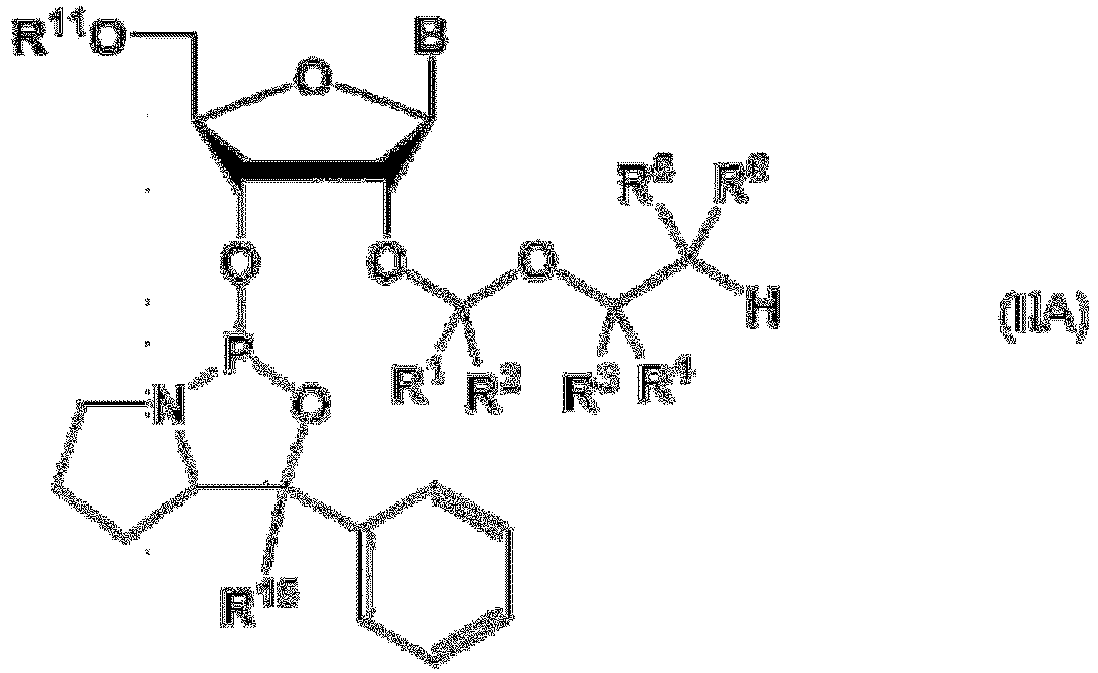
- Procédé pour préparer un acide oligoribonucléique, qui utilise le composé phosphoroamidite selon la revendication 6 ou 7.
- Procédé pour introduire le groupe protecteur selon la formule générale (I) dans laquelle R1 à R6 ont la même signification que dans la revendication 1, qui comprend l'étape de réaction du réactif comprenant un composé représenté par la formule générale (III) suivante :

dans lequel le dérivé est un ribonucléoside protégé, un ribonucléotide protégé, un oligonucléotide, un composé ribonucléotide réactif utilisé pour la synthèse des oligonucléotides, ou un composé nucléotide ou un composé oligonucléotide immobilisé sur une phase solide et protégé par un ou plusieurs groupes protecteurs. - Procédé pour introduire le groupe protecteur selon la formule générale (I) dans laquelle R1 à R6 ont les mêmes significations que dans la revendication 1, qui comprend l'étape de réaction du réactif comprenant un composé représenté par la formule générale (III) suivante :

dans lequel le dérivé est un ribonucléoside protégé, un ribonucléotide protégé, un oligonucléotide, un composé ribonucléotide réactif utilisé pour la synthèse des oligonucléotides, ou un composé nucléotide ou un composé oligonucléotide immobilisé sur une phase solide et protégé par un ou plusieurs groupes protecteurs.
Applications Claiming Priority (2)
| Application Number | Priority Date | Filing Date | Title |
|---|---|---|---|
| US24287709P | 2009-09-16 | 2009-09-16 | |
| PCT/JP2010/065900 WO2011034072A1 (fr) | 2009-09-16 | 2010-09-15 | Nouveau groupe protecteur pour synthétiser de l'arn et dérivé de celui-ci |
Publications (4)
| Publication Number | Publication Date |
|---|---|
| EP2479182A1 EP2479182A1 (fr) | 2012-07-25 |
| EP2479182A4 EP2479182A4 (fr) | 2013-05-08 |
| EP2479182B1 true EP2479182B1 (fr) | 2016-05-25 |
| EP2479182B8 EP2479182B8 (fr) | 2016-07-13 |
Family
ID=43758673
Family Applications (1)
| Application Number | Title | Priority Date | Filing Date |
|---|---|---|---|
| EP10817185.1A Active EP2479182B8 (fr) | 2009-09-16 | 2010-09-15 | Nouveau groupe protecteur pour synthétiser de l'arn et dérivé de celui-ci |
Country Status (6)
| Country | Link |
|---|---|
| US (1) | US8470987B2 (fr) |
| EP (1) | EP2479182B8 (fr) |
| JP (2) | JP5878758B2 (fr) |
| CN (1) | CN102574888A (fr) |
| ES (1) | ES2586683T3 (fr) |
| WO (1) | WO2011034072A1 (fr) |
Families Citing this family (54)
| Publication number | Priority date | Publication date | Assignee | Title |
|---|---|---|---|---|
| CN102282155B (zh) | 2008-12-02 | 2017-06-09 | 日本波涛生命科学公司 | 磷原子修饰的核酸的合成方法 |
| RU2612521C2 (ru) | 2009-07-06 | 2017-03-09 | Онтории, Инк. | Новые пролекарства нуклеиновых кислот и способы их применения |
| ES2586683T3 (es) * | 2009-09-16 | 2016-10-18 | Wave Life Sciences Japan, Inc. | Grupo protector novedoso para sintetizar ARN y derivados del mismo |
| JP5868324B2 (ja) | 2010-09-24 | 2016-02-24 | 株式会社Wave Life Sciences Japan | 不斉補助基 |
| JP6093924B2 (ja) * | 2010-11-30 | 2017-03-15 | 株式会社Wave Life Sciences Japan | 2’−o−修飾rna |
| CN103796657B (zh) | 2011-07-19 | 2017-07-11 | 波涛生命科学有限公司 | 合成官能化核酸的方法 |
| CA2879066C (fr) | 2012-07-13 | 2019-08-13 | Shin Nippon Biomedical Laboratories, Ltd. | Adjuvant d'acide nucleique chiral |
| KR102213609B1 (ko) | 2012-07-13 | 2021-02-08 | 웨이브 라이프 사이언시스 리미티드 | 키랄 제어 |
| PL2872485T3 (pl) | 2012-07-13 | 2021-05-31 | Wave Life Sciences Ltd. | Asymetryczna grupa pomocnicza |
| US8859754B2 (en) * | 2012-07-31 | 2014-10-14 | Ased, Llc | Synthesis of deuterated ribo nucleosides, N-protected phosphoramidites, and oligonucleotides |
| JPWO2015108047A1 (ja) | 2014-01-15 | 2017-03-23 | 株式会社新日本科学 | 免疫誘導活性を有するキラル核酸アジュバンド及び免疫誘導活性剤 |
| US10322173B2 (en) | 2014-01-15 | 2019-06-18 | Shin Nippon Biomedical Laboratories, Ltd. | Chiral nucleic acid adjuvant having anti-allergic activity, and anti-allergic agent |
| JPWO2015108048A1 (ja) | 2014-01-15 | 2017-03-23 | 株式会社新日本科学 | 抗腫瘍作用を有するキラル核酸アジュバンド及び抗腫瘍剤 |
| BR112016016400A2 (pt) | 2014-01-16 | 2017-10-03 | Wave Life Sciences Ltd | Composições de oligonucleotídeos quiralmente controlados, seu uso, sua composição farmacêutica, e métodos |
| IL320434A (en) | 2015-07-22 | 2025-06-01 | Wave Life Sciences Ltd | Oligonucleotide preparations and methods |
| IL295755A (en) | 2015-10-09 | 2022-10-01 | Wave Life Sciences Ltd | Oligonucleotide compositions and methods thereof |
| CN108779132B (zh) | 2016-03-13 | 2022-04-15 | 波涛生命科学有限公司 | 用于亚磷酰胺和寡核苷酸合成的组合物和方法 |
| WO2017184529A1 (fr) | 2016-04-18 | 2017-10-26 | Sarepta Therapeutics, Inc. | Oligomères antisens et procédés d'utilisation de ceux-ci pour le traitement de maladies associées au gène de l'alpha-glucosidase acide |
| MX2018013157A (es) | 2016-04-29 | 2019-05-23 | Sarepta Therapeutics Inc | Analogos de oligonucleotidos dirigidos a lmna humana. |
| EP3452596A4 (fr) | 2016-05-04 | 2020-03-18 | Wave Life Sciences Ltd. | Compositions d'oligonucléotides et procédés associés |
| JP2019520339A (ja) | 2016-06-03 | 2019-07-18 | ウェイブ ライフ サイエンシズ リミテッドWave Life Sciences Ltd. | オリゴヌクレオチド、その組成物および方法 |
| JP2019525742A (ja) | 2016-06-30 | 2019-09-12 | サレプタ セラピューティクス, インコーポレイテッド | 筋ジストロフィーに対するエクソンスキッピングオリゴマー |
| CN109937206B (zh) * | 2016-11-14 | 2022-04-01 | 学校法人东京理科大学 | 聚合性化合物、化合物、及硼烷磷酸酯低聚物的制造方法 |
| US11873316B2 (en) | 2016-11-23 | 2024-01-16 | Wave Life Sciences Ltd. | Compositions and methods for phosphoramidite and oligonucleotide synthesis |
| KR102810425B1 (ko) | 2016-12-19 | 2025-05-21 | 사렙타 쎄러퓨틱스 인코퍼레이티드 | 근육 이상증에 대한 엑손 스킵핑 올리고머 결합체 |
| KR20240006023A (ko) | 2016-12-19 | 2024-01-12 | 사렙타 쎄러퓨틱스 인코퍼레이티드 | 근육 이상증에 대한 엑손 스킵핑 올리고머 결합체 |
| PT3554552T (pt) | 2016-12-19 | 2022-10-03 | Sarepta Therapeutics Inc | Conjugados de oligómero de skipping de exão para distrofia muscular |
| CA3065523A1 (fr) | 2017-06-02 | 2018-12-06 | Wave Life Sciences Ltd. | Compositions d'oligonucleotides et leurs procedes d'utilisation |
| JP2020522510A (ja) | 2017-06-02 | 2020-07-30 | ウェイブ ライフ サイエンシズ リミテッドWave Life Sciences Ltd. | オリゴヌクレオチド組成物及びその使用方法 |
| US11718638B2 (en) | 2017-06-21 | 2023-08-08 | Wave Life Sciences Ltd. | Compounds, compositions and methods for synthesis |
| EP3664816A4 (fr) | 2017-08-08 | 2021-05-19 | Wave Life Sciences Ltd. | Compositions oligonucléotidiques et procédés associés |
| CA3072110A1 (fr) | 2017-09-18 | 2019-03-21 | Wave Life Sciences Ltd. | Technologies de preparation d'oligonucleotides |
| EA201991450A1 (ru) | 2017-09-22 | 2019-12-30 | Сарепта Терапьютикс, Инк. | Конъюгаты олигомеров для пропуска экзона при мышечной дистрофии |
| WO2019067979A1 (fr) | 2017-09-28 | 2019-04-04 | Sarepta Therapeutics, Inc. | Polythérapies pour traiter une dystrophie musculaire |
| WO2019067981A1 (fr) | 2017-09-28 | 2019-04-04 | Sarepta Therapeutics, Inc. | Polythérapies pour traiter une dystrophie musculaire |
| EP3687547A1 (fr) | 2017-09-28 | 2020-08-05 | Sarepta Therapeutics, Inc. | Polythérapies pour traiter une dystrophie musculaire |
| EP3694530A4 (fr) | 2017-10-12 | 2021-06-30 | Wave Life Sciences Ltd. | Compositions d'oligonucléotides et procédés associés |
| US11555189B2 (en) | 2017-10-18 | 2023-01-17 | Sarepta Therapeutics, Inc. | Antisense oligomer compounds |
| SG11202009877XA (en) | 2018-04-12 | 2020-11-27 | Wave Life Sciences Ltd | Oligonucleotide compositions and methods of use thereof |
| KR102670605B1 (ko) * | 2018-04-24 | 2024-05-29 | 스미또모 가가꾸 가부시끼가이샤 | 아미다이트 화합물 및 그 화합물을 사용한 폴리뉴클레오티드의 제조 방법 |
| US12391942B2 (en) | 2018-05-11 | 2025-08-19 | Wave Life Sciences Ltd. | Oligonucleotide compositions and methods of use thereof |
| US10758629B2 (en) | 2018-05-29 | 2020-09-01 | Sarepta Therapeutics, Inc. | Exon skipping oligomer conjugates for muscular dystrophy |
| EP3806868A4 (fr) | 2018-06-13 | 2022-06-22 | Sarepta Therapeutics, Inc. | Oligomères induisant un saut d'exon pour la dystrophie musculaire |
| TW202449155A (zh) | 2018-07-27 | 2024-12-16 | 美商薩羅塔治療公司 | 用於肌肉萎縮症之外顯子跳躍寡聚物 |
| IL318474A (en) | 2018-12-13 | 2025-03-01 | Sarepta Therapeutics Inc | Axon-skipping oligomer complexes for muscular dystrophy |
| JP2022525541A (ja) | 2019-03-20 | 2022-05-17 | ウェイブ ライフ サイエンシズ リミテッド | オリゴヌクレオチド調製に有用な技術 |
| WO2020214763A1 (fr) | 2019-04-18 | 2020-10-22 | Sarepta Therapeutics, Inc. | Compositions pour le traitement de la dystrophie musculaire |
| JP7640461B2 (ja) * | 2019-10-11 | 2025-03-05 | 住友化学株式会社 | 核酸オリゴマーの製造方法 |
| KR20230074205A (ko) * | 2020-09-24 | 2023-05-26 | 스미또모 가가꾸 가부시끼가이샤 | 핵산 올리고머의 제조 방법 |
| EP4271695A2 (fr) * | 2020-12-31 | 2023-11-08 | Alnylam Pharmaceuticals, Inc. | Promédicaments oligonucléotidiques à base de nucléosides modifiés en 2' |
| WO2023055774A1 (fr) | 2021-09-30 | 2023-04-06 | Sarepta Therapeutics, Inc. | Oligonucléotides antisens ayant une ou plusieurs unités abasiques |
| JP2025533454A (ja) | 2022-09-21 | 2025-10-07 | サレプタ セラピューティクス, インコーポレイテッド | Dmdアンチセンスオリゴヌクレオチド介在性エクソンスキッピング効率 |
| TW202442246A (zh) | 2023-04-27 | 2024-11-01 | 美商薩羅塔治療公司 | 用於治療慢性腎病之反義寡聚物 |
| WO2025085810A2 (fr) | 2023-10-18 | 2025-04-24 | Sarepta Therapeutics, Inc. | Oligomères antisens pour le traitement de myopathies centronucléaires |
Family Cites Families (8)
| Publication number | Priority date | Publication date | Assignee | Title |
|---|---|---|---|---|
| DD133885B1 (de) * | 1978-01-04 | 1981-02-25 | Hans Lehmann | Mittel zur bekaempfung von phytopathogenen bakterien und pilzen |
| US4542142A (en) * | 1982-11-22 | 1985-09-17 | Roussel Uclaf | Insecticidal cyclopropane carboxylic acid derivatives with 3-unsaturated-side chain |
| GB0306820D0 (en) * | 2003-03-25 | 2003-04-30 | Ici Plc | Polymerisation of ethylenically unsaturated monomers |
| JP4580870B2 (ja) | 2003-09-02 | 2010-11-17 | 株式会社キラルジェン | リボヌクレオチド又はリボヌクレオチド誘導体の製造方法 |
| WO2005092909A1 (fr) | 2004-03-25 | 2005-10-06 | Toudai Tlo, Ltd. | Procédés de fabrication d'analogue ribonucléotide de forte stéréorégularité et analogue désoxyribonucléotide |
| AU2005275801B2 (en) * | 2004-08-26 | 2012-05-10 | Nippon Shinyaku Co., Ltd. | Phosphoramidite compound and method for producing oligo-RNA |
| WO2007064291A1 (fr) * | 2005-11-30 | 2007-06-07 | Jyoti Chattopadhyaya | Procédé et composés permettant la synthèse de l'arn |
| ES2586683T3 (es) * | 2009-09-16 | 2016-10-18 | Wave Life Sciences Japan, Inc. | Grupo protector novedoso para sintetizar ARN y derivados del mismo |
-
2010
- 2010-09-15 ES ES10817185.1T patent/ES2586683T3/es active Active
- 2010-09-15 EP EP10817185.1A patent/EP2479182B8/fr active Active
- 2010-09-15 CN CN2010800414577A patent/CN102574888A/zh active Pending
- 2010-09-15 WO PCT/JP2010/065900 patent/WO2011034072A1/fr not_active Ceased
- 2010-09-15 US US12/882,390 patent/US8470987B2/en active Active
- 2010-09-15 JP JP2011531939A patent/JP5878758B2/ja active Active
-
2016
- 2016-01-29 JP JP2016015210A patent/JP2016164141A/ja active Pending
Non-Patent Citations (3)
| Title |
|---|
| KENJI UNEYAMA ET AL: "BISTRIFLUOROMETHYLATION OF ACRYLAMIDE FOR TRIFLUOROMETHYLATED SYNTHETIC BLOCKS", TETRAHEDRON LETTERS,, vol. 30, no. 1, 1 January 1989 (1989-01-01), pages 109 - 110, XP055108110 * |
| KIM S-G ET AL: "Use of the hexafluoro-2-butyl protecting group in the synthesis of DNA fragments via the phosphoramidite approach on solid supports", BIOORGANIC & MEDICINAL CHEMISTRY LETTERS, PERGAMON, AMSTERDAM, NL, vol. 5, no. 15, 3 August 1995 (1995-08-03), pages 1663 - 1666, XP004135404, ISSN: 0960-894X, DOI: 10.1016/0960-894X(95)00269-Y * |
| ZHANG ET AL: "Asymmetric synthesis of novel alpha-amino acids with beta-branched side chains", BIOORGANIC & MEDICINAL CHEMISTRY LETTERS, PERGAMON, AMSTERDAM, NL, vol. 17, no. 9, 3 April 2007 (2007-04-03), pages 2401 - 2403, XP022015312, ISSN: 0960-894X, DOI: 10.1016/J.BMCL.2007.02.041 * |
Also Published As
| Publication number | Publication date |
|---|---|
| EP2479182A1 (fr) | 2012-07-25 |
| JPWO2011034072A1 (ja) | 2013-02-14 |
| CN102574888A (zh) | 2012-07-11 |
| JP5878758B2 (ja) | 2016-03-08 |
| ES2586683T3 (es) | 2016-10-18 |
| WO2011034072A1 (fr) | 2011-03-24 |
| US8470987B2 (en) | 2013-06-25 |
| JP2016164141A (ja) | 2016-09-08 |
| EP2479182A4 (fr) | 2013-05-08 |
| EP2479182B8 (fr) | 2016-07-13 |
| US20110178284A1 (en) | 2011-07-21 |
Similar Documents
| Publication | Publication Date | Title |
|---|---|---|
| EP2479182B1 (fr) | Nouveau groupe protecteur pour synthétiser de l'arn et dérivé de celui-ci | |
| US6403566B1 (en) | Nucleosides having bicyclic sugar moiety | |
| EP3812370A1 (fr) | Groupe auxiliaire asymétrique | |
| AU2003222743A1 (en) | Synthesis of locked nucleic acid derivatives | |
| EP3137478B1 (fr) | Groupes protecteurs phosphoreux et leurs procédés de préparation et utilisation | |
| WO2005005450A1 (fr) | Procede de synthese d'un bisdinucleoside cyclique | |
| EP1995253A1 (fr) | Procede pour detacher un groupe protecteur d'un acide nucleique | |
| JP2024054157A (ja) | 修飾ヌクレオシドホスホロアミダイト | |
| US5674856A (en) | Modified oligodeoxyribonucleoditides | |
| US20090312534A1 (en) | Method for removal of nucleic acid-protecting group | |
| EP2017282A1 (fr) | Procede de coiffage d'acide oligonucleique | |
| US20040033967A1 (en) | Alkylated hexitol nucleoside analogues and oligomers thereof | |
| JP2003012690A (ja) | 置換イミダゾール誘導体又は置換ベンズイミダゾール誘導体を用いたヌクレオチドの製造法 | |
| WO2021080021A1 (fr) | Procédé de production d'oligonucléotide | |
| US20250115629A1 (en) | Chiral synthons for the synthesis of chiral phosphorothioates | |
| KR20220123300A (ko) | 분절-타입 아미디트(segment-type amidite)를 사용한 핵산 합성 방법 | |
| KR20240131337A (ko) | 폴리뉴클레오티드 제조 방법 | |
| HK40051606A (en) | Asymmetric auxiliary group | |
| EP1726597A1 (fr) | NOUVEAUX ARNóS ARTIFICIELS MODIFIES AU NIVEAU DU GROUPE 2ó-HYDROXYLE | |
| EA045540B1 (ru) | Модифицированные нуклеозидные амидофосфиты | |
| HK1000191B (en) | Modified oligodeoxyribonucleotides, their preparation and their therapeutic use | |
| HK1056565A (en) | Composition and methods for the synthesis of organophosphorus derivatives |
Legal Events
| Date | Code | Title | Description |
|---|---|---|---|
| PUAI | Public reference made under article 153(3) epc to a published international application that has entered the european phase |
Free format text: ORIGINAL CODE: 0009012 |
|
| 17P | Request for examination filed |
Effective date: 20120412 |
|
| AK | Designated contracting states |
Kind code of ref document: A1 Designated state(s): AL AT BE BG CH CY CZ DE DK EE ES FI FR GB GR HR HU IE IS IT LI LT LU LV MC MK MT NL NO PL PT RO SE SI SK SM TR |
|
| RIN1 | Information on inventor provided before grant (corrected) |
Inventor name: WADA TAKESHI Inventor name: SHIMIZU MAMORU |
|
| DAX | Request for extension of the european patent (deleted) | ||
| RIC1 | Information provided on ipc code assigned before grant |
Ipc: C07F 9/6561 20060101ALI20130328BHEP Ipc: C07F 9/6584 20060101ALI20130328BHEP Ipc: C07F 9/6558 20060101ALI20130328BHEP Ipc: C07F 7/18 20060101ALI20130328BHEP Ipc: C07H 21/02 20060101ALI20130328BHEP Ipc: C07H 19/167 20060101ALI20130328BHEP Ipc: C07C 43/13 20060101ALI20130328BHEP Ipc: C07H 19/10 20060101ALI20130328BHEP Ipc: C07H 19/067 20060101AFI20130328BHEP Ipc: C07H 19/20 20060101ALI20130328BHEP |
|
| A4 | Supplementary search report drawn up and despatched |
Effective date: 20130408 |
|
| 17Q | First examination report despatched |
Effective date: 20131024 |
|
| GRAP | Despatch of communication of intention to grant a patent |
Free format text: ORIGINAL CODE: EPIDOSNIGR1 |
|
| INTG | Intention to grant announced |
Effective date: 20151210 |
|
| GRAS | Grant fee paid |
Free format text: ORIGINAL CODE: EPIDOSNIGR3 |
|
| GRAA | (expected) grant |
Free format text: ORIGINAL CODE: 0009210 |
|
| AK | Designated contracting states |
Kind code of ref document: B1 Designated state(s): AL AT BE BG CH CY CZ DE DK EE ES FI FR GB GR HR HU IE IS IT LI LT LU LV MC MK MT NL NO PL PT RO SE SI SK SM TR |
|
| REG | Reference to a national code |
Ref country code: GB Ref legal event code: FG4D |
|
| REG | Reference to a national code |
Ref country code: CH Ref legal event code: EP |
|
| RAP2 | Party data changed (patent owner data changed or rights of a patent transferred) |
Owner name: WAVE LIFE SCIENCES JAPAN, INC. |
|
| REG | Reference to a national code |
Ref country code: DE Ref legal event code: R082 Ref document number: 602010033691 Country of ref document: DE Representative=s name: GODEMEYER BLUM LENZE PATENTANWAELTE, PARTNERSC, DE Ref country code: DE Ref legal event code: R081 Ref document number: 602010033691 Country of ref document: DE Owner name: WAVE LIFE SCIENCES LTD., SG Free format text: FORMER OWNER: CHIRALGEN, LTD., KAGOSHIMA-SHI, KAGOSHIMA, JP |
|
| REG | Reference to a national code |
Ref country code: IE Ref legal event code: FG4D Ref country code: AT Ref legal event code: REF Ref document number: 802250 Country of ref document: AT Kind code of ref document: T Effective date: 20160615 |
|
| REG | Reference to a national code |
Ref country code: DE Ref legal event code: R096 Ref document number: 602010033691 Country of ref document: DE |
|
| REG | Reference to a national code |
Ref country code: FR Ref legal event code: PLFP Year of fee payment: 7 |
|
| REG | Reference to a national code |
Ref country code: LT Ref legal event code: MG4D |
|
| REG | Reference to a national code |
Ref country code: NL Ref legal event code: MP Effective date: 20160525 |
|
| REG | Reference to a national code |
Ref country code: ES Ref legal event code: FG2A Ref document number: 2586683 Country of ref document: ES Kind code of ref document: T3 Effective date: 20161018 |
|
| PG25 | Lapsed in a contracting state [announced via postgrant information from national office to epo] |
Ref country code: FI Free format text: LAPSE BECAUSE OF FAILURE TO SUBMIT A TRANSLATION OF THE DESCRIPTION OR TO PAY THE FEE WITHIN THE PRESCRIBED TIME-LIMIT Effective date: 20160525 Ref country code: NO Free format text: LAPSE BECAUSE OF FAILURE TO SUBMIT A TRANSLATION OF THE DESCRIPTION OR TO PAY THE FEE WITHIN THE PRESCRIBED TIME-LIMIT Effective date: 20160825 Ref country code: NL Free format text: LAPSE BECAUSE OF FAILURE TO SUBMIT A TRANSLATION OF THE DESCRIPTION OR TO PAY THE FEE WITHIN THE PRESCRIBED TIME-LIMIT Effective date: 20160525 Ref country code: LT Free format text: LAPSE BECAUSE OF FAILURE TO SUBMIT A TRANSLATION OF THE DESCRIPTION OR TO PAY THE FEE WITHIN THE PRESCRIBED TIME-LIMIT Effective date: 20160525 |
|
| REG | Reference to a national code |
Ref country code: AT Ref legal event code: MK05 Ref document number: 802250 Country of ref document: AT Kind code of ref document: T Effective date: 20160525 |
|
| PG25 | Lapsed in a contracting state [announced via postgrant information from national office to epo] |
Ref country code: GR Free format text: LAPSE BECAUSE OF FAILURE TO SUBMIT A TRANSLATION OF THE DESCRIPTION OR TO PAY THE FEE WITHIN THE PRESCRIBED TIME-LIMIT Effective date: 20160826 Ref country code: PT Free format text: LAPSE BECAUSE OF FAILURE TO SUBMIT A TRANSLATION OF THE DESCRIPTION OR TO PAY THE FEE WITHIN THE PRESCRIBED TIME-LIMIT Effective date: 20160926 Ref country code: SE Free format text: LAPSE BECAUSE OF FAILURE TO SUBMIT A TRANSLATION OF THE DESCRIPTION OR TO PAY THE FEE WITHIN THE PRESCRIBED TIME-LIMIT Effective date: 20160525 Ref country code: LV Free format text: LAPSE BECAUSE OF FAILURE TO SUBMIT A TRANSLATION OF THE DESCRIPTION OR TO PAY THE FEE WITHIN THE PRESCRIBED TIME-LIMIT Effective date: 20160525 Ref country code: HR Free format text: LAPSE BECAUSE OF FAILURE TO SUBMIT A TRANSLATION OF THE DESCRIPTION OR TO PAY THE FEE WITHIN THE PRESCRIBED TIME-LIMIT Effective date: 20160525 |
|
| PG25 | Lapsed in a contracting state [announced via postgrant information from national office to epo] |
Ref country code: DK Free format text: LAPSE BECAUSE OF FAILURE TO SUBMIT A TRANSLATION OF THE DESCRIPTION OR TO PAY THE FEE WITHIN THE PRESCRIBED TIME-LIMIT Effective date: 20160525 Ref country code: EE Free format text: LAPSE BECAUSE OF FAILURE TO SUBMIT A TRANSLATION OF THE DESCRIPTION OR TO PAY THE FEE WITHIN THE PRESCRIBED TIME-LIMIT Effective date: 20160525 Ref country code: CZ Free format text: LAPSE BECAUSE OF FAILURE TO SUBMIT A TRANSLATION OF THE DESCRIPTION OR TO PAY THE FEE WITHIN THE PRESCRIBED TIME-LIMIT Effective date: 20160525 Ref country code: RO Free format text: LAPSE BECAUSE OF FAILURE TO SUBMIT A TRANSLATION OF THE DESCRIPTION OR TO PAY THE FEE WITHIN THE PRESCRIBED TIME-LIMIT Effective date: 20160525 Ref country code: SK Free format text: LAPSE BECAUSE OF FAILURE TO SUBMIT A TRANSLATION OF THE DESCRIPTION OR TO PAY THE FEE WITHIN THE PRESCRIBED TIME-LIMIT Effective date: 20160525 |
|
| PG25 | Lapsed in a contracting state [announced via postgrant information from national office to epo] |
Ref country code: BE Free format text: LAPSE BECAUSE OF NON-PAYMENT OF DUE FEES Effective date: 20160525 Ref country code: AT Free format text: LAPSE BECAUSE OF FAILURE TO SUBMIT A TRANSLATION OF THE DESCRIPTION OR TO PAY THE FEE WITHIN THE PRESCRIBED TIME-LIMIT Effective date: 20160525 Ref country code: PL Free format text: LAPSE BECAUSE OF FAILURE TO SUBMIT A TRANSLATION OF THE DESCRIPTION OR TO PAY THE FEE WITHIN THE PRESCRIBED TIME-LIMIT Effective date: 20160525 Ref country code: SM Free format text: LAPSE BECAUSE OF FAILURE TO SUBMIT A TRANSLATION OF THE DESCRIPTION OR TO PAY THE FEE WITHIN THE PRESCRIBED TIME-LIMIT Effective date: 20160525 |
|
| REG | Reference to a national code |
Ref country code: DE Ref legal event code: R097 Ref document number: 602010033691 Country of ref document: DE |
|
| PLBE | No opposition filed within time limit |
Free format text: ORIGINAL CODE: 0009261 |
|
| STAA | Information on the status of an ep patent application or granted ep patent |
Free format text: STATUS: NO OPPOSITION FILED WITHIN TIME LIMIT |
|
| PG25 | Lapsed in a contracting state [announced via postgrant information from national office to epo] |
Ref country code: MC Free format text: LAPSE BECAUSE OF FAILURE TO SUBMIT A TRANSLATION OF THE DESCRIPTION OR TO PAY THE FEE WITHIN THE PRESCRIBED TIME-LIMIT Effective date: 20160525 |
|
| REG | Reference to a national code |
Ref country code: CH Ref legal event code: PL |
|
| 26N | No opposition filed |
Effective date: 20170228 |
|
| PG25 | Lapsed in a contracting state [announced via postgrant information from national office to epo] |
Ref country code: SI Free format text: LAPSE BECAUSE OF FAILURE TO SUBMIT A TRANSLATION OF THE DESCRIPTION OR TO PAY THE FEE WITHIN THE PRESCRIBED TIME-LIMIT Effective date: 20160525 |
|
| REG | Reference to a national code |
Ref country code: IE Ref legal event code: MM4A |
|
| PG25 | Lapsed in a contracting state [announced via postgrant information from national office to epo] |
Ref country code: LI Free format text: LAPSE BECAUSE OF NON-PAYMENT OF DUE FEES Effective date: 20160930 Ref country code: CH Free format text: LAPSE BECAUSE OF NON-PAYMENT OF DUE FEES Effective date: 20160930 Ref country code: IE Free format text: LAPSE BECAUSE OF NON-PAYMENT OF DUE FEES Effective date: 20160915 |
|
| PG25 | Lapsed in a contracting state [announced via postgrant information from national office to epo] |
Ref country code: LU Free format text: LAPSE BECAUSE OF NON-PAYMENT OF DUE FEES Effective date: 20160915 |
|
| REG | Reference to a national code |
Ref country code: FR Ref legal event code: PLFP Year of fee payment: 8 |
|
| REG | Reference to a national code |
Ref country code: DE Ref legal event code: R082 Ref document number: 602010033691 Country of ref document: DE Representative=s name: GODEMEYER BLUM LENZE PATENTANWAELTE, PARTNERSC, DE Ref country code: DE Ref legal event code: R081 Ref document number: 602010033691 Country of ref document: DE Owner name: WAVE LIFE SCIENCES LTD., SG Free format text: FORMER OWNER: WAVE LIFE SCIENCES JAPAN, INC., KAGOSHIMA-SHI, KAGOSHIMA, JP |
|
| REG | Reference to a national code |
Ref country code: GB Ref legal event code: 732E Free format text: REGISTERED BETWEEN 20180215 AND 20180221 |
|
| PG25 | Lapsed in a contracting state [announced via postgrant information from national office to epo] |
Ref country code: HU Free format text: LAPSE BECAUSE OF FAILURE TO SUBMIT A TRANSLATION OF THE DESCRIPTION OR TO PAY THE FEE WITHIN THE PRESCRIBED TIME-LIMIT; INVALID AB INITIO Effective date: 20100915 Ref country code: CY Free format text: LAPSE BECAUSE OF FAILURE TO SUBMIT A TRANSLATION OF THE DESCRIPTION OR TO PAY THE FEE WITHIN THE PRESCRIBED TIME-LIMIT Effective date: 20160525 |
|
| PG25 | Lapsed in a contracting state [announced via postgrant information from national office to epo] |
Ref country code: TR Free format text: LAPSE BECAUSE OF FAILURE TO SUBMIT A TRANSLATION OF THE DESCRIPTION OR TO PAY THE FEE WITHIN THE PRESCRIBED TIME-LIMIT Effective date: 20160525 Ref country code: MT Free format text: LAPSE BECAUSE OF NON-PAYMENT OF DUE FEES Effective date: 20160930 Ref country code: MK Free format text: LAPSE BECAUSE OF FAILURE TO SUBMIT A TRANSLATION OF THE DESCRIPTION OR TO PAY THE FEE WITHIN THE PRESCRIBED TIME-LIMIT Effective date: 20160525 Ref country code: IS Free format text: LAPSE BECAUSE OF FAILURE TO SUBMIT A TRANSLATION OF THE DESCRIPTION OR TO PAY THE FEE WITHIN THE PRESCRIBED TIME-LIMIT Effective date: 20160525 |
|
| REG | Reference to a national code |
Ref country code: FR Ref legal event code: TP Owner name: WAVE LIFE SCIENCES LTD., SG Effective date: 20180530 |
|
| PG25 | Lapsed in a contracting state [announced via postgrant information from national office to epo] |
Ref country code: BG Free format text: LAPSE BECAUSE OF FAILURE TO SUBMIT A TRANSLATION OF THE DESCRIPTION OR TO PAY THE FEE WITHIN THE PRESCRIBED TIME-LIMIT Effective date: 20160525 |
|
| REG | Reference to a national code |
Ref country code: FR Ref legal event code: PLFP Year of fee payment: 9 |
|
| PG25 | Lapsed in a contracting state [announced via postgrant information from national office to epo] |
Ref country code: AL Free format text: LAPSE BECAUSE OF FAILURE TO SUBMIT A TRANSLATION OF THE DESCRIPTION OR TO PAY THE FEE WITHIN THE PRESCRIBED TIME-LIMIT Effective date: 20160525 |
|
| REG | Reference to a national code |
Ref country code: ES Ref legal event code: PC2A Owner name: WAVE LIFE SCIENCES LTD Effective date: 20181218 |
|
| PGFP | Annual fee paid to national office [announced via postgrant information from national office to epo] |
Ref country code: DE Payment date: 20250929 Year of fee payment: 16 |
|
| PGFP | Annual fee paid to national office [announced via postgrant information from national office to epo] |
Ref country code: IT Payment date: 20250919 Year of fee payment: 16 |
|
| PGFP | Annual fee paid to national office [announced via postgrant information from national office to epo] |
Ref country code: GB Payment date: 20250929 Year of fee payment: 16 |
|
| PGFP | Annual fee paid to national office [announced via postgrant information from national office to epo] |
Ref country code: FR Payment date: 20250925 Year of fee payment: 16 |
|
| PGFP | Annual fee paid to national office [announced via postgrant information from national office to epo] |
Ref country code: ES Payment date: 20251001 Year of fee payment: 16 |