EP2479975A2 - Capacité de grand signal commandée et inductivité - Google Patents
Capacité de grand signal commandée et inductivité Download PDFInfo
- Publication number
- EP2479975A2 EP2479975A2 EP12000289A EP12000289A EP2479975A2 EP 2479975 A2 EP2479975 A2 EP 2479975A2 EP 12000289 A EP12000289 A EP 12000289A EP 12000289 A EP12000289 A EP 12000289A EP 2479975 A2 EP2479975 A2 EP 2479975A2
- Authority
- EP
- European Patent Office
- Prior art keywords
- coupling
- inductance
- voltage
- switches
- control
- Prior art date
- Legal status (The legal status is an assumption and is not a legal conclusion. Google has not performed a legal analysis and makes no representation as to the accuracy of the status listed.)
- Granted
Links
Images





Classifications
-
- H—ELECTRICITY
- H03—ELECTRONIC CIRCUITRY
- H03J—TUNING RESONANT CIRCUITS; SELECTING RESONANT CIRCUITS
- H03J5/00—Discontinuous tuning; Selecting predetermined frequencies; Selecting frequency bands with or without continuous tuning in one or more of the bands, e.g. push-button tuning, turret tuner
- H03J5/24—Discontinuous tuning; Selecting predetermined frequencies; Selecting frequency bands with or without continuous tuning in one or more of the bands, e.g. push-button tuning, turret tuner with a number of separate pretuned tuning circuits or separate tuning elements selectively brought into circuit, e.g. for waveband selection or for television channel selection
- H03J5/246—Discontinuous tuning; Selecting predetermined frequencies; Selecting frequency bands with or without continuous tuning in one or more of the bands, e.g. push-button tuning, turret tuner with a number of separate pretuned tuning circuits or separate tuning elements selectively brought into circuit, e.g. for waveband selection or for television channel selection using electronic means
-
- H—ELECTRICITY
- H03—ELECTRONIC CIRCUITRY
- H03H—IMPEDANCE NETWORKS, e.g. RESONANT CIRCUITS; RESONATORS
- H03H7/00—Multiple-port networks comprising only passive electrical elements as network components
- H03H7/30—Time-delay networks
- H03H7/32—Time-delay networks with lumped inductance and capacitance
- H03H7/325—Adjustable networks
-
- H—ELECTRICITY
- H03—ELECTRONIC CIRCUITRY
- H03K—PULSE TECHNIQUE
- H03K3/00—Circuits for generating electric pulses; Monostable, bistable or multistable circuits
- H03K3/02—Generators characterised by the type of circuit or by the means used for producing pulses
- H03K3/027—Generators characterised by the type of circuit or by the means used for producing pulses by the use of logic circuits, with internal or external positive feedback
- H03K3/037—Bistable circuits
-
- H—ELECTRICITY
- H04—ELECTRIC COMMUNICATION TECHNIQUE
- H04N—PICTORIAL COMMUNICATION, e.g. TELEVISION
- H04N3/00—Scanning details of television systems; Combination thereof with generation of supply voltages
- H04N3/10—Scanning details of television systems; Combination thereof with generation of supply voltages by means not exclusively optical-mechanical
- H04N3/16—Scanning details of television systems; Combination thereof with generation of supply voltages by means not exclusively optical-mechanical by deflecting electron beam in cathode-ray tube, e.g. scanning corrections
-
- H—ELECTRICITY
- H04—ELECTRIC COMMUNICATION TECHNIQUE
- H04N—PICTORIAL COMMUNICATION, e.g. TELEVISION
- H04N3/00—Scanning details of television systems; Combination thereof with generation of supply voltages
- H04N3/10—Scanning details of television systems; Combination thereof with generation of supply voltages by means not exclusively optical-mechanical
- H04N3/16—Scanning details of television systems; Combination thereof with generation of supply voltages by means not exclusively optical-mechanical by deflecting electron beam in cathode-ray tube, e.g. scanning corrections
- H04N3/22—Circuits for controlling dimensions, shape or centering of picture on screen
-
- H—ELECTRICITY
- H04—ELECTRIC COMMUNICATION TECHNIQUE
- H04N—PICTORIAL COMMUNICATION, e.g. TELEVISION
- H04N3/00—Scanning details of television systems; Combination thereof with generation of supply voltages
- H04N3/10—Scanning details of television systems; Combination thereof with generation of supply voltages by means not exclusively optical-mechanical
- H04N3/16—Scanning details of television systems; Combination thereof with generation of supply voltages by means not exclusively optical-mechanical by deflecting electron beam in cathode-ray tube, e.g. scanning corrections
- H04N3/27—Circuits special to multi-standard receivers
-
- H—ELECTRICITY
- H03—ELECTRONIC CIRCUITRY
- H03L—AUTOMATIC CONTROL, STARTING, SYNCHRONISATION OR STABILISATION OF GENERATORS OF ELECTRONIC OSCILLATIONS OR PULSES
- H03L7/00—Automatic control of frequency or phase; Synchronisation
- H03L7/06—Automatic control of frequency or phase; Synchronisation using a reference signal applied to a frequency- or phase-locked loop
- H03L7/08—Details of the phase-locked loop
- H03L7/099—Details of the phase-locked loop concerning mainly the controlled oscillator of the loop
Definitions
- the present invention relates to tunable inductors or capacitors of AC electronics, in particular to switched inductors or capacitors in resonant circuits.
- FIG. 1 shows the essential circuit, in which the capacitor CS and the inductance LH form one Series resonant circuit.
- Capacitor CM is coupled to CS via controlled switch transistor Q1 and diode D1 at a subinterval of the resonant circuit period.
- the coupling control only works in one half cycle of the oscillating circuit because D1 always conducts during the other half cycle.
- the capacitor CR is not relevant because it remains short-circuited via the transistor QH and diode DH.
- the transformer DR develops at its secondary winding a voltage pulse during the flyback interval, which depends only on the drive signal of QH. This results in a pulse width modulation signal (hereinafter referred to as PWM signal) at the control input of Q1, which is coupled directly to the control signal to QH (h-drive). If the PWM signal is changed via the input (mod), only its interval length does not shift but its phase position with respect to hdrive.
- PWM signal pulse width modulation signal
- FIG. 2 shows the essential circuit, in which the capacitor CS and the inductance LH form a series resonant circuit.
- Capacitor CM and inductor LM are coupled to CS via the controlled transistors Q1a and Q1b and their integrated diodes in two subintervals of the resonant circuit period.
- the coupling control works in both half periods of the resonant circuit, since the current in CM and LM in both directions depends on the driving of the transistors Q1a and Q1b, respectively.
- the capacitor CR is not relevant because it remains short-circuited via the transistor QH and the diode DH; or transistors Q1a and Q1b remain fully open or fully closed when QH is open.
- a PWM is controlled, which is synchronized with the deflection frequency. This is done by means of a sawtooth generator, which is synchronized directly with the input signal h-drive or above the line flyback pulse.
- the PWM signal remains independent of the controlled capacitance or inductance or the resulting resonant circuit period.
- the PWM modulator is thus only controlled by the deflection frequency (h-drive) and the input (mod).
- the coupling interval must be generated in phase with the resonant circuit period or at least at the corresponding half period. It is no longer possible to use a signal independent of the resonant circuit for generating the switching signals of the transistors.
- resonant circuits or filters For tunable resonant circuits or filters one would like a frequency tuning which depends only on one control variable. This means that amplitude changes in current or voltage should not influence the frequency.
- the resonant circuit amplitude is to be controlled or regulated independently of the resonant circuit frequency. Therefore, if a resonant circuit is formed whose subcomponents can be changed by controlled subinterval coupling, it is very important that the PWM signal can be controlled independently of resonant circuit voltage amplitude. This means that the resulting resonant circuit frequency becomes a function of a control variable.
- Capacitance or inductance change by means of coupling control in oscillating circuits or arbitrary resonant circuits often generate a current flow through diodes, which usually represent the integrated switch diodes.
- the on-state loss of the diodes is proportional to the diode threshold voltage and the current. Since these resonant circuits are often Zerovoltage Switching (ZVS) or Zerocurrent Switching (ZCS) concepts, the losses are mainly determined by the switch and their diode conduction losses. Furthermore, transient events of the diodes in the transition from the blocking mode to the forward mode and vice versa generate interference signals and therefore additional losses. It is therefore important in efficient circuit concepts to avoid or at least minimize all these influences, if possible.
- the following invention describes a method and its detailed implementations for electronically controlling capacitances or inductances. It meets all mentioned requirements and is characterized by the fastest possible control behavior. A capacitance or inductance can thereby be varied from one resonant half cycle period to the next in its entire modulation range.
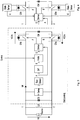
- FIG. 3 shows the block diagram of a resonant network whose total capacity is varied over an electrical size.
- Signal waveforms too FIG. 3 are in FIG. 5 and are used in the further description with its indices.
- the energy source (source) is connected via the nodes 1 and 2 with a parallel resonant circuit.
- the energy source may be any AC source or any part of a coupled LC feed network (not shown).
- the inductance L0 and the capacitance C0 form a resonant circuit.
- the capacitor CM is coupled to C0 via the coupling switches Q1a and Q1b.
- the diodes indicated indicate that the coupling switches can only be controlled in one direction. In opposite current direction Q1a and Q1b remain bridged by the diodes.
- the term switch functionally defines the actively controllable part of Q1a and Q1b.
- the term coupling switch functionally defines the actively controllable part and the diode.
- the first extremal condition of the switch control adjusts when the coupling switches Q1a and Q1b are always open. Then the resulting total capacity is equal to C0 and so minimal. Accordingly, the resonant circuit frequency is maximum.
- the second extremal condition of the switch control adjusts when the coupling switches Q1a and Q1b are always closed. Then the resulting total capacity is equal to the parallel circuit of C0 and CM and thus maximum. Accordingly, the resonant circuit frequency is minimal.
- Partial interval coupling means that C0 and CM are coupled together during part of the resulting resonant circuit period. This is to be understood in the following description as a time or angle interval.
- the entire circuit represents a total capacity (Ctot) whose value is controlled by Control.
- the resonant circuit frequency results as the mean value of the entire resonant circuit period.
- the instantaneous resonant circuit frequency changes within the oscillating circuit period between minimum and maximum or maximum and minimum frequency according to the states of the two coupling switches.
- the resulting capacitor voltage V0 is tapped in the block V-sense and then fed to the block Sign Detect for sign determination.
- the tapping of the capacitor voltage may also comprise only a partial voltage, it is only important that the sign of the output signal has a defined phase reference to the voltage V0 across the capacitor C0.
- the resulting waveform is shown in A.
- the subsequent differentiator (Diff) derives A by time and outputs its magnitude, see curve B. This gives positive pulses at each zero crossing 0, T3 and T6 of the resonant circuit voltage V0.
- the pulse width modulator (PWM) generates a sawtooth C in synchronism with the pulses of B (in FIG. 3 not shown, as it is a signal within the PWM modulator). This sawtooth curve C is compared within the PWM block with the control variable Control. If Control is less than C, the PWM output D is high.
- the PWM output D is low.
- the modulator can be realized in various ways. The only important thing is that the PWM signal D is triggered by B and controlled by Control in its pulse length.
- the subsequent block Demux selects a portion of the corresponding half-wave using signal A and supplies it to the switches Q1a and Q1b. If A is high, the negated signal D controls the switch Q1a via E. If A is low, the negated signal D over F controls the switch Q1b. If D via A is not linked to the corresponding output E or F, E or F remains high. The switch Q1a or Q1b is closed (ON) when E or F is high. If E and F are deep, then Q1a and Q1b are open.
- Another functional possibility to generate the switch signals would be to trigger a frequency divider with the positive edge of D and to control the switches Q1a or Q1b directly with its output or negated output (not shown).
- the advantage in the logic link with A described here is that the switches remain closed longer. Therefore, the current flow interval in the switches expands by the interval from T3 to T4 in switch Q1a and by the interval from 0 to T1 in switch Q1b. Thus, the switches always remain closed for at least one half-cycle and bridge their internal diode. This results in smaller forward losses and prevents transient transients from occurring when the diodes are turned on. The diodes can still carry a certain residual current.
- the method causes a reduction in losses, especially when the on-resistance of the switches (Rdson) is sufficiently small.
- the voltage VQ1 becomes zero (time T2), the stored energy in L0 forces a negative current flow in the internal diode from the coupling switch Q1a. This lasts from T2 to T3 and is overridden by the process described above from the conductive (or inverse-conductive) switch Q1a.
- the coupling switches Q1a and Q1b remain closed until the signal F goes low.
- a negative sinusoidal voltage half wave develops in the sum voltage VQ1 during the time interval from T4 to T5. During this interval no current flows through CM.
- the voltage VQ1 becomes zero (time T5), the stored energy in L0 forces a negative current flow in the internal diode from the coupling switch Q1b. This lasts from T5 to T6 and is replaced by the above-described process by the conductive (or inverse-conducting) switch Q1b.
- the total current flow interval of the internal diodes is limited to the interval from T2 to T3 and T5 to T6.
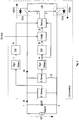
- FIG. 6 shows the block diagram of a resonant network whose total inductance is varied over an electrical size. Signal waveforms too FIG. 6 are in FIG. 7 and are used in the further description with its indices.
- the energy source (source) is connected via the nodes 1 and 2 with a parallel resonant circuit.
- the energy source may be any AC source or any part of a coupled LC feed network (not shown).
- the inductance L0 and the capacitance C0 form a resonant circuit.
- the inductance LM is coupled to L0 via the coupling switches Q1a and Q1b.
- the first extremal condition of the switch control adjusts when both coupling switches Q1a and Q1b are always open. Then the resulting Total inductance equal to L0 and thus maximum. Accordingly, the resonant circuit frequency is minimal.
- the second extremal condition of the switch control adjusts when both coupling switches Q1a and Q1b are always closed. Then the resulting total inductance is equal to the parallel connection of L0 and LM and thus minimal. Accordingly, the resonant circuit frequency is maximum.
- any intermediate value of the two extreme values for the total inductance can be set via the control input Control.
- the entire circuit represents a total inductance (Ltot) whose value is controlled by Control.
- the resonant circuit frequency results as the mean value of the entire resonant circuit period.
- the instantaneous resonant circuit frequency changes within the oscillating circuit period between minimum and maximum or maximum and minimum frequency according to the states of the two coupling switches.
- the resulting coil current is tapped in block I-sense and then fed to the block Sign Detect for sign determination.
- the tapping of the coil current may also comprise only a partial current of I0, it is only important that the sign of the output signal has a defined phase reference to the current I10 in the coil L0.
- the resulting waveform is shown in A.
- the subsequent differentiator (Diff) derives A in time and outputs its magnitude, see curve B. This gives positive pulses at each zero crossing 0, T3 and T6 of resonant circuit current 10.
- the pulse width modulator (PWM) generates in synchronism with the pulses of B. a sawtooth C (in FIG. 6 not shown, as it is a signal within the PWM modulator). This sawtooth curve C is compared within the PWM block with the control variable Control. If Control is less than C, the PWM output D is high. If Control is greater than C, the PWM output D is low. Based on the known pulse width modulation (PWM), the modulator can be realized in various ways.
- the PWM output signal D is triggered by B and is controlled by Control in its pulse length.
- the block V-sense seizes the voltage above L0 and the block Detect Detect the sign of this voltage see signal J.
- the subsequent differentiator (Diff) derives J by time and outputs its magnitude, see curve K. This gives positive pulses at each zero crossing of resonant circuit voltage V0 (see V0 zerocrossing in FIG Figure 7 ).
- the pulses of signal K coincide in time with the maxima or minima of the current I0.
- the signal K is associated with A and D in demux to generate the drive signals E "and F" of the switches Q1a and Q1b.
- the switch Q1a or Q1b is closed (ON) when E "or F" is high.
- the smaller diode current flow interval results in smaller forward losses and prevents the build up of transients during diode turn-on.
- the diodes can still carry a certain residual current.
- the method causes a reduction in losses, especially when the on-resistance of the switches (Rdson) is sufficiently small.
- the coupling switch Q1b closes and a negative sinusoidal current half-wave develops in IM during the time interval from T4 to T5.
- the total coupling switch voltage VQ1 is zero because both coupling switches are closed.
- the current flow interval of the internal diodes is limited to the interval from V0 zerocrossing to T2 of the positive current half cycle in IM or T5 of the negative current half cycle in IM.
- control variable can be changed from one oscillatory cycle period (from 0 to T3) to the next one (from T3 to T6 or 0). This achieves the shortest possible response time or the greatest possible transmission bandwidth with respect to the control input (control).
- the control of the coupling switch corresponds to the FIGS. 3, 4 and 6 a delayed on or off.
- the delay is determined by a control variable (Control).
- All function blocks of the FIGS. 3, 4 and 6 have signal delays between input signal and output signal. These signal delays limit the earliest possible beginning of the decoupling interval (T1, T4 in the Figures 5 and 7 ). This limits the modulation range because in a Aus confusesextremfall in the FIGS. 3, 4 and 5 the switches Q1a and Q1b should already be open again at the zero crossing of the voltage V0. Equally significant is the scope of the FIGS. 6 and 7 because in a Aus confusesextremfall the switches Q1a and Q1b should already be closed again at the zero crossing of the current I0. To compensate for this, one or more blocks in the FIGS. 3, 4 and 6 advance the phases in their transfer function. This way the run times or delays can be compensated and the entire control range can be used.
- phase pre-rotation This gives an even larger phase pre-rotation.
- These possibilities can be imposed by applying the concepts described herein in frequency ranges where the total signal delay is 90 degrees and more of one network period.
- approximately optimal switching signals E 'and F' ( FIG. 4 ) or E "and F" ( FIG. 6 ) are obtained without the state-sense blocks in FIG. 4 or without the additional V-Sense Block in FIG. 6 .
- the logic connection in Demux is adjusted according to the required output signals. It can be z.
- the inverse signal A are used in demux (not shown). The implementation of these possibilities depends on the logic and switch characteristics used, the desired network resonance frequency and the desired tuning range.
- the components can be permuted as desired in their circuits. So it is clear that the concepts described in the FIGS. 3, 4 and 6 can be applied directly to a series connection of the components C0, Cm, L0 or L0, LM, C0.
- the coupling circuit can basically consist of one or two capacitors (CM) or inductors (LM). It is also clear that the presented concepts can also be applied to asymmetric network periods or to just one coupling switch.
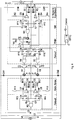
- FIG. 8 shows a detail circuit FIG. 4 ,
- the dashed lines comprise parts of the block diagram.
- waveforms of FIG. 5 referenced with their indexes.
- CM is implemented as a series connection of 2 capacitors CM1 and CM2, which is coupled to C0 via Q1a and Q1b.
- the switch control is operated on a supply voltage V + 15.
- An opto-coupler transmits the control information (Control) galvanically isolated, since the switch control should be galvanically separated by V + 15 from the rest of the network.
- the capacitors C1 and C2 pick up the positive voltage half-wave from V0 and feed it via R1 to the base of transistor Q10.
- Q10 acts as a quasi voltage zero point detector of the positive half wave.
- D1 and D3 accelerate the shutdown as soon as the voltage across C2 falls below the threshold voltage of Q10.
- the capacitive voltage divider C1, C2 prevents DC coupling to V0.
- a phase predistortion can be achieved via R1, C1 and C2.
- these components are dimensioned so that the Phasenwordrehung is at least as large as the total signal delay of the control circuit. This makes it possible to use the entire control range.
- the components Q9, D2, D4, R3, R4, C3 and C4 work identically to the components around Q10, only they are responsible for the negative half wave of V0.
- the two D flip-flops FF1, FF2 and the Nand Gate N1 detect the two positive edges of the output signals of the Voltage zero point detectors Q9 and Q10.
- a flip-flop (FF1 or FF2) alternately switches on the Q output as soon as it is triggered on the Clock CK. This state is immediately reset after the runtime of N1 via the corresponding reset input.
- voltage pulses occur at each zero crossing of V0 (signal curve B), which briefly completely drive through the transistor Q2.
- This symmetric implementation guarantees identical behavior with respect to the two voltage half-waves of V0.
- Q2 is coupled to V0 only during the triggering moment of the short voltage pulses.
- Q7, Q8, R6 and R5 reflect a control current, defined by the control variable Control, which flows into the capacitor C5.
- the result is a sawtooth voltage across C5 (curve C), which reaches its lowest value in time with the drive pulses of Q2.
- This sawtooth voltage triggers FF5 via input CK as soon as its switching threshold is reached.
- This point in time can be controlled via the control input Control because the slope of the sawtooth voltage can be changed by the collector current in Q8 and consequently by Control.
- FF5, FF6, N3 and N4 form the first part of the demux.
- FF5 is configured via the pulses on the set (S) or reset (R) input so that the sawtooth always triggers the corresponding switch, which is responsible for the corresponding half-wave.
- IQ of FF6 is also high, this causes the output of N4 to go low, thus coupling switch Q1a opens via drivers Q3, Q4.
- FF5 is via the R input of FF1 reset as soon as D1 is conductive and FF1 is triggered via the clock CK. This forces high at the output of N3, which closes Q1b via the drivers Q5, Q6. This is the initial condition for the controlled decoupling of CM1 and CM2 during the negative half cycle of V0. If the switching threshold is reached in the PWM modulator (the voltage across C5 is equal to the switching threshold of FF5), FF5 tilts: Q is high and IQ low.
- this integrating voltage measurement makes the detector insensitive to current transients in the current pocket around Q1a.
- the components Q12, D6, D8, R10, R12, C7 and C8 work identically to the components around Q11. They are responsible for the negative half wave of VQ1 and thus capture the state of Q1b.
- the two D flip-flops FF3, FF4 and the Nand Gate N2 detect the two positive edge changes of the voltage zero point detectors Q11 and Q12. For this purpose, a flip-flop switches through as soon as it is triggered on the clock CK. This state is immediately reset after the runtime of N2 via the corresponding reset input. This produces voltage pulses at the output of N1 as soon as the voltage across Q1a or Q1b becomes zero.
- the flip-flop FF6 synchronizes itself after no more than one oscillation circuit period after turning on the entire circuit. Then at least one of the coupling switches Q1a or Q1b has always opened and generated a clock pulse for FF6.
- FIG. 9 shows a summary of the demux signal states over a resonant circuit period respectively after clock (CK) triggering of the corresponding flip-flops.
- the output signals of the state diagram correspond to the signals E, E 'and F and F' of the FIG. 5 ,
- the simplest control circuit is obtained when the switches are controlled via the simple frequency division using FF5.
- FF6, N3 and N4 as well as the blocks StateSense and Demux2 are eliminated.
- Output Q of FF5 is connected directly to the input of drivers Q3 and Q4.
- the output IQ of FF5 is connected directly to the input of drivers Q5 and Q6.
- this variant has the worst efficiency.
- FIG. 10 shows a detail circuit FIG. 6 ,
- the dashed lines comprise parts of the block diagram.
- waveforms of FIG. 7 referenced with their indexes.
- LM is coupled to L0 via Q1a and Q1b.
- the switch control is operated at a voltage V + 15 with any reference potential.
- the required control signals of Coupling switches Q1a and Q1b are coupled galvanically isolated via the transformers T1 and T2 to Q1a and Q1b, respectively.
- an optocoupler with subsequent driver may be used (not shown).
- the driver stages Q3 ... Q6 can be omitted.
- the advantage of a single inductance LM is the greater efficiency and lower costs.
- control current (Control) is now supplied without galvanic isolation.
- the inductance L1 picks up the positive current half-wave of I0 and supplies it via shunt resistor R13 via R1 and C2 to the base of transistor Q10.
- Q10 acts as a quasi-current zero-point detector of the positive half-wave.
- D1 and D3 accelerate the shutdown as soon as the current through C2 changes its sign.
- C2 prevents DC coupling to I0.
- a phase predistortion can be achieved via L1, R1, R13 and C2.
- these components are dimensioned so that the Phasenwordrehung is at least as large as the total signal delay of the control circuit. This makes it possible to use the entire control range.
- the components Q9, D2, D4, R3, R4, R14, C4 and L2 work identically to the components around Q10, only they are responsible for the negative current half-wave of I0.
- the two D flip-flops FF1, FF2 and the Nand gate N1 detect the two positive edges of the output signals of the current zero detectors Q9 and Q10.
- a flip-flop (FF1 or FF2) alternately switches on the Q output as soon as it is triggered on the Clock CK. This state is immediately reset after the runtime of N1 via the corresponding reset input.
- voltage pulses occur at each zero crossing of I0 (signal curve B), which briefly completely drive through the transistor Q2.
- FF5 is configured via the pulses on the set (S) or reset (R) input so that the sawtooth always triggers the corresponding switch, which is responsible for the corresponding half-wave. This corresponds to the switching signal selection by means of signal curve A. If I0 appears with the positive half-wave, D2 is conducting. The collector of Q9 is high and triggers FF2 over CK. The briefly set output Q of FF2 sets the output Q of FF5 via its set (S) input. The high at output Q of FF5 forces a low at the output of N4 which opens Q1a via drivers Q3, Q4. This is the initial condition for the controlled coupling of LM during the positive half cycle of I0.
- This "turn off” command triggers FF6 at the clock input so that FF6's two outputs take over the states of FF5, N3 remains high for the positive current half cycle of I0, N4 goes low, N4 remains high for the negative current half cycle of I0.
- N3 goes low, so that only one of the switches Q1a and Q1b of the corresponding half-wave of I0 remains closed after this point in time (V0 Zerocrossing), thus decoupling LM only from the integrated diodes in Q1a or Q1b Phase advance in the block V-sense is no longer absolutely necessary, a corresponding signal propagation delay keeps the switches closed longer, which further reduces the losses, but the important limiting condition that the switch Q1a or Q1b must open at the latest with the internal diode remains to be strictly observed.
- the advantage of this differentiation is the robustness with respect to transients, which disturb the function only after a change of sign of the total voltage (V0). This makes the "defeat command" of the switches Q1a and Q1b insensitive to transients of the resonant circuit.
- the flip-flop FF6 synchronizes itself after no more than one oscillation circuit period after turning on the entire circuit. Then at least one of the coupling switches Q1a or Q1b has always opened and generated a clock pulse for FF6.
- FIG. 11 shows a summary of the demux signal states over a resonant circuit period respectively after clock (CK) triggering of the corresponding flip-flops.
- the output signals of the state diagram correspond to the signals E "and F" of the FIG. 6 ,
- Another possible drive variant would be to tap the current in the coupling switches Q1a and Q1b (not shown in FIG. 10 ).
- the coupling switch surface is split into a small sense path. This creates an identical sense MOSFET.
- the output of this sense MOSFET is fed to a comparator which is the coupling switch Current zero detected and subsequently feeds the diff block input.
- the voltage can also be measured via Rdson with a comparator.
- Such current sense implementations are already common in output stages of e.g. Eg integrated switching power supplies.
- both switches can be controlled identically.
- I0 zero crossing (signal curve B in FIG. 6 ) defines the opening of both coupling switches.
- the PWM (the voltage across capacitor C5) controls the closing of both coupling switches, and the current zero point in the coupling switch controls the opening of both coupling switches.
Landscapes
- Engineering & Computer Science (AREA)
- Multimedia (AREA)
- Signal Processing (AREA)
- Dc-Dc Converters (AREA)
- Inverter Devices (AREA)
- Measurement Of Resistance Or Impedance (AREA)
Priority Applications (1)
| Application Number | Priority Date | Filing Date | Title |
|---|---|---|---|
| EP18000152.1A EP3361718B1 (fr) | 2011-01-22 | 2012-01-19 | Capacité et inductance pilotées pour grands signals |
Applications Claiming Priority (1)
| Application Number | Priority Date | Filing Date | Title |
|---|---|---|---|
| DE102011009162A DE102011009162A1 (de) | 2011-01-22 | 2011-01-22 | Gesteuerte Großsignal Kapazität und Induktivität |
Related Child Applications (2)
| Application Number | Title | Priority Date | Filing Date |
|---|---|---|---|
| EP18000152.1A Division-Into EP3361718B1 (fr) | 2011-01-22 | 2012-01-19 | Capacité et inductance pilotées pour grands signals |
| EP18000152.1A Division EP3361718B1 (fr) | 2011-01-22 | 2012-01-19 | Capacité et inductance pilotées pour grands signals |
Publications (3)
| Publication Number | Publication Date |
|---|---|
| EP2479975A2 true EP2479975A2 (fr) | 2012-07-25 |
| EP2479975A3 EP2479975A3 (fr) | 2013-06-26 |
| EP2479975B1 EP2479975B1 (fr) | 2018-05-16 |
Family
ID=45571338
Family Applications (2)
| Application Number | Title | Priority Date | Filing Date |
|---|---|---|---|
| EP12000289.4A Active EP2479975B1 (fr) | 2011-01-22 | 2012-01-19 | Capacité de grand signal commandée et inductivité |
| EP18000152.1A Active EP3361718B1 (fr) | 2011-01-22 | 2012-01-19 | Capacité et inductance pilotées pour grands signals |
Family Applications After (1)
| Application Number | Title | Priority Date | Filing Date |
|---|---|---|---|
| EP18000152.1A Active EP3361718B1 (fr) | 2011-01-22 | 2012-01-19 | Capacité et inductance pilotées pour grands signals |
Country Status (3)
| Country | Link |
|---|---|
| US (3) | US8854151B2 (fr) |
| EP (2) | EP2479975B1 (fr) |
| DE (1) | DE102011009162A1 (fr) |
Families Citing this family (6)
| Publication number | Priority date | Publication date | Assignee | Title |
|---|---|---|---|---|
| EP3402063A1 (fr) * | 2013-02-08 | 2018-11-14 | Markus Rehm | Transmission d'énergie électrique sans fil couplée par résonance |
| JP2014159685A (ja) * | 2013-02-19 | 2014-09-04 | Tokai Rika Co Ltd | 伝搬時間測定装置 |
| US9306603B2 (en) * | 2014-01-24 | 2016-04-05 | Qualcomm Incorporated | Tunable radio frequency (RF) front-end architecture using filter having adjustable inductance and capacitance |
| KR102337682B1 (ko) | 2014-10-01 | 2021-12-09 | 삼성전자주식회사 | 디스플레이 장치 및 그의 제어 방법 |
| US10547281B1 (en) * | 2018-07-13 | 2020-01-28 | Qualcomm Incorporated | Source impedance tuning circuit for a receive path |
| CN111294018B (zh) * | 2020-03-17 | 2023-04-14 | 上海傅里叶半导体有限公司 | 一种基于Kaiser窗的LRA驱动脉冲波形设计方法 |
Citations (2)
| Publication number | Priority date | Publication date | Assignee | Title |
|---|---|---|---|---|
| US4533855A (en) | 1983-12-16 | 1985-08-06 | Rca Corporation | Switched capacitor S-correction circuit |
| US6586895B2 (en) | 2001-05-08 | 2003-07-01 | Thomson Licensing S.A. | Raster distortion correction circuit |
Family Cites Families (11)
| Publication number | Priority date | Publication date | Assignee | Title |
|---|---|---|---|---|
| DE19546928A1 (de) * | 1995-12-15 | 1997-06-19 | Diehl Ident Gmbh | Einrichtung zur hochfrequenten Übermittlung einer Information |
| DE19723307B4 (de) * | 1997-06-04 | 2005-03-10 | Atmel Germany Gmbh | Verfahren zur Erzeugung eines Oszillatorsignals |
| AU5299600A (en) * | 1999-05-26 | 2000-12-12 | Broadcom Corporation | Integrated vco |
| DE19925742A1 (de) * | 1999-06-05 | 2000-12-07 | Inst Halbleiterphysik Gmbh | Oszillator mit veränderbarer Induktivität |
| US7005935B2 (en) * | 2001-10-05 | 2006-02-28 | Alfred E. Mann Institute For Biomedical Engineering At The University Of Southern California | Switched reactance modulated E-class oscillator |
| CA2390845C (fr) * | 2002-06-18 | 2004-10-26 | Magneto-Inductive Systems Limited | Appareil et methode de controle permanent d'impedance reactive variable |
| US6882236B2 (en) * | 2002-11-05 | 2005-04-19 | Magneto-Inductive Systems Limited | Dynamically tuned amplifier for frequency shift keyed signals |
| US6934167B2 (en) * | 2003-05-01 | 2005-08-23 | Delta Electronics, Inc. | Contactless electrical energy transmission system having a primary side current feedback control and soft-switched secondary side rectifier |
| NZ539771A (en) * | 2005-04-29 | 2007-10-26 | Auckland Uniservices Ltd | Tuning methods and apparatus for inductively coupled power transfer (ICPT) systems |
| US20080266007A1 (en) * | 2007-04-25 | 2008-10-30 | Ming-Da Tsai | Oscillating apparatus having current compensating device for providing compensating current to compensate for current reduction of transconductive device and method thereof |
| US8098106B1 (en) * | 2009-06-01 | 2012-01-17 | Marvell International Ltd. | Low noise voltage controlled oscillator (VCO) |
-
2011
- 2011-01-22 DE DE102011009162A patent/DE102011009162A1/de not_active Withdrawn
-
2012
- 2012-01-19 US US13/374,846 patent/US8854151B2/en active Active
- 2012-01-19 EP EP12000289.4A patent/EP2479975B1/fr active Active
- 2012-01-19 EP EP18000152.1A patent/EP3361718B1/fr active Active
-
2014
- 2014-09-04 US US14/477,418 patent/US9450558B2/en active Active
-
2016
- 2016-08-19 US US15/241,710 patent/US9748931B2/en active Active
Patent Citations (2)
| Publication number | Priority date | Publication date | Assignee | Title |
|---|---|---|---|---|
| US4533855A (en) | 1983-12-16 | 1985-08-06 | Rca Corporation | Switched capacitor S-correction circuit |
| US6586895B2 (en) | 2001-05-08 | 2003-07-01 | Thomson Licensing S.A. | Raster distortion correction circuit |
Also Published As
| Publication number | Publication date |
|---|---|
| US20140368289A1 (en) | 2014-12-18 |
| EP2479975B1 (fr) | 2018-05-16 |
| US9450558B2 (en) | 2016-09-20 |
| US20120256677A1 (en) | 2012-10-11 |
| US8854151B2 (en) | 2014-10-07 |
| US20160373088A1 (en) | 2016-12-22 |
| EP3361718A1 (fr) | 2018-08-15 |
| US9748931B2 (en) | 2017-08-29 |
| EP2479975A3 (fr) | 2013-06-26 |
| EP3361718B1 (fr) | 2019-04-03 |
| DE102011009162A1 (de) | 2012-07-26 |
Similar Documents
| Publication | Publication Date | Title |
|---|---|---|
| EP2573904B1 (fr) | Oscillateur grand signal commandé en tension | |
| DE4234725B4 (de) | Gleichspannungswandler | |
| EP2479975B1 (fr) | Capacité de grand signal commandée et inductivité | |
| DE202007005779U1 (de) | MF-Plasmaleistungsgenerator | |
| EP2180586B1 (fr) | Circuit convertisseur ainsi qu'unité et système dotés d'un tel circuit convertisseur | |
| DE102020213730A1 (de) | Aktiver burst-zvs-boost-pfc-wandler | |
| DE102007041510A1 (de) | Mehrkanaliger Gleichstromsteller | |
| EP2110938B1 (fr) | Circuit de commande primaire pour un convertisseur électronique de puissance comportant un transformateur sans enroulement auxiliaire avec un réglage basé sur la durée de continuité de courant du côté secondaire | |
| DE102010029244A1 (de) | System und Verfahren zur Transientenunterdrückung in einem Schaltnetzteil | |
| WO2016071029A1 (fr) | Systeme de transmission, procédé et système pour véhicules | |
| DE112017005586T5 (de) | Leistungssender und Verfahren zum drahtlosen Übertragen von Leistung | |
| EP3949099A1 (fr) | Convertisseur continu-continu isolé équipé d'un redresseur à pont de diodes complet côté secondaire et d'un condensateur auxiliaire asymétrique | |
| DE102022209010A1 (de) | Frequenzverwaltung für drahtlose stromübertragung | |
| EP0371555A1 (fr) | Disposition de circuit pour l'alimentation d'une charge | |
| DE102016107068A1 (de) | Phasensynchronisierter modulierbarer resonanter elektro-optischer Modulator zum Schalten von Hochleistungslaserpulsen | |
| WO2018029114A1 (fr) | Système et procédé de transmission d'énergie par induction | |
| EP2151067B1 (fr) | Dispositif de transmission inductive pour énergie électrique et données | |
| DE102011077387A1 (de) | Schaltungsanordnung zum Schalten eines Stromes und Verfahren zum Betreiben derselben | |
| DE102008034989B4 (de) | Schaltungsanordnung und Verfahren zur Steuerung der Leistungsaufnahme von Beleuchtungsanlagen mit Wechselspannungsspeisung | |
| DE19929841C2 (de) | Getakteter Verstärker, insbesondere zur Verstärkung von Audiosignalen | |
| WO2007096263A1 (fr) | Convertisseur élévateur présentant une fréquence de commutation minimale | |
| DE19516861C2 (de) | Einstufiger Gleichspannungskonverter nach dem Gegentaktwandlerprinzip | |
| DE102019214674A1 (de) | Stromrichterschaltung und Verfahren zur Umwandlung elektrischer Signale | |
| DE102007021388B4 (de) | MF-Leistungsgenerator | |
| EP1917711B1 (fr) | Circuit et procede pour generer des signaux de commande pour des elements a potentiel de reference eleve |
Legal Events
| Date | Code | Title | Description |
|---|---|---|---|
| PUAI | Public reference made under article 153(3) epc to a published international application that has entered the european phase |
Free format text: ORIGINAL CODE: 0009012 |
|
| 17P | Request for examination filed |
Effective date: 20120203 |
|
| AK | Designated contracting states |
Kind code of ref document: A2 Designated state(s): AL AT BE BG CH CY CZ DE DK EE ES FI FR GB GR HR HU IE IS IT LI LT LU LV MC MK MT NL NO PL PT RO RS SE SI SK SM TR |
|
| AX | Request for extension of the european patent |
Extension state: BA ME |
|
| PUAL | Search report despatched |
Free format text: ORIGINAL CODE: 0009013 |
|
| AK | Designated contracting states |
Kind code of ref document: A3 Designated state(s): AL AT BE BG CH CY CZ DE DK EE ES FI FR GB GR HR HU IE IS IT LI LT LU LV MC MK MT NL NO PL PT RO RS SE SI SK SM TR |
|
| AX | Request for extension of the european patent |
Extension state: BA ME |
|
| RIC1 | Information provided on ipc code assigned before grant |
Ipc: H04N 3/16 20060101AFI20130517BHEP Ipc: H03J 5/00 20060101ALI20130517BHEP |
|
| 17Q | First examination report despatched |
Effective date: 20160211 |
|
| STAA | Information on the status of an ep patent application or granted ep patent |
Free format text: STATUS: EXAMINATION IS IN PROGRESS |
|
| REG | Reference to a national code |
Ref country code: DE Ref legal event code: R079 Ref document number: 502012012684 Country of ref document: DE Free format text: PREVIOUS MAIN CLASS: H04N0003160000 Ipc: H03H0007320000 |
|
| RIC1 | Information provided on ipc code assigned before grant |
Ipc: H04N 3/27 20060101ALI20171004BHEP Ipc: H03J 5/24 20060101ALI20171004BHEP Ipc: H03L 7/099 20060101ALI20171004BHEP Ipc: H03H 7/32 20060101AFI20171004BHEP Ipc: H04N 3/22 20060101ALI20171004BHEP Ipc: H04N 3/16 20060101ALI20171004BHEP Ipc: H03K 3/037 20060101ALI20171004BHEP |
|
| GRAP | Despatch of communication of intention to grant a patent |
Free format text: ORIGINAL CODE: EPIDOSNIGR1 |
|
| STAA | Information on the status of an ep patent application or granted ep patent |
Free format text: STATUS: GRANT OF PATENT IS INTENDED |
|
| INTG | Intention to grant announced |
Effective date: 20171117 |
|
| GRAS | Grant fee paid |
Free format text: ORIGINAL CODE: EPIDOSNIGR3 |
|
| GRAA | (expected) grant |
Free format text: ORIGINAL CODE: 0009210 |
|
| STAA | Information on the status of an ep patent application or granted ep patent |
Free format text: STATUS: THE PATENT HAS BEEN GRANTED |
|
| AK | Designated contracting states |
Kind code of ref document: B1 Designated state(s): AL AT BE BG CH CY CZ DE DK EE ES FI FR GB GR HR HU IE IS IT LI LT LU LV MC MK MT NL NO PL PT RO RS SE SI SK SM TR |
|
| REG | Reference to a national code |
Ref country code: GB Ref legal event code: FG4D Free format text: NOT ENGLISH |
|
| REG | Reference to a national code |
Ref country code: CH Ref legal event code: EP |
|
| REG | Reference to a national code |
Ref country code: IE Ref legal event code: FG4D Free format text: LANGUAGE OF EP DOCUMENT: GERMAN |
|
| REG | Reference to a national code |
Ref country code: DE Ref legal event code: R096 Ref document number: 502012012684 Country of ref document: DE |
|
| REG | Reference to a national code |
Ref country code: AT Ref legal event code: REF Ref document number: 1000457 Country of ref document: AT Kind code of ref document: T Effective date: 20180615 |
|
| REG | Reference to a national code |
Ref country code: DE Ref legal event code: R084 Ref document number: 502012012684 Country of ref document: DE |
|
| REG | Reference to a national code |
Ref country code: NL Ref legal event code: MP Effective date: 20180516 |
|
| REG | Reference to a national code |
Ref country code: LT Ref legal event code: MG4D |
|
| PG25 | Lapsed in a contracting state [announced via postgrant information from national office to epo] |
Ref country code: ES Free format text: LAPSE BECAUSE OF FAILURE TO SUBMIT A TRANSLATION OF THE DESCRIPTION OR TO PAY THE FEE WITHIN THE PRESCRIBED TIME-LIMIT Effective date: 20180516 Ref country code: LT Free format text: LAPSE BECAUSE OF FAILURE TO SUBMIT A TRANSLATION OF THE DESCRIPTION OR TO PAY THE FEE WITHIN THE PRESCRIBED TIME-LIMIT Effective date: 20180516 Ref country code: NO Free format text: LAPSE BECAUSE OF FAILURE TO SUBMIT A TRANSLATION OF THE DESCRIPTION OR TO PAY THE FEE WITHIN THE PRESCRIBED TIME-LIMIT Effective date: 20180816 Ref country code: BG Free format text: LAPSE BECAUSE OF FAILURE TO SUBMIT A TRANSLATION OF THE DESCRIPTION OR TO PAY THE FEE WITHIN THE PRESCRIBED TIME-LIMIT Effective date: 20180816 Ref country code: SE Free format text: LAPSE BECAUSE OF FAILURE TO SUBMIT A TRANSLATION OF THE DESCRIPTION OR TO PAY THE FEE WITHIN THE PRESCRIBED TIME-LIMIT Effective date: 20180516 Ref country code: FI Free format text: LAPSE BECAUSE OF FAILURE TO SUBMIT A TRANSLATION OF THE DESCRIPTION OR TO PAY THE FEE WITHIN THE PRESCRIBED TIME-LIMIT Effective date: 20180516 |
|
| PG25 | Lapsed in a contracting state [announced via postgrant information from national office to epo] |
Ref country code: GR Free format text: LAPSE BECAUSE OF FAILURE TO SUBMIT A TRANSLATION OF THE DESCRIPTION OR TO PAY THE FEE WITHIN THE PRESCRIBED TIME-LIMIT Effective date: 20180817 Ref country code: RS Free format text: LAPSE BECAUSE OF FAILURE TO SUBMIT A TRANSLATION OF THE DESCRIPTION OR TO PAY THE FEE WITHIN THE PRESCRIBED TIME-LIMIT Effective date: 20180516 Ref country code: LV Free format text: LAPSE BECAUSE OF FAILURE TO SUBMIT A TRANSLATION OF THE DESCRIPTION OR TO PAY THE FEE WITHIN THE PRESCRIBED TIME-LIMIT Effective date: 20180516 Ref country code: NL Free format text: LAPSE BECAUSE OF FAILURE TO SUBMIT A TRANSLATION OF THE DESCRIPTION OR TO PAY THE FEE WITHIN THE PRESCRIBED TIME-LIMIT Effective date: 20180516 Ref country code: HR Free format text: LAPSE BECAUSE OF FAILURE TO SUBMIT A TRANSLATION OF THE DESCRIPTION OR TO PAY THE FEE WITHIN THE PRESCRIBED TIME-LIMIT Effective date: 20180516 |
|
| PG25 | Lapsed in a contracting state [announced via postgrant information from national office to epo] |
Ref country code: CZ Free format text: LAPSE BECAUSE OF FAILURE TO SUBMIT A TRANSLATION OF THE DESCRIPTION OR TO PAY THE FEE WITHIN THE PRESCRIBED TIME-LIMIT Effective date: 20180516 Ref country code: SK Free format text: LAPSE BECAUSE OF FAILURE TO SUBMIT A TRANSLATION OF THE DESCRIPTION OR TO PAY THE FEE WITHIN THE PRESCRIBED TIME-LIMIT Effective date: 20180516 Ref country code: PL Free format text: LAPSE BECAUSE OF FAILURE TO SUBMIT A TRANSLATION OF THE DESCRIPTION OR TO PAY THE FEE WITHIN THE PRESCRIBED TIME-LIMIT Effective date: 20180516 Ref country code: EE Free format text: LAPSE BECAUSE OF FAILURE TO SUBMIT A TRANSLATION OF THE DESCRIPTION OR TO PAY THE FEE WITHIN THE PRESCRIBED TIME-LIMIT Effective date: 20180516 Ref country code: DK Free format text: LAPSE BECAUSE OF FAILURE TO SUBMIT A TRANSLATION OF THE DESCRIPTION OR TO PAY THE FEE WITHIN THE PRESCRIBED TIME-LIMIT Effective date: 20180516 Ref country code: RO Free format text: LAPSE BECAUSE OF FAILURE TO SUBMIT A TRANSLATION OF THE DESCRIPTION OR TO PAY THE FEE WITHIN THE PRESCRIBED TIME-LIMIT Effective date: 20180516 |
|
| REG | Reference to a national code |
Ref country code: DE Ref legal event code: R097 Ref document number: 502012012684 Country of ref document: DE |
|
| PG25 | Lapsed in a contracting state [announced via postgrant information from national office to epo] |
Ref country code: IT Free format text: LAPSE BECAUSE OF FAILURE TO SUBMIT A TRANSLATION OF THE DESCRIPTION OR TO PAY THE FEE WITHIN THE PRESCRIBED TIME-LIMIT Effective date: 20180516 Ref country code: SM Free format text: LAPSE BECAUSE OF FAILURE TO SUBMIT A TRANSLATION OF THE DESCRIPTION OR TO PAY THE FEE WITHIN THE PRESCRIBED TIME-LIMIT Effective date: 20180516 |
|
| PLBE | No opposition filed within time limit |
Free format text: ORIGINAL CODE: 0009261 |
|
| STAA | Information on the status of an ep patent application or granted ep patent |
Free format text: STATUS: NO OPPOSITION FILED WITHIN TIME LIMIT |
|
| 26N | No opposition filed |
Effective date: 20190219 |
|
| PG25 | Lapsed in a contracting state [announced via postgrant information from national office to epo] |
Ref country code: SI Free format text: LAPSE BECAUSE OF FAILURE TO SUBMIT A TRANSLATION OF THE DESCRIPTION OR TO PAY THE FEE WITHIN THE PRESCRIBED TIME-LIMIT Effective date: 20180516 |
|
| REG | Reference to a national code |
Ref country code: GB Ref legal event code: 746 Effective date: 20190509 |
|
| PG25 | Lapsed in a contracting state [announced via postgrant information from national office to epo] |
Ref country code: MC Free format text: LAPSE BECAUSE OF FAILURE TO SUBMIT A TRANSLATION OF THE DESCRIPTION OR TO PAY THE FEE WITHIN THE PRESCRIBED TIME-LIMIT Effective date: 20180516 |
|
| PG25 | Lapsed in a contracting state [announced via postgrant information from national office to epo] |
Ref country code: LU Free format text: LAPSE BECAUSE OF NON-PAYMENT OF DUE FEES Effective date: 20190119 |
|
| REG | Reference to a national code |
Ref country code: BE Ref legal event code: MM Effective date: 20190131 |
|
| REG | Reference to a national code |
Ref country code: IE Ref legal event code: MM4A |
|
| PG25 | Lapsed in a contracting state [announced via postgrant information from national office to epo] |
Ref country code: AL Free format text: LAPSE BECAUSE OF FAILURE TO SUBMIT A TRANSLATION OF THE DESCRIPTION OR TO PAY THE FEE WITHIN THE PRESCRIBED TIME-LIMIT Effective date: 20180516 Ref country code: BE Free format text: LAPSE BECAUSE OF NON-PAYMENT OF DUE FEES Effective date: 20190131 |
|
| PG25 | Lapsed in a contracting state [announced via postgrant information from national office to epo] |
Ref country code: IE Free format text: LAPSE BECAUSE OF NON-PAYMENT OF DUE FEES Effective date: 20190119 |
|
| REG | Reference to a national code |
Ref country code: AT Ref legal event code: MM01 Ref document number: 1000457 Country of ref document: AT Kind code of ref document: T Effective date: 20190119 |
|
| PG25 | Lapsed in a contracting state [announced via postgrant information from national office to epo] |
Ref country code: TR Free format text: LAPSE BECAUSE OF FAILURE TO SUBMIT A TRANSLATION OF THE DESCRIPTION OR TO PAY THE FEE WITHIN THE PRESCRIBED TIME-LIMIT Effective date: 20180516 |
|
| PG25 | Lapsed in a contracting state [announced via postgrant information from national office to epo] |
Ref country code: AT Free format text: LAPSE BECAUSE OF NON-PAYMENT OF DUE FEES Effective date: 20190119 |
|
| PG25 | Lapsed in a contracting state [announced via postgrant information from national office to epo] |
Ref country code: PT Free format text: LAPSE BECAUSE OF FAILURE TO SUBMIT A TRANSLATION OF THE DESCRIPTION OR TO PAY THE FEE WITHIN THE PRESCRIBED TIME-LIMIT Effective date: 20180917 Ref country code: MT Free format text: LAPSE BECAUSE OF FAILURE TO SUBMIT A TRANSLATION OF THE DESCRIPTION OR TO PAY THE FEE WITHIN THE PRESCRIBED TIME-LIMIT Effective date: 20180516 |
|
| PG25 | Lapsed in a contracting state [announced via postgrant information from national office to epo] |
Ref country code: CY Free format text: LAPSE BECAUSE OF FAILURE TO SUBMIT A TRANSLATION OF THE DESCRIPTION OR TO PAY THE FEE WITHIN THE PRESCRIBED TIME-LIMIT Effective date: 20180516 |
|
| PG25 | Lapsed in a contracting state [announced via postgrant information from national office to epo] |
Ref country code: IS Free format text: LAPSE BECAUSE OF FAILURE TO SUBMIT A TRANSLATION OF THE DESCRIPTION OR TO PAY THE FEE WITHIN THE PRESCRIBED TIME-LIMIT Effective date: 20180916 |
|
| PG25 | Lapsed in a contracting state [announced via postgrant information from national office to epo] |
Ref country code: HU Free format text: LAPSE BECAUSE OF FAILURE TO SUBMIT A TRANSLATION OF THE DESCRIPTION OR TO PAY THE FEE WITHIN THE PRESCRIBED TIME-LIMIT; INVALID AB INITIO Effective date: 20120119 |
|
| PG25 | Lapsed in a contracting state [announced via postgrant information from national office to epo] |
Ref country code: MK Free format text: LAPSE BECAUSE OF FAILURE TO SUBMIT A TRANSLATION OF THE DESCRIPTION OR TO PAY THE FEE WITHIN THE PRESCRIBED TIME-LIMIT Effective date: 20180516 |
|
| REG | Reference to a national code |
Ref country code: CH Ref legal event code: U11 Free format text: ST27 STATUS EVENT CODE: U-0-0-U10-U11 (AS PROVIDED BY THE NATIONAL OFFICE) Effective date: 20260201 |
|
| PGFP | Annual fee paid to national office [announced via postgrant information from national office to epo] |
Ref country code: GB Payment date: 20260121 Year of fee payment: 15 |
|
| PGFP | Annual fee paid to national office [announced via postgrant information from national office to epo] |
Ref country code: DE Payment date: 20260203 Year of fee payment: 15 |
|
| PGFP | Annual fee paid to national office [announced via postgrant information from national office to epo] |
Ref country code: FR Payment date: 20260125 Year of fee payment: 15 |
|
| PGFP | Annual fee paid to national office [announced via postgrant information from national office to epo] |
Ref country code: CH Payment date: 20260201 Year of fee payment: 15 |